Anak emak bersemangat dah nak ke sekolah tapi kena harungi jambatan yang canggih ini. Dah setahun tak ada perubahan langsung. Jambatan gantung di Pamah Aur, Bukit Betong, Kuala Lipis,” wrote Siti Zaharah Othman as the caption of the video she took of her husband Abdul Jalil Sulaiman, leading their five-year old son Lutfil Hadi, across a dangerously broken bridge to attend pre-school.
This video collected 1.2 million views and 33,000 shares within eight hours of being posted, with many venting their anger at the government for their inaction over the matter.
Jalil said that this was the only way to send his son to school as it takes 10 minutes to get to the other side of the river versus 40 minutes by road, which is now being submerged by flood waters.
This was refuted by the local assemblyman Datuk Seri Wan Rosdy Wan Ismail who said that the JKKK provides boats for people to cross the submerged road.
Wan Rosdy also clarified that the construction of the new bridge is to commence on Jan 8 2018. The Department of Works had already allocated a sum of RM462,414.40 on the Dec 12 2017 but had to wait for better weather before construction can be commenced.
In a reply to comments, Siti Zaharah said that it has been a year that her husband has had to use the broken bridge to get to work, but critics pointed out that the family owns a Proton Exora, a compact 1.6L MPV.
The husband could have driven the son to the point where the JKKK provides boats for people to cross over to the other side. And as the flooding only recently occurred, Jalil could have driven himself to work instead of using the broken bridge to cross the river.
It is not that both Jalil and Siti Zaharah were desperate enough and left without any option, they blatantly endangered the life of their five-year old son.
To top that off, Siti Zaharah brazenly mislead the public that that was the only option her family had.
Siti Zaharah has since apologised to the assemblyman but never offered any explanation to the public for her behaviour.
In my opinion, the Ministry for Women, Family and Community Development ought to take legal action against both Jalil and Siti Zaharah under Section 31(1)(a) of the Child Act, 2001 for knowingly exposing the child in a manner likely to cause him physical injury or even death, by using the broken bridge when there is an alternative route with the means to take the route.
Seekor beruk bermain dengan sekuntum Bunga Raya (Gambar Hiasan)
Baru-baru ini ditularkan di dalam Facebook dan WhatsApp sebuah video mengenai cara negara China memperluaskan penguasaannya dengan menggunakan kekuatan ekonomi. Video tersebut membandingkan usahasama China-Sri Lanka di pelabuhan laut dalam Hambantota dengan usahasama-usahasama yang dijalankan di Malaysia, membuktikan bahawa Malaysia juga boleh berakhir bukan sahaja menjadi sebuah negara yang dibelenggu masalah hutang yang besar, tetapi juga bakal hilang pegangan ke atas aset-aset tersebut.
Secara kasar, berhutang keada China dengan sebegitu banyak untuk projek-projek tersebut adalah amat menakutkan, terutamanya untuk mereka yang tidak mendapat gambaran penuh. Namun, membandingkan Malaysia dengan Sri Lanka bukanlah suatu perkara yang bijak.
Pelabuhan laut dalam Hambantota terletak di dalam kawasan bekas Presiden Sri Lanka iaitu Mahinda Rajapaksa dan kos pembinaannya adalah lebih dari $1 billion. Sebuah lagi projek yang dibina di dalam kawasan Mahinda ialah Lapangan terbang Mattala Rajapaksa yang terletak 30 kilometer dari pelabuhan tersebut. Sehingga kini, lapangan terbang tersebut digunakan oleh hanya beberapa ratus orang seminggu hinggakan ianya diberi gelaran “lapangan terbang paling sunyi di dunia.”
Hambantota ialah sebuah wilayah yang terpencil di Selatan Sri Lanka. Jaraknya dengan bandar yang paing hampir iaitu Galle ialah 130 kilometer, manakala jaraknya dengan ibu negara Sri Lanka iaitu Colombo ialah 240 kilometer. Jumlah penduduknya hanyalah sekitar 12,000 orang dan ianya merupakan sebuah wilayah yang tersisih dari sebarang pembangunan. Masalah pelabuhan laut dalam Hambantota ialah kedalaman airnya yang tidak mencukupi untuk kapal-kapal dagang yang besar untuk masuk ke pelabuhan tersebut. Maka, ianya tidak menjadi suatu destinasi bagi syarikat-syarikat perkapalan besar. Tiada siapa yang ingin berpindah ke sana kerana ianya berada terlalu jauh dari pembangunan. Ini menyebabkan kedua-dua pelabuhan dan lapangan terbang tidak dapat menjana pendapatan untuk menampung kos operasinya sendiri, apatah lagi untuk membayar pinjaman yang telah diterima daripada China.
Jumlah hutang yang ditanggung oleh Sri Lanka ialah hampir $65 billion. Dari jumlah tersebut, $8 billion adalah hutang kepada China. KDNKnya (Keluaran Dalam Negara Kasar) ialah sebanyak $81.32 billion. Kadar hutang kepada KDNKnya pula ialah 75 peratus manakala rizab matawang asingnya ialah $7.2 billion. Kerajaan Sri Lanka menggunakan 95.4 peratus pendapatannya untuk membayar hutang. Inilah sebab-sebab Sri Lanka mengambil jalan untuk melangsaikan hutang-hutangnya untuk kedua-dua projek tersebut dengan cara menyerahkan pegangan kepada negara pemiutang (China).
Bandingkan apa yang terjadi dengan projek ECRL yang bernilai $13.1 billion (RM55 bilion). Malaysia mengambil pinjaman sebanyak $11.14 billion (85 peratus dari kos keseluruhan projek atau RM46.75 billion) dari China manakala selebihnya dibiayai melalui program sukuk yang dikendalikan oleh institusi-institusi kewangan tempatan.
Projek Forest City di negeri Johor pula merupakan sebuah program pembangunan bernilai $100 billion selama 20 tahun. Walaupun jumlah yang diperuntukkan bagi setiap fasa projek tersebut adalah merupakan maklumat sulit syarikat yang membangunkan projek tersebut, ianya dianggarkan sekitar $5 billion setahun. Projek tersebut telah bermula pada tahun 2015 dan sehingga kini 11 peratus telah dilaksanakan. Pada akhir bulan Disember 2016, Forest City berjaya membuat penjualan 17,000 unit apartmen bernilai $2.9 billion. Tempoh pembangunan projek tersebut masih berbaki 17 tahun lagi.
KDNK Malaysia kini berjumlah $320.25 billion (RM1.3 trillion) untuk tahun 2017. Ini menjadikan kos projek ECRL pada kadar 4.1 peratus dari KDNK manakala projek Forest City pada kadar 1.6 peratus setahun. Jumah hutang keseluruhan negara ialah sebanyak RM685.1 billion atau 50.9 peratus dari KDNK. Dari jumlah ini, RM662.4 billion adalah hutang dalam negara manakala hanya RM22.7 billion merupakan hutang luar pesisir pantai.
Yang menariknya, setakat bulan Oktober 2017, hutang Amerika Syarikat kepada China berjumah $1.2 trillion, iaitu 19 peratus dari sejumlah $6.3 trillion dalam bentuk bil-bil Perbendaharaan, wang, dan bon-bon yang dipegang oleh negara-negara luar. KDNK AS pada tahun 2016 adalah sebanyak $18.57 trillion dan ini menjadikan kadar hutang AS kepada China berbanding KDNKnya sebanyak 6.5 peratus.
Sudah tentu kita boleh membiayai projek-projek di atas tanpa mengambil sebarang pinjaman. Rizab matawang asing kita berjumlah RM414.71 billion ($102.17 billion), lebih dari mencukupi untuk pembiayaan kedua-dua projek tersebut.Jika kita gunakan kaedah di zaman Tun Mahathir, Petronas mempunyai pegangan tunai sebanyak RM129 billion ($31.8 billion) manakala KWSP mempunyai aset-aset yang bernilai $771 billion ($189.9 billion). Ini tidak termasuk pegangan tunai dan aset-aset kepunyaan Khazanah, Tabung Haji, KWAP, SOCSO, PNB dan lain-lain institusi kerajaan.
Sekiranya kadar hutang kepada KDNK sebanyak 50.9 peratus merisaukan anda, ianya pernah berada pada kadar 103.4 peratus semasa Mahathir merupakan Perdana Menteri pada tahun 1985. Dan suatu jumlah bersamaan dengan 24 peratus KDNK juga telah hilang dalam skandal Forex BNM pada tahun 1991 iaitu semasa Mahathir masih lagi Perdana Menteri Malaysia. 24 peratus daripada KDNK sekiranya ia berlaku sekarang bersamaan dengan hilangnya RM315 billion dari RM1.3 trillion. Sebagai perbandingan, kadar hutang kepada KDNK Singapura ialah 112 peratus dan negara tersebut berada di tangga ke-10 dari 17 negara yang mempunyai kadar hutang berbanding KDNK paling tinggi di dunia yang disenaraikan oleh Business Insider, UK. Jepun menduduki tempat pertama dengan kadar 239.2 peratus!
Kita tidak jatuh bankrap semasa zaman Mahathir jadi mengapa perlu kita takutkan kadar hutang berbanding KDNK sebanyak 50.9 peratus bila asas ekonomi kita jauh lebih kukuh sekarang berbanding 103.4 peratus semasa asas kita lemah? Jepun dan Singapura juga tidak jatuh bankrap.
Dan apa masalahnya dengan pemilikan tanah Forest City? Tanah tersebut adalah merupakan tanah yang ditambak di tengah laut. Ini bermakna tiada tanah yang “diberikan kepada China.” Johor mempunyai hak ke atas tanah yang ditambak tersebut berdasarkan Kanun Tanah Negara, 1965 dan selagi ianya berada dalam lingkungan tiga batu nautika mengikut Seksyen 3(3) Akta Laut Wilayah, 2012. Sama ada ianya merupakan pegangan bebas mahupun pegangan pajakan, Johor mempunyai hak untuk mengambil semula tanah tersebut di bawah Akta Pengambilan Tanah, 1960. Mana-mana tanah sehingga 12 batu nautika dari sisir pantai adalah hak milik negara.
Namun Mahathir lebih suka memilih jalan dengan menggembar-gemburkan cerita untuk menakut-nakutkan rakyat. Dalam ucapan beliau baru-baru ini, beliau berkata, “Habislah tanah kita akan dijual, tidak kiralah Forest City, saya harap Forest City akan betul-betul jadi ‘forest’ (hutan)…penduduknya akan terdiri daripada kera, monyet dan sebagainya.”
Taman Perindustrian Malaysia-China Kuantan (MCKIP) dibangunkan oleh MCKIP Sdn Bhd (MCKIPSB) yang merupakan sebuah syarikat usahasama 51:49 di antara sebuah konsortium Malaysia dan sebuah konsortium China. Pegangan dalam Konsortium Malaysia pula terdiri dari IJM (40 peratus), Sime Darby Property (30 peratus) dan Kerajaan Negeri Pahang (30 peratus). Taman perindustrian kembarnya iaitu Taman Perindustrian China-Malaysia Qinzhou (CMQIP) di negera China pula dipegang oleh sebuah konsortium Malaysia (SP Setia Berhad dan Rimbunan Hijau Group) sebanyak 49 peratus.
Mengikut logik Mahathir, bukankah China telah memberi peluang kepada Malaysia untuk menjajah negaranya? Sebelum ini China juga telah membenarkan Singapura menjajahnya di dua kawasan iaitu di Taman Perindustrian China-Singapore Suzhou dan juga di Bandaraya Eko China-Singapore Tianjin.
Walaupun keadaan di Sri Lanka nampak suram, Jepun, Singapura dan India telah menyatakan hasrat untuk membina infrastruktur dan mendirikan perniagaan di Sri Lanka. Walaupun Sri Lanka mempunyai asas ekonomi yang lemah, Lolitha Abeysinghe dari Opportunity Sri Lanka kekal optimistik.
“Pergantungan berlebihan terhadap mana-mana negara untuk pelaburan, teknologi dan pasaran boleh memberi kesan buruk terhadap kepentingan negara dalam jangka panjang, tetapi sekiranya diurus dengan betul dan dengan wawasan yang jauh, Sri Lanka boleh mengurangkan masalah tersebut dan mendapat manfaat terbaik untuk ekonomi luar bandar domestik di dalam sebuah dari wilayah-wilayah terpinggir di Sri Lanka,” katanya.
Malaysia mempunyai wawasan tersebut tetapi malangnya sesetengah orang lebih gemar sekiranya Malaysia gagal hanya kerana kepentingan politik. Politik cara kera dan monyet.
Recently, a video clip of how China is fulfilling its hegemonic ambitions using economic means was spread around especially in Facebook and WhatsApp groups. The video compares the Sino-Sri Lankan joint-venture at the Hambantota Deep Water Port with the ones in Malaysia, proving that Malaysia, like Sri Lanka, could end up not only with a huge debt owing to China, but also lose its ownership of those assets.
On the surface, it sounds scary to have so much money owed to China for these projects especially so for the ill-informed. But comparing Malaysia to Sri Lanka hardly does any justice.
The Hambantota Deep Water Port lies within the constituency of the former President Mahinda Rajapaksa and costs more than $1 billion to construct. Another project that was constructed in this constituency is the Mattala Rajapaksa Airport, located 30 kilometres away from the port, which until now flies only a few hundred passengers in and out weekly and has been dubbed “the world’s loneliest airport.”
Hambantota is a remote region in the South, 240 kilometres from Colombo and the nearest city, Galle, is 130 kilometres away. The population of Hambantota is around 12,000 people and is very underdeveloped. The problem with Hambantota’s deep-water port is that its waters are not deep enough for large vessels with deep draught, so large shipping companies shy away from it. It is far from any development that hardly anyone wants to move there. Both the port and the airport cannot generate enough income to sustain operations let alone pay back loans to the Chinese.
Sri Lanka owes its financiers close to $65 billion and of this, $8 billion alone is owed to the Chinese. Its GDP stands at $81.32 billion, debt-to-GDP ratio stands at roughly 75 percent while its foreign currency reserves is at $7.2 billion. The Sri Lankan government uses 95.4 percent of its revenue to repay debts. These are the reasons for Sri Lanka to opt for a debt-for-equity solution for both projects.
Compare this with Malaysia’s $13.1 billion East Coast Rail Link, or RM55 billion in Malaysian terms. Malaysia took a $11.14 billion loan (85 percent or RM46.75 billion) from China to finance the project while the balance is in the form of a sukuk programme managed by local financial institutions.
The Forest City project in Johor is a development programme that runs over 20 years. How much is being allocated per project is a company confidential information but if we go by average, it would be at $5 billion per annum, with a total of $100 billion over 20 years. The project commenced in 2015 and to date has completed about 11 percent. At the end of December 2016, Forest City saw concluded contracted sales of $2.9 billion for 17,000 apartment units. It still has another 17 years of development to go.
Our GDP now stands at around $320.25 billion (RM1.3 trillion) for 2017 which puts the cost of the ECRL project at 4.1 percent of the GDP while Forest City accounts to approximately 1.6 percent of the GDP per annum. The total Government debt as at end of June 2017 was reported to be at RM685.1 billion or 50.9 percent of the GDP. Of this total, RM662.4 billion was domestic debt while RM22.7 billion was offshore loans.
Interestingly, as of October 2017, the US debt to China is at $1.2 trillion, which is 19 percent of the $6.3 trillion in US Treasury bills, notes and bonds held by foreign countries. The US GDP in 2016 was $18.57 trillion which makes its China-debt-to-GDP alone at 6.5 percent.
Of course, we could undertake to pay for all the above projects. Our foreign currency exchange reserves are at RM414.71 billion ($102.17 billion) which is more than enough to pay for both projects. If we use the Mahathir-era method, then Petronas has RM129 billion in cash ($31.8 billion) while the EPF has RM771 billion ($189.9 billion) worth of assets. This does not include sources from other funds such as Khazanah, Tabung Haji, KWAP, SOCSO, PNB and others.
If our debt-to-GDP ratio of 50.9 percent is still a scary number to you, it was at 103.4 percent when Mahathir was the Prime Minister in 1985! And an equivalent to 24 percent of the GDP went missing as a resut of the BNM Forex scandal also during his tenure as the PM in 1991! That is RM315 billion if our GDP is RM1.3 trillion! In contrast, Singapore’s debt-to-GDP ratio is 112 percent at tenth place out of 17 nations with the highest debt-to-GDP rate listed by Business Insider, UK. Japan is first at 239.2 percent.
Still, we did not go bankrupt back then. So why should we fear a 50.9 percent debt-to-GDP ratio with much stronger economic fundamentals when we have reached 103.4 percent with a much weaker economy? And neither Singapore nor Japan has gone bankrupt.
And what is with the ownership of the land where Forest City is situated? It is a reclaimed land; therefore, no part of mainland Johor was carved out to be “given to the Chinese.” Johor has rights over the reclaimed land as accorded by the National Land Code, 1965 up to three nautical miles as given by Section 3(3) of the Territorial Sea Act, 2012. Whether it is a freehold land or a leasehold land, Johor can always take it back, with provisions, under the Land Acquisition Act, 1960. Up to 12 nautical miles from the foreshore, the Malaysian flag flies no matter who holds the grant.
Mahathir recently said “I hope Forest City will truly become a forest… Its residents will consist of baboons (kera), monkeys (monyet) and so on”, fuelling unjustified fears among the people of Malaysia.
The Malaysia-China Kuantan Industrial Park (MCKIP) has MCKIP Sdn Bhd (MCKIPSB) as its Master Developer. MCKIPSB is a 51:49 joint-venture between a Malaysian consortium and a China consortium. In the Malaysian portion of the shareholding, IJM land holds 40 percent, Sime Darby Property 30 percent and the Pahang State Government holds the remaining 30 percent. Its twin sister, the China-Malaysia Qinzhou Industrial Park (CMQIP) in China is 49 percent owned by a Malaysian consortium (SP Setia Berhad and Rimbunan Hijau Group).
Going by Tun Dr Mahathir’s logic, has China just allowed Malaysia to colonise its land too? Prior to this it allowed Singapore to colonise in two other areas, namely the China-Singapore Suzhou Industrial Park and the China-Singapore Tianjin Eco City.
As bleak as Sri Lanka may sound, Japan, Singapore and India have expressed interest in building infrastructure and setting up shop in Sri Lanka. Even with much weaker economic fundamentals compared to Malaysia, Lolitha Abeysinghe of Opportunity Sri Lanka remains optimistic.
“Over-dependence on any country for investments, technology, and markets could result in some adverse impacts on national interest in the long-run, but if managed properly with a futuristic vision, Sri Lanka can mitigate such adversity and reap the best benefits for the rural domestic economy in one of the least developed districts in Sri Lanka,” he said.
Malaysia has that vision but sadly some of its people would rather see everything fail in the name of politics. The politics of baboons and monkeys.
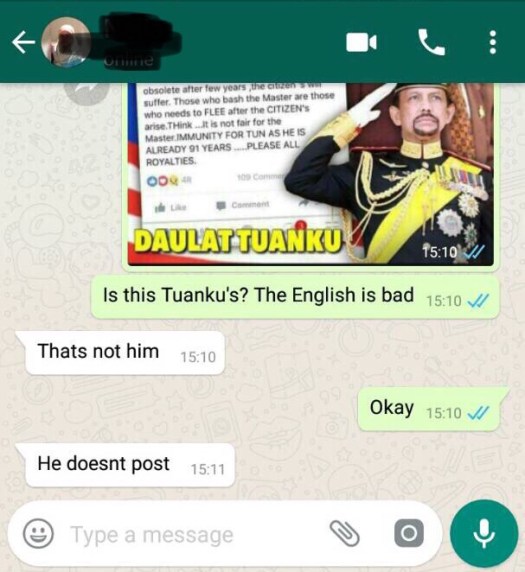
The above Facebook account has been posting stuff which raised many eyebrows, and as usual many gullible Malaysians fall for it.
If it was true that His Majesty The Sultan of Brunei did indeed post especially the one above, he needs to employ someone with better command of the English language and maturity to post on his behalf. It sounds like an elementary school student wanting to sound intelligent.
In a previous post I wrote on how gullible Malaysians can be, often taking “news” at face value without verifying for truth. So, I checked the above account with my niece. She is a Brunei government servant married to a member of the Brunei royal family who is also a diplomat serving at one of Brunei’s embassies in Europe.
She confirmed that the account does not belong to His Majesty and that he does not post his own self. She also pointed me to the official Facebook of His Majesty.
It is very sad to see that we are moving towards getting a developed nation status but Malaysians remain as cultured as the Neanderthals.
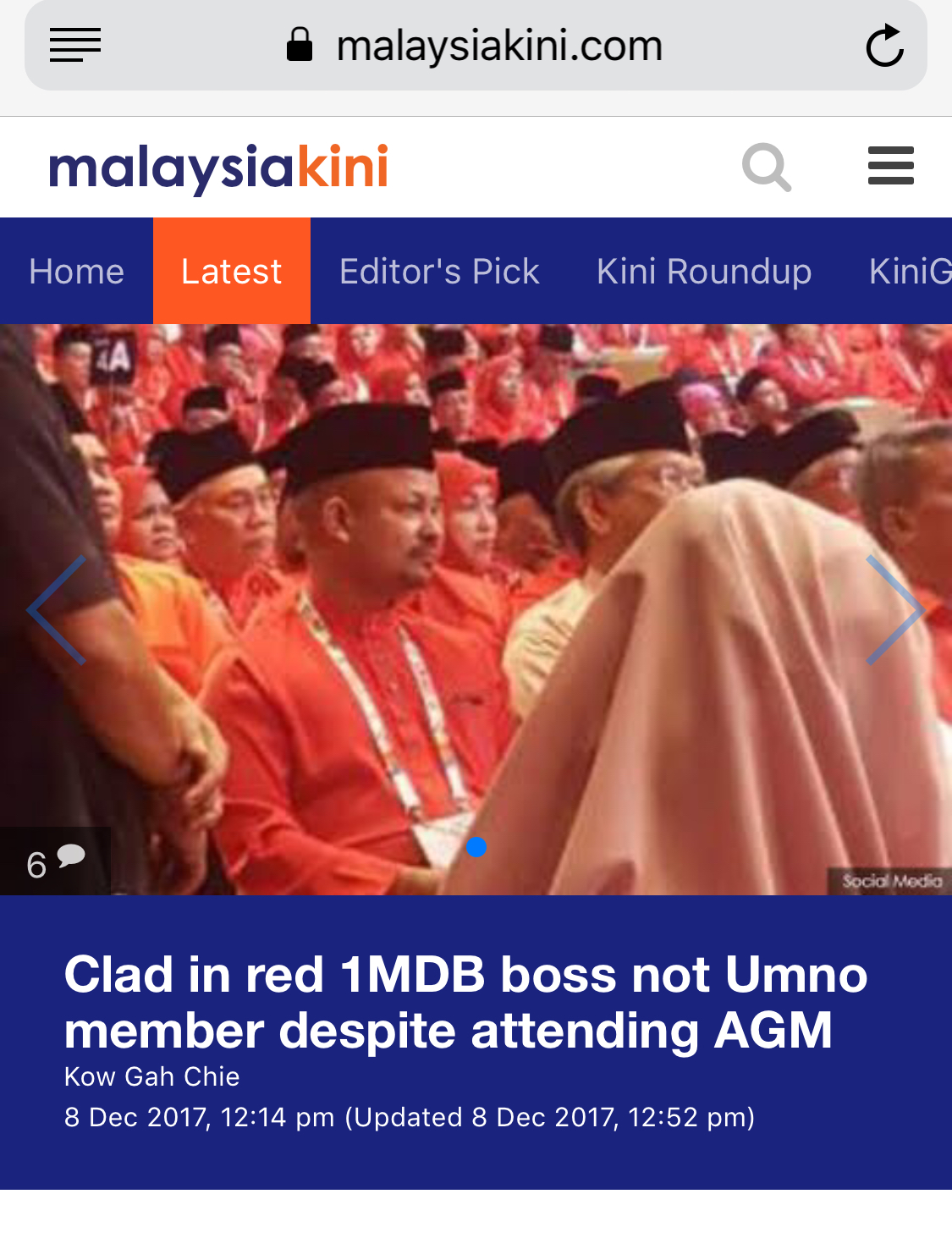
Arul Kanda was spotted at the opening of the UMNO General Assembly
I don’t know why Arul Kanda’s presence at the opening ceremony of the UMNO General Assembly is made a fuss. So did Khazanah Nasional Bhd managing director Azman Mokhtar, Permodalan Nasional Bhd (PNB) group chairperson Abdul Wahid Omar, CEO Abdul Rahman Ahmad and Lembaga Tabung Angkatan Tentera (LTAT) CEO Lodin Wok Kamaruddin.
It has always been a tradition for CEOs of Government-linked companies to be invited to the opening ceremony to listen to the UMNO President’s speech where it always touches socio-economic concerns. Even President of BN component parties are invited. In fact, among those who attended the final UMNO General Assembly with Mahathir as President were MCA’s then-President Ong Ka Ting and also PPP’s M Kayveas. So, what is the big deal?
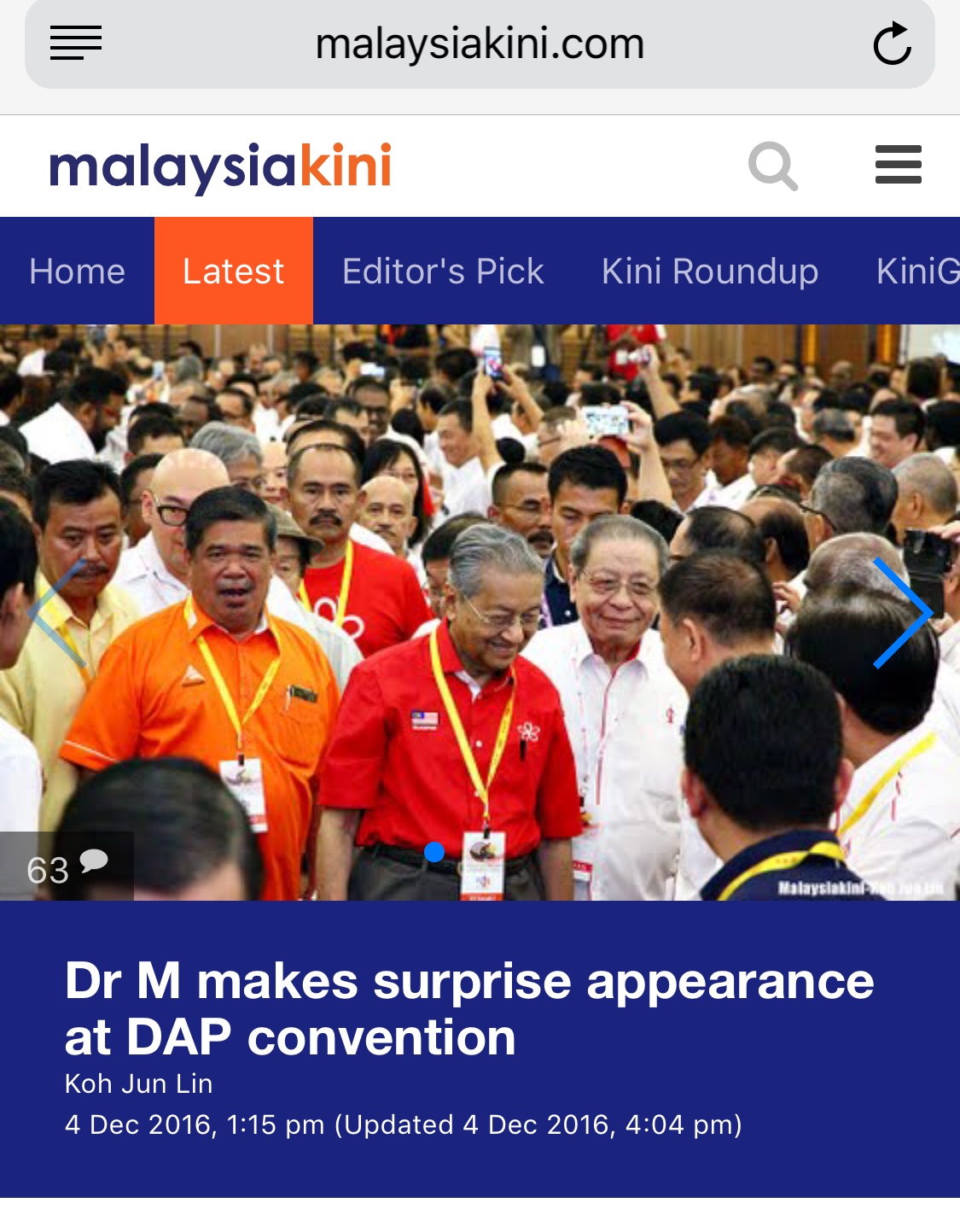
Not too long ago, an archnemesis of the Opposition attended DAP’s Convention. There, those who swore to spit on his grave lined up to smile, bow and shake hands with the man they all had wanted to send to prison for being a corrupt dictator.
Heil Mahathir!
Behind Mahathir in the screen capture above is the very man who used to go around the country calling the former a PEROMPAK (robber).
Of course, now Mahathir is forgiven. All the RM100 billion according to both Lim Kit Siang and Barry Wain that Mahathir squandered have been forgotten, all in the name of politics. And in the name of politics, all those with past sins are forgiven the moment they work hand-in-hand with Pakatan.
Arul Kanda, President of BN component parties, all sat with the rest of the guests an delegations. Mahathir, however, was given a seat on the stage with DAP’s central executive committee members.
DAP Member 001A was given a seat on the stage
So, is Mahathir a DAP member? Maybe, Malaysiakini can answer this question.
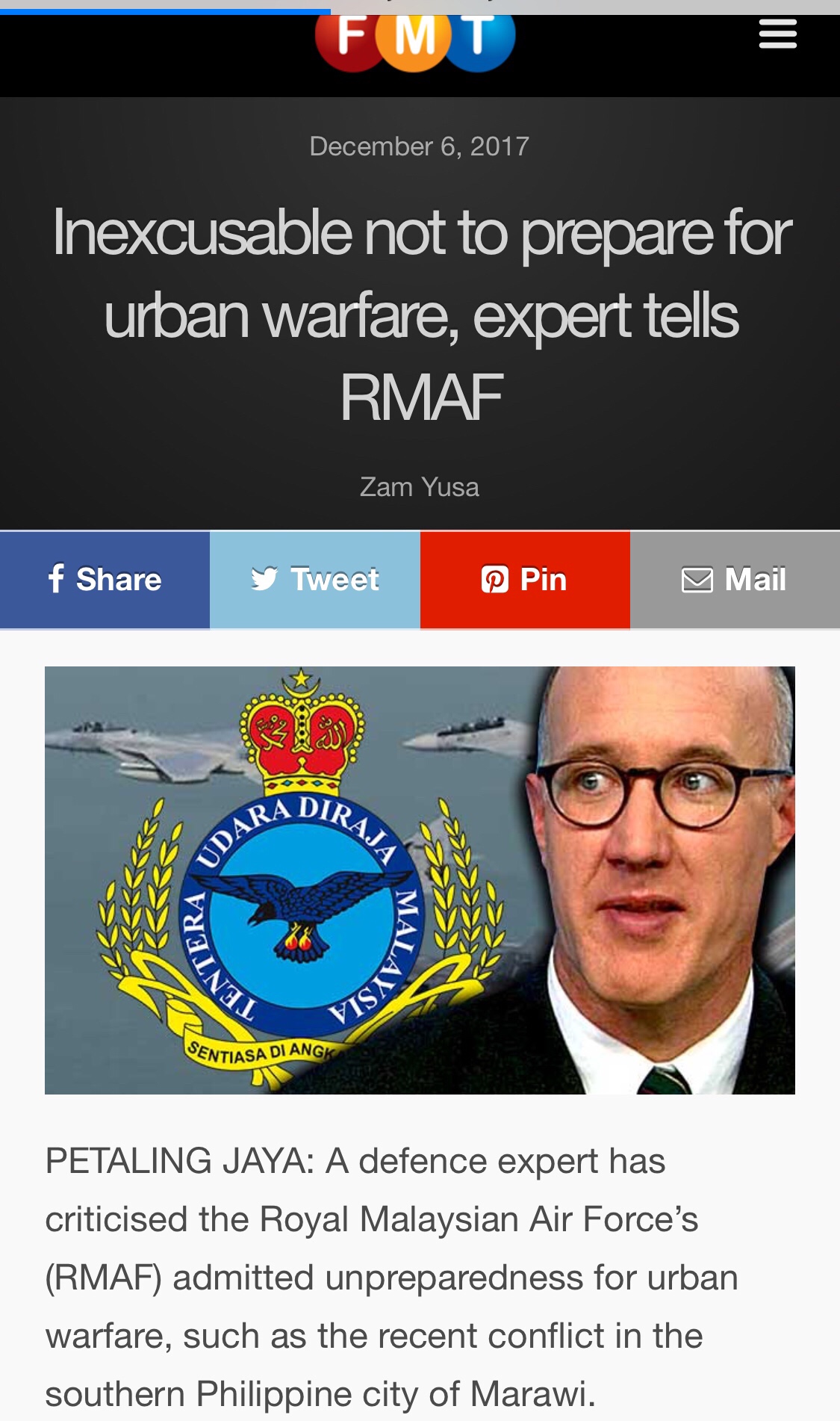
Online “news” portal Free Malaysia Today (FMT) today published a story on the level of preparedness of the Royal Malaysian Air Force (RMAF) if faced with a situation such as Marawi, and got an expert opinion to strengthen its story.
While FMT was talking about clearly refers to the recent statement made by the Chief of RMAF, General Tan Sri Dato’ Sri Haji Affendi bin Buang RMAF, stating that the RMAF will be including urban warfare in its doctrine. This was a reply to a question by a journalist during the recently-concluded Exercise PARADISE 4/2017 in Kota Belud, Sabah.
FMT sought the expert opinion of a Dr Zachary Abuza, a political scientist at the National War College in Washington DC, who focuses on security and political issues in the region.
Dr Abuza instantly criticised the RMAF for not being prepared for urban warfare.
“RMAF’s training is based on preparing to face traditional threats. It’s birth was when fighting the MCP (Malayan Communist Party) in the jungles. It has never had to adjust its training.
“To me, this is understandable but reckless,” he said to FMT.
Abuza felt urban warfare preparedness and capability were still important.
“It’s not that the RMAF has to worry about an invasion, but what if a detachment of RMAF peacekeepers finds itself unexpectedly bogged down during an urban assault?” he was quoted by FMT to have asked.
It is clear to sharp readers that Dr Abuza referred to the RMAF as Royal Malaysian Armed Forces instead of the Air Force. Why would the RMAF have a detachment of peacekeepers anyway?
Therefore, it is forgivable that Dr Abuza had made such a criticism towards the RMAF as the Malaysian Army, which had numerous peacekeeping experiences under its belt. Although the RMAF and the Royal Malaysian Navy participate in peacekeeping missions, the main combat duties is shouldered by the Army.
And FMT being FMT, went to town and published the piece, hammering the Royal Malaysian AIR FORCE for not being ready for urban warfare.
The RMAF’s role in urban warfare is merely a support one, with the Army playing the main role on the ground. All the RMAF needs to do is to insert its Ground Laser Targeting Designator team into the combat zone and paint targets that are to be bombed by its fighters.
Other roles include dropping bombs or perform rocket strikes on targets marked by elements of the Malaysian Army, including interdiction strikes to cut off enemy supply and reinforcement lines, provision of air mobility in support of the Army Air Wing, or perform combat search-and-rescue of downed airmen.
The RMAF and the Malaysian Army have held countless joint exercises to enhance interoperability and coordination and it will take very little tweaking for the two organisations to operate in the urban environment.
Did FMT clarify its story before publishing? I doubt. Else we won’t see the faux pas today.
My post yesterday had put lots of knots in many Opposition supporters’ (Penyokong Pembangkang or PEPEK for short) knickers, it seems. Some questioned why is it that they cannot find reference to some of the things I had written.
The answer is simple – I attended the talk by US Supreme Court Advocate Appellate Tom Goldstein. So did some others whom I saw, like Azmi Arshad, blog owner of Another Brick In The Wall, Tun Faisal of JASA, members of the media (both mainstream and electronic).
The talk was supposed to start at 9am and was to finish at 11am as the auditorium was to be used by another session. Tom arrived late, around 10.25am and was given only half an hour to speak with five minutes of Q&A session. Among the questions asked during the very short Q&A session were “Does the US plan to do away with the jury system in its trials” and “The 1MDB is a civil forfeiture suit, why is there now a criminal action being pursued”.
Both were answered by Tom as per the media reports. And then it was announced that they had to cut the session short because the auditorium had been booked for another programme.
Tom was ushered into a meeting room where he and the Dean of the Faculty of Law had their coffee break, together with some UiTM staff. The media chaps were ushered to a different place to have their food. Only Tun Faisal, a journalist from The Mole, and I, managed to bring our food and sat at the same table with Tom. Tun Faisal and I asked the questions on IPIC, SRC and 1MDB where Tom mentioned the complexity of the case and why there is absolutely no progress whatsoever – the complainants who are in no way linked to 1MDB lodged a complaint with the US Department of Justice saying that money had been siphoned from the 1MDB, to which the 1MDB had denied losing any money. So to whom should the money be returned to if no one has lost any?
And to this I asked Tom if this is the reason it has taken the DoJ so long to actually initiate something, he answered with a simple, “Yes.” In other words, the probe has come to a standstill. The only reason they have asked a stay on the civil investigation and changed it to a criminal one is to NOT allow any of the money to be spent. To date, no one has been named as criminal defendants, not one charge has been filed, and not one targetted to be investigated on a criminal charge.
Which brings me to this: the Attorney-General of the US, in his speech at the Global Forum on Asset Recovery in Washington DC yesterday said that 1MDB is kleptocracy at its worst.
The headline that had gotten all the PEPEKs wet
Mr Sessions said that allegedly corrupt officials and their associates had reportedly used the 1MDB funds for a “lavish spending spree” such as US$200 million for real estate in South California and New York, US$130 million in artwork, US$100 million in an American music label and a US$265 million yacht.
1MDB officials allegedly laundered more than US$4.5 billion in total, he said, through a complex web of opaque transactions and shell companies with bank accounts in various countries such as Switzerland, Singapore, Luxembourg and the US.
This is nothing new. This is something we have heard which was read live on cable TV by Mr Sessions’s predecesor. And this brings me to a question – if this is so, why hasn’t the US DoJ taken any action for the past year and a half? This only underscores what Tom Goldstein had said – the complaint said the money was siphoned from 1MDB, but the 1MDB said they have not lost a single cent. So, whose money did these “1MDB officials” siphon?
Those assets have been frozen since mid-2016 and still have not been returned to 1MDB. Why is that? All the people that have been charged, tried and sent to jail for laundering “1MDB money” in Singapore and elsewhere in the world were bank employees who flouted the local financial regulations. Yet, not a single 1MDB employee has ever been charged in those courts. Why?
PEPEKs are dancing today thinking that something new had been revealed, when it is just old news being repeated. No doubt that they money and assets the US DoJ confiscated last year represents kleptocracy at its worst. But what has that to do with 1MDB? Can we have the money back now if they are 1MDB’s?
The PEPEKs think that they have won the argument, but really they are just dry PEPEKs, giving an erectile dysfunction to the celebration.
I simply do not comprehend the fuss that is being kicked up by Mahathir’s fanatics. On one hand they want the transparency that none of us got when Mahathir was the Prime Minister; on the other they are fuming because Mahathir, Nor Mohamed Yackop and Anwar have been implicated in the findings of the Royal Commission of Inquiry (RCI) for the Bank Negara Malaysia (BNM) foreign exchange scandal of the 1990s.
Mahathir’s long-time crony Daim Zainuddin, who served as finance minister from 14 July 1984 to 15 March 1991, for having aided and abetted Nor Mohamed by leaving BNM “to its own devices”.
Let us ask the very man whose perseverance has finally paid off:
This ought to be the reaction to the RCI findings if we are to ask Lim Kit Siang
Yes. The loss of RM31.5 billion through forex gambling was and still is a crime against the Malaysian people. And if it weren’t for Lim Kit Siang’s persistence and perseverance, we would not have gotten where we are now.
Three people have been found principally liable for the criminal breach of trust and should be probed further over their involvement and liability. They are the former Prime Minister Mahathir Mohamad, his then-Finance Minister Anwar Ibrahim, and ex-BNM advisor Nor Mohamed Yackop.
The commission found in its 524-paged report that the Cabinet in the 1990s was not given the full picture by Anwar on the forex losses, adding that he had “deliberately concealed facts and information and made misleading statements“. It is also of the opinion that the then Prime Minister (Mahathir) had condoned the actions of the Finance Minister.
The RM31.5 billion losses, the report said, were hidden using “unconventional accounting treatments”, such as booking losses to reserves in the balance sheet and the absorption of the remaining losses by the transfer of shares from the Government to BNM as well as the creation of a “Deferred Expenditure” to be repaid in instalments over a decade.
The RCI noted that Anwar Ibrahim, the then Finance Minister, had been informed about the actual forex losses suffered by BNM. It also said that Mahathir was informed by Anwar together with then Treasury deputy secretary-general Tan Sri Clifford Francis Herbert in late 1993 that BNM had suffered estimated losses of RM30 billion on the forex dealings for 1992 and 1993.
However, in the extract of minutes from three Cabinet meetings on March 30, April 6 and 13 in 1994, Anwar had made “no mention of the actual losses of RM12.3 billion for 1992 and RM15.3 billion for 1993.”
Anwar had chaired the March 30 meeting as the deputy prime minister. The losses for 1993 were reported as RM 5.7 billion.
The RCI also noted that the prime minister, who chaired the meeting on April 6, did not correct or offer more information when the forex losses for 1993 were recorded as only RM5.7 billion.
The RCI report said as pointed out by Herbert, he had expected Mahathir to be outraged but his reaction was quite normal with him uttering “sometimes we make profit, sometimes we make losses”.
“His reaction to and acceptance of the huge forex losses suggest that he could have been aware of the forex dealings and its magnitude,” said the report.
Why Did It Take So Long?
Of course supporters of Mahathir got their knickers in a knot over the RCI findings, mostly harp on the duration it took to have a RCI formed, whether it was formed to time itself with the looming general elections so that the Pakatan Harapan would be epitome of broken hopes?
Lim Kit Siang may have harped on the matter, trying to get an RCI formed since 1994, if not earlier. Mahathir was the Prime Minister then until the end of 2003. No one during Pak Lah’s time took up the issue as Mahathir was then breathing down Pak Lah’s neck watching the latter’s every move. In the end, Mahathir got Pak Lah ousted for not playing his game his way.
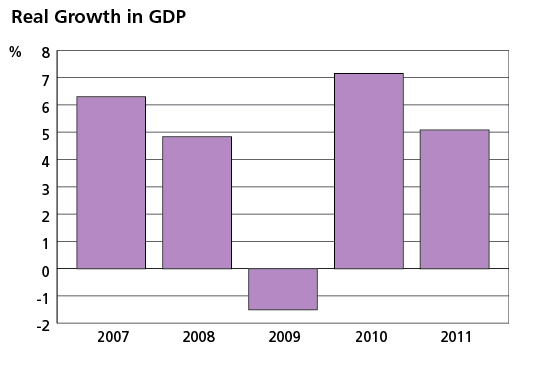
When Najib Razak took over at the beginning of the second quarter of 2009, Malaysia’s economy had shrunk even though oil price was high. The GDP growth rate for Malaysia in 2009 was -2.5 percent because of the global financial crisis then, hence Najib Razak’s priority then was to safeguard the economy and take measures to improve on the GDP growth.
Malaysia’s GDP growth rate for 2009 was -2.5%
And ever since then Najib had been fighting on all fronts to make sure that Malaysia goes through a sustainable growth, and that there would be enough government money to still help the people, especially those from the B40 income group. Hence, we see various initiatives like the 1Malaysia Clinic, Kedai Rakyat 1Malaysia (which is now being revamped), BR1M, PR1MA and various other 1Malaysia initiatives.
And while all that was happening, Lim Kit Siang was still going around asking for an RCI to be formed for the BNM forex scandal. In the run up to the 13th General Elections, Lim Kit Siang wrote this on the BNM forex scandal:
“I had estimated in Parliament two decades ago that Bank Negara lost a colossal RM30 billion from the Bank Negara foreign exchange scandal under Mahathir’s premiership. But Bank Negara claimed RM10.1 billion loss in 1992 and RM5.7 billion in 1993 while former Bank Negara Deputy Governor Dr. Rosli Yaakop estimated last year at a public forum that Bank Negara lost between USD27 to USD33 billion, which was five times more than its foreign reserves and its entire assets of USD20.7 billion in 1992.”
You can read more on what Dr Rosli Yaakop had said on the BNM forex scandal HERE.
Lim Kit Siang also said that Malaysian voters should not only pass a verdict on Najib’s non-transformation in the past four years, but also pass judgment on Mahathir’s 22 years of authoritarian and corrupt policies when he was Prime Minister from 1981 – 2003. He said:
“I am on public record as saying that if Pakatan Rakyat is to capture Putrajaya in the 13GE, we should re-open investigation not only on the RM30 billion Bank Negara forex scandal of 1992, there should be a Royal Commission of Inquiry into the RM100 billion losses suffered by the country in the financial scandals of the 22-year Mahathir era.”
Kit Siang added that the voters should decide whether they endorse the proposal to have a wide-ranging public inquiry into Mahathir’s financial scandals in 22 years which have cost the country RM100 billion of losses and for which the present generation of Malaysians are still paying the price – although there is totally no accountability and transparency about these glaring instances of corruption, cronyism and abuses of power for more than three decades.
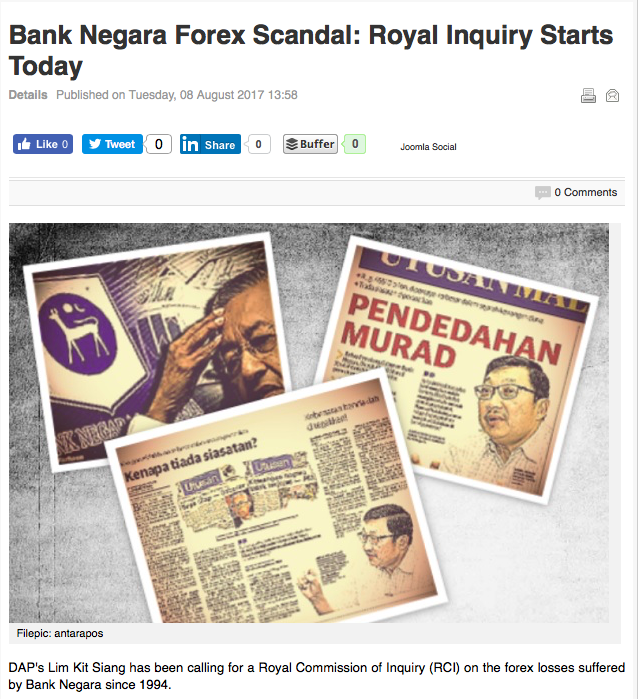
In June 2017, Lim Kit Siang even wanted the report recommending the RCI to be made public. Finally, on 8 August 2017, the RCI commenced, and Kit Siang’s 25 years of wait ended.
Kit Siang’s hard work finally paid off
And one other Pakatan leader who had been lying very low beneath the BNM forex scandal radar is Anwar Ibrahim. If anyone was to ask why did the government not do anything between 2004 and 2017, the answer would be why hadn’t Anwar, since 2 September 1998, asked for an RCI on the matter? Was he afraid that he might get implicated?
You and I know the answer to that now.
And what about the 1MDB scandal? Well, unlike the BNM forex scandal, the 1MDB case was investigated by the Parliament’s Public Accounts Committee, the Royal Malaysian Police, Bank Negara Malaysia and the Malaysian Anti-Corruption Commission. Police reports were also made against 1MDB. But not a single sen had gone missing!
For the BNM forex scandal, this is the first time that it has been investigated – by the RCI, and soon by the Royal Malaysian Police. And the first police report was made by a member of the RCI itself after the RCI findings report was published – 25 years after the whole thing happened.
So, we should all say our thank you to Lim Kit Siang for exposing this crime against ALL Malaysians. Thank you, Lim Kit Siang – for persistently asking for your good friends to be investigated.
I received this copied in a Veterans’ WhatsApp group. I omitted some parts of the message as it was just gibberish talk:
_Copied from write up by Mej **** ***** TUDM (Rtd)_
Good afternoon to all. The fight for a free Malaysia must go on!
Let us get one thing clear – the country and the government are separate entities. Governments come and go, the country is eternal.
We owe our allegiance to the country, not to the government. Therefore, saying bad things about a bad government is not being anti-national. Most important of all, voting against a bad government is not being anti-national. A bad government does not deserve loyalty. Disloyalty to the government is not disloyalty to the country; in fact, voting out a bad government is being loyal to the country.
Clean elections
Clean government
Right to dissent
Save our economy
Fine words they are, but for someone with some legal training to write as such shows how much understanding the author has of the Federal Constitution.
Let us address this “call”:
Point 1:
“Good afternoon to all. The fight for a free Malaysia must go on!
Let us get one thing clear – the country and the government are separate entities. Governments come and go, the country is eternal.
We owe our allegiance to the country, not to the government. Therefore, saying bad things about a bad government is not being anti-national. Most important of all, voting against a bad government is not being anti-national. A bad government does not deserve loyalty. Disloyalty to the government is not disloyalty to the country; in fact, voting out a bad government is being loyal to the country.”
The country and the government cannot be separated, neither can a state be separated from its state government. Yes, governments come and go, but a government is still a government. Officers and men of the civil service, the Armed Forces, the Police owe their allegiance to the King and Country. The King rules the Country, as do the Sultans their respective state, through a government that was picked by the people. Be they the Federal Government or the State Government, they administer the country and the states on behalf of the King and Sultans, as well as the Governors. This is prescribed by Article 39 of the Federal Constitution where the Executive Authority of the Federation is vested in the Yang DiPertuan Agong by him, or by the Cabinet, or by any Minister authorised by the Cabinet.
In the case of the Armed Forces, the King exercises his power through the Minister of Defence. Which is why the officers and men of the Armed Forces are required to salute the Minister of Defence who represents the King’s executive power over the Armed Forces, and the Prime Minister who is the King’s Chief Executive, representing the King.
Article 41 states that the King is the Supreme Commander of the Armed Forces and therefore those representing the King as prescribed by Article 39 are performing their duties on behalf of the King.
Therefore, it is imperative that the Armed Forces, as well as the civil service and the Police, remain loyal to the government of the day as the government of the day represents the King – be it bad or otherwise. Whether or nor a member of the Armed Forces, or the civil service, or the Police subscribes to the government of the day politically is a secondary matter. The oath that was taken was to be loyal to the King and Country; therefore loyalty shall be given to the government of the day.
The Minister who represents the King in matters of defence is also made the Chairman of the Armed Forces Council which is responsible for the command, the discipline and the administration of the Armed Forces, except for matters relating to their operational use. This is prescribed in Article 137 of the Federal Constitution.
And it is the Parliament that passed an Act to amend and consolidate the law relating to the establishment, government and discipline of the Armed Forces is made which is called the Armed Forces Act, 1972.
It is also the Armed Forces Act, 1972 that gave the powers to the Armed Forces Council to enable Brigadier-General Datuk Fadzlette Othman Merican Idris Merican be promoted to Major-General while she is being seconded to a Federal Government Department. Section 5C of the Armed Forces Act, 1972 determines that she remains a member of the regular forces but her remuneration shall be paid by that Federal Government Department.
By the same token, even the ordinary people who are citiens of Malaysia must realise that the Federal Government represents the King, the state governments represent the resective state’s Ruler. These are governments chosen by the people but was appointed by the Rulers to administer the country and states on their behalf. The only way to change these governments is by a democratic process called ELECTIONS (unless you have not heard of that word before).
Point 2:
“Clean elections”
Since 1955, Pulau Pinang, Perak, Kedah, Kelantan, Terengganu, Selangor and Sabah have all seen a change in government. If the elections were not clean, would it have been possible for the Opposition to have won cash cows such as Pulau Pinang and Selangor?
Point 3:
“Clean government”
I must admit there are bad hats in the government, be it the Federal government or the states government. This is why we have seen people like Harun Idris, Mokhtar Hashim, Khir Toyo, Lim Guan Eng charged in court for corruption. All but Lim Guan Eng have served jail time. Guan Eng, who said that he is not afraid to go to prison, has been delaying his corruption trial using technical issues.
Many more state excos have also been arraigned in a court for corruption. This is not possible without agencies such as the Auditor-General’s Office and the Malaysian Anti Corruption Commission which act as checks and balances to ensure that the Federal as well as states governments are run efficiently and cleanly.
Of course there are those who have yet to face the music. For example those responsible for the Maminco scandal in 1985 that saw a loss of RM1.6 billion (about RM2.56 billion in today’s terms); the Perwaja scandal in 1982 that saw a loss of about RM10 billion (RM18.73 billion in today’s terms); the BMF scandal of 1983 that had caused a loss of RM2.5 billion (RM4.5 billion today); the 1986 Deposit-Taking Cooperative Scandal that caused a loss of RM1.5 billion (about RM2.58 billion today); the RM30 billion loss by Bank Negara Malaysis through foreign exchange gambling in 1994 (RM45.25 billion today); the Malaysia Airlines scandal of 1994 with the loss of RM9.4 billion (RM14.18 billion today); the PKFZ scandal of 1999 with a loss of RM12.5 billion (RM13.5 billion in today’s terms).
The above all happened during the tenure of a certain former Prime Minister. The grand total of losses is RM67.5 billion (or RM101.3 billion in today’s terms). The amount shown does not include the bailouts reported in various books, Opposition leaders’ blogs and so on.
I do hope that the cry for a clean government will also call for the arraignment for the Prime Minister during whose tenure the financial scandals happened. Had the RM101.3 billion been put to good use during those 22 years, Sabah and Sarawak would have had SIX toll-free Pan Borneo Highways, or 1,013 80-bedded Government hospitals all over the country!
Instead, it enriched the few and killed one person.
Point 4:
“Right to Dissent”
I have not seen any Opposition-leaning media being taken off print or air, unlike during a certain 22-year period of my life. Malaysiakini et al are still spinning their version of what they call “balanced news” (read: news the way we want you to see it). The way these media operate reminds me of a character in Netflix’s limited series called “Godless” called A.T Grigg, a newspaper owner-editor who writes news the way he sees it, not how it truly happens.
The ISA was repealed six years ago by this present administration. Although replaced with SOSMA and POTA, it doesn’t give powers to the authorities to hold anyone without trial as the ISA did. And the ISA was being used a lot against political dissenters especially in the late 1990s during the tenure of a certain former Prime Minister.
This administration also introduced the Peaceful Assembly Act, 2012 that has allowed more freedom to assemble peacefully, unlike during those days of a certain former Prime Minister where at the slightest hint of a political dissent, you get whisked away to the University of Kamunting.
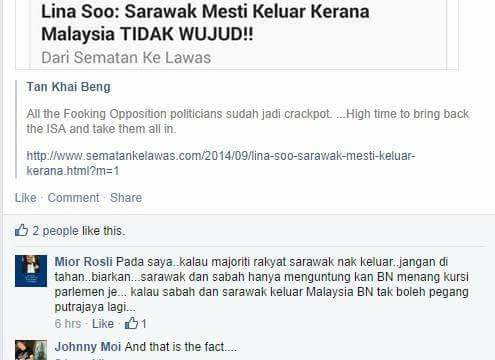
Has the author of the message been arrested yet? Of course not. Even when he actually committed sedition against Malaysia by encouraging Sarawak to secede from Malaysia.
How is it that a legal-trained person does not know that his act is seditious escapes me
Now, how is that seditious? If you look at Section 2 of the Sedition Act, 1948 it tells you the following:
Section 2 defines how an act is seditious. He has committed a seditious act by definition of Section 3(1)(a)
This former Armed Forces officer also committed a crime of sedition under Section 3 (1) (b) of the same Act for encouraging Sarawak to leave Malaysia:
Section 3 (1) (b) of the Sedition Act, 1948
And you thought that the Federal Constitution protects freedom of speech? Yes, it does. But as with all other liberties, they are subjected to restrictions. Article 10(1) guarantees that every citizen has the right to freedom of speech and expression, but at the beginning of the Article it also says the following:
You cannot just say anything you like although you have the freedom of speech and expression
To dissent is okay. To dissent seditiously, or criminally, or dangerously, or incitingly, is not okay.
Any legal-trained person ought to know this, right? What more a former officer of the Armed Forces!
Point 5:
“Save Our Economy”
In April 2017, the World Bank forecasted that Malaysia’s GDP would be at 4.3 percent. This was revised in June 2017 to 4.9 percent due to an acceleration in domestic economic activities (people in Malaysia are actually spending more) by 5.7 percent year-on-year. The GDP growth was revised again in October 2017 to 5.2 percent.
Let me quote several reports here by the World Bank.
World Bank Group lead economist Richard Record said at a media briefing on the update that Malaysia’s robust GDP growth in the first half of 2017 was largely underpinned by strong private-sector expenditure, with additional impetus from an improvement in external demand.
“Private consumption expanded firmly this year, supported by favourable income growth amid stable labour market conditions, and improved consumer confidence. Private investment also sustained rapid growth rates during the period, reflecting mainly continued capital spending in the manufacturing and services sectors,” said Richard Record.
“On the external front, gross exports rebounded strongly from the subdued growth experienced in 2016, supported by double-digit growth in commodity and manufactured exports,” he added.
Economic watchdogs are generally bullish on the Malaysian economy’s performance, buttressed by strong expansion in private consumption and private investment. In the latest update on its World Economic Outlook, the International Monetary Fund has upped its GDP growth projection for Malaysia in 2017 to 4.8 percent from 4.5 percent previously.
Apart from that, the Asian Development Bank has also upgraded its 2017 growth outlook for Malaysia to 4.7% from 4.4%, and indicated that the two-year slowdown in economic growth is likely to have bottomed out last year.
Richard Record also predicted Malaysia’s economy for 2018 and 2019.
“We are forecasting Malaysia’s GDP to grow by 5 percent next year (2018) and 4.8 percent in 2019. Our prediction reflects how we are seeing the country’s macroeconomic fundamentals’ performance and the baseline scenario,” he said.
Online economics portal ‘Focus Economics’ also said the following:
“Economic momentum remained robust in Q3 as confirmed by more complete data. Export growth expanded by a double-digit pace in September, underscoring thriving external demand for Malaysian goods. Household spending was buoyed by a low unemployment rate in September and by higher wages, which were propped up by a thriving manufacturing sector, the key driver of industrial production growth in the quarter. The 2018 budget passed on 27 October is focused on fiscal consolidation and is expected to narrow the fiscal deficit from 3.0 percent in 2017 to 2.8 percent in 2018. Despite the tightening, the budget has consumer-friendly components that will increase disposable income. These include lower income tax rates, especially for middle-income earners; higher public wages; and increased assistance spending.”
Of course, with the oil prices continue to stay below the USD70 per barrel level, Malaysia as well as other countries will continue to experience some sluggishness in the economy. However, good fiscal policies have allowed us to grow unlike a neighbour of ours that is often quoted as being a model economy. That country’s growth have been at 2 percent in 2016, and 2.5 percent this year.
The outlook for the construction sector has taken a sharp turn for the worse, with poll respondents tipping a contraction of 4.2 per cent. The previous survey, released in June, had respondents forecasting 0.2 per cent growth in the sector.
The outlook for the accommodation and food services sector in this model country has also worsened – it is now expected to shrink 1.5 per cent, from previous estimates of a 1 per cent expansion.
Economists polled expect overall economic growth of 2.5 per cent next year for this model country, the same pace as this year.
Perhaps the author of the message we are discussing here should go down South and help revive the economy of that model country.
So, there have you. I really do not know what the fuss is about. All I can deduce is that the author of the message is all hot air – you can feel it blowing on your face, but there is no real substance there. This is the same as BERSIH, and the recycling of petty but stale issues by the Opposition just so that they can remain relevant, and justify for the allowances they receive from the pockets of the rakyat.
You can express your dissatisfaction, but always do so constructively. Especially if you are a member of the Malaysian Armed Forces and Malaysian Armed Forces Veterans.
Rotting Apple Core (courtesy of Science Learning Hub)
It is no surprise that the recent DAP CEC election has retained some 90 percent of its line up. Despite being a dinosaur and having manouvered the DAP through its mother-of-all-U-turns by working with arch-nemesis Mahathir Mohamad, Lim Kit Siang emerged victorious with the most number of votes. His son, Guan Eng, despite being charged on two counts of corruption, came out third and was returned as the Secretary-General of the party.
Returned after being missing for a term is Selangor’s Ronnie Liu who is famous for trying to stop the authorities from raiding brothels and gambling dens in Selangor before DAP came into power. The ousted included the man who is the symbol of cleanliness, moderation and a corrupt-free DAP – Tan Seng Giaw.
And as for its multiracial image, only two Indians and one Punjabi were elected but not one Malay made it to the Top 20 – again, but former DAP Pahang Chairman Tengku Zulpuri Shah bin Tengku Puji was appointed Vice-Chairman. He is the sole Malay in the CEC line-up. Christopher Ross Lim, the Chinese man masquerading as Malay going by the name Zairil Khir Johari, made it at No. 19. He was born a Chinese and remains a Chinese.
Only 54 percent or 1,356 delegates attended the CEC elections out of 2,514 delegates in 2013. This shows that the support for the Lim Dynasty is waning. They can bask in party glory now but whether that will translate into actual votes especially in Pulau Pinang remains to be seen. With only 450,000 registered members, DAP relies more on its propaganda to win over the masses, who of late are drowning in flood waters and overwhelmed by landslides due to the over-development of the hills and reclamation works in Pulau Pinang.
And to appease the spirit of a dead man, the three-year dead Karpal Singh managed to get 43 votes, more than any of the Malay candidates. How Karpal could still get votes baffles me.
This sums up the image of the DAP – rotten to the core.











 SeaDemon Says
You must be logged in to post a comment.