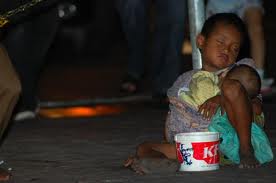
Halal Child Labour (Updated)

Orphan Seeking Donations
Is this a Halal form of Child Labour?

Go to a bank, they are there waiting for you. Go to a petrol station and they hide behind pumps, waiting to pounce on you the moment you start filling your car’s tank up.  Go to an ATM machine, they will be waiting outside.  Go to a food court, they will come and push this worn out leaflet of an orphanage under your nose.

Malaysians are known to be philanthropic.   As a Muslim, you are encouraged to give alms with the hope that God will reward you leaps and bounds.  Sadly, it is Muslim children, mainly orphans whom you see are being exploited by the management of orphanages to solicit funds/donations from the general public.  But is sending children out on their own, for long hours, for days at times, necessary?

The International Labour Organization defines Child Labour in Article 3 of ILO Convention No.182.  It reads:

a) all forms of slavery or practices similar to slavery, such as the sale and trafficking of children, debt bondage and serfdom and forced or compulsory labour, including forced or compulsory recruitment of children for use in armed conflict;

(b) the use, procuring or offering of a child for prostitution, for the production of pornography or for pornographic performances;

(c) the use, procuring or offering of a child for illicit activities, in particular for the production and trafficking of drugs as defined in the relevant international treaties;

(d) work which, by its nature or the circumstances in which it is carried out, is likely to harm the health, safety or morals of children.

Labour that jeopardises the physical, mental or moral well-being of a child, either because of its nature or because of the conditions in which it is carried out, is known as “hazardous work”.

The words I have put in bold are the ones, in my opinion, reflect the nature of labour these unfortunate orphans are being put through.  My question is, what are the authorities doing about this?

In March 2012, Datuk Heng Seai Kei, the Deputy Minister for Women, Family and Community Development said that  continuous effort has been taken by the North-South Highway Project (PLUS) with the cooperation of the Social Welfare Department to curb the abuse of orphans by the management of orphanages along the North-South highway.  Apart from that, the Malaysian Islamic Development Department (JAKIM) has asked the respective state religious authorities to arrest those who exploit children and orphans by asking them to solicit funds.  He said this when answering Dungun MP, Datuk Matulidi Jusoh in Parliament when the latter asked about the actions taken against errant Orphanages and Tahfiz centers that have been exploiting children and orphans.

I think the authorities need to get their act together.  Local authorities are more keen on raiding and confiscating stalls belonging to small-time business owners than stopping child exploitation, and members of the public need to realize that they should start asking these children when do they ever get to study, or if they like walking around in the heat of the sun, or late at night, asking for donations that they never get to see at the end of their “shift.”

These children are innocent, and asking them to solicit funds for orphanages is NOT the way to hone their entrepreneurial skills.  The one I saw at the ESSO station along the North-South highway was virtually there every day.  The one I questioned two nights ago had loitered around my favourite food court for the past two weeks.  When do they ever get to go to class?  When do they sleep? Where do they sleep? What do they get to eat at the end of their “working day?”

And do you ever wonder how many of these children have been sexually harassed by predators as they are left at a location for hours and have to fend for themselves?

And what do these children learn?

Every time they piss someone off for disturbing them while they eat or fill up their tank, they incur the wrath of the restaurant’s or petrol station’s customer.  And it is possible that if they do not get enough “fund” they get punished.  In the end, the only lesson with impact these children will ever learn is resentment and anger.  Now, whose fault is that?

Exploitation of children
What sin have they committed that they are not protected by the community they are in?

Unless you don’t mind seeing your children end up like in the picture above if something unfortunate happens to you, then you can stop reading this blog post and move on.  But to this blogger, the authorities, especially the religious authorities,  have a lot to answer for this Halal child labour.

UPDATED (12.10PM – 29th July 2012)

One comment on my Facebook account on this issue has prompted me to update this post:

Unfortunately, in many cases the parents of the children are not aware of them being used by whatever tahfiz or madrasah to collect alms or to sell trinkets. Do you also notice that most of the time the madrasah or tahfiz is in Kedah or Kelantan, unregistered and not in the Malaysian Education System, nor supported by the state governments. Short of saying they are operating illegally, the children are also not insured nor officially registered in those institutions. There was one case when the rickety van the children were in was involved in a crash, killing 4 kids and the Ustadz. The parents were shocked to hear that the children was brought to KL from Kedah without consent, to beg for alms. For the record, I am totally against this, and I often question the children as to why they were there selling posters instead of studying – Farid Hamid. 8.12am, 29th July 2012

I remember that incident.  This happened a little over five and a half years ago. Five students from a Tahfiz in Kedah died after the van they were traveling in, hit the back of a stationary trailer, on their way back to Kedah after an “excursion” in KL.  None of the parents were informed of the trip to KL, nor was their permission sought by the management of the “Tahfiz.”  You can read about it here.  And yes, the “excursion” to KL was for them to be used by the management of the “Tahfiz” to solicit funds from the public.  You can read about it here.

Seriously, the authorities need to come down hard on these culprits.

Show Tanda Putera

Tanda Putera - Courtesy of www.FILEMKITA.com
Tanda Putera – Courtesy of http://www.FILEMKITA.com

I hardly watch Malay movies nowadays simply because of the arthritic nature of the dialogues – painfully and unrealistically book-styled etc.  The last Malay movie I watched was “Leftenan Adnan” based on the life and death of Lieutenant Adnan bin Saidi of the Malay Regiment who perished after a gallant last stand against the invading Imperial Japanese Army at Opium Hill/Kent Ridge in Singapore.  Even then, the stiff dialogues were there.

“Tanda Putera”, directed by Datin Paduka Shuhaimi Baba, is based on the story of the late Tun Razak, Malaysia’s Second Prime Minister, the 13th May tragedy, his friendship with his deputy, the late Tun Dr Ismail, and his secret fight against Leukemia.  Although I was not invited to the sneak preview of the movie, I was told by fellow blogger Big Dog that it is a movie not to be missed.  He showed me the trailer, and I thought it to be somewhat impressive.  I am pretty sure that it would still contain those arthritic dialogues, but given the sensitive nature of the topic the movie revolves around, I am very sure Shuhaimi Baba would have done extensive research to ensure accuracy of the historical aspect of the movie, much like “Leftenan Adnan.”

For those who believe in what actually happened during the 13th May tragedy, I am sure they would find the movie educational.  However, there will be those who will call it a racist movie, inciting hatred and what have you to justify that the movie should not be watched.  I have seen the reaction by those who oppose to this movie without first taking a look at the movie itself.  Most of those who oppose are those who knew only Tun Dr Mahathir as being the first Prime Minister in their life, and that the PLUS highway has been there since the Cretaceous Period.  While I agree that we should move on from dwelling on the 13th May issue, we should not forget history; what more with attempts to skew the details of history like those done by the likes of Mat Sabu, Kua Kia Soong et al.  There is a lesson to be learnt from the dangers of the 13th May tragedy that is very clear and present today – politics of hatred.  The film does not blame any political party, but instead pointed out the contributions by anarchists, subversive elements, agitators, whom had infiltrated political parties, organisations, unions in order to spread chaos and anarchy – the likes we see now penetrating NGOs in Malaysia, including the blatant hijacking of an otherwise apartisan BERSIH movement.  Read more about the reaction of a certain dinosaur in Parliament when he was asked by an MP about a certain scene involving members of a certain community urinating at the flagpole of the Menteri Besar’s house here.

I find it funny that the very same people who said that Malaysians are matured enough when the likes of Kua Kia Soong and Chin Peng wrote books to present “their view of history” which maybe, in my opinion, very biased, object to the showing of this movie.  Perhaps they want a movie to depict the Imperial Japanese Army as very nice people who treated the Manchurians very well during the years preceding World War 2.

I also find it funny that the Director-General of FINAS has delayed the release of the movie saying it clashes with other events like the Merdeka Day celebration and Hari Raya Puasa.  I thought these two events would help sales of Malay movies as they have in past years.

I would just show it…and as people have said, we Malaysians are matured enough to handle anything.

Or are we?

Living In Holy Shit

Living in Holy Shit
Kelantan After 22 Years: Living In Holy Shit

After all that crap about the imbecilic nature of the Selangor State Government when it comes to handling the water shortage fiasco, I saw a nice tweet by my wife about the number of sewage treatment plants.  It read:

“Kelantan has only 11 sewage treatment plants. Even Perlis has 33. Gulp. Johor has over 600”

“Wow!” I thought.  But since it was early in the morning I thought it was about the number of water treatment plants, as Kelantan has a poor treated water supply coverage as well.  Then I re-read the tweet and I realised how for the past 22 years, the Kelantanese State Government has been shirking its duties in ensuring the basic human rights to clean water supply as well as sanitation.

22 years.

Let us compare the states mentioned above in terms of population count versus the number of sewage treatment plants made available in the respective states.

Johor had 3.23 million in 2010.  Perlis, possibly the state with the least resources, had 198,000 in 2010.  Kelantan 1.46 million in 2010.

Johor has 600 sewage treatment plants for its 3.23 million inhabitants – that translates as having 5,383 persons per sewage treatment plant.  In Perlis, the ratio is 1:6,000; while in Kelantan it is 1:132,727.

Let us go by size of each state: Johor is 19,210 sq.km; Perlis is 821 sq.km; and Kelantan is 15,099 sq.km in size.  The ration of kilometer square per sewage treatment plant is 1:32; in Perlis it is 1:25; but in Kelantan it is 1:1,373.  So, one sewage treatment plant in Kelantan has to cover an area that is 1,373 sq.km, and crap from 32,727 132,727 people.

Little wonder you get headlines like: Tetracycline Resistant Cholera in Kelantan (1998); Cholera Outbreak In Tumpat, Kelantan (1990); Cholera Cases in Kelantan Continue to Rise (2000).  I can go through the tens of headlines right up till June 2012, but I just want to give examples on how crappy shit already is in Kelantan.  People die from the outbreaks above, yet the Kelantan State Government behaves nonchalantly.

Of course, the holier-than-thou attitude the Kelantan State Government adopts does not help the situation; what makes it worse is when voters have been brainwashed to think that whatever Cholera-shit that hit them is a test from God.

Unless the voters are given a knock on the head, my guess is they will continue to live in Holy Shit for another 22 more years.

Ikan Kering

If you follow PUSPEL on Twitter, you will realise how precarious the water supply situation in the Klang Valley is. Treated water is supplied at 4,371 MLD (million liters per day) in the Klang Valley, while the optimal reserve capacity should be between 15 to 20 percent that amount.

However, between 5th June to 11th June, the buffer was only between 1 to 2 percent. On 5th June, it was at 2.06 percent while on 7th June, it was at 1.22 percent. On 17th June, the demand for treated water exceeded supply at 4,410 MLD. This shows that there was a deficit of treated water. Because of this, the Minister for Energy, Green Technology and Water, Datuk Seri Peter Chin was reported to have said to reporters that “the danger zone is so near that we may resort to rationing water.”

While the effort to reduce non-revenue water (NRW) is ongoing, it would be more expensive as a short term goal to reduce NRW than it is to build treatment plants. The government would have to spend RM7.2 billion to reduce the NRW from 32.3 percent this year to 20.83 percent in 2020, and this would only save 126 MLD annually, while the Selangor-Pahang water channeling scheme, which involves building of the Langat 2 water treatment plant, would cost RM5 billion, but provide consumers in the Klang Valley a further 1,130 MLD. Of course, there is a need to educate the consumers in the Klang Valley the importance to conserve treated water. On average, Malaysians use 200 liters of treated water per person per day, while those in Selangor use 239 liters per person per day. To make matters worse, demand increases by 7 percent during the hot season such as now. In my opinion, the state government should increase tariff and not give free/subsidised water to consumers. This would help educate consumers to value water instead of looking at it as God’s eternally endless gift to mankind.

And with the bravado shown by the Selangor state government, we in the Klang Valley will soon be able to enjoy daily supply of ikan kering in lieu of water from the water catchment areas.

Ikan Kering Instead of Water
Ikan Kering instead of Water for water consumers in the Klang Valley if nothing is done soon to increase treated water supply

Torpedoed By The Scorpene

All the hoo-haa about the Scorpene scandal has come to a nought when the probe into the “scandal” discovered that the Mongolian woman tied to the scandal, Altantuya Shaariibuu, had never entered France between 1999 and 2006, and neither did Prime Minister Najib Razak entered France on a personal capacity between those years.

In fact, DCNS officials alluded that they had never met any Mongolian woman by the name of Altantuya Shaariibuu, and all negotiations were done in English, not French as claimed by a certain quarter, therefore dismissing the need for an interpreter.  Furthermore it was revealed that Altantuya could not speak French.

So, what was then she in this all?

And what of the photoshopped photo of her with Najib and Razak?

Read more about it here

Oh, and I see spinners spinning faster than the word “spin” itself already! Haha!

Horas!

Horas!

That is the traditional greeting of the Batak, Simalungun and Mandailing people, located in North Sumatera.  Up until 1947 or 1957, the peoples of Sumatera were free to sail across the Strait of Malacca to trade or visit relatives on the Malayan side.  When immigration laws came into force with the formation of both Indonesia and Malaysia put a stop to it all…almost.  Malaysia is still a magnet for Indonesians to chance a better living, legally or otherwise.

I am a Mandailing by descent, and my ancestors are from the Nasution marga (family or clan).  Although I know next to nothing about my people or their traditions, I am proud to tell fellow Malaysian Mandailing that I am a Nasution.  There are many famous Malaysian Mandailing and they include the late nationalist educationist Aminuddin Baki (marga Lubis), the late Judge Tan Sri Hashim Yeop Abdullah Sani (marga Rangkuti), the late former Menteri Besar of Selangor Dato’ Harun Idris (marga Harahap), former minister Datuk Mokhtar Hashim (marga Harahap), actor Dato’ Ahmad Tamimi Siregar (marga Siregar), former Inspector-General of Police Tun Mohammed Hanif Omar (marga Nasution), former Chief of Air Force General (Rtd) Datuk Seri Abdullah Ahmad (marga Nasution) and last but not least, broadcaster and singer Rubiah Lubis (marga Lubis).

Tor-Tor Dance (courtesy of Malaysia Chronicles)

Recently, the Minister for Information, Communication and Culture, Dato’ Seri Utama Dr Rais Yatim announced his Ministry’s intention to preserve the Mandailing traditional TorTor dance and Gordang Sambilan as part of the Malaysian Mandailing heritage, and this, as did other attempts to preserve other traditions inherited from the Indonesian ancestors, got the Indonesians all riled up.  On Twitter, hashtags such as #MalaysiaMiskinBudaya (Malaysia is Culturally-Poor) and #TorTorPunyaIndonesia (The Tor-Tor is Indonesian) ruled the timeline with Indonesians bashing Malaysia for allegedly stealing the former’s culture.  What is more shocking is when an Indonesian Batak politician, Ruhut Sitompul, was quoted in the Jakarta Post as saying:

“Once in a while, I think it’s necessary that we bomb [Malaysia] as a form of shock therapy. Otherwise they will keep oppressing us. There’s no need for diplomacy – they always find excuses”.

It is funny that a country with 28 million people (plus more than a million who are Indonesian citizens working here) can be threat, oppressing Indonesia that has 240 million inhabitants.  Perhaps, Ruhut Sitompul was looking for a way to shift the focus of Indonesian Muslims (the Mandailing are Muslims) from his recent fiasco with the Islamic Defenders Front (FPI) and Islamic People’s Forum (FUI) over the Lady Gaga concert ban.

Majority of the Twitter hashtag users were from the Jakarta side, rather than from the Sumatera side; while most Malaysians who laugh at the Ministry’s effort to preserve this culture from disappearing from the Malaysian Mandailing community altogether are either non-Malays, or those who are staunchly anti-government.  Some of the comments can be found here .  Perhaps, they would be happy too if China one day declares war on the overseas Chinese community who practice Chinese traditions outside of mainland China.  And the Malays who do not support the preservation of heritage are the ones who are happy when the Wayang Kulit Jawa of Selangor and Johor have disappeared totally from the face of this planet, save for some puppets.

The Malaysian Mandailing Association President, Ramli Abdul Karim Hasibuan said that Malaysia intends to recognise the Tor-Tor dance and the Gordang Sambilan as a Mandailing heritage here, not claim it to be a Malaysian culture.  After all, the two belong to the Mandailing, not Malaysia nor Indonesia.  And I, would of course like to learn more about the culture of my Mandailing side. Maybe, a lesson in history is in order here, for the uninformed Malaysians and Indonesians as well.

Among famous Mandailings in Indonesia include Indonesian actress Tia Ivanka (born Artia Dewi Siregar), composer and musician Rinto Harahap, and singer Diana Nasution.  However, two famous Indonesian Mandailing with ties to Malaysia are the late Adam Malik, a marga Batubara who was a foreign minister of Indonesia and also a Vice-President; and the late General Abdul Haris Nasution, a former Minister of Defence.

Adam Malik was actually born in the town of Chemor, near Ipoh in the state of Perak.  His mother. Siti Salamah, was from Chemor. Every time Adam Malik visited Malaysia, he would take the opportunity to visit his relatives in Chemor (see Abdur-Razzaq Lubis, Adam Malik, anak Chemor, Surat Berita Mandailing, Jilid I, No. 2, 1996: 2-3.).  In fact, both Adam and Haris hailed from the same village of Hutapungkut, right in the middle of the Mandailing homeland in Sumatera.  And it was in major part due to these two Mandailing men that the Indonesian confrontation against Malaysia ended.  They were both against the Confrontation.  Haris even bluntly refused to go to war with Malaysia because he likened it to going to war against his own relatives.  Why is this so?  Haris, who was a General in the Indonesian Armed Forces then, had a nephew also from Chemor, Perak, who was in the Royal Malaysian Navy (retired as Vice-Admiral) Dato’ Mohammed Zain Mohd Salleh (see A.H. Nasution, Memenuhi Panggilan Tugas, Jilid 1: Kenangan Masa Muda, Jakarta: Gunung Aung, MCMLXXXII: 6).  After the peace treaty was signed between the two governments in Bangkok in August 1966 to end the Confrontation, Adam Malik immediately took the opportunity to visit Chemor to assure his relatives (see Adam Malik, Mengabdi Republik, Jilid 1 Adam Malik Dari Andalas, Gunung Agung, Jakarta, 1978; Abdul Rahman Rahim, Jatoh-Nya Sa-Orang President, Penerbitan Utusan Melayu Berhad, chetakan kedua, 1967).

As such, the Indonesians and Malaysians have cross-border ties, ties that bind the two together as the same people divided only by political and diplomatic boundaries, but who are really one.  Therefore, the Tor-Tor, Gordang Sambilan, should be preserved by the people of Malaysia as a heritage so they would and could remember how the bond of this Nusantara  is still very much alive.  And like the Barong dance of Bali that preserves the Hindu Epic of Ramayana from India, strengthens cultural and spiritual ties between nations.  The only way for this to be achieved is to suppress extremism and getting rid of ignorance.

Enter The Dragon

It is that time of the year again, whenever that time may be in a calendar year, but it is the same time Malaysians, those in the Peninsula in particular, have been complaining year after year about since at least 1994.  Every year, haze from neighbouring Indonesia would engulf the Peninsula, and at times even Sarawak, up to the point of suffocating Malaysians. Every year a complaint is lodged, but nothing seems to be seriously done by the Indonesian government to put a stop to this.  This, in my opinion, is akin to bullying of one’s neighbour.

A few weeks ago I tweeted about the need for the Royal Malaysian Navy and the Royal Malaysian Air Force to boost its power projection capabilities in light of China’s increasing bullying of the Philippines over the Scarborough Shoal issue.  What began as a simple issue over a fishing vessel, turned into a standoff between the lightly-armed Philippines Navy against the might of the People’s Liberation Army – Navy (PLAN).  And from the 10th April 2012 up until this posting was made, the whole issue was an impasse.  The Philippines government has announced yesterday that it would be pulling back its vessels from the shoal because of bad weather – another sign of a weak navy, unable to withstand weather conditions.

Interestingly, a senior Royal Malaysian Navy (RMN) replied to my tweet saying that China should not be seen as a threat, but rather an opportunity.  With a population of over 1.3 billion, China, an emerging economic powerhouse, should be seen as an opportunity.  However, as the United States and the European powers have reduced defence spending, China’s has increased 12 percent over the past decade.  China is investing heavily in “asymmetric capabilities” designed to thwart America’s interference in its interests over the East and South China Seas.  According to the Stockholm International Peace Research Institute (SIPRI), by 2035, China’s defence spending could overtake that of America’s.

While China’s People’s Liberation Army (PLA) has an active force of 2.3 million, China’s real military strength lies elsewhere.  As part of the “asymmetric capabilities” China is acquiring A2/AD (anti-access/area denial) capabilities.  In 1996, we saw the US Navy sending two of its carrier battle groups to Taiwan when the PLA started lobbing missiles at islands off Taiwan.  By 2020, China aims to deter American carriers and aircraft from operating within what is known as the “First Island Chain” – a perimeter that runs down from the Aleutians, the north of Taiwan, the Philippines, and Borneo.  In 2005, the “Taiwan Anti-Secession Law” was passed in China, which commits the latter to a military response should Taiwan declare independence.  While the US maintains “strategic ambiguity” on the event that secession happens, Jia Xiudong of the China Institute of International Studies reflects the policy of China:

“We don’t have any ambiguity. We will use whatever means we have to prevent it from happening.”

If so, what has happened to the rhetorical agreements made during the various ASEAN engagements with China?  Let us remember one thing:  while the Chinese politicians do all the talking on behalf of the government of China, the People’s Liberation Army IS NOT formally part of the state.  It is responsible to the Communist Party and is run by the Central Military Commission, not the Ministry of Defence.  Therefore, a better understanding of the  loyalty and priorities of the Chinese military is very much needed.  While Chinese ministers have time and again promised a “peaceful rise,” we see its bullying of neighbours occur on a frequent basis.  Vietnam, Taiwan, the Philippines, have all been physically bullied by China’s military.  While diplomats from both sides tried to water down the situation at the Scarborough Shoals, men of the Chinese military amped up bellicose language.  The state-run media warned that “war could break out with the Philippines if the island nation did not give up its claims on disputed rocks and reefs in the South China Sea.”

Lest we forget, back in a meeting between ASEAN and China in 2010, when faced with a barrage of complaints about his country’s behaviour in the region, its Foreign Minister Yang Jiechi said:

China is a big country, and other countries are small countries and that is just a fact.”

Last week, our Defence Minister cancelled a visit to the RMN outpost at Terumbu Layang-Layang, where a popular dive resort is also located, because of strong objections by China.

You decide if China really is an opportunity, or a threat.  But I have this to say – running down our military as done by certain politicians, is not helping the situation at all.

Power Corrupts

Press Release from IIM
The Malaysian Institute of Integrity supports the MACC’s call to screen election candidates

Power corrupts, they say; or as the longer version goes, “Absolute power corrupts absolutely.

Upon mentioning the word corruption more often than not our mind will wander towards our visual cortex playing visions of Barisan Nasional, the police, and on the lesser side the local authorities.  Like it or not, the management of people’s perception towards the integrity of Barisan Nasional leaders continues to play a huge role especially in the cyber world and will have an impact in the 13th General Election.  While Prime Minister Najib continues to win the rakyat‘s hearts and minds through his policy of openness, there is that little devil playing in the back of our mind asking if Najib would have the political will to remove certain people after the next general election he inherited from his predecessor who had stepped down mid-term.  Let us hope that high-profile cases affecting Barisan Nasional’s integrity such as Shahrizat Jalil’s and Khir Toyo’s will reflect a continuous effort by the Najib administration to strengthen its integrity.

Fighting corruption in Malaysia is not a new thing.  In fact, Malaysia became the first developing nation to have an anti-corruption law when the Anti-Corruption Act was passed in 1961. This was supported by the Emergency Ordinance (Essential Powers) No.22, 1970, and then replaced by the Anti-Corruption Agency Act in 1982.  As part of a continual process to make better the fight against corruption, the Anti-Corruption Act 1997  was passed among others covering more types of corrupt acts, adding more powers to the prosecution and to the Anti Corruption Agency.  To further show its seriousness in fighting corruption, the Government had also tabled (and passed by Parliament) the Witness Protection Act 2009, Enforcement Agency Integrity Commission Act 2009, and the Whistleblower Protection Act 2010.

One may ask how effective have these Acts been, especially in the Whistleblower Protection Act 2010 with regards to the NFC case?  As we know, an employee of a bank here in Malaysia had divulged transaction information of an account belonging to the NFCorp to PKR’s Rafizi Ramli (who by chance is an accountant), who in turn made public the findings and demanded an investigation into the NFCorp.  While we thank the two individuals for their concern into the misuse of public funds granted to the NFCorp to assist its real purpose, the bank employee had committed an offence under Section 97(1) of the Banking and Financial Institutions Act, 1989 for revealing details of a customer’s account, while Rafizi, whether foolishly or knowingly given that he is a certified accountant, had committed an offence under Section 97(3) of the same Act for disclosing information in contravention of subsection (1).  Anywhere you go to, including Switzerland, you will never be able to get information pertaining to the banks’ customers’ account(s) unless compelled by law.

Aren’t Rafizi and the bank employee protected under the Whistleblower Protection Act then?  No, they are not.  All disclosure of improper conduct should be reported to any enforcement agency “Provided such disclosure is not specifically prohibited by any written law” (Section 6(1)).  What the bank employer should have done was to lodge a report with the Malaysian Anti Corruption Commission (MACC) and let due process take place.  It makes no sense to report a purported wrongdoing to the press, or on the Web, or in ceramahs, unless you are not interested in seeing justice being done, but rather throw it to the court of public opinion for political mileage.

Being able to govern the country is at its core all about power and influence.  Elected politicians use their power to get things done.  In an ideal world, we can hope to see this power used to benefit others, meaning voters.  That would be in the form of socialised power.  The other form of power would be called personalised power.  This is used for personal gains.    An elected politician can still use this power to benefit others, and at the same time make personal gains.  After all, none of us have seen a poor former US President.  We have, in our times, seen poor Prime Ministers (such as Tun Razak), but that would be a rare exception.

We have also seen the rearing of ugly heads when it comes to the Opposition-held states; the sand-mining scandal in Selangor, mushrooming of seedy health centers in Selangor, sale of Bayan Mutiara, allocating humongous projects in Kedah without open-tender being called, the contract to supply of tailor-made costumes to the Perak government being given to members of a state assemblyman’s family, and of course, the case Teoh Beng Hock died for.  If you ask a layman like me, I see no benefit whatsoever that could be gained by Barisan Nasional coming from Teoh Beng Hock’s death, but those whose information the late Teoh Beng Hock was privy to, definitely benefited from his eternal silence.  Only fools would think otherwise.

So, my fellow rakyat, voters, the answer is NO, REPLACING X WITH Y DOES NOT CHANGE ANYTHING.  There are positive and negative sides of power.  On the former, power makes leaders more assertive, confident and certain of their decisions.  They must use the power to get the job done.  On the latter, the more power a leader possess, the more they focus on their egocentric desires and as their power increases, they will gradually cease to see the perspective of others.  What we want, as the rakyat, are leaders with integrity, and it does not matter which side of the political fence they are on.

Recently, the Malaysian Institute of Integrity had issued a press statement supporting the move by the Malaysian Anti Corruption Commission offering to vet potential candidates for the GE13.  Datuk Dr Mohd Tap Salleh, President of IIM, said that “this proactive step would help party leadership to nominate candidates with integrity.”

IIM in this statement said that this process will ensure the degree of confidence towards the election and democratic systems will increase, and this will in turn interest the public to participate in the elections process and choose leaders.  “This country needs political leadership with high integrity.  With respect to that, leaders need to have in them pristine values such as trust, responsible, accountable, truthful, transparent, honest, and sincere, in order to serve the nation and its people,” Datuk Dr Mohd Tap added.

And I, as a layman, cannot agree more.  I hope that the Government, political leaders,  and the Elections Commission will take this offer seriously.  Elected politicians must always remember that they have the mandate from the rakyat to administer this government and the constituency they represent to ensure it is done efficiently and the interest of the rakyat protected at all cost, not for their political nor personal gains.

Funny Association of Bar Owners – Part 3

Since my last posting, several landmark events have taken place.  First, the three people seen in the video taken by an Opposition supporter instigating the breach of police barricade at the Dataran Merdeka have been charged under the Peaceful Assembly Act 2012; and under the same Act, the Government has filed a civil suit against the organisers and members of the steering committee of BERSIH 3.0 (Ambiga Sreenivasan and 9 others) for their failure to ensure that their responsibilities as the organisers of the rally to ensure that the Assembly remained peaceful, as stipulated in the Peaceful Assembly Act 2012.  This also opens up the possibility of the injured policemen taking civil action against the organisers jointly and severally for the same reason.  According to the Guidelines on Peaceful Assembly issued by the Office for Democratic Institutions and Human Rights, Para 116 states the following:

In the implementation of legislation on freedom of assembly, consideration should also be given to the rights, health and safety of police officers.

Maybe, it would also be worth to explore Section 34 and 149 of the Penal Code, to show there was a common intention by the organisers of BERSIH 3.0, and the perpetrators charged as above, to endanger public order based on the precedences set by BERSIH 1.0 and 2.0, where they always end in violence.  In BERSIH 2.0 we saw the video of yet another Opposition MP who made a countdown to charge at the police line.  Therefore, the organisers of BERSIH 3.0 should have denounced the act and kept the political parties out of the assembly.  Consider this, would it not be mala fide to even incite, promise and invite 500,000 people to attend a rally in one place that cannot hold more than 100,000?  How did the organisers, as responsible people, expect the police to ensure the safety of the participants of the rally, to weed out bad hats and trouble-makers who may have ill intent, let alone to ensure public order and the right to freedom of passage by road users who are not participants, their right to public order, morality, security and public health?

What has also taken place, in reference to the first case above, the defence counsel for Anwar Ibrahim includes the very man who led the prosecution team against him in the Sodomy II trial, and lost.  This is in particular of interest to me as Mohd Yusof Zainal Abidin was privy to the evidences and information made available to the Attorney-General’s office.  That case is now in its appeal stage and is far from over, making the move by Yusof to join Anwar’s defence team, in my opinion, nothing short of being malum in se.  Already, there is talk among the rakyat about how the Government had lost its case against Anwar in Sodomy II.  We will have to see if Yusof has or will cross the line between being a defence counsel and criminal conspirator.  The Government (Attorney-General’s Office) should have an ethical standards barring former staff who have had access to sensitive law enforcement and intelligence information to move into private practice dealing with clients who can benefit directly from the information.  As in the case of one Michael Abell who switched sides in 1995 from the US Justice Department to defending Cali drug barons, a lack of ethical standard set by the US Justice Department (and in this case, the Malaysian Attorney-General’s Office) squanders public trust when it allows this to happen.

Interestingly, the Bar Council has kept mum on this issue.  An injustice towards the Government seems to be okay from a body that is supposed to uphold the law without fear or favour.  How can one not say that the Bar Council is partisan?  Every action it does seems to favour only one side of the political fence.

I urge those among the 13,000 members of the Malaysian Bar who did not attend the recent Extraordinary General Meeting who are against the resolution passed en bloc and fear for the neutrality of the Bar, to take action now as rakyat like I, have now doubt it being a professional body.

And I would also like to urge Malaysians capable of thinking…to think.

Funny Association of Bar Owners – Part 2

THIS PART SHALL COVER THE TOPIC OF PEACEFUL ASSEMBLY

It is a misconception that there are no limitations to Human Rights.  It is a gross misconception, too, to think that the Right to Peaceably Assemble comes without any form of limitation.  Article 29(2) of the Universal Declaration of Human Rights says so.

In the exercise of his rights and freedoms, everyone shall be subject only to such limitations as are determined by law solely for the purpose of securing due recognition and respect for the rights and freedoms of others and of meeting the just requirements of morality, public order and the general welfare in a democratic society

What does the above mean?  If put in layman terms, the above means you can’t assemble in a quiet neighbourhood at four o’ clock in the morning. You can’t assemble in the middle of a downtown street. If your assembly becomes rowdy, the cops can stop it. If your assembly is a pot party, the police can close it. If you bring 1,000 people into a building designed for 100, the police can close it. Basically, you can’t create a safety hazard. You can’t disturb the peace. You can’t incite a riot. You can’t create unsafe conditions.

The preliminary report by the Bar Council on BERSIH 3.0 acknowledged that some rally participants were already behaving rowdy towards the authorities, but the police did not act until the breach of police line was done by some politically-motivated participants, after a signal instruction was given out to them by some politicians.  The final report, which was prepared in haste, changed the situation to “reported breach” instead of an actual breach, and pinned more than 90 percent of the blame on the police.

The Bar Council’s 93-paged final report contained lots of overkill in order to justify their pinning the blame on the police; citing every single declaration and convention there is on Human Rights, and articles that point to misconducts by the authorities. Now, let us revisit the facts one by one. I will go by chronological order based on the preliminary Bar Council report and compare it with the final version:

Para 5.5: “At around 12.50pm near the roundabout on Jalan Kinabalu, some of our monitors heard some rally participants calling police officers “sampah (rubbish)” as they passed the police line. The police officers, however, did not pay heed to what was said by the participants. ”  Apart from an incident at 12.38pm where rally participants shouted “Rasuah (Corruption/Corrupted)” at the police, the final report did not mention the incident at Jalan Kinabalu.

Para 5.6: “Around 12pm to 1pm, participants at the intersection of Jalan Tun Perak, Jalan TAR and Jalan Raja, booed and jeered at the police officers but there was no retaliation from the police. Some police officers took photos of the crowd surrounding them.”  This, too, was omitted in the final report.

Para 5.7: “Between 12pm and 2pm, PDRM and DBKL constantly drove their vans, cars and trucks along Jalan Tun Perak through the middle of the crowd.  A small number of participants (mostly in yellow t-shirts) at times threw things at the vehicles including cans, empty plastic bottles, and other items, and at other times, the crowd cheered them.” Not a single mention of this was made in the corresponding table in the final Bar Council report.  Instead, it wrote about how the participants were in jovial mood and at the same time the number of police presence was building up and acted in aggressive manner towards the participants.

Para 5.8: “Around 2.50pm, near the barricades at Dataran Merdeka, some of our monitors observed rally participants shouted “masuk, kita masuk! (Go in, let’s go in!)”  The police force then sprayed water cannon and fired tear gas towards the participants.  The monitors, who were trapped within the crowd of participants then heard a group of particpants yelling “undur, undur (retreat, retreat).”  However, some of the participants kept on shouting “masuk, kita masuk (go in, let’s go in).”  Not a single sentence from this preliminary report was included inside the Bar Council’s final report; nor was there any mention of the video of a politician signalling the order for a breach of police barricade be made.  Instead, the final report painted a picture that the police had already fired tear gas BEFORE this signal-event even  took place.  I quote:

2.40pm in front of DBKL building.  A monitor noticed police officers ran backwards towards the police trucks.  The monitor did not hear of any warning sound given by the police but then water cannons sprayed and tear gas fired towards the crowd.  The crowd dispersed towards DBKL building. DBKL officers did not allow the crowd to take cover in the area.

Was the Bar Council fair and just in its reporting of the event?  Why was there such a huge difference between the preliminary and final reports?  One may argue that the preliminary report did not contain all the details of the events as it was quickly drafted, but total omission of events in the final one shows that the Bar Council’s final report was objective.  Its objective was to paint a bad picture of the police and local government authorities.

I think much have been said by me on the Universal Declaration of Human Rights and its limitations.  You can find them in the links below:

A Clean Assembly – Part One

A Clean Assembly – Part Two

A Clean Assembly – Part Three

A Clean Assembly – Part Four

Funny Association of Bar Owners

Now, let us revisit Article 20(1) of the Universal Declaration of Human Rights (UDHR):

Everyone has the right to freedom of peaceful assembly and association

The corresponding article in the Malaysian Federal Constitution would be Article 10(1)(b) that states:

Subject to clauses (2), (3) and (4) – all citizens have the right to a peaceful assembly and without arms

One glance at these two articles will indicate that it is everyone’s right to be able to assemble peacefully.  Does the right come without limitation?  My answer is, of course NOT.

There are SIX guiding principles for the rights to peaceful assembly:

Principle 1 – Presumption in favour of holding assemblies. What it means here is that as a fundamental right, freedom of assembly should, in so far as possible, be enjoyed without regulation. Anything not expressly forbidden in law should be presumed to be permissible, and those wishing to assemble should not be required to obtain permission to do so.  In the Peaceful Assembly Act 2012, Section 9(1) states that the organiser shall, ten days before the date of an assembly, notify the Officer in-charge of Police District (OCPD) in which the assembly is to be held.  No permit is required, as evident in the BERSIH 3.0 assembly where the police and relevant authorities facilitated the passage and assembly of participants EVEN WHEN INCONVENIENCING non-participants. barring areas like the Central Market, the DBKL building, and the Dataran Merdeka.  Were the authorities right by barring the participants entry into these areas?  The answer is, YES.  Section 11 of the Peaceful Assembly Act 2012 requires organisers to obtain consent of owner or occupier of place of assembly.  Unless it is a designated place of assembly, an expressed consent from the owner or occupier is needed for these places.

Principle 2 – The State’s duty to protect peaceful assembly. This is an established fact that from 9am when the Bar Council monitors began observing the assembly, the police were there to facilitate the assembly, EVEN to the point of not reacting to taunts and jeers and objects being thrown at their vehicles prior to 3pm.

Principle 3 – Legality.  Any restriction imposed must have a formal basis in law.  A constitutional lawyer debated with me this issue saying that the Home Minister had already given the green light for the assembly to go ahead without a permit.  Yet, as a lawyer, he failed to understand the part where Section 11 of the Peaceful Assembly Act 2012 states that expressed consent must be obtained from the owner or occupier of the place.  Does he mean that if the Home Minister says it is okay for the participants to camp out on your home lawn then you have no right to refuse?  If so, where is your right under Article 3 of the Universal Declaration of Human Rights? Is it supposed to favour only the participants?

DBKL, as the custodian of the Dataran Merdeka, had obtained a court order two days before BERSIH 3.0 assembled, to bar participants from entering the Dataran Merdeka.  Bear in mind, for two weeks they had closed one eye to a group of students who had camped on the lawn of the Dataran Merdeka, causing damage and throwing rubbish all over the place.  Therefore, an order was obtained to prevent more damage to the Dataran Merdeka.  Remember, By-Law 4 of the Local Government (Dataran Merdeka, Federal Territory, Kuala Lumpur) By-Laws, 1992 states the following:

No person shall, unless approved by the Commissioner in writing, in the Dataran Merdeka– (a) eat any food, drink or smoke any cigarette, cigar or any tobacco; (b) cut, remove, damage, pluck any leaf, branch, flower or seed of any plant or tree; (c) cut, uproot, dig, remove or damage any plant, tree or grass; (d) excavate or remove any earth; (e) climb any tree or structure; (f) dirty, deface, make alteration to, displace or damage any structure; (g) nail, tie, bind, chain, draw, scribble, paint, spray, mark, affix, inscribe, display, place or hang anything on any tree, plant or structure; (h) walk over, step or stand on any planting bed or shrubbery; (i) enter or climb the hundred metre flag pole; (j) ride, drive, pull or push any vehicle whether mechanically propelled or otherwise or slide with a skate; (k) contaminate or pollute the water in any fountain; (l) deface or remove any notice displayed by the Commissioner; (m) spit, urine or defecate; (n) displace, make any alteration to, remove, deface or tamper with anything displayed, exhibit, affixed, hung, placed, constructed or set up by the Commissioner; (o) erect any tent, booth, shed or other structure;(p) drop, throw, deposit, place or leave anything whatsoever; (q) kindle any fire or any fireworks or crackers; (r) lie down or sleep in any part of Dataran Merdeka; or (s) allow any animal which is under his control to enter or remain in any part of Dataran Merdeka.

The order was obtained under Section 98 of the Criminal Procedure Code.  I am pretty sure that the Magistrate who issued the order must have taken into consideration the history and lessons learnt from the previous BERSIH episodes, thus meeting the requirement of the clear and present danger test.  I am also sure that the Magistrate had taken into account statements and remarks made by politicians in the mass media on BERSIH 3.0 that have met the incitement test, before issuing the order.

Principle 4 – Proportionality.  Any restriction imposed on freedom of assembly must be proportional.  The least intrusive means of achieving the legitimate objective being pursued by the authorities should always be given preference.  The dispersal of assemblies may only be a measure of last resort.  The restriction imposed was proportional.  Only the Dataran Merdeka was sealed off, and this only happened AFTER several stadiums offered to the organisers by the local authorities as designated place of assembly, were rejected by the former.  This despite the fact that in BERSIH 2.0, the organiser applied for the use of the Stadium Merdeka, but was rejected by the owner.  If the cause of BERSIH 3.0 is paramount, would venue be a matter?  The dispersal of the assembly was only done when the participants, after being signaled by a politician, breached the barricades protecting the Dataran Merdeka.  If you read the definition under Section 3 of the Peaceful Assembly Act 2012, an assembly is no longer an assembly the moment you assemble in a meeting at a specified place, then walk in a mass march or rally for the purpose of objecting to or advancing your cause.  This is termed as a ‘street protest’ which is no longer covered by the Peaceful Assembly Act 2012 under Section 4(1)(c).  Here, the test of preserving the public order, morality and security takes place.  Even then, before the breach at 2.50pm, the police allowed the participants to rally.

Principle 5 – Good administration.  The public should know which body is responsible for taking decisions about the regulation of freedom of assembly, and this must be clearly stated in the law.  In this case, the Peaceful Assembly Act 2012  states that the Minister of Home Affairs, through the Police, is responsible.

Principle 6 – Non-discrimination.  The right to peaceful assembly should be enjoyed by all.  On the 28th April 2012 we had different parties and organisations that held simultaeneous assembly, including political parties.  None were discriminated.  The right for children to participate in an assembly or organise an assembly is also stated in Section 4(1)(d) and (e) of the Peaceful Assembly Act 2012.  With due regard to the evolving capacity of a child, no children below the age of 15 may participate in an assembly.  What we saw during BERSIH 3.0 was parents taking children even below the age of 12, which in my opinion is irresponsible given the intensity of the event’s atmosphere, and given the history of similar assemblies organised by the same organisers in the past.

We know for a fact that the police had, right up until the breach was “ordered” at 2.50pm, facilitated the street protests, the marches, the multiple (simultaenous) assemblies, did not even react to taunts, jeers, object-throwing.  Suddenly, in the Bar Council’s final report there was this monitor who had heard a police walkie-talkie saying , “Bersiap sedia untuk…(Prepare for….)” although this was heard some 20 minutes before the actual breach.  Other monitors reported seeing pick-up trucks with strange communication poles on top of them.  None of these were in the preliminary report, yet conveniently appeared in the final report that was prepared in haste for the EGM called.  Was the idea of producing this report and the subsequent condemnation of the police a deliberate act to vilify the police?

In 2007, the Office for Democratic Institutions and Human Rights (ODIHR) had issued a Guideline for Freedom of Peaceful Assemblies.  On page 13 of the guideline, the following statement is made:

Only peaceful assemblies are protected. An assembly shall be deemed peaceful if its organisers have peaceful intentions.  The term “peaceful” should be interpreted to include conduct that may annoy or give offence to persons opposed to the ideas or claims that a particular assembly is promoting, and even the conduct that deliberately impedes or obstructs the activities of third parties.  Participation in a public assembly must be voluntary.

And as I said in a few paragraphs above, Section 4(1)(c) of the Peaceful Assembly Act 2012 clearly agrees with the guideline above.  The police were upholding the law by protecting the Dataran Merdeka, as ordered by the Magistrate via a court order issued under Section 98 of the Criminal Procedure Code.  If that is so wrong, then is the Bar Council not interested in upholding the sanctity of the law?  The Dataran Merdeka does not fall under the definition of a public place.  It is not a park where people go picnic or jog at; it is not a square that is open to the public like the Trafalgar Square is; it is not a street or a sidewalk or an avenue or pavement or even a footpath.  It is protected under a By-law made under the Local Government Act, 1976.

I personally do not take the Bar Council’s final report seriously. I do not believe it was made objectively, nor was it a fair report made with good intention.  As for its Monitors, some are members of the opposition party, some are on the BERSIH steering committee, some are both.  How non-partisan is that?

In the next part of my posting, I will address the issue and claims of torture. Lastly, I leave you with this section on “Monitors” set in the guideline issued by the ODIHR. Based on my paragraph above, you decide whether the Bar Council has been fair at all:

8.  Monitors – For the purpose of these Guidelines, monitors are defined as non-participant third-party persons or groups whose primary aim is to observe and record what is taking place.