Forest City: Sustaining The Future

Forest City was under a considerable amount of pressure when it first started due to the knee-jerk reactions of some environmentalists and half-baked as well as over-ripe politicians seeking quick publicity to remain relevant.  While the environmental concerns have been addressed and continues to be addressed as the project progresses, it is notable that the political concerns seem to originate only from the Malay politicians.  It seems that the Chinese politicians realise the potential this development brings.

Almost, if not all the issues have been addressed in a recent posting of mine on the matter, but it seems that these politicians are hell bent on flogging an already decomposing horse.

In the meantime, Forest City continues to develop and progress, in very notable ways.

A UN Global Model

On the 31st October 2017, Forest City won the Global Model of Green Building Industrial Park for the second consecutive year.  The award was part of the Sustainable Cities and Human Settlements Award (SCAHSA) ceremony held in New York.
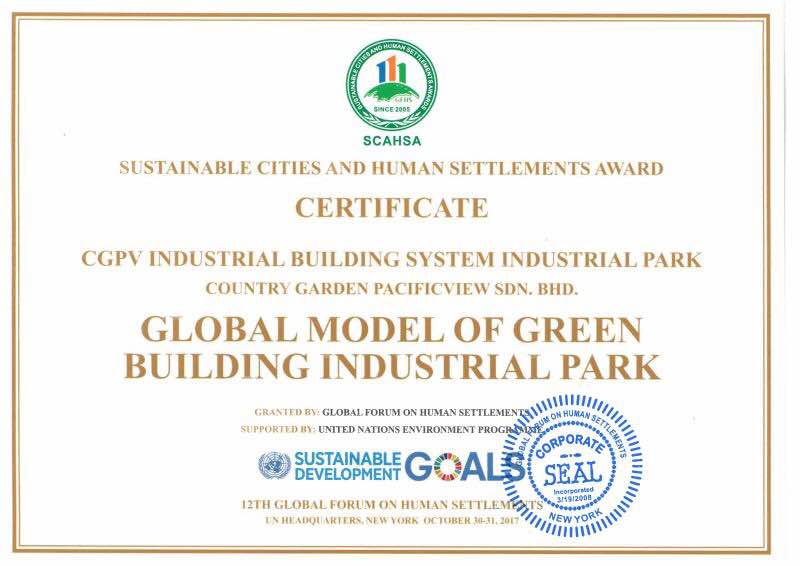
Forest City wins the Global Model of Green Building Industrial Park award for its industrial park which has boosted the construction industry


The SCAHSA award established by the Global Forum on Human Settlement (GFHS), a non-profit organisation with Special Consultative Status within the United Nations Economic and Social Council (ECOSOC). It is a trend setter for urban construction everywhere that respects sustainable development.

Forest City, China’s Wuyi County and Indonesia’s Surabaya City were among the winning entries submitted from 23 countries and regions worldwide. Forest City won the SCAHSA Global Human Settlements Award on Planning and Design at the 11th Global Forum on Human Settlements (GFHS – XI).

Dr. Arab Hoballah (right), former Chief of the Sustainable Lifestyles, Cities and Industry Branch at United Nations Environmental Programme (UNEP) presents the Global Model of Green Building Industrial Park award to Forest City

Forest City, by taking full advantage of its technical resources, is creating a 1.7-square-kilometer construction-focused industrial park, to promote the development of a green building industry and improve building precision and quality, said Dr. Wang Jiying, vice general manager for overseas business at Country Garden.

Forest City will include several support facilities and a powerful water transportation system, all of which are expected to be operational in 2019, with the aim of creating a truly industrialised manufacturing base for the construction industry over the next three to five years.

Creating Potential Future Workforce

A month and a half ago when I was at Forest City, I was brought to visit one of five schools adopted by Forest City where children are given free Mandarin lessons for three months.  This is one of the ways by Forest City to ensure that the local community, especially those in the Tanjung Kupang area, have roles to play in the development.

The result is excellent:

The student above is from the first batch of students who started their Mandarin language course in August 2017 and has graduated.  Forest City is not stopping there.  Forest City’s master developer, Country Garden Pacificview Sdn Bhd (CGPV), aims to give back to the community by offering three-month basic Mandarin language courses to some 100 school children there.

CGPV plans to continue to offer the Mandarin courses in the future as part of its corporate social responsibility effort for the community here.

The second intake will be conducted from January until March next year,” Country Garden Pacificview Sdn Bhd corporate communications head Aeron Munajat told reporters when met at SK Tanjong Adang here today where she handed over certificates to the participants.

Aeron said that apart from learning Mandarin as a third language, the three-month language course will also help the students develop self-confidence which will further enhance their competitiveness in the job market in the future.

She said the course involved students and teachers from five schools, namely SK Morni Pok, SK Tanjong Adang, SK Tiram Duku, SK Tanjung Kupang and SK Pendas Laut.

The classes are conducted every Friday and Saturday from 10am to 12 noon, at the community centre in Kampung Pok,” she added.

Forest City Does Not Pawn Johor Land

The continued but futile attacks on Forest City by Malaysia’s Mugabe and his followers have again earned the ire of His Majesty The Sultan of Johor.

Has Johor ever pawned its land? What is the meaning of pawning? With Forest City, the state of Johor has increased in size. It is not about seizing land to be pawned. In Johor, there are international lots and Malay reserve land.  Anyone can buy at the international zone, be it the Mat Salleh from England or people from India, Japan, China. All of them can purchase it.  They can buy (property), but it does not mean they purchase the land to bring it back to their respective home country,” chided the Sultan.

In Johor, we have an international zone, which means that foreigners could buy. It has international status. In Forest City, we do not sell the land, we sell the strata (titles) and these strata (titles) are for permanent ownership in Johor,” he remarked.

The Sultan added that 40 percent of the investors in Forest City are Malaysians and that even the government has shares in the project, and that the project gave a lot of revenue for the state government, including quit rent and assessment, which the state of Johor benefits.

How much revenue will the Johor government get? When Forest City is completed, the assessment, quit rent will go to who? Who will get the jobs? There are transportation (initiatives), businesses and job opportunities. Don’t be narrow minded about this,” said the Sultan.

A throwback at the Sultan of Johor’s displease of Mahathir’s lies about the Forest City project

The Sultan also said that the most visible benefit of the Forest City project was the boost it has given to the value of real estate in its surrounding areas, particularly in Pontian district, which is now developing at a rapid pace.

He gave an example of how in the past, the people of Pontian were only picking buah duku (lanzones), but now people in Pontian own Mercedes Benz cars.

It means that Pontian has become a district that will see rapid development,” the Sultan stressed. “In the past, an acre (0.4 hectares) of land used to cost RM100,000, but now, it is valued up to RM3 million.”

It is no doubt that Forest City will boost the Iskandar region’s marketability.  With consumer prices 100 percent higher than in Malaysia, rent prices 500 percent higher than in Malaysia, many companies in Singapore were driven to relocate to Iskandar, while Johor Bahru’s shopping malls, food outlets and amusement parks have become a favourite for Singaporeans.  Bangkok’s recent wish for Malaysia to extend its High Speed Rail into Thailand will soon make the Iskandar Econmic Region attractive to the millionaires and billionaires of Indochina. And the green, affordable buildings of Forest City will definitely be a hit.

While they all win, the real winners will be the people of Johor and Malaysia.
The Living Forest

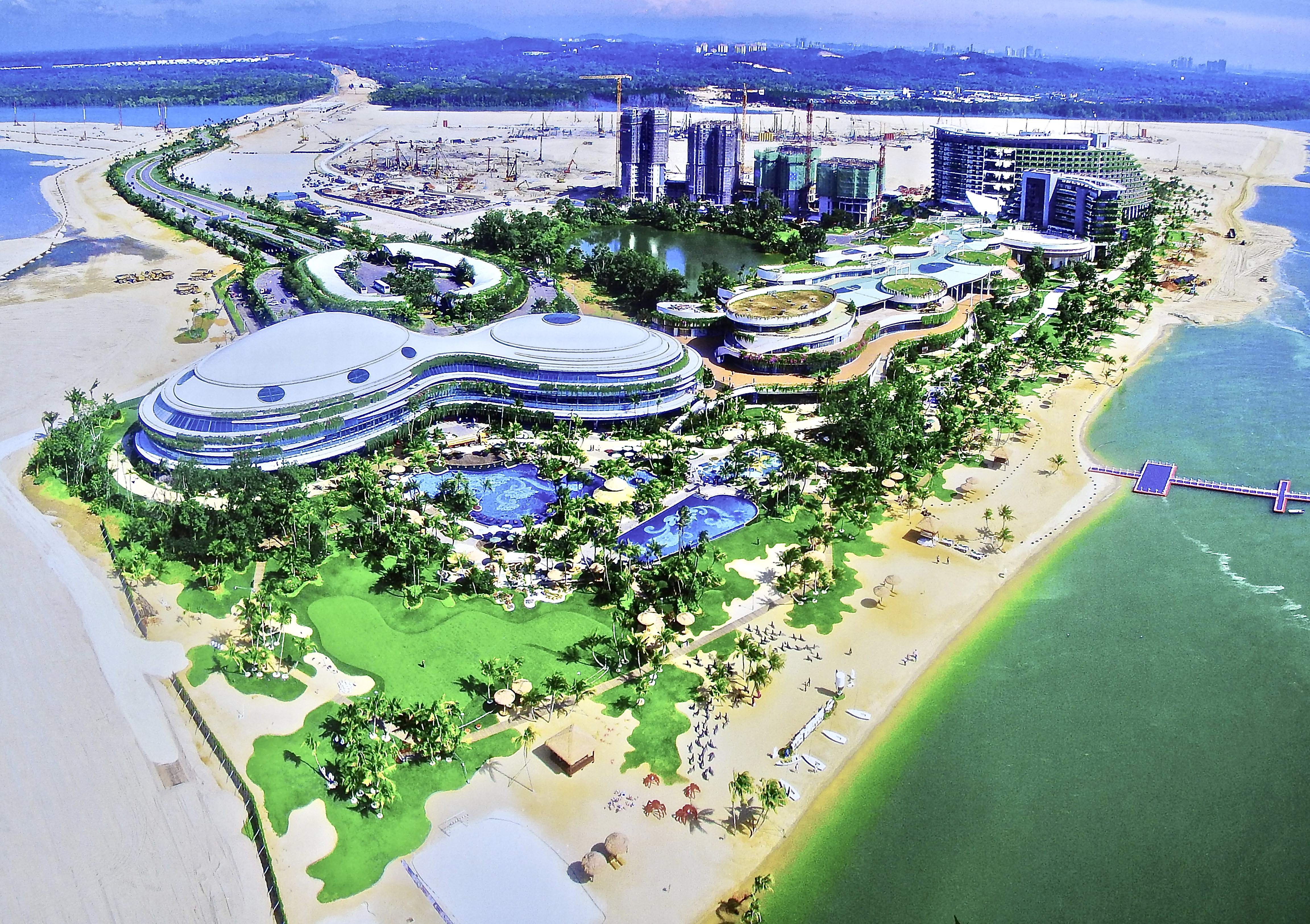
Forest City’s “Island One”, as seen from the air,  is almost sold out
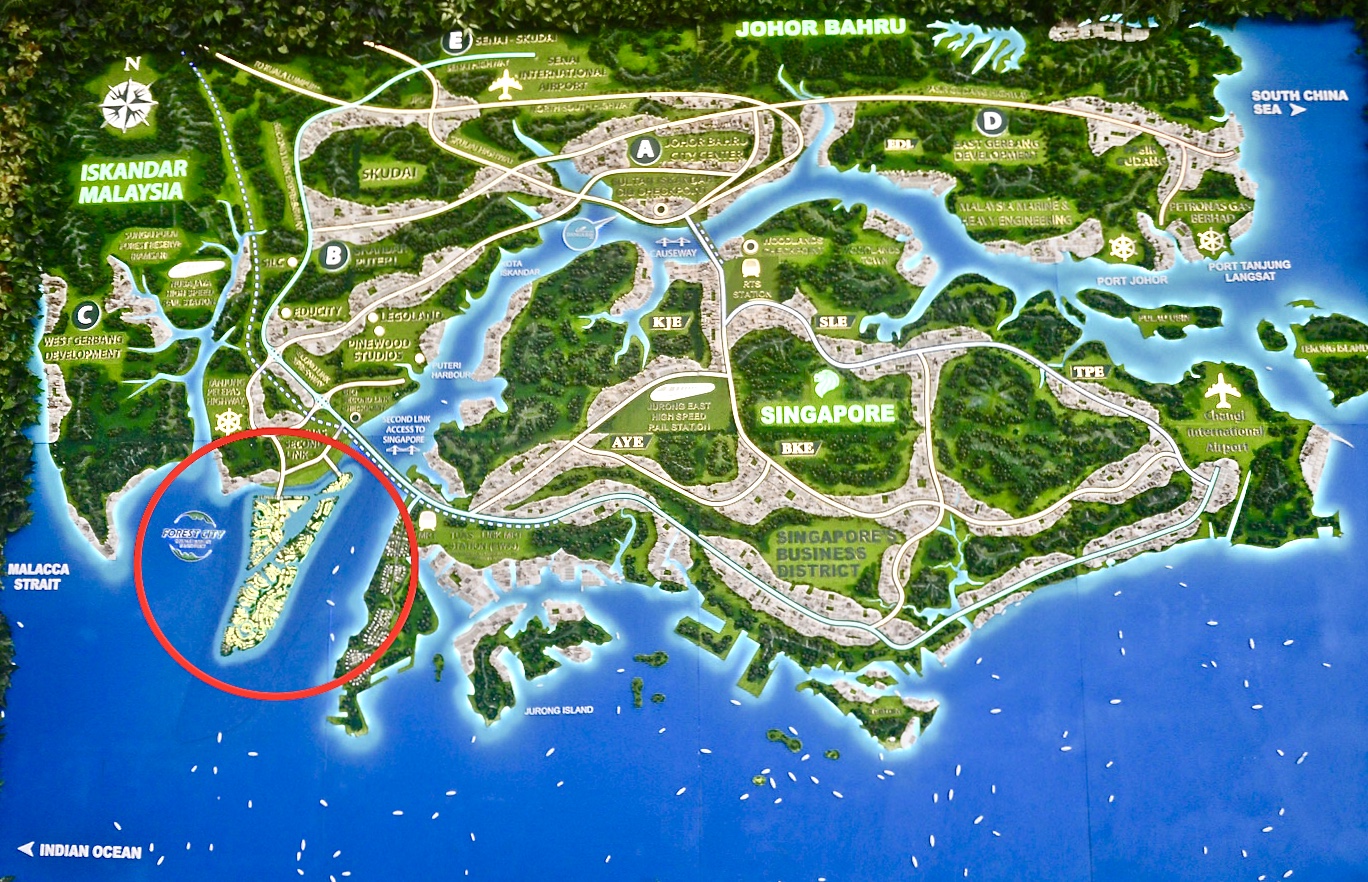
The development of Forest City, one of Johor’s iconic development on the western half of the southern coast of the state, is proceeding well and is on time.  When completed, the southern-most man-made island of the project will be just two kilometers away from Singapore’s Tuas.

A little over two years ago, the project area was under three meters deep of sea water.  Now, a hotel stands completed as do a commercial block as well as an office block, with a beach fronting Tuas.  Aptly named “Hotel Phoenix”, the 280-room four-star hotel has already begun to receive guests, and is now one of the favourite venues in southern Johor for international conferences and events.  Even Jack Ma’s Alibaba had an event here in late September 2017.

This 20-year development is already into its second year, but has been the subject of several controversies, depending on which side of the fence you are viewing the issue from.

700,000 New Citizens

One of the issues raised by the Opposition is the prospect of 700,000 mainland Chinese obtaining Malaysian citizenship after staying at Forest City for several years.  Opposition fear-mongers have been selling this idea to the worried locals who fear that their voice would be drowned by these prospective new citizens.

I threw this idea to an English friend of mine who is married to a Malay woman and have four children, to see if the fear is real.

Bo****ks!” he exclaimed, scoffing at the idea. “I’ve been married and staying here in Malaysia for 22 years now and I still haven’t got my citizenship.  If they think it’s that easy, I will gladly pay the person who could give me my Malaysian identity card.”

But will there actually be 700,000 Chinese from China residing at Forest City? Apparently not.  Buyers include people from the Middle East, Thailand, India and Singapore.  Forest City was already attracting these buyers even before China tightened the outflow of its currency.  Buyers from China have snapped up 70 percent of the early-sale properties there before the measure by China came into effect.

The number of withdrawals caused by the cashflow controls is about 60, compared with the 15,000-unit sales by the end of 2016, the bulk of which were sold to Chinese buyers. We have to look at the issue in perspective. If we are not confident about Forest City, we will not be investing some RM470 million to build a factory to manufacture ready-to-assemble concrete structures like staircases, beams and columns,” said Dr Yu Runze, President and Chief Strategy Officer of Country Garden Pacific View Sdn Bhd., the developer of the project.

Carving Out Malaysia’s Land To Make It China’s

As a state, Johor has jurisdiction of its land including the foreshore according to the National Land Code, 1965 and its territorial sea jutting out 3 nautical miles according to Section 3(3) of the Territorial Sea Act, 2012.

While Section 76 of the National Land Code includes a proviso that does not allow the foreshore and part of the sea bed to be disposed by the state authority for a period exceeding ninety-nine years, Forest City’s reclamation starts beyond the low-water mark of ordinary spring tides. Unlike the reclamations off Pulau Pinang, a bridge connects the man-made island to the mainland rendering it possible for the Johor state government to allow the developer to obtain a freehold status for the reclaimed portion, anything within the three-nautical mile limit.

Forest City is a reclaimed area off the Johor mainland. No part of the mainland is being given out to foreigners
Therefore, no part of the mainland was ever carved to become part of Forest City, nor was there a major displacement of people to make way for the apartment buildings and hotels of the development.  A freehold land does not mean that it belongs to another country. As mentioned, anything that is within 3 nautical miles including the seabed comes under the state authority while from that point up until 12 nautical miles comes under the Federal authority.  The state has the power to acquire the land under the Land Acquisition Act, 1960. hence the sovereignty of the nation is not compromised in any manner.

Forest City Is A China Project And Employs Only Chinese Citizens

The project is being developed by Country Garden Pacific View Sdn Bhd (CGPV), a Johor-China joint-venture company where the China partner has 60 percent equity in the JV, while the Malaysian partners hold 40.

CGPV Executive Director Datuk Md Othman Yusof and CGPV President and Chief Strategy Officer Dr Yu Renzu
CGPV executive director Datuk Md Othman Yusof said that as at end of September 2017, 859 out of 1397, or 61.4 percent of its workers are Malaysians.  This includes the staff at the CGPV Industrial Building System plant in Tanjung Kupang.

Datuk Othman said that it was a decree by His Majesty the Sultan of Johor himself that there should be at least 70 percent staff that are Malaysians.  “After only two years we already have 61.4 percent,” he added. “The only difficult part is getting Malaysians who could work as well under intense pressure on the construction side. Many joined but left as they could not match the discipline of the Chinese workers.”

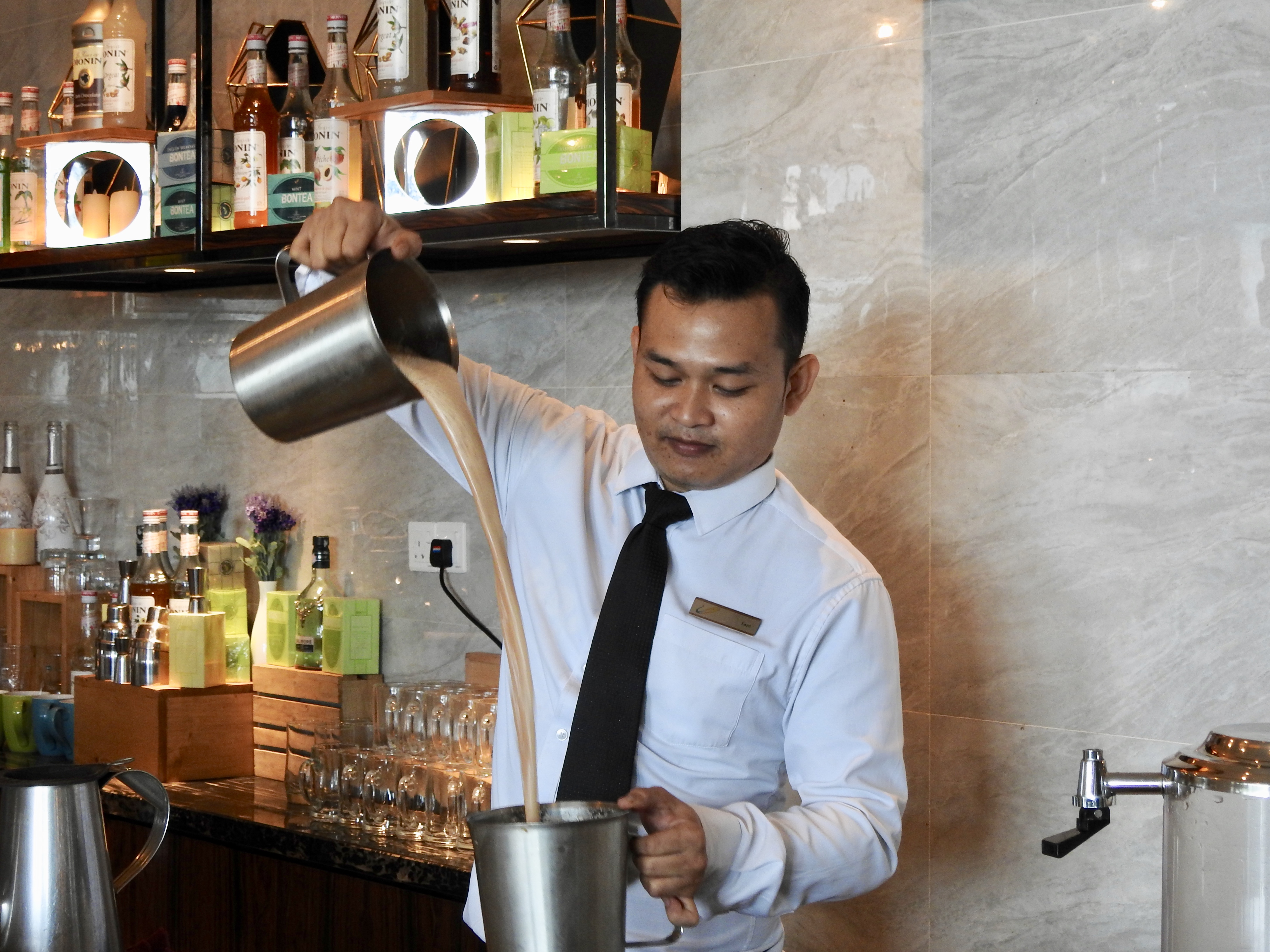
A Malaysian Malay coffee house staff making Teh Tarik for customers
Dr Yu added that of its RM4.7 billion (S$1.5 billion) capital expenditure (capex) spent between early 2015 and December 2016, about RM2 billion, or 42.55 per cent, was spent on the services provided by local consultancy firms and construction materials.

Cement, sand and other materials were bought locally. We did not import them from China. We also use consultancies such as law firms, planners and architects, to name some. So, it is untrue to say that Forest City has not benefited Malaysia or its people,” he remarked.

Forest City Is The Cause Of Pollution?

To blame the pollution of the Tebrau Strait solely on Forest City alone is not fair.  There was already pollution in that area because of the Port of Tanjung Pelepas (PTP), and 60-odd projects taking place along the Sungai Danga and Sungai Pulai which too affect the Tebrau Strait.

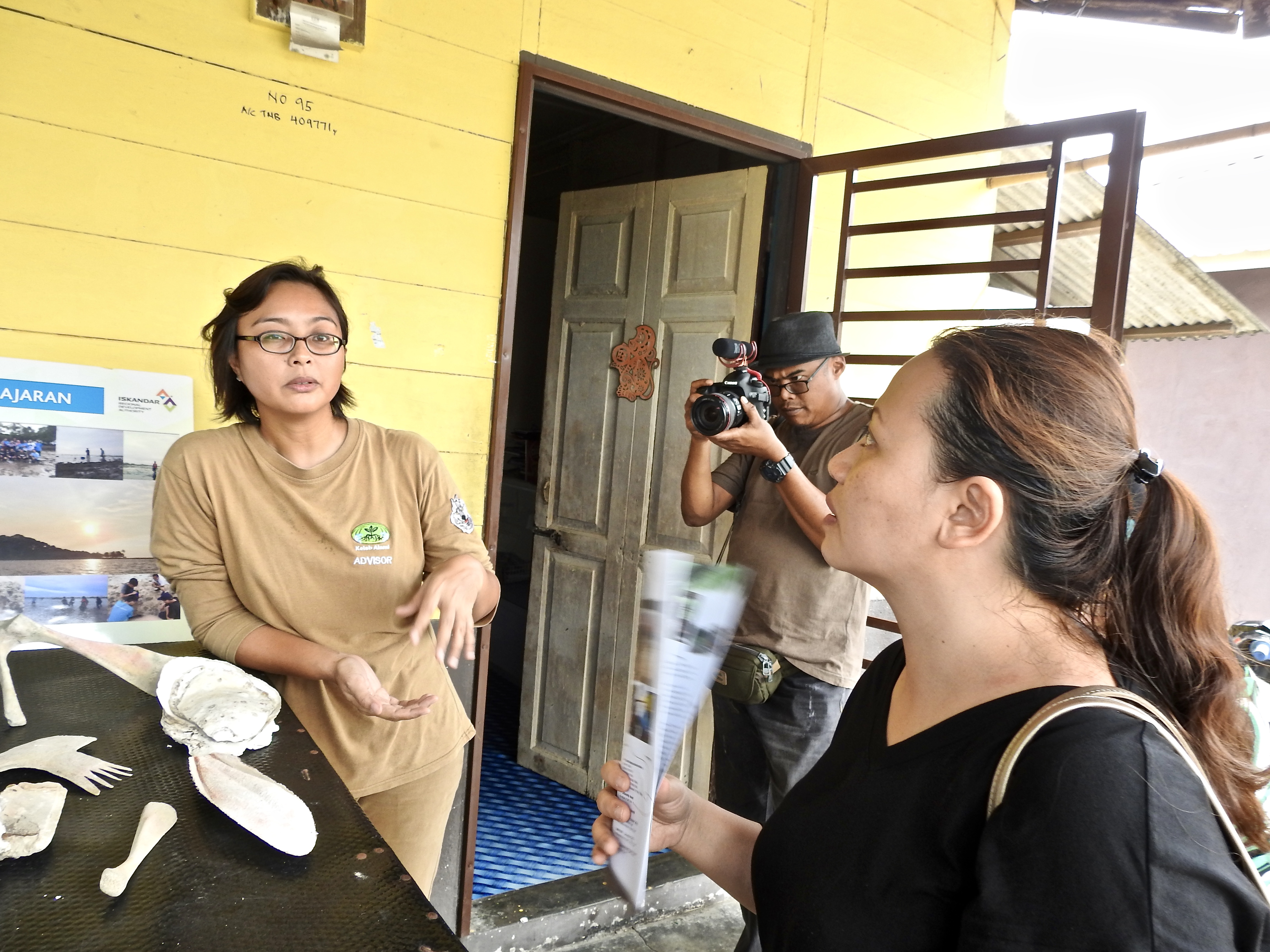
Dr Serina Rahman, co-founder of Kelab Alami, an environmental NGO based in Tanjung Kupang
According to Dr Serina Rahman of Kelab Alami, an environmental NGO based in Tanjung Kupang, intially the reclamation works for the Forest City project was worrisome as the waters off Tanjung Kupang is rich with marine life including sea grass.

The sea grass has spread to the left of the development where there is more water movement.  The seahorses are still there, the dugongs are still there, it’s just that they don’t come near the sand barges as they are noisy. There are other patches of sea grass closer to the port (PTP) so the dugongs are there,” she said in an interview.

The waters off this area isn’t deep.  Where Forest City is now was a place for the prawn fishermen to fish for prawns. When the reclamation started, their catch was affected,” she added. “However, the number of prawns have increased tremendously in this area and if you ask any of the fishermen, they will tell you that they are getting more prawns nowadays. Somehow, the sand that is being used to reclaim the area has brought more prawn species here. They may be invasive but I don’t think the fishermen are complaining.

According to Dr Yu, Forest City was planned as a single 20-square kilometer island.  “However, after doing the Environmental Impact Assessment we found that there is a huge patch of sea grass in the middle of where the island should be and decided to preserve it. So, we made Forest City into a four-island development instead – just for the sea grass,” he explained.

We strive to protect the environment, knowing how important it is for the ecosystem to be able to flourish,” he said. “And because of what we are doing for the sea grass, our neighbour the PTP is also taking measures to protect the aquatic environment.”

I was happy to be shown photos of marine life off the Forest City project that include the Hippocampus kuda seahorses and the Jorunna funebris nudibranch.

Investing In Future Employees

‘Prosper Thy Neighbour’ is something that the management at CGPV holds on to.  To increase the chances of employability, Forest City has embarked on several initiatives including providing free Mandarin and English language classes for the fishermen of Tanjung Kupang.

According to Shalan Jum’at, co-founder of Kelab Alami, Forest City has given funds to assist the local fishing community to buy nets and tools to repair them, and have set up a net-service centre at the Kelab Alami clubhouse.  The fishermen would gather there to learn English and Mandarin from tutors provided by Forest City.  This prepares the fishermen for the possibility of providing eco-tourism services for foreign tourists and future residents of Forest City.

Children from SK Tiram Duku can now learn Mandarin for free, increasing their chances of employability in the future
Five local schools have also been adopted by Forest City where the children are being given Mandarin language classes financed by Forest City.  Schools such as SK Tiram Duku in Tanjung Kupang are being prepared as future employees and service providers for the foreigners residing at Forest City.

We would like to be inclusive and ask the Orang Asli in the surrounding areas to provide guides for eco-tourists but it is so difficult to change their mindset.” explained Dr Yu when asked about the involvement of the local Orang Asli at Forest City.

Encik Noore bin Kasi, 4th generation Tok Batin of Kampung Orang Asli Simpang Arang, with YB Dr Haji Zaini bin Haji Abu Bakar, ADUN of Nusajaya
This was confirmed by Encik Noore bin Kasi, the Tok Batin or village headman of Kampung Orang Asli Simpang Arang.

We would like to get involved in eco-tourism but it is difficult because the Orang Asli have difficulty to change their way of life,” he said of the difficulty faced. “They think that this (Forest City) project does not benefit them. They are wrong! Eco-tourism will definitely benefit them. Development comes at a very fast pace but the mindset of the Orang Asli is too slow to catch up.

He stressed that the situation is made worse by the presence of outsiders, in particular NGOs that are anti-government that have been coming in and out of the village to spread negative views about the project and the government to the Orang Asli community.  He is afraid that the opportunity to benefit from the project will get lesser as time go by, and if the Orang Asli are being bombarded with lies continuously, they will lose out.

Looking Forward

How would Forest City help the locals? According to Datuk Md Othman, Forest City is aimed at foreign buyers, not Malaysians. This is to ensure that foreigners take up only what is being sold at Forest City, leaving the development on mainland Johor up for grabs by the locals.

This is how Johor ensures that the local market is not spoilt,” he added.

Whether or not there is cashflow controls imposed by China, the rich Chinese who already have investments worldwide would still come to Forest City to buy properties.

Dr Yu is equally optimistic. “Forest City is within the One Belt, One Road initiative area. The High Speed Rail ensures connectivity between Forest City and the rest of Asia especially Thailand, and India. People with investments here from the Middle East or China can fly into Senai airport direct and not have to transit at KLIA.  I am certain the cashflow control is just a temporary measure to make sure that they know where are the money being invested, and Forest City being a China-involved development project will surely see a surge in investors from China once everything has been consolidated.

With more sales offices being opened in the Middle East and in Indonesia, Forest City will definitely achieve its target.

Dr Yu said, unlike Langkawi, Tioman or nearby Stulang, the island was not duty-free, but has a portion that is designated as a duty-free area. Within this duty-free area is a township, so that its population will be able to enjoy a lower cost of living because the retail goods and consumables will cost a lot less.

Many things in Forest City will be “unprecedented”, so in that sense, the project will be exciting,” Yu said.

And for as long as Forest City exists, it will surely continue give good life to the people of southern Johor.