Hazy Direction

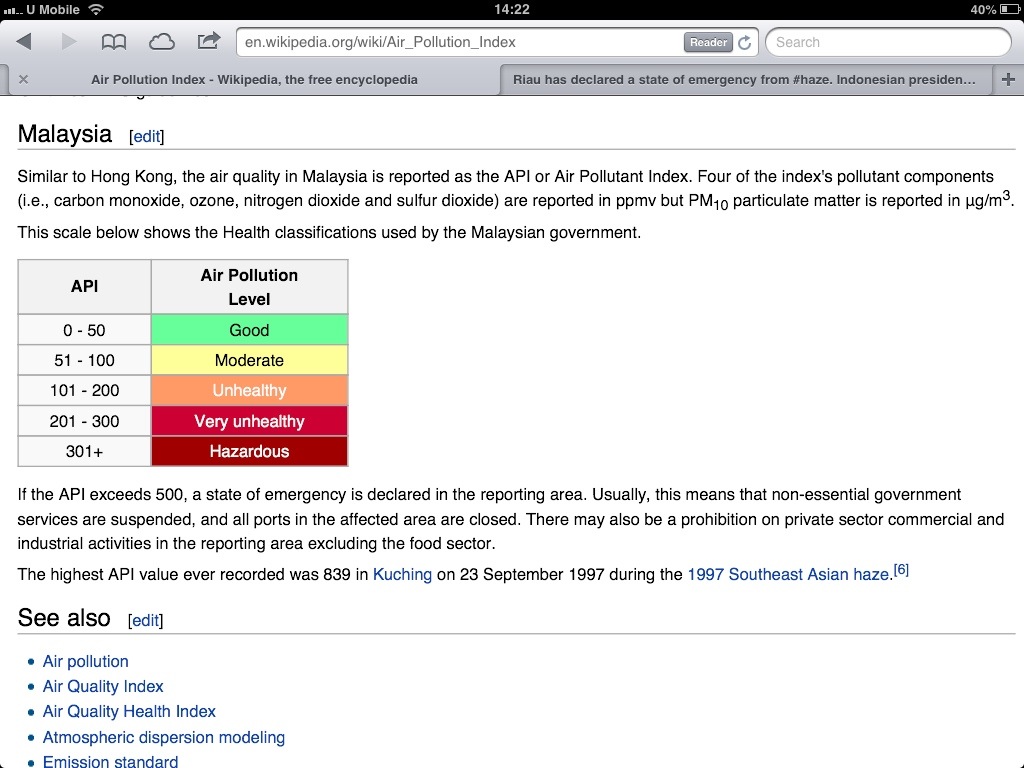
At 7am on Sunday, 23rd June 2013, the Air Pollution Index (or Pollution Standards Index) in the coastal town of Muar, Johor, hit 716. For those without idea of what that means, let me provide you with some notes:
20130623-142257.jpg

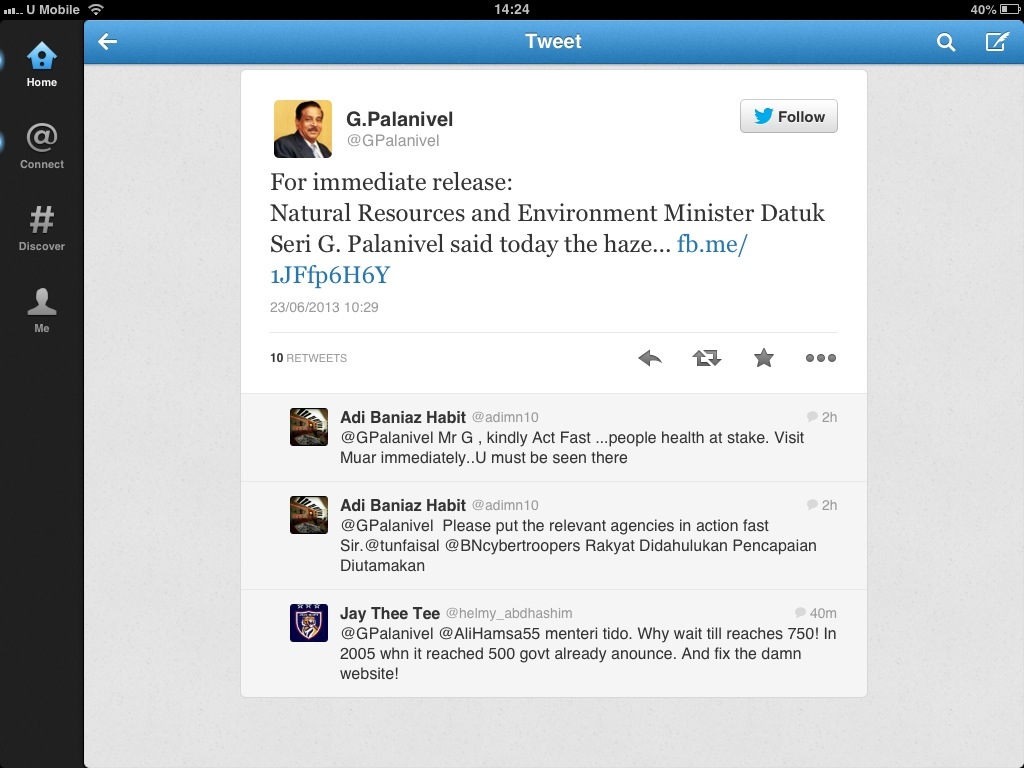
It clearly states that a state of emergency will be declared the moment the API exceeds 500 points. Guess when did the Minister finally declared emergency in Muar?
20130623-142624.jpg

That was 3 hours and 29 minutes later.

Painfully slow.

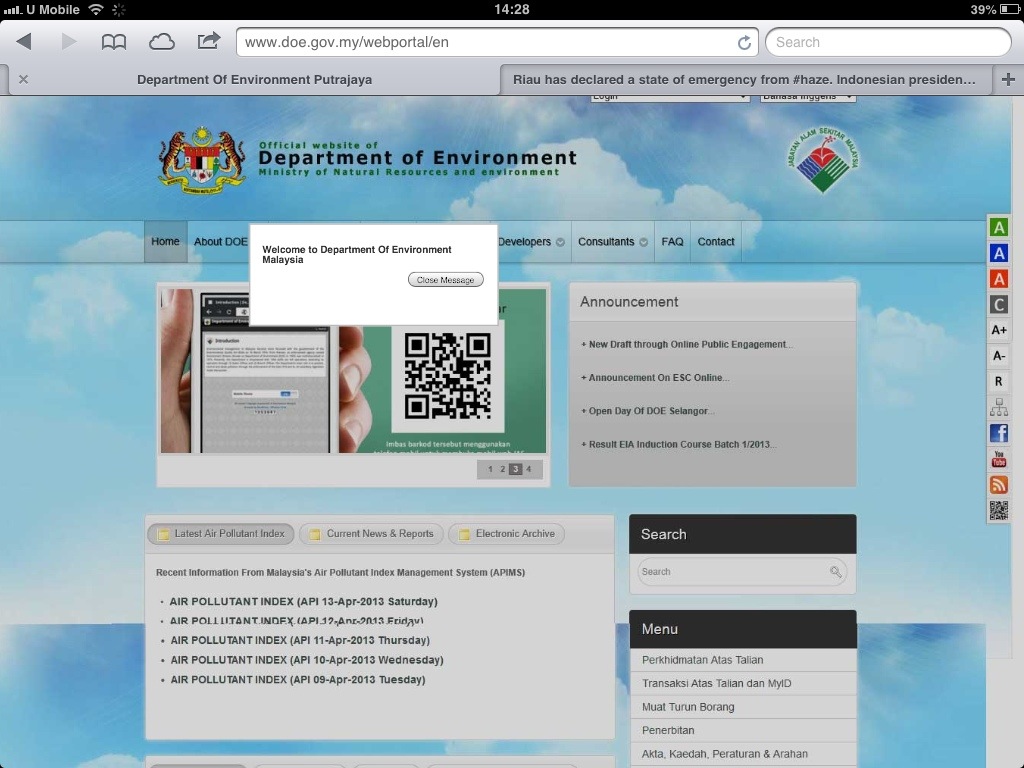
Now that emergency has been declared, what are the residents of Muar supposed to do? I quickly went into the Department of Environment’s website and found nothing on what are people supposed to do once emergency has been declared.
20130623-143455.jpg

I went into the Ministry of Health’s website, there was just an info page on how to deal with the haze conditions, but of course I don’t expect them to come up with a plan because the emergency was declared by the Minister of Natural Resources and Environment.

I guess the government has yet to learn the lessons of Ops Daulat etc. Obviously the Ministry of Natural Resources and Environment has failed in both Risk Management and Crisis Management. In the Risk Management aspect, there should have been a Haze Risk Management Committee set-up and a Risk Assessment done by this committee that involves the Department of Environment, the Meteorological Department, Remote Sensing to determine the hotspots, wind directions, weather and wind patterns on a strategic (long-term) level.

On the Crisis Management path there should have been two phases set: Crisis Precaution and Crisis Handling. In the first phase, when you know things are imminent, you should go into avoidance or prevention: actively engage the Indonesian counterparts on how to discourage slash-and-burn techniques employed by plantations in Sumatra. You already know this will happen on an annual basis, yet you did nothing.

The haze hit the south first, with Singapore being blanketed in a PSI close to 500. Towns like Pasir Gudang and Kota Tinggi also got hit. Yet there was no dissemination of information done by the DOE on steps to be taken by residents. There was no early diagnosis, early recognition of the potential severity of the situation, and there was no early warning given.

If I were the Minister, I would have had a draft of declaration of emergency ready inside my Ministry’s Crisis Management Manual (which I doubt exists) and with the API steadily increasing beyond 400 in Muar yesterday, I would have one ready for issue. Yet, there was none. That is why it took the Minister 3 hours and 29 minutes after the index had screamed 746 to react and declare emergency. And as at time of posting this, not a single information has been issued by he Ministry on steps to be taken by residents and government agencies in a pollution emergency. Funny enough, there wasn’t even a live press conference on news at noon for the Ministry to convey these steps to the public and to the relevant government agencies.

Why? Why is this still happening in the wake of Ops Daulat? Singapore went proactive once PSI hit 400. We took 3 hours and 29 minutes after it hit 746 in Muar. That is worse than being bloody reactive!

The government had better get off its fat butt and treble its efforts in the stage of crisis handling. I expected better from this government after Ops Daulat. I guess I had put my hopes 1mm too high!

Incredible Ink and Indelible Voters

Overseas registered voters as well as local postal voters have all cast their votes. Only the general registered voters will cast theirs five days from now. In six days time we shall all know the outcome, winners as well as losers.

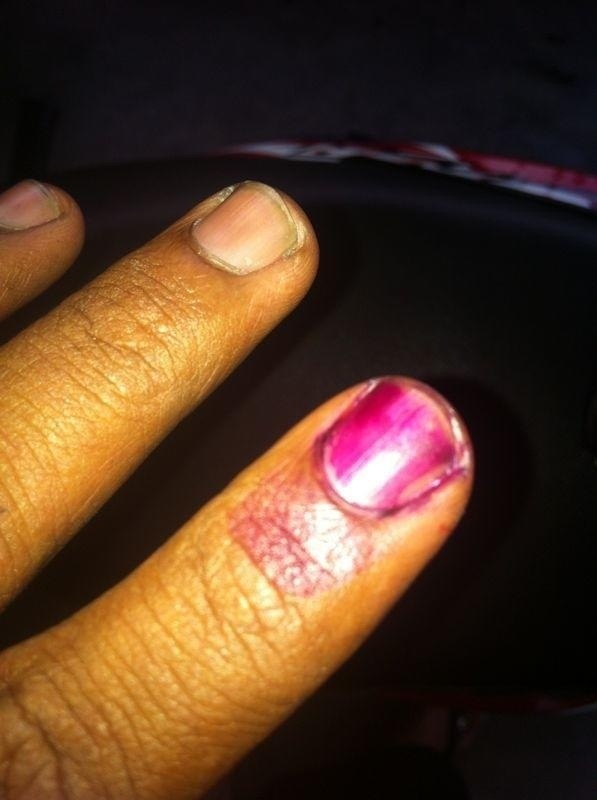
Barely four hours have lapsed since the final postal vote was cast when photos of “disappearing indelible ink” rode the Internet waves, and accusations started flying. This could be pre-empting the outcome of the final ballot count come 5th May. Let me show you the pictures taken by a fellow blogger Hazrey of the finger of a personnel from the Johor Bahru Police Contingent HQ who cast his votes this morning, marked with the indelible ink:

20130430-212125.jpg

The above was the finger, picture taken at around 8.30am. He went home, tried washing it with soap, detergent, dishwashing liquid, and finally washed his car at 5.30pm, and his finger looked like this:

20130430-212512.jpg

It is still marked.

Nurul Izzah, the daughter of Anwar Ibrahim, tried to do a live demonstration on how to erase the indelible ink. She tried to scrub it off the finger of an army personnel who had voted, and failed. You can read more about it here.

Then, this was followed by a series of photos that was supposedly taken during the attempt. Initially to some, it may look convincing. But only the unwise would take things at face value:

20130430-213345.jpg

I don’t know why Pakatan people love to lie, and sometimes don’t even care if they get caught. There is also talk that the voting process overseas was flawed. My younger sister, who voted in Australia, had this to say:

I read some rumors about discrepancy with overseas voting. I’m a pioneer overseas voter. Had to go through thorough security check by OZ security guys who even used a metal detector, then had to go through I/C checks on three occasions by 3 different groups, could only open my envelope in the presence of witness and both of us had to acknowledge in writing there was no discrepancy in information on the envelope and on the contents of the envelope before I could proceed to vote. I even tugged the sack containing our votes just to be sure. I think you need industrial grade equipment to cut through it. It would’ve been impossible to go in and out of that room without possessing more than one I/C. It’d also be pretty hard to claim discrepancy with your acknowledgement in writing. Unless you wanna also claim that ghosts exist.

Come on, fools! If you want to form the government, you have to at least hide your stupidity!

Here, enjoy a video while you sulk!

Undilah Kita Semua

20130403-204645.jpg

This afternoon the Prime Minister announced the dissolution of Parliament to make way for the long-awaited 13th General Elections. For those who never watched black and white television, this is the second time that we have called for the General Elections after the dissolution of state assemblies. The first was in 1974. So, this is nothing new.

In the last General Elections, Barisan Nasional lost badly compared to its 2004 sweep simply because it got big-headed and complacent, and its leaders felt over-confident in another landslide majority. This complacency was evident in the BK5 and K10 machineries that performed its task to gauge the voters by not actually going down to the ground. This act was dubbed “Ops Tiarap” or doing something while lying on one’s stomach. This time around, I cringe whenever someone from Barisan Nasional announces that he is confident that so and so state would be won back by Barisan Nasional.

Najib, as Prime Minister, had inherited a badly-beaten Barisan Nasional from his predecessor a year after the elections. His predecessor seemed reluctant to step down, and was viewed by many as being in a state of denial of captaining Barisan into the biggest slap it has ever received. Therefore, Najib had four years to transform the image of Barisan Nasional into one that is respected by many again.

As for the Pakatan Rakyat, it started off well in a way, even Lim Guan Eng, as the Chief Minister of Penang had offered Barisan Nasional representatives to help out in managing state-related affairs. However, after a while you see the true colours of the loose coalition, especially in the states of Perak, Selangor and Penang. You see the ones who are actually in control of these states are from DAP. DAP ruled Perak and Selangor by proxy, and this is the manner in which Malaysia would be governed should the Pakatan Rakyat win this election. You can read more of this in one of my previous postings, Taken For A Ride. DAP’s attempts to portray itself as a multiracial party fell flat on its face when all the Malay candidates who vied for a seat in the party’s Central Executive Committees were rejected by the Chinese-majority delegates. Declaring there was a problem with the Excel sheet it used for the elections a month and a half later, DAP declared that the Malays actually have an elected representative in the form of one Zairil Khir Johari, who is not even a Malay.

PAS has its own set of problems when it is seen as not being able to overcome its fear of Big Brother DAP, so much so that many of its reps blatantly kowtow to the demands of the DAP. This is even more evident when PAS did nothing to condemn the efforts by Christians to proselytise Malay Muslims.. It is no secret whatsoever as to who are the non-Christians among the DAP leadership. And it is not difficult to amend the Federal Constitution when it comes to the special position of the Rajas and Sultans, the Malays, and Islam as the religion of the Federation. I shall explain this in the next paragraph.

In the process of the enactment of law, a Minister will draw a bill with the help of the Attorney-General’s Department. This bill is then passed to all Members of Parliament (MPs). This bill will go through three readings and a study by a Dewan Select Committee. On the first reading, a Minister reads a brief subject matter of the bill to the Dewan Rakyat and the House Secretary. On the second reading, this bill is debated extensively, after which the Dewan Select Committee will study it further and make amendments where necessary. On the third reading, this bill is voted by the MPs. If it attains a 2/3 support, it is considered as passed.

This bill is then read in the Dewan Negara through the same number of reading and process. Upon passing the bill, it is then given to the Yang DiPertuan Agong (Agong) for His Majesty’s consent. His Majesty has 30 days to give consent or reject the bill. If the bill is rejected by His Majesty, then the Dewan Rakyat will have to debate the bill again and pass it. His Majesty will have another 30 days to give his consent. If His Majesty does not give consent to the bill during this second round of 30 days, the bill automatically becomes a law.

Therefore, the fear felt by Muslim Malays do not come unfounded, as evident in the pictures below:

20130403-214857.jpg

20130403-214918.jpg

20130403-214935.jpg

20130403-214948.jpg

And the most worrying part about the politics of hate advocated by the Pakatan Rakyat is this:

20130403-215045.jpg

As for the PKR, in my opinion it will fare worse off as compared to the previous elections, that its de facto leader, has announced abandoning his voters in Permatang Pauh, to contest in Perak instead.

Among the three parties that make up the loose coalition, DAP will reign supreme. PKR will emerge as the biggest loser.

How would the states fare?

Kelantan: despite the BN gaining more seats, it is in my opinion that Kelantan will remain in PAS’s hands.

Terengganu: it will be a close call as in the previous elections, with BN still holding on to it.

Pahang: Pahang will still remain a BN state.

Sabah: with Yong Teck Lee going around telling voters how Anwar Ibrahim tried to subjugate the state, and the Pakatan Rakyat links to those behind the Lahad Datu armed incursion, Sabah will still be in BN’s hands. But the local parties will give Barisan a run for the money.

Johor: DAP will make a few more gains here, especially in the urban seats, but BN will still retain this state.

Melaka and Negeri Sembilan: will remain in the hands of the Barisan Nasional.

Selangor: despite the efforts of the Barisan Nasional, I opine that it will remain in the hands of the Pakatan Rakyat. However, I believe that DAP will have a Menteri Besar-designate from their ranks this time instead of having to rely on rulingbthe state by proxy again. PKR will lose badly in this state.

Perak: this will be another state that will have a close call. The jury is still out on this one, and the same goes for Kedah.

Penang: with the gentrification of Penang, the half-island state will remain in DAP’s hands. And when I say DAP, I mean the other two parties will not fare well this time.

Of course, the above is just my opinion, and I stand corrected. The outcome may be different.

However, do not experiment with your children’s future. Your decision this round will determine the course for their future.

Be careful and be wise with your choice. If you snooze, your children lose.

Marilah Kita Mengundi.

ESSCOM ERROR

20130330-105410.jpg

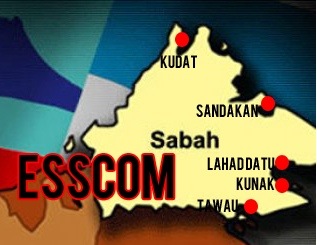
When the government announced the formation of the Eastern Sabah Security Command (ESSCOM), I said to myself, “About bloody time!”. I imagined security sectors formed from Kudat to Sandakan to Lahad Datu to Semporna and Tawau, mirroring what we used to have along the Malaysian-Thai border during the Communist insurgency such as Kota Alfa, Kota Bravo, Kota Charlie and Kota Delta spanning Kuala Perlis to Tumpat. The initial aim was to combat the communist guerrillas and stopping their infiltration from Southern Thailand. After the treaty in December 1989, we had elements of the Unit Pencegahan Penyeludupan (UPP) or the Anti-Smuggling Unit operating in these areas in a supporting role, to curb the smuggling of contrabands and also human trafficking.

Instead, I find it rather amusing when the Ketua Setiausaha Negara announced that Datuk Mohammad Mentek has been appointed as the Director of ESSCOM effective April 1st. What is wrong with this appointment? Mohammad Mentek is the Director of Immigration for the state of Sabah, the agency that, in my opinion, has failed badly in curbing the in-flow of illegal Filipino and Indonesian immigrants into that state.

The New Straits Times ran a story on Mohammad Mentek’s appointment and a statement by the KSN that was complemented by Mohammad’s curriculum vitae; citing even that Mohammad would be very experienced in the field of security and public order.

This April 1st appointment has to be an April’s Fool joke with an extremely bad taste. Surely the KSN should know the functions of the Immigration Department like the back of his hand. If I may provide a memory-jogger for all, the. immigration Department’s functions are:

  • 1. Issuing of passports and travel documents to Malaysian Citizens and Permanent Residents.

    2. Issuing of visas, passes and permits to Foreign Nationals entering Malaysia.

    3. Administering and managing the movement of people at authorised entry and exit points.

    4. Enforcing the Immigration Act 1959/63, Immigration Regulations 1963 and Passport Act 1966.

  • If you think I made the above up, read it here. How much of an expert do you think the Sabah Director of Immigration would be in the field of counter-insurgency warfare, joint-command operations and public order? Other than the pen being mightier than the sword, I doubt if the person’s handled anything more than the butter knife, let alone deploy battalions of soldiers and policemen in combat situations.

    This is another example of the government missing out on a good opportunity to make things better. Obviously, the main concern when we talk about Sabah right now is its defence from foreign elements. With the heavy presence of our security forces there, we can only see illegal immigrants returning to their homeland, and not the other way round. Therefore, the government should have had a clear aim (again, quoting from the Principles of WAR) in ensuring its strategies in making Sabah more secure conform to this aim. A concept called Defence-in-Depth should have been adopted instead where the Army and Police’s General Operations Force occupy the peripheral islands off Sabah, as being done in Ops PASIR, supported by the Navy, Marine Police and the Malaysian Maritime Enforcement Agency. These are the front-liners that will be meeting armed militants head-on. Onshore, defence and security should be effected by the Army and Police. The Immigration Department will just stick to its supporting role, weeding out illegal immigrants.

    Therefore, in my opinion, the ESSCOM should be jointly-directed by the Deputy Commander of the Army’s 1st Division, one of the deputies of the Commissioner of Police, Sabah, and the Malaysian Maritime Enforcement Agency’s Head of Regional Enforcement for Sabah and Labuan. The reason is because they are in-charge of the combat and combat-capable units operating in this region, not the Immigration.

    In conclusion, the choice of the Director of Immigration for Sabah as the Director for ESSCOM is a grave mistake. I respect the person for who he is, but if the government wants to be seen serious in protecting the Malaysians in the state of Sabah, leave the job to the professionals. Not someone who holds a Master of Science (Statistics) degree and a Bachelor of Science (Mathematics) degree from the University of Minnesota, United States.

    The Chinese Navy “Visits” Beting Serupai

    20130328-174347.jpg

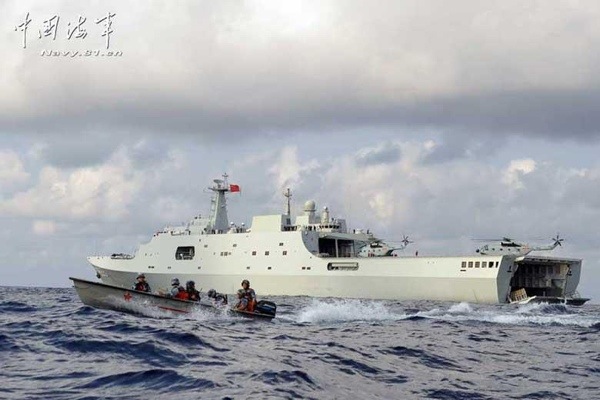
    Mention the name Beting Serupai you might get frowned upon by many. Mention the name James Shoal, and it may raise a few eyebrows. To most Malaysian, they would not be able to pinpoint where James Shoal is, save for some avid fishing enthusiasts, but this 22-meter deep shoal 80 kilometres off Bintulu, Sarawak, has been “visited” by elements of the People’s Liberation Army – Navy (PLA-N) or simply referred to as the Chinese Navy, yesterday.

    In its report on the 26th March 2013, the Associated Press wrote:

    The official People’s Daily online said Wednesday that one destroyer, two frigates and an amphibious landing ship took part in the drills around Chinese-controlled outcroppings. They involved hovercraft, ship-born helicopters, amphibious tanks, and land-based fighters and bombers, and were followed by a ceremonial visit Tuesday to James Shoal farther south.

    The Beting Serupai has always been part of China’s claim, lumped together in the Spratlys, as its southernmost territory. Prior to this “visit” the PLA-N visited the shoal in 1993 and 1994. In April of 2010, its vessel, the Marine Surveillance Ship-83 placed a sovereignty stele into the water area of the shoal.

    When Malaysia enhanced its relationship with China in May 2011, it was looked at as a step further towards harnessing a greater economic relationship. The Malaysian Opposition was quick to excoriate the act as political pandering. But in retrospect, it was strategically a good move as it relives the act by the Sultanate of Melaka with the Chinese. China is not a country one could just ignore. As in the 15th century, an alliance with China not only provides economic benefits, but also from a military standpoint.

    It is no secret that after China’s warnings to Japan, South Korea and Taiwan in 2012, the United States was actively looking for bases in this region. Among the countries where bases are sought include the Philippines and Vietnam. However, no other modern naval base offers the best proximity than Malaysia’s own Teluk Sepanggar just north of Kota Kinabalu. Therefore, it comes as no surprise that the carrier battle group of the USS John C Stennis decided to make a port call there in early October 2012. Before that, in the month of April 2012, the RMN base was visited by the US Navy Secretary, who brought with him the submarine-tender, the USS Emory S Land, and the Los Angeles-class nuclear attack submarine, the USS Louisville.

    The only factor that is stopping the US Navy from getting naval base facilities in Sabah is probably not having a Malaysian government that would kowtow to them. Therefore, the outcome of the next general elections would be important to them. Little wonder that Sabah has been the aim of a certain party. However, this writer hopes that this dangerous effort would not come to fruition.

    That the Department of Foreign Affairs of the Philippines has asked Filipinos to stop referring to Sabah as Sabah, Malaysia three days ago, citing Memorandum Circular No. 162 issued by Malacanang back in 2008. The DFA has also begun referring to Filipinos fleeing Sabah as “displaced persons” instead of “evacuees” or “returnees.” This is the Philippines government doing a 180 on its previous position re the Sabah claim. The fact that the US Navy and Marines have begun deploying its assets in the Philippines comes as no surprise. On Tuesday the USN and US Marine Corps offloaded more than 270 tactical and amphibious assault vehicles in Subic Bay, Zambales.

    American troops from the 3rd Marine Expeditionary Brigade, III Marine Expeditionary Force, offloaded a High Mobility Multipurpose Wheeled Vehicle from the container and roll-on, roll-off ship USNS 1st Lt. Jack Lummus on March 21. Some 8,000 troops from both the US and the Philippines will commence its Balikatan exercise on 5th April. And the US has yet to offer an explanation on why its minesweeper, the USS Guardian, could run aground on Tubbataha Reef in the Sulu Sea near Palawan, two weeks before the incursion by the Sulu militants. And suddenly, Jamalul Kiram III who hardly has enough money to cover the bills for his twice-weekly kidney dialysis, could find the financial resources to send hundreds of armed militants across the Sulu Sea to Lahad Datu.

    Perhaps, the Chinese naval exercise in the South China Sea and its “visit” to the southernmost part it claims comes as a warning to any party that plans to upset the military balance in the region. China, I would expect, would want to protect its interests; and the 180 by the Philippines in the Sabah issue could be seen as an attempt to de-stabilise the region. Having Sabah not only allows a nation to dip its fingers into Sabah’s oilfields but also increases its EEZ reach into the Spratlys.

    Whatever the intentions may be by all the related parties, the Malaysian government should seriously look into increasing its naval and aerial assets. A country that is weak militarily will only see its soil trampled by foreign forces. The government should also make sure Sabah is not lost to another nation, and act against the Quislings who have caused the emergency in Lahad Datu.

    Take Sabah Away, Mr Sulu

    When the late Gene Roddenderry wanted an Asian character to be part of the crew of the Federation Starship USS Enterprise, he wanted a surname that does not represent any particular nation. George Takei, an actor in the world-renowned TV show recalled how Roddenderry opened up a map, looked at Asia and saw the Sulu Sea and exclaimed:

    “Ah! The waters of that sea touch all shores!”

    That was how the character Hikaru Sulu got his name.

    And how true it is that the Sulu Sea has now touched on the raw and sensitive parts of the shores of both Malaysia and the Philippines.

    I wrote some days back on the current stand-off in Lahad Datu and it is today Day 11th since a group of armed men claiming to represent the Sultan of Sulu landed in Lahad Datu, Sabah in Malaysia, asking for the return of Sabah to the Sultanate of Sulu.  When the Philippines government worked a peace deal with the Muslims in the country’s deep south via the Bangsamoro Framework Agreement, the Muslims and their Filipino brethren embraced it as finally a way forward after decades of impasse.  The framework allows for the creation of a single and autonomous entity called Bangsamoro replacing the Autonomous Region of Muslim Mindanao.

    The framework agreement was signed at the Malacanang Palace on 15th October 2012 in the presence of President Beningno Aquino III of the Philippines; Al Haj Murad Ebrahim, the Chairman of the Moro Islamic Liberation Front; Najib Razak, Prime Minister of Malaysia; and Ekmeleddin İhsanoğlu, Secretary-General of the Organisation of Islamic Countries.

    Absent was Nur Misuari, leader of the Moro National Liberation Front. Nur Misuari had called the BFA irrelevant claiming it was cloned by President Aquino and Najib Razak.  The MILF is a breakaway group that was part of the MNLF back in the 1970s.  Disagreement in the way Nur Misuari handled issues led to the group breaking away.

    Also absent was the Sultan of Sulu.  The alienation of the Sultan probably led to the Lahad Datu stand-off.  The Sultan admitted to have been prompted by the alienation to send some 400 men across the sea to Sabah, as the BFA had seen not only improvements in the lives of the Bangsamoro that he played no role in, but also in the intimacy between the Philippines and Malaysia as neighbours.  And as mentioned in my previous posting on this issue, Nur Misuari’s MNLF supports the Sultan.  And this recent posture is to display its relevance again to the Moro people.

    But why was the Sultan alienated in the peace process?  Simple – there are now ten people who claim the throne.  The Philippines government cannot be dealing with ten different Sultans with ten different basic ideas on how to bring peace and development to the Bangsamoro.  Nur Misuari himself did not attend the signing as he fears that there is an ongoing warrant issued for his arrest for waging war against the Philippines government.

    As the militants are bogged down into their second week in Lahad Datu surrounded by the Malaysian security forces, Nur Misuari was quick to threaten Malaysia saying “if one drop of blood is spilled then we will be forced to come to their aid.”  Nur Misuari also said the following:

    This should be handled by cooler heads…that it would also be good to await the Malaysian general election to see who will be the new Prime Minister…

    And who has Nur Misuari implied by that?  None other than his old friend, Anwar Ibrahim.  It was reported by Reuters and confirmed by Philippine military sources that Anwar had traveled and met Nur Misuari to discuss land claims in Sabah, a few months before the Lahad Datu incident happened.  Anwar has vehemently denied this, but the photo below shows otherwise:

    20130222-175404.jpg

    Now, Anwar Ibrahim seems a dubious character himself. In a recent open letter, his former legal counsel member, Yuktes Vijay, asked about the former’s links to Islamic fundamentalists as well as known terrorists. Therefore, it is not impossible for him to have met Nur Misuari to discuss the matter, and then deny it like he denied ever being conferred the title of Huguan Siou although people from his own political party had announced that on Facebook, complemented by photos of him.

    The Philippines government has sent six naval vessels to stop people from the Moro region from entering Malaysian waters as this stand-off continues.  And although the Malaysian government has an upperhand and the firepower to end this stand-off, it is probably of best interest to the Bangsamoro, the government of the Philippines as well as Malaysia, to not allow anything to jeopardise the BFA that is still in its infancy.  Perhaps, the MILF and supporters of the BFA in the Moro region should lend their support to both governments to try end this madness.

    In the meantime, while treading gently on this issue, both governments should get to the root of this and probe Anwar Ibrahim’s role in facilitating or prompting this incident.  For it would not have happened had it not been for someone from the Malaysian side advocating and encouraging it to happen.  It is something close to Sabah, and we know Sabah is being wooed by Anwar’s party.  Get the support of the Kadazan-Dusun-Murut community by being recognised as their Paramount Leader (Huguan Siou), you will get support from the Christians in the west side of Sabah.  Get a deal with the Tausugs in Sulu, you will get support from the Muslims especially in the eastern part of Sabah.

    But at what cost?  That remains unanswered.  But maybe Gene Roddenderry would frown had he known the Sulu Sea is one of the volatile areas of the region.

    Xenophonbia Justified

    Within the hour of writing this posting, the Australian Foreign Minister, Bob Carr, will be issuing a statement on the denial of entry of Independent Senator Nicholas Xenophon into Malaysia.  According to some friends in Australia, “they have made it into such a big thing over here.”

    Perhaps, news agencies in Australia, in particular Sky News Australia, should stop being superficial as their superficial reporting shows their inability to engage in journalistic rigor, comprehend complexity or maintain impartiality.  Else their journos could come and join me write for this blog pro bono perhaps in the classifieds section.  Well, I have no classifieds section.

    Now, please understand the following:

    nickxenophon

    Xenophon is being denied entry for being a “security threat” to Malaysia.  Let us not forget that Xenophon, as an Australian diplomat, broke local law for being directly involved in the BERSIH 3.0 demonstration.  The Malaysian Peaceful Assembly Act 2012 specifically mentions in Section 4(2)(a) that a person commits an offence if being a non-citizen, he organizes or participates in an assembly and should be liable to a fine not exceeding ten thousand Ringgit.  Of course, being Malaysian and hospitable even to foreign lawbreakers, he was allowed to go home without receiving much hassle, let alone a 10 sen fine.

    Isn’t Xenophon then a diplomat, and are diplomats not immune from prosecution?

    Firstly, Article 41 para 1 of the Geneva Convention on Diplomatic Relations, 1961 clearly states that it is the duty of all persons enjoying the privileges and immunities to respect the laws and regulations of the receiving State and have a duty not to interfere in the internal affairs of that State.  Xenophon went against that by getting involved in the BERSIH 3.0 rally.

    Xenophon has always maintained that his interest in free and fair elections in Malaysia started with the prosecution and subsequent acquittal of Anwar Ibrahim of the sodomy charge in Sodomy 2.0 (yes, we Malaysians have a release number for everything).  It does not mean that he did not do it.  As in Sodomy 1.0, Anwar was acquitted due to technical reasons and not because he did not participate in acts of sodomy.  Read the last four paragraphs of this report.

    Perhaps, Sky News Australia should ask itself if there is no thriving democracy in Malaysia, how is it that demonstrations are allowed, and if elections aren’t free and fair, how was it possible that Anwar’s loose coalition won five of Malaysia’s states including two of Malaysia’s cash cow states (Penang and Selangor)?

    Judging from Foreign Minister Bob Carr’s statement on the issue as well as reports by other Australian news agencies, Australia values its good relation with Malaysia, but it is the minority and people who get little backing from the Australian government such as Nick Xenophon, and Foxtel-owned Sky News Australia that continue to believe in the lies dished out by Anwar Ibrahim.  I hope they make time to interview all the founding members of Anwar’s Parti Keadilan Rakyat where even Anwar’s membership is a suspect.  All his comrades who joined him in 1998 have left save for his wife, daughter and his trusted lieutenant whose wife is reported to have had an affair with Anwar when the latter was still a Federal Minister.  And Xenophon’s constant meddling in the affairs of another State not only contravenes the Geneva Convention on Diplomatic Relations, 1961, but also displays his standard of being a diplomat against that of seasoned diplomats who would shy away from giving comments about their host State knowing the line that has been drawn by Article 41 of that Convention.

    As such, Malaysia has the right to declare Nick Xenophon a persona non grata under Article 9 of the same Convention, and list him as an undesired person.  Australia as the sending State has no choice but to recall the person.  We, including Australian journalists, must remember that Article 9 of the Convention allows Malaysia to even declare Xenophon a non grata without explanation, and even before he arrives in Malaysian territory.

    You have your laws, we have ours.  if you want others to respect your laws, learn to respect the laws of others.  You did not respect ours, Xenophon, now off you go.

    The Case for God

    I am called John.

    John F SeaDemon.

    I may be called Yahya or Yahya Shaitan al-Bahri  if I were in an Arab country somewhere, but I doubt John F Kennedy would have been called Yahya F Kennedy had he gone to Saudi Arabia or even Egypt.  In fact, he would still be called Jack…or John.  But for some Christians in Malaysia, especially in the Peninsula Malaysia, God is called Allah. Maybe it is time for me to address the Logos behind the Theos in this theological subject.

    The Language behind Allah

    There has been many attempts at explaining the origin of the name Allah, and the similarity the name has to the Jewish word, Elohim (Elochim).  Allah is derived from two distinct Arabic words: Al (The), and Ilah (God), to describe the Supreme Being, the One God, and the word Allah, in Arabic takes a masculine form.

    The Hebrew equivalent would be Eloah.  However, Eloah is the female word for God.  In order for the name to have a masculine form, the name Eloah is given a plural form, -im, making it masculine.

    However, the Catholic Encyclopedia does not recognise Elohim as the Hebrew word for the God of Israel, but says that it could have been referred to an earlier polytheistic culture’s deity.

    In Arabic, a female form of Allah would be Al-Lat.  Interestingly, Al-Lat during pre-Islamic times refers to one of three goddesses (female) whose shrine and temple was built in the city of Taif in Saudi Arabia.  She was a daughter of the Supreme God, Allah, along with her sisters Manat and al-Uzza.  Here you can see that even polytheistic pre-Islamic Arabs had a Supreme God called Allah.  Hence, if you ask me, an equivalent of Al-Lat in Hebrew would be Eloah, and not The One Supreme God. You can clearly see the difference between Elohim and Allah. While the former had to undergo a gender transformation, the Arabic word Allah is free of grammatical structure and corrupted meanings.

    Of course, Christians in Malaysia argue that Allah is a common denominator for God for both Arab Christians and Muslims.  We’ll come back to that in a while.

    The Local History behind Allah

    Let us remember one thing.  Malaya (Peninsula Malaysia) was never colonised as a whole by the British, save for Penang, Malacca, and Singapore, while Sabah and Sarawak came under direct British colonial rule. Penang was acquired through a deal to lease the island made between the British East India Company and the Sultan of Kedah; Malacca was acquired from the Dutch through the Treaty of Bencoolen; and Singapore was included in the Treaty of Bencoolen by making the severely weakened Dutch to not object to the British occupation of Singapore.  The people of these three places, together with Sabah and Sarawak, became British subjects.

    Through treaties with the Sultans on the Peninsula, the British helped administer the State of the respective Sultans, while the Sultans remained as the supreme head of these sovereign states.  The administration of Islam came under the purview of the respective Sultans as the protectors of the state’s religion.

    So, why does Indonesia have Bibles that use the word Allah to describe God?

    Unlike Malaya, Indonesia was a nation of conquered people.  Hello! Remember the Dutch?  When Douglas MacArthur met Emperor Hirohito, he purposely stood next to the Emperor to show the Japanese people that the Emperor was not a demi-God.  Victors get to do as they please, and this is probably the same case as the Ladang Rakyat issue in Kelantan.  The Dutch conquered parts of Indonesia beginning in 1595, and as part of its attempt to call the Malay diaspora in Indonesia to Christianity, the Book of Matthew was translated into the Indonesian language in 1629; and where the Dutch set foot, other religions were formally prohibited although Chinese temples as well as mosques remained in existence.

    Missionaries, too, made headway in Sabah and Sarawak, converting the populace to Christianity.  Sir Stamford Raffles recommended to Rev. Thomas Raffles (Buitenzorg, 10th February 1815, Mss. Eur. F.202/6) that Borneo be given vigorous campaigns by the missionaries as “the island is inhabited by a race scarcely emerged from Barbarism.”

    This does not mean that the Malays were free from attempts to proselytize them.  In fact, Raffles, in a letter to his cousin in 1815 mentioned how “Religion and laws are so united” in Muslim dominated areas that the introduction of Christian beliefs will bring about “much mischief, much bitterness of heart and contention”.

    Raffles contended that Christianity must be packaged in a new form and be conveyed to the Muslim majority through a gradual approach. The “pagans”, on the other hand, required no stratagems.  His methods include the establishment of missionary schools where the Malays are taught to read and write in their own language.  Then he set up printers to publish books in Malay.  Missionaries were largely responsible for this effort with the help of local agents, and the most famous of these agents was a chap called Abdullah Abdul Kadir who is better known as Munshi (Teacher) Abdullah.  He and other Munshis taught Christian missionaries the Malay language.  His role went beyond that and became the first Muslim in South East Asia to translate the Bible into the Malay language, that he became the target of his contemporaries who called him Abdullah Paderi (Pastor Abdullah) among other things.

    It is interesting to note, however, that Raffles never once attempted to convert Malays in the Federated and Unfederated Malay States where the Sultans rule and guard the interest of the religion of Islam.  This is because it would be foolhardy to anger the Sultans whom the British had a treaty with, by undermining the sanctity of Islam by converting their subjects.  In the case of Raffles, he only focused his efforts on those who are British subjects.

    Here we see the subtle tactics of the Christian missionaries during Raffles’s times, and the Malay lackeys who colluded with them.  We can see the similarities in events of nowadays.  But the above is also why we have Allah in the Bibles of Indonesia and Sabah and Sarawak, but not in Peninsula Malaysia.

    In the next installment I will discuss on how the concept of Trinity came about and why it was opposed by some Christians, and about Allah as the common denominator for God in the Arab-speaking world.

    Enter The Dragon – Part 2

    Chinese Aircraft Carrier (Asian-Defence.net)20121029-225730.jpg

    May I also refer to my previous posting (Enter The Dragon)

    On Friday, 26th October, 2012, Chinese Vice-Foreign Minister Zhang Zhijun warned Japan over its action at the Diaoyu (called Senkaku by the Japanese) islands.

    “We are watching very closely what action Japan might take regarding the Diaoyu islands and their adjacent waters,” Zhang Zhijun said, as reported by Reuters, at an unusual late night news briefing. “The action that Japan might take will shape China’s countermeasures.”

    “If Japan continues down its current wrong path and takes more erroneous actions and creates incidents regarding the Diaoyu Islands and challenges China, China will definitely take strong measures to respond to that,” Zhang said.

    China’s stance vis-à-vis the East and South China Seas have alarmed regional defence watchers. The Philippines, fresh from a very heavily one-sided standoff with the Chinese navy, mulled the purchase of two Maestrale-class frigates from Italy “as is” in order to boost up its antiquated navy.

    Phillipines Defense Undersecretary for Munitions, Installations and Material Fernando Manalo described the frigates as “more lethal” than the Navy’s BRP Gregorio del Pilar, a re-commissioned but stripped down US Hamilton-class Coast Guard cutter.

    He stressed that the frigates would not be stripped down like the Hamilton-class cutters.

    “We demanded that we will not accept what is less than what has been installed in the vessel. Nothing will be removed,” Manalo said.

    Chinese naval officers of late have been quoting Alfred Thayer Mahan extensively. In expanding her fleet, the Chinese have consistently argued that China now depends on oceanic trade for vital raw materials and for energy. Mahan always saw oceanic trade as the key argument for seapower. And while Mahan’s doctrine is greatly appreciated by the Chinese, the Americans will continue to see a reduction in their naval assets, putting pressure on America’s allies to arm themselves.

    The Chinese recently had its first aircraft carrier, the Liaoning, entered service in September this year in the midst of the Senkaku/Diaoyu fiasco. The former Soviet Varyag will be joined by two other aircraft carriers now being built in China.

    The Chinese have also acquired the licence to build Tu-22M3 very potent anti-carrier bombers that gained notoriety during the Cold War in which the US Navy concluded that it was not nearly enough to shoot down anti-ship missiles launched by Backfires simply because the bombers could launch missiles from beyond the horizon, return to base to re-arm, and return for another attack, until the US fleet’s defences were exhausted. It is a popular belief that the Chinese navy would want to acquire the AS-4 anti-ship missiles once carried by Soviet Backfires, now being produced again by the Russians. This missile would give the Chinese a true beyond-the-horizon capability. Otherwise, they can employ their AS-17 rocket-ramjet anti-ship missiles.

    Whether or not the East China Sea is the real focus of China remains to be seen. But the acquisition of aircraft carriers and Backfire bombers certainly reinforce China’s adoption of Mahanian ideas – keep the US fleet beyond the Senkaku/Diaoyu islands, while their real focus is the South China Sea where the stakes may be quite high (oil and fishery, the valuable latter is already proven to be there).

    Chinese hegemony in the South China Sea, strengthen by its now blue-water navy and good deterrence provided by the Backfire bombers, would almost certainly force ASEAN member countries to one day accept a considerable degree of Chinese “sovereignty” over the South China Sea.

    And Malaysia’s already precarious position as a maritime nation is not helped by myopic politicians who keep questioning defence purchases just for the sake of winning public opinion.

    Screwing History

    20120910-010742.jpg

    “Patriotism is the scoundrel’s last refuge,” was a statement made on the evening of 7th April 1775 by the Tory-supporting poet, Samuel Johnson. Johnson’s statement was not referring to patriotism at all. He was in face criticising the false-patriotism of John Stuart, the 3rd Earl of Bute, and his supporters. This is the statement I would like to direct to Kua Kia Soong for his attempt at screwing up the nation’s history.

    PUTERA-AMCJA

    In January of 1947, Lai Tek or Loi Tek or Loi Tak, the Secretary-General of the Communist Party of Malaya (CPM) before Chin Peng, backed and finance the establishment of the multiracial Malayan Democratic Union (MDU) which adopted a CPM programme, and the Malay Nationalist Party (PKMM) to form part of the CPM’s United Front to oppose the British – Malay Rulers – UMNO consultations to replace the Malayan Union and call for immediate representative government based on a Republic Model. The United Front was under the banner of the Pan Malaya Council for Joint Action (PMCJA).

    However, the PMCJA sounded too pro-non-Malays and Burhanuddin Helmi, co-founder of the PKMM, was forced by other left-wing Malay leaders to take the party out. He did so, and formed the Pusat Tenaga Rakyat (PUTERA) as a new vehicle to carry out left-wing Malay demand for a pro-Indonesia republic-type representative government, free of the Malay rulers’ influence. (read more about the PKMM/MNP, KMM et al here)

    The CPM saw their mistake that had deprived their United Front of the illusion of Malay support, reformed the PMCJA into the All Malayan Council for Joint Action (AMCJA), wooed the PKMM’s PUTERA to rejoin a PUTERA-AMCJA coalition jointly chaired by each organisation’s President, namely Burhanuddin Helmi and Tan Cheng Lock.

    Just to remind us all, it was a time when the non-Malays who formed the majority of the population of Malaya, were either immigrants or British subjects even though some were born in Malaya. Therefore, Malayan citizenship was being sought by the Malayan Democratic Union.

    PUTERA-AMCJA then drafted a People’s Constitution (Perlembagaan Ra’ayat) in anticipation of, and to counter the Federation of Malaya Agreement being put together by the British, the Malay Rulers, and UMNO. The Federation Agreement was expected to restrict non-Malay citizenship to assuage right-wing and majority Malay fear of being swamped by the non-Malays who already outnumbered them. At Page 199 of his memoir, Chin Peng wrote:

    “The AMCJA was not exactly a communist front but…it was firmly under our influence. It was never in Cheng Lock’s mind to become a CPM stooge. But that is what exactly happened.”

    Later, the British were to dismiss the PUTERA-AMCJA pretentions of representing the people because the PKMM was confined to a small group of radical left-wing Malays, while the bulk of the Malays supported UMNO. Even the Ulamas were in UMNO until 1956 when they splintered out to form the Pan-Malayan Islamic Party (PAS).

    As for the Chinese, they were divided. On this basis they convinced Cheng Lock to leave the AMCJA and talk to UMNO for citizenship and other related matters.

    THE TUNKU WAS OUSTED AS PM…???

    Tunku was NOT ousted by Razak. UMNO Youth and many of the younger UMNO leaders blamed the Tunku for not doing enough for the Malays, and giving too much face to the Chinese. They wanted Tunku to step down and make way for Razak.

    Tun Razak, Tun Dr Ismail, Khir Johari (who is NOT the biological father of Zairil Khir Johari contrary to skewed popular belief) and the UMNO old guards, would have none of that and wanted Tunku to be given his own time to decide. Tunku saw the writing on the wall and said he would step down as soon as his nephew is installed as the Yang DiPertuan Agong (Sultan Abdul Halim, also the present Yang DiPertuan Agong) as it would not be right for an uncle to sembah his own nephew.

    The Inspector-General of Police, Tun Salleh, was not the kind of man to lend himself to Tunku’s ouster. The Chief of Armed Forces Staff, General Tengku Osman Jiwa, was the IGP’s close friend and also was the Tunku’s nephew.

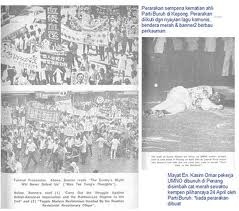
    DID THE HOME MINISTER PURPOSELY ALLOW A FUNERAL PROCESSION AFTER THE POLICE HAD DENIED ITS PERMIT?

    (read more about the Home Ministry over-riding the police’s decision to deny a funeral procession permit)

    It was not certain why was the permit for the funeral procession of the Labour Party member denied by the police. It was either because of the pro-communists wanted it held on Elections eve, or because the organisers wanted an extended route, or whether because they did not want to be policed by the ‘red helmets’ (FRU).

    An appeal was made to the concurrent Home Affairs Minister, Tun Razak who, like Tunku and the other ministers, was back in his constituency, Pekan. His concern was that no cause should be given to anybody to disturb the elections. So, he approved the permit as per the application.

    But without the FRU to police, the procession really went to town. With 10,000 people in the procession, coupled with its shouted and hand-carried slogans crying blood debt will be paid with blood, it set the tone for the behaviour of the two opposition processions post-elections on the 11th and 12th of May.

    As for the reported Tunku Tapes, I have not heard them, nor do I know when in the duration of Tunku’s life, were the recordings made. It could have been made in his twilight years, out of spite, much like Kua Kia Soong’s writings.