Re-Produced: Hatyai Accord: The Failure Of The Domino Theory – Part 3

On the eve of the 55th Merdeka anniversary, uninformed youths, blind to history, displayed flags they said should be the Malaysian flag. As a former military officer who has seen the National Flag draped the coffin of fallen squad mates and subordinates, I find their action, for a lack of better word, disturbing. I seriously hope the Ministry of Home Affairs would take action against them. Politicians attempting to cause dissent among non-Malays, Sabahans and Sarawakians should also be taken action against.

Current political scenario is not new to this nation. The acts of certain politicians mimic those of the Communist Party of Malaya, and a certain significant political party back in the 1960s.

The following article was written during the Merdeka month last year as the third and final instalment about the communists’ armed struggle against this nation.

—————————————————————————————————–

As mentioned in the previous posting, the CPM split into two factions in October 1974: the CPM and the MPLA (CPM-Marxist-Leninist).

In 1975, the Chinese-backed Khmer Rouge ousted the Cambodian military government and began a reign of terror. In Vietnam, Soviet-backed North Vietnamese Army rolled into Saigon, effectively ending the Vietnam War. By December 1975, Laos too, fell to the Communists. In South-East Asia, there was real fear that the ASEAN nations would be next to fall to Communism – the Domino Theory was born.

Both the CPM and MPLA’s spirit were boosted by this new turn of events. Their activities peaked in 1975. There were bombings of the National Monument (Tugu Negara), the Police Field Force camp in Jalan Pekeliling in Kuala Lumpur Having scored a morale-boosting victory by assassinating the Inspector-General of Police, Tan Sri Abdul Rahman Hashim, a year earlier, they set their sights on Tan Sri Yuen Yuet Leng’s predecessor, Tan Sri Jimmy Khoo Chong Khong, the Chief Police Officer of Perak.

Tan Sri Khoo was ambushed near the Ipoh General Hospital by the same assassins that murdered the IGP. His brave driver, Sergeant Chong, returned fire despite having being hit repeatedly by the assassins’ bullets. Sergeant Chong died soon after, but not before injuring one of the assassins in the head that then led the police to them.

Between 1976 and 1977, the Malaysian media was filled with nothing but stories of ambushes and attacks by the communist terrorists against the police and the military.

When Chairman Mao Zedong died, Deng Xiaoping returned to mainstream politics. Given his rapport with Chin Peng, the CPM was fueled to up the revolutionary ante. However, in 1978 Deng visited Thailand, Kuala Lumpur and Singapore, and was convinced to stop exporting Communism. As a result, in 1981 Deng ordered the ‘Suara Revolusi Malaya’ to stop broadcasting.

The CPM had had to relocate the radio station to South Thailand and renamed it ‘Suara Demokrasi.’ Starved of support, the CPM and MPLA were riddled with internal strife and political cleansing (including the execution of suspected counter-revolutionaries) that their effectiveness was greatly reduced.

The MPLA changed its name to the Malayan People’s Army (MPA) in 1982. One of the last gunbattles that occurred in the vicinity of Kuala Lumpur was in May 1983, on the day my paternal grandmother died. A patrol car chanced upon a group of Min Yuens and communist terrorists near what was Mimaland in Gombak. In the gunbattle, one policeman and one CT were killed, while the other policeman and another CT were injured.

The West Betong and Sadao groups of the CPM decided to surrender themselves to the Thai government in 1987 when they realised their struggle was not achieving any success, and with no clear political or military objectives.
On 2nd December 1989, the Communists gave up armed struggle and signed a peace treaty with the governments of Malaysia and Thailand, ending the Second Emergency.
——————————————————————————–
So, were the communist terrorists freedom-fighters as claimed by some parties?

When the Federation of Malaya achieved independence, the CPM had lost all clout in fighting “imperialism” and “colonialism”; yet it continued to do so, and even refused to recognise the formation of the Federation of Malaysia in 1963 by supporting the Indonesian campaign of lynching Malaysia (Ganyang Malaysia).

Let us also not forget that the CPM’s counterparts in especially Sarawak continued to wage war against the government ’til 1989. Among those killed fighting the terrorists in Sarawak was Superintendent Joni Mustapha, a Sarawak hurdler in 1958-59.

Joni was loyal to his men. He was in a cinema in Sibu watching a movie with his son when he got word that his men were pinned down by heavily armed terrorists upriver. He left his son behind and travelled by boat to reach his men. He was felled by machinegun fire, but remained to direct the firefight against the terrorists until he died. Seeing his commander die, Corporal Nguing, an Iban warrior, unsheathed his machete and charged at the terrorists only to be mown down.

Therefore, the communists terrorists not only fought against what some perceived as the “puppet-regime” in Kuala Lumpur, they fought against Malaysians on every inch of this hallowed soil trying to introduce communism, and turn this beloved country of ours into either a China-leaning satellite, or a Soviet-leaning one. It was never a nationalistic fight for freedom as claimed by some mentally-skewed politicians and their supporters either.

There is nothing nationalistic about joining the forces of a foreign-nation to lynch your own people, if the CPM ever regarded Malaysians as their own. Remember, the CPM waged war against the Malaysian people for 32 years after the independence.

Was the fight against the communists solely a malay struggle as claimed by a former Minister? No. Kanang ak Langkau is an Iban. So was Corporal Nguing. Tan Sri Khoo Chong Khong, Tan Sri Yuen Yuet Leng, Colonel Chong Kheng Lay – chinese. Former DSP Jeganathan, whom I had the honour of working with, is an Indian. He was absorbed into the Special Branch from Jabatan Talikom to set up the police VHF network, jungle-bashing, ploughing his way through to construct towers in the jungle with the communists hot on him. Inspectors Kamalanathan and Robert Cheah were injured when a grenade was lobbed into the Ipoh coffee shop where they were having coffee. I worked briefly with Kamalanathan who still limped in 1995 with a shrapnel lodged inside him decades after the incident.

It was a war against all of us, Malaysians – free and independent Malaysians, by godless creatures who call themselves freedom fighters, a war that none of us Malaysians should ever forget, and against those none of us should ever support.

The people of Malaysia, the Malaysian Armed Forces, the Royal Malaysian Police, should always be on guard for a resurgence of communism in Malaysia. The peace treaty of 1989 was just a declaration of the end of an armed struggle; not the giving up of the communist ideology.
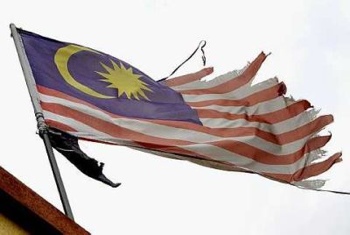
55 And Still Without Political Integrity

20120830-201327.jpg

Malaysia celebrates 55 years of independence. For those who think that this nation only came into being on 16th September 1963, let me tell you that the name of this nation was changed to the Federation of Malaysia to include Sabah, Sarawak and Singapore. Both Alaska and Hawaii joined the United States of America in 1959, but to people from those states 4th of July 1776 is their Independence Day.

For politicians who are trying hard to make the people of Sabah and Sarawak think of themselves as being separated from those on the peninsula, shame on you for trying to tear this nation apart for your political gains.

55 years on, political integrity is what we lack, and that is a big shame to us all. The thing most synonymous with politicians is corruption. I am not just talking about those from the Barisan Nasional, but also those in the loose opposition coalition that calls themselves, ironically, the Pakatan Rakyat. While money politics is still rife within UMNO, we hear of corrupt practices within the Pakatan Rakyat itself. I will let you Google for the links to these yourselves.

Corruption amongst politicians only proves one thing: that power corrupts, and absolute power absolutely corrupts. With power comes the opportunity to enrich one’s self, and to stay in power, one needs to buy his way into a recognised position. And the amount can only increase each time.

The problem lies with us, human beings. God is intangible. Heaven and hell are intangible. Rewards and Sins are intangible. Which is why some people do things without the slightest guilt.

Of course political corruption is not peculiar to Malaysia only, as it is also evident in other nations including in the west, but this is not an excuse for us to accept it as a norm. Political corruption is something that we must all take as a responsibility to eradicate, or curtail. And this is something that needs to be addressed by us as voters to determine the candidates to choose, rather than by party. UNLESS, all political parties can make one important move.

As a voter, I would like all political parties to submit their list of election candidates to the Malaysian Anti Corruption Commission and the Royal Malaysian Police, for the potential candidates to be vetted thoroughly. Only names that have been cleared by BOTH agencies, not either or, can stand for elections. That is one way to ensure that voters are not shortchanged by political parties, especially ones that put whoever they have so they could contest.

As voters, we have the responsibility to choose the correct candidates to represent us. Of course, this process would be made easier had the candidate been cleared by the two agencies I mentioned above.

We must strive to choose only candidates who are able to uphold the Constitution, Law and Order, and Justice. We must choose candidates whom have the ability to lead, bring about development and have a certain specialisation. We should choose only candidates who are interested in serving us, not the other way round. What politicians who hold public posts now think is that they are the VIPs and the people should serve them. What they have forgotten is that they are to represent us, help solve our problems. For that reason they are the Wakils Rakyat, not Boss Rakyat. Sad to say that only P Kamalanathan of Hulu Selangor deserves the Yang Berhormat title. He deserves that respect without reservation.

We must ensure the culture of politics with integrity as our way of life as only this can ensure that we continue to live as one, and continue to enjoy this independence. Those with greed for power should be shunned by all and never be allowed to hold office, for that would be like allowing a cancerous cell to spread.

We must ensure that the Executive Branch of the Government administers this nation with proper engagements with the relevant government departments, and not run the country on their own. We have no time for members of the Executive Branch who are only interested in making money.

We must ensure that our representatives in the Legislative Branch do their job as entrusted to them by us the Voters. They must attend sittings and not play truant, and they should debate a bill through and not walk out. If they disagree with anything at all, they should vote any bill out as a registration of protest…not walk out and cheat their voters of their voice. I also hope to see the end of the Whip System as this will ensure that any bill that is to be tabled is thought through and through by all members before it is tabled on the floor. This is to ensure that the party that tables the bill, tables a quality bill that has the support of the significant majority of its members.

We must ensure that the Judiciary Branch remains independent and is free of corruption. The integrity of the Judiciary Branch is key to the preservation of the Government’s integrity.

We must remember that we, the Voters, are the important component in a traveling bus. We elect our representatives to drive the bus, but it is the Voters who determine the destination the representatives ought to drive to.

Remember, if we do not preserve the integrity of us, as Voters, and the integrity of those we have chosen as the driver of this nation, we may not see another 55 years of an independent Malaysia. Preserve integrity and choose wisely, not emotionally.

Selamat menghayati erti Kemerdekaan.

Re-Produced: Hatyai Accord – The Failure Of The Domino Theory – Part 2

I wrote this continuation of the armed struggle by the Communist Party of Malaya last year. Reeling from losses and lack of support from Malayans, followed by Malaysians, Chin Peng sought the help of China to sponsor its attempt to turn Malaysia into a communist satellite.

——————————————————————————————————-

After the failure of the Communist Party of Malaya’s (CPM) revolt against British colonial rule and the subsequent independent Federation of Malaya’s government, the CPM retreated almost in full to Southern Thailand. In 1961, Chin Peng, leader of the CPM moved to China and sought support from Beijing. Deng Xiaoping, who was the most influential Chinese leader of the time although he never held any head of state office, promised Chin Peng a sum of US$100,000 in support of the CPM’s struggle.

In 1963, when Sabah, Sarawak and Singapore chose to join the Federation of Malaya to form the Federation of Malaysia, Indonesia objected violently by launching a campaign to lynch the newly-formed country out of existence dubbed “Ganyang Malaysia.” The CPM joined the Indonesian forces to fight against the people of Malaysia.

On New Year’s Day in 1968, the Communist Party of China launched the “Cultural Revolution”. The CPM, taking this as a queue and in conjunction with the celebration of the 20th anniversary of the beginning of the first Malayan Emergency, issued on 1st June 1968 a directive: “Hold High the Great Red Banner of Armed Struggle and Valiantly March Forward.” The first act, 16 days later, was to ambush the security forces and murdered 17 of its members in the Kroh area in Perak. Thus begins the Second Emergency. A year later, with the support of the Communist Party of China, the CPM began transmitting “Suara Revolusi Malaya” from the Hunan province, aimed to gather momentum and support from sleeper-agents, CPM members in South Thailand, and communist symphatizers who remained at large.

When Malaysia and Singapore parted ways, the DAP took up the role of the PAP. There were demonstrations and strikes almost on a weekly basis organised by the DAP. With the party being predominantly Chinese, race relations took a toll. This fact was successfully exploited by the CPM. The CPM indoctrinated people at all levels: Chinese civil servants, student leaders, trades unionists, the non-Malay members of the Armed Forces and Police, the middle classes with their ideology. All it did was to portray that the malays dominated the political scene while the chinese and Indians were relegated to being second-class citizens. Does this ring a bell? By 1969, the damage to race relations was just waiting for the final straw to break its back.

Those who were born after 1970 will never be able to recall how a curfew siren sounds like, but this writer had had that experience of rushing home (our quarters was not only fenced up using the normal chain-link fence, the perimeter chain-link fence was covered in total by barbed wire) every time the siren sounded. Those were the days when our boys in blue had to fight on two fronts: against the communists, and against the common criminal.

Fresh from the race riots of May 1969, the government felt that it could not afford any more ethnic antipathy. During the First (Malayan) Emergency, the setting up of New Villages by order of General Templer caused other races to look at the Chinese population as communist-symphatizers, when the truth was far from it. The government of Malaysia rightfully did not declare the Second Emergency as one, but instead learned from the Briggs Plan that the only way to win the war against the communists was through the tandem improvement of security and development: KESBAN – Keselamatan dan Pembangunan (Security and Development).

KESBAN was carried out to protect the people from subversion, insurgency and a state of lawlessness. It saw the coordination of all agencies from kampung level all the way up. I had had the opportunity to work under Tan Sri Yuen Yuet Leng (one of the heroes of Operation Ginger during the First Emergency), who as the Chief Police Officer of Perak, had to fight not just the war against the communists but also against common criminals. He related to me how, when the police force was stretched thin in Perak, called all the head of gangsters in Perak and appointed them as Rukun Tetangga heads.

“They were born leaders with natural leadership skills. All I had to do was channel those skills to positive use.”

The newly-appointed Rukun Tetangga heads were given the task to uphold the law and maintain peace and order. Any gang member found breaking the law would be surrendered to the police, else the leader will be arrested. This ploy work, crime was drastically reduced, and the police had a freer hand in combatting the communist terrorists in Perak.

The Rukun Tetangga (Neighbourhood Watch) was born out of KESBAN. It saw people of all races work together to keep their neighbourhood peaceful; but what it did most was to foster a good relationship and understanding between races. People were more tolerant of each other back then than they are now. Mind you, it was around half a decade after the race riots of 1969. No one, save for a few, cared whether one was Malay, Indian or Chinese, or Muslim, Christian, Buddhist, Tao or Hindu. They were all Malaysians back then.

KESBAN also allowed for development to reach the rural areas; where there was no electricity, some kampungs began to enjoy at least 12-hour electricity supply per day, with the police and military guarding the power supply network from the occasional sabotage by the CPM. Once more rural areas were developed and connected, the communist terrorists moved further deep inside the jungle.

KESBAN would not have been possible had it not been for the establishment of diplomatic ties between China and Malaysia. In February 1972, US President Nixon established diplomatic ties with Communist China in order to stem the influence of the Soviet Union in East Asia. The late Tun Abdul Razak did so in 1974. China warmed up to Malaysia. Everywhere the Malaysian delegation went, children lined up the streets waving the flags of both nation.

One must remember that back in 1961, Chin Peng had gone to meet with Deng Xiaoping. The latter enjoyed strong support in the Communist Party of China but was not in good terms with Chairman Mao. The diplomatic ties between Mao and Razak was in a way a hint to Chin Peng and Deng. The CPM retaliated with the assissination of Tan Sri Abdul Rahman Hashim, the then Inspector-General of Police a week later.

Due to the relationship between China and Malaysia, in October 1974, the CPM saw a split in its ranks, and eventually a split in the organisation. The CPM Marxist-Leninist, a splinter group leaning towards the Soviet Union was born. This group was then renamed the Malayan People’s Liberation Army.

IN PART 3 I WILL WRITE MORE ON THE SECOND EMERGENCY TO ITS EVENTUAL COLLAPSE