This morning I was labelled a ‘Malay supremacist‘ by two non-Malays on Twitter for presenting my views on the Syariah Court (Criminal Jurisdiction) Bill to be proposed by PAS President Haji Hadi Awang. They claim that I was trying to push my idea to them but at the same time ignore the fact that they were pushing their views to me for me to accept.
Then, I saw this on The Star and cannot believe my eyes that this is being said by our very own lawmakers!
A screenshot of The Star on the objection to having two legal systems
Imagine our lawmakers, all born before Malaysia was formed, do not know that the two legal systems have been in place even before 31 August 1957, and was adopted into the Federal Constitution of 16 September 1963 when it was accepted by both North Borneo and Sarawak that entered a Federation with the other states of Malaya to form Malaysia. The Federal Constitution even says that the Attorney-General does not have any jurisdiction over Syariah matters – clearly drawing the line between the two systems.
I have written at length on this matter prior to this. Please refer to the following:
The fear came about when Kelantan state assembly passed its Syariah Offences (II) Enactment last year that includes crimes of theft, fornication and so on prescribing the amputation of limbs, stoning et cetera. Since the punishments prescribed are ultra vires in nature, Hadi Awang sought for the amendments to the Syariah Court (Criminal Jurisdiction) Act, 1965 (Act 355), dubbed by the uninformed as the Hadi Bill or Hudud Bill.
Citing the Bill as unconstitutional, the ill-informed began to attack the Bill at its earliest stage; while the Opposition uses it to mount attacks on UMNO for supporting the proposal to be tabled in Parliament, conveniently forgetting that the Federal Constitution is the supreme law of the land.
What Can Hadi Propose?
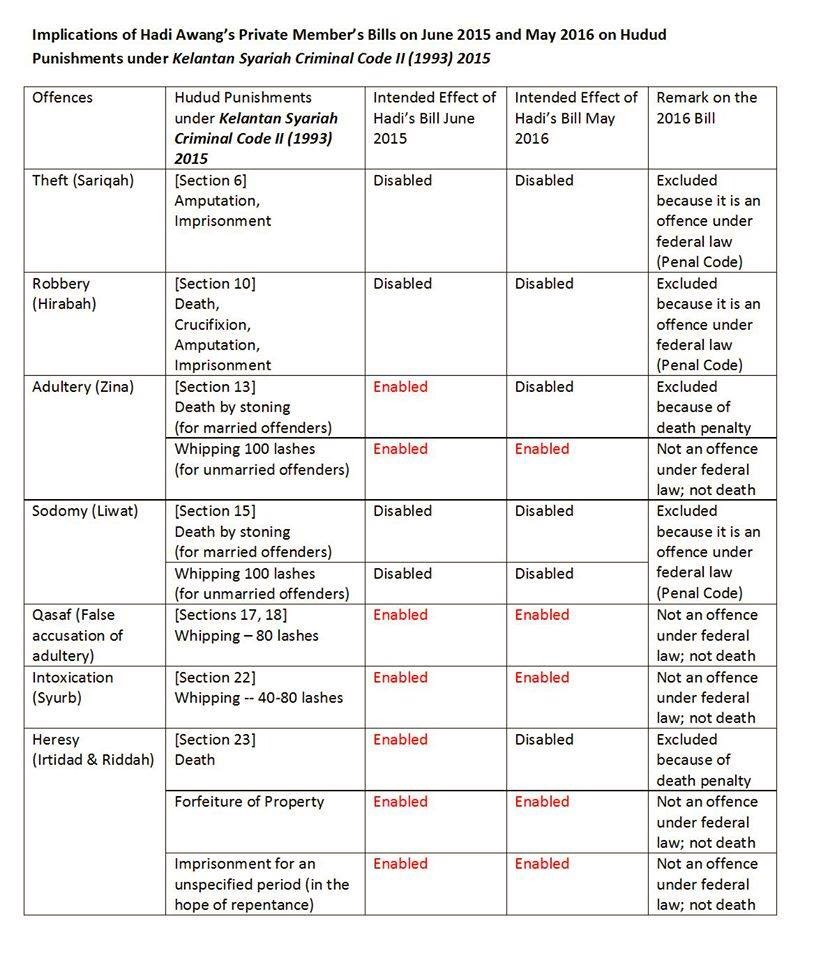
The following is the list of items that Hadi can seek amendments to:
Only the ones in red (Enabled) are the ones Hadi Awang could hope to propose in his Private Bill.
Does The Bill Affect Non-Muslims?
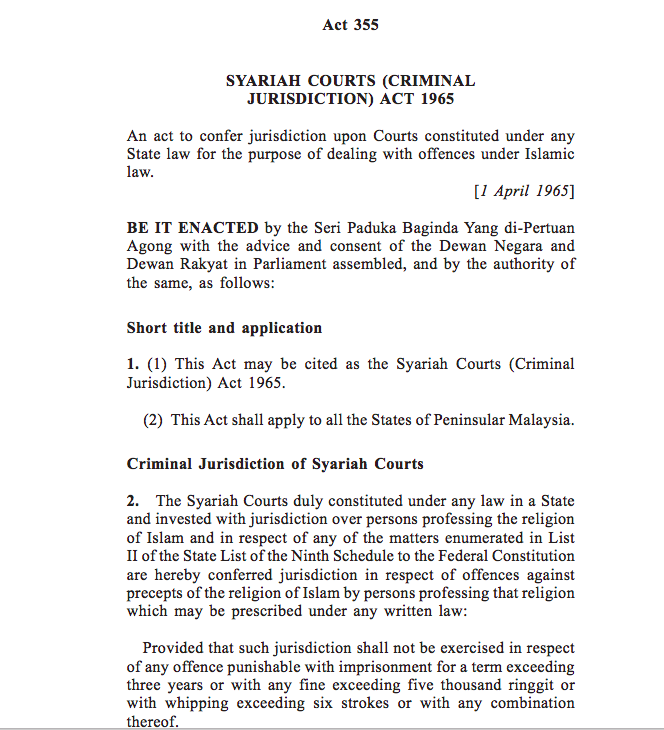
Like I mentioned, the two legal systems have co-existed in Malaysia since the formation of Malaysia. Let us see Section 2 of the Act:
Oh! The Act applies only to Muslims! So why are people jumping like monkeys?
And did Hadi Awang seek to include the non-Muslims in his amendments?
It still says ‘those professing Islam’ as religion. Again, why do people jump like monkeys?
So, no. Whatever you say or think, this law DOES NOT APPLY TO NON-MUSLIMS!
THIS LAW WILL PROMOTE DOUBLE JEOPARDY AND IS UNCONSTITUTIONAL
Have you no brain?
Hadi Awang merely seeks to increase the penalties, not expand the jurisdiction of the Syariah court! As per the table above, all offences covered by either the Penal Code or by any other law that was made under the ambit of the Federal Constitution cannot be charged under the Syariah law.
So how can there be double jeopardy? Murder, robbery, rape, sodomy, are all offences under the Penal Code of Malaysia. You cannot charge these offences under the Syariah law.
How Is The Process Now? What Does Hadi Awang Have To Do?
Any Member of Parliament not representing the ruling government who wants to table a Private Bill will have to apply to the August House for leave to do so. At the same time the said MP is to submit the Bill with an explanatory statement of reasons and objectives of the Bill.
Every such application will have to be in the form of a motion. Only when the House agrees with the motion will the Bill to have been deemed as being read for the first time.
After the first reading the Bill will then be printed and circulated to all members and the Minister in-charge of the subject of the Bill for scrutiny. Only when the Minister in-charge is done with the Bill will it then be reported to the House. After this report is made, the Bill shall be set down for second reading.
There are more stages and hurdles for the Bill to have to go through before it finally makes it as an approved Act, or thrown into the bin.
We are now still at the first stage – the application.
What Else Does The Federal Constitution Say About Each Other’s Religion?
We have Article 11(3)(a) in our Constitution which states:
Every religious group has the right to manage its own affairs
By intruding, isn’t this right given also to the Muslims in Malaysia being denied by the non-Muslims? Remember, Islam is the religion of the Federation and others are given the rights to practice theirs in peace and harmony.
There is nothing wrong with wanting to be a moderate. Moderation is what is preached in Islam. Moderation is what seems to be eroding by the day not just in Islam, but in other religions and cuts across the racial board as well. And this applies to every single country there is on the face of this Earth. And to have a group of people advocating moderation is a more-than-welcome effort in this young-but-amnesiac country that seems to have lost all institutional memory of the events that had brought about the Federal Constitution of Malaysia.
Reading the The Star’s interview with Tan Sri Alwi Jantan (Torchbearers for founding fathers – Sunday, 4th September 2016) I cannot help but agree to some of his points, but at the same time feel as if there is some form of misguidance, or misinterpretation of the Federal Constitution, and a deliberate misleading on the respected Tan Sri’s part.
I agree that rather than focusing on petty issues such as whether or not the Langkawi statue is haram, the religious councils as well as JAKIM should focus more on the development of correct as well as balanced knowledge on Islamic subjects such as Tauhid, Fardhus Ain and Kifayah. This is important to counter the influence of deviationists especially that of the Da’esh. However, religious as well as racial extremism is not confined to Islam alone. In the name of pluralism as advocated by the G25, there should only be single-stream schools. Children who do not grow up together will grow up apart. We can never talk about unity and understanding if we do not understand each other. Preserving the mother-tongue can be done after formal classes are over and this can be done at the school itself, perhaps after lunch. So could the Islamic religious classes. In the latter category, this would ensure that correct teachings are being imparted to the children rather than by private religious schools whose curriculum are not being monitored effectively by the religious councils. Also that way working parents do not need to worry about the whereabouts of their children and can pick them up at school after work, or a similar arrangement could be made.
In a plural society such as ours, the need for our children to grow up together for the sake of unity is paramount. Sending children to separate schools based on mother tongue rather than a common national language is against the spirit of the Constitution. When the Constitution was being drafted for it to be in operation by Merdeka Day 1957, the Reid Commission adopted the Alliance’s (UMNO, MCA and MIC) proposal to establish Malay as the official language of the Federation. However, there were differences on how to go about with this. Ng Ek Teong, the MCA representative submitted that English should be allowed to be used for official purposes for a minimum of 10 years. MIC was in support of this. Both MCA and MIC also proposed for Mandarin and Tamil be allowed to be used in the legislatures for a minimum period of 10 years. UMNO however proposed that English be allowed to be used for a maximum period of ten years after independence. Ng Ek Tong told the Commission that this would only serve as a temporary measure(Colonial Office CO 889/6, Minutes of Alliance hearing before the Reid Commission, 27 September 1956, pp 290-294). Tunku Abdul Rahman however said:
“At the end of 10 years, the general trend will be that people will still demand for it and the people who propose it now are not sure that they would be there to guarantee it. It is bound to cause a lot of debate later on.”(Ibid.)
Even Lord William Reid himself was not in favour of the proposal by MCA and MIC saying that it would cause practical difficulties (Ibid/Making of the Malayan Constitution, Joseph M Fernando, pp 128-129). It was for this reason that the Tunku promoted the Rumi script for the Malay language at the expense of the Jawi script to enable the non-Malays to learn the national language rapidly (Tunku Abdul Rahman (1984), op. cit., pp. 112-114). This has been enshrined in Article 152 of the Federal Constitution as well as in the National Language Act, 1963/1967.
The reality of it now is that the migrant workers from Bangladesh, Pakistan and Myanmar are more able to grasp the Malay language than many of our own Identity Card-wielding citizens. Mind you, they also stood still at Dataran Merdeka while the NegaraKu was being played. Our own citizens refuse to stand up when the NegaraKu was being played in the cinemas, extinguishing the very torch of our founding fathers.
The Constitution is secular only up to a certain point. The Reid Commission, commissioned by both Her Majesty The Queen of England and the Malay Rulers had initially omitted a proposal by the Malay Rulers to have Islam as the religion of the Federation. Reid saw it fit that matters of religion be handled only by the Ruler of the respective States, and that the special position of the Malays be reviewed after 15 years.
When the report was published, the strongest objections came from the man revered by Malaysians now as the father of multiracialism – Dato Onn Jaafar, who as the leader of Parti Negara said that the Malays had been let down. PAS claimed that the Malay interests had been cast aside (von Vorys (1975), op. cit., p.132). Hence, the Tunku later submitted that Islam be made the religion of the Federation with two provisos added: first that it would not affect the position of the Rulers as head of religion in their respective States; second, the practice and propagation of other religions to the non-Malays in the Federation would be assured under the Constitution (UMNO/SUA 154/56, Minutes of Alliance ad-hoc political sub-committee meeting, 2 April 1957).
Sir Donald Charles MacGillivray personally felt that such a provision would be advantageous because the Yang DiPertuan Agong could at the same time become the head of the faith in the Settlements of Penang and Malacca (CO 1030/524 (10), MacGillivray to Secretary of State, 25 February 1957; See also CO 1030/524 (18), MacGillivray to Secretary of State, 21 March 1957).
Fast forward to the present, Article 3 of the Federal Constitution has clearly mentioned Islam as the religion of the Federation with the Rulers being the Head of religion in their respetive States, while the Yang DiPertuan Agong becomes the Head of religion in the States of Pulau Pinang, Melaka, Sabah and Sarawak, as well as in the Federal Territories of Kuala Lumpur, Labuan and Putrajaya. It is not an official religion but the religion of the Federation. The provisos added to safeguard the practice and propagation of other religions are now enshrined in Article 11 with limits to propagate given in Clause 4 of the said Article, to safeguard and honour the position of Islam as the religion of the Federation.
There is even a separation of jurisdiction when it comes to the position of Islam in the Federal Constitution. The Syariah Law comes under the purview of the respective Rulers, and the Attorney-General of Malaysia, under Article 145(3) does not have the jurisdiction over proceedings before a Syariah court, a native court of a court-martial. This separation of jurisdition is also present as provided by Article 121(1A) where both the High Court of Malaya and High Court of Sabah and Sarawak do not have any jurisdiction over Syariah matters. Therefore, the respected Tan Sri should be aware that, borrowing the words of Sir Stamford Raffles in a 1815 letter to his cousin mentioned how “Religion and laws are so united” in Muslim dominated areas that the introduction of Christian beliefs will bring about “much mischief, much bitterness of heart and contention”. (Seademon, A Case For God, 1 Jan 2013) .
Even Act 355, the Syariah Courts (Criminal Jurisdiction) Act, 1965 (last revised in 1988) states the following:
1. (1) This Act may be cited as the Syariah Courts (Criminal Jurisdiction), 1965.
1. (2) This Act shall apply to all the States of Peninsular Malaysia.
2. The Syariah Courts duly constituted under any law in a State and invested with jurisdiction over persons professing the religion of Islam and in respect of any of the matters enumerated in List II of the State List of the Ninth Schedule to the Federal Constitution are hereby conferred jurisdiction in respect of offences against precepts of the religion of Islam by persons professing that religion which may be prescribed under any written law:
Provided that such jurisdiction shall not be exercised in respect of any offence punishable with imprisonment for a term exceeding three years or with any fine exceeding five thousand ringgit or with whipping exceeding six strokes or with any combination thereof.
The Act, clearly says that it first and foremost, applies to all States of the Peninsular Malaysia. It is not applicable to where the Yang DiPertuan Agong is the Head of religion ie. the Federal Territories, Sabah and Sarawak. Second, it applies only to Muslims and any matters in List II of the State List of the Ninth Schedule to the Federal Constitution. Third, it cannot propose any punishment that prescribes any jail term exceeding three years, or with any fine exceeding five thousand ringgit, or with whipping exceeding six strokes or with any combination thereof.
Therefore, there is no question of introducing stoning to death, amputation of limbs etc. Anything above those limitations will be referred to the Criminal Courts.
So, Tan Sri, care to explain how are secularism and pluralism being attacked with examples of provisos of the Federal Constitution or any laws made under it?
Finally, let me quote the interview given by the respected Tan Sri to The Star:
G25 has also expanded its scope to include good governance and tackling corruption. As not only the former head of the PSD but also former secretary-general in the Local Government and Federal Territory Ministry, Health Ministry and Agriculture Ministry, Alwi has focused on good governance, which he calls the precondition for a constitutional democracy: “Those in power must be made accountable for their actions and conduct.”
During his time, civil servants were able to do their jobs without fear or favour, he recalls. “The division of responsibilities between the politicians and civil servants was fairly clear cut.”
But over time good governance has been eroded at an alarming rate, he says.
“There are hardly any more checks and balances.”
What either the good Tan Sri or The Star have also failed to mention is the fact that for more than three years, Tan Sri Alwi Jantan was the Deputy Secretary-General for the Prime Minister’s Department under the founder of Parti Pribumi, Mahathir Mohamad. Mahathir’s now good friend, Lim Kit Siang, wrote not so long ago, on Thursday, 12 February 2015 at 12.57pm:
“This shows the rot in Malaysia, but it is a rot which was started during Mahathir’s 22-year premiership, and by Mahathir himself!
Today, Mahathir is obsessed with the toppling of Najib as Prime Minister, but this is not because he wanted to stop the rot in Malaysia, to restore the independence and integrity of the judiciary and a just rule of law; to end the subversion of the independence and professionalism of national institutions whether the civil service, the police, the elections commission or anti-corruption agency; eradicate rampant corruption; restore ethics and honesty in public life; re-establish a good education system or restore Malaysia’s economic competitiveness.
Mahathir wants Najib out as the Prime Minister for Malaysia, not to stop the rot which was started by him during his premiership, but for an agenda personal to himself.
This is the rot of Hamlet in Malaysia.”
I’m surprised the good Tan Sri had made no mention whatsoever of this episode. And he was a civil servant by definition, under the tutelage of the Pribumi person himself and remained in public service until 16 April 1990, thirteen years before Mahathir steped down.
So, Tan Sri, it is good that you want to become the torchbearer of the founding fathers of this blessed nation. However, please ensure that you are on the right path first before you decide to light that torch and guide others.
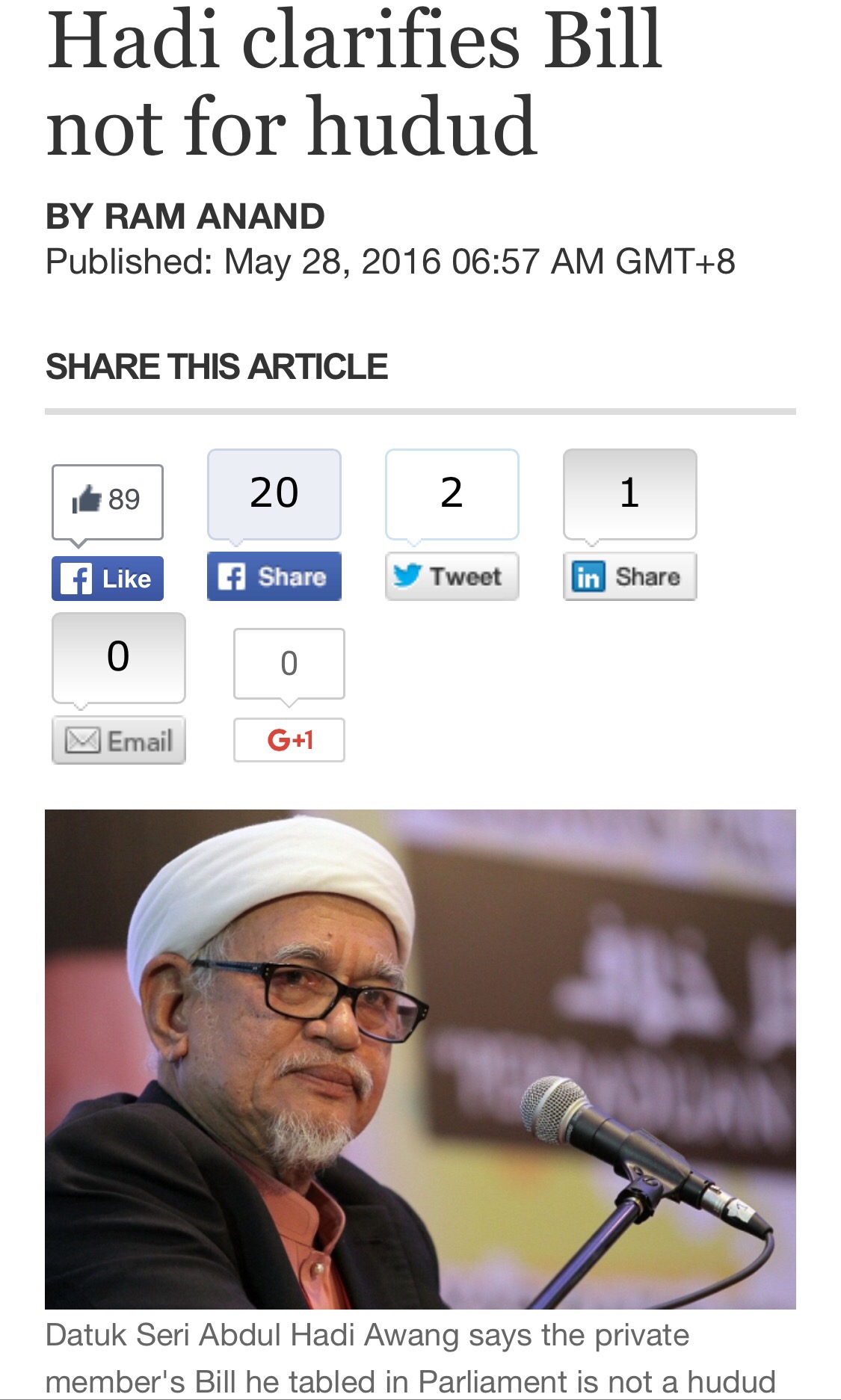
I wrote on Saturday how silly it is for people to go berserk over the private bill by Abd Hadi Awang of PAS seeking to enhance the Syariah Court (Criminal Jurisdiction) Act, 1965.
The religion of the Federation of Malaysia is Islam as given by Article 3(1) of the Federal Constitution. However, other religions may be practiced in peace and harmony. The words peace and harmony are written explicitly to underscore the fact that other religions are being protected by the Constitution. One must also remember the first part of that article stating that Islam is the religion of the Federation. It is the religion and not the official religion.
The British came to Malaya through treaties. The states of Malaya, save for Pulau Pinang and Melaka, were never colonies of Britain. Malaya consists of nine sovereign states. Four were the Federated Malay States while five were Unfederated. The religions of these states have always been Islam. This is evident in a letter from Stamford Raffles to his cousin, Reverend Thomas Raffles that “Religion and laws are so united” in Muslim dominated areas that the introduction of Christian beliefs will bring about “much mischief, much bitterness of heart and contention”. You can read more on this in a previous writing of mine called The Case for God .
I had had a lengthy debate with MCA’s Ti Lian Ker, a senior partner at Messrs Wong, Law & Ti, as he had went on to conduct a session for MCA members on the “far-reaching consequences of the Hudud bill.” When asked, Ti could not even tell me the name of the proposed bill.
For the benefit of the rest, the bill seeks to enhance the Syariah Court (Criminal Jurisdiction) Act, 1965; a law that is prescribed to Muslims only!
Ti asked me two questions: first – why the hush-hush before allowing Hadi to speak in Parliament about it? For a senior politician to not know the processes of a private bill tickles me. Hadi was merely seeking the August House’s permission to table the bill. He was not tabling the bill. And it is not a BN or UMNO bill. A private bill is a bill that is not proposed by the ruling government. It is proposed by members of the Opposition or backbenchers.
In this respect, Hannah Yeoh as the DAP Speaker for the Selangor State Assembly summed it up real well when Selangor UMNO actually wanted to table a Hudud bill for the state. Watch from 0:38.
Hadi, has as much right that has been accorded to other members of Parliament to table out anything, with the agreement of the House. For once I agree with PKR’s N Surendran who explained the process above.
Ti’s second question to me was:
This is what happens when you speak before your brain could even begin to think. Then you add chaos into the confusion. Article 145 of the Federal Constitution clearly states that the Attorney-General has no jurisdiction over Syariah laws. Syariah laws are made according to the sub-articles of Article 3. Imagine a senior partner of a law firm not knowing this. For the record, Ti never replied me.
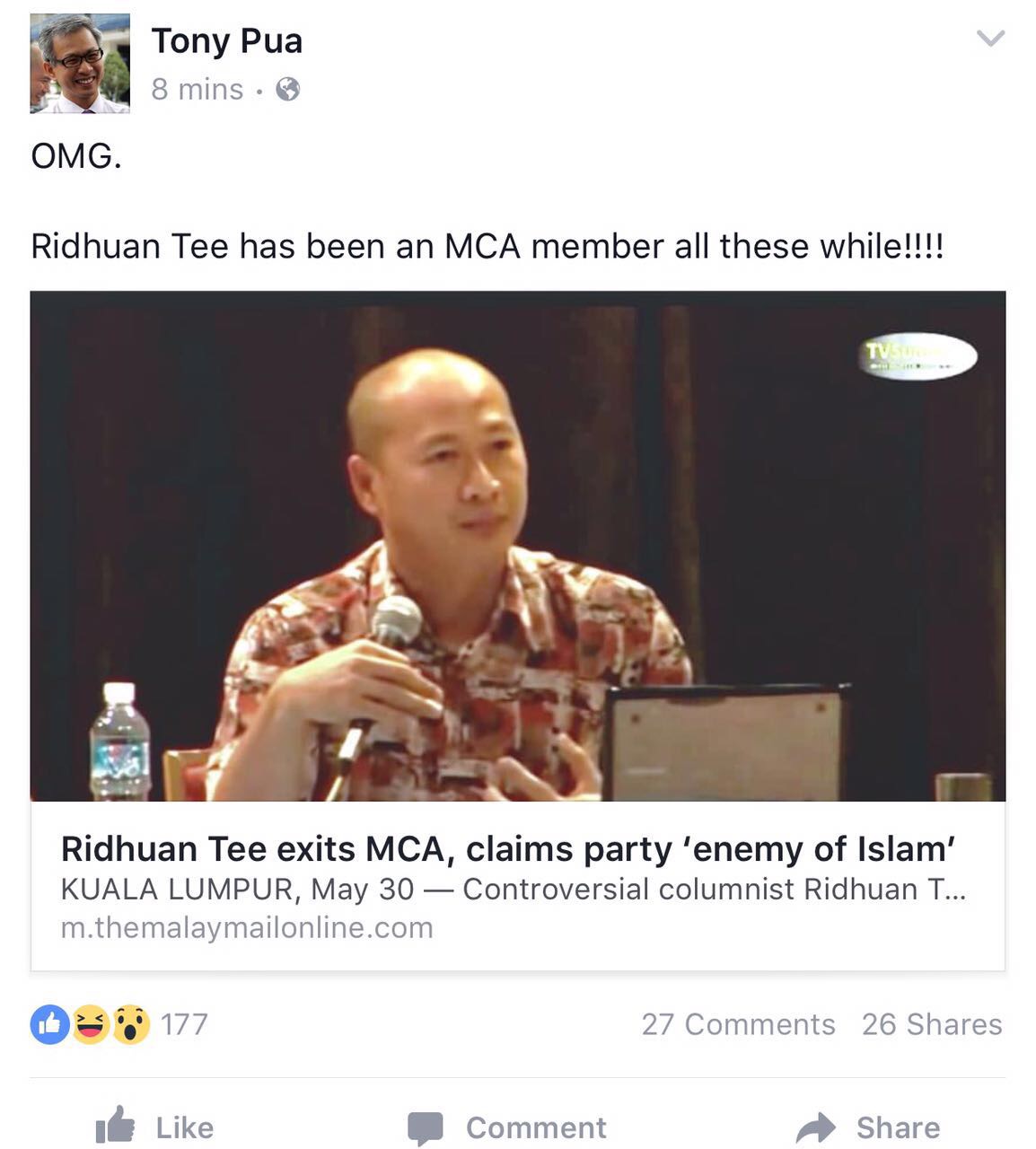
And isn’t it detrimental to the cohesion of the Barisan Nasional that a very ill-informed and non-Muslim person such as Ti to go around explaining to members of the MCA something even he does not grasp? Maybe he should have asked a very recently former MCA member to give clarification on the issue instead:
Some of Ti’s followers, concerned that actual Hudud would eventually be enforced, refused to read Articles 3(1), 11(1) of the Federal Constitution that protects the right to practice one’s religion in peace and harmony. Instead they cited Pakistan as an example of extreme Syariah laws.
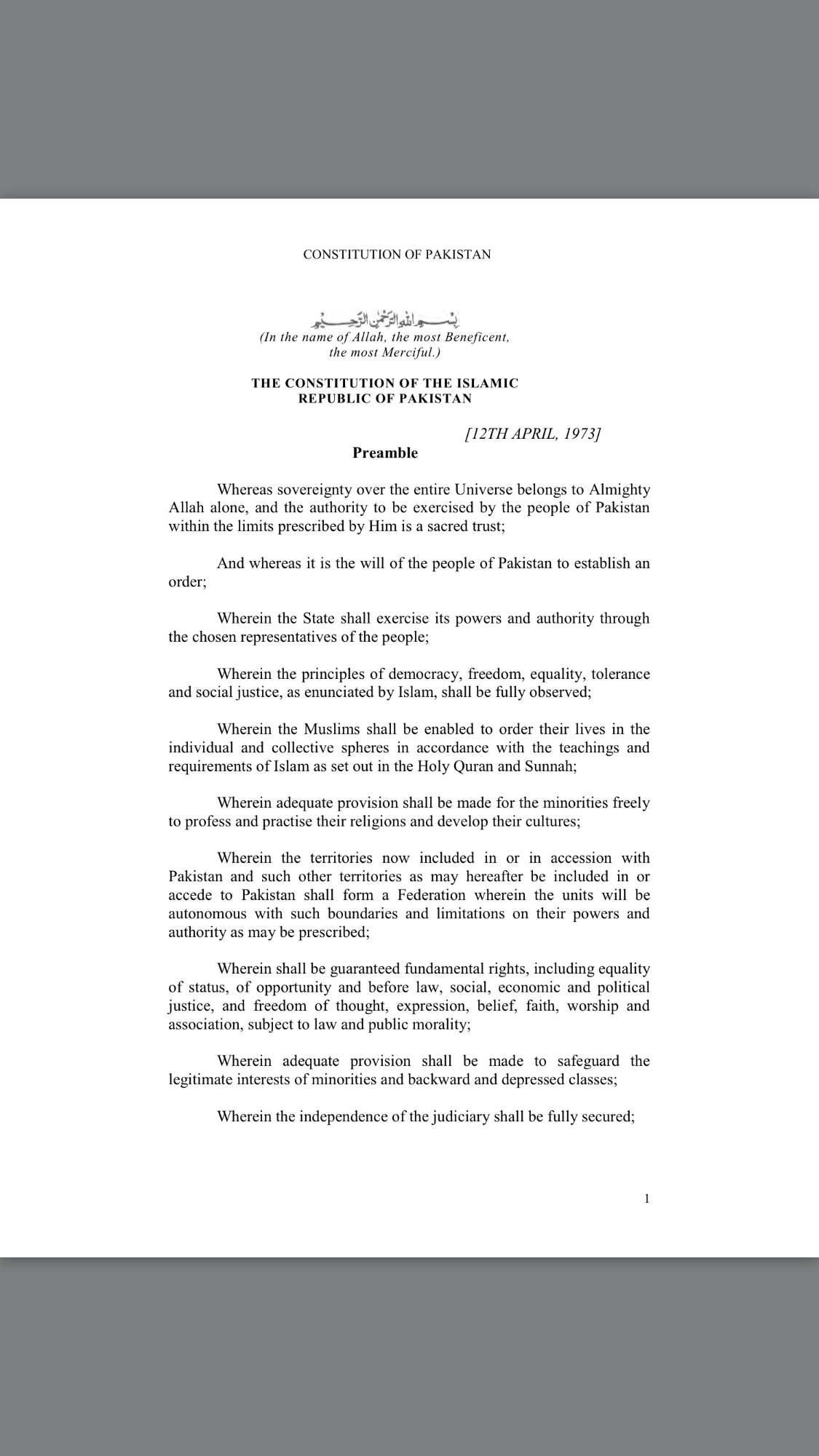
I don’t know what is it with people who don’t read. The official name of Pakistan itself is a dead giveaway. Since 1973, the country is known as The Islamic Republic of Pakistan. Even in the preambles of its Constitution clearly states the intent and spirit of the state and its Constitution:
Checkout how Article 2 of Pakistan’s Constitution differs greatly from Article 3 of ours:
We even have Article 11(3)(a) in our Constitution which states:
Every religious group has the right to manage its own affairs
By intruding, isn’t this right given also to the Muslims in Malaysia being denied by the non-Muslims? Remember, Islam is the religion of the Federation and others are given the rights to practice theirs in peace and harmony. So, why intrude into our affairs?
None of Ti’s followers or defenders quoted me those Articles as asked. Instead they continued to make comparisons between Malaysia and Pakistan.
Their concern is the “protection of the Constitution.” I have written on Saturday how the Federal Constitution remains the supreme law of the land. All the proposals submitted by Hadi that trangress the limits given by the Constitution have been shot down as shown in this table that has now been widely shared:
Let me ask you this: is there anywhere there that says the amendments include its application to non-Muslims? Any proposal for non-Muslim houses of worship to be torn down?
Now, remember! Hadi is merely seeking the permission to table the private bill. Until then he cannot do so. The house will have to debate this and vote on it. So instead of making monkeys out of themselves, shouldn’t the BN non-Muslim MPs take a step back and digest the House rules like smart people should? The following would have been totally unnecessary:
Really? We know that you did not get the lion’s share of your respective community’s votes and this is a good opportunity to try and garner support. You could have done it smartly by saying “we will seek clarification from Hadi and explain to our community” instead of jumping up and down without knowing head or tail about the proposal. It should be the Muslim community to react and not the rest as it would be their liberties affected. Mind you, most of the proposals are already laws in all the states.
Take queue from the Sarawak Progressive Democratic Party:
Perhaps the non-Muslim BN parties in the Peninsular too don’t believe in the democratic rights to speak as provided by the Parliamentary Standing Order No.49.
It is Dood Day + 3. And already there is a storm in the BN hood over Hudud.
Yesterday afternoon, a Kedah MCA man quit the party citing the failure of the MCA to stop UMNO from supporting the tabling of the Hudud bill in Parliament by PAS President Hadi Awang, and UMNO for failing to safeguard the Federal Constitution.
Malaysiakini report on the resignation of Mr Leong from the MCA
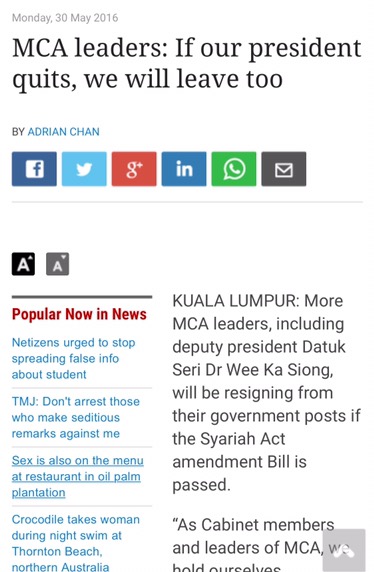
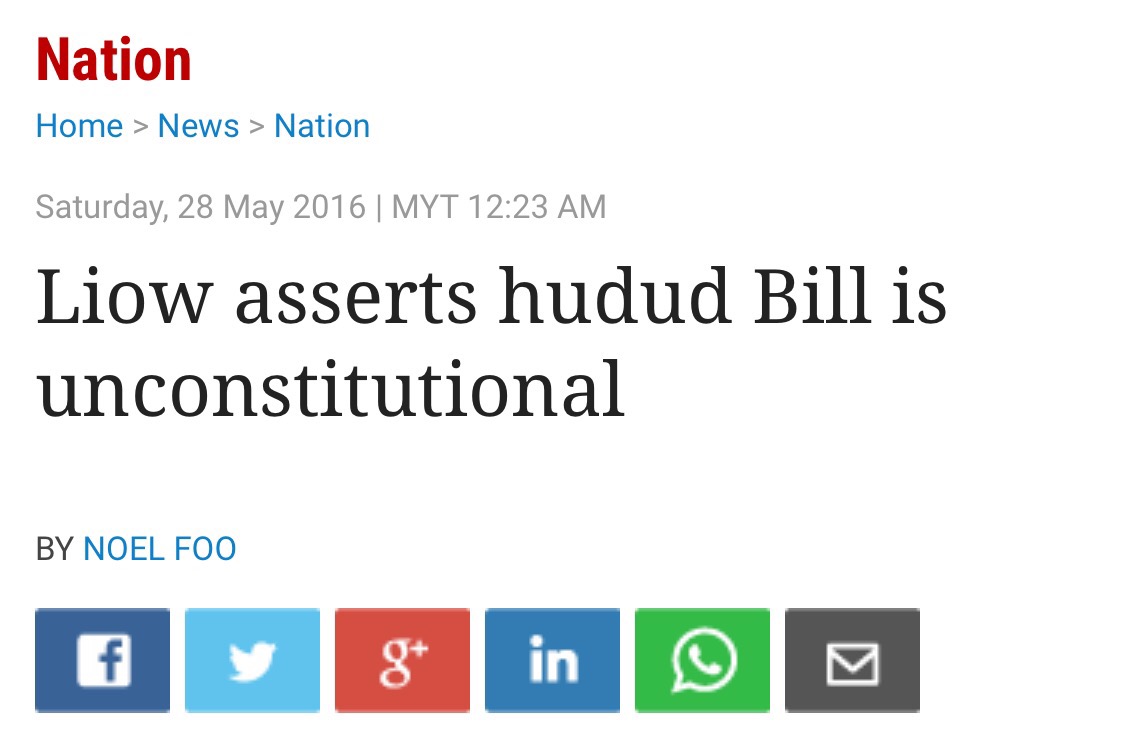
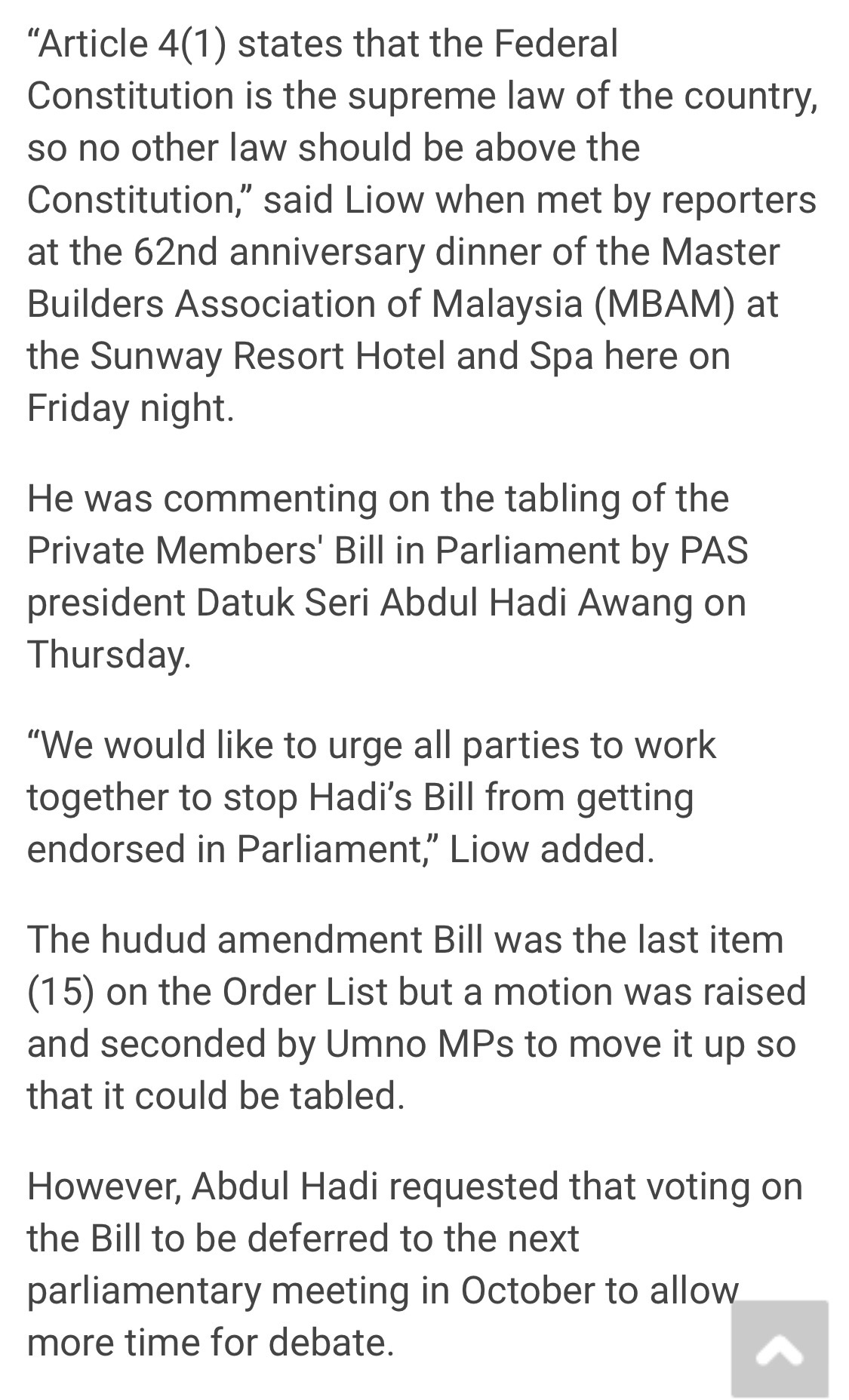
And today, MCA’s President, Liow Tiong Lai said that the tabling of the Hudud bill transgress the limits and is against the spirit of the Federal Constitution.
A report by The Star quoting Liow as saying the tabling of Hudud is unconstitutional “Unconstitutional”
“Spirit of the Federal Constitution”
Big words coming from the two gentlemen who have no inkling whatsoever of the meaning of those terms.
Firstly, the Federal Constitution through Article 3 explicitly states that Islam is the religion of the Federation. Article 11(1) guarantees those other than Muslims the freedom to practice their religion. That still holds true to this day although many non-Malays do unconstitutional acts such as the propagating of other religions to the Muslims (in contravention of Article 11(4).
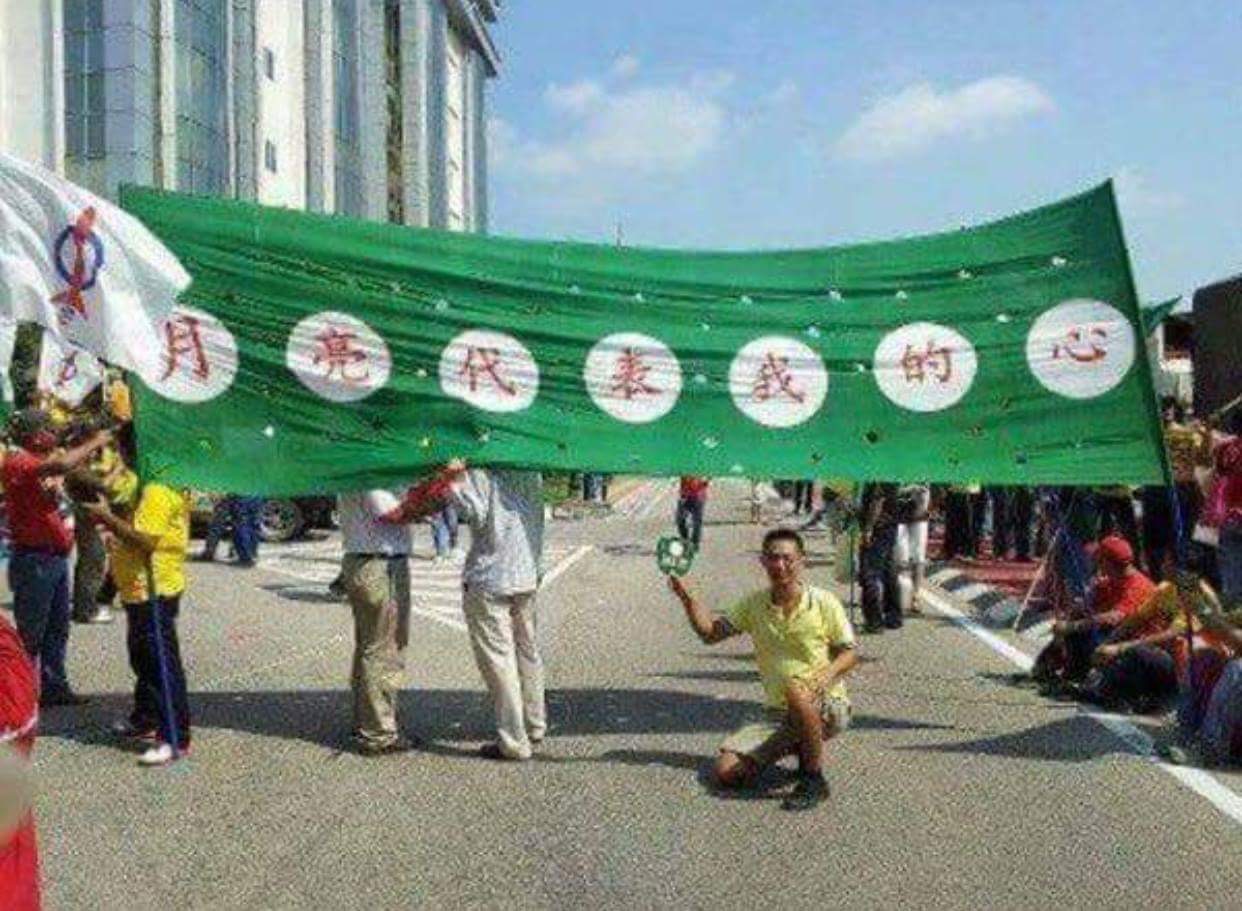
Let us go back to the year 2014 when PAS was in the heart of all DAP supporters:
“The Moon Represents My Heart” as in the Teresa Teng song. Dulu lain, kini lain, selamanya berlainan
In 2014,UMNO
proposed to table specifically a Hudud bill in Selangor. Now I want you to remember the words in BOLD above.
The above words in the red box says:
“The DAP speaker in Selangor also welcomes the tabling of Hudud in Selangor.”
They must be kidding, right? Karpal Singh would not have allowed this to happen (although his son never objected to this). Let us see what were said by both Anthony “Olok-Olok” Loke and Hannah “The Lamb Chop” Yeoh:
Now what have we here? Two DAP stalwarts support the tabling of the Hudud back in 2014. One even went to town telling people not to be afraid of Hudud, explaining what are involved and why people shouldn’t be afraid. This is what MCA should be doing.
Of course that was then and this is now.
Alas! MCA is NOT in the position to do so. You only see a handful of MCA people actually still fighting the real fight, like Tan Khai Beng, Lee Beng Seng, Ang Chor Keong, while the rest have mostly blended in with the Chinese supporters of the DAP as not to be left out, and the following is why:
GE13 support for BN by race
MCA could only garner less than 900,000 votes (including votes of the non-Chinese)!
Both Leong Yong Kong and Liow Tiong Lai probably suffer from this:
Not Yet Cooked Shoot Best
The bill that is being tabled by Hadi Awang is actually to seek amendment to the Syariah Court (Criminal Jurisdiction) Act, 1965. Remember nine paragraphs ago I asked you to remember the words in BOLD? The difference here is that this bill proposed by Hadi is NOT a Hudud bill, but one that seeks the enhancement of punishment for only a certain number of offences. This is to allow the Kelantan state government to apply such amendments in Kelantan.
And true to the spirit of the Federal Constitution, the proposals that went beyond the limits of the ones set by the laws made and passed under the Federal Constitution have been shot down even before the tabling of this bill!
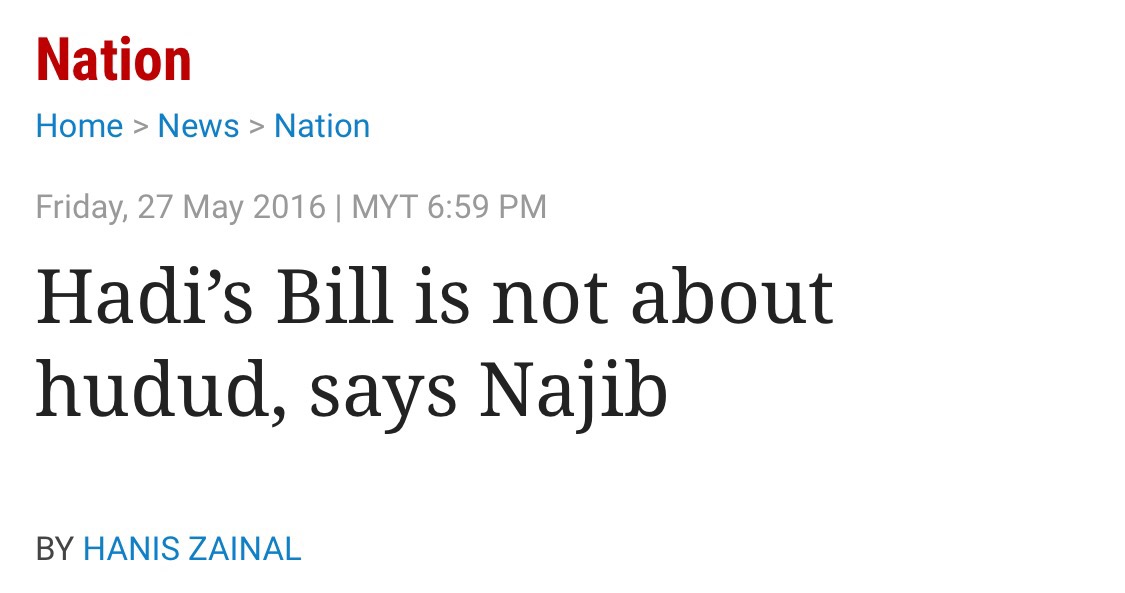
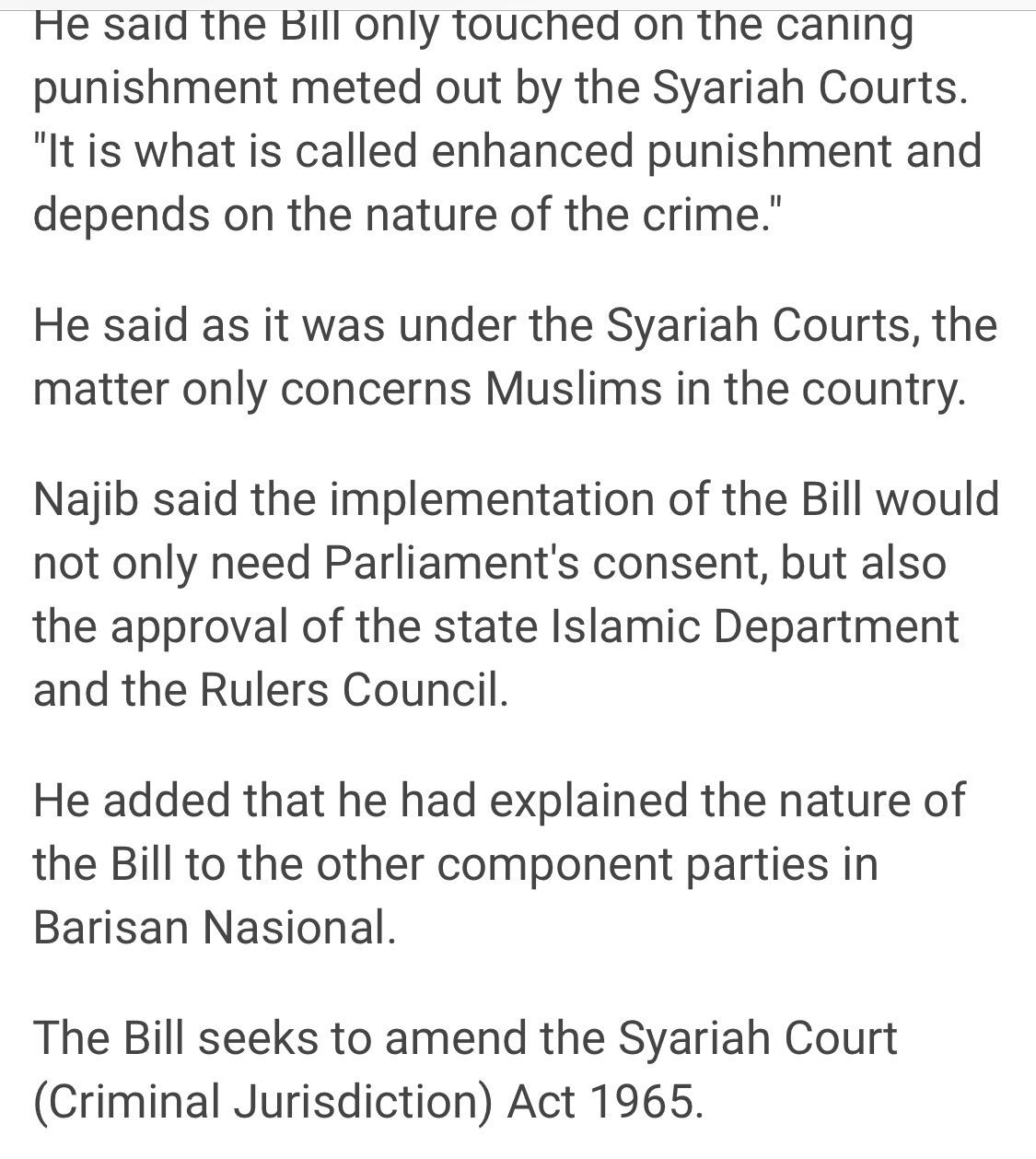
And what did Najib say about this yesterday?
Only after most of the proposals have been shot down for going against the limits of the Federal Constitution was Hadi allowes to table the bill:
APPLIES ONLY TO MUSLIMS
Even if this bill gets passed in Parliament it still needs the consent of the Rulers Council as well as the respective state religious authority to agree before it can be passed. And none affects the non-Muslims.
Where, oh Liow and Leong, is the transgression of the spirit of the Federal Constitution may I ask?
Next time do seek clarification before you start chewing on your foot, or use the stop-and-start method to prevent similar political premature ejaculation.
We all know he is just returning the favour Mahathir once gave during the Port Klang Free Zone (PKFZ) when Mahathir conveniently forgot everything when he keeps saying now he is not senile. And because of Mahathir’s temporary loss of memory Liong Sik was let off the hook, and that contributed to MCA’s bad image in the eyes if the Chinese voters.
Ling Liong Sik should just spend the twilight years repenting for his contribution to the downfall in Chinese support for the MCA while advising Mahathir to do the same, instead of trying to meddle in UMNO’s affairs.
Unless Mahathir has again forgotten the sins of he and Liong Sik in the PKFZ fiasco.
The philosopher Jorge Agustín Nicolás Ruiz de Santayana y Borrás or George Santayana once said that those who do not remember the past are condemned to repeat it. The recurrence of history is part of life’s cycle, but always in different forms. Those who do not remember how certain historical lows were handled are bound to make even bigger mistakes.
Recently, there was a furor following the statement made by UMNO’s Ismail Sabri , the Agriculture and Agro-Based Industries Minister, asking consumers to boycott greedy Chinese businesses. While it is normal to hear the communal-party-disguised-as-a-non-communal-party DAP lashing out at Ismail Sabri, the call by MCA’s Youth Chief, Chong Sin Woon, for the sacking of Ismail Sabri did not go down well with UMNO and 92 Divisions of the latter rallied behind Ismail asking for Sin Woon to be sacked instead.
While I refuse to indulge in a debate over what was said by Ismail Sabri, there is a need for consumers to boycott profiteering businesses who whine about high cost of fuel and pressured the government to allow them to increase the price of their services, but refused to lower prices when the price of fuel has gone down by half. What I am more interested in is the bittersweet alliance between UMNO and MCA, and how history is repeating itself.
While the movement for the independence of Malaya had started decades before, there was no cohesion between races. In 1946 when the Malayan Union was formed, the republican-in-nature Partai Kebangsaan Melayu Malaya (PKMM) and the non-Malay Malayan Democratic Union (MDU) were quick to support the formation. The PKMM, a spin-off from the Batavia-leaning KMM of Ibrahim Yaacob, was all for a Malaya not ruled by the Malay Rulers, while the MDU liked the idea of automatic citizenship (read more in Seademon’s The Road To Merdeka: Persekutuan Tanah China ) for the immigrants. On 1st March 1946, more than 40 Malay organisations met up and 41 decided to form the United Malays National Organisation (UMNO) to champion the Malay rights. The Malays were then a minority in his own land, poor, sidelined from economic development, health care and formal education. With the help and encouragement of the then-British High Commissioner, Sir Henry Gurney, the Malayan Chinese Association (MCA) was formed on the 27th February, 1949. Gurney aimed at winning the allegiance of the Chinese community away from the Communist Party of Malaya (CPM) (Colonial Office Record 537/773(1) Memorandum by Henry Gurney, 28th January, 1949).
There was apprehension and distrust between the Malays and Chinese. The alienation of the Malays by Chinese mining tycoons and rubber estate owners, followed by the preference of the Japanese of the Malays over the immigrant Chinese, and this in turn followed by retribution against the Malays by Chinese sympathizers of the CPM after the Japanese surrender have had contributed enormously to this animosity between the two.
It was since 1950 that Henry Gurney had wanted to introduce some form of democracy to Malaya through elections to satisfy the public’s hunger for democracy versus the communist’s way of winning self-government. Alas, he was only a High Commissioner and still had to go through the true rulers of the Federation of Malaya – The Malay Rulers. So, during the 10th Malay Rulers Meeting on the 22nd and 23rd February, 1950, Gurney presented his recommendation, only to be met with reluctance of the Malay Rulers. In the minutes of meeting, the Sultan of Kedah stated his reservation:
“The most important prerequisite for democracy is education. Without enlightened public opinion a democratic system of Government will be liable to unsteadiness or even confusion and chaos. One danger is that it may be transformed into a single party government through a few skilled electioneers working among the apathetic population and this will work towards dictatorship.” (Colonial Office Records 537/6025(1))
The Malays, as mentioned above, were left behind educationally and may not know what is best for them. For the same reason the PKMM and MDU were in full support of the Malayan Union four years prior to this event. And whatever the outcome, the Malays would have ended up the biggest losers if no one champions their rights. Noted William L Holland in “Nationalism in Malaya” (WL Holland, 1953):
“There was already Malay discontent in the pre-war period over the poor economic position vis-a-vis the Chinese and Indians. Malay peasants and fishermen, noted S.H Silcock and Ungku Aziz, were dependent on Chinese middlemen while Malays worked as messengers in offices where Chinese and Indians were clerks.”
The phrases made bold above by me, still holds true today and became the basis of Ismail Sabri’s main grouse against profiteering businessmen.
Gurney had to bring about some form of democratic self-rule that would benefit all races. Separately he discussed on numerous occasions with both MCA and Dato’ Onn and impressed upon them that self-rule would only happen if there is a closer relations between the communities (The Making of the Malayan Constitution, Joseph M Fernando, 2002, Page 15). Gurney was all for the promotion of Sino-Malay talks to tackle long-term problems. Gurney minuted the following:
“The outstanding issues at that stage were citizenship and the economic backwardness of the Malays. The Chinese leaders sought a more liberalised citizenship than those contained in the 1948 Federation of Malaya Agreement. Onn meanwhile , had approached the Colonial Office to secure financial assistance for the Malays.” (Colonial Office Records 537/773(1))
Onn Jaafar, however, was more open towards a better relationship between the Malays and other races if UMNO was to achieve the long-term ambition of self-governing the nation. In the UMNO annual general meeting in Arau, Perlis, on the 28th May 1949, he said in his speech:
It is absolutely important for the Malays to obtain closer ties with the other people in this country. It is time for us to take the view wider than the kampung view. I ask of you, which will you choose, peace or chaos, friendship or enmity?” (Straits Times, 29th May, 1949)
It was at this meeting that UMNO had agreed to accept non-Malays as associate members. Two years later, in June 1951, Onn went a step further by proposing that UMNO should open its doors to the non-Malays, and that UMNO be renamed the “United Malayan National Organisation.” While the top echelon of the party was supportive of this idea, the grassroot felt it was too radical. The bitterness resulting from the years of resentment and occasional interracial violence were too new for them to accept the non-Malays into their political fold. As a result, Onn left UMNO to form a new party called the Independence of Malaya Party (IMP) despite Gurney’s insistence that the former should remain in UMNO. Onn gambled that UMNO would fall apart and would rally behind him. Instead, UMNO rallied behind its new leader, Tunku Abdul Rahman, who sought to retain and strengthen UMNO’s communal organisational structure. The Tunku also threatened to expel from UMNO any member that joins or had joined the IMP (Straits Times, 18th September, 1951).
The MCA meanwhile remained a loose association of both “neutral” Chinese and the hardcore sympathizers of the CPM. Gurney had felt that the MCA had not gained much support from the Chinese community and the CPM sympathizers especially to help bring about a speedy end of the First Emergency. The Perak MCA Chairman, Leong Yew Koh, wrote to Cheng Lock on 1st June, 1950:
“Although the Perak MCA membership is 40,000 strong, the branch is a mere basin of loose sand.” (Tan Cheng Lock Papers, ISEAS Singapore, Folio IX)
Cheng Lock was quick to suggest that the MCA should become more political in order to better represent the Chinese:
“The MCA should not exist only for the limited, though vital, purpose of the meeting the emergency. It is a living institution which should consolidate itself on a strong and broad democratic foundation, in order that it may be ready to play a part in Malaya of the future as well as the present.” (Colonial Office Records 1022/176)
Thus, the stage is set for two political giants to go against each other for political power, after which we will see whether it was the Tunku or not who played the pivotal role in making the alliance between UMNO and MCA come true.
On 30th October 2012, the UMNO Youth called on the government to defer the implementation of the Automated Enforcement System (AES) to review the weaknesses in the implementation of the system, and the suitability of the location of the AES cameras deployed.
Looking at my Twitter timeline, I see that many are afraid of how the AES might impact the livelihood of the road users. Which means that the implementation of the AES, albeit still in its infancy, has already begun to have an impact on the attitude of road users. Anyhow, of course there will be those who would oppose it for the sake of opposing.
According to MIROS, passenger cars including SUVs, and four-wheeled drive vehicles are the most common types of vehicles involved in the overall investigated cases for 2007 through 2010. Motorcycles are among the lowest vehicle type involved in the investigated cases throughout the said period. Straight and flat roads also contributed higher number of accidents compared to curved roads throughout the same period. 60 percent of those accidents were contributed by speeding, next highest was risky driving, both are factors/offences that could be detected by the AES.
Opponents may argue that the quality of our roads are not up to international standards. However, the World Economic Forum’s 2012 Global Competitiveness Report states that Malaysia’s road quality is ranked 21st out of 139 countries and scored a 5.7 out of 7. In comparison, save for Singapore, we scored better than Thailand, Indonesia, the Philippines and Vietnam, so much so that the Department of Public Works and Highways (DPWH) of the Philippines said that the government of the Philippines would look at Malaysia “as a benchmark in terms of quality of roads.”
Are our speed limits too slow then? Both Japan and Australia have speed limits lower than ours at 100km/h. As a matter of fact, you are only given a lee-way of three per cent over and above the posted speed limit before you are sent to jail. In the US, speed limit on the highways is capped at 70mph, a mere 2km/h more than ours.
What about our weather? Or lighting? Throughout the MIROS study period from 2007 through 2010, most accidents occur in fair weather and during day time.
Our only problem is enforcement. In my opinion, our enforcement of traffic rules has a lot to be desired. It is always a favourite talk that the traffic policemen are always out there to squeeze a RM50 note or two out of you when they stop you. The problem is, most of those who whine about this fact are mostly those who make no qualms about giving bribes. The AES allows enforcement to take place automatically. A habitual traffic offender or a habitual bribe-giver would not have the opportunity to “slow-talk” or bribe a policeman, and best of all, these traffic policemen can be deployed to help law-abiding citizens brave the jam better during rush hour times.
The argument that the locations of the AES cameras are unsuitable or may be overkill considering the number of cameras deployed versus the number of accident-prone areas listed by the police is without substance. Are those who argue on that point implying that drivers will not speed or accidents will not occur at other stretches where accidents are less likely to happen?
The other argument that AES cameras would contribute to more accidents happening is also baseless. Am I to believe that a driver would be looking out for the AES cameras rather than pay attention to the road? How many accidents have happened because drivers look out more for the more mobile policeman with the speed gun? Perhaps these people ought to provide the statistics to back their claim within the next 24 hours :).
And how effective is the AES in reducing the number of accidents?
In 2008 in the UK, Robert Gifford, executive director of the Parliamentary Advisory Council for Transport Safety said, “A four-year evaluation of their effectiveness concluded that 100 lives were saved every year.” The same study concluded that there was a 40% reduction in the number of deaths and injuries on roads with speed cameras. Road deaths, he says, fell below 3,000 for the first time last year and speed is a contributing factor in one in three road deaths. If you go back 10 years ago, “70% of drivers driving in free-flow traffic broke the 30mph speed limit. Now it’s 49%. There has been a big decrease in the deaths of pedestrians, and that is partly due to cameras in urban areas.” There are 6,000 speed cameras deployed in the UK.
In Australia, the New South Wales state government has conducted its first annual review of the effectiveness of speed cameras, finding more than 95 per cent of them are having a positive effect on reducing fatal crashes and injuries. Fatalities fell by 87 per cent and crashes by 38 per cent in the areas around fixed speed cameras, according to a report released in July 2012 by the NSW Centre for Road Safety.
In the five years before the cameras were installed, there were 3959 crashes in the zones around these speed cameras, resulting in 61 deaths and 2124 injuries. But in the recent five-year period, there were 2451 crashes, resulting in eight fatalities and 1344 injuries. The acting general manager of the centre, Marg Prendergast, said the report proved cameras were overwhelmingly effective. The report also found that the number of infringements dropped over time, suggesting the cameras motivated people to slow down.
So, why is there a call for a deferment of the AES? Why is this call made nine years after the study into its implementation was made? And what do the opponents of the AES mean by suggesting that the government ought to study the implementation of the AES thoroughly? Do they mean that the government had hastily jumped into doing something after nine years of mulling about the system? Is the speed of the implementation going to kill the Barisan Nasional’s chance of obtaining a simple majority during the next general elections? Or is the speed of the call for the deferment going to kill BN’s chance of obtaining a simple majority for flip-flopping on its drive to save lives?
What would kill with speed BN’s chances of obtaining a simple majority? The government flip-flopping on a policy laid out by an MCA Minister after being pressured by half-past-six young turks from UMNO. It would only mean the government thrives on a populist approach with blatant disregard for the voters’ safety; AND that UMNO has not shelved its perceived bullying of other BN component members (paragraph added at 0945 hours, 1 Nov 2012).
And for those who think that the AES will only enrich cronies because you have nothing better to think of other than using the same line for different BN-bashing lines, stop speeding, abide by the law, then you don’t get summoned, and none of your money will go to the cronies. Simple, right?
Implement the AES. If there is improvements to be done to its system, do it as you go along, for the journey towards safety is a never-ending journey.
Remember, speed kills. Someone might just hit your child or spouse, or parents and kill them, so think about it!















 SeaDemon Says
You must be logged in to post a comment.