Malaysia Is Buying Up The World According To Pakatan

5254_Sikhs_Malaya3
Everyone talks about Communist atrocities in Malaysia. Well, it was done by Malayans, not China. But we never talk about Japanese atrocities in Malaya. Why?

I refer to a WhatsApp message that says the following:

Listen to this (video) and think about it.

 It’s hard to believe that Malaysia is the perfect model for China after Sri Lanka, Pakistan, Jamaica & Greece.

We hv the history of atrocities by Communist Party (Terrorists).

Jack Ma is also the influential biz advisor to the PM.

Numerous lands & companies bought over by China, Xiamen university for students from China.

Enclavement (safe haven) in MCKIP, Forest Cities, flourishing China’s retail companies even in Aeon too.etc,

Strategic Tun Razak 106 Exchange overlooking KL area, with potential airport, ports and MISC shipping, railway lines, even purchase of Perwaja land within Kemaman Supply base etc….widespread corruptions, a condusive environment to China Belt Road Initiatives.

We hv to accept first that the threat is real.”


HISTORY OF ATROCITIES BY COMMUNIST PARTY

The atrocity done to Malaysians was by those born in Malaya, not China.  China merely gave its support for the setting up of a Communist satellite nation in Malaysia by Chin Peng, who is largely revered by the DAP.

In 1981, Mahathir’s political secretary was arrested by the police for being a communist agent.  Interestingly, Mahathir allowed Communist Cuba to open an embassy in Kuala Lumpur in 1997.  Mahathir also allowed Communist North Korea to open an embassy in Kuala Lumpur in 2003, several months before he stepped down.

Mahathir loved Communist China so much that he visited the country seven times and invited China to invest in Malaysia.  A year after he became PM the Sino-Malaysia trade stood at US$307 million.  A year before he stepped down, it was at US$14 billion.

Mahathir himself said in Bangkok after retirement that for 2000 years China has been a superpower, and it could have invaded the Malay states had it wanted to but never did.  So, if Mahathir has never been afraid of China, why should be we be afraid of it?

JACK MA IS INFLUENTIAL BUSINESS ADVISOR TO THE PM

Well, Jack Ma is the advisor to this country on E-Commerce.  If this is the concern, then Jack Ma is also the business advisor to Indonesia on E-Commerce.  By definition, China has also colonised Indonesia through Jack Ma.

Wait! Jack Ma is also the advisor to the UN Conference on Trade and Development (UNCTAD) on E-Commerce.  So, has China taken over the world?

NUMEROUS LANDS AND COMPANIES BOUGHT OVER BY CHINA. XIAMEN UNIVERSITY FOR STUDENTS FROM CHINA

Wow! Well written by a very ill-informed person.

Xiamen University Campus Malaysia has 700 students from China and 900 from Malaysia.  Last year it gave out scholarships to top performing local (Malaysian students).

Xiamen University Campus Malaysia is just a new face in a crowded space that already has nine branch campus of foreign universities that include Nottingham University, University of Reading, Monash University to name a few.

Why pick on Xiamen University alone? Is it because it is in a state held by the Barisan Nasional?  Before Xiamen University, we already have Hanjiang (Han Chiang) University in Pulau Pinang and New Era University College in Kajang, Selangor.  Why not ask why is the flag of China flying above those campuses as well?

As at the beginning of 2018, China’s investments received in Malaysia is RM63 billion.  Japan’s investments received in Malaysia totals RM70 billion.  Aren’t we selling the country to the Japanese more?

Furthermore, China’s FDI in Malaysia is at the 10th place and accounts for only 2 percent of the total FDI received by Malaysia.  The US debt to China is at US$1.2 TRILLION making its Debt-to-China-versus-GDP at 6.5 percent.  Is the US now owned by China?  You tell me!

ENCLAVEMENT IN MCKIP, FOREST CITY, FLOURISHING CHINA’S RETAIL COMPANIES IN AEON TOO

AEON is a company that has nine members of the Board.  Three of the nine are Japanese while the rest are Malaysians.  If the Japanese board members don’t give a hoot about China retail companies in AEON complexes, why should you?

The Malaysia-China Kuantan Industrial Park (MCKIP) in Kuantan is a 51:49 percent joint-venture between a Malaysian consortium and a China consortium.  How is it that we have sold our country to China when we have a 51-percent control of the park?

Why did the writer also write that there is a CMQIP in China?  Yes, there is a China-Malaysia Qinzhou Industrial Park which is also a 51:49 percent joint-venture between a China consortium and a Malaysian consortium. Has China also sold its ports, airports and country to Malaysia?

There are also the China-Singapore Suzhou Industrial Park (CSSIP) and the China-Singapore Tianjin Eco City (CSTEC), both in China. Has China sold its country to Singapore too?

Exchange 106 is only built by China’s CSCEC, but the master developer is Indonesia’s Mulia Group.  Since when is Exchange 106 a China-owned property?

Forest City is an exception.  Although only 40 percent of the development is owned by a Malaysian company, it is an enclave for foreigners, not just China’s citizens. About 15 percent is owned by other foreigners including those from the Indian subcontinent and the Middle East.  But does owning only 40 percent make Forest City essentially China-owned?

Similarly, the Marina One and DUO development in Singapore are 60 percent owned by Khazanah Nasional. 40 percent remains with Temasek Holdings.  Does that mean those developments are essentially Malaysian? Has Singapore sold itself to Malaysia? Has there been any noise by anyone in Singapore over this issue?

Of course not.  Singaporeans are not as stupid and foolish as Malaysians are who would believe anything especially lies and fake news.

(Originally sent as a WhatsApp message)
Drama Kera La

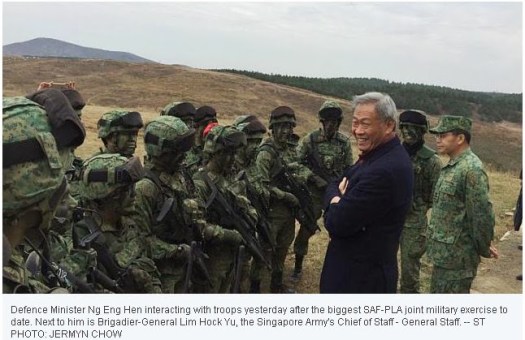
ST photo -SAF-PLA joint military exercise
Singapore Army invading China?

Recently, a video clip of how China is fulfilling its hegemonic ambitions using economic means was spread around especially in Facebook and WhatsApp groups.  The video compares the Sino-Sri Lankan joint-venture at the Hambantota Deep Water Port with the ones in Malaysia, proving that Malaysia, like Sri Lanka, could end up not only with a huge debt owing to China, but also lose its ownership of those assets.

On the surface, it sounds scary to have so much money owed to China for these projects especially so for the ill-informed.  But comparing Malaysia to Sri Lanka hardly does any justice.

The Hambantota Deep Water Port lies within the constituency of the former President Mahinda Rajapaksa and costs more than $1 billion to construct.  Another project that was constructed in this constituency is the Mattala Rajapaksa Airport, located 30 kilometres away from the port, which until now flies only a few hundred passengers in and out weekly and has been dubbed “the world’s loneliest airport.”

Hambantota is a remote region in the South, 240 kilometres from Colombo and the nearest city, Galle, is 130 kilometres away.  The population of Hambantota is around 12,000 people and is very underdeveloped.  The problem with Hambantota’s deep-water port is that its waters are not deep enough for large vessels with deep draught, so large shipping companies shy away from it.  It is far from any development that hardly anyone wants to move there.  Both the port and the airport cannot generate enough income to sustain operations let alone pay back loans to the Chinese.

Sri Lanka owes its financiers close to $65 billion and of this, $8 billion alone is owed to the Chinese.  Its GDP stands at $81.32 billion, debt-to-GDP ratio stands at roughly 75 percent while its foreign currency reserves is at $7.2 billion.  The Sri Lankan government uses 95.4 percent of its revenue to repay debts.  These are the reasons for Sri Lanka to opt for a debt-for-equity solution for both projects.

Compare this with Malaysia’s $13.1 billion East Coast Rail Link, or RM55 billion in Malaysian terms.  Malaysia took a $11.14 billion loan (85 percent or RM46.75 billion) from China to finance the project while the balance is in the form of a sukuk programme managed by local financial institutions.

The Forest City project in Johor is a development programme that runs over 20 years.  How much is being allocated per project is a company confidential information but if we go by average, it would be at $5 billion per annum, with a total of $100 billion over 20 years.  The project commenced in 2015 and to date has completed about 11 percent.  At the end of December 2016, Forest City saw concluded contracted sales of $2.9 billion for 17,000 apartment units.  It still has another 17 years of development to go.

Our GDP now stands at around $320.25 billion (RM1.3 trillion) for 2017 which puts the cost of the ECRL project at 4.1 percent of the GDP while Forest City accounts to approximately 1.6 percent of the GDP per annum.  The total Government debt as at end of June 2017 was reported to be at RM685.1 billion or 50.9 percent of the GDP.  Of this total, RM662.4 billion was domestic debt while RM22.7 billion was offshore loans.

Interestingly, as of October 2017, the US debt to China is at $1.2 trillion, which is 19 percent of the $6.3 trillion in US Treasury bills, notes and bonds held by foreign countries.  The US GDP in 2016 was $18.57 trillion which makes its China-debt-to-GDP alone at 6.5 percent.

Of course, we could undertake to pay for all the above projects.  Our foreign currency exchange reserves are at RM414.71 billion ($102.17 billion) which is more than enough to pay for both projects.  If we use the Mahathir-era method, then Petronas has RM129 billion in cash ($31.8 billion) while the EPF has RM771 billion ($189.9 billion) worth of assets.  This does not include sources from other funds such as Khazanah, Tabung Haji, KWAP, SOCSO, PNB and others.

If our debt-to-GDP ratio of 50.9 percent is still a scary number to you, it was at 103.4 percent when Mahathir was the Prime Minister in 1985!  And an equivalent to 24 percent of the GDP went missing as a resut of the BNM Forex scandal also during his tenure as the PM in 1991!  That is RM315 billion if our GDP is RM1.3 trillion!  In contrast, Singapore’s debt-to-GDP ratio is 112 percent at tenth place out of 17 nations with the highest debt-to-GDP rate listed by Business Insider, UK.  Japan is first at 239.2 percent.

Still, we did not go bankrupt back then. So why should we fear a 50.9 percent debt-to-GDP ratio with much stronger economic fundamentals when we have reached 103.4 percent with a much weaker economy? And neither Singapore nor Japan has gone bankrupt.

And what is with the ownership of the land where Forest City is situated?  It is a reclaimed land; therefore, no part of mainland Johor was carved out to be “given to the Chinese.”  Johor has rights over the reclaimed land as accorded by the National Land Code, 1965 up to three nautical miles as given by Section 3(3) of the Territorial Sea Act, 2012.  Whether it is a freehold land or a leasehold land, Johor can always take it back, with provisions, under the Land Acquisition Act, 1960. Up to 12 nautical miles from the foreshore, the Malaysian flag flies no matter who holds the grant.

Mahathir recently said “I hope Forest City will truly become a forest… Its residents will consist of baboons (kera), monkeys (monyet) and so on”, fuelling unjustified fears among the people of Malaysia.

The Malaysia-China Kuantan Industrial Park (MCKIP) has MCKIP Sdn Bhd (MCKIPSB) as its Master Developer.  MCKIPSB is a 51:49 joint-venture between a Malaysian consortium and a China consortium.  In the Malaysian portion of the shareholding, IJM land holds 40 percent, Sime Darby Property 30 percent and the Pahang State Government holds the remaining 30 percent. Its twin sister, the China-Malaysia Qinzhou Industrial Park (CMQIP) in China is 49 percent owned by a Malaysian consortium (SP Setia Berhad and Rimbunan Hijau Group).

Going by Tun Dr Mahathir’s logic, has China just allowed Malaysia to colonise its land too?  Prior to this it allowed Singapore to colonise in two other areas, namely the China-Singapore Suzhou Industrial Park and the China-Singapore Tianjin Eco City.

As bleak as Sri Lanka may sound, Japan, Singapore and India have expressed interest in building infrastructure and setting up shop in Sri Lanka.  Even with much weaker economic fundamentals compared to Malaysia, Lolitha Abeysinghe of Opportunity Sri Lanka remains optimistic.

Over-dependence on any country for investments, technology, and markets could result in some adverse impacts on national interest in the long-run, but if managed properly with a futuristic vision, Sri Lanka can mitigate such adversity and reap the best benefits for the rural domestic economy in one of the least developed districts in Sri Lanka,” he said.

Malaysia has that vision but sadly some of its people would rather see everything fail in the name of politics.  The politics of baboons and monkeys.