
Ask any Air Defence operator in Malaysia, their dream would be to have eight aircraft on Alert 15 status with the pilots remain suited up in nearby ready rooms while maintenance crews maintain pre-flighted jets on the tarmac. In the digital era, this would probably be the best case scenario save for, perhaps Alert 5, if they are already on Quick Readiness Alert. Gone are the days when Malaysia could scrambled fighters with analog systems in just two minutes.
But since having eight aircraft on Alert 5 can, theoretically, be achievable once the Royal Malaysian Air Force receives its eighteen advanced KAI FA-50M Block 20 light combat aircraft from South Korea beginning later this year, what would back these as the mainstay of Malaysia’s air power projection?
“The question is no longer which fighter is best. It is what air-defence architecture gives Malaysia’s fighters the best chance of surviving, seeing and fighting in a contested battlespace.”
Malaysia will eventually have to make one of the most consequential defence procurement decisions of the coming decade: what should replace the Royal Malaysian Air Force’s Su-30MKM and F/A-18D fleets? Defence Minister Mohamed Khaled Nordin said in May 2026 that evaluation of a new Multi-Role Combat Aircraft (MRCA) is expected to begin around 2030, with the existing Sukhois and Hornets expected to leave service around 2035. CAP55 envisages two MRCA squadrons, while the first FA-50 light combat aircraft are due to enter the force from the end of 2026.
It is tempting to frame the coming competition as a familiar beauty contest among aircraft: Rafale, F-15EX, Eurofighter Typhoon, F-35A, or perhaps a renewed Russian proposition. Each offers a different combination of range, payload, sensors, weapons, survivability, industrial access and political conditions. Yet by the time Malaysia makes its decision, asking which aircraft is “best” may already be the wrong question.
The reason is China’s rapidly changing combat-air ecosystem. Open-source assessments by the Royal United Services Institute estimated roughly 300 J-20 fifth-generation fighters in service by mid-2025, with production accelerating sharply. More important than the number alone is the combination of low-observable aircraft, advanced electronic warfare, datalinks, airborne and ground sensors, and increasingly capable long-range air-to-air missiles such as the PL-15, with the PL-16 and PL-17 adding further depth.
A Malaysian fighter operating over the South China Sea therefore cannot be considered in isolation. A conventional fighter may possess an excellent AESA radar and a formidable beyond-visual-range missile, but if an adversary’s wider sensor network detects, identifies and distributes its position before it can establish a sufficiently precise track on a low-observable opponent, the tactical contest has already begun on unfavourable terms.
The May 2025 India-Pakistan aerial fighting offered a useful warning. Reuters’ subsequent reconstruction of the engagement that resulted in the loss of an Indian Rafale emphasised not simply the performance of Pakistan’s Chinese-made PL-15 missile, but the kill chain around it: sensors and datalinks helped create the firing opportunity. The lesson for Malaysia should not be reduced to “one missile defeated one fighter.” The more important lesson is that a network can magnify the effectiveness of the aircraft and weapon connected to it.
What the candidates actually offer?
The Rafale remains an attractive balanced proposition. It combines a sophisticated electronic-warfare suite, Meteor beyond-visual-range missiles, multirole and maritime-strike capability, and twin-engine redundancy useful for extensive over-water operations. Its weakness in the specific J-20 problem is not that it is an inadequate fighter, but that it is not a very-low-observable aircraft. Against a stealthy opponent supported by a mature sensor network, first detection and first shot become harder to guarantee.
The Eurofighter Typhoon brings exceptional air-to-air performance, strong kinematics and Meteor. It is an outstanding interceptor and has matured into a capable swing-role aircraft. But it confronts broadly the same detection-asymmetry problem as other non-stealth fighters.
The F-15EX approaches the problem differently. Its virtues are endurance, a powerful radar, very large weapons capacity and the ability to carry a substantial number of air-to-air missiles. In a networked force it could be especially valuable as a heavily armed rearward “missile truck,” receiving targeting information from other sensors rather than having to penetrate deepest into the contested area itself. Its size and radar signature, however, make it a poor platform for trying to out-stealth a J-20.
The F-35A is qualitatively different because low observability, passive sensing, sensor fusion and networking are central to its design. It would not make the J-20 problem disappear, and public information cannot support simplistic claims about which stealth fighter would detect the other first. But the F-35 addresses the central operational problem more directly: surviving and gathering information in a battlespace where the opponent is also trying to minimise its detectability. For Malaysia, the complications would include US approval, security requirements, infrastructure, sustainment arrangements and long-term dependence on the F-35 support ecosystem.
A renewed Russian option would have one obvious Malaysian attraction: the RMAF already possesses deep experience with the Flanker family. Malaysia could conceivably seek a much more ambitious industrial arrangement involving local manufacture of selected spares, deeper engine and avionics overhaul, and perhaps a regional maintenance role. Russia has accepted significant localisation elsewhere. But a new major Russian combat-aircraft purchase would introduce sanctions exposure under the United States’ CAATSA framework, while support chains and access to Western technology would have to be weighed carefully. US guidance has historically distinguished routine maintenance and spares for existing Russian equipment from major new purchases or qualitative upgrades.
The real procurement is the network
The more important conclusion is that none of these aircraft should be bought as an isolated answer. Eighteen sophisticated fighters without the systems that allow them to see farther, communicate securely, remain airborne longer and survive enemy targeting would represent an incomplete investment.
Malaysia’s geography makes this especially important. Peninsular Malaysia and Sabah and Sarawak are separated by the South China Sea. A small fighter force must cover enormous distances and cannot be everywhere at once. Airborne early warning and control (AEW&C), modern ground-based surveillance, secure datalinks, electronic warfare, aerial refuelling, dispersed and hardened operating bases, ground-based air defence and adequate stocks of modern beyond-visual-range missiles all multiply the value of each fighter.
The RMAF is already moving in this direction. In June 2026, the service said air-defence radars were being established at Bintulu, Bukit Puteri and Bukit Lunchu, together with an air-surveillance radar on Pulau Layang-Layang, specifically to improve early warning and close surveillance gaps. The Chief of Air Force has also described incoming capabilities in the context of an integrated deterrence strategy rather than as stand-alone platforms.
That approach should become the organising principle of the MRCA programme. An AEW&C aircraft should not merely be an optional add-on after the fighter contract has consumed the budget. Nor should secure datalinks, electronic warfare, missile stocks, maintenance resilience and dispersal be treated as secondary procurement lines. They are part of the weapon system.
There is also a paradox. AEW&C aircraft and tankers dramatically increase fighter effectiveness, but China’s development of very-long-range air-to-air weapons is partly intended to threaten precisely these high-value support aircraft. Malaysia would therefore need to think about where such assets orbit, how they are protected, how information is distributed if one is forced away, and how ground and airborne sensors back one another up. Resilience matters as much as reach. When you take these into account, eighteen is no longer a feasible minimum number of combat aircraft to procure.
Industrial sovereignty matters too
The Russian question raises a broader issue that should apply to every bidder: industrial sovereignty. Malaysia should ask not only what an aircraft can do on delivery day, but what happens in year fifteen when a radar module fails, an engine requires overhaul, a supplier faces sanctions or export restrictions, or a software upgrade becomes necessary.
Local production does not have to mean building an entire fighter in Malaysia. For a fleet of only 18 aircraft, complete assembly may make little economic sense. More useful could be guaranteed access to technical data, local manufacture of high-failure-rate components, deep maintenance and overhaul capability, meaningful technology transfer, long-term stocks of critical spares and clearly negotiated rights to modify or integrate selected systems. A fighter that is spectacular on paper but chronically unavailable is not air power.
Familiarity and commonality
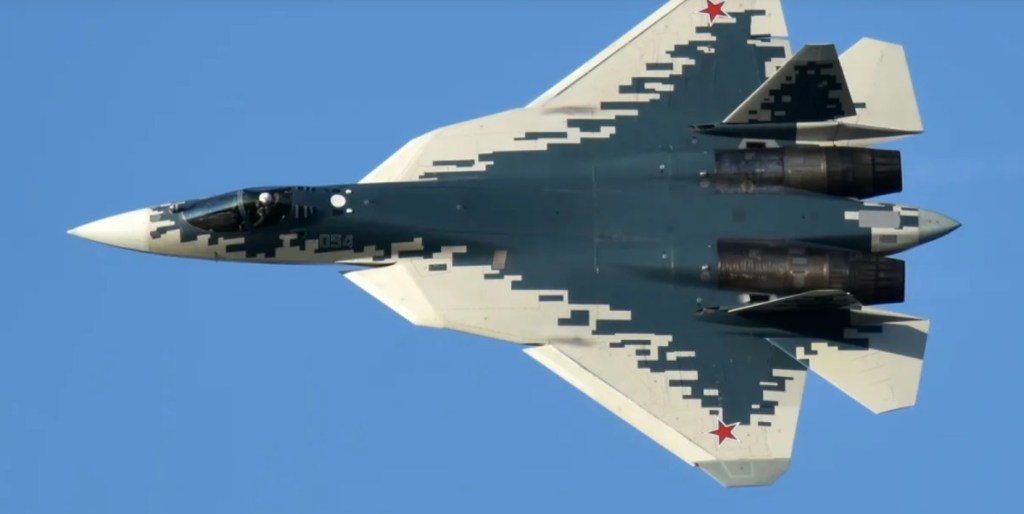
Perhaps, it would be more palatable if Russia proposes the Sukhoi Su-57E as part of a larger fleet-and-industrial package rather than simply offering Malaysia 18 new fighters. Russia needs to address Malaysia’s concerns about supply-chain and logistics, especially in view of the predicament the latter faces with its ongoing war in Ukraine. In that form, buying more than 18 aircraft could potentially make better economic sense on a per-aircraft and whole-fleet basis.
There is already some movement in precisely this direction. At DSA 2026, Rosoboronexport explicitly marketed the Su-57E to Malaysia, arguing that it shares the same systems and weapons with Malaysia’s Su-30MKM fleet. Russia has also publicly described Malaysia as a longstanding military-technical partner and highlighted the existing Malaysian MRO infrastructure.
The economically interesting proposition: 24-36 Su-57E, not 18
Eighteen aircraft is essentially a one operational squadron with limited depth once aircraft start undergoing maintenance, upgrades and training are taken into account. A purchase of perhaps 24 or 36 Su-57Es changes the economics because Malaysia could amortise the fixed costs of simulators, training, ground-support equipment, weapons integration, technical documentation and infrastructure over substantially more aircraft.
For illustration—not a price quotation—suppose establishing an Su-57E ecosystem costs $1 billion in fixed infrastructure, training, spares and integration costs. Spread across 18 aircraft, that is about $55.6 million per aircraft before buying the aircraft themselves. Across 36, it becomes $27.8 million.
But the really interesting possibility is combining the acquisition with Malaysia’s existing 18 Su-30MKMs.
Malaysia is already investing in keeping those aircraft flying. The domestic SLEP undertaken by ATSC is intended to keep them operational for roughly another decade, and the government has specifically said doing this work domestically saves money compared with sending the aircraft back to Russia.
In my opinion, the MKMs should not merely receive a life extension. This is where Russia would need to offer Malaysia a genuine mid-life combat-system modernisation.
The aircraft remain valuable large fighters. Malaysia has also accumulated considerable domestic expertise: ATSC’s Sukhoi Technical Centre already handles scheduled and unscheduled servicing, structural repair, modifications, radar-related work and AL-31FP engine module changes.
A Russian proposal could therefore involve upgrading the MKMs in Malaysia while expanding Malaysian industrial participation.
I would look for radar/sensor improvements, modern electronic warfare and self-protection, mission-computer and cockpit upgrades, secure datalinks, improved identification systems, newer Russian air-to-air weapons, and integration with the Su-57E’s wider combat network.
Interestingly, Russia is already marketing its new RVV-SDM medium-range air-to-air missile for the Su-57E and says it can be adapted to other Russian aircraft after modification. This creates an intriguing division of labour:
Su-57E: penetrating/forward sensor, counter-air and high-end interceptor.
Su-30MKM: large-payload “missile truck” comparable to the F-15EX, maritime strike aircraft and long-range multirole platform.
The Su-57E could detect, classify and distribute targeting information while the MKMs contribute weapons from farther behind. That would make the older aircraft much more useful than treating them simply as fighters waiting for retirement.
The question Malaysia should ask
By 2030, Malaysia should resist turning the MRCA selection into a contest of maximum speed, radar range, missile range or air-show manoeuvrability. Those figures matter, but modern air combat increasingly depends on who constructs the more complete picture of the battlespace and converts that information into a firing opportunity first.
The relevant benchmark is therefore not simply Rafale versus Typhoon versus F-15EX versus F-35A—or a Russian alternative. It is the complete Malaysian system surrounding whichever aircraft is chosen.
If funding is finite, there may even be circumstances in which 18 less extravagantly equipped fighters embedded in a robust national sensor and command network provide greater defensive value than 18 exquisite fighters operating with inadequate airborne warning, thin missile stocks and limited networking. Conversely, a high-end stealth aircraft may justify its premium if Malaysia builds the architecture required to exploit its sensing and information-sharing advantages.
The RMAF’s next MRCA should consequently be selected as one node in an integrated air-defence system stretching from ground radar and Pulau Layang-Layang to AEW&C, fighters, surface-based air defence and command networks across both halves of Malaysia.
The aircraft will remain important. But against a future threat represented not just by the J-20, PL-15 and the network behind them, the decisive advantage may belong not to the country that buys the most impressive fighter, but to the one that best connects everything it has.
Once the Air Defence operators have their eight aircraft to scramble, what would be the ones ready on Alert 15 to support them?



You must be logged in to post a comment.