Drama Kera La

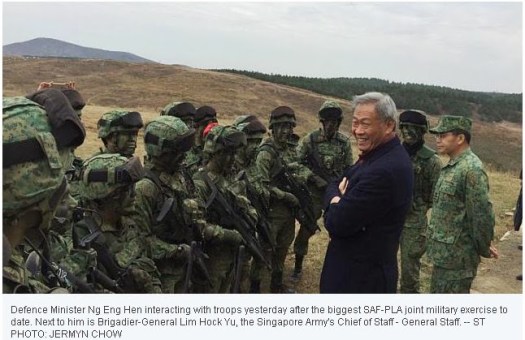
ST photo -SAF-PLA joint military exercise
Singapore Army invading China?

Recently, a video clip of how China is fulfilling its hegemonic ambitions using economic means was spread around especially in Facebook and WhatsApp groups.  The video compares the Sino-Sri Lankan joint-venture at the Hambantota Deep Water Port with the ones in Malaysia, proving that Malaysia, like Sri Lanka, could end up not only with a huge debt owing to China, but also lose its ownership of those assets.

On the surface, it sounds scary to have so much money owed to China for these projects especially so for the ill-informed.  But comparing Malaysia to Sri Lanka hardly does any justice.

The Hambantota Deep Water Port lies within the constituency of the former President Mahinda Rajapaksa and costs more than $1 billion to construct.  Another project that was constructed in this constituency is the Mattala Rajapaksa Airport, located 30 kilometres away from the port, which until now flies only a few hundred passengers in and out weekly and has been dubbed “the world’s loneliest airport.”

Hambantota is a remote region in the South, 240 kilometres from Colombo and the nearest city, Galle, is 130 kilometres away.  The population of Hambantota is around 12,000 people and is very underdeveloped.  The problem with Hambantota’s deep-water port is that its waters are not deep enough for large vessels with deep draught, so large shipping companies shy away from it.  It is far from any development that hardly anyone wants to move there.  Both the port and the airport cannot generate enough income to sustain operations let alone pay back loans to the Chinese.

Sri Lanka owes its financiers close to $65 billion and of this, $8 billion alone is owed to the Chinese.  Its GDP stands at $81.32 billion, debt-to-GDP ratio stands at roughly 75 percent while its foreign currency reserves is at $7.2 billion.  The Sri Lankan government uses 95.4 percent of its revenue to repay debts.  These are the reasons for Sri Lanka to opt for a debt-for-equity solution for both projects.

Compare this with Malaysia’s $13.1 billion East Coast Rail Link, or RM55 billion in Malaysian terms.  Malaysia took a $11.14 billion loan (85 percent or RM46.75 billion) from China to finance the project while the balance is in the form of a sukuk programme managed by local financial institutions.

The Forest City project in Johor is a development programme that runs over 20 years.  How much is being allocated per project is a company confidential information but if we go by average, it would be at $5 billion per annum, with a total of $100 billion over 20 years.  The project commenced in 2015 and to date has completed about 11 percent.  At the end of December 2016, Forest City saw concluded contracted sales of $2.9 billion for 17,000 apartment units.  It still has another 17 years of development to go.

Our GDP now stands at around $320.25 billion (RM1.3 trillion) for 2017 which puts the cost of the ECRL project at 4.1 percent of the GDP while Forest City accounts to approximately 1.6 percent of the GDP per annum.  The total Government debt as at end of June 2017 was reported to be at RM685.1 billion or 50.9 percent of the GDP.  Of this total, RM662.4 billion was domestic debt while RM22.7 billion was offshore loans.

Interestingly, as of October 2017, the US debt to China is at $1.2 trillion, which is 19 percent of the $6.3 trillion in US Treasury bills, notes and bonds held by foreign countries.  The US GDP in 2016 was $18.57 trillion which makes its China-debt-to-GDP alone at 6.5 percent.

Of course, we could undertake to pay for all the above projects.  Our foreign currency exchange reserves are at RM414.71 billion ($102.17 billion) which is more than enough to pay for both projects.  If we use the Mahathir-era method, then Petronas has RM129 billion in cash ($31.8 billion) while the EPF has RM771 billion ($189.9 billion) worth of assets.  This does not include sources from other funds such as Khazanah, Tabung Haji, KWAP, SOCSO, PNB and others.

If our debt-to-GDP ratio of 50.9 percent is still a scary number to you, it was at 103.4 percent when Mahathir was the Prime Minister in 1985!  And an equivalent to 24 percent of the GDP went missing as a resut of the BNM Forex scandal also during his tenure as the PM in 1991!  That is RM315 billion if our GDP is RM1.3 trillion!  In contrast, Singapore’s debt-to-GDP ratio is 112 percent at tenth place out of 17 nations with the highest debt-to-GDP rate listed by Business Insider, UK.  Japan is first at 239.2 percent.

Still, we did not go bankrupt back then. So why should we fear a 50.9 percent debt-to-GDP ratio with much stronger economic fundamentals when we have reached 103.4 percent with a much weaker economy? And neither Singapore nor Japan has gone bankrupt.

And what is with the ownership of the land where Forest City is situated?  It is a reclaimed land; therefore, no part of mainland Johor was carved out to be “given to the Chinese.”  Johor has rights over the reclaimed land as accorded by the National Land Code, 1965 up to three nautical miles as given by Section 3(3) of the Territorial Sea Act, 2012.  Whether it is a freehold land or a leasehold land, Johor can always take it back, with provisions, under the Land Acquisition Act, 1960. Up to 12 nautical miles from the foreshore, the Malaysian flag flies no matter who holds the grant.

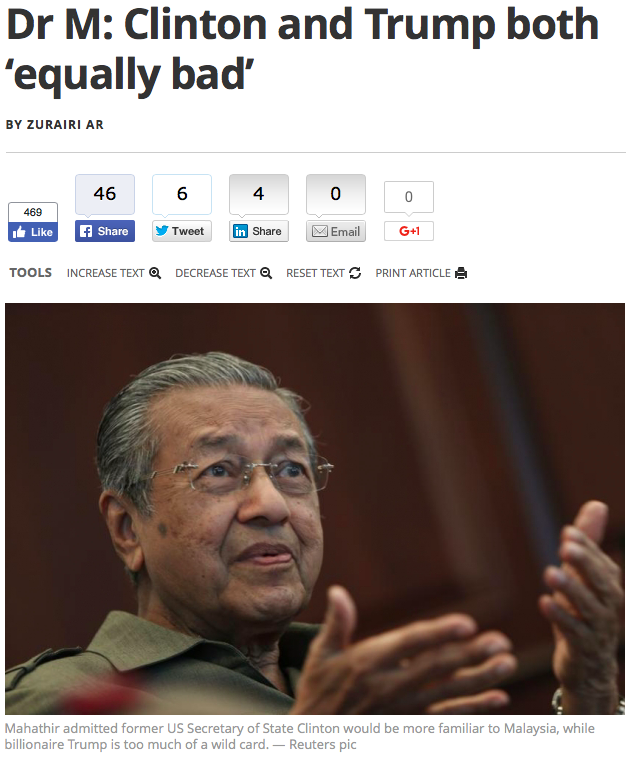
Mahathir recently said “I hope Forest City will truly become a forest… Its residents will consist of baboons (kera), monkeys (monyet) and so on”, fuelling unjustified fears among the people of Malaysia.

The Malaysia-China Kuantan Industrial Park (MCKIP) has MCKIP Sdn Bhd (MCKIPSB) as its Master Developer.  MCKIPSB is a 51:49 joint-venture between a Malaysian consortium and a China consortium.  In the Malaysian portion of the shareholding, IJM land holds 40 percent, Sime Darby Property 30 percent and the Pahang State Government holds the remaining 30 percent. Its twin sister, the China-Malaysia Qinzhou Industrial Park (CMQIP) in China is 49 percent owned by a Malaysian consortium (SP Setia Berhad and Rimbunan Hijau Group).

Going by Tun Dr Mahathir’s logic, has China just allowed Malaysia to colonise its land too?  Prior to this it allowed Singapore to colonise in two other areas, namely the China-Singapore Suzhou Industrial Park and the China-Singapore Tianjin Eco City.

As bleak as Sri Lanka may sound, Japan, Singapore and India have expressed interest in building infrastructure and setting up shop in Sri Lanka.  Even with much weaker economic fundamentals compared to Malaysia, Lolitha Abeysinghe of Opportunity Sri Lanka remains optimistic.

Over-dependence on any country for investments, technology, and markets could result in some adverse impacts on national interest in the long-run, but if managed properly with a futuristic vision, Sri Lanka can mitigate such adversity and reap the best benefits for the rural domestic economy in one of the least developed districts in Sri Lanka,” he said.

Malaysia has that vision but sadly some of its people would rather see everything fail in the name of politics.  The politics of baboons and monkeys.


Erectile Dysfunction

My post yesterday had put lots of knots in many Opposition supporters’ (Penyokong Pembangkang or PEPEK for short) knickers, it seems.  Some questioned why is it that they cannot find reference to some of the things I had written.

The answer is simple – I attended the talk by US Supreme Court Advocate Appellate Tom Goldstein. So did some others whom I saw, like Azmi Arshad, blog owner of Another Brick In The Wall, Tun Faisal of JASA, members of the media (both mainstream and electronic).

The talk was supposed to start at 9am and was to finish at 11am as the auditorium was to be used by another session.  Tom arrived late, around 10.25am and was given only half an hour to speak with five minutes of Q&A session.  Among the questions asked during the very short Q&A session were “Does the US plan to do away with the jury system in its trials” and “The 1MDB is a civil forfeiture suit, why is there now a criminal action being pursued”.

Both were answered by Tom as per the media reports.  And then it was announced that they had to cut the session short because the auditorium had been booked for another programme.

Tom was ushered into a meeting room where he and the Dean of the Faculty of Law had their coffee break, together with some UiTM staff.  The media chaps were ushered to a different place to have their food.  Only Tun Faisal, a journalist from The Mole, and I, managed to bring our food and sat at the same table with Tom.  Tun Faisal and I asked the questions on IPIC, SRC and 1MDB where Tom mentioned the complexity of the case and why there is absolutely no progress whatsoever – the complainants who are in no way linked to 1MDB lodged a complaint with the US Department of Justice saying that money had been siphoned from the 1MDB, to which the 1MDB had denied losing any money.  So to whom should the money be returned to if no one has lost any?

And to this I asked Tom if this is the reason it has taken the DoJ so long to actually initiate something, he answered with a simple, “Yes.”  In other words, the probe has come to a standstill. The only reason they have asked a stay on the civil investigation and changed it to a criminal one is to NOT allow any of the money to be spent.  To date, no one has been named as criminal defendants, not one charge has been filed, and not one targetted to be investigated on a criminal charge.

Which brings me to this:  the Attorney-General of the US, in his speech at the Global Forum on Asset Recovery in Washington DC yesterday said that 1MDB is kleptocracy at its worst.

The headline that had gotten all the PEPEKs wet

Mr Sessions said that allegedly corrupt officials and their associates had reportedly used the 1MDB funds for a “lavish spending spree” such as US$200 million for real estate in South California and New York, US$130 million in artwork, US$100 million in an American music label and a US$265 million yacht.

1MDB officials allegedly laundered more than US$4.5 billion in total, he said, through a complex web of opaque transactions and shell companies with bank accounts in various countries such as Switzerland, Singapore, Luxembourg and the US.

This is nothing new. This is something we have heard which was read live on cable TV by Mr Sessions’s predecesor. And this brings me to a question – if this is so, why hasn’t the US DoJ taken any action for the past year and a half?  This only underscores what Tom Goldstein had said – the complaint said the money was siphoned from 1MDB, but the 1MDB said they have not lost a single cent.  So, whose money did these “1MDB officials” siphon?

Those assets have been frozen since mid-2016 and still have not been returned to 1MDB. Why is that?  All the people that have been charged, tried and sent to jail for laundering “1MDB money” in Singapore and elsewhere in the world were bank employees who flouted the local financial regulations.  Yet, not a single 1MDB employee has ever been charged in those courts.  Why?

PEPEKs are dancing today thinking that something new had been revealed, when it is just old news being repeated. No doubt that they money and assets the US DoJ confiscated last year represents kleptocracy at its worst.  But what has that to do with 1MDB? Can we have the money back now if they are 1MDB’s?

The PEPEKs think that they have won the argument, but really they are just dry PEPEKs, giving an erectile dysfunction to the celebration.

Trumped

Donald Trump is the 45th President of the United States of America

A few hours before Hillary Clinton conceded defeat, signs were everywhere that she was heading down the abyss.  On Twitter people were talking about moving to Canada while the Canadian Immigration website crashed for reasons not yet known to us.  Hillary finally conceded defeat making Trump the President-elect.  The next four years of his Presidency is going to be worth watching.

I can understand how the supporters of the Democrats feel right now, my home state of Selangor fell to what was the Barisan Alternatif in 2008 and the first 24 hours was filled with uncertainties.  In the end, it was business as usual albeit having to sufer the occasional water outtages as well as incompetent solid wastes collection contractors.  Other than that the state runs on autopilot while the politicians in charge of the state are busy giving ceramahs non-stop.

Trump has promised to make America great again.  To make America great again America’s military would also be made great.  It also means that America’s businesses will be given priority over foreign-owned ones.

How does this augur for Malaysia?

Firstly, the Republican-heavy Congress would not pass the Trans-Pacific Partnership Agreement as Trump sees the TPPA as a vehicle that would allow Asian businesses to take over the American economy.  If it were to go ahead a major tweaking of the TPPA needs to be done – tariffs would be raised to favour the American economy and that would not go down well with the other potential TPPA partners.  Anyhow, with the TPPA still not ratified, Trump is likely to hold to his pledge to withdraw the United States from the free-trade agreement.  The good thing from that would be Malaysia’s continued hold on its protectionist policies aimed at preserving the Bumiputra rights as well as the protection for local industries.

Malaysia’s manufactured exports to the US saw an increase by 13 percent recently.  With Trump favouring the great American economy, this would be greatly affected since Malaysia’s economy is 90 percent reliant on exports.  Nomura Holdings in early July 2016 in a report titled ‘Trumping Asia’ bluntly said that if Trump wins, Asia loses.  The Philippines would be the country in the South East Asian region that would be most affected by Trump’s Presidency while Malaysia is fourth after Indonesia.

Chart image from Boomberg with source from Nomura

It is not surprising then to see Prayuth Chan-O-Cha of Thailand, Lee Hsien Loong of Singapore, Duterte of the Philippines and Najib Razak of Malaysia visit China in May, September, mid October and end October respectively to strengthen economic ties and increase trade with China.  These leaders must have predicted that the Democrats would lose to the GOP and knew that if trade is not increased with the largest Asian economic power these nations would stand to lose.  Purchasing the Chinese corvettes was definitely a good decision now given that any purchase from the Western powers would come with lots of strings attached.

China is not without danger because of Trump’s Presidency.  With levels breaching the USD 600 billion level, China is the US’s largest trading partner, and as President, Trump could impose punitive duties that includes a 15 percent tariff on China for a maximum of 150 days without having to go to Congress for approval.

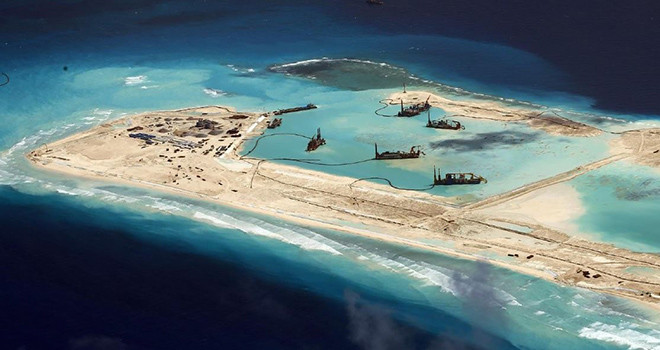
Militarily, Trump had made a statement on China’s expansion in the South China Sea. “We have rebuilt China, and yet they will go in the South China Sea and build a military fortress the likes of which perhaps the world has not seen,” Trump said. “Amazing, actually. They do that, and they do that at will because they have no respect for our president and they have no respect for our country.”

I am of the opinion that the term “We have rebuilt China” used by Trump is the large balance of payments deficit that the US has with China.  If the US could ‘prove’ that China is a currency manipulator, which the US Treasury could easily declare without needing the approval of the Congress, it could trigger a range of trade restrictions against China – a form of pressure for China to ‘respect’ the US as required by Trump to make America great again.  Which is why the visit by Najib Razak to China recently was not an act of ‘kow-towing‘ to a Big Brother, but rather saying “Malaysia is a friend, how can you (China) help us so we can help you?”  China now needs its South East Asian neighbours as well as Russia as its allies.

We have stepped into an era that will be filled with surprises and not less scarily challenging.  The only consolation is that George Soros who finances both the Hillary campaign machinery as well as the Opposition and pro-Opposition organisations in Malaysia will find it hard to thrive.  Perhaps as a gesture of goodwill Trump should look into the affairs of the Open Society Institute and how its financing of the Arab Spring has given rise to the terrorist activities in North Africa, the Middle East as well as in South East Asia and take criminal action against the OSI.

As Tharman Shanmugaratnam, Singapore’s Deputy Prime Minister said early this year, “We are all discovering Donald Trump, as he is himself: there is a stream of consciousness approach to policy pronouncements. One can only hope that it evolves towards addressing the strategic interests of the United States in the world.”

There may be a side to Donald Trump that we have not yet seen.  Others with better insight into things would probably have a better read of his character.  Of course, I am not talking about the Pribumi supremo. He never has anything good to say.

Madman
Madman

Trump would also need friends as China does, and he would look at nations with leaders who are level-headed as they are smart.  I was about to end this post when I saw this Tweet on my timeline:

A tweet by Jonathan Head, BBC's Southeast Asia correspondent
A tweet by Jonathan Head, BBC’s Southeast Asia correspondent

Apparently, not only is Najib Razak a golf buddy of Barack Obama.  He is also Trump’s favourite Prime Minister, as signed on a photograph taken of the two of them.  As I said, leaders have to have foresight and know what is best for the country he leads.  And a line in Shakespeare’s Henry VIII that reminds me exactly of this situation:

Heat not a furnace for your foe so hot that it do singe yourself.

Najib Razak's looking forward to meeting Trump...again
Najib Razak’s looking forward to meeting Trump…again

I call that a masterstroke from a great Statesman.

South China Sea: The Gatling Gun Approach?

China's build-up in the South China Seas brings this region closer to a conflict
China’s build-up in the South China Seas brings this region closer to a conflict

We need to look at what we see as the threats. What you see is the story unfolding in Syria and Iraq and which fighter is not there at the moment? You’ve got the Super Hornets, you’ve got the Typhoons and yet it is still unfolding before our very eyes. And secondly, the threat from IS is different from our traditional terrorist threats that we have faced in the past, don’t compare with the threats that we’re facing from IS.”

Those were the words uttered by the Malaysian Defence Minister on the eve of the recent Langkawi International Maritime and Aerospace exhibition that concluded on the 21st March 2015. He added:

You will see the gatling gun that we have fitted on our A109s and maybe the threat that we face just requires a gatling gun.”

Many defence practitioners, analysts, journalists and bloggers such as I, felt as if the military had been let down when we heard those very words uttered on board the Royal Malaysian Navy’s frigate, KD Jebat.  Malaysia has been seeking for the replacement of the MiG-29N fleet for the longest time, and now it has been stalled again.  Furthermore, the fight against the IS is first and foremost a counter-insurgency warfare that falls within the purview of the Home Ministry, with the Defence Ministry in a supporting role.

It would be good to note, too, that missing from the airshow for the first time at LIMA ’15 are the Smokey Bandits, the RMAF’s aerobatics team that consists of the Mikoyan-Gurevich MiG-29Ns.  It was looked forward to, and missed by many.

In March of 2013, the PLA-N sent its largest and most modern amphibious assault ship, a destroyer and two guided-missile frigate to James Shoal (Beting Serupai), 80km off the coast of Bintulu in Malaysia’s state of Sarawak, to conduct an oath taking ceremony there.  The PLAN sailors and marines pledged to “defend the South China Sea, maintain national sovereignty and strive towards the dream of a strong China.”  Just 80km off Malaysia’s coast, this flotilla went unchallenged by the Royal Malaysian Navy or by the Malaysian Maritime Enforcement Agency vessels.

The RMAF Su-30MKMs are about the only MRCA capable of taking on the PLAN or PLAAF but lack miserably in numbers

While the Minister focuses on the IS threat, which really should be looked at by the Home Ministry and not Defence as it involves counter-insurgency warfare, both the Royal Malaysian Navy and the Royal Malaysian Air Force are in dire need of more capable assets.  Without the MiG-29Ns and the F-5E Tiger IIs, the RMAF is down to just 18 Sukhoi Su-30MKM Flankers and 8 F/A-18 Hornets, supported by 14 BAe Hawk 208 and 6 BAe Hawk Mk 108.  Of course, that is if the serviceability rate is at 100 percent.

The Royal Malaysian Navy’s combat power is represented by 2 Scorpene submarines, 2 Frigates (with 6 to be constructed), 6 corvettes, 6 offshore patrol vessels, and 8 missile boats.  Although the Royal Malaysian Navy could give any enemy a bloody nose if required, without air superiority achieved, there will be a repeat of what happened to Force Z in 1941.  The RMN is also somewhat impaired given that its OPVs are fitted-but-not-with strike-capable weapons such as anti-air and surface-to-surface missiles.

The Kedah-class OPVs have been fitted-but-not-with SSMs (Photo courtesy of BERNAMA)
The Kedah-class OPVs have been fitted-but-not-with SSMs
(Photo courtesy of BERNAMA)

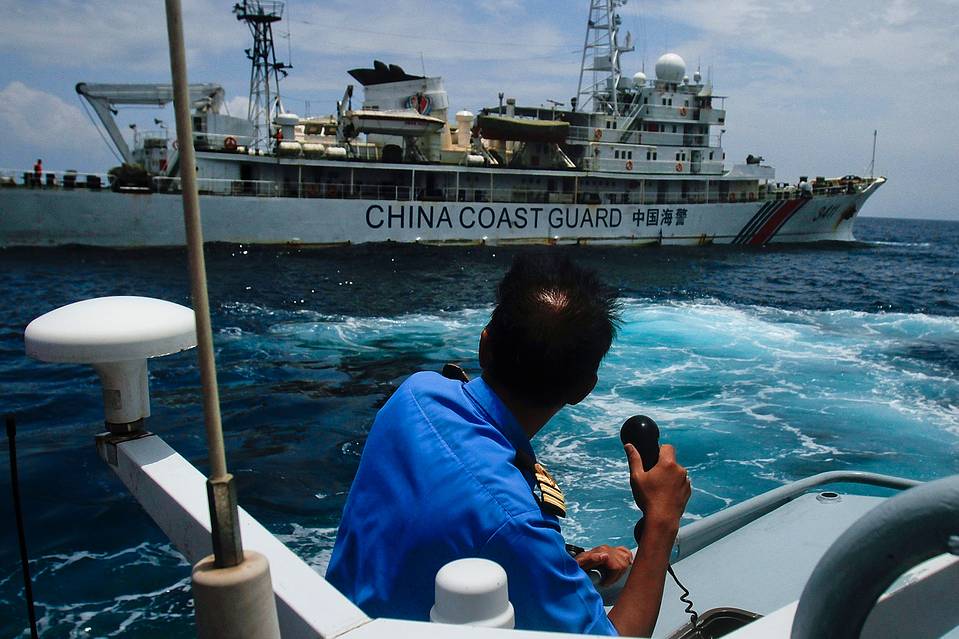
Underscoring its intention to subjugate the other claimants especially Malaysia, the Chinese Coast Guard was found in the vicinity of the Luconia Shoals, 150km off Miri, early this month.  With a large to cover, both the Royal Malaysian Air Force as well as the Royal Malaysian Navy are very much lacking in assets.

A Malaysian vessel intercepts a Chinese Coast Guard cutter at the Luconia Shoals off Sarawak, Malaysia - picture courtesy of WSJ
A Malaysian vessel intercepts a Chinese Coast Guard cutter at the Luconia Shoals off Sarawak, Malaysia – picture courtesy of WSJ

In his speech during the recent Air Force Day celebration, General Dato’ Sri Roslan bin Saad RMAF underlined three approaches to ensure that the RMAF stays on top of the game:

  • The amalgamation of assets and organisation: this approach gives focus to the readiness of aircraft and radar systems. Through the Chief of Air Force’s Directive Number 19, several action plans have been formulated to ensure that the serviceability rate for aircraft and radar systems remain high.
  • Enhancement of Human Resource: this is done by raising, training and sustaining the RMAF’s manpower by increasing its specialisation and competency levels.
  • Optimisation of Available Resources and Finance: this is by formulating a strategy to ensure that resources and finances are being managed properly and are well managed.
General Dato Sri Roslan bin Saad RMAF, the Chief of Air Force, delivering his speech at the Air Force Day parade at the Kuantan Air Base.

In my opinion, the amalgamation of assets should also include the reactivation of the Mikoyan-Gurevich MiG-29N Fulcrum as well as the Northrop F-5E Tiger II fleets.  With limited funds available for the addition of more interceptors as well as MRCAs, perhaps the RMAF should get the MiG-29Ns back online in a reduced number. The final number of MiG-29Ns maintained by the RMAF was ten.  Perhaps eight is a credible size to maintain.  We know that engine hours is no longer the issue with the MiG-29Ns. If budget constraint is a concern, no upgrades are needed for now. They can still perform their MRCA role with what is readily-available, and perform as Smokey Bandits when needed.  It would be worthwhile to note that the Indian Air Force has upgraded its much-older MiG-29Bs to the MiG-29UPG, at par with Russia’s MiG-29SMTs but sporting western avionics.  I am more than sure that Malaysia’s Aerospace Technology Systems Corporation Sdn Bhd (ATSC) could propose an upgrade to the MiG-29Ns. These upgrades would be cheaper than a total fleet purchase which negotiations will take years to conclude.

The Republic of Korea Air Force (RoKAF) maintains more than 400 F-5E Tigers in its inventory while the Republic of China Air Force (RoCAF) maintains more than 200.  These old analog interceptors are based near where the threats are.  The most interesting point about the F-5Es are that they run on analog systems and require less time from cold start to interception.  Malaysia had about 16 F-5Es and 2 RF-5E Tigereye that could do Alert 2 standby for first interception while the Alerts 5 and 7s could come and back them up later.  Two squadrons could still be maintained perhaps in Kuching with an FOB set-up in Miri and Labuan for F-5E detachments.

The two suggestions above is for the RMAF to consider while it waits for budget and arrival of the new MRCA.

It is of no secret that while Dassault Aviation has been promoting its Rafale MRCA heavily in Malaysia especially, the fighter jocks of the RMAF prefer the F-18Ds that they have; and if any addition is to be made to its MRCA fleet, it should be the F-18Ds.  End-users’ opinions and evaluation must be seriously considered.

The other threat that faces Malaysia is the potential insurgency in Sabah’s ESSZONE.  While “helicopters with Gatling guns” may be considered an answer, a helicopter is slow to get away from a fire-fight.  Time and time again we have seen how rebels in the southern Philippines who are also responsible for the kidnappings as well as skirmishes in Sabah brought down military helicopters.

The real answer is in a platform that can deliver enough payload at high speed and conduct effective strafing of known enemy positions.  The RMAF should consider reactivating the Light Attack Squadron (LAS) that was used in counter-insurgency warfare in the 1980s and early 1990s.  The Pilatus PC-7 Mk II, while acting as the aircraft for the LIFT program (Lead-In Fighter Training), can also be used as both counter-insurgency warfare aircraft as well as in support of the roles taken up by the Hawks 108 and 208 as well as the Aermacchi MB-339CM.  Economy-of-effort has always been part of the Principles of War and still holds true today.  Having the experience in the LAS I believe will make them better pilots for the F/A as well as MRCA roles as they progress later.

RMAF BAe Hawks and Aermacchi MB-339CM light fighter/lead trainers flying past during the Air Force Day parade

The RMAF also lacks the eye-in-the-sky.  From the days when I joined the RMAF in the 1980s, the AWACS have always been sought after but never procured.  An AWACS provides the RMAF as well as the RMN a good detail of what is happening both in the sky and at sea.  Four AWACS with good loiter endurance based in Kuching working round-the-clock should suffice. Kuching is at the nearest point between Borneo and the Peninsular, and covers the South China Sea easily.  On top of this, Maritime Patrol Aircraft with anti-ship and anti-submarine capability should be made available for the RMAF.  This is to complement the RMN in its role especially in the South China Sea.

I am not sure but I believe we cannot see much of what is beyond the Crocker range in Sarawak.  Mobile radar systems could be stitched along the range to provide better coverage of what goes beyond the range.  The data can be fed via satellite or HF system.  The RMAF’s HF system is more than capable of providing accurate radar picture of the area.

The Malaysian Army’s “top secret” Vera-E passive radar system should also make its data available and fed into the RMAF’s current air defence radar system to enhance the capability of the the latter.  There is nothing so secret about the Vera-E.  Several keys tapped on Google and one would be able to find out about the Malaysian procurement of the system.  I am flabbergasted that the Malaysian Army has yet to share the Vera-E data with the RMAF.

The government should also allow the RMN to look into procuring available assets from the USN that are capable to deter PLAN assets from entering sovereign waters unchallenged.  Apart from capital assets. the RMN should look into converting some of its smaller assets such as the CB-90s and RHIBs into Unmanned Surface Vessels (USV) with 30mm stabilised weapons and targeting system complemented by a STRIKE-MR fire-and-forget missiles that could be operated remotely to conduct swarm attack on larger enemy units.  Using the USV swarm tactic, the RMN should look at the tactics used by the Liberation Tigers of Tamil Elam (LTTE) to sink larger Sri Lankan naval units.  Using the CB-90s as well as the RHIBs for swarm warfare at shoals and atolls controlled by Malaysia in the South China seas fits with the concept of “working with what we have and not what we feel we should have.”  Swarm forces can neutralise or deter larger forces from advancing further, while the USV concept does not need the unnecessary loss of lives to achieve its objective.

I urge the government to reconsider the budget put forth by both the RMAF and the RMN. Budget constraint should not be a reason the military is not allowed to enhance their current capabilities.  The warfare doctrine based on the principles of selection and the maintenance of aim must be respected if the Malaysian military, in particular the RMAF and RMN, is to achieve its objectives which mainly is to act as deterrence from potential belligerent forces.  If the RMAF and RMN are not allowed to be strong, Malaysia will always be bullied at the South China Sea diplomatically.