The Lessons of Sungai Batu – Final Part

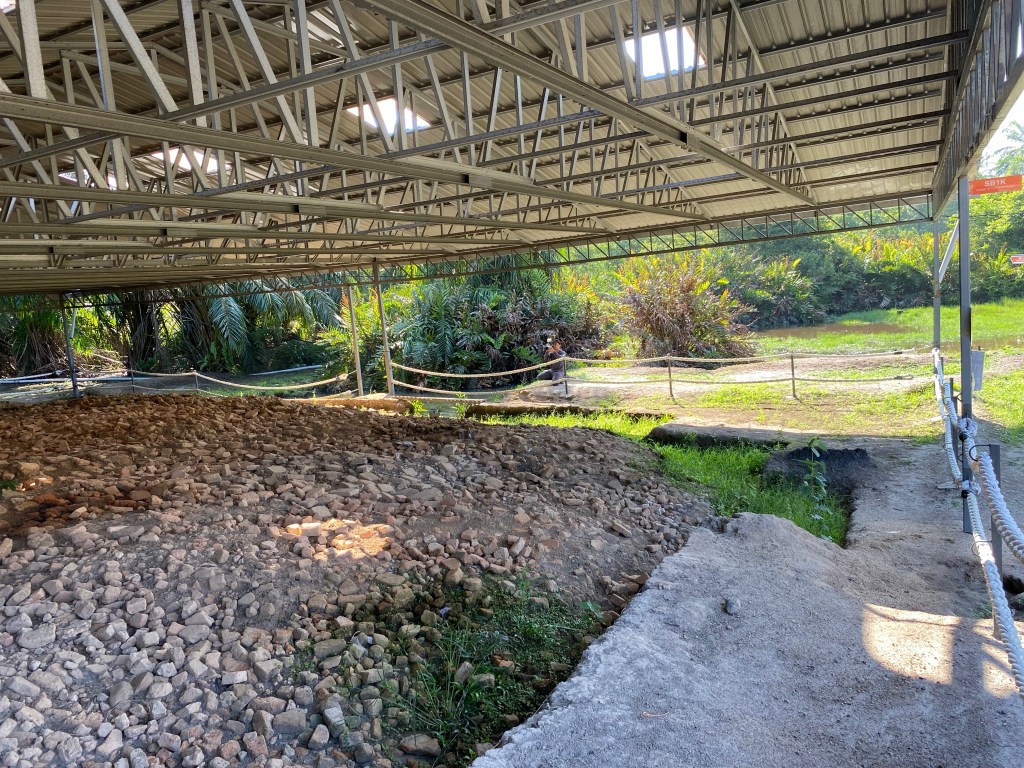
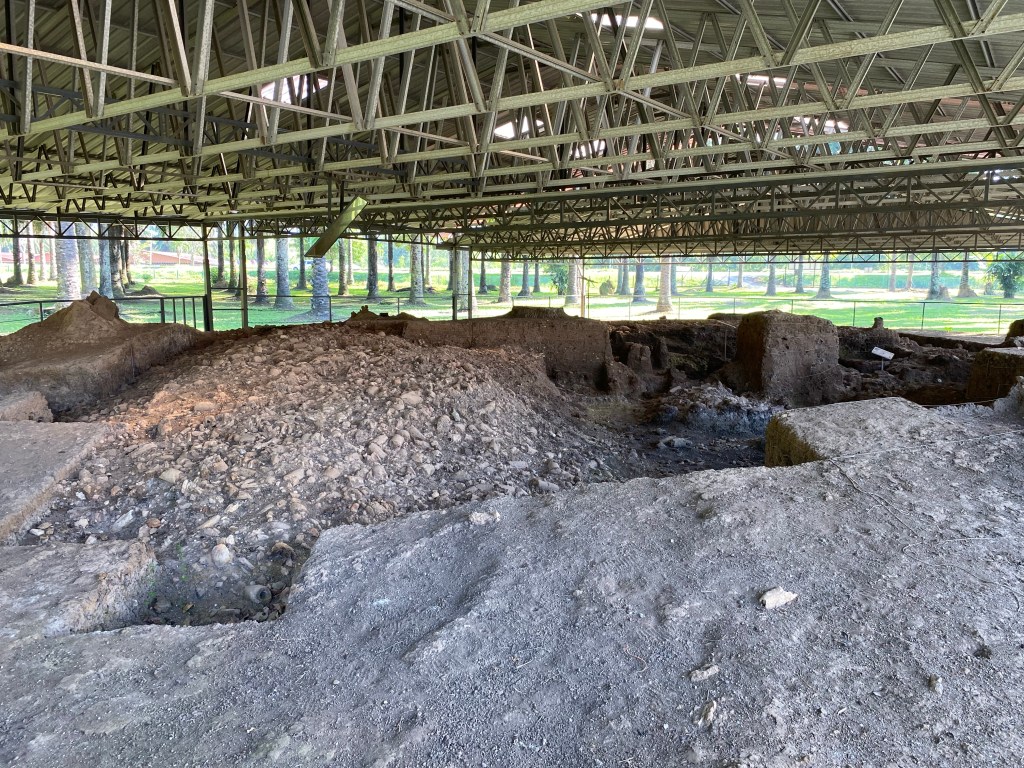
Remnants of at least a million smelting furnaces with Tuyere were found at this site alone at the Sungai Batu Archaeological Complex in Semeling, Kedah

THE Malay world burst with joy when the discovery of the Sungai Batu archaeological site was announced. 

Imagine finding out that your ancestors were very technologically advanced 800 years before common era, 300 years before the birth of the Roman Republic that preceded the Roman Empire.

I was one of them.

Somehow, that finding did not fit into the larger picture. Other regional ancient iron smelting sites only existed around the first and second centuries of the common era – a difference of 1,000 years. 

True enough, a study made 13 years after the discovery found that the sample dates inaccuracies were due to a small number of dating results used in the earlier analysis.

If that is the case, then whose iron-smelting technology was used?  South India’s. 

Sungai Batu was already a known international trading port by 2 C.E. Similar iron-smelting sites in Khao Sam Kaeo, Ban Don Phlong (both in Thailand) and Sriksetra (in Myanmar) were on the decline.  Iron artefacts such as tools for iron-smelting found at Sungai Batu were not produced there.

They were brought there by the South Indian traders.

And the Malay Ruler of Sungai Batu must have provided the manpower for the iron-smelting industry, and had the candis built for the Hindu and Buddhist traders to attract them to the Bujang Valley.

This would explain the construction of the candis— same-sized clay bricks, and constructed at about the same time. They were constructed to provide a good climate for foreign investments. Investments enriched the nation and kept the people happy.

As for religion, the Malays were generally animistic. If, at all, there was any conversion, it was all at a low level where the workers were exposed to the foreign religions, or partook in rituals.

Perhaps the locals participated with the Hindu traders in reciting the Ganesha Sloka prior to commencement of work going ‘Vakra tunda Maha kaaya. Soorya-koti sama prabha. Nir vighnam kuru e Deva. Sarva-karyeshu Sarvadaa.

There is no evidence that they were practising Hindus or Buddhist because there is an absence of any form of deities or structures from that era inland to support that hypothesis.

Up until about four decades ago, Malays still practised age-old animistic rituals such as invoking the spirits of the padi fields, and float little boats containing offerings for spirits of the sea (melayarkan Ancak) at the beginning of the Muslim month of Safar.

But what can we deduce and learn from all the above is that Ancient Kedah and its people were respectful, tolerant and open to new social and cultural practices; they were innovative and quick to accept and adapt to new technologies; it was also possible that Ancient Kedah thrived on multiculturalism as it was a melting pot, and this was the identity that was built in the Bujang Valley area.

Finally, Ancient Kedah was more of a confederation as opposed to the federation that we have now.

Each archaeological site existed because of what they had, but worked closely together to ensure that each of the Bujang Valley entrepôt thrived.

Forward 2,000 years, we have a federation of states that competes with one another economically.

The competitions could be healthy, but in some cases, they are not; we are a melting pot but we are not one. We respect and tolerate each other because the laws tell us to, not because we earn the tolerance or respect; and to make matters worse, we do not have innovation. 

We have blueprints for our industries but they remain as blueprints. We have a 38-year old car industry that has not made it elsewhere; we have an aviation industry that came with the very first edition of LIMA, but we have yet to see even a light commercial aircraft being built.

We have a shipbuilding industry that has failed its customers a number of times, and still relies heavily on government bailouts. 

Multinational manufacturing companies have left and are leaving our industrial zones.

Yes, there is a lot that we can learn from Sungai Batu. We still don’t know much.

The above is based on the most recent data and current findings. Sadly, there are so many other related sites that are not within the gazetted area that are being destroyed.

The government needs to step in in a more serious manner to preserve these sites, and the others as well. 

More funding is needed to preserve and learn about our past, because although life must be lived forward, it has to be understood backwards.

If we do not understand our past according to the narrative based on facts and data, then nation-building and building of the Malaysian identity can never be fully achieved.

(This article was first posted on The Mole ).

Part 1 can be found here.

Part 2 can be found here.
The Lessons of Sungai Batu – Part 2

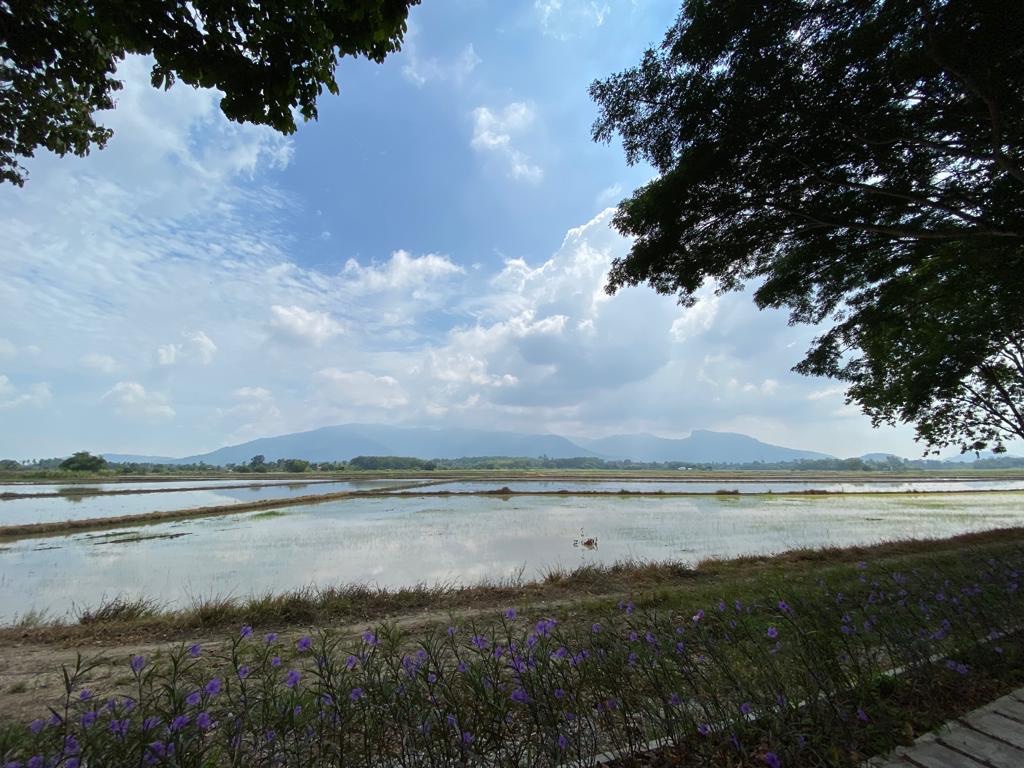
Gunung Jerai as seen from the ancient trading port of Pengkalan Bujang. 2,000 years ago this would have been a view of the sea.

IN the previous write-up the importance of a narrative conforming to the latest data and findings was highlighted.

The latest data and findings also have to fit into the region’s bigger picture. If, as in the joke mentioned, the Hindus had found a fibre optic cable beneath an ancient temple, a comparative study of the region’s historical development of that era should tell us whether or not that finding fits into the whole logic.  

Therefore, it is important for us to understand the evolution of man and the technology they had in order to understand the intricacies of Sungai Batu. 

Like the rest of the world, the people of the Malay peninsula had undergone several eras or ages of development.

The early Palaeolithic age began about 1.83 million years ago, and this finding was made through the discovery of a 3 sq. km. Palaeolithic site at Bukit Bunuh in Lenggong, Perak. 

This early Palaeolithic age lasted till about 10,000 years ago. The stone tools associated with this era are mostly Oldowan assemblages that included pounders, choppers and scrapers, made mainly by the Homo Habilis and Homo Erectus species of archaic human beings.

These tools were improved to Acheulean assemblages during the Upper Lower Palaeolithic stage by the early archaic Homo Sapiens to include hand axes, and other stone tools that had the ability to skin and butcher game, as well as cutting of wood.

The Perak Man existed during the Upper Palaeolithic stage. The now-resident of the Lenggong Archaeological Museum was an Australomelanesoid who lived in the area 10,000 years ago.

It was during his time that Mousterian stone tools were refined and took pointed forms or have sharpened blades and were attached wooden handles, and were used for hunting and used as spears.

Then came the Neolithic age. The people of this age produced more complex tools and accessories such as earthenware, bracelets and other adornments. They have beliefs, customs and rituals.

Unlike their Palaeolithic ancestors who bury their dead in foetal positions, the Neolithic people bury theirs straight.

They live in more permanent settlements, and most probably were engaged in farming as well as livestocks.

According to archaeological studies, the Neolithic age arrived in Malaysia around 4,500 years ago.

In the peninsular, Neolithic settlements date back between 4,300 and 2,000 years ago. 

In Sabah and Sarawak they were around between 3,000 to 2,000 years ago. In Perak, the Neolithic people who lived in Gua Dayak in Lenggong, Perak were there around 1,610 B.P (B.P is Before Present, with its base set in 1950 C.E or Common Era), and that translates to around the year 340 C.E. 

The Neolithic people of Gua Sagu near Kuantan, Pahang were there around 2,835 B.P or 885 B.C.E.

This goes to show that the people of the peninsular were still in a Neolithic age, and the dating of Sungai Batu as a civilisation that were already into iron smelting to 783 B.C.E certainly does not fit into the bigger picture. 

Therefore, iron smelting in the Sungai Batu/Bujang Valley area could have begun in the second century C.E as it did in other areas of the ISEA region.

The Strait of Malacca was also not a preferred trade route during that period. 

East-West trade mostly crossed the Isthmus of Kra in Thailand to get to the other side.

 Iron ingots could not have been traded back then as the weight would have been a hindrance for the overland travel. 

The Strait only became a trade route after the first century C.E. 

While Roman artefacts have been found in northern Vietnam and in China, they all dated after the first century C.E and some came from the Antonine period (between 96 C.E to 192 C.E).

Trade between Rome and the East mostly centred in India and China where silk and spices were sought from.

Alexander the Great (356 B.C.E to 323 B.C.E) only made it up till the Hyphasis river (now the Beas river) in India before his army mutinied, refusing to march farther east.

He never made it to Ancient Kedah.

Meanwhile, the area only came under the Chola dynasty influence during the reign of Rajendra Chola I (between 1,014 C.E to 1,044 C.E), more than a millennium after the existence of the Bujang Valley maritime polity.

Even then, the absence of any Cholan or large Hindu structure of the period to substantiate the claim of a major Cholan influence, or the Indianisation of Kedah. Even the famous Candi Batu Pahat was dated to the 6th and 8th Centuries C.E.

The decline of the Bujang Valley’s maritime importance was due to two main factors— one, the environmental and geomorphological changes to sea levels in the area.

The lowering of sea levels causing the sea line to recede further west rendered the areas of Sungai Batu and Pengkalan Bujang inaccessible to traders. It is possible that after the decline of maritime trade, the ancient Malays shifted their economic activity to agriculture. 

Two, the decline of the Srivijayan empire and the rise of Melaka as an important trading port in 1262 contributed to the end of the role of Ancient Kedah and especially the Bujang Valley as an important trading port.

The above shows that it is virtually illogical for a Neolithic community in the Bujang Valley to have begun its Metal Age era while the rest of the area was still populated by Neolithic people. 

It is illogical for the Roman Empire to have traded with Ancient Kedah for iron ingots in 783 B.C.E as the trade route did not flow through the Strait of Malacca.

It is illogical for Alexander the Great to have set foot in Ancient Kedah as his farthest advance was to a river in northern India. 

And it is illogical for the Bujang Valley industries to have been part of the Cholan empire as it had existed 1,000 years before Chola’s Rajaraja I was even born.

(This article was first published in The Mole )

The Lessons of Sungai Batu – Part 1

The ancient jetty at Sungai Batu was paved with clay bricks to withstand the weight of iron ingots transported to awaiting ships. This photo was taken on Sunday, 11 June 2023

THERE was a joke that went around at the turn of the century. It was about India and Pakistan’s quest for national and religious-identity supremacy.

The Indians wanted to prove that they have been superior in innovations since the dawn of time, started excavating inside an ancient temple. Three metres down, they found a fibreoptic cable. Stumped, by the unexpected discovery the Indian government’s spokesman quickly announced to the world media: the Hindus were the first to introduce Internet broadband.

Not to be outdone, the Pakistanis started digging inside their most ancient mosque. Three metres down, they found nothing. They dug deeper to six metres and still found nothing. The Pakistani government spokesman quickly announced to an anxious global media: the Muslims were the first to introduce wireless broadband.

Although the above is only a joke, it resembles the fantasy-filled narratives that have been flying around in the world wide web surrounding the discovery of the Sungai Batu archaeological site in 2008.

 Although archaeology is often filled with romanticism, self/racial-pride, national pride, it has to be approached rationally. It is a science, and science must be backed by substantiated data, peer-reviews, comparative studies. It must fit into the general timeline. The chronology must fit. Sentiments and sentimental notions should be cast aside when dealing with history.

In the above joke, the discovery of a fibreoptic cable beneath an ancient temple does not mean that fibreoptic cable had existed before the construction of the temple began; the non-discovery of anything does not mean one can simply create a narrative just to prove that one’s national, racial or religious pride need to be boosted.

Since its discovery in 2008, Sungai Batu has been revered and referred to as, among others, a technologically-advanced Malay civilisation, a massive Hindu-Cholan settlement, a settlement of the soldiers of Alexander the Great.  However, studies since then have proven that those narratives do not fit the timeline nor logic.

The problematic narrative first arose with the dating of an iron artefact to 783 B.C.E. This was when the notion that a technologically-advanced Malay civilisation had existed, pre-dating most known civilisation.  The problem lies with the timeline. The rest of the region would still be in a Neolithic stage where people still rely on stone tools and earthenware. 

Just like the claim of a Cholan conquest of Ancient Kedah does not fit any documented timeline. 

While there is evidence of Buddhist-Hindu structures, it is doubtful that there were overwhelming number of Indians who lived there as a result of a conquest, nor is there evidence that the ancient Malays subscribed to any of the religion which had their structures there. There needs an understanding of the levels of propagation and acceptance of religions of the people, based and compared to the proven norms of that era.

Hence, a narrative for the civilisation of the Bujang Valley needs to conform to the latest data and findings. This shall be discussed in Part Two of this article.

(This article first appeared on The Mole ).