13 Ghosts – Part Two

I received a comment from Encik Md Sha’ani bin Abdullah, Commissioner of SUHAKAM containing the media statement from the Chairman of SUHAKAM.  When I received the notification I was inside my car along Jalan Bandar, and I hoped that it would contain something new.  To be fair, this is what was sent.  Let me thank Encik Md Sha’ani for his comment:

KENYATAAN MEDIA
UNDANG-UNDANG TAHANAN PENCEGAHAN BERCANGGAH DENGAN PRINSIP HAK ASASI MANUSIA

Suruhanjaya Hak Asasi Manusia Malaysia (SUHAKAM) meluahkan rasa amat kecewa dan terkejut dengan penangkapan terbaru 13 individu di bawah Akta Keselamatan Dalam Negeri 1960 (ISA) atas kegiatan gerakan militan di Sabah. Tindakan pihak berkuasa ini benar-benar mengejutkan dan sama sekali bertentangan dengan keputusan Perdana Menteri yang berani dan bersejarah untuk memansuhkan ISA serta pengiktirafan dan penghormatan terhadap hak asasi manusia serta perseimbangan antara hak tersebut dengan peraturan undang-undang dalam sistem demokrasi berparlimen negara – yang telah lama dinanti-nantikan dan amat dialu-alukan dengan sepenuh hati oleh rakyat.

Selaras dengan seruan yang telah dibuat sebelum ini agar undang-undang penahanan pencegahan dimansuhkan, Suruhanjaya menggesa agar pihak berkuasa membebaskan kesemua mereka yang ditahan di bawah undang-undang tersebut dan memberikan hak mereka kepada perbicaraan terbuka dengan diwakili peguam. Suruhanjaya juga menyeru Kerajaan supaya menghentikan penggubalan undang-undang yang membenarkan penahanan tanpa bicara dan agar menangani isu berkaitan keganasan di bawah undang-undang lain yang sedia ada; dan sementara pemansuhan ISA dibuat, tiada sebarang penangkapan akan dijalankan di bawah Akta ini.

-TAMAT-

“HAK ASASI UNTUK SEMUA”

TAN SRI HASMY AGAM
Pengerusi
Suruhanjaya Hak Assasi Manusia Malaysia (SUHAKAM)
18 November 2011

There was nothing new.  However, to be fair, I decided to post the media statement here so everyone could read it.  Honestly, I was hoping for something new, for SUHAKAM as a body formed via an Act of Parliament, to advise the Government on the course of action that should be taken – i.e the Act(s) that should have been used to deal with terrorism.  I was truly disappointed.  The statement underscores my point in a previous posting that SUHAKAM is acting more like a non-governmental organisation, than a body to assist the Government and law enforcement agencies on human rights.  When I say human rights, I do not just mean the rights of those arrested under the Internal Security Act, but also the rights of the majority to life, liberty and security of person as stated in Article 3 of the Universal Declaration of Human Rights that the Commission religiously upholds.

Let me make myself clear on one issue: I AM NOT AN ADVOCATE OF THE INTERNAL SECURITY ACT for a simple reason: the Act allows the Minister to order the detention of a person or persons to a period of not more than two years, and may review the detention at the end of the period for a further period of not more than two years.  That is given by Section 8 of the Internal Security Act.  I would prefer the period of 60 days provided for in Section 73(3) of the Act, with the limitations set in Section 73(3)(a), (b) and (c) of the Act, but the order has to come from a High Court judge.  This is what I hope to see in the Anti-Terrorism Act that will be tabled in Parliament soon.

What was offered to me on Twitter as a suggestion to be used against terrorism by a SUHAKAM Comissioner is the Criminal Procedure Code.  In Section 28 of the CPC, a person arrested has to be produced without delay within 24-hours of his arrest in front of a Magistrate for arraignment.  This 24-hour period, though, has its own definition in the Interpretation Act when it comes to the weekends and public holidays.  This is something everyone needs to understand.  If the investigating officer finds that he cannot conclude the investigation within the given 24-hour period, he may, under Section 117 of the CPC, apply for an extension of the remand order.  The Magistrate will then decide if the remand period should be extended to facilitate investigations, and if so, decide on the number of days.  At the end of the extension period, the Magistrate may grant further extensions but the whole extension periods cannot exceed fifteen days in total.

Here, my friends, I would like to ask you: would 15 days be a reasonable period for the police to investigate the suspect’s/suspects’  involvement in terrorism, and that is to include the network, both local and international, of the organisation the suspect/suspects belong to?  What prevailing Act of Law, may I ask you, my dear friends, would allow the police to thoroughly probe and investigate the gravity of the case and network(s) involved?

(The following part in Italics was added at 3.15am, 21st November 2011)

To comment further on the suggestion by SUHAKAM in its media statement above that the Government should use other laws,  for any law to apply appropriately, the evidence must fall within the parameters of the law.  The Internal Security Act is still a valid law for terrorism, subversion, espionage and sabotage of certain kinds.  Other laws can be effectively used if the evidence collected can be adduced in court.  In most cases they can’t because witnesses are afraid to testify in an open court, and the police will not jeopardize the identity of their informants because it is not easy to replace a deep mole.

Whether we like it or not, in my opinion, the Internal Security Act is the prevailing Act of Law, for now, that would allow the police to nip terrorism before we get religious zealots representing whatever religious organisation, blowing themselves up, killing our family members and/or friends, in downtown Kuala Lumpur or Georgetown, during Christmas shopping rush period.

Think about it carefully.

The Internal Security Act is still valid, and it is still applicable.  And the threat and danger that we Malaysians and expats living in our country alike face, is very clear and very present.

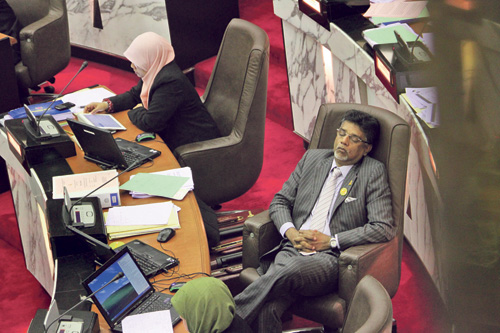
Aftermath of a suicide bombing
The aftermath of a suicide bombing - is this what you want near where you live or work while we await the new Act of Law to be passed?

13 Ghosts

Ask anyone in Tawau what Kampung Ice Box would mean to them, a big majority would cite prevailing lawlessness. Tawau, being close to the border, has been facing numerous problems involving cross-border criminals.  Therefore, it is not surprising that of the 13 suspected Jemaah Islamiah (JI) militants arrested there recently, 6 are from a neighbouring country.  Not too long ago some 150 kilometers away, Abu Sayyaf terrorists kidnapped foreign tourists as well as Malaysian staff from resorts on Sipadan island, some 2 hours away by speedboat from the southern Philippines.

Upon the arrest of the 13 by the Malaysian authorities, PAS was among the first to criticise the arrests saying that since the Internal Security Act is about to be abolished, it should not be used.  The Commission for Human Rights of Malaysia (SUHAKAM) also criticised the move to arrest the 13 and demanded their release.

I was engaged on Twitter by a member of SUHAKAM on my criticisation of the  Commission for calling for the militants’ release. He cited Article 9 of the Universal Declaration Of Human Rights (UDHR). The Article says no one Should be subjected to arbitrary arrest, detention or exile.  What he fail to realise is the rights of the majority should be held paramount. What about my rights to safety and security? Lest we forget under the same Declaration, I have a right under Article 3 which states that Everyone has the right to life, liberty and security of person. Shouldn’t SUHAKAM be defending those rights too? Should SUHAKAM not weigh the interest of the majority versus the rights of the 13 militants? Maybe I should remind SUHAKAM that Article 29(2) of the Declaration sets the limits to one’s freedom; THEREFORE one’s freedom is NOT an absolute right.

Maybe SUHAKAM needs to revisit the mandate that was given to the body via Act597 and that is to promote human rights education, Advise on legislation and policy, and investigate human rights abuse – NOT act as a NGO. And please if any of the Commissioners read law, please get a refund.

And for those who say that the ISA is no longer applicable, if you find any Ringgit note of yours that was signed by Ismail Ali, please collect them and give to me as Ismail Ali is no longer the Governor of Bank Negara, therefore by your definition the notes are no longer legal tender.

I don’t want Malaysians or foreigners killed in Malaysia because we fail to nip terrorism in the bud.

Cronyism and Nepotism

Fresh back from England and jobless I went up to my father and asked him for RM5.  He asked me why do I need RM5 for and I told him maybe I felt like going out for some roti canai with my brother, or something else.  He retorted:

“Do you know how much time does a Constable have to put in just to earn RM5? If you don’t have anything useful to spend RM5 on, don’t ask for any!”

My father used to get lots of coupons for free fast food meals to last the whole family a life time.  All we could do was watch him give away these coupons to friends and relatives, none was left for any of us.

That was how my father taught us, the way he brought us up.  I ended up as a tough nut in the Armed Forces that I used to reject a lot of wet rations sent to the cookhouse whenever I was the Duty Officer that one day the supplier asked the Chief Steward if I had a price.  The Staff Sergeant replied:

“You would stand a better chance wringing water out from a rock.”

Integrity is what we were all taught to have, no fear nor favour should we accept from anyone.  In my current line of work I can easily earn millions a month if I want to but I value my job, my integrity and my family’s dignity.

Which is why I find it wrong for Datuk Seri Shahrizat Jalil to have allowed her family to receive government assistance for the National Feedlot project that may or may have not come to a nought.  Whether or not members of her family are capable, certified or whatever have you, is besides the point.  She is a cabinet minister and her family members should have known not to abuse/misuse/take advantage of her position as one.  She has definitely removed herself from the list of winnable candidates for the next general elections, and by her staying on, will only cause people to say that Najib protects cronies.  Perhaps, the best course of action for her is to go on leave pending investigations; however, I personally would ask her to resign in order to save Barisan Nasional canvassers from having to answer on her behalf come GE13.

Nepotism and cronyism is something that needs to be eradicated, no matter which side of the political fence you are on.

Talking about cronyism, we have one young fart advising the Menteri Besar of Johor for the Iskandar Region Development Authority.  When I say young fart I mean someone who would not have had enough experience underneath his belt to even be the CEO of a public-listed company, let alone advising on a whole economic region.  Not unless he graduated from Lincoln’s Inn at the age of 14, but I, too, have a cousin who graduated from Lincoln’s Inn but I don’t think she’s much of an anything.  How on earth did he get to be in that position?  God, and a few other people might know.  I don’t. But my layman brain tells me you have to be someone’s crony to be in a position as important as that –  and what more at that young age.

Wan Firdaus, along with a Level Four legacy, Zaki Zahid, were recently appointed to the board of DRealty and Kulim, both in JCorp’s stable.  Maybe Zaki’s appointment may not be so bad as he has had some experience being in MRCB before this, but Wan Firdaus?  Neither of them are from Johor which makes me wonder if, out of 4 million or so Johoreans, are none fit to run their state’s company?

Maybe, just maybe Menteri Besar Dato’ Abdul Ghani Othman might want to look for outside talents, looking in may not be so good for Johor.  But maybe he could answer this: is there any non-Sabahan in SEDCO?

There is already a lot of cry of foul-play by local contractors for being left out by IRDA and IIB for the Iskandar region jobs, yet all we see are more and more of outsiders coming into the region, grabbing what they can.

Perhaps Ghani is still in a comfort zone and still sees Johor as Barisan Nasional’s fixed deposit or a bastion of some sort.

Don’t ask me for hard-facts and figures and so on, I am just a layman looking in.  But what I see is not something that I like.

Water, Water, Everywhere? Part 2

Dirty Water

Not too long ago if you go to a government office to get an application form, it would be left either in a tray or in a box for you to take and you would see each person taking more forms than they needed.  Some would end up as kacang puteh wrappers sold by kacang puteh peddlers on bicycles parked outside the very government office.

BECAUSE THEY WERE FREE!

Nowadays, you have to pay RM1 per form, and you can see that each person would take only one form.  Anything that is free has no value.

What I am getting at is, if you give something to someone for free, most of the time it would go to waste, or taken for granted.  The same goes to the free first 20 cubic meters of water given to residents of Selangor by the Pakatan Rakyat government.  In the words of Prof Dr Chan Ngai Weng (Universiti Sains Malaysia and Penang Water Watch):

“The water policy of that (Selangor) state is suicidal!”

He said this during the 1st Malaysian Water Association – Universiti Teknologi Malaysia Roundtable Dialogue titled “Water Has No Value” on Friday, 28th October 2011.

Interestingly, the Seceretary-General of the United Nations, Ban Ki-Moon also underscored this point.  On 3rd August 2011, he told the United Nations General Assembly that water, as Basic Human Right, has a market price.

“Let us be clear,” he asserted, “a right to water and sanitation does not mean that water should be free.”

Let us face the fact.  Water really has no value in Malaysia. On average the water tariff in Malaysia is at 20 US cents per liter or 60 sen.  An average person in Malaysia uses 203 liters per day.  In a month the person would be using up to 6 cubic meters of water.  An average Malaysian family (5 members) would then use up to 30 cubic meters per month.  Therefore, an average family will be paying RM18.27 per month for the use of treated water.  That is the equivalent of an hour and a half of calls from your mobile phone.  You cannot even take the NKVE from KL to Shah Alam and back on that amount.   Water tariffs in Malaysia simply does not meet the cost of producing treated water for the masses.  Therefore, the water service providers in Malaysia really need to look at restructuring the water tariff by increasing the tariffs to a level that reflects the cost price, and a surcharge for those who use more treated water than the national per capita average.  The public will also have to be educated on the cost of water treatment and production through engagement sessions with SPAN, NGOs and the service providers.

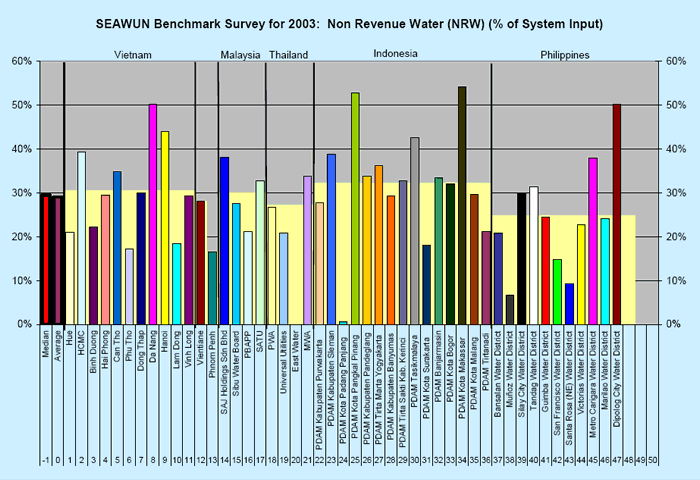
Apart from that, the service providers would also have to prove to consumers that it has taken steps to plug Non-Revenue Water (NRW).  Mind you, we have some 131,000km of water pipelines, 25% of those are made from asbestos-cement and they can easily deteriorate, crack or break altogether.  Our average NRW stands at 36%.  The Asian Development Bank stated that in Asian cities, the NRW averages 30% of water production, but ranges from 4% to 65%, posing as a deterrent to the recovery of production costs.  To plug NRW is costly but has to be done to the point where it would be economically viable to do so.  The panelists of the above dialogue agreed that 25% would be the acceptable level of NRW for Malaysia, and that should be the target for water service providers to achieve over the next few years.

South-East Asia's NRW 2003 (% of System Input)

Another challenge is to protect the water catchment areas.  The value chain starts at water catchment areas and therefore it is imperative that state governments take steps to protect these areas by gazetting them under a specific Act for Water Catchment Areas, and not as it is now, under the Forestry Act.  We often find water resources polluted by human activities in these areas such as logging (legal and illegal), farming, plantation, manufacturing, animal husbandry and indiscriminate dumping of rubbish despite having these areas gazetted under the Forestry Act.  Therefore, protecting water catchment areas is vital to ensure clean and continuous water supply.  The general public needs to be educated on the importance of preserving water catchment areas so they could act as the extra eyes and ears for enforcement authorities.

The biggest challenge, of course, is to depoliticize water.  Water, like the nuclear issue, should best be left to the experts, and not politicians who are self-proclaimed experts.  The current tussle on various water issues by both the ruling government and the opposition over the Langat 2 project is not helping, nor is the war on who has the lowest water tariffs.  When Penang increased its water tariffs, it was the best move yet it was politically lambasted by the BN government.  Face the fact: things are not getting any cheaper and the same goes to the treatment and supply of water.  And to the Selangor state government, stop hoodwinking the public any further.  Based on a projection up to July 2011, the water supply in Selangor is at 4,122 million liters per day (MLD) while the existing capacity is only at 4,326 MLD.  That gives us all a mere 1,204 MLD or 4.7% buffer.  If anything were to happen to any two water treatment plants in Selangor, our taps will run dry for several days at least.  Therefore, the Langat 2 treatment plant needs to be built like yesterday already.

Remember: Malaria, Tuberculosis, rising food prices, environmental degradation – all these have a common denominator: WATER.

Water, Water, Everywhere?

In 2002, the Likud Party won the Israeli General Elections and declared that it would object to the creation of a Palestinian state.  The issue: WATER.  Said Benjamin Netanyahu:

“A Palestinian state would control the aquifer, which gives us 30 percent of our water. Yes to a Palestinian state means no to a Jewish state, and yes to a Jewish state means no to a Palestinian State.”

That is how important water is to all of us, and I am constantly reminded of the hardship people in the Klang Valley had to go through during the water crisis of 1998, and the fact that it could happen again come 2014 (provided the Mayan Calendar’s gotten 2012 all wrong).  My fears are further underscored by this blog written by a friend who was a senior Water Engineer in pioneering Non-Revenue Water control work.

When Pakatan Rakyat gained control of Selangor in 2008, the first thing they did was to supply the first 20 cubic meter of treated water to consumers FREE OF CHARGE, a move I thought was foolish, unprecedented, and was definitely not carefully thought through of.  Nothing more than an election feel-good reward to those whom had vote for them, I believe it only encourages wastage of treated clean water as people do not have to pay for that first 20 cubic meters of water.

Then on 5th August of 2011, Elizabeth Wong, Selangor’s version of Fuziah Salleh of Kuantan (the former is the water “expert” while the latter is the nuclear “expert”) said in The Star that studies done on the growth in demand for water in Selangor by SYABAS was erroneous as it had relied too much on the National Water Resources Study (NWRS) conducted by the Economic Planning Unit in 2000.  That shows how shallow Eli Wong is, as SYABAS had used data collected over the last five years (2005 to 2010) to forecast the future of growth in demand for water.  In fact, Eli Wong went on to say that “… the “Water Demand approach” (SYABAS) used was based on the national GDP growth projection that varies according to the global economic market that has not been stable since the world economic crisis.”

Miss Wong, had you the ability to understand what you read, then you would know that the NWRS based its findings on four components: 1) Domestic Uses, 2) Commercial Uses, 3) Institutional Uses, and 4) Industrial Uses.  Only component (4)  uses GDP as a growth indicator for forecasting demands, and looking at what was written above by my friend, if the Selangor state government does not address this issue now, we may face a serious water shortage issue come 2014.

More alarming is Miss Wong’s continued feeding of misinformation over the Internet over the Selangorku website (SYABAS Gagal Turun Air Tidak Berhasil, Bekalan Air Bersih Terganggu) whether by default that she is ignorant of the water issue, or by design that this misinformation is fed to the masses to serve a much bigger agenda.

Air Tidak Berhasil or Non-Revenue Water for laymen like you and I actually means TREATED water that is lost through leakages in old pipes, theft and other methods, and not billed – cost was incurred to treat the water  but no revenue was able to be collected.  Eli Wong does not understand the economics of NRW.  To lower NRW level, it requires a form of investment. However, the economics of NRW is such that there comes a point where further lowering the NRW level will result in a cost that is too high for a water operator to bear.  The methods used to detect leaks etc is by no means cheap, nor is the replacement of old and faulty pipes.  Selangor is a huge state that the cost of replacing ALL these pipes would be beyond exorbitant.  For the same reason, Kelantan has less than 60% treated piped water supply coverage.  Penang on the other hand has a low NRW because it is far smaller compared to Selangor.  So, how does the PR-led Selangor state government plan to reduce NRW to 10 percent?  This is why the Federal Government has proposed for the building of the Langat2 plant for treating raw water supply from the neighbouring state of Pahang.  Without it, the current Selangor water buffer stands at 5 percent.  If any two water treatment plants in Selangor have to be shut at the same time, say for maintenance, then we will have serious water supply problems.

Water is a very important commodity in life.  Water is beyond necessity as it is life.  The Pakatan Rakyat’s gamble with this water issue should be seen as a gamble with the life of the rakyat.  And in my opinion, Eli Wong should just STFU and let the experts do their job.

In A Bowling Lane There Is A Gutter On Each Side

So it’s gutter-politics when you drag in the child/children of politicians to serve your cause.  Unfortunately, politics is like a bowling alley – there’s a gutter on each side of the lane.

Sample of (not limited to) websites from the holier-than-thou side:

http://www.detikdaily.net/v5/modules.php?name=Forums&file=viewtopic&t=26055

http://ikhwanhafiz.blogspot.com/2011/06/anak-rosmah-menikah-borat.html

http://milosuam.blogspot.com/2011/09/gempar-bakal-menantu-rosmah-anak.html

http://bagindareformasi.blogspot.com/2011/07/gambar-anak-najib-norashman-juga.html

http://anwaribrahimblog.com/2011/06/18/dr-tan-siapa-biaya-kos-pertunangan-anak-najib/

http://shaiful-hulusgr.blogspot.com/2010/06/parti-liar-anak-najib-dan-pemimpin-umno.html

http://www.ibnuhasyim.com/2011/06/kos-pertunangan-anak-najib-atas-nama.html

Pot calling the kettle “black”?

Colour Of Skin

When DAP’s ADUN for Kota Alam Shah in Selangor made an insulting remark about the Malaysian flag on National Day, there was an outcry and a call for him to be punished.  DAP did just that by suspending him from the party for six months.  This was later commuted to just a severe reprimand from the party’s “disciplinary committee.”  It was a punishment nonetheless.

DAP’s office holders are notorious for not respecting the Rukunegara, which was based on the Federal Constitution.

After the political Tsunami of 2008, several DAP’s assemblymen from Penang, Perak, Pahang, Johor, and most recently in Sarawak, refused to either don the official attire and/or the songkok.  The songkok, to them, symbolizes Islam, which is the official religion of Malaysia.  Several rulers were insulted by these people that the Sultan of Johor even made a remark about the behaviour of one who was thrown out of Johor’s Dewan.  Coincidentally, this same state assemblyman is now serving a six-month suspension for using the party’s money for his own interest (if this was done by a BN rep, they would have asked for a Royal Commission of Inquiry).

When the Chief Minister of Penang made a defamatory remark regarding the state of Johor, he too was let off without even a pinch given.

The difference between all the people mentioned above and the Kota Alam Shah’s rep is: the latter is not Chinese.

So much for a so-called multiracial party.

Donkey Hotey

Don Quixote was a Spanish fiction work written in the early 17th century about a middle-aged man whose pursuit of ideals was impractical and foolish.  It was from Quixote’s name that the adjectival form was derived: quixotic.

Quixotic is best used to describe the alternative budget offered by Anwar Ibrahim in Parliament, days before Prime Minister Najib Razak presented the government’s version.  One glaring carrot Anwar presented was setting the minimum wage for Malaysians at RM1.100 per mensem, while Najib’s government is still discussing the issue (or are they?).  Whatever it is, you can have a RM5,000 minimum wage level but it means nothing if all you can buy with it is a packet of asam boi.  Everyone should be thinking of how to increase the purchasing power of the Ringgit.

What was the Ringgit at versus the Greenback before Anwar’s superb fiscal policy as the Finance Minister almost destroyed the former? It was at around RM2.50 to a Dollar or something to that effect.  What are we at now? RM3 to a Dollar or somewhere there.  Simple minds would say that we’re still 50 cents off, therefore to a simple person like me, we have not fully-recovered from the 1997-98 Asian Financial Crisis.  Tun Dr M’s recovery plan which was to continue with what the opposition termed as “wasteful mega-projects” proved vital in helping ordinary Malaysians get back on their feet.  The local spillover effects from those projects were hardware stores get orders for construction materials, workers flock to Malaysia for jobs and spend their money at the local canteen set-up by the makcik who buys her ingredients from the local sundry shop and market.  Every one gets something out of a project, and every one including that makcik becomes a crony.  This is evident when trying to be a popular person, a certain sleeping Prime Minister stopped many mega-projects and caused the economy to slide down.  He learnt the lesson a hard way.

Najib’s budget makes Malaysia attractive for FDIs, and allows the lower income group to have more purchasing power.  When more money circulates in the economy, you create more jobs.  I’m no economist but I think that is how things work.  Setting a high minimum wage will only encourage traders to increase prices of essential goods, thus raising the inflation rate.  When inflation rate goes up, your purchasing power goes down.

Of course, PR is filled with things quixotic, but they are also notorious for not keeping promises made.  Let us take the promises made by PR in Selangor in its 2008 Elections Manifesto:

I want to know how many of you whose baby was born in Selangor has had an account set-up by the Selangor State Government with RM100 in it?

I want to know how many of you do not have to pay any form of fees for your pre-school children?

I want to know how many of  you have received between RM50 to RM100 for every child that you have to send to a nursery?

How many of your invalid kinsfolk has had a Takaful insurance subscribed by the State Government for them?

How many jobless single mothers with children below 12 years of age has received a fixed allowance of between RM150 to RM250?

How many farmers and fishermen have received a minimum wage of RM1,200 per month? (Co-incidentally, Anwar has reduced this to RM1,100!)

Those are among the promises made but have yet to be fulfilled by the Selangor State Government; yet, Anwar dared to make an even bigger promise through his quixotic budget.

Is Anwar a Don Quixote then?  At least Don Quixote’s loss of wits wasn’t as bad as the Donkey’s delirium.