When the development of Forest City commenced, it came under fire by many including the surrounding communities. This is because of the concerns regarding the impact to the environment as well as the negative publicities fed on how livelihoods would be affected. But my recent article has put that to rest.
Despite having only 245 registered fishermen in a community of 11,000 Country Garden Pacificview (CGPV) finds it of utmost importance that the fishermen would be able to continue conducting sustainable fishing in the waters off Forest City and its surroundings.
Kelab Alami, an NGO concerned with environment conservation, was born out of these concerns in 2008. CGPV works hand-in-hand with Kelab Alami by funding its awareness and research activities.
For 2018, Kelab Alami have lined up a series of activities including the spreading of wider awareness pupils in Sekolah Kebangsaan Tanjung Kupang and Sekolah Kebangsaan Tanjung Adang, both in Gelang Patah.
Kelab Alami founder Shalan Jum’at, 30, said plans for 2018 also include mussel farming, habitat documentation and monitoring of various marine species found in the surrounding area of Kampung Pendas and the other nearby villages.
“With development such as Forest City, which is near to Kg Pendas, it is a boom in eco-tourism. The project have presented challenges as well as the potential of the natural wonders in the sea and rivers that lie just at our doorstep,” said Shalan Jum’at.
“Development has changed the face of Tanjung Kupang for the better and spurred the birth of Kelab Alami, which provided opportunities for the local fishermen to diversify their skills as well as given the children a chance to become citizen researchers as well as act as eco-tour guides to tourists and visitors to the villages here,” he said.
Muhamad Sofi Juhari, 19, who joined the club when it was first set up, said he would have been a youth without any goal in life if not for the club.
“I currently work at a motorcycle repair workshop, which is managed by Anak Alami Enterprise. Shalan showed me the ropes in acquiring entrepreneurial skills. Business is good at the motorcycle repair shop with about 300 customers a day,” Muhamad Sofi said.
“Kelab Alami not only helps me to gain self-confidence and knowledge about the natural wonders of the surrounding environment, I also get to hone my entrepreneurial skills and am able to earn an income that I can contribute to my family,” he added.
Another club member, Mohammad Irfan Yazid, 19, who joined Kelab Alami when he was 7 years old, has a different passion. He operates a ikan bakar (grilled fish) and burger food stalls near Muhamad Sofi’s workshop.
“I can sell about 100 burgers and about 10 grilled fishes per day. With more people coming to work in Forest City, my food business is also improving by the day,” said Mohammad Irfan.
“Forest City has also funded Kelab Alami which has organised activities such as youth ranger training and entrepreneurship seed funding as well as fishermen’s seed funding, among others,” he added.
Another member Muhd Arif Aiman Fazail, 17, who joined Kelab Alami at age 11, said he has forged friendship with the other neighbourhood children through club activities.
“I have learnt to appreciate the different species of snakes, lobsters and other creatures of the sea since becoming a club member. Former club members who have left the village in pursuit of higher education come back to see us whenever they can to share their experiences and knowledge with us,” Muhd Arif said.
Meanwhile, Datuk Md Othman Yusof, executive director of CGPV, who visited Kelab Alami in Kampung Pendas Laut recently, applauded the efforts and achievements of Kelab Alami.
“Kelab Alami can also organise community workshops which offer skills to make handicrafts or build items such as wooden chairs and tables. We can emulate Thailand by manufacturing souvenirs in a local cottage industry to present as gifts to visitors. This would generate income for the village where the profit can be enjoyed by the local community,” Md Othman said.
Md Othman, who was at the clubhouse to hand over a cheque of RM194,450 to the non- governmental organisation, also spent some time to chat with the kids of Kelab Alami.
Md Othman, impressed by the knowledge of these youths and confidence exuded by them, was encouraging them to keep up their good work and continue to strive for a brighter future.
Meanwhile, 90 students of Sekolah Kebangsaan Kampung Simpang Arang who come from low-income families, were treated to to a ‘Back to School’ shopping spree at Giant Hypermarket in Tampoi, courtesy of CGPV.
CGPV corporate communications director Aeron Munajat said the Back to School programme is intended to alleviate their families’ financial burden as they prepare for the new school term.
“We do not want the local folk to feel left out due to the development around their village,” she said.
Aeron added that it was an eye-opening experience for some volunteers who were employees from China.
The programme also allows volunteers to interact with the local community, giving them exposure to the lives of the indigenous people.
Chen Hao, 27, who is an assistant legal advisor at Country Garden Pacificview’s legal department, was among the volunteers who overcame the language barrier to communicate with the Orang Asli children.
“We did not speak the same language, but the children and I found ways to communicate through body or sign language. The children would point at something they wanted to buy for school, (for instance). It is my first time meeting Orang Asli children, and I find that they are as bright and bubbly as any other child I know,” said Chen, who has been working at Forest City in Johor for the past two years.
The treats were not limited to Giant Hypermarket, as the Orang Asli children were also treated to lunch after their shopping excursion.
Country Garden Pacificview plans to adopt SK Kampung Simpang Arang next year, making it an addition to the five primary schools it has adopted since 2015.
The five primary schools are SK Morni Pok, SK Tanjung Adang, SK Tiram Duku, SK Tanjung Kupang and SK Pendas Laut.
Besides youth development and education, Forest City focuses on two other pillars, namely societal development and environmental awareness.
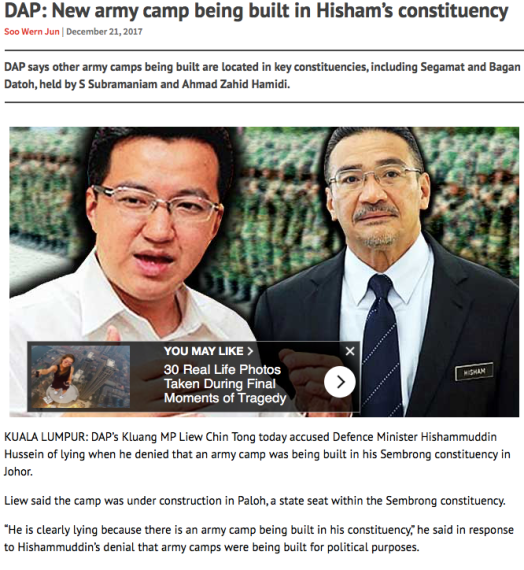
Recently Kluang Member of Parliament Liew Chin Tong slammed Minister of Defence Hishammuddin Hussein for denying that an army camp was being built in Paloh, a state seat in the latter’s constituency of Sembrong. Liew Chin Tong implied that the army camp is being built for political purposes.
“This proves that Barisan Nasional (BN) is using these army camps to increase voters in constituencies that it won with thin majorities in the 13th general election,” Liew told a press conference last week.
He said the inclusion of the army personnel in Paloh would increase the electorate by over 1,000 voters.
“In Paloh, DAP lost only by a few hundred votes and these new voters will result in another BN win,” he added.
The fact is that while members of the Malaysian Armed Forces swears its allegiance to the Yang DiPertuan Agong, His Majesty’s Government (the Government-of-the-Day), and the Country, each member of the Malaysian Armed Forces are free to vote for whom they are politically-inclined to support. Therefore, having a military camp/base does not guarantee you any solid support for votes. I had written at length on this issue of allegiance in a recent blog post.
Perhaps it would be good for Liew Chin Tong to admit that he won Kluang against the Barisan Nasional in 2013 because of the presence of a huge army camp, namely Kem Mahkota, that houses the 61st Royal Artillery Regiment as well as the 881st Regiment, Malaysian Army Aviation.
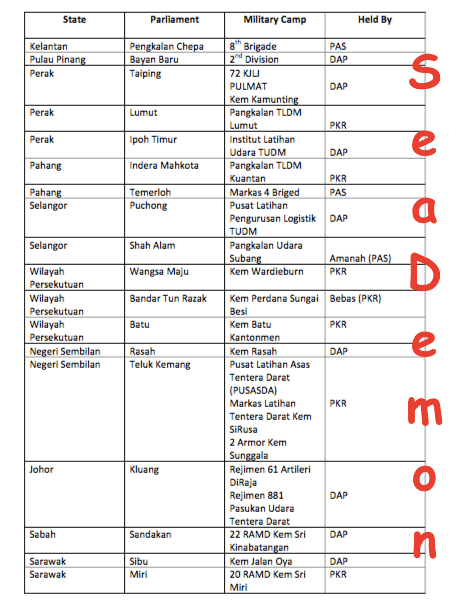
Come to think of it, out of the 89 Parliamentary seats won by the then-Pakatan Rakyat during the 13th General Elections four years ago, at least 18 parliamentary constituencies have major military camps/bases in them. That is 20 percent of the total of parliamentary consituencies held by the Pakatan candidates. Here is the list that I have compiled:
Let us take for example the Lumut Naval Base which is under PKR. That base alone had 14,231 registered voters while PKR’s Mohamad Imran Abd Hamid won 40,308 votes. Why didn’t Barisan Nasional win there?
Perhaps Liew Chin Tong should also inform all Malaysians that out of the 18 constituencies with major military camps/bases that was won by the Pakatan back in 2013, eight seats were won by the DAP. That is 44 percent! Despite being the other “Malay” party within the Pakatan, PKR managed only seven seats or 38 percent. PAS could only get three then but one of those seats, Shah Alam, is now firmly under Khalid Samad of Amanah after he betrayed his oath to remain in PAS if nominated as a candidate and would divorce his wife if he jumps ship. Shah Alam is the home of a major Royal Malaysian Air Force base – Subang.
Pakatan and its supporters should just stop politicising the Malaysian Armed Forces. As towns and cities are developed, old camps and bases are no longer strategic nor conducive to be inhabited. How could Pakatan, advertising that it is all for rights and stuff, allow military personnel to live and work in deplorable and antiquated conditions? And as development creep into their surrounding areas, military bases are no longer of any strategic value. I have addressed this issue in a posting of mine and so has my friend Danny Liew in his recent posting.
So, wouldn’t DAP now like to offer a piece of land in constituencies held by it for Hishammuddin to build military bases or camps?
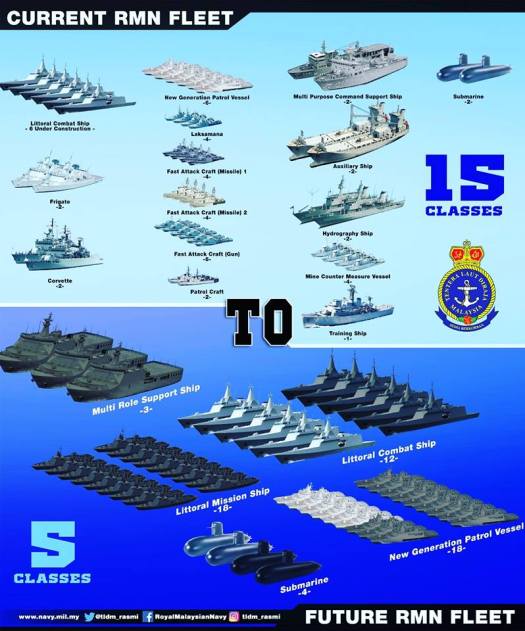
The Royal Malaysian Navy has recently laid the keel for the third Littoral Combat Ship (to be named Shariff Masahor after the Sarawak warrior who fought against the White Rajahs) at the Boustead Naval Shipyard in Lumut. This will be the third of six LCS planned by the RMN as part of its ’15 to 5′ transformation programme.
Dogged by having as many as 15 classes of ships with an average life of 15 years, the current RMN fleet is supplied by seven different nations, causing logistical and financial nightmares for the operators. As a result, the RMN cannot have the kind of force projection that it envisages.
The transformation programme allows the RMN to reduce its current classes to just 5 classes of ships namely the LCS, the Littoral Mission Ships (LMS), the Multi-Role Support Ships (MRSS), submarines, and the patrol vessels (PV).
The LCS, with its ability to perform complete multi-mission 3-D operations, will be the obvious class to spearhead the Royal Malaysian Navy. The six vessels, based on the Gowind 2500 corvette design, will fulfill the operational requirements in both the blue and littoral waters of the Indian Ocean and the South China Sea.
All six vessels are and will be built at the Boustead Naval Shipyard (BNS), which is a bit unorthodox given the need for a good project risk management as not to repeat the disaster caused by a previous builder. The GMD of Boustead Heavy Industries Corporation (BHIC), Vice-Admiral Tan Sri Ahmad Ramli Mohd Nor TLDM (Retired) said that the project team from both BNS and Naval Group have taken the necessary measures to prevent such failure to occur in this project.
Commonality between classes is also key to the success of the 15-to-5 programme. Admiral Tan Sri Ahmad Kamarulzaman bin Hj Ahmad Badaruddin TLDM said that all the classes will have major items that are common to ensure the availability of vessels. Most importantly, these items are being supplied by 104 local vendors and that in turn has created thousands of jobs and endless learning opportunities for locals.
“The Navy is determined to show that not only does it give opportunities to local companies, but also help build the local defence capabilities to reduce reliance on foreign companies,” said Ahmad Kamarulzaman.
The Navy hopes to have up to 12 LCS, 18 LMS, four submarines, 18 PVs and three MRSS to fulfill its doctrine requirements. It is believed that the PVs will consist totally of the Kedah-class NGPV while two more Scorpene submarines will be acquired depending on the funding from the government. It makes a whole lot of sense to have the Kedah-class expanded as Malaysia is already in possession of the builder’s plans, while the acquisition of two more Scorpenes would be a lot cheaper as the infrastructure as well as logistics support are already in place.
In observation however, if all these vessels are already in service, there is only so many number of vessels that the Navy’s bases can handle at any given point of time. I believe that the PVs will all be deployed to the Second, Third and (soon) Fourth Naval Regions, with major assets such as the LCS and LMS divided between the First and Second Naval regions.
How The Royal Malaysian Air Force Fits In
Commonality is another goal the Royal Malaysian Air Force (RMAF) hopes to achieve. Recently, RMAF Chief General Tan Sri Dato Seri Affandi bin Hj Buang TUDM celebrated his first year as the service’s Chief. Although dogged with several incidents of crashes, it has not diminished his team’s aim to elevate the RMAF’s ability as a force to be reckoned with. Only the cut in defence budget has curtailed some of its plans for expansion. The withdrawal of the MiG-29Ns from the frontline has stretched its frontline capabilities too thin.
Although the reintroduction of the MiG-29Ns back into service was thought of as an interim measure before getting its direly-needed MRCAs, this was not agreed by the government as it does not want to see its pilots flying aircraft that may endanger themselves. This would also mean that the RMAF’s current LIFT, the Hawk 208s which are in their 23rd year of service, will soon have to go.
The 15-to-5 programme of the RMN would not mean much without sufficient air cover for the Navy to keep the Sea Lines of Communication (SLOC) open, especially between states in the Peninsular Malaysia with Sabah and Sarawak. The RMAF is already in the process of looking for a suitable replacement for the Beechcraft Super King Air B200T MPAs. If commonality is a key to this, then we would either see the Air Force acquiring either more CN-235s, or opt for a stretched version which is the CN-295. However, given the different powerplant of the CN-295, a MPA version of the CN-235 sounds most viable.
Combat Air Patrols, or sufficient and adequate air cover is also critical to the success of the RMN’s 15-to-5 programme. However, current number of aircraft available to perform the task is limited as only the Boeing F/A-18D Hornet and Sukhoi Su-30MKM would have the ability to get into the theatre in the shortest time compared to the BAe Systems Hawk 108s and 208s. Furthermore, the Su-30MKMs would have to undergo their 10-year maintenance and that would affect the number of availability.
As it is, the supersonic Korean Aerospace Industries (KAI) T-50/FA-50 LIFT cum light fighters are the most suitable for this role, as well as to take over the LIFT role from the BAe Systems Hawk 208s. I have written on the KAI T-50 in a recent article and still believe that other than its cost (said to be a third of a full-fledged fighter aircraft) the commonality that the KAI T-50 have with a type of aircraft that the RMAF is already operating is the Boeing F/A-18D Hornet as they use the same powerplant. Should the RMAF plan to acquire more of the Hornets, the T-50 would be the best option for the RMAF to consider acquiring as they can play the dual role of LIFT and advanced supersonic fighter far better than the Hawks ever could. The RMAF would be able to provide more capable birds in the air in a shorter amount of time while waiting for a much larger budget to actually acquire new MRCAs. The T-50s are combat-proven and have performed well in recent bombing missions against the ISIL-Maute group in Marawi.
Having the T-50s in Kuantan as LIFT/Advanced Fighters and as a advanced fighter detachment in, perhaps, Bintulu, would enhance the RMAF’s operational capability not just as a strike force, but also to provide air support for the Navy’s surface missions. The Chief of RMAF is well-known as a fighter and operations man, and is therefore the perfect person to make a case to fulfill the RMAF’s doctrine with the correct equipment needed by his frontliners.
Summary
The Royal Malaysian Navy is spot on when it decided to go with its 15-to-5 transformation programme that would see more lean-and-mean vessel types be introduced into the service. However, having a good surface capability without capable air support from the Royal Malaysian Air Force would limit its capabilities to keep hostiles away. Both services would need strong support from the government to ensure that force projection to deter opportunistic hostile forces can be achieved by both services.
STUDENT activism in Malaysia peaked in December 1974, having started in September of the same year in Tasek Utara, Johor Bahru, when some 5,000 students demonstrated at the Selangor Club Padang (now Dataran Merdeka) and as expected, clashed with the Federal Reserve Unit (FRU).
As a result, the students retreated to Masjid Negara with the FRU hot on their heels. The demonstration was culled and 1,128 students arrested. The student leaders who were holed up on the University of Malaya campus were soon arrested and so were those who hid inside their rented rooms in nearby Kampung Kerinchi.
Three representatives of Kampung Kerinchi complained that the FRU had taken harsh measures to apprehend the students by firing tear gas and that had resulted in the death of a baby.
My father immediately summoned his then deputy, the late Tan Sri Mahmood Yunus, and then Director of Special Branch, the late (Tan Sri) Mohamed Amin Osman, and asked them if the FRU had indeed fired tear gas into Kampung Kerinchi. Amin was adamant the FRU did nothing as such.
When asked if he (Amin) had checked the allegations himself and also the report received from the FRU troop leader, Amin said no. So my father instructed Amin to go to Kampung Kerinchi to check himself.
“Celaka! Depa tipu saya!” (“Hell! They lied to me!”) exclaimed Amin when he saw the empty tear gas canisters that littered the lanes of Kampung Kerinchi, to which my father replied, “You fell for it because you did not check the information yourself!”
Fake news is a neologism that has entered the lexicon, used to collectively describe rumours, hoaxes, misinformation, propaganda and recycling of old rumours that had been debunked, that mislead people into believing that they are current and true.
Fake news caused the Barisan Nasional to lose its long-held two-thirds majority in 2008 because it was complacent and not quick enough to react and dispel these rumours. Back then, political discussions and dissemination of fake news or propaganda occurred in chat rooms, in SMS, and blogs which were only a handful then. Now there is Facebook, Twitter, Line, Telegram, WhatsApp, YouTube over and above the media available almost ten years ago.
Claire Wardle, Executive Director of First Draft a non-profit organisation dedicated to finding solutions to the challenges associated with trust and truth in the digital age housed at the Shorenstein Centre on Media, Politics and Public Policy at the Harvard Kennedy School, categorised mis and disinformation into seven types:
Satire or parody – this type of misinformation has no intention to cause harm but has potential to fool. A good example of this is of a message purportedly sent by a passenger of the MH370 who said he managed to hide his iPhone5 up his anus! This had been debunked as a prank, but there are those who still believe that the person did manage to shove a five-inch by two-inch phone up his anus without any problem on the island of Diego Garcia.
Misleading content – most recent would be issues tweeted by two artistes that evolve around the rising cost of living, the weakening ringgit, a shambolic economy, designed to rile up anger in their followers. The tweets, not backed by published facts and figures, would do damage to those who have no inclination to check for the truth and to retweet or forward to others.
Imposter content – these are usually propaganda designed to use genuine sources but impersonated as theirs. A simple example would be of Selangor Mentri Besar Datuk Seri Azmin Ali’s recent event officiating the opening of the Rawang-Serendah Bypass, eight days after the bypass was opened by a minister.
Fabricated content – this type of content is 100 per cent false and is designed to deceive and cause harm. If you remember in July 2007, PKR’s Tian Chua admitted that he had fabricated a photo to show that Prime Minister Datuk Seri Najib Razak was together with Abdul Razak Baginda and now dead Mongolian-model Altantuya Shaaribu in Paris.
False connection – this is when headlines, visuals and captions do not support the content. The most famous example from recent times was of The Star’s headline that said “Malaysian Terrorist Leader” while having a huge photo of Muslims praying during the first night of Ramadan. Although The Star apologised for the error, it was not the first time it had made a similar mistake.
False context – this is when genuine content is shared with false contextual information. Artiste Fathia Latiff put up a screen capture of the price of fuel in various OPEC countries on Twitter, asking why Malaysia, as an oil producing country, charges very high for petrol? The screen capture is of oil prices back in 2014. The average value of fuel prices for Malaysia between September 4, 2017 and December 11, 2017, was RM2.23. For comparison, the average price of petrol in the world for this period was RM5.82!
Manipulated content – this is when genuine information or image is manipulated to deceive. Recently, there was a video of a skinny polar bear with muscle atrophy struggling to find food in a snowless land that was made viral. This was attributed to global warming. However, the video was filmed in August when the tundra was snowless. It was only published in December. Even the indigenous community living in the area thought it was a stunt to raise more funds and was doing a disservice to the war against climate change.
I don’t know why Malaysians are so gullible and eager to share fake news.
In WhatsApp groups, you can see how some people could post about something religious and then help spread fake news – something totally against religions. Nowadays, this fake news comes with a disclaimer – “Dari group sebelah”.
Every time we forward or share a post without double-checking or verifying, we add to the noise and confusion. We never consider the source, we never consider the supporting sources and worst of all, we never check our biases.
The late Tan Sri Amin learnt this the hard way.
Having seen that he was misled about the FRU not firing tear gas into Kampung Kerinchi, he went on to check about the claims of a baby that had died as a result of the tear gas. None of the three village representatives had themselves seen the dead baby and no one had actually reported to them of the death.
When asked where the information had come from, they replied, “From Anwar Ibrahim and the other student leaders!”
Zaid Ibrahim on a campaign trail (courtesy of parpukari.blogspot.my)
His Royal Highness Sultan Sharafuddin Idris Shah Alhaj, the Sultan of Selangor from my observation is a calm and very private person. He rarely makes any statement or gives interviews to the media except during his birthday celebration. Only once in a blue moon would Sultan Sharafuddin voice out his concern, especially during the Kajang Move, because it was affecting the efficiency of His Royal Highness’s state government. The Sultan had also expressed his concern over the rudeness of the Opposition and its supporters towards the late Sultan Azlan Shah of Perak during the Perak constitutional crisis of 2009.
The latest episode involves the adverse reaction by DAP’s Zaid Ibrahim to the Sultan’s statement on Mahathir’s remark on the Bugis people. The statement was made as part of an interview with The Star for this year’s celebration of the Sultan’s birthday. In his Twitter postings, Zaid said that when some Rulers play politics, they must know the consequences. Do not think there is no price for partisanship.
What earned Zaid the wrath of many was when he also Tweeted a warning to Sultan Sharafuddin saying the Sultan should be careful with his words (as) no one is immune when (the) country burns.
That is typical of Zaid, when he displays the usual non compos mentis character. Often displaying his republican attitude, Zaid suits well in the DAP – a party known historically for its rash behaviour when it comes to respecting the Rulers Institution. It is also well that he is a Malay, from Kelantan, as it would appeal to the fence-sitting Malays in Kelantan who are politically torn after the departure of PAS from Pakatan Rakyat effectively ending the coalition.
The late Karpal Singh once petitioned to sue Sultan Sharafuddin’s late father, Almarhum Sultan Salahuddin Abdul Aziz Shah Alhaj, in 1987 over a speech by Sultan Salahuddin to the Selangor branch of the Ex-Servicemen’s Association saying that he would not pardon drug traffickers in Selangor. The petition was rejected on the grounds that there was no lis. In 2009, Karpal Singh had intended to sue Sultan Azlan Shah of Perak for appointing Datuk Dr Zambry Abdul Kadir as the new Menteri Besar, replacing DAP’s choice Nizar Jamaluddin. Karpal was found guilty of sedition in 2014.
Since gaining some grounds after the 2008 general elections, the DAP has time and again displayed its disrespect to the Rulers Institution by not abiding by the dress code at state assembly openings. One good example is of DAP’s Gwee Tong Hiang who was the Johor state assemblyman for Bentayan who did not wear a songkok at the state assembly opening. The late Sultan of Johor, Almarhum Sultan Iskandar Ismail was not amused.
“Two days ago someone here tried to be a hero by refusing to dress accordingly. If he wants (to differ), then get out of here now!” the late Sultan chastised. Tong Hiang, unfortunately, was not present then.
The DAP had wised up since then. Seen as a Chinese chauvinist party, such rude behaviour turned them into punching bags of the Malays, especially those from UMNO who had a feast turning the DAP into cheap meals. The DAP quickly recruited liberal Malays into its fold, including Zaid, to do their dirty jobs for them. This keeps the heat off the Chinese in DAP, but pit Malays against Malays.
What the authorities should realise is that such behaviour displayed most recently by Zaid Ibrahim sends the wrong signal that it is alright to reject Malay traditions including respect for the elders and the Rulers to the younger Malaysian who, at their age, would be mostly anti-establishment by nature. If this goes unchecked, it would certainly give birth to more Zaid Ibrahims.
The authorities should take cue from Sultan Sharafuddin.
“I am aware that Zaid had long been making false and incorrect accusations against me. He is a politician and a former minister whom I understand is against the royal institution. My advice to Zaid is simple, do not forget where you come from,” the Sultan said.
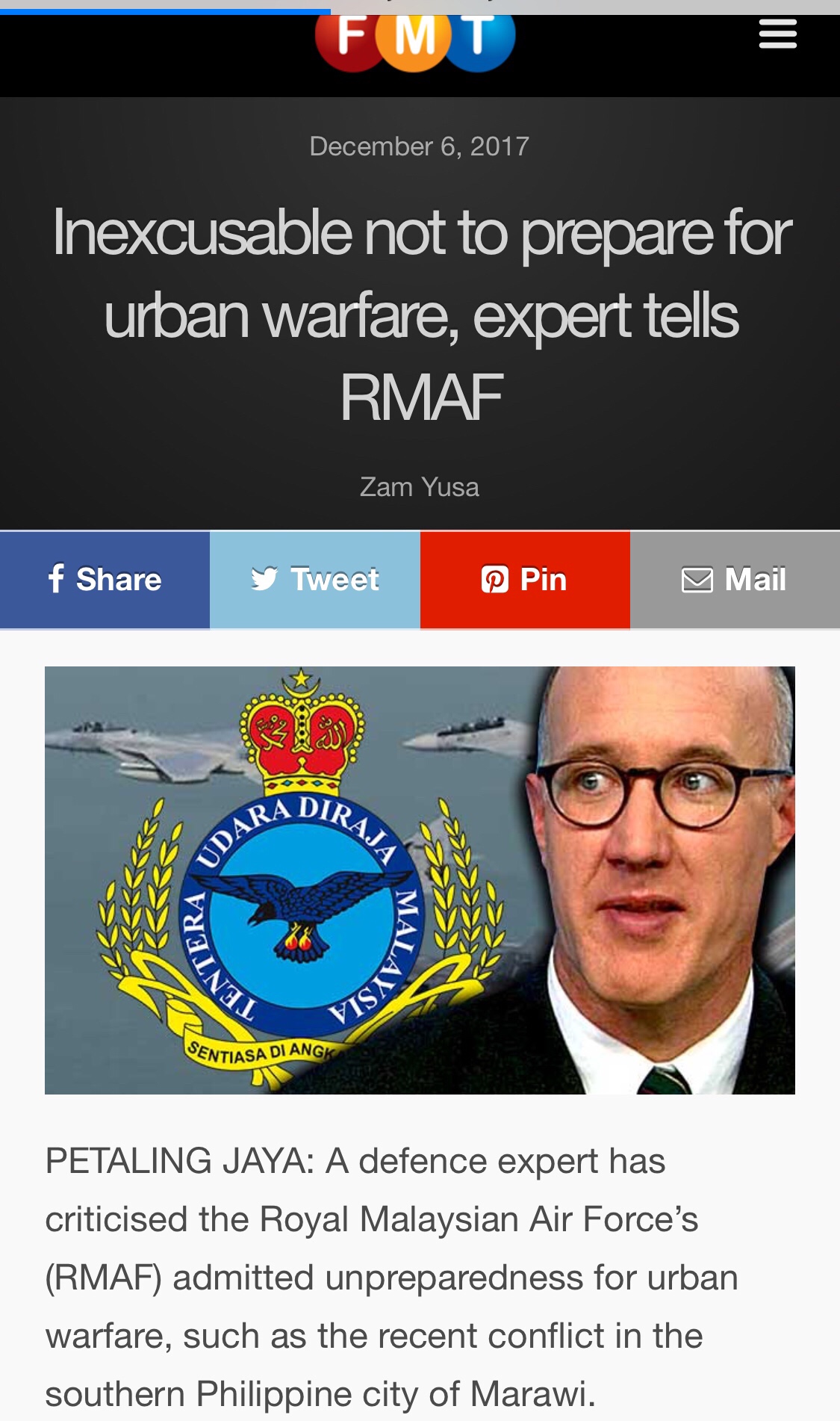
Online “news” portal Free Malaysia Today (FMT) today published a story on the level of preparedness of the Royal Malaysian Air Force (RMAF) if faced with a situation such as Marawi, and got an expert opinion to strengthen its story.
While FMT was talking about clearly refers to the recent statement made by the Chief of RMAF, General Tan Sri Dato’ Sri Haji Affendi bin Buang RMAF, stating that the RMAF will be including urban warfare in its doctrine. This was a reply to a question by a journalist during the recently-concluded Exercise PARADISE 4/2017 in Kota Belud, Sabah.
FMT sought the expert opinion of a Dr Zachary Abuza, a political scientist at the National War College in Washington DC, who focuses on security and political issues in the region.
Dr Abuza instantly criticised the RMAF for not being prepared for urban warfare.
“RMAF’s training is based on preparing to face traditional threats. It’s birth was when fighting the MCP (Malayan Communist Party) in the jungles. It has never had to adjust its training.
“To me, this is understandable but reckless,” he said to FMT.
Abuza felt urban warfare preparedness and capability were still important.
“It’s not that the RMAF has to worry about an invasion, but what if a detachment of RMAF peacekeepers finds itself unexpectedly bogged down during an urban assault?” he was quoted by FMT to have asked.
It is clear to sharp readers that Dr Abuza referred to the RMAF as Royal Malaysian Armed Forces instead of the Air Force. Why would the RMAF have a detachment of peacekeepers anyway?
Therefore, it is forgivable that Dr Abuza had made such a criticism towards the RMAF as the Malaysian Army, which had numerous peacekeeping experiences under its belt. Although the RMAF and the Royal Malaysian Navy participate in peacekeeping missions, the main combat duties is shouldered by the Army.
And FMT being FMT, went to town and published the piece, hammering the Royal Malaysian AIR FORCE for not being ready for urban warfare.
The RMAF’s role in urban warfare is merely a support one, with the Army playing the main role on the ground. All the RMAF needs to do is to insert its Ground Laser Targeting Designator team into the combat zone and paint targets that are to be bombed by its fighters.
Other roles include dropping bombs or perform rocket strikes on targets marked by elements of the Malaysian Army, including interdiction strikes to cut off enemy supply and reinforcement lines, provision of air mobility in support of the Army Air Wing, or perform combat search-and-rescue of downed airmen.
The RMAF and the Malaysian Army have held countless joint exercises to enhance interoperability and coordination and it will take very little tweaking for the two organisations to operate in the urban environment.
Did FMT clarify its story before publishing? I doubt. Else we won’t see the faux pas today.
“There is currently no action against 1MDB. Only against properties thought to have been procured using money belonging to 1MDB,” said Thomas C Goldstein, Advocate Appellate, US Supreme Court said when asked about the civil forfeiture action against 1MDB.
Tom Goldstein was answering question raised during his talk on “Criminal Litigation in the United States of America” at the UiTM Faculty of Law today.
He said that based on the US Constitution, no one should be deprived of their assets without due process of the law, and all due processes of the law must have a hearing concluded before assets can be forfeited.
“The DoJ, based on the complaint, is just tracing the money and think it may be linked to 1MDB. Right now, there is no suggestionof any criminal target,” he added.
Tom Goldstein is one of the US’s most experienced Supreme Court practitioners and his representations span virtually all of the US Federal Law.
As arguing counsel in the Court, Tom has prevailed in cases involving arbitration, bankruptcy, civil procedure, disability law, employment discrimination, the Fourth Amendment, free speech, habeas corpus, immigration, labour, securities, and trademarks.
When asked to whom would the DoJ return the seized money to, Tom explained that the issue has put the DoJ in limbo as the 1MDB has said that the money is not theirs, whereas the case is based on money taken from 1MDB, made by complainants that do not represent 1MDB.
“The DoJ has recently to put on hold civil forfeiture lawsuits against assets acquired (by Malaysian financier Low Taek Jho, also known as Jho Low), because pursuing these may have “an adverse effect” on its ability to conduct the criminal investigation.What the DoJ is doing is it is trying to prevent the money from dissipating by starting a criminal action,” Tom explained. “But right now there is very little activity pertaining to the case and no one has been named as criminal targets.”
Asked if this (that 1MDB says the money is not theirs) is the reason it has taken the DoJ so long to actually initiate something, he answered with a simple, “Yes.”
“A huge amount of money made its way into the US, and the DoJ is interested to know where is the source of this money. It is not a criminal case and an escalation into one will only make life more difficult for them as there has been no precedent. No one has been named in the civil forfeiture suit. If a criminal case were to be developed then it would be a classical criminal case and the burden of proof falls on the DoJ that it has to prove beyond reasonable doubt that crime has been committed,” Tom added.
In addition to practicing law, Tom has taught Supreme Court Litigation at Harvard Law School since 2004, and previously taught the same subject at Stanford Law School for nearly a decade.
Tom is also the co-founder of SCOTUSblog – a website devoted to comprehensive coverage of the Court – which is the only weblog ever to receive the Peabody Award.
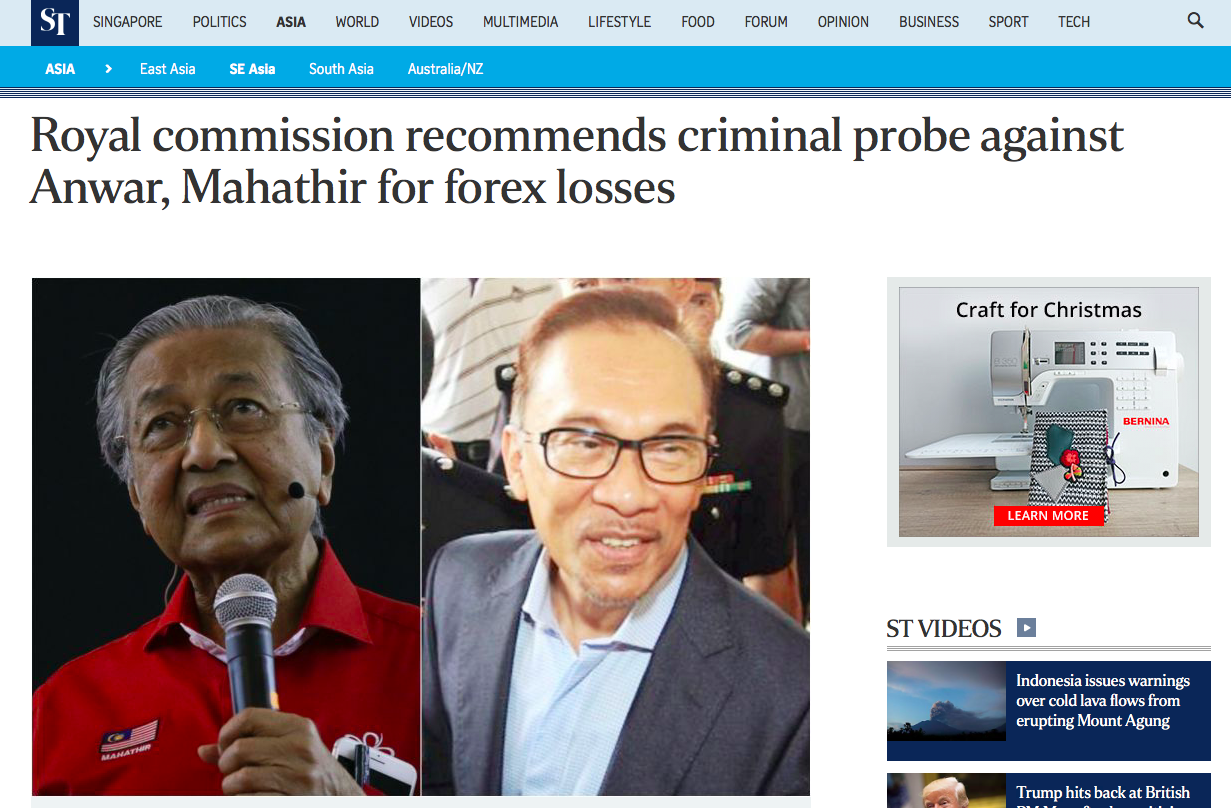
I simply do not comprehend the fuss that is being kicked up by Mahathir’s fanatics. On one hand they want the transparency that none of us got when Mahathir was the Prime Minister; on the other they are fuming because Mahathir, Nor Mohamed Yackop and Anwar have been implicated in the findings of the Royal Commission of Inquiry (RCI) for the Bank Negara Malaysia (BNM) foreign exchange scandal of the 1990s.
Mahathir’s long-time crony Daim Zainuddin, who served as finance minister from 14 July 1984 to 15 March 1991, for having aided and abetted Nor Mohamed by leaving BNM “to its own devices”.
Let us ask the very man whose perseverance has finally paid off:
This ought to be the reaction to the RCI findings if we are to ask Lim Kit Siang
Yes. The loss of RM31.5 billion through forex gambling was and still is a crime against the Malaysian people. And if it weren’t for Lim Kit Siang’s persistence and perseverance, we would not have gotten where we are now.
Three people have been found principally liable for the criminal breach of trust and should be probed further over their involvement and liability. They are the former Prime Minister Mahathir Mohamad, his then-Finance Minister Anwar Ibrahim, and ex-BNM advisor Nor Mohamed Yackop.
The commission found in its 524-paged report that the Cabinet in the 1990s was not given the full picture by Anwar on the forex losses, adding that he had “deliberately concealed facts and information and made misleading statements“. It is also of the opinion that the then Prime Minister (Mahathir) had condoned the actions of the Finance Minister.
The RM31.5 billion losses, the report said, were hidden using “unconventional accounting treatments”, such as booking losses to reserves in the balance sheet and the absorption of the remaining losses by the transfer of shares from the Government to BNM as well as the creation of a “Deferred Expenditure” to be repaid in instalments over a decade.
The RCI noted that Anwar Ibrahim, the then Finance Minister, had been informed about the actual forex losses suffered by BNM. It also said that Mahathir was informed by Anwar together with then Treasury deputy secretary-general Tan Sri Clifford Francis Herbert in late 1993 that BNM had suffered estimated losses of RM30 billion on the forex dealings for 1992 and 1993.
However, in the extract of minutes from three Cabinet meetings on March 30, April 6 and 13 in 1994, Anwar had made “no mention of the actual losses of RM12.3 billion for 1992 and RM15.3 billion for 1993.”
Anwar had chaired the March 30 meeting as the deputy prime minister. The losses for 1993 were reported as RM 5.7 billion.
The RCI also noted that the prime minister, who chaired the meeting on April 6, did not correct or offer more information when the forex losses for 1993 were recorded as only RM5.7 billion.
The RCI report said as pointed out by Herbert, he had expected Mahathir to be outraged but his reaction was quite normal with him uttering “sometimes we make profit, sometimes we make losses”.
“His reaction to and acceptance of the huge forex losses suggest that he could have been aware of the forex dealings and its magnitude,” said the report.
Why Did It Take So Long?
Of course supporters of Mahathir got their knickers in a knot over the RCI findings, mostly harp on the duration it took to have a RCI formed, whether it was formed to time itself with the looming general elections so that the Pakatan Harapan would be epitome of broken hopes?
Lim Kit Siang may have harped on the matter, trying to get an RCI formed since 1994, if not earlier. Mahathir was the Prime Minister then until the end of 2003. No one during Pak Lah’s time took up the issue as Mahathir was then breathing down Pak Lah’s neck watching the latter’s every move. In the end, Mahathir got Pak Lah ousted for not playing his game his way.
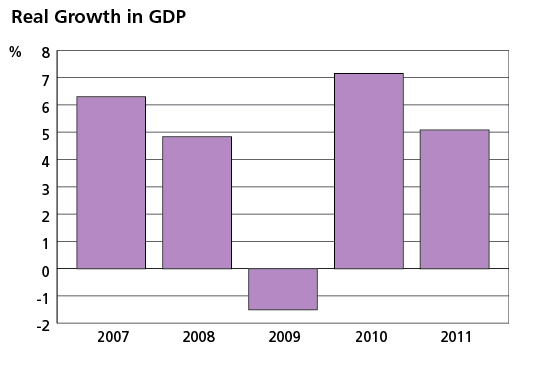
When Najib Razak took over at the beginning of the second quarter of 2009, Malaysia’s economy had shrunk even though oil price was high. The GDP growth rate for Malaysia in 2009 was -2.5 percent because of the global financial crisis then, hence Najib Razak’s priority then was to safeguard the economy and take measures to improve on the GDP growth.
Malaysia’s GDP growth rate for 2009 was -2.5%
And ever since then Najib had been fighting on all fronts to make sure that Malaysia goes through a sustainable growth, and that there would be enough government money to still help the people, especially those from the B40 income group. Hence, we see various initiatives like the 1Malaysia Clinic, Kedai Rakyat 1Malaysia (which is now being revamped), BR1M, PR1MA and various other 1Malaysia initiatives.
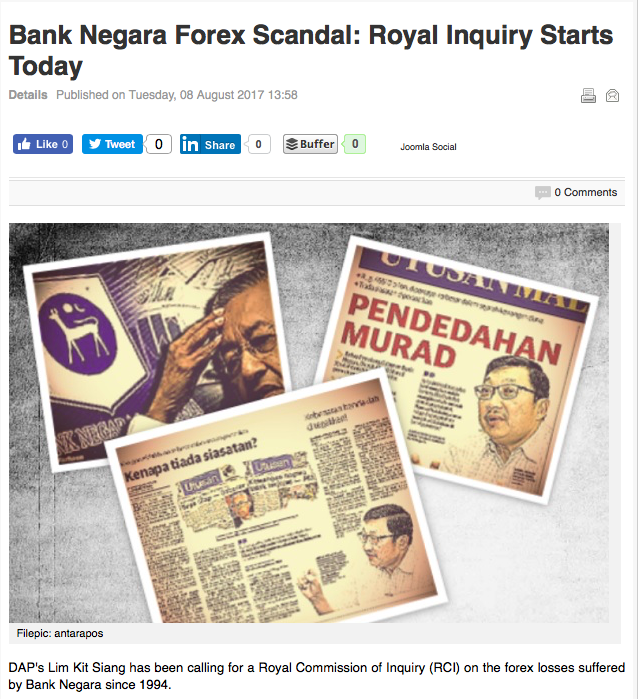
And while all that was happening, Lim Kit Siang was still going around asking for an RCI to be formed for the BNM forex scandal. In the run up to the 13th General Elections, Lim Kit Siang wrote this on the BNM forex scandal:
“I had estimated in Parliament two decades ago that Bank Negara lost a colossal RM30 billion from the Bank Negara foreign exchange scandal under Mahathir’s premiership. But Bank Negara claimed RM10.1 billion loss in 1992 and RM5.7 billion in 1993 while former Bank Negara Deputy Governor Dr. Rosli Yaakop estimated last year at a public forum that Bank Negara lost between USD27 to USD33 billion, which was five times more than its foreign reserves and its entire assets of USD20.7 billion in 1992.”
You can read more on what Dr Rosli Yaakop had said on the BNM forex scandal HERE.
Lim Kit Siang also said that Malaysian voters should not only pass a verdict on Najib’s non-transformation in the past four years, but also pass judgment on Mahathir’s 22 years of authoritarian and corrupt policies when he was Prime Minister from 1981 – 2003. He said:
“I am on public record as saying that if Pakatan Rakyat is to capture Putrajaya in the 13GE, we should re-open investigation not only on the RM30 billion Bank Negara forex scandal of 1992, there should be a Royal Commission of Inquiry into the RM100 billion losses suffered by the country in the financial scandals of the 22-year Mahathir era.”
Kit Siang added that the voters should decide whether they endorse the proposal to have a wide-ranging public inquiry into Mahathir’s financial scandals in 22 years which have cost the country RM100 billion of losses and for which the present generation of Malaysians are still paying the price – although there is totally no accountability and transparency about these glaring instances of corruption, cronyism and abuses of power for more than three decades.
In June 2017, Lim Kit Siang even wanted the report recommending the RCI to be made public. Finally, on 8 August 2017, the RCI commenced, and Kit Siang’s 25 years of wait ended.
Kit Siang’s hard work finally paid off
And one other Pakatan leader who had been lying very low beneath the BNM forex scandal radar is Anwar Ibrahim. If anyone was to ask why did the government not do anything between 2004 and 2017, the answer would be why hadn’t Anwar, since 2 September 1998, asked for an RCI on the matter? Was he afraid that he might get implicated?
You and I know the answer to that now.
And what about the 1MDB scandal? Well, unlike the BNM forex scandal, the 1MDB case was investigated by the Parliament’s Public Accounts Committee, the Royal Malaysian Police, Bank Negara Malaysia and the Malaysian Anti-Corruption Commission. Police reports were also made against 1MDB. But not a single sen had gone missing!
For the BNM forex scandal, this is the first time that it has been investigated – by the RCI, and soon by the Royal Malaysian Police. And the first police report was made by a member of the RCI itself after the RCI findings report was published – 25 years after the whole thing happened.
So, we should all say our thank you to Lim Kit Siang for exposing this crime against ALL Malaysians. Thank you, Lim Kit Siang – for persistently asking for your good friends to be investigated.
For two decades DAP’s Supremo, Emperor Lim Kit Siang, fought to bring to justice those responsible for the loss of RM30 billion (RM45.25 billion in today’s terms) through foreign gambling exchange by the Bank Negara Malaysia (BNM) back in the early 1990s. The greed of those responsible saw the BNM increase its trading volume to USD50 million lots (RM74.46 million or RM205.65 million today) compared to the market norm then of USD5 million (RM7.45 million or RM20.56 million today) to USD10 million (RM14.90 million or RM41.12 million today), amounting to billions of Dollars per day!
BNM’s maximum exposure in the foreign exchange markets then reached as high as RM270 billion – three times the country’s GDP and more than five times the country’s foreign reserves at the time!
Imagine what would have happened had we lost all that! But imagine what RM30 billion then could have done to arrest the massive fall of the Ringgit from RM2.4765 to the USD on 1 April 1997 to RM4.88 to the USD in early January 1998.
Has Lim Kit Siang accepted the loss of the RM30 billion he’s been screaming about?
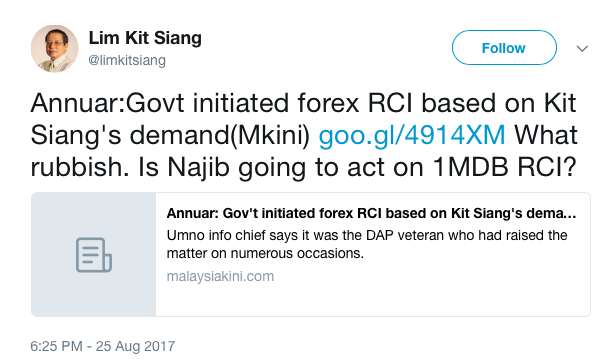
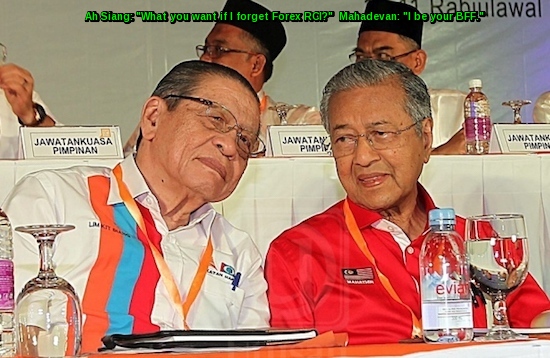
Now Lim Kit Siang plays innocent saying he has nothing to do with wanting a Royal Commission of Inquiry into the BNM Forex scandal. Is it because he and Mahathir are good friends now? Or is it because Mahathir’s involvement means that the DAP has lost one of its Malay political mules?
Best friends forever
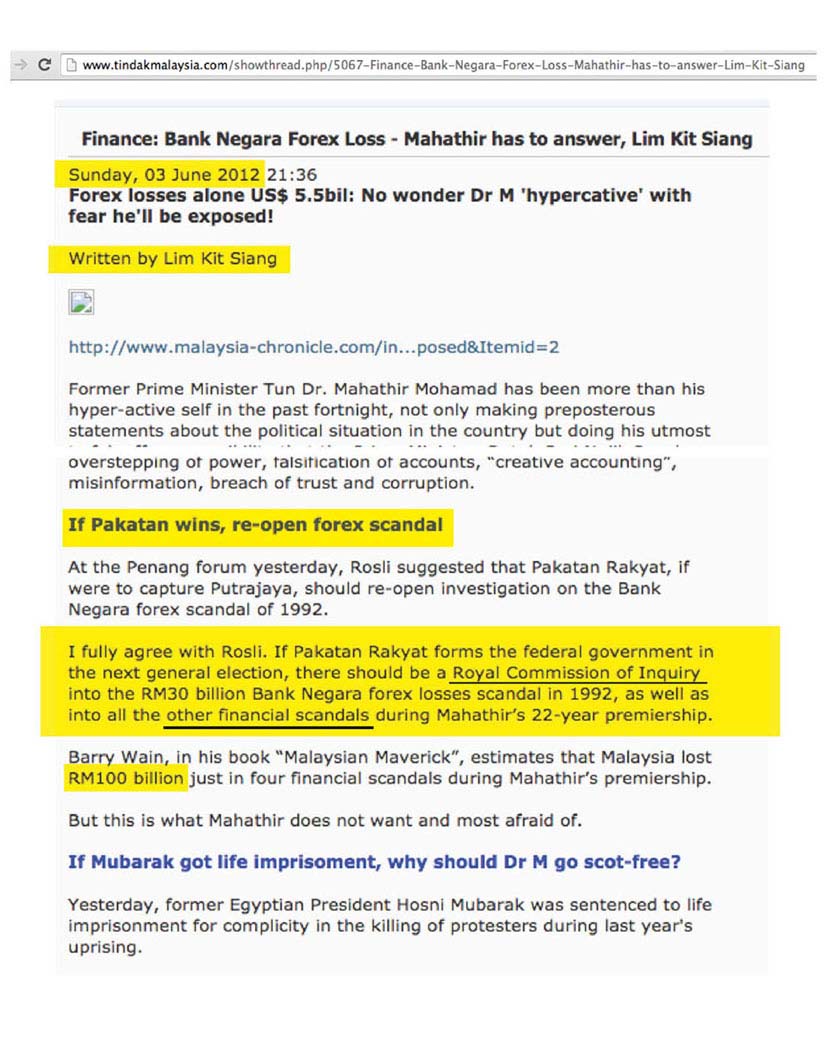
If I recall correctly, it was Lim Kit Siang who mentioned that Mahathir has to answer for the Forex loss, and that if Pakatan captures Putrajaya, he would re-open the BNM Forex scandal. He even asked if (former Egyptian President Hosni) Mubarak got life imprisonment, then why should Mahathir go scot-free?
Lim Kit Siang’s demands re the BNM Forex Scandal
Has Lim Kit Siang forgotten all the above? If he has, has he gone senile due to his age? If he has problems retaining his memory, then I don’t think he ought to contest in the next general elections.
Whatever it is, the biggest winner would be Anwar. Not only does he get to see his jailor jailed, but he won’t be lonely anymore.
I received this copied in a Veterans’ WhatsApp group. I omitted some parts of the message as it was just gibberish talk:
_Copied from write up by Mej **** ***** TUDM (Rtd)_
Good afternoon to all. The fight for a free Malaysia must go on!
Let us get one thing clear – the country and the government are separate entities. Governments come and go, the country is eternal.
We owe our allegiance to the country, not to the government. Therefore, saying bad things about a bad government is not being anti-national. Most important of all, voting against a bad government is not being anti-national. A bad government does not deserve loyalty. Disloyalty to the government is not disloyalty to the country; in fact, voting out a bad government is being loyal to the country.
Clean elections
Clean government
Right to dissent
Save our economy
Fine words they are, but for someone with some legal training to write as such shows how much understanding the author has of the Federal Constitution.
Let us address this “call”:
Point 1:
“Good afternoon to all. The fight for a free Malaysia must go on!
Let us get one thing clear – the country and the government are separate entities. Governments come and go, the country is eternal.
We owe our allegiance to the country, not to the government. Therefore, saying bad things about a bad government is not being anti-national. Most important of all, voting against a bad government is not being anti-national. A bad government does not deserve loyalty. Disloyalty to the government is not disloyalty to the country; in fact, voting out a bad government is being loyal to the country.”
The country and the government cannot be separated, neither can a state be separated from its state government. Yes, governments come and go, but a government is still a government. Officers and men of the civil service, the Armed Forces, the Police owe their allegiance to the King and Country. The King rules the Country, as do the Sultans their respective state, through a government that was picked by the people. Be they the Federal Government or the State Government, they administer the country and the states on behalf of the King and Sultans, as well as the Governors. This is prescribed by Article 39 of the Federal Constitution where the Executive Authority of the Federation is vested in the Yang DiPertuan Agong by him, or by the Cabinet, or by any Minister authorised by the Cabinet.
In the case of the Armed Forces, the King exercises his power through the Minister of Defence. Which is why the officers and men of the Armed Forces are required to salute the Minister of Defence who represents the King’s executive power over the Armed Forces, and the Prime Minister who is the King’s Chief Executive, representing the King.
Article 41 states that the King is the Supreme Commander of the Armed Forces and therefore those representing the King as prescribed by Article 39 are performing their duties on behalf of the King.
Therefore, it is imperative that the Armed Forces, as well as the civil service and the Police, remain loyal to the government of the day as the government of the day represents the King – be it bad or otherwise. Whether or nor a member of the Armed Forces, or the civil service, or the Police subscribes to the government of the day politically is a secondary matter. The oath that was taken was to be loyal to the King and Country; therefore loyalty shall be given to the government of the day.
The Minister who represents the King in matters of defence is also made the Chairman of the Armed Forces Council which is responsible for the command, the discipline and the administration of the Armed Forces, except for matters relating to their operational use. This is prescribed in Article 137 of the Federal Constitution.
And it is the Parliament that passed an Act to amend and consolidate the law relating to the establishment, government and discipline of the Armed Forces is made which is called the Armed Forces Act, 1972.
It is also the Armed Forces Act, 1972 that gave the powers to the Armed Forces Council to enable Brigadier-General Datuk Fadzlette Othman Merican Idris Merican be promoted to Major-General while she is being seconded to a Federal Government Department. Section 5C of the Armed Forces Act, 1972 determines that she remains a member of the regular forces but her remuneration shall be paid by that Federal Government Department.
By the same token, even the ordinary people who are citiens of Malaysia must realise that the Federal Government represents the King, the state governments represent the resective state’s Ruler. These are governments chosen by the people but was appointed by the Rulers to administer the country and states on their behalf. The only way to change these governments is by a democratic process called ELECTIONS (unless you have not heard of that word before).
Point 2:
“Clean elections”
Since 1955, Pulau Pinang, Perak, Kedah, Kelantan, Terengganu, Selangor and Sabah have all seen a change in government. If the elections were not clean, would it have been possible for the Opposition to have won cash cows such as Pulau Pinang and Selangor?
Point 3:
“Clean government”
I must admit there are bad hats in the government, be it the Federal government or the states government. This is why we have seen people like Harun Idris, Mokhtar Hashim, Khir Toyo, Lim Guan Eng charged in court for corruption. All but Lim Guan Eng have served jail time. Guan Eng, who said that he is not afraid to go to prison, has been delaying his corruption trial using technical issues.
Many more state excos have also been arraigned in a court for corruption. This is not possible without agencies such as the Auditor-General’s Office and the Malaysian Anti Corruption Commission which act as checks and balances to ensure that the Federal as well as states governments are run efficiently and cleanly.
Of course there are those who have yet to face the music. For example those responsible for the Maminco scandal in 1985 that saw a loss of RM1.6 billion (about RM2.56 billion in today’s terms); the Perwaja scandal in 1982 that saw a loss of about RM10 billion (RM18.73 billion in today’s terms); the BMF scandal of 1983 that had caused a loss of RM2.5 billion (RM4.5 billion today); the 1986 Deposit-Taking Cooperative Scandal that caused a loss of RM1.5 billion (about RM2.58 billion today); the RM30 billion loss by Bank Negara Malaysis through foreign exchange gambling in 1994 (RM45.25 billion today); the Malaysia Airlines scandal of 1994 with the loss of RM9.4 billion (RM14.18 billion today); the PKFZ scandal of 1999 with a loss of RM12.5 billion (RM13.5 billion in today’s terms).
The above all happened during the tenure of a certain former Prime Minister. The grand total of losses is RM67.5 billion (or RM101.3 billion in today’s terms). The amount shown does not include the bailouts reported in various books, Opposition leaders’ blogs and so on.
I do hope that the cry for a clean government will also call for the arraignment for the Prime Minister during whose tenure the financial scandals happened. Had the RM101.3 billion been put to good use during those 22 years, Sabah and Sarawak would have had SIX toll-free Pan Borneo Highways, or 1,013 80-bedded Government hospitals all over the country!
Instead, it enriched the few and killed one person.
Point 4:
“Right to Dissent”
I have not seen any Opposition-leaning media being taken off print or air, unlike during a certain 22-year period of my life. Malaysiakini et al are still spinning their version of what they call “balanced news” (read: news the way we want you to see it). The way these media operate reminds me of a character in Netflix’s limited series called “Godless” called A.T Grigg, a newspaper owner-editor who writes news the way he sees it, not how it truly happens.
The ISA was repealed six years ago by this present administration. Although replaced with SOSMA and POTA, it doesn’t give powers to the authorities to hold anyone without trial as the ISA did. And the ISA was being used a lot against political dissenters especially in the late 1990s during the tenure of a certain former Prime Minister.
This administration also introduced the Peaceful Assembly Act, 2012 that has allowed more freedom to assemble peacefully, unlike during those days of a certain former Prime Minister where at the slightest hint of a political dissent, you get whisked away to the University of Kamunting.
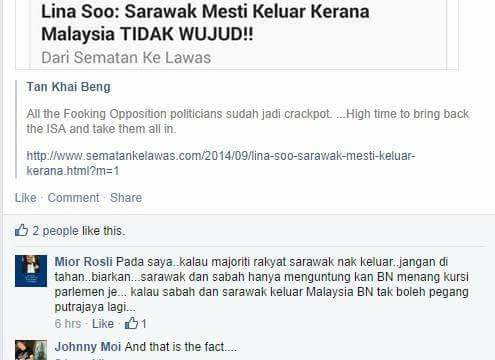
Has the author of the message been arrested yet? Of course not. Even when he actually committed sedition against Malaysia by encouraging Sarawak to secede from Malaysia.
How is it that a legal-trained person does not know that his act is seditious escapes me
Now, how is that seditious? If you look at Section 2 of the Sedition Act, 1948 it tells you the following:
Section 2 defines how an act is seditious. He has committed a seditious act by definition of Section 3(1)(a)
This former Armed Forces officer also committed a crime of sedition under Section 3 (1) (b) of the same Act for encouraging Sarawak to leave Malaysia:
Section 3 (1) (b) of the Sedition Act, 1948
And you thought that the Federal Constitution protects freedom of speech? Yes, it does. But as with all other liberties, they are subjected to restrictions. Article 10(1) guarantees that every citizen has the right to freedom of speech and expression, but at the beginning of the Article it also says the following:
You cannot just say anything you like although you have the freedom of speech and expression
To dissent is okay. To dissent seditiously, or criminally, or dangerously, or incitingly, is not okay.
Any legal-trained person ought to know this, right? What more a former officer of the Armed Forces!
Point 5:
“Save Our Economy”
In April 2017, the World Bank forecasted that Malaysia’s GDP would be at 4.3 percent. This was revised in June 2017 to 4.9 percent due to an acceleration in domestic economic activities (people in Malaysia are actually spending more) by 5.7 percent year-on-year. The GDP growth was revised again in October 2017 to 5.2 percent.
Let me quote several reports here by the World Bank.
World Bank Group lead economist Richard Record said at a media briefing on the update that Malaysia’s robust GDP growth in the first half of 2017 was largely underpinned by strong private-sector expenditure, with additional impetus from an improvement in external demand.
“Private consumption expanded firmly this year, supported by favourable income growth amid stable labour market conditions, and improved consumer confidence. Private investment also sustained rapid growth rates during the period, reflecting mainly continued capital spending in the manufacturing and services sectors,” said Richard Record.
“On the external front, gross exports rebounded strongly from the subdued growth experienced in 2016, supported by double-digit growth in commodity and manufactured exports,” he added.
Economic watchdogs are generally bullish on the Malaysian economy’s performance, buttressed by strong expansion in private consumption and private investment. In the latest update on its World Economic Outlook, the International Monetary Fund has upped its GDP growth projection for Malaysia in 2017 to 4.8 percent from 4.5 percent previously.
Apart from that, the Asian Development Bank has also upgraded its 2017 growth outlook for Malaysia to 4.7% from 4.4%, and indicated that the two-year slowdown in economic growth is likely to have bottomed out last year.
Richard Record also predicted Malaysia’s economy for 2018 and 2019.
“We are forecasting Malaysia’s GDP to grow by 5 percent next year (2018) and 4.8 percent in 2019. Our prediction reflects how we are seeing the country’s macroeconomic fundamentals’ performance and the baseline scenario,” he said.
Online economics portal ‘Focus Economics’ also said the following:
“Economic momentum remained robust in Q3 as confirmed by more complete data. Export growth expanded by a double-digit pace in September, underscoring thriving external demand for Malaysian goods. Household spending was buoyed by a low unemployment rate in September and by higher wages, which were propped up by a thriving manufacturing sector, the key driver of industrial production growth in the quarter. The 2018 budget passed on 27 October is focused on fiscal consolidation and is expected to narrow the fiscal deficit from 3.0 percent in 2017 to 2.8 percent in 2018. Despite the tightening, the budget has consumer-friendly components that will increase disposable income. These include lower income tax rates, especially for middle-income earners; higher public wages; and increased assistance spending.”
Of course, with the oil prices continue to stay below the USD70 per barrel level, Malaysia as well as other countries will continue to experience some sluggishness in the economy. However, good fiscal policies have allowed us to grow unlike a neighbour of ours that is often quoted as being a model economy. That country’s growth have been at 2 percent in 2016, and 2.5 percent this year.
The outlook for the construction sector has taken a sharp turn for the worse, with poll respondents tipping a contraction of 4.2 per cent. The previous survey, released in June, had respondents forecasting 0.2 per cent growth in the sector.
The outlook for the accommodation and food services sector in this model country has also worsened – it is now expected to shrink 1.5 per cent, from previous estimates of a 1 per cent expansion.
Economists polled expect overall economic growth of 2.5 per cent next year for this model country, the same pace as this year.
Perhaps the author of the message we are discussing here should go down South and help revive the economy of that model country.
So, there have you. I really do not know what the fuss is about. All I can deduce is that the author of the message is all hot air – you can feel it blowing on your face, but there is no real substance there. This is the same as BERSIH, and the recycling of petty but stale issues by the Opposition just so that they can remain relevant, and justify for the allowances they receive from the pockets of the rakyat.
You can express your dissatisfaction, but always do so constructively. Especially if you are a member of the Malaysian Armed Forces and Malaysian Armed Forces Veterans.











 SeaDemon Says
You must be logged in to post a comment.