STUDENT activism in Malaysia peaked in December 1974, having started in September of the same year in Tasek Utara, Johor Bahru, when some 5,000 students demonstrated at the Selangor Club Padang (now Dataran Merdeka) and as expected, clashed with the Federal Reserve Unit (FRU).
As a result, the students retreated to Masjid Negara with the FRU hot on their heels. The demonstration was culled and 1,128 students arrested. The student leaders who were holed up on the University of Malaya campus were soon arrested and so were those who hid inside their rented rooms in nearby Kampung Kerinchi.
Three representatives of Kampung Kerinchi complained that the FRU had taken harsh measures to apprehend the students by firing tear gas and that had resulted in the death of a baby.
My father immediately summoned his then deputy, the late Tan Sri Mahmood Yunus, and then Director of Special Branch, the late (Tan Sri) Mohamed Amin Osman, and asked them if the FRU had indeed fired tear gas into Kampung Kerinchi. Amin was adamant the FRU did nothing as such.
When asked if he (Amin) had checked the allegations himself and also the report received from the FRU troop leader, Amin said no. So my father instructed Amin to go to Kampung Kerinchi to check himself.
“Celaka! Depa tipu saya!” (“Hell! They lied to me!”) exclaimed Amin when he saw the empty tear gas canisters that littered the lanes of Kampung Kerinchi, to which my father replied, “You fell for it because you did not check the information yourself!”
Fake news is a neologism that has entered the lexicon, used to collectively describe rumours, hoaxes, misinformation, propaganda and recycling of old rumours that had been debunked, that mislead people into believing that they are current and true.
Fake news caused the Barisan Nasional to lose its long-held two-thirds majority in 2008 because it was complacent and not quick enough to react and dispel these rumours. Back then, political discussions and dissemination of fake news or propaganda occurred in chat rooms, in SMS, and blogs which were only a handful then. Now there is Facebook, Twitter, Line, Telegram, WhatsApp, YouTube over and above the media available almost ten years ago.
Claire Wardle, Executive Director of First Draft a non-profit organisation dedicated to finding solutions to the challenges associated with trust and truth in the digital age housed at the Shorenstein Centre on Media, Politics and Public Policy at the Harvard Kennedy School, categorised mis and disinformation into seven types:
Satire or parody – this type of misinformation has no intention to cause harm but has potential to fool. A good example of this is of a message purportedly sent by a passenger of the MH370 who said he managed to hide his iPhone5 up his anus! This had been debunked as a prank, but there are those who still believe that the person did manage to shove a five-inch by two-inch phone up his anus without any problem on the island of Diego Garcia.
Misleading content – most recent would be issues tweeted by two artistes that evolve around the rising cost of living, the weakening ringgit, a shambolic economy, designed to rile up anger in their followers. The tweets, not backed by published facts and figures, would do damage to those who have no inclination to check for the truth and to retweet or forward to others.
Imposter content – these are usually propaganda designed to use genuine sources but impersonated as theirs. A simple example would be of Selangor Mentri Besar Datuk Seri Azmin Ali’s recent event officiating the opening of the Rawang-Serendah Bypass, eight days after the bypass was opened by a minister.
Fabricated content – this type of content is 100 per cent false and is designed to deceive and cause harm. If you remember in July 2007, PKR’s Tian Chua admitted that he had fabricated a photo to show that Prime Minister Datuk Seri Najib Razak was together with Abdul Razak Baginda and now dead Mongolian-model Altantuya Shaaribu in Paris.
False connection – this is when headlines, visuals and captions do not support the content. The most famous example from recent times was of The Star’s headline that said “Malaysian Terrorist Leader” while having a huge photo of Muslims praying during the first night of Ramadan. Although The Star apologised for the error, it was not the first time it had made a similar mistake.
False context – this is when genuine content is shared with false contextual information. Artiste Fathia Latiff put up a screen capture of the price of fuel in various OPEC countries on Twitter, asking why Malaysia, as an oil producing country, charges very high for petrol? The screen capture is of oil prices back in 2014. The average value of fuel prices for Malaysia between September 4, 2017 and December 11, 2017, was RM2.23. For comparison, the average price of petrol in the world for this period was RM5.82!
Manipulated content – this is when genuine information or image is manipulated to deceive. Recently, there was a video of a skinny polar bear with muscle atrophy struggling to find food in a snowless land that was made viral. This was attributed to global warming. However, the video was filmed in August when the tundra was snowless. It was only published in December. Even the indigenous community living in the area thought it was a stunt to raise more funds and was doing a disservice to the war against climate change.
I don’t know why Malaysians are so gullible and eager to share fake news.
In WhatsApp groups, you can see how some people could post about something religious and then help spread fake news – something totally against religions. Nowadays, this fake news comes with a disclaimer – “Dari group sebelah”.
Every time we forward or share a post without double-checking or verifying, we add to the noise and confusion. We never consider the source, we never consider the supporting sources and worst of all, we never check our biases.
The late Tan Sri Amin learnt this the hard way.
Having seen that he was misled about the FRU not firing tear gas into Kampung Kerinchi, he went on to check about the claims of a baby that had died as a result of the tear gas. None of the three village representatives had themselves seen the dead baby and no one had actually reported to them of the death.
When asked where the information had come from, they replied, “From Anwar Ibrahim and the other student leaders!”
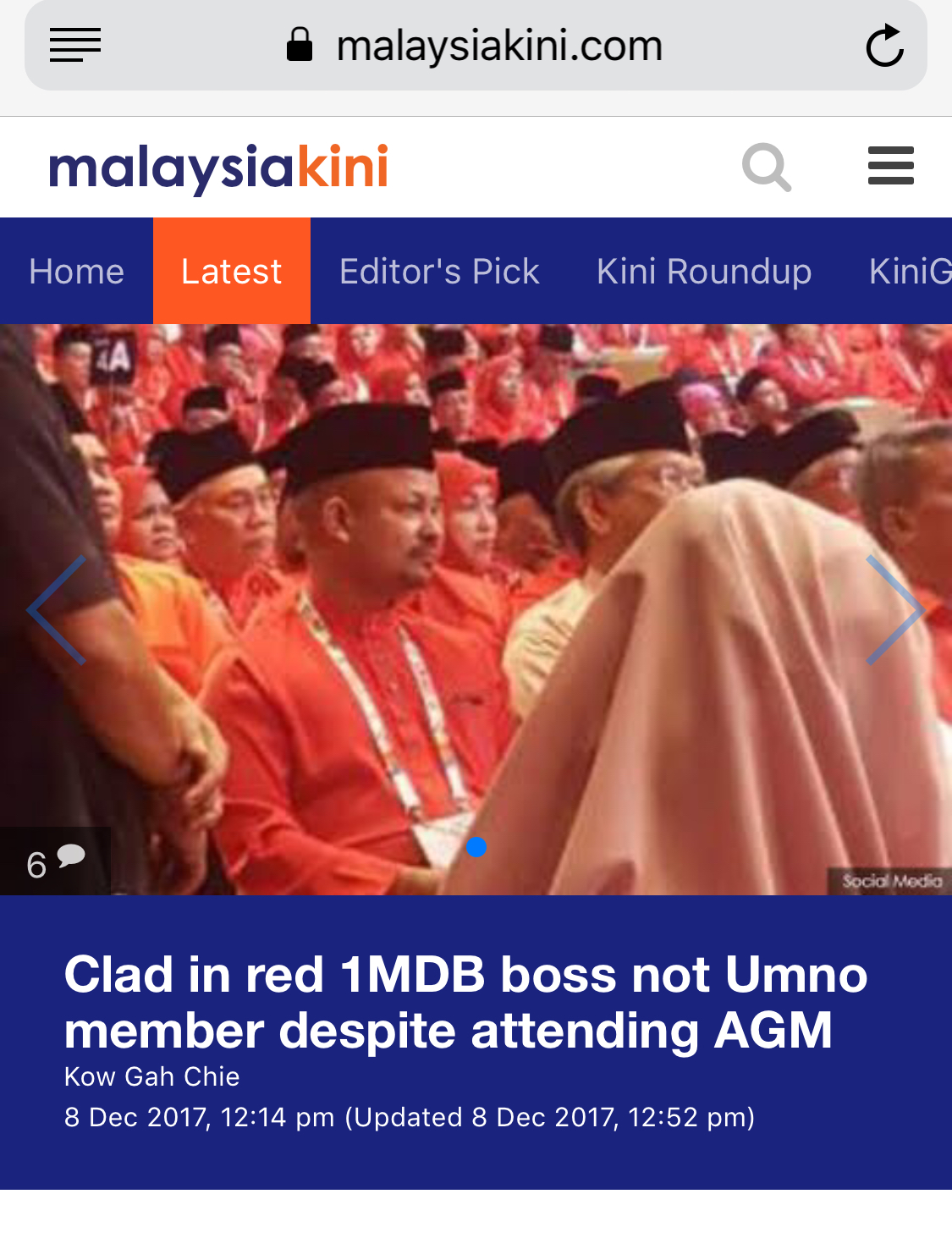
Arul Kanda was spotted at the opening of the UMNO General Assembly
I don’t know why Arul Kanda’s presence at the opening ceremony of the UMNO General Assembly is made a fuss. So did Khazanah Nasional Bhd managing director Azman Mokhtar, Permodalan Nasional Bhd (PNB) group chairperson Abdul Wahid Omar, CEO Abdul Rahman Ahmad and Lembaga Tabung Angkatan Tentera (LTAT) CEO Lodin Wok Kamaruddin.
It has always been a tradition for CEOs of Government-linked companies to be invited to the opening ceremony to listen to the UMNO President’s speech where it always touches socio-economic concerns. Even President of BN component parties are invited. In fact, among those who attended the final UMNO General Assembly with Mahathir as President were MCA’s then-President Ong Ka Ting and also PPP’s M Kayveas. So, what is the big deal?
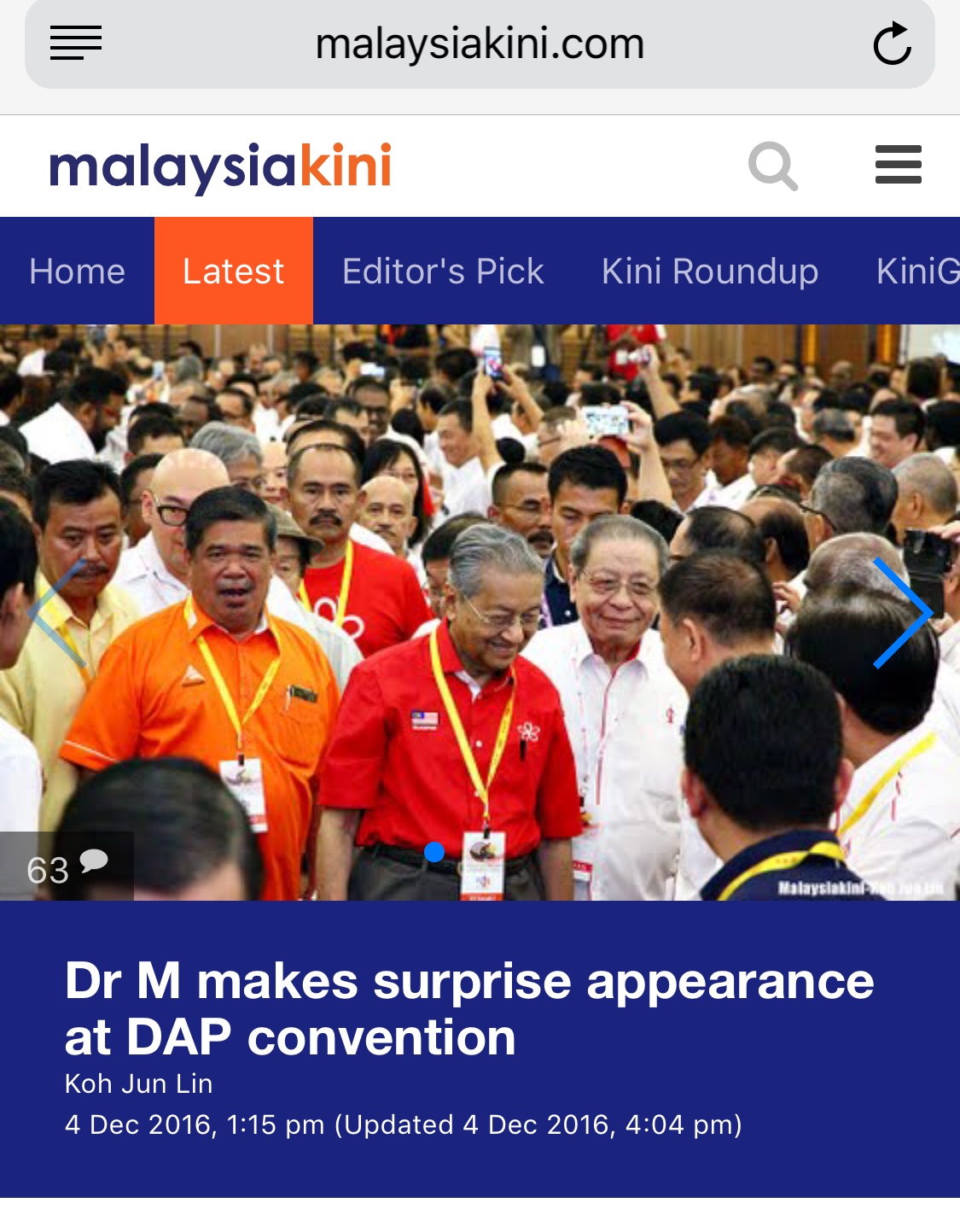
Not too long ago, an archnemesis of the Opposition attended DAP’s Convention. There, those who swore to spit on his grave lined up to smile, bow and shake hands with the man they all had wanted to send to prison for being a corrupt dictator.
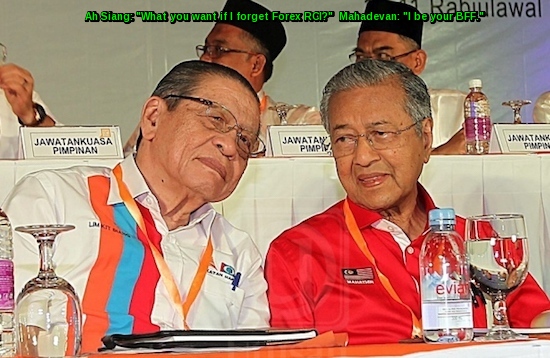
Heil Mahathir!
Behind Mahathir in the screen capture above is the very man who used to go around the country calling the former a PEROMPAK (robber).
Of course, now Mahathir is forgiven. All the RM100 billion according to both Lim Kit Siang and Barry Wain that Mahathir squandered have been forgotten, all in the name of politics. And in the name of politics, all those with past sins are forgiven the moment they work hand-in-hand with Pakatan.
Arul Kanda, President of BN component parties, all sat with the rest of the guests an delegations. Mahathir, however, was given a seat on the stage with DAP’s central executive committee members.
DAP Member 001A was given a seat on the stage
So, is Mahathir a DAP member? Maybe, Malaysiakini can answer this question.
Zaid Ibrahim on a campaign trail (courtesy of parpukari.blogspot.my)
His Royal Highness Sultan Sharafuddin Idris Shah Alhaj, the Sultan of Selangor from my observation is a calm and very private person. He rarely makes any statement or gives interviews to the media except during his birthday celebration. Only once in a blue moon would Sultan Sharafuddin voice out his concern, especially during the Kajang Move, because it was affecting the efficiency of His Royal Highness’s state government. The Sultan had also expressed his concern over the rudeness of the Opposition and its supporters towards the late Sultan Azlan Shah of Perak during the Perak constitutional crisis of 2009.
The latest episode involves the adverse reaction by DAP’s Zaid Ibrahim to the Sultan’s statement on Mahathir’s remark on the Bugis people. The statement was made as part of an interview with The Star for this year’s celebration of the Sultan’s birthday. In his Twitter postings, Zaid said that when some Rulers play politics, they must know the consequences. Do not think there is no price for partisanship.
What earned Zaid the wrath of many was when he also Tweeted a warning to Sultan Sharafuddin saying the Sultan should be careful with his words (as) no one is immune when (the) country burns.
That is typical of Zaid, when he displays the usual non compos mentis character. Often displaying his republican attitude, Zaid suits well in the DAP – a party known historically for its rash behaviour when it comes to respecting the Rulers Institution. It is also well that he is a Malay, from Kelantan, as it would appeal to the fence-sitting Malays in Kelantan who are politically torn after the departure of PAS from Pakatan Rakyat effectively ending the coalition.
The late Karpal Singh once petitioned to sue Sultan Sharafuddin’s late father, Almarhum Sultan Salahuddin Abdul Aziz Shah Alhaj, in 1987 over a speech by Sultan Salahuddin to the Selangor branch of the Ex-Servicemen’s Association saying that he would not pardon drug traffickers in Selangor. The petition was rejected on the grounds that there was no lis. In 2009, Karpal Singh had intended to sue Sultan Azlan Shah of Perak for appointing Datuk Dr Zambry Abdul Kadir as the new Menteri Besar, replacing DAP’s choice Nizar Jamaluddin. Karpal was found guilty of sedition in 2014.
Since gaining some grounds after the 2008 general elections, the DAP has time and again displayed its disrespect to the Rulers Institution by not abiding by the dress code at state assembly openings. One good example is of DAP’s Gwee Tong Hiang who was the Johor state assemblyman for Bentayan who did not wear a songkok at the state assembly opening. The late Sultan of Johor, Almarhum Sultan Iskandar Ismail was not amused.
“Two days ago someone here tried to be a hero by refusing to dress accordingly. If he wants (to differ), then get out of here now!” the late Sultan chastised. Tong Hiang, unfortunately, was not present then.
The DAP had wised up since then. Seen as a Chinese chauvinist party, such rude behaviour turned them into punching bags of the Malays, especially those from UMNO who had a feast turning the DAP into cheap meals. The DAP quickly recruited liberal Malays into its fold, including Zaid, to do their dirty jobs for them. This keeps the heat off the Chinese in DAP, but pit Malays against Malays.
What the authorities should realise is that such behaviour displayed most recently by Zaid Ibrahim sends the wrong signal that it is alright to reject Malay traditions including respect for the elders and the Rulers to the younger Malaysian who, at their age, would be mostly anti-establishment by nature. If this goes unchecked, it would certainly give birth to more Zaid Ibrahims.
The authorities should take cue from Sultan Sharafuddin.
“I am aware that Zaid had long been making false and incorrect accusations against me. He is a politician and a former minister whom I understand is against the royal institution. My advice to Zaid is simple, do not forget where you come from,” the Sultan said.
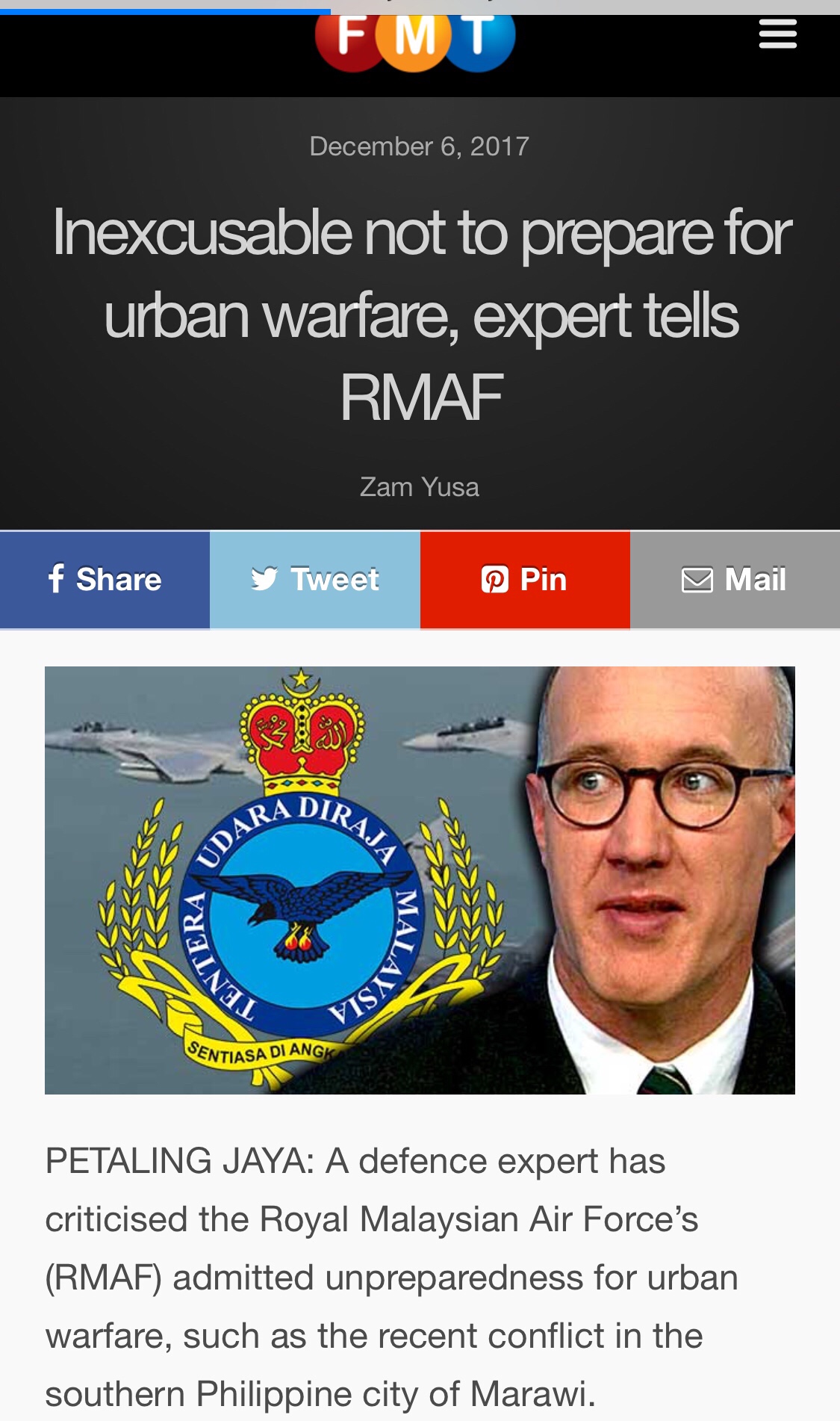
Online “news” portal Free Malaysia Today (FMT) today published a story on the level of preparedness of the Royal Malaysian Air Force (RMAF) if faced with a situation such as Marawi, and got an expert opinion to strengthen its story.
While FMT was talking about clearly refers to the recent statement made by the Chief of RMAF, General Tan Sri Dato’ Sri Haji Affendi bin Buang RMAF, stating that the RMAF will be including urban warfare in its doctrine. This was a reply to a question by a journalist during the recently-concluded Exercise PARADISE 4/2017 in Kota Belud, Sabah.
FMT sought the expert opinion of a Dr Zachary Abuza, a political scientist at the National War College in Washington DC, who focuses on security and political issues in the region.
Dr Abuza instantly criticised the RMAF for not being prepared for urban warfare.
“RMAF’s training is based on preparing to face traditional threats. It’s birth was when fighting the MCP (Malayan Communist Party) in the jungles. It has never had to adjust its training.
“To me, this is understandable but reckless,” he said to FMT.
Abuza felt urban warfare preparedness and capability were still important.
“It’s not that the RMAF has to worry about an invasion, but what if a detachment of RMAF peacekeepers finds itself unexpectedly bogged down during an urban assault?” he was quoted by FMT to have asked.
It is clear to sharp readers that Dr Abuza referred to the RMAF as Royal Malaysian Armed Forces instead of the Air Force. Why would the RMAF have a detachment of peacekeepers anyway?
Therefore, it is forgivable that Dr Abuza had made such a criticism towards the RMAF as the Malaysian Army, which had numerous peacekeeping experiences under its belt. Although the RMAF and the Royal Malaysian Navy participate in peacekeeping missions, the main combat duties is shouldered by the Army.
And FMT being FMT, went to town and published the piece, hammering the Royal Malaysian AIR FORCE for not being ready for urban warfare.
The RMAF’s role in urban warfare is merely a support one, with the Army playing the main role on the ground. All the RMAF needs to do is to insert its Ground Laser Targeting Designator team into the combat zone and paint targets that are to be bombed by its fighters.
Other roles include dropping bombs or perform rocket strikes on targets marked by elements of the Malaysian Army, including interdiction strikes to cut off enemy supply and reinforcement lines, provision of air mobility in support of the Army Air Wing, or perform combat search-and-rescue of downed airmen.
The RMAF and the Malaysian Army have held countless joint exercises to enhance interoperability and coordination and it will take very little tweaking for the two organisations to operate in the urban environment.
Did FMT clarify its story before publishing? I doubt. Else we won’t see the faux pas today.
My post yesterday had put lots of knots in many Opposition supporters’ (Penyokong Pembangkang or PEPEK for short) knickers, it seems. Some questioned why is it that they cannot find reference to some of the things I had written.
The answer is simple – I attended the talk by US Supreme Court Advocate Appellate Tom Goldstein. So did some others whom I saw, like Azmi Arshad, blog owner of Another Brick In The Wall, Tun Faisal of JASA, members of the media (both mainstream and electronic).
The talk was supposed to start at 9am and was to finish at 11am as the auditorium was to be used by another session. Tom arrived late, around 10.25am and was given only half an hour to speak with five minutes of Q&A session. Among the questions asked during the very short Q&A session were “Does the US plan to do away with the jury system in its trials” and “The 1MDB is a civil forfeiture suit, why is there now a criminal action being pursued”.
Both were answered by Tom as per the media reports. And then it was announced that they had to cut the session short because the auditorium had been booked for another programme.
Tom was ushered into a meeting room where he and the Dean of the Faculty of Law had their coffee break, together with some UiTM staff. The media chaps were ushered to a different place to have their food. Only Tun Faisal, a journalist from The Mole, and I, managed to bring our food and sat at the same table with Tom. Tun Faisal and I asked the questions on IPIC, SRC and 1MDB where Tom mentioned the complexity of the case and why there is absolutely no progress whatsoever – the complainants who are in no way linked to 1MDB lodged a complaint with the US Department of Justice saying that money had been siphoned from the 1MDB, to which the 1MDB had denied losing any money. So to whom should the money be returned to if no one has lost any?
And to this I asked Tom if this is the reason it has taken the DoJ so long to actually initiate something, he answered with a simple, “Yes.” In other words, the probe has come to a standstill. The only reason they have asked a stay on the civil investigation and changed it to a criminal one is to NOT allow any of the money to be spent. To date, no one has been named as criminal defendants, not one charge has been filed, and not one targetted to be investigated on a criminal charge.
Which brings me to this: the Attorney-General of the US, in his speech at the Global Forum on Asset Recovery in Washington DC yesterday said that 1MDB is kleptocracy at its worst.
The headline that had gotten all the PEPEKs wet
Mr Sessions said that allegedly corrupt officials and their associates had reportedly used the 1MDB funds for a “lavish spending spree” such as US$200 million for real estate in South California and New York, US$130 million in artwork, US$100 million in an American music label and a US$265 million yacht.
1MDB officials allegedly laundered more than US$4.5 billion in total, he said, through a complex web of opaque transactions and shell companies with bank accounts in various countries such as Switzerland, Singapore, Luxembourg and the US.
This is nothing new. This is something we have heard which was read live on cable TV by Mr Sessions’s predecesor. And this brings me to a question – if this is so, why hasn’t the US DoJ taken any action for the past year and a half? This only underscores what Tom Goldstein had said – the complaint said the money was siphoned from 1MDB, but the 1MDB said they have not lost a single cent. So, whose money did these “1MDB officials” siphon?
Those assets have been frozen since mid-2016 and still have not been returned to 1MDB. Why is that? All the people that have been charged, tried and sent to jail for laundering “1MDB money” in Singapore and elsewhere in the world were bank employees who flouted the local financial regulations. Yet, not a single 1MDB employee has ever been charged in those courts. Why?
PEPEKs are dancing today thinking that something new had been revealed, when it is just old news being repeated. No doubt that they money and assets the US DoJ confiscated last year represents kleptocracy at its worst. But what has that to do with 1MDB? Can we have the money back now if they are 1MDB’s?
The PEPEKs think that they have won the argument, but really they are just dry PEPEKs, giving an erectile dysfunction to the celebration.
“There is currently no action against 1MDB. Only against properties thought to have been procured using money belonging to 1MDB,” said Thomas C Goldstein, Advocate Appellate, US Supreme Court said when asked about the civil forfeiture action against 1MDB.
Tom Goldstein was answering question raised during his talk on “Criminal Litigation in the United States of America” at the UiTM Faculty of Law today.
He said that based on the US Constitution, no one should be deprived of their assets without due process of the law, and all due processes of the law must have a hearing concluded before assets can be forfeited.
“The DoJ, based on the complaint, is just tracing the money and think it may be linked to 1MDB. Right now, there is no suggestionof any criminal target,” he added.
Tom Goldstein is one of the US’s most experienced Supreme Court practitioners and his representations span virtually all of the US Federal Law.
As arguing counsel in the Court, Tom has prevailed in cases involving arbitration, bankruptcy, civil procedure, disability law, employment discrimination, the Fourth Amendment, free speech, habeas corpus, immigration, labour, securities, and trademarks.
When asked to whom would the DoJ return the seized money to, Tom explained that the issue has put the DoJ in limbo as the 1MDB has said that the money is not theirs, whereas the case is based on money taken from 1MDB, made by complainants that do not represent 1MDB.
“The DoJ has recently to put on hold civil forfeiture lawsuits against assets acquired (by Malaysian financier Low Taek Jho, also known as Jho Low), because pursuing these may have “an adverse effect” on its ability to conduct the criminal investigation.What the DoJ is doing is it is trying to prevent the money from dissipating by starting a criminal action,” Tom explained. “But right now there is very little activity pertaining to the case and no one has been named as criminal targets.”
Asked if this (that 1MDB says the money is not theirs) is the reason it has taken the DoJ so long to actually initiate something, he answered with a simple, “Yes.”
“A huge amount of money made its way into the US, and the DoJ is interested to know where is the source of this money. It is not a criminal case and an escalation into one will only make life more difficult for them as there has been no precedent. No one has been named in the civil forfeiture suit. If a criminal case were to be developed then it would be a classical criminal case and the burden of proof falls on the DoJ that it has to prove beyond reasonable doubt that crime has been committed,” Tom added.
In addition to practicing law, Tom has taught Supreme Court Litigation at Harvard Law School since 2004, and previously taught the same subject at Stanford Law School for nearly a decade.
Tom is also the co-founder of SCOTUSblog – a website devoted to comprehensive coverage of the Court – which is the only weblog ever to receive the Peabody Award.
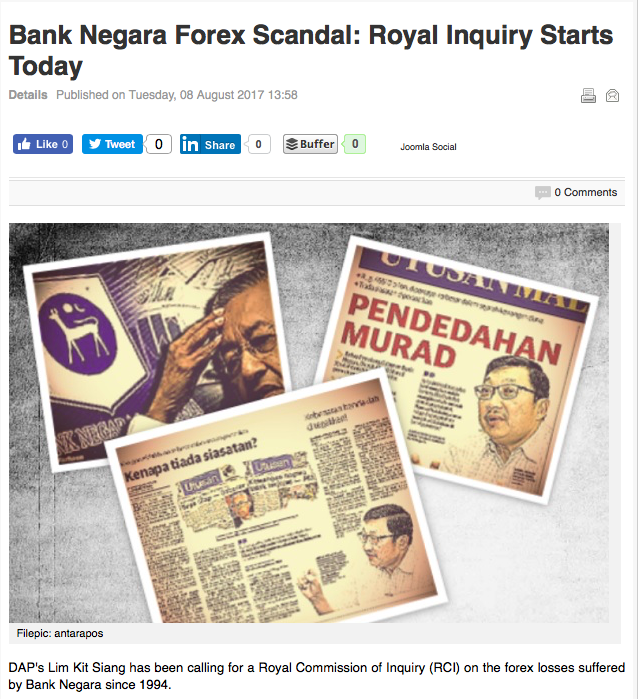
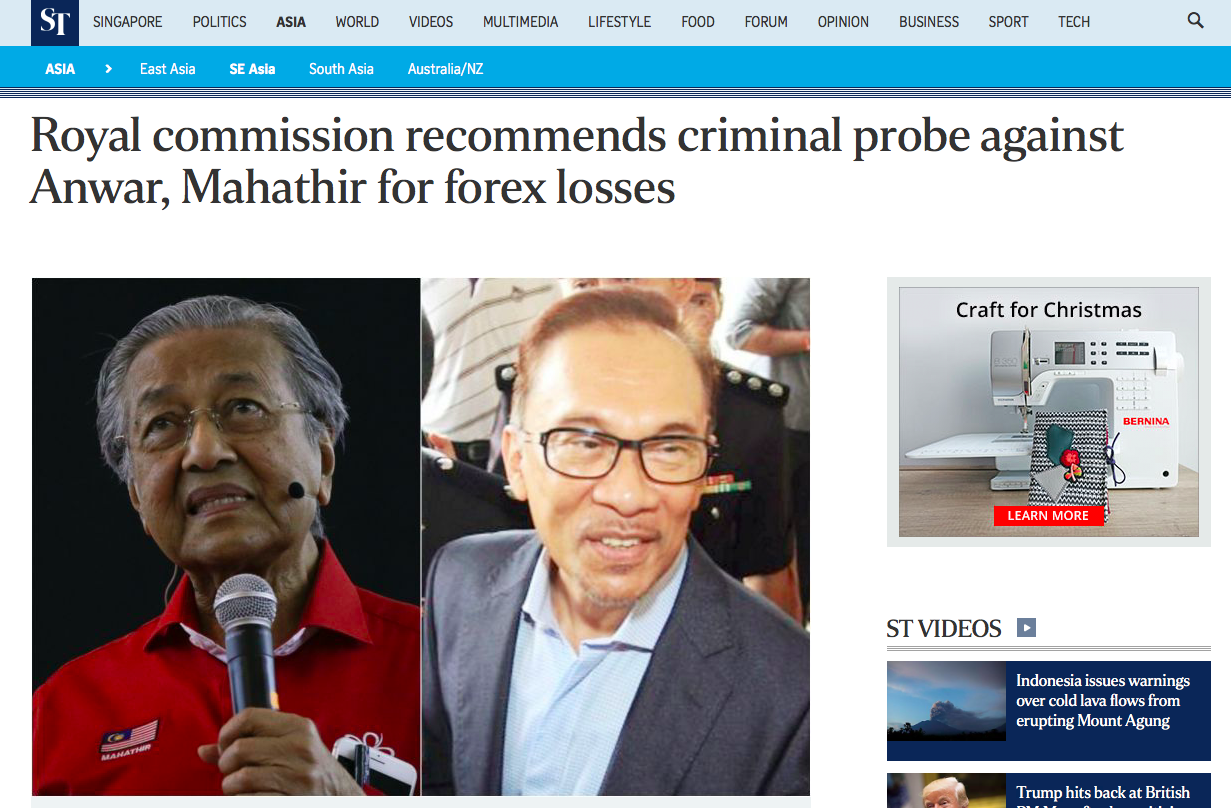
I simply do not comprehend the fuss that is being kicked up by Mahathir’s fanatics. On one hand they want the transparency that none of us got when Mahathir was the Prime Minister; on the other they are fuming because Mahathir, Nor Mohamed Yackop and Anwar have been implicated in the findings of the Royal Commission of Inquiry (RCI) for the Bank Negara Malaysia (BNM) foreign exchange scandal of the 1990s.
Mahathir’s long-time crony Daim Zainuddin, who served as finance minister from 14 July 1984 to 15 March 1991, for having aided and abetted Nor Mohamed by leaving BNM “to its own devices”.
Let us ask the very man whose perseverance has finally paid off:
This ought to be the reaction to the RCI findings if we are to ask Lim Kit Siang
Yes. The loss of RM31.5 billion through forex gambling was and still is a crime against the Malaysian people. And if it weren’t for Lim Kit Siang’s persistence and perseverance, we would not have gotten where we are now.
Three people have been found principally liable for the criminal breach of trust and should be probed further over their involvement and liability. They are the former Prime Minister Mahathir Mohamad, his then-Finance Minister Anwar Ibrahim, and ex-BNM advisor Nor Mohamed Yackop.
The commission found in its 524-paged report that the Cabinet in the 1990s was not given the full picture by Anwar on the forex losses, adding that he had “deliberately concealed facts and information and made misleading statements“. It is also of the opinion that the then Prime Minister (Mahathir) had condoned the actions of the Finance Minister.
The RM31.5 billion losses, the report said, were hidden using “unconventional accounting treatments”, such as booking losses to reserves in the balance sheet and the absorption of the remaining losses by the transfer of shares from the Government to BNM as well as the creation of a “Deferred Expenditure” to be repaid in instalments over a decade.
The RCI noted that Anwar Ibrahim, the then Finance Minister, had been informed about the actual forex losses suffered by BNM. It also said that Mahathir was informed by Anwar together with then Treasury deputy secretary-general Tan Sri Clifford Francis Herbert in late 1993 that BNM had suffered estimated losses of RM30 billion on the forex dealings for 1992 and 1993.
However, in the extract of minutes from three Cabinet meetings on March 30, April 6 and 13 in 1994, Anwar had made “no mention of the actual losses of RM12.3 billion for 1992 and RM15.3 billion for 1993.”
Anwar had chaired the March 30 meeting as the deputy prime minister. The losses for 1993 were reported as RM 5.7 billion.
The RCI also noted that the prime minister, who chaired the meeting on April 6, did not correct or offer more information when the forex losses for 1993 were recorded as only RM5.7 billion.
The RCI report said as pointed out by Herbert, he had expected Mahathir to be outraged but his reaction was quite normal with him uttering “sometimes we make profit, sometimes we make losses”.
“His reaction to and acceptance of the huge forex losses suggest that he could have been aware of the forex dealings and its magnitude,” said the report.
Why Did It Take So Long?
Of course supporters of Mahathir got their knickers in a knot over the RCI findings, mostly harp on the duration it took to have a RCI formed, whether it was formed to time itself with the looming general elections so that the Pakatan Harapan would be epitome of broken hopes?
Lim Kit Siang may have harped on the matter, trying to get an RCI formed since 1994, if not earlier. Mahathir was the Prime Minister then until the end of 2003. No one during Pak Lah’s time took up the issue as Mahathir was then breathing down Pak Lah’s neck watching the latter’s every move. In the end, Mahathir got Pak Lah ousted for not playing his game his way.
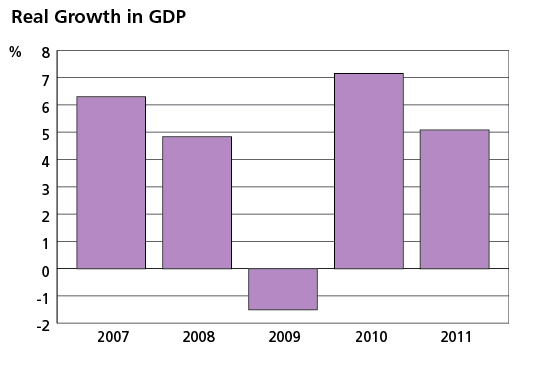
When Najib Razak took over at the beginning of the second quarter of 2009, Malaysia’s economy had shrunk even though oil price was high. The GDP growth rate for Malaysia in 2009 was -2.5 percent because of the global financial crisis then, hence Najib Razak’s priority then was to safeguard the economy and take measures to improve on the GDP growth.
Malaysia’s GDP growth rate for 2009 was -2.5%
And ever since then Najib had been fighting on all fronts to make sure that Malaysia goes through a sustainable growth, and that there would be enough government money to still help the people, especially those from the B40 income group. Hence, we see various initiatives like the 1Malaysia Clinic, Kedai Rakyat 1Malaysia (which is now being revamped), BR1M, PR1MA and various other 1Malaysia initiatives.
And while all that was happening, Lim Kit Siang was still going around asking for an RCI to be formed for the BNM forex scandal. In the run up to the 13th General Elections, Lim Kit Siang wrote this on the BNM forex scandal:
“I had estimated in Parliament two decades ago that Bank Negara lost a colossal RM30 billion from the Bank Negara foreign exchange scandal under Mahathir’s premiership. But Bank Negara claimed RM10.1 billion loss in 1992 and RM5.7 billion in 1993 while former Bank Negara Deputy Governor Dr. Rosli Yaakop estimated last year at a public forum that Bank Negara lost between USD27 to USD33 billion, which was five times more than its foreign reserves and its entire assets of USD20.7 billion in 1992.”
You can read more on what Dr Rosli Yaakop had said on the BNM forex scandal HERE.
Lim Kit Siang also said that Malaysian voters should not only pass a verdict on Najib’s non-transformation in the past four years, but also pass judgment on Mahathir’s 22 years of authoritarian and corrupt policies when he was Prime Minister from 1981 – 2003. He said:
“I am on public record as saying that if Pakatan Rakyat is to capture Putrajaya in the 13GE, we should re-open investigation not only on the RM30 billion Bank Negara forex scandal of 1992, there should be a Royal Commission of Inquiry into the RM100 billion losses suffered by the country in the financial scandals of the 22-year Mahathir era.”
Kit Siang added that the voters should decide whether they endorse the proposal to have a wide-ranging public inquiry into Mahathir’s financial scandals in 22 years which have cost the country RM100 billion of losses and for which the present generation of Malaysians are still paying the price – although there is totally no accountability and transparency about these glaring instances of corruption, cronyism and abuses of power for more than three decades.
In June 2017, Lim Kit Siang even wanted the report recommending the RCI to be made public. Finally, on 8 August 2017, the RCI commenced, and Kit Siang’s 25 years of wait ended.
Kit Siang’s hard work finally paid off
And one other Pakatan leader who had been lying very low beneath the BNM forex scandal radar is Anwar Ibrahim. If anyone was to ask why did the government not do anything between 2004 and 2017, the answer would be why hadn’t Anwar, since 2 September 1998, asked for an RCI on the matter? Was he afraid that he might get implicated?
You and I know the answer to that now.
And what about the 1MDB scandal? Well, unlike the BNM forex scandal, the 1MDB case was investigated by the Parliament’s Public Accounts Committee, the Royal Malaysian Police, Bank Negara Malaysia and the Malaysian Anti-Corruption Commission. Police reports were also made against 1MDB. But not a single sen had gone missing!
For the BNM forex scandal, this is the first time that it has been investigated – by the RCI, and soon by the Royal Malaysian Police. And the first police report was made by a member of the RCI itself after the RCI findings report was published – 25 years after the whole thing happened.
So, we should all say our thank you to Lim Kit Siang for exposing this crime against ALL Malaysians. Thank you, Lim Kit Siang – for persistently asking for your good friends to be investigated.
For two decades DAP’s Supremo, Emperor Lim Kit Siang, fought to bring to justice those responsible for the loss of RM30 billion (RM45.25 billion in today’s terms) through foreign gambling exchange by the Bank Negara Malaysia (BNM) back in the early 1990s. The greed of those responsible saw the BNM increase its trading volume to USD50 million lots (RM74.46 million or RM205.65 million today) compared to the market norm then of USD5 million (RM7.45 million or RM20.56 million today) to USD10 million (RM14.90 million or RM41.12 million today), amounting to billions of Dollars per day!
BNM’s maximum exposure in the foreign exchange markets then reached as high as RM270 billion – three times the country’s GDP and more than five times the country’s foreign reserves at the time!
Imagine what would have happened had we lost all that! But imagine what RM30 billion then could have done to arrest the massive fall of the Ringgit from RM2.4765 to the USD on 1 April 1997 to RM4.88 to the USD in early January 1998.
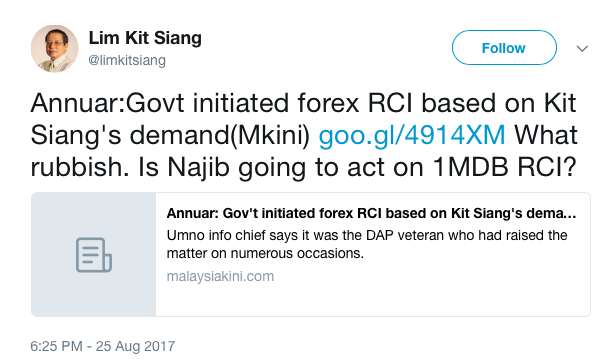
Has Lim Kit Siang accepted the loss of the RM30 billion he’s been screaming about?
Now Lim Kit Siang plays innocent saying he has nothing to do with wanting a Royal Commission of Inquiry into the BNM Forex scandal. Is it because he and Mahathir are good friends now? Or is it because Mahathir’s involvement means that the DAP has lost one of its Malay political mules?
Best friends forever
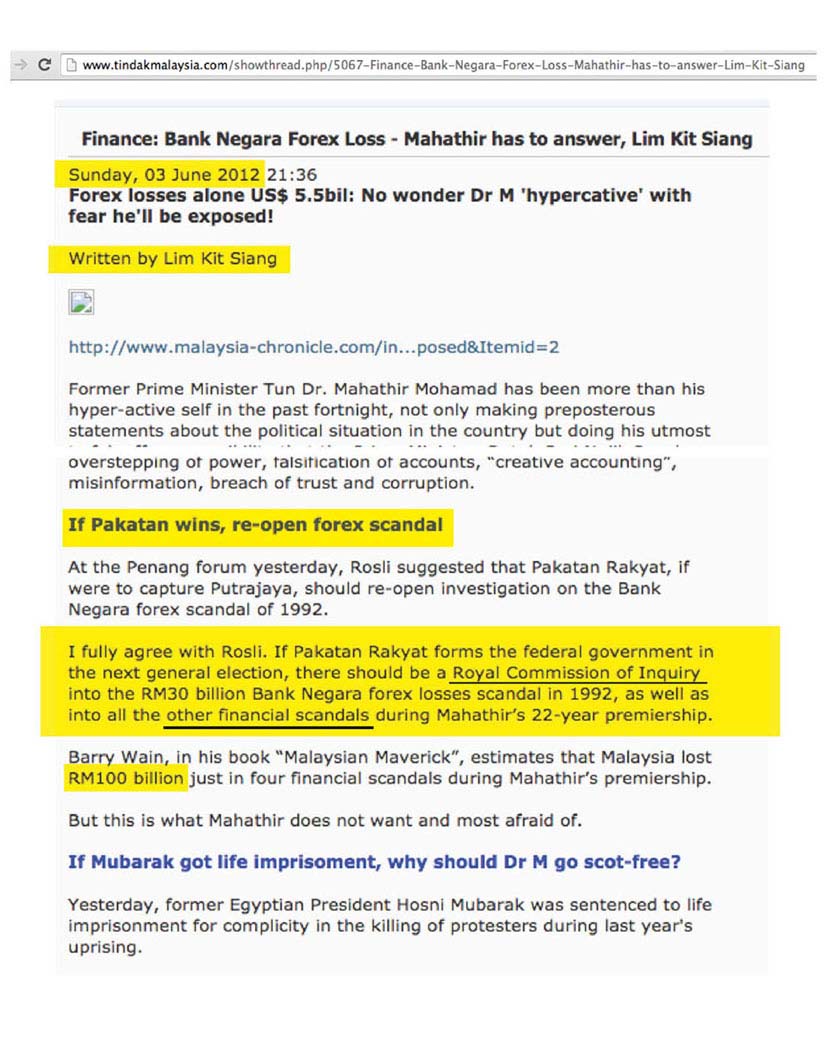
If I recall correctly, it was Lim Kit Siang who mentioned that Mahathir has to answer for the Forex loss, and that if Pakatan captures Putrajaya, he would re-open the BNM Forex scandal. He even asked if (former Egyptian President Hosni) Mubarak got life imprisonment, then why should Mahathir go scot-free?
Lim Kit Siang’s demands re the BNM Forex Scandal
Has Lim Kit Siang forgotten all the above? If he has, has he gone senile due to his age? If he has problems retaining his memory, then I don’t think he ought to contest in the next general elections.
Whatever it is, the biggest winner would be Anwar. Not only does he get to see his jailor jailed, but he won’t be lonely anymore.
I received this copied in a Veterans’ WhatsApp group. I omitted some parts of the message as it was just gibberish talk:
_Copied from write up by Mej **** ***** TUDM (Rtd)_
Good afternoon to all. The fight for a free Malaysia must go on!
Let us get one thing clear – the country and the government are separate entities. Governments come and go, the country is eternal.
We owe our allegiance to the country, not to the government. Therefore, saying bad things about a bad government is not being anti-national. Most important of all, voting against a bad government is not being anti-national. A bad government does not deserve loyalty. Disloyalty to the government is not disloyalty to the country; in fact, voting out a bad government is being loyal to the country.
Clean elections
Clean government
Right to dissent
Save our economy
Fine words they are, but for someone with some legal training to write as such shows how much understanding the author has of the Federal Constitution.
Let us address this “call”:
Point 1:
“Good afternoon to all. The fight for a free Malaysia must go on!
Let us get one thing clear – the country and the government are separate entities. Governments come and go, the country is eternal.
We owe our allegiance to the country, not to the government. Therefore, saying bad things about a bad government is not being anti-national. Most important of all, voting against a bad government is not being anti-national. A bad government does not deserve loyalty. Disloyalty to the government is not disloyalty to the country; in fact, voting out a bad government is being loyal to the country.”
The country and the government cannot be separated, neither can a state be separated from its state government. Yes, governments come and go, but a government is still a government. Officers and men of the civil service, the Armed Forces, the Police owe their allegiance to the King and Country. The King rules the Country, as do the Sultans their respective state, through a government that was picked by the people. Be they the Federal Government or the State Government, they administer the country and the states on behalf of the King and Sultans, as well as the Governors. This is prescribed by Article 39 of the Federal Constitution where the Executive Authority of the Federation is vested in the Yang DiPertuan Agong by him, or by the Cabinet, or by any Minister authorised by the Cabinet.
In the case of the Armed Forces, the King exercises his power through the Minister of Defence. Which is why the officers and men of the Armed Forces are required to salute the Minister of Defence who represents the King’s executive power over the Armed Forces, and the Prime Minister who is the King’s Chief Executive, representing the King.
Article 41 states that the King is the Supreme Commander of the Armed Forces and therefore those representing the King as prescribed by Article 39 are performing their duties on behalf of the King.
Therefore, it is imperative that the Armed Forces, as well as the civil service and the Police, remain loyal to the government of the day as the government of the day represents the King – be it bad or otherwise. Whether or nor a member of the Armed Forces, or the civil service, or the Police subscribes to the government of the day politically is a secondary matter. The oath that was taken was to be loyal to the King and Country; therefore loyalty shall be given to the government of the day.
The Minister who represents the King in matters of defence is also made the Chairman of the Armed Forces Council which is responsible for the command, the discipline and the administration of the Armed Forces, except for matters relating to their operational use. This is prescribed in Article 137 of the Federal Constitution.
And it is the Parliament that passed an Act to amend and consolidate the law relating to the establishment, government and discipline of the Armed Forces is made which is called the Armed Forces Act, 1972.
It is also the Armed Forces Act, 1972 that gave the powers to the Armed Forces Council to enable Brigadier-General Datuk Fadzlette Othman Merican Idris Merican be promoted to Major-General while she is being seconded to a Federal Government Department. Section 5C of the Armed Forces Act, 1972 determines that she remains a member of the regular forces but her remuneration shall be paid by that Federal Government Department.
By the same token, even the ordinary people who are citiens of Malaysia must realise that the Federal Government represents the King, the state governments represent the resective state’s Ruler. These are governments chosen by the people but was appointed by the Rulers to administer the country and states on their behalf. The only way to change these governments is by a democratic process called ELECTIONS (unless you have not heard of that word before).
Point 2:
“Clean elections”
Since 1955, Pulau Pinang, Perak, Kedah, Kelantan, Terengganu, Selangor and Sabah have all seen a change in government. If the elections were not clean, would it have been possible for the Opposition to have won cash cows such as Pulau Pinang and Selangor?
Point 3:
“Clean government”
I must admit there are bad hats in the government, be it the Federal government or the states government. This is why we have seen people like Harun Idris, Mokhtar Hashim, Khir Toyo, Lim Guan Eng charged in court for corruption. All but Lim Guan Eng have served jail time. Guan Eng, who said that he is not afraid to go to prison, has been delaying his corruption trial using technical issues.
Many more state excos have also been arraigned in a court for corruption. This is not possible without agencies such as the Auditor-General’s Office and the Malaysian Anti Corruption Commission which act as checks and balances to ensure that the Federal as well as states governments are run efficiently and cleanly.
Of course there are those who have yet to face the music. For example those responsible for the Maminco scandal in 1985 that saw a loss of RM1.6 billion (about RM2.56 billion in today’s terms); the Perwaja scandal in 1982 that saw a loss of about RM10 billion (RM18.73 billion in today’s terms); the BMF scandal of 1983 that had caused a loss of RM2.5 billion (RM4.5 billion today); the 1986 Deposit-Taking Cooperative Scandal that caused a loss of RM1.5 billion (about RM2.58 billion today); the RM30 billion loss by Bank Negara Malaysis through foreign exchange gambling in 1994 (RM45.25 billion today); the Malaysia Airlines scandal of 1994 with the loss of RM9.4 billion (RM14.18 billion today); the PKFZ scandal of 1999 with a loss of RM12.5 billion (RM13.5 billion in today’s terms).
The above all happened during the tenure of a certain former Prime Minister. The grand total of losses is RM67.5 billion (or RM101.3 billion in today’s terms). The amount shown does not include the bailouts reported in various books, Opposition leaders’ blogs and so on.
I do hope that the cry for a clean government will also call for the arraignment for the Prime Minister during whose tenure the financial scandals happened. Had the RM101.3 billion been put to good use during those 22 years, Sabah and Sarawak would have had SIX toll-free Pan Borneo Highways, or 1,013 80-bedded Government hospitals all over the country!
Instead, it enriched the few and killed one person.
Point 4:
“Right to Dissent”
I have not seen any Opposition-leaning media being taken off print or air, unlike during a certain 22-year period of my life. Malaysiakini et al are still spinning their version of what they call “balanced news” (read: news the way we want you to see it). The way these media operate reminds me of a character in Netflix’s limited series called “Godless” called A.T Grigg, a newspaper owner-editor who writes news the way he sees it, not how it truly happens.
The ISA was repealed six years ago by this present administration. Although replaced with SOSMA and POTA, it doesn’t give powers to the authorities to hold anyone without trial as the ISA did. And the ISA was being used a lot against political dissenters especially in the late 1990s during the tenure of a certain former Prime Minister.
This administration also introduced the Peaceful Assembly Act, 2012 that has allowed more freedom to assemble peacefully, unlike during those days of a certain former Prime Minister where at the slightest hint of a political dissent, you get whisked away to the University of Kamunting.
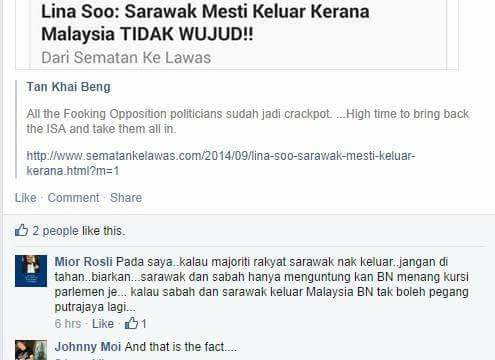
Has the author of the message been arrested yet? Of course not. Even when he actually committed sedition against Malaysia by encouraging Sarawak to secede from Malaysia.
How is it that a legal-trained person does not know that his act is seditious escapes me
Now, how is that seditious? If you look at Section 2 of the Sedition Act, 1948 it tells you the following:
Section 2 defines how an act is seditious. He has committed a seditious act by definition of Section 3(1)(a)
This former Armed Forces officer also committed a crime of sedition under Section 3 (1) (b) of the same Act for encouraging Sarawak to leave Malaysia:
Section 3 (1) (b) of the Sedition Act, 1948
And you thought that the Federal Constitution protects freedom of speech? Yes, it does. But as with all other liberties, they are subjected to restrictions. Article 10(1) guarantees that every citizen has the right to freedom of speech and expression, but at the beginning of the Article it also says the following:
You cannot just say anything you like although you have the freedom of speech and expression
To dissent is okay. To dissent seditiously, or criminally, or dangerously, or incitingly, is not okay.
Any legal-trained person ought to know this, right? What more a former officer of the Armed Forces!
Point 5:
“Save Our Economy”
In April 2017, the World Bank forecasted that Malaysia’s GDP would be at 4.3 percent. This was revised in June 2017 to 4.9 percent due to an acceleration in domestic economic activities (people in Malaysia are actually spending more) by 5.7 percent year-on-year. The GDP growth was revised again in October 2017 to 5.2 percent.
Let me quote several reports here by the World Bank.
World Bank Group lead economist Richard Record said at a media briefing on the update that Malaysia’s robust GDP growth in the first half of 2017 was largely underpinned by strong private-sector expenditure, with additional impetus from an improvement in external demand.
“Private consumption expanded firmly this year, supported by favourable income growth amid stable labour market conditions, and improved consumer confidence. Private investment also sustained rapid growth rates during the period, reflecting mainly continued capital spending in the manufacturing and services sectors,” said Richard Record.
“On the external front, gross exports rebounded strongly from the subdued growth experienced in 2016, supported by double-digit growth in commodity and manufactured exports,” he added.
Economic watchdogs are generally bullish on the Malaysian economy’s performance, buttressed by strong expansion in private consumption and private investment. In the latest update on its World Economic Outlook, the International Monetary Fund has upped its GDP growth projection for Malaysia in 2017 to 4.8 percent from 4.5 percent previously.
Apart from that, the Asian Development Bank has also upgraded its 2017 growth outlook for Malaysia to 4.7% from 4.4%, and indicated that the two-year slowdown in economic growth is likely to have bottomed out last year.
Richard Record also predicted Malaysia’s economy for 2018 and 2019.
“We are forecasting Malaysia’s GDP to grow by 5 percent next year (2018) and 4.8 percent in 2019. Our prediction reflects how we are seeing the country’s macroeconomic fundamentals’ performance and the baseline scenario,” he said.
Online economics portal ‘Focus Economics’ also said the following:
“Economic momentum remained robust in Q3 as confirmed by more complete data. Export growth expanded by a double-digit pace in September, underscoring thriving external demand for Malaysian goods. Household spending was buoyed by a low unemployment rate in September and by higher wages, which were propped up by a thriving manufacturing sector, the key driver of industrial production growth in the quarter. The 2018 budget passed on 27 October is focused on fiscal consolidation and is expected to narrow the fiscal deficit from 3.0 percent in 2017 to 2.8 percent in 2018. Despite the tightening, the budget has consumer-friendly components that will increase disposable income. These include lower income tax rates, especially for middle-income earners; higher public wages; and increased assistance spending.”
Of course, with the oil prices continue to stay below the USD70 per barrel level, Malaysia as well as other countries will continue to experience some sluggishness in the economy. However, good fiscal policies have allowed us to grow unlike a neighbour of ours that is often quoted as being a model economy. That country’s growth have been at 2 percent in 2016, and 2.5 percent this year.
The outlook for the construction sector has taken a sharp turn for the worse, with poll respondents tipping a contraction of 4.2 per cent. The previous survey, released in June, had respondents forecasting 0.2 per cent growth in the sector.
The outlook for the accommodation and food services sector in this model country has also worsened – it is now expected to shrink 1.5 per cent, from previous estimates of a 1 per cent expansion.
Economists polled expect overall economic growth of 2.5 per cent next year for this model country, the same pace as this year.
Perhaps the author of the message we are discussing here should go down South and help revive the economy of that model country.
So, there have you. I really do not know what the fuss is about. All I can deduce is that the author of the message is all hot air – you can feel it blowing on your face, but there is no real substance there. This is the same as BERSIH, and the recycling of petty but stale issues by the Opposition just so that they can remain relevant, and justify for the allowances they receive from the pockets of the rakyat.
You can express your dissatisfaction, but always do so constructively. Especially if you are a member of the Malaysian Armed Forces and Malaysian Armed Forces Veterans.
I received the following WhatsApp message from my father earlier today:
The government has to stop its lies and bullshit. Everybody in the oil industry globally confirms one thing. Malaysia has the “sweetest” crude oil in the world. What this means is this, we produce the highest quality oil in the world. The best of the best. But the rakyat don’t see this. This is exported for other people in the world to use. Then Malaysia reimports low grade and low quality oil at a very cheap price for the rakyat to use. Dirty oil.
The question is this. Isn’t the beautiful sweet high grade quality oil Malaysia produces belong to the rakyat of Malaysia? Why sell it of at a higher price to other countries? The oil belongs to the rakyat of Malaysia. It should be given to the people of Malaysia first. Why import dirty and filthy oil and give the rakyat of Malaysia? Why are Malaysians treated like dogs and be given the bones when other people are given the nice flesh to eat?
Another issue is subsidy. There is no such thing of subsidy. The Government of Malaysia has been lying to Malaysians the past 20 years about subsidy. You see, what you produce, you cannot subsidise. If the government does not sell our high grade oil overseas and give it to Malaysians to use, what is there to subsidise?
This story has been going around a long time to fool the people of Malaysia, especially, the kampung people that petrol need to be subsidised. We don’t need to subsidise any petrol or fuel because Malaysia produces ample oil not only for its rakyat but also for export. So, if you produce your own oil, what is there to subsidise?
If you grow vegetables in your garden to eat, you cannot go around telling people that your vegetables are subsidised. You are growing it. You are producing it. You don’t have to buy it at all from an external source. The same with oil. We produce it. We should be using it first. This is how the Sultan of Brunei thinks. That is why he gives his rakyat very cheap fuel. Then the balance, he exports it at global prices. For him, rakyat comes first. he gives the rakyat clean and cheap oil because he cares.
Our government, terbalik. Rakyat comes last. And our oil resources are far more than Brunei. Few years ago, in the global media, Petronas struck the largest oil reserve and land in the world. Global media confirmed it was the largest oil reserve in the entire world. Then the next day, our government covered it up as mere speculation. So, in actual fact, Malaysia’s petrol company Petronas has unlimited reserves of oil for the next 50 yrs. Can we Malaysians please have the priority to get this fuel first for the rakyat cheaply?
My reply is somewhat simple:
Brunei has a population of 434,000 and produces 110,000 barrels of oil per day. Malaysia has 32 million population and produces only 659,000 barrels of oil per day. Of course Brunei can afford to produce, refine and supply to her own citizens while Malaysia becomes a net importer of processed oil.
Furthermore, Malaysia produces the Tapis crude which is sweet and light with a API gravity of 45.5 degrees and sulphur content of only 0.1 percent, making it expensive on the market.
Petronas sells the Tapis crude to get more money and purchases cheaper crude oils for consumption in Malaysia.
Between 14 August 2017 and 20 November 2017 the average value of retail petrol per liter was RM2.20 with a minimum of RM2.12 and a maximum of RM2.38. For comparison, the average price of petrol in the world for the same period was RM5.80 per liter.
As at 20 November 2017, Malaysia’s retail petrol price is 20th cheapest at USD 0.58 per liter. Among the Asian countries only Myanmar is cheaper than ours – by one US cent. Indonesia is 4 spots higher at USD 0.65.
The Brunei government does not publicise its retail petrol price and is therefore not listed. It subsidises its fuel very heavily. However, in 2008 it increased prices for foreigners to B$1.18 per liter (RM2.832 in November 2008).
If Brunei is the model for Malaysians, let it be known that last year its fiscal deficit hit 16 percent of its GDP as a result of the decline in oil prices. Its 2017 budget was slashed by USD100 million to B$5.3 billion. In 2016 it was B$5.6 billion. It was B$7.3 billion in 2014 when the slump in oil prices began.
The government has frozen new staff hires for the bureaucracy. Certain civil servants benefits such as housing, electricity and petroleum subsidies have been cut.
The grass is always greener elsewhere, until you look hard.








You must be logged in to post a comment.