Forest City: Sustaining The Future

Forest City was under a considerable amount of pressure when it first started due to the knee-jerk reactions of some environmentalists and half-baked as well as over-ripe politicians seeking quick publicity to remain relevant.  While the environmental concerns have been addressed and continues to be addressed as the project progresses, it is notable that the political concerns seem to originate only from the Malay politicians.  It seems that the Chinese politicians realise the potential this development brings.

Almost, if not all the issues have been addressed in a recent posting of mine on the matter, but it seems that these politicians are hell bent on flogging an already decomposing horse.

In the meantime, Forest City continues to develop and progress, in very notable ways.

A UN Global Model

On the 31st October 2017, Forest City won the Global Model of Green Building Industrial Park for the second consecutive year.  The award was part of the Sustainable Cities and Human Settlements Award (SCAHSA) ceremony held in New York.

Forest City wins the Global Model of Green Building Industrial Park award for its industrial park which has boosted the construction industry


The SCAHSA award established by the Global Forum on Human Settlement (GFHS), a non-profit organisation with Special Consultative Status within the United Nations Economic and Social Council (ECOSOC). It is a trend setter for urban construction everywhere that respects sustainable development.

Forest City, China’s Wuyi County and Indonesia’s Surabaya City were among the winning entries submitted from 23 countries and regions worldwide. Forest City won the SCAHSA Global Human Settlements Award on Planning and Design at the 11th Global Forum on Human Settlements (GFHS – XI).

Dr. Arab Hoballah (right), former Chief of the Sustainable Lifestyles, Cities and Industry Branch at United Nations Environmental Programme (UNEP) presents the Global Model of Green Building Industrial Park award to Forest City

Forest City, by taking full advantage of its technical resources, is creating a 1.7-square-kilometer construction-focused industrial park, to promote the development of a green building industry and improve building precision and quality, said Dr. Wang Jiying, vice general manager for overseas business at Country Garden.

Forest City will include several support facilities and a powerful water transportation system, all of which are expected to be operational in 2019, with the aim of creating a truly industrialised manufacturing base for the construction industry over the next three to five years.

Creating Potential Future Workforce

A month and a half ago when I was at Forest City, I was brought to visit one of five schools adopted by Forest City where children are given free Mandarin lessons for three months.  This is one of the ways by Forest City to ensure that the local community, especially those in the Tanjung Kupang area, have roles to play in the development.

The result is excellent:

The student above is from the first batch of students who started their Mandarin language course in August 2017 and has graduated.  Forest City is not stopping there.  Forest City’s master developer, Country Garden Pacificview Sdn Bhd (CGPV), aims to give back to the community by offering three-month basic Mandarin language courses to some 100 school children there.

CGPV plans to continue to offer the Mandarin courses in the future as part of its corporate social responsibility effort for the community here.

The second intake will be conducted from January until March next year,” Country Garden Pacificview Sdn Bhd corporate communications head Aeron Munajat told reporters when met at SK Tanjong Adang here today where she handed over certificates to the participants.

Aeron said that apart from learning Mandarin as a third language, the three-month language course will also help the students develop self-confidence which will further enhance their competitiveness in the job market in the future.

She said the course involved students and teachers from five schools, namely SK Morni Pok, SK Tanjong Adang, SK Tiram Duku, SK Tanjung Kupang and SK Pendas Laut.

The classes are conducted every Friday and Saturday from 10am to 12 noon, at the community centre in Kampung Pok,” she added.

Forest City Does Not Pawn Johor Land

The continued but futile attacks on Forest City by Malaysia’s Mugabe and his followers have again earned the ire of His Majesty The Sultan of Johor.

Has Johor ever pawned its land? What is the meaning of pawning? With Forest City, the state of Johor has increased in size. It is not about seizing land to be pawned. In Johor, there are international lots and Malay reserve land.  Anyone can buy at the international zone, be it the Mat Salleh from England or people from India, Japan, China. All of them can purchase it.  They can buy (property), but it does not mean they purchase the land to bring it back to their respective home country,” chided the Sultan.

In Johor, we have an international zone, which means that foreigners could buy. It has international status. In Forest City, we do not sell the land, we sell the strata (titles) and these strata (titles) are for permanent ownership in Johor,” he remarked.

The Sultan added that 40 percent of the investors in Forest City are Malaysians and that even the government has shares in the project, and that the project gave a lot of revenue for the state government, including quit rent and assessment, which the state of Johor benefits.

How much revenue will the Johor government get? When Forest City is completed, the assessment, quit rent will go to who? Who will get the jobs? There are transportation (initiatives), businesses and job opportunities. Don’t be narrow minded about this,” said the Sultan.

A throwback at the Sultan of Johor’s displease of Mahathir’s lies about the Forest City project

The Sultan also said that the most visible benefit of the Forest City project was the boost it has given to the value of real estate in its surrounding areas, particularly in Pontian district, which is now developing at a rapid pace.

He gave an example of how in the past, the people of Pontian were only picking buah duku (lanzones), but now people in Pontian own Mercedes Benz cars.

It means that Pontian has become a district that will see rapid development,” the Sultan stressed. “In the past, an acre (0.4 hectares) of land used to cost RM100,000, but now, it is valued up to RM3 million.”

It is no doubt that Forest City will boost the Iskandar region’s marketability.  With consumer prices 100 percent higher than in Malaysia, rent prices 500 percent higher than in Malaysia, many companies in Singapore were driven to relocate to Iskandar, while Johor Bahru’s shopping malls, food outlets and amusement parks have become a favourite for Singaporeans.  Bangkok’s recent wish for Malaysia to extend its High Speed Rail into Thailand will soon make the Iskandar Econmic Region attractive to the millionaires and billionaires of Indochina. And the green, affordable buildings of Forest City will definitely be a hit.

While they all win, the real winners will be the people of Johor and Malaysia.

Defence: RMAF’s Walks Slowly But With Big Strides

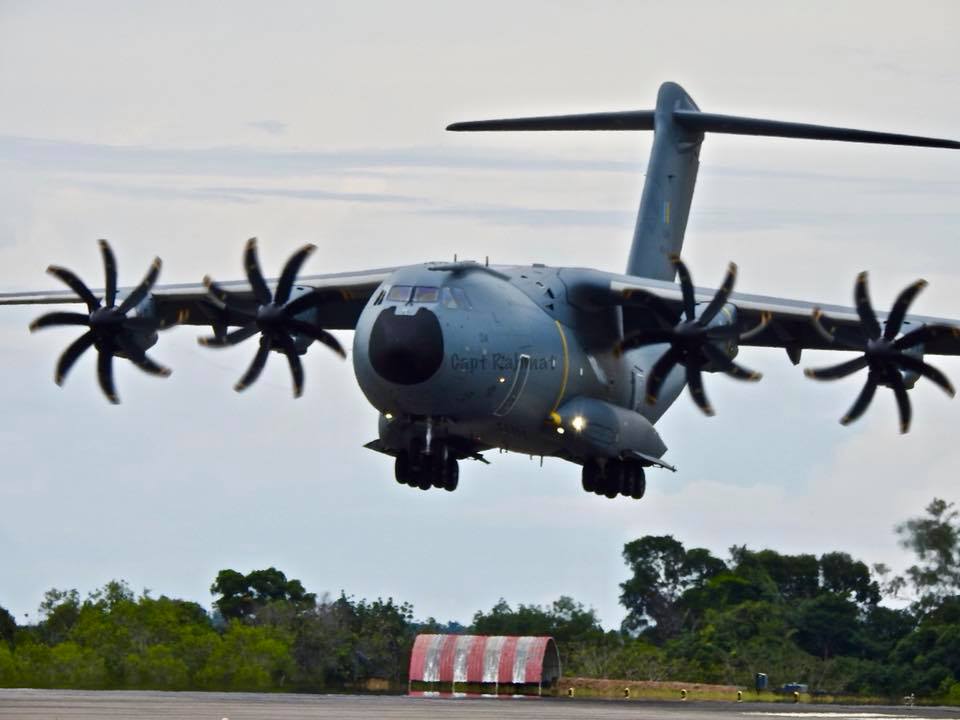
RMAF Airbus A400M (M54-04) on finals at the Labuan airbase during exercise PARADISE 2017

The A400M: How Has It Fared?

When the Royal Malaysian Air Force purchased the Airbus Defence and Space A400M Atlas, many thought it was to replace the Lockheed C-130H-30 that had entered service in 1976.  15 C-130Hs were delivered to the RMAF with 14 still flying.

However, the RMAF announced further upgrades to its C-130H fleet to keep them operational.  The A400M’s role, although similar to that of the C-130H, enhances the RMAF’s airlift capability.  Not only can the A400M carry 17 tonnes more payload compared to the C-130H, it can fly 200 knots faster and land on rough or soft landing strips like the C-130H.

Its glass cockpit/side-stick  coupled with three-axis fly-by-wire (FBW) with flight envelope protection configuration makes the A400M user-friendly and is based on the A380 but modified to suit military operations requirements.  The flight envelope protection allows the A400M to perform bank angles up to 120 degrees!

The cockpit of the RMAF A400M (M54-04) is large and is very comfortable

Not only could the A400M support the Malaysian Armed Forces’s tactical and strategic capabilities, it could also be utilised for Humanitarian Assistance and Disaster Relief (HADR) operations in the region.  To date, the RMAF’s A400Ms have performed two HADR roles: delivering 17 tonnes of aid to embattled Marawi in July 2017 and 12 tonnes of aid to the Rohingya refugees in south Bangladesh in September 2017.

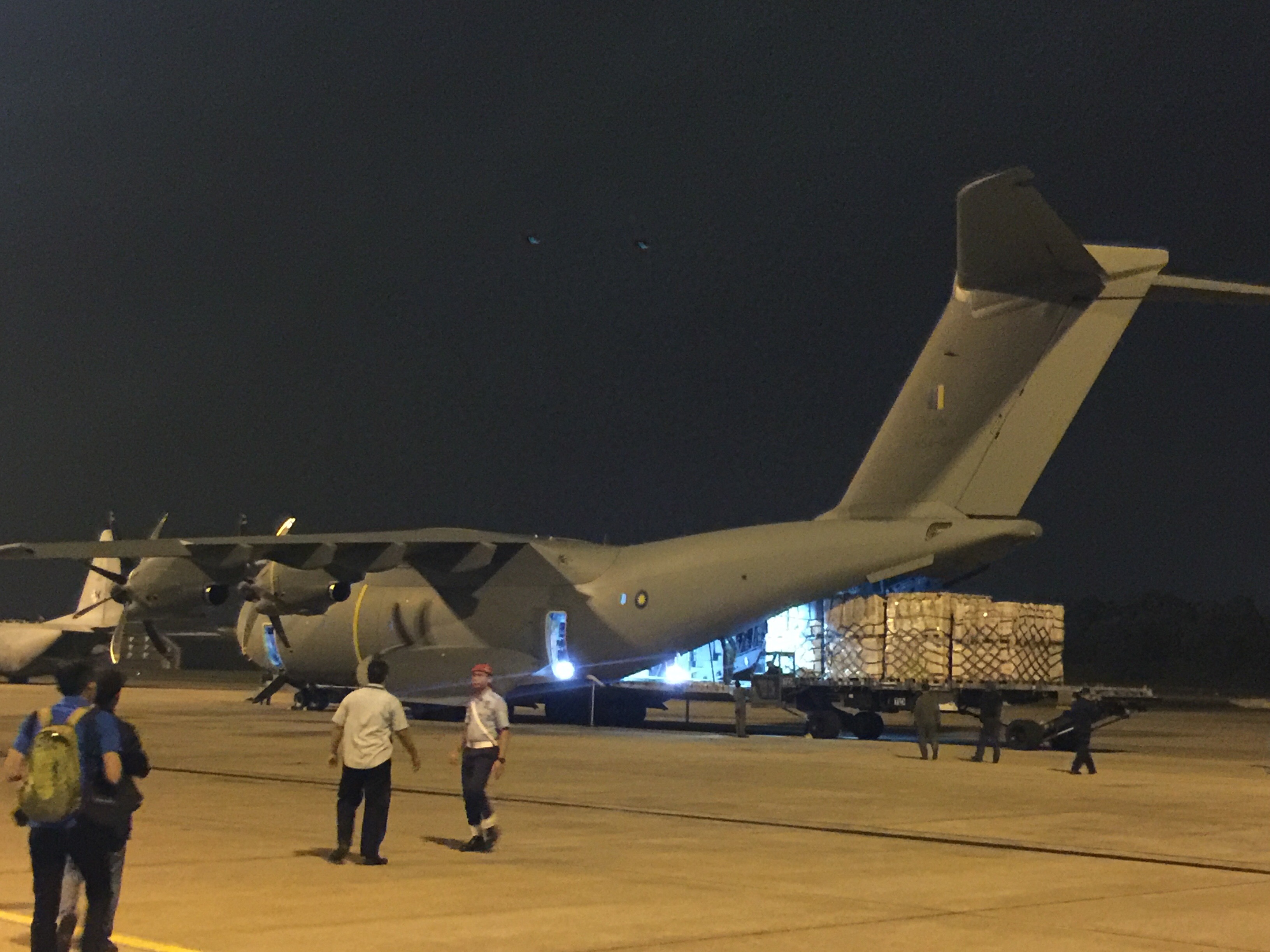
RMAF A400M (M54-04) is being loaded with HADR cargo bound for Marawi

The remarkable thing especially about the Marawi mission was the A400M’s ability to fly to Cagayan del Oro and back without refuelling (an approximately 5,400 kilometers return trip); this, together with its speed cuts down total turnaround time.

The A400M is equipped with the defensive aid sub-system and an in-flight refueling capability.  The inflight-refueling package allows the A400M to refuel helicopters at 105 knots indicated airspeed (KIAS) and fighters at up to 300 knots, hence safer for the refuelling of both helicopters and fighters.  Flight tests have also revealed that at Alpha Max (with the Alpha Floor protection disabled, the A400M reached 98 KIAS before  the FBW low-speed protection function eased the nose down. There was no wing roll-off or loss of control. Recovery was almost immediate when the nose was lowered and thrust added, underscoring the fact that the A400M is indeed a very safe and capable aircraft.

Maritime Patrol Aircraft – Budgeted For

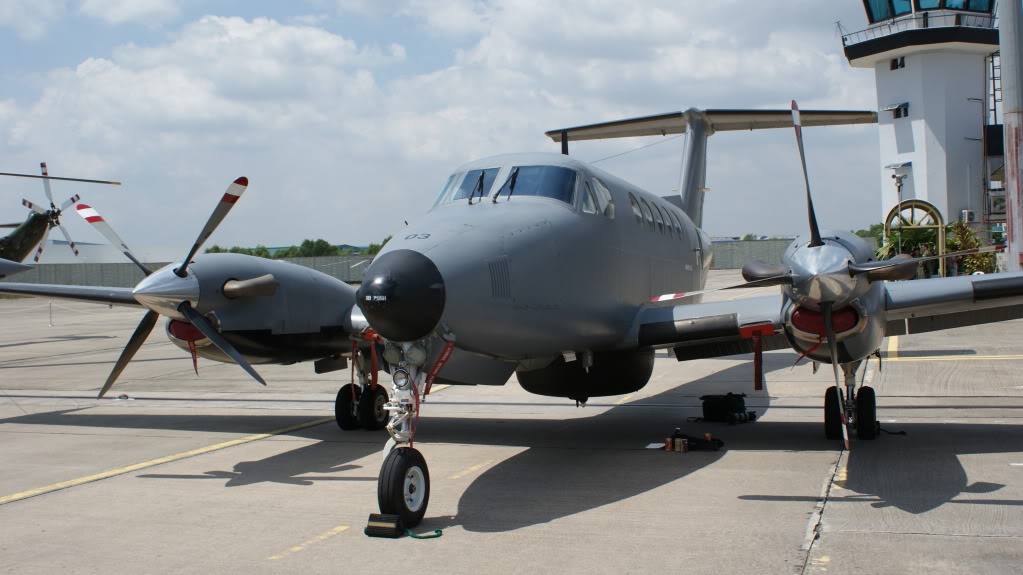
The Beechcraft Super King Air 200T MPA has been in service with RMAF for 23 years

For almost two decades the role of maritime patrol was assigned to several C-130Hs that were converted to C-130MPs.  Four Beechcraft Super King Air B200T aircraft were inducted into the RMAF maritime patrol fleet to complement the C-130MPs.  However, the high operational costs versus mission requirements of the C-130MPs saw the latter taking over the role completely.

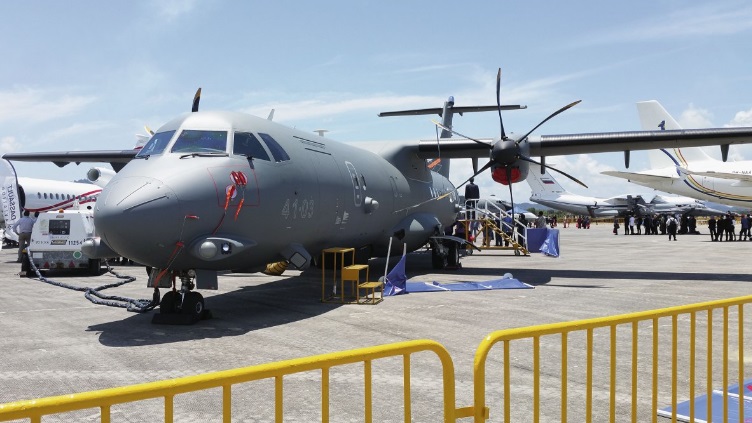
Even before the loss of an airframe, there were already talks of replacing the B200Ts.  Leonardo brought its ATR-72MP aircraft to LIMA ’17.  Apart from the hardpoints and MPA modules on board, the ATR-72MP is just a normal commercially-available aircraft, powerplants and all.  Leonardo’s concept is to provide a platform using what is available in large numbers in the market to keep the costs down.

The Leonardo ATR-72MP, seen here at LIMA 17, also comes with an electronic surveillance and C4I platform. The airframe is that of the ATR-72-600 (photo courtesy of Janes Defence)

Airbus Defence and Space flew a CN295 almost around the world to promote it as a multirole platform.  The CN295, albeit a SAR version that was on its way to its new home in Brazil, made a stop in Malaysia and was presented to operators such as the RMAF, the MMEA, as well as the Royal Malaysian Police Air Wing.

Stretched three metres longer than the CN235 that the RMAF is currently operating, everything about the CN295 is very similar to the CN235, which makes crew conversion fairly easy to make.  It comes with a more powerful plant that features better efficiency, longer loiter capability at station and comes with six external hardpoints for ASW weapons.

When the announcement of the budget for the procurement of four MPAs in 2018 was made, the immediate follow-through was that four of the RMAF’s remaining seven CN235s will be fitted with the MP systems from the B200Ts, a sure sign that either additional CN235s will be acquired for the MPA role, or the CN295s would be acquired instead.

The commonality between the C295 and the CN235 also potentially leads to  even lower operating costs, given the versatile cabin configuration that allows fast switching of mission types, high manouvrability, better low-level flying capabilities given the high-wing configuration and a wide rear ramp, the C295 makes the best option for maritime patrol and surveillance as well as anti-submarine warfare missions in Malaysia.

The C295 is powered by twin PW127G turboprop engines driving Hamilton Sundstrand Type 568F-5 six bladed propellers which provide outstanding hot and high performance, low fuel consumption, and an endurance exceeding 11 hours.  Flying at a maximum speed of 480 km/h which is slower than the  B200T’s 540 km/h, but has a range of 5,600 kilometers compared to the  B200T’s 3,100 kilometer range.

The RMAF’s need for a reliable platform that would be able to perform largely anti-shipping missions and has a reasonable but economical loiter endurance with some strike capability if required makes the CN295 a better choice of MPA. It also makes strategic and economical sense for Malaysia as it allows operators to narrow down its aircraft types and suppliers, making logistical and technical support easier.

The Airbus C-295 of the Força Aérea Brasiliera arrived at the Subang airbase on Friday 7 July 2017

UAV, MRCA and LIFT

Although the procurement of the badly needed MRCA to replace the MiG-29Ns have not been announced, the RMAF is making up for the void by ensuring high serviceability rate of its frontliners.  Observers would note that the serviceability percentage has increased tremendously despite the cut in the defence budget.

Perhaps the RMAF should think of an interim fighter or Lead-In Fighter Trainer  (LIFT) that gives the bang for bucks.  The Korea Aerospace Industries’s TA-50 LIFT comes into mind.  Each unit of the more advanced FA-50 costs half or three times less than a top-of-the-line fighter would but it carries enough sting to hurt the enemy.

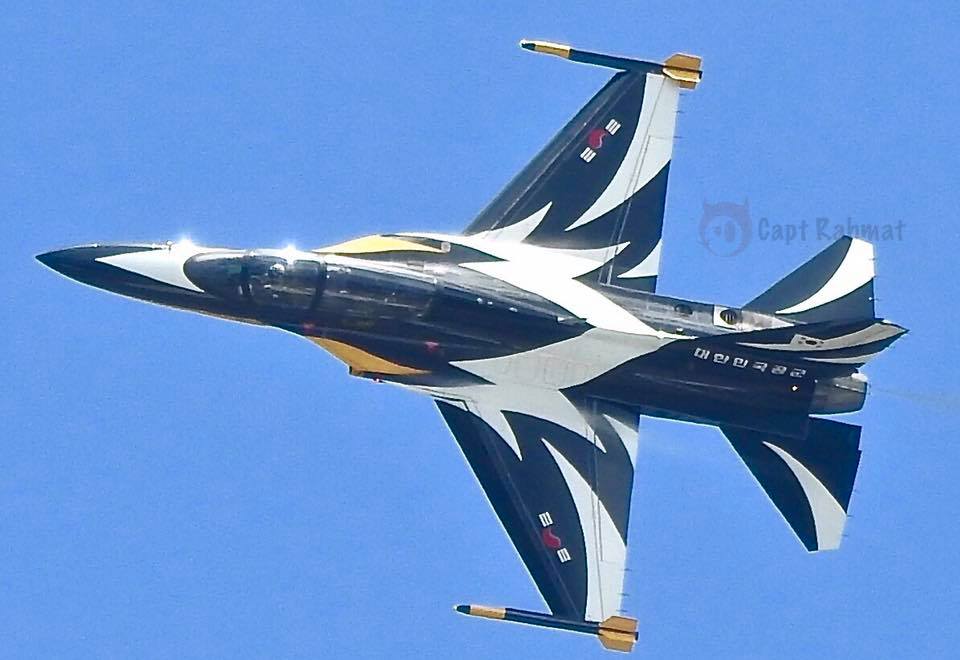
RoKAF Black Eagle’s KAI T-50B zooms above Langkawi during LIMA 17

Losing only but not much in terms of range to the BAe Systems Mk 108/208 that the RMAF currently deploys in Labuan to cover both the eastern South China and Sulu seas, the TA-50’s ability to reach supersonic speeds (Mach 1.5 compared to the Hawk’s Mach 0.84) and excellent thrust-to-weight ratio (0.96 to the Hawk’s 0.65) means that the TA-50 would make a better aircraft placed on Alert 5 to intercept straying foreign aircraft. Its superb ability to deliver air-to-ground as well as anti-shipping ordnances makes it a suitable platform to support anti-incursion/counter-insurgency operations in the ESSCOM area.

The RMAF is also interested to develop its Unmanned Aerial Vehicle capability in both tactical and strategic aspects.  RMAF Chief General Tan Sri Dato Seri Affandi bin Buang TUDM said that the RMAF is conducting a detailed study to identify the UAV capable of meeting the current needs of the country apart from being equipped with technologies which could be shared with various parties in the country.

The Chief of RMAF (second from left) speaking to reporters during Exercise PARADISE 4/2017 at the Kota Belud Air Range

Besides security surveillance, UAV can also be used for other purposes such as weather information and others,” he said. “If the RMAF is able to acquire sophisticated UAVs we would be able to enhance our operations in the Peninsular, Sabah, Sarawak and also in support of the MPAs patrolling the South China Sea as well as the Sulu Sea.

Hopefully the RMAF would acquire UAVs with extended on-station endurance with some hardpoints for strike capability.

Epilogue

Although the RMAF is still in want of frontline airframes, it is seen to improve its serviceability percentage, a task that seemed daunting in times of global econmic uncertainty, but certainly achievable.  The plan to purchase capable Maritime Patrol Aircraft as per the 2018 Budget, and planned addition of sophisticated UAVs, will certainly enhance its control over the airspace.

It is hoped that the government could look into equipping the RMAF with interim strike capability, especially in the South China and Sulu seas, by adding a squadron or two of the KAI TA-50, if not a squadron each of the TA-50 and its frontline version, the FA-50, hopefully by 2020, before preparing its budget for the procurement of actual frontline MRCAs that are badly needed, not only as replacements of the recently-retired MiG-29N, but also as a contingency to replace the F/A-18D which is already in its 20th year of service with the RMAF.

The RMAF may seem to walk slowly, but it is definitely walking with big strides.

Let’s Complain About Retail Fuel Prices

Four days ago, just before the retail fuel price hike of six to seven Sen, the average price of retail petrol per litre was USD1.09 (RM4.59).

I won’t touch on the complexities of how we calculate how much we should be selling petrol week after week, but as a rule of thumb, countries that are richer (UK, France, Germany etc) have higher fuel prices. Countries that are less rich, or countries that produce and export oil, have lower fuel prices. The only exception is the US which is economically advanced but has low fuel prices.

How a country taxes or subsidises fuel contributes to the differences in fuel prices around the world. Since all countries have access to the same fuel prices of the international markets, it is taxes and/or subsidies contribute to the difference in retail fuel prices.

This is how Malaysia fares. If you don’t see the names of other countries then it means that fuel prices are actually much higher than Malaysia’s.

I saw ill-informed people saying that fuel prices and the cost of living in neighbouring Thailand are much lower than in Malaysia. There were also those who said that Malaysia should follow the global prices.

My question to them is: if fuel prices in Thailand are much lower, why do we find people smuggling fuel from Malaysia to Thailand and not the other way round?

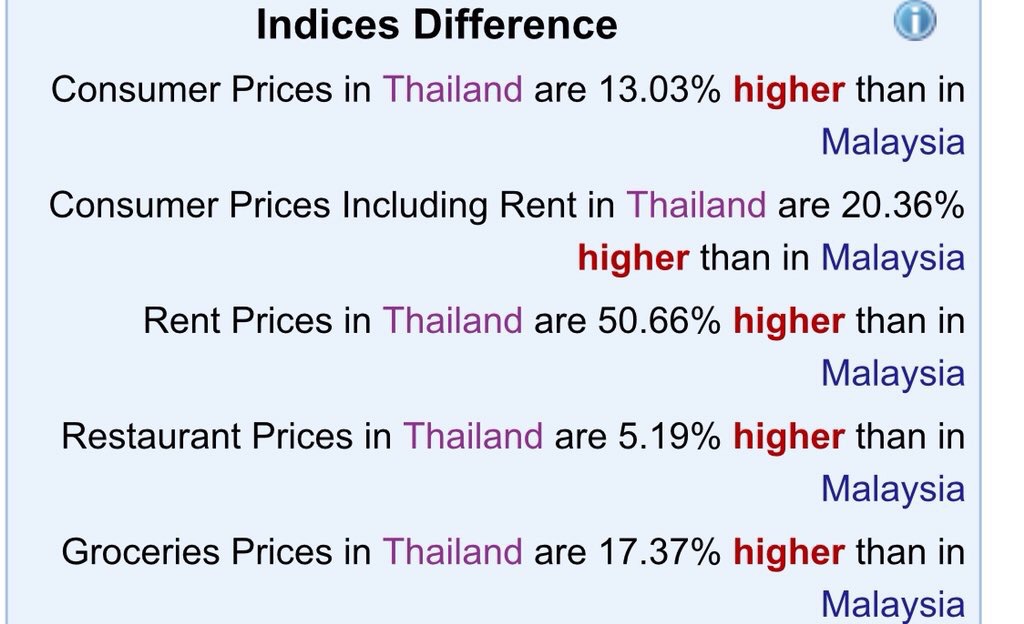
And as for the cost of living, this is the cost of living indices for Malaysia versus Thailand:

Taking the last three months (from 7 August 2017 until 13 November 2017), the average price of fuel in Malaysia was around RM2.18 per litre with the lowest being RM2.07 per litre on 7 August 2017 and highest at RM2.31 per litre on 13 November 2017.

The average price of fuel per litre on the international markets for the duration was at RM5.84. So, would those asking Malaysia to follow the international markets prices want to pay this sum per litre?

I hope that these gullible Malaysians would pause to breathe and check the “facts” that are being shared in chat groups and social media before hitting that “SHARE/FORWARD” button.

But that is like hoping to see anencephalic babies become Einsteins.

The Rotten Core

Rotting Apple Core (courtesy of Science Learning Hub)

It is no surprise that the recent DAP CEC election has retained some 90 percent of its line up.  Despite being a dinosaur and having manouvered the DAP through its mother-of-all-U-turns by working with arch-nemesis Mahathir Mohamad, Lim Kit Siang emerged victorious with the most number of votes.  His son, Guan Eng, despite being charged on two counts of corruption, came out third and was returned as the Secretary-General of the party.

Returned after being missing for a term is Selangor’s Ronnie Liu who is famous for trying to stop the authorities from raiding brothels and gambling dens in Selangor before DAP came into power.  The ousted included the man who is the symbol of cleanliness, moderation and a corrupt-free DAP – Tan Seng Giaw.

And as for its multiracial image, only two Indians and one Punjabi were elected but not one Malay made it to the Top 20 – again, but former DAP Pahang Chairman Tengku Zulpuri Shah bin Tengku Puji was appointed Vice-Chairman.  He is the sole Malay in the CEC line-up.  Christopher Ross Lim, the Chinese man masquerading as Malay going by the name Zairil Khir Johari, made it at No. 19. He was born a Chinese and remains a Chinese.

Only 54 percent or 1,356 delegates attended the CEC elections out of 2,514 delegates in 2013.  This shows that the support for the Lim Dynasty is waning. They can bask in party glory now but whether that will translate into actual votes especially in Pulau Pinang remains to be seen.  With only 450,000 registered members, DAP relies more on its propaganda to win over the masses, who of late are drowning in flood waters and overwhelmed by landslides due to the over-development of the hills and reclamation works in Pulau Pinang.

And to appease the spirit of a dead man, the three-year dead Karpal Singh managed to get 43 votes, more than any of the Malay candidates.  How Karpal could still get votes baffles me.

This sums up the image of the DAP – rotten to the core.

Mahathir Masih Hina Bugis Dan Rakyat Indonesia

Mahathir Mohamad baru-baru ini mengirim seutus surat kepada DUBES Malaysia di Jakarta kerana diminta menjelaskan mengenai kenyataan beliau mengenai ‘Lanun Bugis’.

Beliau langsung tidak rasa bersalah dengan kenyataan tersebut dan tetap dengan pendirian beliau bahawa Najib Razak adalah keturunan lanun Bugis.

Lanun wujud tanpa mengenali kaum dan bangsa, dan mengaitkan Bugis dengan lanun walaupun bukan kesemuanya adalah penghinaan yang nyata.

Malah, Mahathir selain menghina kaum Bugis, beliau dengan angkuhnya menghina rakyat Indonesia tanpa mahu meminta maaf di atas penghinaan terdahulu.

Tak usahlah cucuk orang Indonesia. Mereka bukan boleh undi PRU (Pemilu) 14.”

Jelas Mahathir tidak mahu melayan permintaan DUBES Malaysia yang mahu meredakan kemaharan rakyat Indonesia terhadap Mahathir yang telah menghina orang Bugis. Pendapat rakyat Indonesia tidak penting bagi Mahathir kerana mereka tidak akan mengundi dalam PRU (Pemilu) ke-14 nanti.

Inilah perangai Mahathir, orang yang malu dikaitkan dengan keturunannya sendiri.


A Flood Of Incompetence

I am surprised that a former Brigadier General doesn’t know that you cannot simply deploy the military without explicit instructions

Former army Brigadier turned politician, Arshad Raji, seems to like the attention the electronic media has been according him lately, and he speaks about a wide spectrum of issues – from falling for Mahathir’s fake news of the so-called withdrawal of his close police protection, to the management of the floods in Pulau Pinang.

In the latter issue it was as if he was trying to downplay the Deputy Prime Minister and the BN-led Federal Government’s involvement in the management of the floods.  He was right about some of it, though.  Under the National Security Council Directive No.20, when a state emergency is declared following a disaster affecting two districts or more, the State Disaster Management Committee can call for assistance in the form of assets, finance, and other resources on the state level, and limited form of assistance from federal agencies within the state – the police, armed forces, civil defence etc.  This does not require a call to the Deputy Prime Minister at all.

Look at Level II Disaster Management by the State

The State Disaster Management Committee is chaired by the Chief Minister or Menteri Besar while the Chief Executive is the State Secretary.  But what Arshad Raji did not know, or chose to not reveal during his “press conference” was the fact that until now Lim Guan Eng has not declared a state of emergency in Pulau Pinang despite floods inundating four out of five districts in Pulau Pinang namely Seberang Prai Utara, Seberang Prai Selatan, Barat Daya and Timur Laut.

Don’t blame the Federal Government. Tokong himself did not declare a state of emergency

I lived in Pulau Pinang, on the pulau itself for three years and four months in the late 1980s and never once saw floods affecting the state on this level.  The most I would see is pockets of areas in Datuk Keramat and the Green Lane (Jalan Masjid Negeri) – Jalan Air Itam junction near the State Mosque.  Even then you could still pass the areas on your motorcycle.  Having eight deaths because of floods in a year was unheard of (one died earlier in September while seven this time around).

No rain, no floods” seems to be the best of Lim Guan Eng’s quotes pertaining to floods in Pulau Pinang.  This time, the deluge is blamed on a tyhoon that is battering Vietnam, and rightfully so.  Every time a typhoon hits Vietnam, the northern Peninsular states would receive an extra amount of rainfall.  And since 1881, Vietnam has been battered by 68 typhoons excluding the one that has just hit them.  However, the shocking bit is where 119 flash floods have hit Pulau Pinang since 2013!  That is 2.5 flash floods per month for the last four years!

I wonder why this is the case of late?

It does not take an engineer to tell you that when you do excessive hillside developments, the soil cannot absorb the rainwater as the oxidised topsoil would be transformed into a clay-like material.  The run-offs would be washed into monsoon drains, clogging up the roadside gutters and making the storm sewers shallower as silt accumulates at the bottom.  These drains flow out to sea along natural coastlines, which is why monsoon drains act as gravity sewers.  In Pulau Pinang, you can hardly find a natural coastline as most beaches with gradient have been reclaimed, and the gradient tapers off, diminishing the gravity effect.  Storm water therefore does not flow into the sea but accumulates and saturates the flatter grounds causing floods.

But who cares about eight deaths this year due to floods and one last year when you can make money selling condominium units to the rich?  But it is this excessive development by the state government that was voted in by the Pulau Pinang people that is now killing the Pulau Pinang people and have caused untold miseries.

Everyone also knows that when it is the new moon or full moon, tides will be higher than usual, and that makes it harder for storm drains and rivers to flow water out to sea, what more when there is excessive water caused by the backlash of a typhoon.

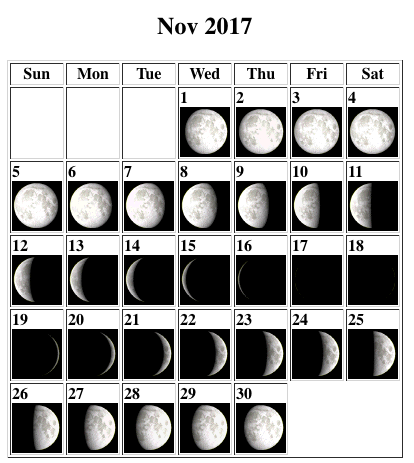
Phases of the moon for November 2017

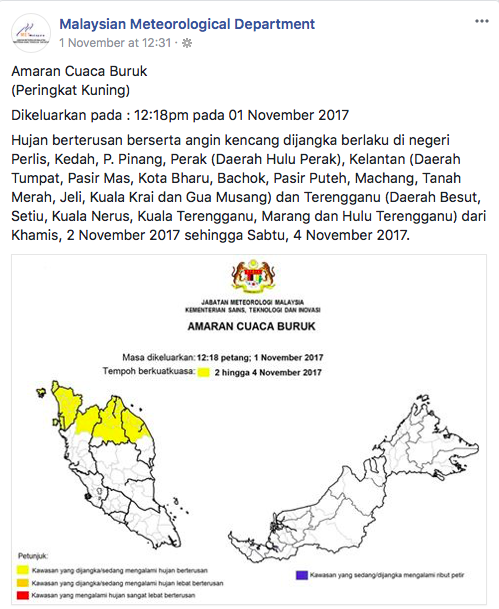
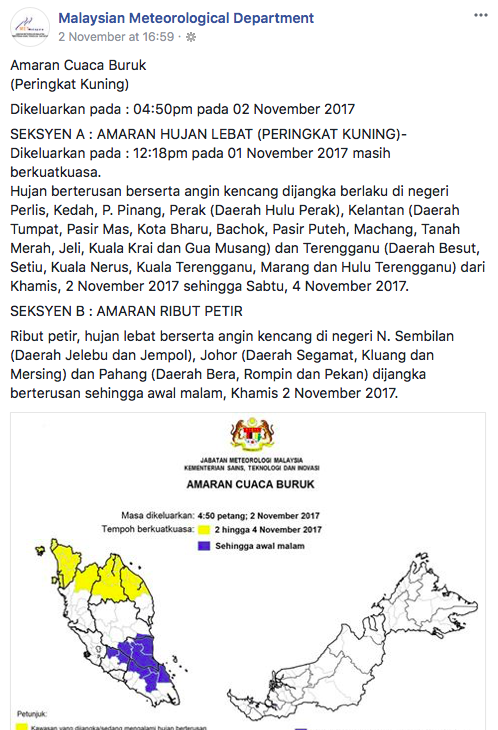
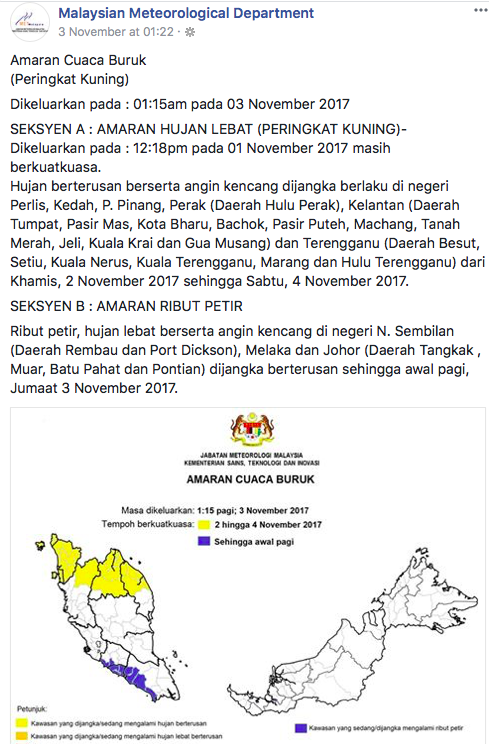
You can see that from 1 November 2017 the moon was in an advanced waxing gibbous phase and full moon over Georgetown, Pulau Pinang occured at 12.40am on Saturday, 4 November 2017.  The Malaysian Meteorological Department had issued a series of bad weather warnings for the northern Peninsular states from 31 October 2017, and every day from then on.

Met Department warning for the northern states on 31 October 2017
Met department warning the northern states that the bad weather was going to last at least four days from 1 November 2017
Another Met department warning on 2 November 2017 reminding the northern states that the bad weather was going to last at least four days until 4 November 2017
Another Met department warning issued on 3 November 2017 for the northern states that the bad weather was going to last at least until 4 November 2017

You can see that there was ample warning by the Malaysian Meteorological Department that the weather was going to be bad for four days.  What did Lim Guan Eng or his State Disaster Management Committee do?  Nothing, until it got really bad.  And at 3.00am, Lim Guan Eng became a cry baby and called the Deputy Prime Minister for help, without even declaring a state emergency.

Lim Guan Eng called the DPM for help at 3am on 5 November 2017, five days after the initial warning was issued by the Malaysian Meteorological Department

Where was his State Disaster Management Committee?  Why had they not sat down to make preparations to mitigate the situation?

Lim Guan Eng was quick to point fingers at Kelantan in the aftermath of the disastrous floods at the end of 2014.  He pointing out that corruption and the incompetency of the Kelantan state government, as well as the rampant hillside clearing as the causes of the floods.

Well, we know that there is rampant hillside clearing in Pulau Pinang.  We also know that the Chief Minister was charged on two accounts of corruption, and we also know now that it was the incompetency of the Pulau Pinang State Disaster Management Committee led by Lim Guan Eng himself as the Chairman that had caused the situation to be worse than it should be.

Lim Guan Eng’s government’s incompetence has killed one person in floods last year, 21 people in a landslide this year, and eight people in the recent floods.  This is the government that the Pulau Pinang people have voted in, and the Chief Minister chosen by them.

Pakatan’s promise
Pakatan’s promise
Pakatan’s promise

119 flash floods have occured since the promises above was made.  And Lim Guan Eng’s government is not worried.  Going by the rate the floods are killing people, there won’t be that many people left to complain about the floods – problem solved.

The Creeping of the Republicans

The Republican Creeps

I blame our history books.  In our eagerness to instill the spirit of nationalism, we took an easy way out by saying that we were colonised by the British, when in actual fact the whole of Malaya came under British rule only during the Malayan Union period.  Only Melaka, Pulau Pinang, Singapore, and for a while Pangkor and the Dindings were under the direct rule of Britain when they were  part of the Strait Settlements.  Other than that, the British advisers administered the Malay states through treaties, and the administrators were under the payroll of the respective Sultans or Rajas, not the British.

One of the leading evidence of the sovereignty and independence of the Malay states was a landmark case in England where in 1885 the Sultan Abu Bakar of Johor went to England, and according to the plaintiff of the case, Miss Mighell, took the name Albert Baker and promised to marry her.

It was held by court that the Sultan was entitled to immunity even though up to the time of suit ‘he has perfectly concealed the fact that he is a sovereign, and has acted as a private individual.’ ‘When once there is the authoritative certificate of the Queen (Victoria) through her minister of state as to the status of another sovereign, that in the courts of this country is decisive’.

To an argument that Sultan Abu Bakar had waived this immunity, the court held that the only way that a sovereign could waive immunity was by submitting to jurisdiction in the face of the court as, for example, by appearance to a writ. If the sovereign ignored the issue of the writ, the court was under a duty of its own motion to recognise his immunity from suit.

The roles of the Malay Rulers are somewhat misunderstood.  While many often think that the Institution of the Rulers mirror that of the British’s Westminster-style monarchy, it is not.  The Rulers ruled this land even when the British were here to administer the land on behalf of The Majesties.

When 31 August 1957 arrived, the powers that the Rulers had invested in the British was duly transferred to a government that was chosen by the people through a process of democracy called Elections.  It is untrue that during the British administration of this land, and now, that the Rulers have no other power other than having a say in the matters of the Religion of Islam and the Malay custom.

The Rulers, as keepers of this land, continue to enjoy their position with their income regulated by the respective laws, and receive advice from the Menteris Besar (or in the case of the Yang DiPertuan Agong, the Prime Minister). This is evident in Article 181(1) of the Federal Constitution which states:

Subject to the provisions of this Constitution,” the “sovereignty, prerogatives, powers and jurisdiction of the Rulers…as hitherto had and enjoyed shall remain unaffected.

The same was noted by Mark R Gillen of the Faculty of Law, University of Victoria (Gillen 1994:7). In the words of the late Sultan of Perak, Sultan Azlan Shah, former Lord President, it is:

a mistake to think that the role of a King, like that of a President, is confined to what is laid down by the Constitution, His role far exceeds those constitutional provisions” (Azlan Shah 1986:89)

In other words, the Rulers may be Constitutional Monarchs, but they are not limited to what have been spelt out in the Federal Constitution.

When Syed Saddiq, the runner for Mahathir wrote to the Sultan of Selangor after His Royal Highness expressed great displeasure over Mahathir’s labelling of the Bugis as “pirates who should return to their own land” and pleaded for the Sultan’s support to “fight against corruption and injustice with the people” it shows this great-person-wannabe’s lack of understanding of the position of the Rulers in the Federal Constitution.

The Rulers are apolitical.  The Rulers do not take sides, or do not express openly whom they prefer over those they do not.  For instance, when the Menteri Besar of Selangor does something that is deemed un-Menteri Besar-like, the most the Sultan would do is to express a reminder for the Menteri Besar to improve his performance so that the lives of the subjects of His Royal Highness are not in any way adversely affected.  To encourage certain courses of action is part of the duty of a Sultan, but the Sultan is above politics.

In the words of Sultan Nazrin Muizuddin Shah of Perak in July 2011:

Rulers must use wisdom to calm situations, but they do not have a ‘magic lamp’ to keep unity, especially when the situation has become chaotic.

When racial strife hit Malaysia on 13th May 1969, the Sultan of Terengganu as well as other Rulers took steps to protect their non-Malay rakyats (Kobkua Suwannathat-Pian, Faculty of Humanities, Universiti Pendidikan Sultan Idris, Kobkua 2011:364). This goes to affirm the special press statement made by the Conference of Rulers in October 2008 explaining that the Institution of Rulers is a “protective umbrella ensuring impartiality among the citizens.”

After 2008, we have witnessed how lawmakers from a certain party have been rude towards the Malay Rulers, forgetting their place in the Federa Constitution.  The Rukunegara  – means nothing to them: there is no Loyalty to the lawmakers themselves are rarely guided by the belief in God as they lie as if God does not exist, they show no loyalty to King and Country except when they need favours or awards which also means they do not subscribe to the supremacy of the Constitution, they don’t believe in the Rule of Law when it does not work according to their overall game plan, and by being rude to the authorities beginning with the Malay Rulers show that they do not practice courtesy and morality.

And are we surprised that we now have common people threatening the police, council enforcement officers, biting court officers, or show gross disrespect for the authority of the Malay Rulers?  They learn such absence of manners from their political idols.

If I were to write a letter to His Royal Highness The Sultan of Selangor, it would be to plead to His Royal Highness to pressure the authorities to hasten their investigation into the seditious nature of Mahathir’s remark.

ISA – Who Got To Play God

(This article appeared as a commentary on The Mole – 30 October 2017)

October 30, 2017

THIS would be my mellow version of the Ops Lalang.

The Internal Security Act, 1960 or the ISA, was probably the most draconian law to ever exist in Malaysia.  Prior to having the ISA, preventive detention was done through the Emergency Regulations Ordinance of 1948 aimed at combatting the communist threats.

With the end of the first Malayan Emergency in 1960, the Ordinance of 148 was done away with but was replaced with the ISA.  The mood of the period must be understood to see the reason for having such law.

Although the Communist Party of Malaya (CPM) had lost the fight, the struggle was continued from across the Thai border by cadres, as well as their supporters (Min Yuen) in Malaya.  They penetrated unions, the press, as well as associations, causing occasional racial tensions in the country.

Pre-1970 Malaysia was not all dandy when it came to race relations.  The economic power was held by the Chinese since the days of the British administration while the Malays had been relegated to being farmers or lower ranking civil servants.

The Chinese immigrants first came to the Malay states in 1777, and first settled in the state of Perak in 1830 (Patrick Sullivan, 1982: 13). Within 44 years, they numbered 26,000 in Perak alone.  In 1921, the number of Chinese immigrants in the Malay states numbered 1,171,740.  Ten years later, it was 1,704,452. In 1941, it became 2,377,990 while the Malays were at 2,277,352 (Paul H Kratoska, 1997:318). The Malays remained as a minority until the census of 1970.

During the war, the Malays did not face much hardship as the Chinese did at the hands of the Japanese.

After the war, the CPM/MPAJA and their Chinese supporters took revenge on the Malays. In Batu Pahat, Muslims were forbidden from congregating at mosques or suraus to perform the Terawih prayers (Hairi Abdullah, 1974/5: 8-9).

The same occurred in Perak and some parts of Batu Pahat where Muslims were gunned down and burnt together with the mosque they were in during Friday prayers.

Mosques and suraus were often used as places of meeting for the Chinese community (WO 172/9773, No.30: 478) and were tainted by incidents such as slaughtering of pigs, and mosques’ compound was used to cook pork, where Malays were forced to join the larger Chinese groups. Pages were torn from the Quran to be used by the Chinese using these mosques as toilet paper.

Racial clashes had begun in September 1945 where Malays and Chinese clashed in Kota Bharu, Selama, Taiping, Sitiawan, Raub.

This culminated in the slaughter of Malays early one morning in a hamlet near Kuala Kangsar called Bekor where 57 men and women, and 24 children were killed by about 500 members of the CPM aided by 500 Chinese villagers from Kelian in March 1946 (CO 537/1580: 21 and Majlis, 24 Februari 1947:5).

All in all, 2,000 lives were lost.

Such was the mood and the ISA was introduced to also prevent further racial clashes by preventing instigators from achieving their objective whatever that may be.

Therefore, it was an Act of Parliament that was used to preserve public order and morals.  If one is to read the ISA thoroughly, then it would be easier to see that the Act was not just about detention without trial, but also as a weapon for the Royal Malaysian Police to nip any cancerous threat to public order and morals in the bud.

Datuk Seri (now Tun) Dr Mahathir Mohamad was Prime Minister as well as Home Minister when Ops Lalang was executed on Oct 26 1987 (arrests were made in the early morning of Oct 27).

Datuk Seri Anwar Ibrahim was Umno Youth chief and also Education Minister in Dr Mahathir’s Third Cabinet.

Anwar had made several unpopular moves that earned the wrath of the MCA such as the removal of crucifixes from missionary schools, introduction of Bahasa Malaysia as the medium of instruction for Tamil and Chinese studies at the University of Malaya, as well as the introduction of non-Chinese educated senior assistants and supervisors to Chinese vernacular schools.

Deputy MCA president Datuk Seri (now Tan Sri) Lee Kim Sai who was also Selangor MCA chief, on the other hand, had also uttered words implying that the Malays were also immigrants.

A 2,000-strong gathering by the Dong Jiao Zong that was also attended by the DAP, MCA and Gerakan was held and a resolution was made to call a three-day boycott by Chinese schools.

Umno Youth responded with a 10,000-strong gathering at the TPCA Stadium in Kampung Baru.  It is said that Dr Mahathir then instructed Datuk Seri (Tan Sri) Sanusi Junid, who was Umno  secretary-general then, to organise a rally of 500,000 members in Kuala Lumpur.

I remember feeling the tension in the air, especially when an army personnel, Private Adam Jaafar, ran amok with his M-16 in Kampung Baru, adding more fuel to a potentially explosive situation.

The senior police management met in Fraser’s Hill to plan and then launched Ops Lalang to prevent bloodshed.

Whether or not Dr Mahathir disagreed with the police for Ops Lalang to be launched, it must be remembered that even if the police had wanted to launch the operations unilaterally, Section 8(1) of the ISA specifically mentions that it is the Home Minister who, upon being satisfied that the detention of any person is necessary, may make an order for the person to be detained for a period of not more than two years.

According to Section 73 of the Act, the police were not given the power to detain a person for more than 30 days unless the Inspector-General of Police had reported of the detention and its reason to the Home Minister.

Nowhere does the Act mention that the Home Minister SHALL or MUST act as advised by the police.  The police provided the names in a list, with reasons why they should be or were detained, but only the Minister could sign the detention order.

Dr Mahathir may now claim that Ops Lalang was the police’s idea, which may be true.  But as mentioned at the beginning of this article that the ISA is an Act of Parliament giving powers to the police to diffuse potentially explosive situations and also to protect and preserve public safety and morals.

The police used the ISA during Ops Lalang as it was intended to be used (there were also detainees from Umno during the sweep), but the Home Minister was the one who played God, and decided whom to be released before the 60 days was up, and whom to hold up to two years.

And that Home Minister is the same unrepentant person now touted to become the next PM by the DAP.

Kemarau Perniagaan Di Malaysia?

Kedai-kedai runcit lama banyak yang tutup sekitar tahun 1980an disebabkan pertumbuhan pesat kompleks membeli-belah dan pasaraya-pasaraya (Gambar ehsan PL1M)

Sehari dua ini kita disajikan dengn berita bahawa lima cawangan pasaraya Giant bakal ditutup dan dikhabarkan bahawa ini petanda ekonomi negara kita sebenarnya meruncing dan bukannya mengembang sepertimana yang diwar-warkan oleh kerajaan.  Berita penutupan cawangan-cawangan pasaraya Giant ini juga disebarkan melalui aplikasi WhatsApp.

Pagi ini juga saya melihat status seorang pengguna Facebook yang juga memberi khabar muram mengenai penutupan beberapa buah perniagaan besar di Malaysia.

Rangkaian Pasaraya Giant mengumumkan penutupan lima buah cawangan di seluruh negara.  Ia merupakan penutupan lima cawangan lama yang mana premisnya akan tamat tempoh pajakan dari sejumlah 122 cawangan di seluruh negara.

Cawangan-cawangan tersebut adalah di Seri Manjung, SACC Mall Shah Alam, Selayang Lama, Sibu dan Sungai Petani.

Walaupun keseluruhan daerah Manjung mempunyai 233,000 penduduk, Lumut hanya mempunyai kurang dari 33,000 orang penduduk dan sebahagian besarnya adalah merupakan warga Tentera Laut DiRaja Malaysia.  Giant perlu bersaing dengan dua buah pasaraya besar yang lain iaitu TESCO dan AEON Mall.

Sibu mempunyai 163,000 penduduk dan selain mempunyai dua cawangan Giant, ia juga mempunyai pusat-pusat membeli-belah seperti Sanyan Mall, Delta Mall, Star Mega Mall dan Medan Mall.

Sebuah Giant Hypermarket yang jauh lebih besar juga wujud berhampiran Giant Selayang Lama iaitu di Batu Caves, sementara cawangan di Selayang Lama terpaksa bersaing dengan pasaraya NSK Selayang yang menawarkan barangan runcit dengan harga yang lebih murah.

SACC Mall di Shah Alam itu sendiri tidak menarik ramai pengunjung.  Selain Giant, banyak premis perniagaan di situ telah ditutup dan berpindah terutamanya syarikat-syarikat yang mendaftarkan perniagaan yang telah menarik ramai pengunjung.  Di Shah Alam sendiri terdapat empat cawangan Giant yang berhampiran iaitu di Seksyen 9, Seksyen 13, Seksyen 18 dan juga Kota Kemuning.

Sungai Petani, walaupun mempunyai lebih kurang 280,000 orang penduduk, mempunyai dua buah cawangan Giant, iaitu Giant Hypermarket dan Giant Supermarket.  Saya yakin yang ditutup ialah Giant Supermarket.  Sungai Petani juga memberi saingan lain kepada Giant Supermarket dalam bentuk Pasaraya Econsave, Tesco, SP Plaza, Petani Parade, Central Square dan Amanjaya Mall.

Nampak gayanya penutupan lima cawangan tersebut merupakan langkah penyatuan atau konsolidasi dan bukannya disebabkan keadaan ekonomi yang muram.  Pengenalan sistem GST juga tidak memberi kesan yang besar kepada para peniaga kerana rata-rata pusat membeli-belah masih dikunjungi ramai orang.

Namun tidak dinafikan peranan yang dimainkan oleh online shopping ada memberi kesan terhadap para peniaga.  Ini adalah kerana ada masanya harga barangan yang dijual secara online adalah jauh lebih murah dari apa yang ditawarkan oleh para peniaga runcit.

Menurut PwC dalam laporan Bancian Runcit Keseluruhan 2016 yang dikeluarkannya baru-baru ini, 3/5 responden dari Malaysia telah mula membeli barangan secara online sejak tiga tahun yang lalu dan angka ini masih mengembang.

Di Amerika Syarikat, di mana GST Malaysia tidak memberi kesan, banyak pasaraya berjenama besar kini menutup beratus-ratus cawangan di seluruh negara kerana kalah kepada jualan online oleh Amazon.

Aéropostale, sebuah syarikat yang menjual pakaian golongan belasan tahun telah membuat permohonan untuk dibankrapkan.  JC Penney telah menutup 40 cawangannya selain membekukan tuntutan elaun lebih masa dan memotong gaji para pekerja.  Sears telah menutup lebih 200 cawangannya.  Macy’s telah menutup 136 cawangan yang menyebabkan 4,500 orang pekerja hilang pekerjaan. American Eagle telah menutup 150 cawangannya manakala Sports Authority telah menutup kesemua 450 cawangannya.  Office Depot telah menutup 749 cawangan, The Children’s Place telah menutup 271 cawangan, manakala Walgreens telah menutup lebih 1,000 cawangan.

Pasaraya terkemuka Walmart telah menutup 269 cawangannya, manakala pendapatan pengasas Amazon yang juga CEOnya, Jeff Bezos, telah meningkat  sebanyak USD6 billion dalam masa beberapa jam sahaja dalam bulan April 2016.  Banyak syarikat perniagaan runcit besaran di Amerika Syarikat terpaksa menutup cawangan, membuang para pekerja dan bergabung dengan syarikat-syarikat lain untuk terus hidup disebabkan persaingan yang diberikan oleh Amazon.

Trend yang sama kini dilihat di Malaysia. Pada bulan April 2017, syarikat gerbang pembayaran online Malaysia iPay88 yang menguasai 70 peratus pembayaran online di Malaysia mengumumkan bahawa angka pembelian online di Malaysia meningkat 161 peratus pada tahun 2016 berbanding tahun sebelumnya, iaitu 38.2 juta transaksi pada tahun 2016 berbanding 14.6 juta pada tahun 2015.

Menurut iPay88 lagi, barangan yang lazim dibeli oleh rakyat Malaysia termasuk pakaian, kasut, barangan kemas, barangan elektronik dan peralatan sukan.

Oleh kerana iPay88 hanya mempunyai 70 peratus penguasaan, ini bermakna jumlah transaksi pembelian online di Malaysia adalah jauh lebih tinggi dari apa yang dilaporkan oleh iPay88.  Angka ini tidak melibatkan pembelian online secara Cash-On-Delivery.

Lazada kini mengalami masalah untuk melayan nafsu serakah rakyat Malaysia yang gemarkan online shopping

Transaksi online, termasuk perbankan digital, adalah sebab bank-bank di Malaysia menutup 63 cawangan setakat April 2017.  HSBC telah menutup lebih 50 peratus cawangannya di UK iaitu sebanyak 62 cawangan. ING di Netherlands telah menutup beberapa cawangannya menyebabkan 1,000 pekerja bank kehilangan pekerjaan.

Citigroup telah menutup sekitar 9 peratus cawangan-cawangannya di seluruh dunia manakala Bank of America pula menutup 206 cawangannya.  Kedua-dua syarikat ini juga beralih kepada perbankan digital.

Pembelian peribadi meningkan kepada 6.6 peratus pada suku pertama tahun 2017 menurut Persatuan Peruncit Malaysia.  Rakyat Malaysia kini lebih banyak berbelanja untuk pembelian barangan secara online dan menjamu selera di luar daripada makan di rumah.  Indeks Sentimen Pengguna yang dikumpul oleh MIER juga menunjukkan peningkatan iaitu pada kadar 76.6 peratus.  Jumlah pembelian kenderaan peribadi bagi tahun 2017 juga adalah 425,711 buah setakat 30 September 2017 berbanding 418,277 buah dalam tempoh yang sama tahun lepas.

Adakah ekonomi Malaysia menghadapi kemarau seperti yang didakwa?  Anda putuskan sendiri.

Pantywaist

Pakatan Cry Babies
Barely a few hours after Najib Razak’s announcing of the budget for 2018, the DAP came up with the above graphic to inform the people that (as usual) Najib Razak’s budget is a copycat budget.

But is it?

It must be remembered that the budget announced by Najib Razak will be implemented nationwide whereas the “Pakatan budget” mentioned in the graphic above is a pick-and-choose budget that only one has been implemented in just one state administered by Pakatan, and not a nationwide solution.

Abolish All Tolls

The Barisan Nasional (BN) -led government announced that from 1 January 2018, tolls at four locations, actually, will be abolished.  They are the Batu Tiga toll on the Federal Highway, the Sungai Rasau toll near Klang that is also on the Federal Highway, the EDL highway toll in Johor Bahru as well as the Bukit Kayu Hitam toll in Kedah.

Pakatan Harapan proposed to abolish all toll collections.  But it has not explained how they plan to compensate in the region of billions to the toll concessionaires for all the money that they have put into the highways they operate and loss of future earnings.

Furthermore, Pakatan promised since before GE12 to abolish toll collection at the Sungai Nyior toll plaza in Pulau Pinang but has not done so to-date.

Pakatan’s de facto a third of a leader, Anwar Ibrahim, had in fact made a promise not too long ago to not allow toll charges to be increased on highways they have shares in, namely, the LDP, KESAS and SPRINT.  So far they have done nothing. If they cannot even control the highways that they have substantial shares in how can we hope for them to abolish all tolls?

Anwar’s broken promise
Pakatan’s alternative budget is also unreliable when it comes to the abolishment of toll on highways.  Azmin Ali as the Menteri Besar of Selangor admitted that it was not going to be easy for them to reduce tolls let alone abolish them on highways where the state government has shares in.

Azmin Ali’s admission that it is difficult to reduce toll rates on highways Selangor has shares in
But instead of reducing or abolishing tolls, Azmin Ali introduced three new tolled highways namely the Sungai Besi-Ulu Klang Elevated Expressway (SUKE), the East Klang Valley Expressway (EKVE), and the Damansara-Shah Alam Elevated Expressway (DASH).  This is a total of 89 kilometres of new tolled highways offered by the Pakatan government versus the 2,083 kilometres  toll-free Pan Borneo Highway offered by the Barisan Nasional government.

Instead of reducing or scrapping tolls, Azmin introduced three more tolled highways in Selangor
So, who is Pakatan trying to kid when it says it wants to abolish tolls on highways?  What funds do they plan to use to acquire the concessions from concessionaires?  The government is able to abolish tolls at four locations because three of them are under PLUS which is 100 percent government-owned through UEM and EPF, and one under MRCB which has Bank Rakyat and Tabung Haji, both are government entities, as shareholders.

Another puzzling behaviour of the Pakatan is that while it claims that it will abolish tolls in total, or in Selangor or Sungai Nyior only, or just reduce the rates, it has been proven that they are just a bag filled with hot air. It has been almost a decade since their coming into power in Pulau Pinang and Selangor yet they have nothing to show. So when the BN government abolishes tolls at four locations, the reaction from them should be one of sheer happiness. Yet they seem to be otherwise. Why?

One example is Azmin’s communications director Yin Shao Loong who is unaware that the concession period for the Batu Tiga toll was extended to 2038 and not 2018.

Had the Batu Tiga toll concession period been extended, the rate users would be paying according to the original agreement signed during Mahathir’s period is RM2.40 instead of the RM1.10 users are enjoying now.

In a way, the recent offer by Maju Holdings Sdn Bhd to buy the PLUS Expressway from UEM and EPF and not increase toll rates on the highway for 20 years may have triggered the government’s decision to abolish toll collection at those four highways.  I still hope that the PM could bring all the relevant parties together to discuss the proposal as it surely benefits the rakyat if feasible.

Abolishing the GST

Prior to the introduction of the 6-percent Goods & Services Tax (GST), business owners were charged the 16-percent Sales & Services Tax (SST).  The Sales Tax was a federal consumption tax imposed on a wide variety of goods, and governed by the Sales Tax Act 1972. The Service Tax, also a federal consumption tax, was levied on customers who consumed certain taxable services, and was governed by the Service Tax Act 1975.

GST versus SST (courtesy of Bloomberg BNA)
The SST was a single stage of consumption tax where businesses cannot recover the tax paid on their purchases. This tax will be treated as a cost to business.  However, it was not a transparent form of taxation as many business owners fail to declare their taxes through transfer pricing.  The GST introduces transparency, curbs the inefficiencies, tax-payment and misappropriation issues  of the SST.

This incurred the wrath of big business owners as they can no longer hide actual sales figures to avoid being taxed.

As opposed to the SST where every single item is taxed 16 percent, household items such as but not limited to sugar, flour, cooking oil, vegetables, fish, meat, poultry and services such as healthcare, education, public transport, housing and agriculture land are exempted from the GST.  If there is a spike in the prices of these items, it is the business owners that are to be blamed for marking up prices, and consumers can report them to the KPDNKK.

It is the efficient way to collect tax from businesses that has helped the government to find an alternative form of income when price of oil have gone down tremendously.

Pakatan wants to either revert back to the SST system but has not mentioned how it plans to make up for the loss of income since oil prices cannot be depended upon, or zero-rate everything as per its alternative budget if it decides to keep the GST system, with the option to increase the rates later.

Again, Pakatan is not being transparent to the masses.

120-Day Maternity Leave versus 90-Day Maternity Leave

There are two aspects to look at when talking about maternity leaves.  First, on the employers’ side – a worker that is unable to perform her duty taxes the company as she receives full pay during her absence, and other workers have to double up to do her work.  Second, going by the concept of ‘iddah of a divorced woman – the waiting period is three menstrual cycles or three months.  I did not use the example of a widow’s waiting period because that includes a period to sufficiently overcome a huge part of grief.

Let us compare with other Muslims countries:

Bangladesh – 112 days: 8 weeks (56 days) before delivery and 8 weeks (56 days) after delivery.

Indonesia – 3 months (90 days)

Pakistan – 90 days (45 before delivery and 45 after)

Oman – 100 days (50 days before and 50 days after)

Qatar – 50 days

Saudi Arabia – 70 days

Syria – 50 days

UAE – 45 days

Yemen – 60 days

Pakatan wants to implement 120 days maternity leave, but evidence shows that after introducing a 90-day maternity leave for Selangor’s civil servants, only 30 employees have actually utilised the 90-day leave in full.

Not many took up the 90-day maternity leave provided by the Selangor state government

I guess 90 days about stretches the limit, especially for employers providing 100 percent pay during maternity leave.

TAWAS versus ADAM50

Tabung Warisan Selangor (TAWAS) is a RM100 one-off gift for every child born in Selangor with the hope of accumulating RM1,500 when they are eligible to withdraw the money when they turn 18.  Amanah Dana Anak Malaysia 2050 (ADAM50) is a 200-unit gift in the form of a trust fund for 2.8 million Malaysian babies born from 1 January 2018 to 31 December 2022. The 200 units will be credited automatically in the unit trust funds managed by Amanah Saham Nasional Bhd after the registration process is completed by their parents or guardian.

TAWAS was launched in 2008 as part of fulfilling Pakatan Rakyat Selangor’s manifesto promise. Between 2008 and 2011, RM588,391 was spent on advertising and promotion for TAWAS but less than 20 percent of newborns (60,972 out of 313,706) in Selangor were registered by the end of 2011.

The Selangor state government had no choice but to extend the registration deadline to allow for more participants but as at 22 July 2014, only 159,953 registration was collected.  The total number of live childbirths in Selangor was 421,652 by the end of 2012. By end of August 2017, TAWAS only managed to get 280,568 registrations.

TAWAS started off with funds amounting to RM13.5 million but the state government has had to spend RM22.87 million annually on TAWAS despite getting only 19.4 percent registration.  Why is there a need to spend so much on so few participants?

The Auditor-General reported that TAWAS, which was formed under the Menteri Besar Selangor (Pemerbadanan) through Yayasan Warisan Anak Selangor (YAWAS) failed to submit documents of issuance of Fixed Deposit Certificates (SST) between YAWAS and AmBank to the auditors.

There is no standard operating procedures (SOP) to fix a deadline for the issuance of SST to the participants from the date the registration was made or was approved. Audit checks found that there is no record of actual of issuance and receipt of actual SST to and from participants.

The TAWAS system only provides information on SST that had been prepared by AmBank, furthermore even YAWAS does not have detailed records on the interests received for each of the SST issued,” the report added.

ADAM50 is managed by Perbadanan Nasional Berhad (PNB) which has been managing funds such as Amanah Saham Nasional, Amanah Saham Bumiputra and Amanah Saham Malaysia.  The 200 incentive units and all dividends received on this initial amount of ADAM50 can only be redeemed when the child reaches 18 years of age.

Pakatan cannot even handle a far smaller fund efficiently and it wants to compare itself to a single corporation that handles funds in excess of RM265 billion.  Where has all the millions of Ringgits pumped into TAWAS gone to despite not getting the number of participants it had envisaged in 2008?

The Return of Petrol Subsidies

I won’t even go there. Everyone knows the removal of subsidies is so that it could be chanelled to the target groups instead of providing everyone, even foreigners, with subsidised petrol.

The Pakatan budget plans to subsidise only cars and motorcycles below 1,000cc. Only the Perodua Kancil and Perodua Viva would fit into the given category. How would the petrol pump know what cars are below 1,000cc and which ones are 1,000cc and above?

Other Pakatan Budget Jokes

While the BN government strives to lower taxes Pakatan’s alternative budget plans to introduce, on top of the 16 percent SST, an Inheritance Tax, Capital Gains Tax and increase Personal Income Tax to make up for the loss of income through the abolishment of the GST. Yet the pantywaist Pakatan have the cheek to cry foul and claim that the BN’s budget is oppressive.

So I will leave it up to you to decide whom to choose come GE14.