The WordPress.com stats helper monkeys prepared a 2013 annual report for this blog.
Here’s an excerpt:
The Louvre Museum has 8.5 million visitors per year. This blog was viewed about 97,000 times in 2013. If it were an exhibit at the Louvre Museum, it would take about 4 days for that many people to see it.
When people think they have too much freedom and show disrespect to others, you get the very person Jebat Must Die identifies in his latest blog post. If showing disrespect towards others, questioning the fundamentals, criticising the religion of others is being regarded as a right, but in turn being criticised is portrayed as being victimised by racists, then the atmosphere is set for the undermining of the unity of this nation.
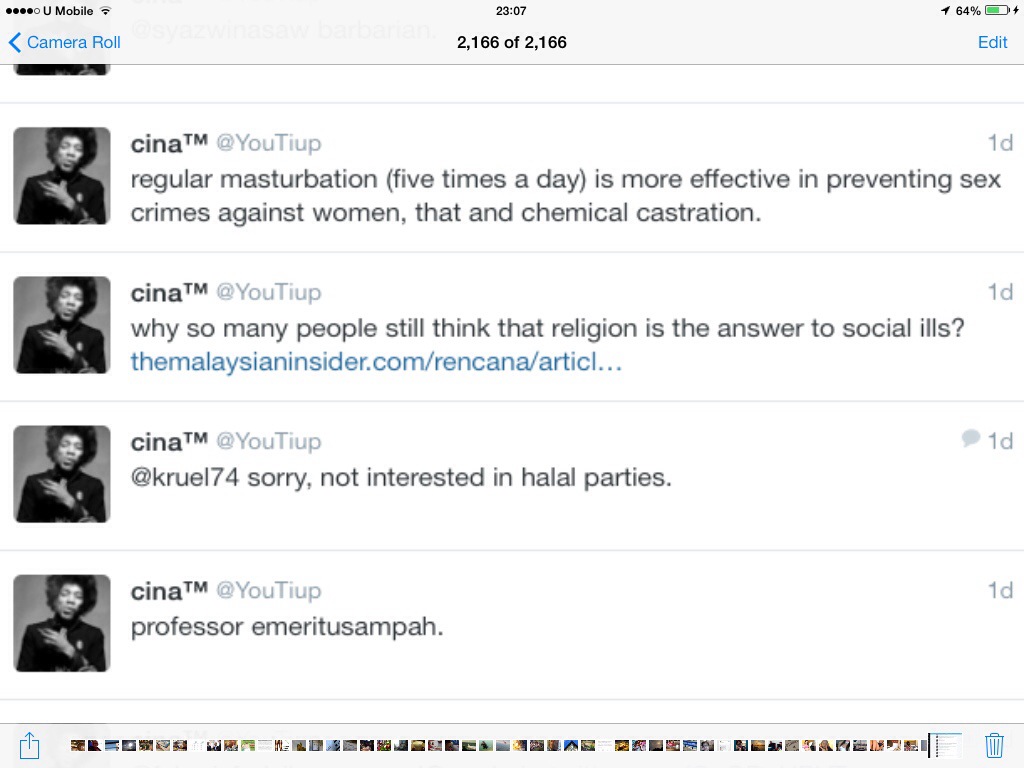
While Jebat Must Die refers to a posting by the said person, this whole fracas had started more than a year ago as the person identified by Jebat Must Die has on several occasions been taunting Malays and criticising Islam. The apex of the brawl happened yesterday (3rd December 2013) when the person tweeted the following (please read the image bottom up):
During the 13th May 1969 tragedy, a well-known Imam in Kampung Baru by the name of Dahlan made an amulet to protect his brother, Abdullah (a.k.a Abdullah Botak) who was a senior police officer, from harm as the racial clashes escalated. Abdullah declined and asked Dahlan to use it to protect himself saying:
Don’t be fooled by the Chinese. I have seen what they are capable of in Bekor!
Not many young Malaysian would know where Bekor is, let alone what had happened there. But Bekor was witness to what was to come 23 years later.
A subtle reminder of the atrocities that had taken place in Bekor
The incident in Kampung Bekor, near Manong in the district of Kuala Kangsar was not the first incident that had involved the killing of Malays by the Chinese, led by the Malayan People’s Anti Japanese Army. What is even sadder is the fact that some Malays were also involved in assisting the Chinese slaughter their own kind. To understand the mood of the day, we would need to go back in time to when migrant Chinese workers started flooding into the Malay states.
According to a paper jointly written by Mohamed Ali Hanifa and Mohammed Redzuan Othman of the History Department, Faculty of Arts and Social Sciences, the University of Malaya, the Chinese immigrants first came to the Malay states in 1777, and first settled in the state of Perak in 1830 (Patrick Sullivan, 1982: 13). Within 44 years, they numbered 26,000 in Perak alone. In 1921, the number of Chinese immigrants in the Malay states numbered 1,171,740. Ten years later, it was 1,704,452. In 1941, it became 2,377,990 while the Malays were at 2,277,352 (Paul H Kratoska, 1997:318). The explosion of numbers of Chinese immigrants brought about social ills. In 1901, the ratio of Chinese women to men were 1:100 in the Federated Malay States alone (Victor Purcell, 1948: 174) and this brought about the setting up of prostitution dens. According to the Straits Settlement Annual Development Record 1906, there were 543 prostitution dens in the Straits Settlement alone, employing 3,894 women (Siti Rodziah Nyan, 2009:200). The Malays remained a minority in their own land until 1970.
When the Japanese invaded Malaya, they portrayed themselves to the Malays as liberators, getting rid of the pseudo-colonialistic British, and began hunting for the Chinese whom were known to have sent money back to assist the Chinese in their war against the Japanese. As such, the Malays did not face as much hardship as the Chinese did during the Japanese occupation. Although the Malays and Chinese share the same hatred towards the Japanese, it was the Chinese that ran a boycotting campaign against the Japanese. This led to the execution of 70,000 Chinese in Singapore labelled by the Japanese as Communists (Colonial Office Records CO 537/3757: 27-28). As a result, many Chinese formed the Malayan People’s Anti Japanese Army (MPAJA), a subversive organisation that was administered by the Communist Party of Malaya (CPM) (War Office Records WO 172/9773, No 23: 384).
After the war, the Sino-Malay relations took a turn for the worse. The Chinese, known for their coarse and rude behaviour began upsetting the Malays. Kenelm O.L Burridge quoted the Malays as saying:
Before the war we and the Chinese lived in peace. But now they want to swallow the people (makan orang). We Muslims do not chase money. That is the Chinese way. They are not Muslims and they do not have the same understanding (faham). If they became Muslims it would be all right (Kenelm O.L Burridge, 1951:163)
Economic competition caused the Chinese to spread rumours about the Malays to put the latter in bad light (War Office Records WO 172/9773, No.30:479). In Batu Pahat, Johor, there was a community that did not respect the local culture (Kenelm O.L Burridge, 1951: 166) and brought about the culture of drinking alcoholic drinks and gambling, and were often found meddling in the affairs of the Malay customs (Seruan Ra’yat, 17 November 1945: 2).
Between the Japanese surrender in August 1945 and the formation of the British Military Administration on 12 September 1945, the MPAJA/CPM left the jungle and occupied police stations and towns and displayed its authority (WO 172/1784, No.51: 180). They took the opportunity to take revenge on the Malays. Throngs of Imams, religious teachers, Malays who had worked in Japanese offices, and commoners were captured and executed. Many Malay houses were burnt at night while their occupants were fast asleep (Mohamed Ali & Mohammed Redzuan, 2011:280).
The violation of the sanctity of Islam also became a factor in the bloody Sino-Malay conflict (WO 172/9773. No.30: 478) when the Bintang Tiga/CPM disrupted religious activities in Muslims places of worship. This started in Batu Pahat, Johor, just before the surrender of the Japanese occupiers, during the Muslim month of Ramadhan. Muslims were forbidden from congregating at mosques or suraus to perform the Terawih prayers (Hairi Abdullah, 1974/5: 8-9). The same occurred in Perak and some parts of Batu Pahat where Muslims were gunned down and burnt together with the mosque they were in during Friday prayers. Mosques and suraus were often used as places of meeting for the Chinese community (WO 172/9773, No.30: 478) and were tainted by incidents such as slaughtering of pigs, and mosques’ compound was used to cook pork, where Malays were forced to join the larger Chinese groups. Pages were torn from the Quran to be used by the Chinese using these mosques as toilet paper.
Facing the atrocities by the Chinese communists, and the betrayal by the British through the formation of the Malayan Union, the period between 1945-46 saw the Malays struggling for the survival of their race and religion.
According to Dr Cheah Boon Kheng, a historian at the School of Humanities, University Sains Malaysia, who is also the author of “Red Star over Malaya”, the Sino-Malay conflict in Johor began between march and August of 1945 (Cheah Boon Kheng, 1981:109). In May 1945, a Moain bi Saridin @ Shahidin, and a Hassan Akasah were brutally murdered by the Chinese communists. When found, they were just a mixed pile of bones without their head. They were murdered for not supporting the CPM. In another incident, a group of Chinese communists attacked the house of the penghulu of Kampung Sungai Tongkang near Batu Pahat, where 30 Malays sought refuge and shot them repeatedly before burning down the house. This conflict spread to the towns of Semerah and Sungai Balang.
When the Japanese announced their surrender on 15th August 1945, the CPM assisted by the Chinese in the MPAJA began to round up Malays suspected of working or assisting the Japanese. Many Malays had their hands and feet bounded and put into gunny sacks before they were thrown into the sea alive (Ibrahim Mahmood, 1981: 32). The Chinese community in Kampung Koh, Sitiawan, Ipoh, Kampar, Langkap and Chuchap assisted the Chinese community in Sungai Manik. Several small skirmishes ensued. In one incident, two of my granduncles were slaughtered by the Chinese near the Sungai Manik railway bridge, while their friend was put into a suitcase alive before he was thrown over into the Bidor river. In another incident, two Malay men returning to Sungai Manik were attacked by a group of Chinese who stabbed and slashed to death one of them while the other jumped into the Bidor river and hid for four days, moving only at night, before he reached safety.
In Bekor, near Manong in the Kuala Kangsar district, alarmed by the growing attacks by the Chinese, the villagers united and held a discussion with the Chinese in January 1946. Pressured by the Chinese who outnumbered them, the Malay representatives stated three demands to the Chinese:
Sa-orang guru Tauhid di-Manong di-dalam suatu mashuarat antara China dengan Melayu kerana hendak mendamaikan perkelahian di-situ telah mengeluarkan 3 tuntutan dengan chakap yang keras dan menghentam-hentam meja dengan tinju-nya sa-hingga China-China yang di-dalam mashuarat itu puchat muka-nya (Suara Ra’yat, 7 Januari 1946: 1)
The first demand was to return all the Malays captured by the Chinese and held in the jungles. If they were executed, the Malays demanded that their grave be shown. The second demand was for the return of their belongings confiscated by the MPAJA, while the final demand was for the Chinese to surrender all their weapons to the government.
Shamsiah Pakeh, a former Quran teacher, and member of the Communist Party of Malaya, approached the villagers of Kampung Bekor to persuade them to join the CPM. In a blog by Amam Fuadi, a descendant of one Haji Hassan bin Khatib Mat Sin who was present when the Chinese attacked Kampung Bekor, he described the story as told by the late Haji Hassan:
” Shamsiah Pakih pakai baju kebaya putih datang kerumah mengajak Tok masuk komunis Tok tak mahu. Pada masa itu siapa yang tidak mahu masuk kominis akan di bunuh. Orang Bekor banyak terlibat dan berdosa kerana bersubahat dengan kominis dan membunuh orang melayu yang tidak mahu masuk kominis. ” (Akhirnya mereka juga mati dibunuh komunis dalam perang Bekor- Penulis) ” …………….dibekor Ada telaga yang di panggil telaga lubang raya tempat memancong orang yang tak mahu masuk kominis.” ”Tok ngah juga hampir hendak dimasukkan kedalam lubang. Salah seorang penduduk Semat yang mati dalam lubang raya ialah yeob tali”
On 5th March 1946, the Chinese began their attacks on Kampung Bekor. At 10am, approximately 100 armed Chinese attacked the village, but this attack was repelled by the defending villagers (WO 172/9773, DT00 07:281). This attack was believed to be the CPM’s gauging the village’s defence.
On 6th March 1946 is what Abdullah Botak was talking about to his brother, Imam Dahlan, on 13th May 1969.
Between 5am to 5.30am, Kampung Bekor was again attacked by the Chinese, assisted by the CPM. All roads leading in and out of the village were guarded by members of the CPM while the Chinese, reinforced by 500 Chinese from Kelian, attacked the villagers. It was a well-planned and orchestrated attack (CO 537/1580: 21 and Majlis, 24 Februari 1947:5).
The attack lasted two hours. 57 men and women who were about to leave the Kampung Bekor mosque after Subuh prayer were murdered by the Chinese (WO 172/9773, No.19: 234-235). From this figure, only one had gunshot wounds while the rest had slash and stab wounds. 24 children were murdered while they were sleeping in their homes, while 15 men, seven women and eight children were missing. The defence of Kampung Bekor was quickly organised by Tuan Haji Abdul Rahman bin Abdul Manan, Tuan Haji Kulub Alang, Tuan Haji Salleh bin Abdul Manan and a few others who managed to kill several Chinese attackers. The Chinese moved in three waves: the front-most attacked, followed by a second wave whose duty was to retrieve bodies and injured Chinese attackers, then move behind the third attacking wave to carry out the dead and wounded. As a result, not one single body of the Chinese attackers could be found in the aftermath of the attack.
The above was what senior police officer Abdullah Botak had described to his brother, Imam Dahlan.
More Malays were attacked and killed by the Chinese in Kota Bharu (Kelantan) on 19th September 1945, in Alor Gajah (Melaka) on 26th September 1945, in Selangor, the districts of Selama, Taiping, Parit, and Sitiawan in Perak, and in Terengganu. In Batu Malim, Raub (Pahang), a skirmish at the local market on 11th February 1946 involving 200 Malays and 150 Chinese caused the death of 30 Chinese including 10 children, while 16 Chinese and 10 Malays were injured.
So heightened was the anger of the Malays towards the Chinese that when the British formed the Malayan Union and planned to grant Chinese and Indian immigrants with automatic citizenship, the Malays united for a common cause, and that is to return the power of the Sultans and reinstate the ownership of the land to the Malays. Left behind economically and lacking education, as well as being the minority in their own land, the Malays never saw any good in granting citizenship to the outsiders. To appease the Malays, the administration saw it fit for the Chinese to be sent back to China. Some 15,000 were sent back until Mao Zedong proclaimed the People’s Republic of China in October 1949. This led to closure of ports, and subsequently beaches, to prevent overseas Chinese from returning. Hence, the Chinese in Malaya had no choice but to learn to live with the Malays. The administration insisted that only those Chinese who would pledge loyalty to Malaya would be granted citizenship.
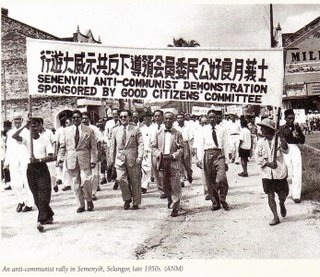
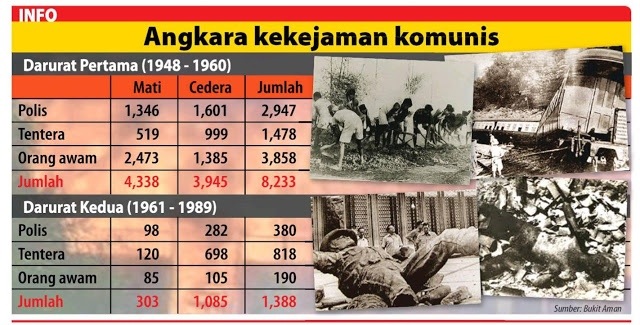
The Malays and Chinese lived peacefully side-by-side. But when China launched the Cultural Revolution, the Communist Party of Malaya issued a directive on 1st June 1968: Hold High the Great Red Banner of Armed Struggle and Valiantly March Forward. This brought about the Second Emergency and again, the Malays being minority, prepared to defend themselves and their religion. Almost every weekend strikes and rallies would be organised by opposition parties, supported by the Communist Party of Malaya, and this culminated in the 13th May 1969 tragedy.
The history of Malaysia, contrary to belief, has been filled with bloodshed. We, as a growing nation, have seen more than enough to last us a life time. And as time goes by, piece by piece our history is being forgotten. When we are a nation without a past, we will become a nation without soul. The above demonstrates how dangerous racial strife can be, and how easy it is to explode again if sensitivities and assimilation is not done or handled well. I strongly believe that both vernacular schools and Islamisation of the National schools do not benefit anyone in Malaysia, and will only contribute to greater rift between the races. Children who do not grow up together will never learn about or respect each other.
As for the Malays, we seem to feel comfortable hiding behind the fact that we make up 71% of the population of this country (including the Bumiputras of Sabah and Sarawak) but we fail to see that we are in fact split into various groups. I doubt if ever an event such as the above were to happen, that the Malays would unite, as we now have the Malay liberals, the so-called Islamists, and the pro-Malays. I won’t be surprised if only 20 percent of the Malays would be prepared to defend their race and religion again.The Malays, are once again, minorities in their own land. But this time, they are asleep as the villagers of Kampung Bekor were almost 68 years ago.
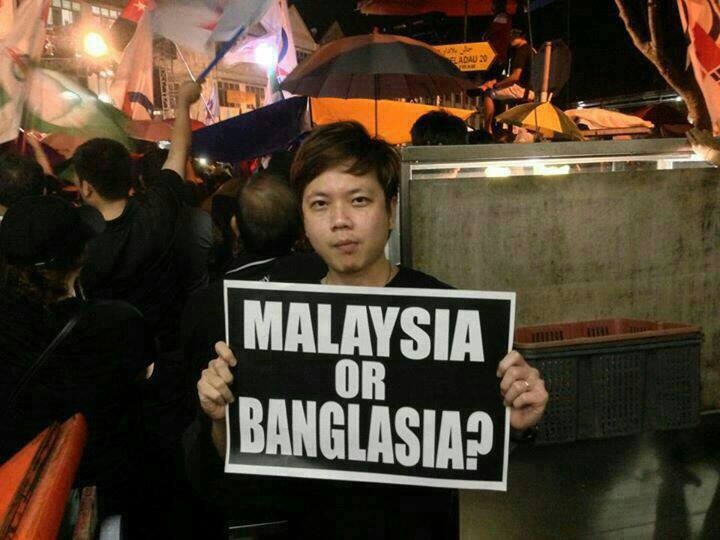
Isn’t it funny how anyone could deny one’s wrong-doings and try to dupe the rest with more lies? What is even funnier is that learned people keep on getting duped. Whoever can forget the lies told in the run up to the 13th General Election; lies about the 40,000 registered Bangladeshi voters that saw innocent Bangladeshi-looking Malaysians getting manhandled by paranoid supporters of Anwar Ibrahim? Then came the lies about the Blackout in a constituency which saw DAP as the winner there.
Yet many Malaysians are gullible enough to believe such lies and accept them without verification, and in turn bad mouth the country to outsiders. Road shows were made to garner support for the Black 505 movement or whatever that farce is called. Now, Anwar Ibrahim plays a chameleon denying ever saying anything about dubious voters.
Probably, he was referring to his press statement made three days before the general elections. Now, be the foreign voters Bangladeshis, Myanmarese or whatever-have-you, that ludicrous suggestion as well as the blackouts were debunked by DAP’ strategist, Ong Kian Ming, in concurring findings by PEMANTAU.
I am writing this because I find it funny. I find it funny because despite what i have posted here I am sure many idiots will still believe Bangladeshis actually voted and there were blackouts that occurred during ballot counting. What is even funnier is Anwar’s appeal to dismiss Shafee Abdullah as prosecutor in the sodomy appeal case was turned down by the. Federal Court.
It’s called Karma, Chameleon!
Thank you Firdaus Christopher for helping me with this piece.
I write this as a warning to my Muslim brothers and sisters. No matter how you conduct your life, you should never compromise your attestation to Allah being the True One God, and that Muhammad is His Messenger through whom His message was delivered to complete what started millenniums before.
The issue of the use of Allah in the Herald has been resolved…well, more or less. I still see on my timeline some people still tweet about it, or have it as part of their Facebook status. I see the occasional Christian politician from Sabah still trying to flog a dead horse by crying foul over the issue although the ruling does not affect Christians of Sabah and Sarawak; while many others who do not understand the history and reason behind the permit to use of Allah in Bibles and Christian literatures in Indonesia, Sabah and Sarawak but not in the peninsular should read my previous writings on this issue:
I also wrote about the word to describe God in Malay in The Case For God Part 2, and I wrote on the subtle ways to undermine the faith of Muslims in the peninsular. You may say that the issue of faith is petty, but if you have met, as I have, Muslims whom have proselytize, you would be shocked to see the numbers and where they are originally from, and with what background.
If I mention the name Joshua Massey I am sure many Malaysian Muslims do not know who he is. I don’t know who Massey is either but that is the pseudonym of a Christian missionary who has written many articles on how to minister Christianity to the Muslims. Among the articles he has written include Should Christians Use Allah In Bible Translation?
In this article, Massey concluded that it is necessary to use Allah in Bibles and not to discard such easily redeemable terms, but to fill them with Biblical meaning. The more a Muslim’s understanding of Allah is informed by the Scriptures, the more Biblical their theology of God will become. Filling familiar words with new meaning, rather than tossing them aside as irreparable, is something the church has wisely done from the beginning.
Of course, in a non-Arab speaking Muslim country, it would be a lot more difficult to penetrate the Muslim community to spread the gospel. Enter the C5: the so-called liberal Muslims who, amongst us, have been saying that it is a small matter for others to use Allah to refer to God. C5 is a category among a spectrum of Christians ranging from C1, referring to those missionaries who set up churches and conduct masses and prayers in the missionaries’ original language, to C6 – those who still retain their Muslim identity and never reveal their faith to Muslims. This spectrum was introduced by a missionary who writes under the pseudonym John Travis. Like Massey who lives amongst Muslims in Asia, Travis too has spent a large portion of his life living amongst the Muslims.
C5 Muslims do not call themselves Christians. They call themselves the Followers of Isa al-Masih, or Jesus the Messiah. They are the Messianic Muslims who reject any unbiblical Muslim practise, and dare to label Muslim practices barbaric, or against human rights, or restricting women’s rights. Anything and any platform they could use to attack the sanctity of Islam, they would. Do not get me wrong: C5 Christians still go to the mosque to pray, still attain their identity as Muslims, but they will back their Christian friends when attacked by other Muslims, not literal attacks though.
Massey knows that Muslims will not attack, as it is unIslamic to be the belligerent, but will defend to their death their land and faith. So you get the C5s to do the attacks for you, therefore the defenders will then be labelled racists, extremists and other labels already thrown by these liberals. In the words of Travis:
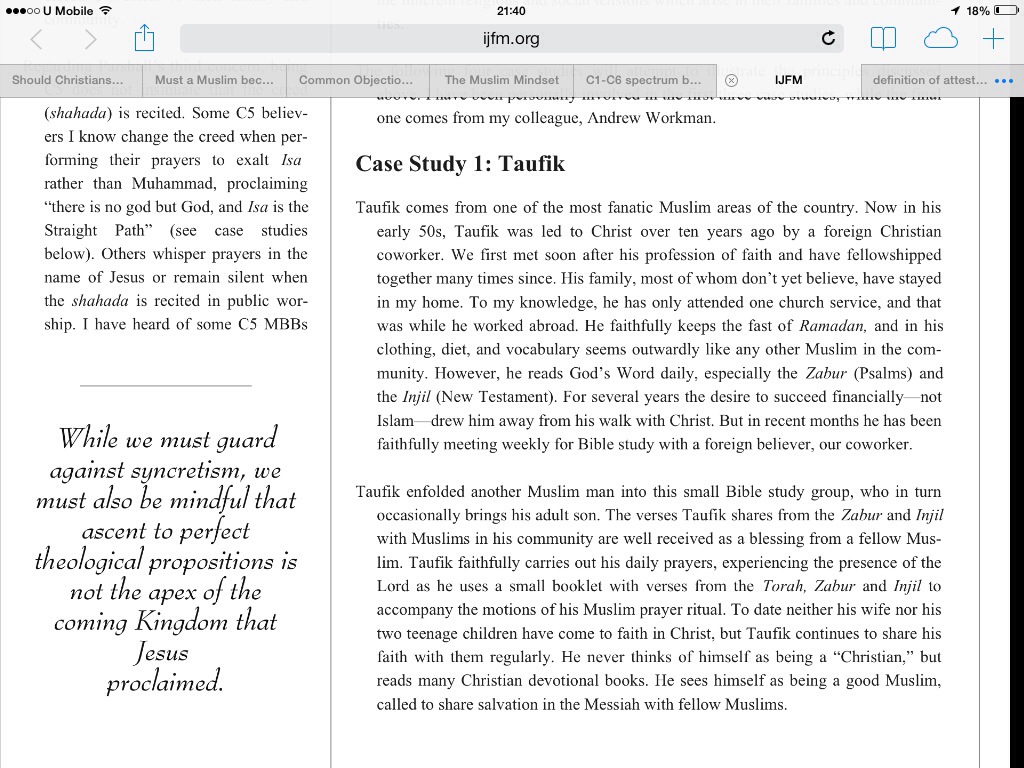
“Some C5 believers adopt Samuel Zwemer’s approach toward Muhammad by affirming all the truth Muhammad brought and never speaking disrespectfully of him. They emphasize that Muhammad was a great statesman and religious reformer, bringing Arabs from pagan polytheism to Abrahamic monotheism. They are quick to add that Muhammad spoke of Isa the Messiah (his virgin birth, miracles and sinless- ness) and acknowledged that the Torah, Zabur and Injil are God’s Word and must be obeyed. When it becomes clear that the Muslim listener is ready for more, they, like Zwemer, share Jesus as Lord and Savior. My observation is that over time, without dictating how new MBBs should view Muhammad, he becomes less and less important to them as they grow in their love and obedience to Jesus”.
The above is taken from John Travis’s article in the International Journal of Frontier Missiology, telling how a Muslim was befriended by a Christian friend, not to accept Christianity, but to also accept the other Books: a concept not unfamiliar in Islam. Working on this and the other concept mentioned in the Quran that Allah does not make any distinction between His Prophets, they work towards undermining the Shahadah.
Similar modus operandi have been seen here in Malaysia. In one case that involved a friend of mine putting a stop to it, a Muslim factory worker was befriended by a fellow male worker, a Christian. She got pregnant and was shunned by her family. With nowhere to go, her boyfriend brought her to see a priest who showered her with compassion. Her roommate managed to sniff the method and alerted an agency my friend was with, and rescued her. In fact, among the DUMC attendees whom I had met last year all spoke of similar subtle methods. Some had converted over a few pair of jeans, some money, rice, so on and so forth. For me, I blame the Malay/Muslim society for failing to help the needy, or for driving away family members who are in need. I remember one Pusat Pungutan Zakat officer who argued intensely with me, insisted that there were no poor people in Petaling Jaya, until I showed him a squatter village.
But that is the fact of the matter – we Muslims in Malaysia are not caring enough. And Muslims are oblivious to threats, not just from the outside, but from the inside as well. Muslims always think that they are strong, and at the same time allow every attempt to chip away at the foundations of Islam in this country, namely the Federal Constitution, and the institution of the Malay Rulers as custodians and protectors of the religion of Islam and the Malay customs. Every attempt to defend these institutions are being portrayed as acts of racism and oppression of the minority, when in essence it is the 60.4 percent Muslim population is the minority. They are split into three: two one thirds that have nothing better to do but claw at each other, while the other third collude with the evangelists to attack the other two thirds.
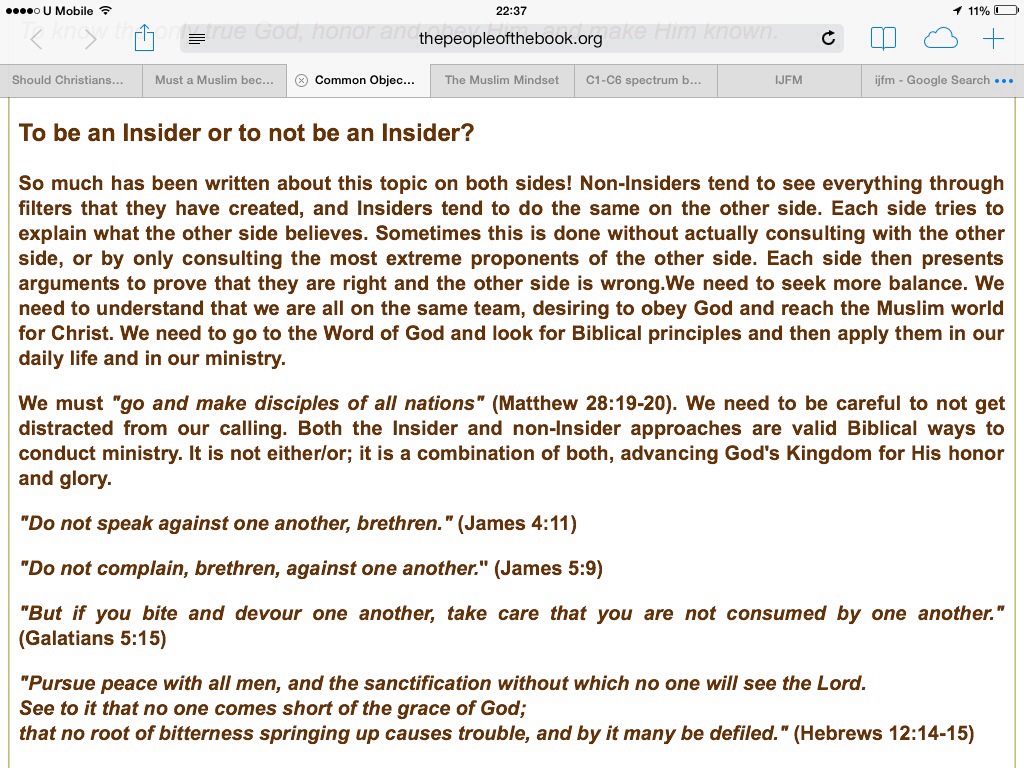
I leave you with an extract from a missiology website about the one third that is helping to destroy us, and urge all you Muslims to pause for a moment and think:
Addendum: 5th Nov 2013
For all those who remember my previous posting on the Allah issue (The Case For God – Part 3, I wrote on Christian publications in Malay in the 19th Century, and how similar publications have made their way into modern-day peninsular Malaysia. One must be wary of religious books bearing Arabic terms that may be representing Christianity but with an Islamic image. I was also informed that in some mosques in this country, as mentioned in Massey’s and Travis’s articles, Arab Christians or Christian Malays have begun preaching to youngsters. Dressed as pious Muslims, they confuse the youngsters using the modus operandi mentioned above.
And I will also be meeting with a Christian friend, who has told me how some of his family members and friends have been actively proselytising needy Muslims in the south of the peninsular. Hopefully this time, I will get to learn more of their modus operandi.
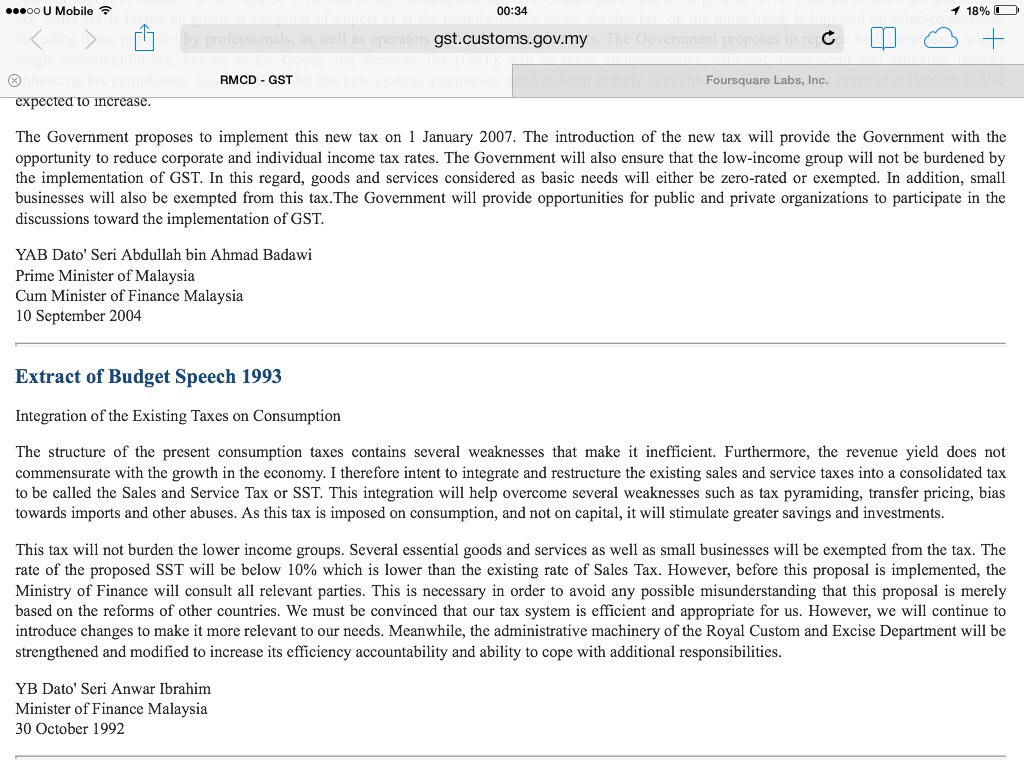
A certain Finance Minister had said the following regarding the SST/GST back in 1993, which reminds me a lot of the current GST to be implemented in 2015:
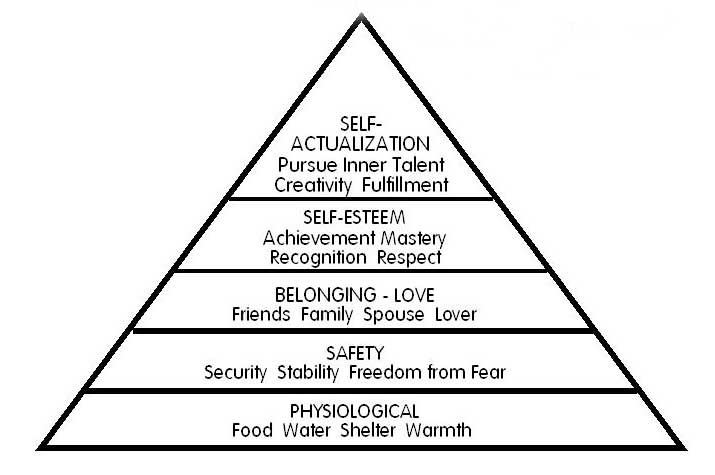
I deal with the Maslow’s Hierarchy of Needs a lot in my job, as behaviour affects one’s decision and motivation to do or achieve something, and especially with regards to safety. Let us have a look at it for a moment:
It shows that a normal human being is more motivated to satisfy his most basic needs first. Therefore, what you want would be at the top of your subconscious list while the good of the common would come on the fifth rung.
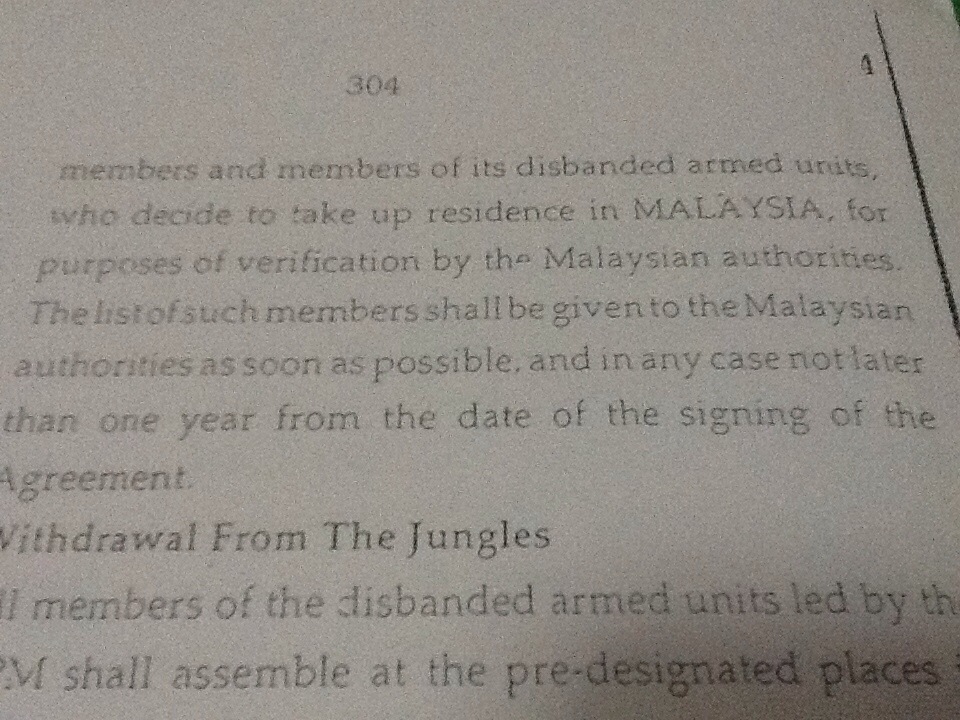
So when Chin Peng had had the opportunity to return to his place of birth, one would imagine that that would have been the apex of his personal needs. In the agreement signed between the Government of Malaysia and the Communist Party of Malaya on 2nd December, 1989, it mentioned that the CPM would have to give a list of those wanting to return to Malaysia, to the Government, within a year of the signing of the agreement.
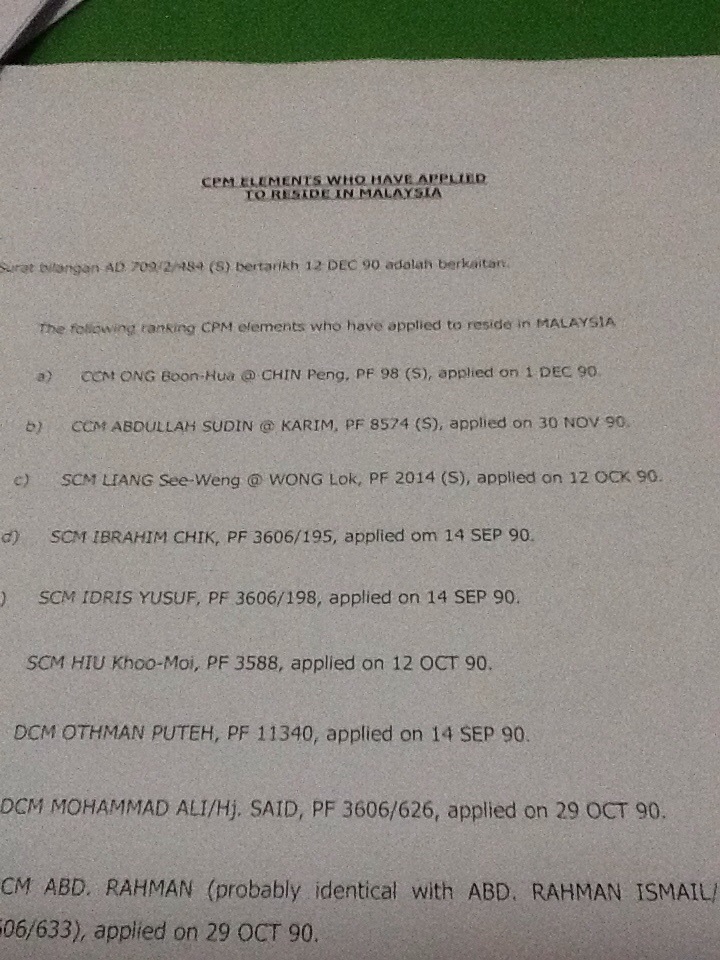
With only 1,188 remaining members, I would give three months for the CPM members to decide, and a further three to produce the list. Those who would have really missed their families, I am sure, would have applied almost immediately. Let us now look at the list of CPM office-bearers who applied to return, and when the application was made. Bear in mind, the cut-off date was 1st December, 1990.
Was Chin Peng desperate to return to Sitiawan? I let you be the judge. But of the 1,188, 431 applied to be allowed to return to Malaysia. Only 338 were allowed home while 93 were denied for reasons that include them not being citizens and/or did not fulfil the conditions of the peace agreement. Those who returned were each given RM8,000 in subsidies and RM300 as subsistence allowance to help them through the normalisation process. You must also remember that among the 1,188 remaining members of the CPM, only 694 were Malaysian, Indonesian and Singaporean nationals, while two were former members of the Imperial Japanese Army who were here since the Second World War. The remaining 492 were Thai nationals.
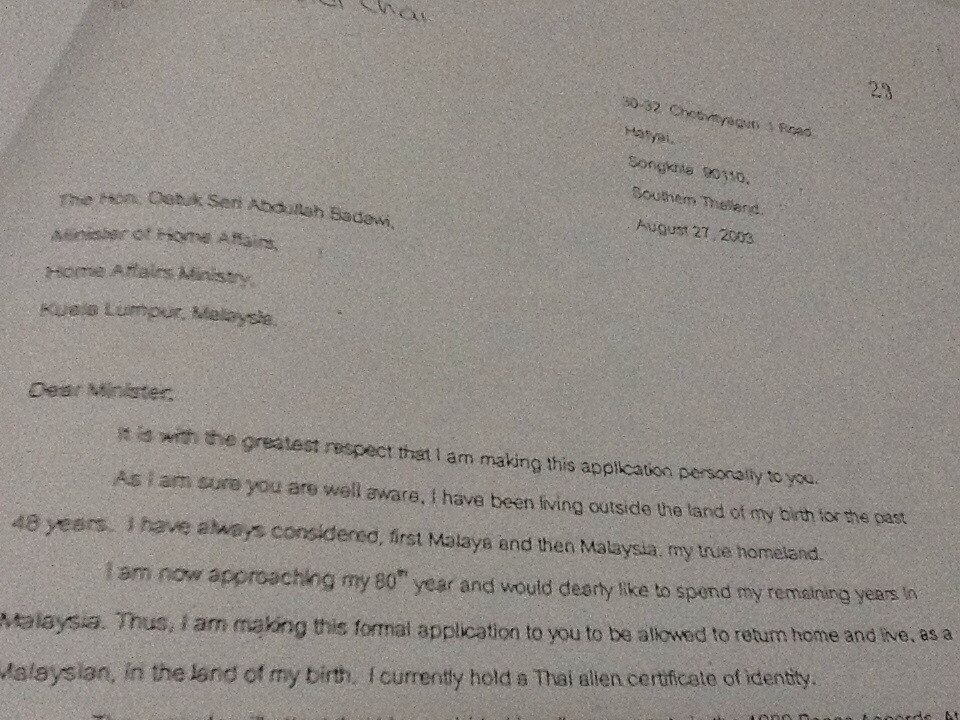
Where do you think Chin Peng would have fitted in? He was born in Sitiawan to China-born parents in what was the Malayan state of Perak; took up arms and rebelled against the government in June 1948, while the Identity Card was only issued to registered citizens in 1949. The answer lies in his letter to the Prime Minister cum Home Affairs Minister on 27th August 2003:
Chin Peng was an alien with a Thai identity card. A bit like the yet-to-be-seen-anywhere 40,000 Banglas with MyKad during the 13th General Elections. Only that Chin Peng was a real person.
Therefore, for those wanting to return then they must fulfil the requirements of the peace agreement i.e. supply of personal particulars for verification as to identity and status (Malaysian citizen, of Malaysian origin – born post Merdeka, or post signing of the formation of Malaysia in 1963, or spouse, or child of either, or if you are an alien), then each applicant must have stayed in a designated place in Southern Thailand for at least six months prior to the application. Chin Peng must have failed at least one of the agreed-upon requirements, like the other 92 applicants. It was not as simple as “you apply in time, you get the automatic right to return.” If I am wrong, then we should give automatic citizenship to the children of homeless Bajaus in Sabah. Why complain?
Even with Chin Peng being over in Thailand, there were many fans of his, including characters such as Nga Kor Ming, Teresa Kok, Ronnie Liu et al already clamouring for his return, hero-worship him, and praise the Communist Party of Malaya, an organisation banned under Section 5 of the Societies Act, 1966. However, some self-proclaimed patriots from Malaysia continue to uphold and worship the atrocities committed by the CPM, in violation of Sections 47 and 50 of the Societies Act, 1966. This is evident in the recent arrest of two persons at an airport for being in possession of materials banned under Section 50 of the above mentioned Act, having returned from attending Chin Peng’s funeral in. Bangkok.
Coincidentally, the Germans have similar laws banning anything that could remind them of their Nazi past. Section 86 of the
Strafgesetzbuch prescribes the ban on logos, materials, propaganda, books, data storage of such material, dissemination or the possession of said materials whether domestic or abroad, are liable to imprisonment and fines. And this was made because the Nazis committed atrocities on ONE group of people in Germany for five years. Chin Peng and his men slaughtered Malayans/Malaysians for 41 years. Not just Malays, but also Chinese, Indians and other Malayans/Malaysians as well!
Some even tried to justify that atrocities were committed by both sides during the Emergency. Can they answer who slaughtered the British planters first? Another even said it was a civil war. Was it one? Civil wars are fought by and between citizens of the same nation. This was fought by 694 Malaysians, Indonesians and Singaporeans, 492 Thais, and two soldiers from the Imperial Japanese Army with the aim of setting up a satellite communist state by removing the Malay Rulers and their British advisers, and rule the masses using communist ideology. That, my dear idiot, is called an insurgency.
If Chin Peng’s ashes should be allowed back on the basis that he was born in Sitiawan albeit being non-citizen, for being a “nationalist” (doubtful), go tell the Jews and Germany a statue of German-citizen Hitler, who definitely was a nationalist, should be allowed to be built near the Brandenburg Gate or the Reichstag.
I blame the skewed understanding of history among Malaysians, as well as attempts to rewrite history, on the Malaysian education system. The best way to get the nation together is to say that Malaya was colonised. The only times Malaya was wholly colonised was between 1942 and 1945, then again in 1946 until 1948. The Portuguese colonised Malacca, so did the Dutch. The rest of the Malay Peninsula were divided into various sovereign states.
Let me give you a brief history lesson on the MALAY peninsula:
The British came here for want of economic materials, and as a result of the various treaties with the respective states’ Sultan and Raja, the various states in Malaya became protectorates, administered by British Residents who were employed by the various Sultans and Rajas. Save for the Strait Settlements, the rest of the Malay Peninsula were never British colonies. Initially, the states of Perak, Selangor, Pahang and Negeri Sembilan all had their own Resident, but decided to have a common Resident as mentioned in Clause 4 of the Treaty of the Federation, 1895:
The above named Rulers agree to accept a British officer, to be styled the Resident General as the agent and representative of the British government under the government of the Straits Settlement. They undertake to provide him with a suitable accommodation with such salary as determined by Her Majesty’s government and to follow his advice in all matters of administration other than those touching the Mohammadan religion. The appointment of the Resident General will not affect the obligations of the Rulers towards the British Resident now existing or hereafter to be appointed to offices in the above mentioned protected states.
In return for the access to economic gains, Britain promised the states protection against threats. The protectorate over the Malay states does not amount to colonisation and sovereignty but prevents occupation or conquest of the protectorate by other nations (as evident during the Japanese invasion of Malaya). This differs from a colony in that the protectorates do not form an integral part of the territories of Great Britain.
As mentioned, the Malay states were made up of nine sovereign states, headed by the Sultan/Raja, and advised by a British adviser, with Negeri Sembilan, Selangor, Pahang and Perak forming the Federated Malay States, while the rest were termed as the Unfederated Malay States with individual treaties with the British. Malacca, Penang and Singapore became part of the colonies as part of the Straits Settlement. Three legal cases became the test for the independent-nature of the sovereign states, namely the Mighell vs Sultan of Johore (1894), Duff Development Co. Ltd vs Kerajaan Negeri Kelantan & Anor (1924), and the Pahang Consolidated Co. Ltd vs State of Pahang (1931-32).
Therefore, on 31st August, 1957, the independence we gained was from feudalism, and not colonialism as we were brought up to believe in. On that day, the Sultans and Rajas were removed of their British advisers who administered their state on their behalf, and were now advised by the Prime Minister and the Cabinet (Chief Minister and Executive Councillors on state level). The constitution of rulership was continued but modified to include parliamentary democracy.
Since the independence we gained on 31st August, 1957 was from feudalism (the governing of the nation by a government elected by the people as opposed to British-appointed advisers), when did the nationalist movement for this independence actually began? It was upon the formation of the Malayan Union of 1946, an idea conceived during the Second World War and first presented to the British War Cabinet in May 1944 which required the Malay rulers to concede ALL powers to the British Crown, another indicator of the independent nature of the Malay states before the Japanese occupation. That started the ball rolling for the independence we now have.
Characters such as Burhanuddin Helmi, Ibrahim Yaacob, Hassan Manan, Mokhtaruddin Lasso, Ahmad Boestamam, Shamsiah Fakeh all fought for an independent Malaya under Javanese rule under the banner of Melayu Raya. You can read more on this in my posting The Road to Merdeka: Persekutuan Tanah China dated 6th September 2013. There you can read more about the characters mentioned, and also how that movement is linked to Chin Peng’s attempt to turn Peninsular Malaysia/Malaya into a communist state aligned with China.
The question whether Chin Peng was a contributor to the independence does not arise at all; he only assumed command of the Communist Party of Malaya when his predecessor, Loi Tak a.k.a Loi Tek a.k.a Lai Teck absconded with the movement’s funds in 1947. Why would the staunchly anti-communist British regard the Communist Party of Malaya as brothers-in-arms fighting the Japanese? Loi Tak, the Secretary-General of the CPM was a spy for the French colonial authorities in Vietnam to penetrate the Vietnamese freedom fighters and communists. You can read more in British Intrigue & The CPM: Some Characters.
And the remark made by Mariam Mokhtar that without the CPM, the Japanese in Malaya would not have been defeated is a feeble and shallow attempt to rewrite history. On 13th August 1945, Sukarno and Drs Hatta met up with Burhanuddin Helmi and Ibrahim Yaakob in Taiping to discuss the independence of Malaya under Javanese rule. In attendance was Major General Hirokichi Umezu of the Imperial Japanese Army. Ibrahim Yaakob was a Lieutenant Colonel in the Japanese Volunteer Army (Giyuugun). That effectively says that from that date, until the formal surrender of the Japanese military on 2nd September 1945, the Imperial Japanese Army remained undefeated.
Chin Peng fought against a collectively independent Malaya in 1948, a Malaya that was not colonised. Therefore, what was he fighting for? Was he planning to drive out the British advisers and become advisers in turn to the Malay rulers? According to Prof Dr Cheah Boon Kheng, the ratio of Chinese to Malays in communist-front organisations was 15:1, and as high as 50:1 in the CPM itself (The Star, Red Star Over Malaya, Sunda, 29th November, 2009). Do we honestly think they had the support of the whole population of Malaya? Whose interests would have been protected or preserved had they gotten their way then? Therefore the label “Chinese communists” as mentioned by Mariam Mokhtar is an apt description.
Mariam Mokhtar should also get her facts right (Chin Peng Has The Last Laugh, Malaysiakini, 23rd September 2013). Because of the ratio above, the Emergency was in essence a battle between the Malays who were trying to preserve their identity and religion, and the non-Malays who were against the CPM, against the Chinese-majority CPM that was bent on setting up a satellite communists state here. Mariam mentioned that atrocities were not just committed by Chin. Peng, but by both sides because “Malaya was on a war footing”. Since when was Malaya on a war footing? Who committed the first atrocity in 1948? Why was he fighting against an independent Malaya? And why did he not stop after the Tunku had announced our independence in 1956?
Chin Peng betrayed the people of Malaya. At the Baling talks, he promised the Tunku that the CPM would lay down their arms immediately if the British agreed to transfer power over internal security and defence into the hands of the Tunku’s Umno-MCA-MIC Alliance Government. Did he do it? No. He continued to kill Malayans/Malaysians for a further 34 years after the talks.
Chin Peng may be gone. And on every 16th September, Malaysia Day would be more meaningful – the day the man who butchered 10,000 of the people he had wanted to liberate, finally kicked the bucket on foreign soil.
Good riddance to bad rubbish!
In the final instalment, I will cover non-Malaysian Chin Peng’s request to be allowed to visit Sitiawan.
The greatest news I received on Malaysia Day was of Chin Peng’s death. I was some 250 nautical miles from Kuantan and had been sailing for more than a week without receiving any form of news from home, so imagine my feeling of jubilation.
Yes, it has almost been 24 years since the signing of the peace treaty in Hatyai between the Government of the Federation of Malaysia and the Communist Party of Malaya. I will cover more on the treaty in the second part. Many do not understand that the treaty was about the ending of hostilities between the two parties, but not about the CPM having to give their ideology up. So, when The Sunday Star decided to ask 19-year olds if the thought the communist is still a threat my mind instinctively asked, “what is the purpose of asking those who were still swimming inside testicles when the treaty was signed?” It just hinted malicious intent. Of late, the popular mainstream daily and ASTRO’s Awani sound like some leftist publications.
Many in KL would not remember the bombings, and shootings of police officers that occurred in KL itself. The last I heard of a gun-battle between the police and the CPM was in May 1983 on the old trunk road between Gombak and Janda Baik, near Mimaland. One policeman died, the other wounded but managed to kill both Min Yuens.
I read with disgust both on the mainstream media as well as on the online social media how sympathisers asked the government to allow for Chin Peng’s ashes be brought back to Sitiawan. After all, “the man is more a threat alive than when he is dead” quoted a member of a BN component party. If that was supposed to have moved me, then it had failed miserably.
Equally disgusting was the comparisons made between the bodies of the Sulu terrorists, bomb-making terrorists Azahari and Nordin Mat top, with Chin Peng. Nobody ever claimed the bodies of the Sulu terrorists, Azahari and Nordin Mat Top were Malaysian citizens and never did they wage war against their people – unlike Chin Peng whom I believe was never a citizen of the Federation of Malaysia, nor was he a citizen of the Federation of Malaya, as described in Part 1.1 (a) of the Second Schedule of the Federal Constitution of Malaysia. I doubt Malaysian-born Kamahl calls Malaysia home!
Worst is when PAS members also went to Bangkok to attend the wake of the man so determined to eradicate the Malays and their religion. I suppose in the name of politics and power, God comes second. After all, God is intangible, unlike Chin Peng.
And the statement made by a former Inspector-General of Police on the matter saying that the world would laugh at us if we do not allow Chin Peng’s ashes to be brought back for final rites is an insult to us servicemen (police and military), especially to those who continue to suffer as a result of the loss of limbs, or loss of a father, husband, or son. Perhaps this is why an ex-IGP was made an Ambassador while this ex-IGP continue to find recognition for the things he had done; but all he was famous for was punching Anwar Ibrahim while in custody!
Hitler killed Jews for only five years. Chin Peng waged war against the people he was supposed to liberate for 41 years. Why did not Chin Peng stop as soon as the Tunku had announced Malaya’s independence in Melaka in 1956? Why did he continue to wage war against this nation and her people? The British government servants were all serving the Sultans and Rajas and were answerable to the latter, with the exception of Penang, Melaka and Singapore that were colonies of the British Empire. So Chin Peng was not interested in fighting against colonialism, the Japanese also did that in Malaya!
Chin Peng was more interested in assuming this nation under communism, as a satellite nation to the People’s Republic of China. And thousands died fighting this man who was adamant to destroy their religion and way of life.
To those who continue to ask for Chin Peng’s ashes to be allowed a final trip to Malaysia, and ask others to move on, forgive and forget, do ask the Jews to forgive Hitler for the five years of atrocities committed against them. Then we should be able to move on eight times the amount of time taken for the Jews to forgive Hitler.
Chin Peng never showed any compassion, nor did he ever exhibit remorse. He was a psychopath worshipped by idiots who deserves not even a single whiff of sympathy.
Therefore, he should just stay out forever and not tarnish the soil of this beloved nation.
As Malaysia approaches its 50th year, I cannot help but think that while being in its infancy this nation is ageing far too fast and is fast being tired of itself. The cohesiveness of its people in the run up to the events on the 31st August, 1957 and 16th September, 1963 is fast coming undone. Many a times have I written on how far more cohesive we were immediately after the 13th May, 1969 tragedy than we are now, despite claims of how far more mature we are in the political sense. That may be true, but we behave like immature kids behaving like we are politically mature.
Elements once found destructive, such as Communism, is now being looked up to. A few days ago, left-leaning students were audience in a forum that had a former member of the all-but-defunct Communist Party of Indonesia, and students were seen wearing t-shirts glorifying Tan Malaka, a Marxist who once lived in Indonesia. To add insult to injury, Karpal Singh has also been reported as supporting the move to allow former leader of the Communist Party of Malaya, Chin Peng, to return to Malaysia. Of course, humanitarians would argue that there is nothing wrong with allowing an octogenarian back to the land he was born in, and liberals would think the same. I hope these same people would also condemn Israel for still hunting former Nazis and tell the people of Cambodia they should forgive the Khmer Rouge.
For whatever reasons too did the police not act previously on criminal elements. The removal of the ISA and the Emergency Ordinance rendered the police virtually helpless in its fight against crime, let alone be able to maintain peace and order and breathe at the same time. Kudos to the good teamwork of the present Inspector-General of Police and the new Minister of Home Affairs. We have not seen this kind of teamwork since the days of Tun Dr Ismail – Tun Salleh, and Tun Ghazali Shafie – Tun Haniff days.
I have read comments from politicians from both sides of the political fence who are against giving the police emergency powers and say that the police should learn from their British counterparts on how to police the law without having firearms. Britain, for those who did not study geography, is an island, unlike Malaysia that has land borders with neighbours. A simple ferry or train ride from the European continent requires passengers and luggages to be scanned. My former college mate who is now a Chief Inspector in the Thames Valley Police lamented how he sometimes wish he was given a gun, especially in the wake of the two incidents where two women constables were gunned down by armed criminals. Imagine our police fighting crime with porous borders.
The introduction of the proposed Criminal Prevention Act should hopefully allow the police to conduct interdiction strikes on hardcore crime gangs. This Act will allow the police to hold criminal elements for up to 70 days pending trial. I have not seen the draft in full but I am sure it will uphold the rights of those who want peace.
Was there political interference in the police’s operations before the new Minister and Inspector-General came into office? I would leave that to the former Inspector-Generals to answer. But I know a gangster was awarded one of the highest Federal titles. How his name had made it through police vetting definitely puzzles me.
I know for sure there are politicians from both sides of the political fence whom have been seen with criminal elements, and photographs of these politicians meeting with criminals exist. These are prominent politicians and I know the police has full knowledge of this. Whether their presence with the criminals is for political or for personal reasons, only they and the police can answer this.
Former IGP Tun Haniff Omar once remarked that the BERSIH rally had communist elements involved. I would not be at all surprised if there are members of the CPM whom have made it into political parties, as they did before 13th May, 1969. Today, we have former police Director of CID Tan Sri Zaman Khan saying that an ex-convict who was a triad chief is also holding a lower office in a political party in Penang (NST, Nation page 25, 5th September 2013).
I particularly like Ben Tan’s article “Youth gangs today lack ‘basic values’.” (NST, Comments page 18, 5th September 2013). Ben, NST’s Johor bureau chief wrote:
GANGSTER’S LIFE: The members just crave money and power.
Ironically, the same can be said of the young politicians mentioned above, and of most politicians too. I certainly hope the Home Minister will give all the support the police needs in making this nation a safer place to live in.
At 50, Malaysia is already more divisive than it should be. Political fanatics are to be blamed. With the underworld and subversive elements making a breakthrough, it will not be long before our children begin to face the mistakes we have all made. Criminals, subversive elements, politicians with links to the underworld should never be allowed to represent the people of Malaysia, and I urge the Malaysian people to reject them and reject those who protect them. If we don’t, we won’t see Malaysia living past 100.







 SeaDemon Says
You must be logged in to post a comment.