Online “news” portal Free Malaysia Today (FMT) today published a story on the level of preparedness of the Royal Malaysian Air Force (RMAF) if faced with a situation such as Marawi, and got an expert opinion to strengthen its story.
While FMT was talking about clearly refers to the recent statement made by the Chief of RMAF, General Tan Sri Dato’ Sri Haji Affendi bin Buang RMAF, stating that the RMAF will be including urban warfare in its doctrine. This was a reply to a question by a journalist during the recently-concluded Exercise PARADISE 4/2017 in Kota Belud, Sabah.
FMT sought the expert opinion of a Dr Zachary Abuza, a political scientist at the National War College in Washington DC, who focuses on security and political issues in the region.
Dr Abuza instantly criticised the RMAF for not being prepared for urban warfare.
“RMAF’s training is based on preparing to face traditional threats. It’s birth was when fighting the MCP (Malayan Communist Party) in the jungles. It has never had to adjust its training.
“To me, this is understandable but reckless,” he said to FMT.
Abuza felt urban warfare preparedness and capability were still important.
“It’s not that the RMAF has to worry about an invasion, but what if a detachment of RMAF peacekeepers finds itself unexpectedly bogged down during an urban assault?” he was quoted by FMT to have asked.
It is clear to sharp readers that Dr Abuza referred to the RMAF as Royal Malaysian Armed Forces instead of the Air Force. Why would the RMAF have a detachment of peacekeepers anyway?
Therefore, it is forgivable that Dr Abuza had made such a criticism towards the RMAF as the Malaysian Army, which had numerous peacekeeping experiences under its belt. Although the RMAF and the Royal Malaysian Navy participate in peacekeeping missions, the main combat duties is shouldered by the Army.
And FMT being FMT, went to town and published the piece, hammering the Royal Malaysian AIR FORCE for not being ready for urban warfare.
The RMAF’s role in urban warfare is merely a support one, with the Army playing the main role on the ground. All the RMAF needs to do is to insert its Ground Laser Targeting Designator team into the combat zone and paint targets that are to be bombed by its fighters.
Other roles include dropping bombs or perform rocket strikes on targets marked by elements of the Malaysian Army, including interdiction strikes to cut off enemy supply and reinforcement lines, provision of air mobility in support of the Army Air Wing, or perform combat search-and-rescue of downed airmen.
The RMAF and the Malaysian Army have held countless joint exercises to enhance interoperability and coordination and it will take very little tweaking for the two organisations to operate in the urban environment.
Did FMT clarify its story before publishing? I doubt. Else we won’t see the faux pas today.
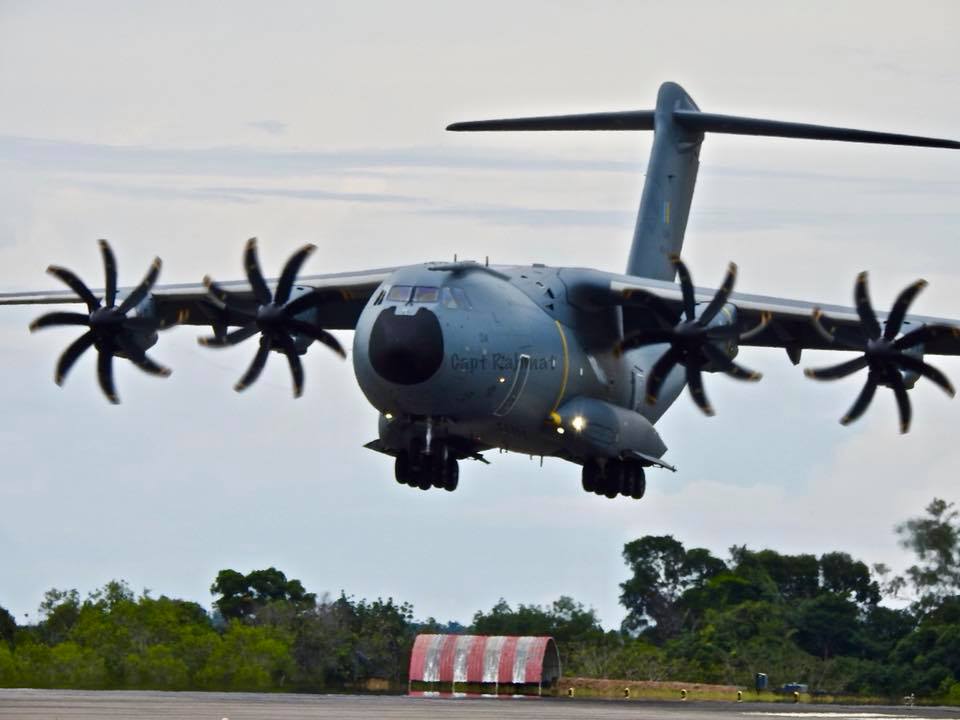
RMAF Airbus A400M (M54-04) on finals at the Labuan airbase during exercise PARADISE 2017
The A400M: How Has It Fared?
When the Royal Malaysian Air Force purchased the Airbus Defence and Space A400M Atlas, many thought it was to replace the Lockheed C-130H-30 that had entered service in 1976. 15 C-130Hs were delivered to the RMAF with 14 still flying.
However, the RMAF announced further upgrades to its C-130H fleet to keep them operational. The A400M’s role, although similar to that of the C-130H, enhances the RMAF’s airlift capability. Not only can the A400M carry 17 tonnes more payload compared to the C-130H, it can fly 200 knots faster and land on rough or soft landing strips like the C-130H.
Its glass cockpit/side-stick coupled with three-axis fly-by-wire (FBW) with flight envelope protection configuration makes the A400M user-friendly and is based on the A380 but modified to suit military operations requirements. The flight envelope protection allows the A400M to perform bank angles up to 120 degrees!
The cockpit of the RMAF A400M (M54-04) is large and is very comfortable
Not only could the A400M support the Malaysian Armed Forces’s tactical and strategic capabilities, it could also be utilised for Humanitarian Assistance and Disaster Relief (HADR) operations in the region. To date, the RMAF’s A400Ms have performed two HADR roles: delivering 17 tonnes of aid to embattled Marawi in July 2017 and 12 tonnes of aid to the Rohingya refugees in south Bangladesh in September 2017.
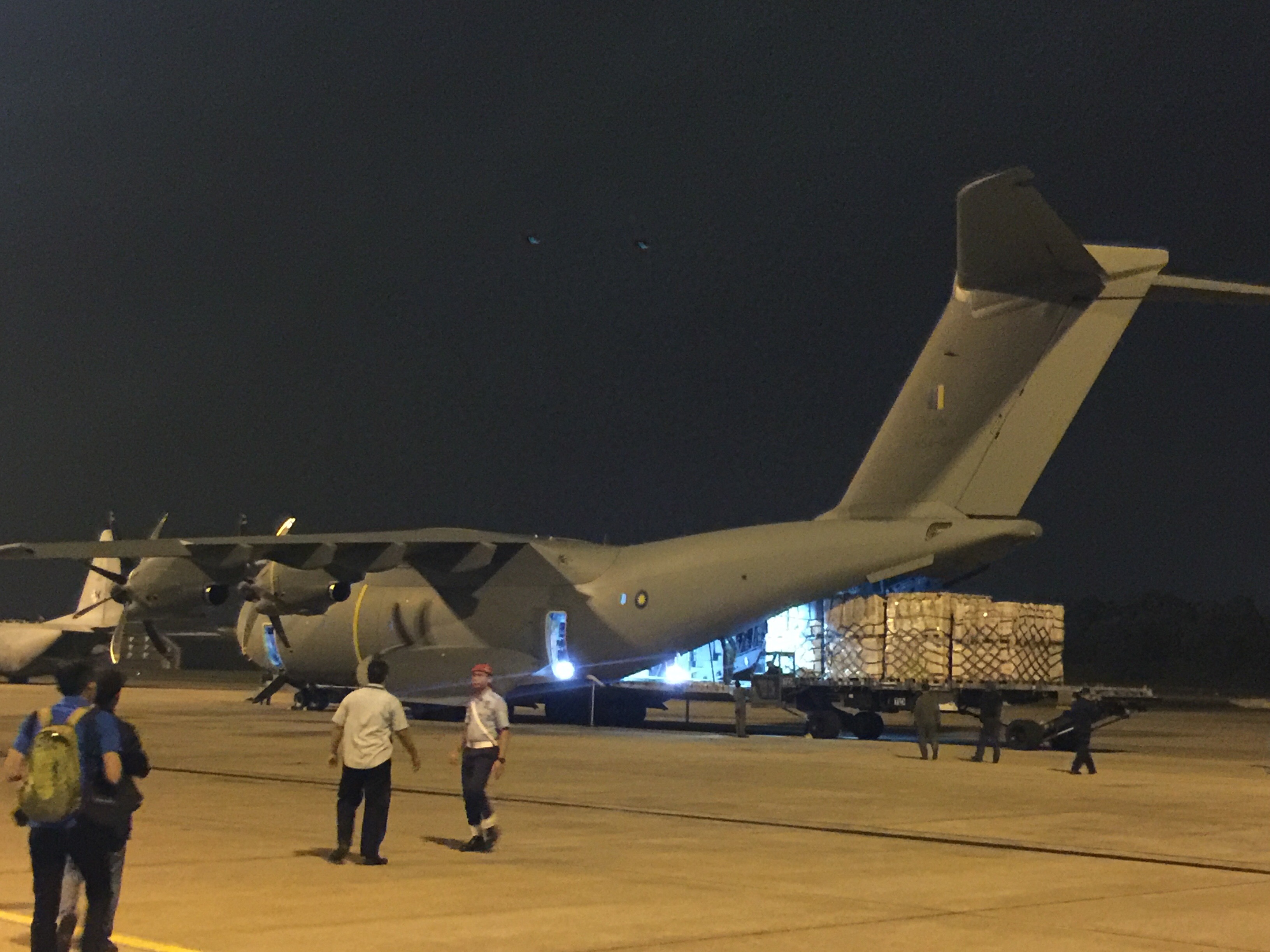
RMAF A400M (M54-04) is being loaded with HADR cargo bound for Marawi
The remarkable thing especially about the Marawi mission was the A400M’s ability to fly to Cagayan del Oro and back without refuelling (an approximately 5,400 kilometers return trip); this, together with its speed cuts down total turnaround time.
The A400M is equipped with the defensive aid sub-system and an in-flight refueling capability. The inflight-refueling package allows the A400M to refuel helicopters at 105 knots indicated airspeed (KIAS) and fighters at up to 300 knots, hence safer for the refuelling of both helicopters and fighters. Flight tests have also revealed that at Alpha Max (with the Alpha Floor protection disabled, the A400M reached 98 KIAS before the FBW low-speed protection function eased the nose down. There was no wing roll-off or loss of control. Recovery was almost immediate when the nose was lowered and thrust added, underscoring the fact that the A400M is indeed a very safe and capable aircraft.
Maritime Patrol Aircraft – Budgeted For
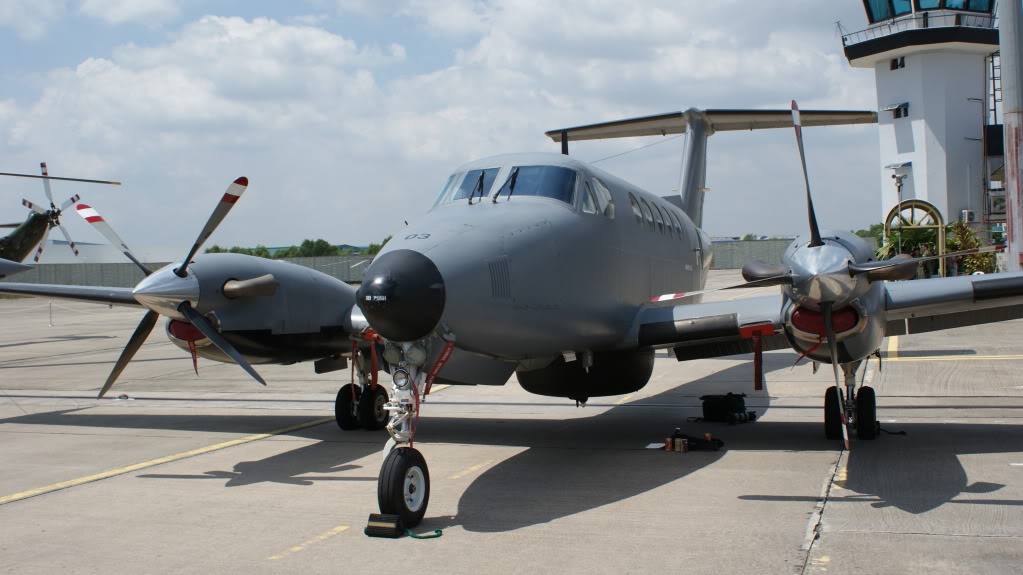
The Beechcraft Super King Air 200T MPA has been in service with RMAF for 23 years
For almost two decades the role of maritime patrol was assigned to several C-130Hs that were converted to C-130MPs. Four Beechcraft Super King Air B200T aircraft were inducted into the RMAF maritime patrol fleet to complement the C-130MPs. However, the high operational costs versus mission requirements of the C-130MPs saw the latter taking over the role completely.
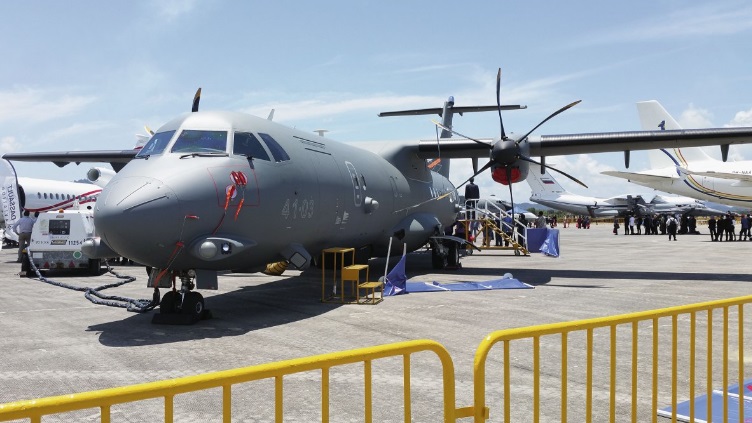
Even before the loss of an airframe, there were already talks of replacing the B200Ts. Leonardo brought its ATR-72MP aircraft to LIMA ’17. Apart from the hardpoints and MPA modules on board, the ATR-72MP is just a normal commercially-available aircraft, powerplants and all. Leonardo’s concept is to provide a platform using what is available in large numbers in the market to keep the costs down.
The Leonardo ATR-72MP, seen here at LIMA 17, also comes with an electronic surveillance and C4I platform. The airframe is that of the ATR-72-600 (photo courtesy of Janes Defence)
Airbus Defence and Space flew a CN295 almost around the world to promote it as a multirole platform. The CN295, albeit a SAR version that was on its way to its new home in Brazil, made a stop in Malaysia and was presented to operators such as the RMAF, the MMEA, as well as the Royal Malaysian Police Air Wing.
Stretched three metres longer than the CN235 that the RMAF is currently operating, everything about the CN295 is very similar to the CN235, which makes crew conversion fairly easy to make. It comes with a more powerful plant that features better efficiency, longer loiter capability at station and comes with six external hardpoints for ASW weapons.
When the announcement of the budget for the procurement of four MPAs in 2018 was made, the immediate follow-through was that four of the RMAF’s remaining seven CN235s will be fitted with the MP systems from the B200Ts, a sure sign that either additional CN235s will be acquired for the MPA role, or the CN295s would be acquired instead.
The commonality between the C295 and the CN235 also potentially leads to even lower operating costs, given the versatile cabin configuration that allows fast switching of mission types, high manouvrability, better low-level flying capabilities given the high-wing configuration and a wide rear ramp, the C295 makes the best option for maritime patrol and surveillance as well as anti-submarine warfare missions in Malaysia.
The C295 is powered by twin PW127G turboprop engines driving Hamilton Sundstrand Type 568F-5 six bladed propellers which provide outstanding hot and high performance, low fuel consumption, and an endurance exceeding 11 hours. Flying at a maximum speed of 480 km/h which is slower than the B200T’s 540 km/h, but has a range of 5,600 kilometers compared to the B200T’s 3,100 kilometer range.
The RMAF’s need for a reliable platform that would be able to perform largely anti-shipping missions and has a reasonable but economical loiter endurance with some strike capability if required makes the CN295 a better choice of MPA. It also makes strategic and economical sense for Malaysia as it allows operators to narrow down its aircraft types and suppliers, making logistical and technical support easier.
The Airbus C-295 of the Força Aérea Brasiliera arrived at the Subang airbase on Friday 7 July 2017
UAV, MRCA and LIFT
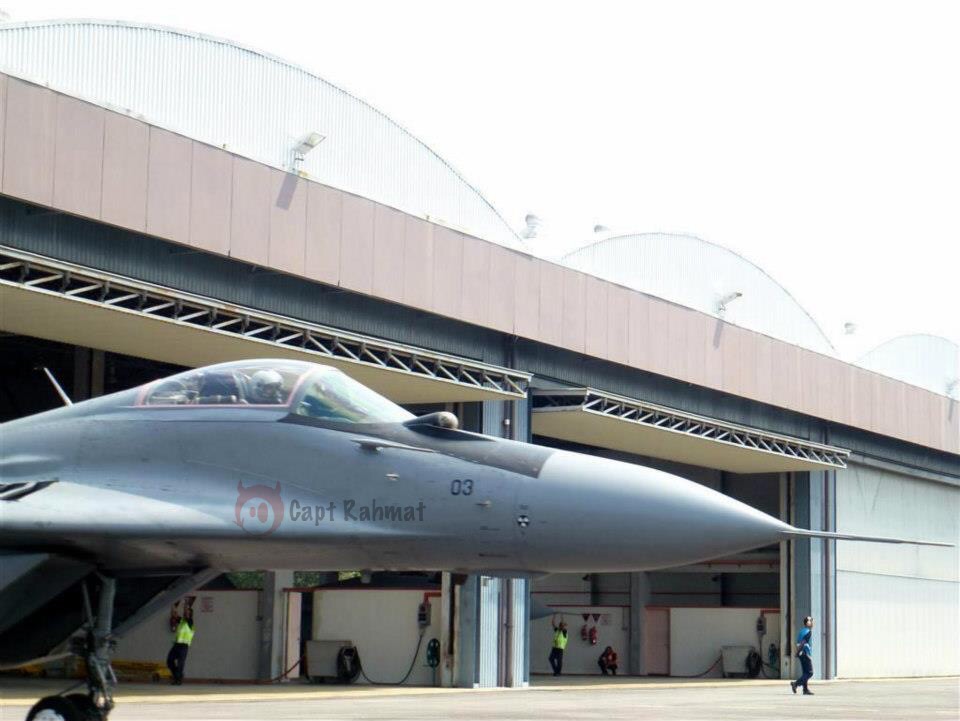
Although the procurement of the badly needed MRCA to replace the MiG-29Ns have not been announced, the RMAF is making up for the void by ensuring high serviceability rate of its frontliners. Observers would note that the serviceability percentage has increased tremendously despite the cut in the defence budget.
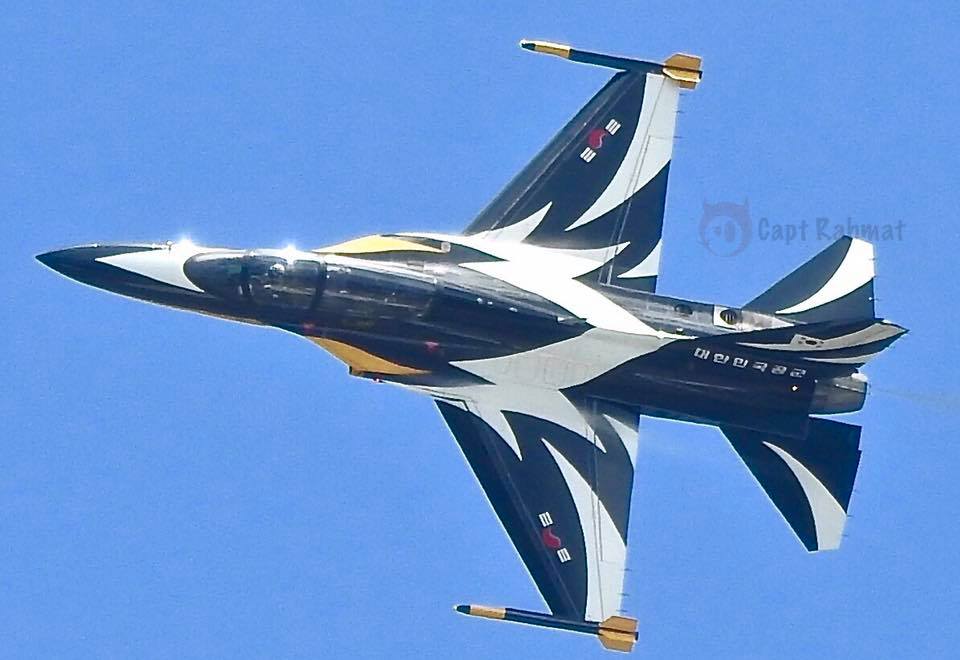
Perhaps the RMAF should think of an interim fighter or Lead-In Fighter Trainer (LIFT) that gives the bang for bucks. The Korea Aerospace Industries’s TA-50 LIFT comes into mind. Each unit of the more advanced FA-50 costs half or three times less than a top-of-the-line fighter would but it carries enough sting to hurt the enemy.
RoKAF Black Eagle’s KAI T-50B zooms above Langkawi during LIMA 17
Losing only but not much in terms of range to the BAe Systems Mk 108/208 that the RMAF currently deploys in Labuan to cover both the eastern South China and Sulu seas, the TA-50’s ability to reach supersonic speeds (Mach 1.5 compared to the Hawk’s Mach 0.84) and excellent thrust-to-weight ratio (0.96 to the Hawk’s 0.65) means that the TA-50 would make a better aircraft placed on Alert 5 to intercept straying foreign aircraft. Its superb ability to deliver air-to-ground as well as anti-shipping ordnances makes it a suitable platform to support anti-incursion/counter-insurgency operations in the ESSCOM area.
The RMAF is also interested to develop its Unmanned Aerial Vehicle capability in both tactical and strategic aspects. RMAF Chief General Tan Sri Dato Seri Affandi bin Buang TUDM said that the RMAF is conducting a detailed study to identify the UAV capable of meeting the current needs of the country apart from being equipped with technologies which could be shared with various parties in the country.
The Chief of RMAF (second from left) speaking to reporters during Exercise PARADISE 4/2017 at the Kota Belud Air Range
“Besides security surveillance, UAV can also be used for other purposes such as weather information and others,” he said. “If the RMAF is able to acquire sophisticated UAVs we would be able to enhance our operations in the Peninsular, Sabah, Sarawak and also in support of the MPAs patrolling the South China Sea as well as the Sulu Sea.”
Hopefully the RMAF would acquire UAVs with extended on-station endurance with some hardpoints for strike capability.
Epilogue
Although the RMAF is still in want of frontline airframes, it is seen to improve its serviceability percentage, a task that seemed daunting in times of global econmic uncertainty, but certainly achievable. The plan to purchase capable Maritime Patrol Aircraft as per the 2018 Budget, and planned addition of sophisticated UAVs, will certainly enhance its control over the airspace.
It is hoped that the government could look into equipping the RMAF with interim strike capability, especially in the South China and Sulu seas, by adding a squadron or two of the KAI TA-50, if not a squadron each of the TA-50 and its frontline version, the FA-50, hopefully by 2020, before preparing its budget for the procurement of actual frontline MRCAs that are badly needed, not only as replacements of the recently-retired MiG-29N, but also as a contingency to replace the F/A-18D which is already in its 20th year of service with the RMAF.
The RMAF may seem to walk slowly, but it is definitely walking with big strides.
Pada hari Selasa bersamaan 12 Februari 2013, sekumpulan 100 orang bersenjata yang diketuai oleh Haji Musa, orang kanan Mohammad Ismail A Kiram, anak keempat kepada Muhammad Fuad A Kiram, seorang yang mengangkat dirinya sendiri sebagai Sultan Sulu, telah mendarat di Kampung Tanduo, Tanjung Labian, di daerah Lahad Datu, Sabah.
Menurut laporan asal, mereka berkumpul di sebuah rumah milik Ahmad Malandi, yang juga dikenali sebagai ‘Mat Bom‘ bukan hanya kerana beliau sering menggunakan bom buatan sendiri untuk menangkap ikan, tetapi juga kerana pernah menyerang sebuah pejabat FELDA di FELDA Sahabat dalam tahun 1990an dengan menggunakan bom ikan gara-gara tidak berpuas hati dengan pertikaian tanah pusaka dengan FELDA.
Saya pernah menulis bagaimana kumpulan pertama yang terdiri dari lima orang yang memakai jubah diiringi 27 orang memakai separa-celoreng telah medarat terlebih dahulu, diikuti sekitar 70 orang kemudiannya. Kesemua mereka bersenjatakan M-14 dan AR-15.
Pasukan keselamatan membuat tembakan di sebalik perlindungan semasa Op Daulat
Pasukan keselamatan telah mula bertindak dengan Polis DiRaja Malaysia menggerakkan dua kompeni dari Pasukan Gerakan Am, dan disokong oleh pegawai dan anggota Tentera Darat Malaysia dari 5 Briged Infantri. Rundingan dijalankan pihak PDRM untuk memujuk mereka meletakkan senjata dan menyerah diri kepada pihak polis. Malangnya, pada 1 Mac 2013 para pengganas Sulu ini bertindak bertempur dengan pasukan Komando 69 PDRM di Kampung Tanduo, diikuti dengan serang hendap terhadap pegawai dan anggota Cawangan Khas PDRM di Kampung Simunul di Semporna keesokan harinya. Pada 5 Mac 2013, peringkat ofensif oleh Angkatan Tentera Malaysia dan PDRM telah dilancarkan untuk menghapuskan para pengganas tersebut.
Salah seorang pengganas Sulu yang mampus ditembak oleh pasukan keselamatan Malaysia
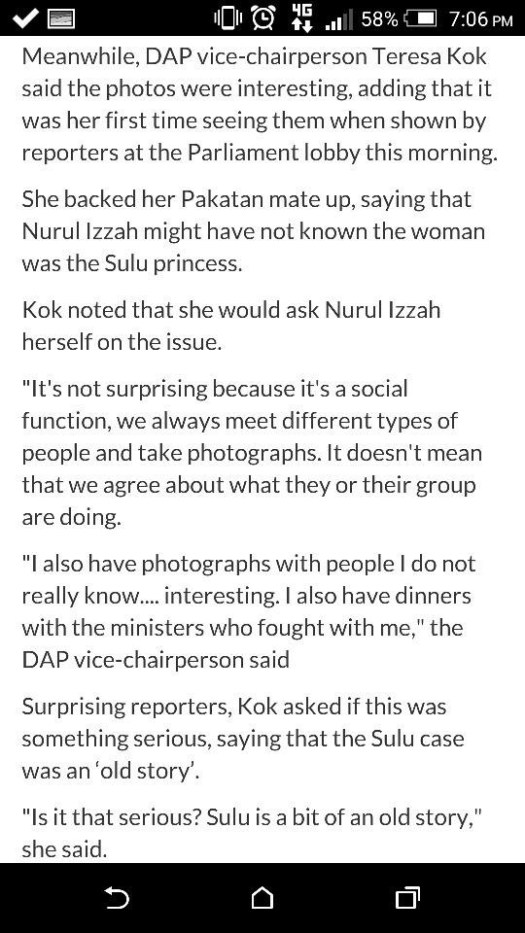
“Kisah di Kampung Tanduo adalah kisah lama,” kata Ahli Parlimen DAP, Teresa Kok
Sungguh malang nasib balu dan ibubapa 10 orang para pegawai dan anggota PDRM dan ATM yang terkorban di Lahad Datu mempertahankan kedaulatan negara. Pengorbanan anak mereka, suami mereka, bapa kepada anak-anak mereka, diperlekehkan oleh mereka yang tidak berhati perut, hanya kerana kepentingan politik sempit mereka.
Salah seorang perajurit negara yang terkorban di Lahad Datu
Baru-baru ini dilangsungkan perbarisan penganugerahan “Battle Honour Daulat Februari 2013” di Kota Kinabalu. Selain untuk menganugerahkan unit-unit ATM yang terlibat dalam Op Daulat dengan “Battle Honour,” ianya juga adalah untuk memberitahu kepada rakyat Malaysia, terutamanya di Sabah, bahawa kerajaan tidak memandang ringan tugas mempertahankan kedaulatan negara, dan juga memperingatkan semua bahaya pencerobohan yang dilakukan sama ada untuk peperangan konvensional mahupun peperangan asimetri.
Perbarisan penganugerahan “Battle Honour Daulat Februari 2013” di Padang Merdeka, Kota Kinabalu pada 11 Ogos 2017
Lewat ini kita sering dapati sesetengah pihak yang tidak bertanggung jawab menyerang integriti serta moral pasukan keselamatan dengan menghina dan merendah-rendahkan kebolehan serta aset yang dimiliki pasukan keselamatan. Mungkin mereka merasakan bahawa di dalam mana-mana peperangan, mereka tidak akan merasa sebarang kesusahan.
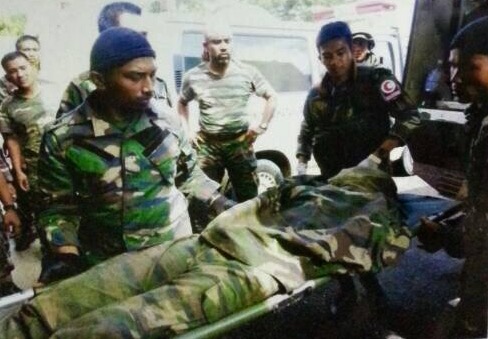
Kita ketahui terdapat anggota ATM dan PDRM yang tercedera dalam pertempuran semasa Op Daulat dilangsungkan tetapi tidak ramai yang mengetahui mahupun dapat menilai pengorbanan yang dilakukan oleh pasukan keselamatan kita untuk mempertahankan kedaulatan. Ini bukannya cerita ‘Combat‘ mahupun ‘Rambo‘ di mana heronya akan mendapat luka-luka kecil tatkala bertempur, tetapi ada yang tidak sempurna anggota dan fungsi tubuh badan setelah terkena tembakan.
Berikut adalah di antara paparan yang mungkin tidak pernah dilihat oleh rakyat Malaysia sebelum ini, tetapi saya rasakan amat perlu ditunjuk supaya kita faham erti pengorbanan pasukan keselamatan kita.
Seorang anggota keselamatan Malaysia yang tercedera ditembak diberi rawatan oleh petugas Kor Kesihatan DiRajaSeorang anggota pasukan keselamatan kita yang ditembak di dada diberi rawatan oleh petugas Kor Kesihatan DiRaja setelah peluru tersebut menembusi tubuh beliau
Sekiranya anda merasakan hanya para anggota keselamatan kita yang merasa pahit maung pertempuran, anda tersilap. Realitinya amat berbeza sekali.
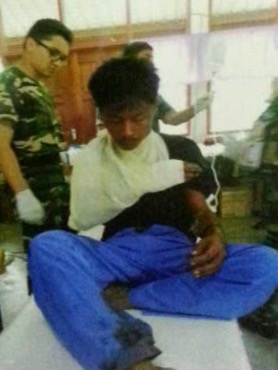
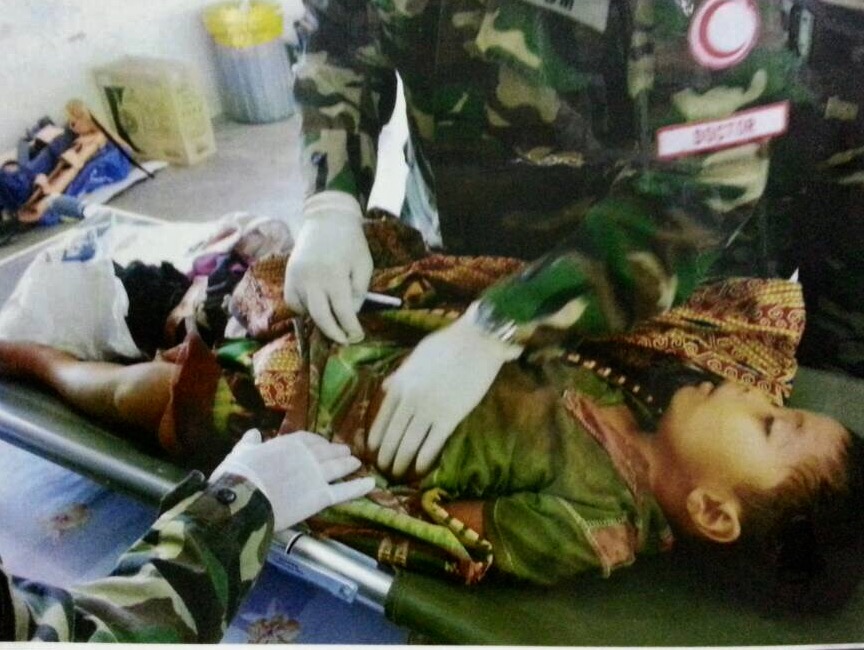
Apabila hospital medan didirikan oleh Kor Kesihatan DiRaja di kawasan operasi, orang awam yang terdiri dari para penduduk di situ yang telah tercedera ditembak secara rambang oleh pengganas Sulu berduyun-duyun datang untuk mendapatkan rawatan kecemasan. Di antara mereka termasuk kanak-kanak dan bayi yang menjadi mangsa keganasan pengganas Sulu. Mereka langsung tidak berperi kemanusiaan terhadap para penduduk timur Sabah sedangkan mereka kata Sabah adalah hak mereka.
Seorang mangsa tembakan rambang pengganas Sulu mendapatkan rawatan setelah Kor Kesihatan DiRaja membuka hospital medanSeorang kanak-kanak juga menjadi mangsa kekejaman peluru pengganas SuluBayi yang tidak berdosa ini juga tidak terlepas dari keganasan para pengikut Kiram. Bayi ini telah kehilangan banyak darah semasa dibawa ke hospital medan ATM. Status bayi ini tidak diketahui sama ada selamat ataupun tidak
Rentetan daripada insiden di Lahad Datu inilah kerajaan mewujudkan ESSCOM untuk memantapkan kawalan keselamatan di timur Sabah. Menteri Pertahanan Dato’ Seri Hishammuddin Tun Hussein berkata inisiatif terbaharu kerajaan ialah dengan menempatkan 7,000 anggota Tentera Darat dengan perlaksanaan Op Daratan, Op Balasah, Op Khas dan Op Pasir bagi mempertahankan daratan Sabah. Satu kompeni infantri Tentera Darat juga telah ditempatkan di kawasan Cenderawasih, Lahad Datu untuk memastikan kawasan pantai Lahad Datu terkawal sepenuhnya.
Tambah beliau lagi, inisiatif Trilateral Maritime Patrol (TMP) telah dilancarkan oleh Malaysia bagi memastikan mana-mana anggota militan termasuk Da’esh tidak menjadikan Laut Sulu sebagai laluan tikus untuk menceroboh masuk ke negara ini manakala inisiatif Trilateral Air Patrol (TAP) akan dilaksanakan dalam masa terdekat.
Jangan kita lupa siapa musuh kita. Jangan kita bersekongkol dengan mereka yang bersahabat dengan musuh yang tidak senang dengan kemerdekaan dan kesenangan yang kita kecapi. Jangan kita termakan hasutan politik kebencian (politics of hate) yang diamalkan oleh sesetengah pihak yang sanggup berbaik-baik dengan musuh untuk mendapat pengiktirafan mereka.
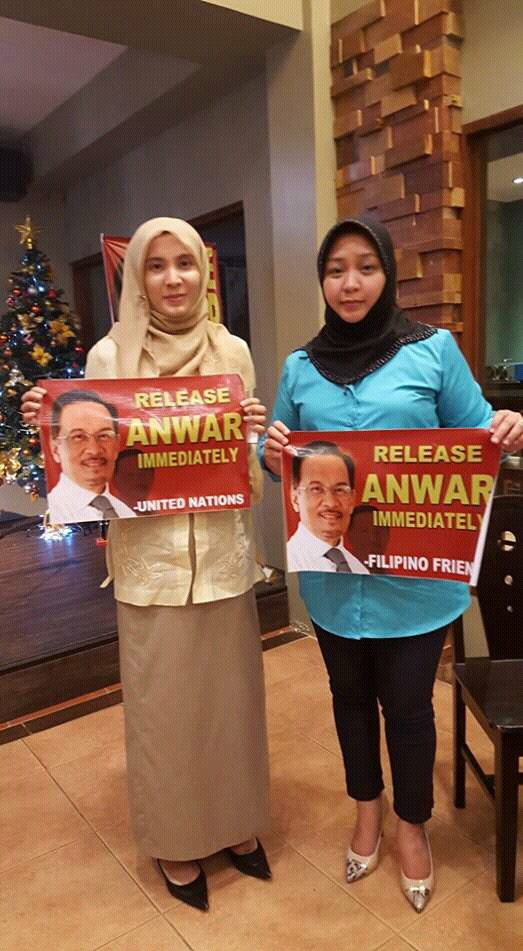
Musuh dalam selimut: Nurul Izzah bersama dengan Jacel Kiram, anak “Sultan” Kiram yang sehingga kini menganggap Sabah sebahagian dari “kerajaan” Sulu
Jangan kita lupa pengorbanan pasukan keselamatan kita. Jangan jadikan pemergian mereka, dan juga pemergian para penduduk yang menjadi mangsa kekejaman pengganas Sulu sebagai pemergian yang sia-sia. Berikanlah sokongan tidak berbelah bahagi kepada pasukan keselamatan kita, terutamanya Angkatan Tentera Malaysia, kerana musuh tidak membeza-bezakan di antara tentera dan rakyat Malaysia.
Kita semua adalah musuh mereka.
Berilah sokongan tidak berbelah bahagi kepada Angkatan Tentera Malaysia
Bising FELDA akhirnya tertangkap ambil komisyen juak hotel felda ialah Zahid Md Arip Pemimpin Pusat Parti Bunga Raya…kini mula terdedah pula kes kapal selam rupanya Mahathir dan anaknya di belakang sebenarnya SCORPENE : Perjanjian Pembelian Dibuat Sejak Zaman Mahathir Lagi
Razak Baginda tidak ada sewaktu perjanjian kapal selam diadakan, yang ada adalah Mahathir.
Ini kerana perjanjian kapal selam itu sebenarnya sudah dirangka dan dimeterai ketika zaman pentadbiran Mahathir Mohamad dulu sebagai Perdana Menteri dan bukannya pada zaman Perdana Menteri sekarang, Datuk Seri Najib Tun Razak.
Perkara itu direkodkan dalam hansard sidang Dewan Rakyat pada tahun 2002 lagi. Timbalan Menteri Pertahanan telah memaklumkan Dewan Rakyat mengenai kontraknya apabila perkara itu dibangkitkan di parlimen.
Mahathir yang kini adalah Pengerusi PPBM jangan buat-buat lupa berkenaan perjanjian membeli kapal selam itu.
Masa itu, Timbalan Menteri berkenaan telah menyatakan dalam dewan yang mulia di Parlimen jumlah yang dibayar kepada syarikat Malaysia bukannya komisen tapi kos perkhidmatan, penyelenggaraan dan latihan.
Kedua-dua mereka Perdana Menteri, Mahathir, dan Timbalan Perdana Menteri pada masa itu Tun Abdullah Ahmad Badawi sebenarnya tahu apa yang berlaku.
Bahkan sebelum itu Mahathir sudah meninjau kapal selam dari Perancis ketika Pameran Maritim dan Udara Antarabangsa Langkawi (LIMA’97) 1997. Tiga kapal selam dari tiga negara iaitu Rusia, Perancis dan Turki turut menyertainya untuk ditinjau oleh kerajaan pada masa itu.
Kemudian selepas meninjau kapal selam Perancis di LIMA 97, setahun selepas itu Mahathir menulis surat pada Michel Rocard, Perdana Menteri Perancis berkaitan hal kapal selam.
Dalam buku bertajuk “Surat Terpilih Dr Mahathir Kepada Pemimpin Dunia”, mukasurat 218, menyatakan pada tahun 1998, Perdana Menteri, Perancis dan Mahathir bertukar-tukar empat pucuk surat.
Dalam kandungan surat itu menyatakan bahawa Malaysian Airlines (MAS) akan mendapat lebih hak mendarat di Paris, dan Malaysia akan mendapatkan dua kapal selam buatan Perancis iaitu jenis Scorpene yang akan dihantar pada 2009.
“Seramai 145 orang pegawai Tentera Laut Diraja Malaysia (TLDM) sedang dilatih di Ecole Formation de Sous Marine di Brest, sejak 2005.
“Dua kapal selam itu akan diletakkan di pangkalan di Sepanggar di Sabah apabila ia sudah beroperasi nanti,” kata surat itu.
Ini bukti jelas, rundingan untuk pembelian kapal selam ini dibuat sejak zaman Mahathir lagi. Dua hari lepas, Mahathir kata dia tidak tahu menahu tentang pembelian kapal selam. Mahathir memang sengaja buat buat lupa dan tidak mahu mengaku.
Pembohongan Mahathir tidak boleh ditutup. Jangan cuba menipu orang yang mengetahui urusan rundingan kapal selam itu.
Bekas Pegawai Penyiasat Tentera Udara Diraja Malaysia (TUDM) Kapten (B) Abdul Rahmat Omar Tun Haniff pula mendedahkan pembohongan Mahathir itu.
“Mahathir boleh memperbodohkan pemuda seperti Ketua Armada PPBM) Syed Saddiq, mereka yang lebih matang mengetahui perkara sebenar.
“Lampu hijau bagi pembelian Scorpene diberikan oleh Perdana Menteri dan Menteri Kewangan sejak 1995 lagi” katanya.
Sejak 1995 lagi, sebab itulah pada 1997 pada pameran LIMA 97 ada kapal selam dari Perancis datang ke Langkawi. Kemudian pada 1998, Mahathir dan Perdana Menteri Perancis berutus surat berkaitan pembelian kapal selam itu.
6 tahun selepas itu, pada 2002, kontrak pembelian kapal selam bernilai RM3.7 billion diluluskan oleh Perdana Menteri pada waktu itu.
Malah lebih mengejutkan bila bekas pegawai penyiasat ketenteraan, Kapten (B) Abdul Rahmat Tun Haniff mendedahkan anak Mahathir dan Daim terlibat dalam urusan kapal selam ini.
“Penyokong asal program kapal selam Malaysia adalah Mokhzani Mahathir dan Ibrahim Mohd Noor (pada ketika itu CEO syarikat yang baru disenaraikan BERNAS, bertindak bagi pihak Daim Zainuddin)” kata Abdul Rahmat.
Hari ini, Mahathir mahu pertikai kenapa Malaysia beli kapal selam. Tidak patut hendak pertikai lagi bila Arab Saudi sendiri sudah mahu belajar dan berkongsi kepakaran dan latihan kapal selam dengan Malaysia.
Sesudah gagal gunakan isu 1MDB, DoJ dan lain lain lagi untuk jatuhkan Datuk Seri Najib, Mahathir kena cungkil balik cerita kapal selam untuk dijadikan isu. “Desperate” dah Mahathir ini.
Klik https://www.facebook.com/SudahlahMahathir/
Malaysian Incite’s story on a Multi Launch Rocket System offer by China to Malaysia
Malaysian Incite today came up with another piece of hogwash (what’s new) on a supposed defence deal between Malaysia and China.
“Up to 12 units of the AR3 multiple launch rocket system (MLRS) will be offered to Malaysia in a purchase programme with a loan period of 50 years,” wrote Malaysian Incite quoting an unnamed source (very credible this) believed by many local defence observers and writers to be a person with the surname of ‘Lam.’
50 YEARS? This is just to rile up the stupid Opposition supporters who cannot distinguish the difference between the rain-unfriendly ASTRO DTU and the Army’s ASTROS II. In just 30 years the ASTROS system has undergone so many upgrades and a new system called the ASTROS 2020 is already in development phase. Do you mean Malaysia will be stuck with an obsolete system for half the system’s life and still has to pay for it?
Firstly, the Malaysian Army already has six batteries of the ASTROS II MLRS acquired in two batches in 2002 and 2007. The ASTROS II are battle-proven and was first deployed during the Gulf War by the Saudi Arabian forces. The obvious differences between the ASTROS II and the AR3 system that “China is offering” are the range of the rockets and the Guided Multiple Launch Rocket System (GMLRS) as opposed to the conventionally-targetted MLRS that the Malaysian Army employs.
Secondly, the timing of Malaysian Incite’s article on the MLRS coincides with Singapore’s National Day – and with Malaysian Incite being as bad as Malaysiakini (or is attempting to dethrone Malaysiakini as the bad boy portal), the best thing to do mid-week (which coincidetally happens to be Singapore’s National Day) is to create a sour point in the Malaysia-Singapore relations.
Thirdly, the MLRS is a offensive operations weapons system. No one buys an MLRS unless someone next door has it first. In Malaysia’s case, Thailand became the first MLRS operator on this end of Asia. So, we bought the ASTROS II. Two years after we acquired the second batch, Singapore bought the US M-142 HIMARS. Therefore, Singapore has no fear to add if Malaysia is given access to China’s AR3 as. if fired from Woodlands, the HIMARS would be able to hit Bangi and Kajang compared to the AR3 hitting Woodlands only if fired from Ayer Keroh.
Fourthly, a new MLRS is not something the Malaysian Army wants right now. It has other worries to address. It is adequately prepared to defend against land aggression and protect its infrastructure and fire units with its air defence systems if needed. As with Singapore, the asymmetrical threat is now the paramount concern, and instead of being concerned about fighting each other, Malaysia and Singapore are working closely (even with other countries) to combat asymmetrical threats.
Fifthly (yes, there is fifthly. It is just superfluous but more formal than fifth), being at the receiving end of a MLRS salvo is like being in a rain of steel and high explosives, saturation fire is the concept. You don’t need it to be super-duper accurate because when the rockets hit the ground, there is nowhere safe that you can hide. And what is this about the AR3 having a radar because airspace control issue has been a sore point between Malaysia and Singapore? The AR3 is not designed to do air defence. It is a land-offensive system! It shoots targets on the surface, not in the air!
The Malaysian Incite tries to be scarily defence-savvy but sounds scarily stupid trying to sound intelligent
Finally, read Malaysian Incite only if you believe that China has the ability to remotely-control the AR3 that Malaysia “will be getting” to fire rockets at Singapore if Malaysia refuses to do so. The Malaysian Incite is definitely THE portal for empty-skulled sorry-excuse-for-human-beings.
I read this I so scare one lor! I scare oledi Singapore sure scare one mah!
If I were the Malaysian Army, and in a decade I want to replace my ASTROS II, I would probably get the ASTROS 2020 with the tactical missiles with a 300 kilometre range, if I really want such a system. Else, I will look for a system with commonalities for easy operator transition.
And to add, Najib Razak does not go around making enemies with neighbours. We have had a lot of enemy-making for 22 years once upon a time.
One of the things introduced by the Najib Razak administration is for Ministers to go down to the ground and meet with the frontliners, learn about the problems that they face as well as consider the proposals from them on how things can be done better. The days of “I’m a Minister therefore I know better” or “You are new therefore you know nothing” are over.
Sun Tzu quoted in Chapter 10 of the ‘Art of War‘:
“Treat your men as you would your own beloved sons. And they will follow you into the deepest valley.“
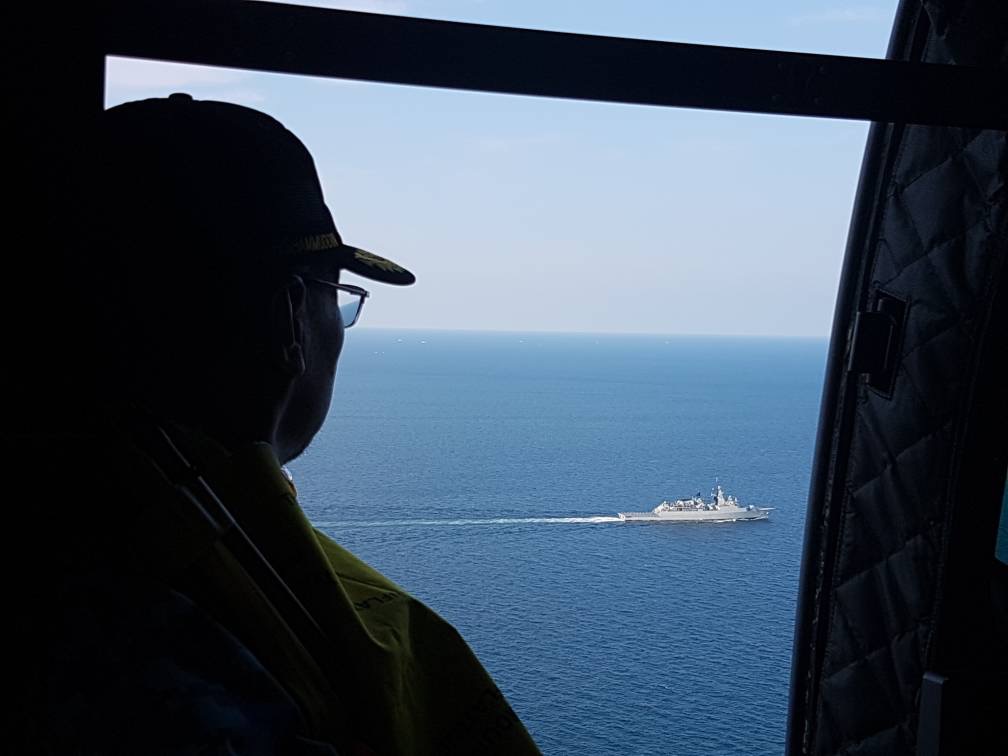
Taking queue from both his boss and Sun Tzu, Minister of Defence Dato’ Sri Hishammuddin Tun Hussein rushed off to Kuantan after the conclusion of the recent National Security Council meeting to rendezvous with the Royal Malaysian Navy frigate KD Lekiu which was conducting a patrol in the South China Sea. Despite the very limited time that he has, he made it a point to meet the frontliners to see how they are getting on while keeping the nation safe and secure during the fasting month.
Hishammuddin looking at the KD Lekiu before landing (taken from the Minister’s Twitter)
Hishamuddin, who was accompanied by the Chief of the Armed Forces General Tan Sri Raja Mohamed Affandi Raja Mohamed Noor, and the Chief of Navy Admiral Tan Sri Ahmad Kamarulzaman Ahmad Badaruddin RMN, landed on board the KD Lekiu at 5.30pm and was met by the Commanding Officer of the KD Lekiu, Captain Mohd Fadzli Kamal Mohd Mohaldin RMN who then gave the Minister a short safety briefing.
Hishammuddin saying goodbye to the crew of the EC725
When the Ec725 helicopter took off and flew by the starboard side of the KD Lekiu, Hishammuddin said, “That helicopter crew is excellent, and for it to be able to land on this ship shows great cooperation between the Air Force and the Navy. That is how the services, the Army included, depend on each other for support.”
True enough. It was the first time that the KD Lekiu had accepted the EC725 on its flight deck.
On board the Minister spent his time talking to the officers and men, asking them how do they find spending Ramadhan and Aidil Fitri away from home. There are times that the KD Lekiu, like many other man-o-wars in the navy, have to spend up to three months at sea away from home, regardless of the festive seasons.
This scene is repeated throughout the Minister’s visit – officers and crew asking for a photo op with the Minister and the latter is always obliging
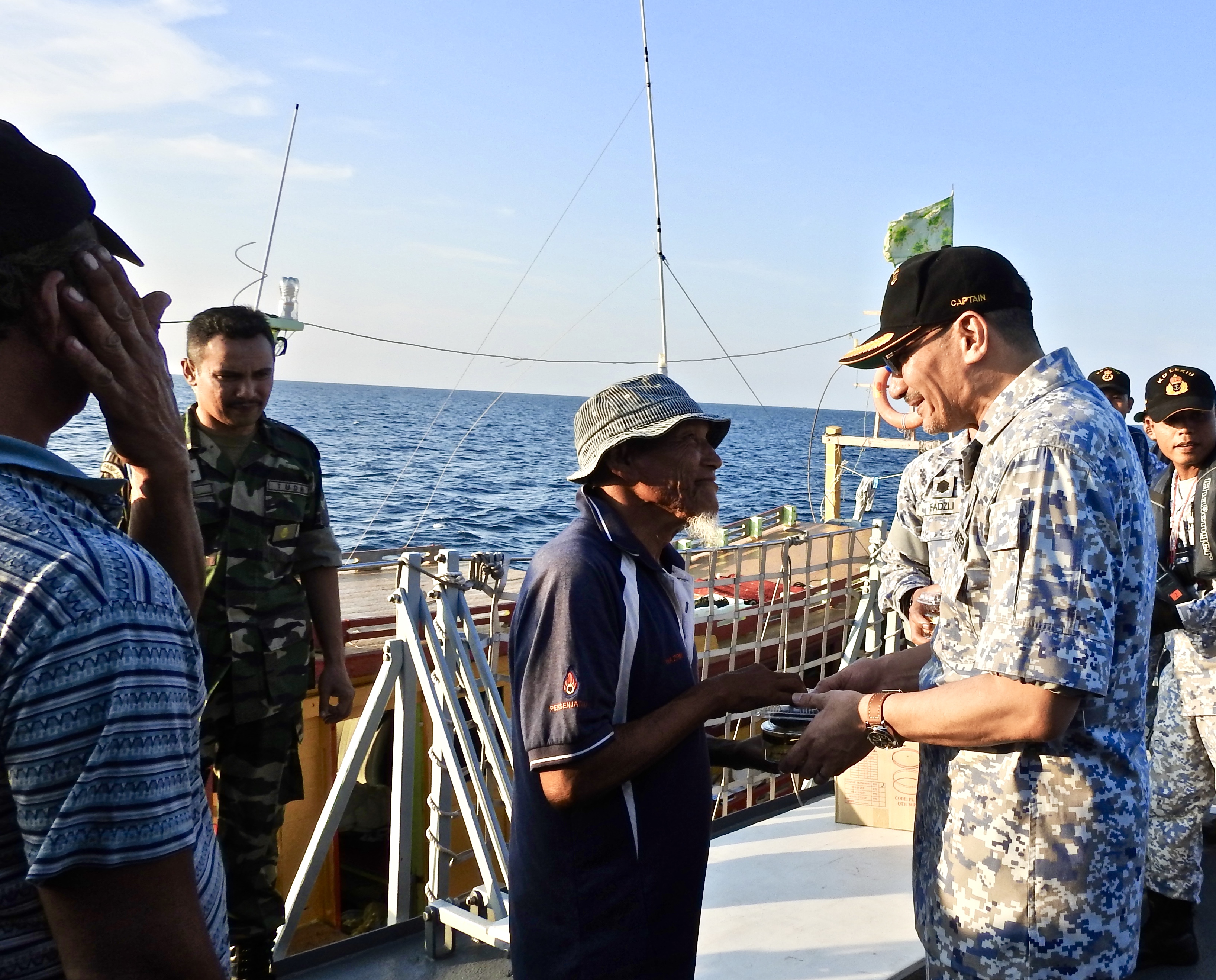
Through the Royal Malaysian Navy’s “Rakan Maritim” (RAKAM) program where the maritime community especially the commercial fishermen work hand-in-hand with the Navy to provide information especially on crime at sea, the fishing community has been providing such support especially through the “Initiatif Bertanya Khabar” (IBK) conducted by the individual naval vessels that are on patrol. A fishing trawler that was hailed came alongside.
The Minister is seen helping a trawler crew come on board
Encik Ramli bin Isa and Fauzi bin Omar had been out at sea for four days with another crew member. The moment they realised that it was the Minister himself whom had helped them up, their face lit up. The Minister, General Raja Mohamed Affandi and Admiral Ahmad Kamarulzaman asked them how they were and if they find that the waters are safe from foreign elements.
I later asked the two fishermen of the Navy’s initiative. They are very happy with it and find it reassuring that the Navy has been actively making its presence felt. On meeting the Minister, they were very surprised that a Minister would want to even ask how they are.
“I know he must be really busy but for him to make time to ask me how I am is like having a dream come true,” said Encik Ramli.
Hishammuddin later gave some food to the fishermen for them to break fast with.
Hishammuddin later had a talk with some of the crew which was also attended by the Commanding Officer and the Chief of Navy. There, the Minister related to the men the government’s plans for the Navy, and how the Ministry is working hard to facilitate the Navy’s 15-to-5 transformation program.
DS Hishammuddin and TS Ahmad Kamarulzaman spend a few moments with the men of the KD Lekiu
Tan Sri Kamarulzaman is happy with the progress of the 15-to-5 transformation program where the Royal Malaysian Navy will limit its fleet types to just five instead of the current fifteen. The program will see the RMN operating only Littoral Mission Ships, Littoral Combat Ships, New Generaion Patrol Vessels, Multirole Support Ships, and Submarines.
RMN’s 15-to-5 transformation program (courtesy of Senang Diri)
As we waited for maghrib prayers, Dato’ Sri Hishammuddin said to me, “I’m amazed by these navy people. They stay months at sea guarding our waters. ”
“I guess we’ll just have to make the public understand about what they do out here,” I replied.
The Minister frowned and replied with a sigh, “That is another matter. It is so difficult to get the public to understand wht these people do here, the hardship they have to go through. Imagine if these people are not here to do their duty. Mosul, Aleppo can happen here.”
It is so damned hard to get the support of the people, especially from the non-Malays, let alone to get them to join. But when something happens, they would be the first to condemn, especially so in the case of the fatal crash that killed two of our RMAF pilots.
The usual comments made especially by the non-Malays about the Malaysian Armed Forces
How the realisation that without the Malaysian Armed Forces this country would be in ruins escapes them puzzles me. It is because of these men and women that they are able to wake up in the morning and make money, and then go home to sleep peacefully.
Perhaps it is time for the National Service to be what it is – a two-year active duty upon attaining the age of 18, followed by a 10-year stint as reservists. That would probably make them have a better understanding of the Armed Forces and love the country as something more than just a place to make money in.
In the meantime, the men of the KD Lekiu will continue to be vigilant so we can all wake up shamelessly in total ignorance of their existence.
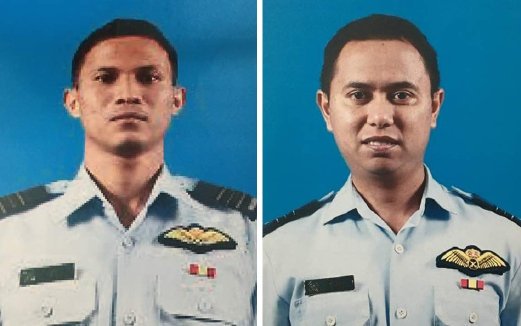
It is a sad day for the nation. We lost two Ops Daulat heroes, Major Mohd Hasri Zahari RMAF, and Major Yazmi Mohamed Yusof RMAF. The nation mourns for them. What happened to them 21 minutes into their flight, 60 kilometers North Northeast from the Kuantan Air Base will not be known until the Board that has been set up to investigate this incident comes out with its final report.
Details are sketchy. The pair took off at 11.09am and communications was lost at 11.30am. They were said to be performing a Functional Check Flight, which requires a rather complex form of flight manouvers depending on the function that needs to be tested. For example, an aircraft that has recently had an engine change will need a specific profile for that Functional Check Flight.
If it was a Functional Check Flight, the crew would have had a checklist that they needed to follow. They would record their findings according to each of the item, in sequential order, given in the checklist for them to perform before signing off upon completion of the Functional Check Flight.
Something must have happened in the midst of the flight that only the Board would be able to deduce after gathering all the facts.
Officers and men (and women) of the Royal Malaysian Air Force, like in the other services, are paid to die if necessary. When they step into the aircraft, no matter how well they are maintained, there is that nagging little part in their mind that knows that there is a chance that they might not come back alive. Just as we drive to work every day. When we leave home, how sure are we that we will get to see our family again? But the pilots knew what was expected of them when they applied to join His Majesty’s Armed Forces. We, as Malaysians, know that these two would die for anything as long as others may live. My only grouse is, every time something like this happens, instant “experts” flood the Internet with baseless accusations and theories.
THEORY NO.1 – LIKE MH370 THE RMAF RADAR PEOPLE ARE SLEEPING AGAIN, THAT IS WHY THE AIRCRAFT IS STILL MISSING
For those who still think that radar covers everything that is above the surface of the Earth, please have someone swing a baseball bat at your head – repeatedly. Radar only covers some 15 percent of the surface of the Earth. The Air Defence people did not sleep that night when the MH370 went missing. They saw where it went until the aircraft went out of radar coverage. You can read more about it here. The details of the flight may have changed a bit as we have learnt much more about what happened at night, but the RMAF was spot on with its procedures.
In the case of the missing BAe Hawk 108 aircraft, you must first know how radar works. The radar transmits a radio beam which bounces off a flying object, and the beam that is bounced back is received by the radar’s receiver. This is then translated as an image on the radar screen for the operator to see.
I explained a bit more early this month on how the RMAF Air Defence radar works. Please read about it here.
The Hawk went down. Which means it no longer reflected any beam for the radar receiver to receive. How can there be any image showing on the screen? So based on the last seen position, a search-and-rescue team was dispatched by helicopter to the last known location of the missing Hawk. They found the bodies of the pilot but not the aircraft. This I shall answer in…
THEORY NO.2 – THE HAWK IS MISSING BECAUSE THE RMAF DOES NOT KNOW WHERE IT IS
This is the obvious, actually. If the RMAF know where the aircraft is, this theory of your would be academic. But no. If you expect to find a wreckage that is almost intact, think again.
In 1996, ValuJet Flight 592 fell out of the sky after taking off from Miami and disappeared in the Everglades. The DC-9 aircraft with 110 on board was shredded into pieces by the impact. It took months before they could retrieve as many pieces of the wreckage that could be found.
In 1993, an RMAF PC-7 crashed into a paddy field in Perlis. The PC-7 is a much slower aircraft compared to the Hawk. When I arrived at the scene, it too was shredded into pieces. Nothing that resembled an aircraft could be seen. We found the engine a couple of days later buried 12 meters deep in the soft paddy field.
The ground where the Hawk is said to have gone missing is a secondary jungle that is swampy in nature. The wreckage could be in there somewhere. All we need to find is the impact point. This may also be related to Theory No.4. But that is for later.
THEORY NO.3 – THE HAWK IS AN OLD JUNK
How old is old for an aircraft?
I shall not compare military aircraft to civilian airliners. I shall not even compare the Hawk to the C-130H that we have been operating since 1976. They conduct different missions and face different kind of airframe stresses. However, be mindful that the Royal New Zealand Air Force operates C-130s that are more than 50 years old. Older than I am, in fact.
I will then compare the Hawk to another aircraft that probably faces even greater airframe stresses – the F-16A. The United States Air Force retired its F-16s that entered service in 1979 only five years ago. Therefore they were in service for 33 years! The Hawk has been in service in the RMAF for 22 years now. The USAF has over 5,000 aircraft and the average age of 25 years! The Republic of Singapore Air Force only retired its A-4SU after 31 years in service. In fact, our F-5Es entered service in 1975 and was only retired in 2015 the same year the RSAF retired its F-5Ss after 36 years! Was it old? Ask a Tiger-driver how superb the F-5 was as it was retired. Only the avionics could be considered old.
THEORY NO.4 – WHY DIDN’T THEIR CHUTES OPEN? DON’T THEY HAVE EJECTION SEATS?
The bodies were found 20 meters from each other. An eyewitness said that she saw both men with their chute deployed. I don’t know how credible this eyewitness is. I hope that she is not as credible as the makcik who said she saw the MH370 somewhere in the North Andaman Sea from 40,000 feet.
Truth be told, I am sure that the top brass are as equally perplexed as I am. That is why they have convened a Board to investigate this.
Could they have ejected? Perhaps. I can only think of them being too low and were in a full dive when they did so. Back i the 1980s, an Aermacchi MB-339A that was performing aerobatics went into a dive. The air crew ejected but they were too low and the orientation of the aircraft was not one in which they could have ejected safely. At least one of the air crew wen through the wall of a house.
Being in full dive would also explain the missing aircraft as it could be in shreds with a large portion of it down in the swampy ground. I can only speculate here and I hate to speculate.
So, let us just let the RMAF conduct their investigation and we get on with our daily lives, can we? And in the meantime, let us offer our heroes some prayers, and pray that the family they have left behind be given the strength to face the dark days ahead until light comes shining back into their life.
And stop hiding behind user names and keyboards while hitting out at the RMAF over this incident. Cowards will die many times while the brave die but once.
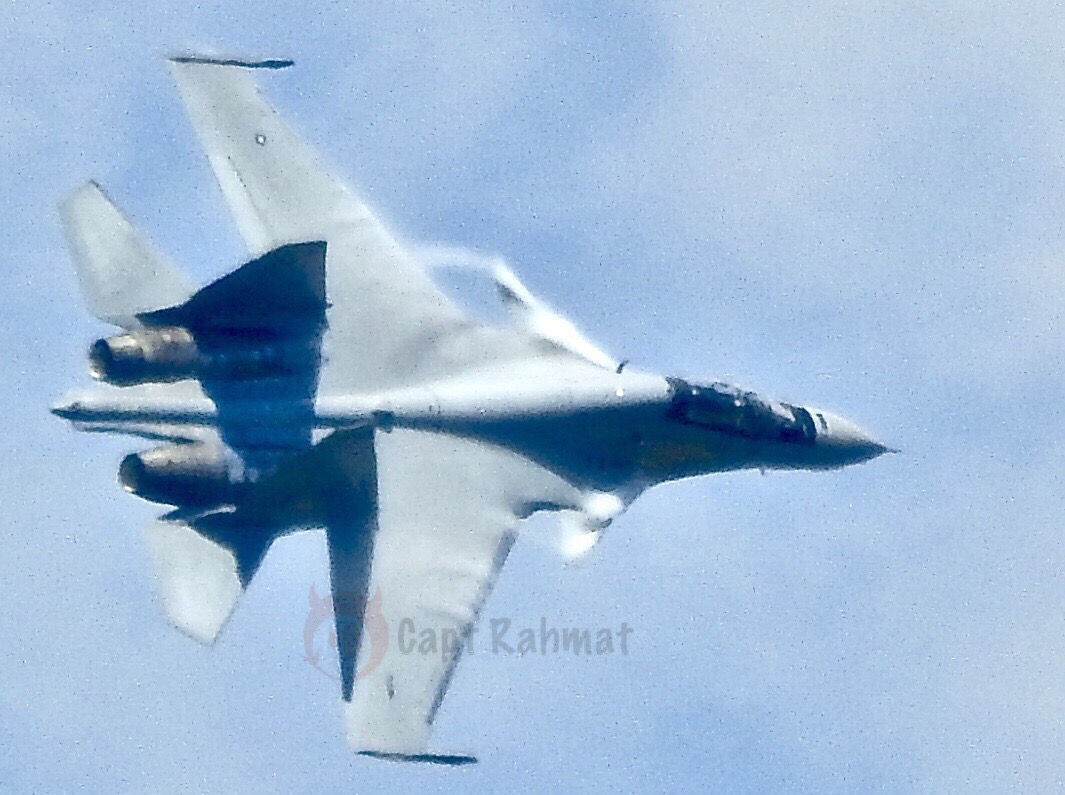
An RMAF Sukhoi Su-30MKM multirole combat aircraft performs a tight turn on a hot afternoon
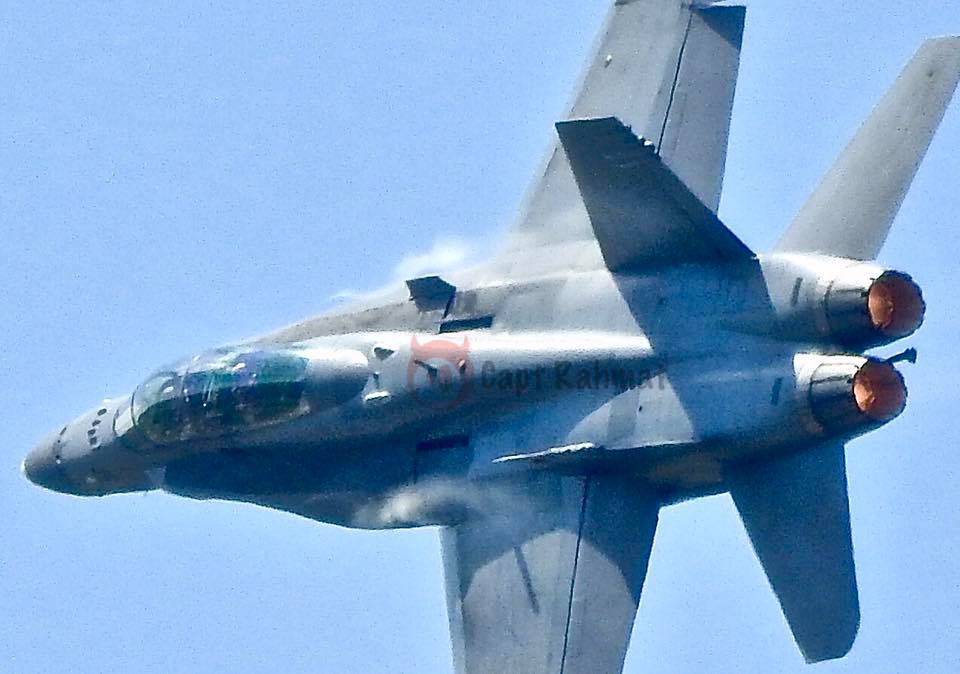
Many are awed by the performances put by the Royal Malaysian Air Force’s stars at the Langkawi International Maritime and Aerospace 2017 exhibition – the Sukhoi Su-30MKM Flanker and the Boeing F/A-18D Hornet.
Many can imagine the manoeuvres these mighty aircrafts could do in combat, but not many know who or what makes them tick.
They are the Air Defence Controllers, the guardians of Malaysian airspace.
An air defence radar basks in the sunset
Majority of Malaysians are not aware of their existence until the MH370 disappeared. Suddenly, this silent service came under an intense spotlight, especially when shone by those who do not have an iota of idea of how airspace and air defence in Malaysia work.
When Malaya gained independence in 1957, the airspace of the nation was only monitored by two long-range radars located at Western Hill in Pulau Pinang and Bukit Gombak in Singapore through the Anglo-Malayan Defence Arrangement which ended in the late 1960s.
The Royal Malaysian Air Force (RMAF) set up three air defence centres (ADCs) namely the No.1 ADC at the Butterworth airbase, No.2 ADC at Bukit Jugra, and No.3 ADC at the Kuantan airbase. These three ADCs shouldered the responsibility of monitoring our airspace.
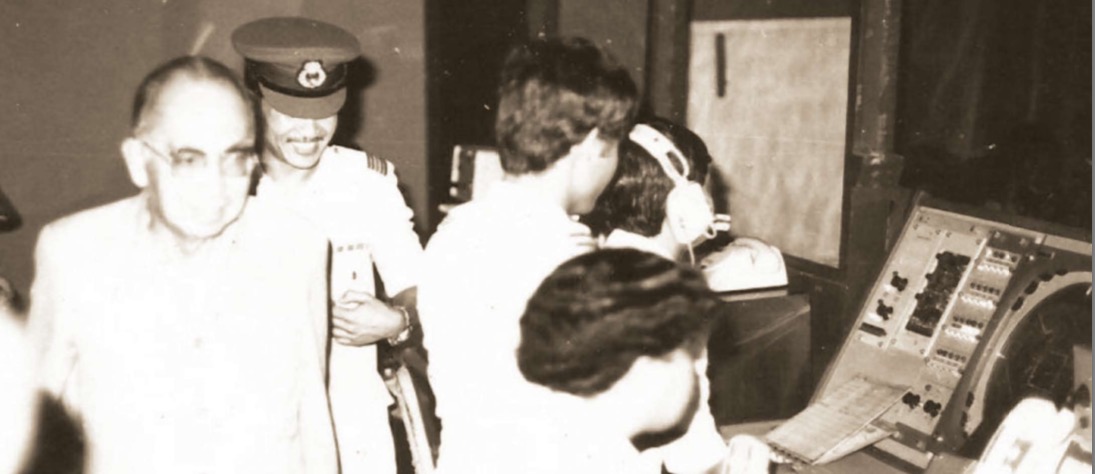
The late Tun Haji Abdul Razak visiting the No.1 ADC accompanied by the Chief of RMAF, Air Vice Marshall Dato’Sulaiman bin Sujak (later Tan Sri)
The RMAF has since expanded its air defence by creating five squadrons to also cover Sabah and Sarawak, and one Ground-Based Air Defence Squadron.
So how is it that it is the Air Defence Controllers who make the fighters tick?
There are two types of radar in use by the RMAF, Primary and Secondary. While the radar rotates 360-degrees, radio waves are transmitted and will bounce off targets as an echo and is received by the radar system’s receiver unit.
The Primary radar is the one that transmits the energy waves that bounces off targets while the Secondary radar interrogates the signal from the target’s transponder. This is then processed and the data is fed into the Command and Control system which is displayed on a screen and the target is then tracked by a Surveillance Officer who tracks and labels the target.
An Identification Officer then conducts identification procedures by correlating both radar and track data with information received from other agencies such as the Department of Civil Aviation. If the target does not correspond with a non-hostile or non-civilian target, then the unidentified target will be reported to the Officer-in-Charge.
An RMAF radar Command and Reporting Centre (CRC)
The Officer-in-Charge then conducts a threat assessment and evaluation of the unidentified target. Simultaeneously, the recognised air situation data is also displayed in the National Air Defence Centre to enable the Higher Authority to monitor the situation and assist effective decision making.
A visual identification of the unidentified target may be needed, or if the target poses a threat, the Officer-in-Charge then scrambles fighters to intercept the target. If threat exists, the RMAF’s surface-to-air defence systems would be put on the highest alert to anticipate a hostile act by the said target.
A fighter is scrambled to intercept the target
The pilot intercepting the target will then make a visual identification of the target and report back to the Fighter Controller. Instructions and orders from the Higher Authority are also relayed back to the intercepting pilot who will then execute either a Force Down procedure or chase the target out of our airspace while comunicating with the target either through the radio or signals.
Only if the instructions are not obeyed will the pilot escalate the rules of engagement. If the instructions are obeyed and a force down is required, the intercepting pilot will escort the target to the nearest airfield or airport where the target will be investigated.
The elaborate and complex systems that the RMAF Air Defence Centres employ are among the best, and therefore need the continuous support and understanding of not only the higher management of the RMAF, but also of the Government to ensure that hardware, software and its operators remain dynamic, well-maintained and trained.
And although they are mostly trained locally by the RMAF, some do get their training elsewhere in the world. For example the RMAF has had officers do their Basic Air Defence Operator Course in Australia. Some get trained as Air Weapons Controller in the United States of America. Some attend their Master Controller Course in England, Advanced Defence Weapons Controller in Bangladesh to name a few.
RMAF Air Defence Officers attending their Basic Air Defence Operators Course in Australia during the earlier days of the RMAF
And when you spend your time with your family, friends, or sleep at night, and while the interceptor pilots are on standby inside their crew room, remember this – you only get to go about living a happy life and going about with your personal business because of these glamourless silent sentinels who watch our airspace round the clock.
General Dato’ Sri Haji Affendi bin Buang RMAF, Chief of Air Force speaking to reporters at the ‘Media with RMAF Day’ recently. To his right is Lieutenant-General Dato’ Sri Haji Abdul Mutalib bin Dato’ Haji Ab Wahab RMAF, Commander of RMAF Operations Command“We shall prioritise our needs and ensure that the sovereignty of this beloved nation is NOT compromised in any way despite the budget constraints.”
The above was said by the Chief of the Royal Malaysian Air Force (RMAF), General Dato’ Sri Haji Affendi bin Buang RMAF when asked to comment about the effects of the budget constraints on RMAF operations.
“True to this year’s 59th anniversary theme which is ‘Kuasa Udara Tonggak Kedaulatan Negara’ (Air Power Pillar of National Sovereignty) the RMAF’s assets will always be ready in any situation and time to deal with any eventuality.”
The absence of any stop-gap measure since the RMAF took the MiG-29Ns offline, coupled with the lack of funds for the acquisition of new MRCAs have been worrying. Although the Royal Malaysian Navy (RMN) has gotten its boost in assets with the purchase of six Littoral Mission Ships, the lessons of Force Z that ended some 47 nautical miles northeast of Tioman island must never be forgotten.
Force Z comprised of the brand-new battleship HMS Prince of Wales, the battlecruiser HMS Repulse, and destroyers HMS Electra, HMS Express, HMS Tenedos and HMAS Vampire. On 10 December 1941, Force Z was decimated by Japanese aircraft from Saigon with only the destroyers making it back to Singapore.
Lack of air cover and underestimation of the Japanese force were key reasons to its decimation.
The RMAF has been wanting for a new MRCA and the two strongest contenders are the Dassault Rafale and the Saab Gripen. There is a need to maintain the number of airframes to meet the doctrine. However, it does not seem as if the RMAF would be getting any in the near future.
This has prompted the RMAF leadership under General Affendi to bring the MiG-29N back online. “We will make sure that we have sufficient airframes to conduct the priority missions and not compromise our sovereignty,” added General Affendi.
A senior RMAF MiG-29N jock confided that it is very necessary to have the MiG-29N back online no matter the short-term cost of operating them.
“We’ll see probably six to ten of them flying missions soon,” he said.
“Maybe you’ll see the return of the Smokey Bandits at the next LIMA!” quipped another, referring to the RMAF’s MiG-29N aerobatic team that used to wow the crowd at previous Langkawi International Maritime and Aerospace exhibitions.
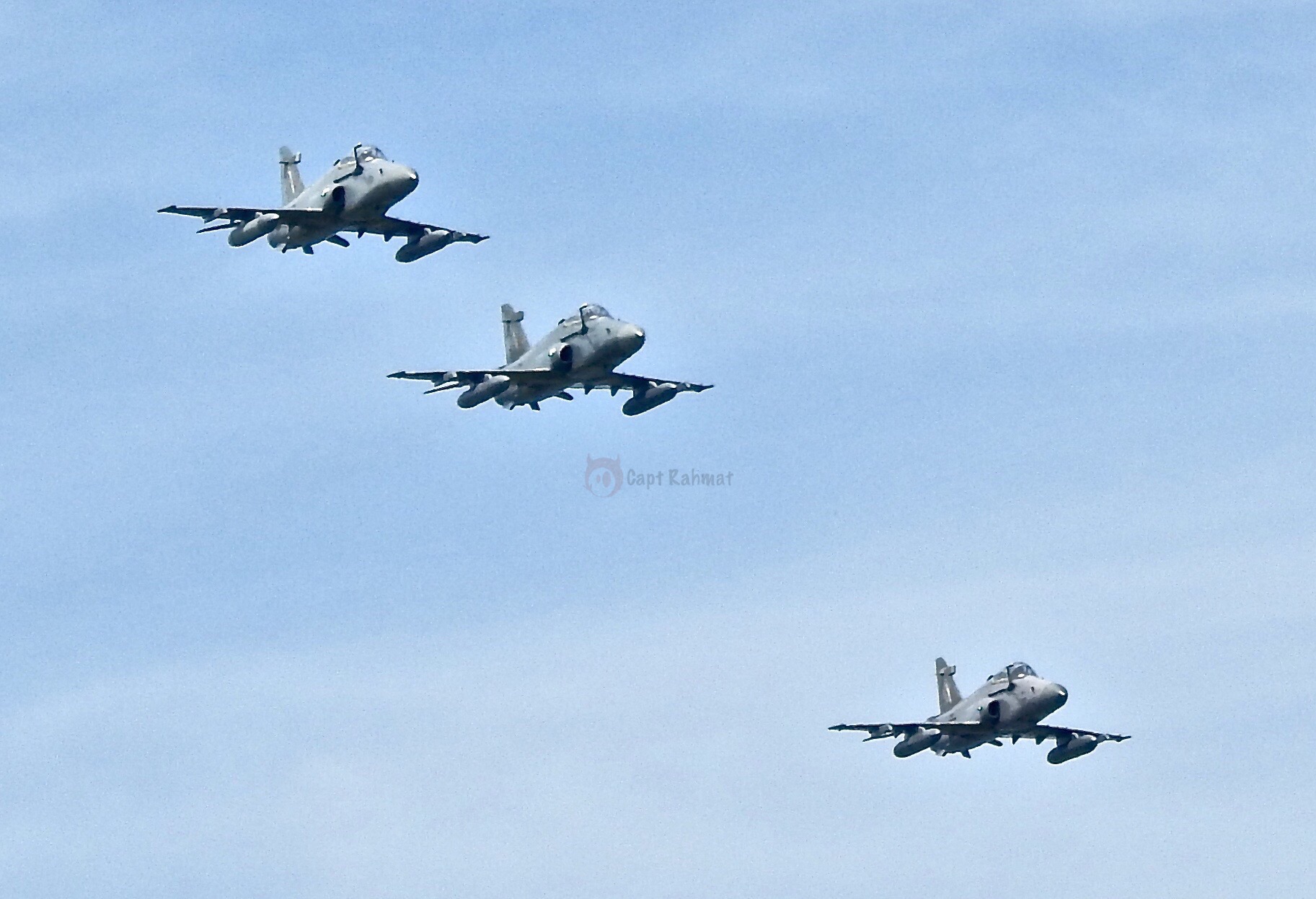
The MiG-29Ns will come back online to ensure that the sovereignty is not compromisedMost of the fighter squadrons are based in the Peninsular with only the No.6 Squadron based in Labuan operating the Hawks 208s. The Hawks have been succesful in intercepting foreign military aircraft in the eastern South China Sea.
“There has not been that many incursions by the Chinese. It’s the countries that are observing the Chinese that have made the most incursions,” confided another senior officer. “The Hawks are doing a good job at intercepting and directing them out of our airspace.”
Even so, the Hawks are limited in terms of endurance, firepower and range to perform such task. The squadron not only has to cover the development in the Spratlys but also the east of Sabah.
“You mean for ESSCOM?” I asked another senior officer.
“Not just there. To watch over the Ambalat area too,” he replied. “We could do with at least two G550 AEW equivalent to cover our waters and borders.”
Therefore, it makes real sense to have the MiG-29Ns back online, perhaps based in Labuan, while some Hawk 208s could go on rotational deployment at Sandakan for interdiction missions.
“The RMAF is also seeking to develop its capabilities especially in maritime patrol and the use of Unmanned Aerial Vehicles,” General Affendi explained. “We need to look for other longer-endurance aircraft and systems that is better than the Beechcraft that we have.”
The RMAF fleet of the Beechcraft 200T MPA have been reduced to just three aircraft after a crash on the 21 December 2016 killed the aircraft commander while two other aircrew survived with injuries. The Beechcrafts have been in service for almost two decades.
Asked if the recent offer by the Japanese Maritime Self-Defence Forces (JMSDF) of its almost three-decades old P-3C Orions, General Affendi said that a team will be sent to evaluate the aircraft offered.
“It is not just about operating the aircraft but also the cost of upgrading if needed and maintenance as they are not new aircraft,” he replied. “We do need better MPA capabilities which is why we will scrutinise the JMSDF MPAs and compare them to purchasing and operating newer systems.”
The Japanese Maritime Self Defence Forces has offered Malaysia its decommissioned P-3C Orion MPAs (Photo courtesy of Wikipedia)General Affendi thanked the government for its support and understands the constraints faced by the government as a result of a sluggish global economy. Nevertheless, he said that the RMAF would work within its means to ensure that all systems needed to monitor and intercept incursions as well as to carry out other missions such as Humanitarian And Disaster Relief (HADR) required from time to time.
“The Airbus A400M is a good buy. We can carry more load than the C-130Hs ever could and go places the (Boeing) C-17 (Globemaster III) cannot,” said General Affendi of the RMAF’s latest acquisitions. “Imagine how many stops the C-130H needed before getting to the Middle East. The A400M can fly straight to Dubai from here.”
The RMAF says its current strength of four A400M is sufficient to carry out foreseen missionsThe RMAF had brought 80 media practitioners from all over the country to witness the capabilities of the force. Performing Close Air Support displays were F/A-18D Hornets and Hawk 208s while a EC-725 Caracal helo inserted a PASKAU GFAC team to perform GLTD mission for the above aircraft before being extracted via SPIE-Rig method.
No matter the situation, the RMAF will fulfill its motto “Sentiasa Di Angkasaraya” and with a good leadership under the Chief, General Dato Sri Haji Affendi bin Buang RMAF, the RMAF will continue to be rejuvenated at 59.
Selamat menyambut Hari Ulangtahun Tentera Udara DiRaja Malaysia ke-59.
An F/A-18D Hornet makes an aggressive turn An Eurocopter EC-725 Caracal positions itself to extract the PASKAU GFAC team Three Hawk 208s orbit the airfield prior to landing A PASKAU GFAC team is extracted using the SPIE-Rig method
The practical leader – General Dato Sri Haji Affendi bin Buang RMAF
“A leader is one who knows the way, goes the way and shows the way.”
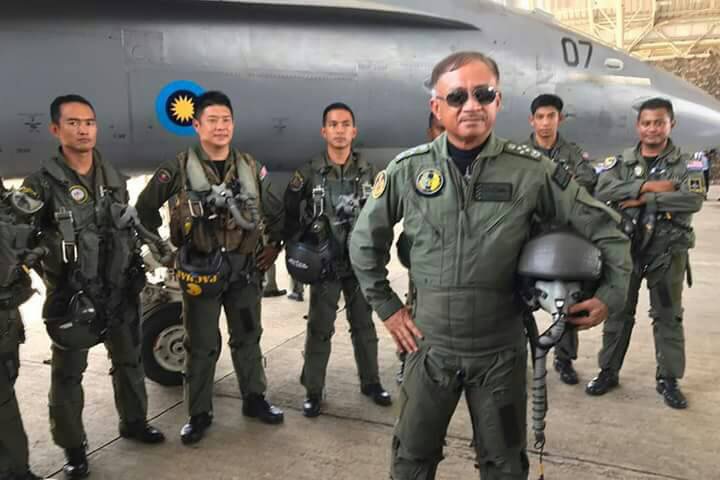
That quote from renowned American author John C Maxwell aptly describes the Chief of the Royal Malaysian Air Force, General Dato’ Sri Haji Affendi bin Buang RMAF.
One look at him reminded me of the first Chief of the RMAF that I served under, the late Lieutenant-General Tan Sri Mohamed bin Ngah Said RMAF – charismatic, feet-on-the-ground practical.
General Affendi is that. A senior RMAF officer describes him as “an intelligent, smartly dressed, easy going, approachable and true Air Force General.”
“If you want to see things get done, Apai will get it done,” he added.
And it is no wonder that “Apai”, the Iban word for “Father” is not just his callsign, but in the true sense what the men and women of the RMAF regard him as.
Hailing from Kuching, Sarawak, General Affendi is the first RMAF Chief from the eastern half of Malaysia. He joined as an Officer Cadet in 1980 before undergoing his basic flight training at the No.1 Flight Training School in RMAF Alor Setar (now Air Force College). He subsequently trained on the Aermacchi MB-339A before joining the No.9 Squadron for a type-conversion on the McDonnell Douglas A-4PTM Skyhawk, and later served as an operational fighter pilot of the No.6 Squadron.
He was recognised as an ace when flying the Skyhawks doing Close Air Support and Battlefield Interdiction missions against the Communist insurgency in the late 1980s. A senior Air Defence Controller described him:
“Apai is s***hot! With Apai you seldom need to call Check Six. He will manoeuvre and saddle-in to kill the bandit.”
In 1994 he was one of the officers selected for the MiG-29 Project Team who inducted and built up the operational capabilities of the RMAF MiG-29s. Later he flew the MiG-29s on patrols in the Spratlys area.
In recognition of his leadership, steadfastness and bravery in conductng his missions, he was not only awarded with military gallantry honours but also recently conferred the sacred Blue Beret of the Pasukan Khas TUDM (PASKAU).
General Affendi was conferred the Blue Beret of the PASKAU on the 28th February 2017Out of his office, General Affendi is known to shun protocol whenever possible. He prefers to be with the men and women he leads and meets them whenever he can. Despite being the Chief, General Affendi prefers to wade in the same mud as the one his men and women wade in. You will never see him sit in a VIP seat when travelling on board any of the RMAF transport aircraft. He prefers to work within his means.
And given the tough times the almost 59-year old RMAF is going through due to the global economic slowdown, only the tough will get going. And when the jobs needs to be done, Apai will see it get done.






















 SeaDemon Says
You must be logged in to post a comment.