We have just celebrated the 68th anniversary of our founding as a nation governed by ourselves. I try not to use the term “independence “ because technically speaking, only Pulau Pinang and Melaka achieved independence from direct colonial rule. The agreements the British had with the individual Malay Rulers only created Protectorates out of the Malay States. But although the agreements regarded us as independent and sovereign nations, we were subjugated and the British officials behaved like colonisers. Oh yes, setting the historical record straight is a monumental task. For instance, Sabah and Sarawak were never independent nations prior to Malaysia Day. That’s a narrative put up by politicians and played every time a state election in those states is around the corner. So it will take political will to set the record straight.
Yesterday, a vehicle belonging to JPJ that was in the parade, carried a placard bearing a love message for a budak Koleq – PMX. But is Anwar Ibrahim really PMX? To answer that question, we have to go back to a 1959 story about two budaks Koleq. They were PMI, PMII, PMIII and PMIV. That’s four PMs, but only two budaks Koleq.
Not many know that PMI – Tunku Abdul Rahman – was a budak Koleq, albeit for a short while. But, he was. He left after a quarrel with a member of another royal family after a football match. I think that that was how it went. But he was more known as a Sultan Abdul Hamid College alumnus. We all know that he headed the Alliance Party and won a landslide victory in the 1955 elections before “Merdeka.” But as with any election, voters would quickly realise that election manifestos are not Bibles, and disenchantment with the Alliance Party grew. “Merdeka” was euphoric and put everything on hold, but as the date for the Malayan Federation’s first general elections loomed, Tunku realised that he had to go to the ground to garner support.
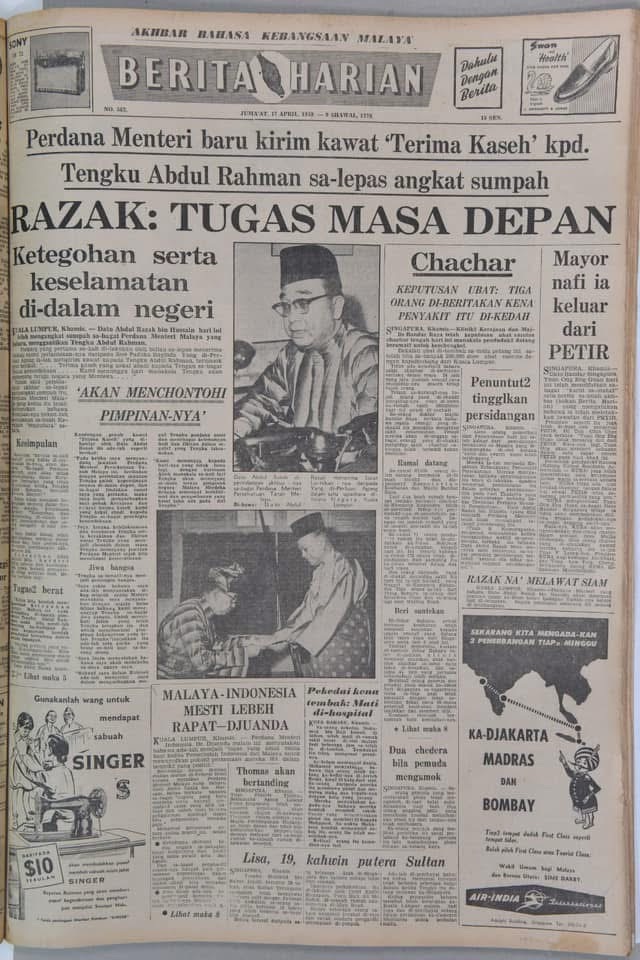
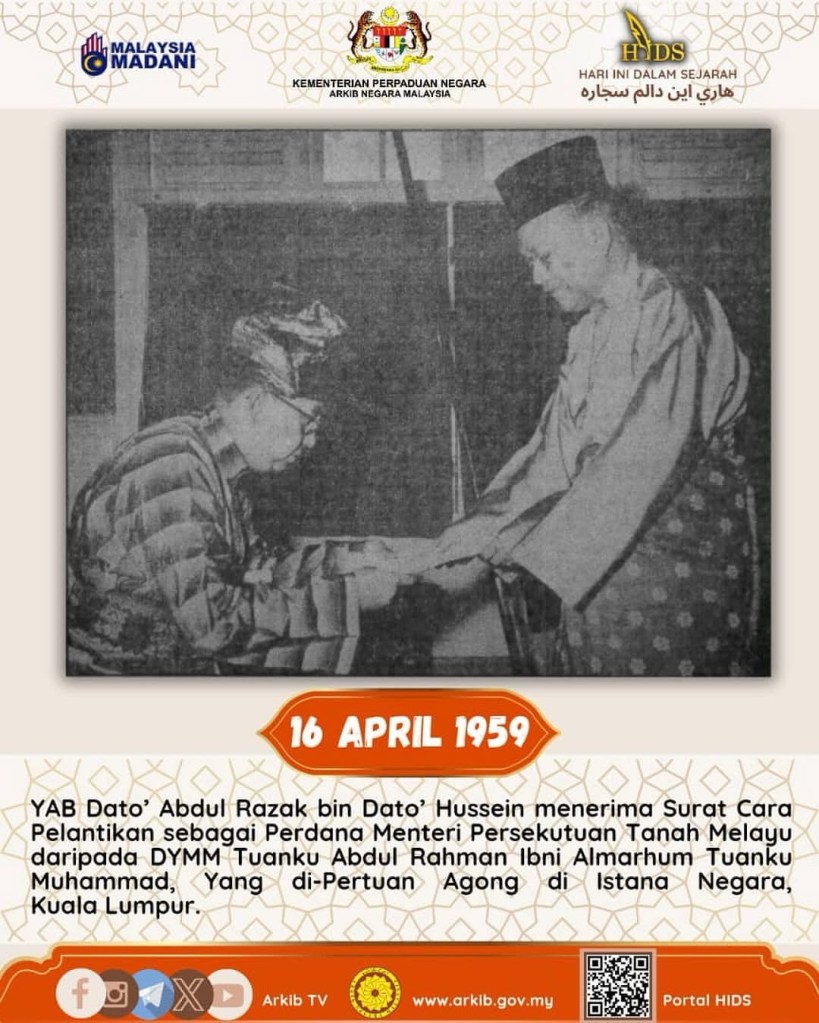
In order not to be seen as using his position as Prime Minister or abuse his office to go campaigning, Tunku Abdul Rahman resigned from office. Yes, he resigned. He did not go on leave. He stepped down on 15 April 1959 and handed over the Premiership to another budak Koleq – Dato (later Tun) Abdul Razak, who became PM on 16 April 1959. If you ask Google AI, it will say that that’s wrong and that Razak was only acting PM. But Google’s intelligence is artificial. Razak actually took oath of office in front of the Yang Dipertuan Agong as PMII – Federation of Malaya’s second Prime Minister. The latter even sent a telegram to the former, thanking him for the trust and confidence. The following is an excerpt from the New York Times, 16 April 1959, page 4:
MALAYAN RESIGNS AS PRIME MINISTER
KUALA LUMPUR, Malaya, April 15—Tengku Abdul Rahman relinquished the Prime Ministry of Malaya tonight. Tomorrow the Deputy Prime Minister, Dato Abdul Razak bin Dato Hussein, takes over. His tenure of office is expected to last only until general elections toward the end of August bring Tengku (Prince) Abdul Rahman’s Alliance party to power again and the Prince returns to Government leadership.
Tengku Abdul Rahman said that the change in the Prime Minister’s post would not mean a change in policies.
Dato Abdul Razak bin Dato Hussein, the incoming Prime Minister, is 37 years old, which makes him yet the youngest chief executive of a country in the British Commonwealth.
His predecessor resigned to devote himself full-time to campaigning in the first full Parliamentary elections. (End)
So, Razak was PMII from 16 April 1959 until the dissolution of parliament on 22 June 1959, and remained as a caretaker PM until a new cabinet was formed on 22 August 1959, returning Tunku as PMIII. Razak, of course, became PM again (PMIV) from 22 September 1970 until his death on 14 January 1976.
Razak, accepting his Instrument of Appointment from the first Yang Dipertuan Agong, after taking the oath of office on 16 April 1959
There you have it – 59 years before Tun Dr Mahathir, another SAHC alumnus, became PM again (PMIX) – two budaks Koleq, Rahman and Razak, had become the PM twice.
The JPJ placard should have read:
“I Love You PMXII”
That’s for the other budak Koleq who became PM. The title PMX should go to that guy from Muar High School. The one after PMIX.
But whatever it is, that placard should really have read “I Love You YDPA XVII” because the parade is for His Majesty as the Head of the Nation. The Prime Minister is only the head of the Executive Branch of His Majesty’s Government. JPJ’s Director-General heads a department in His Majesty’s Government. No one else takes precedence over the Yang Dipertuan Agong.
That ends our history and protocol lessons for this session.
(Note: “budak Koleq” is a self-given term by students and old boys of the Malay College Kuala Kangsar)
2,400 years ago, people believed that the universe revolved around the Earth in a geocentric orbit. This belief — that Earth was the centre of the universe — was widely accepted until around 600 years ago, when it came to be understood that the Sun is at the centre of our solar system.
The current evidence on temples built in ancient Kedah indicate that only a small segment of Malays there at the time adopted Hindu-Buddhism
With the discovery of other galaxies, we now know that none of them move around a single centre. That is the current narrative — until a new discovery may come along to challenge it.
Recently, a protest was held outside the gates of a prominent public university against the organisation of a conference said to be discussing and defining the narrative surrounding ancient Kedah. The concern was that this narrative might be shaped by those who do not prioritise the interests of a particular race or religion.
Such fears are rooted in the opinions of individuals who have never been formally trained in the disciplines of History or Archaeology. As someone who has been specifically trained in History at a well-known local public university, I would like to explain why the protest was a fruitless exercise.
Evidence matters
Can anyone write about history? Certainly. You could even write a paper on the effectiveness of nuclear fission energy if you wanted to. However, there are several factors and conditions that must be fulfilled before your work can be accepted — especially by experts in the field. This includes the standards of evidence and sources you use, and how you interpret those findings.
Your sources must be empirical or academically peer-reviewed. If your references are merely social media posts, you may as well write a romance novel. You must adhere to ethical research practices and subject your findings to rigorous scrutiny by other experts to ensure they meet strict and credible academic standards.
If your writing is based on personal opinion, then it no longer qualifies as academic work. That is propaganda — or at best, baseless rhetoric.
Free from bias
Your research must also be free from bias. This means you cannot write to support one side or dismiss another. You must remain objective. We cannot fabricate a narrative and then create fictional evidence to support it. Historiography must be free from centrism of all forms — be it ethnocentrism, anachronism, political centrism, religious centrism, or other imbalances.
In the case of the aforementioned protest, it was driven by emotions rooted in ethnocentrism and religious centrism. Among the claims made was that the Malays of ancient Kedah practised Islam and not Hindu-Buddhism, as has been widely accepted.
However, there is currently no verified discovery that supports the claim that Malays in ancient Kedah practised a form of Islam or even an early version of it. We have discovered prehistoric human remains dating back to the Palaeolithic and Neolithic eras, such as the Pulau Pinang Woman (6,000 years ago), the Perak Man (11,000 years), and the Nenggiri Woman (14,000 years). Yet, none of these findings provide any evidence of Islamic practices — if anything, they suggest a belief system rooted in animism.
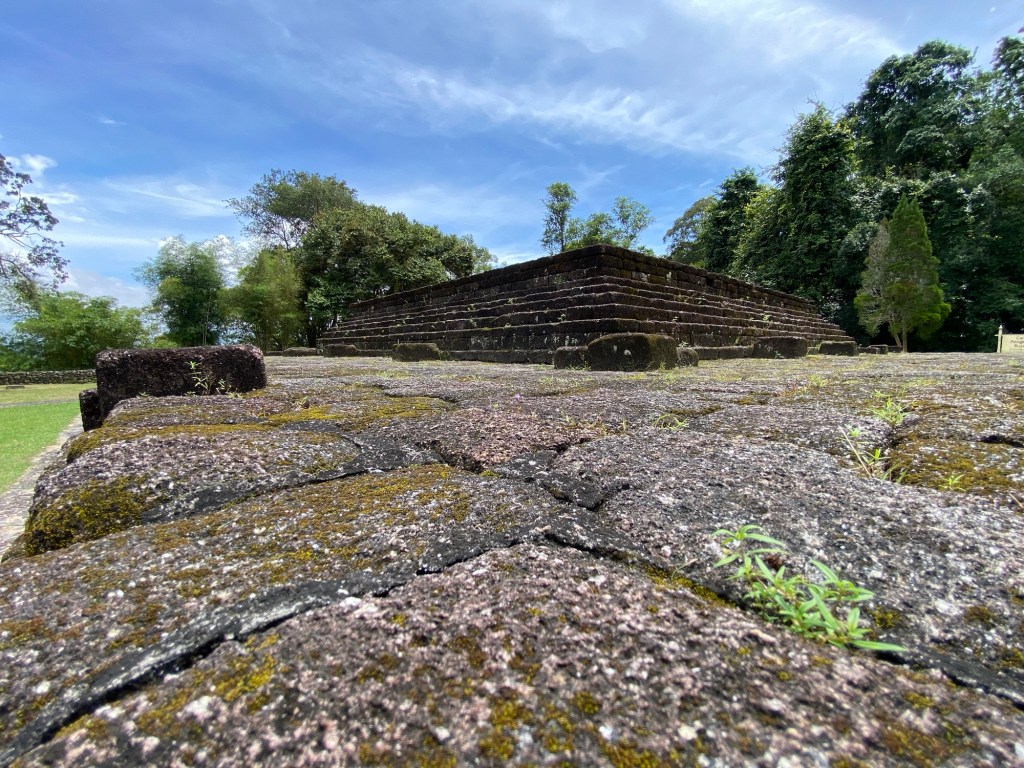
This also does not mean that all Malays in ancient Kedah were influenced by Hindu-Buddhism. Nearly all temples (candi) found in the Bujang Valley were built between the 4th and 13th centuries AD. They were discovered at ancient trading sites such as Sungai Batu, Kampung Pendiat, Pengkalan Bujang, and Kampung Sungai Mas. Only the temples at Bukit Choras and Bukit Batu Pahat were located slightly further inland.
All of them are small in size compared to Angkor Wat, Borobudur, Gedingsuro, or Welan temples. This suggests that the Bujang Valley temples served as places of worship for Indian and Chinese traders, and perhaps a small number of local Malays involved in international trade. They were not built for a large population of Hindu-Buddhist worshippers. In short, only a small segment of Malays in ancient Kedah adopted Hindu-Buddhism.
This is further supported by the absence of temples inland, including in the upper reaches of the Sungai Muda — a key trading hub — or after ancient Kedah declined as a major destination post-14th century. If the local population truly practised Hindu-Buddhism, more temples would surely have been found by researchers who have studied the area since the late 19th century.
Professors are not all-knowing
One of the individuals who frequently comments on ancient Kedah — especially Sungai Batu — is Professor Dr Nik Najah Fadilah binti Haji Yaacob, better known online as Professor Dr Solehah Yaacob. She is a professor of Arabic grammar at a public university in Gombak. She has not been formally trained in History or Archaeology.
I admire her dedication to studying history. And because she carries the title of “Professor”, many people understandably take her statements at face value.
In reality, a history graduate with a bachelor’s degree has greater subject knowledge than a professor whose field lies elsewhere. History students must study world history across various periods — from prehistory to proto-history, traditional history, and modern history. Professors, on the other hand, conduct focused research in their own specific fields, not across all disciplines.
This is why professors should understand the boundaries of their expertise. For example, I once had a discussion with Professor Emeritus Dr Anthony Milner, an Australian historian renowned for his work on Southeast Asia and Malaysia. His expertise is in traditional political history. He never claimed to be an expert in Malaysia’s proto-history, especially that of ancient Kedah, because that is not his area of study.
Therefore, I would prefer if Professor Dr Solehah would present her research to qualified experts for academic review, rather than promoting it on social media. Social media is not the place for academic validation. It would also be better if her research did not involve prophets unless she can provide credible sources. Otherwise, that is no longer history — that is propaganda.
As the Prophet Muhammad (peace be upon him) said: “Whosoever tells a lie against me intentionally then surely let him occupy his seat in Hell-Fire” [Sahih al-Bukhari (110)]
Unity over division
Disputes involving race and religion serve no benefit. Why must we boast about our supposed superiority over other ethnicities when Allah SWT considers all of us equal? Must we Malays be arrogant and see ourselves as holier than others? Are we somehow greater than Allah SWT?
If someone we mock ends up embracing Islam, does that not make them purer and more free of sin than we are? But how will they ever do so if we continue behaving like this?
We must accept narratives grounded in recent discoveries. As academics, we should keep an open mind. All historical research and findings should contribute towards the strengthening of our nation and its people — not towards sowing division or conflict between communities.
If there is new evidence or findings, they should be presented for academic review by others in the field. If accepted, that narrative should be acknowledged. What are we trying to take pride in — a fabricated past, or a history built upon proven facts? May we all be spared from pointless actions. – April 14, 2025
Captain Abdul Rahmat Omar (Rtd) is the Malay Consultative Council Bureau of Security, Defence, Public Order and Martial Arts chairman.
The Bukit Choras ancient Buddhist temple complex existed before Rajendra Chola ransacked the Srivijayan empire
The attempt by Nga Kor Ming to have Chinese new villages listed as UNESCO heritage sites has caused a tiff between the DAP and its partner UMNO.
The Chinese new villages were, in essence, concentration camps aimed at reducing and curbing contacts between the Malayan Communist Party terrorists and their sympathizers during the First Malayan Emergency (1948-60).
The Bujang Valley in Kedah contains remnants of what is known as ‘Ancient Kedah’ that spanned from the Kra Isthmus all the way down to Beruas, Perak. It was a vassal state of the Srivijayan empire that was a confederation.
But, Ancient Kedah or Kedah Tua itself is subjected to claims and counterclaims based on racial and national supremacy. Recently, a friend asked me based on my elementary knowledge of the Pallava script as well as what I have learned from Ancient Kedah, what would be my most unpopular opinion of its history. My short answer would be “All of it,” and this will be my attempt at explaining the history.
WAS PENINSULAR MALAYSIA INDIAN?
No.
The Hindu temples in the Bujang Valley were constructed between the 11th and 13th century C.E (or A.D, whichever is the most familiar term to you). Even the Candi Bukit Batu Pahat, the largest ancient Hindu temple in Merbok which was thought by Quaritch Wales to have been constructed between the 7th and 8th centuries C.E, were constructed between the 12th and 13th centuries C.E, towards the end of the importance of Bujang Valley as an entrepôt.
The Cholas weren’t here in an expansion mode. Srivijaya was a Buddhist empire that was a vassal of the Sung Dynasty. It gave traders from China special preferences while taxing the ones from the Chola empire exorbitantly. Sick of this mistreatment, King Rajendra Chola invaded the Srivijayan entrepôts along what is now the western coast of Southern Thailand, Kedah, as well as the Srivijayan capital of Palembang in Sumatera in 1023 C.E and stayed for 66 years before, at least, the ruler of Ancient Kedah was restored.
The Cholas packed up and went back to India. By the end of the 13th century C.E, the Chola empire was defeated by the Pandyan.
In terms of inscriptions, Pallava Grantha has always been the script for both Sanskrit and ancient Malay in this part of the world. The Devanagari script which was widely used in the Chola empire only existed around the 7th century C.E.
WAS PENINSULAR MALAYSIA HINDU OR BUDDHIST?
Neither.
The earliest evidence of Buddhism in Peninsular Malaysia are in Buddhist texts that made reference to two Buddhist monks coming to Ancient Kedah shortly after the third Buddhist council, which took place in the 3rd century B.C.E.
At the same time, however, the earliest archaeological evidence, found in the Bujang Valley, suggests the presence of a Hindu—Buddhist kingdom as early as the 2nd century C.E. From the 8th to the 13th century, the Malay Peninsular was under the influence of the Srivijaya empire, which was based on the island of Sumatera and which the Chinese monk I-Tsing described, in 671, as an important center for Buddhist learning with more than one thousand Buddhist monks.
But if we look at the locations of both ancient Hindu and ancient Buddhist temples, they were all located along or near the ancient coastline. Sungai Batu was an industrial port, Pengkalan Bujang, Bukit Batu Pahat, Kampung Pendiat, Sungai Mas were all entrepôts where traders gathered to make a living. Even Bukit Choras was located on the bank of an ancient river estuary.
Neither James Low, Quaritch Wales nor the modern researchers have found any evidence of the existence of ancient Hindu or Buddhist temples further inland. Furthermore, no temples were found to have been built in Ancient Kedah after the 13th century C.E, that is after the decline of the importance of Ancient Kedah as a maritime trading nation. This goes to prove that the majority of the population of Ancient Kedah practiced animism until the arrival and acceptance of Islam by the local ruler.
THERE EXISTED A GREAT MALAY KINGDOM THAT HAD TIES WITH PROPHETS AND SUPPLIED QUALITY IRON TO THESE PROPHETS
Very highly unlikely.
This would be in reference to the ancient iron smelting site in Sungai Batu , Merbok. This site was dated to around 4th century C.E. At least, that is what has been confirmed by samples collected during excavations performed there.
However, an outlier sample dates to between 535 B.C.E and 788 B.C.E was found, and has been the basis of claims that Sungai Batu is the oldest civilization in Southeast Asia, and that the site is proof that the Malays were a great race. This was used to counter claims that Kedah (and Peninsular Malaysia) was once Hindu under Chola rule.
Outliers are very common phenomena in archaeology. They can be caused by numerous effects such as contamination with older samples, inherent variation between different sources of carbon, differences in Carbon-14 intake by plants, and other factors. This is why archaeologists normally do not base any conclusions on a single date; there are instead various mathematical formulae for deriving a range of possible dates (rather than a single date) from a group of samples.
According to archaeologist Professor Dr John N. Miksic, who is Professor in the Southeast Asian Studies Department, National University of Singapore, the first known trading port in the Malay Peninsula formed in 4th century BCE. The site is now in a village in South Thailand called Khao Sam Kaeo. This area at that time was probably inhabited by Malay speakers. It was on the east coast of the Peninsula. Artifacts there in addition to localy-made items came from India and south China (which at this time was still inhabited by people whom the Chinese called the Yueh, which can be transliterated as Viet).
He said that the oldest evidence of ports in Kedah appeared in the 5th century CE in the form of inscriptions. Radiocarbon dates from Sungai Batu span a wide range of dates, only one of which originates from the 8th century BCE. This could be an erroneous result due to random variation in dosage of radiation from the soil, the presence of old wood in a younger soil stratum, or just possibly the remains of very early metal working or other human activity. It does not however date any trading activity. The oldest pottery in Sungai Batu is over 1,000 years later.
I don’t feel supreme by knowing that the people of Sungai Batu left 50 or 500 or 500,000 or 2,000,000 Tuyeres behind. Unless there is a monument like the one in Bumiayu or Batujaya or Angkor or Ayutthaya, then treading on the grounds of Sungai Batu is similar to walking on the grounds where a demolished illegal pottery factory once stood.
I won’t even attempt to comment on the story of Abraham marrying a Cham princess, a story that was conjured up without any documentary or archaeological evidence.
SO, WHICH PAST SHOULD WE PRESERVE IF THERE IS NO ONE RACE THAT WAS GREAT?
Pallava the script came from the Indian subcontinent and was widely used here. Inscriptions using the Pallava script have been found in both Sanskrit and Ancient Malay. But to say that people in the Peninsular were Hindus, Buddhists or Indians because of the use of the script is as naive as saying Malaysians are Romans because we use the Latin alphabets.
If we look closely at the existence of the Hindu and Buddhist temples, as well as the Tuyeres left behind at Sungai Batu, the greatness of the people back then lie in their tolerance for each other. The temples were not large in size, but must have been enough for traders from India and China to pray in, while waiting for favourable winds to take them back to whence they were from. They must have been built to attract traders, just as how the government-of-the-day would create a favourable environment for investors to conduct businesses here. The Sungai Batu industry could not have thrived without local manpower.
The above points to only one thing – the great tolerant people of Ancient Kedah were ruled by wise leaders. That is the greatness of the people. That is what we should preserve and learn from. That is the narrative that we Malaysians should be proud of.
Dr Shaiful Idzwan Shahidan pointed out that the sample that linked the Sungai Batu archaeological site to 788 BCE is an outlier
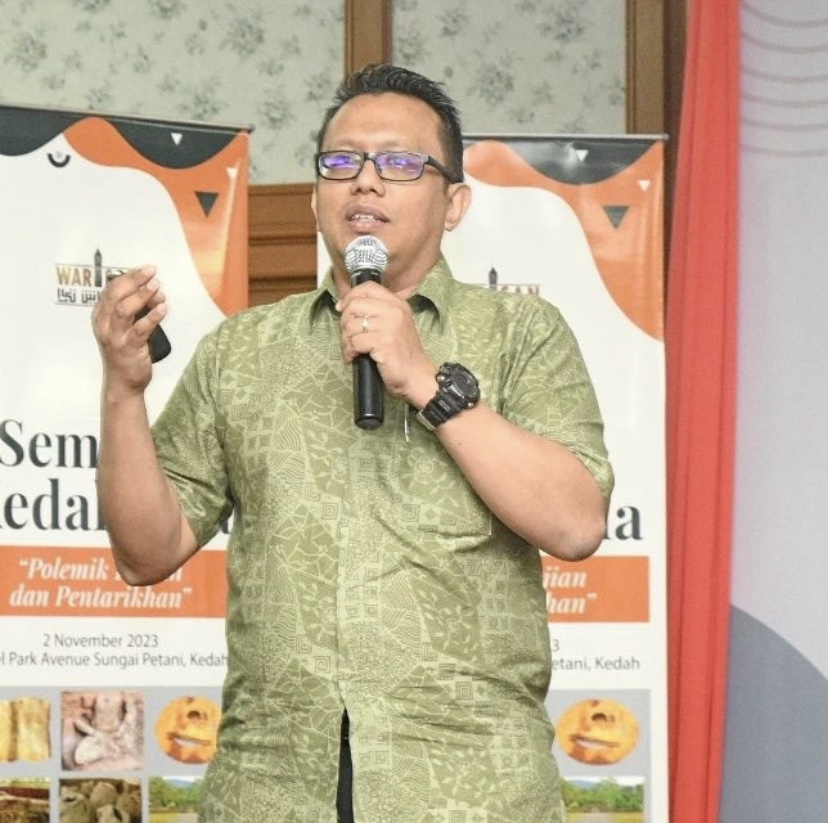
The Malaysian National Heritage Department (JWN) organised a full-day seminar on Ancient Kedah: Research and Dating Polemics in Sungai Petani on 4 November 2023. Among the speakers was Dr Shaiful Idzwan Shahidan, a consultant at USAINS Unitech.
Dr Shaiful Idzwan is an advocate of the Bayesian method in archaeology – an explicit, probabilistic method for combining different sorts of evidence to estimate the dates of events that happened in the past and for quantifying the uncertainties of these estimates.
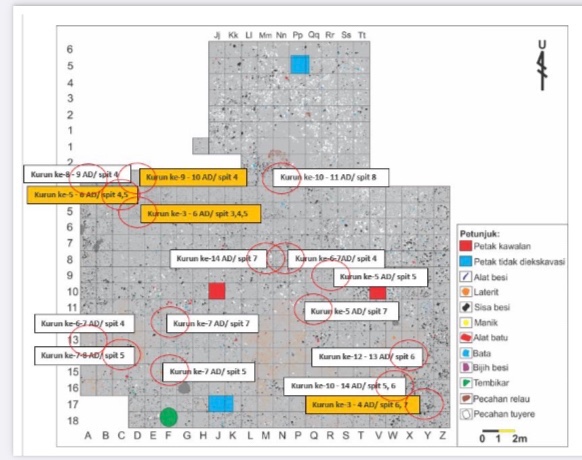
In answering the polemics of research and archaeological dating especially related to the Sungai Batu Archaeological Complex (SBAC), he said that the radiocarbon dating of the SB2H site where the 788 BCE sample was found (sample 516413), should not be compared directly based on the depth of the spit because the level of the spit is different according to the actual contour of the site before being excavated.
Dr Shaiful Idzwan said that the dating obtained from the yellow plots is reliable because it is representative of the whole site from the beginning until the final layer of culture.
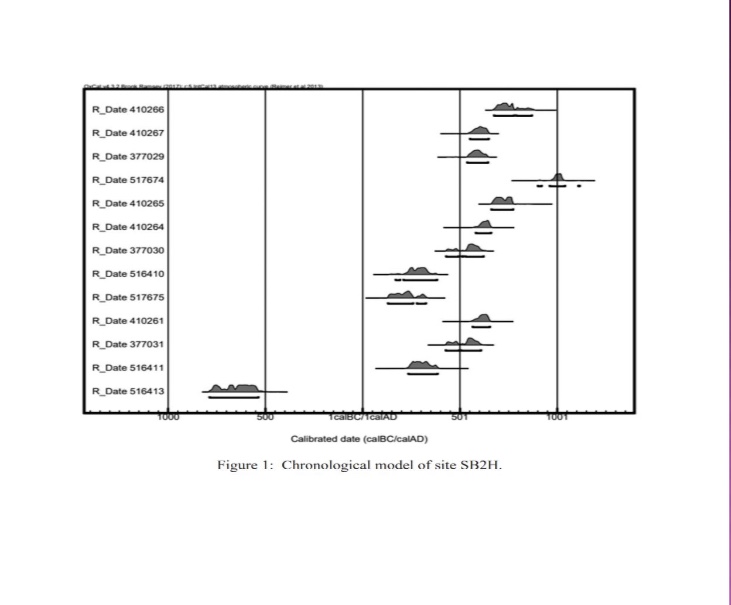
A chronological model of the SB2H site showing the calibrated dating of samples from the site is further evidence that the 788 BCE sample is an outlier.
An outlier is an observation that lies an abnormal distance from other values in a random sample from a population.
In fact, sample 516413 does not specifically point to 788 BCE as claimed, but has a range between 788 BCE to 537 BCE). However, he said that any finding needs to be adapted to the historical and cultural context.
In this case, the rest of the SBAC samples have overwhelmingly been dated to the 2nd to the 8th century CE. This range fits into not just the Bujang Valley narrative, but coincides also with the existence of other maritime polities such as Srivijaya, China and India, as well as nations that had once traded with Ancient Kedah.
A chronological model of the SB2H site at SBAC showing sample 516413 as an outlier
This narrative has been peer-reviewed and accepted by experts on Southeast Asian archaeology.
We are aware that historical narratives can change with new findings. HG Quaritch Wales, the man who discovered the Bukit Batu Pahat temple in 1936 dated the temple to the 7th to 8th century CE based on the data that was available to him during that era.
However, more recent scholars have revised that to the 12th to 13th century CE.
The onus is on the JWN to come up with a narrative that has been proven, peer-reviewed and agreed upon by experts in Southeast Asian archaeology. Else, the nation’s historical narrative will be laughed upon by other nations.
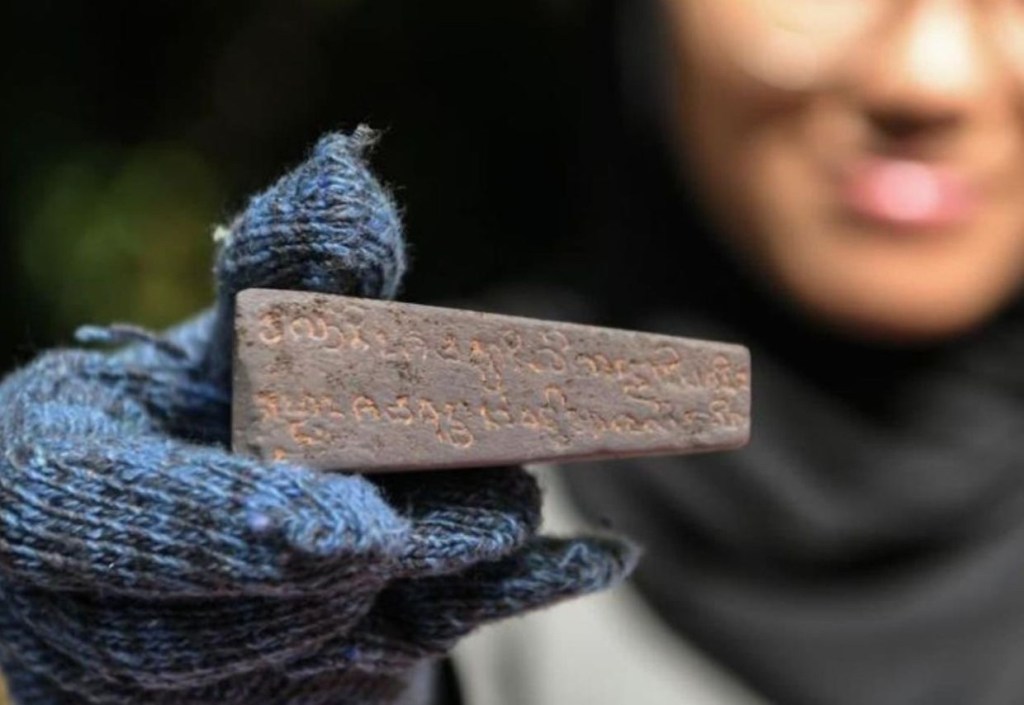
A black slate stone with a 7th to 8th century CE Pallava inscription was amongst the most recent discoveries at Bukit Choras (courtesy of The Star)
Amongst the finds that renowned archaeologist Horace Geoffrey “H.G.” Quaritch Wales discovered in 1936 in the Bujang Valley was the Bukit Choras temple site.
Wales then dated it to the 4th century CE based on the shape of the type of mold used to make the basement of the structure (Wales 1940:7).
However, a recent excavation and research works conducted by the Universiti Sains Malaysia’s (USM) Centre for Global Archaeological Research (CGAR) and the National Heritage Department (NHD) that took place between 28 August and 12 September 2023 have discovered two near-perfect statues and an ancient inscription using the Pallava script.
According to The Star, USM CGAR senior lecturer Dr Nasha Rodziadi Khaw, who led the excavation works, said the finds from the temple site could date back to around the eighth or ninth century AD, which is the same as most of the temple sites in the Bujang Valley, and the development period of the Srivijaya Empire.
“The uniqueness of the temple at this archaeological site is firstly how it has been preserved, we can see that the condition of the walls in the north, west and south areas are well-preserved.
“Secondly, we found two human-sized structures made out of stucco… and the discovery of stucco has not been reported in the Bujang Valley but only in Sumatra and Java,” Nasha said at a press conference on Friday, 22 September 2023.
Nasha said based on preliminary research, there is a similarity between the temple architecture in Bukit Choras and that of temples in West Java and Sumatra, at the same time raising questions about the cultural relationship between Kedah Tua and other sites in South-East Asia.
He said the Bukit Choras Archaeological Site is considered to be special due to its isolated position north of Gunung Jerai, whereas the other archaeological sites in the Bujang Valley are mostly situated south of Gunung Jerai in the areas around Sungai Merbok and Sungai Muda.
He, however, said his team still needed time to do more research, perhaps over several years, and this must be done on-site before any conclusion can be made about the ancient site.
He also hoped his team can provide more information and data to add value to the history of Kedah Tua.
He added that the temple is also the biggest ever found in the Bujang Valley and it had interesting architecture.
What is more interesting is that the Pallava inscription used a 7th to 8th century CE script, but because it is believed to have been deposited at the temple during its construction, the inscription itself is much older than the temple.
Therefore, it would not be surprising if, upon completion of studies several years from now, the temple is found to have existed only between the 9th or 10th century CE, in consistence with the area’s trade with the Chola kingdom.
The Bukit Choras temple is said to be the largest temple discovered in the Bujang Valley. Although not as large as the Borobudur and Angkor temples, it would certainly be an archaeo-tourism attraction for visitors to the area.
We certainly hope for more discoveries to be found when excavation works continue in the near future.
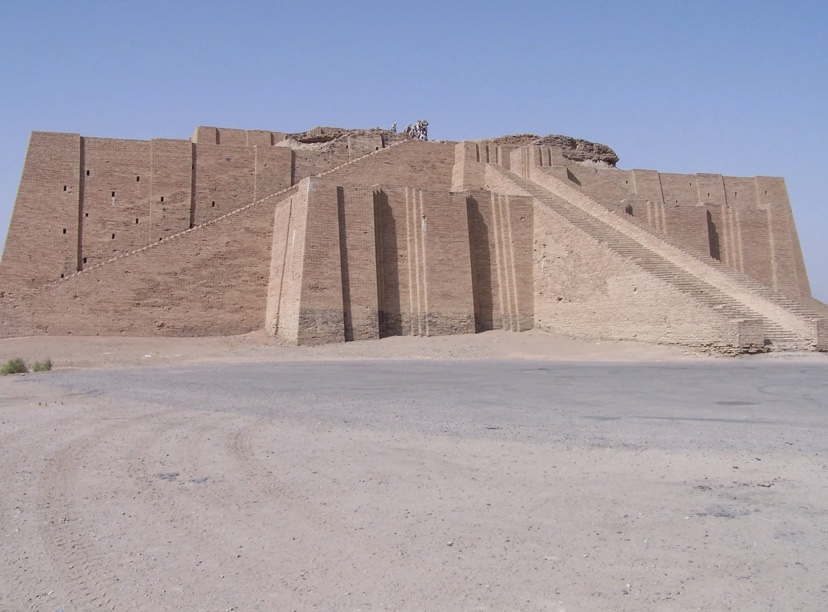
Did King Shalmaneser I of Assyria order the construction of a Ziggurat in Qalah (Kedah) in 1,300BCE? Or was it some place else in Mesopotamia with the same name?
Imagine that you are in Melaka just after it was conquered by Alfonso de Albuquerque. The year is 1512 CE. They were building the Fortaleza Velha, otherwise known as A Famosa. And then next to the fortress is a building similar to the Petronas Twin Towers.
Would that have made any sense?
When researchers from the Universiti Sains Malaysia headed by Professor Dr Mokhtar Saidin discovered a vast ancient iron-smelting complex in 2009 in Sungai Batu, Kedah, and carbon-dated samples showed that they had originated from the year 788 BCE, I was elated. It was proof that there was an advanced metal-age Malay civilisation that had existed 2,800 years ago.
But something was not right. When cross-referenced, there were things that did not jive.
Ancient Kedah was not located along the Maritime Silk Road that connected the Indian continent with China during that time. Trade circa 5th century BCE still passed overland through the Isthmus of Kra instead of through the Strait of Malacca. The latter only emerged as a trade route first century CE. It only flourished in the 6th and 7th centuries CE. And this is the view that even the UNESCO holds.
Therefore, iron-smelting industries could not have existed in Ancient Kedah before the first century CE. We were still very much a bunch of Neolithic people in 788 BCE. All the other archaeological sites in the peninsula of that era, when cross-referenced, confirmed that fact.
Yes, we are proud that there was a very important ancient entrepôt located in Kedah’s Bujang Valley, but that came almost a full millennium later.
In an interview with the New Straits Times (Ancient Seaport of Sg Batu, NST, May 23, 2016), Dr Mokhtar said that the brick riverside jetty, ritual monuments (candi) were built in the 2nd century CE, while the iron smelting sites were used from the 1st century CE.
Not only that, he even went on to mention an unsupported point that the name Qalah – the ancient Arabic name for Kedah – is inscribed in ancient Mesopotamian scripts from 1,300 BCE. The Assyrian King Shalmaneser I founded Qalah (also spelt Kalah or Kalhu, and Calah in the Bible).
An inscription of the script in the Akkadian language can be found in the British Museum which reads as follows:
“Shalmaneser, great king, strong king, king of the universe, king of Assyria, son of Ashurnasirpal (II), great king, strong king, king of the universe, king of Assyria, son of Tukultï-Ninurta (II), who was also king of the universe and king of Assyria: construction of the Ziqqurat of Calah.” (Brick of Shalmaneser III, lines 1 to 7).
If indeed Shalmaneser I ordered the construction of a Ziqqurat in Ancient Kedah, if Calah is indeed Kedah, then three questions need to be answered. First, where is the Ziggurat or its remnants? Second, why do archaeologists and historians all over the world agree that Calah is now Nimrud, Iraq? Third, Shalmaneser I ruled over Assyria in 13 century BCE. Sungai Batu, as claimed, existed only in 7th century BCE. Why is there a 500-year discrepancy?
Just as we have Kota Bharu in Kelantan, we also have a Kota Bharu in Perak. We have at least four more in Indonesia. When the Imperial Japanese Army landed in Kota Bharu on December 8, 1942, I am positive that that did not happen in Perak, just as Calah or Kalah, or Qalah mentioned either in the Brick of Shalmaneser or in the Bible is not referenced to Ancient Kedah.
Furthermore, researches show that trade between Mesopotamia and Ancient Egypt only occurred around 400 BCE while trade with the Indus Valley happened around 300 BCE. It is very doubtful that they had any trade links with Ancient Kedah in 788 BCE.
On the claim made by Dr Mokhtar that there has not been any researcher doing work at the Sungai Batu site, the Global Archaeology Research Centre at the Universiti Sains Malaysia has clarified with CNA that there is a team that is continuing Dr Mokhtar’s legacy headed by protohistorian Dr Nasha Rodziadi Khaw. Dr Nasha is also an expert on early civilisations in Malaysia and Southeast Asia.
I was also told by Dr Nasha, when I met him early in June 2023 at the USM, that the work continues with whatever evidences and artefacts that have been collected thus far. Out of 97 sites identified in Sungai Batu, 54 have been excavated. The other 43 will be left for future researches and when the technology has improved.
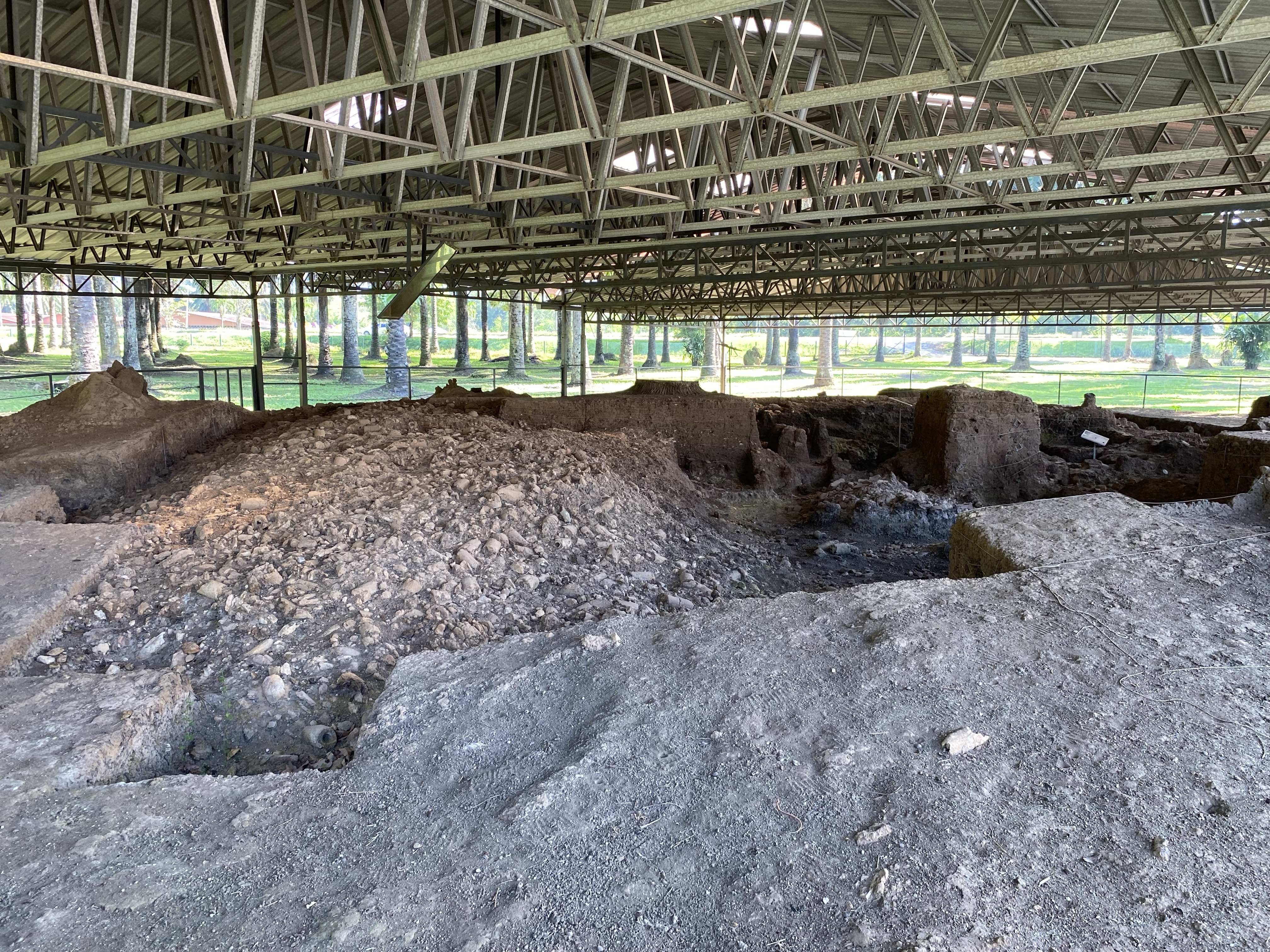
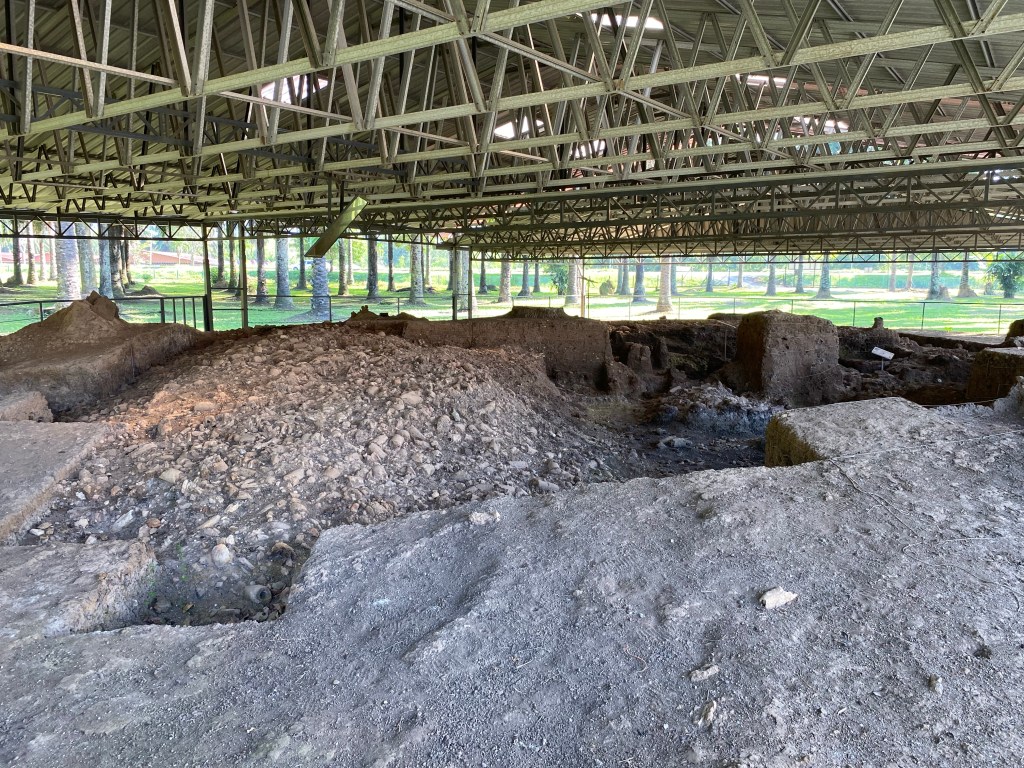
No ancient ships have ever been found, let alone seen. They had found an artefact, a nail, that could have been used on ships but could also have been used on other wooden structures. No excavation was ever done because they could not confirm if there actually are ancient vessels in the swampy area near the ancient riverside jetty. Excavations are expensive, and funds are also needed at other sites such as at Bukit Choras, some 45 kilometres to the north.
The four samples that were dated during Dr Mokhtar’s excavation in 2009 have been identified as outliers – in archaeology-speak, anomalies or aberrations. They were found among the hundreds of samples from one of 54 excavated sites, while the rest of the sites have been dated to around 2 CE when technologically-advanced dating was done in 2019.
Dr Mokhtar was still two years away from retirement, and should know about this as he was still the Director of the Global Archaeological Research Centre then.
When we started off with the discovery of the Sungai Batu sites in 2009, we were delighted that it was dated to 788 BCE. But 10 years later, with advanced technology, peer reviews and cross-references, this has now become 2AD.
Therefore, it is only prudent to save the other 43 sites for a future research using more advanced methods.
We are very proud of Dr Mokhtar’s discovery of the ancient iron-smelting area in Sungai Batu, but until new evidences surface we have to accept the reality that the area only became an industrial trading port after 1 CE, not 788 BCE.
Yes, there was an advanced Malay civilisation that was involved in a massive iron-smelting industry in the Bujang Valley, but that was 2,000 years ago, not 2,800 years ago, and they were certainly not linked to Mesopotamia.
The fact is that those ancient Malays were a tolerant, progressive and welcoming lot, allowing traders from the Indian continent to come trade, stay, and pray.
That is the spirit that we should all try to emulate in our quest of nation building.
(This article was first published by The Mole) and updated locally at 5.42pm, June 5, 2023).
Peninggalan puing berjuta relau beserta Tuyere di tapak arkaeologi Sungai Batu.Gambar ini diambil oleh penulis pada hari Ahad, 11 Jun 2023dalam lawatan ke tapak tersebut
Semasa penemuan bukti industri peleburan besi zaman prasejarah di Sungai Batu diumumkan pada tahun 2008, ramai orang begitu teruja terutamanya orang Melayu. Saya merupakan salah seorang daripada kumpulan tersebut. Malah, apabila dikhabarkan terdapat artefak yang ditemui yang ditarikhkan kepada tahun 788 Sebelum Masihi (S.M), ianya memberi gambaran suatu tamadun Melayu yang begitu hebat yang telah wujud lebih awal berbanding tamadun Rom. Malah, pentarikhan tersebut bermakna tamadun Melayu yang hebat ini telah wujud 1,600 tahun sebelum Candi Borobudur dibina dan 1,800 tahun sebelum Angkor Wat wujud.
Kemudian wujud pula di media sosial kisah-kisah dongeng yang diwujudkan bukan sahaja terhad kepada mengukuhkan bukti tamadun Melayu silam yang hebat seperti kisah Iskandar Zulkarnain, kisah perdagangan besi dengan Empayar Rom, tetapi penemuan candi-candi berkait dengan agama-agama benua kecil India juga telah melahirkan suatu kepercayaan bahawa ianya merupakan bukti Tanah Melayu ini dihuni terlebih dahulu oleh orang dari benua kecil India berikutan penaklukan oleh Raja Chola. Sejauh manakah kebenaran kepercayaan-kepercayaan tersebut?
KRONOLOGI PRASEJARAH TANAH MELAYU
Sejarah dan arkaeologi adalah merupakan disiplin-disiplin yang wajib dilandaskan dan diasaskan berdasarkan fakta, dokumen, penemuan sahih serta kajian perbandingan dengan lain-lain data, fakta, penemuan sahih di rantau ini. Ini kerana lain-lain rantau atau kawasan mempunyai garismasa kemajuan yang berbeza.
Garismasa kemajuan masyarakat Melayu kuno atau prasejarah meletakkan zaman Palaeolitik (Zaman Batu Lama) di Tanah Melayu di antara 1.83 juta tahun dahulu (melalui penemuan tapak Palaeolitik di Bukit Bunuh, Lenggong, Perak) dan 10,000 tahun dahulu (dengan penemuan Lelaki Perak juga di Lenggong). Pada zaman ini, orang Melayu Kuno masih menggunakan peralatan yang diperbuat daripada batu untuk berburu, mengetuk dan memotong daging.
Kemudian tiba zaman Neolitik (Zaman Batu Baharu) yang tiba sekitar 4,500 tahun dahulu. Di zaman ini, Melayu Kuno sudah pandai membuat peralatan daripada tanah liat seperti mangkuk, takal, gelang, manik. Mereka juga sudah mempunyai kepercayaan dan mengebumikan orang mati dengan cara lurus ataupun melunjur. Mereka juga tinggal di penempatan yang lebih kekal (gua-gua) dan berkemungkinan telah mula bercucuk tanam pada skala kecil serta membela binatang, berbanding cara nomadik masyarakat Palaeolitik.
Zaman Neolitik di Tanah Melayu tiba sekitar 4,300 dan 2,000 tahun dahulu, manakala di Sabah dan Sarawak pula ia tiba sekitar 3,000 dan 2,000 tahun dahulu. Masyarakat Neolitik pernah hidup di Gua Sagu, Kuantan, Pahang sekitar 885 S.M. Di Gua Dayak, Lenggong, Perak pula masyarakat Neolitik pernah tinggal di sana sekitar tahun 340 Masihi. Ini bermakna, sekiranya masyarakat Zaman Logam Sungai Batu sudah wujud dan berdagang hasil besi pada tahun 788 S.M, ianya berada dalam garismasa zaman Neolitik di mana masyarakat setempat masih menggunakan peralatan yang diperbuat daripada batu hingga 1,128 tahun selepas tahun 788 S.M.
Kita harus fahami walaupun Tamadun Yunani dan Lembah Indus telah lama menggunakan besi dan gangsa, ia tidak bermakna seluruh dunia turut lalui zaman yang sama. Sebagai contoh, zaman logam di Tanah Melayu bermula sekitar 2 Masihi hingga 5 Masihi. Ada pun gendang gangsa pernah ditemui di Sungai Tembeling di Pahang, Gua Harimau di Perak, Lembah Bernam di Selangor, dan di Batu Burok di Terengganu, kesemuanya ini merupakan gendang Dong Son yang datangnya dari Dong Son di Vietnam dan ditinggalkan oleh para pedagang sekitar 500 S.M hingga 500 Masihi.
Ada sebab kenapa Vietnam dan Thailand lalui Zaman Logam lebih awal berbanding Tanah Melayu dan Indonesia. Ini adalah disebabkan oleh laluan perdagangan Barat ke Timur tidak melalui Selat Melaka hinggalah sekitar 2 ke 3 Masihi. Ini merupakan garismasa Lembah Bujang menjadi pelabuhan perdagangan yang terkenal. Ini mungkin disebabkan penemuan bijih besi bermutu jenis Hematite dan Magnetite di kawasan tersebut.
Sebelum itu, perdagangan hanya melibatkan rempah ratus dan barangan tidak berat seperti tembikar. Maka, laluan pedagang adalah merentasi Segenting Kra. Hanya setelah perdagangan melibatkan hasil besi, maka Selat Melaka menjadi laluan kapal-kapal dagang.
Masyarakat zaman Neolitik masih wujud di Indonesia dalam zaman sejarah moden. Contoh, Pulau Enggano di barat Sumatra masih wujud di abad ke-19, manakala masyarakat Neolitik masih wujud di Papua, Irian Jaya dan di Pulau Sentinel di Lautan Andaman. Ini adalah bukti perkembangan dan pembangunan sesuatu zaman bagi setiap masyarakat mahupun sesebuah rantau.
PERDAGANGAN DENGAN EMPAYAR ROM, KETIBAAN ISKANDAR ZULKARNAIN, DAN LEMBAH BUJANG HASIL EMPAYAR CHOLA?
Di antara dakwaan yang berkitar di dalam Jaringan Sejagat termasuklah dakwaan bahawa Empayar Rom pernah mempunyai hubungan perdagangan dengan Lembah Bujang dan telah menggunakan besi yang dibeli dari lembah tersebut untuk membuat pedang dan perisai tenteranya.
Sepertimana yang telah diterangkan di atas, industri peleburan besi di Sungai Batu berlaku sekitar tahun 2 Masihi hingga 5 Masihi. Empayar Rom wujud sekitar tahun 753 S.M dan berakhir pada tahun 1453 dengan jatuhnya kota Konstatinopel ke tangan Bani Othmaniah di bawah Sultan Mehmed II. Namun, wujud perdagangan di antara empayar tersebut dengan India dan China. Peta yang dilukis oleh Ptolemy pada tahun 2 Masihi menunjukkan laluan dagang darat (Laluan Sutera) untuk ke Serica dan laluan laut untuk ke Qin. Perdagangan ketika ini melibatkan sutera dan bulu binatang.
Teks Yunani Períplous tis Erythrás Thalássis (Pelayaran Mengelilingi Laut Merah) yang ditulis pada Abad Pertama tahun Masihi menyebut bagaimana para pedagang sutera belayar hingga ke Tamala, sebuah bandar di Myanmar yang terletak ke Barat Laut Semenanjung Tanah Melayu, dan kemudiannya menyeberangi Segenting Kra untuk ke Teluk Siam dan belayar seterusnya ke pelabuhan utama Qin iaitu Cattigara (kini Óc Eo di Barat Daya Vietnam).
Ini membuktikan bahawa perdagangan timur-barat pada Abad Pertama tahun Masihi masih hanya melibatkan barangan yang ringan yang boleh dibawa merentasi laluan darat (Segenting Kra) seperti sutera dan bulu binatang. Maka, Sungai Batu masih belum wujud sebagai sebuah pelabuhan terkenal, dan Selat Melaka masih belum menjadi laluan utama para pedagang.
Bagaimana pula dengan Iskandar Zulkarnain?
Beliau dilahirkan pada tahun 356 S.M dan meninggal dunia pada tahun 323 S.M, iaitu sekitar 400 hingga 500 tahun sebelum Sungai Batu menjadi pusat perdagangan terkenal dengan industri peleburan besi.
Walaupun sekiranya Sungai Batu telahpun wujud mengikut pentarikhan asal 788 S.M, paling jauh pernah Iskandar Zulkarnain dan bala tenteranya sampai ialah di Sungai Hyphasis (kini Sungai Beas di Himachal Pradesh, timur-laut India) bilamana tenteranya telah lakukan dahagi kerana enggan untuk terus mara ke timur, dan memaksa Iskandar untuk berpatah balik ke Yunani. Maka, agak mustahil bagi Iskandar mahupun isterinya untuk pernah menjejakkan kaki di Sungai Batu dalam usianya yang singkat (sekitar 33 tahun sahaja).
Bagaimana pula dengan pengaruh Empayar Chola?
Kawasan Lembah Bujang hanya dipengaruhi oleh Empayar Chola semasa pemerintahan Rajendra Chola I (di antara 1,014 Masihi dan 1,044 Masihi), iaitu
1,000 tahun setelah Sungai Batu menjadi pusat perdagangan besi terlebur, dan Lembah Bujang sebagai pelabuhan utama di rantau ini.
Ketiadaan penemuan sebarang struktur besar seperti Angkor Wat, Borobudur, atau seperti di Mohenjo-daro bermakna sifat Lembah Bujang sebagai pelabuhan dagangan tidak berubah menjadi pusat pentadbiran sebuah kerajaan Hindu India. Sebarang candi yang wujud, sebagai contoh di kawasan Pengkalan Bujang dibina menggunakan batu-bata tanah liat dan bersaiz kecil. Pentarikhan struktur-struktur tersebut juga menandakan bahawa pembinaan struktur-struktur tersebut dilakukan lebih kurang dalam masa yang sama, iaitu sekitar abad ke 10-11 Masihi, lebih kurang garis masa pengaruh kerajaan Chola di Kedah.
Ini agak baharu sekiranya dibandingkan dengan Candi Bukit Batu Pahat yang terletak dalam lingkungan 10 kilometer ke barat laut Tapak Arkeologi Sungai Batu yang terbina sekitar abad ke 7 Masihi. Hanya Candi Bukit Choras di Kota Sarang Semut, sekitar 40 kilometer ke utara Tapak Arkeologi Sungai Batu dibina sekitar abad ke 4 Masihi, semasa industri peleburan besi di Sungai Batu sedang rancak.
Penemuan-penemuan di atas memberi kita kewarasan untuk membuat rumusan-rumusan seperti berikut :
adalah mustahil untuk masyarakat Melayu Kuno untuk menghasilkan jongkong besi pada tahun 788 S.M apabila masyarakat Melayu Kuno di kawasan tersebut ketika itu menjalani kehidupan bersifat Neolitik. Empat sampel yang pentarikhannya 788 S.M itu berkemungkinan telah dibawa dari luar.
pada tahun 788 S.M laluan pedagang dari Timur ke Barat adalah melalui Segenting Kra. Kedah belum menjadi pelabuhan terkenal. Tiada aktiviti perdagangan secara besar-besaran berlaku di Semenanjung Tanah Melayu sebelum Tahun Masihi.
teknologi peleburan besi ini besar kemungkinan dibawa dari luar, terutamanya dari benua India.
Raja/Ketua yang ada di kawasan Lembah Bujang telah menyediakan sumber manusia untuk menjalankan industri peleburan besi, serta industri-industri sampingan seperti pembuatan ketuhar peleburan dan Tureye, pembuatan batu-bata dari tanah liat, penyediaan makanan, dan tenaga buruh am.
Kehadiran candi-candi Buddha, Hindu, Animistik yang wujud sebelum kedatangan pengaruh kerajaan Chola di kawasan pesisiran laut lebih cenderung kepada membuktikan bahawa candi-candi tersebut disediakan oleh kerajaan yang ada pada ketika itu untuk menarik minat para pedagang luar, dan agama asing tidak banyak mempengaruhi masyarakat setempat. Ianya juga bukti masyarakat Melayu Kuno bersifat terbuka dan amalkan sikap bertoleransi.
KESIMPULAN
Kita tidak boleh menafsir sejarah dengan menggunakan emosi atau sentimen kenegaraan, keagamaan mahupun perkauman. Sudah tentu kita semua akan berbangga sekiranya wujud masyarakat Melayu Kuno yang maju pada tahun 788 S.M. Bayangkan pada zaman Kesultanan Melaka telah wujud satu bangunan setinggi menara Merdeka 118 sedangkan lain-lain bangunan di sekelilingnya diperbuat daripada kayu- hebat, tetapi tidak masuk akal.
Kita perlu menafsir sejarah menggunakan dokumen-dokumen, bukti-bukti nyata dan ketara, bukti-bukti yang disokong oleh lain-lain penyelidikan.
Sejarah adalah bersifat tidak menentu. Apa yang nyata pada hari ini bakal berubah apabila lain-lain bukti ditemui. 10,000 tahun dahulu manusia percaya bumi ini berbentuk leper. Penemuan abad ke-16 membuktikan bumi ini bulat. Sekian lama kita diajar bahawa Melaka dibuka sekitar tahun 1400. Pada tahun 2010, terdapat bukti kukuh Melaka dibuka pada tahun 1262.
Pada tahun 2008, kita digembirakan dengan berita wujudnya masyarakat Melayu Kuno yang maju di Sungai Batu sekitar tahun 788 S.M. Teknologi dan penyelidikan terkini pada tahun 2019 membuktikan bahawa tarikh tersebut sebenarnya ialah sekitar tahun ke-2 Masihi.
Itu bukti-bukti setakat ini. Mungkin dengan kewujudan teknologi yang lebih canggih di masa hadapan, apa yang kita ketahui hari ini juga akan berubah.
Remnants of at least a million smelting furnaces with Tuyere were found at this site alone at the Sungai Batu Archaeological Complex in Semeling, Kedah
THE Malay world burst with joy when the discovery of the Sungai Batu archaeological site was announced.
Imagine finding out that your ancestors were very technologically advanced 800 years before common era, 300 years before the birth of the Roman Republic that preceded the Roman Empire.
I was one of them.
Somehow, that finding did not fit into the larger picture. Other regional ancient iron smelting sites only existed around the first and second centuries of the common era – a difference of 1,000 years.
True enough, a study made 13 years after the discovery found that the sample dates inaccuracies were due to a small number of dating results used in the earlier analysis.
If that is the case, then whose iron-smelting technology was used? South India’s.
Sungai Batu was already a known international trading port by 2 C.E. Similar iron-smelting sites in Khao Sam Kaeo, Ban Don Phlong (both in Thailand) and Sriksetra (in Myanmar) were on the decline. Iron artefacts such as tools for iron-smelting found at Sungai Batu were not produced there.
They were brought there by the South Indian traders.
And the Malay Ruler of Sungai Batu must have provided the manpower for the iron-smelting industry, and had the candis built for the Hindu and Buddhist traders to attract them to the Bujang Valley.
This would explain the construction of the candis— same-sized clay bricks, and constructed at about the same time. They were constructed to provide a good climate for foreign investments. Investments enriched the nation and kept the people happy.
As for religion, the Malays were generally animistic. If, at all, there was any conversion, it was all at a low level where the workers were exposed to the foreign religions, or partook in rituals.
Perhaps the locals participated with the Hindu traders in reciting the Ganesha Sloka prior to commencement of work going ‘Vakra tunda Maha kaaya. Soorya-koti sama prabha. Nir vighnam kuru e Deva. Sarva-karyeshu Sarvadaa.’
There is no evidence that they were practising Hindus or Buddhist because there is an absence of any form of deities or structures from that era inland to support that hypothesis.
Up until about four decades ago, Malays still practised age-old animistic rituals such as invoking the spirits of the padi fields, and float little boats containing offerings for spirits of the sea (melayarkan Ancak) at the beginning of the Muslim month of Safar.
But what can we deduce and learn from all the above is that Ancient Kedah and its people were respectful, tolerant and open to new social and cultural practices; they were innovative and quick to accept and adapt to new technologies; it was also possible that Ancient Kedah thrived on multiculturalism as it was a melting pot, and this was the identity that was built in the Bujang Valley area.
Finally, Ancient Kedah was more of a confederation as opposed to the federation that we have now.
Each archaeological site existed because of what they had, but worked closely together to ensure that each of the Bujang Valley entrepôt thrived.
Forward 2,000 years, we have a federation of states that competes with one another economically.
The competitions could be healthy, but in some cases, they are not; we are a melting pot but we are not one. We respect and tolerate each other because the laws tell us to, not because we earn the tolerance or respect; and to make matters worse, we do not have innovation.
We have blueprints for our industries but they remain as blueprints. We have a 38-year old car industry that has not made it elsewhere; we have an aviation industry that came with the very first edition of LIMA, but we have yet to see even a light commercial aircraft being built.
We have a shipbuilding industry that has failed its customers a number of times, and still relies heavily on government bailouts.
Multinational manufacturing companies have left and are leaving our industrial zones.
Yes, there is a lot that we can learn from Sungai Batu. We still don’t know much.
The above is based on the most recent data and current findings. Sadly, there are so many other related sites that are not within the gazetted area that are being destroyed.
The government needs to step in in a more serious manner to preserve these sites, and the others as well.
More funding is needed to preserve and learn about our past, because although life must be lived forward, it has to be understood backwards.
If we do not understand our past according to the narrative based on facts and data, then nation-building and building of the Malaysian identity can never be fully achieved.
Gunung Jerai as seen from the ancient trading port of Pengkalan Bujang. 2,000 years ago this would have been a view of the sea.
IN the previous write-up the importance of a narrative conforming to the latest data and findings was highlighted.
The latest data and findings also have to fit into the region’s bigger picture. If, as in the joke mentioned, the Hindus had found a fibre optic cable beneath an ancient temple, a comparative study of the region’s historical development of that era should tell us whether or not that finding fits into the whole logic.
Therefore, it is important for us to understand the evolution of man and the technology they had in order to understand the intricacies of Sungai Batu.
Like the rest of the world, the people of the Malay peninsula had undergone several eras or ages of development.
The early Palaeolithic age began about 1.83 million years ago, and this finding was made through the discovery of a 3 sq. km. Palaeolithic site at Bukit Bunuh in Lenggong, Perak.
This early Palaeolithic age lasted till about 10,000 years ago. The stone tools associated with this era are mostly Oldowan assemblages that included pounders, choppers and scrapers, made mainly by the Homo Habilis and Homo Erectus species of archaic human beings.
These tools were improved to Acheulean assemblages during the Upper Lower Palaeolithic stage by the early archaic Homo Sapiens to include hand axes, and other stone tools that had the ability to skin and butcher game, as well as cutting of wood.
The Perak Man existed during the Upper Palaeolithic stage. The now-resident of the Lenggong Archaeological Museum was an Australomelanesoid who lived in the area 10,000 years ago.
It was during his time that Mousterian stone tools were refined and took pointed forms or have sharpened blades and were attached wooden handles, and were used for hunting and used as spears.
Then came the Neolithic age. The people of this age produced more complex tools and accessories such as earthenware, bracelets and other adornments. They have beliefs, customs and rituals.
Unlike their Palaeolithic ancestors who bury their dead in foetal positions, the Neolithic people bury theirs straight.
They live in more permanent settlements, and most probably were engaged in farming as well as livestocks.
According to archaeological studies, the Neolithic age arrived in Malaysia around 4,500 years ago.
In the peninsular, Neolithic settlements date back between 4,300 and 2,000 years ago.
In Sabah and Sarawak they were around between 3,000 to 2,000 years ago. In Perak, the Neolithic people who lived in Gua Dayak in Lenggong, Perak were there around 1,610 B.P (B.P is Before Present, with its base set in 1950 C.E or Common Era), and that translates to around the year 340 C.E.
The Neolithic people of Gua Sagu near Kuantan, Pahang were there around 2,835 B.P or 885 B.C.E.
This goes to show that the people of the peninsular were still in a Neolithic age, and the dating of Sungai Batu as a civilisation that were already into iron smelting to 783 B.C.E certainly does not fit into the bigger picture.
Therefore, iron smelting in the Sungai Batu/Bujang Valley area could have begun in the second century C.E as it did in other areas of the ISEA region.
The Strait of Malacca was also not a preferred trade route during that period.
East-West trade mostly crossed the Isthmus of Kra in Thailand to get to the other side.
Iron ingots could not have been traded back then as the weight would have been a hindrance for the overland travel.
The Strait only became a trade route after the first century C.E.
While Roman artefacts have been found in northern Vietnam and in China, they all dated after the first century C.E and some came from the Antonine period (between 96 C.E to 192 C.E).
Trade between Rome and the East mostly centred in India and China where silk and spices were sought from.
Alexander the Great (356 B.C.E to 323 B.C.E) only made it up till the Hyphasis river (now the Beas river) in India before his army mutinied, refusing to march farther east.
He never made it to Ancient Kedah.
Meanwhile, the area only came under the Chola dynasty influence during the reign of Rajendra Chola I (between 1,014 C.E to 1,044 C.E), more than a millennium after the existence of the Bujang Valley maritime polity.
Even then, the absence of any Cholan or large Hindu structure of the period to substantiate the claim of a major Cholan influence, or the Indianisation of Kedah. Even the famous Candi Batu Pahat was dated to the 6th and 8th Centuries C.E.
The decline of the Bujang Valley’s maritime importance was due to two main factors— one, the environmental and geomorphological changes to sea levels in the area.
The lowering of sea levels causing the sea line to recede further west rendered the areas of Sungai Batu and Pengkalan Bujang inaccessible to traders. It is possible that after the decline of maritime trade, the ancient Malays shifted their economic activity to agriculture.
Two, the decline of the Srivijayan empire and the rise of Melaka as an important trading port in 1262 contributed to the end of the role of Ancient Kedah and especially the Bujang Valley as an important trading port.
The above shows that it is virtually illogical for a Neolithic community in the Bujang Valley to have begun its Metal Age era while the rest of the area was still populated by Neolithic people.
It is illogical for the Roman Empire to have traded with Ancient Kedah for iron ingots in 783 B.C.E as the trade route did not flow through the Strait of Malacca.
It is illogical for Alexander the Great to have set foot in Ancient Kedah as his farthest advance was to a river in northern India.
And it is illogical for the Bujang Valley industries to have been part of the Cholan empire as it had existed 1,000 years before Chola’s Rajaraja I was even born.
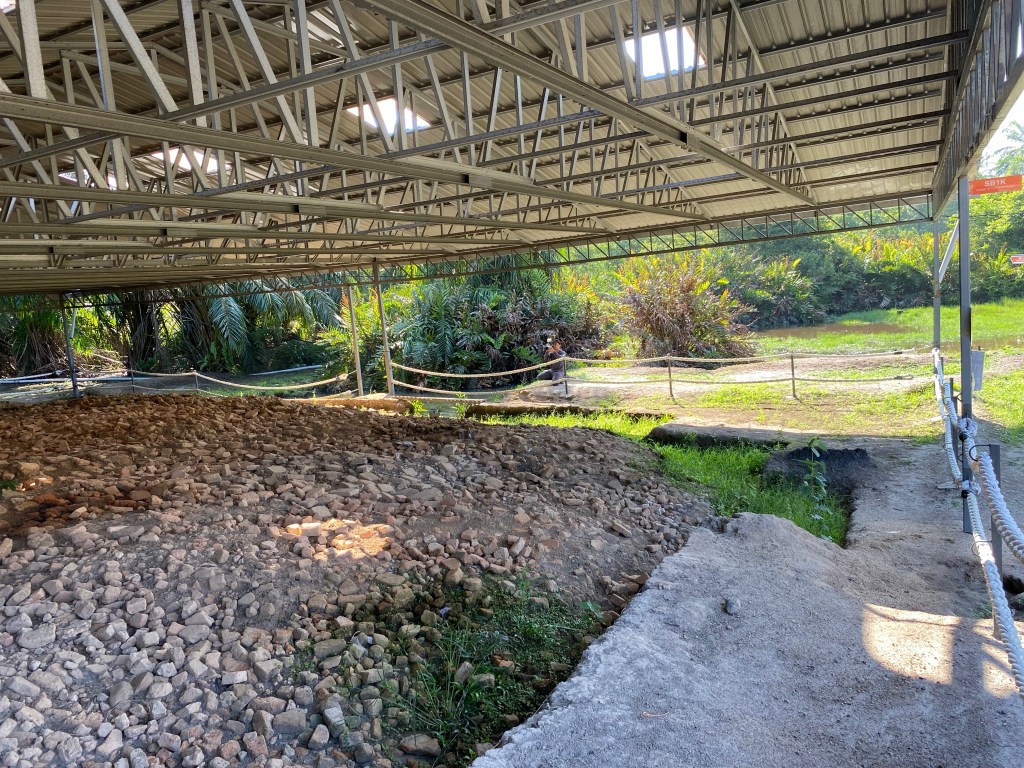
The ancient jetty at Sungai Batu was paved with clay bricks to withstand the weight of iron ingots transported to awaiting ships. This photo was taken on Sunday, 11 June 2023
THERE was a joke that went around at the turn of the century. It was about India and Pakistan’s quest for national and religious-identity supremacy.
The Indians wanted to prove that they have been superior in innovations since the dawn of time, started excavating inside an ancient temple. Three metres down, they found a fibreoptic cable. Stumped, by the unexpected discovery the Indian government’s spokesman quickly announced to the world media: the Hindus were the first to introduce Internet broadband.
Not to be outdone, the Pakistanis started digging inside their most ancient mosque. Three metres down, they found nothing. They dug deeper to six metres and still found nothing. The Pakistani government spokesman quickly announced to an anxious global media: the Muslims were the first to introduce wireless broadband.
Although the above is only a joke, it resembles the fantasy-filled narratives that have been flying around in the world wide web surrounding the discovery of the Sungai Batu archaeological site in 2008.
Although archaeology is often filled with romanticism, self/racial-pride, national pride, it has to be approached rationally. It is a science, and science must be backed by substantiated data, peer-reviews, comparative studies. It must fit into the general timeline. The chronology must fit. Sentiments and sentimental notions should be cast aside when dealing with history.
In the above joke, the discovery of a fibreoptic cable beneath an ancient temple does not mean that fibreoptic cable had existed before the construction of the temple began; the non-discovery of anything does not mean one can simply create a narrative just to prove that one’s national, racial or religious pride need to be boosted.
Since its discovery in 2008, Sungai Batu has been revered and referred to as, among others, a technologically-advanced Malay civilisation, a massive Hindu-Cholan settlement, a settlement of the soldiers of Alexander the Great. However, studies since then have proven that those narratives do not fit the timeline nor logic.
The problematic narrative first arose with the dating of an iron artefact to 783 B.C.E. This was when the notion that a technologically-advanced Malay civilisation had existed, pre-dating most known civilisation. The problem lies with the timeline. The rest of the region would still be in a Neolithic stage where people still rely on stone tools and earthenware.
Just like the claim of a Cholan conquest of Ancient Kedah does not fit any documented timeline.
While there is evidence of Buddhist-Hindu structures, it is doubtful that there were overwhelming number of Indians who lived there as a result of a conquest, nor is there evidence that the ancient Malays subscribed to any of the religion which had their structures there. There needs an understanding of the levels of propagation and acceptance of religions of the people, based and compared to the proven norms of that era.
Hence, a narrative for the civilisation of the Bujang Valley needs to conform to the latest data and findings. This shall be discussed in Part Two of this article.


 SeaDemon Says
You must be logged in to post a comment.