Malaysia’s Prime Minister Najib Razak also joined thousands in a rally at a stadium in Kuala Lumpur earlier this month to show his concerns regarding the Rohingyan plight as they continue to be massacred by anti-Islamic parties in Myanmar while the Myanmarese government turn a blind eye on Rakhine.
Malaysia’s Foreign Minister Anifah Aman also called for a meeting with his ASEAN counterparts to discuss the problem.
ASEAN ministers meeting on the Rohingya problem
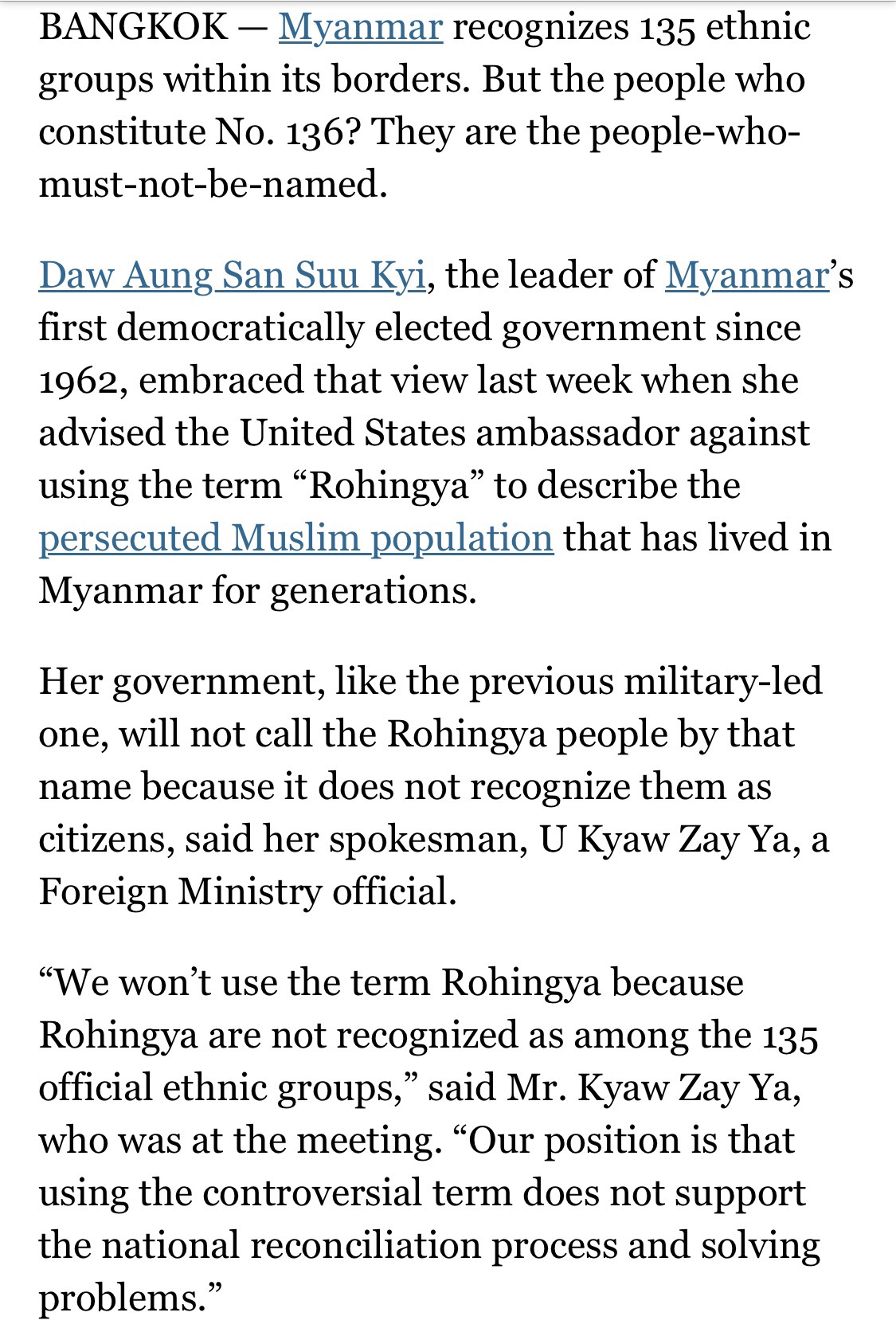
In attendance was Aung San Suu Kyi, the Nobel Peace Prize winner who has denied the rights of the Rohingya.
New York Times report on Aung San Suu Kyii’s refusal to address the Rohingya problem
Malaysia’s stand has won the admiration of many Rohingya in Malaysia and abroad. I met several in Saudi Arabia recently who said Malaysia’s stern voice has provided some relief to the Rohingya people in Myanmar.
One of those whom I met was Shah, a hotel cleaner who has lived in Saudi Arabia for the past 19 years. Although he has never been to Malaysia, he was singing praises as news from home said that the oppression has slowed down after Malaysia voiced out its concerns.
Shah the cleaner from Myanmar who is happy with Malaysia’s stand on the Rohingya issue
It is hoped that Malaysia would be able to get other ASEAN members to find a sustainable long-term solution to the problem and continue to be the voice for the Rohingya.
In another step for Malaysia into strengthening ties with its neighbours, the Royal Malaysian Air Force (RMAF) plays its part by strengthening its cameraderie with its Indonesian counterpart, the Tentara Nasional Indonesia – Angkatan Udara (TNI-AU).
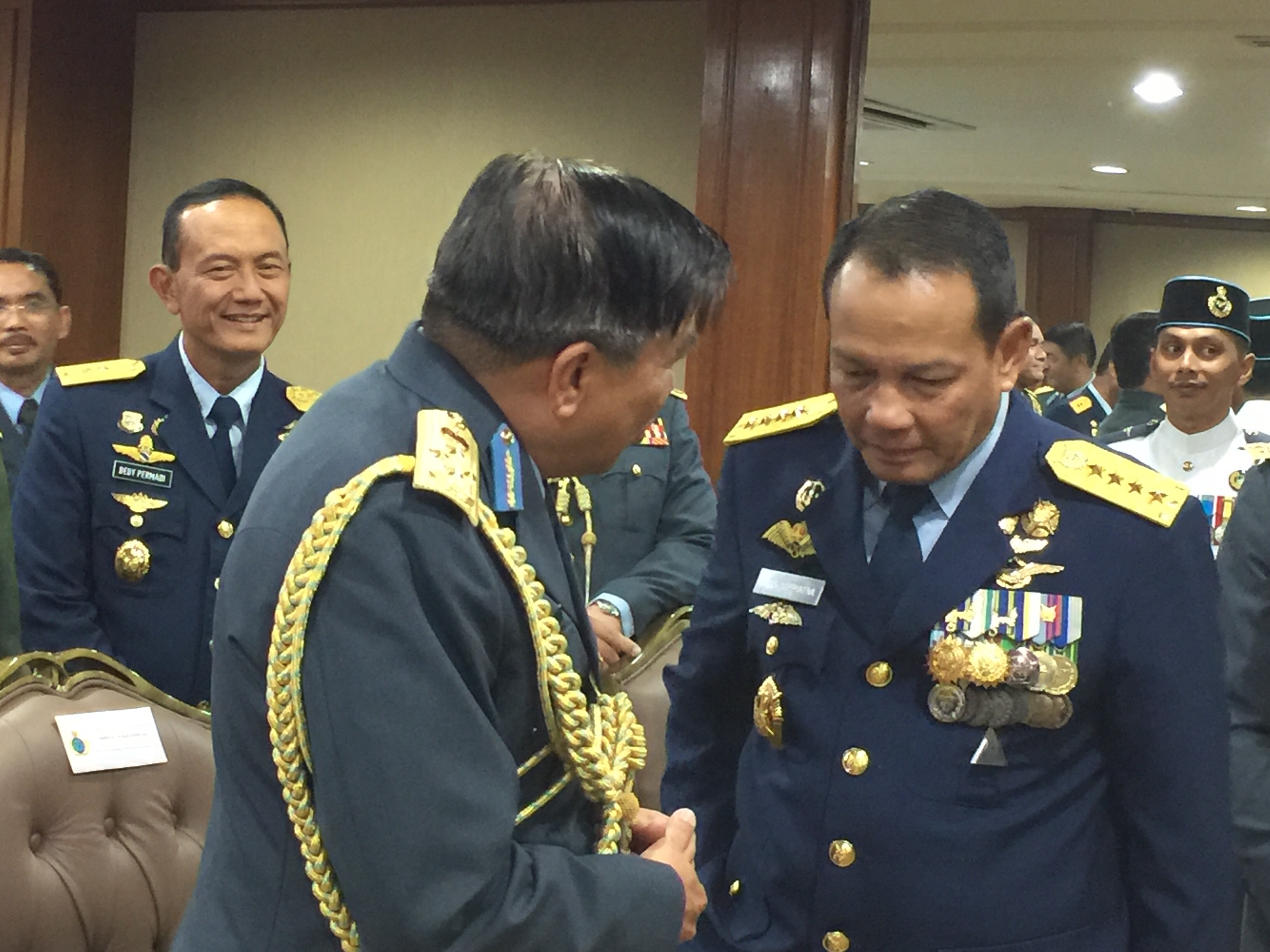
Seri Paduka Baginda Yang Di Pertuan Agong Almu’tasimu Billahi Muhibbuddin Tuanku AlHaj Abdul Halim Mu’adzam Shah Ibni Almarhum Sultan Badlishah as the Field Marshall and Commander-in-Chief of the Malaysian Armed Forces saw it fit to bestow upon the Chief of Staff of the TNI-AU, Air Chief Marshal Agus Supriatna, the honorary award of the Darjah Panglima Gagah Angkatan Tentera (PGAT).
To present the award on behalf of His Majesty was the Deputy Minister of Defence, Dato’ Sri Mohd Johari bin Baharum. The ceremony was held at the Ministry of Defence in Kuala Lumpur.
Air Chief Marshal Agus Supriatna saluting Dato’ Sri Mohd Johari bin Baharum after receiving the Darjah Panglima Gagah Angkatan Tentera
ACM Agus began his military career in 1983 and became a A-4 Skyhawk pilot from the No.11 Squadron based at the Lanud Iswahjudi Madiun (Iswahyudi Air Force Base) in East Java town of Maospati in the Magetan Province. He was promoted to his current post in 2015.
ACM Agus who is on a two-day working visit to Malaysia also paid a coutesy call to the RMAF Chief, General Tan Sri Dato’ Sri Roslan bin Saad TUDM at the latter’s office.
The ceremony was attended by senior officers from the RMAF, the Royal Malaysian Navy, the Malaysian Army as well as members of the TNI-AU delegation.
Good neighbours and brothers-in-arms: Chief of RMAF General Tan Sri Dato’ Sri Roslan bin Saad TUDM having a chat with his TNI-AU counterpart Air Chief Marshal Agus Supriatna at the Ministry of Defence
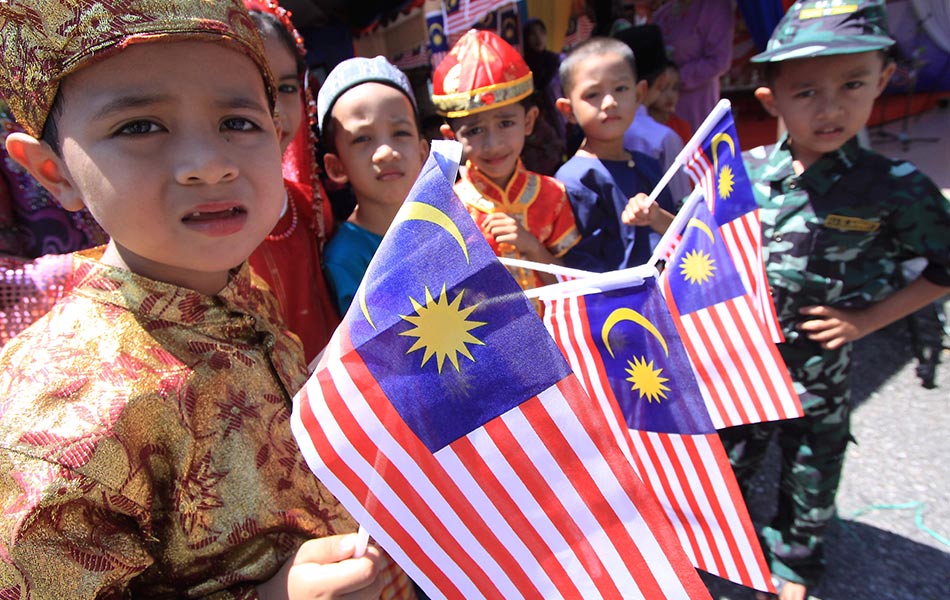
Children in different costumes holding the Malaysia flag – BERNAMAThis article is the last installment in a series on the Formation of Malaysia, and is a continuation from The Road to Malaysia: Part 3 – The Cobbold Commission.
“… there is no doubt about the wishes of a sizeable majority of the peoples of these territories to join the Federation of Malaysia.” (UN Secretary-General U Thant, 13th September 1963]
After World War 2, the British was economically and financially strained to maintain its colonies especially those east of Suez. It would be a matter of time before Britain would have to give up all of its colonies abroad, save for some of the smaller ones. The Cobbold Commission’s report agreed unanimously that a decision in principle should be taken by governments as soon as possible; that the new state should be called Malaysia; that the constitution of the Federation of Malaya should be adapted for Malaysia, instead of drafting a completely new one; that there should be no right to secede from Malaysia after merger.
Although the Tunku had asked the Malayan Commissioners to sign the report, he was still apprehensive about what “Malaysia” would do to his political position, and what kind of repercussions “Malaysia” would have on Malaya’s relationship with Indonesia and the Philippines.
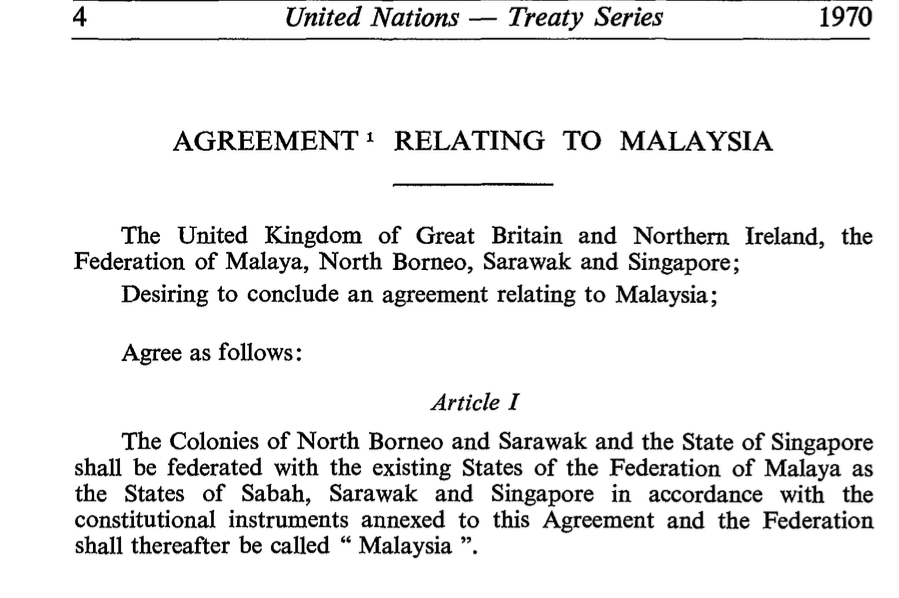
The Malaysia Agreement was signed on the 9th July 1963. Although not sovereign nor self-governing, the leaders of both North Borneo and Sarawak were invited to sign it. Annexed to the Agreement were a number of Constitutional instruments that included admission to the federation of the three former British dependencies; state constitutions for Sabah (as North Borneo would be called), Sarawak and Singapore; a scheme to compensate officers retiring from government service in North Borneo and Sarawak.
A separate legislation ending British jurisdiction in North Borneo, Sarawak and Singapore was enacted at Westminster. It did not provide for the separate independence of the three territories but transferred sovereignty to the new Federation of Malaysia (Commonwealth Relations Office and Commonwealth Office Briefs for Malaysia Bill, 1963 – Dominions Office DO 169/329). Therefore the self-rule given by the British to Sarawak on the 22nd July 1963 and the declaration of independence by Sabah on the 31st July 1963 were not a recognition of the independence of either Sarawak or Sabah, but an independence of the states in adherence to Malaysia (Ghazali Shafie’s Memoir on the Formation of Malaysia, p438). For all intents and purposes, both North Borneo and Sarawak remained as Colonies of Great Britain until the coming into operation of Malaysia.
If the appointment of a Chief Minister is to be taken as the point when independence had been achieved, Malaya would have been independent in July of 1955!
The late President Wee Kim Wee of Singapore, then a young Straits Times reporter, covered Sabah’s Merdeka Day and filed a report that, from all the obvious evidence, it was a declaration of independence within Malaysia.
The Malaysia Agreement referred to North Borneo, Sarawak and Singapore as Colonies.Malaysia Day was supposed to have happened on the 31st August 1963. However, several last minute events forced Malaysia Day to be postponed.
1) a last-minute interference by British officials prevailing upon Iban leaders to demand for the post of Sarawak Governor whilst also keeping the post of Chief Minister, thus reneging on an earlier understanding that for the first two years, the post of either the Chief Minister or Governor should go to a Malay if the other was given to an Iban. The Tunku was livid and decided that Malaysia would happen without Sarawak. All the cabinet ministers of Malaya except Tun Razak agreed with the Tunku. Through Ghazali Shafie, Razak negotiated with the leaders of Sarawak and in the end Abang Haji Openg was the Governor designate, Stephen Kalong Ningkan as the Chief Minister, and Temenggung Jugah as a Federal Minister in-charge of Sarawak Affairs. Had it not been for Razak’s persistence, the Tunku would have had things go his way and Sarawak would not have been in Malaysia.
2) the protest by both the Philippines and Indonesia at the United Nations against the formation of Malaysia. They requested that the UN secretary-general, or his representative, should ‘ascertain’ the extent of support in the Borneo territories for Malaysia, that observers from all three governments should accompany the UN mission, and that the formation of Malaysia should be postponed until the completion of the UN report.
Led by Lawrence Michelmore (the American deputy director of the UN Office of Personnel) the mission consisted of Argentinian, Brazilian, Ceylonese, Czech, Ghanaian, Pakistani, Japanese, and Jordanian members of the UN Secretariat. It was accompanied by observers from Indonesia and the Philippines—an arrangement which the British government grudgingly accepted. From 24th August to 4th September they held public hearings in widespread locations and reconvened in Kuching on 5th September, past the 31st August 1963 deadline. This forced Malaya to change the date for Malaysia Day to 16th September 1963.
The UN report, which was published on the 14th September, was generally favourable to Malaysia. In his assessment of the mission’s findings, U Thant was in no doubt that ‘a sizeable majority of the peoples’ wished to join Malaysia, although he also rebuked the Malayans for fixing a new Malaysia Day before the mission had completed its work. Even before the survey was finished, however, Indonesia and the Philippines were attempting to discredit it and, on its publication, they rejected the report and refused to be bound by its findings.
3) was of the PAS Government in Kelantan wanting the Malaysia Agreement and Malaysia Act to be declared ‘void and inoperative.’ Kelantan argued that the Act would abolish the Federation of Malaya, thereby violating the Federation of Malaya Agreement of 1957; that the proposed changes needed the consent of each state of Malaya and that this had not been obtained; that the Sultan of Kelantan should have been a party to the Malaysia Agreement in the same way as the Malay rulers had been signatories of the Malaya Agreement of 1957; that constitutional convention called for consultation with the rulers of individual Malay states regarding subsequent changes to the constitution; and that the federal parliament had no power to legislate for Kelantan in this matter.
On the 14th September 1963 the Chief Justice ruled that both the Malaysia Agreement and the Malaysia Act were constitutional (Tan Sri Mohamed Suffian bin Hashim, An introduction to the constitution of Malaysia (Kuala Lumpur, 1972) pp 13–14).
By 16th September 1963, we are all Malaysians.
Looking back, I remember an article quoting Tan Sri Abdul Ghani Gilong relating his experience visiting Kuala Lumpur on the invitation of the Tunku, he said:
“Kami naik kenderaan yang dipandu. Bagi sesetengah anggota delegasi saya, itulah kali pertama mereka menikmati air paip dan tandas berpam.”
“Kami dibawa ke beberapa tempat dan kampung yang sudah mendapat pembangunan seperti jalanraya dan sebagainya. Saya sendiri apabila balik ke Sabah telah berkempen menyokong penubuhan Persekutuan Malaysia dengan memberitahu kawan-kawan mengenai pembangunan yang ada di Malaya ketika itu.
Katanya satu kejadian lucu ialah apabila ada anggota rombongannya tidur di lantai dalam bilik hotel mereka dan bukan di atas katil yang empuk.
“Apabila saya nampak, mereka memberitahu saya mereka ingatkan katil itu adalah untuk ‘tuan’, seolah-olah hanya orang kulit putih boleh tidur di atas katil dan anak tempatan tidur di atas lantai sahaja.”
“Saya beritahu mereka katil itu mereka punya untuk tidur di atasnya.”
(“We rode on a vehicle that came with a driver. For some members of my delegation, that’s the first time they enjoyed tap water (running water) and flushing toilets.”
“We were taken to several places and villages that have received development such as roads and so on. When I went back to Sabah I campaigned in support of the establishment of the Federation of Malaysia by telling my friends about the existing development in the then Malaya.
He said that one funny scene was when there were members of his entourage who slept on the floor in their hotel room and not on their comfortable.
“When I saw, they told me they thought it was a bed especially for the ‘master’, as if only the white people could sleep on the bed while the local people sleep on the floor.”
Such was how inferior the people of Sabah and Sarawak felt of themselves before Malaysia existed, and it was not that long ago.
I believe that there has been progress that has been made in both Sabah and Sarawak although there should be more. When I was working offshore, most of my drilling and marine crew are from Sabah and Sarawak, especially the Ibans. My last Chief Mate is a Kelabit from Bario, while one of our vessels’ Captain is a Kedayan from Limbang. In my opinion, both the Merdeka Day on the 31st August and Malaysia Day on the 16th September are equally important to us. Without the 31st August 1957 event, Malaysia would not have happened and I shudder to think what ill-fortune would have befallen the people of Sabah and Sarawak, especially with China, Indonesia and the Philippines staking a claim in both the states.
I also believe that the current Federal Government is doing all it can to fulfill the promises made back in 1963, an uhill task given that previous Prime Ministers, especially a particular former Prime Minister for 22 years, did not do much for the people of Sabah and Sarawak.
Let us concentrate on nation-building, and put aside state-nationalism as that brings about nothing beneficial to any of us. And let us not let hatred destroy us. Our forefathers who agreed to form Malaysia did so following the democratic system, and not through violent nor nonsensical demonstrations or coups.
And let us remember the famous words by the great Temenggung Jugah ak Barieng:
“Anang aja Malaysia tu baka Tebu, Manis di pun, tabar Di ujung”
(Let’s hope Malaysia does not end up like a sugarcane. Sweet at the beginning, bland at the end)
In Vietnam, Laos and Cambodia the communists were making advances while the number of American servicemen in Vietnam tripled the number sent in 1950. In Indonesia, the influence of the Partai Komunis Indonesia on President Sukarno was strong. In Singapore, all the political parties except Singapore UMNO accused the PAP of having carried out negotiations to be merged with Malaya without first consulting the people. This gave ammunition to the communists in Singapore and their sympathisers to attack both Lee Kuan Yew and the Tunku.
In British Borneo, the communists and their sympathisers tried to intimidate the natives thinking that it would work as it did in Singapore. Truth be told, it had quite the opposite effect. Lee Kuan Yew observed that as in Singapore, those anti-Malaysia in Sarawak were the Chinese communists, chauvinists and their sympathisers, while in North Borneo, they were Chinese businessmen and Chinese who were under the influence of individual British officials who were opposed to the Malaysia Concept, or ignorant of it. Kuan Yew noted that the direct links between the Chinese in Perlis throughout Malaya and Singapore to the British Borneo are the Chinese newspapers. Hence, Kuan Yew suggested to the Tunku for the Chinese chauvinists be separated from the Chinese communists and the two groups should be separated.
Members of the Cobbold Commission arrived in Kuching in the morning of the 20th February 1962. The members were:
Sir Cameron Fromanteel Cobbold, former Governor of the Bank of England, also Chairman of the Commission of Enquiry,
Sir Anthony Foster Abell, former British Governor of Sarawak and the High Commissioner to Brunei,
Sir David Watherston, the last British Chief Secretary of Malaya,
Wong Pow Nee, the Chief Minister of Penang, and,
Ghazali Shafie, Permanent Secretary to the Ministry of Foreign Affairs of Malaya.
They were first brought to the Astana, a house that was built in 1870 by the second White Rajah, Charles Anthoni Johnson Brooke as a wedding gift for his wife, Margaret Alice Lili de Windt. It had been occupied by the British Governor since 1946. Ghazali Shafie could not help but notice a Jawi inscription at the entrance of the Astana left by one of the Brookes “BERHARAP LAGI BERNAFAS, (Have Hope While There Is Still Breath)” perhaps an apt motivation for the colonial officials who did not want Sarawak to be part of the Federation of Malaysia.
The Brookes had built the Astana on the northern bank of the Sarawak river because it was where the Malays were. The Brookes depended on the Malays for safety and security, the Chinese for prosperity and trading, while the natives were not entirely trusted. The same compartmentalisation was practised in Sarawak by the colonial officials after taking over the state from the Brookes in 1946.
The first groups of interviewees were interviewed in Kuching on the 21st February 1962. The first group amongst these interviewees was extremely pro-Malaysia. They were led by Abang Mustapha, Datu Bandar of Kuching. The second group was led nby Ong Kee Hui from SUPP. This group was against the special rights to be accorded to the natives of Sarawak unless if it is not stated in the to-be-formulated Constitution. This group had a contempt for the backwardness of the natives and had regarded their leaders as men of no consequences. This stand prompted an Iban by the name of Jonathan Bangau whom the SUPP had nominated as the party’s leader in Sibu to resign.
The next day, another group of Chinese in Kuching were interviewed. Their spokesperson, a Chinese woman, twisted and distorted events in Malaya into something truly hateful. She accused the Malayan Government of policies that turned very young girls into prostitutes and had labour laws that accorded workers not more than Ringgit 1.50 per fourteen-hour working day without holidays! When these allegations were countered by Ghazali and Wong Pow Nee, she informed the Commission that she had read the stories from Chinese newspapers to which Wong Pow Nee murmured that these must have been communist publications.
In Bau and Simanggang (now Sri Aman), banners and placards expressing anti-Malaysia slogans in Chinese characters plastered the town in anticipation of the Commission members interviewing residents there. The scene was different in Kanowit and Kapit. People shook the hands of the Commission members, especially the Malayan ones. One of the Tuai Rumah even held Ghazali Shafie’s hand as they walked through Kapit town. They were all awaiting the arrival of Malaysia!
However, Ghazali learnt that under the colonial administration the Iban had suffered oppression and suppression. This began when Sarawak was under the Brunei Sultanate and continued under the Brookes and subsequently the British. When they faced the Commission, they were all for Malaysia and some even emphasised on the need for a speedy arrival of better education and development for the Iban community.
At Binatang (now Bintangor), the division between the wishes of the natives and the Chinese was most prominent. The natives were all for the speedy arrival of Malaysia while the Chinese were divided into two groups: one favouring a referendum, while the other favouring a Federation of North Borneo, Brunei and Sarawak – a line maintained especially by the communists.
In North Borneo, the only negative views were given by the British officials and expatriates as well as the rich local businessmen. At this juncture, Ghazali noted that these British officials knew nothing or chose to disregard Harold MacMillan’s famous “Wind of Change” speech in Cape Town made on the 3rd February 1960.
Cobbold, not having any experience in dealing with the Far East, succumbed to the ideas of these officials that in his draft, he recommended that both the British and Malayan Governments should have executive powers over the British Borneo states for five years. Both Wong Pow Nee and Ghazali believe that the Malayan Government would never agree to perpetuate colonialism in any form. However, the two governments should discuss the matter should they want the British officials to stay on in Borneo in the service of the two territories. Wong Pow Nee quoted the state of Penang where he was once a Chief Minister to demonstrate the point that the British fears were groundless and that the Tunku, the Malayan people as well as the 70 percent who advocate the creation of Malaysia in the North Borneo and Sarawak would not agree to Cobbold’s suggestions as it would still be a form of colonialism. What more that the communists in Malaya, Singapore, Indonesia, China and the Soviet Union had branded the Malaysia Concept as neo-colonialism. Interesting also to note here is that in April 1962, the Philippines House of Representatives had made a formal claim on North Borneo. On the 20th January 1963, Drs Subandrio, and alleged communist and also Sukarno’s Foreign Minister and Second Deputy Prime Minister announces Indonesia’s “confrontation” towards Malaysia.
In the end, on the 31st July 1962, Prime Minister Harold MacMillan told the Malayan delegates that Her Majesty’s Government was just as anxious to see Malaysia succeed. Soon after, an Inter-Governmental Committee (IGC) was set up by the Malayan and British Governments that would include the North Borneo and Sarawak Governments. On the 12th September 1962, the North Borneo Legislative Council adopted the following motion:
“Be it resolved that this Council do welcome the decision in principle of the British and Malayan Governments to establish Malaysia by the 31st August, 1963…”
Then on the 26th September 1962, the Council Negri of Sarawak adopted the following motion without dissent:
“This Council welcomes the decision in principle of the British and Malayan Governments to etablish Malaysia by the 31st August, 1963…”
The Federation of Malaysia that would include the Federation of Malaya, North Borneo and Sarawak was to come into operation by the 31st August 1963. All in all, the IGC made recommendations in its report pertaining to the States’ Constitutions, legislative powers, financial provisions, elections, the Judiciary, public service, citizenship, immigration, religion, education, the National Language, status of existing laws, the position of the indigenous races and transitional arrangements prior to the formation of Malaysia.
North Borneo was thoroughly satisfied with the IGC report and the North Borneo Legislative Council unanimously adopted the Report on the 13th March 1963. The Sarawak Government was satisfied and considered that the Report contained “generous terms of safeguards for Sarawak.” Stephen Kalong Ningkan as the Secretary-General of the Sarawak Aliance said that his party “fully endorses the Report.” Leong Ho Yuen, the Vice-Chairman of the SUPP said: “All in all, the Report is quite satisfactory. Though we cannot get all we asked for, at least we have been given a high percentage.” The Sarawak Council Negri voted unanimously to adopt the Report on the 8th March 1963, five days before North Borneo.
Donald Stephens who was the Chairman of the Executive Committee of the North Borneo Alliance said: “The whole of North Borneo will now welcome with joy the creation of Malaysia.”
Tomorrow, on Malaysia Day, we shall look into the self-rule granted to the State of Sarawak and why was Malaysia formed on the 16th September 1963 instead of on the 31st August. We will also look at what was said by those who were involved in parts of the process.
Heavily-armed group of men wearing black crosses the Strait of Melaka in twenty speedboats at night from the island of Rupat, 50 kilometers from the coastal town of Port Dickson. Travelling at 36 knots it takes them just 47 minutes to reach the Negeri Sembilan shores. Most land at the beach in Pasir Panjang to distract the security forces while three land at the town itself. Sending a group of armed men with suicide bombers hitting the waterfront cafes, the rest making for the refinery and power station in cars provided by sleeper agents. Being an insurgency or homeland security in nature, the OCPD could only declare the area as an emergency area but lacks the resources to combat them. He could not readily ask for the assistance from the various army units located there without having to go through the red tapes. Stretched thin in terms ofmanpower, there is very little that the police could do.
Scenario Two
The Chief Minister of Penang (whomever that may be) with members of the Penang State Executive Committee holds a function in the vicinity of Weld Quay. Several heavily armed men emerges from an abandoned building across the road and randomly fires into the crowd. Two of them managed to get close to the podium before blowing themselves up.
When two rival gangs got involved in a quarrel that culminated in a grenade-throwing incident in Bukit Bintang in October 2014, I went on air to discuss the matter and registered my concerns about the possibility of terror attacks in Kuala Lumpur and how real they could get. The attack in Puchong by Daesh sympathisers underscores this concern and shows that the police cannot cover everything.
Scenario One above is an enhancement of two actual events that took place in Sabah – both in Lahad Datu in 1985 and in 2013. In 1985, a group of 15-20 armed men from the Philippines robbed the Chartered Bank and Malaysia Airlines office in Lahad Datu. These men fired randomly at onlookers killing at least 21 people and injuring 11 others. The outnumbered and outgunned police sought help from the nearest military unit but were told that it was beyond them as the incident was a robbery and not an invasion. In 2013, a group of heavily armed men landed at Kampung Tanduo and started what was known as the Lahad Datu stand off. Insurgency by nature, the military was not made involved until after several policemen were killed.
Several years ago the police stopped three youths in Johor Baru from carrying out a suicide mission at the Causeway. When the police questioned one of the youths on the reason for wanting to blow himself up, the latter replied, “I would go straight to heaven, I could pick ten of my family members whom I would want to be in heaven with me, and I would get 72 virgins.” When asked what would he do with these 72 virgins he simply replied, “I don’t know.”
He was 13 when arrested, had no idea what he was doing but he thought what he was about to do would do his religion, him and his family a lot of good.
In times like this, the traditional school of thought where “terrorism is a network where one cell controls other cells” no longer applies. No longer does the body wither when the head is taken off. The terrorism of nowadays only needs likeminded people who share the same interest, ideology and wavelength. No longer do you need so many people to conduct a terror attack – and at times, lone wolves obsessed with the lunacy of the “teachings” would be enough to drive someone to blow himself up in the name of religion.
Th recent arrests of Daesh-related operatives in Batam whom had planned a rocket attack on the Singapore CBD shows how dangerous these pockets of terrorists are. They are totally detached from what is considered as the main body of Daesh. All it takes for the network to expand and work are social media and phone apps.
The Batam raid succeeded because intelligence agencies from Indonesia, Malaysia and Singapore have been sharing information on known and known-potential terrorists in the region. What all agencies fear are those who enter the country undetected through rat-holes in the borders, as Federal police Special Branch Counter-Terrorism Division (SB-CTD) principal assistant director Datuk Ayob Khan Mydin Pitchay said it would be harder to detect them as “we wouldn’t know whom to look for and where.” And with limited resources and men, it is not possible to keep every target in sight.
The recent grenade attack at the Movida Bar in Puchong is evident.
Perhaps the timing is just right that Datuk Seri Mustafar Ali is made the Director-General of the Immigration Department. One of the most dedicated senior officers of the Malaysian Anti-Corruption Commission, Mustafar would be able to clean the department up and help plug the holes at our borders.
Ayob Khan’s men and women are working continuously round the clock monitoring the Internet traffic and keeping tab on known Daesh sympathisers. With the coming into force of the National Security Council Act, 2016, his men would have a better legal backing to combat terrorism and prevent terrorist attacks in the country. The new Act would allow all resources to be deployed without having the present red tapes preventing instant cooperation and coordination between agencies.
Without which, Malaysians cannot have a normal life – no shopping in peace, no weekend dinner and drinks with friends and family. Our way of life, as we know it, would simply be disrupted.
It is a Ramadan and a bleak Syawal for the former workers of JVC Kenwood at Section 22 Shah Alam as the factory ceases its operations as reported by The Rakyat Post above. I am sure the decision to cease operations must have been made much earlier than just a few months or a year ago as any plant closure affects production as well as support services.
Many were too quick to blame the Federal Government as according to them investments come under the purview of the Federal Government. Many however forget that investments in a state comes under the purview of the respective states’ economic development council or committee.
Does the seemingly bleak economy (despite the A- rating by Fitch) have any role in the closure of the plant? Let us examine:
Now it seems that TASCO had come into a sales and purchase agreement with JVC Manufacturing Malaysia Sdm Bhd for the purchase of the said property in 2009. This is a year after Pakatan Rakyat took over the state from Barisan Nasional. Six years on, it seems as if the Selangor SEDC had done nothing to persuade JVC to maintain a plant in Selangor. Why so?
It is easy to put the blame on the Federal Government. However, JVC has been cutting back its workforce not just in Malaysia but worldwide.
“They told us that the factory operations were moving to Thailand,” said a worker.
It was reported last year that JVC had cut its workforce globally by 14% to just under 20,000 people and about 90% of production now took place mostly in Indonesia and Malaysia.
Checks on jobstreet.com have shown that JVC is still hiring staff for its Tampoi plant in Johor.
Similarly, a few metres away from the JVC plant, Ansell Malaysia Sdn Bhd’s operations have also ceased and its workers were retrenched yesterday. The Australian company made healthcare protective gear.
A worker on site said: “They are moving their operations to Melaka. They have already told us about this six months ago and compensation was also paid out.”
Therefore, we are seeing a move out of Selangor not just by JVC but also by other foreign companies as well, unless Melaka and Johor are not in Malaysia, or that these states are not affected by the “slowdown” in the Malaysian economy.
Maybe it is the hard work that Johor’s and Melaka’s SEDC have put in to ensure that foreign companies do not divest, unlike Selangor’s that was not able to or did not talk to JVC when the sales and purchase agreement was made six years ago.
Maybe Selangor has lost the edge it once had when it was still governed by Barisan Nasional.
Malaysian authorities dig up mass graves along the Malaysian-Thai border near Wang Kelian, and the cartoon published by Nation News of Thailand (pic by Siakapkeli.my)
The Nation recently ran a cartoon that made fun of Malaysia in light of the recent discoveries of human-trafficking camps with mass graves of Rohingyas. The cartoon was picked up by an AFP correspondent based in Malaysia, Parameswaran Ponnudurai., and was subsequently highlighted by The Malaysian Chronicle. It is all well and good for Thailand that the remains of the Rohingyas as well as the camps are mostly found on this side of the border, not that they do not have any, mind you. The Thais should also remember that while Malaysia and Indonesia have agreed to take in 7,000 of these refugees, Thais have adamantly refused to take in any.
Setelah menerima arahan Perdana Menteri Datuk Seri Najib Razak, Tentera Laut DiRaja Malaysia mengerahkan lima buah aset permukaannya untuk memberi bantuan kepada pelarian Rohingya serta melakukan operasi mencari dan menyelamat selebih pelarian Rohingya yang masih berada di laut dan belum ditemui. Di dalam satu sidang akhbar yang telah diadakan petang tadi, Panglima Tentera Laut Laksamana Tan Sri Abdul Aziz Jaafar TLDM menegaskan bahawa kelima-lima aset tersebut yang terdiri dari KD Mahawangsa, KD Selangor, KD Laksamana Muhammad Amin KD Ledang dan KD Jerai telah diarahkan untuk memberi bantuan sewajarnya seperti yang telah diarahkan oleh Majlis Keselamatan Negara (MKN).
KD Jerai, kapal penyapu ranjau TLDM yang turut serta dalam misi bantuan kemanusiaan untuk pelarian Rohingya – gambar TLDMKrisis pelarian Rohingya telah menyaksikan kematian beratus jika bukan beribu pelarian akibat pelayaran yang mengambil masa lebih tiga minggu untuk tiba di perairan Thailand, Malaysia dan Indonesia. Hanya Malaysia dan Indonesia sahaja yang telah memberi persetujuan untuk memberi perlindungan sementara kepada 7,000 orang pelarian, sementara Thailand akan menghentikan penundaan semula ke laut bot-bot yang membawa para pelarian tersebut. Menteri Luar, Dato’ Sri Anifah Aman menegaskan para pelarian tersebut perlu dihantar pulang dan diberi penempatan tetap dalam masa setahun dengan bantuan kewangan daripada masyarakat antarabangsa.
Bagi TLDM dan kerajaan Malaysia, ini bukanlah julung kali ianya terlibat dalam misi bantuan kemanusiaan untuk kaum Rohingya. Pada bulan September 2012, kerajaan telah menggunakan kapal KD Indera Sakti untuk menghantar sebanyak 480 tan barangan keperluan seperti makanan, ubat-ubatan serta keperluan harian lain melalui pelabuhan Sittwe, Myanmar.
It is interesting how time and time again we, our ASEAN neighbours included, vote in or root for people who are popular rather than people who can actually do the job. The Philippines had Cory Aquino, Eric Estrada; Indonesia had Gus Dur (Abdurrahman Wahid). In Malaysia, we have people rooting for Anwar Ibrahim despite the comical and absurd nature of his “struggle” to become a Prime Minister come what may. What is more absurd and even funnier was the populist campaign designed by Najib Razak’s consultants to paint a popular image of the incumbent.
And that failed badly.
So, what do we Malaysian people actually want? Someone who wins on a big popularity ticket, or someone who can actually work, proven to have truly serviced his/her constituency and not just offer lip service?
Indonesia now has Joko Widodo. See one person’s observations of him before and after the elections and see how the same reflects many politicians here in Malaysia.
The apex court of Malaysia, the Federal Court, has ruled in favour of the Appellate Court to deny the Christian Herald Weekly the use of “Allah” in its articles instead of “God” or “Lord”. Four out of the seven bench members voted to uphold the ruling by the Appellate Court while three dissented. While many jumped saying that it was an unfair decision, I did not see one person noting that one of the dissenting members is a Malay and a Muslim.
The ruling brings to a closure a divisive episode that began in 2006 that led to several unnecessary reactive incidents in early 2010 due to a High Court decision in favour of the Christian Herald Weekly. While BigDog argues that the apex court’s ruling upholds Articles 3(1) and 11(4) of the Federal Constitution, many think that it is their right to use Allah in reference to God.
Let me quote what was said as part of the judgment delivered:
‘The usage of the word Allah is not an integral part of the faith in Christianity. The usage of the word will cause confusion in the community.’
Many including outsiders such as Francis X Clooney SJ in his article entitled “Is Allah Not Our God? – America Magazine (Catholic) tried to argue for the Catholics in Malaysia without understanding the history behind this ruling and how Articles 3(1) and 11(4) of the Federal Constitution came about.
Perhaps, I may need to point out to Mr Clooney as well as uninformed Malaysians that while in the Peninsular Malaysia the use of Allah and several other words are regulated by various laws, they are not regulated for use in the Sidang Injil Borneo’s Bibles for the people of Sabah and Sarawak. Even in Indonesia some Christians use “Allah” – and this is all due to historical reasons.
In my blog post entitled The Case For God, I wrote about the history of the usage of “Allah” in Christian literatures:
Let us remember one thing. Malaya (Peninsula Malaysia) was never colonised as a whole by the British, save for Penang, Malacca, and Singapore, while Sabah and Sarawak came under direct British colonial rule. Penang was acquired through a deal to lease the island made between the British East India Company and the Sultan of Kedah; Malacca was acquired from the Dutch through the Treaty of Bencoolen; and Singapore was included in the Treaty of Bencoolen by making the severely weakened Dutch to not object to the British occupation of Singapore. The people of these three places, together with Sabah and Sarawak, became British subjects.
Through treaties with the Sultans on the Peninsula, the British helped administer the State of the respective Sultans, while the Sultans remained as the supreme head of these sovereign states. The administration of Islam came under the purview of the respective Sultans as the protectors of the state’s religion.
So, why does Indonesia have Bibles that use the word Allah to describe God?
Unlike Malaya, Indonesia was a nation of conquered people. Hello! Remember the Dutch? When Douglas MacArthur met Emperor Hirohito, he purposely stood next to the Emperor to show the Japanese people that the Emperor was not a demi-God. Victors get to do as they please, and this is probably the same case as the Ladang Rakyat issue in Kelantan. The Dutch conquered parts of Indonesia beginning in 1595, and as part of its attempt to call the Malay diaspora in Indonesia to Christianity, the Book of Matthew was translated into the Indonesian language in 1629; and where the Dutch set foot, other religions were formally prohibited although Chinese temples as well as mosques remained in existence.
Missionaries, too, made headway in Sabah and Sarawak, converting the populace to Christianity. Sir Stamford Raffles recommended to Rev. Thomas Raffles (Buitenzorg, 10th February 1815, Mss. Eur. F.202/6) that Borneo be given vigorous campaigns by the missionaries as “the island is inhabited by a race scarcely emerged from Barbarism.”
This does not mean that the Malays were free from attempts to proselytize them. In fact, Raffles, in a letter to his cousin in 1815 mentioned how “Religion and laws are so united” in Muslim dominated areas that the introduction of Christian beliefs will bring about “much mischief, much bitterness of heart and contention”.
Raffles contended that Christianity must be packaged in a new form and be conveyed to the Muslim majority through a gradual approach. The “pagans”, on the other hand, required no stratagems. His methods include the establishment of missionary schools where the Malays are taught to read and write in their own language. Then he set up printers to publish books in Malay. Missionaries were largely responsible for this effort with the help of local agents, and the most famous of these agents was a chap called Abdullah Abdul Kadir who is better known as Munshi (Teacher) Abdullah. He and other Munshis taught Christian missionaries the Malay language. His role went beyond that and became the first Muslim in South East Asia to translate the Bible into the Malay language, that he became the target of his contemporaries who called him Abdullah Paderi (Pastor Abdullah) among other things.
It is interesting to note, however, that Raffles never once attempted to convert Malays in the Federated and Unfederated Malay States where the Sultans rule and guard the interest of the religion of Islam. This is because it would be foolhardy to anger the Sultans whom the British had a treaty with, by undermining the sanctity of Islam by converting their subjects. In the case of Raffles, he only focused his efforts on those who are British subjects.
Here we see the subtle tactics of the Christian missionaries during Raffles’s times, and the Malay lackeys who colluded with them. We can see the similarities in events of nowadays. But the above is also why we have Allah in the Bibles of Indonesia and Sabah and Sarawak, but not in Peninsula Malaysia.
And the above continues to be protected and respected in Sabah and Sarawak by the 10-point agreement which also includes the immigration right to refuse entry to any undesirable persons that the Opposition has said is a violation of their rights.
What does the above history have to do with modern-day Malaysia where history should or suggested be forgotten?
In my later post entitled The Case For God – Part 3 I wrote about the attempts to proselytise Muslims which is in contravention of the Federal Constitution:
As mentioned in the previous installment, too, I find the argument that Allah is the common denominator for God in this region a joke. The common denominator in the Indo-Malay speaking world would be Tuhan instead of Allah. However, Allah is the term that is inside the Quran for as long as time can remember. I cannot say the same for the Bible as it no longer reflects the Old Testament. Anyhow, you cannot find the name Allah inside the Old Testament. Just a Hebrew name that does not even resemble both the Arabic and Roman spelling of Allah. Even so, Elohim as called by the Jews, refers to The God that has no Son, nor an equivalent called the Holy Spirit. Mind you, even the Jews are totally against the concept of deifying a human being. I am sure my wife’s Iban relatives who are Christian would understand the term “Tuhan” without any problem since Bahasa Malaysia is derived from the Malay language, and the term for God in Malay is Tuhan.
We have seen the subtle tactics of missionaries of those days in the first installment and how their modus operandi is now refined by present-day missionaries. This blogger had had the opportunity to meet up with Muslims proselytized during the month of Ramadhan of 2012 and was told of the very fine and subtle methods used to proselytize Muslims in Malaysia. Back in the late 19th and early 20th century, the Malay people were not only bombarded with the Malay Bible, but also Christian publications in Malay such as Buletin Ariffin, Cermin Mata, Sahabat and Warta Melayu. Little has changed, but made only better. Recently, Johor’s Department of Islamic Affairs, together with the Home Ministry, confiscated 250 Christian literature in the Malay language. Imagine these books having titles such as Kaabah, Mengenal Rasul and Wahyu Illahi. With the state of Johor having around 58 percent Muslims, 2 percent Christians, and 40 percent other religions, who were these Malay literature targeting? Ibans? Christians? Chinese? Read more about the attempt to proselytize Muslims in BigDog’s post.
So, what about the use of Allah by Christians in Indonesia, Egypt etc.?
Tell me how good has that been for Indonesia and Egypt? How well do the Muslims and Christians get along in those countries? The very reason we do not have beheading of Christians in Kelantan or lynching of Muslims in Sarawak is because we do not step on each others toes.
When the Turks charged at the British lines during the Battle of Gallipoli, they cried “Allahu Akbar.” The British soldiers retorted, “Come and get your Allah here!”
If the same British soldiers are here now, they would be utmost disappointed that the Christians in Malaysia now want to accept Allah – the name of the God they believed to be false – as the special noun to replace the word “god”.
Why am I still on this issue? Some lawyers now say whatever decree the Agong issues, is not binding for non-Malays and non-Muslims.
Fine. The Malay Rulers may not have intrinsic powers left apart from dissolving or withholding a cabinet or state assembly, appoint a Prime Minister or a Menteri Besar, and protect the religion of Islam and Malay customs. I shall not dwell too deeply into this but my friend SatD has written a very good piece on this in his blog Pure Shiite.
What is most important is that when the Selangor Islamic Religious Department (JAIS) confiscated those Bibles containing the special noun “Allah”, they were acting on the provisions of Section 9 of the Selangor Shariah Criminal Enactment which prohibits the use of 25 or so Islamic words and nouns in non-Muslim publications. You will be committing a crime merely by having one in your house or car, let alone propagate one to a Muslim (or more).
What does the Shariah enactment have to do with non-Muslims, you may ask. Everything! It is NOT an Islamic law, it is a State law! Actually, it is a State Criminal Law! And a state criminal law applies to all be they Muslims or otherwise. And it is a STRICT LIABILITY law! Like I said, you have one, you break the law!
You constitutional law sexperts may also argue that the law is unconstitutional. It may be so. But it is the state law until and until a Constitutional court decides otherwise.
Oh, cry foul all you want and claim that the Apellate Court judges were all Malays. This is the part that I do not understand. All these challenges to the decision of the Apellate Court may be a norm to some of you common criminals and petty lawbreakers; the judges may not even hazard to act against them but the person who should be taking action, the Attorney-General, should. It is in contempt of a court ruling. What does that tell me, a layman? The A-G is simply useless for allowing lawlessness become a norm.
When Muslims cry foul to the Christians saying that “Allah” is an integral part of Islam, it is because the concept of trinity is an antithesis of the “Oneness” of Allah. The special noun refers to The God, One and Only God. Not a God that needs a trike to be able to “stand.”
The Christians lashed back saying that the Muslims should not tell them what is integral and what is not to them, saying that Allah is integral to the Christians. Else why quarrel over the special noun?
The word “integral” means something that if not present, does not complete something. Like tyres to cars.
Let me ask them this: if “Allah” is integral to the Christian faith, does this mean that the Popes, for 2,000 years, all the way from St Peter Petrus, have gotten it all wrong?
Maybe those adamant to use the special noun “Allah” can now shout to the Pope to come get his “Allah” here.








 SeaDemon Says
You must be logged in to post a comment.