
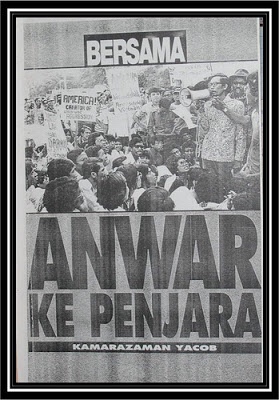
STUDENT activism in Malaysia peaked in December 1974, having started in September of the same year in Tasek Utara, Johor Bahru, when some 5,000 students demonstrated at the Selangor Club Padang (now Dataran Merdeka) and as expected, clashed with the Federal Reserve Unit (FRU).
As a result, the students retreated to Masjid Negara with the FRU hot on their heels. The demonstration was culled and 1,128 students arrested. The student leaders who were holed up on the University of Malaya campus were soon arrested and so were those who hid inside their rented rooms in nearby Kampung Kerinchi.
Three representatives of Kampung Kerinchi complained that the FRU had taken harsh measures to apprehend the students by firing tear gas and that had resulted in the death of a baby.
My father immediately summoned his then deputy, the late Tan Sri Mahmood Yunus, and then Director of Special Branch, the late (Tan Sri) Mohamed Amin Osman, and asked them if the FRU had indeed fired tear gas into Kampung Kerinchi. Amin was adamant the FRU did nothing as such.
When asked if he (Amin) had checked the allegations himself and also the report received from the FRU troop leader, Amin said no. So my father instructed Amin to go to Kampung Kerinchi to check himself.
“Celaka! Depa tipu saya!” (“Hell! They lied to me!”) exclaimed Amin when he saw the empty tear gas canisters that littered the lanes of Kampung Kerinchi, to which my father replied, “You fell for it because you did not check the information yourself!”
Fake news is a neologism that has entered the lexicon, used to collectively describe rumours, hoaxes, misinformation, propaganda and recycling of old rumours that had been debunked, that mislead people into believing that they are current and true.
Fake news caused the Barisan Nasional to lose its long-held two-thirds majority in 2008 because it was complacent and not quick enough to react and dispel these rumours. Back then, political discussions and dissemination of fake news or propaganda occurred in chat rooms, in SMS, and blogs which were only a handful then. Now there is Facebook, Twitter, Line, Telegram, WhatsApp, YouTube over and above the media available almost ten years ago.
Claire Wardle, Executive Director of First Draft a non-profit organisation dedicated to finding solutions to the challenges associated with trust and truth in the digital age housed at the Shorenstein Centre on Media, Politics and Public Policy at the Harvard Kennedy School, categorised mis and disinformation into seven types:
Satire or parody – this type of misinformation has no intention to cause harm but has potential to fool. A good example of this is of a message purportedly sent by a passenger of the MH370 who said he managed to hide his iPhone5 up his anus! This had been debunked as a prank, but there are those who still believe that the person did manage to shove a five-inch by two-inch phone up his anus without any problem on the island of Diego Garcia.
Misleading content – most recent would be issues tweeted by two artistes that evolve around the rising cost of living, the weakening ringgit, a shambolic economy, designed to rile up anger in their followers. The tweets, not backed by published facts and figures, would do damage to those who have no inclination to check for the truth and to retweet or forward to others.
Imposter content – these are usually propaganda designed to use genuine sources but impersonated as theirs. A simple example would be of Selangor Mentri Besar Datuk Seri Azmin Ali’s recent event officiating the opening of the Rawang-Serendah Bypass, eight days after the bypass was opened by a minister.
Fabricated content – this type of content is 100 per cent false and is designed to deceive and cause harm. If you remember in July 2007, PKR’s Tian Chua admitted that he had fabricated a photo to show that Prime Minister Datuk Seri Najib Razak was together with Abdul Razak Baginda and now dead Mongolian-model Altantuya Shaaribu in Paris.
False connection – this is when headlines, visuals and captions do not support the content. The most famous example from recent times was of The Star’s headline that said “Malaysian Terrorist Leader” while having a huge photo of Muslims praying during the first night of Ramadan. Although The Star apologised for the error, it was not the first time it had made a similar mistake.
False context – this is when genuine content is shared with false contextual information. Artiste Fathia Latiff put up a screen capture of the price of fuel in various OPEC countries on Twitter, asking why Malaysia, as an oil producing country, charges very high for petrol? The screen capture is of oil prices back in 2014. The average value of fuel prices for Malaysia between September 4, 2017 and December 11, 2017, was RM2.23. For comparison, the average price of petrol in the world for this period was RM5.82!
Manipulated content – this is when genuine information or image is manipulated to deceive. Recently, there was a video of a skinny polar bear with muscle atrophy struggling to find food in a snowless land that was made viral. This was attributed to global warming. However, the video was filmed in August when the tundra was snowless. It was only published in December. Even the indigenous community living in the area thought it was a stunt to raise more funds and was doing a disservice to the war against climate change.
I don’t know why Malaysians are so gullible and eager to share fake news.
In WhatsApp groups, you can see how some people could post about something religious and then help spread fake news – something totally against religions. Nowadays, this fake news comes with a disclaimer – “Dari group sebelah”.
Every time we forward or share a post without double-checking or verifying, we add to the noise and confusion. We never consider the source, we never consider the supporting sources and worst of all, we never check our biases.
The late Tan Sri Amin learnt this the hard way.
Having seen that he was misled about the FRU not firing tear gas into Kampung Kerinchi, he went on to check about the claims of a baby that had died as a result of the tear gas. None of the three village representatives had themselves seen the dead baby and no one had actually reported to them of the death.
When asked where the information had come from, they replied, “From Anwar Ibrahim and the other student leaders!”
It seems that nothing has changed since 1974.
(This article was first published on The Mole)



 SeaDemon Says
You must be logged in to post a comment.