Pakatan Hampas

Kerajaan Persekutuan berhasrat untuk membina sejuta rumah mampu milik di semua negeri di Malaysia, termasuk di negeri-negeri yang ditadbir oleh Pakatan Harapan.  Namun, nilai hartanah yang tinggi, terutamanya di negeri-negeri di bawah pentadbiran Pakatan Harapan, menjadi batu penghalang hasrat tersebut.

Masalah Di Selangor

Semasa di bawah pentadbiran Barisan Nasional, rumah mampu milik merupakan tanggungjawab badan-badan kerajaan negeri seperti Perbadanan Kemajuan Negeri Selangor (PKNS).  Namun, sejak pentadbiran diambil alih oleh Pakatan Rakyat pada tahun 2008, PKNS bertukar menjadi sebuah agensi yang mengejar keuntungan.

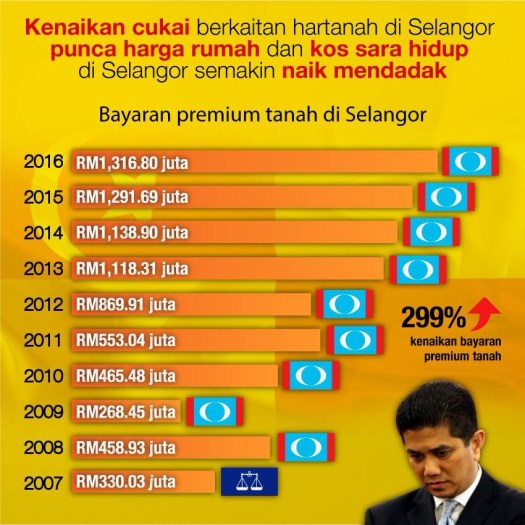
Pebangunan hartanah merupakan sumber hasil bagi kerajaan negeri dan pihak berkuasa tempatan melalui yuran tukar penggunaan tanah, pembahagian-pembahagian kecil dan lain-lain hal berkenaan dengan tanah.  Kesemua kos-kos ini telah meningkat sejak pengambil alihan pentadbiran oleh Pakatan.

2d7f4cc5-07fa-4819-9022-91f68461288b
Kenaikan bayaran premium tanah di Selangor sahaja adalah sebanyak 299 peratus sejak 2008

Penjualan tanah di bawah harga pasaran adalah salah satu cara untuk mengadakan rumah kos murah.  Namun, kebiasaan tersebut telah dihapuskan.  Malah, PKNS sendiri kini terpaksa membida untuk tanah pada harga pasaran?

Kita perlu meneliti prosedur-prosedur yang dikenakan terhadap para pemaju oleh pelbagai jabatan kerajaan negeri dan pihak-pihak berkuasa tempatan.

Birokrasi dan sikap berdolak-dalik merupakan sebab-sebab lazim yang melambatkan proses dan ini menambahkan lagi kos.  Perbelanjaan dan faedah pinjaman bank perlu dibayar walaupun projek belum dapat dimulakan.  Kita belum lagi berbincang mengenai  rasuah dan ini boleh memberi kesan besar terhadap kos kerana kadar yang diminta oleh ‘orang-orang tengah’ untuk ‘melicinkan proses’ boleh menjadi besar dan untuk setiap tandatangan yang diperlukan.

Tidak meghairankanlah jika sebahagian besar pemaju berpendapat bahawa pihak kerajaan negeri dan pihak berkuasa tempatan merupakan batu halangan terhadap rumah mampu milik kerana tanah merupakan hak dan kuasa kerajaan negeri dan bukan kerajaan persekutuan.  Maka, kerajaan persekutuan tiada hak untuk memperbetulkan keadaan ini.

Masalah di Pulau Pinang

Kalau gambarajah di atas menunjukkan bayaran premium tanah yang meningkat di Selangor, kita lihat gambarajah seterusnya yang menunjukkan lonjakan caj cukai hartanah di Selangor dan Pulau Pinang sejak 2008:

03a7f838-0a50-4723-8078-47328d86f2c2
Lonjakan caj cukai hartanah kepada penduduk tempatan sejak Pakatan mentadbir Selangor dan Pulau Pinang

Kerajaan negeri dan pihak berkuasa tempatan perlu serius dalam mengotakan janji mereka untuk mengadakan rumah-rumah kos rendah dan rumah mampu milik.  Di penghujung penggal kedua berkuasa di Pulau Pinang, DAP masih belum menyerahkan rumah mampu miliknya yang pertama, malah menyalahkan kerajaan persekutuan di atas kegagalannya sendiri.

Kampung-kampung tradisi, terutamanya penempatan tradisi orang-orang Melayu, dirobohkan untuk memberi laluan kepada para pemaju membangunkan kondominium mampu tengok dan lain-lain pembangunan komersil.  Kerajaan negeri Pulau Pinang juga bersikap tidak bertanggung jawab menjual tanah-tanah milik kerajaan negeri kepada para pemaju hinggakan hanya tinggal baki tujuh peratus sahaja tanah kerajaan negeri di Pulau Pinang.  Ini bermakna peuang untuk mendirikan rumah-rumah mampu milik di Pulau Pinang semakin halus.

Para pemaju kecil juga tidak berpeluang untuk mengambil bahagian dalam pembangunan di Pulau Pinang akibat caj-caj yang dikenakan terhadap para pemaju begitu tinggi.  Kita lihat gambarajah seterusnya:

69d859e3-71eb-4371-8052-c3049c2fc1cb
Kenapa kerajaan negeri Pulau Pinang begitu galak menaikkan kadar caj-caj? Siapa yang membuat untung sedangkan rakyat tidak lagi mampu memiliki sebarang hartanah di dalam negeri tersebut?

Dari gambarajah di atas kita dapat lihat kerakusan kerajaan negeri Pulau Pinang di bawah pentadbiran DAP hanya mementingkan keuntungan dan membelakangkan keperluan rakyat.

Di bawah kerajaan DAP, sumbangan perumahan kos rendah dikenakan sebanyak RM150,000 bagi setiap unit.  Di bawah BN tiada caj dikenakan.  Setiap gerai penjaja dikenakan RM58,000 – kenaikan sebanyak RM55,000 berbanding dengan semasa di bawah pentadbiran BN.  Untuk penyediaan kemudahan komuniti seperti padang, dewan serbaguna, masjid dan surau dan sebagainya, kerajaan DAP mengenakan caj sebanyak RM500 sekaki persegi berbanding RM25 sekaki persegi di bawah BN.  Untuk infrastruktur seperti jalan dan saliran, kerajaan DAP mengenakan RM15 sekaki persegi berbanding tiada caj di bawah BN untuk jalan, dan RM50,000 seekar untuk saliran berbanding RM10,000 di bawah BN.

Satu lagi bukti kerajaan DAP tidak menghiraukan keperluan rakyat ialah mengenakan caj sebanyak RM500 sekaki persegi untuk setiap tadika yang disediakan.  Tiada caj dikenakan oleh pentadbiran BN Pulau Pinang sebelum ini.

Berapa pula premium tanah yang dikenakan oleh kerajaan DAP Pulau Pinang?  Kita telah melihat lonjakan dahsyat di negeri Selangor sejak 2008, kita lihat pula keadaannya di Pulau Pinang:

b391f7f7-5a7d-470a-b9d1-ec8da7aa38aa
1,671 peratus kenaikan sejak 2008. Beginilah rakusnya DAP apabila berkuasa

Nampak gayanya premium tanah yang dikenakan oleh kerajaan DAP Pulau Pinang melonjak dengan begitu banyak sekali berbanding semasa di bawah pentadbiran BN pada tahun 2007.  Pengurangan hanya berlaku dua kali iaitu pada tahun 2008 semasa mula-mula memegang pentadbiran negeri.  Mungkin ketika ini mereka hendakkan maklumbalas positif mengenai cara DAP mentadbir negeri.  Kemudian kenaikan dikenakan sedikit demi sedikit dan melonjak besar selepas memegang tampuk pentadbiran kerajaan negeri selepas 2013, kemudian turun sedikit pada tahun 2016 selepas Lim Guan Eng dihadapkan ke mahkamah di atas satu perbuatan rasuah – salahguna kuasa dan jawatan untuk kepentingan dirinya.

Ringkasannya

Caj-caj dan bayaran premium yang dikenakan terhadap para pemaju di Pulau Pinang menyebabkan rumah mampu milik di Pulau Pinang yang berkeluasan 1,000 kaki persegi menjadi RM120,000 seunit berbanding RM42,000 seunit semasa di bawah pentadbiran BN.  Apabila dikenakan kadar faedah sebanyak 5 peratus setahun untuk tempoh pinjaman 30 tahun, bayaran faedah akan menjadi RM116,569.73 atau RM671.03 setiap bulan.  Kos keseluruhan akan menjadi RM236,569.73 setiap unit.  Adakah kadar bulanan ini mampu dibayar oleh mereka yang dari golongan berpendapatan rendah?

Keengganan kerajaan negeri Selangor di bawah PKR memberi kerjasama dengan agensi perumahan kerajaan pusat seperti PR1MA dan PPR mendatangkan masalah untuk kerajaan pusat membantu kerajaan negeri membina rumah-rumah kos rendah dan mampu milik.  Setakat ini hanya 11,000 unit rumah sahaja yang daat didirikan berbanding sasaran 70,000.

Ini berbeza sekali dengan kerajaan negeri Kelantan di bawah PAS yang menerima bantuan kerajaan pusat dengan tangan terbuka.  Setakat Ogos 2017, 418 unit PPR telah dibina di Machang manakala 1,000 unit telah dibina di Kota Bharu.  Ini menunjukkan walaupun berlainan fahaman politik, kerajaan PAS sanggup mengenepikan perjuangan demi kesejahteraan rakyat, tidak seperti Pakatan Harapan yang tidak langsung memberi harapan kepada para pengundi.

Pandai-pandailah anda menilaikan sendiri siapa yang mendahulukan kepentingan rakyat dan siapa yang mendahulukan kepentingan keuntungan.

Pakatan Can Promise Sarawak The World

The question is, can it even deliver those promises?

In a recent article posted on Tian Chua’s Malaysia-Chronicle, Pakatan made a promise to Sarawakians – a promise that they claim the Barisan Nasional can never match.

If you have problems accessing the website, don’t worry. It has been spread via WhatsApp as usual and the content is as follows:

———————————————-

A DEAL NAJIB CAN NEVER MATCH: SARAWAK TO KEEP 50% TAX REVENUE, 20% OIL & GAS ROYALTY, DECISION & EDUCATION RIGHTS TO BE RETURNED TO STATE GOVT – HARAPAN

Politics | January 20, 2018 by | 0 Comments

Pakatan Harapan’s Sarawak manifesto pledges that the state will retain 50 percent of all tax revenues collected in the state.

The state will also receive 20 percent from oil and gas royalties or its equivalent value from the federal government, according to the manifesto titled ‘New Deal for Sarawak Part Two’, which was released today.

“The government of Sarawak shall use these funds to shoulder the fiscal responsibility of the federal government in education and health,” the manifesto states.

Harapan also promised to set up a Petronas equivalent in the state, to be named Sarawak Petrogas, which would be wholly owned by the state government.

Sarawak Petrogas, which will be directly answerable to the Sarawak legislative assembly, will jointly manage oil and gas resources within the territorial borders and waters of Sarawak, together with Petronas, the manifesto says.

This is similar to Petroleum Sarawak, an oil and gas company started by the current Sarawak state government, which is meant to be an equal partner with Petronas for oil and gas activities in the state.

‘State can localise education syllabi’

With the decision rights returned to Sarawak in education and healthcare, the state can localise the education syllabi, review staffing and administrative policies, improve and upgrade the quality of all hospitals in the state and equip hospitals with cancer and heart centres, among others.

Harapan will also focus on speeding up the supply of clean water and electricity to all houses in Sarawak, both suburban and rural, as well as roads connecting rural native heartlands to stimulate economic growth in the interiors of Sarawak.

It will also ensure top priority is given to competent and eligible Sarawakians for employment and promotion in federal government departments and agencies in Sarawak.

World-class coaching facilities and a sports institute will be developed in Sarawak, the manifesto states, to equip and harness the potential of Sarawakian athletes.

Aside from its commitment to restore Sarawak to its original status within the context of the Malaysia Agreement 1963, Harapan said it would also form a Royal Commission to review various legislations that affect Sarawak’s rights to its natural resources.

These legislations include the Continental Shelf Act 1966, the Petroleum Development Act 1974 and the Territorial Sea Act 2012.

Harapan said Part Three of its New Deal for Sarawak would be released at a later date.

MKINI

—————————————-

Hallelujah!

But before you even start to dance with joy, let me remind you that this is another one of those ad nauseam promises made, which can never be fulfilled, and will later be blamed on the Federal Constitution and the Federal Government.

Pakatan Harapan Sarawak cannot deliver fully on this promise because it is merely a state entity and cannot arrogate to the state what are Federal rights. As usual, Pakatan Harapan will refer to its non-existent utopian Federal Constitution when making such promises.

Even if it is a Pakatan Harapan Federal Government promise, it cannot fully deliver without the consent of the 11 Peninsular Malaysia states and Sabah because the Malaysia Agreement 1963 is an agreement inter se.

Any increase in the rights of one state vis a vis its position with the Federal Government diminishes the position of the other states vis a vis that one state as well as with the Federal Government . It will need the agreement of the other states in the Federation.

Therefore, Pakatan Harapan should stop making false promises and giving the people false hopes just because they (Pakatan Harapan) have false intelligence.

Mahathir’s Reformasi

It was a movement to topple the second most-hated dictator of the South East Asia. Tens of thousands would march on the streets of Kuala Lumpur chanting “Undur Mahathir, undur!” and the infamous “Reformasi!” after Anwar Ibrahim was summarily expelled from UMNO and denied a chance for the premiership over reasons Mahathir himself claims to have forgotten or something to that effect.

Leading this group of demonstrators was Anwar’s most loyal lieutenants, Azmin Ali, who was his Principal Private Secretary in the Deputy Prime Minister’s Office. With Anwar still in jail, Azmin is the most favourite choice for Pakatan’s Prime Minister-designate amongst the younger generation.

Or that was what we all thought would happen.

Suddenly, the 92-year old Mahathir manoeuvred his way into being accepted as the Prime Minister again if Pakatan wins the next general elections. DAP and the anti-Azmin camp inside PKR namely Wan Azizah’s camp accepted the nonagenarian but this was rejected by several opposition-friendly NGOs as well as Selangor’s PKR.

Several hints on social media platforms and insiders’ information of Anwar’s opposition to Mahathir being designated as Pakatan’s Prime Minister warranted an article by The Star’s Joceline Tan. The writing is all over the wall – REFORMASI is dead.

In a move seen to insult Mahathir, Azmin offered his Gombak parliamentary seat for Mahathir to contest in in the next general election, an offer rejected outright by the latter.

A leopard never changes its spots – and true to his character, Mahathir announced that he will deal with dissenters quietly – a reminder of his 22-year reign of terror.

Just like Anwar whose colour of underwear was made public for going against Mahathir, Azmin now finds tales of his sexual trysts being made public. We are reminded of the time Anina Saadudin’s steamy WhatsApp messages were made public after falling out with Mahathir’s inner circle.

Anything Azmin is now being attacked, therefore it’s going to be interesting to see how the champion of Reformasi will now go against the man he has been fighting against for the past 20 years.

If he fails, it would be Mahathir’s masterstroke – for killing off the Reformasi movement from inside and finally making it his own Reformasi where dissent can never be tolerated.

Welcome to Mahathir’s Reformasi – or Dictatorship 2.0 as we know it.

Nasib Orang Asli Tidak Pernah Dipinggirkan

Orang_Asli
Sepasang bapa dan anak Orang Asli Semenanjung Malaysia

Sepanjang tahun 1970an hinggalah awal 2000, Tentera Udara DiRaja Malaysia sentiasa mempunyai beberapa buah helikopter Sikorsky S-61A Nuri dan Aérospatiale Alouette III yang sentiasa bersedia untuk memberi perkhidmatan kepada Orang Asli di Semenanjung Malaysia, sama ada untuk kecemasan perubatan mahupun untuk membawa mereka keluar untuk menyertai program-program JHEOA (kini JAKOA) di bandar-bandar besar.

Kini, tanggungjawab tersebut juga ditanggung oleh Unit Udara Jabatan Bomba dan Penyelamat Malaysia (JBPM) yang sering kelihatan menerbangkan helikopter-helikopternya di kawasan pedalaman.

WhatsApp Image 2018-01-16 at 10.52.333
Unit Udara JBPM digerakkan ke Gua Musang untuk membantu membawa para pelajar Orang Asli ke sekolah

Baru-baru ini, cuaca buruk telah menyebabkan jalan-jalan yang menghubungkan Gua Musang dengan empat pos Orang Asli di pedalaman terputus, menyebabkan seramai 242 orang pelajar Orang Asli terkandas dan tidak dapat pergi ke sekolah.  Para pelajar tersebut adalah dari Pos Belatim, Pos Balar, Pos Gob dan Pos Bihai.  Dari Pos Bihai melibatkan mereka-mereka dari Kampung Laklok, Kampung Tendrik, Kampung Bihai dan Kampung Hak.

JBPM telah menggerakkan dua buah helikopter dari jenis Agusta Westland A109E dan Agusta Westland 139 untuk membantu menghantar para pelajar tersebut ke sekolah.  Pesawat-pesawat tersebut dipandu oleh Penguasa Kanan Bomba I Roslan bin Aziz, Mejar Leong Cheong Meng TUDM, dan dibantu oleh penolong juruterbang Timbalan Penguasa Bomba Faizal bin Latif dan Timbalan Penguasa Bomba Sharizal bin Sahari.  Turut serta ialah tiga orang Kuartermaster Udara iaitu Penolong Penguasa Bomba Ubadah bin Suib, Pegawai Bomba Kanan I Mohd Norhasrul bin Mohd Noordin dan Pegawai Bomba Kanan I Safuan bin Mohamad.

Pesawat jenis Agusta Westland A109E telah mula berkhidmat dengan Unit Udara JBPM pada tahun 2003 manakala Agusta Westland A139 pula mula diterima pada tahun 2010.  Unit tersebut mengoperasikan sebanyak lapan buah helikopter pelbagai jenis.  Unit ini telah bermula dengan empat buah helikopter Mil-Mi-17-1 buatan Russia yang mula diterima pada tahun 1998.  Ini diikuti oleh dua buah helikopter Agusta Westland A109E, dan dua buah Agusta Westland A139.  Salah sebuah helikopter Agusta Westland A109E tersebut telah terhempas dalam cuaca berkabus di FELCRA Kuala Kaung, Lanchang, Pahang semasa membuat pengawasan dari udara pada 16 September 2010.  JBPM juga telah memesan dua buah helikopter jenis Agusta Westland A189 pada tahun 2016.

DTlliqDVQAAGnis
Para pelajar Orang Asli dibawa keluar menaiki pesawat Agusta Westland A109 Unit Udara JBPM

Walaupun cuaca tidak menentu, kedua-dua buah helikopter tersebut telah berjaya membawa keluar seramai 52 orang pelajar dari Pos Balar dan Pos Belatim ke Padang Sivik Gua Musang, manakala 44 orang pelajar dibawa keluar dari Pos Cemal ke Pos Balar pada hari pertama Ops Murni.  Operasi itu telah bermula pada jam 10.10 pagi dan berakhir pada jam 5.10 petang akibat cuaca yang bertambah buruk.

WhatsApp Image 2018-01-16 at 23.55.581
Pesakit Orang Asli dikeluarkan untuk dibawa ke hospital sebaik pesawat mendarat di Gua Musang

Walaupun Ops Murni bertujuan untuk membolehkan para pelajar Orang Asli hadir sessi persekolahan, operasi tersebut diselangi beberapa penerbangan ihsan membawa Orang Asli yang mempunyai sakit kritikal ke Hospital Gua Musang.  Ini menunjukkan kesediaan Unit Udara JBPM untuk bertukar mod operasi demi nyawa dan kesejahteraan masyarakat walaupun nyawa sendiri dipertaruhkan demi menyelamatkan orang lain.

heli10
Pesawat Agusta Westland A109E (9M-BOA) milik Unit Udara JBPM yang terhempas dalam kabus di FELCRA Kuala Kaung, Lanchang, Pahang. Tiga orang anak kapal cedera dalam insiden ini. PgKB I Roslan bin Aziz adalah salah seorang mangsa insiden tersebut

Ramai di kalangan rakyat Malaysia yang tidak tahu mengenai perkhidmatan-perkhidmatan yang disediakan oleh kerajaan untuk masyarakat Orang Asli.  Disebabkan ketidak-pekaan ini, kerajaan sering dicemuh dan dituduh tidak mengambil berat masalah yang dihadapi oleh masyarakat tersebut.  Hakikatnya, untuk pihak JBPM sahaja, sebanyak 47 penerbangan ihsan telah dibuat pada tahun 2015 untuk menerbangkan seramai 111 orang pesakit dan pengiring.  Sebahagian besar adalah dari kalangan masyarakat Orang Asli.

Oleh itu, jangan mudah menuduh bahawa kerajaan tidak mengambil berat terhadap masyarakat luar bandar terutamanya Orang Asli kerana juruterbang-juruterbang seperti PgKB I Roslan dan Mejar Leong sentiasa bersedia memberi keutamaan kepada kesejahteraan masyarakat tersebut.

WhatsApp Image 2018-01-16 at 10.52.33
PgKB I Roslan bin Aziz berbincang mengenai operasi yang telah mereka jalankan setelah tamat penerbangan hari pertama Ops Murni

The Non-Malay Heroes of Malaysia

Tan_Sri_Khoo_Chong_Kong_2

I am appalled that there still are those who deny the roles played by the non-Malays in defending this country, especially during the two Emergencies; that dark 33 years of fighting communism.  The history books emphasised more on the 12-year First Emergency because of its relation to the independence of Malaya, thus many forget that not too long-ago bombs were going off in the middle of Kuala Lumpur while ordinary policemen were getting slayed.

The First Emergency broke out in June 1948 with the murder of three British estate managers in Sungai Siput.  Fuelled by the progressive successes the Communist Party of China was having against the Kuomintang, the acts of banditry increased exponentially.  Based on a priori the British found it best to both resettle the Chinese in camps while between 20,000 to 50,000 be sent back to China.  The plan moved at a snail’s pace due to the objections by many, and with the total withdrawal of the Kuomintang to Formosa, the repatriation of the Chinese came to a halt in September 1949 when the Communist Party of China closed off all ports and beaches.  Only 6,000 Chinese from Malaya were sent back (Anthony Short, 1975 pp 178-201).  The rest were settled in new villages to curb them from supplying the Communist Party of Malaya with food and other essentials.

When Ismail Mina Ahmad, the chairman of the Ummah umbrella group for Muslim organisations, claimed that only the Malays fought against invaders and communists in this country, it shows the level of ignorance on his part (Syed Jaymal Zahiid – In fiery speech cleric tells forum only Malays fought invaders communists, Malay Mail Online, 13 January 2018).  His claim is far from the truth.

At the peak of the First Emergency, the British had to not only bring in members of the Palestine Police Force who were experienced in counter-insurgency warfare, but also recruited a large number of Chinese residents of Malaya.  Tan Sri Dr Too Chee Chew, more famously known as CC Too, headed the Psychological Warfare section.  We had the likes of Tan Sri Jimmy Koo Chong Kong, Tan Sri Yuen Yuet Ling, Datuk Leong Chee Woh to name a few who spent most of their lives fighting the communists.

CC Too, Koo Chong Kong and Yuen Yuet Ling were among the ranks of the Malayan People Anti-Japanese Army (MPAJA) during the Second World War who chose to go against their former comrades and became targets of the Communist Party of Malaya. Jimmy Khoo Chong Kong, who was also a former member of the Sarawak Communist Party before surrendering to the authorities and joining the Royal Malaysian Police, paid with his life on 13 November 1975 in Ipoh, Perak, as did his driver Constable (awarded Sergeant posthumously) Yeong Peng Cheong who died with his gun blazing.  Without hesitation, even with the knowledge that he was also on the hit list, Tan Sri Yuen Yuet Ling replaced Tan Sri Koo as the Perak Chief Police Officer.

When a Royal Malaysian Air Force Sikorsky S-61A Nuri helicopter was shot down in Gubir, Kedah on 27 April 1976, three Malaysian Chinese personnel were also among the 11 killed. They were Captain Choo Yeok Boo TUDM, Lieutenant Chung Ming Teck TUDM and Sergeant (Air) Leong Yee Heng.  They were on a resupply mission from the Butterworth Air Base when they were shot down.

Captain Frank Chong Keng Lay TUDM (retired as Lieutenant-Colonel) flew his Nuri into a hot landing zone to rescue several infantrymen.  His two commando escorts were killed as his Nuri took 22 heavy machinegun shots.  The next day he flew into the same landing zone to repeat the task.  Keng Lay was my Chief of Staff at the RMAF Air Training Command where I was a Staff Officer and later its Adjutant.

Inspectors Kamalanathan and Robert Cheah were inside a coffee shop meeting with informers when a terrorist threw a grenade into the shop.  The explosion maimed Kamalanathan and for the rest of his life he walked with an obvious limp with a grenade shrapnel still embedded in his leg.

There were many other non-Malay police officers in particular those who served in the Special Branch who died as unsung heroes as they were not recruited nor trained with other policemen.  They were the deep infiltrators, members of the community, who went on leading a double life that even their own family did not know they were all policemen.  Their pay did not come from Bluff Road (Bukit Aman) directly. DSP Jeganathan was a Jabatan Talikom employee tasked with setting up the police’s VHF network and spent years jungle-bashing, building towers on mountain and hilltops with the communist terrorists hot on his heels so that the police could have a nationwide communications network.

There were those who were just roadside sweepers working for the municipal and town councils, collecting information.  One had his cover blown when he was discovered in a different town by a neighbour asking him loudly what was he doing there sweeping the streets.

Another was on his death bed, ridden with cancer, when he sought the help of a Malaysian daily to contact my father to tell the latter of his condition.  His real name was quoted by the daily to my father, which my father could not recall.  My father asked the contact in the daily to ask him his Special Branch name. When the reply came, my father left his golf game and rushed to the hospital and after more than 50 years of being married, the wife and family finally knew the man-of-their-house was a hero fighting the communists, not just some small-time trader.

Let us not forget Chief Inspector Chin Chin Kooi.  He was a Special Branch officer probing communist activities in Serdang, Kedah.  At 9pm on 12 July 1973, six communist terrorists stormed into his home and let loose a volley of bullets.  Mortally wounded, Chin returned fire until his last breath.

Across the South China Sea, Police Field Force Superintendent Joni Mustapha was a champion Sarawak hurdler from 1958 to 1959.  Joni was watching a movie with his son in Sibu when a policeman relayed a message to him that his men were being pinned down by communist terrorists upriver Sungai Setabau.  He asked the policeman to stay with his son in the cinema and left to rescue his men.

Constable Nuing Saling, an Iban policeman, was on a two-week leave to be with his wife Imbok Jimbon who was six months pregnant with their third child.  Upon hearing that Joni was leaving for the jungle, hurriedly joined the team.  Both Joni and Nuing had made a pact that they would help each other. They left by boat to get to the location.  Upon arrival, they engaged the communist terrorists.  Joni was felled by machinegun fire but remained conscious to direct the firefight until he died.  Another constable friend, Abang Masri was already dead.  Seeing his commander and friend die, Nuing unsheathed his machete and charged at the terrorists’ position firing at them, only to be mown down.  He had been hit in the face by a bullet.  Nuing refused to give up.  He continued his charge and was hit several times more but kept on charging, killing and wounding many.  He died inside the location of the communist terrorists.

Kanang ak Langkau is perhaps the most known warrior from Sarawak who shed blood and tears fighting against the communist terrorists.  He was wounded several times but not once let his wounds stop him from fighting.

These are stories that we should all remember.  Stories of our non-Malay brethren heroes who risked and gave their lives so that we can all enjoy the peace and prosperity that God has bestowed upon us.  Many more have gone unsung, but they shall not be forgotten.  Especially not by selfishly ignoring the sacrifices that have been made by them.

Reformasi Untuk Mahathir

Mahathir’s return to politics in 1973 was watched closely by other races, in particular the Chinese and Indians.  His meteoric rise to the Deputy Prime Minister’s post in 1976 was of grave concern by many.  His imminent Premiership caused a large number of migration by Malaysian Chinese.  Despite the economic growth in the late 1980s through 1997, some 42,000 Malaysian Chinese opted to work elsewhere.  This number includes some 14,000 Malaysian Chinese who were working illegally in Japan in 1993 (Shimada, 1994).

If citizenship is conferred on races other than the Malays, it is because the Malays consent to this,” wrote Mahathir in his book ‘The Malay Dilemma‘.

“The Chinese and Indians coming from countries with vast populations are less concerned about good behavior and manners. In their lives, nobility, which is always associated with breeding, was totally absent. Age and riches are the only things they defer to,” he added.

Calling for reforms such as the mandatory use of tamper-proof scales, Mahathir wrote of scales that can be used to shortchange customers and said, ”The small-time Chinese retailer is adept at this practice and unscrupulous enough to use it as a weapon in competition.”

Mahathir was the ultra-Malay to many including the Malays themselves.  Fears of race clashes haunted the voters during the run-up to the 1982 General Elections.  I remember being sent to Mimaland in Gombak with Datuk Latt Shariman (President, E-Sports Malaysia) on polling day in case something bad happens.  It was the first General Elections under Mahathir and it was called more than a year before the then-mandate ended.  Public rallies were banned citing ‘security’ reasons and only indoor gatherings and house-to-house canvassing were allowed (Lim Kit Siang, 22 March 1982).

Even though Malaysia’s economic growth peaked at 8 percent in the mid 1990s, it was mired in scandals involving the practice of cronyism and nepotism.  Lim Kit Siang wrote that Mirzan, Mokhzani and Mukhriz Mahathir – acted as companies’ directors, and that according to searches the DAP had made at the Registry of Companies at the end of 1994, Mirzan had interests in 98 companies, Mokhzani in 48 companies and Mukhriz in 67 companies (Lim Kit Siang, 16 June 1998).  Compared to the 213 companies his sons were directors in back in 1994, 488 is the number of companies Mahathir, daughter and sons are directors in as at end of 2016 (Wakeup Malaya, 6 January 2017).

The calls for Mahathir to resign in 1998 for practising nepotism and cronyism culminated in the sacking of Anwar Ibrahim as his deputy in September of the same year, accusing the latter not only of being a tool for George Soros’s attacks on the country’s financial system but also for leading a morally-corrupted life.  Lim Kit Siang and other Opposition leaders were quick to embrace Anwar, acccepting him into their fold when it was just a year earlier that the late Karpal Singh had made mention of allegations of sexual misconducts against Anwar in a Parliamentary sitting – a scene not much different to Lim Kit Siang’s immediate acceptance of Mahathir after decades of mudslinging the latter.

20161218-reformasi-1998-undur-mahathir

Anti-Mahathir demonstrations were held almost daily and then held every Friday afternoon at the National Mosque.  These demonstrations were quelled using brute force.  The ‘Reformasi’ movement was born, and the likes of theatre-practitioners such as Jo Kukathas were seen on the streets and interviewed by Maria Ressa saying “Enough is Enough” to Mahathir.  Anwar and several other pro-Reformasi and UMNO leaders critical of Mahathir were arrested without trial under the ISA including current DPM Ahmad Zahid Hamidi.

Parti Keadilan Rakyat, then known by its acronym ADIL, was born out of hatred towards Mahathir, with the aim of toppling him and installing Anwar Ibrahim.  The 1999 General Elections saw how Mahathir suffered a pyrrhic victory, losing grounds in Kelantan and his homestate of Kedah, while losing Terengganu to PAS.  Mahathir-loyalists such as Ramli Ngah Talib, Megat Junid Megat Ayub and Sanusi Junid lost their seats.  That was the beginning of the sounding of the death knell for Mahathir’s virtually unchallenged reign.  During the UMNO General Assembly of 2002, he announced his resignation from party posts as well as Malaysia’s Prime Minister.

Ever since then, with the more open administrations of Pak Lah and Najib Razak, Mahathir became one of the targets of the Opposition in their blog posts, press statements as well as ceramahs.

In June 2012, Mahathir’s newly-made best friend even suggested that Mahathir is tried for his part in the BNM Forex scandal, hinting Egyptian Hosni Mubarak’s imprisonment as a comparison (Lim Kit Siang, 3 June 2012).

Screen Shot 2018-01-09 at 14.13.11

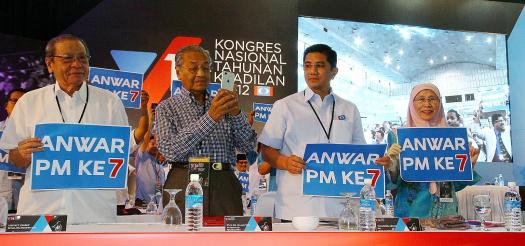
But all is forgotten and forgiven now, even when Mahathir admitted that his apology was only customary and not sincere.  Despite veiled objections from Anwar and Azmin Ali’s camp, Mahathir was named at a Pakatan convention as their Prime Minister of choice albeit interim.   This underscores the fact that the leadership of Pakatans parties do not trust the younger generation to lead the coalition as the position of the elders and powers that come with the position, may be undermined by the younger ones.

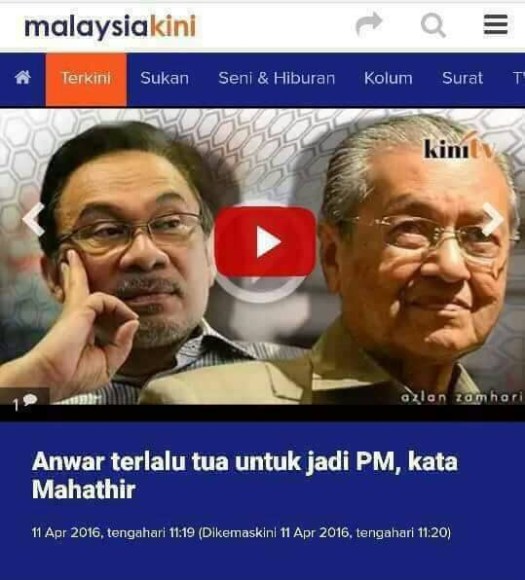
The signal of dissent is clear.  Azmin only attended the convention for a while, not waiting for the announcement to be made while Karpal Singh’s daughter, Sangeet Kaur Deo,  has hit out at Pakatan which probably is suffering from a dearth of capable young leaders.  Even Mahathir once quipped that Anwar, who is 22 years his junior, may be too old to become a Prime Minister.

img_5213

On Facebook, we are seeing people in their 40s and 50s voicing out their concern over Pakatan’s choice of Prime Minister, alarmed that the monster they have put behind them, could very well jump out from underneath the bed and into their lives again.

WhatsApp Image 2018-01-09 at 11.38.33

But it does not stop Mahathir from wanting to become the Prime Minister.  He once hinted that he may have to consider becoming the PM again, underscoring the fact that he does not trust anyone else.

img_6975
“I may be 93 but at 71 Anwar is much older!”

Wan Azizah may be blind to the fact that Mahathir had once denied the Premiership to her husband and went as far as making sure Anwar went to jail to keep him out of the way, while Lim Kit Siang is only friends with Mahathir because he needs the Malay votes to ensure Pakatan’s seats are sustained after the departure of PAS from the now-defunct Pakatan Rakyat.

Will Mahathir be willing to step aside for Anwar Ibrahim or whoever else younger who would be more acceptable to the younger and middle-aged generation aware of his antics?  I doubt.  But as Sangeet mentioned above, it will be a return to Mahathirism, an era of abuse of power, cronyism and nepotism that the Reformasi movement was totally against.

Somehow, it seems that the Reformasi movement has become a tool for what it was totally against – ushering Mahathir into the premiership and welcoming again abuse of pwer, nepotism and cronyism.

ST_20170522_NRPKR22_3156926
Anwar is NOT going to be MY PM


And An Apology Is Enough?

abridge

Anak emak bersemangat dah nak ke sekolah tapi kena harungi jambatan yang canggih ini. Dah setahun tak ada perubahan langsung. Jambatan gantung di Pamah Aur, Bukit Betong, Kuala Lipis,” wrote Siti Zaharah Othman as the caption of the video she took of her husband Abdul Jalil Sulaiman, leading their five-year old son Lutfil Hadi, across a dangerously broken bridge to attend pre-school.

This video collected 1.2 million views and 33,000 shares within eight hours of being posted, with many venting their anger at the government for their inaction over the matter.

Jalil said that this was the only way to send his son to school as it takes 10 minutes to get to the other side of the river versus 40 minutes by road, which is now being submerged by flood waters.

This was refuted by the local assemblyman Datuk Seri Wan Rosdy Wan Ismail who said that the JKKK provides boats for people to cross the submerged road.

Wan Rosdy also clarified that the construction of the new bridge is to commence on Jan  8 2018.  The Department of Works had already allocated a sum of RM462,414.40 on the Dec 12 2017 but had to wait for better weather before construction can be commenced.

In a reply to comments, Siti Zaharah said that it has been a year that her husband has had to use the broken bridge to get to work, but critics pointed out that the family owns a Proton Exora, a compact 1.6L MPV.

The husband could have driven the son to the point where the JKKK provides boats for people to cross over to the other side.  And as the flooding only recently occurred, Jalil could have driven himself to work instead of using the broken bridge to cross the river.

It is not that both Jalil and Siti Zaharah were desperate enough and left without any option, they blatantly endangered the life of their five-year old son.

To top that off, Siti Zaharah brazenly mislead the public that that was the only option her family had.

Siti Zaharah has since apologised to the assemblyman but never offered any explanation to the public for her behaviour.

In my opinion, the Ministry for Women, Family and Community Development ought to take legal action against both Jalil and Siti Zaharah under Section 31(1)(a) of the Child Act, 2001 for knowingly exposing the child in a manner likely to cause him physical injury or even death, by using the broken bridge when there is an alternative route with the means to take the route.

But as usual, as in the case of the use of children for begging by “religious schools”, or bringing children to street protests, not one authority seems to care and enforcement of the Child Act would be a bonanza if any action is actually taken.

If it does happen, I would think that many would run to the nearest Magnum or Da Ma Cai outlet and spend their savings there.

(This posting was featured on The Mole)

Drama Kera La (Versi BM)

IMG_4539
Seekor beruk bermain dengan sekuntum Bunga Raya (Gambar Hiasan)

Baru-baru ini ditularkan di dalam Facebook dan WhatsApp sebuah video mengenai cara negara China memperluaskan penguasaannya dengan menggunakan kekuatan ekonomi.  Video tersebut membandingkan usahasama China-Sri Lanka di pelabuhan laut dalam Hambantota dengan usahasama-usahasama yang dijalankan di Malaysia, membuktikan bahawa Malaysia juga boleh berakhir bukan sahaja menjadi sebuah negara yang dibelenggu masalah hutang yang besar, tetapi juga bakal hilang pegangan ke atas aset-aset tersebut.

Secara kasar, berhutang keada China dengan sebegitu banyak untuk projek-projek tersebut adalah amat menakutkan, terutamanya untuk mereka yang tidak mendapat gambaran penuh.  Namun, membandingkan Malaysia dengan Sri Lanka bukanlah suatu perkara yang bijak.

Pelabuhan laut dalam Hambantota terletak di dalam kawasan bekas Presiden Sri Lanka iaitu Mahinda Rajapaksa dan kos pembinaannya adalah lebih dari $1 billion.  Sebuah lagi projek yang dibina di dalam kawasan Mahinda ialah Lapangan terbang Mattala Rajapaksa yang terletak 30 kilometer dari pelabuhan tersebut.  Sehingga kini, lapangan terbang tersebut digunakan oleh hanya beberapa ratus orang seminggu hinggakan ianya diberi gelaran “lapangan terbang paling sunyi di dunia.”

Hambantota ialah sebuah wilayah yang terpencil di Selatan Sri Lanka.  Jaraknya dengan bandar yang paing hampir iaitu Galle ialah 130 kilometer, manakala jaraknya dengan ibu negara Sri Lanka iaitu Colombo ialah 240 kilometer.  Jumlah penduduknya hanyalah sekitar 12,000 orang dan ianya merupakan sebuah wilayah yang tersisih dari sebarang pembangunan.  Masalah pelabuhan laut dalam Hambantota ialah kedalaman airnya yang tidak mencukupi untuk kapal-kapal dagang yang besar untuk masuk ke pelabuhan tersebut.  Maka, ianya tidak menjadi suatu destinasi bagi syarikat-syarikat perkapalan besar.  Tiada siapa yang ingin berpindah ke sana kerana ianya berada terlalu jauh dari pembangunan.  Ini menyebabkan kedua-dua pelabuhan dan lapangan terbang tidak dapat menjana pendapatan untuk menampung kos operasinya sendiri, apatah lagi untuk membayar pinjaman yang telah diterima daripada China.

Jumlah hutang yang ditanggung oleh Sri Lanka ialah hampir $65 billion.  Dari jumlah tersebut, $8 billion adalah hutang kepada China.  KDNKnya (Keluaran Dalam Negara Kasar) ialah sebanyak $81.32 billion.  Kadar hutang kepada KDNKnya pula ialah 75 peratus manakala rizab matawang asingnya ialah $7.2 billion.  Kerajaan Sri Lanka menggunakan 95.4 peratus pendapatannya untuk membayar hutang.  Inilah sebab-sebab Sri Lanka mengambil jalan untuk melangsaikan hutang-hutangnya untuk kedua-dua projek tersebut dengan cara menyerahkan pegangan kepada negara pemiutang (China).

Bandingkan apa yang terjadi dengan projek ECRL yang bernilai $13.1 billion (RM55 bilion).  Malaysia mengambil pinjaman sebanyak $11.14 billion (85 peratus dari kos keseluruhan projek atau RM46.75 billion) dari China manakala selebihnya dibiayai melalui program sukuk yang dikendalikan oleh institusi-institusi kewangan tempatan.

Projek Forest City di negeri Johor pula merupakan sebuah program pembangunan bernilai $100 billion selama 20 tahun.  Walaupun jumlah yang diperuntukkan bagi setiap fasa projek tersebut adalah merupakan maklumat sulit syarikat yang membangunkan projek tersebut, ianya dianggarkan sekitar $5 billion setahun.  Projek tersebut telah bermula pada tahun 2015 dan sehingga kini 11 peratus telah dilaksanakan.  Pada akhir bulan Disember 2016, Forest City berjaya membuat penjualan 17,000 unit apartmen bernilai $2.9 billion.  Tempoh pembangunan projek tersebut masih berbaki 17 tahun lagi.

KDNK Malaysia kini berjumlah $320.25 billion (RM1.3 trillion) untuk tahun 2017.  Ini menjadikan kos projek ECRL pada kadar 4.1 peratus dari KDNK manakala projek Forest City pada kadar 1.6 peratus setahun.  Jumah hutang keseluruhan negara ialah sebanyak RM685.1 billion atau 50.9 peratus dari KDNK.  Dari jumlah ini, RM662.4 billion adalah hutang dalam negara manakala hanya RM22.7 billion merupakan hutang luar pesisir pantai.

Yang menariknya, setakat bulan Oktober 2017, hutang Amerika Syarikat kepada China berjumah $1.2 trillion, iaitu 19 peratus dari sejumlah $6.3 trillion dalam bentuk bil-bil Perbendaharaan, wang, dan bon-bon yang dipegang oleh negara-negara luar.  KDNK AS pada tahun 2016 adalah sebanyak $18.57 trillion dan ini menjadikan kadar hutang AS kepada China berbanding KDNKnya sebanyak 6.5 peratus.

Sudah tentu kita boleh membiayai projek-projek di atas tanpa mengambil sebarang pinjaman.  Rizab matawang asing kita berjumlah RM414.71 billion ($102.17 billion), lebih dari mencukupi untuk pembiayaan kedua-dua projek tersebut.Jika kita gunakan kaedah di zaman Tun Mahathir, Petronas mempunyai pegangan tunai sebanyak RM129 billion ($31.8 billion) manakala KWSP mempunyai aset-aset yang bernilai $771 billion ($189.9 billion).  Ini tidak termasuk pegangan tunai dan aset-aset kepunyaan Khazanah, Tabung Haji, KWAP, SOCSO, PNB dan lain-lain institusi kerajaan.

Sekiranya kadar hutang kepada KDNK sebanyak 50.9 peratus merisaukan anda, ianya pernah berada pada kadar 103.4 peratus semasa Mahathir merupakan Perdana Menteri pada tahun 1985.  Dan suatu jumlah bersamaan dengan 24 peratus KDNK juga telah hilang dalam skandal Forex BNM pada tahun 1991 iaitu semasa Mahathir masih lagi Perdana Menteri Malaysia.  24 peratus daripada KDNK sekiranya ia berlaku sekarang bersamaan dengan hilangnya RM315 billion dari RM1.3 trillion.  Sebagai perbandingan, kadar hutang kepada KDNK Singapura ialah 112 peratus dan negara tersebut berada di tangga ke-10 dari 17 negara yang mempunyai kadar hutang berbanding KDNK paling tinggi di dunia yang disenaraikan oleh Business Insider, UK.  Jepun menduduki tempat pertama dengan kadar 239.2 peratus!

Kita tidak jatuh bankrap semasa zaman Mahathir jadi mengapa perlu kita takutkan kadar hutang berbanding KDNK sebanyak 50.9 peratus bila asas ekonomi kita jauh lebih kukuh sekarang berbanding 103.4 peratus semasa asas kita lemah?  Jepun dan Singapura juga tidak jatuh bankrap.

Dan apa masalahnya dengan pemilikan tanah Forest City?  Tanah tersebut adalah merupakan tanah yang ditambak di tengah laut.  Ini bermakna tiada tanah yang “diberikan kepada China.”  Johor mempunyai hak ke atas tanah yang ditambak tersebut berdasarkan Kanun Tanah Negara, 1965 dan selagi ianya berada dalam lingkungan tiga batu nautika mengikut Seksyen 3(3) Akta Laut Wilayah, 2012.  Sama ada ianya merupakan pegangan bebas mahupun pegangan pajakan, Johor mempunyai hak untuk mengambil semula tanah tersebut di bawah Akta Pengambilan Tanah, 1960.  Mana-mana tanah sehingga 12 batu nautika dari sisir pantai adalah hak milik negara.

Namun Mahathir lebih suka memilih jalan dengan menggembar-gemburkan cerita untuk menakut-nakutkan rakyat.  Dalam ucapan beliau baru-baru ini, beliau berkata, “Habislah tanah kita akan dijual, tidak kiralah Forest City, saya harap Forest City akan betul-betul jadi ‘forest’ (hutan)…penduduknya akan terdiri daripada kera, monyet dan sebagainya.

Taman Perindustrian Malaysia-China Kuantan (MCKIP) dibangunkan oleh MCKIP Sdn Bhd (MCKIPSB) yang merupakan sebuah syarikat usahasama 51:49 di antara sebuah konsortium Malaysia dan sebuah konsortium China.  Pegangan dalam Konsortium Malaysia pula terdiri dari IJM (40 peratus), Sime Darby Property (30 peratus) dan Kerajaan Negeri Pahang (30 peratus).  Taman perindustrian kembarnya iaitu Taman Perindustrian China-Malaysia Qinzhou (CMQIP) di negera China pula dipegang oleh sebuah konsortium Malaysia (SP Setia Berhad dan Rimbunan Hijau Group) sebanyak 49 peratus.

Mengikut logik Mahathir, bukankah China telah memberi peluang kepada Malaysia untuk menjajah negaranya?  Sebelum ini China juga telah membenarkan Singapura menjajahnya di dua kawasan iaitu di Taman Perindustrian China-Singapore Suzhou dan juga di Bandaraya Eko China-Singapore Tianjin.

Walaupun keadaan di Sri Lanka nampak suram, Jepun, Singapura dan India telah menyatakan hasrat untuk membina infrastruktur dan mendirikan perniagaan di Sri Lanka.  Walaupun Sri Lanka mempunyai asas ekonomi yang lemah, Lolitha Abeysinghe dari Opportunity Sri Lanka kekal optimistik.

Pergantungan berlebihan terhadap mana-mana negara untuk pelaburan, teknologi dan pasaran boleh memberi kesan buruk terhadap kepentingan negara dalam jangka panjang, tetapi sekiranya diurus dengan betul dan dengan wawasan yang jauh, Sri Lanka boleh mengurangkan masalah tersebut dan mendapat manfaat terbaik untuk ekonomi luar bandar domestik di dalam sebuah dari wilayah-wilayah terpinggir di Sri Lanka,” katanya.

Malaysia mempunyai wawasan tersebut tetapi malangnya sesetengah orang lebih gemar sekiranya Malaysia gagal hanya kerana kepentingan politik. Politik cara kera dan monyet.

Drama Kera La

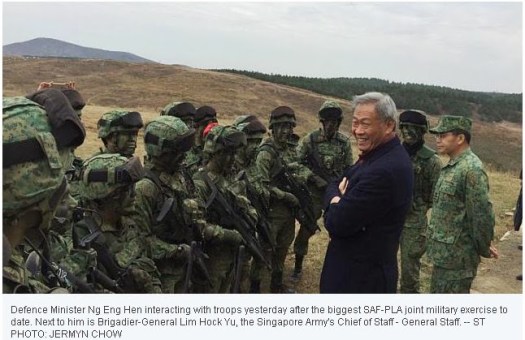
ST photo -SAF-PLA joint military exercise
Singapore Army invading China?

Recently, a video clip of how China is fulfilling its hegemonic ambitions using economic means was spread around especially in Facebook and WhatsApp groups.  The video compares the Sino-Sri Lankan joint-venture at the Hambantota Deep Water Port with the ones in Malaysia, proving that Malaysia, like Sri Lanka, could end up not only with a huge debt owing to China, but also lose its ownership of those assets.

On the surface, it sounds scary to have so much money owed to China for these projects especially so for the ill-informed.  But comparing Malaysia to Sri Lanka hardly does any justice.

The Hambantota Deep Water Port lies within the constituency of the former President Mahinda Rajapaksa and costs more than $1 billion to construct.  Another project that was constructed in this constituency is the Mattala Rajapaksa Airport, located 30 kilometres away from the port, which until now flies only a few hundred passengers in and out weekly and has been dubbed “the world’s loneliest airport.”

Hambantota is a remote region in the South, 240 kilometres from Colombo and the nearest city, Galle, is 130 kilometres away.  The population of Hambantota is around 12,000 people and is very underdeveloped.  The problem with Hambantota’s deep-water port is that its waters are not deep enough for large vessels with deep draught, so large shipping companies shy away from it.  It is far from any development that hardly anyone wants to move there.  Both the port and the airport cannot generate enough income to sustain operations let alone pay back loans to the Chinese.

Sri Lanka owes its financiers close to $65 billion and of this, $8 billion alone is owed to the Chinese.  Its GDP stands at $81.32 billion, debt-to-GDP ratio stands at roughly 75 percent while its foreign currency reserves is at $7.2 billion.  The Sri Lankan government uses 95.4 percent of its revenue to repay debts.  These are the reasons for Sri Lanka to opt for a debt-for-equity solution for both projects.

Compare this with Malaysia’s $13.1 billion East Coast Rail Link, or RM55 billion in Malaysian terms.  Malaysia took a $11.14 billion loan (85 percent or RM46.75 billion) from China to finance the project while the balance is in the form of a sukuk programme managed by local financial institutions.

The Forest City project in Johor is a development programme that runs over 20 years.  How much is being allocated per project is a company confidential information but if we go by average, it would be at $5 billion per annum, with a total of $100 billion over 20 years.  The project commenced in 2015 and to date has completed about 11 percent.  At the end of December 2016, Forest City saw concluded contracted sales of $2.9 billion for 17,000 apartment units.  It still has another 17 years of development to go.

Our GDP now stands at around $320.25 billion (RM1.3 trillion) for 2017 which puts the cost of the ECRL project at 4.1 percent of the GDP while Forest City accounts to approximately 1.6 percent of the GDP per annum.  The total Government debt as at end of June 2017 was reported to be at RM685.1 billion or 50.9 percent of the GDP.  Of this total, RM662.4 billion was domestic debt while RM22.7 billion was offshore loans.

Interestingly, as of October 2017, the US debt to China is at $1.2 trillion, which is 19 percent of the $6.3 trillion in US Treasury bills, notes and bonds held by foreign countries.  The US GDP in 2016 was $18.57 trillion which makes its China-debt-to-GDP alone at 6.5 percent.

Of course, we could undertake to pay for all the above projects.  Our foreign currency exchange reserves are at RM414.71 billion ($102.17 billion) which is more than enough to pay for both projects.  If we use the Mahathir-era method, then Petronas has RM129 billion in cash ($31.8 billion) while the EPF has RM771 billion ($189.9 billion) worth of assets.  This does not include sources from other funds such as Khazanah, Tabung Haji, KWAP, SOCSO, PNB and others.

If our debt-to-GDP ratio of 50.9 percent is still a scary number to you, it was at 103.4 percent when Mahathir was the Prime Minister in 1985!  And an equivalent to 24 percent of the GDP went missing as a resut of the BNM Forex scandal also during his tenure as the PM in 1991!  That is RM315 billion if our GDP is RM1.3 trillion!  In contrast, Singapore’s debt-to-GDP ratio is 112 percent at tenth place out of 17 nations with the highest debt-to-GDP rate listed by Business Insider, UK.  Japan is first at 239.2 percent.

Still, we did not go bankrupt back then. So why should we fear a 50.9 percent debt-to-GDP ratio with much stronger economic fundamentals when we have reached 103.4 percent with a much weaker economy? And neither Singapore nor Japan has gone bankrupt.

And what is with the ownership of the land where Forest City is situated?  It is a reclaimed land; therefore, no part of mainland Johor was carved out to be “given to the Chinese.”  Johor has rights over the reclaimed land as accorded by the National Land Code, 1965 up to three nautical miles as given by Section 3(3) of the Territorial Sea Act, 2012.  Whether it is a freehold land or a leasehold land, Johor can always take it back, with provisions, under the Land Acquisition Act, 1960. Up to 12 nautical miles from the foreshore, the Malaysian flag flies no matter who holds the grant.

Mahathir recently said “I hope Forest City will truly become a forest… Its residents will consist of baboons (kera), monkeys (monyet) and so on”, fuelling unjustified fears among the people of Malaysia.

The Malaysia-China Kuantan Industrial Park (MCKIP) has MCKIP Sdn Bhd (MCKIPSB) as its Master Developer.  MCKIPSB is a 51:49 joint-venture between a Malaysian consortium and a China consortium.  In the Malaysian portion of the shareholding, IJM land holds 40 percent, Sime Darby Property 30 percent and the Pahang State Government holds the remaining 30 percent. Its twin sister, the China-Malaysia Qinzhou Industrial Park (CMQIP) in China is 49 percent owned by a Malaysian consortium (SP Setia Berhad and Rimbunan Hijau Group).

Going by Tun Dr Mahathir’s logic, has China just allowed Malaysia to colonise its land too?  Prior to this it allowed Singapore to colonise in two other areas, namely the China-Singapore Suzhou Industrial Park and the China-Singapore Tianjin Eco City.

As bleak as Sri Lanka may sound, Japan, Singapore and India have expressed interest in building infrastructure and setting up shop in Sri Lanka.  Even with much weaker economic fundamentals compared to Malaysia, Lolitha Abeysinghe of Opportunity Sri Lanka remains optimistic.

Over-dependence on any country for investments, technology, and markets could result in some adverse impacts on national interest in the long-run, but if managed properly with a futuristic vision, Sri Lanka can mitigate such adversity and reap the best benefits for the rural domestic economy in one of the least developed districts in Sri Lanka,” he said.

Malaysia has that vision but sadly some of its people would rather see everything fail in the name of politics.  The politics of baboons and monkeys.


Forest City Continues To Benefit Its Surrounding Communities

When the development of Forest City commenced, it came under fire by many including the surrounding communities. This is because of the concerns regarding the impact to the environment as well as the negative publicities fed on how livelihoods would be affected. But my recent article has put that to rest.

Despite having only 245 registered fishermen in a community of 11,000 Country Garden Pacificview (CGPV) finds it of utmost importance that the fishermen would be able to continue conducting sustainable fishing in the waters off Forest City and its surroundings.

Kelab Alami, an NGO concerned with environment conservation, was born out of these concerns in 2008. CGPV works hand-in-hand with Kelab Alami by funding its awareness and research activities.

For 2018, Kelab Alami have lined up a series of activities including the spreading of wider awareness pupils in Sekolah Kebangsaan Tanjung Kupang and Sekolah Kebangsaan Tanjung Adang, both in Gelang Patah.

Kelab Alami founder Shalan Jum’at, 30, said plans for 2018 also include mussel farming, habitat documentation and monitoring of various marine species found in the surrounding area of Kampung Pendas and the other nearby villages.

With development such as Forest City, which is near to Kg Pendas, it is a boom in eco-tourism. The project have presented challenges as well as the potential of the natural wonders in the sea and rivers that lie just at our doorstep,” said Shalan Jum’at.

Development has changed the face of Tanjung Kupang for the better and spurred the birth of Kelab Alami, which provided opportunities for the local fishermen to diversify their skills as well as given the children a chance to become citizen researchers as well as act as eco-tour guides to tourists and visitors to the villages here,” he said.

Muhamad Sofi Juhari, 19, who joined the club when it was first set up, said he would have been a youth without any goal in life if not for the club.

I currently work at a motorcycle repair workshop, which is managed by Anak Alami Enterprise. Shalan showed me the ropes in acquiring entrepreneurial skills. Business is good at the motorcycle repair shop with about 300 customers a day,” Muhamad Sofi said.

Kelab Alami not only helps me to gain self-confidence and knowledge about the natural wonders of the surrounding environment, I also get to hone my entrepreneurial skills and am able to earn an income that I can contribute to my family,” he added.

Another club member, Mohammad Irfan Yazid, 19, who joined Kelab Alami when he was 7 years old, has a different passion. He operates a ikan bakar (grilled fish) and burger food stalls near Muhamad Sofi’s workshop.

I can sell about 100 burgers and about 10 grilled fishes per day. With more people coming to work in Forest City, my food business is also improving by the day,” said Mohammad Irfan.

Forest City has also funded Kelab Alami which has organised activities such as youth ranger training and entrepreneurship seed funding as well as fishermen’s seed funding, among others,” he added.

Another member Muhd Arif Aiman Fazail, 17, who joined Kelab Alami at age 11, said he has forged friendship with the other neighbourhood children through club activities.

I have learnt to appreciate the different species of snakes, lobsters and other creatures of the sea since becoming a club member. Former club members who have left the village in pursuit of higher education come back to see us whenever they can to share their experiences and knowledge with us,” Muhd Arif said.

Meanwhile, Datuk Md Othman Yusof, executive director of CGPV, who visited Kelab Alami in Kampung Pendas Laut recently, applauded the efforts and achievements of Kelab Alami.

Kelab Alami can also organise community workshops which offer skills to make handicrafts or build items such as wooden chairs and tables. We can emulate Thailand by manufacturing souvenirs in a local cottage industry to present as gifts to visitors. This would generate income for the village where the profit can be enjoyed by the local community,” Md Othman said.

Md Othman, who was at the clubhouse to hand over a cheque of RM194,450 to the non- governmental organisation, also spent some time to chat with the kids of Kelab Alami.

Md Othman, impressed by the knowledge of these youths and confidence exuded by them, was encouraging them to keep up their good work and continue to strive for a brighter future.

Meanwhile, 90 students of Sekolah Kebangsaan Kampung Simpang Arang who come from low-income families, were treated to to a ‘Back to School’ shopping spree at Giant Hypermarket in Tampoi, courtesy of CGPV.

CGPV corporate communications director Aeron Munajat said the Back to School programme is intended to alleviate their families’ financial burden as they prepare for the new school term.

We do not want the local folk to feel left out due to the development around their village,” she said.

Aeron added that it was an eye-opening experience for some volunteers who were employees from China.

The programme also allows volunteers to interact with the local community, giving them exposure to the lives of the indigenous people.

Chen Hao, 27, who is an assistant legal advisor at Country Garden Pacificview’s legal department, was among the volunteers who overcame the language barrier to communicate with the Orang Asli children.

We did not speak the same language, but the children and I found ways to communicate through body or sign language. The children would point at something they wanted to buy for school, (for instance). It is my first time meeting Orang Asli children, and I find that they are as bright and bubbly as any other child I know,” said Chen, who has been working at Forest City in Johor for the past two years.

The treats were not limited to Giant Hypermarket, as the Orang Asli children were also treated to lunch after their shopping excursion.

Forest City staff assisting Orang Asli children to choose their school uniform at the Giant Hypermarket in Tampoi (pic courtesy of NSTP/Hairul Anuar Rahim)

Country Garden Pacificview plans to adopt SK Kampung Simpang Arang next year, making it an addition to the five primary schools it has adopted since 2015.

The five primary schools are SK Morni Pok, SK Tanjung Adang, SK Tiram Duku, SK Tanjung Kupang and SK Pendas Laut.

Besides youth development and education, Forest City focuses on two other pillars, namely societal development and environmental awareness.