Protest Against China’s Blatant Intrusion

Ever since my last posting on China’s hegemonic role in the South China Sea I was told that China has agreed to not station its coast guard cutter at the Luconia Shoals while Minister in the Prime Minister’s Department, Shahidan Kassim, announced in Parliament that there has been an increase in operational presence by the Royal Malaysian Navy and the Malaysian Maritime Enforcement Agency at the South Luconia Shoals from 269 days in 2014 to 345 days this year. It is believed that Malaysia’s continuous diplomatic stance that is seen as friendly by China as opposed to holding demonstrations as held in other claimant countries is the reason for the one step back taken by China at the Luconia Shoals. However, the Chinese coast guard continues to loiter in the South China Sea.

  
However this morning (18th December 2015) a group of about 16 people calling themselves the Sarawak Association for People’s Aspiration or SAPA, headed by Lina Soo as its President, held a protest rally in front of the Chinese Consulate in Kuching, Sarawak.

The protest which began at about 9am kicked off by the submission of a protest note at 9.28am to the personal assistant for Mr Liu Quan by SAPA, followed by shouts in Hokkien saying “Get out and don’t return” by the SAPA members.

  
Although small, this protest is significant as it displays a growing awareness amongst Malaysians on the blatant incursions by the Chinese navy as well coast guard.

China has been aggressive in creating ad hoc ADIZ (Air Defence Identification Zone) around its man-made islands, warning off other military aircraft and vessels that got too near. Four days ago the BBC filed a story on how one of its journalist flying in a Cessna 206 was asked to leave the area to avoid miscalculations.

Last month a Royal Australian Air Force AP-3C Orion aircraft was told by the Chinese to leave and that “it would be a shame if a plane fell from the sky.”

Things are not going to get better as China continues to claim the South China Sea as its territorial waters whereas two thirds of South Korea’s energy supplies, nearly 60 per cent of Japan’s and Taiwan’s energy supplies, and 80 per cent of China’s crude oil imports come through the South China Sea. Even Indonesia, a non-claimant, has begun to reinforce its military presence in the Natuna islands to face the Chinese.

It will be a matter of time, sooner rather than later, that we will see aggressive flying by PLAAF aircraft that will be stationed at China’s South China Sea airstrips when intercepting other military aircraft. The South China Sea is a potential flashpoint Malaysian cannot ignore nor take lightly.

Jangan Lakukan Kesilapan Dan Kebodohan Saya – Mahathir

  
Tajuk di atas adalah merupakan pengakuan Mahathir sendiri pada tahun 2007.

“Ini adalah salah satu perkara yang perlu kita betulkan. Apa yang diperlukan adalah sebuah kabinet yang tidak selalunya berpengetahuan kerana ianya dibentuk oleh ahli-ahli politik dan bukannya para pakar dan kadangkala ahli politik seperti saya boleh menjadi bodoh,” jawab beliau kepada para wartawan yang memberitahu bahawa kelima-lima lebuhraya bertol dibina semasa beliau menjadi Perdana Menteri.

Kita semua maklum bagaimana baru-baru ini kadar tol dikebanyakan lebuhraya dinaikkan, kecuali lebuhraya-lebuhraya yang dikendalikan oleh PLUS. Ini adalah kerana lebuhraya-lebuhraya PLUS dimiliki 51 peratus oleh UEM Berhad dan 49 peratus oleh Tabung Haji. UEM adalah 100 peratus milik Khazanah. Langkah pemilikan PLUS Berhad telah dibuat di bawah pentadbiran Najib pada tahun 2009.

Bagi kenaikan tambang ERL yang dimiliki YTL Berhad, konsesi ERL telah ditandatangani juga semasa pentadbiran Mahathir. Menurut perjanjian konsesi tersebut, sekiranya kerajaan enggan membenarkan kenaikan tambang, kerajaan wajib membayar RM2.9 bilion kepada YTL atau membenarkan mereka menyambung konsesi selama 30 tahun lagi.

Kenaikan yang membebankan rakyat kini adalah akibat kesilapan dan kebodohan yang telah dilakukan oleh pentadbiran Mahathir. Yang menanggung kebodohan tersebut adalah kita rakyat dan tempias akibat kebodohan tersebut terkena kepada pentadbiran kini. Adalah diharap pentadbiran kini tidak terjangkit kebodohan yang sama dan lebuhraya Pan Borneo bebas tol sepanjang 2,083 kilometer yang diumumkan oleh Najib baru-baru ini merupakan harapan cerah bahawa kebodohan tersebut telahpun berakhir.

Nota kaki: sila baca dengan lebih lanjut bagaimana YTL bekerja kuat untuk mendapatkan kontrak-kontrak kerana ianya bukan syarikat kroni Mahathir

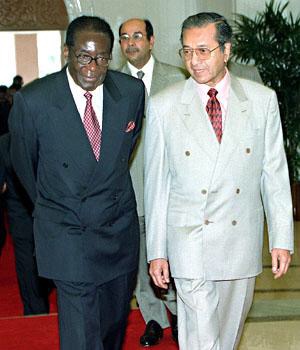
Mahabe: How Mahathir and Mugabe Share More Than Just The Same Initials

  
Lately, there has been attempts by the pro-Mahathir camp to equate Najib and his economic policies to Mugabe’s. Little do they know that both Mahathir and Mugabe are still good friends, with the former being the latter’s confidante, as this Malaysiakini report filed on 17th March 2002 states:

———-

The recent Sunday Telegraph report that Zimbabwean president Robert Mugabe has channelled some 10 million pounds into Malaysian bank accounts should come as little surprise to those who had been following his rapid descent into international ignominy.
Although the allegations were vehemently denied by Foreign Minister Syed Hamid Albar, the Telegraph report was hardly the first linking Mugabes fortunes to Malaysia.
Back in January, The Guardian newspaper revealed that the business interests of Mugabes Zanu PF party was run by a southern African family originally from Malaysia. The head of the family is widely believed to be Shamsudin Abu Hassan, a tycoon on good terms with Prime Minister Dr Mahathir Mohamad.
Later, a British Broadcasting Corporation analysis alluded that Western money laundering and financial crime experts had been scrutinising accounts holding some US$65 million, said to be Mugabes assets in Malaysia.
But the Malaysian connection in Zimbabwean affairs has certainly not come out of the blue. Asias longest serving ruler and one of Africas longest have been building close relations these past 20 years.
The relationship dates back to the early 1980s when Mugabe became president of Zimbabwe after leading a victorious war against the countrys white minority rulers. Mahathir, who came into power in 1981, played a key role in initiating the newly independent Zimbabwe into the Commonwealth group of nations.
Nationalist pleas
Of late, this relationship has become all the more significant to the African leader as his unpopular methods of policy-making coupled with suspicions of unfair electoral practices, had lost him many friends abroad.
Pointedly, Malaysia was one of only four countries the rest were Nigeria, Botswana and Bangladesh to block Britains move to expel Zimbabwe from the Commonwealth for the ruling partys alleged role in sponsoring violence against opposition members.
In the intervening years, Mahathir and Mugabe found much in common. The two conservative leaders often made impassioned pleas to their people to observe more nationalist attitudes.
Both were also outspoken critics of what they regarded as neo-colonial imperialism of Western countries against the developing world.
Mahathir, who had frequently lambasted what he considered Western double standards, is widely known for his rejection of International Monetary Fund advice in face of Malaysias economic troubles during the Asian financial crisis.
Taking a leaf out of his book, Mugabe attempted to achieve much the same in 1999 when he dispatched a group of Zimbabwes top economic and financial planners to seek Mahathirs advice on how to implement reforms without IMF support.
Economic pointers
It appears that the African leader may have picked up more than economic pointers from his Malaysian counterpart judging from curious similarities in his use of law-making powers.
Mugabe first encountered stern international criticism when he embarked on a controversial land reform programme to redistribute vast farmlands mostly owned by Zimbabwes white minority, to landless peasants.
Allegations of corruption soon marred the nationalisation programme as beneficiaries of the most valuable lands were found to be cronies of Mugabe from his Zanu PF party. Other plots were found to be neglected once they had been repossessed, rather than redistributed to the landless poor.
It did not help matters that Mugabes other well-intentioned policies failed to bear fruit. IMF funding for his programme of free market reforms started in 1991 was later suspended because the reforms got off track. The rapidly declining state of social services for the black majority, such as health and education, also resulted in a growth of domestic discontent.
To muzzle internal opposition, Mugabe pushed through a Freedom of Information Bill to restrict press freedom and a Public Order and Security Act to criminalise criticism against him. Police were also given powers to control and disperse public gatherings whenever they deem it reasonable to do so.
All this would seem rather familiar to Malaysians.
Mahathirs New Economic Policy introduced in the 1970s sought as well to redistribute wealth to the Malay Malaysian majority. This was compounded by racial quotas within the civil service, public universities and government-backed investment schemes.
He created a Malay Malaysian middle class, including several billionaires, through government patronage, but his party Umno has often been accused of practising money politics.
Mahathirs grand plan to boost national pride by constructing projects from the biggest dam to the tallest towers also ran into deep hitches when the countrys massive debt situation plunged it into a currency crisis.
10 worst enemies of the press
In face of the strongest opposition throughout his rule, Mahathir stepped up on the use of repressive laws to silent dissent. The Internal Security Act removed his political opponents while the Printing Presses and Publications Act kept the media in check.
In fact, it is by no accident that the US-based Committee to Protect Journalists last year voted both Mahathir and Mugabe into their 10 worst enemies of the press list.
Malaysian police are also given wide-ranging powers to disperse crowds suspected of exploiting sensitive issues against the government.
Most recently, Mugabes public order legislation has emerged in the milder form of Mahathirs Akujanji or loyalty pledge which prohibits civil servants, academicians and students from criticising government policy.
The use of these restrictive laws has enabled Mahathir to survive the reformasi movement in Malaysia and to remain entrenched in his position.
Will this be a sign of things to come for Mugabe ?
Mugabe may have won the battle at the Zimbabwean polls, but it remains to be seen if he has won the war on public opinion. As the European Union, United States and Australia prepare for further sanctions in addition to the travel ban already imposed, Mugabe could well be perched at the threshold of Zimbabwes own reformasi period.
In the meantime, the Mahathir-Mugabe connection will predictably grow stronger. Increasingly isolated, Mugabe may find himself in less welcoming arms than Mahathirs.

———–

Mugabe sought Mahathir’s advise for economic growth. We all know what happened to Zimbabwe after. In 2000, the economy of Zimbabwe shrank significantly  causing widespread poverty and 80 percent unemployment.

So we know that the doctor does not always give good advice. And we also know now that although the negative publicity conjured by Mahathir and his mules have affected Malaysia’s economic image, Malaysia’s economy is still on the right track and is not about to join the club of doom as claimed.

And we know who is the Prime Minister and who isn’t.

Mahathir’s Lies/Penipuan Mahathir – Part 1

SILA SKROL KE BAWAH UNTUK BAHASA MALAYSIA:


Got up this morning and saw that I was tagged in a Facebook post. Apparently something happened between Mahathir and Najib in July of 2014 that had caused the withdrawal of Mahathir’s support for the PM.

It only confirms the message I received several days ago about how Mahathir had used the rakyat‘s hard cash to satisfy his personal interests:

 1) BNM Forex gambling losses RM30 billion

2) The Perwaja Steel Scandal : RM10 billion

3) Bank Bumiputra Scandal RM10 billion

4) Maminco-Makuwasa Affair RM1.6 Billion

5) Proton losses to Rakyat RM300 billion

6) MAS RM20 billion

 TOTAL RM371.6 billion

The above does not include figures claimed by the Opposition and their supporters that can be found in a book called “Malaysian Maverick” whose author Mahathir has never sued if the contents are untrue. You can read more about this HERE.

I leave you with a video of Part 1 of Mahathir’s lies that you can see by clicking on the link at the bottom of this posting.

———-

Saya bangun pagi tadi dan mendapati saya telah di tag dalam satu posting Facebook. Nampaknya sesuatu telah berlaku di antara Mahathir dan Najib dalam bulan Julai 2014 yang menyebabkan Mahathir menarik balik sokongannya terhadap Najib.

Posting tersebut mengesahkan satu pesanan yang saya terima melalui telefon yang menujukkan bagaimana Mahathir telah menggunakan wang tunai  rakyat untuk kepuasan matlamat peribadi beliau seperti berikut:

1) Kerugian pertaruham pertukaran matawang asing BNM RM30 billion
2) Skandal  Perwaja Steel RM10 billion
3) Skandal Bank Bumiputra RM10 billion
4) Masalah Maminco-Makuwasa RM1.6 Billion
5) Kerugian Proton kepada Rakyat RM300 billion
6) Kerugian MAS RM20 billion
 JUMLAH RM371.6 billion

Butiran di atas tidak termasuk perkara-perkara lain yang pernah dikemukakan pihak pembangkang serta para penyokong mereka yang boleh didapati dalam sebuah buku bertajuk “Malaysian Maverick” yang mana pengarangnya hingga kini masih belum disaman Mahathir sekiranya isi kandungannya hanya merupakan fitnah. Butir-butir buku tersebut boleh dibaca di SINI.

Saya tinggalkan anda dengan sebuah video bahagian pertama mengenai penipuan Mahathir:

MAHATHIR’S LIES PART 1/PENIPUAN MAHATHIR BAHAGIAN 1

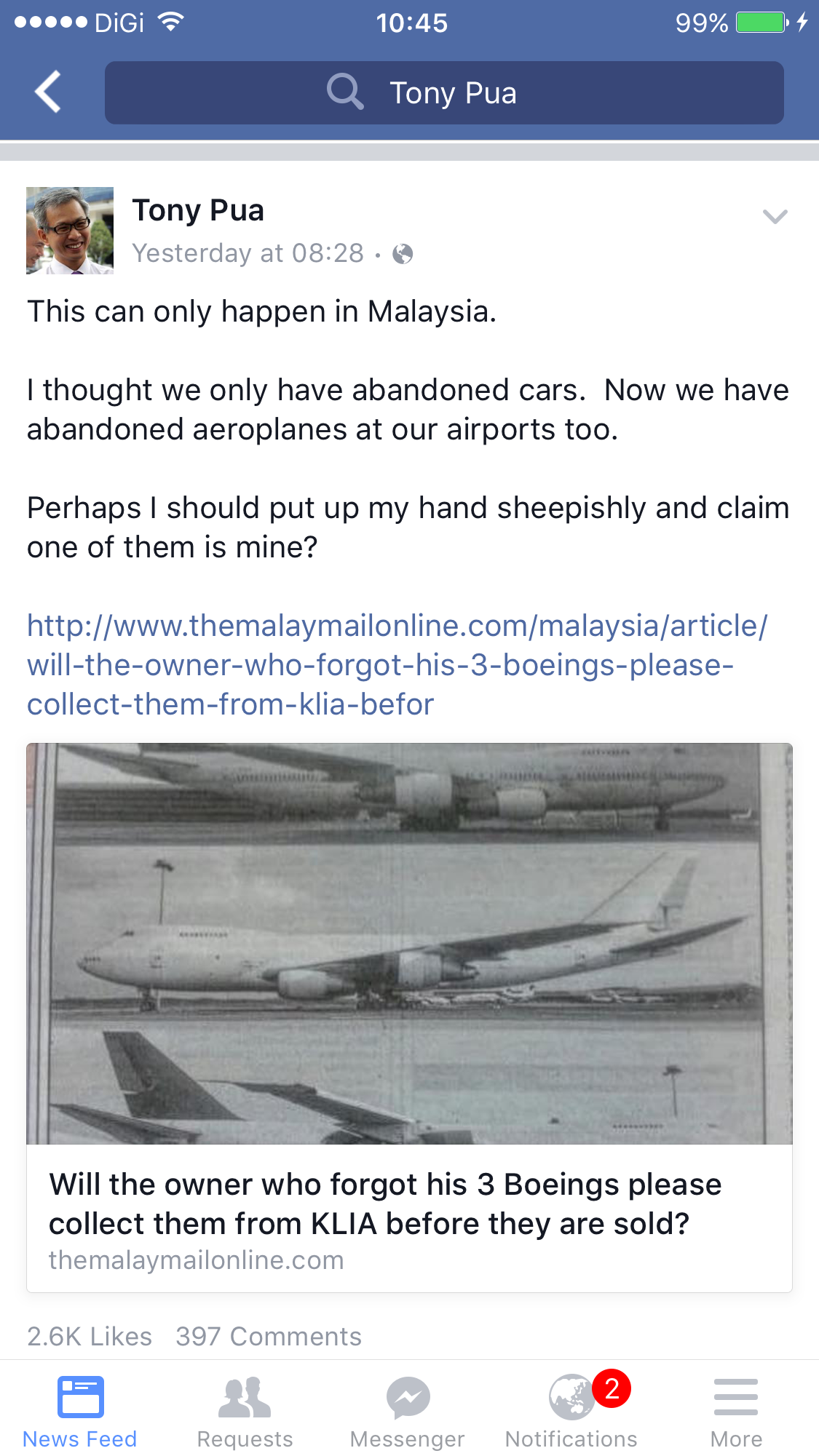
Did Three Boeing 747-200s Suddenly Appear At The KLIA?

  
See the pic above.

This is how simple minds work. The above was posted by a local celebrity. Without further checking people like this celebrity simply put things down as facts, and brain-dead zombies take the “facts” as the truth.

The sad part is many believe the celebrity.
These aircraft were leased by MAS Cargo from Air Atlanta Icelandic, an aircraft leasing company. The latter sold these aircraft to their new owner. At the end of the lease, MAS Cargo parked them on the apron awaiting collection by their “new” owners who never turned up.
Those who travel frequently to and from KLIA for the past one year and a half would have seen these aircraft. They did not just appear as how simple minds would think so.

Then look at the pic below taken from Tony Puaka’s Facebook:


Tiny is another brainless buffoon whose mouth opens wide enough for us to see that there is abaolutely nothing inside the cavity in between his ears. Is Malaysia the only place where people abandon planes? If he uses the Internet to seatch for the truth rather than just to spread lies, he should have found this following link:

http://m.timesofindia.com/city/nagpur/Abandoned-plane-gets-a-new-resting-place/articleshow/49159971.cms 

Stop making up facts, and don’t show to others how less clever you really are.
The moral of the story is, if you don’t have the facts, don’t talk about it or make up stories about it like some has-been Prime Minister, or some low-class buffoon disguised as a politician, or a bimbo.

I.S.A 2.0 Ad Nauseam

  
There was a time when dissidents could not even voice out freely. Anyone found criticising a certain then-Prime Minister would be hauled up and locked up without any chance of trial. Judges who do not toe the line get removed or sidelined. And at virtually every function attaended bybthis former Prime Minister Sinatra’s “My Way” would reverberate the function hall, a subtle reminder of how things should be run – thise who resist will be given a free ride to the Kamunting detention centre thanks to the Internal Security Act (ISA). Coincidentally this former Prime Minister now joins the call for more freedom of speech when in the past he got expelled from UMNO for criticising the then Prime Minister for, among others, NOT executing Chinese prisoners.

Today, Malaysians speak freely. Yet they still claim voices of dissent are being stifled. Anwar Ibrahim, the so-called victim of political conspiracy (apparently his proponents claim the government provided an arse to be buggered and poor Anwar couldn’t resist getting himself in deep shit) could still make political statements from behind bars even to the international media.

People ask me, is the National Security Council Act going to be ISA 2.0?

Miss Lim Sian See writes the following:

In 2011, ISA an the Emergency Ordinance 1969 was repealed by govt. These two acts had powers that were wide-ranging and had taken effect for decades.
Since then, the govt has passed several bills to give back some powers that were missing from those two acts.
– When SOSMA was introduced, Pakatan said it was ISA 2.0.

– When the Peaceful Assembly Act was introduced, some also called it ISA 2.0.

– When the amendments to the Prevention of Crime Act (POCA) was introduced, they called it ISA 2.0,

– When the Prevention of Terrorism Act (POTA) was introduced, it was also called ISA 2.0
And recently, the National Security Council (NSC) bill was introduced and passed, the same people and international human rights groups are calling it ISA 2.0 too.
The NSC bill allows the National Security Council to declare certain areas as a security area, Once declared, security forces deployed “may without warrant arrest any person found committing, alleged to have committed or reasonably suspected of having committed any offence under any written laws in the security area”.
The scope and powers under the NSC bill are very similar to those under the Emergency Ordinance where 92 emergency ordinances, five to six parliamentary acts, and hundreds of subsidiary legislations actually gave more power to the Federal Govt for the 42 years from 1969 to 2011 – all of which were lifted by Najib’s govt.
For example, under the EO the federal government can make laws that are under a state’s jurisdiction such as on land matters – something that the NSC does not have.
During these 40 years, the EO which was already in effect did not affect our country’s progress. The NSC bill provides us with the ability to implement EO-type rules only in specific areas and only IF there is a specific terrorism or security threat as deemed necessary by the NSC.
Any renewal to the security areas are also to be passed by parliament.
It is thus clear that the NSC powers are less than the EO powers. Also, no security areas have been declared – unlike the EO where the entire country was under Emergency law for 42 years. 
Many may have forgotten that France implemented a state of emergency and closed all its borders less than a month ago after Paris was attacked leaving 130 persons dead,
France parliament have now voted to extend the emergency for 3 months and there is talk that the emergency period will be extended indefinitely,
Since the declaration of that emergency, France police have conducted more than 2,200 raids on homes and businesses, detained 232 people, restricted the movements of many others – banned 22 people from leaving the country and confined nine of them to their homes -, freeze assets and closed 3 mosques.
These acts by the France police are exactly the same concerns that critics of the NSC bill have – but strangely, these very same critics do not criticize France for doing what the NSC bills allow our govt to do.
Should a “Paris attack” occur in Malaysia first before these critics finally understand why the government needs to put these laws in place and then they will keep quiet?
What the government has done is to ensure that, in the event of a similar attack like in Paris, Malaysia is legally equipped to move as quickly as France did,
The prior laws passed such as POTA, PCA, SOSMA were more preventative laws, The NSC laws are designed to allow the Govt to legally and swiftly act IF such attacks like in Paris happens and allow for a much stronger response,
For all the multiple times the opposition have cried ISA 2.0 or “uncharted territory:, it cannot be denied that the old ISA and EO were still much worse and unfair than what we have as replacement laws -which has more checks and balances.
Recent threats and attacks world-wide leaves Malaysia no choice but to be equipped legally to either prevent or respond decisively should such attacks happens in this country.

http://www.wsj.com/articles/french-authorities-close-four-mosques-during-state-of-emergency-1449079003

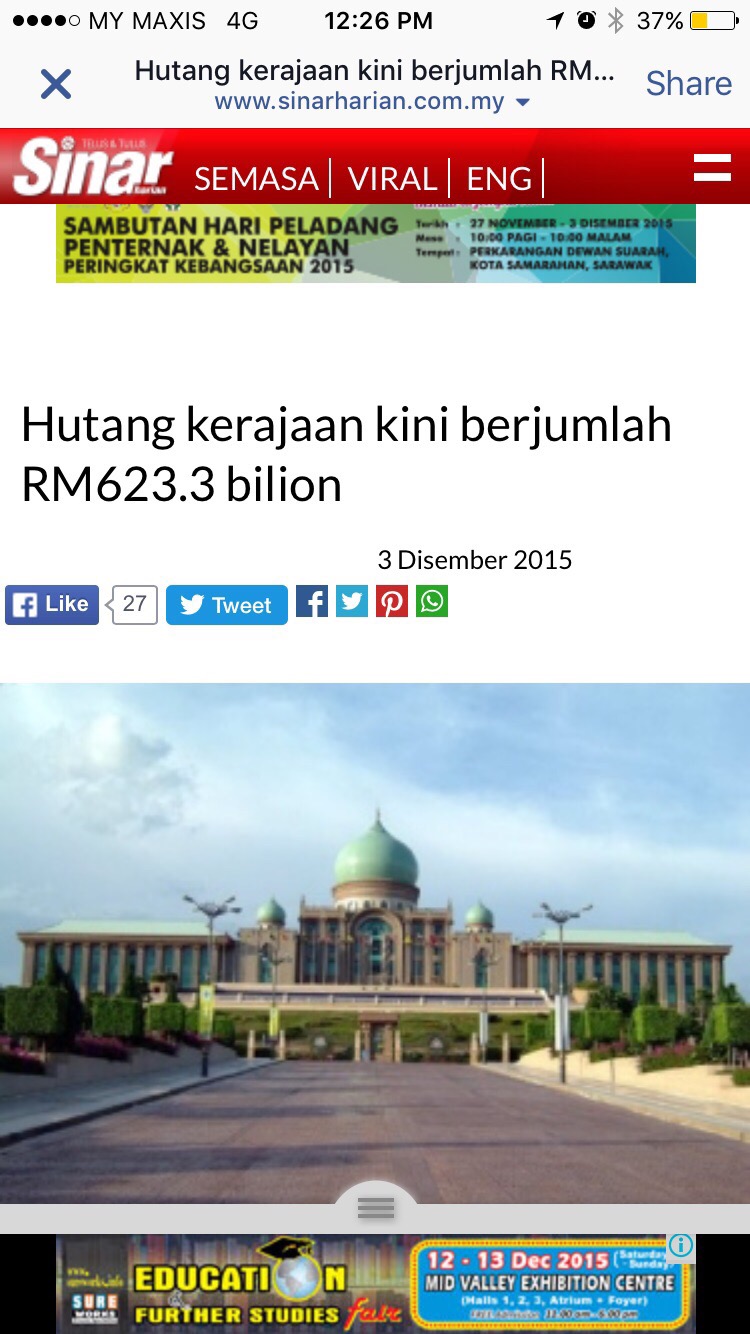
RM623.3 billion… AND FALLING!

  
One look at the headline above and the untrained mind would scream in panic.

However…

According to a parliament answer by Deputy Finance Minister Johari, as at end Sept 30, 2015 our govt debt is now at RM623.3 billion, which is 50.7% of GDP – dropping from 52.8% (RM568,8 billion at June 30, 2014) and 54.7% (RM547.6 billion as at end 2013).

Our debt has increased but our country’s GDP (our national income) has increased much faster due to our steady GDP growth – hence the sizeable drop in the Debt to GDP ratio.
At 50.7% Debt to GDP ratio, according to the CIA fact-book, more than 70 other countries in the world will have to go bankrupt before it reaches our turn.
These countries include: Japan Zimbabwe Greece Lebanon Jamaica Italy Portugal Eritrea Cabo Verde Grenada Ireland Cyprus Belgium Singapore Barbados Spain Puerto Rico France Canada Egypt Bhutan Jordan Antigua And Barbuda United Kingdom Iceland Croatia Austria Saint Kitts And Nevis Belize Saint Lucia Hungary United States Germany Morocco Sudan Albania Sri Lanka Ghana Ukraine Dominica Serbia Sao Tome And Principe Netherlands Malta Aruba Saint Vincent And The Grenadines Israel Seychelles Pakistan Guyana Uruguay El Salvador Mauritius Slovenia Malawi Mozambique Montenegro Finland Brazil Bahamas, The Yemen Costa Rica Slovakia Senegal Vietnam Venezuela India Marshall Islands Syria 
The steady drop in our Debt-To-GDP ratio is due to our shrinking yearly budget deficits which have been reducing every year to only 3.2% this year and targeted at 3.1% next year.

The federal government debt as of Sept 30 this year was at RM623.3 billion, said Deputy Finance Minister Johari Abdul Ghani.

“Of this amount, 96.4 percent or RM601.1 billion was domestic debt, with the balance of RM22.2 billion or 3.6 percent being offshore loans in various denominations of currency.
“The government debt is manageable and categorised as a country with moderate indebtedness,” he told the Dewan Rakyat today.
He said this in response to a question from Ahmad Hamzah (BN-Jasin) who asked for clarification from the finance minister on the federal government debt.
Johari said the level of the federal government debt for the stated period to the Gross Domestic Product (GDP) was 50.7 percent.
—-
https://www.cia.gov/library/publications/the-world-factbook/rankorder/2186rank.html
http://www.malaysiakini.com/news/322001
http://www.themalaysianinsider.com/bahasa/article/hutang-negara-rm568.9-bilion-atau-52.8-daripada-kdnk


Bat Journalism

“As blind as a bat.”

That is how I would describe most journalists today. They never understand not a scintilla of what they write but they write them anyway. Corrections can be made later no matter if the damage has been done and is irreversible.

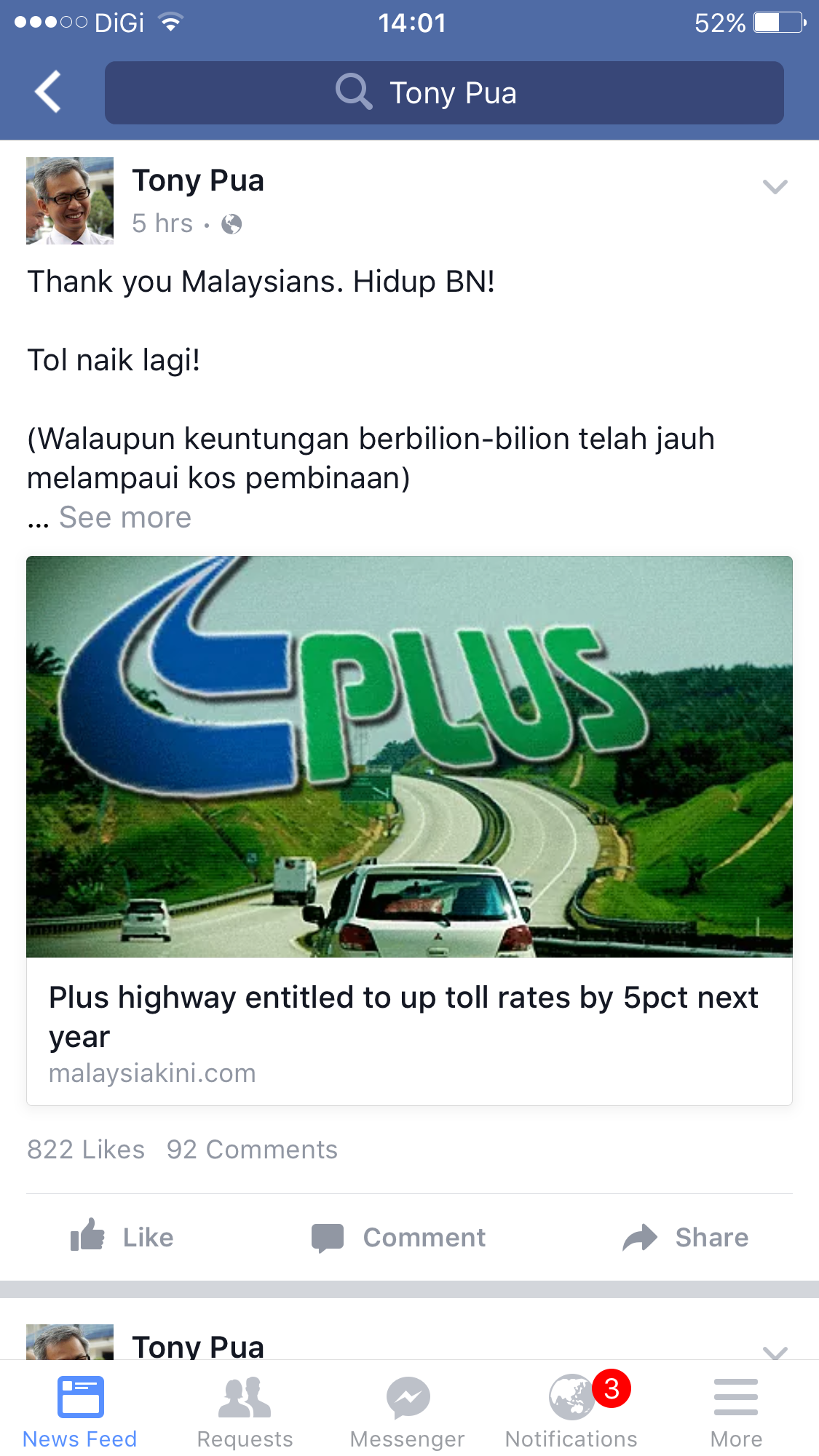
The latest intentional or unintentional faux pas is about the PLUS highway concession, quoting Deputy Works Minister Datuk Rosnah Abdul Rashid Sirlin in her answer to a supplemental question from Datuk Ahmad Fauzi Zahari (BN – Setiawangsa). One portal reported:
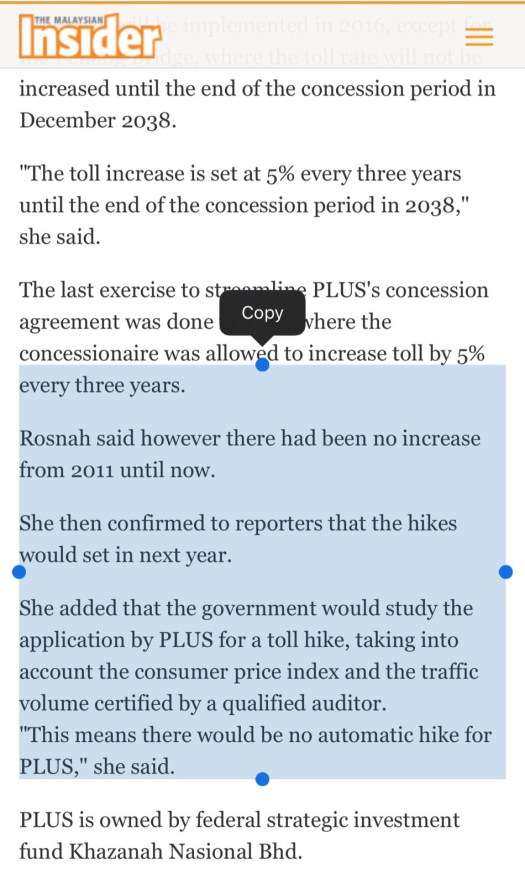
  
The report above is as if the decision for a toll hike every whatever the number of years set in the agreement. What the portals have not mentioned is that it is up to the government to allow any toll hike after all concerns have been weighed. 

Of course you have opportunistic baboons such as Tony Puaka to further add to the confusion:

  
The actual answer by the Deputy Minister is as follows:

1.​Lebuhraya Utara Selatan (PLUS) telah mula dibina pada tahun 1989 dan siap pada tahun 1994 dengan kos sebanyak RM5.9 bilion. Kos projek ini ditanggung sepenuhnya oleh syarikat konsesi PLUS, kecuali kos pengambilan tanah yang ditanggung oleh Kerajaan. Berdasarkan perjanjian konsesi tambahan terkini (2011), tempoh konsesi Lebuhraya PLUS akan tamat pada 31 Disember 2038. Setakat ini Kerajaan tidak ada perancangan untuk melanjutkan lagi tempoh konsesi tersebut.


2.​Dalam tahun 2011, PLUS telah melaksanakan pengstruktaran semula dimana PLUS terpaksa membuat pinjaman sejumlah RM30.6 billion melalui penerbitan bon. Bayaran balik faedah pinjaman telah mula pada tahun 2012 manakala bayaran pokok hanya akan bermula pada tahun 2017 sehingga 2038.


3.​Untuk makluman Ahli Yang Berhormat, syarikat PLUS merupakan pemegang konsesi bagi 6 lebuh raya iaitu:


• Lebuhraya Utara Selatan

• Lebuhraya Lingkaran Tengah ELITE

• Lebuhraya LINKEDUA

• Jambatan Pulau Pinang

• Lebuhraya Butterworth Kulim

• Lebuhraya Seremban Port Dickson


4.​Melalui penstrukturan semula pada tahun 2011, hasil keuntungan terkumpul pemegang konsesi Lebuhraya PLUS sehingga 2014 adalah RM26 juta. Secara puratanya, 50% daripada hasil keuntungan adalah digunakan untuk membayar balik faedah pinjaman. Syarikat PLUS telah membuat pinjaman melalui penerbitan bon berjumlah RM30.6 bilion. Pinjaman ini dibuat pada tahun 2011 semasa penstrukuturan PLUS Berhad.


5.​20-25% digunakan untuk membiayai kos operasi dan penyenggaraan, ini termasuk lebih kurang 25% jajaran yang tidak dikenakan tol.


6.​15-20% adalah untuk kerja-kerja upgrading, termasuk pembinaan persimpangan bertingkat Sungai Buaya, Bukit Gambir, Kuala Kangsar, Ainsdale dan kerja-kerja naiktaraf Lorong Keempat Lebuhraya Utara Selatan.


7.​Baki 10% adalah untuk bayaran balik kepada pemegang saham yang terdiri daripada KWSP (49%) dan Khazanah (51%).


8.​Untuk makluman Ahli Yang Berhormat juga, perjanjian konsesi PLUS telah mengalami penstrukutran semula kadar tol sebanyak 4 kali iaitu pada tahun 1999, 2002, 2005 dan 2011 di mana kadar tolnya telah mengalami beberapa perubahan daripada penggunaan Consumer Price Index (CPI), 26% setiap 5 tahun pada tahun 1999 dan kepada 10% setiap 3 tahun pada tahun 2005 dan akhir sekali pada tahun 2011 di mana kenaikan kadar tol diselaraskan kepada 5% setiap 3 tahun.


9.​Kadar tol PLUS tidak dinaikkan sejak tahun 2005. Dalam penstrukturan semula kadar tol tahun 2011, tiada kenaikan tol sehingga 2015. Manifesto PRU 13 BN menetapkan pengurangan kadar tol secara berperingkat lebuh raya Antara Bandar. Sehubungan dengan itu, Kerajaan akan berunding dengan syarikat konsesi bagi memenuhi akujanji manifesto tersebut.


10.​Untuk makluman Ahli Yang Berhormat juga, jajaran Lebuhraya Utara Selatan bermula dari Bukit Kayu Hitam hingga ke Johor adalah sepanjang 848km. Lain-lain lebuhraya ELITE (63km), BKE (17km), SPDH (23km), JPP (13.5km).


11.​Untuk makluman Ahli Yang Berhormat, jumlah keuntungan selepas cukai PLUS Berhad bagi tahun kewangan berakhir 31 Disember 2014 ialah sebanyak RM8.4 juta, iaitu mengambikira PLUS Berhad sebagai entiti korporat tunggal yang mengendalikan 5 lebuhraya selepas pengstrukturan semula PLUS mulai bulan November 2011

PLUS operates six highways with a total distance of 964.5km. PLUS has not had a toll increase since 2005. As a result of a restructuring exercise in 2011, PLUS has had to raise RM30.6 billion through bonds issuance. 50 percent of its profit since then has gone to the payment of loan interest while 20 to 25 percent has been allocated for the operations and maintenance of the highways, 15 to 20 percent to upgrading works, while the balance of 10 percent has gone to the payments to the shareholders i.e KWSP and Khazanah.

The above profit was at RM26 million (2014).

What we must also remember, because the toll concession agreements are all legacies of a certain former Prime Minister, the original agreement allowed for a hike of 10 percent every three years. The current Prime Minister initiated for the takeover and has had the agreement renegotiated in 2011 to a hike of 5 percent every three years. However, there has been no hike since 2005.

And if I understand the statement correctly there will not be any automatic hike and that the government is committed in reducing intercity toll rates until 2018.

Blind dingbats who call themselves journalists should act more responsibly when reporting. Sensationalism sells, but that only goes to prove that you are just another opportunistic baboon like Tony Puaka.

Withering Heights 

There was a time when Anwar Ibrahim and ADIL (later KEADILAN, and then Parti Keadilan Rakyat) enjoyed the massive support of the rakyat no matter the program. That was the time when those who hated his guts such as the DAP and PAS treated him and his party as a political mules. The jockeys rode to victory in many places in 2008 while PKR only got the MB seat in Selangor by virtue of PKR being able to provide a Malay candidate as the MB.

As time goes by, the rakyat can finally see that other than Rafizi, Wan Azizah, N Surendran, Nurul Izzah and Tian Chua, PKR has nonother candidates qualified to become anything, and that PKR is nothing but a vehicle to promote Anwar Ibrahim as the next Prime Minister, and stops at only that.

The above is evident in the latest cow-dung shat by PKR in the case of the Tian Chua-arranged meeting between Nurul Izzah and Jacel Kiram, discarding the sensitivities causedby the Lahad Datu intrusion.

  
So how much support does PKR and its loose coalition have nowadays?

  
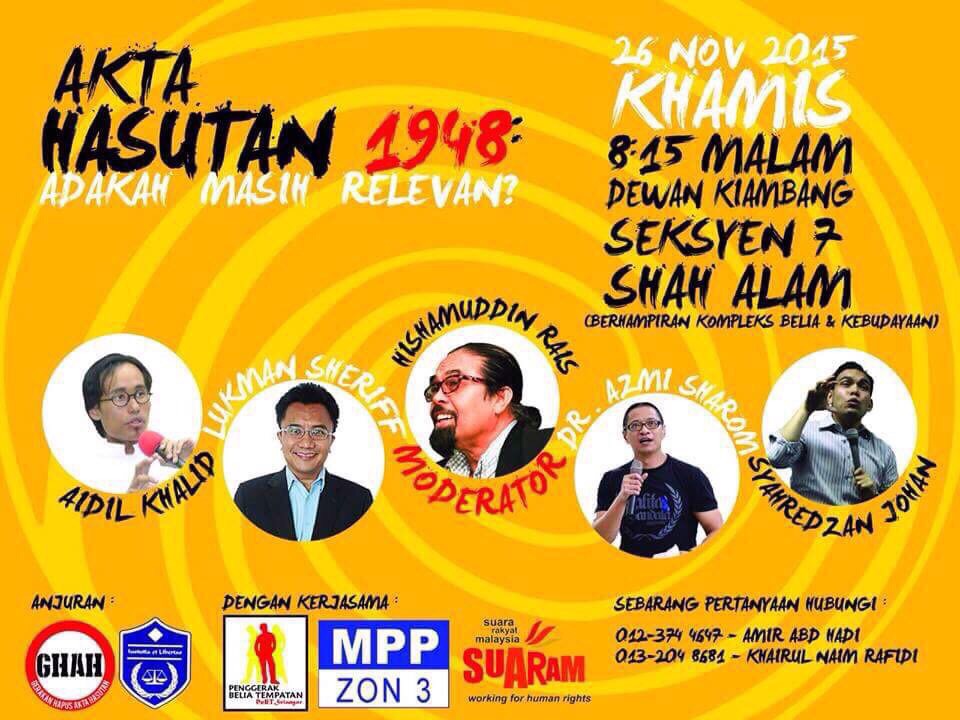
The above Pakatan-organised (PKR) forum was held in Opposition-held Shah Alam, its own safe seat. Using the favourite opposition-leaning media’s words, “tens of thousands” attended. Here is a photo of the forum.

   
My guess is we will have a new Menteri Besar in Selangor – a DAP stooge.  DAP as usual will have the most seats in Selangor and Mat Sabu-led Amananah will contest. Pseudo-religious voters will support Mat Sabu and his massacre of cartoons and among these DAP-friendly candidates, one will become the Menteri Besar-designate.
DAP will eventually have its way in Selangor.

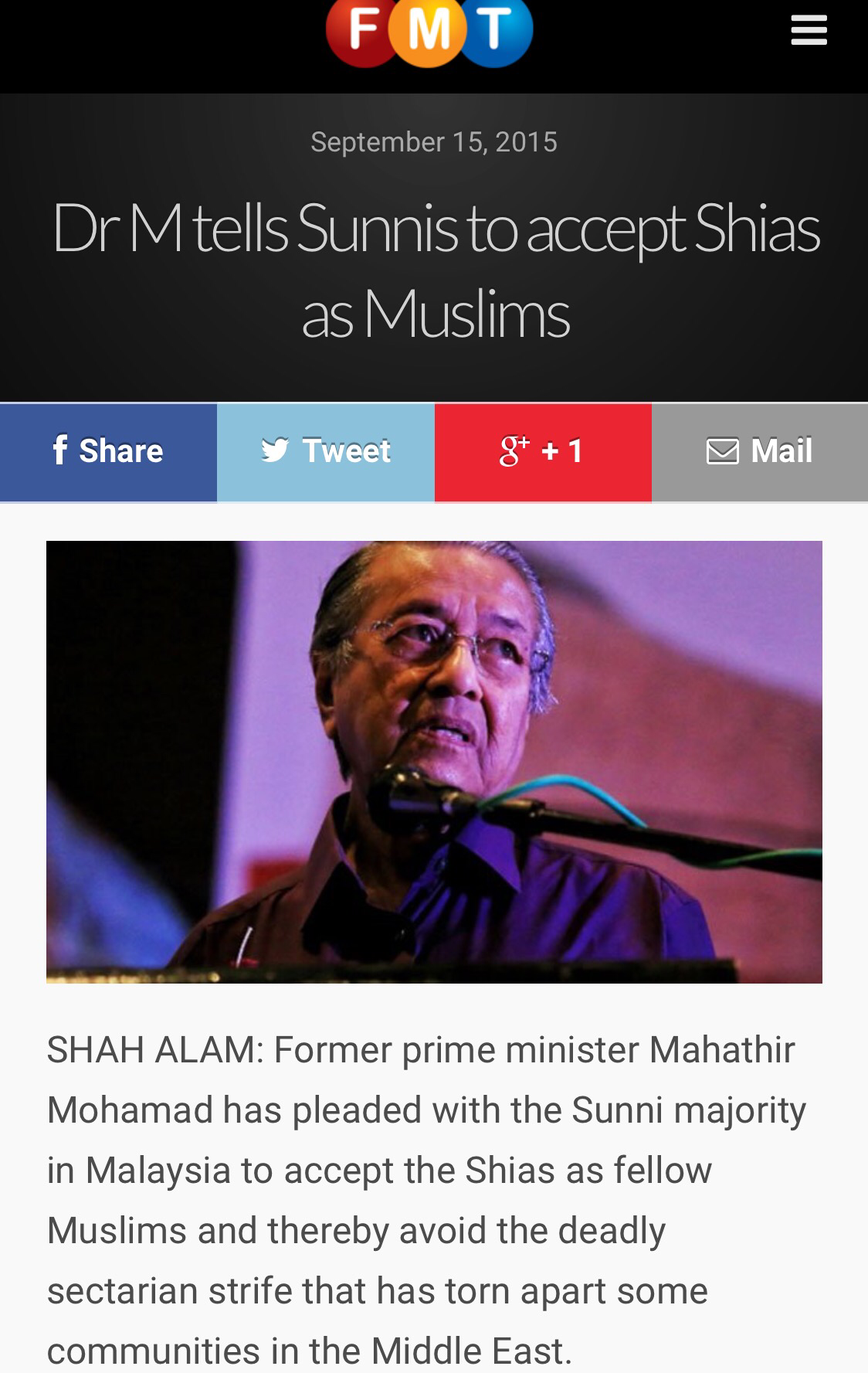
Jacking Shiite

While JAKIM could improve more than just being a body to justify what is Halal or Haram, I feel that it is a very much needed organisation to help regulate the understanding of Islam according to Mazhab Shafie of the Ahlus Sunnah Wal Jama’ah teachings.

Not Wahabbi, not Shiah. Not ISIS.

I don’t agree with some of JAKIM’s findings, but I don’t agree with calls to disband JAKIM. By NOT having JAKIM, however, only allows unwanted elements attack the foundation of those who do not have a good grasp of basic Islam – Fiqh and Tauhid. We see from time to time attempts are being made to proselytise Muslims; and we see how some have adopted very liberal interpretation of Fiqh to the point of mocking those conservative Muslims. We see how extremists have also taken advantage of the weak and those who do not practice by promising them paradise and so on so they would commit terrorism to “atone” for their sins as seen by the many number of Malaysians who suddenly think they can go to paradise by joining ISIS.

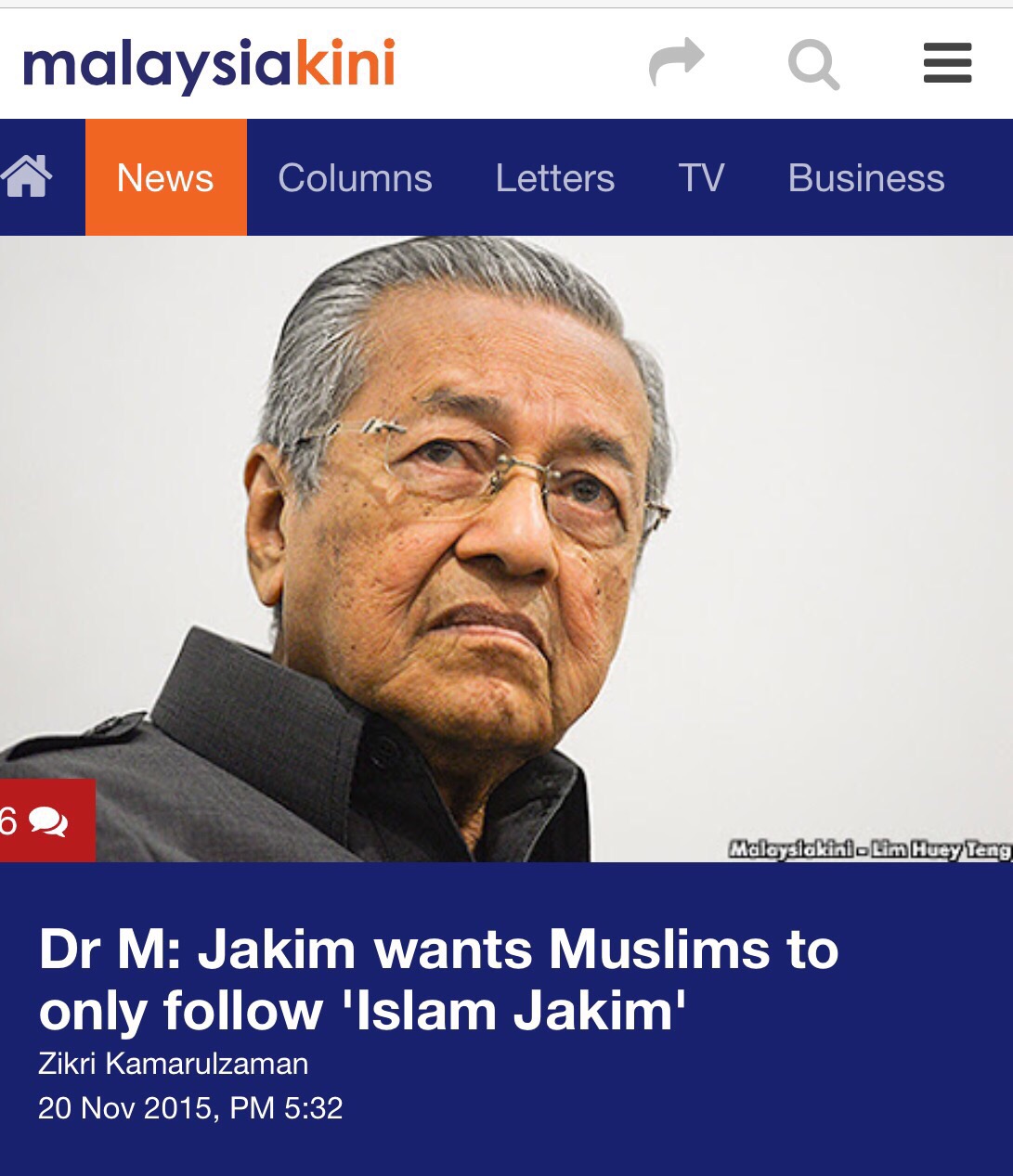
Today, another person has joined in the fray by mocking JAKIM.


Perhaps, this person who is always mudah lupa especially during the PKFZ hearings, has also lupa that he wants Malaysians to accept another version of Islam:

  
Before you begin thinking about what he has said, I would like you to ask yourselves if you would go down with him to Anwar’s favourite backyard?