Let Sleeping Dogs Lie

My father is 76 this year. He is still as sharp as ever. He only learnt to use a smartphone about a year ago after the passing of my late brother. He relied much on his trusted Nokia mobile phone until that got spoilt. He now sends and forwards Whatsapp messages to his children and grandchildren. Previously they were all sent as SMS. Of course, some of the messages he forwarded to us make me cringe as they were either older than the age of his smartphone, or unauthenticated; something you would not see if this was 21 years ago when he was still the IGP that he was for 20 years.

Having been the IGP for 20 years means that his opinions, in law and order as well as public moral and safety, count. This he continues to speak out at public forums. When he does so, he would relate it to the history of this nation most would have forgotten, or never experienced. He does so without interfering with or meddling into how the current leadership of the Royal Malaysian Police manages the force, and law and order. He knows his place – he was the IGP. He no longer is one.

I, too, find that as I age, I grow more sensitive. There are times when I wish I am still wearing my uniform. There are times when I wish that the Air Force still runs on the same tradition and system as those times when I was a serving officer. I meet up with veterans from other services as well, and just yesterday I was with a former army commando talking about old times. He keeps talking about “how it was then, as compared to how it is now” something I am also inclined to do.  However, I smiled at him and said, “times have changed. This is the present generation’s time.” I do engage former colleagues and squad mates who are still serving. I give ideas when asked, but always remind myself that I am no longer part of that life I sorely miss.

Tun Dr Mahathir was a towering statesman. For 22 years he managed this country with an iron fist along the line of his favourite Sinatra song, “My Way.” My way or the highway was his style. It was his style that propelled this beloved nation to where it is now. For all the good that he had done, many remember that his ways were often brash and snubbed many people in and out of this country that former Prime Minister of Australia, Paul John Keating, branded Mahathir an incalcitrant.

When Dr Mahathir was at the helm, there were dozens of accusations made against him. From bailouts to cronyism to interference in the independence of the judiciary to name just a few.  Of course when the Bumiputra Malaysia Finance Ltd bailout happened and its auditor got murdered, many of those who cry out against bailouts today were still in diapers. When Perwaja steel was bailed out, the Internet in Malaysia was still in its infancy, hence never received the same level of amplification that the recent “bailouts” have seen.  It was a time when UMNO cohorts thumped their chest and said, “UMNO and the government are one.” I don’t have to dwell on this as Tunku Abdul Aziz and numerous blogs have covered these “abuse of power.”

I don’t care for those in the opposition because it is their job to criticize come what may, but it is those in UMNO who are now taking the same line as the opposition. When the judiciary came under attack for not coming up with a verdict that favoured Anwar Ibrahim, UMNO members were quick to defend the judiciary, or any other government agency for that matter, the Audito-General’s office included.  Now, they too say that the audit report by the Auditor-General may not be transparent or not impartial.

Why the about turn now? Why the change in behaviour from UMNO to becoming the opposition? Why the incessant attack regardless of whatever explanation is offered? Isn’t this the very same opposition method that these same UMNO people criticized and ridiculed? How can public attacks on UMNO’s President be beneficial to UMNO if it means adding friendly fuel to the opposition’s fire?

Of course, now is about now and how best we move forward from here. Calls for Najib Razak to step down have not been accompanied by who should succeed and who should succeed next after the successor. The business continuity plan just isn’t there.  Even Dr Mahathir has stated that he doesn’t know who should lead the nation should Najib step down. So should we continue with this onslaught on Najib?

Dr Mahathir is whom I would describe as a once-in-a-lifetime leader. There is no doubt that I will never live to see another great leader such as he. Sharp, witty, acid-tongued, sarcastic to the point that the west has this love-hate relationship when it comes to Mahathir. I love the legacy he has built for us all, but now I am beginning to have my doubts about the relevance of his spoken facts. It was still okay when in the beginning he asked about 1MDB. However, when he raised the issue of Altantuya not only was he underscoring the opposition’s stand that the judiciary is not impartial, but his act was in contempt of a court decision. Is that the case that he is putting forth? The straw that broke the camel of my respect’s back was the announcement he made on the resignation of the Speaker of the Dewan Rakyat. In my eyes the pre-emptive announcement was a low blow. It would have been alright had such an announcement been made AFTER the fact that a resignation had indeed taken place.

How different is that than Anwar’s 16th September 2008 announcement of having the numbers to form a government?  The funny part is, the announcement was spun by pro-Mahathir people as “the trump card of all announcements.”!

Sometimes I wonder if it is the people around Dr Mahathir, especially those in want of something out of all this or just in want of a raison d’etre, who keep prodding the 90-year old to continue attacking Najib? Why are they taking advantage of an old man? Why use him as a shield? Is there no shame in that? That goes to the pro-Najib people too! Why make matters worse by attacking Dr Mahathir and family? Why are you bringing yourselves down to the pro-Mahathir level if you find their methods despicable?

I just wish they would stop the quarrel and leave Najib and the old man and his legacy alone.

Tabung Haji Buys 1MDB Land

I look at the above issue from a layman’s point of view. A slightly different layman that is. When I saw the headlines that discussed this issue I asked myself, “What the heck? Tabung Haji has lots of investments and has invested in many things other than the 1MDB land at the Tun Razak Exchange (TRX).  How the 1MDB acquired the land, at what price whatsoever to me should be left aside as that is not the crux of the matter.  The question now is of Tabung Haji’s decision to acquire the land.

Firstly it was reported that Tabung Haji, or TH, had acquired two pieces of land at the TRX for a hefty sum of RM772 million.  Initially, the Chairman of TH, Abdul Azeez Abdul Rahim denied such a deal was made.  A day later the CEO of TH, Johan Abdullah, admitted that only one parcel was purchased at RM188.5 million, not two as reported.  So, TH has bought another piece of land which I assume was done through one of its subsidiaries.  It doesn’t really matter to me if it wasn’t.  Under Section 4(1) of the Tabung Haji Act, 1995 the Board of Directors of TH has the authority to manage the funds including to come out with policies regarding the managing of funds and pilgrims affairs. The question that should be asked here is if the decision to acquire that parcel of land was the correct decision?

TH, I believe like other corporations would, has a set of process that needs to be satisfied before an investment is allowed to be made. There would have to have a department that looks at potential investments or purchases to be made.  They would have to put up a paper and work hand-in-hand with a risk management department that would identify and analyse the risks involve.  The paper would then have to be submitted to a valuation panel before being escalated to an investment panel, while the risk assessment would have to be forwarded to a risk management committee.  The investment panel, upon being satisfied with the investment valuation will then escalate the paper up to the board of directors who in turn will be advised by the risk assessment committee before a go-no go decision is made.  However, TH being a pilgrims fund board, might have to seek the approval of a minister under whose purview it comes under.

I am not in the business of defending anyone. TH’s Investments Panel consists of seven persons including a Chairman, and a representative of the Bank Negara or a professional from the finance sector. If it had gone through the processes and had satisfied all the requirements, then why not? Why are we making such big fuss about the purchase? Would we have batted an eyelid had it been purchased from Phuying Gersang Sdn Bhd?

If you believe there are irregularities in the acquisition process, go ahead and make a police report so the authorities could step in and investigate the matter. There is no point harping on issues that had due process done and help stir things up over nothing if you don’t have evidence of wrongdoings.

Perhaps you scream foul because Azeez screwed up in his denial, or because it was made by Azeez who is said to be closely linked to Rosmah.  But that does not prove anything wrong, does it?

It is a shame that the Opposition is trying to stir shit over something that to a layman like me is not a big issue. It is an even bigger shame that some BN supporters help the Opposition members to stir the same shit.

Like I said. I am not in the business of defending anyone. I just don’t like shit-stirrers.

Survey: Najib, Mahathir and the 1MDB

I created a survey last week just to find out what people think of the Najib-Mahathir spat regarding the 1MDB affair. The following are the results:

Q1: How do you perceive the 1MDB as?

58% said that it is a scheme that will bring trouble to us all

41% said that it is a good scheme that is badly executed

1% said that 1MDB would benefit the rakyat

Q2: Did Najib asnwer all Dr M’s questions?

79% said NO

20% said SOME

1% said YES

Q3: Does Dr M have the right to question Najib?

97% said YES

3% said NO

Q4: What should Najib do regarding the 1MDB?

52% said he should step down

27% said he should step aside while investigation is being conducted

5% said he should disregard all criticisms and carry on

17% did not agree with any of the above

Q5: Would BN lose more seats in the next general elections because of 1MDB?

70% agreed absolutely

23% somewhat agreed

6% said BN would remain with the same number of seats

1% said BN would gain more seats

Q6: Whom would you support?

95% Dr M

5% Najib

Q7: 1MDB would:

52 % said drag the nation down

47% said benefit only those with interest in 1MDB

1% said benefit the country

The Respondents:

37% of the respondents are aged between 36 to 45;  31% are aged between 46 to 60; 29% are between 21 and 35; 5% are 61 and above.

Demography:

39% of the respondents are from Selangor

30% are from Kuala Lumpur

5% each from Sarawak and Johor

4% are Malaysians living abroad

3% each from Perak, Putrajaya and Pulau Pinang

2% each from Kedah and Pahang

1% each from Melaka, Kelantan, Terengganu, Sabah, Negeri Sembilan and Perlis

Labuan did not register any response

The Overseas Respondents:

Of the 4% Malaysians living abroad:

 36% are currently in the United States of America

23% are currently in Singapore

4.5% each from Saudi Arabia, New Zealand, Australia, United Kingdom, France, Indonesia and the Republic of Korea

9.5% took the survey from unknown locations 

The Bittersweet Alliance – Part 1

The philosopher Jorge Agustín Nicolás Ruiz de Santayana y Borrás or George Santayana once said that those who do not remember the past are condemned to repeat it.  The recurrence of history is part of life’s cycle, but always in different forms.  Those who do not remember how certain historical lows were handled are bound to make even bigger mistakes.


Recently, there was a furor following the statement made by UMNO’s Ismail Sabri , the Agriculture and Agro-Based Industries Minister, asking consumers to boycott greedy Chinese businesses.  While it is normal to hear the communal-party-disguised-as-a-non-communal-party DAP lashing out at Ismail Sabri, the call by MCA’s Youth Chief, Chong Sin Woon, for the sacking of Ismail Sabri did not go down well with UMNO and 92 Divisions of the latter rallied behind Ismail asking for Sin Woon to be sacked instead.


While I refuse to indulge in a debate over what was said by Ismail Sabri, there is a need for consumers to boycott profiteering businesses who whine about high cost of fuel and pressured the government to allow them to increase the price of their services, but refused to lower prices when the price of fuel has gone down by half.  What I am more interested in is the bittersweet alliance between UMNO and MCA, and how history is repeating itself.


While the movement for the independence of Malaya had started decades before, there was no cohesion between races. In 1946 when the Malayan Union was formed, the republican-in-nature Partai Kebangsaan Melayu Malaya (PKMM) and the non-Malay Malayan Democratic Union (MDU) were quick to support the formation.  The PKMM, a spin-off from the Batavia-leaning KMM of Ibrahim Yaacob, was all for a Malaya not ruled by the Malay Rulers, while the MDU liked the idea of automatic citizenship (read more in Seademon’s The Road To Merdeka: Persekutuan Tanah China ) for the immigrants. On 1st March 1946, more than 40 Malay organisations met up and 41 decided to form the United Malays National Organisation (UMNO) to champion the Malay rights.  The Malays were then a minority in his own land, poor, sidelined from economic development, health care and formal education.  With the help and encouragement of the then-British High Commissioner, Sir Henry Gurney, the Malayan Chinese Association (MCA) was formed on the 27th February, 1949. Gurney aimed at winning the allegiance of the Chinese community away from the Communist Party of Malaya (CPM) (Colonial Office Record 537/773(1) Memorandum by Henry Gurney, 28th January, 1949).


There was apprehension and distrust between the Malays and Chinese.  The alienation of the Malays by Chinese mining tycoons and rubber estate owners, followed by the preference of the Japanese of the Malays over the immigrant Chinese, and this in turn followed by retribution against the Malays by Chinese sympathizers of the CPM after the Japanese surrender have had contributed enormously to this animosity between the two.


It was since 1950 that Henry Gurney had wanted to introduce some form of democracy to Malaya through elections to satisfy the public’s hunger for democracy versus the communist’s way of winning self-government.  Alas, he was only a High Commissioner and still had to go through the true rulers of the Federation of Malaya – The Malay Rulers.  So, during the 10th Malay Rulers Meeting on the 22nd and 23rd February, 1950, Gurney presented his recommendation, only to be met with reluctance of the Malay Rulers.  In the minutes of meeting, the Sultan of Kedah stated his reservation:


The most important prerequisite for democracy is education. Without enlightened public opinion a democratic system of Government will be liable to unsteadiness or even confusion and chaos. One danger is that it may be transformed into a single party government through a few skilled electioneers working among the apathetic population and this will work towards dictatorship.” (Colonial Office Records 537/6025(1))


The Malays, as mentioned above, were left behind educationally and may not know what is best for them.  For the same reason the PKMM and MDU were in full support of the Malayan Union four years prior to this event.  And whatever the outcome, the Malays would have ended up the biggest losers if no one champions their rights. Noted William L Holland in “Nationalism in Malaya” (WL Holland, 1953):


“There was already Malay discontent in the pre-war period over the poor economic position vis-a-vis the Chinese and Indians. Malay peasants and fishermen, noted S.H Silcock and Ungku Aziz, were dependent on Chinese middlemen while Malays worked as messengers in offices where Chinese and Indians were clerks.”


The phrases made bold above by me, still holds true today and became the basis of Ismail Sabri’s main grouse against profiteering businessmen.


Gurney had to bring about some form of democratic self-rule that would benefit all races.  Separately he discussed on numerous occasions with both MCA and Dato’ Onn and impressed upon them that self-rule would only happen if there is a closer relations between the communities (The Making of the Malayan Constitution, Joseph M Fernando, 2002, Page 15).  Gurney was all for the promotion of Sino-Malay talks to tackle long-term problems.  Gurney minuted the following:


“The outstanding issues at that stage were citizenship and the economic backwardness of the Malays.  The Chinese leaders sought a more liberalised citizenship than those contained in the 1948 Federation of Malaya Agreement.  Onn meanwhile , had approached the Colonial Office to secure financial assistance for the Malays.” (Colonial Office Records 537/773(1))


Onn Jaafar, however, was more open towards a better relationship between the Malays and other races if UMNO was to achieve the long-term ambition of self-governing the nation.  In the UMNO annual general meeting in Arau, Perlis, on the 28th May 1949, he said in his speech:


It is absolutely important for the Malays to obtain closer ties with the other people in this country.  It is time for us to take the view wider than the kampung view.  I ask of you, which will you choose, peace or chaos, friendship or enmity?” (Straits Times, 29th May, 1949)


It was at this meeting that UMNO had agreed to accept non-Malays as associate members.  Two years later, in June 1951, Onn went a step further by proposing that UMNO should open its doors to the non-Malays, and that UMNO be renamed the “United Malayan National Organisation.”  While the top echelon of the party was supportive of this idea, the grassroot felt it was too radical.  The bitterness resulting from the years of resentment and occasional interracial violence were too new for them to accept the non-Malays into their political fold.  As a result, Onn left UMNO to form a new party called the Independence of Malaya Party (IMP) despite Gurney’s insistence that the former should remain in UMNO.  Onn gambled that UMNO would fall apart and would rally behind him.  Instead, UMNO rallied behind its new leader, Tunku Abdul Rahman, who sought to retain and strengthen UMNO’s communal organisational structure.  The Tunku also threatened to expel from UMNO any member that joins or had joined the IMP (Straits Times, 18th September, 1951).


The MCA meanwhile remained a loose association of both “neutral” Chinese and the hardcore sympathizers of the CPM.  Gurney had felt that the MCA had not gained much support from the Chinese community and the CPM sympathizers especially to help bring about a speedy end of the First Emergency.  The Perak MCA Chairman, Leong Yew Koh, wrote to Cheng Lock on 1st June, 1950:


“Although the Perak MCA membership is 40,000 strong, the branch is a mere basin of loose sand.” (Tan Cheng Lock Papers, ISEAS Singapore, Folio IX)


Cheng Lock was quick to suggest that the MCA should become more political in order to better represent the Chinese:


“The MCA should not exist only for the limited, though vital, purpose of the meeting the emergency.  It is a living institution which should consolidate itself on a strong and broad democratic foundation, in order that it may be ready to play a part in Malaya of the future as well as the present.” (Colonial Office Records 1022/176)


Thus, the stage is set for two political giants to go against each other for political power, after which we will see whether it was the Tunku or not who played the pivotal role in making the alliance between UMNO and MCA come true.


Stay tuned.

Reduced To Ranks

An Indian man displays the indelible ink mark on his finger after casting his vote in Mumbai India - source www.dailymail.co.uk
An Indian man displays the indelible ink mark on his finger after casting his vote in Mumbai India – source http://www.dailymail.co.uk

Another Air Force personnel has been punished after being found guilty of more or less the same case as former Major Zaidi Ahmad. Quoting an unnamed source, the Malaysian Insider reported that Flight Sergeant Jamal Ibrahim “…was not brought to court but was still punished for the alleged offence,” something that I find outrageously absurd.  However, coming from the Malaysian Insider, I am not at all surprised.

The source said Jamal was given an option whether to fight his case in the martial court or be tried by the commanding officer and he chose the latter.
Before this gets blown by idiots who do not understand the system, first of all, whiners should not join the Armed Forces.  If you have problems following orders, get a pound for yourself at the SPCA or at a similar organisation.  Secondly, people are already starting to say that Zaidi’s dismissal from the service versus Jamal’s reduction of rank reeks of political arm twisting.
Zaidi was an officer. Jamal is not.  An officer holds the King’s Commission, an enlisted man does not.  An enlisted man’s rank is given by the service chief. An officer up to the rank of Captain gets his promotion from the Armed Forces Council, while Major and above get it from the King himself, as recommended by the Armed Forces Council.  Which is why you no longer have promotions exams once you have attained the rank of a Major.
So why was Zaidi tried by a court-martial and not given the option to be tried by his Commanding Officer like Jamal?  Why the harsh treatment?
Section 96 (1) of the Armed Forces Act, 1972 clearly states the following:
After investigating a charge against a commissioned officer below the rank of Lieutenant-Colonel or its equivalent, or against a Warrant Officer may, if an Authority has powers under the following provisions of this Part to deal with it summarily, be so dealt with by that Authority in accordance with those provisions
So, why didn’t that authority deal with Zaidi summarily?  Firstly, Zaidi did not have a Commanding Officer. He WAS the Commanding Officer. Furthermore, Section 89 (7) of the Act also mentions that “where an officer is sentenced to imprisonment, he is also sentenced to be dismissed with disgrace from His Majesty’s service.”  As only His Majesty has the power to dismiss an officer, only a Court-Martial could try him.
Jamal on the other hand is a serviceman. A non-commissioned officer. Not even an Appointed Officer or a Warrant Officer, let along a Commissioned Officer.  His Commanding Officer has the choice of giving him lesser punishments as prescribed by the Act including detention of not more than 90 days, or anything lesser.  He was also, at the beginning of his summary trial by the Commanding Officer, be given the choice of either being tried by a court-martial, or by his Commanding Officer.  We know he chose the latter. The normal proceeding would follow, in accordance to the law, with the unit’s Adjutant advising.  On arraignment, he will be read the charge according to the charge sheet and asked for his plea.  I would expect Jamal to plead guilty, given that that would give him a lesser punishment.  With his service taken into consideration, the Commanding Officer gave him the lesser punishment of reduction of rank (demotion, for those not well read) when it could have been any number of days in a gazetted detention center.
So, there you go.  No one was given a harsher treatment.  Everyone was given due process according to the law.  Now, please stop politicising the Armed Forces. That kind of thing is only done by anarchists bent on sowing the seeds of a civil war, unless you are one.
And for those in the Armed Forces, if you think you cannot serve the country apolitically, get out at the earliest opportunity you can get and once you get your NRIC, go ahead and peddle your political agenda.

He That Spareth The Rod

The Malays have a proverb:

“Melentur buluh biarlah dari rebungnya (To bend a bamboo, you must do it from its shoot”

Of course Malay proverbs don’t mean much to the others, but since Proverbs 13:24 speaks about it, I’ll quote it:

“He that spareth his rod hateth his son: but he that loveth him chasteneth him betimes.”

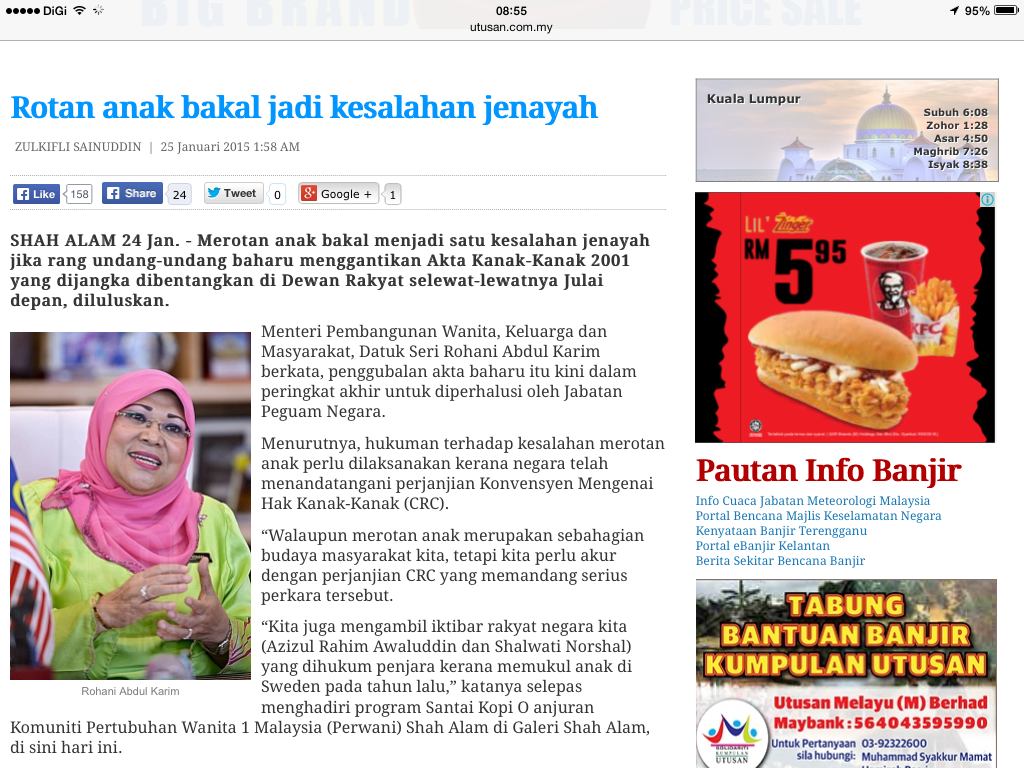
Today’s posting is brought about by a statement by Rohani Karim, the Minister for Women and Family Development, saying that with the ratification by Malaysia of the Child Rights Convention, caning by parents will soon be a crime:

2015/01/img_1356.png

Even with the present Child Protection Act, the government cannot stop orphanages and Islamic-Knowledge centres from exploiting children, the government is already thinking of a new remedy instead of tweaking the old one. This is the same knee-jerk reaction the government had when it abolished the Internal Security Act and is now reeling in agony with the increase in violent crimes, seditious remarks, all on a daily basis.

Each of my children have been spanked at least once when they were little for breaching the “line.” I won’t say that they are perfectly disciplined but not one of them grew up touching things they are not supposed to, be it at home or in other people’s home. I am glad they know how to show respect to others and are not as wild as other children are, and know when to draw the line. You don’t beat them up senselessly, you discipline them and explain why they aren’t allowed to do certain things and what would the consequences, other than getting punished, be.

I don’t know if Rohani Karim understands the contents of the CRC before ratifying, or did she ratify because it would be trendy to do so? You know, the “I am part of the big league” feeling you get, and the pat in the back others give you for kow-towing to their standards? Let me refresh her knowledge on the CRC:

2015/01/img_1385.jpg

So, children in countries that have ratified the CRC must be given the rights to choose their own religion, while parents only have the right to advise. The government would also have the authority to override the decision parents have made for their children. The children can also seek “governmental review” if they disagree to the decisions that have been made by their parents.

What is this world coming to? What will Malaysia become?

Malaysia is already suffering from a high number if juvenile crime. Gangsterism, rape, substance abuse, break-ins, violent crimes committed by juveniles increased by more than 5,000 cases in 2013 compared to the previous year, said the Home Ministry. People are clamouring for an amendment in the various laws to send parents to jail with their children for any crime that they commit due to neglect by the parents, yet Rohani agreed that children should not be punished. We already suffer from teenage Mat Rempits making a ruckus at night while we are trying to sleep, schoolboys on motorbikes without licence scratching our car, not wearing helmets, or turn into snatch thieves injuring, maiming or killing some old lady in the process.

2015/01/img_1365.jpg

The CRC will also give the right to children access to information, and you know what kind of information that are readily available on the Internet like they are not doing that already; they will have the right to peaceful assembly, freedom of expression and association. And the CRC applies to children below the age of 18.

We as a nation are already suffering since the next generation of leaders are already without conscience and moral, and Rohani sees fit that we give them more freedom to decide on what they want while parents are to slave to make sure that their needs are met and protected. Soon, we will have more cases of abandoned children and newborns found in toilet bowls and rubbish bins because of this.

2015/01/img_1369.jpg

Come on, Rohani. Wise up! You should weigh the requirements of the CRC against our culture and religions before deciding to become popular with foreigners.

What I would give to have a decently-intelligent Minister here in Malaysia.

One day, you will find parents being sued by their children for “mental abuse” by merely staring at them!

2015/01/img_1384.jpg

Do You Choose A Person Who Is A Populist, Or One Who Can Actually Work?

It is interesting how time and time again we, our ASEAN neighbours included, vote in or root for people who are popular rather than people who can actually do the job. The Philippines had Cory Aquino, Eric Estrada; Indonesia had Gus Dur (Abdurrahman Wahid). In Malaysia, we have people rooting for Anwar Ibrahim despite the comical and absurd nature of his “struggle” to become a Prime Minister come what may. What is more absurd and even funnier was the populist campaign designed by Najib Razak’s consultants to paint a popular image of the incumbent.

And that failed badly.

So, what do we Malaysian people actually want? Someone who wins on a big popularity ticket, or someone who can actually work, proven to have truly serviced his/her constituency and not just offer lip service?

Indonesia now has Joko Widodo. See one person’s observations of him before and after the elections and see how the same reflects many politicians here in Malaysia.

The Drama King

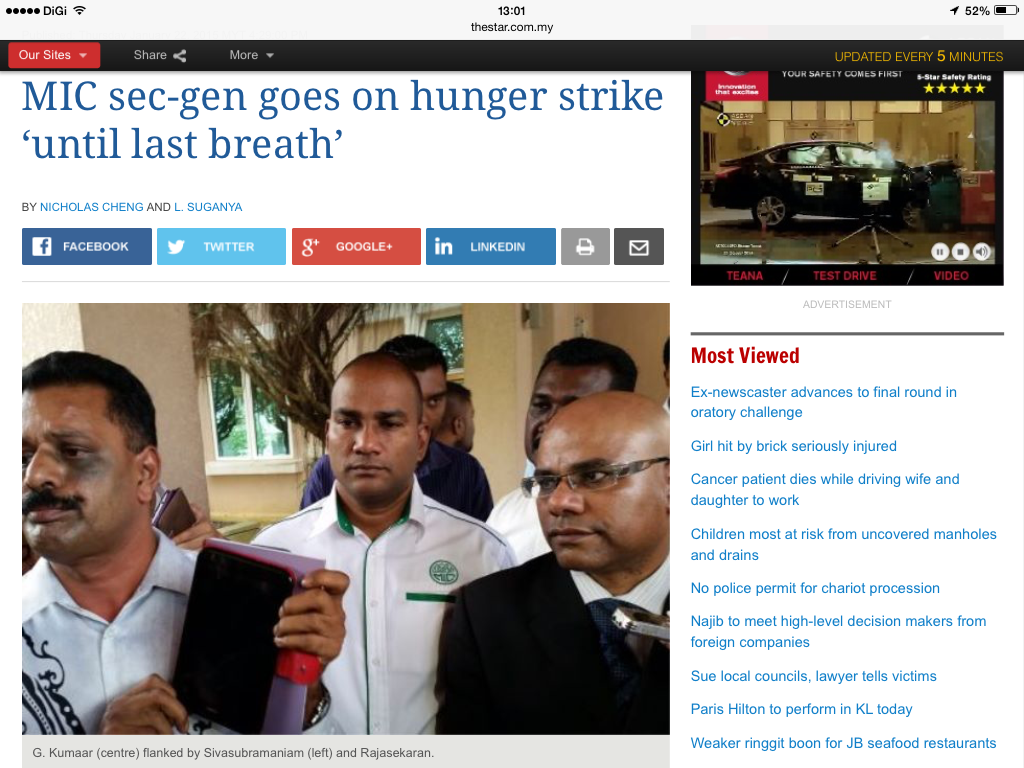
The Malaysian Indian Congress (MIC) which is a component party of the ruling Barisan Nasional is at loggerheads with the Registrar of Societies as the latter had detected irregularities in the MIC party elections. As such, the RoS had instructed the MIC to hold another party elections or something to that effect. The party’s President, G Palanivel has thus far disobeyed the RoS instruction.

Enter the party’s Secretary-General, Kumaar Aamaan, who some say is the illegal Sec-Gen given that the RoS did not recognise the party elections thus rendering all appointees illegal. He went to the RoS office and went on a hunger strike:

2015/01/img_1318.jpg

He also declared that he would fast until his last breath:

2015/01/img_1324.png

Then he said because of his hunger strike, he received a death threat:

2015/01/img_1323.png

Now, why would anyone bent on dying for his cause feel threatened by a death threat? It does sound funny, doesn’t it?

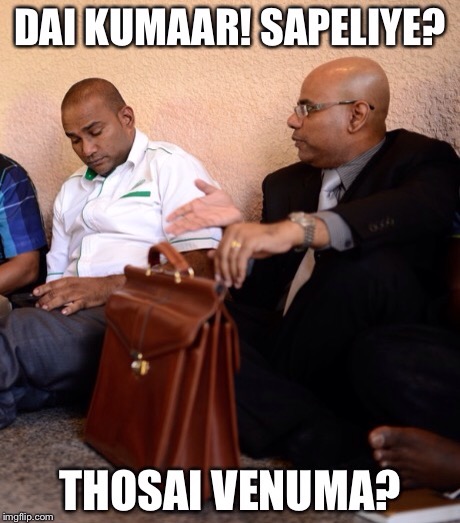
I really think he was feeling very hungry at that point:

2015/01/img_1326.jpg

And just as I thought he would sit there through the weekend in front of the RoS office, all skin and bones, came the shocking news:

2015/01/img_1335.png

SAY WHAT???? You said you were going to fast until your last breath! Are you hungry?

2015/01/img_1334.jpg

That is the Drama King who has turned the much-respected MIC into another lawless DAP. If you think that that’s funny, wait until the next bomb I am about to drop:

WHERE ARE THOSE BN PEOPLE WHO MADE SO MUCH NOISE ABOUT THE DAP DISOBEYING THE INSTRUCTION FROM THE ROS LAST YEAR? WHY HAVE THEY ALL GONE SILENT?

Now you may laugh and wonder.

The Final Curtain?

Another former Minister has spoken out at Najib Razak’s apparent use of Anwar Ibrahim to attack his opponents. Former Minister, Sanusi Junid, has hinted that if Najib does not step down now, UMNO and BN will suffer.

Anwar, who has been in TV3’s bad books, and who also issued a general ban on broadcast journalists from that station to cover any of his or PKR’s events, has been given full attention by the station to lambast Najib’s opponents within UMNO.

Najib, who took over the helm of both UMNO and BN from a weak predecessor, is seen by the public as a weaker Prime Minister. That the BN fared as bad as or worse than GE12 in the last general elections says a lot about his leadership. While he does try to have a hands-on approach on many things which is good, his policies and decisions made seem to lack any prior thoughts, begging the public to ask if it is really Najib’s consultants who do the thinking while Najib just read the scripts and smile or frown as directed.

I, for one, don’t give much thought on the political squabbles. I am more concerned with those who incessantly try to run down the country; but this latest tiff between Najib and his critiques started off with the 1MDB fiasco, and it seems that someone has unearthed the leadership’s Pandora Box.

Who after Najib is none of my concern. Whoever commands majority support of UMNO with the blessing of the component parties in BN should be able to lead. However, the UMNO tradition (budaya) of never to shine before your leader does ought to be done away with. I was told that during the recent floods, although the Deputy Prime Minister was in town while many including the Prime Minister were away shopping or golfing abroad, the former did not act swiftly until instructed to do so. How true this is, I don’t know but if so, it truly is damaging that you cannot decide as a Deputy Prime Minister on behalf of the Prime Minister who was away golfing. “Mana boleh! Ini budaya UMNO!” said the person to my father when asked why did the Deputy Prime Minister not act since the Prime Minister was on holiday abroad.

Najib could easily have called for an impromptu press conference to announce that the DPM was to head the disaster management team while he had to golf with Obama to discuss pressing matters. There was a whole army of foreign press there that he could have used to convey the message to worried Malaysians, but he did not. Was he waiting for his consultants to come up with a script and a set of more acceptable wardrobe?

It was equally bad that (I’m very sure it was his consultants who prepared this line) Najib made only the home and business insurance issue as THE reason for not declaring an emergency in the flood-stricken states. There was a bunch of other stronger reasons that could have been used, but maybe his consultants thought it was best to use the insurance issue as that was more personal for flood victims. Well, it backfired. Miserably! Adding insult to injury, the disaster-relief operation was like a dumbstruck Medusa. Every agency was doing its own thing with no clear command and control until much later. Given that the head of the National Security Council is an administrator rather than a field man, and has had no experience managing disasters, with the Prime Minister being abroad, things did not move as they should have.

Anyway, I have digressed from the issue of Najib’s quarrel with his detractors. But I think Najib’s continuous display of dishing out half-baked policies and display of desperately holding on to the Premiership simply means that he is no Tun Razak, who was brilliant in character and leadership that even political dinosaurs like Lim Kit Siang misses him, and Dyana Samad remembers Tun Razak’s superb leadership although she was still swimming inside her father’s balls when the Tun died.

UMNO needs to evolve and revamp itself in order to stay relevant in the next general elections. But first, it needs a serious change in leadership.

Conduct Unbecoming

2015/01/img_1121.png

“Loose Talk Could Sink This Ship”

“The Walls Have Ears”

The above are among reminders you would normally see then in a military establishment. Whether or not these reminders are being repeated today remains to be answered. At least such reminders should be repeated in all courses attended by military personnel.

Back in the 1970s, at the height of the Second Emergency, soldiers got killed after wives talked eagerly in public about the husbands going for operations against communist terrorists. Mind you, wives and children are the only people in any military establishment that are never vetted by security agencies.

One such wife was even employed as a typist at one military establishment. For years she mailed the carbon papers of each important military correspondence to the intelligence service of a neighbouring country before she was arrested.

In the late 1980s, 10 officers and men of the Armed Forces were nabbed by military intelligence after they were found to have sold strategic defence files to the intelligence agencies of a neighbouring country. The highest amount paid for a file was USD96,000 for a document on contingency defence plans of a particular state. The rest were defence plans of an Air Force Base, a naval base, and the layout of a military hospital.

In the Armed Forces too you have channels to complain or air your grouses. Your quarters is leaking, you complain to the Facilities Officer. Your mess food sucks, you complain to the Mess Messing Member, or in the case of the other ranks (rank and file if you must), complain to the Duty Officer who is supposed to eat the food you eat with you. Your senior officer has wronged you, the Armed Forces Act, 1972 allows you to seek redress of wrong. Your indelible ink wears off your finger in less than a day, you complain to the Officer Commanding the Administration Branch. Better still, if it is on the same day of voting, you complain to the Elections Commission officers at your place of voting.

There is a reason that you are an Armed Forces member and not a civilian. It means that you are not a civilian. You come from a highly disciplined institution that lives by its codes of rules, regulations, standing orders and orders. You cannot whine like an old lady in public, more so when you are in uniform.

Former Major Zaidi bin Ahmad was a good officer, until the day he appeared in the photo above. He was my junior by two intakes. He was a good pilot. He flew the F-5E Tiger II before progressing to a F-18 Hornet driver, after which he was picked to lead No.12 Squadron (F-5E Tiger II) as its Commanding Officer. He was a quiet man, well-mannered, and according to those who know him, it was no secret that he is a staunch supporter of PAS.

There is nothing about being a military man and have a liking for whichever political party. When I was a serving officer, I told my men that they were free to vote for anyone they wished, but as a member of His Majesty’s Air Force, they should remain apolitical in their conduct.

Granted that Zaidi might have had good intention by talking about his experience with the indelible ink, he went against the Armed Forces Council’s Order No. 13 of 1960. What more, he was wearing his uniform. As a member of the Armed Forces, you are not to talk to the media unless you have prior clearance from the Public Relations Office at both the Air Force HQ and the Ministry of Defence. You might be subjected to unguided and mischievous questions and you might answer wrongly. You might give away more than you should, as the information you are privy to may cause harm to the defence of the nation if leaked whether intentionally or unintentionally.

After the episode above, he was under investigation I presume, and an orders signal was issued for him to be transferred to a lesser sensitive post pending investigation. Each signal (in the civilian world before the advent of the E-Mail is much like the telegram) is either an unclassified document (Pendarjahan TERBUKA), or RESTRICTED and above (Pendarjahan TERHAD ke atas). I would expect the signal pertaining to his transfer was classified as PERSONNEL-IN-CONFIDENCE (SULIT DARIHAL ANGGOTA).

A transfer is normal when one is under investigation. Policemen under investigation are always transferred to “desk” duties. The same applied to Zaidi. Instead, perhaps for political reasons, he decided to show the signal to journalists who do not have the necessary security clearance to be privy to the information on the signal.

One might argue that a transfer order is hardly detrimental to the security of the nation. Well, in this case, maybe it wasn’t. It is not so much the content that is in question but the act of showing any document to those unauthorised to view it. Imagine if his grouses are bigger, I cannot imagine what a Commanding Officer of a fighter squadron, charged with taking care of the nation’s defence, could and would reveal to unauthorised people. That act, to me, shows how this senior officer’s conduct was very unbecoming, and is not trustworthy to be looking after the nation’s defence.  To add insult to injury, Zaidi even sent out an SMS in the form of a political incitement; definitely unbecoming of a senior officer of the Armed Forces.

Was the punishment of being discharged from His Majesty’s service received by Zaidi harsh? My answer is a definite no. Firstly, Zaidi was a senior officer and a Commanding Officer. He was not some less-educated Private or Airman. He was charged under Section 50 (2) and Section 51 of the Armed Forces Act, 1972, for disobedience to superior officer and disobedience to standing orders.

If I may read to you the punishments prescribed by these sections. They read:

Every person subject to service law under this Act who, whether wilfully or through neglect, disobeys ny lawful command of his superior officer/standing orders shall, on conviction by court-martial, be liable to imprisonment or any less punishment provided by this Act.

The scale of punishments for an Officer of the Armed Forces prescribed by the Armed Forces Act, 1972, can be found in Section 89 (2) of the Act. They are:

Death,

Imprisonment to a term not exceeding 14 years,

Dismissal with disgrace from His Majesty’s service,

Dismissal from His Majesty’s service,

Forfeiture of seniority of rank,

Dismissal of an officer from the ship he belongs to,

Fine,

Severe reprimand,

Reprimand,

In the occasion of expense, damage, or loss, stoppages.

In the case of Zaidi’s, the gravity of his offences and his rank and position make only the first four punishments applicable to him.  However, since the death punishment is out of the question, the members of the Court-Martial chose the least: dismissal from His Majesty’s service, meaning that he is still entitled to his benefits.

Is that harsh? Not at all. There have been officers dismissed for lesser offences. Examplary? Yes. And very necessary.

Zaidi no doubt was a good guy. However, his political beliefs led him to do what every officer and man of His Majesty’s Armed Forces should not do: disobey orders and putting the uniform you wear to shame. A King’s Officer does not whine about his grouses in public like a yeast-infected aunt. He should live the organised life of his organisation instead of abusing his uniform for his own benefit. There were channels he could have gone through but no. He thought he knew best and in doing so he did injustice to his family.

He is now a political celebrity, a nicer way to call a donkey in politics. He will now be part of a circus act and may earn a bit from the collection made from the spectators of the nightly circus shows he will be performing in, all in the misguided name of justice. Once the next general elections is over, we hope he would have found a steady job by then.