Apabila demam pilihanraya semakin panas, akan terbit suara-suara sumbang Pakatan yang bukan sahaja menyerang parti memerintah, malah semua institusi kerajaan akan diserang dan difitnah demi mengelirukan para pengundi. Institusi Angkatan Tentera Malaysia (ATM) juga tidak lekang dari budaya fitnah yang menjadi darah daging Pakatan.
Sekiranya Nik Nazmi menghabiskan masa menggunakan Internet untuk membaca fakta dan mengurangkan masa beliau menyebar fitnah, beliau tentu akan dapat lihat bahawa kapal-kapal milik TLDM sentiasa menjalankan rondaan bukaan sahaja di Zon Ekonomi Eksklusif (EEZ), malah juga di perairan Laut Sulu di timur negeri Sabah. Bagusnya TLDM ialah setiap buah kapal serta unit-unit sokongan mempunyai akaun Twitter dan kita dapat melihat aktiviti-aktiviti am yang dilakukan oleh kapal-kapal milik TLDM dalam memelihara kedaulatan perairan negara ini.
Kita mungkin mempunyai kapal-kapal yang telah berusian setengah abad seperti KD Hang Tuah yang kini menjalankan peranan sebagai friget latihan, serta bot-bot peronda kelas Kris seperti KD Sri Johor dan KD Sri Perlis. KD Sri Johor dan KD Sri Perlis masih aktif membuat rondaan di perairan Laut Sulu. Hakikat bahawa ketiga-tiga kapal tersebut masih dalam perkhidmatan aktif membuktikan bahawa rejim penyelenggaraan TLDM adalah amat baik sekali.
Program peremajaan serta pemerkasaan TLDM sepatutnya telah berjalan dengan lancar kalau budaya pemberian kontrak kepada kroni yang telah diamalkan oleh Pengerusi Pakatan Harapan tidak berlaku. Mungkin Nik Nazmi patut ajukan pertanyaan kepada Pengerusi kesayangannya bagaimana pemberian kontrak tersebut boleh berlaku, hinggakan kerajaan terpaksa mengeluarkan lebih kewangan untuk menyiapkan enam buah kapal peronda kelas Kedah sedangkan bajet yang diberikan kepada kroni Pengerusi mereka itu telah habis digunakan. Akibat terpaksa menyiapkan apa yang tidak disiapkan oleh kroni tersebut, program pemerkasaan serta peremajaan aset TLDM tergendala buat seketika waktu.
Hanya kini apabila kerajaan Najib Razak bergabung usaha dengan Panglima TLDM, baru lah dapat TLDM merealisasikan usaha peremajaan dan pemerkasaan TLDM dengan program 15-to-5 yang akan menyaksikan TLDM menggunakan hanya lima kelas aset tempur dan sokongan berbanding dengan 15 yang diwarisi dari zaman Pengerusi Pakatan Harapan tersebut.
Kenapa kapal TLDM lebih kecil berbanding dengan negara luar? Saiz kapal bukannya menjadi ukuran kekuatan sesuatu tentera laut. Kapal pengangkut pesawat milik Tentera Laut DiRaja Thailand Chakri Nareubet adalah kapal pengangkut pesawat (CV) yang paling kecil di dunia. Panjangnya hanyalah 201 meter berbanding kapal pengangkut helikopter (LHD) milik Tentera Laut Amerika Syarikat (USN) iaitu USS Wasp yang panjangnya 257 meter. Dan USS Wasp hanyalah separuh panjang kapal-kapal pengangkut pesawat (CVN) milik USN.
Kapal pemusnah INS Eilat milik Tentera Laut Israel yang panjangnya 100 meter telah ditenggelamkan pada tahun 1967 menggunakan peluru berpandu jenis Styx yang dilancarkan dari sebuah bot peronda jenis Komar milik Tentera Laut Mesir pada tahun 1967 yang panjangnya hanya 25 meter.
Kapal pemusnah milik USN iaitu USS Cole yang panjangnya 105 meter telah dilumpuhkan oleh sebuah bot fiberglass berukuran 4 meter pada tahun 2000. Serangan oleh bot fiberglass tersebut telah mengorbankan 15 orang anak kapal dan mencederakan 39 yang lain.
Ini membuktikan bahawa saiz kapal bukannya menjadi ukuran, tetapi saiz serta jenis kapal perlulah memenuhi doktrin milik Tentera Laut DiRaja Malaysia. Tetapi saya yakin Nik Nazmi tidak faham akan konsep doktrin Angkatan Tentera Malaysia. Dakwaan serta tohmahan yang dilemparkan beliau terhadap TLDM menunjukkan betapa ceteknya minda beliau.
Kurangkan berpolitik, dan kurangkan bermain game-game perang di komputer peribadi ataupun telefon pintar. Realiti adalah amat berbeza dari hiburan yang disajikan di alam maya tersebut.
“The government shall continue to look after the welfare of the Malaysian Armed Forces,” said Minister of Defence, Datuk Seri Hishammuddin Tun Hussein.
He said this in a meet with Royal Malaysian Navy personnel, civilian staff of the Ministry of Defence in Sabah, as well as Armed Forces veterans at the Kota Kinabalu Naval Base here.
Announcing the agenda to build more quarters for the naval personnel, Hishammuddin said that they (the naval personnel) cannot be sent for operations if they worry about the safety and security of their families.
Prior to this, the state government of Sabah offered a piece of land to be developed into 1,700 houses by the Ministry of Defence. However, the location at Kampung Layang-Layang is not suitable as it is 30 kilometres away from the base.
“I shall announce the housing agenda within the next week or two,” he said.
The event was also attended by Minister in the Prime Minister’s Department in charge of the Economic Planning Unit, Datuk Seri Panglima Abdul Rahman Dahlan and Chief of Defence Forces, General Tan Sri Raja Mohamed Affandi Raja Mohamed Noor.
Earlier, Datuk Seri Hishammuddin launched a Petronas kiosk inside the base as part of the welfare initiatives. Prior to this, personnel working in the base had to travel 20 kilometres to the nearest petrol station.
When asked about a group of Armed Forces veterans who attack the government’s initiatives to help both serving and former members of the Malaysian Armed Forces, Hishammuddin said that this is just a small group of people whose agenda is to serve the seasonal politicking of others.
“This government will not be disheartened by this group. We have provided a lot more under this government and shall continue to strive for the best for the members of the Armed Forces and its veterans,” he commented.
Datuk Seri Hishammuddin also handed over keys of family quarters to 20 crew member of the patrol vessel KD Selangor. 16-year old Kasih Nuraisyah Ramaddy Ricky, the daughter of Corporal Ramaddy Ricky Ahmad, who scored 7As in her Pentaksiran Tingkatan 3 exam was among thirteen children of Armed Forces personnel who received academic excellence awards from the Minister.
Hishammuddin congratulates Corporal Ramaddy Ricky Ahmad after presenting an award to the latter’s 16-year old daughter, Kasih Nuraisyah, for scoring 7As in her Pentaksiran Tingkatan 3 exam last year
Nampaknya sedang tular di media sosial video Majlis Paluan Berundur ATM dari Kem TUDM Sungai Besi, Kuala Lumpur sehingga ada pihak yang membangkitkan isu bahawa kem tersebut telah dijual kepada China. Sesungguhnya, ia dakwaan yang tidak berasas sama sekali. Baca penjelasan berikut untuk mengetahui fakta sebenar.
1. Pemindahan TUDM Kuala Lumpur ke Pangkalan Udara Sendayan dibuat berdasarkan faktor rasionalisasi daripada aspek operasi dan keselamatan, dan juga TUDM Kuala Lumpur sudah terlalu lama dan usang, dibangun sejak tahun 1940-an.
2. Operasi penerbangan di TUDM Kuala Lumpur tidak berapa selamat disebabkan kepesatan pembangunan Bandaraya Kuala Lumpur, dengan adanya bangunan tinggi dan kepadatan penduduk.
3. Kawasan TUDM Kuala Lumpur amat terdedah dengan ancaman luar disebabkan lokasi berhampiran lebuhraya dan kawasan perumahan. Dengan ancaman yang ada sekarang ini, ia boleh dilancarkan daripada kawasan-kawasan tersebut.
4. Pendedahan TUDM Kuala Lumpur kepada umum turut menyukarkan pihak TUDM untuk memberi perlindungan mantap sebagai kawasan operasi ketenteraan kerana terdedah kepada aktiviti pengintipan.
5. PU Sendayan & 31 Rejimen Artileri Kem Tun Ibrahim, Kajang adalah antara tapak-tapak relokasi TUDM Kuala Lumpur. Penempatan di beberapa pangkalan udara yang ada adalah mengikut misi dan kesesuaian seperti yang dibuat di PU KL sebelum ini.
6. Ini adalah kali pertama sebuah Pangkalan Udara (Sendayan) dibina untuk keselesaan para pegawai dan anggota TUDM di mana mereka akan mendapat kawasan kerja, kediaman dan infrastruktur yang baru untuk memberi sokongan atas misi-misi latihan TUDM. Selain itu, dengan adanya PU Sendayan ini, TUDM akan dapat menempatkan pusat latihan TUDM di mana buat masa ini latihan-latihan tersebut berpecah dan ada yang dibuat di Subang, Alor Star serta di Kinrara.
7. PU Sendayan ini apabila siap dibina dapat menyatukan TUDM yang akan meletakkan semua ini di bawah satu bumbung bagi tujuan uniformiti dan latihan manakala perintah dan kawalan akan menjadi lebih berkesan.
ISU KEHILANGAN ASPEK SEJARAH PU KUALA LUMPUR
1. Sejarah TUDM Kuala Lumpur akan dikekalkan selepas dipindahkan ke PU Sendayan kerana ia merupakan landasan antarabangsa yang pertama digunakan semasa zaman kemerdekaan. TUDM akan memelihara artifak-artifak sejarah TUDM Kuala Lumpur ini di muzium TUDM. Ini akan dilakukan bagi memastikan sejarah TUDM tidak akan terlupus.
ISU PROJEK BANDAR MALAYSIA DIKUASAI SYARIKAT CHINA
1. Dakwaan kononnya projek Bandar Malaysia di bekas TUDM Kuala Lumpur di ibu negara dikuasai oleh syarikat China kini bukan lagi isu. Sebaliknya tapak strategik seluas 198 hektar itu dikuasai 100% Kementerian Kewangan, berikutan terbatal perjanjian jualan saham (SSA) Bandar Malaysia dengan pihak pemegang saham projek tersebut sebelumnya.
2. TRX City, dengan mengambil kira kepentingan nilai tanah Bandar Malaysia, akan mengekalkan pemilikan penuh terhadap kawasan itu demi memastikan rakyat Malaysia meraih manfaat hasil pembangunannya.
3. Adalah fitnah berniat jahat dengan mengatakan kem TUDM KL diserah kepada Cina dari China.
RUMUSAN
1. Adalah tidak benar kerajaan mengenepikan sejarah penting negara dengan menyerahkan Pangkalan Udara Kuala Lumpur kepada pihak pemaju untuk dibangunkan. Banyak sejarah dan artifak TUDM akan dipelihara untuk pengetahuan generasi akan datang.
2. PU Kuala Lumpur telah hilang nilai strategiknya dan tidak sesuai lagi untuk menempatkan unit-unit tentera. Kedudukannya juga menjadikan pengintipan dan serangan oleh musuh menjadi begitu mudah.
3. Angkatan Tentera Malaysia memperolehi kemudahan-kemudahan yang jauh lebih baik dan bersesuaian setelah perpindahan ini berlaku.
4. Malaysia bukan satu-satunya negara yang menutup pangkalan-pangkalan tentera. United Kingdom telah dan bakal menutup sebanyak 56 pangkalan-pangkalan tentera termasuk Woolwich Barracks dan Fort George yang berusia hampir 300 tahun dan kaya dengan unsur-unsur sejarah. Berbeza dengan Malaysia, penutupan pangkalan-pangkalan tentera di UK tidak melibatkan sebarang penggantian.
Oleh itu janganlah kita mempolitikkan pertahanan negara dan hargai Angkatan Tentera Malaysia serta hak mereka untuk bertugas dan tinggal di pangkalan-pangkalan yang jauh lebih moden dan selesa sesuai dengan tugas mereka yang berat untuk menjaga kemananan, kesejahteraan dan kedaulatan negara.
I am appalled that there still are those who deny the roles played by the non-Malays in defending this country, especially during the two Emergencies; that dark 33 years of fighting communism. The history books emphasised more on the 12-year First Emergency because of its relation to the independence of Malaya, thus many forget that not too long-ago bombs were going off in the middle of Kuala Lumpur while ordinary policemen were getting slayed.
The First Emergency broke out in June 1948 with the murder of three British estate managers in Sungai Siput. Fuelled by the progressive successes the Communist Party of China was having against the Kuomintang, the acts of banditry increased exponentially. Based on a priori the British found it best to both resettle the Chinese in camps while between 20,000 to 50,000 be sent back to China. The plan moved at a snail’s pace due to the objections by many, and with the total withdrawal of the Kuomintang to Formosa, the repatriation of the Chinese came to a halt in September 1949 when the Communist Party of China closed off all ports and beaches. Only 6,000 Chinese from Malaya were sent back (Anthony Short, 1975 pp 178-201). The rest were settled in new villages to curb them from supplying the Communist Party of Malaya with food and other essentials.
When Ismail Mina Ahmad, the chairman of the Ummah umbrella group for Muslim organisations, claimed that only the Malays fought against invaders and communists in this country, it shows the level of ignorance on his part (Syed Jaymal Zahiid – In fiery speech cleric tells forum only Malays fought invaders communists, Malay Mail Online, 13 January 2018). His claim is far from the truth.
At the peak of the First Emergency, the British had to not only bring in members of the Palestine Police Force who were experienced in counter-insurgency warfare, but also recruited a large number of Chinese residents of Malaya. Tan Sri Dr Too Chee Chew, more famously known as CC Too, headed the Psychological Warfare section. We had the likes of Tan Sri Jimmy Koo Chong Kong, Tan Sri Yuen Yuet Ling, Datuk Leong Chee Woh to name a few who spent most of their lives fighting the communists.
CC Too, Koo Chong Kong and Yuen Yuet Ling were among the ranks of the Malayan People Anti-Japanese Army (MPAJA) during the Second World War who chose to go against their former comrades and became targets of the Communist Party of Malaya. Jimmy Khoo Chong Kong, who was also a former member of the Sarawak Communist Party before surrendering to the authorities and joining the Royal Malaysian Police, paid with his life on 13 November 1975 in Ipoh, Perak, as did his driver Constable (awarded Sergeant posthumously) Yeong Peng Cheong who died with his gun blazing. Without hesitation, even with the knowledge that he was also on the hit list, Tan Sri Yuen Yuet Ling replaced Tan Sri Koo as the Perak Chief Police Officer.
When a Royal Malaysian Air Force Sikorsky S-61A Nuri helicopter was shot down in Gubir, Kedah on 27 April 1976, three Malaysian Chinese personnel were also among the 11 killed. They were Captain Choo Yeok Boo TUDM, Lieutenant Chung Ming Teck TUDM and Sergeant (Air) Leong Yee Heng. They were on a resupply mission from the Butterworth Air Base when they were shot down.
Captain Frank Chong Keng Lay TUDM (retired as Lieutenant-Colonel) flew his Nuri into a hot landing zone to rescue several infantrymen. His two commando escorts were killed as his Nuri took 22 heavy machinegun shots. The next day he flew into the same landing zone to repeat the task. Keng Lay was my Chief of Staff at the RMAF Air Training Command where I was a Staff Officer and later its Adjutant.
Inspectors Kamalanathan and Robert Cheah were inside a coffee shop meeting with informers when a terrorist threw a grenade into the shop. The explosion maimed Kamalanathan and for the rest of his life he walked with an obvious limp with a grenade shrapnel still embedded in his leg.
There were many other non-Malay police officers in particular those who served in the Special Branch who died as unsung heroes as they were not recruited nor trained with other policemen. They were the deep infiltrators, members of the community, who went on leading a double life that even their own family did not know they were all policemen. Their pay did not come from Bluff Road (Bukit Aman) directly. DSP Jeganathan was a Jabatan Talikom employee tasked with setting up the police’s VHF network and spent years jungle-bashing, building towers on mountain and hilltops with the communist terrorists hot on his heels so that the police could have a nationwide communications network.
There were those who were just roadside sweepers working for the municipal and town councils, collecting information. One had his cover blown when he was discovered in a different town by a neighbour asking him loudly what was he doing there sweeping the streets.
Another was on his death bed, ridden with cancer, when he sought the help of a Malaysian daily to contact my father to tell the latter of his condition. His real name was quoted by the daily to my father, which my father could not recall. My father asked the contact in the daily to ask him his Special Branch name. When the reply came, my father left his golf game and rushed to the hospital and after more than 50 years of being married, the wife and family finally knew the man-of-their-house was a hero fighting the communists, not just some small-time trader.
Let us not forget Chief Inspector Chin Chin Kooi. He was a Special Branch officer probing communist activities in Serdang, Kedah. At 9pm on 12 July 1973, six communist terrorists stormed into his home and let loose a volley of bullets. Mortally wounded, Chin returned fire until his last breath.
Across the South China Sea, Police Field Force Superintendent Joni Mustapha was a champion Sarawak hurdler from 1958 to 1959. Joni was watching a movie with his son in Sibu when a policeman relayed a message to him that his men were being pinned down by communist terrorists upriver Sungai Setabau. He asked the policeman to stay with his son in the cinema and left to rescue his men.
Constable Nuing Saling, an Iban policeman, was on a two-week leave to be with his wife Imbok Jimbon who was six months pregnant with their third child. Upon hearing that Joni was leaving for the jungle, hurriedly joined the team. Both Joni and Nuing had made a pact that they would help each other. They left by boat to get to the location. Upon arrival, they engaged the communist terrorists. Joni was felled by machinegun fire but remained conscious to direct the firefight until he died. Another constable friend, Abang Masri was already dead. Seeing his commander and friend die, Nuing unsheathed his machete and charged at the terrorists’ position firing at them, only to be mown down. He had been hit in the face by a bullet. Nuing refused to give up. He continued his charge and was hit several times more but kept on charging, killing and wounding many. He died inside the location of the communist terrorists.
Kanang ak Langkau is perhaps the most known warrior from Sarawak who shed blood and tears fighting against the communist terrorists. He was wounded several times but not once let his wounds stop him from fighting.
These are stories that we should all remember. Stories of our non-Malay brethren heroes who risked and gave their lives so that we can all enjoy the peace and prosperity that God has bestowed upon us. Many more have gone unsung, but they shall not be forgotten. Especially not by selfishly ignoring the sacrifices that have been made by them.
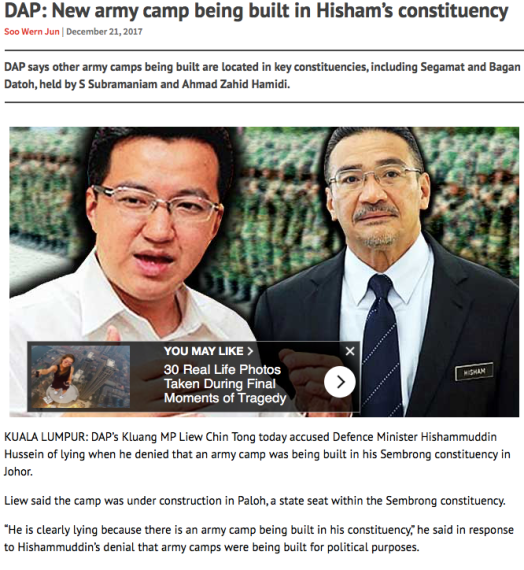
Recently Kluang Member of Parliament Liew Chin Tong slammed Minister of Defence Hishammuddin Hussein for denying that an army camp was being built in Paloh, a state seat in the latter’s constituency of Sembrong. Liew Chin Tong implied that the army camp is being built for political purposes.
“This proves that Barisan Nasional (BN) is using these army camps to increase voters in constituencies that it won with thin majorities in the 13th general election,” Liew told a press conference last week.
He said the inclusion of the army personnel in Paloh would increase the electorate by over 1,000 voters.
“In Paloh, DAP lost only by a few hundred votes and these new voters will result in another BN win,” he added.
The fact is that while members of the Malaysian Armed Forces swears its allegiance to the Yang DiPertuan Agong, His Majesty’s Government (the Government-of-the-Day), and the Country, each member of the Malaysian Armed Forces are free to vote for whom they are politically-inclined to support. Therefore, having a military camp/base does not guarantee you any solid support for votes. I had written at length on this issue of allegiance in a recent blog post.
Perhaps it would be good for Liew Chin Tong to admit that he won Kluang against the Barisan Nasional in 2013 because of the presence of a huge army camp, namely Kem Mahkota, that houses the 61st Royal Artillery Regiment as well as the 881st Regiment, Malaysian Army Aviation.
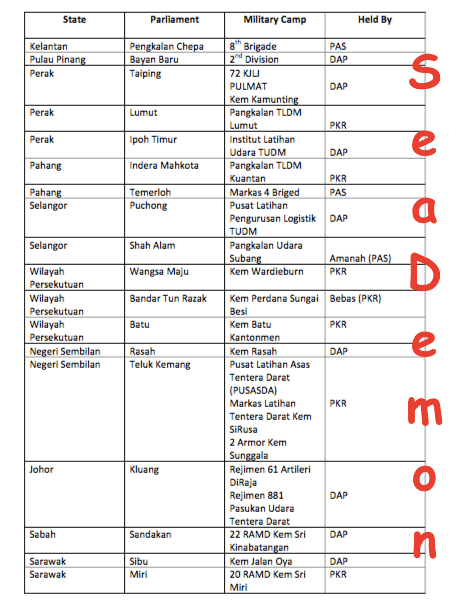
Come to think of it, out of the 89 Parliamentary seats won by the then-Pakatan Rakyat during the 13th General Elections four years ago, at least 18 parliamentary constituencies have major military camps/bases in them. That is 20 percent of the total of parliamentary consituencies held by the Pakatan candidates. Here is the list that I have compiled:
Let us take for example the Lumut Naval Base which is under PKR. That base alone had 14,231 registered voters while PKR’s Mohamad Imran Abd Hamid won 40,308 votes. Why didn’t Barisan Nasional win there?
Perhaps Liew Chin Tong should also inform all Malaysians that out of the 18 constituencies with major military camps/bases that was won by the Pakatan back in 2013, eight seats were won by the DAP. That is 44 percent! Despite being the other “Malay” party within the Pakatan, PKR managed only seven seats or 38 percent. PAS could only get three then but one of those seats, Shah Alam, is now firmly under Khalid Samad of Amanah after he betrayed his oath to remain in PAS if nominated as a candidate and would divorce his wife if he jumps ship. Shah Alam is the home of a major Royal Malaysian Air Force base – Subang.
Pakatan and its supporters should just stop politicising the Malaysian Armed Forces. As towns and cities are developed, old camps and bases are no longer strategic nor conducive to be inhabited. How could Pakatan, advertising that it is all for rights and stuff, allow military personnel to live and work in deplorable and antiquated conditions? And as development creep into their surrounding areas, military bases are no longer of any strategic value. I have addressed this issue in a posting of mine and so has my friend Danny Liew in his recent posting.
So, wouldn’t DAP now like to offer a piece of land in constituencies held by it for Hishammuddin to build military bases or camps?
Hishammuddin Hussein delivering his speech at the recent UMNO General Assembly
It is bad enough that there is a large number of non-Malays who do not have good command of the Malay language despite it being the National Language, and despite this nation’s being in existence for 60 years, but nothing can be worse than Malays who do not understand the language themselves.
Left-leaning media have been slamming the speech by UMNO Vice-President Hishammuddin Hussein, who is also the Defence Minister, on the so-called deployment to Jerusalem in response to President Trump’s recognition of the city as Israel’s capital.
“The international conflict in Jerusalem is a political issue. It is best left to diplomacy to sort out this historical mess. If diplomacy fails, the next course of action can be international condemnation. Blindly making a declaration to commit our troops is unwise,” he said.
“I would like to know who authorised Hishammuddin to prepare the army to be deployed in the Middle-East? Was there a special session of parliament on this matter for the matter to be debated?” asked DAP’s P Ramasamy.
You can see how this issue is being played in Israel. The Jerusalem Post reported it as:
The issue made headlines on The Jerusalem Post
Whereas, in relatively sober Malaysian media it reads as:
The not-so-kosher Malay Mail Online sought clarification on the matter with the Deputy Defence Minister
However, if one were to listen to the speech made by Hishammuddin, nowhere in the speech did he mention about committing the troops to defend Jerusalem. All he said was if the need arises, if the King as The Commander-in-Chief decrees it, then the Malaysian Armed Forces is always ready to contribute in any manner. You can listen to the part where this is mentioned from 18:19 to 19:47 of the following video:
The issue also sparked a debate between myself and a fellow defence blogger Danny Liew versus two of his Facebook followers who criticised the speech saying that our troops are not ready nor trained for desert warfare.
The truth is, our troops have had its fair share of desert operations that started off with the UNIIMOG mission of 1988-1991 to monitor the ceasefire between Iran and Iraq after a lengthy war. This was followed by UNTAG in Namibia (1989-1990), a country named after the vast Namib Desert that makes up the most of its countryside. We still maintain our presence in the Western Sahara as part of MINURSO and we have been there since 1991. We were deployed to monitor the Kuwait/Iraq border as part of UNIKOM, after the first Gulf War and were there from 1992 to 2003. Don’t also forget that we were in Somalia from 1993 to 1994 as part of UNISOM, and this was where we saw full combat rescuing US troops from their disastrous unilateral operation at the Bakaara Market. We have been deployed in South Lebanon as part of UNIFIL since 2007. And we are part of Exercise North Thunder in Saudi Arabia as part of the International Military Alliance To Fight Terrorism (IMAFT), a coalition that was formed to combat Da’esh. You may read more about that HERE.
The NPA picks and chooses its quarrels, and the quarrels are mainly with the government despite Arshad Raji having said that they are apolitical. But the apolitical nature of the NPA is the same as that of BERSIH. It never attacks the Opposition.
The NPA also claims to be loyal to the Rulers Institution and the Country. Yet, they only provided deafening silence when U-Turn Mahathir and DAP’s running dog Zaid Ibrahim were rude towards the Sultan of Johor and Sultan of Selangor. So, what are they patriotic about? Supporting a DAP-led coalition to form the next government?
The NPA is nothing more than just Mahathir lackeys
Maybe their pension is not enough to support them.
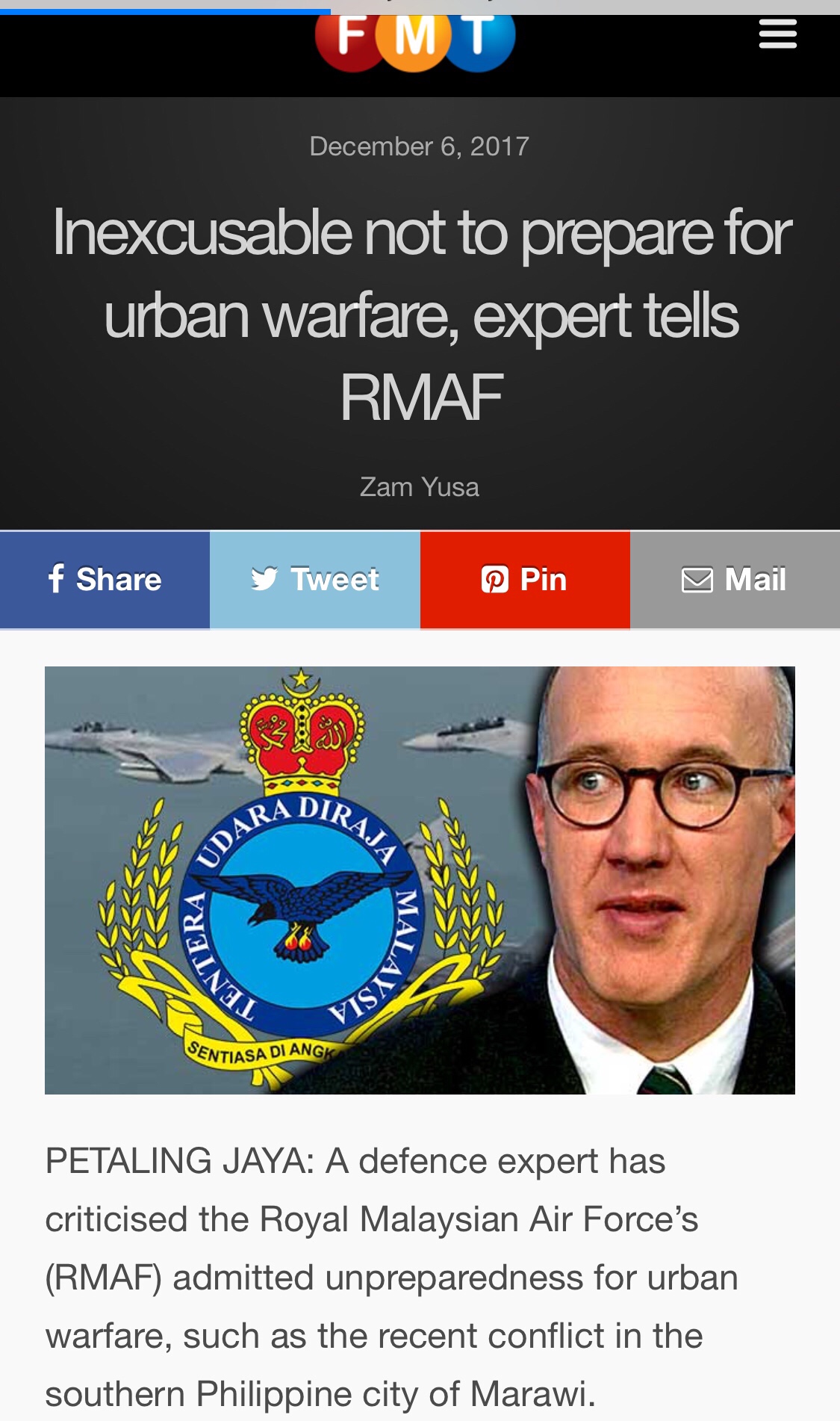
Online “news” portal Free Malaysia Today (FMT) today published a story on the level of preparedness of the Royal Malaysian Air Force (RMAF) if faced with a situation such as Marawi, and got an expert opinion to strengthen its story.
While FMT was talking about clearly refers to the recent statement made by the Chief of RMAF, General Tan Sri Dato’ Sri Haji Affendi bin Buang RMAF, stating that the RMAF will be including urban warfare in its doctrine. This was a reply to a question by a journalist during the recently-concluded Exercise PARADISE 4/2017 in Kota Belud, Sabah.
FMT sought the expert opinion of a Dr Zachary Abuza, a political scientist at the National War College in Washington DC, who focuses on security and political issues in the region.
Dr Abuza instantly criticised the RMAF for not being prepared for urban warfare.
“RMAF’s training is based on preparing to face traditional threats. It’s birth was when fighting the MCP (Malayan Communist Party) in the jungles. It has never had to adjust its training.
“To me, this is understandable but reckless,” he said to FMT.
Abuza felt urban warfare preparedness and capability were still important.
“It’s not that the RMAF has to worry about an invasion, but what if a detachment of RMAF peacekeepers finds itself unexpectedly bogged down during an urban assault?” he was quoted by FMT to have asked.
It is clear to sharp readers that Dr Abuza referred to the RMAF as Royal Malaysian Armed Forces instead of the Air Force. Why would the RMAF have a detachment of peacekeepers anyway?
Therefore, it is forgivable that Dr Abuza had made such a criticism towards the RMAF as the Malaysian Army, which had numerous peacekeeping experiences under its belt. Although the RMAF and the Royal Malaysian Navy participate in peacekeeping missions, the main combat duties is shouldered by the Army.
And FMT being FMT, went to town and published the piece, hammering the Royal Malaysian AIR FORCE for not being ready for urban warfare.
The RMAF’s role in urban warfare is merely a support one, with the Army playing the main role on the ground. All the RMAF needs to do is to insert its Ground Laser Targeting Designator team into the combat zone and paint targets that are to be bombed by its fighters.
Other roles include dropping bombs or perform rocket strikes on targets marked by elements of the Malaysian Army, including interdiction strikes to cut off enemy supply and reinforcement lines, provision of air mobility in support of the Army Air Wing, or perform combat search-and-rescue of downed airmen.
The RMAF and the Malaysian Army have held countless joint exercises to enhance interoperability and coordination and it will take very little tweaking for the two organisations to operate in the urban environment.
Did FMT clarify its story before publishing? I doubt. Else we won’t see the faux pas today.
I received this copied in a Veterans’ WhatsApp group. I omitted some parts of the message as it was just gibberish talk:
_Copied from write up by Mej **** ***** TUDM (Rtd)_
Good afternoon to all. The fight for a free Malaysia must go on!
Let us get one thing clear – the country and the government are separate entities. Governments come and go, the country is eternal.
We owe our allegiance to the country, not to the government. Therefore, saying bad things about a bad government is not being anti-national. Most important of all, voting against a bad government is not being anti-national. A bad government does not deserve loyalty. Disloyalty to the government is not disloyalty to the country; in fact, voting out a bad government is being loyal to the country.
Clean elections
Clean government
Right to dissent
Save our economy
Fine words they are, but for someone with some legal training to write as such shows how much understanding the author has of the Federal Constitution.
Let us address this “call”:
Point 1:
“Good afternoon to all. The fight for a free Malaysia must go on!
Let us get one thing clear – the country and the government are separate entities. Governments come and go, the country is eternal.
We owe our allegiance to the country, not to the government. Therefore, saying bad things about a bad government is not being anti-national. Most important of all, voting against a bad government is not being anti-national. A bad government does not deserve loyalty. Disloyalty to the government is not disloyalty to the country; in fact, voting out a bad government is being loyal to the country.”
The country and the government cannot be separated, neither can a state be separated from its state government. Yes, governments come and go, but a government is still a government. Officers and men of the civil service, the Armed Forces, the Police owe their allegiance to the King and Country. The King rules the Country, as do the Sultans their respective state, through a government that was picked by the people. Be they the Federal Government or the State Government, they administer the country and the states on behalf of the King and Sultans, as well as the Governors. This is prescribed by Article 39 of the Federal Constitution where the Executive Authority of the Federation is vested in the Yang DiPertuan Agong by him, or by the Cabinet, or by any Minister authorised by the Cabinet.
In the case of the Armed Forces, the King exercises his power through the Minister of Defence. Which is why the officers and men of the Armed Forces are required to salute the Minister of Defence who represents the King’s executive power over the Armed Forces, and the Prime Minister who is the King’s Chief Executive, representing the King.
Article 41 states that the King is the Supreme Commander of the Armed Forces and therefore those representing the King as prescribed by Article 39 are performing their duties on behalf of the King.
Therefore, it is imperative that the Armed Forces, as well as the civil service and the Police, remain loyal to the government of the day as the government of the day represents the King – be it bad or otherwise. Whether or nor a member of the Armed Forces, or the civil service, or the Police subscribes to the government of the day politically is a secondary matter. The oath that was taken was to be loyal to the King and Country; therefore loyalty shall be given to the government of the day.
The Minister who represents the King in matters of defence is also made the Chairman of the Armed Forces Council which is responsible for the command, the discipline and the administration of the Armed Forces, except for matters relating to their operational use. This is prescribed in Article 137 of the Federal Constitution.
And it is the Parliament that passed an Act to amend and consolidate the law relating to the establishment, government and discipline of the Armed Forces is made which is called the Armed Forces Act, 1972.
It is also the Armed Forces Act, 1972 that gave the powers to the Armed Forces Council to enable Brigadier-General Datuk Fadzlette Othman Merican Idris Merican be promoted to Major-General while she is being seconded to a Federal Government Department. Section 5C of the Armed Forces Act, 1972 determines that she remains a member of the regular forces but her remuneration shall be paid by that Federal Government Department.
By the same token, even the ordinary people who are citiens of Malaysia must realise that the Federal Government represents the King, the state governments represent the resective state’s Ruler. These are governments chosen by the people but was appointed by the Rulers to administer the country and states on their behalf. The only way to change these governments is by a democratic process called ELECTIONS (unless you have not heard of that word before).
Point 2:
“Clean elections”
Since 1955, Pulau Pinang, Perak, Kedah, Kelantan, Terengganu, Selangor and Sabah have all seen a change in government. If the elections were not clean, would it have been possible for the Opposition to have won cash cows such as Pulau Pinang and Selangor?
Point 3:
“Clean government”
I must admit there are bad hats in the government, be it the Federal government or the states government. This is why we have seen people like Harun Idris, Mokhtar Hashim, Khir Toyo, Lim Guan Eng charged in court for corruption. All but Lim Guan Eng have served jail time. Guan Eng, who said that he is not afraid to go to prison, has been delaying his corruption trial using technical issues.
Many more state excos have also been arraigned in a court for corruption. This is not possible without agencies such as the Auditor-General’s Office and the Malaysian Anti Corruption Commission which act as checks and balances to ensure that the Federal as well as states governments are run efficiently and cleanly.
Of course there are those who have yet to face the music. For example those responsible for the Maminco scandal in 1985 that saw a loss of RM1.6 billion (about RM2.56 billion in today’s terms); the Perwaja scandal in 1982 that saw a loss of about RM10 billion (RM18.73 billion in today’s terms); the BMF scandal of 1983 that had caused a loss of RM2.5 billion (RM4.5 billion today); the 1986 Deposit-Taking Cooperative Scandal that caused a loss of RM1.5 billion (about RM2.58 billion today); the RM30 billion loss by Bank Negara Malaysis through foreign exchange gambling in 1994 (RM45.25 billion today); the Malaysia Airlines scandal of 1994 with the loss of RM9.4 billion (RM14.18 billion today); the PKFZ scandal of 1999 with a loss of RM12.5 billion (RM13.5 billion in today’s terms).
The above all happened during the tenure of a certain former Prime Minister. The grand total of losses is RM67.5 billion (or RM101.3 billion in today’s terms). The amount shown does not include the bailouts reported in various books, Opposition leaders’ blogs and so on.
I do hope that the cry for a clean government will also call for the arraignment for the Prime Minister during whose tenure the financial scandals happened. Had the RM101.3 billion been put to good use during those 22 years, Sabah and Sarawak would have had SIX toll-free Pan Borneo Highways, or 1,013 80-bedded Government hospitals all over the country!
Instead, it enriched the few and killed one person.
Point 4:
“Right to Dissent”
I have not seen any Opposition-leaning media being taken off print or air, unlike during a certain 22-year period of my life. Malaysiakini et al are still spinning their version of what they call “balanced news” (read: news the way we want you to see it). The way these media operate reminds me of a character in Netflix’s limited series called “Godless” called A.T Grigg, a newspaper owner-editor who writes news the way he sees it, not how it truly happens.
The ISA was repealed six years ago by this present administration. Although replaced with SOSMA and POTA, it doesn’t give powers to the authorities to hold anyone without trial as the ISA did. And the ISA was being used a lot against political dissenters especially in the late 1990s during the tenure of a certain former Prime Minister.
This administration also introduced the Peaceful Assembly Act, 2012 that has allowed more freedom to assemble peacefully, unlike during those days of a certain former Prime Minister where at the slightest hint of a political dissent, you get whisked away to the University of Kamunting.
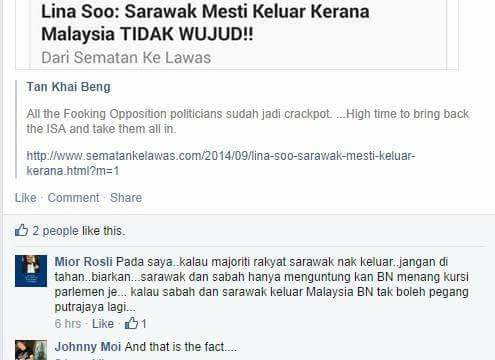
Has the author of the message been arrested yet? Of course not. Even when he actually committed sedition against Malaysia by encouraging Sarawak to secede from Malaysia.
How is it that a legal-trained person does not know that his act is seditious escapes me
Now, how is that seditious? If you look at Section 2 of the Sedition Act, 1948 it tells you the following:
Section 2 defines how an act is seditious. He has committed a seditious act by definition of Section 3(1)(a)
This former Armed Forces officer also committed a crime of sedition under Section 3 (1) (b) of the same Act for encouraging Sarawak to leave Malaysia:
Section 3 (1) (b) of the Sedition Act, 1948
And you thought that the Federal Constitution protects freedom of speech? Yes, it does. But as with all other liberties, they are subjected to restrictions. Article 10(1) guarantees that every citizen has the right to freedom of speech and expression, but at the beginning of the Article it also says the following:
You cannot just say anything you like although you have the freedom of speech and expression
To dissent is okay. To dissent seditiously, or criminally, or dangerously, or incitingly, is not okay.
Any legal-trained person ought to know this, right? What more a former officer of the Armed Forces!
Point 5:
“Save Our Economy”
In April 2017, the World Bank forecasted that Malaysia’s GDP would be at 4.3 percent. This was revised in June 2017 to 4.9 percent due to an acceleration in domestic economic activities (people in Malaysia are actually spending more) by 5.7 percent year-on-year. The GDP growth was revised again in October 2017 to 5.2 percent.
Let me quote several reports here by the World Bank.
World Bank Group lead economist Richard Record said at a media briefing on the update that Malaysia’s robust GDP growth in the first half of 2017 was largely underpinned by strong private-sector expenditure, with additional impetus from an improvement in external demand.
“Private consumption expanded firmly this year, supported by favourable income growth amid stable labour market conditions, and improved consumer confidence. Private investment also sustained rapid growth rates during the period, reflecting mainly continued capital spending in the manufacturing and services sectors,” said Richard Record.
“On the external front, gross exports rebounded strongly from the subdued growth experienced in 2016, supported by double-digit growth in commodity and manufactured exports,” he added.
Economic watchdogs are generally bullish on the Malaysian economy’s performance, buttressed by strong expansion in private consumption and private investment. In the latest update on its World Economic Outlook, the International Monetary Fund has upped its GDP growth projection for Malaysia in 2017 to 4.8 percent from 4.5 percent previously.
Apart from that, the Asian Development Bank has also upgraded its 2017 growth outlook for Malaysia to 4.7% from 4.4%, and indicated that the two-year slowdown in economic growth is likely to have bottomed out last year.
Richard Record also predicted Malaysia’s economy for 2018 and 2019.
“We are forecasting Malaysia’s GDP to grow by 5 percent next year (2018) and 4.8 percent in 2019. Our prediction reflects how we are seeing the country’s macroeconomic fundamentals’ performance and the baseline scenario,” he said.
Online economics portal ‘Focus Economics’ also said the following:
“Economic momentum remained robust in Q3 as confirmed by more complete data. Export growth expanded by a double-digit pace in September, underscoring thriving external demand for Malaysian goods. Household spending was buoyed by a low unemployment rate in September and by higher wages, which were propped up by a thriving manufacturing sector, the key driver of industrial production growth in the quarter. The 2018 budget passed on 27 October is focused on fiscal consolidation and is expected to narrow the fiscal deficit from 3.0 percent in 2017 to 2.8 percent in 2018. Despite the tightening, the budget has consumer-friendly components that will increase disposable income. These include lower income tax rates, especially for middle-income earners; higher public wages; and increased assistance spending.”
Of course, with the oil prices continue to stay below the USD70 per barrel level, Malaysia as well as other countries will continue to experience some sluggishness in the economy. However, good fiscal policies have allowed us to grow unlike a neighbour of ours that is often quoted as being a model economy. That country’s growth have been at 2 percent in 2016, and 2.5 percent this year.
The outlook for the construction sector has taken a sharp turn for the worse, with poll respondents tipping a contraction of 4.2 per cent. The previous survey, released in June, had respondents forecasting 0.2 per cent growth in the sector.
The outlook for the accommodation and food services sector in this model country has also worsened – it is now expected to shrink 1.5 per cent, from previous estimates of a 1 per cent expansion.
Economists polled expect overall economic growth of 2.5 per cent next year for this model country, the same pace as this year.
Perhaps the author of the message we are discussing here should go down South and help revive the economy of that model country.
So, there have you. I really do not know what the fuss is about. All I can deduce is that the author of the message is all hot air – you can feel it blowing on your face, but there is no real substance there. This is the same as BERSIH, and the recycling of petty but stale issues by the Opposition just so that they can remain relevant, and justify for the allowances they receive from the pockets of the rakyat.
You can express your dissatisfaction, but always do so constructively. Especially if you are a member of the Malaysian Armed Forces and Malaysian Armed Forces Veterans.
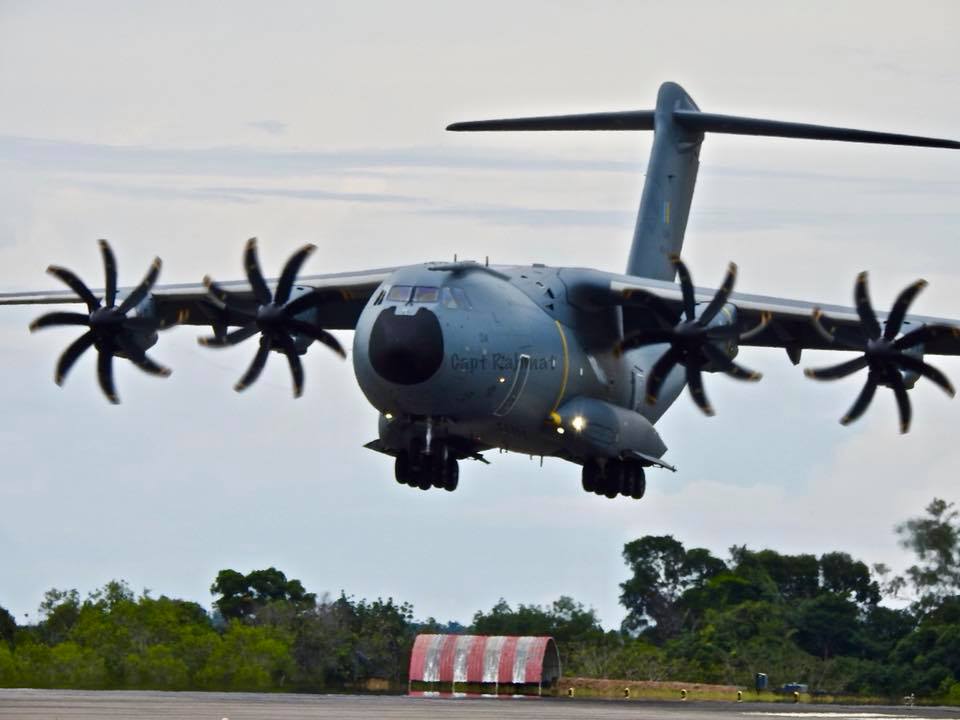
RMAF Airbus A400M (M54-04) on finals at the Labuan airbase during exercise PARADISE 2017
The A400M: How Has It Fared?
When the Royal Malaysian Air Force purchased the Airbus Defence and Space A400M Atlas, many thought it was to replace the Lockheed C-130H-30 that had entered service in 1976. 15 C-130Hs were delivered to the RMAF with 14 still flying.
However, the RMAF announced further upgrades to its C-130H fleet to keep them operational. The A400M’s role, although similar to that of the C-130H, enhances the RMAF’s airlift capability. Not only can the A400M carry 17 tonnes more payload compared to the C-130H, it can fly 200 knots faster and land on rough or soft landing strips like the C-130H.
Its glass cockpit/side-stick coupled with three-axis fly-by-wire (FBW) with flight envelope protection configuration makes the A400M user-friendly and is based on the A380 but modified to suit military operations requirements. The flight envelope protection allows the A400M to perform bank angles up to 120 degrees!
The cockpit of the RMAF A400M (M54-04) is large and is very comfortable
Not only could the A400M support the Malaysian Armed Forces’s tactical and strategic capabilities, it could also be utilised for Humanitarian Assistance and Disaster Relief (HADR) operations in the region. To date, the RMAF’s A400Ms have performed two HADR roles: delivering 17 tonnes of aid to embattled Marawi in July 2017 and 12 tonnes of aid to the Rohingya refugees in south Bangladesh in September 2017.
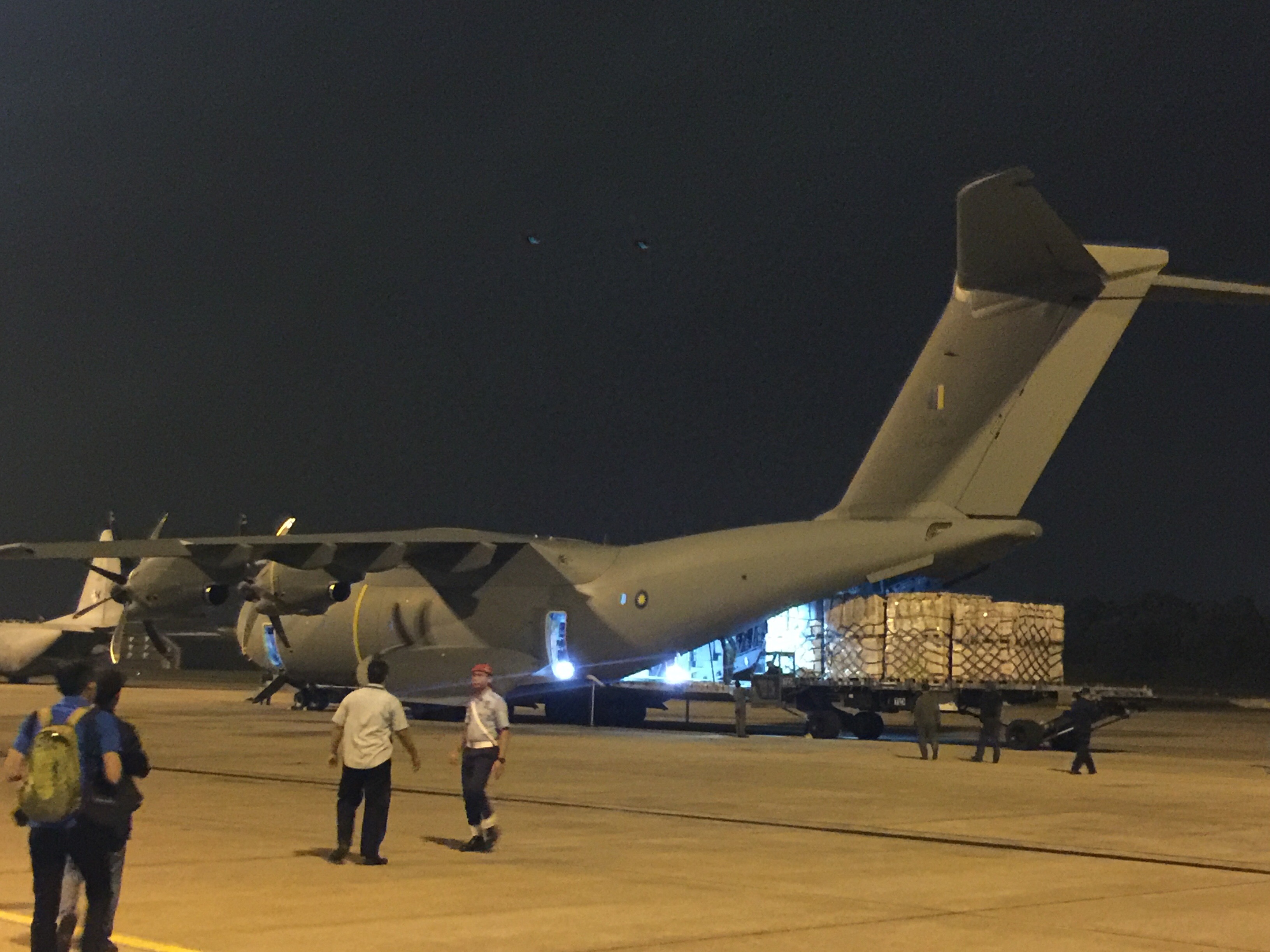
RMAF A400M (M54-04) is being loaded with HADR cargo bound for Marawi
The remarkable thing especially about the Marawi mission was the A400M’s ability to fly to Cagayan del Oro and back without refuelling (an approximately 5,400 kilometers return trip); this, together with its speed cuts down total turnaround time.
The A400M is equipped with the defensive aid sub-system and an in-flight refueling capability. The inflight-refueling package allows the A400M to refuel helicopters at 105 knots indicated airspeed (KIAS) and fighters at up to 300 knots, hence safer for the refuelling of both helicopters and fighters. Flight tests have also revealed that at Alpha Max (with the Alpha Floor protection disabled, the A400M reached 98 KIAS before the FBW low-speed protection function eased the nose down. There was no wing roll-off or loss of control. Recovery was almost immediate when the nose was lowered and thrust added, underscoring the fact that the A400M is indeed a very safe and capable aircraft.
Maritime Patrol Aircraft – Budgeted For
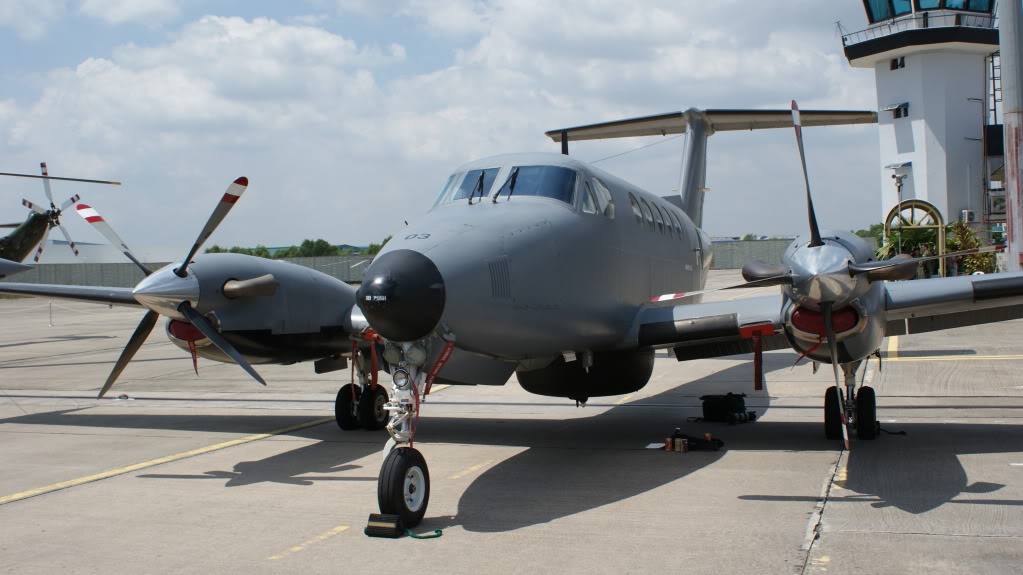
The Beechcraft Super King Air 200T MPA has been in service with RMAF for 23 years
For almost two decades the role of maritime patrol was assigned to several C-130Hs that were converted to C-130MPs. Four Beechcraft Super King Air B200T aircraft were inducted into the RMAF maritime patrol fleet to complement the C-130MPs. However, the high operational costs versus mission requirements of the C-130MPs saw the latter taking over the role completely.
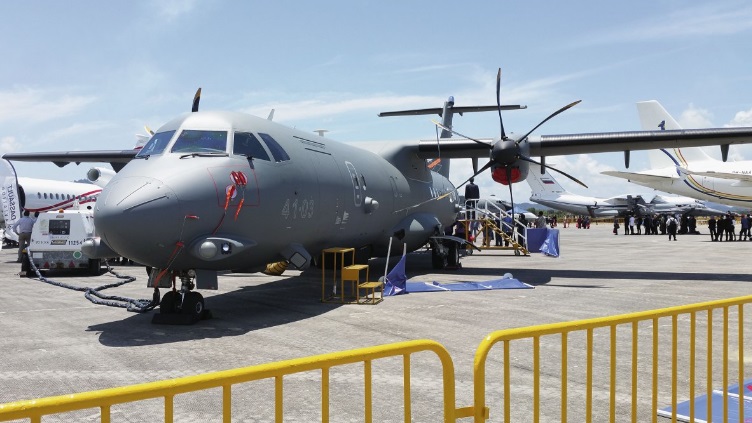
Even before the loss of an airframe, there were already talks of replacing the B200Ts. Leonardo brought its ATR-72MP aircraft to LIMA ’17. Apart from the hardpoints and MPA modules on board, the ATR-72MP is just a normal commercially-available aircraft, powerplants and all. Leonardo’s concept is to provide a platform using what is available in large numbers in the market to keep the costs down.
The Leonardo ATR-72MP, seen here at LIMA 17, also comes with an electronic surveillance and C4I platform. The airframe is that of the ATR-72-600 (photo courtesy of Janes Defence)
Airbus Defence and Space flew a CN295 almost around the world to promote it as a multirole platform. The CN295, albeit a SAR version that was on its way to its new home in Brazil, made a stop in Malaysia and was presented to operators such as the RMAF, the MMEA, as well as the Royal Malaysian Police Air Wing.
Stretched three metres longer than the CN235 that the RMAF is currently operating, everything about the CN295 is very similar to the CN235, which makes crew conversion fairly easy to make. It comes with a more powerful plant that features better efficiency, longer loiter capability at station and comes with six external hardpoints for ASW weapons.
When the announcement of the budget for the procurement of four MPAs in 2018 was made, the immediate follow-through was that four of the RMAF’s remaining seven CN235s will be fitted with the MP systems from the B200Ts, a sure sign that either additional CN235s will be acquired for the MPA role, or the CN295s would be acquired instead.
The commonality between the C295 and the CN235 also potentially leads to even lower operating costs, given the versatile cabin configuration that allows fast switching of mission types, high manouvrability, better low-level flying capabilities given the high-wing configuration and a wide rear ramp, the C295 makes the best option for maritime patrol and surveillance as well as anti-submarine warfare missions in Malaysia.
The C295 is powered by twin PW127G turboprop engines driving Hamilton Sundstrand Type 568F-5 six bladed propellers which provide outstanding hot and high performance, low fuel consumption, and an endurance exceeding 11 hours. Flying at a maximum speed of 480 km/h which is slower than the B200T’s 540 km/h, but has a range of 5,600 kilometers compared to the B200T’s 3,100 kilometer range.
The RMAF’s need for a reliable platform that would be able to perform largely anti-shipping missions and has a reasonable but economical loiter endurance with some strike capability if required makes the CN295 a better choice of MPA. It also makes strategic and economical sense for Malaysia as it allows operators to narrow down its aircraft types and suppliers, making logistical and technical support easier.
The Airbus C-295 of the Força Aérea Brasiliera arrived at the Subang airbase on Friday 7 July 2017
UAV, MRCA and LIFT
Although the procurement of the badly needed MRCA to replace the MiG-29Ns have not been announced, the RMAF is making up for the void by ensuring high serviceability rate of its frontliners. Observers would note that the serviceability percentage has increased tremendously despite the cut in the defence budget.
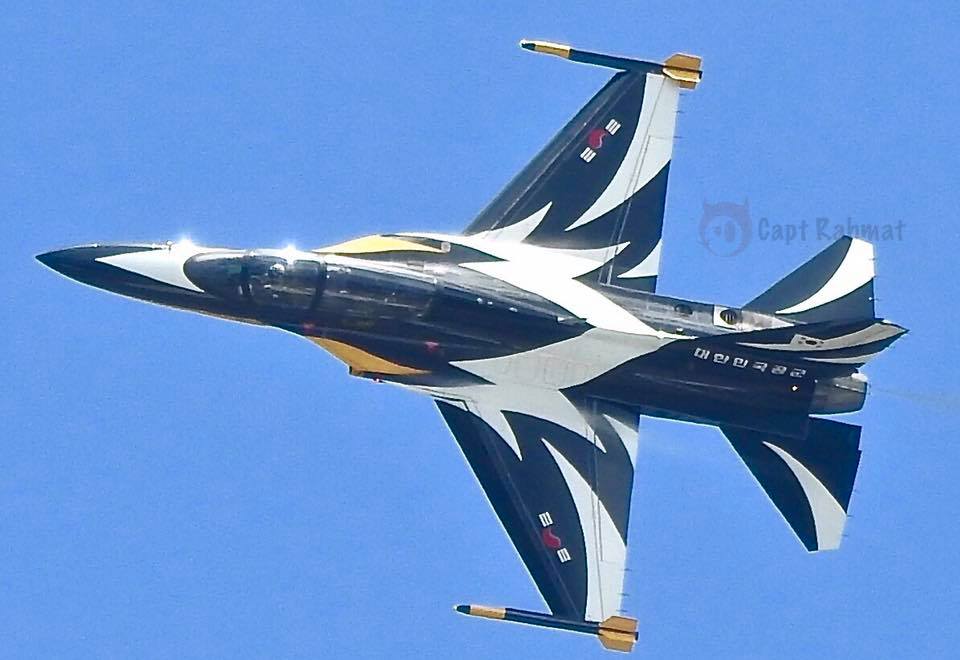
Perhaps the RMAF should think of an interim fighter or Lead-In Fighter Trainer (LIFT) that gives the bang for bucks. The Korea Aerospace Industries’s TA-50 LIFT comes into mind. Each unit of the more advanced FA-50 costs half or three times less than a top-of-the-line fighter would but it carries enough sting to hurt the enemy.
RoKAF Black Eagle’s KAI T-50B zooms above Langkawi during LIMA 17
Losing only but not much in terms of range to the BAe Systems Mk 108/208 that the RMAF currently deploys in Labuan to cover both the eastern South China and Sulu seas, the TA-50’s ability to reach supersonic speeds (Mach 1.5 compared to the Hawk’s Mach 0.84) and excellent thrust-to-weight ratio (0.96 to the Hawk’s 0.65) means that the TA-50 would make a better aircraft placed on Alert 5 to intercept straying foreign aircraft. Its superb ability to deliver air-to-ground as well as anti-shipping ordnances makes it a suitable platform to support anti-incursion/counter-insurgency operations in the ESSCOM area.
The RMAF is also interested to develop its Unmanned Aerial Vehicle capability in both tactical and strategic aspects. RMAF Chief General Tan Sri Dato Seri Affandi bin Buang TUDM said that the RMAF is conducting a detailed study to identify the UAV capable of meeting the current needs of the country apart from being equipped with technologies which could be shared with various parties in the country.
The Chief of RMAF (second from left) speaking to reporters during Exercise PARADISE 4/2017 at the Kota Belud Air Range
“Besides security surveillance, UAV can also be used for other purposes such as weather information and others,” he said. “If the RMAF is able to acquire sophisticated UAVs we would be able to enhance our operations in the Peninsular, Sabah, Sarawak and also in support of the MPAs patrolling the South China Sea as well as the Sulu Sea.”
Hopefully the RMAF would acquire UAVs with extended on-station endurance with some hardpoints for strike capability.
Epilogue
Although the RMAF is still in want of frontline airframes, it is seen to improve its serviceability percentage, a task that seemed daunting in times of global econmic uncertainty, but certainly achievable. The plan to purchase capable Maritime Patrol Aircraft as per the 2018 Budget, and planned addition of sophisticated UAVs, will certainly enhance its control over the airspace.
It is hoped that the government could look into equipping the RMAF with interim strike capability, especially in the South China and Sulu seas, by adding a squadron or two of the KAI TA-50, if not a squadron each of the TA-50 and its frontline version, the FA-50, hopefully by 2020, before preparing its budget for the procurement of actual frontline MRCAs that are badly needed, not only as replacements of the recently-retired MiG-29N, but also as a contingency to replace the F/A-18D which is already in its 20th year of service with the RMAF.
The RMAF may seem to walk slowly, but it is definitely walking with big strides.
Pada hari Selasa bersamaan 12 Februari 2013, sekumpulan 100 orang bersenjata yang diketuai oleh Haji Musa, orang kanan Mohammad Ismail A Kiram, anak keempat kepada Muhammad Fuad A Kiram, seorang yang mengangkat dirinya sendiri sebagai Sultan Sulu, telah mendarat di Kampung Tanduo, Tanjung Labian, di daerah Lahad Datu, Sabah.
Menurut laporan asal, mereka berkumpul di sebuah rumah milik Ahmad Malandi, yang juga dikenali sebagai ‘Mat Bom‘ bukan hanya kerana beliau sering menggunakan bom buatan sendiri untuk menangkap ikan, tetapi juga kerana pernah menyerang sebuah pejabat FELDA di FELDA Sahabat dalam tahun 1990an dengan menggunakan bom ikan gara-gara tidak berpuas hati dengan pertikaian tanah pusaka dengan FELDA.
Saya pernah menulis bagaimana kumpulan pertama yang terdiri dari lima orang yang memakai jubah diiringi 27 orang memakai separa-celoreng telah medarat terlebih dahulu, diikuti sekitar 70 orang kemudiannya. Kesemua mereka bersenjatakan M-14 dan AR-15.
Pasukan keselamatan membuat tembakan di sebalik perlindungan semasa Op Daulat
Pasukan keselamatan telah mula bertindak dengan Polis DiRaja Malaysia menggerakkan dua kompeni dari Pasukan Gerakan Am, dan disokong oleh pegawai dan anggota Tentera Darat Malaysia dari 5 Briged Infantri. Rundingan dijalankan pihak PDRM untuk memujuk mereka meletakkan senjata dan menyerah diri kepada pihak polis. Malangnya, pada 1 Mac 2013 para pengganas Sulu ini bertindak bertempur dengan pasukan Komando 69 PDRM di Kampung Tanduo, diikuti dengan serang hendap terhadap pegawai dan anggota Cawangan Khas PDRM di Kampung Simunul di Semporna keesokan harinya. Pada 5 Mac 2013, peringkat ofensif oleh Angkatan Tentera Malaysia dan PDRM telah dilancarkan untuk menghapuskan para pengganas tersebut.
Salah seorang pengganas Sulu yang mampus ditembak oleh pasukan keselamatan Malaysia
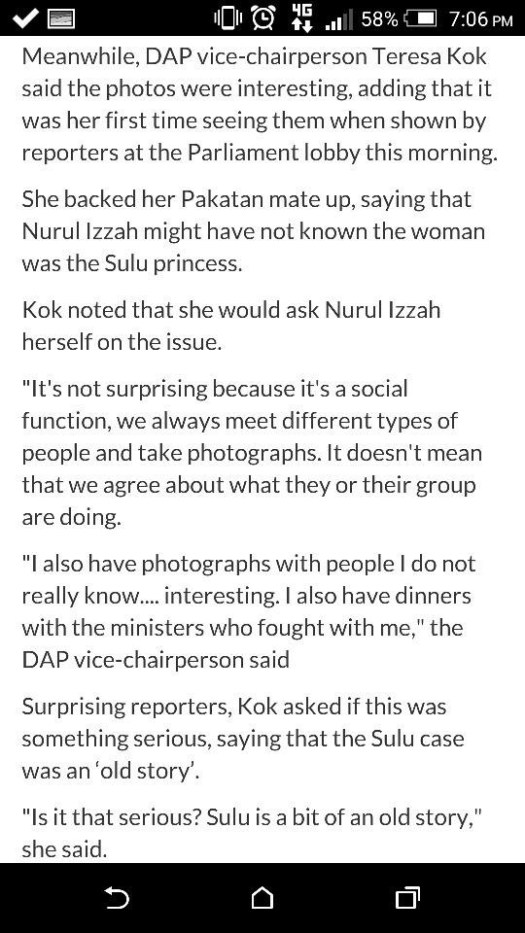
“Kisah di Kampung Tanduo adalah kisah lama,” kata Ahli Parlimen DAP, Teresa Kok
Sungguh malang nasib balu dan ibubapa 10 orang para pegawai dan anggota PDRM dan ATM yang terkorban di Lahad Datu mempertahankan kedaulatan negara. Pengorbanan anak mereka, suami mereka, bapa kepada anak-anak mereka, diperlekehkan oleh mereka yang tidak berhati perut, hanya kerana kepentingan politik sempit mereka.
Salah seorang perajurit negara yang terkorban di Lahad Datu
Baru-baru ini dilangsungkan perbarisan penganugerahan “Battle Honour Daulat Februari 2013” di Kota Kinabalu. Selain untuk menganugerahkan unit-unit ATM yang terlibat dalam Op Daulat dengan “Battle Honour,” ianya juga adalah untuk memberitahu kepada rakyat Malaysia, terutamanya di Sabah, bahawa kerajaan tidak memandang ringan tugas mempertahankan kedaulatan negara, dan juga memperingatkan semua bahaya pencerobohan yang dilakukan sama ada untuk peperangan konvensional mahupun peperangan asimetri.
Perbarisan penganugerahan “Battle Honour Daulat Februari 2013” di Padang Merdeka, Kota Kinabalu pada 11 Ogos 2017
Lewat ini kita sering dapati sesetengah pihak yang tidak bertanggung jawab menyerang integriti serta moral pasukan keselamatan dengan menghina dan merendah-rendahkan kebolehan serta aset yang dimiliki pasukan keselamatan. Mungkin mereka merasakan bahawa di dalam mana-mana peperangan, mereka tidak akan merasa sebarang kesusahan.
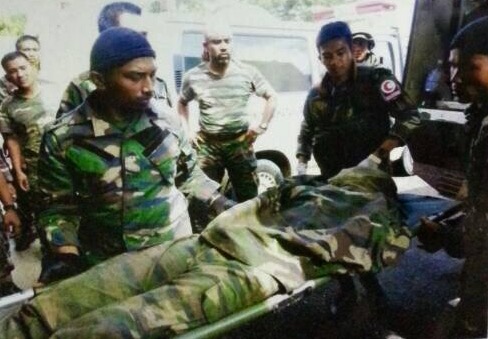
Kita ketahui terdapat anggota ATM dan PDRM yang tercedera dalam pertempuran semasa Op Daulat dilangsungkan tetapi tidak ramai yang mengetahui mahupun dapat menilai pengorbanan yang dilakukan oleh pasukan keselamatan kita untuk mempertahankan kedaulatan. Ini bukannya cerita ‘Combat‘ mahupun ‘Rambo‘ di mana heronya akan mendapat luka-luka kecil tatkala bertempur, tetapi ada yang tidak sempurna anggota dan fungsi tubuh badan setelah terkena tembakan.
Berikut adalah di antara paparan yang mungkin tidak pernah dilihat oleh rakyat Malaysia sebelum ini, tetapi saya rasakan amat perlu ditunjuk supaya kita faham erti pengorbanan pasukan keselamatan kita.
Seorang anggota keselamatan Malaysia yang tercedera ditembak diberi rawatan oleh petugas Kor Kesihatan DiRajaSeorang anggota pasukan keselamatan kita yang ditembak di dada diberi rawatan oleh petugas Kor Kesihatan DiRaja setelah peluru tersebut menembusi tubuh beliau
Sekiranya anda merasakan hanya para anggota keselamatan kita yang merasa pahit maung pertempuran, anda tersilap. Realitinya amat berbeza sekali.
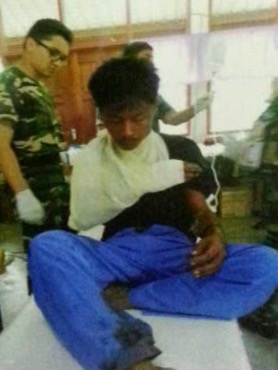
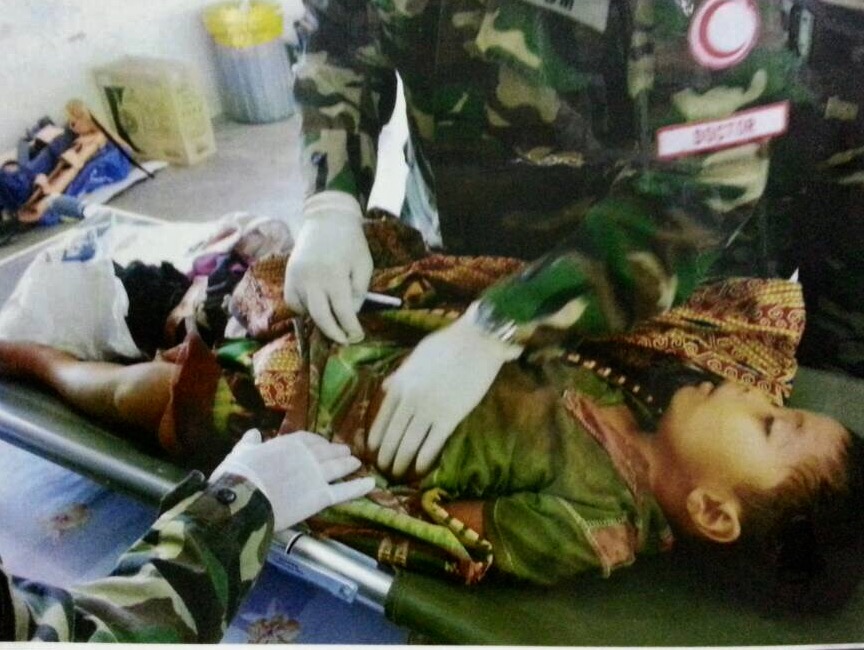
Apabila hospital medan didirikan oleh Kor Kesihatan DiRaja di kawasan operasi, orang awam yang terdiri dari para penduduk di situ yang telah tercedera ditembak secara rambang oleh pengganas Sulu berduyun-duyun datang untuk mendapatkan rawatan kecemasan. Di antara mereka termasuk kanak-kanak dan bayi yang menjadi mangsa keganasan pengganas Sulu. Mereka langsung tidak berperi kemanusiaan terhadap para penduduk timur Sabah sedangkan mereka kata Sabah adalah hak mereka.
Seorang mangsa tembakan rambang pengganas Sulu mendapatkan rawatan setelah Kor Kesihatan DiRaja membuka hospital medanSeorang kanak-kanak juga menjadi mangsa kekejaman peluru pengganas SuluBayi yang tidak berdosa ini juga tidak terlepas dari keganasan para pengikut Kiram. Bayi ini telah kehilangan banyak darah semasa dibawa ke hospital medan ATM. Status bayi ini tidak diketahui sama ada selamat ataupun tidak
Rentetan daripada insiden di Lahad Datu inilah kerajaan mewujudkan ESSCOM untuk memantapkan kawalan keselamatan di timur Sabah. Menteri Pertahanan Dato’ Seri Hishammuddin Tun Hussein berkata inisiatif terbaharu kerajaan ialah dengan menempatkan 7,000 anggota Tentera Darat dengan perlaksanaan Op Daratan, Op Balasah, Op Khas dan Op Pasir bagi mempertahankan daratan Sabah. Satu kompeni infantri Tentera Darat juga telah ditempatkan di kawasan Cenderawasih, Lahad Datu untuk memastikan kawasan pantai Lahad Datu terkawal sepenuhnya.
Tambah beliau lagi, inisiatif Trilateral Maritime Patrol (TMP) telah dilancarkan oleh Malaysia bagi memastikan mana-mana anggota militan termasuk Da’esh tidak menjadikan Laut Sulu sebagai laluan tikus untuk menceroboh masuk ke negara ini manakala inisiatif Trilateral Air Patrol (TAP) akan dilaksanakan dalam masa terdekat.
Jangan kita lupa siapa musuh kita. Jangan kita bersekongkol dengan mereka yang bersahabat dengan musuh yang tidak senang dengan kemerdekaan dan kesenangan yang kita kecapi. Jangan kita termakan hasutan politik kebencian (politics of hate) yang diamalkan oleh sesetengah pihak yang sanggup berbaik-baik dengan musuh untuk mendapat pengiktirafan mereka.
Musuh dalam selimut: Nurul Izzah bersama dengan Jacel Kiram, anak “Sultan” Kiram yang sehingga kini menganggap Sabah sebahagian dari “kerajaan” Sulu
Jangan kita lupa pengorbanan pasukan keselamatan kita. Jangan jadikan pemergian mereka, dan juga pemergian para penduduk yang menjadi mangsa kekejaman pengganas Sulu sebagai pemergian yang sia-sia. Berikanlah sokongan tidak berbelah bahagi kepada pasukan keselamatan kita, terutamanya Angkatan Tentera Malaysia, kerana musuh tidak membeza-bezakan di antara tentera dan rakyat Malaysia.
Kita semua adalah musuh mereka.
Berilah sokongan tidak berbelah bahagi kepada Angkatan Tentera Malaysia

















 SeaDemon Says
You must be logged in to post a comment.