Muhyiddin spoke on a PAS platform recently on 1MDB
Muhyiddin recently appeared on a PAS platform in Kuala Terengganu to speak about 1MDB etc. He was invited on the capacity of a former Deputy Prime Minister before the formation of Parti Pribumi which he is a pro-tem President. Not once did he address the long-standing question from especially the PAS members – how much did he make from the 1BestariNet scandal?
PAS first asked this question back in April 2012. Mahfuz Omar of PAS asked then why was the project not given to known telecommunications players such as Telekom Malaysia, Celcom or TimeDotCom who would be able to provide better Internet backbone to support the project.
The 1BestariNet project is a RM4.077 billion project over 15 years to provide 4G Internet connectivity as well as virtual learning environment for 9,924 schools nationwide. YTL, a known favourite of Parti Pribumi’s founder Mahathir, secured a RM663 million package signed by Muhyiddin when he was the Minister of Education. The Public Accounts Committee (PAC) in 2015 concluded that the implementation of the First Phase of the project is a failure. Not even a project steering committee and project technical committee were established at ministry-level to ensure its smooth implementation.
Responding to the PAC report, Economic Advisor to the Concerned Social-Minded Association (Persatuan Minda Sosial Prihatin) Suud Ridzuan called for Muhyiddin, the then Deputy Prime Minister cum Minister of Education to step down to facilitate the investigation into the scandal.
“According to the PAC, this project is a failure. Why was there a need to spend so much for this program?” he asked. “I urge the Malaysian Anti Corruption Commission to investigate.”
the installation of 1BestariNet Receiver Integrated System (1BRIS) communication towers that are supposed to transmit and receive high-speed wireless data in schools that do not have the appropriate LAN (Local Access Network) structure,
the refusal by YTL to pay RM1,200 per month to the Ministry of Education (MoE) as recommended by the Property Valuation and Service Department for each 1BRIS site. The MoE has thus far bowed down to YTL by allowing them to pay RM1,000 for each 1BRIS site instead;
the installation of the 1BRIS towers increased the electricity bill for each school by RM120 to RM150 monthly. With YTL’s refusal to pay the RM500 for each 1BRIS tower site, the MoE would have to fork out between RM5.77 million to RM6.92 million each year until the expiration of the contract.
The portal also alleged Muhyiddin’s son-in-law’s involvement in the project, an allegation that has gone unanswered by Muhyiddin.
Perhaps the MACC should seriously look into this issue as it has gone almost forgotten. Nabbing errant GLC office-holders may be a good thing, but letting a former senior Minister go free after hunderds of millions tangible rakyat‘s funds have been spent without tangible good results will not go down well with the majority.
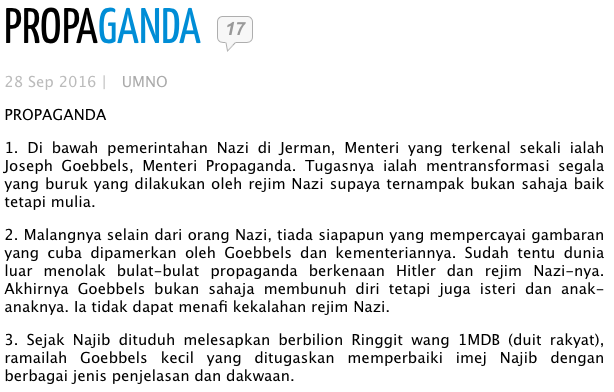
A screenshot of Mahathir’s blog raising the Nazi issue while Najib Razak was in Germany
The above was taken from Mahathir’s latest blog posting entitled ‘Propaganda.’ In this posting he likens Najib Razak to being a Nazi with pro-Najib bloggers such as BigDog and Rocky Bru, former staunch supporters of his, as being the Little Goebbels for Najib Razak. Whatever label that you wish to put on BigDog, I know for one thing his loyalty, other than to the nation, is to the Malays and the Malay cause. Like me, the straw that broke the ‘sympathy-for-Mahathir‘ camel’s back was when Mahathir joined the BERSIH protest last year, licking his own gob as he backtracked on his own words to not work with the opposition and condemn street demonstrations.
Attacking the bloggers,if the defence of Najib Razak or attacks on behalf of him is not working, is not wise at all. It goes to show that the likes of BigDog and Rocky are in fact making an impact on Mahathir’s struggle to oust the Premier. Likening Najib Razak to a Nazi while he is in Germany is not prudent at all. It shows how insensitive Mahathir is and a lack of decorum on his part. Then again, when has Mahathir ever showed to possess any sense of decorum at all, if any?
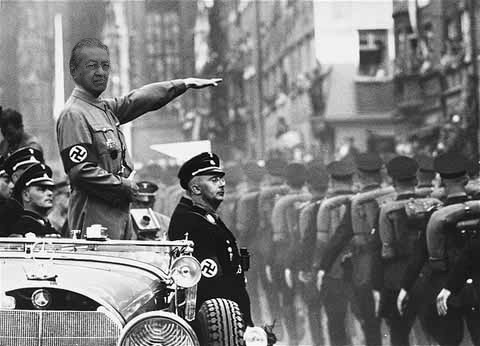
However, history has proven that there is someone with a racist and anti-semitic traits amongst us. Mahathir Mohamed is his name. So many things that he had said even before his premiership that points to these traits. Then again, what is Mahathir without his acid tongue?
First and foremost according to this blog, Mahathir s/o Iskandar Kutty is ashamed of his heritage. In fact, Philip Bowring who was an Editor for the Far Eastern Economic Review and a South China Morning Post columnist once wrote:
‘In his new book, A New Deal for Asia, he writes about his father in such a way as to imply that he was a Malay dedicated to the improvement of his fellow Malays rather than the hard-working Indian immigrant and government servant that he was. No mention of Dr Mahathir’s Indian Muslim background ever appears in the media. The subject is taboo.’
And UMNO suffered for 22 years being the cover for Mahathir to hide his true identity while creating a Herrenvolk culture to underscore his superiority especially over the Indians. In fact, he is now surrounded by people like him who could be termed as Ehrenarier, who are neither Malay but nor would they admit to who they really are. In 1922, Hitler said in a conversation with Major Joseph Hell (Josef Hell, “Aufzeichnung,” 1922, ZS 640, p. 5, Institut für Zeitgeschichte) that when he has power, “the destruction of the Jews will be my first and most important job. As soon as I have power, I shall have gallows after gallows erected, for example, in Munich on the Marienplatz-as many of them as traffic allows. Then the Jews will be hanged one after another, and they will stay hanging until they stink.”
Mahathir said something similar in 1979 about the Vietnamese boat people that was quoted by the Associated Press saying Malaysia would expel 75,540 boat people as well as “arm itself with legal powers to shoot new arrivals on sight.”
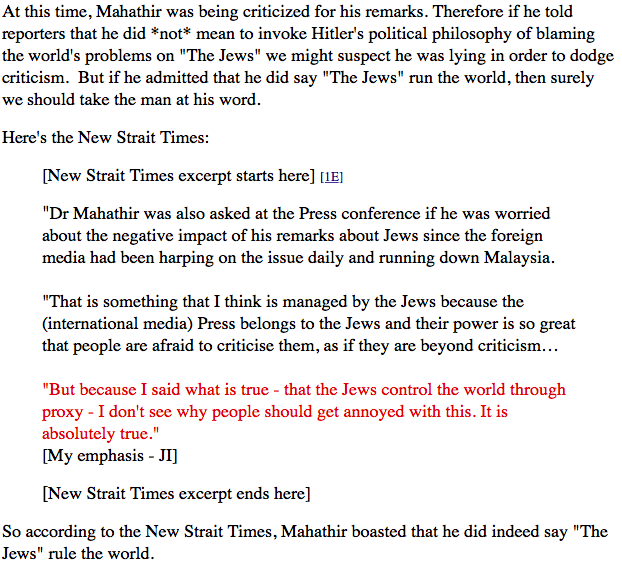
In October 2003, just before he left office, he made an anti-semitic remark in October 2003 that got played up by the Western media. Malaysia is labeled anti-Semitic until today, no thank you to Mahathir. While we are anti-Zionism, I doubt Malaysia is anti-Jew. One of my former bosses is a Jew who even contributed to a mosque for iftar during Ramadhan.
Courtesy of Emperor’s Clothes (www.emperors-clothes.com)
That is Mahathir being brash and abrasive for you…just so he could get somewhere.
I won’t write about how anti-Chinese Mahathir is. He enriches a few Chinese businessmen so they would be indebted to him, but at the same time help him to keep the mass of Chinese crabs in a barrel firmly inside the barrel. You can read more in his ultra-Malay book:
Mahathir’s Kampf
I read that when I found it in my father’s study room back in 1976. It made me worry when Mahathir replaced Hussein Onn as the Prime Minister in 1981. Since then, the DAP Chinese have been using the excuse of being victimised by the Malays, in particular by UMNO. Today, whenever the DAP creates racial tension and the Malays react, they would cry victimisation.
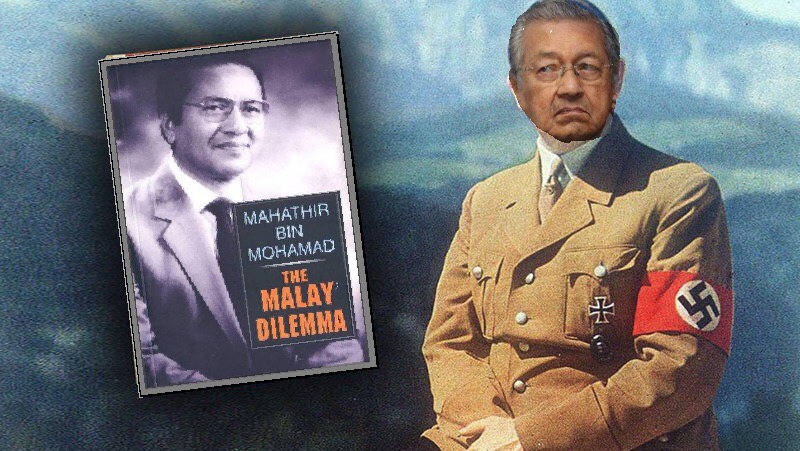
Who are we to blame? Erasing two decades of damage done to Malaysia by Mahathir is not easy. The interracial resentment has set in deep and the outcome of the General Elections of 2008 was the direct result of that. The fact that his followers are still worshipping him for his past while turning a blind eye to his present role as a one-man demolition derby does not help either. He had probably read ‘Mein Kampf‘ before writing ‘Malay Dilemma‘. Therefore, it comes as no surprise that the Supreme Leader of Parti Pribumi was once referred to as HITLER.
Perhaps, we need a proper Entnazifizierung program for them. But until then, Mahathir will just stand proudly while watching his band of Schutzstaffel march past him to do his bidding.
Datuk Seri Dr Ahmad Zahid Hamidi delivering his speech at the 71st UNGA in New York – photo courtesy of BERNAMA
I admit I cringed when Zahid Hamidi delivered his speech at the 71st UNGA in New York yesterday. My wife and cousins were in fits. This wasn’t the first time that I cringed when a Malaysian stood in front of an international audience delivering a speech or presentation with a poor command of the English language. The first was the late Tun Ghafar Baba who also delivered a speech on behalf of the government also at the UNGA 27 years ago next month talking about the Antarctic Treaty System. In various oil and gas meetings and conferences, I had to endure speeches delivered by Malaysians and cringed everytime they burst out in a self-made English-sounding slang to accompany their already poor command of the English language. Definitely Zahid et al need to brush up their command of the English language. However, there have been meetings and conferences that I have attended where even non-Malaysian speakers struggle with their English-language presentations and discussions. It is not just Malaysians who have this problem.
Most of those who criticise Zahid are those who still use ‘CONGRATES’ and/or ‘STUCKED.’ And many cannot even converse in Bahasa Malaysia despite having Malaysian birth certificate and identity card. Zahid could of course speak in Bahasa Malaysia, Javanese, a Chinese dialect (his foster father is a Chinese) and as we know now, some English. My only complain is of the quality of some of the English language teachers that we have. I still see some English teachers on social media
Grammar?
We have had two reports on the importance of Bahasa Melayu becoming the National Language published prior to the 13th May tragedy (Razak Report, 1956 and Rahman Talib Report, 1960). The Mahathir Mohamad Cabinet Report (1985) emphasised the importance of Bahasa Melayu as the unifying language for all races in Malaysia. In fact, Article 152 of the Federal Constitution and the National Language Act 1963/1967 have uphold Bahasa Melayu as the National Language. The Razak Report pointed out not only should the medium of teaching in schools be in Bahasa Melayu, but also for a uniformed curriculum to be taught at all schools. However, this was not thoroughly implemented. Children still went to schools with different medium of language. Different languages instill different values; and the use of Bahasa Melayu as a medium of teaching became a serious issue (Abdullah Hassan, 1996: 265).
As an outcome of the 13th May tragedy, political leaders got together and agreed that a single language as a medium of teaching is the way to foster unity amongst the different races of Malaysia. Tun Datuk Patinggi Hj Abdul Rahman Bin Ya’kub, the Education Minister in 1970 instructed all English-medium schools to use Bahasa Melayu in stages. Only a few Chinese schools continued to teach lessons in Mandarin (Abdullah Hassan, 1996: 266).
The rift is getting worse now. We have chauvinistic organisations championing the right to teach subjects in the vernacular to their students, while the National Language becomes just one of the subjects. Bangladeshis, Pakistanis, Myanmarese now have better command of the National Language than many of the people’s representatives. Who are we to blame? So, stop complaining about Zahid. If he can improve his command of the English language, can you improve your Bahasa Malaysia too?
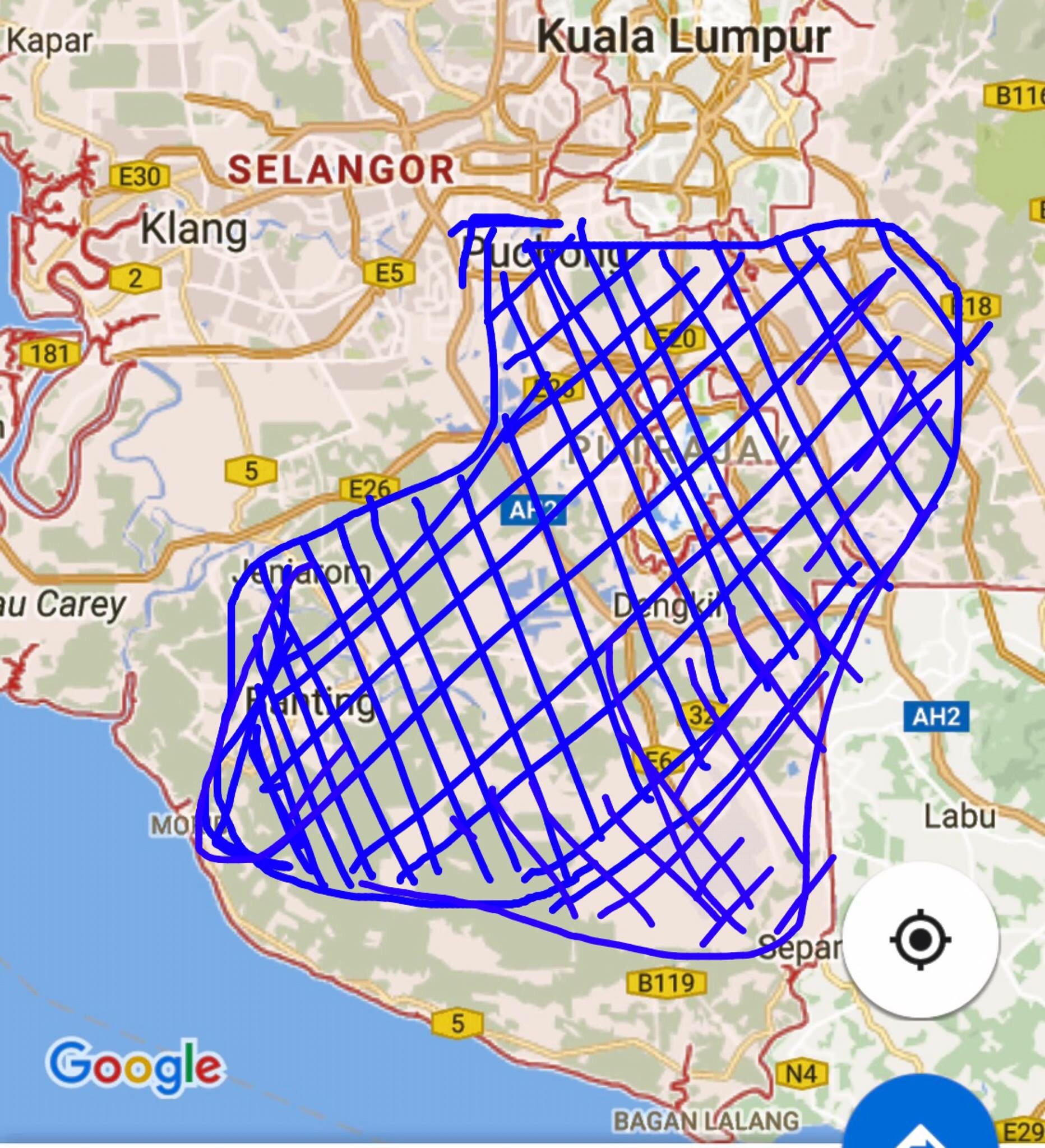
For the people of Petaling district, this is the second time that taps have run dry. The first was just before Aidil Adha (2nd September 2016) when a pipe burst caused taps in Subang Jaya, USJ, parts of Puchong and Pinggiran USJ to not have water supply for about three days. The second time which began two days ago is caused by contamination of the raw water supply to the Semenyih River Water Treatment Plant and this time several districts are affected namely
Hulu Langat (Bangi, Bandar Bukit Mahkota, Kajang, Semenyih and Rinching),
Kuala Langat (Morib, Banting, Saujana Putra, Bandar Rimbayu and Teluk Panglima Garang),
Petaling (USJ1-27, Puchong, Seri Kembangan and Serdang),
Sepang (Putrajaya, Cyberjaya, Bandar Nusa Putra, Putra Heights, Pulau Meranti, Kota Warisan, Bandar Bukit Puchong and Sungai Merab).
If you have no idea how huge an area that is, let me represent them using the map below:
Both these situations were totally avoidable. Since 2010 various water-related non-governmental organisations, water industry players as well as the Federal Government have advised the Pakatan-led Selangor state government to allow for the construction and completion of the Langat 2 Water Treatment Plant. Else, Selangor would face a water crisis by 2014. The state government vehemently denied that Selangor would face such a crisis.
True enough, people in Selangor had to undergo scheduled rationing in 2014 and 2015. 60,000 accounts were affected. That translates into at least 360,000 people who were directly affected. This time it could be far more.
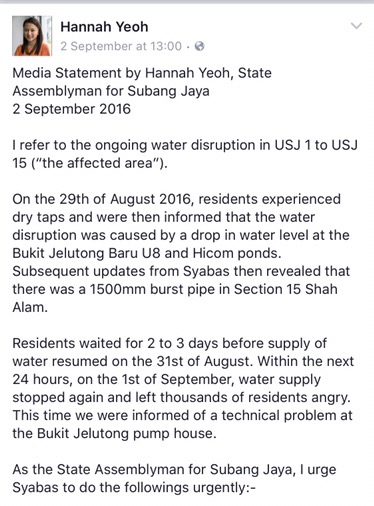
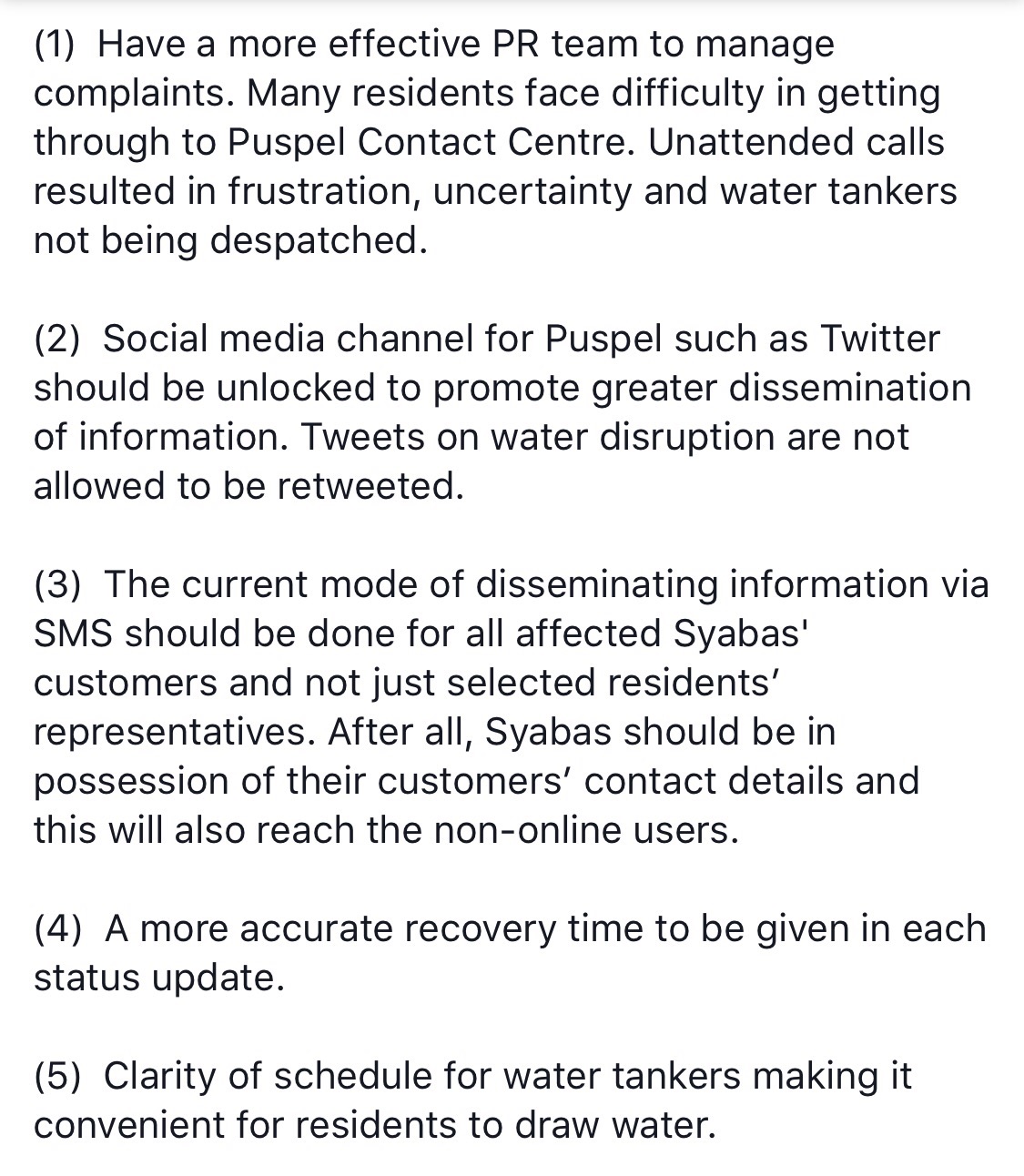
When a pipe burst on the 2nd September 2016, instead of helping by explaining the situation, an assemblyman decided to take it out on Syarikat Bekalan Air Selangor (SYABAS). This assemblyman gave the most absurd ideas on how to manage water cuts:
This invited a basket of zombies to support her statement, some even blaming the Federal government for the problem. In one of the community WhatsApp groups one even said that maybe the problem was created by the Barisan Nasional to create hatred towards the Selangor state government. What they failed to realise is that the Selangor state government IS the one managing it’s water treatment and supply:
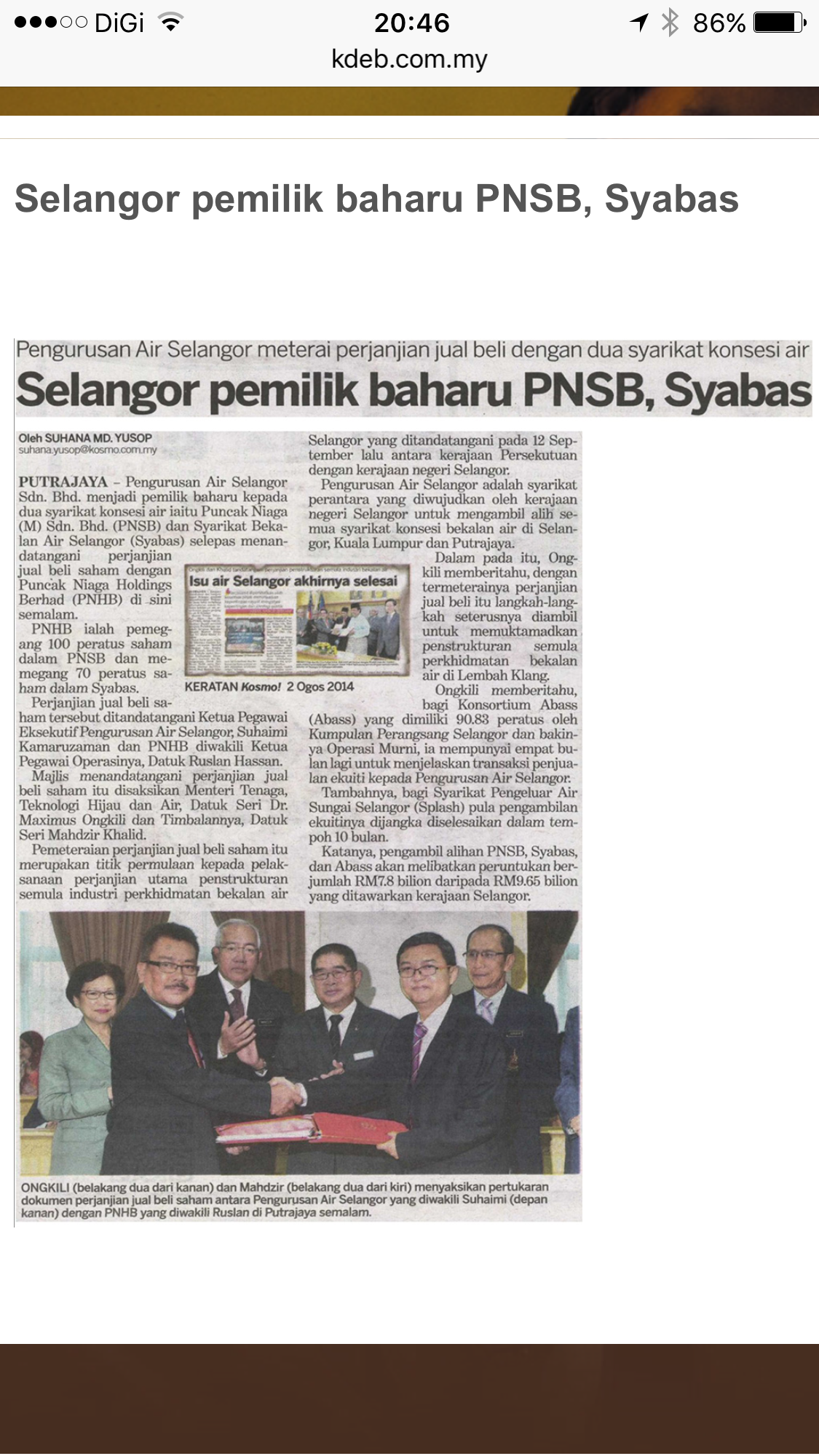
Not clear enough? How about this? From September 2015, the Selangor state government owns the water concessionaires in the state!
The second problem is that unlike Penang, Selangor does not gazette its water catchment areas. Factories, loggers have no problem whatsoever to encroach into the water catchment areas. It is a no-brainer that this is the contributing factor to the hundreds of cases of contamination of the Langat and Semenyih rivers and their tributaries.
Let us not kid each other. The Selangor state government has been in denial about the dire water situation in the state since 2008. It was made worse when the whole situation was not dealt with properly and by not heeding the advice of the industry players.
So, I hope Hannah Yeoh actually means it when she said there should be a management change. It should be a change in the management of the state. It can’t even handle the basic but extremely critical issues and it’s members are spending more time bashing others than actually looking into the problems the rakyat is facing! And when shit actually hits the fan, this is the sorry excuse to say “Oh! We’re with you! We feel your pain!”
Yes, Hannah Yeoh. Let us have that change in the management soon. Your voters are already supporting your call.
In the famous words of your fellow party member and former USJ resident Jeff Ooi,
Having found a partner-in-crime in Mahathir, Lim Kit Siang pushes aside all allegations that he had made against the founder of the Pribumi party.
Three years on, as the DAP Parliamentary Leader still owes the people of Sabah an answer pertaining to Mahathir’s involvement in the IC-for-vote scam otherwise known as “Project IC” or “Project M.”
I am not making this up. I am merely asking Lim Kit Siang if, now that he has Mahathir’s ears, the allegations he had made against the latter are true, or if he had been misleading the Sabahans especially in a scam of his called “I-Lie-For-Votes”?
—-———————————
KUALA LUMPUR, 21 JAN: Rakyat bukan setakat tidak yakin terhadap integriti institusi negara, malah pertikai iltizam kerajaan Barisan Nasional (BN) terhadap dasar 1Malaysia terhadap fitnah bekas Perdana Menteri paling lama memerintah, Tun Dr Mahathir Mohamad kepada Bapa Malaysia, Tunku Abdul Rahman dan satu juta warga generasi Merdeka apabila cuba menjustifikasikan Projek IC atau Projek M yang melakukan jenayah dan pengkhianatan “kewarganegaraan-untuk-undi” di Sabah bagi mempertahankan kuasa UMNO di negeri itu.
Ketua Parlimen DAP, Lim Kit Siang berkata, Perdana Menteri, Datuk Seri Najib Razak sepatutnya membersihkan nama Tunku Abdul Rahman, bapanya sendiri Tun Razak dan satu juta warga generasi Merdeka daripada fitnah Mahathir itu.
Katanya, Mahathir juga sepatutnya menjawab kepada rakyat Sabah dan Malaysia mengapa beliau hidup di dalam pembohongan selama dua dekad iaitu 10 tahun sebagai PM dan 10 tahun selepas bersara apabila menafikan kewujudan Projek IC atau Projek M yang melakukan penipuan “kewarganegaraan-untuk-undi”.
“Persoalannya, bagaimana rakyat Malaysia mahu melihat dasar 1Malaysia Najib sebagai sebuah dasar yang serius bagi menjadikan Malaysia yang lebih berdaya maju, lebih produktif dan lebih berdaya saing apabila usaha pembangunan bangsa bukan saja oleh Tunku Abdul Rahman, juga satu juta warga generasi Merdeka diperkecil malah difitnah seperti yang dilakukan Mahathir.
“Mahathir mendakwa Tunku melakukan sesuatu yang lebih teruk daripada Projek IC atau Projek M apabila memberi kewarganegaraan kepada sejuta warga semenanjung Malaysia yang tidak layak,” katanya dalam kenyataan media mengenai Pengiraan Detik 82 hari ke PRU-13, semalam.
Kit Siang yang juga Ahli Parlimen Ipoh Timur berkata, matlamat 1Malaysia adalah untuk menjadikan Malaysia lebih berdaya maju, lebih produktif dan lebih berdaya saing, dan kemuncaknya sebuah negara yang hebat: sebuah negara yang diharapkan agar setiap warga Malaysia melihat dirinya terlebih dahulu sebagai rakyat Malaysia, dan kemudian barulah melihat dirinya berdasarkan bangsa, agama kawasan geografi dan latar belakang sosial, dan juga sebuah negara yang diharapkan agar prinsip 1Malaysia dijalin dalam struktur ekonomi, politik dan sosial masyarakat.
Menurutnya, Rakyat Malaysia sekarang bingung dengan jawapan Najib selepas mesyuarat Majlis Tertinggi Barisan Nasional Khamis lalu mengenai pendedahan penipuan “kewarganegaraan-untuk-undi” oleh Suruhanjaya Siasatan Diraja (RCI) mengenai pendatang tanpa izin di Sabah dan reaksi Mahathir.
“Sebenarnya, Najib tidak katakan apa yang lebih penting daripada yang beliau katakan iaitu masih awal untuk membuat kesimpulan daripada RCI memandangkan ia masih di peringkat permulaan dengan 167 lagi saksi akan dipanggil, Najib juga berhati-hati mengelak memberi komen kepada fitnah Mahathir terhadap Tunku serta satu juta warga generasi Merdeka.
“Adakah ini bermakna Najib menyokong fitnah Mahathir bahawa Tunku memberi kewarganegaraan kepada sejuta warga tidak layak iaitu bukan saja mengaitkan Bapa Malaysia tetapi juga bapa Najib, Tun Razak
“Saya harap Najib segera membersihkan bukan saja nama Tunku tetapi juga bapanya, Tun Razak dan menjauhkan dirinya daripada fitnah Mahathir itu,” katanya.
Katanya, klip video terkenal “Listen, listen, listen!” Sharifah-Bawani adalah bukti terkini berterusan dan bahaya tersembunyi pusaka 22 tahun pemerintahan drakonian Mahathir, mendedahkan kepalsuan dakwaan bahawa pemerintahan Najib membuang segala beban lampau yang bersifat Mahathir dan kini menganut kepercayaan “Era kerajaan tahu semua telah berlalu”. – Roketkini.com
——————————
I would like to call upon Malaysians now to ask Lim Kit Siang if Mahathir has answered him, and make the answer known to us all, especially the Sabahans, in the mass and electronic media.
Lim Kit Siang can read the original article here in case he is absent-minded.
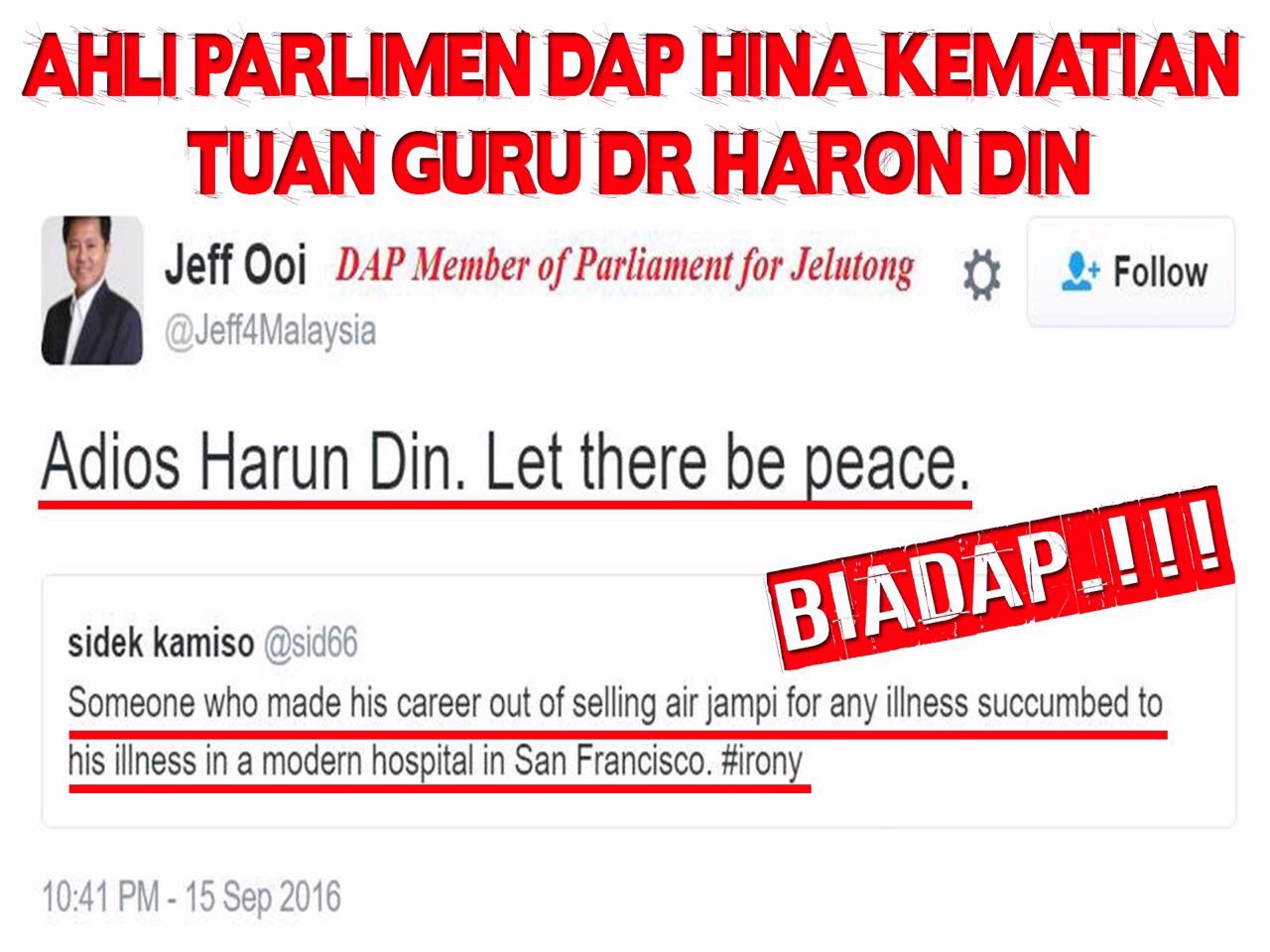
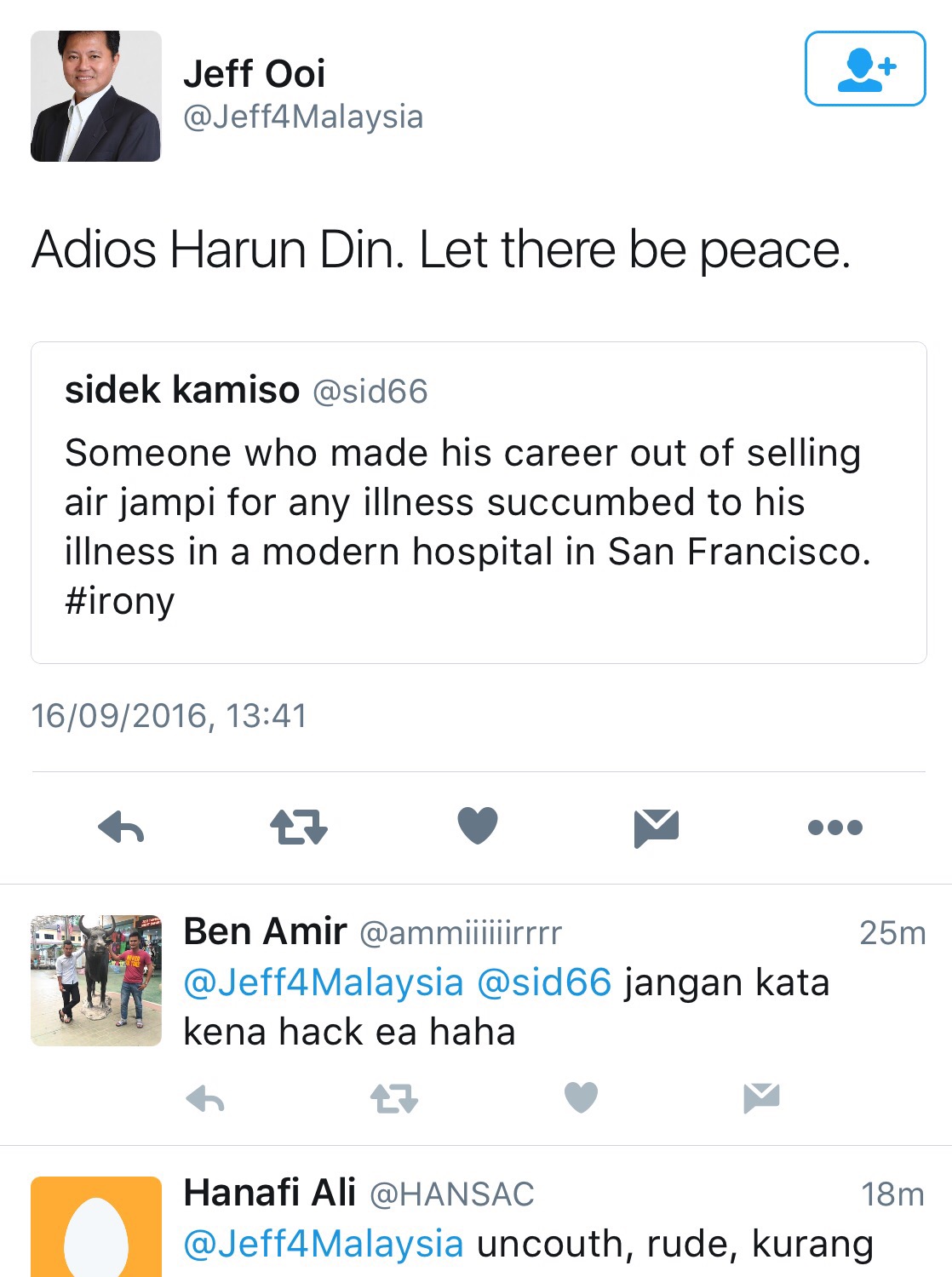
Jeff Ooi’s done it again! The latest Muslim he had targetted was the late Haron Din who passed away early Friday morning (Malaysian time).
In a Tweet in reply to a similarly rude Tweet at 1.41pm on 16th September 2016, Jeff Ooi used Adios Harun Din. It may have been alright albeit sounding disrespectful had it been a stand-alone Tweet, replying to an earlier rude Tweet made it sound much like the cocktail drink I posted above.
It is reported that Jeff Ooi has deleted the Tweet but no apology has been made. An apology is not a culture embedded in Jeff Ooi’s DNA.
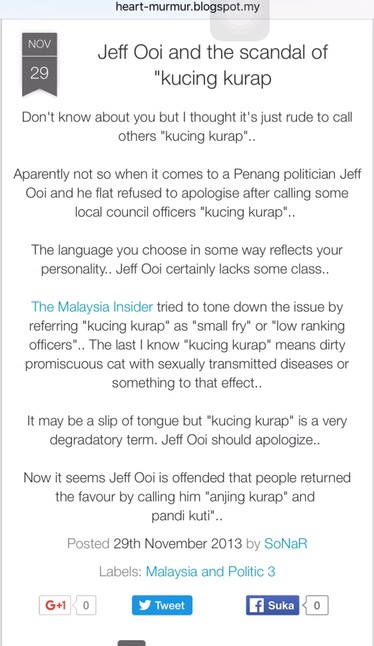
Almost three years ago, the Member of Parliament for Jelutong drew the wrath of the members of the public as well as from Pakatan assemblymen when he called officers from the Majlis Perbandaran Pulau Pinang ‘kucing kurap.’ A defiant Jeff Ooi refused to apologise for the remark. He did apologise a week later but only after he was instructed by the late Karpal Singh to do so.
A year after being elected Jeff Ooi had called Mohd Razali Abdullah, a MPPP councillor an Islamic terrorist. Razali was a member of the Jemaah Islah Malaysia, a registered organisation that had a close tie with the DAP Socialist Youth (DAPSY). It took an order from recently-charged Chief Minister of Pulau Pinang, Lim Guan Eng, before he retracted his remark. However, to date, Jeff Ooi has never offered any form of apology to Razali.
In 2011, Jeff Ooi organised a Christian function at the Red Rock hotel in Pulau Pinang where Sarawak pastors were his guests. The function, according to Big Dog and Helen Ang, was to pledge their support for the Christian agenda to have a leader of their faith to become the Prime Minister of Malaysia.
I blame the voters of Jelutong for returning him to the MP seat. I also pity them for having a wretched outsider to become their voice. And I would like to remind them to give Jeff Ooi the boot in the next general election.
We don’t need racists and chauvinists in this country, and we don’t need people who have very little respect for others to lead us. Come GE14, should say to Jeff Ooi “Adios Motherfucker!”
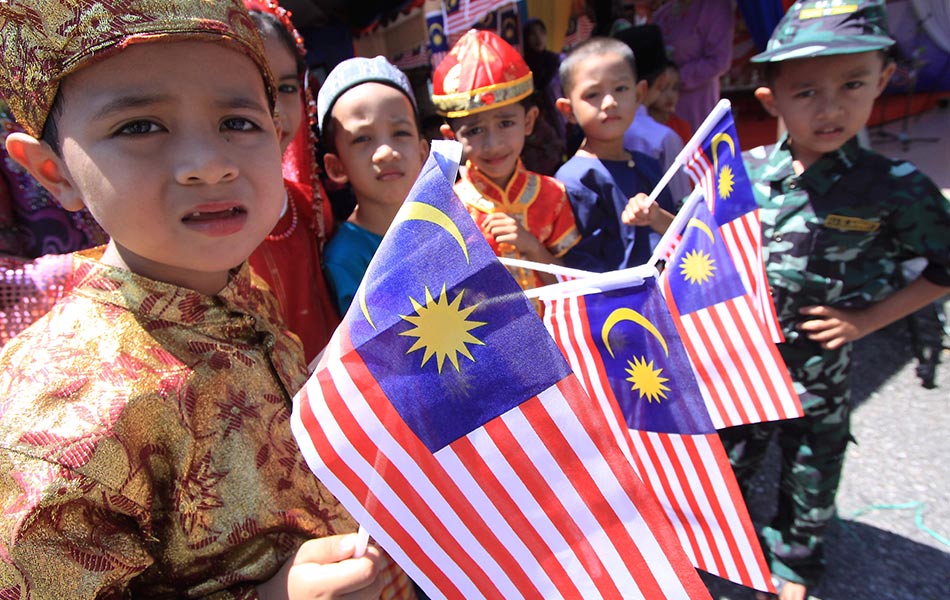
Children in different costumes holding the Malaysia flag – BERNAMAThis article is the last installment in a series on the Formation of Malaysia, and is a continuation from The Road to Malaysia: Part 3 – The Cobbold Commission.
“… there is no doubt about the wishes of a sizeable majority of the peoples of these territories to join the Federation of Malaysia.” (UN Secretary-General U Thant, 13th September 1963]
After World War 2, the British was economically and financially strained to maintain its colonies especially those east of Suez. It would be a matter of time before Britain would have to give up all of its colonies abroad, save for some of the smaller ones. The Cobbold Commission’s report agreed unanimously that a decision in principle should be taken by governments as soon as possible; that the new state should be called Malaysia; that the constitution of the Federation of Malaya should be adapted for Malaysia, instead of drafting a completely new one; that there should be no right to secede from Malaysia after merger.
Although the Tunku had asked the Malayan Commissioners to sign the report, he was still apprehensive about what “Malaysia” would do to his political position, and what kind of repercussions “Malaysia” would have on Malaya’s relationship with Indonesia and the Philippines.
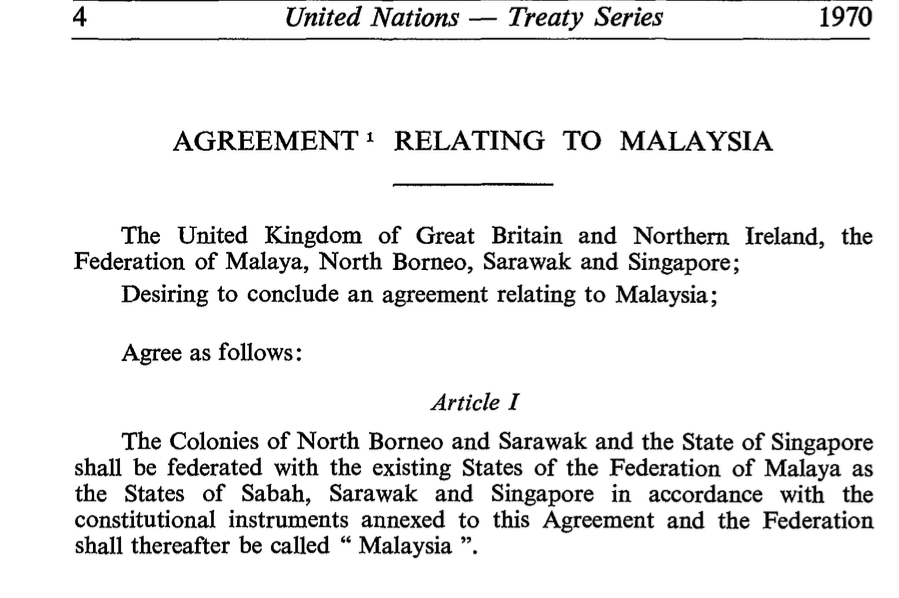
The Malaysia Agreement was signed on the 9th July 1963. Although not sovereign nor self-governing, the leaders of both North Borneo and Sarawak were invited to sign it. Annexed to the Agreement were a number of Constitutional instruments that included admission to the federation of the three former British dependencies; state constitutions for Sabah (as North Borneo would be called), Sarawak and Singapore; a scheme to compensate officers retiring from government service in North Borneo and Sarawak.
A separate legislation ending British jurisdiction in North Borneo, Sarawak and Singapore was enacted at Westminster. It did not provide for the separate independence of the three territories but transferred sovereignty to the new Federation of Malaysia (Commonwealth Relations Office and Commonwealth Office Briefs for Malaysia Bill, 1963 – Dominions Office DO 169/329). Therefore the self-rule given by the British to Sarawak on the 22nd July 1963 and the declaration of independence by Sabah on the 31st July 1963 were not a recognition of the independence of either Sarawak or Sabah, but an independence of the states in adherence to Malaysia (Ghazali Shafie’s Memoir on the Formation of Malaysia, p438). For all intents and purposes, both North Borneo and Sarawak remained as Colonies of Great Britain until the coming into operation of Malaysia.
If the appointment of a Chief Minister is to be taken as the point when independence had been achieved, Malaya would have been independent in July of 1955!
The late President Wee Kim Wee of Singapore, then a young Straits Times reporter, covered Sabah’s Merdeka Day and filed a report that, from all the obvious evidence, it was a declaration of independence within Malaysia.
The Malaysia Agreement referred to North Borneo, Sarawak and Singapore as Colonies.Malaysia Day was supposed to have happened on the 31st August 1963. However, several last minute events forced Malaysia Day to be postponed.
1) a last-minute interference by British officials prevailing upon Iban leaders to demand for the post of Sarawak Governor whilst also keeping the post of Chief Minister, thus reneging on an earlier understanding that for the first two years, the post of either the Chief Minister or Governor should go to a Malay if the other was given to an Iban. The Tunku was livid and decided that Malaysia would happen without Sarawak. All the cabinet ministers of Malaya except Tun Razak agreed with the Tunku. Through Ghazali Shafie, Razak negotiated with the leaders of Sarawak and in the end Abang Haji Openg was the Governor designate, Stephen Kalong Ningkan as the Chief Minister, and Temenggung Jugah as a Federal Minister in-charge of Sarawak Affairs. Had it not been for Razak’s persistence, the Tunku would have had things go his way and Sarawak would not have been in Malaysia.
2) the protest by both the Philippines and Indonesia at the United Nations against the formation of Malaysia. They requested that the UN secretary-general, or his representative, should ‘ascertain’ the extent of support in the Borneo territories for Malaysia, that observers from all three governments should accompany the UN mission, and that the formation of Malaysia should be postponed until the completion of the UN report.
Led by Lawrence Michelmore (the American deputy director of the UN Office of Personnel) the mission consisted of Argentinian, Brazilian, Ceylonese, Czech, Ghanaian, Pakistani, Japanese, and Jordanian members of the UN Secretariat. It was accompanied by observers from Indonesia and the Philippines—an arrangement which the British government grudgingly accepted. From 24th August to 4th September they held public hearings in widespread locations and reconvened in Kuching on 5th September, past the 31st August 1963 deadline. This forced Malaya to change the date for Malaysia Day to 16th September 1963.
The UN report, which was published on the 14th September, was generally favourable to Malaysia. In his assessment of the mission’s findings, U Thant was in no doubt that ‘a sizeable majority of the peoples’ wished to join Malaysia, although he also rebuked the Malayans for fixing a new Malaysia Day before the mission had completed its work. Even before the survey was finished, however, Indonesia and the Philippines were attempting to discredit it and, on its publication, they rejected the report and refused to be bound by its findings.
3) was of the PAS Government in Kelantan wanting the Malaysia Agreement and Malaysia Act to be declared ‘void and inoperative.’ Kelantan argued that the Act would abolish the Federation of Malaya, thereby violating the Federation of Malaya Agreement of 1957; that the proposed changes needed the consent of each state of Malaya and that this had not been obtained; that the Sultan of Kelantan should have been a party to the Malaysia Agreement in the same way as the Malay rulers had been signatories of the Malaya Agreement of 1957; that constitutional convention called for consultation with the rulers of individual Malay states regarding subsequent changes to the constitution; and that the federal parliament had no power to legislate for Kelantan in this matter.
On the 14th September 1963 the Chief Justice ruled that both the Malaysia Agreement and the Malaysia Act were constitutional (Tan Sri Mohamed Suffian bin Hashim, An introduction to the constitution of Malaysia (Kuala Lumpur, 1972) pp 13–14).
By 16th September 1963, we are all Malaysians.
Looking back, I remember an article quoting Tan Sri Abdul Ghani Gilong relating his experience visiting Kuala Lumpur on the invitation of the Tunku, he said:
“Kami naik kenderaan yang dipandu. Bagi sesetengah anggota delegasi saya, itulah kali pertama mereka menikmati air paip dan tandas berpam.”
“Kami dibawa ke beberapa tempat dan kampung yang sudah mendapat pembangunan seperti jalanraya dan sebagainya. Saya sendiri apabila balik ke Sabah telah berkempen menyokong penubuhan Persekutuan Malaysia dengan memberitahu kawan-kawan mengenai pembangunan yang ada di Malaya ketika itu.
Katanya satu kejadian lucu ialah apabila ada anggota rombongannya tidur di lantai dalam bilik hotel mereka dan bukan di atas katil yang empuk.
“Apabila saya nampak, mereka memberitahu saya mereka ingatkan katil itu adalah untuk ‘tuan’, seolah-olah hanya orang kulit putih boleh tidur di atas katil dan anak tempatan tidur di atas lantai sahaja.”
“Saya beritahu mereka katil itu mereka punya untuk tidur di atasnya.”
(“We rode on a vehicle that came with a driver. For some members of my delegation, that’s the first time they enjoyed tap water (running water) and flushing toilets.”
“We were taken to several places and villages that have received development such as roads and so on. When I went back to Sabah I campaigned in support of the establishment of the Federation of Malaysia by telling my friends about the existing development in the then Malaya.
He said that one funny scene was when there were members of his entourage who slept on the floor in their hotel room and not on their comfortable.
“When I saw, they told me they thought it was a bed especially for the ‘master’, as if only the white people could sleep on the bed while the local people sleep on the floor.”
Such was how inferior the people of Sabah and Sarawak felt of themselves before Malaysia existed, and it was not that long ago.
I believe that there has been progress that has been made in both Sabah and Sarawak although there should be more. When I was working offshore, most of my drilling and marine crew are from Sabah and Sarawak, especially the Ibans. My last Chief Mate is a Kelabit from Bario, while one of our vessels’ Captain is a Kedayan from Limbang. In my opinion, both the Merdeka Day on the 31st August and Malaysia Day on the 16th September are equally important to us. Without the 31st August 1957 event, Malaysia would not have happened and I shudder to think what ill-fortune would have befallen the people of Sabah and Sarawak, especially with China, Indonesia and the Philippines staking a claim in both the states.
I also believe that the current Federal Government is doing all it can to fulfill the promises made back in 1963, an uhill task given that previous Prime Ministers, especially a particular former Prime Minister for 22 years, did not do much for the people of Sabah and Sarawak.
Let us concentrate on nation-building, and put aside state-nationalism as that brings about nothing beneficial to any of us. And let us not let hatred destroy us. Our forefathers who agreed to form Malaysia did so following the democratic system, and not through violent nor nonsensical demonstrations or coups.
And let us remember the famous words by the great Temenggung Jugah ak Barieng:
“Anang aja Malaysia tu baka Tebu, Manis di pun, tabar Di ujung”
(Let’s hope Malaysia does not end up like a sugarcane. Sweet at the beginning, bland at the end)
In Vietnam, Laos and Cambodia the communists were making advances while the number of American servicemen in Vietnam tripled the number sent in 1950. In Indonesia, the influence of the Partai Komunis Indonesia on President Sukarno was strong. In Singapore, all the political parties except Singapore UMNO accused the PAP of having carried out negotiations to be merged with Malaya without first consulting the people. This gave ammunition to the communists in Singapore and their sympathisers to attack both Lee Kuan Yew and the Tunku.
In British Borneo, the communists and their sympathisers tried to intimidate the natives thinking that it would work as it did in Singapore. Truth be told, it had quite the opposite effect. Lee Kuan Yew observed that as in Singapore, those anti-Malaysia in Sarawak were the Chinese communists, chauvinists and their sympathisers, while in North Borneo, they were Chinese businessmen and Chinese who were under the influence of individual British officials who were opposed to the Malaysia Concept, or ignorant of it. Kuan Yew noted that the direct links between the Chinese in Perlis throughout Malaya and Singapore to the British Borneo are the Chinese newspapers. Hence, Kuan Yew suggested to the Tunku for the Chinese chauvinists be separated from the Chinese communists and the two groups should be separated.
Members of the Cobbold Commission arrived in Kuching in the morning of the 20th February 1962. The members were:
Sir Cameron Fromanteel Cobbold, former Governor of the Bank of England, also Chairman of the Commission of Enquiry,
Sir Anthony Foster Abell, former British Governor of Sarawak and the High Commissioner to Brunei,
Sir David Watherston, the last British Chief Secretary of Malaya,
Wong Pow Nee, the Chief Minister of Penang, and,
Ghazali Shafie, Permanent Secretary to the Ministry of Foreign Affairs of Malaya.
They were first brought to the Astana, a house that was built in 1870 by the second White Rajah, Charles Anthoni Johnson Brooke as a wedding gift for his wife, Margaret Alice Lili de Windt. It had been occupied by the British Governor since 1946. Ghazali Shafie could not help but notice a Jawi inscription at the entrance of the Astana left by one of the Brookes “BERHARAP LAGI BERNAFAS, (Have Hope While There Is Still Breath)” perhaps an apt motivation for the colonial officials who did not want Sarawak to be part of the Federation of Malaysia.
The Brookes had built the Astana on the northern bank of the Sarawak river because it was where the Malays were. The Brookes depended on the Malays for safety and security, the Chinese for prosperity and trading, while the natives were not entirely trusted. The same compartmentalisation was practised in Sarawak by the colonial officials after taking over the state from the Brookes in 1946.
The first groups of interviewees were interviewed in Kuching on the 21st February 1962. The first group amongst these interviewees was extremely pro-Malaysia. They were led by Abang Mustapha, Datu Bandar of Kuching. The second group was led nby Ong Kee Hui from SUPP. This group was against the special rights to be accorded to the natives of Sarawak unless if it is not stated in the to-be-formulated Constitution. This group had a contempt for the backwardness of the natives and had regarded their leaders as men of no consequences. This stand prompted an Iban by the name of Jonathan Bangau whom the SUPP had nominated as the party’s leader in Sibu to resign.
The next day, another group of Chinese in Kuching were interviewed. Their spokesperson, a Chinese woman, twisted and distorted events in Malaya into something truly hateful. She accused the Malayan Government of policies that turned very young girls into prostitutes and had labour laws that accorded workers not more than Ringgit 1.50 per fourteen-hour working day without holidays! When these allegations were countered by Ghazali and Wong Pow Nee, she informed the Commission that she had read the stories from Chinese newspapers to which Wong Pow Nee murmured that these must have been communist publications.
In Bau and Simanggang (now Sri Aman), banners and placards expressing anti-Malaysia slogans in Chinese characters plastered the town in anticipation of the Commission members interviewing residents there. The scene was different in Kanowit and Kapit. People shook the hands of the Commission members, especially the Malayan ones. One of the Tuai Rumah even held Ghazali Shafie’s hand as they walked through Kapit town. They were all awaiting the arrival of Malaysia!
However, Ghazali learnt that under the colonial administration the Iban had suffered oppression and suppression. This began when Sarawak was under the Brunei Sultanate and continued under the Brookes and subsequently the British. When they faced the Commission, they were all for Malaysia and some even emphasised on the need for a speedy arrival of better education and development for the Iban community.
At Binatang (now Bintangor), the division between the wishes of the natives and the Chinese was most prominent. The natives were all for the speedy arrival of Malaysia while the Chinese were divided into two groups: one favouring a referendum, while the other favouring a Federation of North Borneo, Brunei and Sarawak – a line maintained especially by the communists.
In North Borneo, the only negative views were given by the British officials and expatriates as well as the rich local businessmen. At this juncture, Ghazali noted that these British officials knew nothing or chose to disregard Harold MacMillan’s famous “Wind of Change” speech in Cape Town made on the 3rd February 1960.
Cobbold, not having any experience in dealing with the Far East, succumbed to the ideas of these officials that in his draft, he recommended that both the British and Malayan Governments should have executive powers over the British Borneo states for five years. Both Wong Pow Nee and Ghazali believe that the Malayan Government would never agree to perpetuate colonialism in any form. However, the two governments should discuss the matter should they want the British officials to stay on in Borneo in the service of the two territories. Wong Pow Nee quoted the state of Penang where he was once a Chief Minister to demonstrate the point that the British fears were groundless and that the Tunku, the Malayan people as well as the 70 percent who advocate the creation of Malaysia in the North Borneo and Sarawak would not agree to Cobbold’s suggestions as it would still be a form of colonialism. What more that the communists in Malaya, Singapore, Indonesia, China and the Soviet Union had branded the Malaysia Concept as neo-colonialism. Interesting also to note here is that in April 1962, the Philippines House of Representatives had made a formal claim on North Borneo. On the 20th January 1963, Drs Subandrio, and alleged communist and also Sukarno’s Foreign Minister and Second Deputy Prime Minister announces Indonesia’s “confrontation” towards Malaysia.
In the end, on the 31st July 1962, Prime Minister Harold MacMillan told the Malayan delegates that Her Majesty’s Government was just as anxious to see Malaysia succeed. Soon after, an Inter-Governmental Committee (IGC) was set up by the Malayan and British Governments that would include the North Borneo and Sarawak Governments. On the 12th September 1962, the North Borneo Legislative Council adopted the following motion:
“Be it resolved that this Council do welcome the decision in principle of the British and Malayan Governments to establish Malaysia by the 31st August, 1963…”
Then on the 26th September 1962, the Council Negri of Sarawak adopted the following motion without dissent:
“This Council welcomes the decision in principle of the British and Malayan Governments to etablish Malaysia by the 31st August, 1963…”
The Federation of Malaysia that would include the Federation of Malaya, North Borneo and Sarawak was to come into operation by the 31st August 1963. All in all, the IGC made recommendations in its report pertaining to the States’ Constitutions, legislative powers, financial provisions, elections, the Judiciary, public service, citizenship, immigration, religion, education, the National Language, status of existing laws, the position of the indigenous races and transitional arrangements prior to the formation of Malaysia.
North Borneo was thoroughly satisfied with the IGC report and the North Borneo Legislative Council unanimously adopted the Report on the 13th March 1963. The Sarawak Government was satisfied and considered that the Report contained “generous terms of safeguards for Sarawak.” Stephen Kalong Ningkan as the Secretary-General of the Sarawak Aliance said that his party “fully endorses the Report.” Leong Ho Yuen, the Vice-Chairman of the SUPP said: “All in all, the Report is quite satisfactory. Though we cannot get all we asked for, at least we have been given a high percentage.” The Sarawak Council Negri voted unanimously to adopt the Report on the 8th March 1963, five days before North Borneo.
Donald Stephens who was the Chairman of the Executive Committee of the North Borneo Alliance said: “The whole of North Borneo will now welcome with joy the creation of Malaysia.”
Tomorrow, on Malaysia Day, we shall look into the self-rule granted to the State of Sarawak and why was Malaysia formed on the 16th September 1963 instead of on the 31st August. We will also look at what was said by those who were involved in parts of the process.
It seems that Anwar the Buggerer has been buggered twice by Chief Buggerer Mahathir. Oh, don’t be naïve. Especially to those too young to remember what Mahathir had said about Anwar on the 22nd September 1998, two days after Mahathir had Anwar arrested.
Makes you wonder who’s the Buggerer and who’s the one Buggered, doesn’t it?














 SeaDemon Says
You must be logged in to post a comment.