
Adios MF
 How do you make an AMF?
- 1 X Jeff Ooi
- 1 X DAP
- 1 X General Election
- 1 X Big Kick in Jeff Ooi’s butt
Jeff Ooi’s done it again! The latest Muslim he had targetted was the late Haron Din who passed away early Friday morning (Malaysian time).
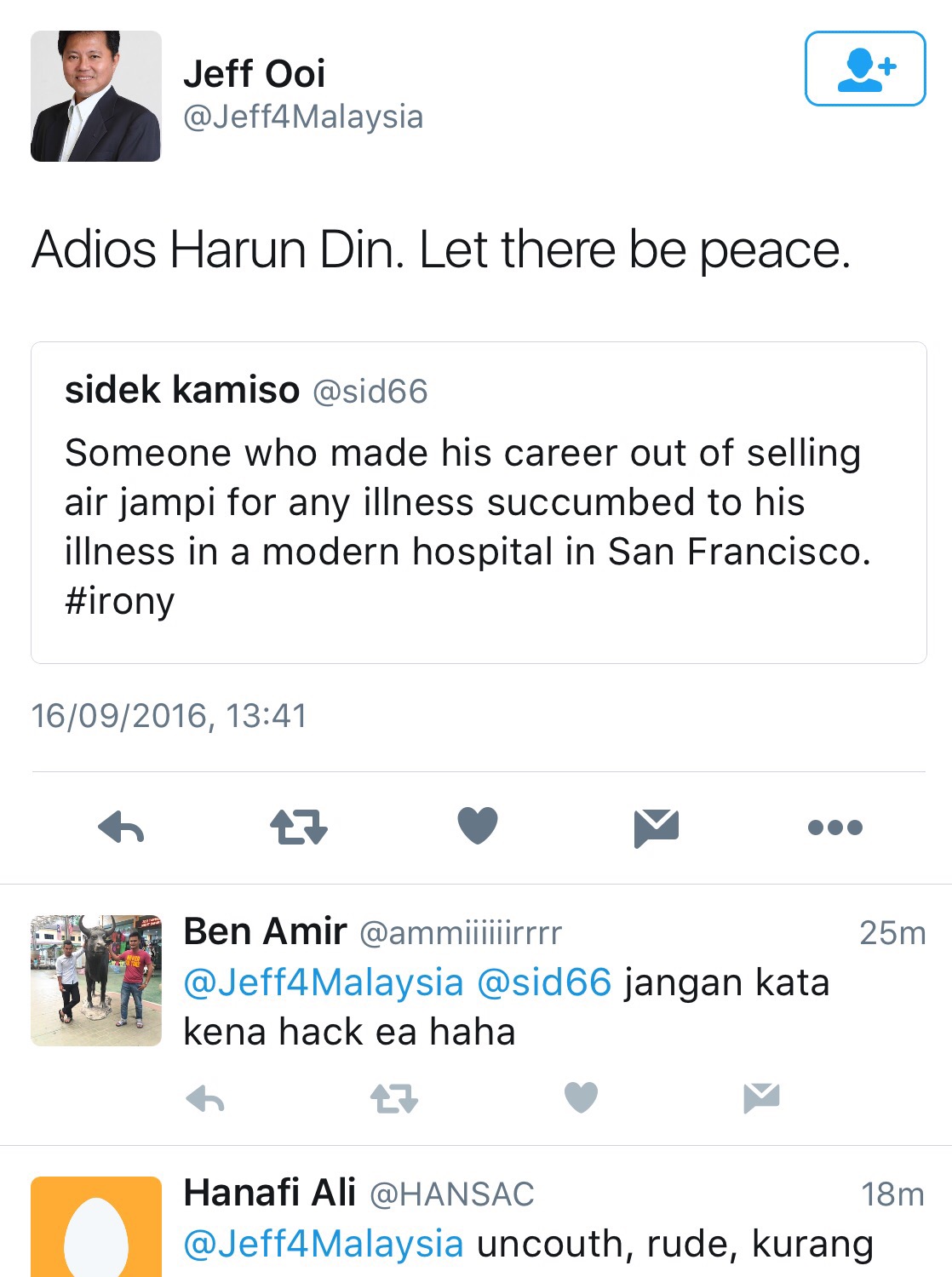
In a Tweet in reply to a similarly rude Tweet at 1.41pm on 16th September 2016, Jeff Ooi used Adios Harun Din. It may have been alright albeit sounding disrespectful had it been a stand-alone Tweet, replying to an earlier rude Tweet made it sound much like the cocktail drink I posted above.
It is reported that Jeff Ooi has deleted the Tweet but no apology has been made. An apology is not a culture embedded in Jeff Ooi’s DNA.
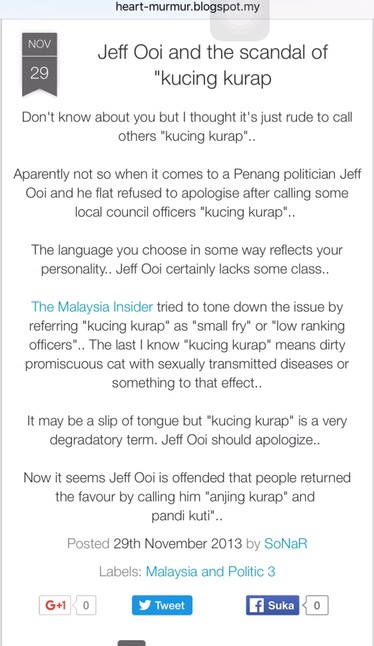
Almost three years ago, the Member of Parliament for Jelutong drew the wrath of the members of the public as well as from Pakatan assemblymen when he called officers from the Majlis Perbandaran Pulau Pinang ‘kucing kurap.’ A defiant Jeff Ooi refused to apologise for the remark. He did apologise a week later but only after he was instructed by the late Karpal Singh to do so.
A year after being elected Jeff Ooi had called Mohd Razali Abdullah, a MPPP councillor an Islamic terrorist. Razali was a member of the Jemaah Islah Malaysia, a registered organisation that had a close tie with the DAP Socialist Youth (DAPSY). It took an order from recently-charged Chief Minister of Pulau Pinang, Lim Guan Eng, before he retracted his remark. However, to date, Jeff Ooi has never offered any form of apology to Razali.
In 2011, Jeff Ooi organised a Christian function at the Red Rock hotel in Pulau Pinang where Sarawak pastors were his guests. The function, according to Big Dog and Helen Ang, was to pledge their support for the Christian agenda to have a leader of their faith to become the Prime Minister of Malaysia.
I blame the voters of Jelutong for returning him to the MP seat. I also pity them for having a wretched outsider to become their voice. And I would like to remind them to give Jeff Ooi the boot in the next general election.
We don’t need racists and chauvinists in this country, and we don’t need people who have very little respect for others to lead us. Come GE14, should say to Jeff Ooi “Adios Motherfucker!”

The Road to Malaysia: Part 4 – Merdeka & Malaysia Day

“… there is no doubt about the wishes of a sizeable majority of the peoples of these territories to join the Federation of Malaysia.” (UN Secretary-General U Thant, 13th September 1963]
After World War 2, the British was economically and financially strained to maintain its colonies especially those east of Suez. It would be a matter of time before Britain would have to give up all of its colonies abroad, save for some of the smaller ones. The Cobbold Commission’s report agreed unanimously that a decision in principle should be taken by governments as soon as possible; that the new state should be called Malaysia; that the constitution of the Federation of Malaya should be adapted for Malaysia, instead of drafting a completely new one; that there should be no right to secede from Malaysia after merger.
Although the Tunku had asked the Malayan Commissioners to sign the report, he was still apprehensive about what “Malaysia” would do to his political position, and what kind of repercussions “Malaysia” would have on Malaya’s relationship with Indonesia and the Philippines.
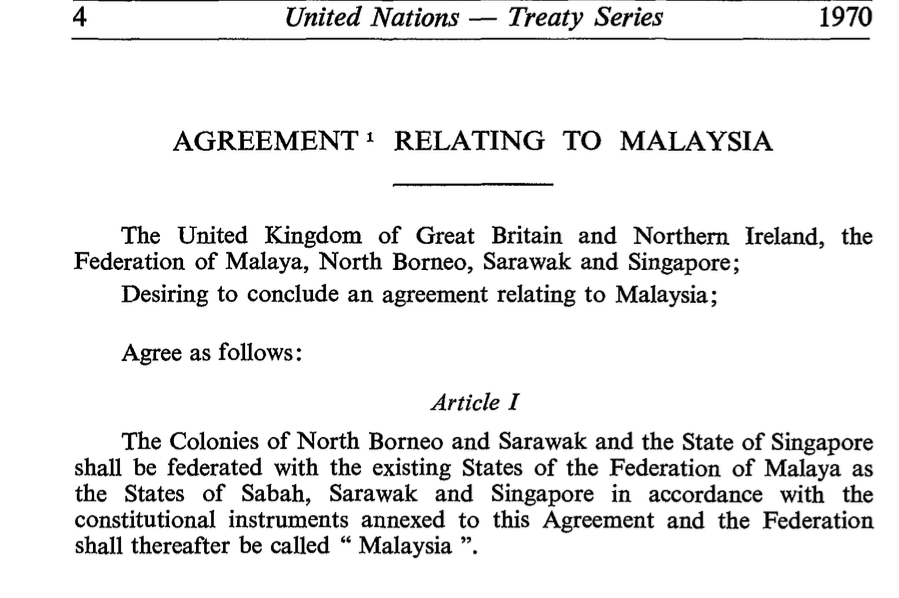
The Malaysia Agreement was signed on the 9th July 1963. Although not sovereign nor self-governing, the leaders of both North Borneo and Sarawak were invited to sign it. Annexed to the Agreement were a number of Constitutional instruments that included admission to the federation of the three former British dependencies; state constitutions for Sabah (as North Borneo would be called), Sarawak and Singapore; a scheme to compensate officers retiring from government service in North Borneo and Sarawak.
A separate legislation ending British jurisdiction in North Borneo, Sarawak and Singapore was enacted at Westminster. It did not provide for the separate independence of the three territories but transferred sovereignty to the new Federation of Malaysia (Commonwealth Relations Office and Commonwealth Office Briefs for Malaysia Bill, 1963 – Dominions Office DO 169/329). Therefore the self-rule given by the British to Sarawak on the 22nd July 1963 and the declaration of independence by Sabah on the 31st July 1963 were not a recognition of the independence of either Sarawak or Sabah, but an independence of the states in adherence to Malaysia (Ghazali Shafie’s Memoir on the Formation of Malaysia, p438). For all intents and purposes, both North Borneo and Sarawak remained as Colonies of Great Britain until the coming into operation of Malaysia.
If the appointment of a Chief Minister is to be taken as the point when independence had been achieved, Malaya would have been independent in July of 1955!
The late President Wee Kim Wee of Singapore, then a young Straits Times reporter, covered Sabah’s Merdeka Day and filed a report that, from all the obvious evidence, it was a declaration of independence within Malaysia.
1) a last-minute interference by British officials prevailing upon Iban leaders to demand for the post of Sarawak Governor whilst also keeping the post of Chief Minister, thus reneging on an earlier understanding that for the first two years, the post of either the Chief Minister or Governor should go to a Malay if the other was given to an Iban. The Tunku was livid and decided that Malaysia would happen without Sarawak. All the cabinet ministers of Malaya except Tun Razak agreed with the Tunku. Through Ghazali Shafie, Razak negotiated with the leaders of Sarawak and in the end Abang Haji Openg was the Governor designate, Stephen Kalong Ningkan as the Chief Minister, and Temenggung Jugah as a Federal Minister in-charge of Sarawak Affairs. Had it not been for Razak’s persistence, the Tunku would have had things go his way and Sarawak would not have been in Malaysia.
2) the protest by both the Philippines and Indonesia at the United Nations against the formation of Malaysia. They requested that the UN secretary-general, or his representative, should ‘ascertain’ the extent of support in the Borneo territories for Malaysia, that observers from all three governments should accompany the UN mission, and that the formation of Malaysia should be postponed until the completion of the UN report.
Led by Lawrence Michelmore (the American deputy director of the UN Office of Personnel) the mission consisted of Argentinian, Brazilian, Ceylonese, Czech, Ghanaian, Pakistani, Japanese, and Jordanian members of the UN Secretariat. It was accompanied by observers from Indonesia and the Philippines—an arrangement which the British government grudgingly accepted. From 24th August to 4th September they held public hearings in widespread locations and reconvened in Kuching on 5th September, past the 31st August 1963 deadline. This forced Malaya to change the date for Malaysia Day to 16th September 1963.
The UN report, which was published on the 14th September, was generally favourable to Malaysia. In his assessment of the mission’s findings, U Thant was in no doubt that ‘a sizeable majority of the peoples’ wished to join Malaysia, although he also rebuked the Malayans for fixing a new Malaysia Day before the mission had completed its work. Even before the survey was finished, however, Indonesia and the Philippines were attempting to discredit it and, on its publication, they rejected the report and refused to be bound by its findings.
3) was of the PAS Government in Kelantan wanting the Malaysia Agreement and Malaysia Act to be declared ‘void and inoperative.’ Kelantan argued that the Act would abolish the Federation of Malaya, thereby violating the Federation of Malaya Agreement of 1957; that the proposed changes needed the consent of each state of Malaya and that this had not been obtained; that the Sultan of Kelantan should have been a party to the Malaysia Agreement in the same way as the Malay rulers had been signatories of the Malaya Agreement of 1957; that constitutional convention called for consultation with the rulers of individual Malay states regarding subsequent changes to the constitution; and that the federal parliament had no power to legislate for Kelantan in this matter.
On the 14th September 1963 the Chief Justice ruled that both the Malaysia Agreement and the Malaysia Act were constitutional (Tan Sri Mohamed Suffian bin Hashim, An introduction to the constitution of Malaysia (Kuala Lumpur, 1972) pp 13–14).
By 16th September 1963, we are all Malaysians.
Looking back, I remember an article quoting Tan Sri Abdul Ghani Gilong relating his experience visiting Kuala Lumpur on the invitation of the Tunku, he said:
“Kami naik kenderaan yang dipandu. Bagi sesetengah anggota delegasi saya, itulah kali pertama mereka menikmati air paip dan tandas berpam.”
“Kami dibawa ke beberapa tempat dan kampung yang sudah mendapat pembangunan seperti jalanraya dan sebagainya. Saya sendiri apabila balik ke Sabah telah berkempen menyokong penubuhan Persekutuan Malaysia dengan memberitahu kawan-kawan mengenai pembangunan yang ada di Malaya ketika itu.
Katanya satu kejadian lucu ialah apabila ada anggota rombongannya tidur di lantai dalam bilik hotel mereka dan bukan di atas katil yang empuk.
“Apabila saya nampak, mereka memberitahu saya mereka ingatkan katil itu adalah untuk ‘tuan’, seolah-olah hanya orang kulit putih boleh tidur di atas katil dan anak tempatan tidur di atas lantai sahaja.”
“Saya beritahu mereka katil itu mereka punya untuk tidur di atasnya.”
(“We rode on a vehicle that came with a driver. For some members of my delegation, that’s the first time they enjoyed tap water (running water) and flushing toilets.”
“We were taken to several places and villages that have received development such as roads and so on. When I went back to Sabah I campaigned in support of the establishment of the Federation of Malaysia by telling my friends about the existing development in the then Malaya.
He said that one funny scene was when there were members of his entourage who slept on the floor in their hotel room and not on their comfortable.
“When I saw, they told me they thought it was a bed especially for the ‘master’, as if only the white people could sleep on the bed while the local people sleep on the floor.”
“I told them that that was their bed and to sleep on it.”) (Free Malaysia Today – 13th September 2013).
Such was how inferior the people of Sabah and Sarawak felt of themselves before Malaysia existed, and it was not that long ago.
I believe that there has been progress that has been made in both Sabah and Sarawak although there should be more. When I was working offshore, most of my drilling and marine crew are from Sabah and Sarawak, especially the Ibans. My last Chief Mate is a Kelabit from Bario, while one of our vessels’ Captain is a Kedayan from Limbang. In my opinion, both the Merdeka Day on the 31st August and Malaysia Day on the 16th September are equally important to us. Without the 31st August 1957 event, Malaysia would not have happened and I shudder to think what ill-fortune would have befallen the people of Sabah and Sarawak, especially with China, Indonesia and the Philippines staking a claim in both the states.
I also believe that the current Federal Government is doing all it can to fulfill the promises made back in 1963, an uhill task given that previous Prime Ministers, especially a particular former Prime Minister for 22 years, did not do much for the people of Sabah and Sarawak.
Let us concentrate on nation-building, and put aside state-nationalism as that brings about nothing beneficial to any of us. And let us not let hatred destroy us. Our forefathers who agreed to form Malaysia did so following the democratic system, and not through violent nor nonsensical demonstrations or coups.
And let us remember the famous words by the great Temenggung Jugah ak Barieng:
“Anang aja Malaysia tu baka Tebu, Manis di pun, tabar Di ujung”
(Let’s hope Malaysia does not end up like a sugarcane. Sweet at the beginning, bland at the end)
SELAMAT HARI MALAYSIA
The Road to Malaysia: Part 3 – The Cobbold Commission

In Vietnam, Laos and Cambodia the communists were making advances while the number of American servicemen in Vietnam tripled the number sent in 1950. In Indonesia, the influence of the Partai Komunis Indonesia on President Sukarno was strong. In Singapore, all the political parties except Singapore UMNO accused the PAP of having carried out negotiations to be merged with Malaya without first consulting the people. This gave ammunition to the communists in Singapore and their sympathisers to attack both Lee Kuan Yew and the Tunku.
In British Borneo, the communists and their sympathisers tried to intimidate the natives thinking that it would work as it did in Singapore. Truth be told, it had quite the opposite effect. Lee Kuan Yew observed that as in Singapore, those anti-Malaysia in Sarawak were the Chinese communists, chauvinists and their sympathisers, while in North Borneo, they were Chinese businessmen and Chinese who were under the influence of individual British officials who were opposed to the Malaysia Concept, or ignorant of it. Kuan Yew noted that the direct links between the Chinese in Perlis throughout Malaya and Singapore to the British Borneo are the Chinese newspapers. Hence, Kuan Yew suggested to the Tunku for the Chinese chauvinists be separated from the Chinese communists and the two groups should be separated.
Members of the Cobbold Commission arrived in Kuching in the morning of the 20th February 1962. The members were:
- Sir Cameron Fromanteel Cobbold, former Governor of the Bank of England, also Chairman of the Commission of Enquiry,
- Sir Anthony Foster Abell, former British Governor of Sarawak and the High Commissioner to Brunei,
- Sir David Watherston, the last British Chief Secretary of Malaya,
- Wong Pow Nee, the Chief Minister of Penang, and,
- Ghazali Shafie, Permanent Secretary to the Ministry of Foreign Affairs of Malaya.
They were first brought to the Astana, a house that was built in 1870 by the second White Rajah, Charles Anthoni Johnson Brooke as a wedding gift for his wife, Margaret Alice Lili de Windt. It had been occupied by the British Governor since 1946. Ghazali Shafie could not help but notice a Jawi inscription at the entrance of the Astana left by one of the Brookes “BERHARAP LAGI BERNAFAS, (Have Hope While There Is Still Breath)” perhaps an apt motivation for the colonial officials who did not want Sarawak to be part of the Federation of Malaysia.
The Brookes had built the Astana on the northern bank of the Sarawak river because it was where the Malays were. The Brookes depended on the Malays for safety and security, the Chinese for prosperity and trading, while the natives were not entirely trusted. The same compartmentalisation was practised in Sarawak by the colonial officials after taking over the state from the Brookes in 1946.
The first groups of interviewees were interviewed in Kuching on the 21st February 1962. The first group amongst these interviewees was extremely pro-Malaysia. They were led by Abang Mustapha, Datu Bandar of Kuching. The second group was led nby Ong Kee Hui from SUPP. This group was against the special rights to be accorded to the natives of Sarawak unless if it is not stated in the to-be-formulated Constitution. This group had a contempt for the backwardness of the natives and had regarded their leaders as men of no consequences. This stand prompted an Iban by the name of Jonathan Bangau whom the SUPP had nominated as the party’s leader in Sibu to resign.
The next day, another group of Chinese in Kuching were interviewed. Their spokesperson, a Chinese woman, twisted and distorted events in Malaya into something truly hateful. She accused the Malayan Government of policies that turned very young girls into prostitutes and had labour laws that accorded workers not more than Ringgit 1.50 per fourteen-hour working day without holidays! When these allegations were countered by Ghazali and Wong Pow Nee, she informed the Commission that she had read the stories from Chinese newspapers to which Wong Pow Nee murmured that these must have been communist publications.
In Bau and Simanggang (now Sri Aman), banners and placards expressing anti-Malaysia slogans in Chinese characters plastered the town in anticipation of the Commission members interviewing residents there. The scene was different in Kanowit and Kapit. People shook the hands of the Commission members, especially the Malayan ones. One of the Tuai Rumah even held Ghazali Shafie’s hand as they walked through Kapit town. They were all awaiting the arrival of Malaysia!
However, Ghazali learnt that under the colonial administration the Iban had suffered oppression and suppression. This began when Sarawak was under the Brunei Sultanate and continued under the Brookes and subsequently the British. When they faced the Commission, they were all for Malaysia and some even emphasised on the need for a speedy arrival of better education and development for the Iban community.
At Binatang (now Bintangor), the division between the wishes of the natives and the Chinese was most prominent. The natives were all for the speedy arrival of Malaysia while the Chinese were divided into two groups: one favouring a referendum, while the other favouring a Federation of North Borneo, Brunei and Sarawak – a line maintained especially by the communists.
In North Borneo, the only negative views were given by the British officials and expatriates as well as the rich local businessmen. At this juncture, Ghazali noted that these British officials knew nothing or chose to disregard Harold MacMillan’s famous “Wind of Change” speech in Cape Town made on the 3rd February 1960.
Cobbold, not having any experience in dealing with the Far East, succumbed to the ideas of these officials that in his draft, he recommended that both the British and Malayan Governments should have executive powers over the British Borneo states for five years. Both Wong Pow Nee and Ghazali believe that the Malayan Government would never agree to perpetuate colonialism in any form. However, the two governments should discuss the matter should they want the British officials to stay on in Borneo in the service of the two territories. Wong Pow Nee quoted the state of Penang where he was once a Chief Minister to demonstrate the point that the British fears were groundless and that the Tunku, the Malayan people as well as the 70 percent who advocate the creation of Malaysia in the North Borneo and Sarawak would not agree to Cobbold’s suggestions as it would still be a form of colonialism. What more that the communists in Malaya, Singapore, Indonesia, China and the Soviet Union had branded the Malaysia Concept as neo-colonialism. Interesting also to note here is that in April 1962, the Philippines House of Representatives had made a formal claim on North Borneo. On the 20th January 1963, Drs Subandrio, and alleged communist and also Sukarno’s Foreign Minister and Second Deputy Prime Minister announces Indonesia’s “confrontation” towards Malaysia.
In the end, on the 31st July 1962, Prime Minister Harold MacMillan told the Malayan delegates that Her Majesty’s Government was just as anxious to see Malaysia succeed. Soon after, an Inter-Governmental Committee (IGC) was set up by the Malayan and British Governments that would include the North Borneo and Sarawak Governments. On the 12th September 1962, the North Borneo Legislative Council adopted the following motion:
“Be it resolved that this Council do welcome the decision in principle of the British and Malayan Governments to establish Malaysia by the 31st August, 1963…”
Then on the 26th September 1962, the Council Negri of Sarawak adopted the following motion without dissent:
“This Council welcomes the decision in principle of the British and Malayan Governments to etablish Malaysia by the 31st August, 1963…”
The Federation of Malaysia that would include the Federation of Malaya, North Borneo and Sarawak was to come into operation by the 31st August 1963. All in all, the IGC made recommendations in its report pertaining to the States’ Constitutions, legislative powers, financial provisions, elections, the Judiciary, public service, citizenship, immigration, religion, education, the National Language, status of existing laws, the position of the indigenous races and transitional arrangements prior to the formation of Malaysia.
North Borneo was thoroughly satisfied with the IGC report and the North Borneo Legislative Council unanimously adopted the Report on the 13th March 1963. The Sarawak Government was satisfied and considered that the Report contained “generous terms of safeguards for Sarawak.” Stephen Kalong Ningkan as the Secretary-General of the Sarawak Aliance said that his party “fully endorses the Report.” Leong Ho Yuen, the Vice-Chairman of the SUPP said: “All in all, the Report is quite satisfactory. Though we cannot get all we asked for, at least we have been given a high percentage.” The Sarawak Council Negri voted unanimously to adopt the Report on the 8th March 1963, five days before North Borneo.
Donald Stephens who was the Chairman of the Executive Committee of the North Borneo Alliance said: “The whole of North Borneo will now welcome with joy the creation of Malaysia.”
Tomorrow, on Malaysia Day, we shall look into the self-rule granted to the State of Sarawak and why was Malaysia formed on the 16th September 1963 instead of on the 31st August. We will also look at what was said by those who were involved in parts of the process.
The Buggerer and the Buggered
 I see people on my timeline jumping with joy when they saw the above photo making its rounds on the Internet and social media.
I hope they will have their feet planted firmly on the ground when they see this.

Do read more about it here.
It seems that Anwar the Buggerer has been buggered twice by Chief Buggerer Mahathir. Oh, don’t be naïve. Especially to those too young to remember what Mahathir had said about Anwar on the 22nd September 1998, two days after Mahathir had Anwar arrested.
Makes you wonder who’s the Buggerer and who’s the one Buggered, doesn’t it?
DAP Broken Records
The Penang DAP sounds more like a broken record nowadays. When Penang DAP voters dumped Koh Tsu Koon-led Gerakan for DAP, they genuinely believed that DAP could bring about the changes they were all looking forward to. DAP, together with their Pakatan Rakyat partners threw in a manifesto that everyone thought was Utopian that even they did not think that they would wrestle any of the states from the Barisan Nasional. However, thank you (or no thank you) to Mahathir whose personal attacks on the then-Prime Minister Abdullah Badawi, the Pakatan Rakyat was caught with their pants off when they actually won. They had to now live up to the manifesto and promises they had made.
No thank you to Mahathir as the current problems faced by the Penang people are all started by his attacks on Abdullah, but thanks to him voters get to see the real face of the DAP.
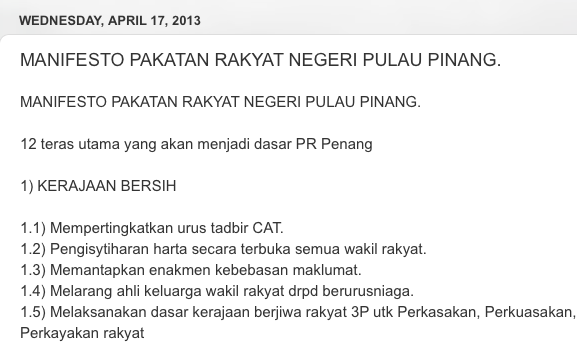
http://mansorothman.blogspot.my/2013/04/manifesto-pakatan-rakyat-negeri-pulau.html
In 2008, the DAP-led state government quickly introduced the principles of Competent, Accountability and Transparency (CAT) to the people of Penang. This was repeated in the manifesto for the 2013 General Elections as shows above. In the first bullet it stated that the administration of the CAT would be improved; all state assemblymen would be transparent and declare their assets; strengthen the freedom of information enactment; forbid family members of assemblymen from conducting businesses. What has been going on in real life has far digressed from the “clean government” manifesto.
The Penang state government is far from being competent, accountable and transparent. Its Chief Minister Lim Guan Eng was charged in court for two counts of corruption cum abuse of position; the only declaration of assets to the public was by Lim Guan Eng when he invited the press into his controversial bungalow on Jalan Pinhorn to show them that there is no swimming pool; according to FreedomInfo.org, a global network of freedom of information advocates, Penang’s Freedom of Information policy does not comply to international definitions and is restrictive; family members of Penang’s state assemblymen especially the office holders are found to be conducting businesses like nobody’s business. The latest involves Lim Kiat Seong, father of State Assemblyman Lim Siew Khim.
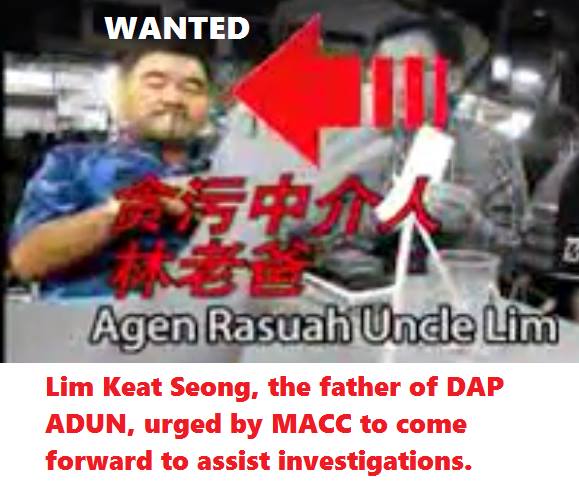
In a video that was made public by Penang Gerakan’s Oh Tong Keong, Kiat Seong, 68 years old was seen with a middleman and a complainant who argued that he had made a RM260 payment to bypass the Low-Cost Housing process but had yet to receive an offer letter.
In her defence, Lim Siew Khim who is also Wanita DAP Chief said that her father’s business has nothing to do with her, and that she has never heard anyone compaining about the issue in her constituency. She even claimed to not have any knowledge of the issue. I can only make the following deductions about Siew Khim:
- She never goes down to the ground to care about the grassroots;
- She does not care about the goings-on in her constituency;
- She does not think what her father did is wrong;
- She thinks the voters are stupid and would just accept her explanation at face value.
Lim Kiat Seong went missing immediately after the video was made public. The MACC later found him and arrested him, and after being grilled for five hours, led the MACC to two properties where documents related to the case were seized. Lim Siew Khim arrived at the MACC’s office on Jalan Northam at 10am for questioning.
Ironically, Lim Kiat Seong and Lim Kit Siang, father of charged-for-corruption Lim Guan Eng, share the same Chinese characters in their name (林吉祥). Lim Kiat Seong is how the name is pronounced in Hokkien while Lim Kit Siang is Southern Min Chinese!
DAP loves to point to the mistakes made by others, the Barisan Nasional in particular. It would go on and on about any issues brought forth that implicates anyone from the Barisan Nasional that they begin to sound like a broken heavy metal record that unfortunately repeats the shrieks instead of the strums. And the DAP has also chosen to not see that it has perhaps broken records for having the most number of corruption or corrupted-practices cases in slightly less than two terms.
I would be very amused if come GE14, the voters in Penang prove Lim Siew Khim’s Point Number Four right.
Sarawak Repost
Give enough rope and he will hang himself
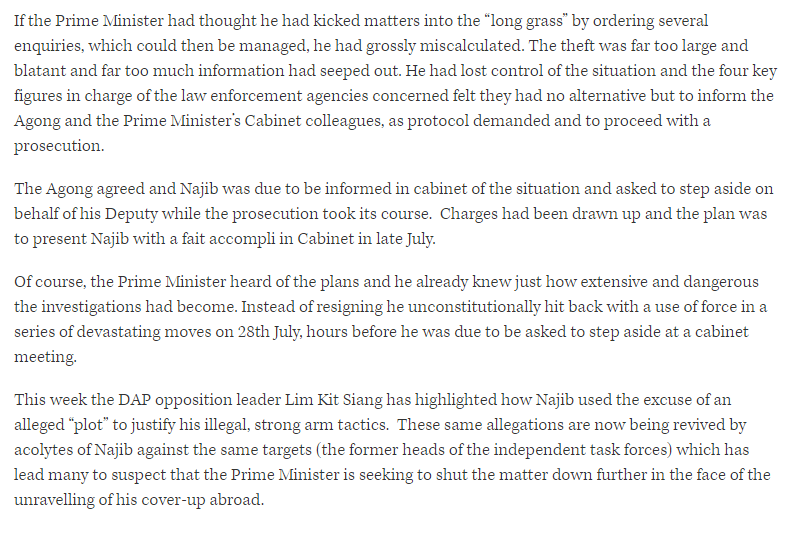
That is how the idiom goes. Muhyiddin was the first one to admit that there was a conspiracy to topple Najib Razak. Then recently Mahathir himself named the conspirators as former Governor of Bank Negara Zeti Aktar Aziz, former Attorney-General Gani Patail, and former head of the Malaysian Anti-Corruption Commission Abu Kassim. Mahathir’s favourite news portal Sarawak Report has now joined in and underscored the role of the three in trying to bring down Najib Razak. This time around, the Sarawak Report (SR) has gone overboard by including His Majesty The Yang DiPertuan Agong into the conspiracy.
The SR claims that by middle of 2015, all three conspirators agreed that Najib Razak had embezzled billions from public funds “not only to fund lavish frivolities for the PM and his wife and family, but also influence the outcome of a very tight election.”
First and foremost, the investigation into the 1MDB was far from over in the middle of 2015. A quick check of SPRM’s press statements archive found no such announcement being made. Furthermore, Najib Razak as the accused had not been called to give his statement regarding the 1MDB, and it was only in December 2015 that Najib Razak was summoned to do so. How a charge sheet was drafted before investigation was completed is beyond me. When investigations were completed and submitted to the 20-member Public Accounts Committee, the PAC released its findings on 7th April 2016 that there is absolutely no truth in billions having gone missing, and that the 1MDB issue is solely governance in nature. This findings was also agreed and signed by six Opposition members of the PAC including Tony Pua himself.
As for influencing a very tight election, the SR’s myopic reporting means that nothing is ever mentioned about journalist Nile Bowie’s report on the millions of USD channeled to the Opposition and/or Opposition-friendly organisations annually to fund activities that would destabilise the ruling government.The National Endowment for Democracy (NED) has channeled millions to beneficiaries such as SUARAM, BERSIH, Merdeka Center for Opinion Research through the National Democratic Institute for International Affairs (NDI) and the International Republican Institute (IRI). The IRI, said Nile Bowie, received $802,122 in 2010 to work with “state leaders in Penang and Selangor to provide them with public opinion research, training and other resources to enable them to be more effective representatives of their constituents”. IRI claims that it “does not provide direct funding to political parties” in Malaysia, but their lack of transparency, significant budget and emphasis on helping broaden the appeal of political parties in opposition-held states suggests at the very minimum that funding is taking place indirectly.
The SR also claims that Najib Razak is the sole shareholder and decision-maker in the 1MDB and the only man able to sign off investment decisions such as the Joint Ventures with Petrosaudi and Aabar,
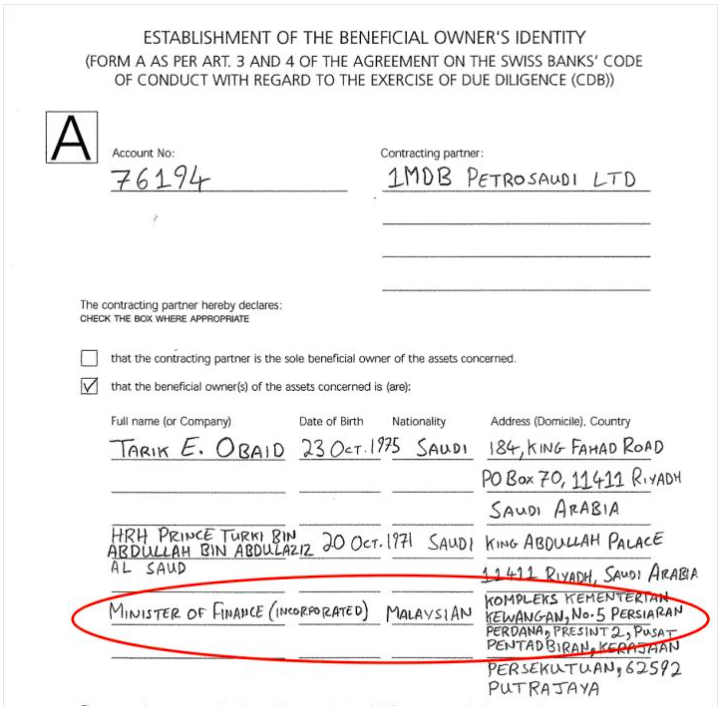
Perhaps, the SR does not know that the Minister of Finance (Incorporated) was passed in an Act of law in 1957 through the Minister of Finance (Incorporation) Act, 1957 that was revised under Mahathir Mohamad’s tenure in September 1987. Its objectives are to ensure sustained and continuous economic growth; to strengthen national competitiveness and economic resilience; to ensure effective and prudent financial management; to pursue a more equitable sharing of national wealth; and to improve quality of life and well being of society. It is headed by one Encik Asri of Bahagian Menteri Kewangan (Diperbadankan). And mind you, Najib Razak is not the only Minister of Finance. There is a dedicated Minister of Finance whose time is 100 percent there unlike Najib Razak. He is NOT a Deputy Minister, he is a FULL Finance Minister.
Of course, according to the SR, the conspirators then had no choice but to bring the matters to His Majesty Yang DiPertuan Agong, and the Yang DiPertuan Agong agreed that Najib Razak should step down “while prosecution took its course.” Like I mentioned above, how was it possible for prosecution to proceed when Najib Razak himself had not been questioned on his involvement by the very agencies claimed by SR to have decided to prosecute? Furthermore, what Constitutional powers does the Yang DiPertuan Agong have to tell Najib Razak to step down? Even Lim Guan Eng, already investigated and charged in court on two counts of corruption, has not left office to let prosecution take its course!
On the 28th July 2015, Gani Patail was removed as the Attorney-General and was replaced by Mohamed Apandi Ali. SR pointed that the act of removing the AG was unconstitutional. Allow me to go slightly deep into the Federal Constitution of Malaysia to comment on this claim.
The Federation of Malaya was born on 31st August 1957, adopting a new Constitution that replaced the Federated Malay States Constitution of 1948. During that time, the Attorney-General was Cecil Majella Sheridan, a practicing solicitor who joined the Colonial Legal Service to help reopen the courts in 1946 after World War Two. He was posted to Kelantan and Terengganu to become the States’ Legal Adviser and Deputy Public Prosecutor. In 1955, he became the Legal Draftsman for the Federation. Upon Indepence, Sheridan was made the Solicitor-General and subsequently the Attorney-General in 1959. Sheridan then began to prepare for the enlargement of Malaya into Malaysia (with the accession in 1963 of Singapore, Sabah and Sarawak). In the process, he worked closely with Tunku Abdul Rahman, Tun Razak, and Lee Kuan Yew, of Singapore.
During this time, Article 145 of the Federal Constitution was limited to five clauses only. Article 145(5) then provided that “the Attorney-General shall not be removed from office except on the like grounds and in the like manner as a judge of the Federal Court.” This Article was drafted by the Reid Commission and subsequently passed to be included in the Federal Constitution of 1957. A Government White Paper explained the need for Article 145(5):
“It is essential that , in discharging his duties, the Attorney-General should act in an impartial and quasi-judicial spirit. A clause has therefore been included to safeguard the Attorney-General’s position by providing that he shall not be removed from office except on the like grounds and in the like manner as a Judge of the Supreme Court.”
This is still maintained in Articles 105(3) for the Auditor-General and 125(3) for the Judges.
With the imminent formtion of the Federation of Malaysia, Sheridan amended Clause 5 of Article 145 and added Clause 6 to facilitate his eventual removal from the AG’s position. Article 145(6) of the Federation of Malaysia Constitution, 1963 reads:
“The person holding the office of the Attorney-General immediately prior to the coming into operation of this Article (note: specific reference to Sheridan) shall continue to hold the office on terms and conditions not less favourable than those applicable to him immediately before such coming into operation and shall not be removed from office except on the like grounds and the like manner as a judge of the Federal Court.”
And Clause 5 of the Article was changed to the following:
“Subject to Clause (6), the Attorney-General shall hold office during the pleasure of the Yang DiPertuan Agong and may at any time resign his office and, unless he is a member of the Cabinet, shall receive such remuneration as the Yang DiPertuan Agong may determine.”
Article 145 was amended for two reasons according to Sheridan’s successor, Abdul Cadir Yusoff: one is the desire to have “the most suitable person available for the performance of the onerous tasks” of the AG’s office regardless whether the person was from the pubic service or not, and secondly the impartiality of a political appointee could be assured by conferring on him “untrammelled constitutional discretion.” Bear in mind that Abdul Cadir was both a lawyer and a politician and could not have been appointed under the previous version of the Constitution. Nowhere in the Constitution, in its present form, requires for the formation of a tribunal to remove or replace an Attorney-General as applicable to the Auditor-General and Judges via Articles 105(3) and 125(3).
Therefore, Gani Patail’s removal was not unconstitutional.
I refuse to comment on the rest of the fairy tale that Clare Rewcastle Brown had conjured because she seemed excited plucking these stories from a very low sky that her nipples probably scrape the ground giving her that pleasure. Like the story about the fire that had occured at the Royal Malaysian Police Headquarters in Bukit Aman, as she claimed “destroyed evidence of money laundering” when the division that was investigating the 1MDB issue is housed in a different building in a different part of the Bukit Aman complex. Also on the murder of DPP Kevin Morais whom she said was the one who had drafted the charge against Najib Razak when the poor sod was confirmed by his own brother and by authorities not investigating 1MDB.
You can choose to believe Sarawak Report if you wish to. All Clare Rewcastle Brown does is to repost trash and expands on it, grabbing more invisible low hanging fruits while her nipples harden at being scraped against the asphalt. Must make her wet teling lies. But it’s funny how the white trash seem to have conveniently omitted Justo from the equation.
Nothing to hide? I don’t think so.
Purging Penang’s Peasants
“You tengoklah sekarang. Kalau you tak ada duit you cuma boleh tengok bukit. Kalau you kaya you boleh tengok laut. Bukan Melayu sahaja yang tak mampu. Cina pun ramai tak mampu!” (You look at it now. If you don’t have money you’d be looking at the hills. If you are rich you can see the sea. It isn’t just the Malays who cannot afford, but many of the Chinese too!)
The above are words said to me by a Penang Chinese during my last visit to Penang.
If you live or have lived in Penang like I did, you would know what the statement above is all about. My earliest memory of Penang is of my trip there in 1974. Several more visits followed and I finally lived there from 1989 until the end of 1991 when I worked at Jalan Azyze.
Penang has always been a melting pot of cultures because unlike the mainland Peninsular Malaysia, Penang (together with Melaka and Singapore) were true crown colonies, ruled by Britain through the Colonial Office in India. The composition has always been majority Chinese, followed by Malays and people of the Indian diaspora.
When I got married there weren’t many quarters for armed forces officers back then and rent rates were just too high for me (I was earning a basic of RM750 per month with RM115 as service allowance). My monthly housing allowance was RM400 while a terrace-house would have cost me RM800 a month. Initially I could only afford to live in a squatter house, which really was a shed attached to the back of a main house in what was Kampung Haji Mahmood in Tanjung Tokong and paid RM150 per month for that. It was literally a eat-where-you-sleep and shit-where-you-bathe house. I stayed there for half a year before moving to an apartment unit at the UDA apartments across the road. What I liked most about Tanjung Tokong were the stalls that lined up the coastal road. I used to hang out at a stall operated by a man named Murad and would fish across the road for Groupers. Yes, you could see the sea then and the proof of that is when the South Asian Tsunami (aka Boxing Day Tsunami) hit Penang in 2004, Tanjung Tokong was one of the places affected.
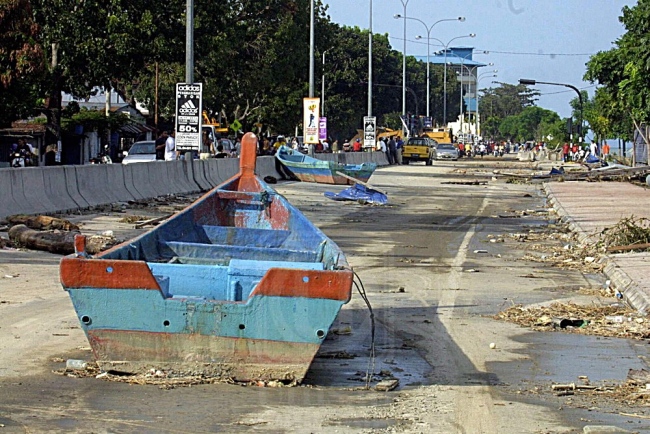


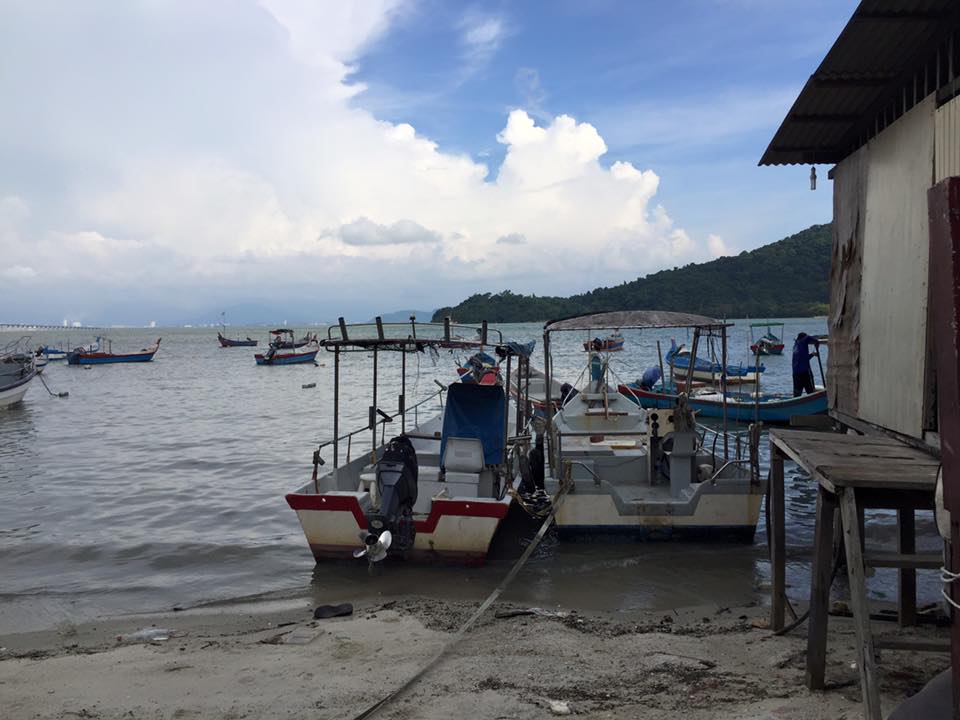
Shahrul Nizal Md Daud, 30, said there were times when he came home empty-handed. “I have a family to feed. I also need to pay for the house and car. “We were given only RM5,000 as compensation. How long can that last us?” Both fishermen said they had no clue as to the purpose of the reclamation, adding that more than 100 fishermen had been given until the end of the month to move out.
Read More : http://www.nst.com.my/news/2016/08/167306/fishermen-fear-their-livelihoods-some-may-call-it-quits


They become the homeless, the vagrants, the destitute.
When commenting on Tengku Adnan’s move to arrest the homeless and fine soup kitchens two years ago, Lim Guan Eng had this to say:
The truth is far from it. A quick walk around the KOMTAR building where Lim Guan Eng’s office is located, we found the following:

And NGOs tackling the issue of the homeless in Penang all say that there is no government shelter that is being provided for the down-and-out.
Penang is already inhabited by those who can afford to live there which translates into more financial support for the DAP government. The gentrification of Penang has helped those marginalised to move out of the island in search for more affordable housing and new jobs. Given that the Chief Minister has been charged in court for corruption and corrupted practices under Section 23 of the Anti-Corruption Act and Section 165 of the Penal Code, yet is still trying to create unnecessary projects in Penang, I don’t think he is interested in helping the Penang people. As in the words of Trevor D Richardson: “People used to make money, but somewhere along the way, it started making us.“
Being Magnanimous
Congratulations to Azizulhasni Awang, the Pocket Rocketman, for winning a bronze medal in the Kierin event at the Rio Velodrome recently. It is an achievement to be proud of.
However, he spoiled the celebration by making a statement, thanking the Terengganu Menteri Besar sarcastically for NOT rendering any assistance to him and his teammate in their preparations for the 2016 Olympics in Rio de Janeiro.

Several questions here: why send such proposal to Ahmad Razif and not Datuk Rozi Mamat who is the Terengganu Executive Councillor for Youth, Sports and Human Resources? Did Azizul’s manager call the Menteri Besar personally? To whom was the proposal handed over to and was it by mail or by hand?
Azizul is not without controversy. He was almost expelled from the 2014 Commonwealth Games in Glasgow for making a political statement in support for Gaza.

“It’s inappropriate for any form of protest in a Games venue – we respect everyone’s right to protest out-with. He has had a strong reprimand from his team management and he has apologised. In apologising profusely he now knows any repetition will see a removal of his accreditation,” said Mike Hooper, chief executive of the Commonwealth Games Federation.
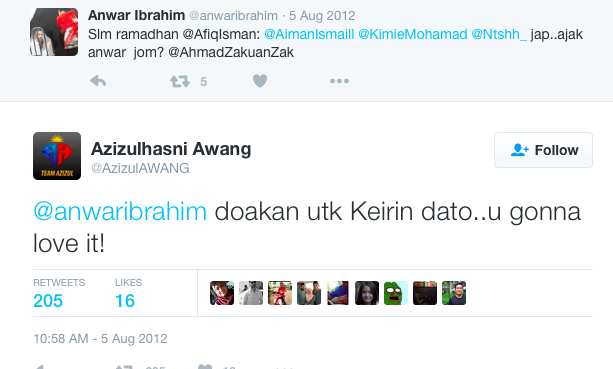
Azizul loves to do things without giving a thought first. Those who know of his political leaning would also remember this tweet that was not a reply to a topic, but a reply to actually start a conversation with a certain politician asking the latter to pray for his success, while other sportsmen and women showed political neutrality as they were there representing Malaysians irrespective of political beliefs and creed:

Najib Razak has always been magnanimous. Why am I including him in this post? If you remember the campaign by Mahathir to oust Najib started in the second half of 2014. Since then Mahathirs goalpost has changed so many times that I have lost count. This includes the inclusion of the Altantuya case by Mahathir in May 2015 when Najib didn’t flinch, and sending out his pariahs to lodge reports overseas in order to put the Premier in a bad light.
When things really seemed bleak for Najib, I asked some of his close associates why hasn’t the PM hit back at Mahathir? Apparently, they asked this question to Najib but he replied saying that the last thing he would want people to see is hi being rude to an elderly figure – and that is VERY un-Asian, let alone not-Malay. Najib’s magnanimity crosses political boundaries and has been seen on occasions taking time to visit opposition leaders who fell ill, and although he was in Turkey when the late Karpal Singh passed away, Najib made a blog entry dedicated to Karpal – in spite of being called a murderer in Parliament by Karpal Singh’s Gobind Singh Deo, and allegation that is baseless and has been proven in a court of law that Najib is not linked to the case in any way. Not once would you hear harsh words being directed towards anyone, including to his detractors.
You would go far being magnanimous, especially when your name is big enough for people to remember. In contrast to Azizulhasni’s uncalled for outburst, Joseph Schooling participated in the Olympics, beat the reigning champion to win the Gold, without a single help from the Singapore government. Yet, when Prime Minister Lee Hsien Loong asked for permission for a selfie to be taken with him, Schooling obliged and was gracious about it.

I hope the Menteri Besar of Terengganu would investigate thoroughly Azizulhasni’s allegations and make public the findings. And I also hope that the state would assist him with his road bike, using state funds. And as pointed out by Dr Aznil Hisham, if Azizulhasni does not improve and get a Silver in the next Olympics, be prepared to be criticised and eat the humble pie for having used taxpayers’ money but fail to give something back in return. Furthermore, he received RM2.85 million from the Sime Darby Foundation before he went to Rio de Janeiro and will be receiving another RM100,000 from SDF as a reward for his achievement at Rio.
Now, how many RM12,000 road bikes do you think Azizul could have bought before going to Rio with RM2.85 million?
Now, tell me if his outburst on Facebook is justifiable?

Au·thor·i·tar·i·an

Former Sabah Chief Minister Tan Sri Joseph Pairin Kitingan knows very well what Mahathir would do to those he hates. He experienced that first hand in 1990 when Mahathir went all out to try depose him as Chief Minister. Pairin was Chief Minister of Sabah from 1984 to 1995.
Speaking to reporters after receiving a courtesy visit from the Kadazandusun Cultural Association Youth Council yesterday Pairin said that when Mahathir is a ‘political animal’ who, when he does not like a person, would go all out (to get the person out of his way).
Therefore, it comes as no surprise to Pairin when Mahathir would form a new party and work with his enemies just to try force Najib Razak out of office.
In politics, anything goes – wrote Awang Selamat, a pseudonym used for Utusan Malaysia’s editorials. And that includes trying to erase his dark past by working with DAP’s Lim Kit Siang whom he had put behind bars without trial during his tenure. It was Mahathir whom had planted the idea that DAP is nothing less than the enemies of the Malays and what Malaysia stands for, in the mind of the Malay masses. Equally disgusting is Lim Kit Siang whom had spent most of his life in DAP slandering Mahathir as being the most corrupted dictator, now seen being in the same bed with Mahathir.
Another person who would know Mahathir well is Tan Sri Musa Hitam, who was Mahathir’s deputy from 1981 to 1986. While he described Mahathir as “observant, innovative, and meticulous” he also used the words “authoritarian, contemptuous, and belligerent”.
In an article by The Star, Musa said Dr Mahathir could be pleasant and engaging at times, but would often come off as being disinterested in dialogue or debate.
“Discussion and debate were never the order of the day,” he wrote in his book ‘Frankly Speaking’ which was recently launched by His Royal Highness the Sultan of Perak.

In his book Musa wrote:
“Malaysia today is going through a difficult transition. Trying to establish a mature democracy after more than two decades of authoritarian rule is not easy. Moreover, there is no guarantee that the current, more open political system will continue. Malaysia would, in fact, find itself gripped by reactionary forces that even now are advocating policies and practices that – if adopted – would eventually result in the country becoming a failed state.”
This was echoed by the former Grand Mufti of Jordan, Professor Dr Amin Mohammad Sallam al-Manasyeh in an interview with the portal MalaysiaGazette. “I am of the opinion that if Allah gives him (Najib) time, he will continue to develop and position Malaysia as the best country in the world. That’s what I think about him,” he said in the interview.
I, too, had doubts about Najib Razak’s ability to do well as the leader of this country. Up until April of 2015 at least, I and like-minded friends did not think that he would last in the face of relentless acrid attacks by Mahathir. By May, Mahathir faltered and changed goalposts several times while Najib Razak stood firm, unwilling to budge even a bit. Most of us saw that the light shone by Najib in the tunnel of lies made by his detractors is far brighter than the one shone by Mahathir. And this year, Mahathir received multiple slaps first in the form of the resignation of his son Mukhriz as the Menteri Besar after being told by the Council of Regent of Kedah that he had lost majority support of the State Assembly. This was followed by his own resignation from UMNO. Then came the hattrick wins in Sarawak, Sungai Besar and Kuala Kangsar elections where, despite Mahathir’s claims, Barisan Nasional still won. And then he was conned by his own people for faking more than half a million signatures of people reportedly in support of his ‘Save Malaysia’ declaration.

One would think that at 91, Mahathir would take it slow and call it a day. Well, that is not Mahathir. In the end he sets up another political party called Parti Pribumi Bersatu Malaysia (BERSATU) where Najib’s former deputy Muhyiddin Yassin becomes the pro-tem President, and his son Mukhriz the pro-tem Treasurer. And where is Mahathir in this party? He positions himself as Lim Kit Siang has – the Puppet Master. Despite being a political giant, Muhyiddin has all but lost support in Pagoh and Muar. Many Johoreans still remember him for his sins committed against the Malays. He would now have to find another seat to contest in. Otherwise his political career is as good as over.
Admitted to the National Heart Institute for medical complications the day his party’s registration form was submitted to the Registrar of Societies, Mahathir’s first act upon being ill was to post a blog article attacking Najib, not taking care of his health or coming to a realisation that his days as a mortal are numbered, and that instead of creating more sins, he should repent. No, things like that never seem important to Mahathir. And neither would the parasites who call themselves “his advisers” advise the old man to slow down. Instead, they feed his anger, and he in turn feeds them for making him angry. And Mahathir should remember that whenever he, the authoritarian, gets angry, he loses support. Zuraidah Ibrahim aptly puts it in the South China Morning Post:
Instead of departing on his terms, as he did in 2003, he may now find himself leaving the scene a loser.
For Najib Razak, it is business as usual. As in the old adage wrongly attributed to Thomas Jefferson:
In matters of style, swim with the current; in matters of principle, stand like a rock.
And like a rock does he stand.
 SeaDemon Says
You must be logged in to post a comment.