Reformasi Untuk Mahathir

Mahathir’s return to politics in 1973 was watched closely by other races, in particular the Chinese and Indians.  His meteoric rise to the Deputy Prime Minister’s post in 1976 was of grave concern by many.  His imminent Premiership caused a large number of migration by Malaysian Chinese.  Despite the economic growth in the late 1980s through 1997, some 42,000 Malaysian Chinese opted to work elsewhere.  This number includes some 14,000 Malaysian Chinese who were working illegally in Japan in 1993 (Shimada, 1994).

If citizenship is conferred on races other than the Malays, it is because the Malays consent to this,” wrote Mahathir in his book ‘The Malay Dilemma‘.

“The Chinese and Indians coming from countries with vast populations are less concerned about good behavior and manners. In their lives, nobility, which is always associated with breeding, was totally absent. Age and riches are the only things they defer to,” he added.

Calling for reforms such as the mandatory use of tamper-proof scales, Mahathir wrote of scales that can be used to shortchange customers and said, ”The small-time Chinese retailer is adept at this practice and unscrupulous enough to use it as a weapon in competition.”

Mahathir was the ultra-Malay to many including the Malays themselves.  Fears of race clashes haunted the voters during the run-up to the 1982 General Elections.  I remember being sent to Mimaland in Gombak with Datuk Latt Shariman (President, E-Sports Malaysia) on polling day in case something bad happens.  It was the first General Elections under Mahathir and it was called more than a year before the then-mandate ended.  Public rallies were banned citing ‘security’ reasons and only indoor gatherings and house-to-house canvassing were allowed (Lim Kit Siang, 22 March 1982).

Even though Malaysia’s economic growth peaked at 8 percent in the mid 1990s, it was mired in scandals involving the practice of cronyism and nepotism.  Lim Kit Siang wrote that Mirzan, Mokhzani and Mukhriz Mahathir – acted as companies’ directors, and that according to searches the DAP had made at the Registry of Companies at the end of 1994, Mirzan had interests in 98 companies, Mokhzani in 48 companies and Mukhriz in 67 companies (Lim Kit Siang, 16 June 1998).  Compared to the 213 companies his sons were directors in back in 1994, 488 is the number of companies Mahathir, daughter and sons are directors in as at end of 2016 (Wakeup Malaya, 6 January 2017).

The calls for Mahathir to resign in 1998 for practising nepotism and cronyism culminated in the sacking of Anwar Ibrahim as his deputy in September of the same year, accusing the latter not only of being a tool for George Soros’s attacks on the country’s financial system but also for leading a morally-corrupted life.  Lim Kit Siang and other Opposition leaders were quick to embrace Anwar, acccepting him into their fold when it was just a year earlier that the late Karpal Singh had made mention of allegations of sexual misconducts against Anwar in a Parliamentary sitting – a scene not much different to Lim Kit Siang’s immediate acceptance of Mahathir after decades of mudslinging the latter.
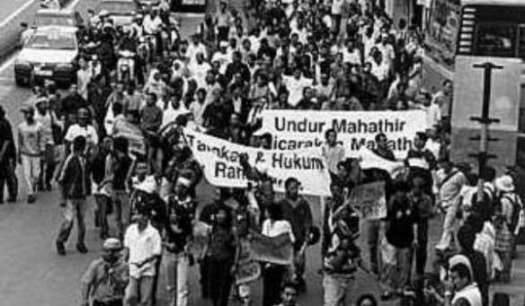
20161218-reformasi-1998-undur-mahathir

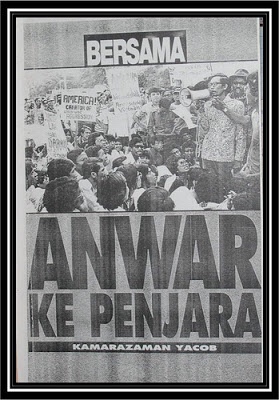
Anti-Mahathir demonstrations were held almost daily and then held every Friday afternoon at the National Mosque.  These demonstrations were quelled using brute force.  The ‘Reformasi’ movement was born, and the likes of theatre-practitioners such as Jo Kukathas were seen on the streets and interviewed by Maria Ressa saying “Enough is Enough” to Mahathir.  Anwar and several other pro-Reformasi and UMNO leaders critical of Mahathir were arrested without trial under the ISA including current DPM Ahmad Zahid Hamidi.

Parti Keadilan Rakyat, then known by its acronym ADIL, was born out of hatred towards Mahathir, with the aim of toppling him and installing Anwar Ibrahim.  The 1999 General Elections saw how Mahathir suffered a pyrrhic victory, losing grounds in Kelantan and his homestate of Kedah, while losing Terengganu to PAS.  Mahathir-loyalists such as Ramli Ngah Talib, Megat Junid Megat Ayub and Sanusi Junid lost their seats.  That was the beginning of the sounding of the death knell for Mahathir’s virtually unchallenged reign.  During the UMNO General Assembly of 2002, he announced his resignation from party posts as well as Malaysia’s Prime Minister.

Ever since then, with the more open administrations of Pak Lah and Najib Razak, Mahathir became one of the targets of the Opposition in their blog posts, press statements as well as ceramahs.

In June 2012, Mahathir’s newly-made best friend even suggested that Mahathir is tried for his part in the BNM Forex scandal, hinting Egyptian Hosni Mubarak’s imprisonment as a comparison (Lim Kit Siang, 3 June 2012).

Screen Shot 2018-01-09 at 14.13.11

But all is forgotten and forgiven now, even when Mahathir admitted that his apology was only customary and not sincere.  Despite veiled objections from Anwar and Azmin Ali’s camp, Mahathir was named at a Pakatan convention as their Prime Minister of choice albeit interim.   This underscores the fact that the leadership of Pakatans parties do not trust the younger generation to lead the coalition as the position of the elders and powers that come with the position, may be undermined by the younger ones.

The signal of dissent is clear.  Azmin only attended the convention for a while, not waiting for the announcement to be made while Karpal Singh’s daughter, Sangeet Kaur Deo,  has hit out at Pakatan which probably is suffering from a dearth of capable young leaders.  Even Mahathir once quipped that Anwar, who is 22 years his junior, may be too old to become a Prime Minister.
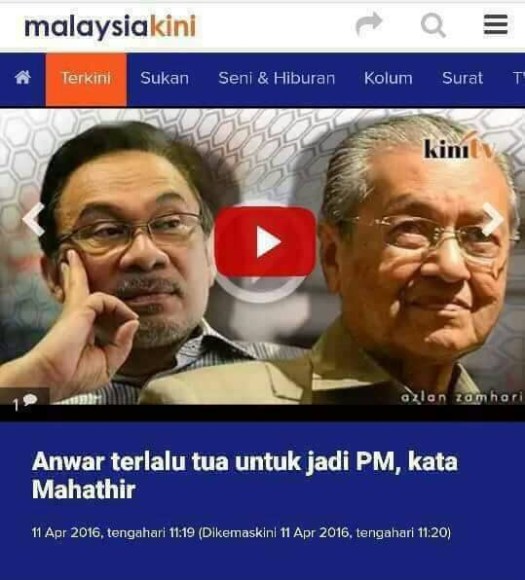
img_5213

On Facebook, we are seeing people in their 40s and 50s voicing out their concern over Pakatan’s choice of Prime Minister, alarmed that the monster they have put behind them, could very well jump out from underneath the bed and into their lives again.
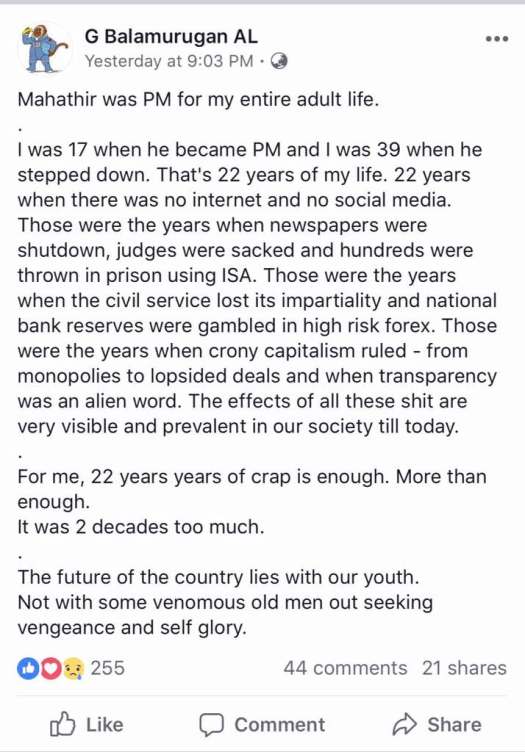
WhatsApp Image 2018-01-09 at 11.38.33

But it does not stop Mahathir from wanting to become the Prime Minister.  He once hinted that he may have to consider becoming the PM again, underscoring the fact that he does not trust anyone else.

img_6975
“I may be 93 but at 71 Anwar is much older!”

Wan Azizah may be blind to the fact that Mahathir had once denied the Premiership to her husband and went as far as making sure Anwar went to jail to keep him out of the way, while Lim Kit Siang is only friends with Mahathir because he needs the Malay votes to ensure Pakatan’s seats are sustained after the departure of PAS from the now-defunct Pakatan Rakyat.

Will Mahathir be willing to step aside for Anwar Ibrahim or whoever else younger who would be more acceptable to the younger and middle-aged generation aware of his antics?  I doubt.  But as Sangeet mentioned above, it will be a return to Mahathirism, an era of abuse of power, cronyism and nepotism that the Reformasi movement was totally against.

Somehow, it seems that the Reformasi movement has become a tool for what it was totally against – ushering Mahathir into the premiership and welcoming again abuse of pwer, nepotism and cronyism.
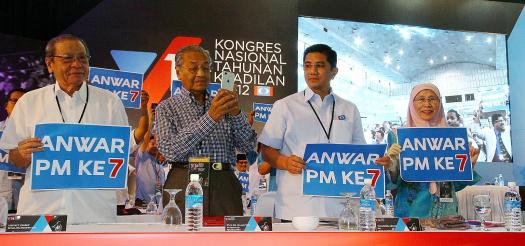
ST_20170522_NRPKR22_3156926
Anwar is NOT going to be MY PM


Drama Kera La (Versi BM)

IMG_4539
Seekor beruk bermain dengan sekuntum Bunga Raya (Gambar Hiasan)

Baru-baru ini ditularkan di dalam Facebook dan WhatsApp sebuah video mengenai cara negara China memperluaskan penguasaannya dengan menggunakan kekuatan ekonomi.  Video tersebut membandingkan usahasama China-Sri Lanka di pelabuhan laut dalam Hambantota dengan usahasama-usahasama yang dijalankan di Malaysia, membuktikan bahawa Malaysia juga boleh berakhir bukan sahaja menjadi sebuah negara yang dibelenggu masalah hutang yang besar, tetapi juga bakal hilang pegangan ke atas aset-aset tersebut.

Secara kasar, berhutang keada China dengan sebegitu banyak untuk projek-projek tersebut adalah amat menakutkan, terutamanya untuk mereka yang tidak mendapat gambaran penuh.  Namun, membandingkan Malaysia dengan Sri Lanka bukanlah suatu perkara yang bijak.

Pelabuhan laut dalam Hambantota terletak di dalam kawasan bekas Presiden Sri Lanka iaitu Mahinda Rajapaksa dan kos pembinaannya adalah lebih dari $1 billion.  Sebuah lagi projek yang dibina di dalam kawasan Mahinda ialah Lapangan terbang Mattala Rajapaksa yang terletak 30 kilometer dari pelabuhan tersebut.  Sehingga kini, lapangan terbang tersebut digunakan oleh hanya beberapa ratus orang seminggu hinggakan ianya diberi gelaran “lapangan terbang paling sunyi di dunia.”

Hambantota ialah sebuah wilayah yang terpencil di Selatan Sri Lanka.  Jaraknya dengan bandar yang paing hampir iaitu Galle ialah 130 kilometer, manakala jaraknya dengan ibu negara Sri Lanka iaitu Colombo ialah 240 kilometer.  Jumlah penduduknya hanyalah sekitar 12,000 orang dan ianya merupakan sebuah wilayah yang tersisih dari sebarang pembangunan.  Masalah pelabuhan laut dalam Hambantota ialah kedalaman airnya yang tidak mencukupi untuk kapal-kapal dagang yang besar untuk masuk ke pelabuhan tersebut.  Maka, ianya tidak menjadi suatu destinasi bagi syarikat-syarikat perkapalan besar.  Tiada siapa yang ingin berpindah ke sana kerana ianya berada terlalu jauh dari pembangunan.  Ini menyebabkan kedua-dua pelabuhan dan lapangan terbang tidak dapat menjana pendapatan untuk menampung kos operasinya sendiri, apatah lagi untuk membayar pinjaman yang telah diterima daripada China.

Jumlah hutang yang ditanggung oleh Sri Lanka ialah hampir $65 billion.  Dari jumlah tersebut, $8 billion adalah hutang kepada China.  KDNKnya (Keluaran Dalam Negara Kasar) ialah sebanyak $81.32 billion.  Kadar hutang kepada KDNKnya pula ialah 75 peratus manakala rizab matawang asingnya ialah $7.2 billion.  Kerajaan Sri Lanka menggunakan 95.4 peratus pendapatannya untuk membayar hutang.  Inilah sebab-sebab Sri Lanka mengambil jalan untuk melangsaikan hutang-hutangnya untuk kedua-dua projek tersebut dengan cara menyerahkan pegangan kepada negara pemiutang (China).

Bandingkan apa yang terjadi dengan projek ECRL yang bernilai $13.1 billion (RM55 bilion).  Malaysia mengambil pinjaman sebanyak $11.14 billion (85 peratus dari kos keseluruhan projek atau RM46.75 billion) dari China manakala selebihnya dibiayai melalui program sukuk yang dikendalikan oleh institusi-institusi kewangan tempatan.

Projek Forest City di negeri Johor pula merupakan sebuah program pembangunan bernilai $100 billion selama 20 tahun.  Walaupun jumlah yang diperuntukkan bagi setiap fasa projek tersebut adalah merupakan maklumat sulit syarikat yang membangunkan projek tersebut, ianya dianggarkan sekitar $5 billion setahun.  Projek tersebut telah bermula pada tahun 2015 dan sehingga kini 11 peratus telah dilaksanakan.  Pada akhir bulan Disember 2016, Forest City berjaya membuat penjualan 17,000 unit apartmen bernilai $2.9 billion.  Tempoh pembangunan projek tersebut masih berbaki 17 tahun lagi.

KDNK Malaysia kini berjumlah $320.25 billion (RM1.3 trillion) untuk tahun 2017.  Ini menjadikan kos projek ECRL pada kadar 4.1 peratus dari KDNK manakala projek Forest City pada kadar 1.6 peratus setahun.  Jumah hutang keseluruhan negara ialah sebanyak RM685.1 billion atau 50.9 peratus dari KDNK.  Dari jumlah ini, RM662.4 billion adalah hutang dalam negara manakala hanya RM22.7 billion merupakan hutang luar pesisir pantai.

Yang menariknya, setakat bulan Oktober 2017, hutang Amerika Syarikat kepada China berjumah $1.2 trillion, iaitu 19 peratus dari sejumlah $6.3 trillion dalam bentuk bil-bil Perbendaharaan, wang, dan bon-bon yang dipegang oleh negara-negara luar.  KDNK AS pada tahun 2016 adalah sebanyak $18.57 trillion dan ini menjadikan kadar hutang AS kepada China berbanding KDNKnya sebanyak 6.5 peratus.

Sudah tentu kita boleh membiayai projek-projek di atas tanpa mengambil sebarang pinjaman.  Rizab matawang asing kita berjumlah RM414.71 billion ($102.17 billion), lebih dari mencukupi untuk pembiayaan kedua-dua projek tersebut.Jika kita gunakan kaedah di zaman Tun Mahathir, Petronas mempunyai pegangan tunai sebanyak RM129 billion ($31.8 billion) manakala KWSP mempunyai aset-aset yang bernilai $771 billion ($189.9 billion).  Ini tidak termasuk pegangan tunai dan aset-aset kepunyaan Khazanah, Tabung Haji, KWAP, SOCSO, PNB dan lain-lain institusi kerajaan.

Sekiranya kadar hutang kepada KDNK sebanyak 50.9 peratus merisaukan anda, ianya pernah berada pada kadar 103.4 peratus semasa Mahathir merupakan Perdana Menteri pada tahun 1985.  Dan suatu jumlah bersamaan dengan 24 peratus KDNK juga telah hilang dalam skandal Forex BNM pada tahun 1991 iaitu semasa Mahathir masih lagi Perdana Menteri Malaysia.  24 peratus daripada KDNK sekiranya ia berlaku sekarang bersamaan dengan hilangnya RM315 billion dari RM1.3 trillion.  Sebagai perbandingan, kadar hutang kepada KDNK Singapura ialah 112 peratus dan negara tersebut berada di tangga ke-10 dari 17 negara yang mempunyai kadar hutang berbanding KDNK paling tinggi di dunia yang disenaraikan oleh Business Insider, UK.  Jepun menduduki tempat pertama dengan kadar 239.2 peratus!

Kita tidak jatuh bankrap semasa zaman Mahathir jadi mengapa perlu kita takutkan kadar hutang berbanding KDNK sebanyak 50.9 peratus bila asas ekonomi kita jauh lebih kukuh sekarang berbanding 103.4 peratus semasa asas kita lemah?  Jepun dan Singapura juga tidak jatuh bankrap.

Dan apa masalahnya dengan pemilikan tanah Forest City?  Tanah tersebut adalah merupakan tanah yang ditambak di tengah laut.  Ini bermakna tiada tanah yang “diberikan kepada China.”  Johor mempunyai hak ke atas tanah yang ditambak tersebut berdasarkan Kanun Tanah Negara, 1965 dan selagi ianya berada dalam lingkungan tiga batu nautika mengikut Seksyen 3(3) Akta Laut Wilayah, 2012.  Sama ada ianya merupakan pegangan bebas mahupun pegangan pajakan, Johor mempunyai hak untuk mengambil semula tanah tersebut di bawah Akta Pengambilan Tanah, 1960.  Mana-mana tanah sehingga 12 batu nautika dari sisir pantai adalah hak milik negara.

Namun Mahathir lebih suka memilih jalan dengan menggembar-gemburkan cerita untuk menakut-nakutkan rakyat.  Dalam ucapan beliau baru-baru ini, beliau berkata, “Habislah tanah kita akan dijual, tidak kiralah Forest City, saya harap Forest City akan betul-betul jadi ‘forest’ (hutan)…penduduknya akan terdiri daripada kera, monyet dan sebagainya.

Taman Perindustrian Malaysia-China Kuantan (MCKIP) dibangunkan oleh MCKIP Sdn Bhd (MCKIPSB) yang merupakan sebuah syarikat usahasama 51:49 di antara sebuah konsortium Malaysia dan sebuah konsortium China.  Pegangan dalam Konsortium Malaysia pula terdiri dari IJM (40 peratus), Sime Darby Property (30 peratus) dan Kerajaan Negeri Pahang (30 peratus).  Taman perindustrian kembarnya iaitu Taman Perindustrian China-Malaysia Qinzhou (CMQIP) di negera China pula dipegang oleh sebuah konsortium Malaysia (SP Setia Berhad dan Rimbunan Hijau Group) sebanyak 49 peratus.

Mengikut logik Mahathir, bukankah China telah memberi peluang kepada Malaysia untuk menjajah negaranya?  Sebelum ini China juga telah membenarkan Singapura menjajahnya di dua kawasan iaitu di Taman Perindustrian China-Singapore Suzhou dan juga di Bandaraya Eko China-Singapore Tianjin.

Walaupun keadaan di Sri Lanka nampak suram, Jepun, Singapura dan India telah menyatakan hasrat untuk membina infrastruktur dan mendirikan perniagaan di Sri Lanka.  Walaupun Sri Lanka mempunyai asas ekonomi yang lemah, Lolitha Abeysinghe dari Opportunity Sri Lanka kekal optimistik.

Pergantungan berlebihan terhadap mana-mana negara untuk pelaburan, teknologi dan pasaran boleh memberi kesan buruk terhadap kepentingan negara dalam jangka panjang, tetapi sekiranya diurus dengan betul dan dengan wawasan yang jauh, Sri Lanka boleh mengurangkan masalah tersebut dan mendapat manfaat terbaik untuk ekonomi luar bandar domestik di dalam sebuah dari wilayah-wilayah terpinggir di Sri Lanka,” katanya.

Malaysia mempunyai wawasan tersebut tetapi malangnya sesetengah orang lebih gemar sekiranya Malaysia gagal hanya kerana kepentingan politik. Politik cara kera dan monyet.

Drama Kera La

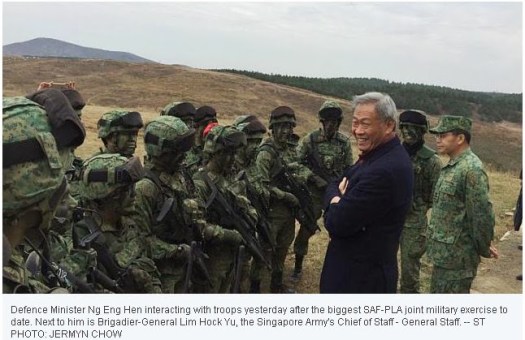
ST photo -SAF-PLA joint military exercise
Singapore Army invading China?

Recently, a video clip of how China is fulfilling its hegemonic ambitions using economic means was spread around especially in Facebook and WhatsApp groups.  The video compares the Sino-Sri Lankan joint-venture at the Hambantota Deep Water Port with the ones in Malaysia, proving that Malaysia, like Sri Lanka, could end up not only with a huge debt owing to China, but also lose its ownership of those assets.

On the surface, it sounds scary to have so much money owed to China for these projects especially so for the ill-informed.  But comparing Malaysia to Sri Lanka hardly does any justice.

The Hambantota Deep Water Port lies within the constituency of the former President Mahinda Rajapaksa and costs more than $1 billion to construct.  Another project that was constructed in this constituency is the Mattala Rajapaksa Airport, located 30 kilometres away from the port, which until now flies only a few hundred passengers in and out weekly and has been dubbed “the world’s loneliest airport.”

Hambantota is a remote region in the South, 240 kilometres from Colombo and the nearest city, Galle, is 130 kilometres away.  The population of Hambantota is around 12,000 people and is very underdeveloped.  The problem with Hambantota’s deep-water port is that its waters are not deep enough for large vessels with deep draught, so large shipping companies shy away from it.  It is far from any development that hardly anyone wants to move there.  Both the port and the airport cannot generate enough income to sustain operations let alone pay back loans to the Chinese.

Sri Lanka owes its financiers close to $65 billion and of this, $8 billion alone is owed to the Chinese.  Its GDP stands at $81.32 billion, debt-to-GDP ratio stands at roughly 75 percent while its foreign currency reserves is at $7.2 billion.  The Sri Lankan government uses 95.4 percent of its revenue to repay debts.  These are the reasons for Sri Lanka to opt for a debt-for-equity solution for both projects.

Compare this with Malaysia’s $13.1 billion East Coast Rail Link, or RM55 billion in Malaysian terms.  Malaysia took a $11.14 billion loan (85 percent or RM46.75 billion) from China to finance the project while the balance is in the form of a sukuk programme managed by local financial institutions.

The Forest City project in Johor is a development programme that runs over 20 years.  How much is being allocated per project is a company confidential information but if we go by average, it would be at $5 billion per annum, with a total of $100 billion over 20 years.  The project commenced in 2015 and to date has completed about 11 percent.  At the end of December 2016, Forest City saw concluded contracted sales of $2.9 billion for 17,000 apartment units.  It still has another 17 years of development to go.

Our GDP now stands at around $320.25 billion (RM1.3 trillion) for 2017 which puts the cost of the ECRL project at 4.1 percent of the GDP while Forest City accounts to approximately 1.6 percent of the GDP per annum.  The total Government debt as at end of June 2017 was reported to be at RM685.1 billion or 50.9 percent of the GDP.  Of this total, RM662.4 billion was domestic debt while RM22.7 billion was offshore loans.

Interestingly, as of October 2017, the US debt to China is at $1.2 trillion, which is 19 percent of the $6.3 trillion in US Treasury bills, notes and bonds held by foreign countries.  The US GDP in 2016 was $18.57 trillion which makes its China-debt-to-GDP alone at 6.5 percent.

Of course, we could undertake to pay for all the above projects.  Our foreign currency exchange reserves are at RM414.71 billion ($102.17 billion) which is more than enough to pay for both projects.  If we use the Mahathir-era method, then Petronas has RM129 billion in cash ($31.8 billion) while the EPF has RM771 billion ($189.9 billion) worth of assets.  This does not include sources from other funds such as Khazanah, Tabung Haji, KWAP, SOCSO, PNB and others.

If our debt-to-GDP ratio of 50.9 percent is still a scary number to you, it was at 103.4 percent when Mahathir was the Prime Minister in 1985!  And an equivalent to 24 percent of the GDP went missing as a resut of the BNM Forex scandal also during his tenure as the PM in 1991!  That is RM315 billion if our GDP is RM1.3 trillion!  In contrast, Singapore’s debt-to-GDP ratio is 112 percent at tenth place out of 17 nations with the highest debt-to-GDP rate listed by Business Insider, UK.  Japan is first at 239.2 percent.

Still, we did not go bankrupt back then. So why should we fear a 50.9 percent debt-to-GDP ratio with much stronger economic fundamentals when we have reached 103.4 percent with a much weaker economy? And neither Singapore nor Japan has gone bankrupt.

And what is with the ownership of the land where Forest City is situated?  It is a reclaimed land; therefore, no part of mainland Johor was carved out to be “given to the Chinese.”  Johor has rights over the reclaimed land as accorded by the National Land Code, 1965 up to three nautical miles as given by Section 3(3) of the Territorial Sea Act, 2012.  Whether it is a freehold land or a leasehold land, Johor can always take it back, with provisions, under the Land Acquisition Act, 1960. Up to 12 nautical miles from the foreshore, the Malaysian flag flies no matter who holds the grant.

Mahathir recently said “I hope Forest City will truly become a forest… Its residents will consist of baboons (kera), monkeys (monyet) and so on”, fuelling unjustified fears among the people of Malaysia.

The Malaysia-China Kuantan Industrial Park (MCKIP) has MCKIP Sdn Bhd (MCKIPSB) as its Master Developer.  MCKIPSB is a 51:49 joint-venture between a Malaysian consortium and a China consortium.  In the Malaysian portion of the shareholding, IJM land holds 40 percent, Sime Darby Property 30 percent and the Pahang State Government holds the remaining 30 percent. Its twin sister, the China-Malaysia Qinzhou Industrial Park (CMQIP) in China is 49 percent owned by a Malaysian consortium (SP Setia Berhad and Rimbunan Hijau Group).

Going by Tun Dr Mahathir’s logic, has China just allowed Malaysia to colonise its land too?  Prior to this it allowed Singapore to colonise in two other areas, namely the China-Singapore Suzhou Industrial Park and the China-Singapore Tianjin Eco City.

As bleak as Sri Lanka may sound, Japan, Singapore and India have expressed interest in building infrastructure and setting up shop in Sri Lanka.  Even with much weaker economic fundamentals compared to Malaysia, Lolitha Abeysinghe of Opportunity Sri Lanka remains optimistic.

Over-dependence on any country for investments, technology, and markets could result in some adverse impacts on national interest in the long-run, but if managed properly with a futuristic vision, Sri Lanka can mitigate such adversity and reap the best benefits for the rural domestic economy in one of the least developed districts in Sri Lanka,” he said.

Malaysia has that vision but sadly some of its people would rather see everything fail in the name of politics.  The politics of baboons and monkeys.


DAP Benefitted From Military Camps

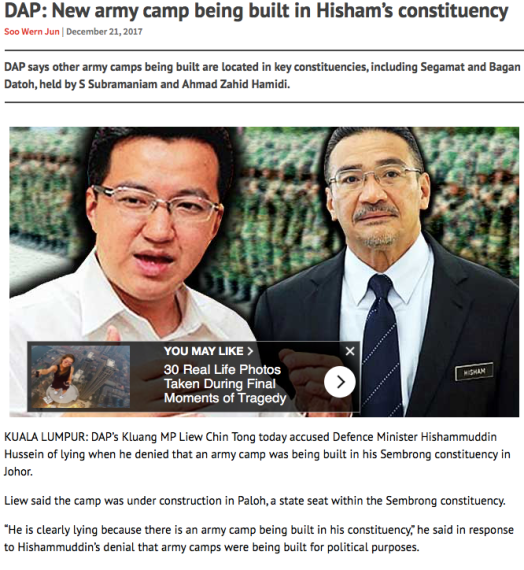
Screen Shot 2017-12-25 at 23.48.38

Recently Kluang Member of Parliament Liew Chin Tong slammed Minister of Defence Hishammuddin Hussein for denying that an army camp was being built in Paloh, a state seat in the latter’s constituency of Sembrong.  Liew Chin Tong implied that the army camp is being built for political purposes.

“This proves that Barisan Nasional (BN) is using these army camps to increase voters in constituencies that it won with thin majorities in the 13th general election,” Liew told a press conference last week.

He said the inclusion of the army personnel in Paloh would increase the electorate by over 1,000 voters.

“In Paloh, DAP lost only by a few hundred votes and these new voters will result in another BN win,” he added.

The fact is that while members of the Malaysian Armed Forces swears its allegiance to the Yang DiPertuan Agong, His Majesty’s Government (the Government-of-the-Day), and the Country, each member of the Malaysian Armed Forces are free to vote for whom they are politically-inclined to support.  Therefore, having a military camp/base does not guarantee you any solid support for votes.  I had written at length on this issue of allegiance in a recent blog post.

Perhaps it would be good for Liew Chin Tong to admit that he won Kluang against the Barisan Nasional in 2013 because of the presence of a huge army camp, namely Kem Mahkota, that houses the 61st Royal Artillery Regiment as well as the 881st Regiment, Malaysian Army Aviation.

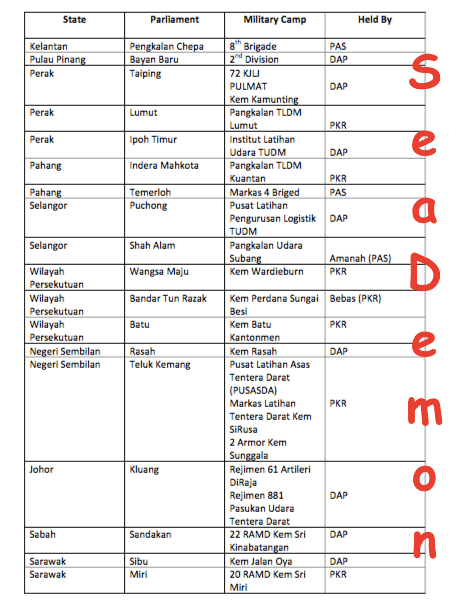
Come to think of it, out of the 89 Parliamentary seats won by the then-Pakatan Rakyat during the 13th General Elections four years ago, at least 18 parliamentary constituencies have major military camps/bases in them.  That is 20 percent of the total of parliamentary consituencies held by the Pakatan candidates. Here is the list that I have compiled:

Senarai Kem Tentera Bawah PH 2013

Let us take for example the Lumut Naval Base which is under PKR.  That base alone had 14,231 registered voters while PKR’s Mohamad Imran Abd Hamid won 40,308 votes.  Why didn’t Barisan Nasional win there?

Perhaps Liew Chin Tong should also inform all Malaysians that out of the 18 constituencies with major military camps/bases that was won by the Pakatan back in 2013, eight seats were won by the DAP. That is 44 percent!  Despite being the other “Malay” party within the Pakatan, PKR managed only seven seats or 38 percent. PAS could only get three then but one of those seats, Shah Alam, is now firmly under Khalid Samad of Amanah after he betrayed his oath to remain in PAS if nominated as a candidate and would divorce his wife if he jumps ship.  Shah Alam is the home of a major Royal Malaysian Air Force base – Subang.

Pakatan and its supporters should just stop politicising the Malaysian Armed Forces.  As towns and cities are developed, old camps and bases are no longer strategic nor conducive to be inhabited.  How could Pakatan, advertising that it is all for rights and stuff, allow military personnel to live and work in deplorable and antiquated conditions?  And as development creep into their surrounding areas, military bases are no longer of any strategic value.  I have addressed this issue in a posting of mine and so has my friend Danny Liew in his recent posting.

So, wouldn’t DAP now like to offer a piece of land in constituencies held by it for Hishammuddin to build military bases or camps?

A Royal Poser

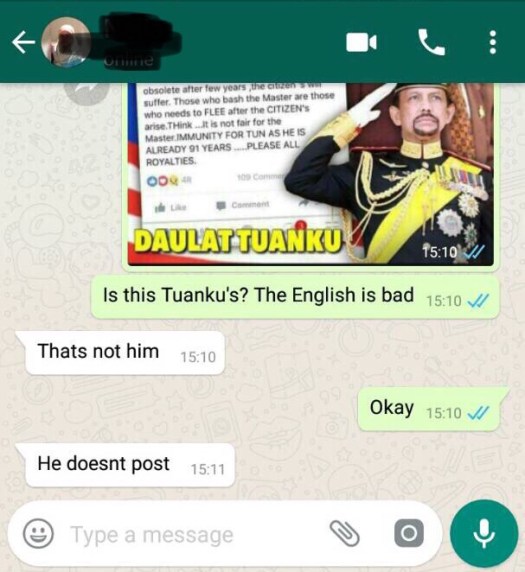
The above Facebook account has been posting stuff which raised many eyebrows, and as usual many gullible Malaysians fall for it.

If it was true that His Majesty The Sultan of Brunei did indeed post especially the one above, he needs to employ someone with better command of the English language and maturity to post on his behalf. It sounds like an elementary school student wanting to sound intelligent.

In a previous post I wrote on how gullible Malaysians can be, often taking “news” at face value without verifying for truth. So, I checked the above account with my niece. She is a Brunei government servant married to a member of the Brunei royal family who is also a diplomat serving at one of Brunei’s embassies in Europe.

She confirmed that the account does not belong to His Majesty and that he does not post his own self. She also pointed me to the official Facebook of His Majesty.

It is very sad to see that we are moving towards getting a developed nation status but Malaysians remain as cultured as the Neanderthals.

The Pick And Choose Patriot

Hishammuddin Hussein delivering his speech at the recent UMNO General Assembly

It is bad enough that there is a large number of non-Malays who do not have good command of the Malay language despite it being the National Language, and despite this nation’s being in existence for 60 years, but nothing can be worse than Malays who do not understand the language themselves.

Left-leaning media have been slamming the speech by UMNO Vice-President Hishammuddin Hussein, who is also the Defence Minister, on the so-called deployment to Jerusalem in response to President Trump’s recognition of the city as Israel’s capital.

This began with the criticism by a group of political ex-soldiers calling themselves the National Patriots Association (NPA).  Its President, Brig-Gen Arshad Raji (Retired), said that Jerusalem is not a military issue to begin with.

The international conflict in Jerusalem is a political issue. It is best left to diplomacy to sort out this historical mess. If diplomacy fails, the next course of action can be international condemnation.  Blindly making a declaration to commit our troops is unwise,” he said.

I would like to know who authorised Hishammuddin to prepare the army to be deployed in the Middle-East? Was there a special session of parliament on this matter for the matter to be debated?” asked DAP’s P Ramasamy.

You can see how this issue is being played in Israel.  The Jerusalem Post reported it as:

The issue made headlines on The Jerusalem Post

Whereas, in relatively sober Malaysian media it reads as:

The not-so-kosher Malay Mail Online sought clarification on the matter with the Deputy Defence Minister

However, if one were to listen to the speech made by Hishammuddin, nowhere in the speech did he mention about committing the troops to defend Jerusalem.  All he said was if the need arises, if the King as The Commander-in-Chief decrees it, then the Malaysian Armed Forces is always ready to contribute in any manner.  You can listen to the part where this is mentioned from 18:19 to 19:47 of the following video:

The issue also sparked a debate between myself and a fellow defence blogger Danny Liew versus two of his Facebook followers who criticised the speech saying that our troops are not ready nor trained for desert warfare.

The truth is, our troops have had its fair share of desert operations that started off with the UNIIMOG mission of 1988-1991 to monitor the ceasefire between Iran and Iraq after a lengthy war.  This was followed by UNTAG in Namibia (1989-1990), a country named after the vast Namib Desert that makes up the most of its countryside. We still maintain our presence in the Western Sahara as part of MINURSO and we have been there since 1991.  We were deployed to monitor the Kuwait/Iraq border as part of UNIKOM, after the first Gulf War and were there from 1992 to 2003.  Don’t also forget that we were in Somalia from 1993 to 1994 as part of UNISOM, and this was where we saw full combat rescuing US troops from their disastrous unilateral operation at the Bakaara Market.  We have been deployed in South Lebanon as part of UNIFIL since 2007. And we are part of Exercise North Thunder in Saudi Arabia as part of the International Military Alliance To Fight Terrorism (IMAFT), a coalition that was formed to combat Da’esh.  You may read more about that HERE.

The NPA picks and chooses its quarrels, and the quarrels are mainly with the government despite Arshad Raji having said that they are apolitical.  But the apolitical nature of the NPA is the same as that of BERSIH.  It never attacks the Opposition.

The NPA is silent about DAP’s P Ramasamy who supported the Gerakan Aceh Merdeka, a separatist movement in Indonesia whose aim used to be to liberate Aceh from Indonesia, and also supported the internationally-recognised terrorist organisation Liberation Tigers of Tamil Eelam (LTTE) otherwise known as the Tamil Tigers.

The NPA also claims to be loyal to the Rulers Institution and the Country.  Yet, they only provided deafening silence when U-Turn Mahathir and DAP’s running dog Zaid Ibrahim were rude towards the Sultan of Johor and Sultan of Selangor.  So, what are they patriotic about? Supporting a DAP-led coalition to form the next government?

The NPA is nothing more than just Mahathir lackeys

Maybe their pension is not enough to support them.

A Lesson On Fake News In Malaysia

STUDENT activism in Malaysia peaked in December 1974, having started in September of the same year in Tasek Utara, Johor Bahru, when some 5,000 students demonstrated at the Selangor Club Padang (now Dataran Merdeka) and as expected, clashed with the Federal Reserve Unit (FRU).

As a result, the students retreated to Masjid Negara with the FRU hot on their heels.  The demonstration was culled and 1,128 students arrested. The student leaders who were holed up on the University of Malaya campus were soon arrested and so were those who hid inside their rented rooms in nearby Kampung Kerinchi.

Three representatives of Kampung Kerinchi complained that the FRU had taken harsh measures to apprehend the students by firing tear gas and that had resulted in the death of a baby.

My father immediately summoned his then deputy, the late Tan Sri Mahmood Yunus, and then Director of Special Branch, the late (Tan Sri) Mohamed Amin Osman, and asked them if the FRU had indeed fired tear gas into Kampung Kerinchi. Amin was adamant the FRU did nothing as such.

When asked if he (Amin) had checked the allegations himself and also the report received from the FRU troop leader, Amin said no.  So my father instructed Amin to go to Kampung Kerinchi to check himself.

Celaka! Depa tipu saya!” (“Hell! They lied to me!”) exclaimed Amin when he saw the empty tear gas canisters that littered the lanes of Kampung Kerinchi, to which my father replied, “You fell for it because you did not check the information yourself!

Fake news is a neologism that has entered the lexicon, used to collectively describe rumours, hoaxes, misinformation, propaganda and recycling of old rumours that had been debunked, that mislead people into believing that they are current and true.

Fake news caused the Barisan Nasional to lose its long-held two-thirds majority in 2008 because it was complacent and not quick enough to react and dispel these rumours.  Back then, political discussions and dissemination of fake news or propaganda occurred in chat rooms, in SMS, and blogs which were only a handful then.  Now there is Facebook, Twitter, Line, Telegram, WhatsApp, YouTube over and above the media available almost ten years ago.

Claire Wardle, Executive Director of First Draft a non-profit organisation dedicated to finding solutions to the challenges associated with trust and truth in the digital age housed at the Shorenstein Centre on Media, Politics and Public Policy at the Harvard Kennedy School, categorised mis and disinformation into seven types:

Satire or parody – this type of misinformation has no intention to cause harm but has potential to fool. A good example of this is of a message purportedly sent by a passenger of the MH370 who said he managed to hide his iPhone5 up his anus!  This had been debunked as a prank, but there are those who still believe that the person did manage to shove a five-inch by two-inch phone up his anus without any problem on the island of Diego Garcia.

Misleading content – most recent would be issues tweeted by two artistes that evolve around the rising cost of living, the weakening ringgit, a shambolic economy, designed to rile up anger in their followers. The tweets, not backed by published facts and figures, would do damage to those who have no inclination to check for the truth and to retweet or forward to others.

Imposter content – these are usually propaganda designed to use genuine sources but impersonated as theirs. A simple example would be of Selangor Mentri Besar Datuk Seri Azmin Ali’s recent event officiating the opening of the Rawang-Serendah Bypass, eight days after the bypass was opened by a minister.

Fabricated content – this type of content is 100 per cent false and is designed to deceive and cause harm. If you remember in July 2007, PKR’s Tian Chua admitted that he had fabricated a photo to show that Prime Minister Datuk Seri Najib Razak was together with Abdul Razak Baginda and now dead Mongolian-model Altantuya Shaaribu in Paris.

False connection – this is when headlines, visuals and captions do not support the content. The most famous example from recent times was of The Star’s headline that said “Malaysian Terrorist Leader” while having a huge photo of Muslims praying during the first night of Ramadan. Although The Star apologised for the error, it was not the first time it had made a similar mistake.

False context – this is when genuine content is shared with false contextual information. Artiste Fathia Latiff put up a screen capture of the price of fuel in various OPEC countries on Twitter, asking why Malaysia, as an oil producing country, charges very high for petrol?  The screen capture is of oil prices back in 2014. The average value of fuel prices for Malaysia between September 4, 2017 and December 11, 2017, was RM2.23. For comparison, the average price of petrol in the world for this period was RM5.82!

Manipulated content – this is when genuine information or image is manipulated to deceive. Recently, there was a video of a skinny polar bear with muscle atrophy struggling to find food in a snowless land that was made viral. This was attributed to global warming. However, the video was filmed in August when the tundra was snowless. It was only published in December.  Even the indigenous community living in the area thought it was a stunt to raise more funds and was doing a disservice to the war against climate change.

I don’t know why Malaysians are so gullible and eager to share fake news.

In WhatsApp groups, you can see how some people could post about something religious and then help spread fake news – something totally against religions. Nowadays, this fake news comes with a disclaimer – “Dari group sebelah”.

Every time we forward or share a post without double-checking or verifying, we add to the noise and confusion.  We never consider the source, we never consider the supporting sources and worst of all, we never check our biases.

The late Tan Sri Amin learnt this the hard way.

Having seen that he was misled about the FRU not firing tear gas into Kampung Kerinchi, he went on to check about the claims of a baby that had died as a result of the tear gas.  None of the three village representatives had themselves seen the dead baby and no one had actually reported to them of the death.

When asked where the information had come from, they replied, “From Anwar Ibrahim and the other student leaders!”

It seems that nothing has changed since 1974.

(This article was first published on The Mole)

Jumping To Conclusion

Arul Kanda was spotted at the opening of the UMNO General Assembly

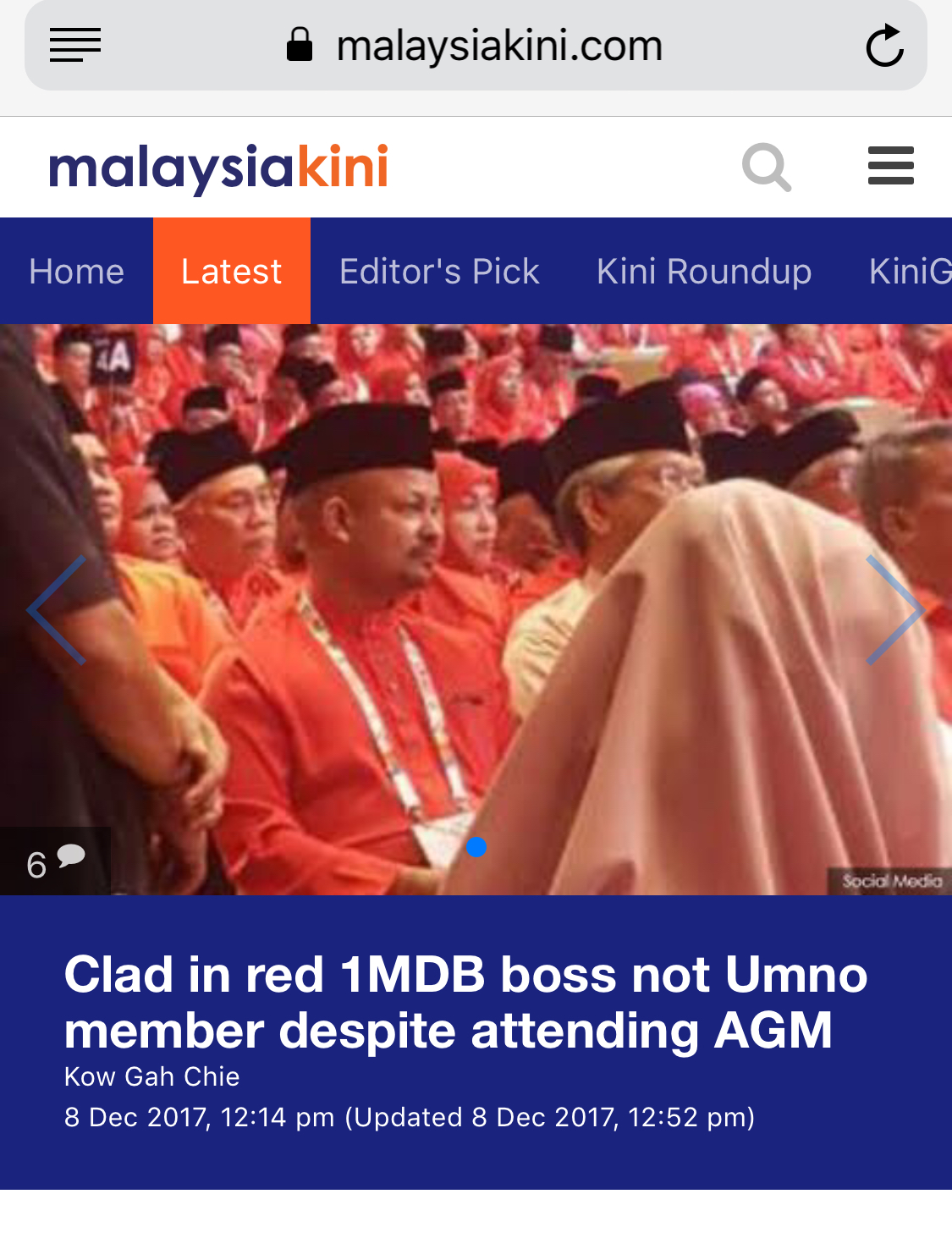
I don’t know why Arul Kanda’s presence at the opening ceremony of the UMNO General Assembly is made a fuss.  So did Khazanah Nasional Bhd managing director Azman Mokhtar, Permodalan Nasional Bhd (PNB) group chairperson Abdul Wahid Omar, CEO Abdul Rahman Ahmad and Lembaga Tabung Angkatan Tentera (LTAT) CEO Lodin Wok Kamaruddin.

It has always been a tradition for CEOs of Government-linked companies to be invited to the opening ceremony to listen to the UMNO President’s speech where it always touches socio-economic concerns.  Even President of BN component parties are invited.  In fact, among those who attended the final UMNO General Assembly with Mahathir as President were MCA’s then-President Ong Ka Ting and also PPP’s M Kayveas. So, what is the big deal?

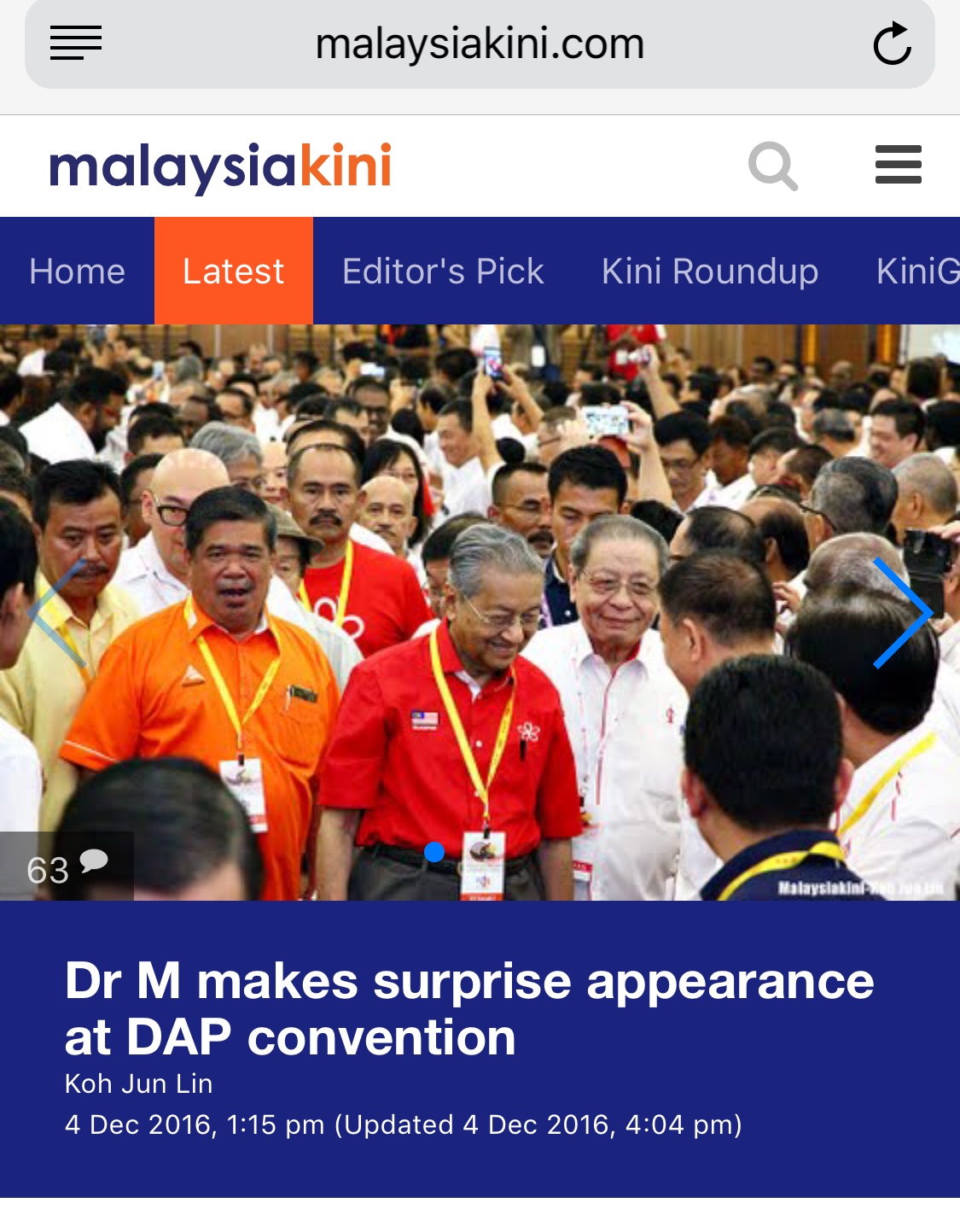
Not too long ago, an archnemesis of the Opposition attended DAP’s Convention.  There, those who swore to spit on his grave lined up to smile, bow and shake hands with the man they all had wanted to send to prison for being a corrupt dictator.

Heil Mahathir!

Behind Mahathir in the screen capture above is the very man who used to go around the country calling the former a PEROMPAK (robber).

Of course, now Mahathir is forgiven.  All the RM100 billion according to both Lim Kit Siang and Barry Wain that Mahathir squandered have been forgotten, all in the name of politics.  And in the name of politics, all those with past sins are forgiven the moment they work hand-in-hand with Pakatan.

Arul Kanda, President of BN component parties, all sat with the rest of the guests an delegations. Mahathir, however, was given a seat on the stage with DAP’s central executive committee members.

DAP Member 001A was given a seat on the stage

So, is Mahathir a DAP member?  Maybe, Malaysiakini can answer this question.

Non Compos Mentis

Zaid Ibrahim on a campaign trail (courtesy of parpukari.blogspot.my)

His Royal Highness Sultan Sharafuddin Idris Shah Alhaj, the Sultan of Selangor from my observation is a calm and very private person. He rarely makes any statement or gives interviews to the media except during his birthday celebration.  Only once in a blue moon would Sultan Sharafuddin voice out his concern, especially during the Kajang Move, because it was affecting the efficiency of His Royal Highness’s state government.  The Sultan had also expressed his concern over the rudeness of the Opposition and its supporters towards the late Sultan Azlan Shah of Perak during the Perak constitutional crisis of 2009.


The latest episode involves the adverse reaction by DAP’s Zaid Ibrahim to the Sultan’s statement on Mahathir’s remark on the Bugis people.  The statement was made as part of an interview with The Star for this year’s celebration of the Sultan’s birthday.  In his Twitter postings, Zaid said that when some Rulers play politics, they must know the consequences. Do not think there is no price for partisanship.


What earned Zaid the wrath of many was when he also Tweeted a warning to Sultan Sharafuddin saying the Sultan should be careful with his words (as) no one is immune when (the) country burns.


That is typical of Zaid, when he displays the usual non compos mentis character.  Often displaying his republican attitude, Zaid suits well in the DAP – a party known historically for its rash behaviour when it comes to respecting the Rulers Institution.  It is also well that he is a Malay, from Kelantan, as it would appeal to the fence-sitting Malays in Kelantan who are politically torn after the departure of PAS from Pakatan Rakyat effectively ending the coalition.


The late Karpal Singh once petitioned to sue Sultan Sharafuddin’s late father, Almarhum Sultan Salahuddin Abdul Aziz Shah Alhaj, in 1987 over a speech by Sultan Salahuddin to the Selangor branch of the Ex-Servicemen’s Association saying that he would not pardon drug traffickers in Selangor. The petition was rejected on the grounds that there was no lis.  In 2009, Karpal Singh had intended to sue Sultan Azlan Shah of Perak for appointing Datuk Dr Zambry Abdul Kadir as the new Menteri Besar, replacing DAP’s choice Nizar Jamaluddin.  Karpal was found guilty of sedition in 2014.


Since gaining some grounds after the 2008 general elections, the DAP has time and again displayed its disrespect to the Rulers Institution by not abiding by the dress code at state assembly openings.  One good example is of DAP’s Gwee Tong Hiang who was the Johor state assemblyman for Bentayan who did not wear a songkok at the state assembly opening.  The late Sultan of Johor, Almarhum Sultan Iskandar Ismail was not amused.


Two days ago someone here tried to be a hero by refusing to dress accordingly. If he wants (to differ), then get out of here now!” the late Sultan chastised.  Tong Hiang, unfortunately, was not present then.


The DAP had wised up since then.  Seen as a Chinese chauvinist party, such rude behaviour turned them into punching bags of the Malays, especially those from UMNO who had a feast turning the DAP into cheap meals.  The DAP quickly recruited liberal Malays into its fold, including Zaid, to do their dirty jobs for them.  This keeps the heat off the Chinese in DAP, but pit Malays against Malays.


What the authorities should realise is that such behaviour displayed most recently by Zaid Ibrahim sends the wrong signal that it is alright to reject Malay traditions including respect for the elders and the Rulers to the younger Malaysian who, at their age, would be mostly anti-establishment by nature.  If this goes unchecked, it would certainly give birth to more Zaid Ibrahims.


The authorities should take cue from Sultan Sharafuddin.


I am aware that Zaid had long been making false and incorrect accusations against me. He is a politician and a former minister whom I understand is against the royal institution. My advice to Zaid is simple, do not forget where you come from,” the Sultan said.


What 1MDB Suit?

There is currently no action against 1MDB. Only against properties thought to have been procured using money belonging to 1MDB,” said Thomas C Goldstein, Advocate Appellate, US Supreme Court said when asked about the civil forfeiture action against 1MDB.

Tom Goldstein was answering question raised during his talk on “Criminal Litigation in the United States of America” at the UiTM Faculty of Law today.

He said that based on the US Constitution, no one should be deprived of their assets without due process of the law, and all due processes of the law must have a hearing concluded before assets can be forfeited.

The DoJ, based on the complaint, is just tracing the money and think it may be linked to 1MDB. Right now, there is no suggestion of any criminal target,” he added.

Tom Goldstein is one of the US’s most experienced Supreme Court practitioners and his representations span virtually all of the US Federal Law.

As arguing counsel in the Court, Tom has prevailed in cases involving arbitration, bankruptcy, civil procedure, disability law, employment discrimination, the Fourth Amendment, free speech, habeas corpus, immigration, labour, securities, and trademarks.

When asked to whom would the DoJ return the seized money to, Tom explained that the issue has put the DoJ in limbo as the 1MDB has said that the money is not theirs, whereas the case is based on money taken from 1MDB, made by complainants that do not represent 1MDB.

The DoJ has recently to put on hold civil forfeiture lawsuits against assets acquired (by Malaysian financier Low Taek Jho, also known as Jho Low), because pursuing these may have “an adverse effect” on its ability to conduct the criminal investigation. What the DoJ is doing is it is trying to prevent the money from dissipating by starting a criminal action,” Tom explained. “But right now there is very little activity pertaining to the case and no one has been named as criminal targets.”

Asked if this (that 1MDB says the money is not theirs) is the reason it has taken the DoJ so long to actually initiate something, he answered with a simple, “Yes.”

A huge amount of money made its way into the US, and the DoJ is interested to know where is the source of this money. It is not a criminal case and an escalation into one will only make life more difficult for them as there has been no precedent. No one has been named in the civil forfeiture suit. If a criminal case were to be developed then it would be a classical criminal case and the burden of proof falls on the DoJ that it has to prove beyond reasonable doubt that crime has been committed,” Tom added.

In addition to practicing law, Tom has taught Supreme Court Litigation at Harvard Law School since 2004, and previously taught the same subject at Stanford Law School for nearly a decade.

Tom is also the co-founder of SCOTUSblog – a website devoted to comprehensive coverage of the Court – which is the only weblog ever to receive the Peabody Award.