Sabah 20-Point Agreement: Religion

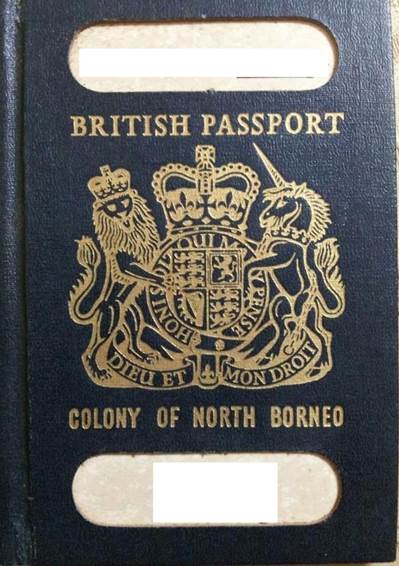
Colonial passport for the colonised people of North Borneo

For the previous installment on the background, please click here.

In his book on Page 101, Dr Jeffrey Kitingan wrote that although there is no objection to Islam being the religion of the Federation there should not be a STATE RELIGION in North Borneo.  Therefore, anything pertaining to Islam in the MALAYAN CONSTITUTION cannot be applied to NORTH BORNEO.

His grouse on this matter came about as a result of the late Tun Datu Mustapha expelling Christian priests from Sabah and accused both Tun Datu Mustapha and Datuk Harris Salleh of acting in such manner to strengthen their political position with the Federal government, therefore Islam should not be the religion of the state of Sabah.

The above controversial statement goes against the agreements reached as recorded by the Cobbold Commission, the Malaysia Solidarity Consultative Committee (MSCC) , and the Inter-Governmental Committee (IGC) in 1962.

According to the memorandum of the MSCC that was chaired by Donald A Stephens (later Chief Minister of Sabah, Tun Fuad Stephens) with representatives from Singapore, Malaya, Sarawak and North Borneo, the MSCC found that the acceptance of Islam as the religion of the Federation does not endanger religious freedom as evident on Page 120 of the MSCC memorandum dated 3 February 1962:
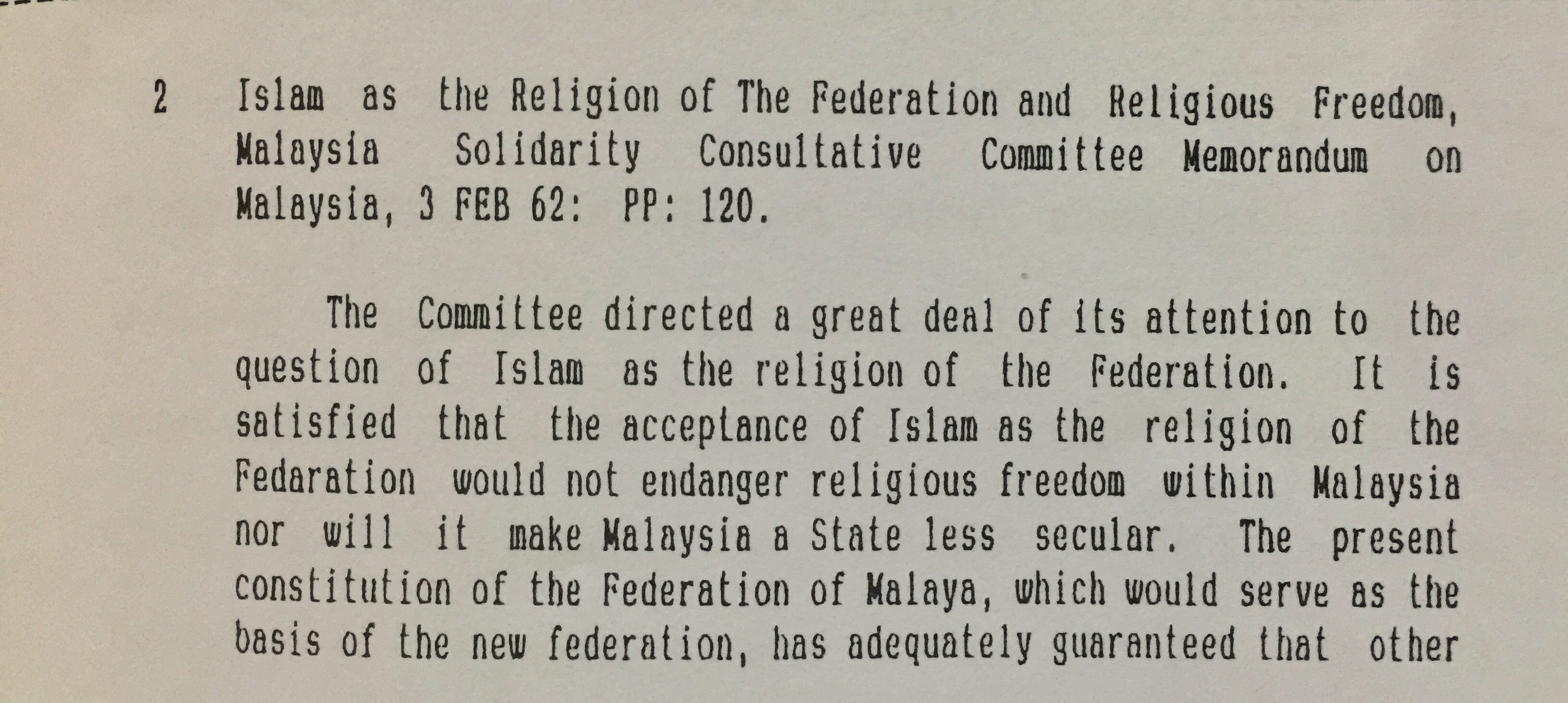
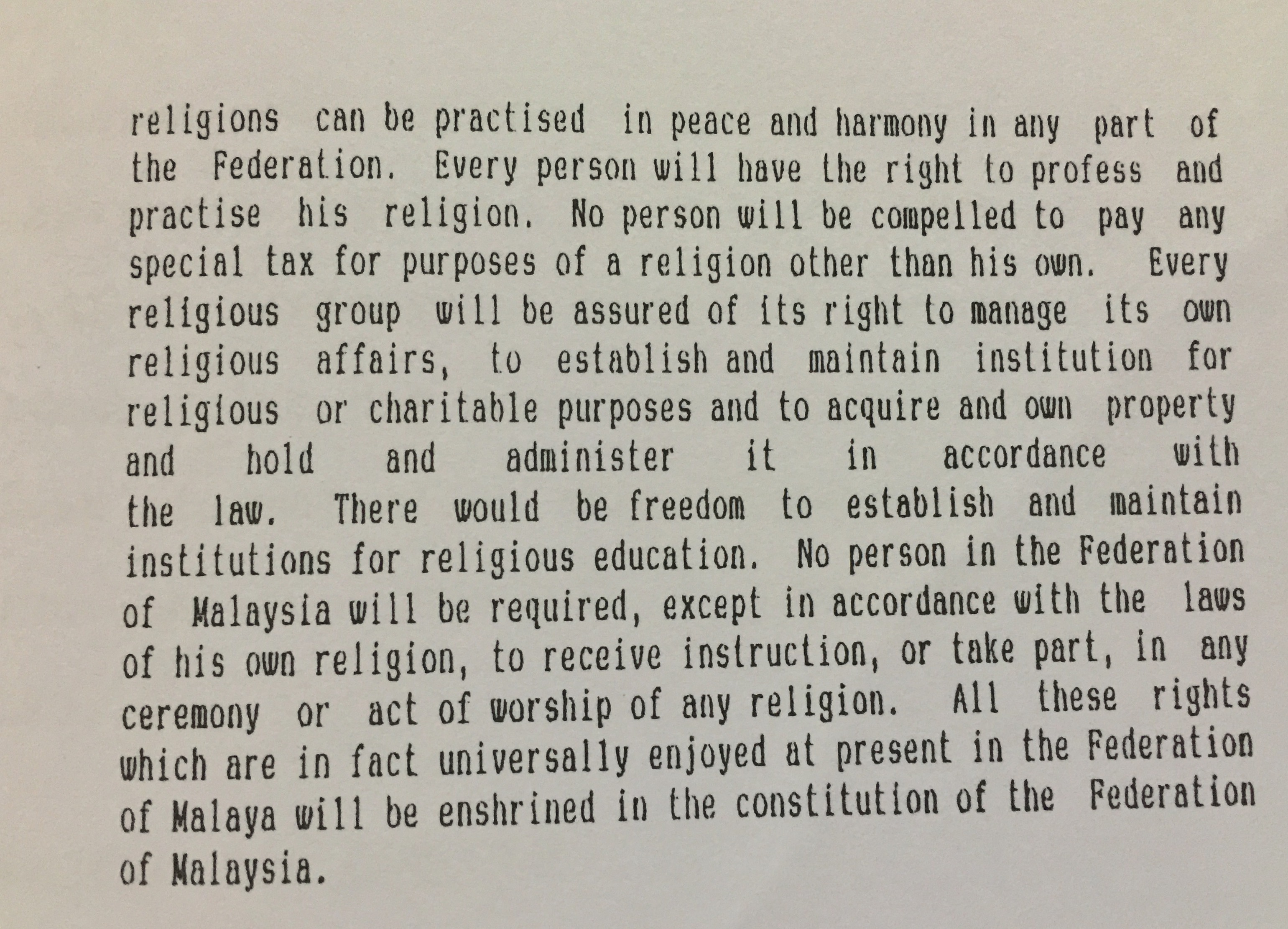
MSCC Memorandum dated 3 February 1962 PP 120

The MSCC had scrutinised the position of Islam in respect of states other than the Malay States and found no objection was made against the then-present arrangement for Pulau Pinang and Melaka to also be adopted by North Borneo, Sarawak and Singapore.

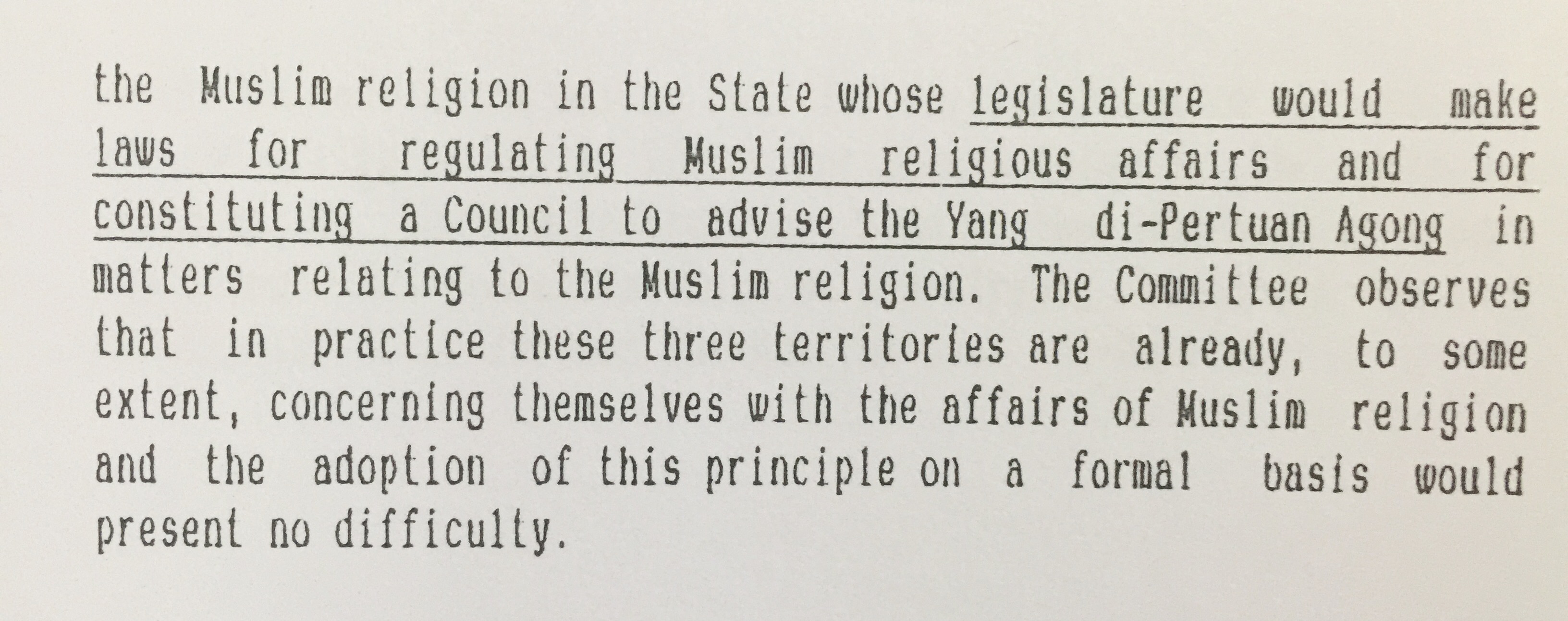
Each of the states above would have its own constitution to address the requirement with Yang DiPertuan Agong as the Head of Islam in those states.  The respective State’s Assembly will enact laws to govern Islamic affairs and form a Board to advise the Yang DiPertuan Agong on matters pertaining to Islam.

On pages 120 and 121 of the memorandum mentioned it is stated so:
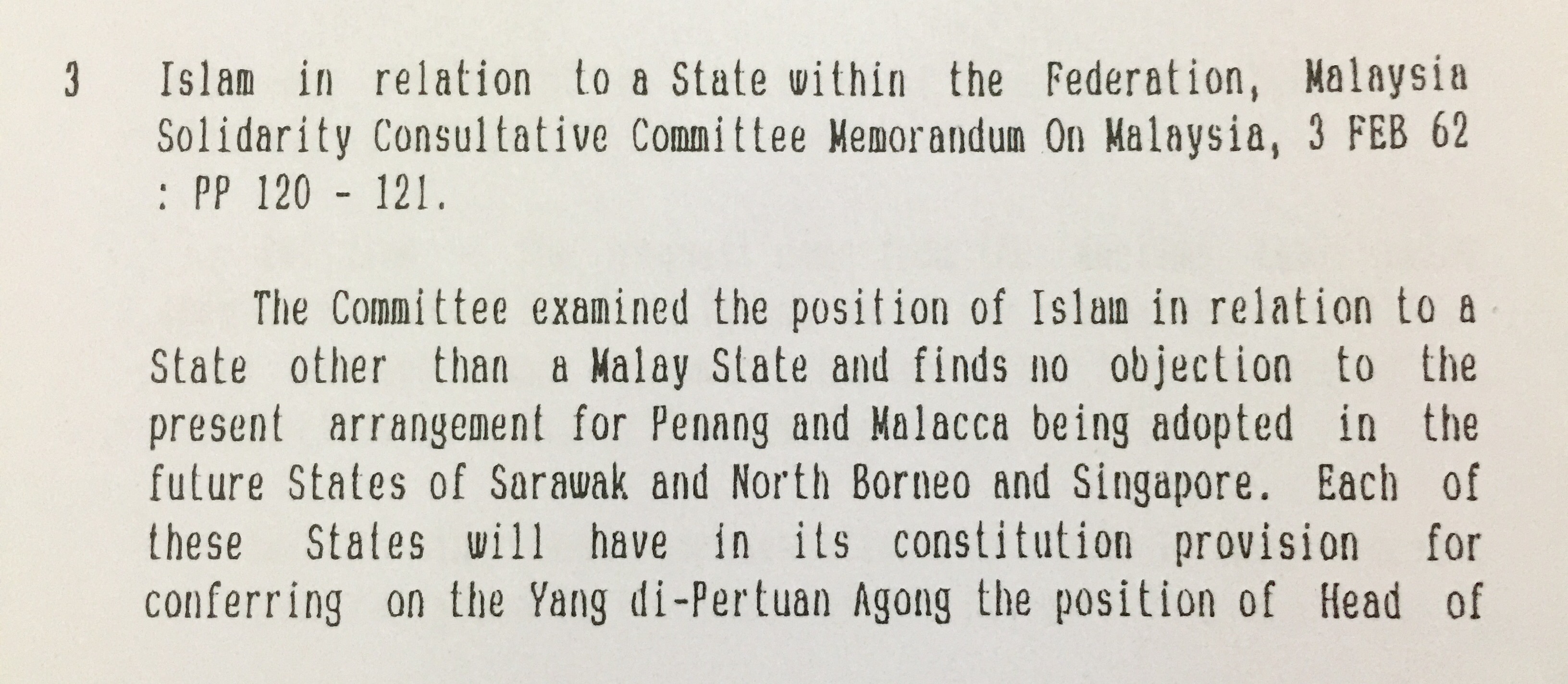
 

MSCC Memorandum dated 3 February 1962 PP 120-121

In the Report of the Commission of Enquiry (Cobbold Commission), North Borneo and Sarawak, dated 21st June 1962 found that there was everywhere agreement that as the Muslims are minorities in North Borneo and Sarawak, there should be no restrictions on complete freedom of other religions in those states.
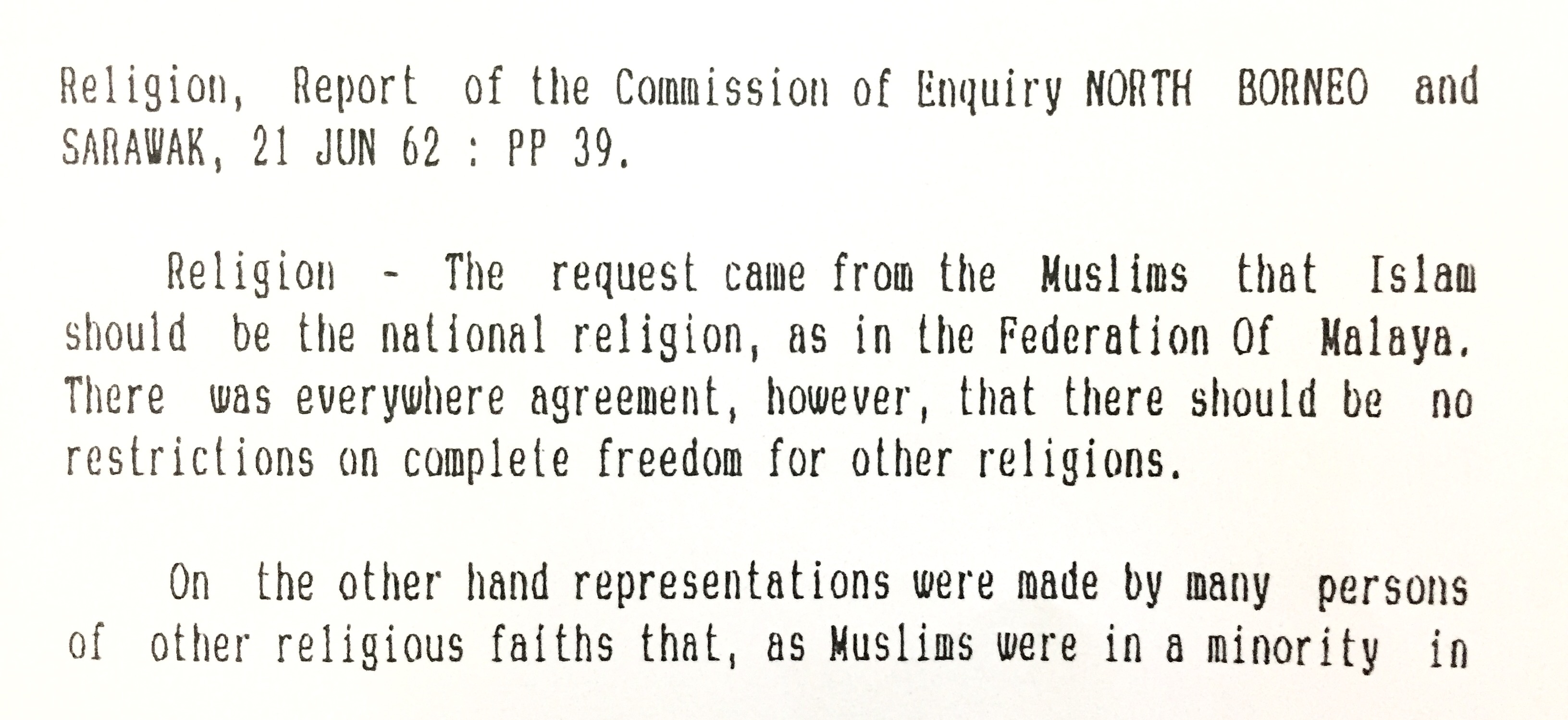
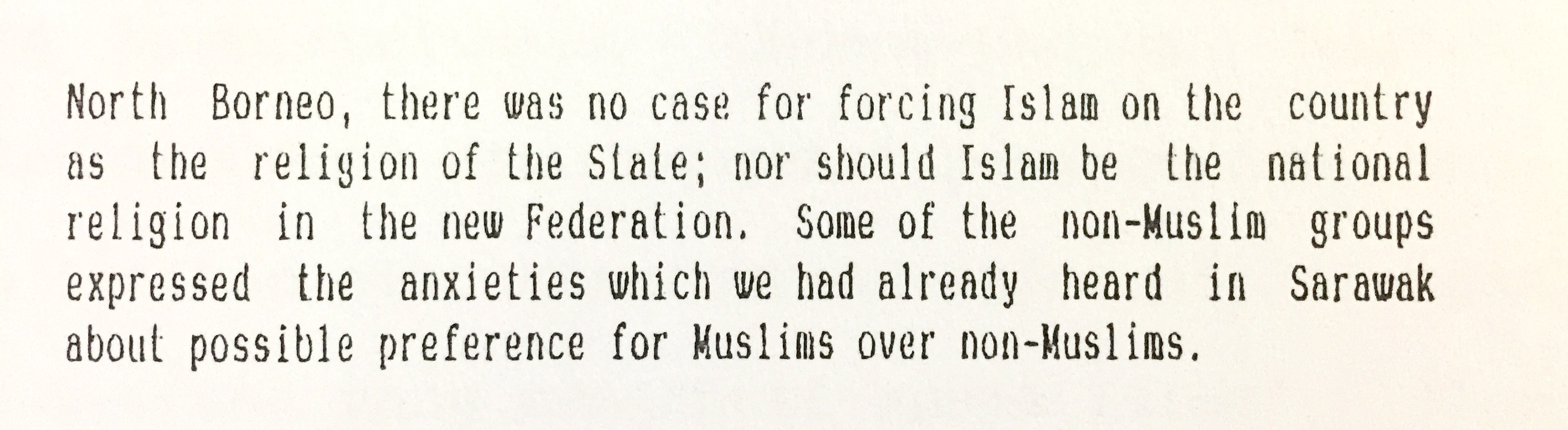
Cobbold Commission Report dated 21 June 1962 PP 39

In relation to that, the Inter-Governmental Committee, headed by Lord Landsdowne produced a report in 1962 and made the following recommendations on religion on Pages 5 and 6 which have been passed by the Sabah (and Sarawak) state assembly as follows:
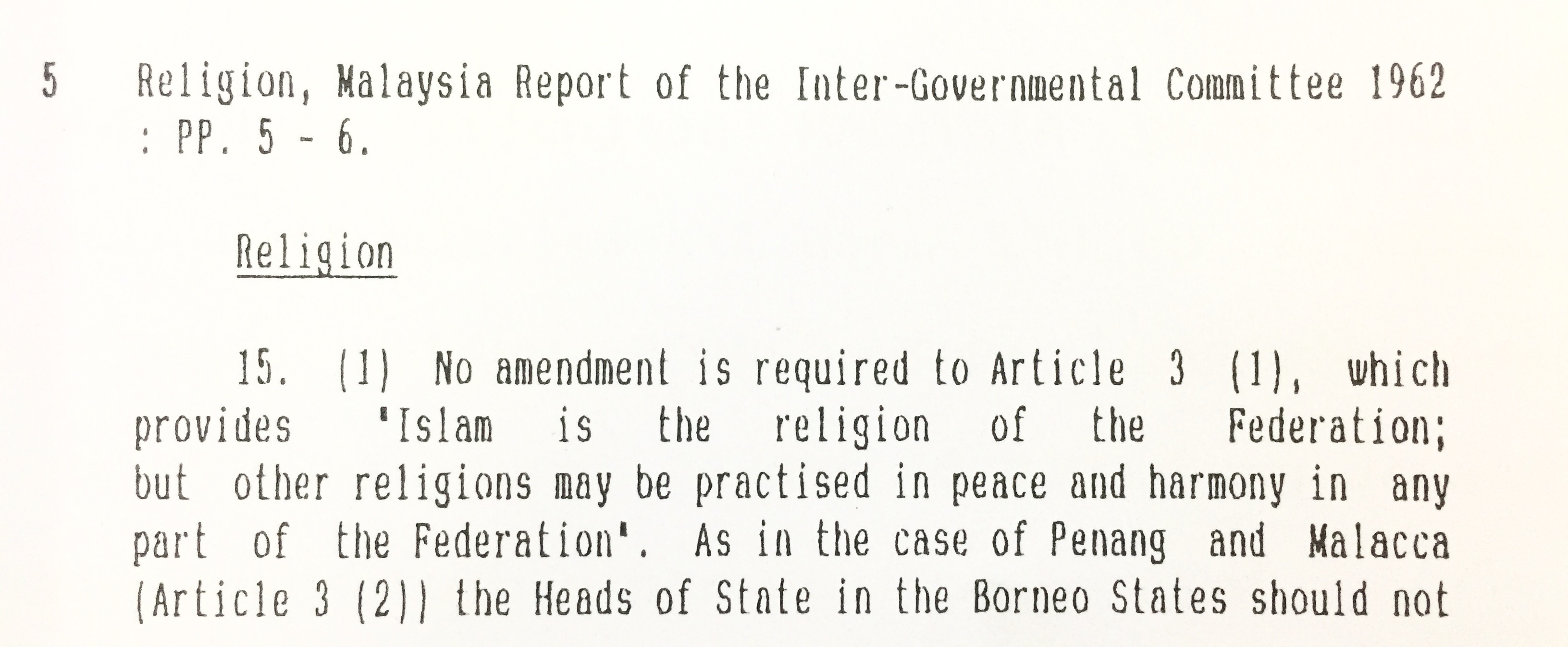
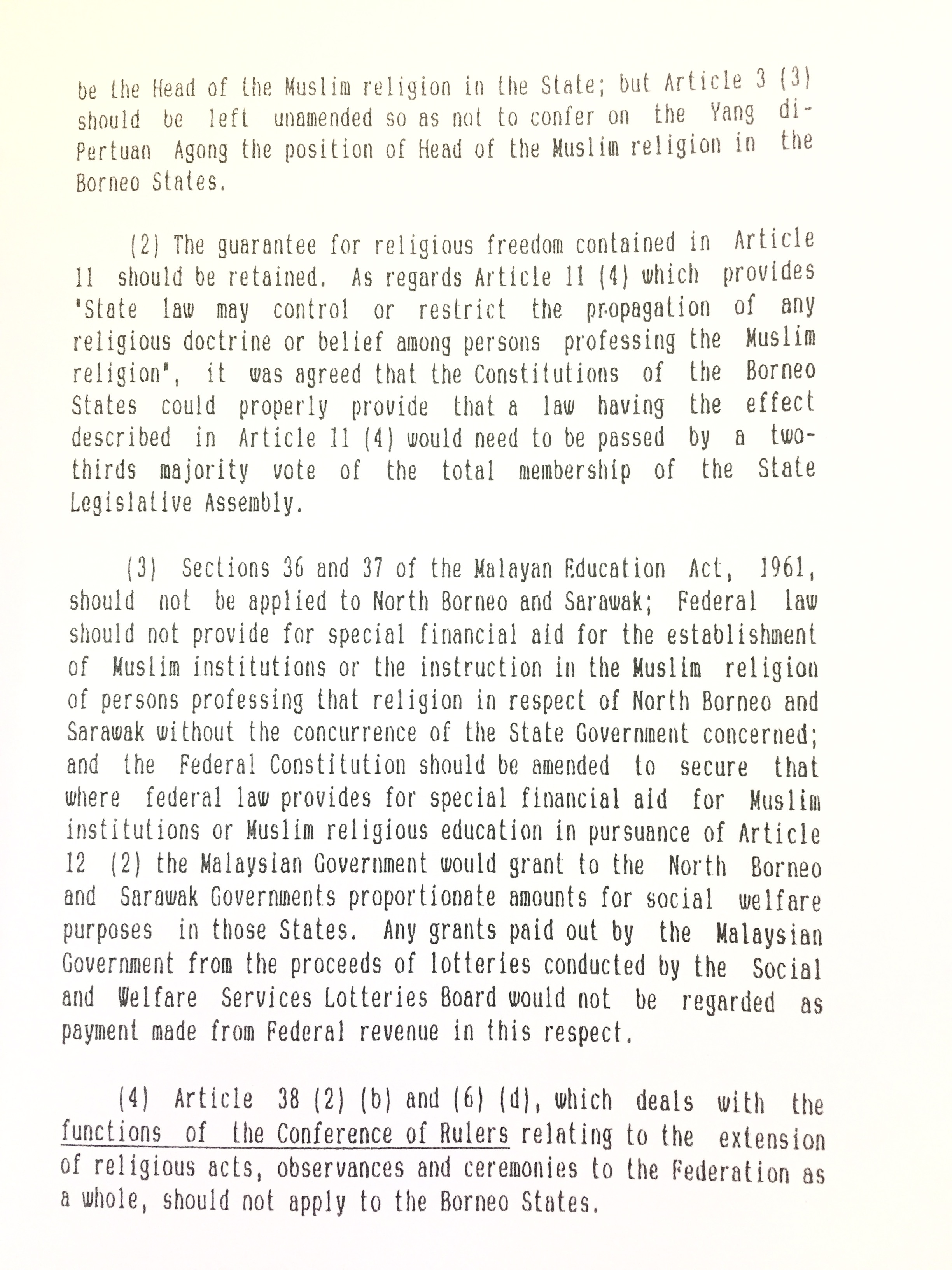
IGC Report 1962 on Religion PP 5-6

The IGC, which has representation from the Federation of Malaya representing the states in the Federation, Singapore, North Borneo and Sarawak, recommended that Article 3 needed no amendment.  However, the provision of financial aid to Muslim establishments should only come with the concurrence of the states of North Borneo and Sarawak.  This has since been provided for via Section 3 of the Sabah Islamic Laws Administration Enactment, 1992 where the Yang DiPertuan Agong is the Head of Islam in Sabah, and a Council (Majlis Agama Islam Sabah) was formed to manage and administer the Islamic affairs in Sabah. This has also been provided in the Sabah State Constitution (Articles 5B(1) and 5B(2)).

As mentioned at the beginning of this article, Dr Jeffrey Kitingan was angered by Tun Datu Mustapha’s action to chase out Christian missionaries from Sabah in 11972.  Dr Jeffrey used this as the basis of raising the religion issue that was presented as part of the 20-point memorandum for the inclusion of Sabah into the Federation of Malaysia.

Having understood the reason for his raising the issue again, we must also understand the events that had taken place after Tun Datu Mustapha’s ousting of the Christian missionaries.

Parti Bersatu Sabah (PBS) won the state elections and formed the Sabah state government in 1985.  From that point up until 1991, the Sabah state government built 825 churches compared to only 216 suraus and mosques.

The state government’s refusal to entertain a request by the Sabah Islamic Council made on the 2nd August 1986 and again on the 12th August 1986 to amend the state’s Shariah Law (Administration) Enactment No.15/77 to accord to the Yang DiPertuan Agong the power to administer Islam in the state of Sabah as required by Article 3(3) of the Federal Constitution (as amended on the 12th August 1976) and Article 5B of the Sabah State Constitution (as amended on the 28th December 1985) clearly denied the Yang DiPertuan Agong His Majesty’s prerogative that was agreed by the Malaysia Solidarity Consultative Council, the findings of the Cobbold Commission as well as the Inter-Governmental Committee, and the wishes made by the Muslims of North Borneo in 1962.

The ousting of the Christian missionaries in 1972 was made because the nine missionaries who were foreigners abused the work permit given to them to work in Sabah, not to conduct evagelical missions.  They were Roman Catholics, Anglicans, the Basil Mission and from the Borneo Evangelical Mission.

As Immigration affairs is a Sabah prerogative as accorded in the Federal Constitution of Malaysia, the first act by the Sabah state government under Tun Datu Mustapha was to deny them an extension of their work permit.  They were then given a 14-day special pass to enable them to make arrangements to leave Sabah.  However, the missionaries refused to obey the 13-day order.

Consequently, they were removed from Sabah through a Removal Order issued by the Sabah Immigration Department made under Section 32 of the Immigration Ordinance 12/59.

The Federal government had no role whatsoever in the removal of these missionaries.  It was purely a state decision that was made based on a sound reason – the people of Sabah, regardless of race or religion had been living harmoniously.  However, these missionaries have been sowing the seeds of hatred among the Christians of Sabah towards the Muslims by telling them to fear the “Islamisation” of Christians through forced conversions, a claim the missionaries themselves could not substatiate.

There was a plea made by the Christians in Sabah to the then-Prime Minister for the missionaries to be allowed to remain in Sabah.  Tun Abdul Razak however recommended to the Christians of Sabah to instead allow priests from the Peninsular and Sarawak to replace the nine missionaries.

In his book, Jeffrey Kitingan had profusely spoken about alleged digressions from and breach of the Federation of Malaysia Agreement but avoided on the issue of the Sabah state government of 1985 breaching agreements made by the MSCC, findings of the Cobbold Commission, the IGC as well as the Federal Constitution of Malaysia.

On the contrary, the Federal government has been fulfilling its end of the agreement by allowing the freedom for other religions to be practiced by its followers as per the agreement.

At no point was there any intrusion made by the Federal government in the affairs of Sabah, and that the removal of the missionaries from Sabah for violating the conditions of the work permit was totally a state issue, made using the powers accorded to the state of Sabah, as agreed by all parties that had agreed on the formation of the Federation of Malaysia.

In the next installement, we shall talk about the second point – LANGUAGE.

There Is Honour In Honorary

A friend sent me the above article written by a former senior Armed Forces officer on the subject of “honorary” ranks.  I have taken the liberty to share the article below:

As long as I can remember and it is important that we consider this, the only other persons outside the military who donned military uniform were our royalty (the Raja Raja) in their capacity as Colonel-in-Chief of the various Corps that made up our armed forces that included the navy and air force. It is largely a ceremonial position that is a common feature in several Commonwealth armies.

However, our country is unique. We have nine Raja Raja who in order of seniority act as patron to the corresponding senior unit they are assigned. It is more or less a permanent inherited position that is, a well-respected custom that remains unchanged to this day.

Military officers whether serving or retired are very proud of our uniform, ranks and military accoutrements. The king, who is also our commander-in-chief, by way of a formal document commissions us. We undergo rigorous training at the various officers training academies domestic and foreign to be commissioned as second lieutenants (one pip) as our initial rank.

It is a long and arduous journey as we progress through a maze of military requirements that consists of passing promotion examinations and career courses to earn a higher rank. Few ever qualify for the rank of general of various grades but as professional soldiers we serve our country and navigate the complex eco system of military service to excel professionally.

Those who served during the height of the Emergency and the Indonesian Confrontation as front line troops bore the full brunt of those conflicts. Many of our comrades were maimed and others made the ultimate sacrifice. Thus the weight of history is borne by all who wear the military uniform, and whatever exclusivity it brings is defined by those who served and continue to serve our “tanah air.”

As military officers, we are very concerned that of late, politicians have begun dispensing “commission ranks” — colonels, generals and captains (navy) — among themselves which also extends to other celebrities such as singers, actors, sportsmen and social activists. None of these people have ever fired a shot in defence of the realm or done a day of military training.

Some even proudly display the converted Parachute Badge commonly referred as “Jump Wings” without doing a single jump. There are also cases where certain individuals have the audacity to don the converted maroon beret of our commando units. We adhere to the belief and convention that no one other than the Raja Raja have the right to this honour.

I think it is time we put a stop to these so-called honorary ranks and unauthorised use of military accoutrements. If there is a need for such ranks to be handed out then those chosen need to at least pass basic military training before even being considered for such an honour.

Otherwise, those “rewarded” dishonour the service of men and women, who have actually earned their ranks in the process of serving their king and country.

And lastly I would like to add that of late that large number of non military organisations have all gone “al military/police” by wearing military type ranks, insignias and camouflage uniform to the boot. Let’s keep the ranks of lieutenant, captain, major, colonel etc strictly for the military only.

The top echelon of these organisations have also chosen to wear the cross swords/kris an insignia normally reserved for our top generals and very senior police officers. By doing so they not only confuse the public but our soldiers and policemen as to their standing in protocol.

The country should have only two recognised institutions known as the uniformed service that’s the army and the police.

It’s about time our authorities do something about by having proper guidelines to this effect.

I am puzzled that a retired senior Armed Forces officer does not know that the provision for Honorary commissions exists in the Armed Forces Act, 1972.  I first came across this provision when I studied the Act for the Military Law subject during my Officer Cadet days.

Under Section 8 of the Act it says:

The Yang di-Pertuan Agong may grant honorary commissions in the regular forces to such persons as he may think fit.

Honorary Colonels (Navy Captains), for example, are given to civilians whose position in his or her organisation commands assets of strategic importance to the Malaysian Armed Forces, such as the Malayan Railway, ports authorities, the MISC, TNB, Telekom etc., etc., and honorary ranks go down all the way to Honorary Captains (Navy Lieutenants).  The lower ranks include esteemed sportsmen and sportswomen and individuals whose charisma and value to the society would be valuable to the service they are commissioned into, such as to inspire the men and women of the service, to act as a bridge between the service and related civilian agencies, and also to promote the service in public relations exercises.

They are all given the honorary commission of the respective service’s volunteer reserve force.

Therefore you get sportsmen and sportswomen such as Datuk Lee Chong Wei and Datuk Nichol David who have been commissioned into the Navy and Air Force respectively.  You have Dato Irmohizam Ibrahim, the Member of Parliament for Kuala Selangor who has been commissioned into the Navy.  He was selected for the honorary commission by virtue that he is the Chairman of the Lembaga Kemajuan Perikanan Malaysia and has been actively involved in promoting the Navy’s RAKAM (Rakan Maritim) initiative for the fishing community.

Why is this a big thing? Richie McCaw, the former New Zealand’s All Blacks Captain was made Honorary Wing Commander (Lieutenant Colonel equivalent) of the Royal New Zealand Air Force!

The Indian Air Force gave honorary Group Captain (Colonel equivalent) to Sachin Tendulkar, India’s cricket team captain.

These individuals are commissioned as honorary officers in the volunteer forces of the three services of the Armed Forces. These officers do not need to fire any gun as they do not have command status.  However, if there is a request and the command of the service the honorary officer is commissioned into, it would be at the expense of the honorary officer him/herself.

Nor do they get any remuneration from the Armed Forces except for the one-off RM1,000 for them to make their uniform and buy the accessories.  They are also not subjected to the Armed Forces Act and neither are they given a service number.

And it is not up to politicians to hand out ranks.  The commission is given by the Yang DiPertuan Agong on the advice of the Armed Forces Council which comprises of the Minister of Defence, a representative of the Rulers appointed by the Rulers Institution, the Chief Secretary of the Ministry of Defence, the Armed Forces Chief, the Chief of the Services, and two other members appointed by the Yang DiPertuan Agong.

The Colonels-in-Chief and Captain-in-Chief of the respective Corps or Service would have a say on the Honorary commission to be awarded by the corps or service they preside over.  For example, His Royal Highness the Sultan of Selangor as the Captain-in-Chief of the Royal Malaysian Navy has set the number of honorary commissioned officers at 50.  Therefore, the Chief of Navy has to carefully select the individuals the Navy believes to be worthy of such commission.

No wings are given out to these honorary officers unless they have such qualification.  There are cases where former servicemen have been given honorary commission for the role they play in bridging the society and the armed forces, such as Datuk Huan Cheng Guan, who was an other rank in the Royal Malaysian Air Force.  He received an honorary commission for his tireless effort in bridging the society with the armed forces.

If Datuk Huan had a jump wing when he was serving, there is no reason for him not to don the wing if he wears the uniform of an honorary officer.

If Khairy Jamaluddin is the one that is being referred to, then let it be known that he is an active reservist and had undergone basic parachute training and therefore deserves to don the wing on his uniform.  He is also a Brigadier General in the Askar Wataniah.

MS Dhoni, another captain of India’s cricket team was not only given an honorary Lieutenant Colonel but also the jump wings of India’s Parachute Regiment, the regiment he was commissioned into honorarily.

Just like in India, it is customary for any commander of any regiment, corps or service to award honorary jump or pilot’s wings to any individual that they see fit.

As for civilian organisations that have ranks similar to the military and police, I can see several that have that kind of rank.  The Angkatan Pertahanan Awam is Malaysia’s Civil Defence Force and plays a role during wartime in assisting in the defence of the country.  Therefore, it deserves the ranks.  Oddly, it uses military ranks up to Colonel and then use police ranks for star officers.

RELA uses civilian ranks akin to the police because they come from the same Ministry and RELA acts as a support organisation to maintain public order, security and safety.

The Malaysian Maritime Enforcement Agency (MMEA), although a civilian organisation but like the police it is an armed service.  Its Director-General is appointed by the Yang DiPertuan Agong and plays the role of a paramilitary force at sea maintaining our sovereignty.  I see nothing wrong with them using Navy-like ranks because of the huge role that they play.

The MMEA is not like UK’s Coast Guard which is a purely search-and-rescue outfit, while the MMEA does law enforcement, maritime border control as well as search-and-rescue.

Perhaps, Lt Col Mohd Idris should also know that the Salvation Army uses military ranks and even have military training academies and corps.  However, I have yet to see anyone complain in the newspapers over such petty issue.

Therefore, why should we complain over something that is completely legal and is awarded by the Rulers?

Insula Est, Non Tua

Coat of Arms of the British East Hindia Company
Coat of Arms of the British East India Company

Of late there have been calls for the return of Pulau Pinang to the sovereign Ruler of Kedah.  This is because since being governed by the DAP, Pulau Pinang (Penang) has been behaving like an autonomous state while chasing out Malays, Indians as well as marginalised Chinese from the island state.

If I were to follow my heart, I would wish for Kedah to reassert its sovereignty over Penang. However, legally that would be disastrous for Malaysia.

The History of the 

The proponents for the return of Penang to Kedah base their arguments on the agreement made in 1786 between the British East India Company and the Ruler of Kedah at the time, Sultan Abdullah Mukarram Shah.  During that time, Kedah was already under the Rattanakosin Kingdom established by King Taksin. Kedah was already paying tributes in the form of Gold Flowers to the Kingdom of Siam in 1781 and had accepted the Siamese sovereignty.

In the 1786 agreement, Francis Light was supposed to assist the Kedah ruler in the event that Kedah comes under attack by another power; the British East India Company (BEIC) was not to protect enemies of Kedah (namely the Burmese and Siamese); and BEIC was to pay the Kedah government an annual repariation of 30,000 Spanish Dollars for the lease of Penang.

Tension grew when Francis Light did not inform his superiors in India of the full details of what he had promised to Sultan Abdullah.  In the end, Light was asked to provide Sultan Abdullah with less than what had been requested. The EIC decided to to provide the Sultan with any form of protection and nothing was said of financial repariation.

Light was forced to use the island’s revenue to pay the Sultan but offered only $10,000 Straits Dollars a year for eight years for the island, or $4,000 Straits Dollars a year for so long as the Company occupied the island.

The unamused Sultan then gathered his forces in Prai in late 1790 to take Penang back by force which was defeated by Light. Sultan Abdullah sent his emmissaries Tunku Sharif Muhammad, Tunku Alang Ibrahim and Datuk Penggawa Telibun to negotiate a treaty with Light.

In 1791 a treaty called the Treaty of Friendship and Peace was signed between the BEIC and the Sultan of Kedah and the annual payment of a sum of 6,000 Spanish Dollars was promised to the Sultan for the rights to Penang and the two countries promised “to live in peace by sea and land, to continue as long as the Sun and Moon give light.”  BEIC was to no longer provide protection to Kedah against its enemies.  This treaty supercedes the treaty of 1786. (Dr Cheah Boon Kheng, former lecturer, History Department of the Universiti Sains Malaysia)

In 1800, another treaty was signed between BEIC and Sultan Ahmad Tajuddin Halim Shah II, the successor of Sultan Abdullah for the lease of Seberang Prai (called Province Wellesley then) for an annual sum of 4,000 Spanish Dollars that is to continue “as long as the Sun and Moon give light.”

From 1826, the BEIC placed Penang under the Straits Settlements. Subsequently, in 1874 the BEIC was dissolved and as a result of the 1873  East India Stock Dividend Redemption Act the Straits Settlements came under direct British Crown rule via its government in India.

The Brtish Government became the rightful owner of Penang as successor of the BEIC.

Towards The Independence of Malaya

Each state in what was called Malaya were sovereign states up until 31st August 1957 when the Federation of Malaya that existed following the breakdown of the Malayan Union in 1948 ceased to exist.

“Malaya” as it was known then was made up of the Federated Malay States (Selangor, Perak, Negeri Sembilan, Pahang), the Unfederated Malay States (Kedah, Kelantan, Terengganu, Perlis, Johor), and the Straits Settlements (Penang, Melaka and Singapore).

The discussions leading to the formation of the 1957 Federation of Malaya excluded Singapore in the equation.

During these discussions, both Melaka and Penang were referred to as the Crown Colonies whose people are citizens of Britain. The discussions involved Her Majesty Queen Elizabeth’s Government, the Nine Malay Rulers, and the Alliance government the people had elected to represent them.

In an early stage, it was agreed by both Her Majesty’s Government and the Nine Rulers that the office and person of the Yang DiPertuan Agong and the Queen would jointly administer the Settlements as “equal partners.”  According to this arrangement, the Queen would delegate her sovereign authority to the Yang DiPertuan Agong as the representative of the Queen and the Nine Rulers and that the Melaka and Penang would have a Governor appointed in consultation with the Straits Settlements’ office (CO1030/132(28) dated 16 August 1956).

This would be in line with protecting the Straits Chinese who were British subjects whose representation to the British government expressed fears that if Penang is administered by the independent Malayan government, they would be subjected to discrimination.

The British High Commissioner to Malaya, Sir Donald MacGillivray had already expressed grave doubts as to whether that arrangement would be accepted by the Alliance Party as the latter had wanted all the Settlements involved to be part of the newly independent and self-governing Malaya (CO1030/135 (2) dated 19 July 1956).

UMNO as represented by Tunku Abdul Rahman had also proposed that the provisions for Malay reservations in the proposed Constitution should be applied to Penang and Melaka.  However, this was met with stiff resistance by the British government. The Secretary of State said the proposal could “aggravate racial feeling”, adding that during the 180 years of British rule in the Settlements there had been no racial discrimination (CO1030/496 (8) dated 14 May 1957).

A compromise was proposed by the Rulers’ legal adviser, Neil Lawson, who suggested that one of the clauses on land reservations to include a provision to allow the State governments to set up a trust to buy land for the settlement of the Malays. This compromise was accepted by the meeting. This proposal was contained in Article 88 of the Federal Constitution allowing Parliament to modify the articles on land (Articles 83 – 87) for application in Penang and Melaka (Constitutional Proposals for Malaya, Cmnd, 210, op.cit).

If you noticed in all the above meetings not once did the Sultan of Kedah, Sultan Sir Badlishah ibni al-Marhum Sultan Abdul Hamid Halim Shah, discussed the return of Penang to Kedah as well as asserting His Royal Highness’s sovereign authority over Penang.

This demonstrates that Pulau Pinang and Seberang Perai were no longer legally part of the Kedah Sultanate.

However, what also almost happened was the return of Melaka to the Dutch.

On 16 May 1957, a newspaper Straits Budget reported that the Malayan Party under Tan Kee Gak had planned to ask the British Secretary of State about the Anglo-Dutch Treaty of 1824 in respect of Melaka.  According to Tan Kee Gak, Britain was planning to abandon Melaka to Malaya and as a contracting party was in breach of the said contract.  Therefore, Melaka should be returned to the Dutch instead of be part of an independent Malaya.

The Colonial Office viewed the report seriously and sought the advice of the Foreign Office which in turn sought the help of the government of the Netherlands to renounce such a claim explicitly (CO1030/439 (79) dated 20 June 1957).

Summary

I have no reservation whatsoever in expressing my disgust at the way Lim Guan Eng runs Penang and uses it in a very unMalaysian way.  But I doubt there is any legal avenue that would allow for the return of Penang to Kedah that would be undamaging to the country in its present legal form.  It would allow for parties in Melaka perhaps to ask Netherlands to reconsider claiming the state as its own based on the 1824 treaty, and Manila would have a legal precedence to follow in its claim on Sabah.

Not once did the Sultan Of Kedah from the days of Sultan Ahmad Tajuddin Halim Shah II through Sultan Abdul Halim Mu’adzam Shah have ever staked a claim on Penang.  This is simply because the treaties of 1791 and 1800 have superceded the one made in 1786.

And Penang’s current form is because of the 1957 Federal Constitution, cemented further by the 1963 Federal Constitution, agreed upon by all including by the Nine Malay Rulers without a single objection to its sovereign status. So how is it that Penang should be taken back by Kedah?

If the current claim is about the maruah (face/pride) of the Kedah Sultanate or about the pride of the Malays, that is just the mouth talking before the brain could think.

It would be nice to live dreaming about the day Penang becomes another district of Kedah but that is what the heart wishes. It is the legal and constitutional implications that have to be thought of thoroughly.


Menjunjung Kasih

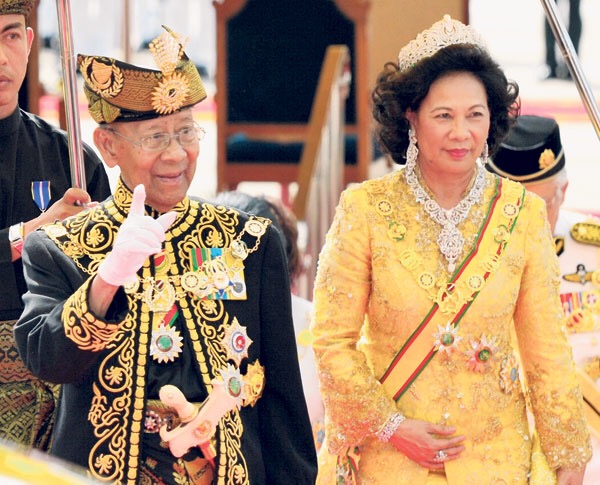
Tuanku Abdul Halim ibni Almarhum Sultan Badlishah is not the typical Yang DiPertuan Agong.

His Majesty is the first Sultan to have been elected twice to the office, and the oldest. He is also the second oldest and second longest reigning monarch after Queen Elizabeth II.

When Tuanku Abdul Halim first took office on the 21st September 1970, Malaysia had just come out of an extremely bad episode that happened just a little over a year before that.

Then Prime Minister, Tunku Abdul Rahman Putra Al-Haj, stepped down a day after Tuanku Abdul Halim was sworn in as the Fifth Yang DiPertuan Agong – not because of pressure as claimed by some, but due to the fact that the Prime Minister felt it was inappropriate to sembah his own nephew.

His Majesty reigned over a period when the Second Emergency had just begun and race relations was at its lowest. But it was the combination of His Majesty’s wisdom and the great stewardship of Tun Abdul Razak that saw Malaysians unite against a common front – the Communist Party of Malaya.

Tuanku Abdul Halim’s second reign as the Yang DiPertuan Agong came in an era where rumours reign supreme. Despite remaining neutral His Majesty was, on more than one occasion, the victim of vicious rumours for not acting as expected by certain irresponsible quarters.

His Majesty’s openness has allowed for people from both sides of the political fence to air their grouse and seek advice.

Although the rights of the Yang DiPertuan Agong include the right to be informed, to be consulted, to advise, to encourage and to warn, again the wisdom of His Majesty has seen the first for rights being exercised.

And being steadfast in His Majesty’s stand in certain delicate matters as well as having the wisdom that befits a Yang DiPertuan Agong, His Majesty’s encouragement have allowed Prime Minister Najib Razak to have better concentration on the administration of this country.

Kedah will once more enjoy Tuanku Abdul Halim’s great leadership while the rest of Malaysia will miss him.

Patik menjunjung kasih Tuanku.

Dirgahayu dan Daulat Tuanku. Semoga Allah terus merahmati Duli Tuanku.

Kelantan: The 15th Yang DiPertuan Agong

Daulat Tuanku - Sultan Muhammad V has been elected as the 15th Yang DiPertuan Agong
Daulat Tuanku – Sultan Muhammad V has been elected as the 15th Yang DiPertuan Agong

Sultan Muhammad V, the 29th Sultan of Kelantan, has been elected to become the 15th Yang DiPertuan Agong by the Council of Rulers today.  His Royal Highness shall be replacing Tuanku Al-Haj Abdul Halim Mu’adzam Shah ibni Almarhum Sultan Badlishah, the Sultan of Kedah whose tenure will end on the 12th December 2016.

For months whispers have been flying around that HRH Sultan Muhammad V would not be eligible be elected as the YDP Agong as he is not married.  However, there are only three reasons for a nominated Sultan to be disqualified;

  1. He is not an adult,
  2. He has made known to the Council of Rulers that he wishes not to be nominated, or,
  3. Five of the Rulers vote against his nomination for reasons such as being mentally or physically challenged, or for some other reason.

The second and third reasons were used during the discussion to elect the First Yang DiPertuan Agong where Sultan Abu Bakar of Pahang was the most senior Ruler after Sultan Sir Ibrahim of Johor who had declined the nomination due to old age (Sultan Sir Ibrahim passed away on the 8th May 1959). He became the Sultan of Pahang on the 24th June 1932. However, Sultan Abu Bakar’s nomination was rejected FIVE TIMES by the Rulers because he was a controversial figure – he had financial difficulties and had wanted to marry a perempuan ronggeng (Abdullah Ahmad, 2016 p.141).  Tunku Abdul Rahman, who was then the Chief Minister of Malaya advised Sultan Abu Bakar against marrying this woman named Hathifah binte Abdul Rashid if he wanted to become the Yang DiPertuan Agong. Sultan Abu Bakar agreed.

However, Sultan Abu Bakar married Hathifah anyway and Tunku only discovered so when they were honeymooning in Hong Kong (Straits Times, 21st April 1957).

Being single is not a prerequisite for a Sultan or Raja to be elected to the throne of the Yang DiPertuan Agong.

Early this morning, the infamous portal Malaysiakini and the Malaysiakini-wanna-be Malay Mail Online both reported that the Sultan of Johor had declined the offer to become the next Yang DiPertuan Agong, quoting a Facebook page and not official sources.

It has been a norm that the Raja or Sultan with the most seniority would be considered as the candidate for the post of the Yang DiPertuan Agong.  All the nine states have since provided a Yang DiPertuan Agong and the list of seniority is as follows:

  1. The Yam DiPertuan Besar of Negeri Sembilan,
  2. The Sultan of Selangor,
  3. The Raja of Perlis,
  4. The Sultan of Terengganu,
  5. The Sultan of Kedah,
  6. The Sultan of Kelantan,
  7. The Sultan of Pahang,
  8. The Sultan of Johor,
  9. The Sultan of Perak.

With the ascension of the Sultan of Perak, Sultan Azlan Shah, as the ninth Yang DiPertuan Agong, a new official list was made based on the seniority of the states that have provided a Yang DiPertuan Agong previously.  Whether or not Johor was offered is not known but such offer could only be made had the Sultans of Kelantan and Pahang declined the nomination.  It would seem impossible for the Sultan of Kelantan to reject such offer only to accept it later when the one that should have been offered next is the Sultan of Perak.

Such is the uniqueness of the office of the Yang DiPertuan Agong that was institutionalised on the 31st August 1957.  It was first to be called the Yang DiPertuan Besar but was rejected by the Rulers Council in favour of Yang DiPertuan Agong.  Every five years the Rulers would meet to elect the next Yang DiPertuan Agong and the Timbalan Yang DiPertuan Agong.  Although some say that this is similar to that practised in the United Arab Emirates, the office of the President of the UAE is a hereditary office of absolute monarchies.  They are the government whereas in Malaysia the government is elected by the people and is dismissed by the people through general elections.  And unlike in the UAE, the Rulers council cannot dismiss a Prime Minister or anyone else without the advise of the Prime Minister.  Therefore, a recent attempt by Parti Pribumi member named Mahathir to get the Rulers Council to intervene and dismiss the Prime Minister is just a futile and cheap attempt to lie to the people of Malaysia.  Of course, there would be those mentally-challenged people who would believe that he is right.

With the election of Sultan Muhammad V as the 15th Yang DiPertuan Agong it is hoped that this would bring about a much better cooperation between the PAS-led Kelantan state government and the Barisan Nasional-led Federal government. Such cooperation would be very beneficial to not only the development and people of the state of Kelantan, but also to the Malays and Islam in Malaysia that are coming under constant attacks by Malay liberalistas, evangelists and chauvinistic politicians opposed to Malay unity and the position of Islam as the Religion of the Federation.

DAULAT TUANKU!