Lim Kit Siang boleh cuba untuk menjauhkan dirinya dari peristiwa 13 Mei 1969 tetapi sikap rasisnya ternyata dengan jelas sebelum berlakunya peristiwa tersebut.
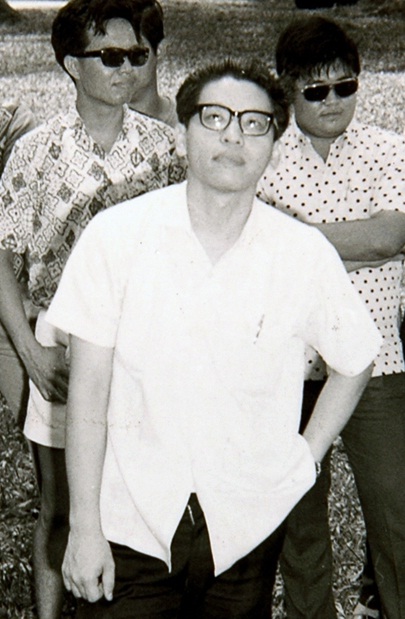
Lim Kit Siang bersama konco-konconya sebelum peristiwa 13 Mei 1969
Di antara 20 perkara yang dituntut oleh Kit Siang adalah seperti berikut:
TANAH mesti diberi kepada semua yang tidak mempunyai tanah, tanpa mengira kaum. Sejak terbentuknya Kampung Baru Serdang, tiada tanah telah diperuntukkan kepada para penduduk dan ini adalah bukti nyata sikap rasis dan ketidakupayaan kerajaan Perikatan dalam hal pentadbiran dan pengagihan tanah.
PENGHAPUSAN pembahagian rakyat Malaysia kepada ‘Bumiputera’ dan ‘Bukan Bumiputera’.
TARAF KHAS diberikan kepada Bahasa Cina, Tamil dan Inggeris dengan Bahasa Melayu sebagai Bahasa Kebangsaan untuk digunakan dalam perhubungan antara kaum.
PENGGUNAAN BEBAS Bahasa Cina, Tamil dan Inggeris dalam Parlimen, Dewan Undangan Negeri-Negeri dan di notis awam dan persuratan kerajaan.
PENOLAKAN Laporan Abdul Rahman Talib yang bertujuan untuk menukar semua sekolah, sama ada rendah mahupun menengah, ke sekolah yang menggunakan Bahasa Melayu semata-mata untuk tujuan pengajaran, pembelajaran dan peperiksaan.
PENGHAPUSAN kategori ‘Sekolah Kebangsaan’ dan ‘Sekolah Jenis Kebangsaan’.
PENGGUNAAN sebuah sistem pendidikan yang bersepadu, dengan bahasa-bahasa utama (Cina, Tamil dan Inggeris) digunakan dalam pengajaran, pembelajaran dan peperiksaan, dan pengiktirafan sekolah-sekolah tersebut sebagai ‘Sekolah Kebangsaan’ asalkan ianya berpaksikan Malaysia dan mengajar Bahasa Kebangsaan sebagai Bahasa Kedua.
PENERIMAAN kesusasteraan Malaysia yang ditulis oleh rakyat Malaysia sama ada penulisan tersebut adalah dalam bahasa-bahasa selain Bahasa Melayu.
Menuduh Encik Lee Siok Yew dan MCA sebagai menjual kepentingan kaum Cina kepada Melayu, Kit Siang berkata fanatik UMNO tidak akan membenarkan bahasa lain tumbuh dengan bebas, dan itulah sebabnya mereka (UMNO) tidak membenarkan penggunaan bahasa Cina dan lain-lain di Parlimen, Dewan Undangan Negeri, persuratan kerajaan, notis awam, dan sebagai media pengajaran dan peperiksaan di sekolah-sekolah.
Tambah Kit Siang lagi, akhirnya fanatik UMNO mahu melihat terkuburnya bahasa Cina dan lain-lain – supaya di tempat-tempat awam, kedai, rumah, hanya Bahasa Kebangsaan digunakan.
Demikianlah sikap Lim Kit Siang yang dianggap kini oleh seorang tua yang mudah lupa sebagai bukan rasis. Adalah diharap agar kita mengingati sejarah negara ini dan apa yang telah dilakukan oleh segelintir orang yang tidak mahu lihat generasi yang akan datang hidup dalam keadaan aman dan muhibbah.
I found this on FMT and this is good especially for those born after 1970 and never knew the man:
Malaysians must never forget that under former prime minister Tun Dr Mahathir there were monetary losses amounting to tens of billions of ringgit unaccounted for, and irretrievable.
These include: Forex scandal in early 90s : RM30 billion The Perwaja Steel Scandal : RM10 billion Bank Bumi scandal: RM10 billion Maminco-Makuwasa Affair RM1.6 Billion
Mahathir used Petronas as a ‘bank’ to bail out many companies, banks etc.
Opposition politician Syed Husin Ali said, “Petronas has neither been fully transparent nor accountable with how it spends its money, especially in aiding and abetting Tun Mahathir to indulge in unproductive construction of mega projects, to bail out ailing crony companies and corporate figures, and to involve [itself]in excessive and wasteful spending on celebrations and conferences.”
Mahathir used his position to bail out his children or to give them special benefits.
Konsortium Perkapalan
In early 1998, Petronas acquired a debt-laden shipping concern controlled by Mahathir’s eldest son Mirzan Mahathir’s Konsortium Perkapalan for RM 226 million and assumed its debts of more than 324 million, according to Far Eastern Economic Review stating the debt at RM 1.6 billion.
In early November 2012, Petronas Carigali Sdn Bhd reportedly awarded a RM700 million contract to a Sapura-Kencana Petroleum Bhd wholly-owned subsidiary where Mahathir’s son Mokhzani is a vice-chairperson.
Mahathir replied in a sarcastic tone when asked during a press conference whether there was conflict of interest in the deal.
“Yes of course, he (Mokhzani) is given it because I instructed Petronas. Put that in your paper. I presided over everything. I told them, please give to my son and not to anybody else. That’s what I have been doing all the time. When I was the prime minister, everything was given to my children. But when everything goes to the children of the other Prime Minister, you don’t want to mention because he is a nice man. He enables you to read, doesn’t he?” Mahathir said in reply.
Can Mahathir explain and repay all the above losses?
In sharp contrast, 1MDB is facing a cash flow situation but has strong assets.
When president of UMNO, Mahathir introduced a quota system for party elections to ensure he was not challenged. Now he is telling UMNO members to remove the PM.
When he was PM, he was infamous for using the ISA jailing opposition. Can you ever forget Ops Lallang I and II?
Has the current regime done that? No.
Tun Dr Mahathir could never be criticised by anyone, not even Soros. Today, old and filthy rich, he wants to criticize and remove Najib who has silently endured all attacks and is ready to be transparent.
Malaysians seem to have forgotten how ‘wonderful’ Malaysia was under TDM and are sharpening claws to attack Najib whom, thanks to the TDM media psywar, is perceived as the bad guy when actually the worst villain ever to have walked Malaysia is TDM! http://www.freemalaysiatoday.com/category/highlight/2015/03/14/never-forget-the-billions-lost-under-mahathir/
Daulat Tuanku – Sultan Muhammad V has been elected as the 15th Yang DiPertuan Agong
Sultan Muhammad V, the 29th Sultan of Kelantan, has been elected to become the 15th Yang DiPertuan Agong by the Council of Rulers today. His Royal Highness shall be replacing Tuanku Al-Haj Abdul Halim Mu’adzam Shah ibni Almarhum Sultan Badlishah, the Sultan of Kedah whose tenure will end on the 12th December 2016.
For months whispers have been flying around that HRH Sultan Muhammad V would not be eligible be elected as the YDP Agong as he is not married. However, there are only three reasons for a nominated Sultan to be disqualified;
He is not an adult,
He has made known to the Council of Rulers that he wishes not to be nominated, or,
Five of the Rulers vote against his nomination for reasons such as being mentally or physically challenged, or for some other reason.
The second and third reasons were used during the discussion to elect the First Yang DiPertuan Agong where Sultan Abu Bakar of Pahang was the most senior Ruler after Sultan Sir Ibrahim of Johor who had declined the nomination due to old age (Sultan Sir Ibrahim passed away on the 8th May 1959). He became the Sultan of Pahang on the 24th June 1932. However, Sultan Abu Bakar’s nomination was rejected FIVE TIMES by the Rulers because he was a controversial figure – he had financial difficulties and had wanted to marry a perempuan ronggeng (Abdullah Ahmad, 2016 p.141). Tunku Abdul Rahman, who was then the Chief Minister of Malaya advised Sultan Abu Bakar against marrying this woman named Hathifah binte Abdul Rashid if he wanted to become the Yang DiPertuan Agong. Sultan Abu Bakar agreed.
However, Sultan Abu Bakar married Hathifah anyway and Tunku only discovered so when they were honeymooning in Hong Kong (Straits Times, 21st April 1957).
Early this morning, the infamous portal Malaysiakini and the Malaysiakini-wanna-be Malay Mail Online both reported that the Sultan of Johor had declined the offer to become the next Yang DiPertuan Agong, quoting a Facebook page and not official sources.
It has been a norm that the Raja or Sultan with the most seniority would be considered as the candidate for the post of the Yang DiPertuan Agong. All the nine states have since provided a Yang DiPertuan Agong and the list of seniority is as follows:
The Yam DiPertuan Besar of Negeri Sembilan,
The Sultan of Selangor,
The Raja of Perlis,
The Sultan of Terengganu,
The Sultan of Kedah,
The Sultan of Kelantan,
The Sultan of Pahang,
The Sultan of Johor,
The Sultan of Perak.
With the ascension of the Sultan of Perak, Sultan Azlan Shah, as the ninth Yang DiPertuan Agong, a new official list was made based on the seniority of the states that have provided a Yang DiPertuan Agong previously. Whether or not Johor was offered is not known but such offer could only be made had the Sultans of Kelantan and Pahang declined the nomination. It would seem impossible for the Sultan of Kelantan to reject such offer only to accept it later when the one that should have been offered next is the Sultan of Perak.
Such is the uniqueness of the office of the Yang DiPertuan Agong that was institutionalised on the 31st August 1957. It was first to be called the Yang DiPertuan Besar but was rejected by the Rulers Council in favour of Yang DiPertuan Agong. Every five years the Rulers would meet to elect the next Yang DiPertuan Agong and the Timbalan Yang DiPertuan Agong. Although some say that this is similar to that practised in the United Arab Emirates, the office of the President of the UAE is a hereditary office of absolute monarchies. They are the government whereas in Malaysia the government is elected by the people and is dismissed by the people through general elections. And unlike in the UAE, the Rulers council cannot dismiss a Prime Minister or anyone else without the advise of the Prime Minister. Therefore, a recent attempt by Parti Pribumi member named Mahathir to get the Rulers Council to intervene and dismiss the Prime Minister is just a futile and cheap attempt to lie to the people of Malaysia. Of course, there would be those mentally-challenged people who would believe that he is right.
With the election of Sultan Muhammad V as the 15th Yang DiPertuan Agong it is hoped that this would bring about a much better cooperation between the PAS-led Kelantan state government and the Barisan Nasional-led Federal government. Such cooperation would be very beneficial to not only the development and people of the state of Kelantan, but also to the Malays and Islam in Malaysia that are coming under constant attacks by Malay liberalistas, evangelists and chauvinistic politicians opposed to Malay unity and the position of Islam as the Religion of the Federation.
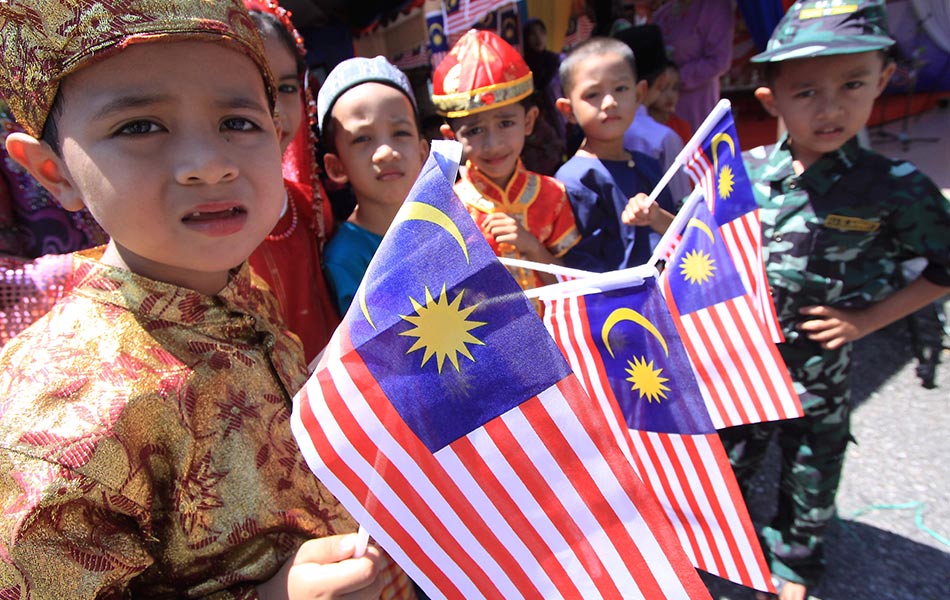
Children in different costumes holding the Malaysia flag – BERNAMAThis article is the last installment in a series on the Formation of Malaysia, and is a continuation from The Road to Malaysia: Part 3 – The Cobbold Commission.
“… there is no doubt about the wishes of a sizeable majority of the peoples of these territories to join the Federation of Malaysia.” (UN Secretary-General U Thant, 13th September 1963]
After World War 2, the British was economically and financially strained to maintain its colonies especially those east of Suez. It would be a matter of time before Britain would have to give up all of its colonies abroad, save for some of the smaller ones. The Cobbold Commission’s report agreed unanimously that a decision in principle should be taken by governments as soon as possible; that the new state should be called Malaysia; that the constitution of the Federation of Malaya should be adapted for Malaysia, instead of drafting a completely new one; that there should be no right to secede from Malaysia after merger.
Although the Tunku had asked the Malayan Commissioners to sign the report, he was still apprehensive about what “Malaysia” would do to his political position, and what kind of repercussions “Malaysia” would have on Malaya’s relationship with Indonesia and the Philippines.
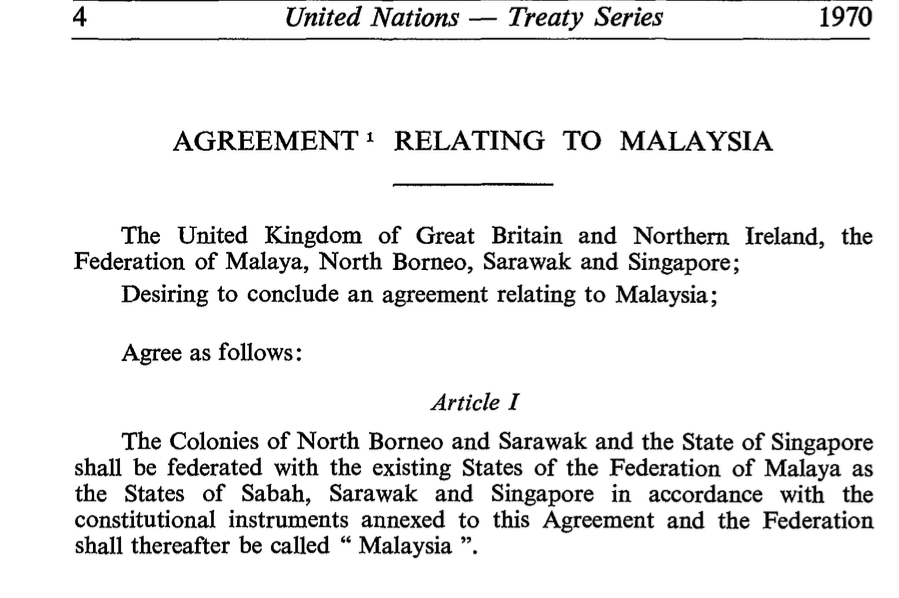
The Malaysia Agreement was signed on the 9th July 1963. Although not sovereign nor self-governing, the leaders of both North Borneo and Sarawak were invited to sign it. Annexed to the Agreement were a number of Constitutional instruments that included admission to the federation of the three former British dependencies; state constitutions for Sabah (as North Borneo would be called), Sarawak and Singapore; a scheme to compensate officers retiring from government service in North Borneo and Sarawak.
A separate legislation ending British jurisdiction in North Borneo, Sarawak and Singapore was enacted at Westminster. It did not provide for the separate independence of the three territories but transferred sovereignty to the new Federation of Malaysia (Commonwealth Relations Office and Commonwealth Office Briefs for Malaysia Bill, 1963 – Dominions Office DO 169/329). Therefore the self-rule given by the British to Sarawak on the 22nd July 1963 and the declaration of independence by Sabah on the 31st July 1963 were not a recognition of the independence of either Sarawak or Sabah, but an independence of the states in adherence to Malaysia (Ghazali Shafie’s Memoir on the Formation of Malaysia, p438). For all intents and purposes, both North Borneo and Sarawak remained as Colonies of Great Britain until the coming into operation of Malaysia.
If the appointment of a Chief Minister is to be taken as the point when independence had been achieved, Malaya would have been independent in July of 1955!
The late President Wee Kim Wee of Singapore, then a young Straits Times reporter, covered Sabah’s Merdeka Day and filed a report that, from all the obvious evidence, it was a declaration of independence within Malaysia.
The Malaysia Agreement referred to North Borneo, Sarawak and Singapore as Colonies.Malaysia Day was supposed to have happened on the 31st August 1963. However, several last minute events forced Malaysia Day to be postponed.
1) a last-minute interference by British officials prevailing upon Iban leaders to demand for the post of Sarawak Governor whilst also keeping the post of Chief Minister, thus reneging on an earlier understanding that for the first two years, the post of either the Chief Minister or Governor should go to a Malay if the other was given to an Iban. The Tunku was livid and decided that Malaysia would happen without Sarawak. All the cabinet ministers of Malaya except Tun Razak agreed with the Tunku. Through Ghazali Shafie, Razak negotiated with the leaders of Sarawak and in the end Abang Haji Openg was the Governor designate, Stephen Kalong Ningkan as the Chief Minister, and Temenggung Jugah as a Federal Minister in-charge of Sarawak Affairs. Had it not been for Razak’s persistence, the Tunku would have had things go his way and Sarawak would not have been in Malaysia.
2) the protest by both the Philippines and Indonesia at the United Nations against the formation of Malaysia. They requested that the UN secretary-general, or his representative, should ‘ascertain’ the extent of support in the Borneo territories for Malaysia, that observers from all three governments should accompany the UN mission, and that the formation of Malaysia should be postponed until the completion of the UN report.
Led by Lawrence Michelmore (the American deputy director of the UN Office of Personnel) the mission consisted of Argentinian, Brazilian, Ceylonese, Czech, Ghanaian, Pakistani, Japanese, and Jordanian members of the UN Secretariat. It was accompanied by observers from Indonesia and the Philippines—an arrangement which the British government grudgingly accepted. From 24th August to 4th September they held public hearings in widespread locations and reconvened in Kuching on 5th September, past the 31st August 1963 deadline. This forced Malaya to change the date for Malaysia Day to 16th September 1963.
The UN report, which was published on the 14th September, was generally favourable to Malaysia. In his assessment of the mission’s findings, U Thant was in no doubt that ‘a sizeable majority of the peoples’ wished to join Malaysia, although he also rebuked the Malayans for fixing a new Malaysia Day before the mission had completed its work. Even before the survey was finished, however, Indonesia and the Philippines were attempting to discredit it and, on its publication, they rejected the report and refused to be bound by its findings.
3) was of the PAS Government in Kelantan wanting the Malaysia Agreement and Malaysia Act to be declared ‘void and inoperative.’ Kelantan argued that the Act would abolish the Federation of Malaya, thereby violating the Federation of Malaya Agreement of 1957; that the proposed changes needed the consent of each state of Malaya and that this had not been obtained; that the Sultan of Kelantan should have been a party to the Malaysia Agreement in the same way as the Malay rulers had been signatories of the Malaya Agreement of 1957; that constitutional convention called for consultation with the rulers of individual Malay states regarding subsequent changes to the constitution; and that the federal parliament had no power to legislate for Kelantan in this matter.
On the 14th September 1963 the Chief Justice ruled that both the Malaysia Agreement and the Malaysia Act were constitutional (Tan Sri Mohamed Suffian bin Hashim, An introduction to the constitution of Malaysia (Kuala Lumpur, 1972) pp 13–14).
By 16th September 1963, we are all Malaysians.
Looking back, I remember an article quoting Tan Sri Abdul Ghani Gilong relating his experience visiting Kuala Lumpur on the invitation of the Tunku, he said:
“Kami naik kenderaan yang dipandu. Bagi sesetengah anggota delegasi saya, itulah kali pertama mereka menikmati air paip dan tandas berpam.”
“Kami dibawa ke beberapa tempat dan kampung yang sudah mendapat pembangunan seperti jalanraya dan sebagainya. Saya sendiri apabila balik ke Sabah telah berkempen menyokong penubuhan Persekutuan Malaysia dengan memberitahu kawan-kawan mengenai pembangunan yang ada di Malaya ketika itu.
Katanya satu kejadian lucu ialah apabila ada anggota rombongannya tidur di lantai dalam bilik hotel mereka dan bukan di atas katil yang empuk.
“Apabila saya nampak, mereka memberitahu saya mereka ingatkan katil itu adalah untuk ‘tuan’, seolah-olah hanya orang kulit putih boleh tidur di atas katil dan anak tempatan tidur di atas lantai sahaja.”
“Saya beritahu mereka katil itu mereka punya untuk tidur di atasnya.”
(“We rode on a vehicle that came with a driver. For some members of my delegation, that’s the first time they enjoyed tap water (running water) and flushing toilets.”
“We were taken to several places and villages that have received development such as roads and so on. When I went back to Sabah I campaigned in support of the establishment of the Federation of Malaysia by telling my friends about the existing development in the then Malaya.
He said that one funny scene was when there were members of his entourage who slept on the floor in their hotel room and not on their comfortable.
“When I saw, they told me they thought it was a bed especially for the ‘master’, as if only the white people could sleep on the bed while the local people sleep on the floor.”
Such was how inferior the people of Sabah and Sarawak felt of themselves before Malaysia existed, and it was not that long ago.
I believe that there has been progress that has been made in both Sabah and Sarawak although there should be more. When I was working offshore, most of my drilling and marine crew are from Sabah and Sarawak, especially the Ibans. My last Chief Mate is a Kelabit from Bario, while one of our vessels’ Captain is a Kedayan from Limbang. In my opinion, both the Merdeka Day on the 31st August and Malaysia Day on the 16th September are equally important to us. Without the 31st August 1957 event, Malaysia would not have happened and I shudder to think what ill-fortune would have befallen the people of Sabah and Sarawak, especially with China, Indonesia and the Philippines staking a claim in both the states.
I also believe that the current Federal Government is doing all it can to fulfill the promises made back in 1963, an uhill task given that previous Prime Ministers, especially a particular former Prime Minister for 22 years, did not do much for the people of Sabah and Sarawak.
Let us concentrate on nation-building, and put aside state-nationalism as that brings about nothing beneficial to any of us. And let us not let hatred destroy us. Our forefathers who agreed to form Malaysia did so following the democratic system, and not through violent nor nonsensical demonstrations or coups.
And let us remember the famous words by the great Temenggung Jugah ak Barieng:
“Anang aja Malaysia tu baka Tebu, Manis di pun, tabar Di ujung”
(Let’s hope Malaysia does not end up like a sugarcane. Sweet at the beginning, bland at the end)
In Vietnam, Laos and Cambodia the communists were making advances while the number of American servicemen in Vietnam tripled the number sent in 1950. In Indonesia, the influence of the Partai Komunis Indonesia on President Sukarno was strong. In Singapore, all the political parties except Singapore UMNO accused the PAP of having carried out negotiations to be merged with Malaya without first consulting the people. This gave ammunition to the communists in Singapore and their sympathisers to attack both Lee Kuan Yew and the Tunku.
In British Borneo, the communists and their sympathisers tried to intimidate the natives thinking that it would work as it did in Singapore. Truth be told, it had quite the opposite effect. Lee Kuan Yew observed that as in Singapore, those anti-Malaysia in Sarawak were the Chinese communists, chauvinists and their sympathisers, while in North Borneo, they were Chinese businessmen and Chinese who were under the influence of individual British officials who were opposed to the Malaysia Concept, or ignorant of it. Kuan Yew noted that the direct links between the Chinese in Perlis throughout Malaya and Singapore to the British Borneo are the Chinese newspapers. Hence, Kuan Yew suggested to the Tunku for the Chinese chauvinists be separated from the Chinese communists and the two groups should be separated.
Members of the Cobbold Commission arrived in Kuching in the morning of the 20th February 1962. The members were:
Sir Cameron Fromanteel Cobbold, former Governor of the Bank of England, also Chairman of the Commission of Enquiry,
Sir Anthony Foster Abell, former British Governor of Sarawak and the High Commissioner to Brunei,
Sir David Watherston, the last British Chief Secretary of Malaya,
Wong Pow Nee, the Chief Minister of Penang, and,
Ghazali Shafie, Permanent Secretary to the Ministry of Foreign Affairs of Malaya.
They were first brought to the Astana, a house that was built in 1870 by the second White Rajah, Charles Anthoni Johnson Brooke as a wedding gift for his wife, Margaret Alice Lili de Windt. It had been occupied by the British Governor since 1946. Ghazali Shafie could not help but notice a Jawi inscription at the entrance of the Astana left by one of the Brookes “BERHARAP LAGI BERNAFAS, (Have Hope While There Is Still Breath)” perhaps an apt motivation for the colonial officials who did not want Sarawak to be part of the Federation of Malaysia.
The Brookes had built the Astana on the northern bank of the Sarawak river because it was where the Malays were. The Brookes depended on the Malays for safety and security, the Chinese for prosperity and trading, while the natives were not entirely trusted. The same compartmentalisation was practised in Sarawak by the colonial officials after taking over the state from the Brookes in 1946.
The first groups of interviewees were interviewed in Kuching on the 21st February 1962. The first group amongst these interviewees was extremely pro-Malaysia. They were led by Abang Mustapha, Datu Bandar of Kuching. The second group was led nby Ong Kee Hui from SUPP. This group was against the special rights to be accorded to the natives of Sarawak unless if it is not stated in the to-be-formulated Constitution. This group had a contempt for the backwardness of the natives and had regarded their leaders as men of no consequences. This stand prompted an Iban by the name of Jonathan Bangau whom the SUPP had nominated as the party’s leader in Sibu to resign.
The next day, another group of Chinese in Kuching were interviewed. Their spokesperson, a Chinese woman, twisted and distorted events in Malaya into something truly hateful. She accused the Malayan Government of policies that turned very young girls into prostitutes and had labour laws that accorded workers not more than Ringgit 1.50 per fourteen-hour working day without holidays! When these allegations were countered by Ghazali and Wong Pow Nee, she informed the Commission that she had read the stories from Chinese newspapers to which Wong Pow Nee murmured that these must have been communist publications.
In Bau and Simanggang (now Sri Aman), banners and placards expressing anti-Malaysia slogans in Chinese characters plastered the town in anticipation of the Commission members interviewing residents there. The scene was different in Kanowit and Kapit. People shook the hands of the Commission members, especially the Malayan ones. One of the Tuai Rumah even held Ghazali Shafie’s hand as they walked through Kapit town. They were all awaiting the arrival of Malaysia!
However, Ghazali learnt that under the colonial administration the Iban had suffered oppression and suppression. This began when Sarawak was under the Brunei Sultanate and continued under the Brookes and subsequently the British. When they faced the Commission, they were all for Malaysia and some even emphasised on the need for a speedy arrival of better education and development for the Iban community.
At Binatang (now Bintangor), the division between the wishes of the natives and the Chinese was most prominent. The natives were all for the speedy arrival of Malaysia while the Chinese were divided into two groups: one favouring a referendum, while the other favouring a Federation of North Borneo, Brunei and Sarawak – a line maintained especially by the communists.
In North Borneo, the only negative views were given by the British officials and expatriates as well as the rich local businessmen. At this juncture, Ghazali noted that these British officials knew nothing or chose to disregard Harold MacMillan’s famous “Wind of Change” speech in Cape Town made on the 3rd February 1960.
Cobbold, not having any experience in dealing with the Far East, succumbed to the ideas of these officials that in his draft, he recommended that both the British and Malayan Governments should have executive powers over the British Borneo states for five years. Both Wong Pow Nee and Ghazali believe that the Malayan Government would never agree to perpetuate colonialism in any form. However, the two governments should discuss the matter should they want the British officials to stay on in Borneo in the service of the two territories. Wong Pow Nee quoted the state of Penang where he was once a Chief Minister to demonstrate the point that the British fears were groundless and that the Tunku, the Malayan people as well as the 70 percent who advocate the creation of Malaysia in the North Borneo and Sarawak would not agree to Cobbold’s suggestions as it would still be a form of colonialism. What more that the communists in Malaya, Singapore, Indonesia, China and the Soviet Union had branded the Malaysia Concept as neo-colonialism. Interesting also to note here is that in April 1962, the Philippines House of Representatives had made a formal claim on North Borneo. On the 20th January 1963, Drs Subandrio, and alleged communist and also Sukarno’s Foreign Minister and Second Deputy Prime Minister announces Indonesia’s “confrontation” towards Malaysia.
In the end, on the 31st July 1962, Prime Minister Harold MacMillan told the Malayan delegates that Her Majesty’s Government was just as anxious to see Malaysia succeed. Soon after, an Inter-Governmental Committee (IGC) was set up by the Malayan and British Governments that would include the North Borneo and Sarawak Governments. On the 12th September 1962, the North Borneo Legislative Council adopted the following motion:
“Be it resolved that this Council do welcome the decision in principle of the British and Malayan Governments to establish Malaysia by the 31st August, 1963…”
Then on the 26th September 1962, the Council Negri of Sarawak adopted the following motion without dissent:
“This Council welcomes the decision in principle of the British and Malayan Governments to etablish Malaysia by the 31st August, 1963…”
The Federation of Malaysia that would include the Federation of Malaya, North Borneo and Sarawak was to come into operation by the 31st August 1963. All in all, the IGC made recommendations in its report pertaining to the States’ Constitutions, legislative powers, financial provisions, elections, the Judiciary, public service, citizenship, immigration, religion, education, the National Language, status of existing laws, the position of the indigenous races and transitional arrangements prior to the formation of Malaysia.
North Borneo was thoroughly satisfied with the IGC report and the North Borneo Legislative Council unanimously adopted the Report on the 13th March 1963. The Sarawak Government was satisfied and considered that the Report contained “generous terms of safeguards for Sarawak.” Stephen Kalong Ningkan as the Secretary-General of the Sarawak Aliance said that his party “fully endorses the Report.” Leong Ho Yuen, the Vice-Chairman of the SUPP said: “All in all, the Report is quite satisfactory. Though we cannot get all we asked for, at least we have been given a high percentage.” The Sarawak Council Negri voted unanimously to adopt the Report on the 8th March 1963, five days before North Borneo.
Donald Stephens who was the Chairman of the Executive Committee of the North Borneo Alliance said: “The whole of North Borneo will now welcome with joy the creation of Malaysia.”
Tomorrow, on Malaysia Day, we shall look into the self-rule granted to the State of Sarawak and why was Malaysia formed on the 16th September 1963 instead of on the 31st August. We will also look at what was said by those who were involved in parts of the process.
During the Commonwealth Parliamentary Association of Asia (CPA) meeting in Singapore on the 23rd July 1961, a conference resolution to establish a Malaysia Consultative Committee led by North Borneo’s Donald Stephens and Sarawak United People’s Party’s Yeo Cheng Hoe. Both would become members of the Malaysia Solidarity Consultative Committee and hasten the formation of the Federation of Malaysia.
We see today how some foreign plenipotentiaries act in contravention of Article 41(1) and (2) of the Vienna Convention on Diplomatic Relations, 1961 where the diplomat should not interfere with the internal affairs of the Receiving State and all businesses by the mission of the Sending State must be coordinated with the Foreign Ministry or any other relevant ministries of the Receiving State. However, we see today various anti-government NGOs being courted by these foreign missions, even to the extent of having the number one diplomat attending and participating in the programs executed by these NGOs.
Things were not much different back in 1961 – especially for Singapore, although Singapore was still a Crown Colony with self-rule. George Douglas Hamilton, the 10th Earl of Selkirk (Lord Selkirk) was often observed by Lee Kwan Yew to be making special efforts to court left-wing politicians especially PAP’s left-wing politician Lim Chin Siong, who are opposed to the Malaysia Concept. This relationship grew stronger and especially after the Hong Lim by-election in April 1961 where an Independent thumped PAP’s candidate by a 4,927 majority, and later the Anson by-election in July 1961 where the Worker’s Party’s David Saul Marshall trounced PAP’s Mahmud Awang by a 546 majority. Because of Lim Chin Siong’s ties with the communist-oriented Anti-British League, the PAP leadership began to be openly challenged by the pro-communist members of the PAP and were now prepared to assume leadership. Tunku’s grouse with PAP is not that it is a pro-communist party, but that it is not anti-communist.
For the British, they did not mind if Singapore was governed by a pro-communist government as long as they are allowed to keep their base for use by the South-East Asia Treaty Organisation (SEATO). To the communist, it was a good rallying point for the British to continue keeping Singapore as a colony and a base in order to attract more anti-colonial supporters to Singapore and the Borneo territories, and intensive anti-merger campaign was undertaken by the communists in Singapore. Lee Kwan Yew believed that the British authority in Singapore had encourage the communists in the PAP to revolt against the non-communist leadership in PAP. Kuan Yew coud not take action by imprisoning the communists for fear that he would be branded a British stooge and that would exacerbate the revolt by the communist against the PAP leadership. Merger with the Federation of Malaya was now central in his struggle against the communists.
The mood for Malaysia in Jesselton (now Kota Kinabalu) however was very good. When Ghazali Shafie arrived there, Sir William Almond Condrington Goode, the British Governor for North Borneo who was leaving for Sandakan told Ghazali to use his car to get around Jesselton for the Commonwealth Committee meeting. As he got into Goode’s car, Ghazali noticed that the driver had not removed the state pennant from the car and asked the driver to do so, so he (Ghazali) could travel correctly in the car. The driver turned around and replied that because of “Malaysia” he would drive Ghazali with the state pennant flying, and drove off with policemen saluting.
The Committee agreed that its aims and objectives should be to collect and collate views and opinions concerning the creation of Malaysia; to disseminate information on the question of Malaysia; to initiate and encourage discussions on Malaysia; and to foster activities that would promote and expedite the realisation of Malaysia. While Donald Stephens chaired the meeting, North Borneo was represented by Datu Mustapha, Singapore by S Rajaratnam, and Sarawak by Yeo Cheng Hoe. All of them agreed with the grand plan.
William Goode was not happy with Donald Stephens’s statement on Malaysia, in particular the latter’s target date of 1963 for the formation. Lord Selkirk had prior to this expressed that the people in British Borneo were not ready to govern themselves as they were still headhunters twenty years earlier. Therefore, Selkirk opined that it would be better for the people of British Borneo to come under a Federation of North Borneo, Brunei and Sarawak for five to ten years before they could decide whether or not to merge with Malaya to form the Federation of Malaysia. Sir Alexander Waddle, H.C White and Sir William Goode, the Governors of Sarawak, Brunei and North Borneo respectively made mention on how the idea of Malaysia is being received warmly by the people of the respective states; however they were worried that the Singapore Chinese especially, would swamp them.
On the 26th and 27th August 1961, Ghazali Shafie met with Kadazan leaders as well as leaders from the United Kadazan National Organisation (UKNO) to explain to them the Malaysia Concept, and after hearing about the special position accorded to the Malays in the Federation of Malaya Constitution, they all agreed that Malaysia would be the best solution to protect especially the interests of the Kadazans.
Later at night on the 27th August 1961, the British District Officer had invited Ghazali for drinks with British, European as well as Chinese leaders. Ghazali had suspected that it was more of an exercise to intimidate him. True enough some asked what was the advantage that the Federation of Malaya would get from Malaysia to which Ghazali replied saying that the question of advantage to Malaya would not arise as Malaya would simply cease to exist with the formation of Malaysia. Another pointed his finger at Ghazali and poked him in the chest asking why is Malaya in a hurry to form Malaysia since the people of British Borneo were not yet ready and to let the states of Borneo form their own Federation first? Ghazali pointed his finger back at the person and reminded him that the Tunku had merely made a mention about the Malaysia Concept once in Singapore and one or two more statements after that, and if the person felt that he was being pressured it was not because Malaya had pressured him but that he had been caught in a new political whirlpool within the Borneo territories and he had little knowledge of and was not keen on adjusting himself to the new order.
Back in Kuala Lumpur, Lee Kuan Yew was in absolute hurry for Singapore to be merged with Malaysia. The threat of the communist was real. In a discussion, he agreed with the Tunku that the rights of the Malays in Singapore would take precedence as the Malays in Malaya and Singapore, together with the “sons of the soil” in North Borneo and Sarawak, would form the single largest entity in the new Federation. The Tunku lamented to Kuan Yew that Malaya was very short of effective Chinese leaders. Tan Siew Sin of the MCA was a very sincere and clever man but could not speak any Chinese dialect to be really influential among the Chinese masses. It was no secret then that the Tunku would prefer to have Kuan Yew to assist him in managing the politics among the Chinese in the new Malaysia.
Back in North Borneo, trouble was brewing. The British Government had sent Donald Stephens to the UK to attend the Commonwealth Parliamentary Association meeting, while colonial officials in North Borneo worked on to split the Kadazan by saying that Donald Stephens was not a real Kadazan. As a result, UKNO was split into three factions: one following Donald Stephens, another following Abdul Ghani Gilong, while the other following Orang Kaya-Kaya GS Sundang. Datu Mustapha himself was offered two million Ringgit by a wealthy Chinese to form a political party that would espouse the Malaysia Concept but at its own pace, prefering to hang on to the colonial administration. On hearing this, Ghazali advised Mustapha to form a firm relationship with Donald Stephens in order to bring together the natives of North Borneo. Once a strong base was established, the Chinese would have no choice but to capitulate.
It was not an easy task. Donald Stephens was from the Kadazandusun community. The Kadazans and Dusuns were naturally biased towards the colonial officials and the white rulers who served the North Borneo Company before them. These white rulers’ laws protected them from pirates and coastal marauders who plundered their homes and treated them with no respect – the Suluks. Since Mustapha was a Suluk, the Kadazans and Dusuns treated him with fear and distrust though not without awe and respect. That was how the British applied the divide et impera policy to keep them apart.
On the 27th September 1961, the British High Commissioner to Malaya, Sir Geofroy William Tory, called upon Ghazali Shafie to inform the latter that the Governors of North Borneo and Sarawak reported that the people of North Borneo were thinking along the thoughts of the Governors – that is to form a North Borneo Federation instead. When pressed for further explanation, Tory admitted that the Governors were talking in terms of what the Chinese businessmen said.
On the 9th October 1961, Donald Stephens, Mustapha and with about thirty people in the North Borneo delegation arrived in Kuala Lumpur at the invitation of the Tunku who spoke to them both about the need to forget past quarrels and work together for the people of North Borneo. The Tunku also spoke to them about the Chinese community in North Borneo who very much supported the colonial administration there but told them to not be hostile towards the Chinese.
After dinner that night, Mustapha spoke to the attendees about how he and Donald Stephens had decided to form a political movement that would devote itself towards the independence of North Borneo through the Malaysia Concept. He also confessed to have regarded Donald Stephens as a rival for the leadership of the natives, but must now be brothers for the sake of North Borneo and encouraged the other community leaders in the delegation to do the same to one another.
Donald Stephens was more emotional. Tears were rolling down his cheeks when he admitted he had not trusted Mustapha before and asked for the latter’s forgiveness. There was a thunderous applause and both Mustapha and Donald Stephens embraced each other and announced to those present that they were now blood brothers and pledged to work together for the well-being of the people through the Malaysia Concept.
A North Borneo Chinese by the name of Chan also spoke in support of the Malaysia Concept and thought the Chinese should also form a political party. He, Donald Stephens and Mustapha then held hands together with everyone else and shouted Merdeka Malaysia ten times in keeping with the feng shui of the double ten – it was already the 10th October 1961, and this happened inside the Federal Hotel on Jalan Bukit Bintang.
After much deliberation at the second Malaysian Solidarity Consultative Committee meeting in Kuching, as well as some political maneuvering to get the support of Kalong Ningkan and his Sarawak National Party (SNAP) as well as to neutralise the opposition to the PAP within UMNO led by Aziz Ishak, it was decided that an Enquiry Commission, as envisaged by the Tunku and Harold MacMillan, to be appointed to gauge the desirability of the Malaysia Concept among the people of North Borneo and Sarawak.
In Part Three, we shall look into the Cobbold Commission’s work and findings, and reaction by our neighbours.
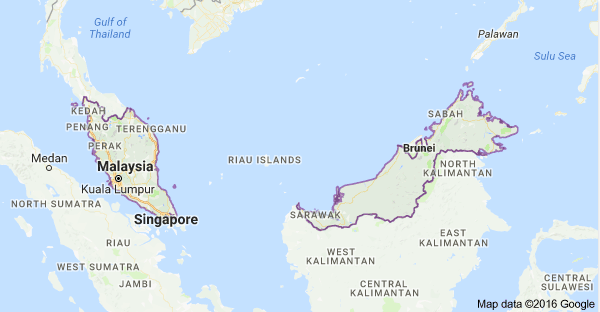
Google map data 2016 of Malaysia“Najib Abdul Razak has done more for Sarawak than all the previous Prime Ministers, including the one who served for 22 years,” said Sarawak Chief Minister, Adenan Satem to a crowd of about 3,000 people at the State Gawai Dayak Dinner in 2015 (Malaysiakini: 4 June 2015). That was what crossed my mind when thinking about sacrifices on the morning of the first day of Aidil Adha. Najib Razak broke previous Prime Ministers’ record for being the PM who has visited Sarawak the most and has brought about promising developments in both Sabah and Sarawak including the toll-free Pan Borneo Highway. What is most important is the capacity building for Bumiputera contractors through the 30 percent participation of Bumiputera contractors in this project.
All this had its beginnings more than 50 years ago when both Sabah and Sarawak were the British Colonies of North Borneo and Sarawak.
Prior to 1948, there was no country called Malaya but a territory of nine sultanates as British Protectorates and three Straits Settlements as Crown Colonies. Only the Crown Colonies were under direct British rule via the Colonial Office (Seademon Says: The Road to Merdeka – British Malaya, 12th September 2011). The British almost succeeded in implementing a Federation albeit through the shortlived Malayan Union, but that was later replaced with the Federation of Malaya on 1st February 1948.
Back then, Malaya was just a place for the Chinese migrants to work for money that would be sent home to China – the country the British had encouraged them to remember as their home during the interwar years. Tun Ghazali Shafie, then the Deputy Assistant District Officer of Kuala Lipis. He recalled how, when asked if the Chinese would support the Malays in an endeavour to dislodge all British Advisors from all the states of Malaya, the Justice of Peace for Kuala Lipis Mr Ong Siong Teck replied, “We Chinese had always been independent. Of course, but we must be given a place.”
On the 27th July 1955, the Alliance Party had won all but one seat in the Federal Legislative Council elections, and on Sunday, 31st July 1955, the Tunku handed the British High Commissioner his list of cabinet members (six Malays, three Chinese and two Indians) that would still have to be passed to the Rulers for their formal concurrence. This was when the Federation of Malaya gained self rule, a big step towards independence. At this time, there was a planned hegemony over the mainland including Malaya and Singapore, leaving the islands to Sukarno’s Indonesia (Seademon Says: The Road to Merdeka – Persekutuan Tanah China, 6th September 2011). Communism was rearing its ugly head at Malaya, Singapore and Borneo.
By June 1959, Singapore had its General Elections and Lee Kwan Yew’s People’s Action Party (PAP) was swept into power. The communist group in Singapore, including those in the PAP, had to lie low for the time being as Kuan Yew had promised the British that he would not allow any subversive elements to conduct their activities. Singapore was keen for a merger with Malaya as that would grant them independence and assure them that the Federal government of Malaya would never allow the communists to exist.
By the end of April 1961, the situation in the South East Asia had changed drastically with the Pathet Lao guerrillas had come quite close to Luang Prabang in northern Laos, with the help of the Soviet Union and China. It was then that Ghazali Shafie pressed the Tunku to hasten the “Malaysia Concept” to create a Federation of Malaya, Singapore and the British North Borneo that included the Sultanate of Brunei.
On the 27th May 1961, the Tunku signalled the birth of the “Malaysia Concept” in a speech in Singapore to the Foreign Correspondents Association (Ghazali Shafie’s Memoir on the Formation of Malaysia, 1998 pg.26):
“…sooner or later Malaya should have an understanding Ong Siong Teck Britain and the peoples of Singapore, North Borneo, Brunei and Sarawak. It is premature for me to say now how this closer understanding can be brought about, but it is inevitable that we should look ahead to this objective and think of a plan whereby these territories can be brought closer together in political and economic cooperation…”
“In North Borneo, there were already signs that Manila was going to make a cartographic claim based on some vague historical background,” wrote Ghazali Shafie, “(and) the Communist Clandestine Organisation (CCO) in Sarawak with assistance from abroad had begun to show its fangs and claws. Whitehall would never do nything very positive for the people and that colonial territory could not be defended by armed means in the post-World War II period of anti-colonialism.”
The British then planned for a federation for North Borneo, Brunei and Sarawak, and some British officials in Brunei even encouraged the locals to hate Malayan expatriates there. In fact, a Malayan forest officer, Yakin, was assaulted by Bruneians. These Malayans were there at the request of Sultan Sir Omar Ali Saifuddin III to replace British officials in key posts, making the Bruneians think that the Malayans were stealing their jobs and subtly colonising them.
The Yang DiPertuan Agong, the Tunku and Malaysian officials visiting Brunei were subjected to insults and had the word CONGO shouted at them. The truth is no Brunei high officials had ever bothered explaining to the people of Brunei the reason they were there, including Haji Marsal Maun, the Menteri Besar of Brunei.
Before ending the visit, the Tunku made a radio broadcast to the people of Brunei telling them that the presence of Malayan officials in Brunei was at the request of His Highness the Sultan of Brunei and it was never Malaya’s intention to colonise.
While the Yang DiPertuan Agong left Brunei for Kuala Lumpur, the Tunku continued his tour to Sibu on board the KD Mutiara. She was the first ship that was specifically built for the Royal Malayan Navy. She was also the first RMN vessel to be given the “Kapal DiRaja” title and was the first RMN vessel to be built locally. Their destination was Sarawak, a state that was once a realm of Brunei until 1841 when James Brooke was granted the areas around Kuching and Bau, from Sultan Omar Ali Saifuddin II, and was later given the title Rajah of the territories. The White Rajahs ruled Sarawak until 1946 when after the war Charles Vyner Brooke, the 4th Rajah of Sarawak ceded his interest in Sarawak to the Colonial Office for a sizeable pension for him and his three daughters. Unsure of the legality of the cession, the British Government quickly passed a Bill of Annexation, effectively ending the rule by the White Rajahs.
In Sibu the Tunku met with Temenggung Jugah, Aini Dobi (whose brother Rosly Dobi was hanged for the assassination of Governor Duncan George Stewart in 1949), Tuanku Bujang, Abang Louis Barieng and Ahmad Zaidi Adruce. An Iban in the administrative service in Sibu approached Ghazali Shafie asking the latter to explain more about the “Malaysia Concept.” Ghazali Shafie told the former in general what it was all about and the intentions of uplifting the indigenous people using the same special position of the Malays in the Malayan Federal Constitution. Bennet agreed that Sarawak could achieve independence through the “Malaysia Concept” but his worry was having the Chinese from Singapore flooding Sarawak. Ghazali suggested that Sarawak could ask for special powers to control immigration to which Bennet touched Ghazali’s hand saying, “Please help us.”
The Ibans were in a dire strait. Sibu was a town that was very Chinese – 95 percent of its 29,630 inhabitants in 1961 were Chinese. In comparison, Sibu had 162,676 inhabitants in 2010 and 65 percent were Chinese. A school that the Tunku had visited just outside of Sibu only had a Primary Two class and was not able to find a teacher compared to a Chinese school nearby. The British were not interested in developing the locals and if the situation was to continue for long, the rate of development for the Iban would be slow compared to the Chinese who had very good schools. Even Temenggung Jugah was illiterate. He had a signatured tattoed to his left arm and would put his left arm on a piece of paper so he could copy that to sign documents!
As they left Sibu and the KD Mutiara sailed down the Rajang, it was obvious that Sarawak as a colony would not be left alone by Communist China. Ships from China sailing the Rajang had revolutionary songs blaring over their tannoy system, even in the town of Binatang (now Bintangor). It was obvious that the Chinese were using revolutionary propaganda to stir up anti-colonial feelings amongst Sarawak’s masses, and that the “Malaysia Concept” would be the best way to save Sarawak especially from China.
When the KD Mutiara sailed past Binatang, a town of a few brick houses and a dirt road, the people had come out to the jetty shouting for the Tunku to stop. The Tunku requested for Lt Ismail, the CO of KD Mutiara to anchor so he could go ashore. The Tunku was met by hundreds of people who gave him a very warm welcome, and the Tunku gave them some words of encouragement. Ghazali was met by two young people, an Iban police inspector and a Malay customs officer. Ghazali noted that both were critical of the colonial administration which had never brought any development to the local people. These two officers later resigned from their respective jobs and spent full time promoting the “Malaysia Concept.”
In the next part we shall talk about the consutations with North Borneo, Singapore and how the British tried to stall the formation of Malaysia.
Tiada Akta Parlimen yang menamatkan atau menyekat penggunaan bahasa Inggeris bagi apa-apa maksid yang disebut dalam Fasal (2) hingga (5) Artikel 152 boleh mula berkuatkuasa berkenaan dengan penggunaan bahasa Inggeris dalam Fasal (2) Perkara ini sehingga sepuluh tahun selepas Hari Malaysia.
Malangnya, dalam video yang kita saksikan sebentar tadi, Ahli Parlimen DAP tersebut tidak menyebut mengenai had sepuluh tahun selepas Hari Malaysia, iaitu pada 16 haribulan September 1973. Sebaliknya, bekiau berkeras menyatakan bahawa ianya menjadi hak beliau sebagai orang Sarawak untuk terus menggunakan bahasa Inggeris di dalam sidang Parlimen.
Setelah Hari Malaysia 1973, iaitu tamatnya perlindungan hak sepuluh tahun berbahasa Inggeris, Akta Bahasa Kebangsaan 1963/67 (semakan 1971) secara automatik berkuatkuasa di seluruh Persekutuan Malaysia. Ini bermakna bahasa penghantar rasmi bagi Sabah dan Sarawak juga adalah Bahasa Malaysia. Walau bagaimanapun, Seksyen 5 Akta tersebut memberi kelonggaran untuk seseorang Ahli Parlimen mahupun Ahli Dewan Undangan Negeri dari Sabah dan Sarawak untuk berucap dalam bahasa Inggeris di dalam majlis Parlimen tetapi dengan izin Speaker Dewan. Ianya bukan lagi suatu hak mutlak. Sekiranya tidak diizinkan oleh Speaker Dewan maka setiap Ahli Parlimen mahupun Dewan Undangan Negeri hendaklah menggunakan Bahasa Kebangsaan. Malah Akta tersebut dipinda semula pada tahun 1983 dan diperluaskan lagi.
Saya berasa hairan akan kedegilan pihak DAP yang terus menggunakan bahasa Inggeris sedangkan tidak berapa lama dahulu mereka memperjuangkan penggunaan Bahasa Kebangsaan dalam Kitab Injil malah tetap dengan pendirian mereka bahawa penggunaan kalimah Allah dalam kitab Injil adalah sebahagian dari ajaran Kristian yang tidak boleh diabaikan.
Oleh kerana mereka kini berkeras ingin gunakan bahasa Inggeris di dalam Parlimen, adakah ini juga bermaksud kalimah Allah tiada lagi kepentingan dalam perjuangan DAP?
Ini bukan kali pertama Ahli Parlimen Kuching daripada parti DAP ini mempersenda dan mempertikai apa yang termaktub dalam perlembagaan dan bersuara bagai menanam kebencian terhadap Malaysia.
Pada 17 September tahun lalu, Chong menganggap lagu kebangsaan Negaraku sebagai memalukan dan mengarut sebelum meminta maaf.
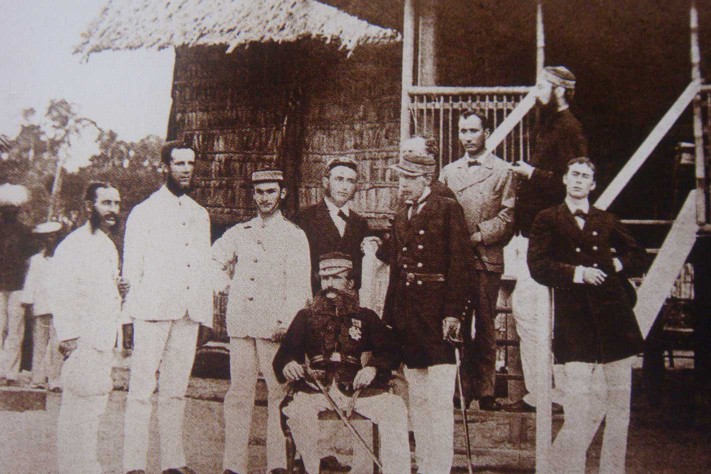
Sir William Jervois (seated) with JWW Birch standing to his left, and Frank A Swettenham right most by the staircase
Delegation of Authority
141 years ago Perak became the first sovereign state in the Malay peninsula to come into a treaty with the British for the latter to provide the former with protection, while the former has the “right” to interfere in the internal administration of the state – by the appointment of a Resident or Adviser to the Sultan, on the payroll of the Sultan, and whose “advice” must be asked and “acted upon” in all matters other than the ones affecting the Malay religion and custom (C.D Cowan, 1961; Emily Sadka, 1968; Eunice Thio, 1969). Between 1874 and 1930, similar but not identical treaties were signed with the other Sultans and Head of States. The treaties notwithstanding, the Sultans and Head of States remain the sovereign ruler of their respective sovereign state. De facto however, the British assumed the unstated “right” to administer the states as well with the exception of Kelantan through the Kelantan Treaty of 1910 (signed in Kota Bharu on 22 October 1910) when the government of King George V undertook not to interfere in the “internal administration” of the state or to curtail the “administrative authority” of the Ruler.
Sovereignty of the Rulers
Although the Rulers had divested much of their independence, both they and their state remained sovereign. Independence is not equal to sovereignty. As a principle of international law, sovereignty denotes, in its purest form, the concept of a ‘supreme authority’ be it an individual or a collective unit and implied power to exercise independence both internationally and domestically. Paradoxically, inherent in this conception of sovereignty is the possibility that the sovereign state could also impose limits on its own independence without suffering a diminution of its inherent sovereignty (L Oppenheim, 1928 pp 135 and 250; Albert Lau, 1991). In other words, the Anglo-Malay treaties in no way compromised the de jure sovereignty of the Malay Rulers.
There were three test cases to determine the sovereignty of the Rulers and the State they ruled:
The infamous Mighell v Albert Baker a.k.a Mighell v The Sultan of Johore (1894) which I have also covered in a previous article when the issue of the Ruler’s immunity as a sovereign was raised in an English court, it was ruled that, although the Sultan by treaty had bound himself not to exercise some of the rights of a sovereign ruler, this did not deprive him of his character as an independent sovereign.
In Duff Development Company Limited v The Government of Kelantan (1924), the House of Lords similarly upheld the sovereignty of Kelantan and its Ruler was not intended to be qualified by the terms of the treaty.
In Pahang Consolidated Company Limited v State of Pahang (1933), the Privy Council summarised the constitutional position in Pahang as follows: subject to the limitations which the Sultan had from time to time imposed upon himself, he remained ‘an absolute ruler in whom resides all legislative and executive power.’ (See, 1894; Q.B 1924; A.C and M.L.J)
The above implied that Britain could do nothing in these states contrary to the terms of the existing treaties. W. Ormsby-Gore, the Under-Secretary of State for the Colonies put it in 1928:
“Our (Britain’s) position in every State rests solemnly on treaty obligations….We neither have the right nor the desire to vary this system of government or to alter the type of constitution or administration that now obtains.”(W Ormsby-Gore report, 1928).
This was later echoed by Sir P. Cunliffe-Lister, the 1st Earl of Swinton and a prominent British Conservative politician, on 14 July 1933:
“There is no question at all of altering in any degree, even by a comma, the Treaties which bind us…and which are charters of the agreements with the Rulers both of the Federated and Unfederated Malay States.”
Interesting, however, is that the Colonial Office came close to discussing the deposition of two Sultans namely the Sultan of Johore (1906) and the Sultan of Terengganu (1919). In the case of the Sultan of Johore, the Colonial Office was told that unless Sultan Ibrahim of Johore complied with His Majesty’s Government’s wishes, he must “retire from the business altogether.” In 1914, Sultan Ibrahim was brought to task again for allowing conditions in Johore to deteriorate “to that which called for decided action in 1906” and warned that, unless the administration improved, “the only alternative is his removal from the State.” In 1919, Malayan officials, increasingly piqued by the obstructive nature of Sultan Muhammed of Terengganu, similarly recommended that “sufficient pressure” should be put on him to “compel his resignation.” (Minute by Lucas, 30 March 1906 CO 273/324 no. 10619; Young to Harcourt, 19 March 1914, CO 273/406 no. 13282; and report by J. Humphreys, 3 December 1919, CO 537/797 no. 5002).
Having said that, it frustrated the British that they had no jurisdiction whatsoever by virtue of the treaties signed, and a movement was initiated by Edward Gent, to change all that.
Willan’s Mission and the Malayan Union
Among the thorny problems of pre-WW2 Malay States is the question of the Chinese immigrants brought in by the British. In the Strait Settlements of Penang, Melaka and Singapore, they could be given the status of British Protected Persons. In both the Federated Malay States (FMS) and the Unfederated Malay States (UMS) the British have no jurisdiction to apply the same rule to them, nor are they citizens of their respective host state. As far as the Malay Rulers were concerned, only the Muslim Malays are their subjects, not those who are alien, non-native and are non-Muslims. The British tried to convince the Rulers and also by asking the Chinese to pledge loyalty to the Rulers. However, the Chinese were disinclined to accept the Malay Rulers as theirs.
The problem arose when in 1929 the Chinese government passed the Chinese Nationality Law stating that all persons of the Chinese race, wherever born, were considered as subjects of China. As such, the Chinese government could intervene in cases where the Chinese are not being fairly treated.
In 1911, the Malays made up 53% of the population. By 1931, they were already outnumbered and in 1941 formed only 41% of the population. The Chinese community was at 43%, displacing the Malays as the dominant racial group. The Malays were in a disadvantageous position and this proved explosive in 1946 during the Bekor tragedy. The Malays remained as the minority until 1970.
The only solution out of this is for the Chinese in the Malay states to be declared as British Protected Persons, but such move is against the treaties. To put this into effect, Malaya has to come under a federation or a union where power is central, and the Anglo-Malay Treaties be reviewed and replaced by a new one.
Following the Fall of Singapore on 15 February 1942, the British saw that it was no longer possible to return to the pre-war system as they had failed to provide the Malay states the protection from the Japanese. Edward Gent saw this as an opportunity to streamline all the Malay States and the Strait Settlements excluding Singapore under one administration to be based in Kuala Lumpur. A month after the Fall of Singapore, he set up a team to quickly work out a solution and framework even though it was still not known then how the war would end.
When the war ended, this plan was quickly put in place. Between 8 to 29 September 1945, the Deputy Chief Civil Affairs Officer of Malaya, HC Willan, accompanied by the Senior Civil Affairs Officer for Johor, Colonel MC Hay, made his way to the Pasir Pelangi palace and interviewed the Sultan Ibrahim. Having studied files and found proof of Sultan Ibrahim collaborating with the Japanese, his task was to assess the Sultan’s reception of the British. Not once, noted Willan, did Sultan Ibrahim hinted that the British had let him down by losing Johor. More remarkably, Sultan Ibrahim wrote to Colonel Hay the very next day intimated his willingness to “serve under the British Military Administration.” Willan opined that Johor would sign the new treaty.
Of all the Malay Rulers, only the Sultan of Perak proved difficult. Willan proposed that Johor, Selangor, Negeri Sembilan and Pahang should be approached in that order to sign the revised treaty. Once the rest have signed, there would not be any reason for Perak not to sign. When Harold MacMichael arrived in Johor, Sultan Ibrahim offered no resistance although he produced a memorandum containing points relating to the Sultan’s personal prestige and the status of Johor reproduced as Annex I in MacMichael’s report – Albert Lau, 1991). This is the “1946 agreement” made in conjunction with the signing of the Malayan Union agreement between the government of Johor and the British Military Administration that has been played up in the social media of late as the Federated Malay States agreement of 1948 had yet to be formulated. Johor was the first state to submit to being colonised by the British.
As expected, Sultan Abdul Aziz of Perak became the stumbling block. For Sultan Abdul Aziz, the central issue was still sovereignty. He wrote:
“It is true that under the Treaties I was bound to accept the advice of the British Resident, but nevertheless I was a Sovereign in my State having power to assent or withhold assent to legislation. I am now invited to sit as a member at an Advisory Council with the Governor assuming the function which rightly belongs to me. Being a member of the Advisory Council with authority over the other States is a doubtful honour. I neither desire to have any influence over the other States nor welcome any other Ruler to have influence within my State.”
The Sultan was also further incensed that under the new agreement the Malays in Perak would no longer swear allegiance to him but to the Malayan Union, thus in effect reducing him to the position of a Sultan without subjects:
“All these facts tend to show that my sovereign rights are in real danger. You can well imagine my feelings. I have no status, no State and no subjects.”(Sultan Abdul Aziz to Alexander Newboult, 20 February 1946, CO 537/1548 no. 50823/34 Pt.1)
By the latter half of February 1946, there was more cohesiveness amongst the Rulers in going against the Malayan Union. The Rulers had tactically rallied behind an informal united front presided by the Sultans of Perak and Kedah. In a concerted display of solidarity, the Rulers of Perak, Kedah, Pahang, Selangor and Negeri Sembilan jointly petitioned to defer the implementation of the new Malayan Union constitution until an independent commission had first visited the country and consulted local opinion. (Newboult to Hall, 22 February 1946, CO 537/1548 no. 50823/34 Pt.1).
The movement against the Malayan Union was born and so was UMNO. The discussions on the formation of the Federation of Malaya began with the British, the Rulers and UMNO taking part in the discussions.
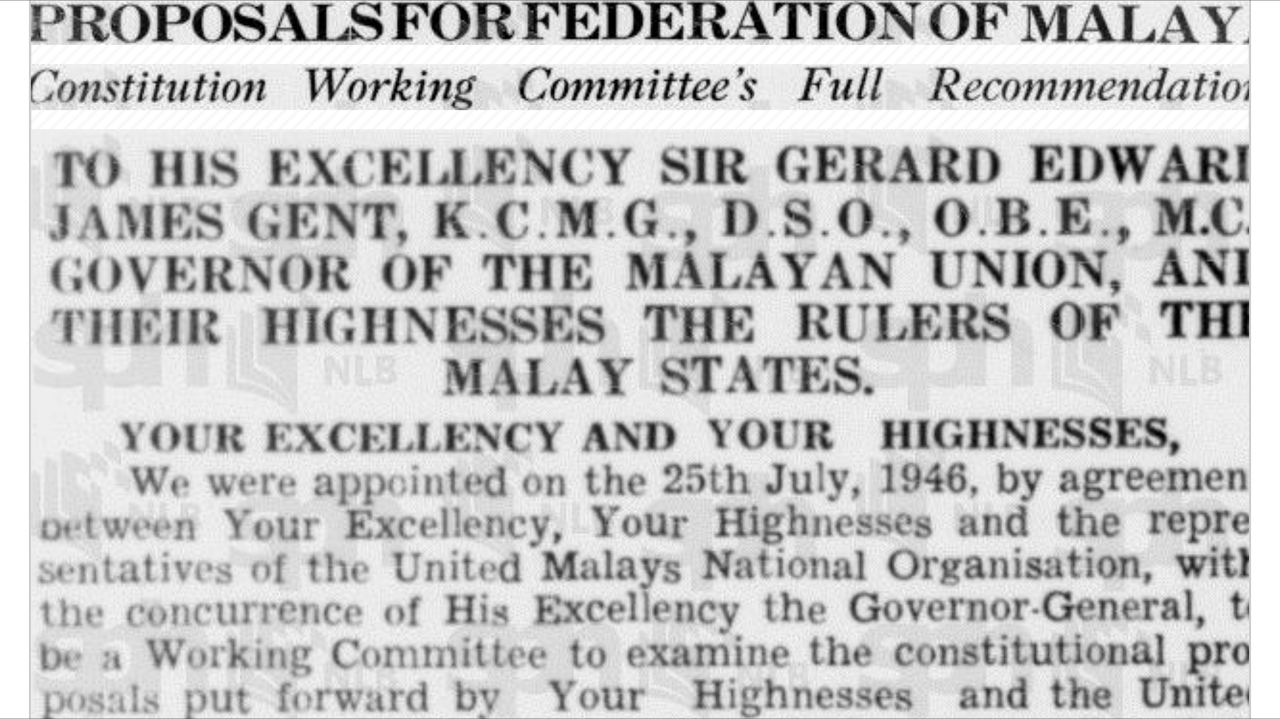
Proposals for the Federation of Malaya Agreement
Epilogue
The Anglo-Malay treaties were left relatively intact with more power given to the people to effect some degree of self-governance, the Rulers continued with their ceremonial roles and duties. The Federation of Malaya came into effect on 1 February 1948, replacing the Malayan Union.
On 31 August 1957, the Federation of Malaya became independent, not from colonisation, but from feudalism. Executive powers that were given to the British have been given to the people of Malaysia to determine how they are to be governed and by whom. All agreements and treaties made between the Rulers and the British since 1874 became void. Professor Datuk Dr Ramlah Adam said all agreements inked during the British colonial period are considered void automatically after Aug 31, 1957.
“These issues are over. The powers of the Malay royalty are now included in the Federal Constitution.”
There is no more “state citizenship” but only “federation citizenship,” which makes Malaysians who they are irrespective of where they were born. The Federal Constitution too does not provide for any state to secede from the Federation. This was further enhanced in Sabah where the Malaysia Agreement of 1963 specifically says the state cannot secede.
Unsolicited remarks should not be made and the spirit of history has to be understood in order to understand why are we where we are, and why are we who we are. Such talks only put the sacrifices of our predecessors in vain.
52 years it has been since the time when four parts of this region joined together to form the Federation of Malaysia (although two years later Singapore was expelled). We have seen the nation go through some ups and downs, but we always pull through together. Lately, we only see the constant superfluous jeremiad coming from all sorts of people and I wonder if we have all become a bunch of whiners who prefer to do nothing but expect everything in return?
Up until the early 1980s there were still areas especially in the Peninsular that either did not have running water and electricity, or had electricity for only 12 hours in a day. Those days no one complained about having to fetch a pail or two of water to be used for cooking or to wash clothes. Then came the supply of treated water and life became much easier. Then when there is a disruption on supply, they blame the government for not providing them with water.
We whine about everything – especially about other races. The Malays would blame the Chinese for their woes; the Chinese blame the Malays for the privileges that the latter get; the Indians would blame everyone else for their misfortunes. I don’t remember us being this divided even five years after the 13th May tragedy.
I went to a Christian missionary primary school, now a National school (Sekolah Kebangsaan). In my class then we had almost the same number of Malay and Chinese students, and several from the Indian diaspora. We learned together, ate together, played together, got punished together. What is more important is that we grew up together.
Now, we have National schools that are predominantly Malay, while the Chinese and Indians prefer to send their kids to vernacular schools. When kids don’t grow up together, they don’t learn about each other. When they don’t learn about each other, that is when they grow up not understanding each other. Then we will always have the Yellow shirts and the Red shirts doing rallies, opposing each other.
This is why I am for the abolishing of vernacular schools. Some were quick to jump on me saying that I am against diversity.
Far from it!
I said, schools. And it is not about diversity, but division!
All schools should be National-type schools. Where children regardless of race and religion grow up together and learn things together. These schools should start at 8am daily and finish at 6pm. They study together from 8am until lunch at 1pm. Then they attend vernacular classes or religious classes in the afternoon until 6pm. They should not grow up separately.
That is all I wish for, unity in diversity, as far as education is concerned. The beneficiaries of such a change would be my grandchildren and yours. Only then could we truly be Malaysian.
As long as we are not willing to let our children grow up together, we will continue to remain divided.







 SeaDemon Says
You must be logged in to post a comment.