KL 1 Million 12 and Miscounting

1,998, 1,999, 2,000, 1 million

That is probably how Pakatan Rakyat leaders and organisers of the KL112 rally count, given the fact that the DAP could not count 2,000 ballots correctly during its recent Central Executive Committee election.

PR leaders had tried to get 1 million participants for the KL112 rally, but until the end of the rally, probably only 40,000 or less attended.

Pakatan’s formal online voice, Malaysiakini, was reported to have put the number of people gathered at the Stadium Merdeka at 80,000. With a seating capacity of 35,000, with the field being able to take another 5,000, the picture published below by Malaysiakini would have had soooooome credibility (yes, that typo is intentional to demonstrate my stretching of that possibility):

20130112-171819.jpg

But its blurry nature raised lots of doubt.

Let us compare the picture above with a much clearer one below:

20130112-172240.jpg

Now, that looks a lot less than 40,000, doesn’t it? Now, that shows the gradual erosion of support to rallies that have the sole intention of promoting Anwar Ibrahim as Prime Minister, and very little of anything else.

When asked, a Pakatan supporter shrugged it off merely saying numbers are not important.

I guess since 16th September 2008 they no longer are. 😉

The Case for God – Part 3

In the previous installment I discussed the concept of Trinity to explain how it undermines the divinity of God according to Christianity, thus making the application of the name Allah for a such God an overkill and not appropriate for the actual meaning of Allah.

As mentioned in the previous installment, too, I find the argument that Allah is the common denominator for God in this region a joke. The common denominator in the Indo-Malay speaking world would be Tuhan instead of Allah. However, Allah is the term that is inside the Quran for as long as time can remember. I cannot say the same for the Bible as it no longer reflects the Old Testament. Anyhow, you cannot find the name Allah inside the Old Testament. Just a Hebrew name that does not even resemble both the Arabic and Roman spelling of Allah. Even so, Elohim as called by the Jews, refers to The God that has no Son, nor an equivalent called the Holy Spirit. Mind you, even the Jews are totally against the concept of deifying a human being. I am sure my wife’s Iban relatives who are Christian would understand the term “Tuhan” without any problem since Bahasa Malaysia is derived from the Malay language, and the term for God in Malay is Tuhan.

We have seen the subtle tactics of missionaries of those days in the first installment and how their modus operandi is now refined by present-day missionaries. This blogger had had the opportunity to meet up with Muslims proselytized during the month of Ramadhan of 2012 and was told of the very fine and subtle methods used to proselytize Muslims in Malaysia. Back in the late 19th and early 20th century, the Malay people were not only bombarded with the Malay Bible, but also Christian publications in Malay such as Buletin Ariffin, Cermin Mata, Sahabat and Warta Melayu. Little has changed, but made only better. Recently, Johor’s Department of Islamic Affairs, together with the Home Ministry, confiscated 250 Christian literature in the Malay language. Imagine these books having titles such as Kaabah, Mengenal Rasul and Wahyu Illahi. With the state of Johor having around 58 percent Muslims, 2 percent Christians, and 40 percent other religions, who were these Malay literature targeting? Ibans? Christians? Chinese? Read more about the attempt to proselytize Muslims in BigDog’s post.

So, what about the use of Allah by Christians in Indonesia, Egypt etc.?

Tell me how good has that been for Indonesia and Egypt? How well do the Muslims and Christians get along in those countries? The very reason we do not have beheading of Christians in Kelantan or lynching of Muslims in Sarawak is because we do not step on each others toes.

But I guess, for the purpose of gaining support and diverting the attention of voters from issues currently plaguing the DAP so close tot the next general elections, Lim Guan Eng raised the “use of Allah in Bible” issue again. And the Muslims in the Pakatan Rakyat chose to keep quiet about it except for the MP for Parit Buntar, Mujahid Yusof Rawa who questioned Guan Eng’s motive. I suppose for most PR Muslims, it is okay for Muslims to be proselytize as long as they get to wrestle power from the present government. To cloud the vision of their supporters from their internal issues of corruption, cronyism and nepotism, they decided to rally the support of the mostly Chinese Christians by raising the Allah issue again, knowing very well it would somehow hurt the relationship between UMNO and the Christians within the Barisan Nasional. I hope no fool would fall for this treachery.

What is the purpose of using the name Allah in Bibles, having a Malay Bible, and Christian publications in Malay if not to proselytize the Muslims? With all due respect to my Christian friends, why hasn’t the Vatican been using Allah or Elohim? Why do they stick to the name they know? And what is the most familiar term for God here in Malaysia if not Tuhan?

Like I mentioned in the first instalment. I am called John, and wherever I go, I will still be called John. No one in Germany would call me Johann, no Arab would call me Yahya, no one in Sweden would call me Jan or Jon. So, if your common denominator is Tuhan, call as it is. Not adopt from some other language. Or else, I would question why aren’t you calling God “Deus.” Please don’t fall for the politics of hate propagated by those who are irresponsible.

We have been living together, respecting each other for more than five decades peacefully except for one dark moment in 1969. Let us not let the political ambition of some to destroy the peace and prosperity that we have maintained for so long.

May I remind the Christians, in particular the Catholics about what is mentioned in the Catholic Encyclopedia about Allah:

Let it be noted that although Allah is an Arabic term, it is used by all Moslems, whatever be their language, as the name of God

If you still cannot see that, then there will soon be trouble in this peaceful nation. So, who is not respecting who?

The Case for God – Part 2

In the previous installment we see the difference in how Christianity was spread throughout the Indo-Malay world. In this installment, we discuss the concept of Trinity and why some Christians now continue to reject it.

Allah The One God

Since Allah is the common denominator to refer to God in the Arabic-speaking world, why is it then a problem for Malay Muslims to accept its use in the Malaysian Bibles?

First of all, the common denominator for God in the Indo-Malay speaking world is Tuhan, not Allah.   Like mentioned in paragraphs above, the general Christian world believes in the Trinity where God is the Father, God is the Son, and God is the Holy Spirit.  Muslims have a problem here thinking that this is all about polytheism, but really in technical terms it is not.  But neither is it monotheism as the Jews and Muslims hold on to.  In the Trinity concept, while God is all those three persons, the Father is NOT the Son or the Holy Spirit; the Son is NOT the Father or the Holy Spirit; neither the Holy Spirit is the other two.  It is the concept of one deity in three persons.

The problem with Muslim scholars in Malaysia is that their studies are so focused on Islam that they fail at comparative religious studies and often make opinions based on what they think is being practiced in other religions.  How many other Muslims read the Bible to know that after the publishing of the King James Bible in 1611, there have been other versions including the “new version”, the “children version”, and the “American version” (I’ll call them KJV in short)? How many know of the various changes made to God’s words in the Bible that appears in the KJV of today?

Mind you, the KJV was translated and printed by Thomas Nelson Publishers.  In 1969, the publishers was purchased by Sam Moore, who started by selling Bibles door-to-door to finance his pursuit of a medical degree.  He vowed to make Thomas Nelson the leading publisher of Bibles again. In 1976, he initiated the creation of the new Bible translation calling it the New King James Version (NKJV) that propelled Thomas Nelson back to the number one spot.

Hence, the NKJV Bible is more a human dogma than a collection of divine words.  Some versions has had the word “He” changed to “It” to accommodate a politically-correct gender-unbiased view.  Personally, I would use “It” to refer either to things that are not alive, or to beings other than the human.  The Quran, on the other hand, has never been changed, and the divinity of its content unquestioned.

The concept of Trinity was also alien to some Christians.  It was during the First Council of Nicea in 325AD , the first ecumenical council of the Church that was convened by the Roman Emperor, Constantine I, that an attempt to get the Christian world to agree on the divinity of Jesus Christ.  The main topic was to discuss the teachings of a Christian presbyter in Egypt called Arius, who focused on Godhead, which emphasized the Father’s divinity over the Son.  He endorsed the following doctrine:

  1. That the Son, or the Word (Logos) and the Father were not of the same essence (ousia);
  2. That the Son was a created being (ktisma);
  3. That the worlds were created through the Word, then he must have existed before all time;
  4. However, the Word did not exist, before he was begotten by the Father.

For his belief, and for refusing to sign the Creed and accepting the divinity of Christ, Arius and two other Church leaders were banished, prompting others to sign.  One must remember that Emperor Constantine I was never a baptized Christian until he was on his deathbed and the word ecumenical means world, in reference to the Roman Empire dominating what they saw was the world to them.

The Arian church lives on in some parts of the world, notably in the Eastern Christianity domain, the Oriental Orthodox.  Due to the differences, the Church of Rome and the Orthodox Church were no longer in communion, although rivalry between the two have all but diminished since the Great Schism, but the latter still rejects the dogmatic definition published by the Pope, or by an ecumenical council, and also rejects the Council of Chalcedon.

The introduction of  the Filioque by the Western Church into the Latin version of the Nicene Creed without holding a council or gaining consent from the Eastern Churches contributed greatly to this schism. The Filioque is a phrase that states the Holy Spirit as proceeding from “the Father and the Son”, while the Eastern Churches have always held on to the fact that the Holy Spirit proceeds from the Father, and has the same status as the Son.

As such, God the Father in this concept does not qualify itself to be interpreted as Allah to be used in the Bible. God, as portrayed in the Trinity concept, does not stand, and cannot stand alone.  The concept of God as a Supreme Being that exists even before time does not seem to hold true when it comes to the Christian interpretation of God, and although the Jews, Christians and Muslims are people of the book, only the Christians have created God as an image, whereas, especially in Islam, God is beyond human comprehension.  Simply put, if you think that it is impossible to imagine God, even that imagination and thought come after His creation and is still nowhere near describing Allah.  Both the Jews and the Muslims reject the hypostasis nature of God as projected by the Christians.

Therefore, in my humble opinion, and without prejudice to my Christian friends, God the Father should be Tuhan Bapak; God the Son should be Tuhan Anak; and God the Holy Spirit should be Tuhan Ruhul Kudus.

In my next installment, we will have a look at the common denominator and what has become of it, and what I think of this whole issue.

2012 in review

The WordPress.com stats helper monkeys prepared a 2012 annual report for this blog.

Here’s an excerpt:

4,329 films were submitted to the 2012 Cannes Film Festival. This blog had 18,000 views in 2012. If each view were a film, this blog would power 4 Film Festivals

Click here to see the complete report.

The Case for God

I am called John.

John F SeaDemon.

I may be called Yahya or Yahya Shaitan al-Bahri  if I were in an Arab country somewhere, but I doubt John F Kennedy would have been called Yahya F Kennedy had he gone to Saudi Arabia or even Egypt.  In fact, he would still be called Jack…or John.  But for some Christians in Malaysia, especially in the Peninsula Malaysia, God is called Allah. Maybe it is time for me to address the Logos behind the Theos in this theological subject.

The Language behind Allah

There has been many attempts at explaining the origin of the name Allah, and the similarity the name has to the Jewish word, Elohim (Elochim).  Allah is derived from two distinct Arabic words: Al (The), and Ilah (God), to describe the Supreme Being, the One God, and the word Allah, in Arabic takes a masculine form.

The Hebrew equivalent would be Eloah.  However, Eloah is the female word for God.  In order for the name to have a masculine form, the name Eloah is given a plural form, -im, making it masculine.

However, the Catholic Encyclopedia does not recognise Elohim as the Hebrew word for the God of Israel, but says that it could have been referred to an earlier polytheistic culture’s deity.

In Arabic, a female form of Allah would be Al-Lat.  Interestingly, Al-Lat during pre-Islamic times refers to one of three goddesses (female) whose shrine and temple was built in the city of Taif in Saudi Arabia.  She was a daughter of the Supreme God, Allah, along with her sisters Manat and al-Uzza.  Here you can see that even polytheistic pre-Islamic Arabs had a Supreme God called Allah.  Hence, if you ask me, an equivalent of Al-Lat in Hebrew would be Eloah, and not The One Supreme God. You can clearly see the difference between Elohim and Allah. While the former had to undergo a gender transformation, the Arabic word Allah is free of grammatical structure and corrupted meanings.

Of course, Christians in Malaysia argue that Allah is a common denominator for God for both Arab Christians and Muslims.  We’ll come back to that in a while.

The Local History behind Allah

Let us remember one thing.  Malaya (Peninsula Malaysia) was never colonised as a whole by the British, save for Penang, Malacca, and Singapore, while Sabah and Sarawak came under direct British colonial rule. Penang was acquired through a deal to lease the island made between the British East India Company and the Sultan of Kedah; Malacca was acquired from the Dutch through the Treaty of Bencoolen; and Singapore was included in the Treaty of Bencoolen by making the severely weakened Dutch to not object to the British occupation of Singapore.  The people of these three places, together with Sabah and Sarawak, became British subjects.

Through treaties with the Sultans on the Peninsula, the British helped administer the State of the respective Sultans, while the Sultans remained as the supreme head of these sovereign states.  The administration of Islam came under the purview of the respective Sultans as the protectors of the state’s religion.

So, why does Indonesia have Bibles that use the word Allah to describe God?

Unlike Malaya, Indonesia was a nation of conquered people.  Hello! Remember the Dutch?  When Douglas MacArthur met Emperor Hirohito, he purposely stood next to the Emperor to show the Japanese people that the Emperor was not a demi-God.  Victors get to do as they please, and this is probably the same case as the Ladang Rakyat issue in Kelantan.  The Dutch conquered parts of Indonesia beginning in 1595, and as part of its attempt to call the Malay diaspora in Indonesia to Christianity, the Book of Matthew was translated into the Indonesian language in 1629; and where the Dutch set foot, other religions were formally prohibited although Chinese temples as well as mosques remained in existence.

Missionaries, too, made headway in Sabah and Sarawak, converting the populace to Christianity.  Sir Stamford Raffles recommended to Rev. Thomas Raffles (Buitenzorg, 10th February 1815, Mss. Eur. F.202/6) that Borneo be given vigorous campaigns by the missionaries as “the island is inhabited by a race scarcely emerged from Barbarism.”

This does not mean that the Malays were free from attempts to proselytize them.  In fact, Raffles, in a letter to his cousin in 1815 mentioned how “Religion and laws are so united” in Muslim dominated areas that the introduction of Christian beliefs will bring about “much mischief, much bitterness of heart and contention”.

Raffles contended that Christianity must be packaged in a new form and be conveyed to the Muslim majority through a gradual approach. The “pagans”, on the other hand, required no stratagems.  His methods include the establishment of missionary schools where the Malays are taught to read and write in their own language.  Then he set up printers to publish books in Malay.  Missionaries were largely responsible for this effort with the help of local agents, and the most famous of these agents was a chap called Abdullah Abdul Kadir who is better known as Munshi (Teacher) Abdullah.  He and other Munshis taught Christian missionaries the Malay language.  His role went beyond that and became the first Muslim in South East Asia to translate the Bible into the Malay language, that he became the target of his contemporaries who called him Abdullah Paderi (Pastor Abdullah) among other things.

It is interesting to note, however, that Raffles never once attempted to convert Malays in the Federated and Unfederated Malay States where the Sultans rule and guard the interest of the religion of Islam.  This is because it would be foolhardy to anger the Sultans whom the British had a treaty with, by undermining the sanctity of Islam by converting their subjects.  In the case of Raffles, he only focused his efforts on those who are British subjects.

Here we see the subtle tactics of the Christian missionaries during Raffles’s times, and the Malay lackeys who colluded with them.  We can see the similarities in events of nowadays.  But the above is also why we have Allah in the Bibles of Indonesia and Sabah and Sarawak, but not in Peninsula Malaysia.

In the next installment I will discuss on how the concept of Trinity came about and why it was opposed by some Christians, and about Allah as the common denominator for God in the Arab-speaking world.

Downwards Accelerating Party

The Democratic Action Party voted its Central Executive Committee today.  Prior to that, campaigning saw the various camps begging for grassroot support; for some, political survival depended much on being elected to the CEC.  For the Malays in the DAP, there was hope that with its recent seemingly multiracial stand, the DAP would stand a better chance at having more support from the Malay voters, and hopefully having Malays elected into the CEC by the delegates would allow DAP to demand for more election seats, even to be able to contest in Malay strongholds.

Previously, the DAP’s CEC had 31 members.  Of these 31, three were Indians, while the Sikhs and the Malays were represented by two people each.  Today, 2,576 delegates voted.  Father and son, Lim Kit Siang and Lim Guan Eng, mustered 1,607  and 1,576 votes respectively, underscoring the fact that the DAP really is a “Daddy-Anak Party” (Father and Son Party).  Party strongman, Karpal Singh came in third with 1,411 votes.

Anthony Loke and Vincent Wu were tied with 1,202 votes each.  Tan Kok Wai is in sixth place with 1,199 votes.  Karpal’s son, the other Daddy-Anak Party defining team, was in seventh place with 1,197 votes.  Despite all the exposures and mileage received, Tony Pua only managed 1,162 votes putting him in the eighth place, while Selangor DAP’s Teng Chang Khim, manager to get 1,152 votes putting him in the ninth place.  At the bottom of the top ten list is Fong Kui Lun who received 1,137 votes.

The one who is linked to a recipient of a State Government contract when Pakatan Rakyat came into power in Perak, Nga Kor Ming, received 1,075 votes putting him in the 11th place.  Chong Chieng Jen and Chong Eng both received 1,011 and 1,006 votes respectively, putting them in the 12th and 13th places.  Chieng Jen remains the only representative from the Sabah/Sarawak side. Chow Kon Yeow received 985 votes and the 14th place.

M Kulasegaran, the man who received the highest vote in DAP Perak but never got the Perak DAP Chairman post because it was given to Nga Kor Ming, was tied with Liew Chin Tong with 984 votes.

A person who was reported to have had a fall out with Lim Guan Eng, Johor’s Dr Boo Cheng Hau, is in 17th place with 958 votes.  Selangor DAP Chairman Teresa Kok is in the 18th place with 925 votes while Teo Nie Ching is in the 19th place with 903 votes.

Nga Kor Ming’s cousin, Ngeh Koo Ham rounded up the top 20 with 824 votes.

Hiew King Chiew, DAP’s Member of Parliament for Kota Kinabalu, did not make it, signaling the possibility that he is out of favour with the Lims and will most probably be dropped as Sabah DAP Chairman.  Another failure is Ronnie Liu, the controversial Selangor State Exco who seems to be a burden for DAP Selangor carries.  Also out of the list is Prof Ramasamy, the person who last year had a public spat with strongman Karpal Singh.

The DAP quickly claimed that the CEC, the Lims in particular, had a strong backing from the delegates.  However, the numbers show that Lim Sr only received 62.4 percent of total votes, while Lim Jr received 1,576 votes out of 2,576, or only 61.2 percent of total votes.  In short, 1,000 delegates did not vote for Lim Guan Eng.  This layman does not see this as a strong backing.

All seven Malay candidates in DAP lost badly.  I know the press quoted eight but I do not consider Zairil Khir Johari bin Abdullah a Malay. The late Khir Johari was not his biological father.  Anyway, branding himself a Malay and chosen as Lim Guan Eng’s political secretary, and like his boss, did not get him any strong support.  Zairil, or whatever his name was, before Khir Johari married his mother in 1996 when he was seven or eight, only managed to secure 305 votes.

The other Malay DAP candidates scored even worse: Zulkifli Mohd Noor from Penang, who has tried for the past 25 years to get into the CEC,  received 216 votes; Tengku Zulpuri Shah Raja Puji from Pahang received 121 votes; Solaiman Op Syed Ibrahim of Perak received 98; Roseli Abd Ghani received 39; Harun Ahmad received only 28.  Only Senator Ariffin SM Omar and Johor DAP Vice-Chairman Ahmad Ton scored higher than Zairil, receiving 748 and 347 votes respectively.

Zulkifli was clearly peeved.

“When we say ‘Malaysian Malaysia,’ we must represent all religions, all races…balance. The message I conveyed did not reached the grassroots. They are still choosing leaders based on race,” he told Bernama.

He said that the election was also not based on ability and experience of the candidates in fighting for the party.

“There is no change. The results is a setback for Malay candidates. Perhaps the top leaders who contested want to take care of their own interests, not the party’s interests.”

This means that the Indian community now only has 1/3 representation compared to what they used to have in the previous CEC, while majority of the DAP delegates gave a strong signal to its Malay members as to who is King in the DAP.

And it certainly isn’t Mr Singh.  And it certainly isn’t a multi-racial party.

UPDATED 16TH DEC 2012 – 1515 HOURS

The DAP has apparently appointed two “Malays” to the CEC to appease or maybe to fulfill their idea of the Malaysian Malaysia concept.  Senator Ariffin SM Omar and Zairil Khir Johari bin Ablululah have been appointed to the CEC – these two are supposed to represent and mirror the composition of the Malays in Malaysia.  Unfortunately, there are more than 50 percent Malays in Malaysia.

Like I mentioned above, Zairil is not a Malay, but a full-blown born Chinese with a Malay name, and therefore cannot be considered as a Malay-representative in the CEC.  Therefore, reality sees only one Malay in the current CEC compared to two in the previous one. He was not born to parents who professed to be Muslims, and I doubt they spoke or lived as Malays when he was born. Therefore, Zairil does not fulfill the requirements of Article 160 of the Federal Constitution to be categorised as a Malay.

As for Zulkifli Mohd Noor, he can keep on trying to get into the CEC another 25 years.

Long live Malaysian Malaysia. *BARF*

Speed Kills – Comment That Deserves A Mention

I post below a comment by a reader, Mustapha Ong, on my most recent posting:

My few sentences will describe the attitude and mentality of all those who are less civic minded in their shallow thinking and perception of the recently implemented AES high technology cameras based on a long period of detailed studies since 2003 through different agencies and stakeholders, both local and overseas. AES is a Federal government project that had to be sieved through a number of assessments and technological tests over the last 9 years or so, before the government decided to take a serious review of the project based on the following criteria:-

1. To create public awareness that speech kills;

2. To educate road users to be more civic minded;

3. To minimize any human contact between the enforcement officers
and the motorists and cyclists and other road users;

4, To check reckless drivings especially among public and commercial
vehicles;

5. To check and reduce corruption and abuses of power being targeted
at reckless and inexperienced drivers and other road users;

6. To deploy enforcement officers (traffic police, City and Local Council)
to other enforcement and national security agencies;

7. To improve efficiency of relevant enforcement agencies in terms of
human capital, financial and accounting procedures, etc.

8. To relieve the capitalization and allocation of public funds from the
Treasury to finance the AES project estimated cost of more than
RM700 million.

9. To relieve the government’s subsequent liabilities on the heavy
and regular maintenance of the high-tech cameras.

10.Any other reasons and justification due to the nationwide
implementation of the AES project as it phases out over the
projected variation at various stages.

As far as the government and the majority public knows, the AES project had been deliberately politicized by the the opposition-led states and some other less civic minded individual or interest group. I am not a lawyer, but the government should examine the legality of a Federal initiated national project nationwide, including those governed by the opposition. The issue should be referred for a jurisdiction review to be assessed by the AG Chamber.

In this context DAP leaders through CM Lim Guan Eng had taken the matter in their own jurisdiction in suspending the implementation of the AES project in Penang, Selangor, Kedah and Kelantan. DAP has clearly politicized the AES project to suit their own administrative agenda. I dare say that the PR state governments are of no saint or less evil and corrupted to the core as reported on the mismanagement of human capital, enforcement of business licences, public tenders and other resources and services, I therefore challenge LIM Guan Eng to look at their own backyard, especially the PR states of Selangor and Penang,

The enforcement officers and relevant agencies in the City and Local councils are abusing their power and encourage more corruptions than the previous BN state government. Clear examples are the existence of thousands of entertainment outlets including reflexology centers, SPAs, dinning joints with PROs, social escorts and prostitutes, illegal or pirate taxis and cargo lorries and trucks and many other sources of obtaining corrupted monies. If DAP and their crony allies PKR and PAS are so adamant to exploit and sabotage the Federal projects, I advise that they should wait for the opportunity to win the coming PRU13 and govern this country, according to their wimps and fancies. Until then, I gracefully request LIM Guan Eng to stop harassing the BN government and stop being too personal in this blog comments against our BN Ministers and other corporate leaders,cronies and supporters.

Speed Kills

20121031-141459.jpg

My previous posting is deemed relevant.

On 30th October 2012, the UMNO Youth called on the government to defer the implementation of the Automated Enforcement System (AES) to review the weaknesses in the implementation of the system, and the suitability of the location of the AES cameras deployed.

Looking at my Twitter timeline, I see that many are afraid of how the AES might impact the livelihood of the road users. Which means that the implementation of the AES, albeit still in its infancy, has already begun to have an impact on the attitude of road users. Anyhow, of course there will be those who would oppose it for the sake of opposing.

According to MIROS, passenger cars including SUVs, and four-wheeled drive vehicles are the most common types of vehicles involved in the overall investigated cases for 2007 through 2010. Motorcycles are among the lowest vehicle type involved in the investigated cases throughout the said period. Straight and flat roads also contributed higher number of accidents compared to curved roads throughout the same period. 60 percent of those accidents were contributed by speeding, next highest was risky driving, both are factors/offences that could be detected by the AES.

Opponents may argue that the quality of our roads are not up to international standards. However, the World Economic Forum’s 2012 Global Competitiveness Report states that Malaysia’s road quality is ranked 21st out of 139 countries and scored a 5.7 out of 7. In comparison, save for Singapore, we scored better than Thailand, Indonesia, the Philippines and Vietnam, so much so that the Department of Public Works and Highways (DPWH) of the Philippines said that the government of the Philippines would look at Malaysia “as a benchmark in terms of quality of roads.”

Are our speed limits too slow then? Both Japan and Australia have speed limits lower than ours at 100km/h. As a matter of fact, you are only given a lee-way of three per cent over and above the posted speed limit before you are sent to jail. In the US, speed limit on the highways is capped at 70mph, a mere 2km/h more than ours.

What about our weather? Or lighting? Throughout the MIROS study period from 2007 through 2010, most accidents occur in fair weather and during day time.

Our only problem is enforcement. In my opinion, our enforcement of traffic rules has a lot to be desired. It is always a favourite talk that the traffic policemen are always out there to squeeze a RM50 note or two out of you when they stop you. The problem is, most of those who whine about this fact are mostly those who make no qualms about giving bribes. The AES allows enforcement to take place automatically. A habitual traffic offender or a habitual bribe-giver would not have the opportunity to “slow-talk” or bribe a policeman, and best of all, these traffic policemen can be deployed to help law-abiding citizens brave the jam better during rush hour times.

The argument that the locations of the AES cameras are unsuitable or may be overkill considering the number of cameras deployed versus the number of accident-prone areas listed by the police is without substance. Are those who argue on that point implying that drivers will not speed or accidents will not occur at other stretches where accidents are less likely to happen?

The other argument that AES cameras would contribute to more accidents happening is also baseless. Am I to believe that a driver would be looking out for the AES cameras rather than pay attention to the road? How many accidents have happened because drivers look out more for the more mobile policeman with the speed gun? Perhaps these people ought to provide the statistics to back their claim within the next 24 hours :).

And how effective is the AES in reducing the number of accidents?

In 2008 in the UK, Robert Gifford, executive director of the Parliamentary Advisory Council for Transport Safety said, “A four-year evaluation of their effectiveness concluded that 100 lives were saved every year.” The same study concluded that there was a 40% reduction in the number of deaths and injuries on roads with speed cameras. Road deaths, he says, fell below 3,000 for the first time last year and speed is a contributing factor in one in three road deaths. If you go back 10 years ago, “70% of drivers driving in free-flow traffic broke the 30mph speed limit. Now it’s 49%. There has been a big decrease in the deaths of pedestrians, and that is partly due to cameras in urban areas.” There are 6,000 speed cameras deployed in the UK.

In Australia, the New South Wales state government has conducted its first annual review of the effectiveness of speed cameras, finding more than 95 per cent of them are having a positive effect on reducing fatal crashes and injuries. Fatalities fell by 87 per cent and crashes by 38 per cent in the areas around fixed speed cameras, according to a report released in July 2012 by the NSW Centre for Road Safety.

In the five years before the cameras were installed, there were 3959 crashes in the zones around these speed cameras, resulting in 61 deaths and 2124 injuries. But in the recent five-year period, there were 2451 crashes, resulting in eight fatalities and 1344 injuries. The acting general manager of the centre, Marg Prendergast, said the report proved cameras were overwhelmingly effective. The report also found that the number of infringements dropped over time, suggesting the cameras motivated people to slow down.

So, why is there a call for a deferment of the AES? Why is this call made nine years after the study into its implementation was made? And what do the opponents of the AES mean by suggesting that the government ought to study the implementation of the AES thoroughly? Do they mean that the government had hastily jumped into doing something after nine years of mulling about the system? Is the speed of the implementation going to kill the Barisan Nasional’s chance of obtaining a simple majority during the next general elections? Or is the speed of the call for the deferment going to kill BN’s chance of obtaining a simple majority for flip-flopping on its drive to save lives?

What would kill with speed BN’s chances of obtaining a simple majority? The government flip-flopping on a policy laid out by an MCA Minister after being pressured by half-past-six young turks from UMNO. It would only mean the government thrives on a populist approach with blatant disregard for the voters’ safety; AND that UMNO has not shelved its perceived bullying of other BN component members (paragraph added at 0945 hours, 1 Nov 2012).

And for those who think that the AES will only enrich cronies because you have nothing better to think of other than using the same line for different BN-bashing lines, stop speeding, abide by the law, then you don’t get summoned, and none of your money will go to the cronies. Simple, right?

Implement the AES. If there is improvements to be done to its system, do it as you go along, for the journey towards safety is a never-ending journey.

Remember, speed kills. Someone might just hit your child or spouse, or parents and kill them, so think about it!

Enter The Dragon – Part 2

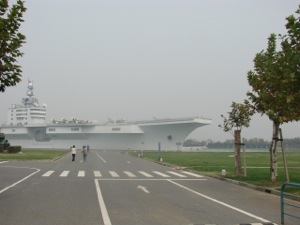
Chinese Aircraft Carrier (Asian-Defence.net)20121029-225730.jpg

May I also refer to my previous posting (Enter The Dragon)

On Friday, 26th October, 2012, Chinese Vice-Foreign Minister Zhang Zhijun warned Japan over its action at the Diaoyu (called Senkaku by the Japanese) islands.

“We are watching very closely what action Japan might take regarding the Diaoyu islands and their adjacent waters,” Zhang Zhijun said, as reported by Reuters, at an unusual late night news briefing. “The action that Japan might take will shape China’s countermeasures.”

“If Japan continues down its current wrong path and takes more erroneous actions and creates incidents regarding the Diaoyu Islands and challenges China, China will definitely take strong measures to respond to that,” Zhang said.

China’s stance vis-à-vis the East and South China Seas have alarmed regional defence watchers. The Philippines, fresh from a very heavily one-sided standoff with the Chinese navy, mulled the purchase of two Maestrale-class frigates from Italy “as is” in order to boost up its antiquated navy.

Phillipines Defense Undersecretary for Munitions, Installations and Material Fernando Manalo described the frigates as “more lethal” than the Navy’s BRP Gregorio del Pilar, a re-commissioned but stripped down US Hamilton-class Coast Guard cutter.

He stressed that the frigates would not be stripped down like the Hamilton-class cutters.

“We demanded that we will not accept what is less than what has been installed in the vessel. Nothing will be removed,” Manalo said.

Chinese naval officers of late have been quoting Alfred Thayer Mahan extensively. In expanding her fleet, the Chinese have consistently argued that China now depends on oceanic trade for vital raw materials and for energy. Mahan always saw oceanic trade as the key argument for seapower. And while Mahan’s doctrine is greatly appreciated by the Chinese, the Americans will continue to see a reduction in their naval assets, putting pressure on America’s allies to arm themselves.

The Chinese recently had its first aircraft carrier, the Liaoning, entered service in September this year in the midst of the Senkaku/Diaoyu fiasco. The former Soviet Varyag will be joined by two other aircraft carriers now being built in China.

The Chinese have also acquired the licence to build Tu-22M3 very potent anti-carrier bombers that gained notoriety during the Cold War in which the US Navy concluded that it was not nearly enough to shoot down anti-ship missiles launched by Backfires simply because the bombers could launch missiles from beyond the horizon, return to base to re-arm, and return for another attack, until the US fleet’s defences were exhausted. It is a popular belief that the Chinese navy would want to acquire the AS-4 anti-ship missiles once carried by Soviet Backfires, now being produced again by the Russians. This missile would give the Chinese a true beyond-the-horizon capability. Otherwise, they can employ their AS-17 rocket-ramjet anti-ship missiles.

Whether or not the East China Sea is the real focus of China remains to be seen. But the acquisition of aircraft carriers and Backfire bombers certainly reinforce China’s adoption of Mahanian ideas – keep the US fleet beyond the Senkaku/Diaoyu islands, while their real focus is the South China Sea where the stakes may be quite high (oil and fishery, the valuable latter is already proven to be there).

Chinese hegemony in the South China Sea, strengthen by its now blue-water navy and good deterrence provided by the Backfire bombers, would almost certainly force ASEAN member countries to one day accept a considerable degree of Chinese “sovereignty” over the South China Sea.

And Malaysia’s already precarious position as a maritime nation is not helped by myopic politicians who keep questioning defence purchases just for the sake of winning public opinion.

Proportionally Worse In Four Years

20121024-122558.jpgThe anger towards the AES system (pic by Fella Firdaus)

I cannot understand the negative reception by certain quarters from both sides of the political fence towards the Automatic Enforcement System (AES). While short-sighted members of the Barisan Nasional say that the installation of the AES will cause middle-income supporters to switch allegiance to the Pakatan Rakyat, the Pakatan Rakyat supporters played its usual game of saying the AES was awarded to enrich cronies.

Maybe, a memory-jogger is appropriate for both.

According to the WHO’s Global Status Report on Road Safety (2009), road traffic injuries is the leading cause of death for people between 15-19 years of age. It is the second leading cause of death for those between 5-14 years of age; third for those between 30-44. 90 percent of road fatalities happen in low and middle-income countries.

In 2009, a report from MIROS (Malaysian Institute of Road Safety Research) states that we had 3.7 deaths per 10,000 vehicles when the global benchmark is two. We had 23.5 deaths per 100,000 population when the global benchmark is 10.

Fatalities by mode of transport shows that in 2008, motorcycles contributed to 60 percent of the fatalities followed by cars at 20 percent, while the age groups of 16-20 and 21-25 contributed 977 and 937 deaths respectively. That is 1,914 voters and potential voters gone in just one year.

Those from the Barisan Nasional should recognise that when a family member dies, very seldom do we see family members accepting the blame for the deceased’s recklessness. The blame will normally fall on the opposite party involved in the accident, or the government for not doing anything to mitigate or lessen the probability of accidents occurring.

For Pakatan Rakyat, it is very easy for them to point at Barisan Nasional saying that the AEs is nothing but a means to enrich cronies. Lest we forget in the four years that they have been in power in certain states, we hear of corruption in those states. Kedah has been awarding contracts to five unregistered contractors to undertake projects involving Taman Seri Gemilang, Seberamg Terus flats, Taman Wira, Alor Malai flats, Simpang Kuala flats, Tongkang Yard flats and Taman Kota Nelayan.

To make matters worse, the directors of the five companies are all relatives.

In Penang, we hear of the Bayan Mutiara and PPRT land sale issues. In Perak, during the short two years Pakatan Rakyat was in power, cousins Nga Kor Ming and Ngeh Koo Ham ruled Perak by proxy, and we all know of the ceremonial dress or suit tailoring contract involving a relative of at least one of the two. The conduct of the two was to the point of being ad nauseam that delegates at the recent Perak DAP Convention lambasted the two for their undemocratic ways.

DAP.jpgThe anger towards Teresa Kok (pic courtesy of Mynewshub)

In Selangor where DAP also rules by proxy, we should never forget why the late Teoh Beng Hock was called in by the Malaysian Anti Corruption Commission (MACC). We should not forget what case was being investigated by the MACC, and who benefits the most from Beng Hock’s permanent silence. Just because Beng Hock was a Chinese, and BN has a Malay-majority party in it, don’t turn it into a Malay versus Chinese thing. It could have been a Chinese whacking a Chinese thing too!

Little Napoleons from DAP also rule Selangor. Kinrara voters, who voted for Teresa Kok in GE12, are now angry with her for being greedy, holding seven posts, thus neglecting her voters. Others that are being targeted include Ronnie Liu and Tony Pua.

The anger towards cronyism and nepotism practised by the office-holders of DAP has prompted some DAP grassroots to form a movement called the Liberos. This movement consists of DAP loyalists who had hoped for a DAP government that would make a difference, instead got disenfranchised when those elected did not become people-oriented, egotistic, selfish and greedy, so much so that DAP now stands for Daddy-Anak-Party or Developers Association of Penang. DAP leaders are quick to punish critiques while cronies are spared. The above are among the reasons for DAP’s Orang Asli rep, Bah Tony, to quit the so-called socialist democratic party recently.

So, for those who claim the AES only benefits BN cronies, be aware that cronyism and nepotism is rife and alive within Pakatan Rakyat itself, and I think what goes within PKR is academic. There was not even a proper party election to begin with, and its supremo was not even elected.

The idea of having the AES was mooted 10 years ago, while studies were conducted in 2003. And unlike the tender process (if any) in the Pakatan Rakyat-held states, the tender-selection committee involved members from the MACC, the Treasury and the Attorney-General’s Office.

If you think there is hanky-panky involving the AES, report to the MACC instead of whining. We have the machinery in place, use it. If you don’t use it, then you are just whining because you are a habitual traffic offender.

For Barisan Nasional members who are against the AES, grow up and wise up. Stop looking at your pockets and start protecting the lives of the Rakyat.

Shame on you all for objecting to the AES!