Unqualified

Yap Sin Tian, the embattled President of Dong Zong, may find himself now in a bit of a fix as he had failed to garner the support of the Chinese community during the 926 rally. With independent Chinese school boards criticising him for alleged abuse of power and resources organising rallies to boost his fledgling image. It is also said that the exposé about his fake doctorate has caused the Chinese community to distance themselves from him. The Chinese regard education highly, and cheating one’s education record is something horrible to do.

Enter a man who aspires to become the next Prime Minister. His has never made economic sense even when he held the Finance Minister portfolio. I often wonder what qualification does he hold?

Then I found this link.

I wonder if the Chinese who support the Opposition would still regard him highly.

The Case For Turun Zakir Naik

Zakir Naik.

A name that I never knew of until last week, when a lawyer-friend asked me what I thought of him. I never gave the question much thought until this morning.

Zakir Naik was a doctor in India until he decided to abandon his practice to pursue his idea of helping Islam, or so he believes.

His speeches have irked so many that he was refused entry into the UK and Canada for glorifying terrorism and other inflammatory remarks. You can read more about it here.

He is due to make an appearance here in Malaysia. Blogger Dhanyaraam described Zakir Naik as a person who could affect the harmony of Malaysia’s plural society. Zakir Naik on several occasions have made fun of the Hindu lord, Ganesha.

Would I want a person like Zakir Naik here in Malaysia? I hope the authorities would seriously look into this matter. But as a Muslim, God’s warning in Surah al-An’am (6: 108) is reason enough for me to not allow him in.

Rebuttal: Con Air

I refer to an article in The Star dated 25th September 2012 implying that I exposed Dato Taufik Omar as the person who had loaned the said private jet to Anwar.

I hope that the respected newspaper had read my blog posting that only mentioned Dato Taufik is said to be the operator, or owner, or agent of the aircraft, and that he should come forth to clear the air to the masses on the situation.

John F SeaDemon
25th September 2012
10.02AM

Con Air

Much has been said about Anwar Ibrahim’s flight to Labuan using a private jet, that even Khairy Jamaluddin’s questioned Anwar’s reason for using the private jet – which was because flight connections to Labuan is poor, a bull I refuse to believe because being in the offshore industry, Labuan is among my usual destinations.

According to the Gerakan’s Youth Chief, Anwar claimed that the use of the private jet was made available by a friend who expects nothing in return, while Anwar’s lieutenant and fellow passenger, Tian Chua, claims that it was chartered from the owner. Who’s telling the truth remains unclear at press time.

The aircraft in question, a Dassault Mystere Falcon 900, registration N990BB is registered to an American company, but has been operating out of Subang since at least February of 2012. In 1995, the cost of operating such aircraft per flight hour was USD9700., which makes you wonder why would one want to foot such a bill out of goodwill?

The aircraft is registered to Wells Fargo Bank Northwest as its trustee, but reliable sources in Subang (remember, I have an aviation background, too!) tell me that the operator, or owner, or agent for the aircraft in Malaysia is one Dato Mohamad Taufik bin Haji Omar, Chairman of LD Sports Sdn Bhd, President of the Malaysian Judo Association.

In order to clear this con air, I strongly urge Dato Taufik to come forth and explain to the masses.

Let us await his response.

Defence Should Not Be Politicized

Hardly a week prior to this posting, there was a medical evacuation flight for two civilian patients made by the Royal Malaysian Air Force from Tawau to Kota Kinabalu.  Fuel cost for the flight alone, made using one of the RMAF’s workhorses, the Sikorsky S-61A4 “Nuri” helicopter, would have cost around RM6,500.  That is for just that one flight, let alone keeping all our aircraft airborne-ready to protect our airspace from intruders.

You may call me bias, as I was once part of the Air Force, but the organization is extremely proud of its capabilities.  And recently, the decision by the Air Force to allow alternative media practitioners a “no-holds barred” open day session at the RMAF Base Kuantan proved successful in answering many of the peculiar questions about the nation’s defence spending.  I was honoured not only to have been invited along by the Minister of Defence, but also for being able to help clarify certain things based on my experience to other bloggers.

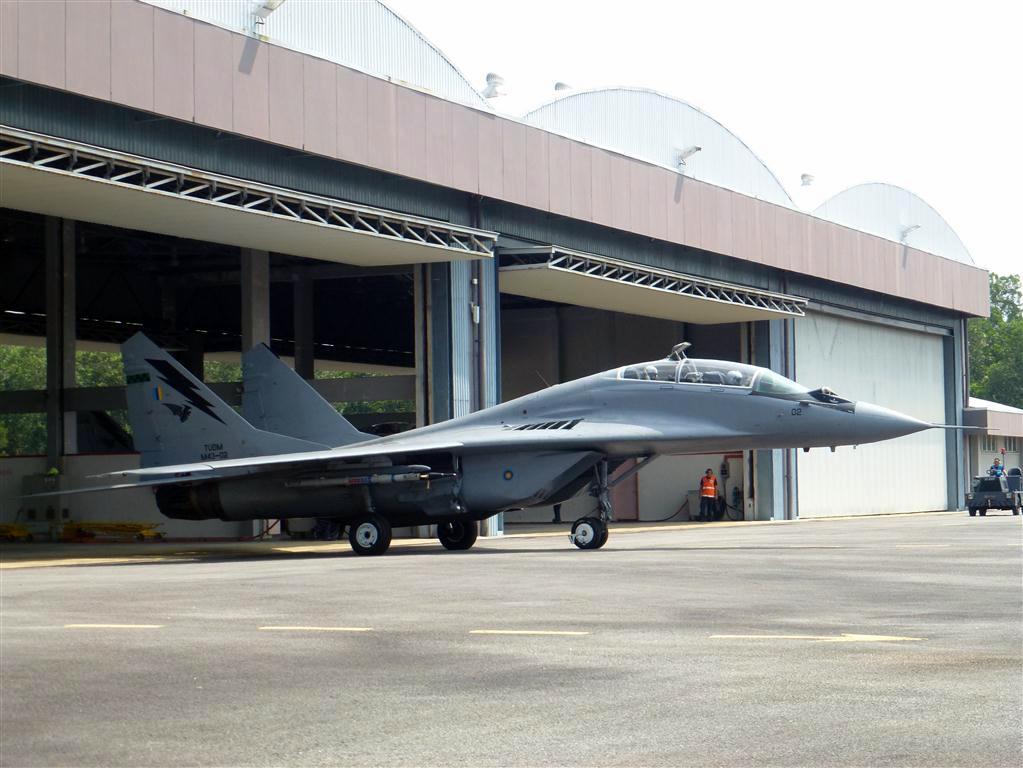
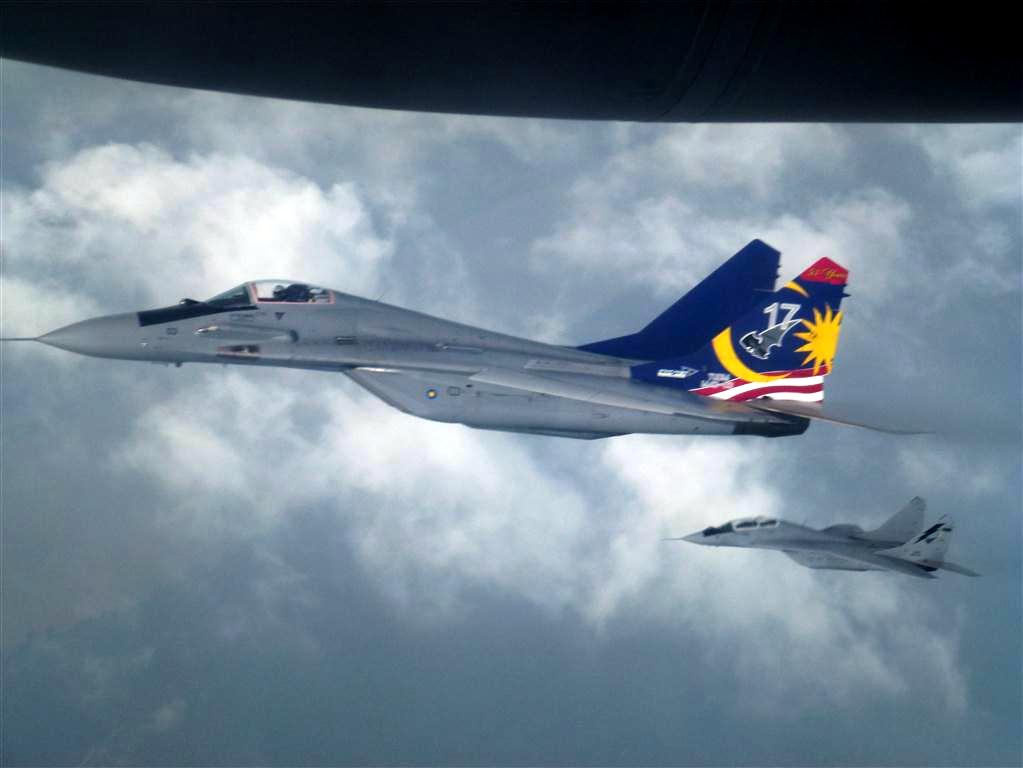
Two Mig-29N interceptors from No.17 Squadron initiating the “Forced Down” maneuvers

For the first time (probably) in the history of the Armed Forces, the Air Force allowed civilians a peep into its daily life, and were allowed to question anything from operational capabilities right to the case of the missing F-5E engine.  And it was a good thing that the Minister and the Air Force were very open in answering each question.

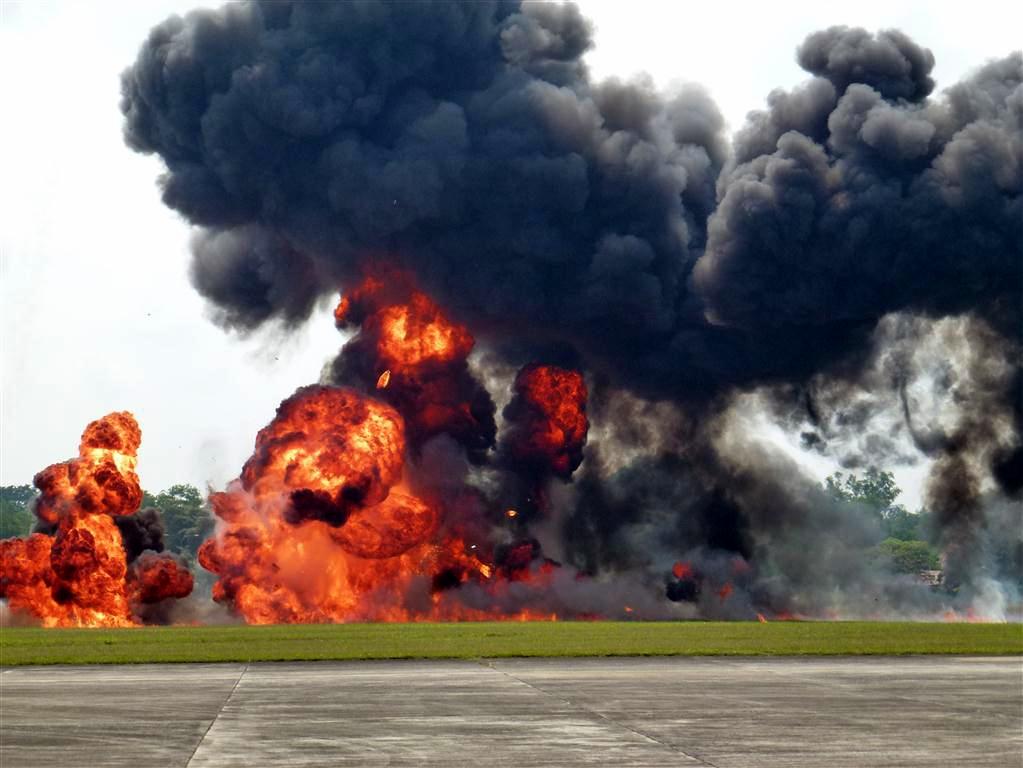
A “target” being hit by BAe Hawk 206 close air support aircraft after being “painted” with laser-targetting device employed by the RMAF Commandos, the PASKAU

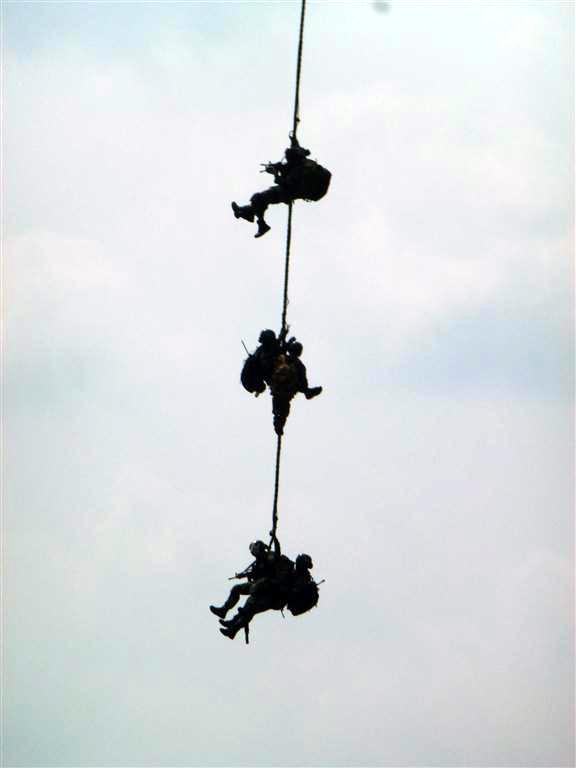
The bloggers were first taken to the Air Movement building where they were given a briefing of the activities ahead while having breakfast.  They were then taken to a static display of aircraft operated at the RMAF Base Kuantan.  They were shown the types of air interdiction missiles as well as air-to-ground munitions used by those aircraft.  Next, a section of the RMAF Commandos, the PASKAU, jumped off from 10,000 feet in a HALO (High Altitude Low Opening) formation to land in the center of the airfield where they employed a laser-targetting device to guide laser-guided munitions from the BAe Hawk 206 aircraft towards a target.  Having achieved their objective, two S-61A4 Nuri helicopters flew in tactical formation at tree-top level to extract the commandos via the SPIE-Rig (Special Purpose Insertion/Extraction) method.

Members of the elite PASKAU unit being extracted using the SPIE-Rig method

Next, the bloggers were divided into two groups.  I was in Group ‘A’ together with the Minister, Deputy Chief of Air Force, and blogger Big Dog where we were taken to the No.17 Squadron, home of the Smokey Bandits (Mig-29N).  There, we witnessed scrambling of Alert 5 aircraft that were sent to intercept two inbound bogeys (unknown aircraft) entering Malaysian airspace.  The term Alert 5, for the uninitiated, means from the point the scramble siren is sounded until the aircraft is airborne, takes five minutes.  There are, of course, different levels of interceptor aircraft readiness.

“Taufan Ganas 2” of the No.17 Squadron scrambles to intercept bogeys entering our airspace

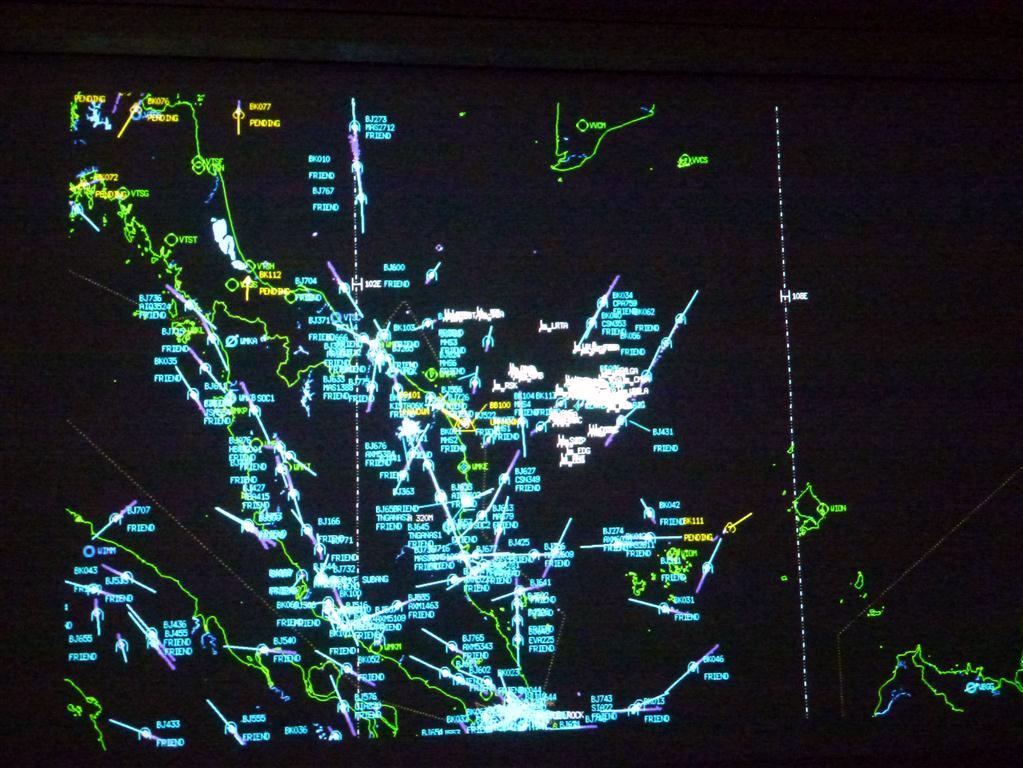
Next we were brought to the No. 320 Sector Operations Squadron Center.  This center is one of the centers that have the whole view of what is happening in and around our airspace.  It is a superior version of what I used to see almost two decades ago and I must say I am proud of how the Air Force has spent its money.  It is both my hope and that of the Air Force’s that the Government would allocate funds for Airborne Early Warning and Command (AWACS) aircraft to further enhance this capability.  On the question of frequent intrusions to the south of the Peninsula, it is obvious that the RMAF is very well aware of what is going on there, and suffice to say, having seen the capabilities of our radar defence system, that it is not true at all what some Members of Parliament, in particular from the Opposition, have been saying.

Real-time feed of all the aircraft inside our airspace, monitored by the No.320 Squadron. This image can be zoomed in to see each individual area

With the addition of the Air Combat Maneuvering Instrumentation system our pilots have tripled their kill ratio compared to what it was back in the late 1980s and early 1990s.  Back then, our Air Force was already a force to be reckoned with.  Now, as in the words of a squadmate of mine who is associated with the ACMI system:

“You can run, but you cannot hide!”

The visit at the RMAF Base Kuantan ended with a visit to the training facilities developed locally by or in co-operation with local defence players.  These facilities have produced world-class skilled officers, men and women in order to protect us better.  Lunch was served at the Air Movement building where the Minister answered several questions pertaining to the Air Force, including debunking of claims that very senior officers of the Air Force are involved in the case of the missing F-5E engine.  It is clear now that the Opposition does not want the case to be tried by the Courts Martial because they have a lot to hide, and are trying to divert attention by framing others.

The Minister also asked for both mainstream and alternative media practitioners to be fair to the Armed Forces, and not politicize defence spending.  This is in light of the Opposition ridiculing the Armed Forces, especially in the Scorpene submarines case, that has somewhat affected the morale of the men and women of our Armed Forces.  When their claims of the Scorpenes not being able to dive was debunked live during LIMA 2011, they went to town with the costs of procurements and expenses.

I am sure they will never question the RM6,500 fuel cost for the S-61A4 Nuri medical evacuation flight last week had it been one of their family members being flown for medical treatment.  Therefore, stop politicizing our national defence.

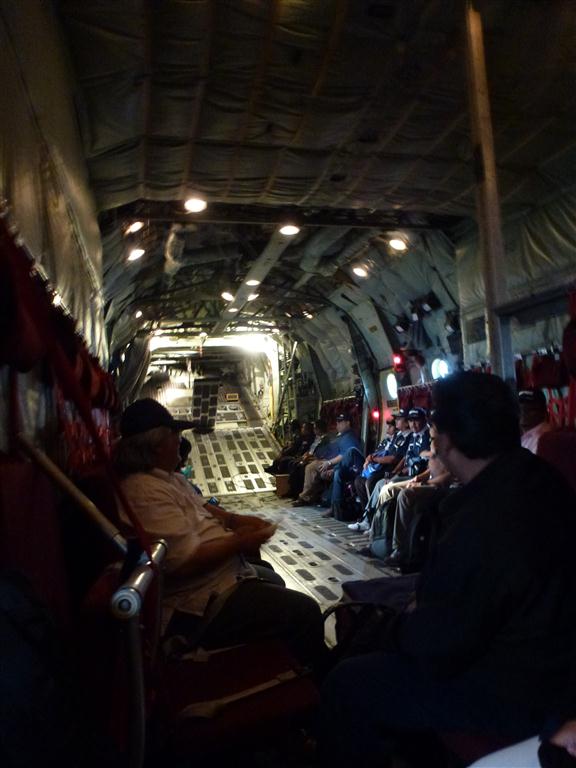
Inside the C-130H transport aircraft

Screwing History

20120910-010742.jpg

“Patriotism is the scoundrel’s last refuge,” was a statement made on the evening of 7th April 1775 by the Tory-supporting poet, Samuel Johnson. Johnson’s statement was not referring to patriotism at all. He was in face criticising the false-patriotism of John Stuart, the 3rd Earl of Bute, and his supporters. This is the statement I would like to direct to Kua Kia Soong for his attempt at screwing up the nation’s history.

PUTERA-AMCJA

In January of 1947, Lai Tek or Loi Tek or Loi Tak, the Secretary-General of the Communist Party of Malaya (CPM) before Chin Peng, backed and finance the establishment of the multiracial Malayan Democratic Union (MDU) which adopted a CPM programme, and the Malay Nationalist Party (PKMM) to form part of the CPM’s United Front to oppose the British – Malay Rulers – UMNO consultations to replace the Malayan Union and call for immediate representative government based on a Republic Model. The United Front was under the banner of the Pan Malaya Council for Joint Action (PMCJA).

However, the PMCJA sounded too pro-non-Malays and Burhanuddin Helmi, co-founder of the PKMM, was forced by other left-wing Malay leaders to take the party out. He did so, and formed the Pusat Tenaga Rakyat (PUTERA) as a new vehicle to carry out left-wing Malay demand for a pro-Indonesia republic-type representative government, free of the Malay rulers’ influence. (read more about the PKMM/MNP, KMM et al here)

The CPM saw their mistake that had deprived their United Front of the illusion of Malay support, reformed the PMCJA into the All Malayan Council for Joint Action (AMCJA), wooed the PKMM’s PUTERA to rejoin a PUTERA-AMCJA coalition jointly chaired by each organisation’s President, namely Burhanuddin Helmi and Tan Cheng Lock.

Just to remind us all, it was a time when the non-Malays who formed the majority of the population of Malaya, were either immigrants or British subjects even though some were born in Malaya. Therefore, Malayan citizenship was being sought by the Malayan Democratic Union.

PUTERA-AMCJA then drafted a People’s Constitution (Perlembagaan Ra’ayat) in anticipation of, and to counter the Federation of Malaya Agreement being put together by the British, the Malay Rulers, and UMNO. The Federation Agreement was expected to restrict non-Malay citizenship to assuage right-wing and majority Malay fear of being swamped by the non-Malays who already outnumbered them. At Page 199 of his memoir, Chin Peng wrote:

“The AMCJA was not exactly a communist front but…it was firmly under our influence. It was never in Cheng Lock’s mind to become a CPM stooge. But that is what exactly happened.”

Later, the British were to dismiss the PUTERA-AMCJA pretentions of representing the people because the PKMM was confined to a small group of radical left-wing Malays, while the bulk of the Malays supported UMNO. Even the Ulamas were in UMNO until 1956 when they splintered out to form the Pan-Malayan Islamic Party (PAS).

As for the Chinese, they were divided. On this basis they convinced Cheng Lock to leave the AMCJA and talk to UMNO for citizenship and other related matters.

THE TUNKU WAS OUSTED AS PM…???

Tunku was NOT ousted by Razak. UMNO Youth and many of the younger UMNO leaders blamed the Tunku for not doing enough for the Malays, and giving too much face to the Chinese. They wanted Tunku to step down and make way for Razak.

Tun Razak, Tun Dr Ismail, Khir Johari (who is NOT the biological father of Zairil Khir Johari contrary to skewed popular belief) and the UMNO old guards, would have none of that and wanted Tunku to be given his own time to decide. Tunku saw the writing on the wall and said he would step down as soon as his nephew is installed as the Yang DiPertuan Agong (Sultan Abdul Halim, also the present Yang DiPertuan Agong) as it would not be right for an uncle to sembah his own nephew.

The Inspector-General of Police, Tun Salleh, was not the kind of man to lend himself to Tunku’s ouster. The Chief of Armed Forces Staff, General Tengku Osman Jiwa, was the IGP’s close friend and also was the Tunku’s nephew.

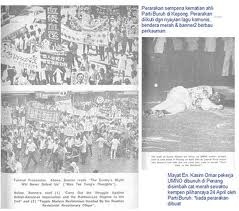
DID THE HOME MINISTER PURPOSELY ALLOW A FUNERAL PROCESSION AFTER THE POLICE HAD DENIED ITS PERMIT?

(read more about the Home Ministry over-riding the police’s decision to deny a funeral procession permit)

It was not certain why was the permit for the funeral procession of the Labour Party member denied by the police. It was either because of the pro-communists wanted it held on Elections eve, or because the organisers wanted an extended route, or whether because they did not want to be policed by the ‘red helmets’ (FRU).

An appeal was made to the concurrent Home Affairs Minister, Tun Razak who, like Tunku and the other ministers, was back in his constituency, Pekan. His concern was that no cause should be given to anybody to disturb the elections. So, he approved the permit as per the application.

But without the FRU to police, the procession really went to town. With 10,000 people in the procession, coupled with its shouted and hand-carried slogans crying blood debt will be paid with blood, it set the tone for the behaviour of the two opposition processions post-elections on the 11th and 12th of May.

As for the reported Tunku Tapes, I have not heard them, nor do I know when in the duration of Tunku’s life, were the recordings made. It could have been made in his twilight years, out of spite, much like Kua Kia Soong’s writings.

Re-Produced: Hatyai Accord: The Failure Of The Domino Theory – Part 3

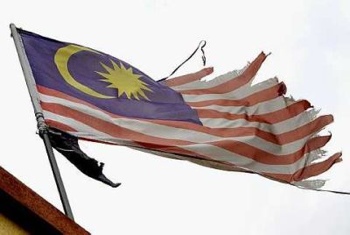
On the eve of the 55th Merdeka anniversary, uninformed youths, blind to history, displayed flags they said should be the Malaysian flag. As a former military officer who has seen the National Flag draped the coffin of fallen squad mates and subordinates, I find their action, for a lack of better word, disturbing. I seriously hope the Ministry of Home Affairs would take action against them. Politicians attempting to cause dissent among non-Malays, Sabahans and Sarawakians should also be taken action against.

Current political scenario is not new to this nation. The acts of certain politicians mimic those of the Communist Party of Malaya, and a certain significant political party back in the 1960s.

The following article was written during the Merdeka month last year as the third and final instalment about the communists’ armed struggle against this nation.

—————————————————————————————————–

As mentioned in the previous posting, the CPM split into two factions in October 1974: the CPM and the MPLA (CPM-Marxist-Leninist).

In 1975, the Chinese-backed Khmer Rouge ousted the Cambodian military government and began a reign of terror. In Vietnam, Soviet-backed North Vietnamese Army rolled into Saigon, effectively ending the Vietnam War. By December 1975, Laos too, fell to the Communists. In South-East Asia, there was real fear that the ASEAN nations would be next to fall to Communism – the Domino Theory was born.

Both the CPM and MPLA’s spirit were boosted by this new turn of events. Their activities peaked in 1975. There were bombings of the National Monument (Tugu Negara), the Police Field Force camp in Jalan Pekeliling in Kuala Lumpur Having scored a morale-boosting victory by assassinating the Inspector-General of Police, Tan Sri Abdul Rahman Hashim, a year earlier, they set their sights on Tan Sri Yuen Yuet Leng’s predecessor, Tan Sri Jimmy Khoo Chong Khong, the Chief Police Officer of Perak.

Tan Sri Khoo was ambushed near the Ipoh General Hospital by the same assassins that murdered the IGP. His brave driver, Sergeant Chong, returned fire despite having being hit repeatedly by the assassins’ bullets. Sergeant Chong died soon after, but not before injuring one of the assassins in the head that then led the police to them.

Between 1976 and 1977, the Malaysian media was filled with nothing but stories of ambushes and attacks by the communist terrorists against the police and the military.

When Chairman Mao Zedong died, Deng Xiaoping returned to mainstream politics. Given his rapport with Chin Peng, the CPM was fueled to up the revolutionary ante. However, in 1978 Deng visited Thailand, Kuala Lumpur and Singapore, and was convinced to stop exporting Communism. As a result, in 1981 Deng ordered the ‘Suara Revolusi Malaya’ to stop broadcasting.

The CPM had had to relocate the radio station to South Thailand and renamed it ‘Suara Demokrasi.’ Starved of support, the CPM and MPLA were riddled with internal strife and political cleansing (including the execution of suspected counter-revolutionaries) that their effectiveness was greatly reduced.

The MPLA changed its name to the Malayan People’s Army (MPA) in 1982. One of the last gunbattles that occurred in the vicinity of Kuala Lumpur was in May 1983, on the day my paternal grandmother died. A patrol car chanced upon a group of Min Yuens and communist terrorists near what was Mimaland in Gombak. In the gunbattle, one policeman and one CT were killed, while the other policeman and another CT were injured.

The West Betong and Sadao groups of the CPM decided to surrender themselves to the Thai government in 1987 when they realised their struggle was not achieving any success, and with no clear political or military objectives.
On 2nd December 1989, the Communists gave up armed struggle and signed a peace treaty with the governments of Malaysia and Thailand, ending the Second Emergency.
——————————————————————————–
So, were the communist terrorists freedom-fighters as claimed by some parties?

When the Federation of Malaya achieved independence, the CPM had lost all clout in fighting “imperialism” and “colonialism”; yet it continued to do so, and even refused to recognise the formation of the Federation of Malaysia in 1963 by supporting the Indonesian campaign of lynching Malaysia (Ganyang Malaysia).

Let us also not forget that the CPM’s counterparts in especially Sarawak continued to wage war against the government ’til 1989. Among those killed fighting the terrorists in Sarawak was Superintendent Joni Mustapha, a Sarawak hurdler in 1958-59.

Joni was loyal to his men. He was in a cinema in Sibu watching a movie with his son when he got word that his men were pinned down by heavily armed terrorists upriver. He left his son behind and travelled by boat to reach his men. He was felled by machinegun fire, but remained to direct the firefight against the terrorists until he died. Seeing his commander die, Corporal Nguing, an Iban warrior, unsheathed his machete and charged at the terrorists only to be mown down.

Therefore, the communists terrorists not only fought against what some perceived as the “puppet-regime” in Kuala Lumpur, they fought against Malaysians on every inch of this hallowed soil trying to introduce communism, and turn this beloved country of ours into either a China-leaning satellite, or a Soviet-leaning one. It was never a nationalistic fight for freedom as claimed by some mentally-skewed politicians and their supporters either.

There is nothing nationalistic about joining the forces of a foreign-nation to lynch your own people, if the CPM ever regarded Malaysians as their own. Remember, the CPM waged war against the Malaysian people for 32 years after the independence.

Was the fight against the communists solely a malay struggle as claimed by a former Minister? No. Kanang ak Langkau is an Iban. So was Corporal Nguing. Tan Sri Khoo Chong Khong, Tan Sri Yuen Yuet Leng, Colonel Chong Kheng Lay – chinese. Former DSP Jeganathan, whom I had the honour of working with, is an Indian. He was absorbed into the Special Branch from Jabatan Talikom to set up the police VHF network, jungle-bashing, ploughing his way through to construct towers in the jungle with the communists hot on him. Inspectors Kamalanathan and Robert Cheah were injured when a grenade was lobbed into the Ipoh coffee shop where they were having coffee. I worked briefly with Kamalanathan who still limped in 1995 with a shrapnel lodged inside him decades after the incident.

It was a war against all of us, Malaysians – free and independent Malaysians, by godless creatures who call themselves freedom fighters, a war that none of us Malaysians should ever forget, and against those none of us should ever support.

The people of Malaysia, the Malaysian Armed Forces, the Royal Malaysian Police, should always be on guard for a resurgence of communism in Malaysia. The peace treaty of 1989 was just a declaration of the end of an armed struggle; not the giving up of the communist ideology.

55 And Still Without Political Integrity

20120830-201327.jpg

Malaysia celebrates 55 years of independence. For those who think that this nation only came into being on 16th September 1963, let me tell you that the name of this nation was changed to the Federation of Malaysia to include Sabah, Sarawak and Singapore. Both Alaska and Hawaii joined the United States of America in 1959, but to people from those states 4th of July 1776 is their Independence Day.

For politicians who are trying hard to make the people of Sabah and Sarawak think of themselves as being separated from those on the peninsula, shame on you for trying to tear this nation apart for your political gains.

55 years on, political integrity is what we lack, and that is a big shame to us all. The thing most synonymous with politicians is corruption. I am not just talking about those from the Barisan Nasional, but also those in the loose opposition coalition that calls themselves, ironically, the Pakatan Rakyat. While money politics is still rife within UMNO, we hear of corrupt practices within the Pakatan Rakyat itself. I will let you Google for the links to these yourselves.

Corruption amongst politicians only proves one thing: that power corrupts, and absolute power absolutely corrupts. With power comes the opportunity to enrich one’s self, and to stay in power, one needs to buy his way into a recognised position. And the amount can only increase each time.

The problem lies with us, human beings. God is intangible. Heaven and hell are intangible. Rewards and Sins are intangible. Which is why some people do things without the slightest guilt.

Of course political corruption is not peculiar to Malaysia only, as it is also evident in other nations including in the west, but this is not an excuse for us to accept it as a norm. Political corruption is something that we must all take as a responsibility to eradicate, or curtail. And this is something that needs to be addressed by us as voters to determine the candidates to choose, rather than by party. UNLESS, all political parties can make one important move.

As a voter, I would like all political parties to submit their list of election candidates to the Malaysian Anti Corruption Commission and the Royal Malaysian Police, for the potential candidates to be vetted thoroughly. Only names that have been cleared by BOTH agencies, not either or, can stand for elections. That is one way to ensure that voters are not shortchanged by political parties, especially ones that put whoever they have so they could contest.

As voters, we have the responsibility to choose the correct candidates to represent us. Of course, this process would be made easier had the candidate been cleared by the two agencies I mentioned above.

We must strive to choose only candidates who are able to uphold the Constitution, Law and Order, and Justice. We must choose candidates whom have the ability to lead, bring about development and have a certain specialisation. We should choose only candidates who are interested in serving us, not the other way round. What politicians who hold public posts now think is that they are the VIPs and the people should serve them. What they have forgotten is that they are to represent us, help solve our problems. For that reason they are the Wakils Rakyat, not Boss Rakyat. Sad to say that only P Kamalanathan of Hulu Selangor deserves the Yang Berhormat title. He deserves that respect without reservation.

We must ensure the culture of politics with integrity as our way of life as only this can ensure that we continue to live as one, and continue to enjoy this independence. Those with greed for power should be shunned by all and never be allowed to hold office, for that would be like allowing a cancerous cell to spread.

We must ensure that the Executive Branch of the Government administers this nation with proper engagements with the relevant government departments, and not run the country on their own. We have no time for members of the Executive Branch who are only interested in making money.

We must ensure that our representatives in the Legislative Branch do their job as entrusted to them by us the Voters. They must attend sittings and not play truant, and they should debate a bill through and not walk out. If they disagree with anything at all, they should vote any bill out as a registration of protest…not walk out and cheat their voters of their voice. I also hope to see the end of the Whip System as this will ensure that any bill that is to be tabled is thought through and through by all members before it is tabled on the floor. This is to ensure that the party that tables the bill, tables a quality bill that has the support of the significant majority of its members.

We must ensure that the Judiciary Branch remains independent and is free of corruption. The integrity of the Judiciary Branch is key to the preservation of the Government’s integrity.

We must remember that we, the Voters, are the important component in a traveling bus. We elect our representatives to drive the bus, but it is the Voters who determine the destination the representatives ought to drive to.

Remember, if we do not preserve the integrity of us, as Voters, and the integrity of those we have chosen as the driver of this nation, we may not see another 55 years of an independent Malaysia. Preserve integrity and choose wisely, not emotionally.

Selamat menghayati erti Kemerdekaan.

Re-Produced: Hatyai Accord – The Failure Of The Domino Theory – Part 2

I wrote this continuation of the armed struggle by the Communist Party of Malaya last year. Reeling from losses and lack of support from Malayans, followed by Malaysians, Chin Peng sought the help of China to sponsor its attempt to turn Malaysia into a communist satellite.

——————————————————————————————————-

After the failure of the Communist Party of Malaya’s (CPM) revolt against British colonial rule and the subsequent independent Federation of Malaya’s government, the CPM retreated almost in full to Southern Thailand. In 1961, Chin Peng, leader of the CPM moved to China and sought support from Beijing. Deng Xiaoping, who was the most influential Chinese leader of the time although he never held any head of state office, promised Chin Peng a sum of US$100,000 in support of the CPM’s struggle.

In 1963, when Sabah, Sarawak and Singapore chose to join the Federation of Malaya to form the Federation of Malaysia, Indonesia objected violently by launching a campaign to lynch the newly-formed country out of existence dubbed “Ganyang Malaysia.” The CPM joined the Indonesian forces to fight against the people of Malaysia.

On New Year’s Day in 1968, the Communist Party of China launched the “Cultural Revolution”. The CPM, taking this as a queue and in conjunction with the celebration of the 20th anniversary of the beginning of the first Malayan Emergency, issued on 1st June 1968 a directive: “Hold High the Great Red Banner of Armed Struggle and Valiantly March Forward.” The first act, 16 days later, was to ambush the security forces and murdered 17 of its members in the Kroh area in Perak. Thus begins the Second Emergency. A year later, with the support of the Communist Party of China, the CPM began transmitting “Suara Revolusi Malaya” from the Hunan province, aimed to gather momentum and support from sleeper-agents, CPM members in South Thailand, and communist symphatizers who remained at large.

When Malaysia and Singapore parted ways, the DAP took up the role of the PAP. There were demonstrations and strikes almost on a weekly basis organised by the DAP. With the party being predominantly Chinese, race relations took a toll. This fact was successfully exploited by the CPM. The CPM indoctrinated people at all levels: Chinese civil servants, student leaders, trades unionists, the non-Malay members of the Armed Forces and Police, the middle classes with their ideology. All it did was to portray that the malays dominated the political scene while the chinese and Indians were relegated to being second-class citizens. Does this ring a bell? By 1969, the damage to race relations was just waiting for the final straw to break its back.

Those who were born after 1970 will never be able to recall how a curfew siren sounds like, but this writer had had that experience of rushing home (our quarters was not only fenced up using the normal chain-link fence, the perimeter chain-link fence was covered in total by barbed wire) every time the siren sounded. Those were the days when our boys in blue had to fight on two fronts: against the communists, and against the common criminal.

Fresh from the race riots of May 1969, the government felt that it could not afford any more ethnic antipathy. During the First (Malayan) Emergency, the setting up of New Villages by order of General Templer caused other races to look at the Chinese population as communist-symphatizers, when the truth was far from it. The government of Malaysia rightfully did not declare the Second Emergency as one, but instead learned from the Briggs Plan that the only way to win the war against the communists was through the tandem improvement of security and development: KESBAN – Keselamatan dan Pembangunan (Security and Development).

KESBAN was carried out to protect the people from subversion, insurgency and a state of lawlessness. It saw the coordination of all agencies from kampung level all the way up. I had had the opportunity to work under Tan Sri Yuen Yuet Leng (one of the heroes of Operation Ginger during the First Emergency), who as the Chief Police Officer of Perak, had to fight not just the war against the communists but also against common criminals. He related to me how, when the police force was stretched thin in Perak, called all the head of gangsters in Perak and appointed them as Rukun Tetangga heads.

“They were born leaders with natural leadership skills. All I had to do was channel those skills to positive use.”

The newly-appointed Rukun Tetangga heads were given the task to uphold the law and maintain peace and order. Any gang member found breaking the law would be surrendered to the police, else the leader will be arrested. This ploy work, crime was drastically reduced, and the police had a freer hand in combatting the communist terrorists in Perak.

The Rukun Tetangga (Neighbourhood Watch) was born out of KESBAN. It saw people of all races work together to keep their neighbourhood peaceful; but what it did most was to foster a good relationship and understanding between races. People were more tolerant of each other back then than they are now. Mind you, it was around half a decade after the race riots of 1969. No one, save for a few, cared whether one was Malay, Indian or Chinese, or Muslim, Christian, Buddhist, Tao or Hindu. They were all Malaysians back then.

KESBAN also allowed for development to reach the rural areas; where there was no electricity, some kampungs began to enjoy at least 12-hour electricity supply per day, with the police and military guarding the power supply network from the occasional sabotage by the CPM. Once more rural areas were developed and connected, the communist terrorists moved further deep inside the jungle.

KESBAN would not have been possible had it not been for the establishment of diplomatic ties between China and Malaysia. In February 1972, US President Nixon established diplomatic ties with Communist China in order to stem the influence of the Soviet Union in East Asia. The late Tun Abdul Razak did so in 1974. China warmed up to Malaysia. Everywhere the Malaysian delegation went, children lined up the streets waving the flags of both nation.

One must remember that back in 1961, Chin Peng had gone to meet with Deng Xiaoping. The latter enjoyed strong support in the Communist Party of China but was not in good terms with Chairman Mao. The diplomatic ties between Mao and Razak was in a way a hint to Chin Peng and Deng. The CPM retaliated with the assissination of Tan Sri Abdul Rahman Hashim, the then Inspector-General of Police a week later.

Due to the relationship between China and Malaysia, in October 1974, the CPM saw a split in its ranks, and eventually a split in the organisation. The CPM Marxist-Leninist, a splinter group leaning towards the Soviet Union was born. This group was then renamed the Malayan People’s Liberation Army.

IN PART 3 I WILL WRITE MORE ON THE SECOND EMERGENCY TO ITS EVENTUAL COLLAPSE

Re-Produced: Hatyai Accord: The Failure of the Domino Theory – Part 1

I wrote this article last year when I saw there was an attempt to skew history, partly for political gains, and partly because of ignorance of our history.  I found it disheartening, too, when people representing the government did not do a good job at explaining who PKMM, or API, or AWAS were in relation to the rise of Malay nationalism, in relation to the struggle this nation from the clutches of the British.  Were they really freedom fighters, or were they fighting for Malaya to be part of something bigger?

———————————————————————————————————————————————–

Very early one morning as I prepared to go to school, I could hear a distant dull explosion, followed a bit later by the rattle of the window panes. It was 1975, 7 years into the Second Emergency. It preceded the assassination of the then Chief Police Officer of Perak, Tan Sri Khoo Chong Kong (November 1975), and in turn was preceded by the assassination of the then Inspector-General of Police, Tan Sri Abdul Rahman Hashim. These events were among the reasons that drove me to serve in the Malaysian Armed Forces and managed to join the later part of the Second Emergency campaign.

The Communist Party of Malaya (CPM) has its roots from the South Seas Communist Party (SSCP), otherwise known as the Nanyang Communist Party, that was headquartered in Singapore. The latter was formed by the Chinese Communist Party (CCP) in 1922. Since communism was introduced to this region by Dutch radicals, the SSCP’s theater of operations were mainly focused in the Dutch East Indies, infiltrating trades unions and disrupting lives. The SSCP attempted an uprising in 1925 which was crushed by the Dutch East Indies authorities and retreated to Singapore where they grouped up. In 1930, the SSCP was dissolved and the Communist Party of Malaya was born.

We all know what happened during the post-war years preceding the First Malayan Emergency. But let me add a point to make people understand a fact here. In my Twitter profile, I described myself as …not prejudiced. I hate everyone equally. This is to show my political stand (or the virtual absence of it). I have friends on both sides of the political fence. One thing I cannot stand is stupidity and blind loyalty. The left-leaning side (depending on which compass direction you are facing) claims that the Tunku, Tun Abdul Razak, Tun Hussein Onn and Tun Mahathir were not freedom fighters. They have been accused as British lackeys, serving the Colonial government’s interests. I guess I will have to forgive them for their lack of knowledge in history before I bludgeon any of them for their sheer stupidity, but:

Tunku Abdul Rahman, Tun Abdul Razak, Tun Hussein Onn and Tun Dr Mahathir all came from the states of Kedah, Pahang and Johor. When were these states under Colonial rule at any time other than during the brief Malayan Union period?

I should bludgeon the right-leaning side as well for not noticing the above for their defence. Shame on you.

The CPM was organised into the Malayan People’s Anti-British Army but changed that to the Malayan People’s Liberation Army (MPLA) with the aim to set-up the People’s Democratic Republic of Malaya (and Singapore). I guess most of us know the connotation of the name, and countries that had inherited the name, such as the People’s Democratic Republic of Korea (aka North Korea).

The MPLA was supported by the CPM’s civilian organisation named Min Yuen. This organisation organised supplies for the MPLA.

The first Malayan General Elections was held in 1955, and Malaya had its first Chief Minister: Tunku Abdul Rahman, whose first act was to bring peace to the nation by declaring partial amnesty to members of the CPM. This partial amnesty was called off 6 months later with only 17 members of the CPM surrendering.

I will also not dwell so much on the details of the First Emergency (1948-1960), but for those not in the know, there was the first National Service registration in the late 1950s after we gained our independence. Some 240,000 registered to combat the communists, or 17 percent of the 1.4 million inhabitants of Malaya then. 20,000 were called up, but only 1500 reported for training. All of them were absorbed into the Federation of Malaya Police Force.

Then, there was a second National Service registration in 1958, but those registered were never called up because by then the members of the CPM realised that the independent Government of the Federation of Malaya, headed by the Tunku and backed by the parties representing the Malays, Chinese and Indians, was not offering any more amnesty and was adamant to obliterate the CPM. This drove the members to surrender by the hundreds, wave after wave, that in the middle of 1958 the CPM, whose MPLA was active only in Perak and South Johor by 1957, had to fall back to the Thai side of the border. Chin Peng and his Central Executive Committee had of course retreated in 1953 when the tide started to turn against the CPM.

In 1960, the Government of the Federation of Malaya declared the Malayan Emergency (First Emergency) over.

I WILL WRITE ABOUT THE CPM IN THE 1960s AND THE SECOND EMERGENCY