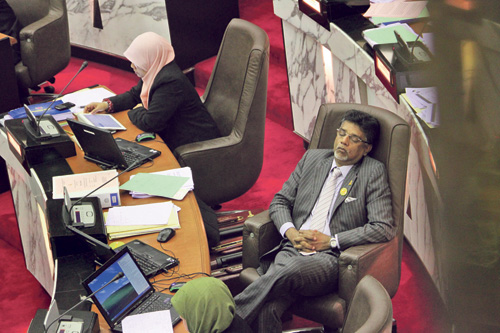
diGAJI untuk memBUTA

Your Opinion Does Not Matter

Not too long ago if you go to a government office to get an application form, it would be left either in a tray or in a box for you to take and you would see each person taking more forms than they needed. Some would end up as kacang puteh wrappers sold by kacang puteh peddlers on bicycles parked outside the very government office.
BECAUSE THEY WERE FREE!
Nowadays, you have to pay RM1 per form, and you can see that each person would take only one form. Anything that is free has no value.
What I am getting at is, if you give something to someone for free, most of the time it would go to waste, or taken for granted. The same goes to the free first 20 cubic meters of water given to residents of Selangor by the Pakatan Rakyat government. In the words of Prof Dr Chan Ngai Weng (Universiti Sains Malaysia and Penang Water Watch):
“The water policy of that (Selangor) state is suicidal!”
He said this during the 1st Malaysian Water Association – Universiti Teknologi Malaysia Roundtable Dialogue titled “Water Has No Value” on Friday, 28th October 2011.
Interestingly, the Seceretary-General of the United Nations, Ban Ki-Moon also underscored this point. On 3rd August 2011, he told the United Nations General Assembly that water, as Basic Human Right, has a market price.
“Let us be clear,” he asserted, “a right to water and sanitation does not mean that water should be free.”
Let us face the fact. Water really has no value in Malaysia. On average the water tariff in Malaysia is at 20 US cents per liter or 60 sen. An average person in Malaysia uses 203 liters per day. In a month the person would be using up to 6 cubic meters of water. An average Malaysian family (5 members) would then use up to 30 cubic meters per month. Therefore, an average family will be paying RM18.27 per month for the use of treated water. That is the equivalent of an hour and a half of calls from your mobile phone. You cannot even take the NKVE from KL to Shah Alam and back on that amount. Water tariffs in Malaysia simply does not meet the cost of producing treated water for the masses. Therefore, the water service providers in Malaysia really need to look at restructuring the water tariff by increasing the tariffs to a level that reflects the cost price, and a surcharge for those who use more treated water than the national per capita average. The public will also have to be educated on the cost of water treatment and production through engagement sessions with SPAN, NGOs and the service providers.
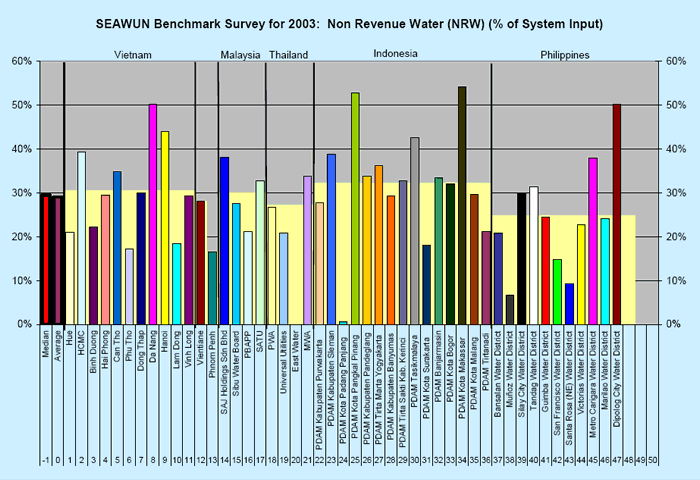
Apart from that, the service providers would also have to prove to consumers that it has taken steps to plug Non-Revenue Water (NRW). Mind you, we have some 131,000km of water pipelines, 25% of those are made from asbestos-cement and they can easily deteriorate, crack or break altogether. Our average NRW stands at 36%. The Asian Development Bank stated that in Asian cities, the NRW averages 30% of water production, but ranges from 4% to 65%, posing as a deterrent to the recovery of production costs. To plug NRW is costly but has to be done to the point where it would be economically viable to do so. The panelists of the above dialogue agreed that 25% would be the acceptable level of NRW for Malaysia, and that should be the target for water service providers to achieve over the next few years.
Another challenge is to protect the water catchment areas. The value chain starts at water catchment areas and therefore it is imperative that state governments take steps to protect these areas by gazetting them under a specific Act for Water Catchment Areas, and not as it is now, under the Forestry Act. We often find water resources polluted by human activities in these areas such as logging (legal and illegal), farming, plantation, manufacturing, animal husbandry and indiscriminate dumping of rubbish despite having these areas gazetted under the Forestry Act. Therefore, protecting water catchment areas is vital to ensure clean and continuous water supply. The general public needs to be educated on the importance of preserving water catchment areas so they could act as the extra eyes and ears for enforcement authorities.
The biggest challenge, of course, is to depoliticize water. Water, like the nuclear issue, should best be left to the experts, and not politicians who are self-proclaimed experts. The current tussle on various water issues by both the ruling government and the opposition over the Langat 2 project is not helping, nor is the war on who has the lowest water tariffs. When Penang increased its water tariffs, it was the best move yet it was politically lambasted by the BN government. Face the fact: things are not getting any cheaper and the same goes to the treatment and supply of water. And to the Selangor state government, stop hoodwinking the public any further. Based on a projection up to July 2011, the water supply in Selangor is at 4,122 million liters per day (MLD) while the existing capacity is only at 4,326 MLD. That gives us all a mere 1,204 MLD or 4.7% buffer. If anything were to happen to any two water treatment plants in Selangor, our taps will run dry for several days at least. Therefore, the Langat 2 treatment plant needs to be built like yesterday already.
Remember: Malaria, Tuberculosis, rising food prices, environmental degradation – all these have a common denominator: WATER.
 In 2002, the Likud Party won the Israeli General Elections and declared that it would object to the creation of a Palestinian state. The issue: WATER. Said Benjamin Netanyahu:
“A Palestinian state would control the aquifer, which gives us 30 percent of our water. Yes to a Palestinian state means no to a Jewish state, and yes to a Jewish state means no to a Palestinian State.”
That is how important water is to all of us, and I am constantly reminded of the hardship people in the Klang Valley had to go through during the water crisis of 1998, and the fact that it could happen again come 2014 (provided the Mayan Calendar’s gotten 2012 all wrong). My fears are further underscored by this blog written by a friend who was a senior Water Engineer in pioneering Non-Revenue Water control work.
When Pakatan Rakyat gained control of Selangor in 2008, the first thing they did was to supply the first 20 cubic meter of treated water to consumers FREE OF CHARGE, a move I thought was foolish, unprecedented, and was definitely not carefully thought through of. Nothing more than an election feel-good reward to those whom had vote for them, I believe it only encourages wastage of treated clean water as people do not have to pay for that first 20 cubic meters of water.
Then on 5th August of 2011, Elizabeth Wong, Selangor’s version of Fuziah Salleh of Kuantan (the former is the water “expert” while the latter is the nuclear “expert”) said in The Star that studies done on the growth in demand for water in Selangor by SYABAS was erroneous as it had relied too much on the National Water Resources Study (NWRS) conducted by the Economic Planning Unit in 2000. That shows how shallow Eli Wong is, as SYABAS had used data collected over the last five years (2005 to 2010) to forecast the future of growth in demand for water. In fact, Eli Wong went on to say that “… the “Water Demand approach” (SYABAS) used was based on the national GDP growth projection that varies according to the global economic market that has not been stable since the world economic crisis.”
Miss Wong, had you the ability to understand what you read, then you would know that the NWRS based its findings on four components: 1) Domestic Uses, 2) Commercial Uses, 3) Institutional Uses, and 4) Industrial Uses. Only component (4) uses GDP as a growth indicator for forecasting demands, and looking at what was written above by my friend, if the Selangor state government does not address this issue now, we may face a serious water shortage issue come 2014.
More alarming is Miss Wong’s continued feeding of misinformation over the Internet over the Selangorku website (SYABAS Gagal Turun Air Tidak Berhasil, Bekalan Air Bersih Terganggu) whether by default that she is ignorant of the water issue, or by design that this misinformation is fed to the masses to serve a much bigger agenda.
Air Tidak Berhasil or Non-Revenue Water for laymen like you and I actually means TREATED water that is lost through leakages in old pipes, theft and other methods, and not billed – cost was incurred to treat the water but no revenue was able to be collected. Eli Wong does not understand the economics of NRW. To lower NRW level, it requires a form of investment. However, the economics of NRW is such that there comes a point where further lowering the NRW level will result in a cost that is too high for a water operator to bear. The methods used to detect leaks etc is by no means cheap, nor is the replacement of old and faulty pipes. Selangor is a huge state that the cost of replacing ALL these pipes would be beyond exorbitant. For the same reason, Kelantan has less than 60% treated piped water supply coverage. Penang on the other hand has a low NRW because it is far smaller compared to Selangor. So, how does the PR-led Selangor state government plan to reduce NRW to 10 percent? This is why the Federal Government has proposed for the building of the Langat2 plant for treating raw water supply from the neighbouring state of Pahang. Without it, the current Selangor water buffer stands at 5 percent. If any two water treatment plants in Selangor have to be shut at the same time, say for maintenance, then we will have serious water supply problems.
Water is a very important commodity in life. Water is beyond necessity as it is life. The Pakatan Rakyat’s gamble with this water issue should be seen as a gamble with the life of the rakyat. And in my opinion, Eli Wong should just STFU and let the experts do their job.
Iniye Deepavali Nal Vathukkal
So it’s gutter-politics when you drag in the child/children of politicians to serve your cause. Unfortunately, politics is like a bowling alley – there’s a gutter on each side of the lane.
Sample of (not limited to) websites from the holier-than-thou side:
http://www.detikdaily.net/v5/modules.php?name=Forums&file=viewtopic&t=26055
http://ikhwanhafiz.blogspot.com/2011/06/anak-rosmah-menikah-borat.html
http://milosuam.blogspot.com/2011/09/gempar-bakal-menantu-rosmah-anak.html
http://bagindareformasi.blogspot.com/2011/07/gambar-anak-najib-norashman-juga.html
http://anwaribrahimblog.com/2011/06/18/dr-tan-siapa-biaya-kos-pertunangan-anak-najib/
http://shaiful-hulusgr.blogspot.com/2010/06/parti-liar-anak-najib-dan-pemimpin-umno.html
http://www.ibnuhasyim.com/2011/06/kos-pertunangan-anak-najib-atas-nama.html
Pot calling the kettle “black”?
When DAP’s ADUN for Kota Alam Shah in Selangor made an insulting remark about the Malaysian flag on National Day, there was an outcry and a call for him to be punished. DAP did just that by suspending him from the party for six months. This was later commuted to just a severe reprimand from the party’s “disciplinary committee.” It was a punishment nonetheless.
DAP’s office holders are notorious for not respecting the Rukunegara, which was based on the Federal Constitution.
After the political Tsunami of 2008, several DAP’s assemblymen from Penang, Perak, Pahang, Johor, and most recently in Sarawak, refused to either don the official attire and/or the songkok. The songkok, to them, symbolizes Islam, which is the official religion of Malaysia. Several rulers were insulted by these people that the Sultan of Johor even made a remark about the behaviour of one who was thrown out of Johor’s Dewan. Coincidentally, this same state assemblyman is now serving a six-month suspension for using the party’s money for his own interest (if this was done by a BN rep, they would have asked for a Royal Commission of Inquiry).
When the Chief Minister of Penang made a defamatory remark regarding the state of Johor, he too was let off without even a pinch given.
The difference between all the people mentioned above and the Kota Alam Shah’s rep is: the latter is not Chinese.
So much for a so-called multiracial party.
Don Quixote was a Spanish fiction work written in the early 17th century about a middle-aged man whose pursuit of ideals was impractical and foolish. It was from Quixote’s name that the adjectival form was derived: quixotic.
Quixotic is best used to describe the alternative budget offered by Anwar Ibrahim in Parliament, days before Prime Minister Najib Razak presented the government’s version. One glaring carrot Anwar presented was setting the minimum wage for Malaysians at RM1.100 per mensem, while Najib’s government is still discussing the issue (or are they?). Whatever it is, you can have a RM5,000 minimum wage level but it means nothing if all you can buy with it is a packet of asam boi. Everyone should be thinking of how to increase the purchasing power of the Ringgit.
What was the Ringgit at versus the Greenback before Anwar’s superb fiscal policy as the Finance Minister almost destroyed the former? It was at around RM2.50 to a Dollar or something to that effect. What are we at now? RM3 to a Dollar or somewhere there. Simple minds would say that we’re still 50 cents off, therefore to a simple person like me, we have not fully-recovered from the 1997-98 Asian Financial Crisis. Tun Dr M’s recovery plan which was to continue with what the opposition termed as “wasteful mega-projects” proved vital in helping ordinary Malaysians get back on their feet. The local spillover effects from those projects were hardware stores get orders for construction materials, workers flock to Malaysia for jobs and spend their money at the local canteen set-up by the makcik who buys her ingredients from the local sundry shop and market. Every one gets something out of a project, and every one including that makcik becomes a crony. This is evident when trying to be a popular person, a certain sleeping Prime Minister stopped many mega-projects and caused the economy to slide down. He learnt the lesson a hard way.
Najib’s budget makes Malaysia attractive for FDIs, and allows the lower income group to have more purchasing power. When more money circulates in the economy, you create more jobs. I’m no economist but I think that is how things work. Setting a high minimum wage will only encourage traders to increase prices of essential goods, thus raising the inflation rate. When inflation rate goes up, your purchasing power goes down.
Of course, PR is filled with things quixotic, but they are also notorious for not keeping promises made. Let us take the promises made by PR in Selangor in its 2008 Elections Manifesto:
I want to know how many of you whose baby was born in Selangor has had an account set-up by the Selangor State Government with RM100 in it?
I want to know how many of you do not have to pay any form of fees for your pre-school children?
I want to know how many of you have received between RM50 to RM100 for every child that you have to send to a nursery?
How many of your invalid kinsfolk has had a Takaful insurance subscribed by the State Government for them?
How many jobless single mothers with children below 12 years of age has received a fixed allowance of between RM150 to RM250?
How many farmers and fishermen have received a minimum wage of RM1,200 per month? (Co-incidentally, Anwar has reduced this to RM1,100!)
Those are among the promises made but have yet to be fulfilled by the Selangor State Government; yet, Anwar dared to make an even bigger promise through his quixotic budget.
Is Anwar a Don Quixote then? At least Don Quixote’s loss of wits wasn’t as bad as the Donkey’s delirium.
When you talk about the defence of Johor, you will often hear the term “Segamat Line.” It is that theoretical line that cuts from the east coast to the west across Segamat. I shall not elaborate more on that matter, just that I chose this as the title for this posting.
Much has been said about Mat Sabu and his glorification of Mat Indera and the Johor communists that led to youngsters who were still swimming inside their father’s balls when members of the Communist Party of Malaya still went around killing policemen, armed forces personnel, civilians, attacking various places with bombs etc to glorify them as well. What Mat Sabu did invoked the wrath of the majority of Malays that Nik Aziz saw it fit to raise the Hudud issue again just to put the Malay support slide in check. Did the PAS central committee sanction Mat Sabu’s script? I don’t know but I don’t believe so. His script echoes that of DAP’s Ronnie Liu’s – a cry to glorify Chin Peng and his cohorts back in August 2005.
To me, it was DAP’s script that Mat Sabu used with the intention of splitting the Malay votes in Johor. It is no secret that Johor is UMNO’s strongest bastion. You split the Malays there, UMNO is doomed. DAP Johor, with Boo Cheng Hau as the State Opposition Leader, is not in the position to take the lead in this process. Why do I say so? Despite portraying itself as a multiracial party, DAP is a chinese-based party. For example, Johor has 3,3 million inhabitants. 1.8 million or 54% are Malays; 1.0 million or 30% are Chinese; 200k or 6% are Indians. But the composition of DAP’s State Committee has only one Malay committee member and two Indians while the other 12 are Chinese. This is not limited to Johor only. The same numbers represent Kedah, while in other states you can hardly find any Malay committee member. In DAP’s Central Committee, out of 31 members only two are Malays and three from the Indian diaspora. In DAP Women Section, the only odd one out of 11 members is an Indian who is only the ASSISTANT Publicity Secretary. She’s there only for publicity. In DAPSY, out of 23 members only one is not Chinese. He is a Sikh, and no, his name is not Jaswan Singh. So, is DAP in essence a multiracial party? I leave that to your judgement.
Therefore, using Mat Sabu and his party would definitely help the cause. But to a certain extent, it backfired.
Enter Gwee Tong Hiang.
Who is Gwee Tong Hiang? On the 21st June 2008, His Royal Highness the Sultan of Johor had this to say about Tong Hiang:
“Ada yang kat sini, yang semalam atau yang hari kelmarin, yang menunjuk-nunjuk jaguh, yang tak mahu pakai senonoh, kalau hendak, ini jam keluar kat sini (There are people here, who yesterday or the day before, tried to be heroes by not dressing decently … come out now here).”
Tong Hiang is one of many DAP state assemblymen and Parliamentarians who have trouble memorising the Rukunegara especially Rukuns number 2, 3 and 5. For those of you having the same problem, please Google it.
Tong Hiang was not a favourite of the Johor DAP State Committee, and when he promoted himself as a GE12 candidate for the Bentayan state seat, B00 Cheng Hau was not at all pleased. However, being in Lim Guan Eng’s circle, he got his wish. When he was accused of the improper execution of the sale and purchase of Muar’s Wisma DAP in 2007, Guan Eng instructed Tong Hiang to bring his 17 accusers to court.
Tong Hiang’s arrogance, along the way, has caused discontent among DAP Muar’s members and many have left him since GE12. He is dubbed “the Ronnie Liu of Johor” for his purported association with loan sharks and other seedy characters. Early this year, DAP Bakri was reported to have had around RM60,000 but just after mid-2011, it was left with aroound RM2000 to RM3000 in the bank. In August of 2011, the DAP Bakri Liaison Committee had its annual election, members who have been told of the financial crisis faced, ousted Tong Hiang as their Chairman. Finally, in September 2011, Tong Hiang was suspended for six months by DAP’s Disciplinary Committee for improprieties in managing DAP Bakri’s funds. He was alleged to have issued a party cheque for an amount of RM45,000 for the purchase of a pick-up truck that was registered in his company’s name. If a BN person did so, I am very sure DAP would have asked for his head for breach of trust, but as expected and as Guan Eng’s henchman in Johor, Tong Hiang was only given the suspension. Hardly a punishment considering how much party funds he had misused. To add insult to injury, the DAP Party Disciplinary Committee Chairman also issued a gag order for members not to make any statement regarding Tong Hiang’s suspension.
Tong Hiang’s latest stunt, holding a press conference claiming that someone from the BN had offered him RM500,000 RM150,000 to jump ship should also be taken with a pinch of salt. No one sane mind would want to be associated with someone who is under suspension from his own party for the misappropriation of party funds. I can only deduce that he pulled that stunt to shift the people’s attention away from his misdemeanour.
Therefore, we know now that as the State Committee Chairman, Boo Cheng Hua only controls south of the Segamat line, while the one in control of the north of Johor is Guan Eng. Perhaps more of those not aligned to Tong Hiang will be ousted in the future.
As for whether Tong Hiang will ever be reported to the authorities for breach of trust and misappropriation of party funds, we’ll wait and see. But I will definitely not hold my breath.
I hope he is dead. At the time of writing, he is comatosed and dying in a hospital in Bangkok.
Finally.
And it is this man I am talking about: Mr Ong Boon Hua, otherwise known as CHIN PENG.
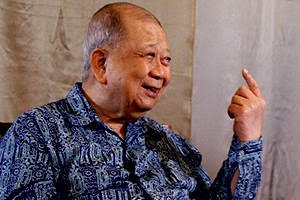
If you think you see an old man in the picture above, let me remind you at one time he butchered Malayans (and subsequently Malaysians).
Chin Peng was born in Sitiawan, Perak on the 21st October 1924. He embraced Communism when he was 15, and by the time he was 17, he not only led the underground cells of three Chinese secondary schools, workers, shop assistants and the domestic servants of European families, but was made a member of the Perak State Communist Committee. He took over the leadership of the Communist Party of Malaya (CPM) in 1947 as its Secretary-General, replacing Lai Teck (a.k.a Loi Tek) who turned out to be a double-agent and had absconded with the Party’s funds. But it was on the 16th June 1948 that Chin Peng was propelled to infamy, when CPM members in Sungai Siput, Perak, murdered three European plantation managers and started a state of Emergency that saw thousands of Malays and Chinese alike, displaced from the land and homes; 8,850 security personnel and 4,468 civilians were killed or wounded by the CPM from that point of time until the end of the First Emergency in 1960. Chin Peng had, by 1953, retreated to South Thailand with his Central Executive Committee, and subsequently to China when the First Emergency was declared over.
To some, the struggle of the CPM was an act of anti-colonialism. To these people who have very shallow understanding of the nation’s history, please read my previous postings on the CPM and whether or not the Malay Peninsula was “colonised”:
https://seademon.wordpress.com/2011/08/27/running-dogs/
https://seademon.wordpress.com/2011/08/31/domino-theory-part-1/
https://seademon.wordpress.com/2011/09/02/domino-theory-part-2/
https://seademon.wordpress.com/2011/09/04/domino-theory-part-3/
https://seademon.wordpress.com/2011/09/06/the-road-to-merdeka-persekutuan-tanah-china/
https://seademon.wordpress.com/2011/09/12/british-malaya/
Having said that, the struggle by the CPM was far from over. On 17th June 1968, the Second Emergency commenced by the killing of 17 members of the security forces in Perak’s Kroh area. This Second Emergency also saw the CPM dispatching two high-ranking police officers namely the late Tan Sri Abdul Rahman Hashim, who was the Inspector-General of Police on June 1974, and Tan Sri “Jimmy” Khoo Chong Kong, the Chief Police Officer of Perak a year later. By the way, the Police finally apprehended the assassins. Although the police believed that the same people were responsible for the murders of both Tan Sri Rahman and Tan Sri Jimmy Khoo, they were only tried for murdering the latter. Read an account by Najib Rahman about his father’s assassination http://www.nst.com.my/nst/articles/Myfather_theIGP_wasgunneddown/Article/
Guess who defended Lim Woon Chong, who was one of the assassins, in court? Find out here: http://www.nst.com.my/nst/articles/11ccig/Article/
In this article http://www.malaysia-today.net/mtcolumns/no-holds-barred/43359-the-issue-is-chin-peng-is-chinese-and-not-malay , Raja Petra’s shallow way of thinking had made him conveniently blogged that since the Malaysian government has ties with THE China that supported the CPM, then there is nothing wrong with the CPM nor is there anything wrong with allowing Chin Peng to come back to Malaysia. Would Germany have allowed Hitler to come back if he was still alive? Raja Petra’s leaving out historical facts is a blatant act of trying to influence the shallow ones amongst his readers to think that he is right. I would suggest he does more reading and find out why did China stop supporting the CPM LOOOOOOOOONNNNNNNNNNNG before the Hat Yai Accord was signed in December 1989. If he is too lazy to do any research, then he ought to read https://seademon.wordpress.com/2011/09/04/domino-theory-part-3/
If only Raja Petra knew of the KPI set by Zhou En-Lai to Chin Peng, then he would know why Chin Peng had said the following:
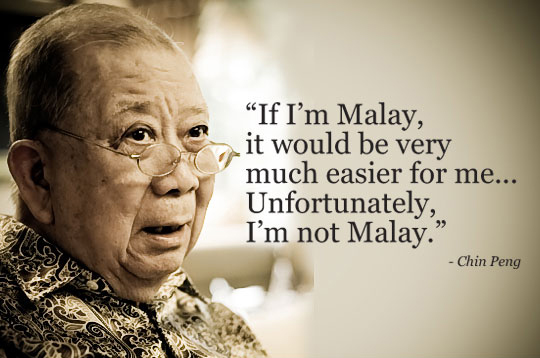
So, Raja Petra, Najib Razak shaking hands with the Chinese, as did his father in 1974, had nothing to do with whether or not the Malaysian government agrees with Communism. Anwar Ibrahim is very close to Paul Wolfowitz, the architect of the death of millions of Muslims since 9/11. So was he implying that Anwar is anti-Islam? It was just a naughty attempt by Raja Petra to make the Chinese hate the Malays for not being sympathetic towards Chin Peng. Very seditious indeed, in my opinion. Furthermore, what colonialism was Chin Peng fighting against from 31st August 1957 through 2nd December 1989? Should Chin Peng have been allowed to return to Malaysia? My answer would be a straight NO.
Do I have any sympathy for the man responsible for the deaths of thousands of Malaysians, disrupting the lives of tens if not hundreds of thousands more? Should I even feel sorry for him since he is an old and dying man? Not a hint. I hope he suffers and rots in whichever hell he belongs to.
So, to those who think that I am heartless for not feeling sorry for Chin Peng let me ask you a question. Did the Jews weep when Hitler died?
Mr Ong Boon Hua, please die quickly. I hope they cremate you and flush you down the toilet where you and your supporters belong.
Yes, no, yes, no.
It is the perception of some that Nik Aziz’s wanting to exercise the Hudud is a smoke-screen aimed at throwing people off PAS’s back after the crappy reception it received due to Mat Sabu’s open support for the communist, Mat Indera. It is my opinion that Mat Sabu’s support for Mat Indera was very much DAP’s script. It is an open secret that Johor is the target of DAP – you split the Malays in Johor, you will break UMNO’s back. Coming from DAP, that is nothing new. DAP had tried to pit the Malays in Penang against each other by trying to introduce the Mosque Committee elections. Had the elections gone through, it would have seen Malays of different political stand battle each other and the congregation of each mosque would never be the same again. Let the Malays fight each other, you will have the solid backing from the Penang Chinese community, thus Penang would remain in DAP’s hands come GE13.
In the period of PR’s political “maturity”, Nik Aziz’s stand on the Hudud issue was uncalled for. It successfully displayed to the public what kind of coalition PR is – same bedfellows with different dreams. The only thing they have in common is to oust BN from power. Whether or not the motley team can unite to run the country effectively remains a big question. While DAP controls Penang in toto it was not the case when PR was running Perak, and certainly not so now in Selangor. In both these states, although headed by a Menteri Besar from PAS and PKR, DAP is the one calling the shots. The PR Perak saw DAP assemblymen doing things at their own whims and fancies; in Selangor the DUMC fiasco saw three DAP assemblymen (and only them) at the initial damage-control press conference held by the PKR Menteri Besar. Nik Aziz seems like a rogue to the DAP on the Hudud issue, veering away from the PR tangent, and Anwar Ibrahim’s initial support for Nik Aziz has seen an about turn. What is PR without DAP’s support? Where would Anwar be without the DAP?
Therefore, yesterday’s press conference announcing the reaching of an amicable solution between the three parties seem more of a window dressing for damage has already been done. It only goes to prove who, among the three parties, now calls the shots – and how powerless Nik Aziz is.
 SeaDemon Says
You must be logged in to post a comment.