Kedah Tua: Nation-building should be based on facts, not racial polemics

2,400 years ago, people believed that the universe revolved around the Earth in a geocentric orbit. This belief — that Earth was the centre of the universe — was widely accepted until around 600 years ago, when it came to be understood that the Sun is at the centre of our solar system.
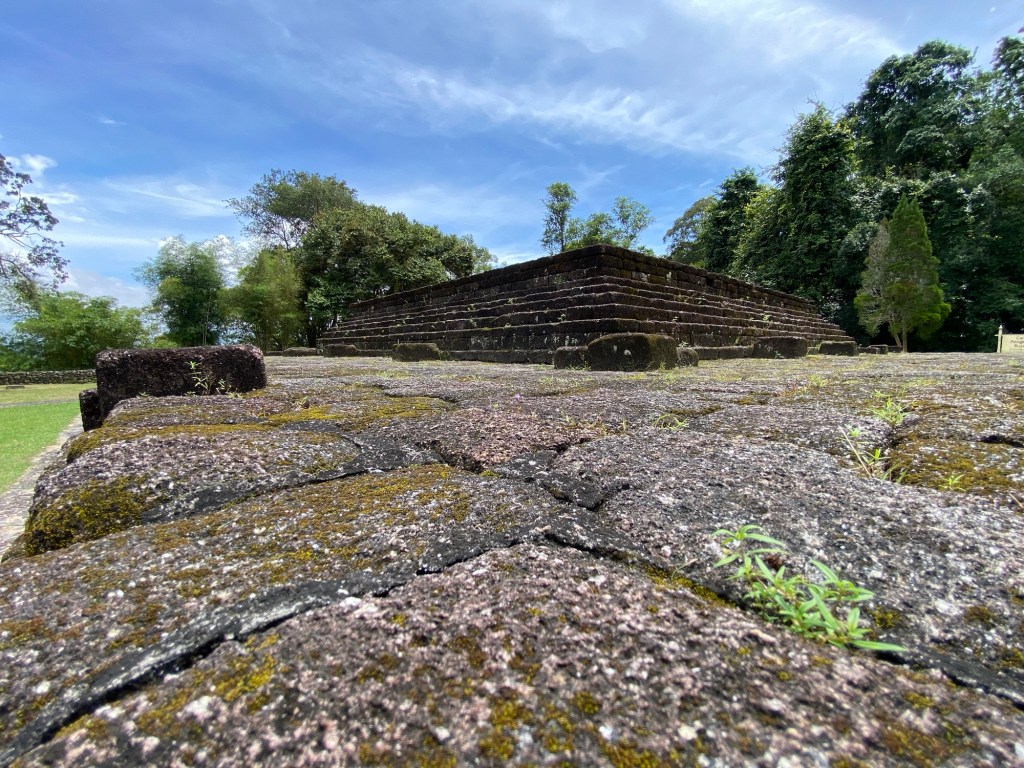
The current evidence on temples built in ancient Kedah indicate that only a small segment of Malays there at the time adopted Hindu-Buddhism

With the discovery of other galaxies, we now know that none of them move around a single centre. That is the current narrative — until a new discovery may come along to challenge it.

Recently, a protest was held outside the gates of a prominent public university against the organisation of a conference said to be discussing and defining the narrative surrounding ancient Kedah. The concern was that this narrative might be shaped by those who do not prioritise the interests of a particular race or religion.

Such fears are rooted in the opinions of individuals who have never been formally trained in the disciplines of History or Archaeology. As someone who has been specifically trained in History at a well-known local public university, I would like to explain why the protest was a fruitless exercise.

Evidence matters

Can anyone write about history? Certainly. You could even write a paper on the effectiveness of nuclear fission energy if you wanted to. However, there are several factors and conditions that must be fulfilled before your work can be accepted — especially by experts in the field. This includes the standards of evidence and sources you use, and how you interpret those findings.

Your sources must be empirical or academically peer-reviewed. If your references are merely social media posts, you may as well write a romance novel. You must adhere to ethical research practices and subject your findings to rigorous scrutiny by other experts to ensure they meet strict and credible academic standards.

If your writing is based on personal opinion, then it no longer qualifies as academic work. That is propaganda — or at best, baseless rhetoric.

Free from bias

Your research must also be free from bias. This means you cannot write to support one side or dismiss another. You must remain objective. We cannot fabricate a narrative and then create fictional evidence to support it. Historiography must be free from centrism of all forms — be it ethnocentrism, anachronism, political centrism, religious centrism, or other imbalances.

In the case of the aforementioned protest, it was driven by emotions rooted in ethnocentrism and religious centrism. Among the claims made was that the Malays of ancient Kedah practised Islam and not Hindu-Buddhism, as has been widely accepted.

However, there is currently no verified discovery that supports the claim that Malays in ancient Kedah practised a form of Islam or even an early version of it. We have discovered prehistoric human remains dating back to the Palaeolithic and Neolithic eras, such as the Pulau Pinang Woman (6,000 years ago), the Perak Man (11,000 years), and the Nenggiri Woman (14,000 years). Yet, none of these findings provide any evidence of Islamic practices — if anything, they suggest a belief system rooted in animism.

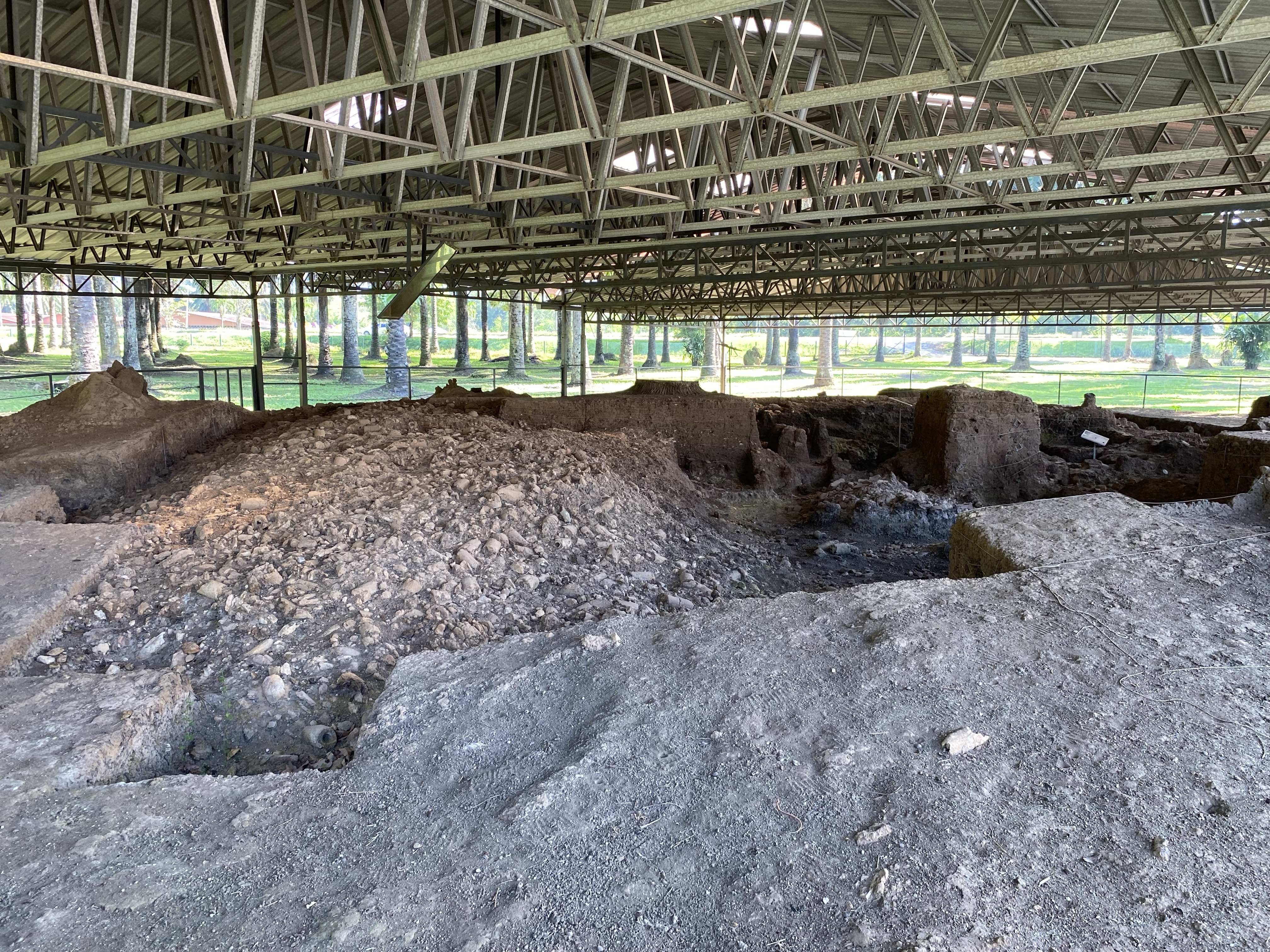
This also does not mean that all Malays in ancient Kedah were influenced by Hindu-Buddhism. Nearly all temples (candi) found in the Bujang Valley were built between the 4th and 13th centuries AD. They were discovered at ancient trading sites such as Sungai Batu, Kampung Pendiat, Pengkalan Bujang, and Kampung Sungai Mas. Only the temples at Bukit Choras and Bukit Batu Pahat were located slightly further inland.

All of them are small in size compared to Angkor Wat, Borobudur, Gedingsuro, or Welan temples. This suggests that the Bujang Valley temples served as places of worship for Indian and Chinese traders, and perhaps a small number of local Malays involved in international trade. They were not built for a large population of Hindu-Buddhist worshippers. In short, only a small segment of Malays in ancient Kedah adopted Hindu-Buddhism.

This is further supported by the absence of temples inland, including in the upper reaches of the Sungai Muda — a key trading hub — or after ancient Kedah declined as a major destination post-14th century. If the local population truly practised Hindu-Buddhism, more temples would surely have been found by researchers who have studied the area since the late 19th century.

Professors are not all-knowing

One of the individuals who frequently comments on ancient Kedah — especially Sungai Batu — is Professor Dr Nik Najah Fadilah binti Haji Yaacob, better known online as Professor Dr Solehah Yaacob. She is a professor of Arabic grammar at a public university in Gombak. She has not been formally trained in History or Archaeology.

I admire her dedication to studying history. And because she carries the title of “Professor”, many people understandably take her statements at face value.

In reality, a history graduate with a bachelor’s degree has greater subject knowledge than a professor whose field lies elsewhere. History students must study world history across various periods — from prehistory to proto-history, traditional history, and modern history. Professors, on the other hand, conduct focused research in their own specific fields, not across all disciplines.

This is why professors should understand the boundaries of their expertise. For example, I once had a discussion with Professor Emeritus Dr Anthony Milner, an Australian historian renowned for his work on Southeast Asia and Malaysia. His expertise is in traditional political history. He never claimed to be an expert in Malaysia’s proto-history, especially that of ancient Kedah, because that is not his area of study.

Therefore, I would prefer if Professor Dr Solehah would present her research to qualified experts for academic review, rather than promoting it on social media. Social media is not the place for academic validation. It would also be better if her research did not involve prophets unless she can provide credible sources. Otherwise, that is no longer history — that is propaganda.

As the Prophet Muhammad (peace be upon him) said: “Whosoever tells a lie against me intentionally then surely let him occupy his seat in Hell-Fire” [Sahih al-Bukhari (110)]

Unity over division

Disputes involving race and religion serve no benefit. Why must we boast about our supposed superiority over other ethnicities when Allah SWT considers all of us equal? Must we Malays be arrogant and see ourselves as holier than others? Are we somehow greater than Allah SWT?

If someone we mock ends up embracing Islam, does that not make them purer and more free of sin than we are? But how will they ever do so if we continue behaving like this?

We must accept narratives grounded in recent discoveries. As academics, we should keep an open mind. All historical research and findings should contribute towards the strengthening of our nation and its people — not towards sowing division or conflict between communities.

If there is new evidence or findings, they should be presented for academic review by others in the field. If accepted, that narrative should be acknowledged. What are we trying to take pride in — a fabricated past, or a history built upon proven facts? May we all be spared from pointless actions. – April 14, 2025

Captain Abdul Rahmat Omar (Rtd) is the Malay Consultative Council Bureau of Security, Defence, Public Order and Martial Arts chairman.

(This post was first published by Scoop )

Which Past Should We Preserve?

The Bukit Choras ancient Buddhist temple complex existed before Rajendra Chola ransacked the Srivijayan empire

The attempt by Nga Kor Ming to have Chinese new villages listed as UNESCO heritage sites has caused a tiff between the DAP and its partner UMNO.

The Chinese new villages were, in essence, concentration camps aimed at reducing and curbing contacts between the Malayan Communist Party terrorists and their sympathizers during the First Malayan Emergency (1948-60).

I agree with former Pulau Pinang Deputy Chief Minister and historian P Ramasamy who asked why are politicians and others merely concerned with rendering post-colonial historical sites under the umbrella of Unesco, or some other heritage bodies. There are sites in Kedah that have been discovered since the 19th century but have yet to be protected and recognized as UNESCO heritage sites.

The Bujang Valley in Kedah contains remnants of what is known as ‘Ancient Kedah’ that spanned from the Kra Isthmus all the way down to Beruas, Perak. It was a vassal state of the Srivijayan empire that was a confederation.

But, Ancient Kedah or Kedah Tua itself is subjected to claims and counterclaims based on racial and national supremacy. Recently, a friend asked me based on my elementary knowledge of the Pallava script as well as what I have learned from Ancient Kedah, what would be my most unpopular opinion of its history. My short answer would be “All of it,” and this will be my attempt at explaining the history.

WAS PENINSULAR MALAYSIA INDIAN?

No.

The Hindu temples in the Bujang Valley were constructed between the 11th and 13th century C.E (or A.D, whichever is the most familiar term to you). Even the Candi Bukit Batu Pahat, the largest ancient Hindu temple in Merbok which was thought by Quaritch Wales to have been constructed between the 7th and 8th centuries C.E, were constructed between the 12th and 13th centuries C.E, towards the end of the importance of Bujang Valley as an entrepôt.

The Cholas weren’t here in an expansion mode. Srivijaya was a Buddhist empire that was a vassal of the Sung Dynasty. It gave traders from China special preferences while taxing the ones from the Chola empire exorbitantly. Sick of this mistreatment, King Rajendra Chola invaded the Srivijayan entrepôts along what is now the western coast of Southern Thailand, Kedah, as well as the Srivijayan capital of Palembang in Sumatera in 1023 C.E and stayed for 66 years before, at least, the ruler of Ancient Kedah was restored.

The Cholas packed up and went back to India. By the end of the 13th century C.E, the Chola empire was defeated by the Pandyan.

There is no evidence of any existence of a major administrative or religious complex anywhere to support the theory of a Chola conquest in Kedah. Even P Ramasamy said that it was wrong to say that Cholas was an expansionist or imperial power in regard to the Malay Archipelago.

In terms of inscriptions, Pallava Grantha has always been the script for both Sanskrit and ancient Malay in this part of the world. The Devanagari script which was widely used in the Chola empire only existed around the 7th century C.E.

WAS PENINSULAR MALAYSIA HINDU OR BUDDHIST?

Neither.

The earliest evidence of Buddhism in Peninsular Malaysia are in Buddhist texts that made reference to two Buddhist monks coming to Ancient Kedah shortly after the third Buddhist council, which took place in the 3rd century B.C.E.

At the same time, however, the earliest archaeological evidence, found in the Bujang Valley, suggests the presence of a Hindu—Buddhist kingdom as early as the 2nd century C.E. From the 8th to the 13th century, the Malay Peninsular was under the influence of the Srivijaya empire, which was based on the island of Sumatera and which the Chinese monk I-Tsing described, in 671, as an important center for Buddhist learning with more than one thousand Buddhist monks.

But if we look at the locations of both ancient Hindu and ancient Buddhist temples, they were all located along or near the ancient coastline. Sungai Batu was an industrial port, Pengkalan Bujang, Bukit Batu Pahat, Kampung Pendiat, Sungai Mas were all entrepôts where traders gathered to make a living. Even Bukit Choras was located on the bank of an ancient river estuary.

Neither James Low, Quaritch Wales nor the modern researchers have found any evidence of the existence of ancient Hindu or Buddhist temples further inland. Furthermore, no temples were found to have been built in Ancient Kedah after the 13th century C.E, that is after the decline of the importance of Ancient Kedah as a maritime trading nation. This goes to prove that the majority of the population of Ancient Kedah practiced animism until the arrival and acceptance of Islam by the local ruler.

THERE EXISTED A GREAT MALAY KINGDOM THAT HAD TIES WITH PROPHETS AND SUPPLIED QUALITY IRON TO THESE PROPHETS

Very highly unlikely.

This would be in reference to the ancient iron smelting site in Sungai Batu , Merbok. This site was dated to around 4th century C.E. At least, that is what has been confirmed by samples collected during excavations performed there.

However, an outlier sample dates to between 535 B.C.E and 788 B.C.E was found, and has been the basis of claims that Sungai Batu is the oldest civilization in Southeast Asia, and that the site is proof that the Malays were a great race. This was used to counter claims that Kedah (and Peninsular Malaysia) was once Hindu under Chola rule.

Outliers are very common phenomena in archaeology. They can be caused by numerous effects such as contamination with older samples, inherent variation between different sources of carbon, differences in Carbon-14 intake by plants, and other factors. This is why archaeologists normally do not base any conclusions on a single date; there are instead various mathematical formulae for deriving a range of possible dates (rather than a single date) from a group of samples.

According to archaeologist Professor Dr John N. Miksic, who is Professor in the Southeast Asian Studies Department, National University of Singapore, the first known trading port in the Malay Peninsula formed in 4th century BCE. The site is now in a village in South Thailand called Khao Sam Kaeo.  This area at that time was probably inhabited by Malay speakers. It was on the east coast of the Peninsula. Artifacts there in addition to localy-made items came from India and south China (which at this time was still inhabited by people whom the Chinese called the Yueh, which can be transliterated as Viet).

He said that the oldest evidence of ports in Kedah appeared in the 5th century CE in the form of inscriptions. Radiocarbon dates from Sungai Batu span a wide range of dates, only one of which originates from the 8th century BCE. This could be an erroneous result due to random variation in dosage of radiation from the soil, the presence of old wood in a younger soil stratum, or just possibly the remains of very early metal working or other human activity. It does not however date any trading activity. The oldest pottery in Sungai Batu is over 1,000 years later.

I don’t feel supreme by knowing that the people of Sungai Batu left 50 or 500 or 500,000 or 2,000,000 Tuyeres behind. Unless there is a monument like the one in Bumiayu or Batujaya or Angkor or Ayutthaya, then treading on the grounds of Sungai Batu is similar to walking on the grounds where a demolished illegal pottery factory once stood.

I won’t even attempt to comment on the story of Abraham marrying a Cham princess, a story that was conjured up without any documentary or archaeological evidence.

SO, WHICH PAST SHOULD WE PRESERVE IF THERE IS NO ONE RACE THAT WAS GREAT?

Pallava the script came from the Indian subcontinent and was widely used here. Inscriptions using the Pallava script have been found in both Sanskrit and Ancient Malay. But to say that people in the Peninsular were Hindus, Buddhists or Indians because of the use of the script is as naive as saying Malaysians are Romans because we use the Latin alphabets.

If we look closely at the existence of the Hindu and Buddhist temples, as well as the Tuyeres left behind at Sungai Batu, the greatness of the people back then lie in their tolerance for each other. The temples were not large in size, but must have been enough for traders from India and China to pray in, while waiting for favourable winds to take them back to whence they were from. They must have been built to attract traders, just as how the government-of-the-day would create a favourable environment for investors to conduct businesses here. The Sungai Batu industry could not have thrived without local manpower.

The above points to only one thing – the great tolerant people of Ancient Kedah were ruled by wise leaders. That is the greatness of the people. That is what we should preserve and learn from. That is the narrative that we Malaysians should be proud of.

The Outlier Sungai Batu Is

Dr Shaiful Idzwan Shahidan pointed out that the sample that linked the Sungai Batu archaeological site to 788 BCE is an outlier

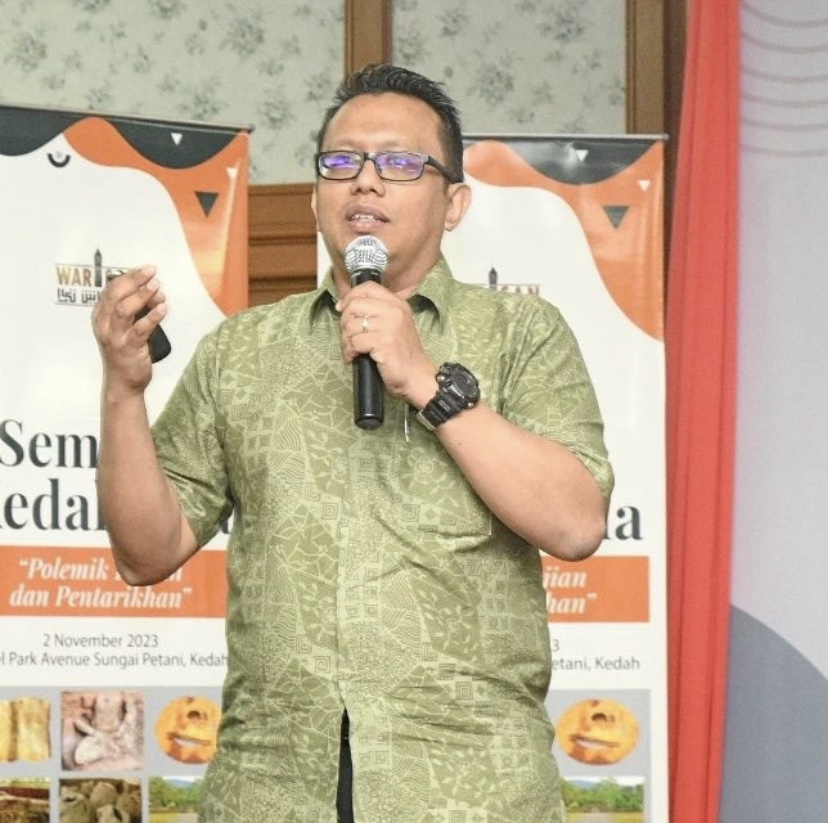
The Malaysian National Heritage Department (JWN) organised a full-day seminar on Ancient Kedah: Research and Dating Polemics in Sungai Petani on 4 November 2023. Among the speakers was Dr Shaiful Idzwan Shahidan, a consultant at USAINS Unitech.

Dr Shaiful Idzwan is an advocate of the Bayesian method in archaeology – an explicit, probabilistic method for combining different sorts of evidence to estimate the dates of events that happened in the past and for quantifying the uncertainties of these estimates.

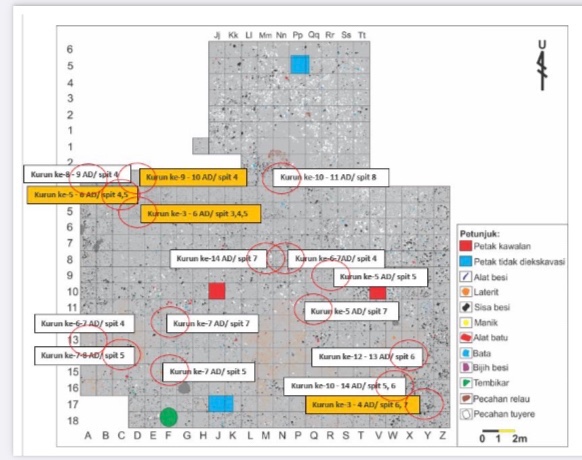
In answering the polemics of research and archaeological dating especially related to the Sungai Batu Archaeological Complex (SBAC), he said that the radiocarbon dating of the SB2H site where the 788 BCE sample was found (sample 516413), should not be compared directly based on the depth of the spit because the level of the spit is different according to the actual contour of the site before being excavated.

Dr Shaiful Idzwan said that the dating obtained from the yellow plots is reliable because it is representative of the whole site from the beginning until the final layer of culture.

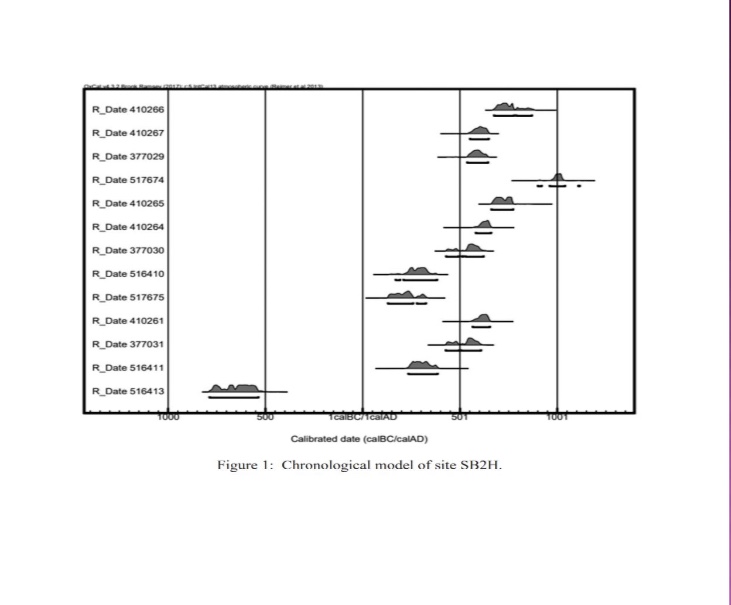
A chronological model of the SB2H site showing the calibrated dating of samples from the site is further evidence that the 788 BCE sample is an outlier.

An outlier is an observation that lies an abnormal distance from other values in a random sample from a population.

In fact, sample 516413 does not specifically point to 788 BCE as claimed, but has a range between 788 BCE to 537 BCE). However, he said that any finding needs to be adapted to the historical and cultural context.

In this case, the rest of the SBAC samples have overwhelmingly been dated to the 2nd to the 8th century CE. This range fits into not just the Bujang Valley narrative, but coincides also with the existence of other maritime polities such as Srivijaya, China and India, as well as nations that had once traded with Ancient Kedah.

A chronological model of the SB2H site at SBAC showing sample 516413 as an outlier

This narrative has been peer-reviewed and accepted by experts on Southeast Asian archaeology.

We are aware that historical narratives can change with new findings. HG Quaritch Wales, the man who discovered the Bukit Batu Pahat temple in 1936 dated the temple to the 7th to 8th century CE based on the data that was available to him during that era.

However, more recent scholars have revised that to the 12th to 13th century CE.

The onus is on the JWN to come up with a narrative that has been proven, peer-reviewed and agreed upon by experts in Southeast Asian archaeology. Else, the nation’s historical narrative will be laughed upon by other nations.

Making of a Martyr

Even without Sanusi around, the momentum created by his arrest cannot be stopped (pic courtesy of NST)

Sanusi is an intelligent person. What he lacks is finesse and decorum. There is nothing classy about him. Like other politicians, he forgets that he has been chosen to represent the voters to serve in HRH’s government. Not his government, not his party’s government. It is the Sultan’s government. He can have fights with others, but he should never drag the Malay Rulers into his quarrels.

But as crude and rude as he may be, he hits the right notes with the people of Kedah, and those in the Malay heartlands. He is right about asking for a fair compensation for not being able to develop the Muda basin to make Kedah more palatable to investors in order to create more job opportunities. He is also right in saying that legally Pulau Pinang still belongs to the Sultanate of Kedah.

The Malay voters see him as a fighter, one man fighting against the whole Federal government. The police may have the right to arrest him, but sending 20 men at 3am shows lack of tact on the part of the police. The timing was totally wrong no matter the excuse. They knew where to find him. All they had to do was wait and escort him to the courthouse.

After all, he had been charged on two counts which are bailable offenses. The Anwar administration, above all, should have known this. They have mustered lots of experience in this matter, being subjected to raids and arrests prior to 9 May 2018.

Now, Sanusi has emerged from the courthouse a martyr. Even if he is absent, there is no stopping the momentum.

History Evolves, So Should Our Beliefs

In 1912, British engineer, adventurer, travel-writer and later, television show host Carveth Wells arrived in Pulau Pinang to do a survey for the construction of railroads and roads in the Malay Peninsula. After arriving in Prai, he saw several salt-water crocodiles on the shore. In his book Six Years in the Malay Jungle he mentioned how the locals believe that when a crocodile leaves the sea and enters the mangrove swamp, it turns into a wild dog.

That may seem absurd to us all now but that and other theories of spontaneous generation, such as dirty rags kept in closets will turn into rats, were popularly accepted for two millenia. It was people like Pasteur and others who provided new scientific evidence to disprove of those absurd theories.

CHALLENGING ESTABLISHED BELIEFS

Just as how those in my generation were told that Malaya was colonised by Britain and that Melaka was established in 1400, through new evidences obtained by the release of classified documents, we know now that we were never a colony of Britain and that Melaka was founded circa 1262.

New evidences can shake the core of our historical beliefs. There were so many things that we did not know about our “independence,” and we believed everything the school text books had told us. In the end we knew that the Federation of Malaya Agreement, 1957 was all about the transfer of executive powers back to the Malay Rulers, and then to be delegated to a cabinet of ministers chosen from the various elected representatives, who then replace the British officers to serve the Rulers and their subjects. Merdeka was just a political cry to rally the voters of Malaya to support the Alliance rather than the Independence of Malaya Party who first used ‘Merdeka‘ as its election slogan.

What the above had done was to change the whole perception of the formation of this nation. Then it answers the rude claim by a certain politician in 2011 that the policemen who died in the Bukit Kepong tragedy in were ‘British Dogs.’

SHAKING THE CORE

The late Tony Horwitz who authored the non-fiction book ‘Confederates in the Attic,’ a book addressing the American Civil War, was very thorough in his research and was considered to be one of the authorities of the subject. He visited virtually all the major battle sites.

One day he met anthropologist Paul Hawke at a major battle site in Shiloh, Tennessee and the latter shook his belief. Hawke explained that previous interpretations of the battle of Shiloh did not include one major artefact – the ground itself. The interpretations were made based on first hand accounts: accounts of Civil War veterans who gathered at the site in the past.

And as the New York Public Library narrated, the loudest, most influential, and most repetitive veterans—and the ones with the most to gain—spoke with writers and journalists and their accounts were taken as the true accounts of the event, and passed on to future generations in newspaper accounts and diaries.

But Hawke found that first hand accounts and reports did not match the written histories. After the battle of Shiloh, General Ulysses Grant ordered that the dead be buried on the line—meaning where they fell. As an anthropologist, Hawke went and looked for the burial ground and found that they did not align with generally accepted history.

The same treatment must be applied to the findings at Sungai Batu. If previous samples dated in 2009 were found to have originated from 788 BCE, yet later with more advanced and sophisticated technology found that they existed only a millenium later, the latter has to be accepted. Historical interpretations are not cast in stone. The latest findings would have to be peer-reviewed by others who are authorities in the matter before they can be accepted. And that process is already academic. It has been accepted that the Sungai Batu iron-smelting industry had flourished only after the Common Era.

CHARTING THE PAST FOR OUR FUTURE THROUGH TECHNOLOGICAL ADVANCEMENTS

With history evolving, through emerging technologies, new methods, narratives, and influences, what sense do we make of the attempts to tell the truth to others as it is seen through thoughts and biases? This is the question that we must ask ourselves and answer, as more and more evidences will be available to us that will change the narrative that we believe in today.

And it is only up to us as lay persons and academicians, to accept the latest findings with an open mind to bring to the present what has made us what we are today.

The importance of cross referencing in setting historical facts

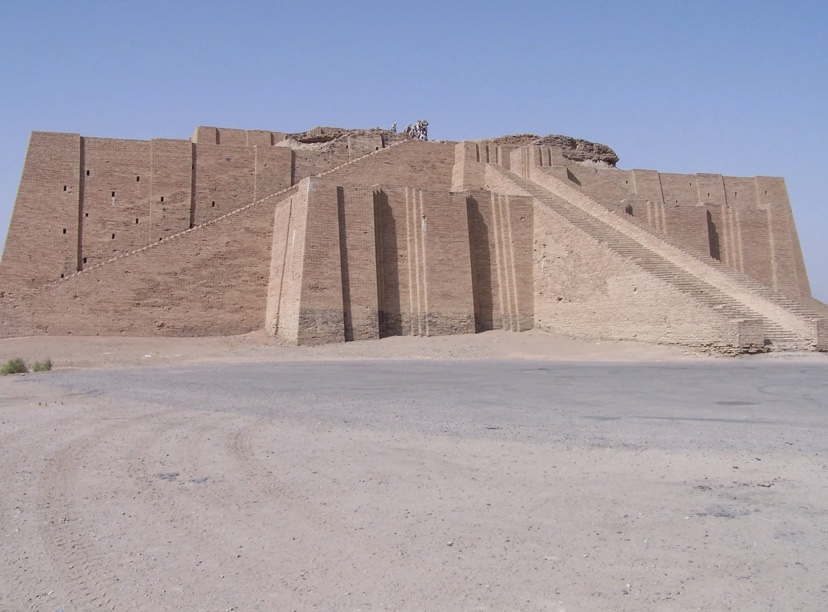
Did King Shalmaneser I of Assyria order the construction of a Ziggurat in Qalah (Kedah) in 1,300BCE? Or was it some place else in Mesopotamia with the same name?

Imagine that you are in Melaka just after it was conquered by Alfonso de Albuquerque.  The year is 1512 CE. They were building the Fortaleza Velha, otherwise known as A Famosa.  And then next to the fortress is a building similar to the Petronas Twin Towers.

Would that have made any sense?

When researchers from the Universiti Sains Malaysia headed by Professor Dr Mokhtar Saidin discovered a vast ancient iron-smelting complex in 2009 in Sungai Batu, Kedah, and carbon-dated samples showed that they had originated from the year 788 BCE, I was elated. It was proof that there was an advanced metal-age Malay civilisation that had existed 2,800 years ago.

But something was not right.  When cross-referenced, there were things that did not jive.

Ancient Kedah was not located along the Maritime Silk Road that connected the Indian continent with China during that time.  Trade circa 5th century BCE still passed overland through the Isthmus of Kra instead of through the Strait of Malacca.  The latter only emerged as a trade route first century CE. It only flourished in the 6th and 7th centuries CE. And this is the view that even the UNESCO holds.

Therefore, iron-smelting industries could not have existed in Ancient Kedah before the first century CE.  We were still very much a bunch of Neolithic people in 788 BCE.  All the other archaeological sites in the peninsula of that era, when cross-referenced, confirmed that fact.

Yes, we are proud that there was a very important ancient entrepôt located in Kedah’s Bujang Valley, but that came almost a full millennium later.

In an interview with the New Straits Times (Ancient Seaport of Sg Batu, NST, May 23, 2016), Dr Mokhtar said that the brick riverside jetty, ritual monuments (candi) were built in the 2nd century CE, while the iron smelting sites were used from the 1st century CE.

So, it came as both a surprise and a shock when Dr Mokhtar told Channel News Asia (Kedah Has Southeast Asia’s Oldest Civilisation and Archaeologists Barely Know Its Complete History, CNA, June 2, 2023, updated June 4, 2023) that the Sungai Batu site dates back to 788 BCE.

Not only that, he even went on to mention an unsupported point that the name Qalah – the ancient Arabic name for Kedah – is inscribed in ancient Mesopotamian scripts from 1,300 BCE.  The Assyrian King Shalmaneser I founded Qalah (also spelt Kalah or Kalhu, and Calah in the Bible).

An inscription of the script in the Akkadian language can be found in the British Museum which reads as follows:

Shalmaneser, great king, strong king, king of the universe, king of Assyria, son of Ashurnasirpal (II), great king, strong king, king of the universe, king of Assyria, son of Tukultï-Ninurta (II), who was also king of the universe and king of Assyria: construction of the Ziqqurat of Calah.” (Brick of Shalmaneser III, lines 1 to 7).

If indeed Shalmaneser I ordered the construction of a Ziqqurat in Ancient Kedah, if Calah is indeed Kedah, then three questions need to be answered.  First, where is the Ziggurat or its remnants? Second, why do archaeologists and historians all over the world agree that Calah is now Nimrud, Iraq? Third, Shalmaneser I ruled over Assyria in 13 century BCE. Sungai Batu, as claimed, existed only in 7th century BCE. Why is there a 500-year discrepancy?

Just as we have Kota Bharu in Kelantan, we also have a Kota Bharu in Perak.  We have at least four more in Indonesia. When the Imperial Japanese Army landed in Kota Bharu on December 8, 1942, I am positive that that did not happen in Perak, just as Calah or Kalah, or Qalah mentioned either in the Brick of Shalmaneser or in the Bible is not referenced to Ancient Kedah.

Furthermore, researches show that trade between Mesopotamia and Ancient Egypt only occurred around 400 BCE while trade with the Indus Valley happened around 300 BCE.  It is very doubtful that they had any trade links with Ancient Kedah in 788 BCE.

On the claim made by Dr Mokhtar that there has not been any researcher doing work at the Sungai Batu site, the Global Archaeology Research Centre at the Universiti Sains Malaysia has clarified with CNA that there is a team that is continuing Dr Mokhtar’s legacy headed by protohistorian Dr Nasha Rodziadi Khaw.  Dr Nasha is also an expert on early civilisations in Malaysia and Southeast Asia.

I was also told by Dr Nasha, when I met him early in June 2023 at the USM, that the work continues with whatever evidences and artefacts that have been collected thus far. Out of 97 sites identified in Sungai Batu, 54 have been excavated. The other 43 will be left for future researches and when the technology has improved.

No ancient ships have ever been found, let alone seen.  They had found an artefact, a nail, that could have been used on ships but could also have been used on other wooden structures.  No excavation was ever done because they could not confirm if there actually are ancient vessels in the swampy area near the ancient riverside jetty.  Excavations are expensive, and funds are also needed at other sites such as at Bukit Choras, some 45 kilometres to the north.

The four samples that were dated during Dr Mokhtar’s excavation in 2009 have been identified as outliers – in archaeology-speak, anomalies or aberrations.  They were found among the hundreds of samples from one of 54 excavated sites, while the rest of the sites have been dated to around 2 CE when technologically-advanced dating was done in 2019.

Dr Mokhtar was still two years away from retirement, and should know about this as he was still the Director of the Global Archaeological Research Centre then.

When we started off with the discovery of the Sungai Batu sites in 2009, we were delighted that it was dated to 788 BCE. But 10 years later, with advanced technology, peer reviews and cross-references, this has now become 2AD.

Therefore, it is only prudent to save the other 43 sites for a future research using more advanced methods.

We are very proud of Dr Mokhtar’s discovery of the ancient iron-smelting area in Sungai Batu, but until new evidences surface we have to accept the reality that the area only became an industrial trading port after 1 CE, not 788 BCE.

Yes, there was an advanced Malay civilisation that was involved in a massive iron-smelting industry in the Bujang Valley, but that was 2,000 years ago, not 2,800 years ago, and they were certainly not linked to Mesopotamia.

The fact is that those ancient Malays were a tolerant, progressive and welcoming lot, allowing traders from the Indian continent to come trade, stay, and pray.  

That is the spirit that we should all try to emulate in our quest of nation building.

(This article was first published by The Mole) and updated locally at 5.42pm, June 5, 2023).

Sungai Batu Bukti Kehebatan Sejarah Melayu Tetapi

Peninggalan puing berjuta relau beserta Tuyere di tapak arkaeologi Sungai Batu. Gambar ini diambil oleh penulis pada hari Ahad, 11 Jun 2023 dalam lawatan ke tapak tersebut

Semasa penemuan bukti industri peleburan besi zaman prasejarah di Sungai Batu diumumkan pada tahun 2008, ramai orang begitu teruja terutamanya orang Melayu. Saya merupakan salah seorang daripada kumpulan tersebut. Malah, apabila dikhabarkan terdapat artefak yang ditemui yang ditarikhkan kepada tahun 788 Sebelum Masihi (S.M), ianya memberi gambaran suatu tamadun Melayu yang begitu hebat yang telah wujud lebih awal berbanding tamadun Rom. Malah, pentarikhan tersebut bermakna tamadun Melayu yang hebat ini telah wujud 1,600 tahun sebelum Candi Borobudur dibina dan 1,800 tahun sebelum Angkor Wat wujud.

Kemudian wujud pula di media sosial kisah-kisah dongeng yang diwujudkan bukan sahaja terhad kepada mengukuhkan bukti tamadun Melayu silam yang hebat seperti kisah Iskandar Zulkarnain, kisah perdagangan besi dengan Empayar Rom, tetapi penemuan candi-candi berkait dengan agama-agama benua kecil India juga telah melahirkan suatu kepercayaan bahawa ianya merupakan bukti Tanah Melayu ini dihuni terlebih dahulu oleh orang dari benua kecil India berikutan penaklukan oleh Raja Chola. Sejauh manakah kebenaran kepercayaan-kepercayaan tersebut?

KRONOLOGI PRASEJARAH TANAH MELAYU

Sejarah dan arkaeologi adalah merupakan disiplin-disiplin yang wajib dilandaskan dan diasaskan berdasarkan fakta, dokumen, penemuan sahih serta kajian perbandingan dengan lain-lain data, fakta, penemuan sahih di rantau ini. Ini kerana lain-lain rantau atau kawasan mempunyai garismasa kemajuan yang berbeza.

Garismasa kemajuan masyarakat Melayu kuno atau prasejarah meletakkan zaman Palaeolitik (Zaman Batu Lama) di Tanah Melayu di antara 1.83 juta tahun dahulu (melalui penemuan tapak Palaeolitik di Bukit Bunuh, Lenggong, Perak) dan 10,000 tahun dahulu (dengan penemuan Lelaki Perak juga di Lenggong). Pada zaman ini, orang Melayu Kuno masih menggunakan peralatan yang diperbuat daripada batu untuk berburu, mengetuk dan memotong daging.

Kemudian tiba zaman Neolitik (Zaman Batu Baharu) yang tiba sekitar 4,500 tahun dahulu. Di zaman ini, Melayu Kuno sudah pandai membuat peralatan daripada tanah liat seperti mangkuk, takal, gelang, manik. Mereka juga sudah mempunyai kepercayaan dan mengebumikan orang mati dengan cara lurus ataupun melunjur. Mereka juga tinggal di penempatan yang lebih kekal (gua-gua) dan berkemungkinan telah mula bercucuk tanam pada skala kecil serta membela binatang, berbanding cara nomadik masyarakat Palaeolitik.

Zaman Neolitik di Tanah Melayu tiba sekitar 4,300 dan 2,000 tahun dahulu, manakala di Sabah dan Sarawak pula ia tiba sekitar 3,000 dan 2,000 tahun dahulu. Masyarakat Neolitik pernah hidup di Gua Sagu, Kuantan, Pahang sekitar 885 S.M. Di Gua Dayak, Lenggong, Perak pula masyarakat Neolitik pernah tinggal di sana sekitar tahun 340 Masihi. Ini bermakna, sekiranya masyarakat Zaman Logam Sungai Batu sudah wujud dan berdagang hasil besi pada tahun 788 S.M, ianya berada dalam garismasa zaman Neolitik di mana masyarakat setempat masih menggunakan peralatan yang diperbuat daripada batu hingga 1,128 tahun selepas tahun 788 S.M.

Kita harus fahami walaupun Tamadun Yunani dan Lembah Indus telah lama menggunakan besi dan gangsa, ia tidak bermakna seluruh dunia turut lalui zaman yang sama. Sebagai contoh, zaman logam di Tanah Melayu bermula sekitar 2 Masihi hingga 5 Masihi. Ada pun gendang gangsa pernah ditemui di Sungai Tembeling di Pahang, Gua Harimau di Perak, Lembah Bernam di Selangor, dan di Batu Burok di Terengganu, kesemuanya ini merupakan gendang Dong Son yang datangnya dari Dong Son di Vietnam dan ditinggalkan oleh para pedagang sekitar 500 S.M hingga 500 Masihi.

Ada sebab kenapa Vietnam dan Thailand lalui Zaman Logam lebih awal berbanding Tanah Melayu dan Indonesia. Ini adalah disebabkan oleh laluan perdagangan Barat ke Timur tidak melalui Selat Melaka hinggalah sekitar 2 ke 3 Masihi. Ini merupakan garismasa Lembah Bujang menjadi pelabuhan perdagangan yang terkenal. Ini mungkin disebabkan penemuan bijih besi bermutu jenis Hematite dan Magnetite di kawasan tersebut.

Sebelum itu, perdagangan hanya melibatkan rempah ratus dan barangan tidak berat seperti tembikar. Maka, laluan pedagang adalah merentasi Segenting Kra. Hanya setelah perdagangan melibatkan hasil besi, maka Selat Melaka menjadi laluan kapal-kapal dagang.

Masyarakat zaman Neolitik masih wujud di Indonesia dalam zaman sejarah moden. Contoh, Pulau Enggano di barat Sumatra masih wujud di abad ke-19, manakala masyarakat Neolitik masih wujud di Papua, Irian Jaya dan di Pulau Sentinel di Lautan Andaman. Ini adalah bukti perkembangan dan pembangunan sesuatu zaman bagi setiap masyarakat mahupun sesebuah rantau.

PERDAGANGAN DENGAN EMPAYAR ROM, KETIBAAN ISKANDAR ZULKARNAIN, DAN LEMBAH BUJANG HASIL EMPAYAR CHOLA?

Di antara dakwaan yang berkitar di dalam Jaringan Sejagat termasuklah dakwaan bahawa Empayar Rom pernah mempunyai hubungan perdagangan dengan Lembah Bujang dan telah menggunakan besi yang dibeli dari lembah tersebut untuk membuat pedang dan perisai tenteranya.

Sepertimana yang telah diterangkan di atas, industri peleburan besi di Sungai Batu berlaku sekitar tahun 2 Masihi hingga 5 Masihi. Empayar Rom wujud sekitar tahun 753 S.M dan berakhir pada tahun 1453 dengan jatuhnya kota Konstatinopel ke tangan Bani Othmaniah di bawah Sultan Mehmed II. Namun, wujud perdagangan di antara empayar tersebut dengan India dan China. Peta yang dilukis oleh Ptolemy pada tahun 2 Masihi menunjukkan laluan dagang darat (Laluan Sutera) untuk ke Serica dan laluan laut untuk ke Qin. Perdagangan ketika ini melibatkan sutera dan bulu binatang.

Teks Yunani Períplous tis Erythrás Thalássis (Pelayaran Mengelilingi Laut Merah) yang ditulis pada Abad Pertama tahun Masihi menyebut bagaimana para pedagang sutera belayar hingga ke Tamala, sebuah bandar di Myanmar yang terletak ke Barat Laut Semenanjung Tanah Melayu, dan kemudiannya menyeberangi Segenting Kra untuk ke Teluk Siam dan belayar seterusnya ke pelabuhan utama Qin iaitu Cattigara (kini Óc Eo di Barat Daya Vietnam).

Ini membuktikan bahawa perdagangan timur-barat pada Abad Pertama tahun Masihi masih hanya melibatkan barangan yang ringan yang boleh dibawa merentasi laluan darat (Segenting Kra) seperti sutera dan bulu binatang. Maka, Sungai Batu masih belum wujud sebagai sebuah pelabuhan terkenal, dan Selat Melaka masih belum menjadi laluan utama para pedagang.

Bagaimana pula dengan Iskandar Zulkarnain?

Beliau dilahirkan pada tahun 356 S.M dan meninggal dunia pada tahun 323 S.M, iaitu sekitar 400 hingga 500 tahun sebelum Sungai Batu menjadi pusat perdagangan terkenal dengan industri peleburan besi.

Walaupun sekiranya Sungai Batu telahpun wujud mengikut pentarikhan asal 788 S.M, paling jauh pernah Iskandar Zulkarnain dan bala tenteranya sampai ialah di Sungai Hyphasis (kini Sungai Beas di Himachal Pradesh, timur-laut India) bilamana tenteranya telah lakukan dahagi kerana enggan untuk terus mara ke timur, dan memaksa Iskandar untuk berpatah balik ke Yunani. Maka, agak mustahil bagi Iskandar mahupun isterinya untuk pernah menjejakkan kaki di Sungai Batu dalam usianya yang singkat (sekitar 33 tahun sahaja).

Bagaimana pula dengan pengaruh Empayar Chola?

Kawasan Lembah Bujang hanya dipengaruhi oleh Empayar Chola semasa pemerintahan Rajendra Chola I (di antara 1,014 Masihi dan 1,044 Masihi), iaitu

1,000 tahun setelah Sungai Batu menjadi pusat perdagangan besi terlebur, dan Lembah Bujang sebagai pelabuhan utama di rantau ini.

Ketiadaan penemuan sebarang struktur besar seperti Angkor Wat, Borobudur, atau seperti di Mohenjo-daro bermakna sifat Lembah Bujang sebagai pelabuhan dagangan tidak berubah menjadi pusat pentadbiran sebuah kerajaan Hindu India. Sebarang candi yang wujud, sebagai contoh di kawasan Pengkalan Bujang dibina menggunakan batu-bata tanah liat dan bersaiz kecil. Pentarikhan struktur-struktur tersebut juga menandakan bahawa pembinaan struktur-struktur tersebut dilakukan lebih kurang dalam masa yang sama, iaitu sekitar abad ke 10-11 Masihi, lebih kurang garis masa pengaruh kerajaan Chola di Kedah. 

Ini agak baharu sekiranya dibandingkan dengan Candi Bukit Batu Pahat yang terletak dalam lingkungan 10 kilometer ke barat laut Tapak Arkeologi Sungai Batu yang terbina sekitar abad ke 7 Masihi. Hanya Candi Bukit Choras di Kota Sarang Semut, sekitar 40 kilometer ke utara Tapak Arkeologi Sungai Batu dibina sekitar abad ke 4 Masihi, semasa industri peleburan besi di Sungai Batu sedang rancak.

Penemuan-penemuan di atas memberi kita kewarasan untuk membuat rumusan-rumusan seperti berikut :

  • adalah mustahil untuk masyarakat Melayu Kuno untuk menghasilkan jongkong besi pada tahun 788 S.M apabila masyarakat Melayu Kuno di kawasan tersebut ketika itu menjalani kehidupan bersifat Neolitik. Empat sampel yang pentarikhannya 788 S.M itu berkemungkinan telah dibawa dari luar.
  • pada tahun 788 S.M laluan pedagang dari Timur ke Barat adalah melalui Segenting Kra. Kedah belum menjadi pelabuhan terkenal. Tiada aktiviti perdagangan secara besar-besaran berlaku di Semenanjung Tanah Melayu sebelum Tahun Masihi.
  • teknologi peleburan besi ini besar kemungkinan dibawa dari luar, terutamanya dari benua India.
  • Raja/Ketua yang ada di kawasan Lembah Bujang telah menyediakan sumber manusia untuk menjalankan industri peleburan besi, serta industri-industri sampingan seperti pembuatan ketuhar peleburan dan Tureye, pembuatan batu-bata dari tanah liat, penyediaan makanan, dan tenaga buruh am.
  • Kehadiran candi-candi Buddha, Hindu, Animistik yang wujud sebelum kedatangan pengaruh kerajaan Chola di kawasan pesisiran laut lebih cenderung kepada membuktikan bahawa candi-candi tersebut disediakan oleh kerajaan yang ada pada ketika itu untuk menarik minat para pedagang luar, dan agama asing tidak banyak mempengaruhi masyarakat setempat. Ianya juga bukti masyarakat Melayu Kuno bersifat terbuka dan amalkan sikap bertoleransi.

KESIMPULAN

Kita tidak boleh menafsir sejarah dengan menggunakan emosi atau sentimen kenegaraan, keagamaan mahupun perkauman. Sudah tentu kita semua akan berbangga sekiranya wujud masyarakat Melayu Kuno yang maju pada tahun 788 S.M. Bayangkan pada zaman Kesultanan Melaka telah wujud satu bangunan setinggi menara Merdeka 118 sedangkan lain-lain bangunan di sekelilingnya diperbuat daripada kayu- hebat, tetapi tidak masuk akal.

Kita perlu menafsir sejarah menggunakan dokumen-dokumen, bukti-bukti nyata dan ketara, bukti-bukti yang disokong oleh lain-lain penyelidikan.

Sejarah adalah bersifat tidak menentu. Apa yang nyata pada hari ini bakal berubah apabila lain-lain bukti ditemui. 10,000 tahun dahulu manusia percaya bumi ini berbentuk leper. Penemuan abad ke-16 membuktikan bumi ini bulat. Sekian lama kita diajar bahawa Melaka dibuka sekitar tahun 1400. Pada tahun 2010, terdapat bukti kukuh Melaka dibuka pada tahun 1262.

Pada tahun 2008, kita digembirakan dengan berita wujudnya masyarakat Melayu Kuno yang maju di Sungai Batu sekitar tahun 788 S.M. Teknologi dan penyelidikan terkini pada tahun 2019 membuktikan bahawa tarikh tersebut sebenarnya ialah sekitar tahun ke-2 Masihi.

Itu bukti-bukti setakat ini. Mungkin dengan kewujudan teknologi yang lebih canggih di masa hadapan, apa yang kita ketahui hari ini juga akan berubah.

How The RUU355 Is Unconstitutional

What everyone fears most is for the Malays to unite.  I wrote this a few months back.  All the lawmakers know that the RUU355 amendments have no impact whatsoever to the non-Muslims, and even if all the Muslims MPs from both PAS and UMNO were to vote for the amendments, they will never attain the 2/3rd majority required to pass the bill for it to go to the next stage.

Which is why the Malays in the DAP, PAN, PKR and Pribumi are the tools for the DAP leadership to use, as in the words of Superman Hew, “to screw the Malays using the Malays.”

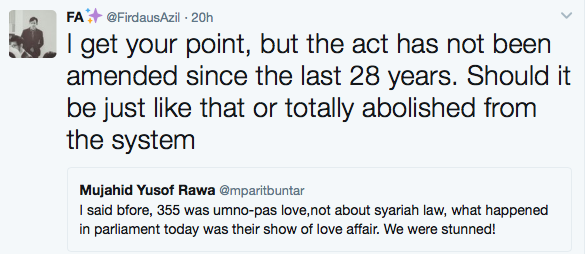
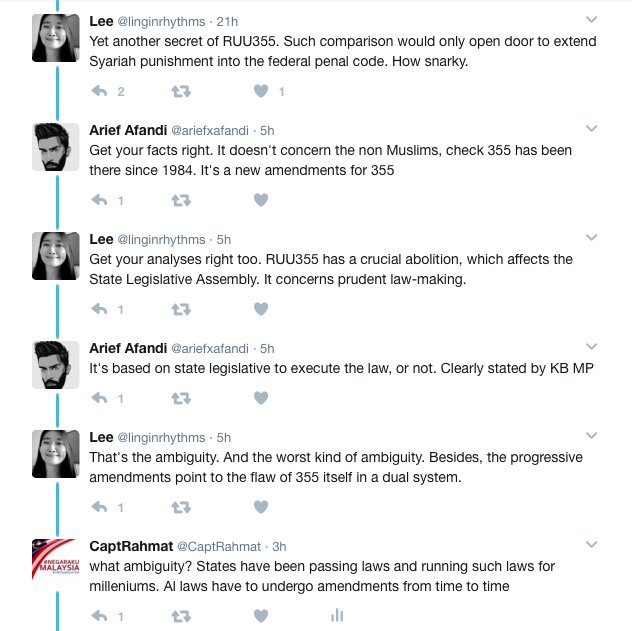
Objections are raised using mainly the Malay tools.  The screen-capture of a Twitter conversation between a BERNAMA journalist and a PAN MP is the evidence to that.

In the run up to its tabling, the RUU355 has met with lots of resistance.  I don’t believe that the lawmakers don’t know that it is the right of each religious group to manage and administer its own affairs.  I also don’t believe that the lawmakers do not know that Islam is the religion of the Federation.

But the resistance towards it is mainly to avoid the provision of an opportunity for Muslims and Malays to unite just before the next general elections.  They oppose just for the sake of opposing.

And then in comes the individuals who do not see or understand that in Islam, protecting the rights of a community supercedes the rights to protect an individual’s rights, nor understand the separation of jurisdiction between the civil law and Syariah law.

This dual system of law first existed in the Malay states in Perak in 1807 with the introduction of the Royal Charter of Justice of 1807 in Pulau Pinang.  Prior to that, laws based on the Syariah has been the lex loci of this land.

Islam first came to this land in the ninth century A.D and flourished in the 13th century, 200 years before the kingdom of Melaka was founded. The first evidence of a coded Syariah law was from the Terengganu’s Batu Bersurat, written in 1303, a full century before Melaka.

The kingdom of Melaka produced two major legal digests, which formed the main source of written law in Melaka – the Hukum Kanun Melaka , and the Undang-Undang Laut Melaka .  The Hukum Kanun consists of 44 chapters, which touched upon matters such as the duties and responsibilities of the Ruler, prohibitions amongst members of society and penalties for civil and criminal wrongs and family law.  The Undang-Undang Laut consists of 25 chapters, which covered maritime matters, such as the duties and responsibilities of ships’ crew, laws pertaining to voyages and trade.  The law contained in the above written codes are said to be based on Islamic law of the Shafie School, together with elements of local custom.

Melaka’s written codes were responsible for the growth of other written codes in other states of the Peninsula: Pahang Legal Digest 1595, the laws of Kedah 1605, the Laws of Johore 1789, and the 99 Laws of Perak, 1878.

Therefore, the question of the Syariah creeping into the lives of the Muslims of the land does not hold true.  The reverse however is.  The RUU355 is not about amending the offences but merely seeking the agreement to enhance the punishments to be meted out for the offences.  And as explained in previous writings as per clickable links above, the Federal Constitution is the supreme law of the land and therefore offences already covered in the Penal Code as well as in other civil laws made canoot be tried under the Syariah laws of Malaysia.

Furthermore, the separation of jurisdiction of the legal systems provided by the Constitution also ensures that the rights of non-Muslims are protected – only Muslims can be subjected to the Syariah law.

On the question of the Muslims being subjected to dual laws, this is not a problem. If a Muslim commits theft, he will not get his hand amputated in Malaysia.  Theft is an offence under the Penal Code and therefore the Muslim offender gets punished according to what is provided for by the Penal Code.  The punishments that the Syariah court can mete out cannot go beyond the Second List of the Ninth Schedule of the Federal Constitution of Malaysia.

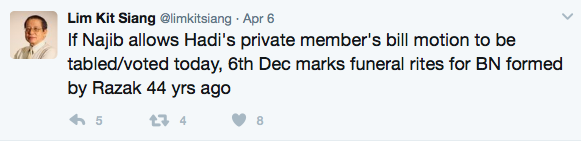
DAP Emperor Lim Kit Siang was against the introduction of Section 298A of the Penal Code of Malaysia.  In a Parliament debate on the 9th December 1982 on the Penal Code and Criminal Procedure Code (Amendment) Bill 1982 he said the following:

I quote:

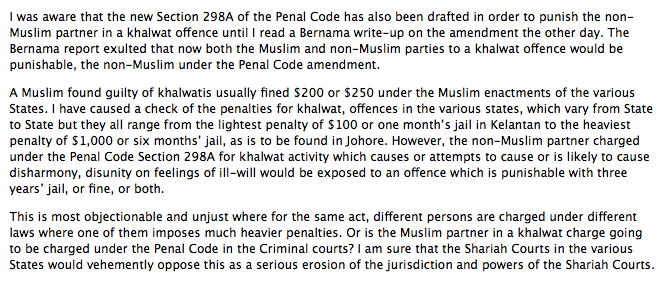
I was aware that the new Section 298A of the Penal Code has also been drafted in order to punish the non-Muslim partner in a khalwat offence until I read a Bernama write-up on the amendment the other day. The Bernama report exulted that now both the Muslim and non-Muslim parties to a khalwat offence would be punishable, the non-Muslim under the Penal Code amendment.

A Muslim found guilty of khalwat is usually fined $200 or $250 under the Muslim enactments of the various States. I have caused a check of the penalties for khalwat, offences in the various states, which vary from State to State but they all range from the lightest penalty of $100 or one month’s jail in Kelantan to the heaviest penalty of $1,000 or six months’ jail, as is to be found in Johore. However, the non-Muslim partner charged under the Penal Code Section 298A for khalwat activity which causes or attempts to cause or is likely to cause disharmony, disunity on feelings of ill-will would be exposed to an offence which is punishable with three years’ jail, or fine, or both.

This is most objectionable and unjust where for the same act, different persons are charged under different laws where one of them imposes much heavier penalties. Or is the Muslim partner in a khalwat charge going to be charged under the Penal Code in the Criminal courts? I am sure that the Shariah Courts in the various States would vehemently oppose this as a serious erosion of the jurisdiction and powers of the Shariah Courts.

So, in 1982 Lim Kit Siang opposed the introduction of Section 298A because a similar offence tried under the Syariah law would only provide for a much lesser sentence.  Why is he complaining now about Hadi wanting to introduce higher punishments for the same?  Wouldn’t it be fair for the non-Muslims?

He added:

As the purpose of the 2M government is to uphold the sanctity of Islam, defend true Islamic values and Muslim unity in the country so as to be able to deal with the problems of kafir mengafir, two imam issue, separate prayers and burials, in the Muslim community, the government should confine its legislative efforts to the Muslims only, and not draft a Bill with such far-reaching consequences in allowing for State interference in the practice, profession and propagation of non-Muslim faiths.

35 years later, he backtracks on the need for Muslims to make better its laws for the Muslims only. Which is why I say Lim Kit Siang is opposing for the sake of opposing so that the Muslims do not rally behind this bill months before the general election is due.

Even PKR’s Wong Chen acknowledged back on 29th Aril 2013, six days before the 13th General Elections that in order to gain support from the Malays, PAS, which was a partner in the Pakatan Rakyat coalition, needed to play up the Hudhd issue and had the full support from the parties in the Pakatan Harapan.

http://www.youtube.com/watch?v=syPqbbA1IyE

Hannah Yeoh, who is the Speaker of the Selangor State Assembly even allowed the Hudud motion to be brought into the assembly.  So why oppose the same motion when it is brought into Parliament? Why the double standard?

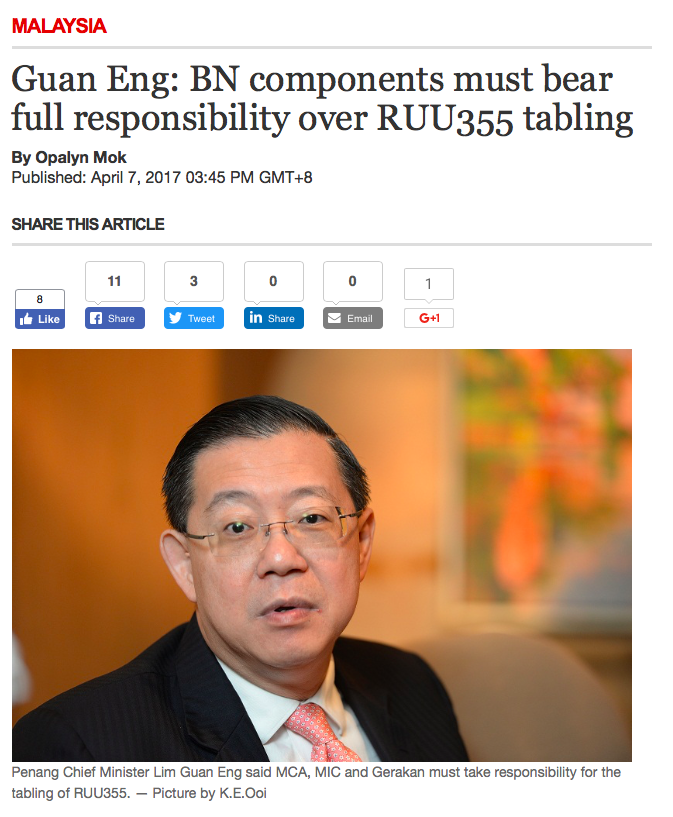
And why must Lim Guan Eng ask the BN components such as MCA, MIC and others to bear responsibility for the tabling of the RUU355?  Why don’t he ask his party’s Anthony Loke and Hannah Yeoh instead? They both supported Hudud and the tabling of Hudud in the Selangor State Assembly (as in the case of Hannah Yeoh).

Anthony Loke even went to town with his support for Hudud telling his Chinese audience not to be aafraid of Hudud:

Yet, the RUU355 is not even about Hudud. So, what is unconstitutional about the RUU355?

Only the objections by the vapid non-Muslims against the RUU355 is unconstitutional, as it is a right given to all religious groups, not just the Muslims, to manage its own affairs.  I don’t have to agree with the amendments proposed by the RUU355, but it is my religion and therefore it should be left to the Muslims to manage its own affairs – as guaranteed by the Federal Constitution.

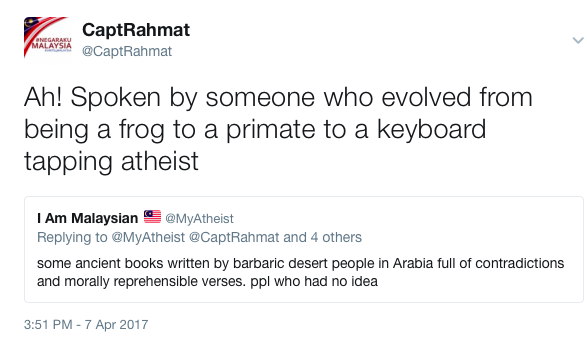
And as for the atheists, just stay off my social media accounts. You don’t have the locus standi to participate in this debate.

Insula Est, Non Tua

Coat of Arms of the British East Hindia Company
Coat of Arms of the British East India Company

Of late there have been calls for the return of Pulau Pinang to the sovereign Ruler of Kedah.  This is because since being governed by the DAP, Pulau Pinang (Penang) has been behaving like an autonomous state while chasing out Malays, Indians as well as marginalised Chinese from the island state.

If I were to follow my heart, I would wish for Kedah to reassert its sovereignty over Penang. However, legally that would be disastrous for Malaysia.

The History of the 

The proponents for the return of Penang to Kedah base their arguments on the agreement made in 1786 between the British East India Company and the Ruler of Kedah at the time, Sultan Abdullah Mukarram Shah.  During that time, Kedah was already under the Rattanakosin Kingdom established by King Taksin. Kedah was already paying tributes in the form of Gold Flowers to the Kingdom of Siam in 1781 and had accepted the Siamese sovereignty.

In the 1786 agreement, Francis Light was supposed to assist the Kedah ruler in the event that Kedah comes under attack by another power; the British East India Company (BEIC) was not to protect enemies of Kedah (namely the Burmese and Siamese); and BEIC was to pay the Kedah government an annual repariation of 30,000 Spanish Dollars for the lease of Penang.

Tension grew when Francis Light did not inform his superiors in India of the full details of what he had promised to Sultan Abdullah.  In the end, Light was asked to provide Sultan Abdullah with less than what had been requested. The EIC decided to to provide the Sultan with any form of protection and nothing was said of financial repariation.

Light was forced to use the island’s revenue to pay the Sultan but offered only $10,000 Straits Dollars a year for eight years for the island, or $4,000 Straits Dollars a year for so long as the Company occupied the island.

The unamused Sultan then gathered his forces in Prai in late 1790 to take Penang back by force which was defeated by Light. Sultan Abdullah sent his emmissaries Tunku Sharif Muhammad, Tunku Alang Ibrahim and Datuk Penggawa Telibun to negotiate a treaty with Light.

In 1791 a treaty called the Treaty of Friendship and Peace was signed between the BEIC and the Sultan of Kedah and the annual payment of a sum of 6,000 Spanish Dollars was promised to the Sultan for the rights to Penang and the two countries promised “to live in peace by sea and land, to continue as long as the Sun and Moon give light.”  BEIC was to no longer provide protection to Kedah against its enemies.  This treaty supercedes the treaty of 1786. (Dr Cheah Boon Kheng, former lecturer, History Department of the Universiti Sains Malaysia)

In 1800, another treaty was signed between BEIC and Sultan Ahmad Tajuddin Halim Shah II, the successor of Sultan Abdullah for the lease of Seberang Prai (called Province Wellesley then) for an annual sum of 4,000 Spanish Dollars that is to continue “as long as the Sun and Moon give light.”

From 1826, the BEIC placed Penang under the Straits Settlements. Subsequently, in 1874 the BEIC was dissolved and as a result of the 1873  East India Stock Dividend Redemption Act the Straits Settlements came under direct British Crown rule via its government in India.

The Brtish Government became the rightful owner of Penang as successor of the BEIC.

Towards The Independence of Malaya

Each state in what was called Malaya were sovereign states up until 31st August 1957 when the Federation of Malaya that existed following the breakdown of the Malayan Union in 1948 ceased to exist.

“Malaya” as it was known then was made up of the Federated Malay States (Selangor, Perak, Negeri Sembilan, Pahang), the Unfederated Malay States (Kedah, Kelantan, Terengganu, Perlis, Johor), and the Straits Settlements (Penang, Melaka and Singapore).

The discussions leading to the formation of the 1957 Federation of Malaya excluded Singapore in the equation.

During these discussions, both Melaka and Penang were referred to as the Crown Colonies whose people are citizens of Britain. The discussions involved Her Majesty Queen Elizabeth’s Government, the Nine Malay Rulers, and the Alliance government the people had elected to represent them.

In an early stage, it was agreed by both Her Majesty’s Government and the Nine Rulers that the office and person of the Yang DiPertuan Agong and the Queen would jointly administer the Settlements as “equal partners.”  According to this arrangement, the Queen would delegate her sovereign authority to the Yang DiPertuan Agong as the representative of the Queen and the Nine Rulers and that the Melaka and Penang would have a Governor appointed in consultation with the Straits Settlements’ office (CO1030/132(28) dated 16 August 1956).

This would be in line with protecting the Straits Chinese who were British subjects whose representation to the British government expressed fears that if Penang is administered by the independent Malayan government, they would be subjected to discrimination.

The British High Commissioner to Malaya, Sir Donald MacGillivray had already expressed grave doubts as to whether that arrangement would be accepted by the Alliance Party as the latter had wanted all the Settlements involved to be part of the newly independent and self-governing Malaya (CO1030/135 (2) dated 19 July 1956).

UMNO as represented by Tunku Abdul Rahman had also proposed that the provisions for Malay reservations in the proposed Constitution should be applied to Penang and Melaka.  However, this was met with stiff resistance by the British government. The Secretary of State said the proposal could “aggravate racial feeling”, adding that during the 180 years of British rule in the Settlements there had been no racial discrimination (CO1030/496 (8) dated 14 May 1957).

A compromise was proposed by the Rulers’ legal adviser, Neil Lawson, who suggested that one of the clauses on land reservations to include a provision to allow the State governments to set up a trust to buy land for the settlement of the Malays. This compromise was accepted by the meeting. This proposal was contained in Article 88 of the Federal Constitution allowing Parliament to modify the articles on land (Articles 83 – 87) for application in Penang and Melaka (Constitutional Proposals for Malaya, Cmnd, 210, op.cit).

If you noticed in all the above meetings not once did the Sultan of Kedah, Sultan Sir Badlishah ibni al-Marhum Sultan Abdul Hamid Halim Shah, discussed the return of Penang to Kedah as well as asserting His Royal Highness’s sovereign authority over Penang.

This demonstrates that Pulau Pinang and Seberang Perai were no longer legally part of the Kedah Sultanate.

However, what also almost happened was the return of Melaka to the Dutch.

On 16 May 1957, a newspaper Straits Budget reported that the Malayan Party under Tan Kee Gak had planned to ask the British Secretary of State about the Anglo-Dutch Treaty of 1824 in respect of Melaka.  According to Tan Kee Gak, Britain was planning to abandon Melaka to Malaya and as a contracting party was in breach of the said contract.  Therefore, Melaka should be returned to the Dutch instead of be part of an independent Malaya.

The Colonial Office viewed the report seriously and sought the advice of the Foreign Office which in turn sought the help of the government of the Netherlands to renounce such a claim explicitly (CO1030/439 (79) dated 20 June 1957).

Summary

I have no reservation whatsoever in expressing my disgust at the way Lim Guan Eng runs Penang and uses it in a very unMalaysian way.  But I doubt there is any legal avenue that would allow for the return of Penang to Kedah that would be undamaging to the country in its present legal form.  It would allow for parties in Melaka perhaps to ask Netherlands to reconsider claiming the state as its own based on the 1824 treaty, and Manila would have a legal precedence to follow in its claim on Sabah.

Not once did the Sultan Of Kedah from the days of Sultan Ahmad Tajuddin Halim Shah II through Sultan Abdul Halim Mu’adzam Shah have ever staked a claim on Penang.  This is simply because the treaties of 1791 and 1800 have superceded the one made in 1786.

And Penang’s current form is because of the 1957 Federal Constitution, cemented further by the 1963 Federal Constitution, agreed upon by all including by the Nine Malay Rulers without a single objection to its sovereign status. So how is it that Penang should be taken back by Kedah?

If the current claim is about the maruah (face/pride) of the Kedah Sultanate or about the pride of the Malays, that is just the mouth talking before the brain could think.

It would be nice to live dreaming about the day Penang becomes another district of Kedah but that is what the heart wishes. It is the legal and constitutional implications that have to be thought of thoroughly.


Si Bedal Kurang Semporna

Artikel asal telah ditulis oleh Saudara Hafizi Harris di laman Facebooknya semalam (Selasa 25hb Oktober 2016):

_____________________________

Hari ini Shafie Apdal, Ahli Parlimen Semporna telah membuat pembohongan di Parlimen. Di antaranya ialah:


1) Shafie mendakwa 60% daripada Bandar Malaysia telah dijual kepada China.


Ini tidak benar. 60% daripada Bandar Malaysia telah dijual kepada 60% konsortium Iskandar Waterfront Holdings (IWH) dan 40% kumpulan China Railway.


Pegangan saham IWH ialah 40% Kumpulan Prasarana Rakyat Johor (KPRJ – Johor State Govt) dan 60% Sumber Kepercayaan (Tan Sri Dato ‘Lim Kang Hoo).


A. 40% 1MDB atau MOF Inc (sekiranya saham dipindahkan), 36% IWH dan 24% CREC. Oleh itu, pemilikan projek utama adalah 76% Malaysia dan 24% China.


2. Shafie mendakwa 1MDB sahaja menggunakan Arul Kanda dan tidak mewujudkan peluang pekerjaan manakala bail-out untuk Proton dan MAS menyelamatkan pekerjaan.


Pertama, tidak seperti Proton dan MAS, 1MDB tidak pernah diselamatkan oleh kerajaan.


Mungkin Shafie Apdal tidak pernah pergi ke Sendayan untuk melihat pangkalan udara baru sedang dibina atau 7 kemudahan tentera di seluruh negara yang sedang dibina sekarang dibiayai oleh 1MDB sebagai sebahagian daripada perjanjian pertukaran mereka dengan MINDEF?


Atau beribu-ribu pekerja di TRX sekarang ini yang sedang berusaha menyiapkannya atau puluhan ribu pekerjaan yang akan diwujudkan apabila TRX mula beroperasi, dalam suasana pelaburan asing telah diterima daripada Australia, Indonesia dan Hong Kong?


Ia sudah pasti bukan hanya Arul Kanda sahja bekerja di sana😃


3. Shafie mendakwa bahawa Sabah dan Sarawak adalah negeri-negeri yang paling miskin dan mereka sedang disalah urus😂


Sabah mencatatkan pertumbuhan gaji kedua tertinggi 37.5% dan Sarawak mencatatkan 26% pertumbuhan gaji sejak 2010 – berbanding dengan hanya 17.2% bagi Pulau Pinang dan 20.8% bagi Selangor.


Berasaskan pendapatan isi rumah, Sabah sekali lagi mencatat pertumbuhan pendapatan isi rumah kedua tertinggi 81.3% manakala Sarawak mencapai 57.8% – kedua-dua outreached Selangor dan Pulau Pinang.


Pada KDNK asas per kapita, Sarawak dan Sabah bukanlah negeri-negeri yang paling miskin. Sarawak sebenarnya negeri ke-4 terkaya dan mempunyai KDNK per kapita sebanyak RM44k – bersamaan dengan Pulau Pinang. Walaupun Sabah mencatatkan RM19,700 – lebih tinggi daripada Kedah dan Kelantan.


Kadar kemiskinan tegar di Sabah juga menurun daripada 19.2% pada tahun 2009 kepada hanya 3.9% pada tahun 2014.


Manakala di Sarawak, kadar kemiskinan tegar juga berkurangan daripada 5.3% kepada 0.6%.


Malah, Sabah mempunyai rizab negeri RM2.33 bilion pada 2014 – hampir dua kali ganda daripada Pulau Pinang manakala Sarawak mempunyai rizab sebanyak RM27 bilion pada tahun 2014 – atau kira-kira 8 kali lebih tinggi daripada Selangor.


Malah Sabah dan Sarawak telah menerima bantuan dan pembangunan yang lebih besar daripada Kerajaan Persekutuan sejak 2009.


Jadi, bagaimana Shafie Apdal mewajarkan bahawa Sabah dan Sarawak adalah negeri termiskin dan sedang disalah urus?


Hanya kerana Shafie mempunyai imuniti parlimen maka dengan sewenang – wenangnya bercakap berdasarkan fakta media tanpa fakta sebenar?😂