BN Is Serious About The Security Of Sabah

A ‘Force Demonstration’ conducted by the three services of the Malaysian Armed Forces was held at Kem Paradise near Kita Belud today. 400 personnel were involved in the demonstration of firepower that also saw the involvement of two Boeing F/A-18 Hornet fighters, two Sukhoi Su-30MKM multirole combat aircraft, four BAe Hawk light multirole fighters and helicopters from all three services.

In his speech, Defence Minister Datuk Seri Hishammuddin Hussein assures the people of Sabah that the Barisan Nasional government under Prime Minister Datuk Seri Najib Razak will continue to preserve the peace and security that is being enjoyed by the people of Sabah.

“The government will not compromise the security of Sabah. Today’s programme that involves all three branches of the Malaysian Armed Forces proves that we are sincere and serious about it,” he said.

Hishammuddin also urged the people of Sabah to not fall for the irresponsible sentiments of hatred that are being played by the Opposition.

“Their appearance is seasonal in nature and is filled with their agenda. They do not offer solutions like we do, especially in the security aspect of the people of Sabah,” he added.

The force demonstration was also attended by Minister of Communications and Multimedia, Datuk Seri Salleh Said Keruak; Secretary-General of the Ministry of Defence, Datuk Seri Mohd Radzi Abd Rahim; Chief of Defence Forces, General Tan Sri Raja Mohamed Affandi Raja Mohamed Noor; Chief of the Royal Malaysian Air Force, General Tan Sri Affendi Buang and Chief of Army, General Tan Sri Zulkiple Kassim.

Meanwhile, Hishammuddin said that the Malaysian Armed Forces shall continue to cooperate and conduct trilateral cooperation with Indonesia and Philippines to face the threat of terrorism.

“For now, we have joint air and sea patrols with our neighbours while joint land patrols will be conducted soon,” he said.

The demonstration today also saw a field hospital being set up where the people of Kota Belud were given free medical and dental treatment.

Harapan Palsu Buat Anak Muda

Rasulullah SAW bersabda yang bermaksud:

Ada tiga tanda orang munafik, iaitu apabila dia bercakap dia berbohong, apabila berjanji dia ingkar dan apabila diberi amanah dia khianat.” (Riwayat al-Bukhari dan Muslim).

Enam tahun yang lepas, semasa kita semua sibuk membuat persiapan untuk menghadapi Pilihanraya Umum Ke-13, Pakatan Rakyat yang kini terkubur telah berjanji untuk menghapuskan PTPTN.

Hari ini, Pakatan Harapan sekali lagi tampil memberi harapan palsu kepada anak-anak muda.

Kalau dulu Pakatan Rakyat berjanji untuk memansuhkan PTPTN, kali ini Pakatan Harapan yang dikepalai oleh satu fossil hidup berumur 93 tahun yang kerap menjadi perabut Institut Jantung Negara bila ceramahnya tidak mendapat sambutan, mengubah janji tersebut dari pemansuhan kepada penangguhan pembayaran.

Jadi, adik-adik, sekali lagi anda tertipu kerana setiap janji yang dibuat oleh Pakatan tidak akan ditunaikan. Malah, mereka lebih gemar membuat U-turn demi U-turn.

Contoh pertama ialah janji untuk memansuhkan PTPTN pada PRU Ke-13 kini digantikan dengan penangguhan pembayaran PTPTN sebagai janji untuk PRU Ke-14.

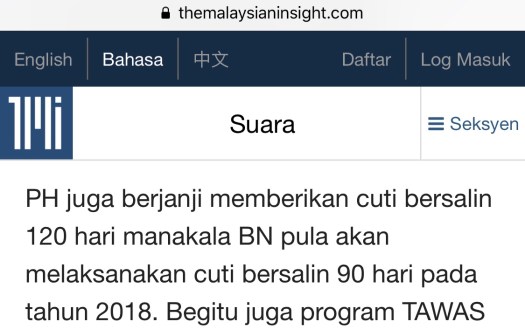
Semasa membuat Bajet 2018, Pakatan berjanji akan memberi cuti bersalin selama 120 hari sebagai bukti ianya memartabatkan kaum wanita, manakala BN hanya memberi selama 90 hari.

Dalam janji Pakatan untuk PRU Ke-14, jumlah yang dijanjikan telahpun dikuramgkan ke 90 hari, iaitu sesuatu yang telah dilaksanakan oleh kerajaan BN di bawah Najib Razak. Siapa kini yang tidak memartabatkan kaum wanita PADA HARI WANITA SEDUNIA?

Nampaknya, benarlah seperti apa yang disuarakan oleh Kepala Pakatan yang masih tamakkan kuasa dan tidak akan memberikan kuasa kepada golongan muda:

Dan apa sabda Rasulullah SAW di atas mengenai orang yang tidak menunaikan janji?

Munafik! Inikah golongan yang anda ingin jadikan pemimpin?

The Israeli In KL

When Israeli diplomat David Roet attended a United Nations conference in Kuala Lumpur recently, the Opposition went into full swing trying to discredit the government saying that it wants to establish diplomatic relations with Israel.

In a statement, the Malaysian Ministry of Foreign Affairs (MoFA) explicitly states that the invitations to the Israeli delegates was issued by the UN as per Article III of the Host Country Agreement signed by the organisation and Malaysia so that the UN is able to conduct its conferences away from any of its established headquarters.

IMG_6292.

The Article states, in part, that the Forum shall be opened to all UN member states and its Specialised Agencies. This was confirmed by Israel’s Hadashot TV which reported that Malaysia was compelled to host the Israelis, since it was required to grant visas to all delegations in order to hold the international conference.  Therefore, it is immaterial whether or not Malaysia has diplomatic relations with Israel.  It is for the same reason that Fidel Castro was able to attend the UN summit in New York in 1976, 1995 and 2000.

Malaysia-Israeli Relations

IMG_6307

If you walk along Jalan Zainal Abidin in Pulau Pinang which is just off Burmah Road near the Tune Hotel, you will come across an old cemetery.  That is a Jewish Cemetery.  Jalan Zainal Abidin was once called Jalan Yahudi or Jew Street, the only evidence that a Jewish enclave once existed on the island.

Israel first established contact with our pre-independence government in 1956 when Israeli Prime Minister Moshe Sharett visited Malaya to propose the appointment of an Israeli consul in Malaya.  Israel also voted in favour of the Malayan bid to become a UN member in 1957.  Trade between the two countries was in place.  This was banned in 1974, after the Yom Kippur war, but indirect trade (through third countries) was in place.

An Opposition supporter was quick to point out that according to the Israeli Central Bureau of Statistics, between 2008 and 2011 trade between the two countries fluctuated considerably.  Israel’s exports to Malaysia peaked at USD798 million in 2010 while imports from Malaysia peaked in 2011 at USD93.6 million.

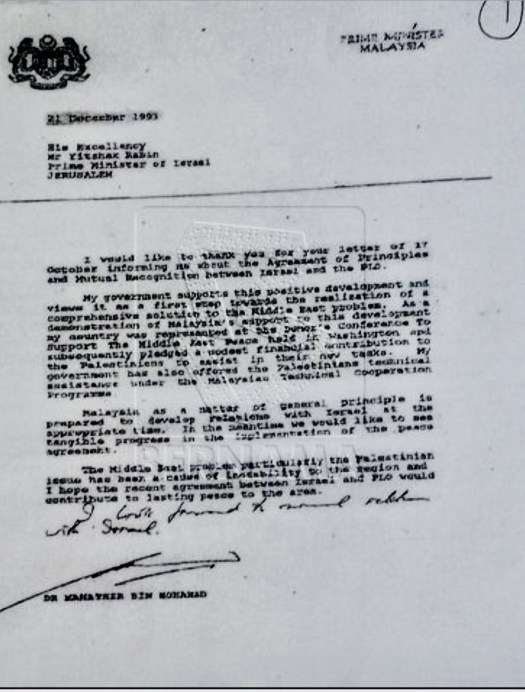
Although the preriod shown above shows the statistics was for the period between the end of Abdullah Badawi’s administration and the commencement of the Najib Razak administration, the flourish in trade could be traced back to the Mahathir administration.  In December 1993, as a consequence of the Oslo I Accord, Mahathir wrote a letter to Israeli Prime Minister Yitzhak Rabin.

IMG_6303
Mahathir’s letter to Yitzhak Rabin in December 1993

The photo of the letter may be a bit difficult to read but I shall provide the transcript here:

PRIME MINISTER, MALAYSIA

21 December 1993

His Excellency Mr Yitzhak Rabin Prime Minister of Israel, JERUSALEM

I would like to thank you for your letter of 17 October informing me about the Agreement of Principles and Mutual Recognition between Israel and the PLO.

My government supports this positive development and views it as a first step towards the realization of a comprehensive solution to the Middle East problem. As a demonstration of Malaysia’s support to this development my country was represented at the Donor’s Conference to support The Middle East Peace held in Washington and subsequently pledged a modest financial contribution to the Palestinians to assist in their new tasks. My government has also offered the Palestinians technical assistance under the Malaysian Technical Cooperation Programme.

Malaysia as a matter of general principle is prepared to develop relations with Israel at the appropriate time. In the meantime, we would like to see tangible progress in the implementation of the peace agreement.

The Middle East problem particularly the Palestinian issue has been a cause of instability to the region and I hope the recent agreement between Israel and PLO would contribute to lasting peace to the area.

I look forward to normal relations with Israel.

DR. MAHATHIR BIN MOHAMAD

I intentionally made bold the last line because, while the rest of the content which, obviously was drafted by someone else, Mahathir wrote that bold part saying he looked forward to normal relations with Israel himself.  Yes, it was handwritten.

In the most recent diplomatic history, Obama wished to have normal relations with Cuba.  Diplomatic relations between the US and Cuba was subsequently restored.  The following year, PKR’s Chua Jui Meng, who was the then-Deputy Minister of International Trade and Industry, suggested that Israel could eventually become a destination for Malaysia’s investments (Shanti Nair, Routledge, 1997 p.252).

As a result, in 1999 Israeli exports to Malaysia totalled USD107 million.  In 2000, it was USD732 million, and USD615.5 million the following year.  In 2002, the Israel Ministry of Industry report on trade relations with Indonesia and Malaysia advised Israelis interested in conducting business with Malaysian companies that “there is no opposition to trade and commerce relations as long as a low profile is kept“.

Discretion is essential for these companies, not just in Malaysia but also in Indonesia.  Reputation and financial damage are the risks for companies in these two countries if they are known to be doing trade with Israel.  According to Emanuel Shahaf, the vice chairman of the Israel-Indonesia Chamber of Commerce, “There are two contradictory trends. The pro trend is that Indonesia demands more high-tech things… The negative trend is the political situation is not getting better (when it comes to Israel), in fact it’s getting worse.”

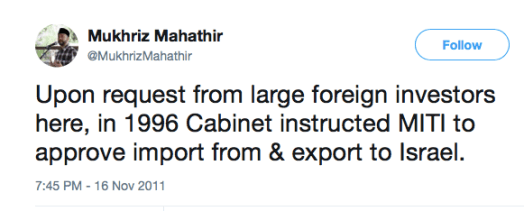
Mahathir’s son Mukhriz, who was the Deputy Minister of International Trade and Industry in 2011 confirmed that Malaysia has had bilateral trade relations with Israel since 1996.

Mukhriz tweeted “Upon request from large foreign investors here, in 1996 the Cabinet instructed MITI to approve import from and export to Israel.” The relevation came as a surprise, especially as the trade ties were established during the Mahathir administration.  Mahathir has been a vocal opponent of Israel and continues to project this false stand via his Perdana Leadership Foundation which openly opposes Israeli occupation of Palestinian land.  Najib took over from Abdullah only in 2009.

Screen Shot 2018-02-15 at 23.43.02

So, thank you Mahathir for his eagerness to start a diplomatic relationship with Israel in 1993.

Congratulations also to the Opposition states as they received a lot of FDI from Israeli companies.  Don’t forget to thank Mukhriz for that information and confirmation.

Screen Shot 2018-02-15 at 23.42.24

Shalom Alekhem!

Bila Lembu Bersuara

IMG_6130

Setelah didapati bersalah melanggar undang-undang, khususnya Akta Bank dan Institusi-Institusi Kewangan, 1989 (BAFIA), Rafizi terus mencari simpati dan sokongan di media sosial dengan membuat satu bebenang mengenai isu NFC di Twitter.  Beberapa soalan telah diajukan oleh Rafizi untuk menerangkan kenapa beliau melanggar undang-undang tersebut.  Saya akan kongsikan di sini apa yag telah dituliskan serta pendapat saya mengenai setiap persoalan yang diajukan Rafizi.

Rafizi telah memulakan dengan mengfalsafahkan perbuatannya dengan mengajukan dua soalan:

  1. “Apakah tanggungjawab saya apabila mendapat tahu mengenai skandal NFC?”
  2. Apakah wajar melanggar undang-undang demi menyelamatkan wang rakyat?”

Beliau menjawab soalan pertama dengan mengatakan bahawa sekiranya beliau tidak berbuat apa-apa mengenai perkara tersebut, beliau pecah amanah sebagai seorang wakil rakyat dan pemimpin politik, serta amanah yang Allah kurniakan untuk memahami isu-isu tersebut.

Larangan Hasutan dan Pecah Rahsia serta Patuh Kepada Undang-Undang menurut Islam

Beliau mengutarakan bahawa undang-undang seperti BAFIA, Akta Rahsia Rasmi, Akta Hasutan adalah undang-undang yang telah digubal dengan niat buruk untuk melindungi pesalah yang berkuasa.

Undang-undang, di mana sahaja kita berada, sama ada di sebuah negara Islam, mahupun negara yang ditadbir oleh bukan Islam, adalah wajib dipatuhi, selagi ianya tidak menyuruh kepada melanggar hukum Allah SWT.

Surah An-Nisaa’ ayat 59 menyebut:

Wahai orang-orang yang beriman, ta’atilah Allah dan ta’atilah Rasul (Nya), dan ulil amri di antara kamu.

Ulil Amri di sini bermaksud ibubapa jika anda masih anak yang masih bergantung kepada ibubapa; suami kepada isteri seperti mana yang diwahyukan melalui surah An-Nisaa’ ayat 34; Majikan jika anda bekerja untuknya maka wajib mematuhi peraturan dan arahan bekerja; pemimpin yang dipilih, hakim-hakim mahkamah, polis dan lain-lain pihak berkuasa sekiranya anda adalah rakyat.

Sebuah hadith Sahih Muttafaqun Alayhi Bukhari dan Muslim (Bukhari 2796/Muslim 1839 menyebut:

Menjadi kewajipan seorang muslim mendengar dan taat dalam melakukan perintah yang disukai atau pun tidak disukai, kecuali bila diperintahkan melakukan maksiat. Bila dia diperintah melakukan maksiat, maka tidak ada kewajiban untuk mendengar serta taat.

Akta BAFIA diwujudkan untuk memelihara rahsia-rahsia peribadi, bukan untuk melindungi orang yang salah.  Sekiranya tiada akta seperti ini diwujudkan, maka kandungan akaun anda boleh didedahkan kepada sesiapa sahaja.  Bukan Malaysia sahaja yang mempunyai undang-undang seperti ini, bahkan Agensi Kewangan Saudi Arabia dan lain-lain negara di dunia juga ada mempunyai undang-undang yang sedemikian.

Akta Hasutan adalah undang-undang untuk mencegah dari perbuatan atau pertuturan yang menghasut orang ramai untuk memberontak atau bangun melawan pihak berkuasa, kerajaan mahupun Raja.  Perbuatan menghasut ini sekali lagi bertentangan dengan dalil-dalil di atas.  Iblis telah memberontak semasa diperintah oleh Allah SWT untuk sujud terhadap Adam a.s. dan mengeluarkan kata-kata berbaur hasutan yang mempersoalkan keperluannya sebagai malaikat Allah untuk sujud kepada kejadian Allah yang diperbuat dari tanah.  Akibatnya Iblis telah diusir keluar dari syurga.

Akta Rahsia Rasmi pula diadakan untuk menentukan rahsia-rahsia  kerajaan Yang DiPertuan Agong tidak disebarkan sewenang-wenangnya.  Bayangkan walaupun adanya Akta ini, masih ada yang tidak memegang sumpah dan ikrar yang dibuat semasa diambil bekerja.  Memelihara rahsia itu adalah satu perintah Allah SWT.  Surah At-Tahrim Ayat 3 mafhumnya:

Dan ingatlah ketika Nabi membicarakan secara rahasia kepada salah seorang isterinya (Hafsah) suatu peristiwa. Maka tatkala (Hafsah) menceritakan peristiwa itu (kepada Aisyah) dan Allah memberitahukan hal itu (pembicaraan Hafsah dan Aisyah) kepada Muhammad lalu Muhammad memberitahukan sebagian (yang diberitakan Allah kepadanya) dan menyembunyikan sebagian yang lain (kepada Hafsah). Maka tatkala (Muhammad) memberitahukan pembicaraan (antara Hafsah dan Aisyah) lalu (Hafsah) bertanya: “Siapakah yang telah memberitahukan hal ini kepadamu?” Nabi menjawab: “Telah diberitahukan kepadaku oleh Allah yang Maha Mengetahui lagi Maha Mengenal

Akibat tidak memelihara rahsia tersebut, Hafsah binti Umar r.a dan Aishah binti Abu Bakar r.a tidak didatangi Rasulullah SAW selama sebulan lamanya.  Itu adalah hukuman bagi kedua-dua isteri Rasulullah SAW itu (Sahih Bukhari 5191).

Anggapan Rafizi bahawa orang yang menggunakan logik bahawa jika anda langgar undang-undang maka anda harus dihukum adalah orang-orang yang otaknya terletak dilutut juga menunjukkan betapa beliau sendiri tidak percaya kepada perintah dan ketentuan Allah SWT.  Dalil-dalil di atas telah menunjukkan beberapa contoh yang dipetik dari Al-Quran dan Hadith Rasulullah SAW mengenai hukuman yang dikenakan setelah perintah dilanggar.

Begitu juga tanggapan bahawa Mahatma Gandhi itu penjenayah – manakan sama perjuangan Gandhi dengan perjuangan Rafizi.  Gandhi memperjuangkan kebebasan tanah airnya dari penjajahan British.  Rafizi hanya memperjuangkan popularitinya.

Ingat – sebelum 2013, Rafizi tidak mempunyai apa-apa jawatan dalam exco PKR.  Isu NFC telah memberinya nama dan populariti yang telah membolehkannya bertanding di kerusi Parlimen kawasan Pandan dan menang.

Wang NFC Itu Dana?

Wang yang NFCorp gunakan itu adalah wang yang dipinjam daripada kerajaan melalui Kementerian Pertanian dan Industri Asas Tani, yang ketika itu di bawah Menterinya iaitu Muhyiddin Yassin.

Rafizi bukan orang pertama yang mencanangkan kisah NFC ini.  Maka dia bukanlah pemberi maklumat sepertimana yang digembar-gemburkan.  Kisah NFC ini mula muncul dalam laporan audit Jabatan Audit Negara pada tahun 2010.  Di dalam laporan tersebut, tiada langsung perkataan-perkataan seperti “kucar-kacir” mahupun “penyelewengan” sepertimana yang digunakan oleh pihak pembangkang dan Rafizi sendiri.

Yang dilaporkan oleh Jabatan Audit Negara ialah terdapat kelemahan-kelemahan dalam projek tersebut yang ditemui oleh jabatan tersebut.  NFCorp telah menternak sebanyak 4,000 ekor lembu tetapi ini hanyalah merupakan 40 peratus dari jumlah yang telah disyaratkan.  Maka, sebanyak 8,000 ekor lagi lembu telah dibawa masuk.

Masalah yang timbul adalah apabila Kementerian Pertanian dan Industri Asas Tani tidak memenuhi syarat perjanjian mereka untuk menyediakan tempt-tempat penyembelihan berkualiti untuk eksport, serta jalan-jalan untuk ke tapak projek NFC tersebut.  Ini telah menyebabkan kelewatan pada pihak NFC untuk menjalankan projek tersebut.  Malah, kelewatan yang disebabkan oleh Kementerian Pertanian dan Industri Asas Tani inilah yang menjadi perkara kritikal dalam laporan Jabatan Audit Negara tersebut dan bukan terhadap syarikat NFCorp.

Rafizi hanya menggunakan penyata akaun-akaun yang diperolehi dengan cara yang melanggar Akta BAFIA dan menghebahkan mengenai akaun-akaun tersebut dalam satu sidang akhbar yang diadakannya pada 12 Mac 2012.  Beliau mengaitkan akaun-akaun tersebut dengan “penyelewengan” oleh NFC dan memfitnah beberapa orang dan syarikat.

Akibatnya, Rafizi telah disaman oleh NFCorp dan akibatnya didapati bersalah oleh mahkamah atas tuduhan memfitnah, dan diarahkan membayar RM300,000 kepada mereka-mereka yang telah difitnahnya.  Bagaimana Rafizi membayar saman fitnahnya? Dia telah melakukan kutipan derma (crowdfunding) dengan meminta para penyokongnya membayar samannya.  Beliau tidak perlu keluarkan barang satu sen pun. Kesalahan fitnahnya ditanggung oleh orang lain.

Jikalau apa yang diwar-warkan oleh Rafizi itu benar, sudah tentu dia tidak akan didapati bersalah.

Dana Telah Dilesapkan?

Rafizi juga berkata kerahsiaan bank bukan untuk melesapkan dana awam.  Rafizi suka menggembar-gemburkan cerita.  NFC membayar balik RM5 juta setahun termasuk faedah kepada kerajaan.  Sehingga 2013, NFC telah membayar sebanyak RM34.98 juta.

Pembayaran ini terpaksa dihentikan kerana akaun mereka telah dibekukan kerajaan semasa disiasat.  Siasatan oleh SPRM dan PDRM tidak menemui sebarang kesalahan yang dilakukan oleh NFC/NFCorp.  Walau bagaimanapun, Pengerusi NFCorp telah dituduh melakukan jenayah pecah amanah dengan membuat pembelian hartanah untuk syarikat tersebut tanpa persetujuan lembaga pengarah.  Oleh sebab bukti pihak pendakwaan tidak mencukupi, beliau telah diberi pelepasan dan pembebasan oleh mahkamah.

Jelas bahawa NFC ada membuat pembayaran balik pinjaman kepada kerajaan.  Jika benar Rafizi pentingkan hak rakyat, kenapa beliau berdiam diri dalam isu pembayaran RM305 juta yang telah dibayar untuk laporan kajian kesesuaian projek terowong bawah laut Pulau Pinang tetapi sehingga kini masih belum nampak walau sehelai pun laporan tersebut walaupun telah 22 bulan berlalu?

Kenapa Rafizi Tidak Diberi Perlindungan Sebagai Pemberi Maklumat?

Rafizi menulis: “Kalau bising dalam media sahaja tidak cukup untuk sedarkan rakyat kerana bukan semua membaca laporan media. Kena masuk kampung ceramah. Kena buat video.  sebab itu tidak ada cara lain: inilah caranya.”

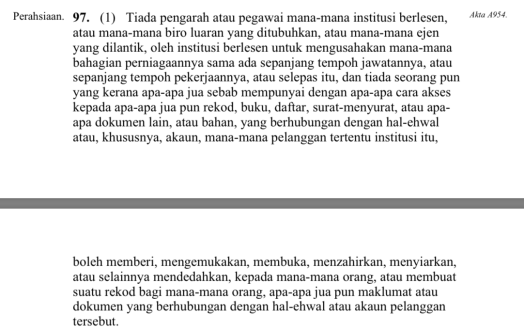
Seksyen 6 Akta Perlindungan Pemberi Maklumat, 2010 terang-terang menyebut bahawa sesiapapun boleh membuat pendedahan mengenai kelakuan tidak wajar (salahlaku) KEPADA MANA-MANA AGENSI PENGUATKUASAAN YANG DIFIKIRKANNYA MUNASABAH  DENGAN SYARAT BAHAWA PENDEDAHAN SEDEMIKIAN TIDAK DILARANG SECARA KHUSUS OLEH MANA-MANA UNDANG-UNDANG BERTULIS.

Seksyen 97(1) Akta Perbankan dan Institusi-Institusi Kewangan 1989 pula menyebut:
Screen Shot 2018-02-11 at 22.51.07

Rafizi telah menerima penyata akaun-akaun tersebut daripada seorang pegawai bank yang tidak diberi kebenaran oleh empunya akaun-akaun tersebut.

Rafizi kemudiannya mendedahkan penyata akaun-akaun tersebut kepada pihak media dalam sidang akhbarnya. Media bukanlah agensi penguatkuasaan yang ditakrifkan dalam Akta Perlindungan Pemberi Maklumat, 2010.

Dengan ini terang lagi bersuluh bahawa Rafizi telah melanggar undang-undang dan tidak layak diberi perlindungan sebagaimana diperuntukkan oleh Akta Perlindungan Pemberi Maklumat, 2010.

Akhir Kata

Rafizi tidak pernah hormat kepada agama Islam mahupun undang-undang.  Beliau adalah merupakan seorang penghasut dan pemfitnah bersiri.  Di antara siri hasutan dan fitnah beliau termasuk:

  • 12 Januari 2013, Datuk Seri Ahmad Zahid Hamidi yang ketika itu Menteri Pertahanan telah mengemukakan saman malu ke atas Rafizi kerana menerbit artikel fitnah dalam blog beliau. Rafizi telah menurunkan artikel tersebut dan memohon maaf kepada Zahid.
  • 22 Nov 2014, Perdana Menteri dan isteri fail saman malu dan Rafizi balas dengan mengatakan fitnah beliau itu ‘hanya gurauan’ kerana memfitnah subsidi minyak masuk ke dalam akaun Perdana Menteri dan isteri untuk membeli cincin baru. Fitnah beliau tersebut terus dipercayai sehingga ke hari ini dan telah memberi kerosakan teruk kepada imej Datin Seri Rosmah.
  • Januari 2016, Rafizi didenda RM1,800 oleh mahkamah kerana mencetus ketegangan agama Islam-Kristian dengan memfitnah mengatakan ahli UMNO telah membaling bom petrol ke gereja.
  • Rafizi juga telah menabur fitnah kononnya Tabung Haji sudah kehabisan wang sebab dana Tabung Haji telah dirompak. Akhirnya, kerana percayakan fitnah tersebut, 3,954 pendeposit menutup akaun tabung haji manakala 3,105 telah membatalkan pendaftaran untuk menunaikan ibadah haji.
  • Rafizi juga menabur fitnah dengan mendakwa kos projek MRT sebanyak RM21billion bagi laluan sepanjang 21km sedangkan ianya untuk laluan sepanjang 51km.
  • Pada bulan Oktober 2016, Rafizi diarah membayar RM300,000 oleh mahkamah kerana memfitnah NFC mengenai pembelian hartanah.
  • Pada bulan November 2016, Rafizi didenda RM1,950 oleh mahkamah kerana himpunan haram “Blackout 505”.
  • Pada bulan November 2016 juga Rafizi dihukum penjara 18 bulan oleh mahkamah kerana melakukan kesalahan di bawah Akta Rahsia Rasmi.
  • Pada penghujung bulan November 2016, Rafizi telah diminta bertaubat oleh Abdul Hadi Awang kerana memfitnah PAS menerima dana 1MDB.

Inilah Rafizi yang masih diagung-agungkan oleh mereka yang tenggelam dalam kebencian yang tidak berasas. Kalau ada pun asas yang didakwa mereka, asas tersebut hanyalah berlandaskan pembohongan dan penipuan semata-mata tanpa usul periksa.

Rafizi menulis: “Hakim saya ialah Allah. Hanya hukumanNya yang saya benar-benar peduli, bukan hakim-hakim lain.”

Begitulah Rafizi cuba menunjukkan betapa alimnya beliau.  Perintah Allah dilanggarnya, undang-undang diketepikannya.  Kini, beliau cuba memperdayakan ramai dengan imej alim.  Tak ubah seperti para perogol yang memakai songkok atau kopiah apabila dihadapkan ke mahkamah.

Screen Shot 2018-02-11 at 23.38.15

Biarlah Rafizi mengelembukan diri sendiri.  Jangan terikut dilembukan olehnya.  Ingat firman Allah SWT dalam surah Al-Buruuj ayat 10:

“Sesungguhnya orang-orang yang mendatangkan fitnah kepada orang-orang mukmin lelaki dan perempuan, kemudian mereka tidak bertaubat, maka bagi mereka azab Jahannam dan bagi mereka azab (neraka) yang sangat pedih.”

Fitnah dan Pakatan berpisah tiada.

Don’t Be Jumud, Jomo

I read with amusement a recent article posted on an Opposition-leaning news portal how Jomo Kwame Sundaram’s answer to address a ballooning debt is by cutting the Prime Minister’s Office’s spending, and also to reduce the number of mega-projects.

Jomo, who is Visiting Senior Fellow at Khazanah Research Institute, said that what Malaysia needs now is more appropriate development expenditure, not yet more operating expenditure, especially for the PMO, which has grown more than tenfold and has centralised power like never before.

According to the article, the PMO was allocated RM17.43 billion in Budget 2018, almost double the RM8.938 billion it received in 2008.

The Prime Minister’s Office or the Prime Minister’s Department?

The Visiting Fellow at Khazanah Research Institute apparently finds it difficult to distinguish between the Prime Minister’s Office and the Prime Minister’s Department.

According to Budget 2018, RM17.43 billion was allocated to the Prime Minister’s Department, and not the Prime Minister’s Office.

The Prime Minister’s Office is only one of 56 agencies under the Prime Minister’s Department.

I don’t know what was Jomo also trying to imply by saying that the PMO has more centralised power like never before.

Since the budget is for the PMD and not the PMO, the centralised power and authority to spend the budget comes under the Chief Secretary to the Government of Malaysia, who is appointed by the Yang DiPertuan Agong.

Major agencies under the Prime Minister’s Department include the 7,000-strong Malaysian Maritime Enforcement Agency, the 3,000-strong Civil Defence Force as well as the Eastern Sabah Security Command (ESSCOM).

All these agencies have been tasked to look after our security and well-being.

In 2008, there was no MMEA nor was there the ESSCOM.

The MMEA, for example, has since added more capable blue-water assets to replace its ageing heritage assets handed down from other agencies such as the Royal Customs Department, Royal Malaysian Police, Royal Malaysian Navy and the Fisheries Department.

The heritage assets’ average age was 30 years old and consisted mainly of coastal and brown-water assets.

ESSCOM has also added more assets such as surface-search radar, build installations for security units to operate from, to combat border incursions by illegal immigrants as well as by terrorist groups.

The Malaysian Civil Defence Force, or Angkatan Pertahanan Awam Malaysia (APM), has gone on a massive recruitment drive and assets procurement.

With a permanent force of only 3,000 there is not enough of them to go around in the case of an emergency or disaster.

It was reported that in Kuala Kangsar, there is only one permanent APM staff who is the ambulance driver when responding to an accident or other emergency medical cases, and is also the coxswain for the rescue boat when there are floods.

Surely the men and women of the agencies I mentioned above also deserve a raise when due.

Then there is of course, the Parliament.

The budget for Parliament also comes under the Prime Minister’s Department, in case Jomo is not aware of that.

Operating costs, staffing costs, allowances and pensions for current and former members of Parliament come from the Prime Minister’s Department.

So, when your MP walks out of a debate or does not attend bills voting sessions, don’t ask why is the government spending unnecessarily.

Ask why is the government paying for your lazy MP. Ask also why was your MP a one-term MP, and why is there so many one-term MPs especially from the Opposition.

And please also ask why is the government still spending on the secretariats of two former Prime Ministers – one who made so much noise when the government reduced the budget allocated for his staff, while he goes around running down the current government as well as the country.

Debts? Can’t We Pay?

Jomo, described as a prominent economist in the article, also mentioned about the fast-rising government debt which is now hitting almost RM700 billion (USD178 billion).

He said that the mega-projects that are now being constructed have added to the burden of debt that Malaysia has to shoulder.

While it is true that our debt is actually at RM687 billion, domestic debt is at RM492 billion (or 72 percent of total debt) while external debt is at RM195 billion (28 percent).

Our International reserves stand at RM417 billion.  I am looking at the latest report issued last week by the Bank Negara Malaysia.

But you do not just look at debt to know how we are performing economically.

Our debt to GDP ratio is at 53.2 percent, down from 54.5 percent the previous year, year-on-year.

So Jomo is off the target when he said the government is not addressing its debt issue.

Market consensus of our GDP expansion was at 5.4 percent.  Yet, it was at 6.2 percent year-on-year in September 2017, making our economy one of the most robust expanding economy.

Private consumption increased by 7.2 percent in the same reporting period where Malaysian spend mostly on food, communication, housing and facilities.

So how is that possible if the economy is not doing well?  Our exports grew by 12 percent; manufacturing sector rose 7 percent; services rose 6.6 percent; construction 6.1 percent.

At 53.2 percent debt to GDP ratio, it means that the government is still able to pay off its debts.

As a comparison, Japan’s debt to GDP ratio is 250 percent; the US is at 106 percent; France is at 96 percent while the UK is at 89 percent.

Among ASEAN nations, Singapore has the highest debt to GDP ratio which is at 112 percent.  Any country that has its debt to GDP ratio exceeding 100 percent means that it has debts more than it could make money.

But do we hear anyone from the countries mentioned above complain?

Epilogue

Every day we hear of ill-informed Malaysians complaining that our country is in such huge debt that the country will soon be in ruins.

Selective statements by the likes of Jomo is not helping the situation. And it certainly does not help especially when his statement was intentionally directed at the Prime Minister’s Office, and not the Prime Minister’s Department where the budget was given.

Perhaps, it was malice on his part to intentionally and falsely painting the wrong picture, to make the Prime Minister look bad.

Or perhaps it was the editor of the said portal who spun Jomo’s statement to make it look as if Jomo implied that it was the PMO instead of the PMD.

Either way, Jomo’s intentional or unintentional non-mention of the debt-to-GDP ratio shows the bad blood he has with the Najib administration.

A true economist would give the WHOLE picture.

Jomo is not.

(This article was first published by The Mole)

Ada Faham, Rais?

raisthehutt
“I don’t know if i have a brain!”

Recently, 14 European Union ministers and 3 Charges D’Affaires met with members of Pakatan Harapan. Rais Hussin (above) who heads the Policy and Strategy Bureau of Pribumi wrote that the claim of Foreign Minister Anifah Aman that Pakatan had breached the sovereignty of Malaysia was ludicrous and off target. He went as far as quoting the Vienna Convention on Diplomatic Relations, 1961.

Very laudable, Rais. Good effort in trying to at least look clever. They say ‘The Devil is always in the details‘, Rais. The very least you could do is read the statement by the Foreign Minister properly.

He said ‘mengundang campur tangan‘ which, if translated properly, means ‘inviting interference‘ in Malaysia’s domestic issues as well as the issues raised to the delegates would effect the image and sovereignity of the country.

The concern of the Malaysian Government is why is Pakatan Harapan members, especially PPBM members who do not even hold seats in Parliament (with the exception of self-proclaimed Brunei citizen Mukhriz Mahathir who is the ADUN of Jerlun), air domestic issues to representatives of foreign nations? What is the intention here?

Years ago, Mahathir chide the west for poking their noses into Malaysia’s domestic affairs. Now you are asking foreign nations to interfere but at the same time chide the Government for inviting foreign investments from China and the Middle East. That is blowing hot and cold at the same time.  It is a known fact that you are full of hot air anyway but you are undoubtedly a qualified and proven strategist. Just look at how spectacular Muhyddin is doing now (that was being ironic and sarcastic in case it escaped your alleged intellectual mind).

Did Mahathir chide Anwar for seeking support from Al Gore, Estrada etc? Wait! You reformed! Of course! That is why Mahathir has done a U-turn and is doing what Anwar did. So was Anwar right? Did Mahathir actually screw Malaysia for 22 years?

Bad mouthing our country to outsiders is simply in bad taste. Sabotaging the country for your own political gain? And it was thought that Mahathir and PPBM could sink no lower.

Are you hoping for the EU to place an embargo on Malaysia? It would definitely affect the Palm Oil industry which will in turn affect the small producers. So, when these people lose their income and can’t provide food on the table, will you be answerable?

You talk about 1MDB, SRC and Felda without any hint of knowledge concerning the matters. The US, Singapore, Switzerland took action after Bank Negara hit 1MDB with heavy penalties.

The SRC, Felda and Mara are still under investigation in case you are unaware. Any form of investigation would not happen if Mahathir were the Prime Minister because he would just instruct the MACC to turn a blind eye just like in the case of the BNM Forex scandal.

By the way, do you even understand what 1MDB is all about? You probably do a little after all those hours of trying to memorise and parrot what the blogs alleged. Or perhaps you received advice from Pakatan’s renowned economists i.e. Mat Sabu, who coincidentally is the person who coined the term ‘Mahafiraun‘ for your beloved ‘Prime Minister’-designate, a name that is still being used by the original reformasi people in reference to him.

With regards to the 1MDB, not one individual has been charged or arrested in the US despite all attempts by Pakatan to get the DOJ to take action. A civil action has been taken, which the DOJ had applied to the US courts but even that, further action had to be postponed. Why is this so? It is because although Pakatan sent its goons over to the US to report about the loss of money from 1MDB, the US DOJ is having problems trying to ascertain where the money is actually from as 1MDB has not lost any money.

However, you can be proud of the constant use of the word ‘kleptocracy’ which shows that you are capable of some form of basic intelligence – amoeba level, that is.

Those arrested and charged in Singapore were all bank employees who flouted the local financial regulations.  Sorry to spoil your stupid fun but those people are NOT related to, nor are they employed by the 1MDB.

Perhaps, if you were to put in some effort to properly read the Foreign Minister’s  statement (two months should do for you given your level of comprehension), the concerns were regarding the good name, integrity and guaranteed sovereignty of the country.  It did not at all touch on electoral monitoring groups.

The point is, both the Prime Minister and Foreign Minister were disturbed by the actions of Pakatan bad mouthing Malaysia to outsiders.  And this begs a question from me: IF YOU ARE SO CONFIDENT OF FORMING THE NEXT GOVERNMENT, AND HAVE THE NUMBERS WHY DO YOU HAVE TO SEEK THE HELP OF FOREIGNERS?

Surely a person like Anifah Aman who has served two terms as the Malaysian Foreign Minister and widely respected on the world stage knows, unlike you, his subject matter. Anifah spoke facts on possible ramifications of the shallow-minded actions Pakatan had made.

The Foreign Minister made no mention that it is wrong for the EU Ambassadors to meet with MPs of the Opposition as this is the norm in democratic nations but the Vienna Convention on Diplomatic Relations allows the Government to take the necessary action if any diplomat intervenes in the internal affairs of a country.

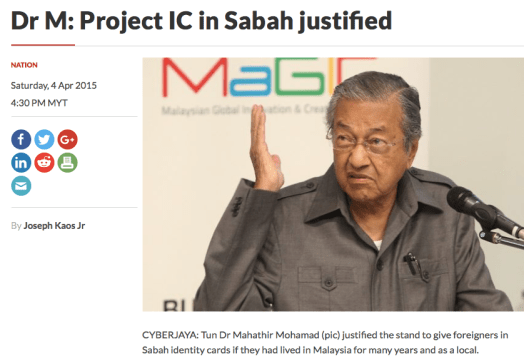
Unlike you, the Foreign Minister is a man who is not just a politician, but more so that he is a very well respected diplomat. He is well respected around the world, and in the US is well received by both the Democrats and Republican Senate reprentatives. Therefore, it should not come as a surprise to you that he also holds several important international portfolios and, unlike your master who gave Malaysian identity cards to foreigners in Sabah, has the undeniable loyalty and affection of the majority of Sabahans.

Stop behaving as if you are intelligent. Allah Knows. Ada faham, Rais?

Screen Shot 2018-02-02 at 01.41.15
Mamak penjual kerakyatan Malaysia

The China Mahathir So Loved

stock-photo-lawatan-rasmi-perdana-menteri-datuk-seri-mahathir-mohamad-ke-china-158640
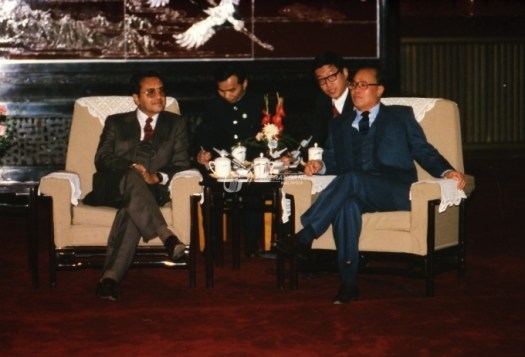
Mahathir visiting China in 1985 (courtesy of Penerangan Malaysia)

The ‘Ping Pong Diplomacy’ between Malaysia and China that happened in 1971 was a marked departure from the policy on China set by Tunku Abdul Rahman.  While Tunku blamed China for its support for the Communist Party of Malaya (CPM), Tun Abdul Razak saw it necessary to engage China to end its support for the CPM.

When Mahathir took over the premiership in 1981, he placed importance on economic development and not so much foreign policy.  Three years earlier, Deng Xiao Ping had also placed China under a process of economic modernisation.  However, although there was an increase in bilateral economic and trade exchanges with China, the percentage of that compared to the overall trade declined.  In the 10 years since the beginning of formal diplomatic relations, economic and trade exchanges between the two countries was at 3.5 percent of Malaysia’s total trade.  This number fell to just 1.5 percent in 1984 (Stephen Leong, “Malaysia and the People’s Republic of China in the 1980s: Political Vigilance and Economic Pragmatism”, Asian Survey, Vol. 27, No. 10, October 1987, p.1114).

In a speech at Qing Hua University, Beijing in November 1985, an alarmed Mahathir said: “My own country`s bilateral trade with China has in fact declined since 1980 and this is despite the widely held view that China`s modernisation would increase the opportunities for trade and economic links.”

Mahathir saw China as a very important partner that could help the modernisation of Malaysia’s economy so much so that the delegation that he brought with him on that first visit in 1985 was huge. In a speech given during that visit he said:

I have brought with me a large delegation of leading Malaysian entrepreneurs and businessmen. It is my hope that with your cooperation they would be able to fully explore further opportunities for trade and economic cooperation.

Mahathir made six other visits to China between 1993 and 2001, a display of the importance of China in his economic policies.  A year after he began his administration, trade with China stood at USD307 million.  This jumped to USD1.4 billion ten years later.  A year before he stepped down, it was at USD14 billion.

Mahathir led another large trade delegation to China in 1993 and 1994 with China returning the favour towards the end of 1994.  Of China’s communist ideology, Mahathir in his speech during the 2nd Malaysia-China Forum in Beijing in August 1996 said:

China has come in for special attention. For years it had been condemned for being Communist and isolationist, practising a close centrally planned economy. Now it has opened up and has adopted a version of the universally acclaimed market system. Instead of being welcomed to the fold, it is looked upon with fear and suspicion. The World Bank has sounded the alarm by predicting that China will emerge in the 21st Century as the greatest world economic power. And fear of China has mounted.”

stock-photo-lawatan-rasmi-perdana-menteri-datuk-seri-mahathir-mohamad-ke-china-332796
Mahathir’s visit to China (courtesy of Penerangan Malaysia)

Hence, we can see that it has never bothered Mahathir that China is a communist country, and working with China does not turn a country into a communist one.  China was so important to Mahathir that he wanted to see his proposal for a regional consultative group, namely the East Asia Economic Group (EAEG) take flight with US and US-leaning countries accepting China.  This, however, was not to be.  To his dismay, Japan refused as it was closely linked to the USA which had formed APEC; South Korea refused as the EAEC proposed by Mahathir would have placed Japan at the centre of the organisation.

During the Asian Financial Crisis of 1997-98, the Chinese Government assumed a highly responsible attitude. It provided assistance to all the affected countries including Malaysia within the framework of the IMF arrangements and through bilateral channels.  The decision of not devaluating the Renminbi, for which China paid a high price, assisted ASEAN countries affected by the crisis to pull through.

During his visit to China in August 1999, Mahathir thanked China in his speech:

China`s concern for the well-being of East Asia in the financial crisis has been most laudable. The regional economies and the global community at large greatly appreciate China`s decision — despite strong pressures — not to devalue the Yuan. Beijing`s cooperation and high sense of responsibility has spared the region of a much worse consequence. Renminbi devaluation would almost certainly result in a new round of currency devaluation by the affected economies.”

The crisis had brought both Malaysia and China closer together, both Mahathir and China promised better cooperation.  In June 1999, Malaysia and China agreed to invest around USD2.5 billion to develop a Trans-Asia Railway from Singapore to Kunming passing, without doubt, through Malaysia.  Mahathir welcomed China to play an active role in the railroad construction.

When Premier Zhu Rongji visited Malaysia in November 1999, an overwhelmed Mahathir said in his speech:

We appreciate the decision of the PRC to participate in the pulp and paper projects in Sabah. I understand that this project is valued at RM4.3 billion is the PRC’s largest investment in the region. We hope as many PRC companies will try to explore the investment opportunities available in Malaysia.”

However, it is so wrong now for China to help Malaysia build the East Coast Rail Link (ECRL).  Every single investment by China in Malaysia is seen as ‘selling away our rights and sovereignty’ but it was not the case back then.

I often wonder if Mahathir is jealous that Najib Razak is doing better, or if he (or his agents) is not getting a slice of the cake?  He seems to be the only one making noise about China’s investments in Malaysia although, at less than three percent of the total FDI, is at the 10th place of the largest Foreign Direct Investments in Malaysia – the largest being Singapore.  Why is China being made the scapegoat?

stock-photo-lawatan-rasmi-perdana-menteri-datuk-seri-mahathir-mohamad-ke-china-336069
Mahathir, Siti Hasmah, and a very young Marina visit the Great Wall of China. We wonder what post Marina held that she tagged along on an official trip and if she had travelled by normal flights herself as Najib’s family did. If not, who foot her bill for her? (courtesy of Penerangan Malaysia)

Which is why DAP supremo Lim Kit Siang has been silent on the issue of Forest City for the longest time – as he can see how it benefits his parliamentary constituency, very much unlike Mahathir whose hatred for Najib surpasses the needs of his political partners and voters.

During a conference on Assessing ASEAN’s Readiness by Country at the Napalai Ballroom, Dusit Thani hotel in Bangkok on 17 September 2013, the nonagenarian said:

We have been trading with China for almost 2,000 years. China was very big, most developed nation in the past, they could have conquered us but they didn’t. They came and lived in Malaysia but they didn’t conquer us. And I don’t want to be in any confrontation with China. China is a good trading nation with 1.4 billion people.

And suddenly after 2,000 years of peaceful co-existence, just because Najib Razak is now the Prime Minister of Malaysia, the China that Mahathir so loved wants to invade us?

That, to me, sounds blatant hypocrisy.

(This posting was first published by The Mole)

Pakatan Hampas

Kerajaan Persekutuan berhasrat untuk membina sejuta rumah mampu milik di semua negeri di Malaysia, termasuk di negeri-negeri yang ditadbir oleh Pakatan Harapan.  Namun, nilai hartanah yang tinggi, terutamanya di negeri-negeri di bawah pentadbiran Pakatan Harapan, menjadi batu penghalang hasrat tersebut.

Masalah Di Selangor

Semasa di bawah pentadbiran Barisan Nasional, rumah mampu milik merupakan tanggungjawab badan-badan kerajaan negeri seperti Perbadanan Kemajuan Negeri Selangor (PKNS).  Namun, sejak pentadbiran diambil alih oleh Pakatan Rakyat pada tahun 2008, PKNS bertukar menjadi sebuah agensi yang mengejar keuntungan.

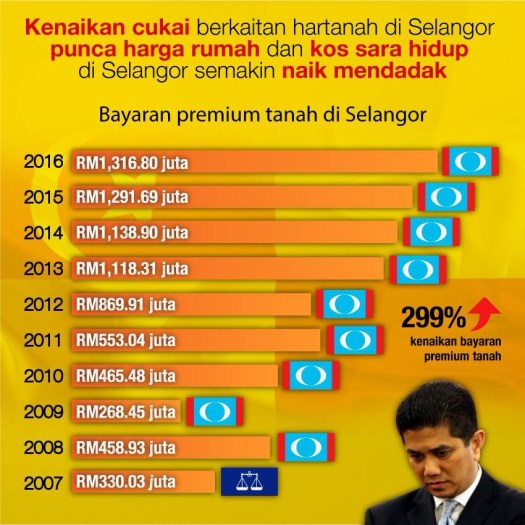
Pebangunan hartanah merupakan sumber hasil bagi kerajaan negeri dan pihak berkuasa tempatan melalui yuran tukar penggunaan tanah, pembahagian-pembahagian kecil dan lain-lain hal berkenaan dengan tanah.  Kesemua kos-kos ini telah meningkat sejak pengambil alihan pentadbiran oleh Pakatan.

2d7f4cc5-07fa-4819-9022-91f68461288b
Kenaikan bayaran premium tanah di Selangor sahaja adalah sebanyak 299 peratus sejak 2008

Penjualan tanah di bawah harga pasaran adalah salah satu cara untuk mengadakan rumah kos murah.  Namun, kebiasaan tersebut telah dihapuskan.  Malah, PKNS sendiri kini terpaksa membida untuk tanah pada harga pasaran?

Kita perlu meneliti prosedur-prosedur yang dikenakan terhadap para pemaju oleh pelbagai jabatan kerajaan negeri dan pihak-pihak berkuasa tempatan.

Birokrasi dan sikap berdolak-dalik merupakan sebab-sebab lazim yang melambatkan proses dan ini menambahkan lagi kos.  Perbelanjaan dan faedah pinjaman bank perlu dibayar walaupun projek belum dapat dimulakan.  Kita belum lagi berbincang mengenai  rasuah dan ini boleh memberi kesan besar terhadap kos kerana kadar yang diminta oleh ‘orang-orang tengah’ untuk ‘melicinkan proses’ boleh menjadi besar dan untuk setiap tandatangan yang diperlukan.

Tidak meghairankanlah jika sebahagian besar pemaju berpendapat bahawa pihak kerajaan negeri dan pihak berkuasa tempatan merupakan batu halangan terhadap rumah mampu milik kerana tanah merupakan hak dan kuasa kerajaan negeri dan bukan kerajaan persekutuan.  Maka, kerajaan persekutuan tiada hak untuk memperbetulkan keadaan ini.

Masalah di Pulau Pinang

Kalau gambarajah di atas menunjukkan bayaran premium tanah yang meningkat di Selangor, kita lihat gambarajah seterusnya yang menunjukkan lonjakan caj cukai hartanah di Selangor dan Pulau Pinang sejak 2008:

03a7f838-0a50-4723-8078-47328d86f2c2
Lonjakan caj cukai hartanah kepada penduduk tempatan sejak Pakatan mentadbir Selangor dan Pulau Pinang

Kerajaan negeri dan pihak berkuasa tempatan perlu serius dalam mengotakan janji mereka untuk mengadakan rumah-rumah kos rendah dan rumah mampu milik.  Di penghujung penggal kedua berkuasa di Pulau Pinang, DAP masih belum menyerahkan rumah mampu miliknya yang pertama, malah menyalahkan kerajaan persekutuan di atas kegagalannya sendiri.

Kampung-kampung tradisi, terutamanya penempatan tradisi orang-orang Melayu, dirobohkan untuk memberi laluan kepada para pemaju membangunkan kondominium mampu tengok dan lain-lain pembangunan komersil.  Kerajaan negeri Pulau Pinang juga bersikap tidak bertanggung jawab menjual tanah-tanah milik kerajaan negeri kepada para pemaju hinggakan hanya tinggal baki tujuh peratus sahaja tanah kerajaan negeri di Pulau Pinang.  Ini bermakna peuang untuk mendirikan rumah-rumah mampu milik di Pulau Pinang semakin halus.

Para pemaju kecil juga tidak berpeluang untuk mengambil bahagian dalam pembangunan di Pulau Pinang akibat caj-caj yang dikenakan terhadap para pemaju begitu tinggi.  Kita lihat gambarajah seterusnya:

69d859e3-71eb-4371-8052-c3049c2fc1cb
Kenapa kerajaan negeri Pulau Pinang begitu galak menaikkan kadar caj-caj? Siapa yang membuat untung sedangkan rakyat tidak lagi mampu memiliki sebarang hartanah di dalam negeri tersebut?

Dari gambarajah di atas kita dapat lihat kerakusan kerajaan negeri Pulau Pinang di bawah pentadbiran DAP hanya mementingkan keuntungan dan membelakangkan keperluan rakyat.

Di bawah kerajaan DAP, sumbangan perumahan kos rendah dikenakan sebanyak RM150,000 bagi setiap unit.  Di bawah BN tiada caj dikenakan.  Setiap gerai penjaja dikenakan RM58,000 – kenaikan sebanyak RM55,000 berbanding dengan semasa di bawah pentadbiran BN.  Untuk penyediaan kemudahan komuniti seperti padang, dewan serbaguna, masjid dan surau dan sebagainya, kerajaan DAP mengenakan caj sebanyak RM500 sekaki persegi berbanding RM25 sekaki persegi di bawah BN.  Untuk infrastruktur seperti jalan dan saliran, kerajaan DAP mengenakan RM15 sekaki persegi berbanding tiada caj di bawah BN untuk jalan, dan RM50,000 seekar untuk saliran berbanding RM10,000 di bawah BN.

Satu lagi bukti kerajaan DAP tidak menghiraukan keperluan rakyat ialah mengenakan caj sebanyak RM500 sekaki persegi untuk setiap tadika yang disediakan.  Tiada caj dikenakan oleh pentadbiran BN Pulau Pinang sebelum ini.

Berapa pula premium tanah yang dikenakan oleh kerajaan DAP Pulau Pinang?  Kita telah melihat lonjakan dahsyat di negeri Selangor sejak 2008, kita lihat pula keadaannya di Pulau Pinang:

b391f7f7-5a7d-470a-b9d1-ec8da7aa38aa
1,671 peratus kenaikan sejak 2008. Beginilah rakusnya DAP apabila berkuasa

Nampak gayanya premium tanah yang dikenakan oleh kerajaan DAP Pulau Pinang melonjak dengan begitu banyak sekali berbanding semasa di bawah pentadbiran BN pada tahun 2007.  Pengurangan hanya berlaku dua kali iaitu pada tahun 2008 semasa mula-mula memegang pentadbiran negeri.  Mungkin ketika ini mereka hendakkan maklumbalas positif mengenai cara DAP mentadbir negeri.  Kemudian kenaikan dikenakan sedikit demi sedikit dan melonjak besar selepas memegang tampuk pentadbiran kerajaan negeri selepas 2013, kemudian turun sedikit pada tahun 2016 selepas Lim Guan Eng dihadapkan ke mahkamah di atas satu perbuatan rasuah – salahguna kuasa dan jawatan untuk kepentingan dirinya.

Ringkasannya

Caj-caj dan bayaran premium yang dikenakan terhadap para pemaju di Pulau Pinang menyebabkan rumah mampu milik di Pulau Pinang yang berkeluasan 1,000 kaki persegi menjadi RM120,000 seunit berbanding RM42,000 seunit semasa di bawah pentadbiran BN.  Apabila dikenakan kadar faedah sebanyak 5 peratus setahun untuk tempoh pinjaman 30 tahun, bayaran faedah akan menjadi RM116,569.73 atau RM671.03 setiap bulan.  Kos keseluruhan akan menjadi RM236,569.73 setiap unit.  Adakah kadar bulanan ini mampu dibayar oleh mereka yang dari golongan berpendapatan rendah?

Keengganan kerajaan negeri Selangor di bawah PKR memberi kerjasama dengan agensi perumahan kerajaan pusat seperti PR1MA dan PPR mendatangkan masalah untuk kerajaan pusat membantu kerajaan negeri membina rumah-rumah kos rendah dan mampu milik.  Setakat ini hanya 11,000 unit rumah sahaja yang daat didirikan berbanding sasaran 70,000.

Ini berbeza sekali dengan kerajaan negeri Kelantan di bawah PAS yang menerima bantuan kerajaan pusat dengan tangan terbuka.  Setakat Ogos 2017, 418 unit PPR telah dibina di Machang manakala 1,000 unit telah dibina di Kota Bharu.  Ini menunjukkan walaupun berlainan fahaman politik, kerajaan PAS sanggup mengenepikan perjuangan demi kesejahteraan rakyat, tidak seperti Pakatan Harapan yang tidak langsung memberi harapan kepada para pengundi.

Pandai-pandailah anda menilaikan sendiri siapa yang mendahulukan kepentingan rakyat dan siapa yang mendahulukan kepentingan keuntungan.

Reformasi Untuk Mahathir

Mahathir’s return to politics in 1973 was watched closely by other races, in particular the Chinese and Indians.  His meteoric rise to the Deputy Prime Minister’s post in 1976 was of grave concern by many.  His imminent Premiership caused a large number of migration by Malaysian Chinese.  Despite the economic growth in the late 1980s through 1997, some 42,000 Malaysian Chinese opted to work elsewhere.  This number includes some 14,000 Malaysian Chinese who were working illegally in Japan in 1993 (Shimada, 1994).

If citizenship is conferred on races other than the Malays, it is because the Malays consent to this,” wrote Mahathir in his book ‘The Malay Dilemma‘.

“The Chinese and Indians coming from countries with vast populations are less concerned about good behavior and manners. In their lives, nobility, which is always associated with breeding, was totally absent. Age and riches are the only things they defer to,” he added.

Calling for reforms such as the mandatory use of tamper-proof scales, Mahathir wrote of scales that can be used to shortchange customers and said, ”The small-time Chinese retailer is adept at this practice and unscrupulous enough to use it as a weapon in competition.”

Mahathir was the ultra-Malay to many including the Malays themselves.  Fears of race clashes haunted the voters during the run-up to the 1982 General Elections.  I remember being sent to Mimaland in Gombak with Datuk Latt Shariman (President, E-Sports Malaysia) on polling day in case something bad happens.  It was the first General Elections under Mahathir and it was called more than a year before the then-mandate ended.  Public rallies were banned citing ‘security’ reasons and only indoor gatherings and house-to-house canvassing were allowed (Lim Kit Siang, 22 March 1982).

Even though Malaysia’s economic growth peaked at 8 percent in the mid 1990s, it was mired in scandals involving the practice of cronyism and nepotism.  Lim Kit Siang wrote that Mirzan, Mokhzani and Mukhriz Mahathir – acted as companies’ directors, and that according to searches the DAP had made at the Registry of Companies at the end of 1994, Mirzan had interests in 98 companies, Mokhzani in 48 companies and Mukhriz in 67 companies (Lim Kit Siang, 16 June 1998).  Compared to the 213 companies his sons were directors in back in 1994, 488 is the number of companies Mahathir, daughter and sons are directors in as at end of 2016 (Wakeup Malaya, 6 January 2017).

The calls for Mahathir to resign in 1998 for practising nepotism and cronyism culminated in the sacking of Anwar Ibrahim as his deputy in September of the same year, accusing the latter not only of being a tool for George Soros’s attacks on the country’s financial system but also for leading a morally-corrupted life.  Lim Kit Siang and other Opposition leaders were quick to embrace Anwar, acccepting him into their fold when it was just a year earlier that the late Karpal Singh had made mention of allegations of sexual misconducts against Anwar in a Parliamentary sitting – a scene not much different to Lim Kit Siang’s immediate acceptance of Mahathir after decades of mudslinging the latter.

20161218-reformasi-1998-undur-mahathir

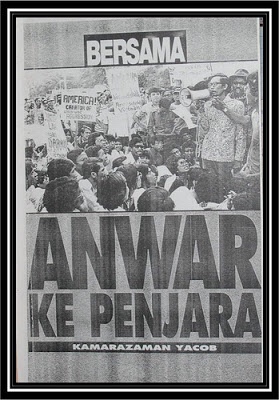
Anti-Mahathir demonstrations were held almost daily and then held every Friday afternoon at the National Mosque.  These demonstrations were quelled using brute force.  The ‘Reformasi’ movement was born, and the likes of theatre-practitioners such as Jo Kukathas were seen on the streets and interviewed by Maria Ressa saying “Enough is Enough” to Mahathir.  Anwar and several other pro-Reformasi and UMNO leaders critical of Mahathir were arrested without trial under the ISA including current DPM Ahmad Zahid Hamidi.

Parti Keadilan Rakyat, then known by its acronym ADIL, was born out of hatred towards Mahathir, with the aim of toppling him and installing Anwar Ibrahim.  The 1999 General Elections saw how Mahathir suffered a pyrrhic victory, losing grounds in Kelantan and his homestate of Kedah, while losing Terengganu to PAS.  Mahathir-loyalists such as Ramli Ngah Talib, Megat Junid Megat Ayub and Sanusi Junid lost their seats.  That was the beginning of the sounding of the death knell for Mahathir’s virtually unchallenged reign.  During the UMNO General Assembly of 2002, he announced his resignation from party posts as well as Malaysia’s Prime Minister.

Ever since then, with the more open administrations of Pak Lah and Najib Razak, Mahathir became one of the targets of the Opposition in their blog posts, press statements as well as ceramahs.

In June 2012, Mahathir’s newly-made best friend even suggested that Mahathir is tried for his part in the BNM Forex scandal, hinting Egyptian Hosni Mubarak’s imprisonment as a comparison (Lim Kit Siang, 3 June 2012).

Screen Shot 2018-01-09 at 14.13.11

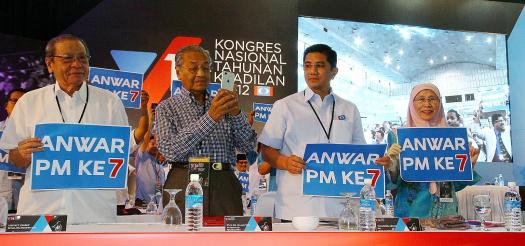
But all is forgotten and forgiven now, even when Mahathir admitted that his apology was only customary and not sincere.  Despite veiled objections from Anwar and Azmin Ali’s camp, Mahathir was named at a Pakatan convention as their Prime Minister of choice albeit interim.   This underscores the fact that the leadership of Pakatans parties do not trust the younger generation to lead the coalition as the position of the elders and powers that come with the position, may be undermined by the younger ones.

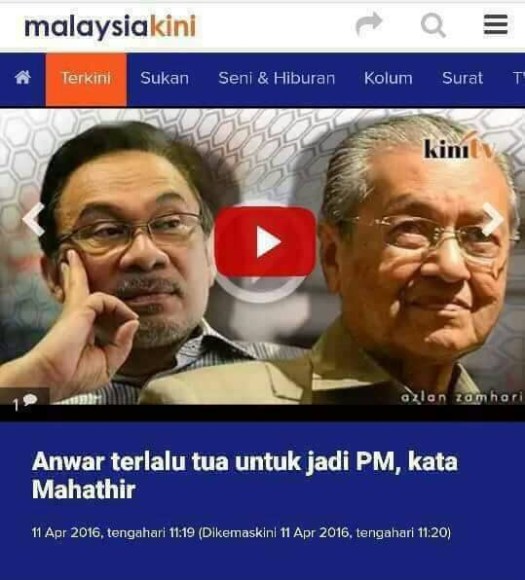
The signal of dissent is clear.  Azmin only attended the convention for a while, not waiting for the announcement to be made while Karpal Singh’s daughter, Sangeet Kaur Deo,  has hit out at Pakatan which probably is suffering from a dearth of capable young leaders.  Even Mahathir once quipped that Anwar, who is 22 years his junior, may be too old to become a Prime Minister.

img_5213

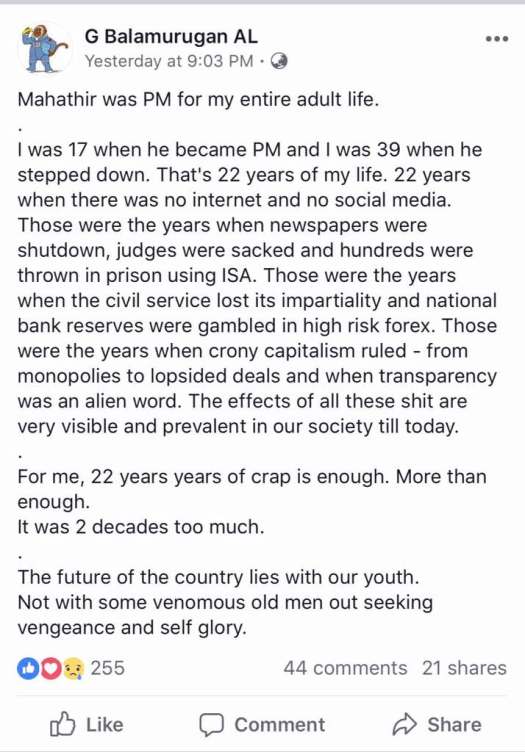
On Facebook, we are seeing people in their 40s and 50s voicing out their concern over Pakatan’s choice of Prime Minister, alarmed that the monster they have put behind them, could very well jump out from underneath the bed and into their lives again.

WhatsApp Image 2018-01-09 at 11.38.33

But it does not stop Mahathir from wanting to become the Prime Minister.  He once hinted that he may have to consider becoming the PM again, underscoring the fact that he does not trust anyone else.

img_6975
“I may be 93 but at 71 Anwar is much older!”

Wan Azizah may be blind to the fact that Mahathir had once denied the Premiership to her husband and went as far as making sure Anwar went to jail to keep him out of the way, while Lim Kit Siang is only friends with Mahathir because he needs the Malay votes to ensure Pakatan’s seats are sustained after the departure of PAS from the now-defunct Pakatan Rakyat.

Will Mahathir be willing to step aside for Anwar Ibrahim or whoever else younger who would be more acceptable to the younger and middle-aged generation aware of his antics?  I doubt.  But as Sangeet mentioned above, it will be a return to Mahathirism, an era of abuse of power, cronyism and nepotism that the Reformasi movement was totally against.

Somehow, it seems that the Reformasi movement has become a tool for what it was totally against – ushering Mahathir into the premiership and welcoming again abuse of pwer, nepotism and cronyism.

ST_20170522_NRPKR22_3156926
Anwar is NOT going to be MY PM


A Lesson On Fake News In Malaysia

STUDENT activism in Malaysia peaked in December 1974, having started in September of the same year in Tasek Utara, Johor Bahru, when some 5,000 students demonstrated at the Selangor Club Padang (now Dataran Merdeka) and as expected, clashed with the Federal Reserve Unit (FRU).

As a result, the students retreated to Masjid Negara with the FRU hot on their heels.  The demonstration was culled and 1,128 students arrested. The student leaders who were holed up on the University of Malaya campus were soon arrested and so were those who hid inside their rented rooms in nearby Kampung Kerinchi.

Three representatives of Kampung Kerinchi complained that the FRU had taken harsh measures to apprehend the students by firing tear gas and that had resulted in the death of a baby.

My father immediately summoned his then deputy, the late Tan Sri Mahmood Yunus, and then Director of Special Branch, the late (Tan Sri) Mohamed Amin Osman, and asked them if the FRU had indeed fired tear gas into Kampung Kerinchi. Amin was adamant the FRU did nothing as such.

When asked if he (Amin) had checked the allegations himself and also the report received from the FRU troop leader, Amin said no.  So my father instructed Amin to go to Kampung Kerinchi to check himself.

Celaka! Depa tipu saya!” (“Hell! They lied to me!”) exclaimed Amin when he saw the empty tear gas canisters that littered the lanes of Kampung Kerinchi, to which my father replied, “You fell for it because you did not check the information yourself!

Fake news is a neologism that has entered the lexicon, used to collectively describe rumours, hoaxes, misinformation, propaganda and recycling of old rumours that had been debunked, that mislead people into believing that they are current and true.

Fake news caused the Barisan Nasional to lose its long-held two-thirds majority in 2008 because it was complacent and not quick enough to react and dispel these rumours.  Back then, political discussions and dissemination of fake news or propaganda occurred in chat rooms, in SMS, and blogs which were only a handful then.  Now there is Facebook, Twitter, Line, Telegram, WhatsApp, YouTube over and above the media available almost ten years ago.

Claire Wardle, Executive Director of First Draft a non-profit organisation dedicated to finding solutions to the challenges associated with trust and truth in the digital age housed at the Shorenstein Centre on Media, Politics and Public Policy at the Harvard Kennedy School, categorised mis and disinformation into seven types:

Satire or parody – this type of misinformation has no intention to cause harm but has potential to fool. A good example of this is of a message purportedly sent by a passenger of the MH370 who said he managed to hide his iPhone5 up his anus!  This had been debunked as a prank, but there are those who still believe that the person did manage to shove a five-inch by two-inch phone up his anus without any problem on the island of Diego Garcia.

Misleading content – most recent would be issues tweeted by two artistes that evolve around the rising cost of living, the weakening ringgit, a shambolic economy, designed to rile up anger in their followers. The tweets, not backed by published facts and figures, would do damage to those who have no inclination to check for the truth and to retweet or forward to others.

Imposter content – these are usually propaganda designed to use genuine sources but impersonated as theirs. A simple example would be of Selangor Mentri Besar Datuk Seri Azmin Ali’s recent event officiating the opening of the Rawang-Serendah Bypass, eight days after the bypass was opened by a minister.

Fabricated content – this type of content is 100 per cent false and is designed to deceive and cause harm. If you remember in July 2007, PKR’s Tian Chua admitted that he had fabricated a photo to show that Prime Minister Datuk Seri Najib Razak was together with Abdul Razak Baginda and now dead Mongolian-model Altantuya Shaaribu in Paris.

False connection – this is when headlines, visuals and captions do not support the content. The most famous example from recent times was of The Star’s headline that said “Malaysian Terrorist Leader” while having a huge photo of Muslims praying during the first night of Ramadan. Although The Star apologised for the error, it was not the first time it had made a similar mistake.

False context – this is when genuine content is shared with false contextual information. Artiste Fathia Latiff put up a screen capture of the price of fuel in various OPEC countries on Twitter, asking why Malaysia, as an oil producing country, charges very high for petrol?  The screen capture is of oil prices back in 2014. The average value of fuel prices for Malaysia between September 4, 2017 and December 11, 2017, was RM2.23. For comparison, the average price of petrol in the world for this period was RM5.82!

Manipulated content – this is when genuine information or image is manipulated to deceive. Recently, there was a video of a skinny polar bear with muscle atrophy struggling to find food in a snowless land that was made viral. This was attributed to global warming. However, the video was filmed in August when the tundra was snowless. It was only published in December.  Even the indigenous community living in the area thought it was a stunt to raise more funds and was doing a disservice to the war against climate change.

I don’t know why Malaysians are so gullible and eager to share fake news.

In WhatsApp groups, you can see how some people could post about something religious and then help spread fake news – something totally against religions. Nowadays, this fake news comes with a disclaimer – “Dari group sebelah”.

Every time we forward or share a post without double-checking or verifying, we add to the noise and confusion.  We never consider the source, we never consider the supporting sources and worst of all, we never check our biases.

The late Tan Sri Amin learnt this the hard way.

Having seen that he was misled about the FRU not firing tear gas into Kampung Kerinchi, he went on to check about the claims of a baby that had died as a result of the tear gas.  None of the three village representatives had themselves seen the dead baby and no one had actually reported to them of the death.

When asked where the information had come from, they replied, “From Anwar Ibrahim and the other student leaders!”

It seems that nothing has changed since 1974.

(This article was first published on The Mole)