1MDB, IPP et al

I find this a must-share:

Eol Zari
1MDB : A PERSONAL VIEW

E. Zari 18 May 2015.

In the past, I have not said much about the controversial issue surrounding 1MDB. Why 1MDB? What are the roles of 1MDB and its contributions to our national economy? I have been keeping this information to myself for sometimes as I feel it may not be the right time to share with my esteemed readers. However, today I was taken by the information transmitted to me by my close friend. This piece of information is similar to the one which I have been keeping all this while.

I am convinced that this is a non-biased piece of information. Being a LNG Consultant and in the course of my works, I have the opportunity to interact with PETRONAS, TNB, TNB Fuel, PEMANDU, Energy Commission and other known organizations for nearly 3 years from 2011. I help to educate the personnel from PEMANDU, TNB, Energy Commission on the new source of energy – Liquefied Natural Gas as a feed for the power plants and city gas.

My area of specialization is energy. I was once a principal specialist in LNG shipping operations in PETRONAS. I have spent 35 years of my career in this field. Energy is the life blood for infrastructures development and this is a major ingredient for our country in achieving economic progress to become a developed nation.

I leave it to my esteemed readers to interpret on what I have outlined. After all we are human and I expect each and every one of us to have their own views.

Back in 1990s, Malaysia introduced the concept of Independent Power Plant (IPP) for electricity generation. This initiative was under our former Prime Minister, Tun Mahathir. The main players who owned the IPPs were Tan Sri Syed Mokhtar, YTL group, Genting and Anand Krishnan. Sime Darby was also one of them but being a Government linked company not much attention was given. These players got the most attractive deal and it was a one sided. The former chairman of TNB, the late Tan Sri Ani Arope, a man of integrity refused to sign the agreements and he voluntarily resigned in protest.

The opposition parties took the Government to task for granting a one sided deal. They argued that it was a “crony’s agreement” and questioned the needs for the Government to grant substantial subsidy to the IPPs. Even in May 2011, one of the opposition members regarded these IPPs as “a major drug factory” that required substantial subsidy from the Government of estimated RM19 billion a year.

In the mid-2011, I was taken as a LNG Consultant to look into the possibility of importing LNG through the Malacca Regas Terminal at Sungei Udang. This terminal is an open gate similar to the one I used to do in United Kingdom – the Dragon LNG Regas Terminal located at Milford Haven in Wales. The Sungei Udang’s LNG Regas Terminal is owned by PETRONAS and the imported LNG is vaporized as gas to flow into the PGU pipelines. This is in view of the insufficient domestic gas from the East Coast of about 950 mmscfd. TNB requires about 1350 mmscfd. The capacity of Sungei Udang is about 500mmscfd or equivalent to about 40 cargoes of imported LNG via the Q Flex LNG ship of capacity 210,000 m3 each.

Actually, I am humble to note that the concept of the floating LNG storage using two of our old LNG ships with an island jetty, the first in the world was mooted by me to the CEO of PETRONAS Gas the ownership of this project. This idea came by while discussing with him in the car on the way to Narita Airport from Tokyo. With this idea, PETRONAS saved for not doing the dredging and a greenfield shore LNG storage which costs would be very substantial.

As a result of the marked disparity between imported LNG and domestic gas price, TNB who earned a thin margin from the IPPs was not able to absorb this disparity in prices and therefore was not able to buy the gas from the imported LNG directly. Ultimately, PETRONAS has to be the importer and therefore a subsidizer.

Under PM Najib, a company, My Power was formed by the Government to initiate renegotiation with the IPPs for a balanced deal. Thereafter, 1MDB purchased the IPP from Ananda in March 2012 and followed by the purchase of Genting in August 2012. Subsequently, in October 2012, Energy Commission announced the decision on the concessionaries agreement with the IPPs. As outlined in this agreement, there is no further extension of concession for the IPP owned by Ananda and also new concessions for the other three IPPs. Only new concessions are to be given to 1MDB and TNB. This new arrangement will ensure that private companies will not earn excessively at the expense of Government’s subsidy.

As a result of the mistake done since 1990s, for the past 20 years an approximate of about RM100 billion was lost by PETRONAS and TNB because of this inferior deal. Actually, credit should be given to PM Najib, Energy Commission and 1MDB for saving our country from this excessive subsidy granted to these favored companies from the earlier regime. To me credit should be given to whom it is due.

Actually, the rates of tariff for consumers for Peninsular Malaysia should be increased by July 2014 and January 2015 under the Fuel Cost Pass Through (FCPT). But it was never increase because the new revised agreement was improved and was more attractive and balanced to TNB, the final purchaser. Instead, the electricity tariff was reduced from March 2015 due to the reduction of coal prices and the reduction of tariff of these IPPs.

Under this new arrangement, TNB started to register substantial profit from 2013, 2014 and the first quarter of 2015. It records a profit of RM2.3 billion in the first 3 months of 2015. Therefore, with this revised arrangement the benefactors are:

1. TNB registers higher profit,

2. The Malaysian consumers benefit from lower tariff partly due to the reduction of oil prices.

3. PETRONAS will not have to incur higher subsidy which in the past benefit only these private companies, and

4. Consumers of electricity are the ultimate winner.

The losers are the original owners of the IPPs. And this may be the reasons why they are not happy with 1MDB and PM Najib even from the senior members of UMNO.

The issue of Tun Razak Exchange (TRX) and the purchase of land by Tabung Haji is insignificant compared with the amount saved by the revision of the agreement initiated by the present Government.

On the other side of the coin, there are allegations by the oppositions for the misused of fund by 1MDB, the role played by Jholow, the disappearance of proceeds from the Petro Saudi investment and latest the controversial sale of a piece of land of about 1.5 acres for RM188 million to Tabung Haji’s subsidiary. These issues started late last year when 1MDB was not able to raise enough fund to pay their loan installment.

The issue is now further twisted and makes it looked as though 1MDB is losing RM44 billion which is not the case. Actually, 1MDB does not lost RM44 billion. What it lost will be the substantial amount of loan repayments which they have to dig from somewhere because of the reversed operating leverage. Temporarily, their current income is not able to cover the loans and other expenses. However, given time they will be able to reverse this situation. Additionally, because of this bad publicity it is feared that Deutsche Bank may request for early settlement as 1MDB is not able to secure additional collateral. We should refrain from speculating further pending the outcome of the Auditor General’s findings which will be available the latest by end June 2015.

Other personalities including the prominent lawyer and former minister, Zaid Ibrahim commented that as the Chairman of 1MDB, Najib should stand up and face this by responding to the allegations. The Chairman of CIMB, who is Najib’s younger brother, during the luncheon meeting also asserted that the Chairman of the Board and its members of 1MDB to do the same.
Continue reading “1MDB, IPP et al”

The Bittersweet Alliance – Part 1

The philosopher Jorge Agustín Nicolás Ruiz de Santayana y Borrás or George Santayana once said that those who do not remember the past are condemned to repeat it.  The recurrence of history is part of life’s cycle, but always in different forms.  Those who do not remember how certain historical lows were handled are bound to make even bigger mistakes.


Recently, there was a furor following the statement made by UMNO’s Ismail Sabri , the Agriculture and Agro-Based Industries Minister, asking consumers to boycott greedy Chinese businesses.  While it is normal to hear the communal-party-disguised-as-a-non-communal-party DAP lashing out at Ismail Sabri, the call by MCA’s Youth Chief, Chong Sin Woon, for the sacking of Ismail Sabri did not go down well with UMNO and 92 Divisions of the latter rallied behind Ismail asking for Sin Woon to be sacked instead.


While I refuse to indulge in a debate over what was said by Ismail Sabri, there is a need for consumers to boycott profiteering businesses who whine about high cost of fuel and pressured the government to allow them to increase the price of their services, but refused to lower prices when the price of fuel has gone down by half.  What I am more interested in is the bittersweet alliance between UMNO and MCA, and how history is repeating itself.


While the movement for the independence of Malaya had started decades before, there was no cohesion between races. In 1946 when the Malayan Union was formed, the republican-in-nature Partai Kebangsaan Melayu Malaya (PKMM) and the non-Malay Malayan Democratic Union (MDU) were quick to support the formation.  The PKMM, a spin-off from the Batavia-leaning KMM of Ibrahim Yaacob, was all for a Malaya not ruled by the Malay Rulers, while the MDU liked the idea of automatic citizenship (read more in Seademon’s The Road To Merdeka: Persekutuan Tanah China ) for the immigrants. On 1st March 1946, more than 40 Malay organisations met up and 41 decided to form the United Malays National Organisation (UMNO) to champion the Malay rights.  The Malays were then a minority in his own land, poor, sidelined from economic development, health care and formal education.  With the help and encouragement of the then-British High Commissioner, Sir Henry Gurney, the Malayan Chinese Association (MCA) was formed on the 27th February, 1949. Gurney aimed at winning the allegiance of the Chinese community away from the Communist Party of Malaya (CPM) (Colonial Office Record 537/773(1) Memorandum by Henry Gurney, 28th January, 1949).


There was apprehension and distrust between the Malays and Chinese.  The alienation of the Malays by Chinese mining tycoons and rubber estate owners, followed by the preference of the Japanese of the Malays over the immigrant Chinese, and this in turn followed by retribution against the Malays by Chinese sympathizers of the CPM after the Japanese surrender have had contributed enormously to this animosity between the two.


It was since 1950 that Henry Gurney had wanted to introduce some form of democracy to Malaya through elections to satisfy the public’s hunger for democracy versus the communist’s way of winning self-government.  Alas, he was only a High Commissioner and still had to go through the true rulers of the Federation of Malaya – The Malay Rulers.  So, during the 10th Malay Rulers Meeting on the 22nd and 23rd February, 1950, Gurney presented his recommendation, only to be met with reluctance of the Malay Rulers.  In the minutes of meeting, the Sultan of Kedah stated his reservation:


The most important prerequisite for democracy is education. Without enlightened public opinion a democratic system of Government will be liable to unsteadiness or even confusion and chaos. One danger is that it may be transformed into a single party government through a few skilled electioneers working among the apathetic population and this will work towards dictatorship.” (Colonial Office Records 537/6025(1))


The Malays, as mentioned above, were left behind educationally and may not know what is best for them.  For the same reason the PKMM and MDU were in full support of the Malayan Union four years prior to this event.  And whatever the outcome, the Malays would have ended up the biggest losers if no one champions their rights. Noted William L Holland in “Nationalism in Malaya” (WL Holland, 1953):


“There was already Malay discontent in the pre-war period over the poor economic position vis-a-vis the Chinese and Indians. Malay peasants and fishermen, noted S.H Silcock and Ungku Aziz, were dependent on Chinese middlemen while Malays worked as messengers in offices where Chinese and Indians were clerks.”


The phrases made bold above by me, still holds true today and became the basis of Ismail Sabri’s main grouse against profiteering businessmen.


Gurney had to bring about some form of democratic self-rule that would benefit all races.  Separately he discussed on numerous occasions with both MCA and Dato’ Onn and impressed upon them that self-rule would only happen if there is a closer relations between the communities (The Making of the Malayan Constitution, Joseph M Fernando, 2002, Page 15).  Gurney was all for the promotion of Sino-Malay talks to tackle long-term problems.  Gurney minuted the following:


“The outstanding issues at that stage were citizenship and the economic backwardness of the Malays.  The Chinese leaders sought a more liberalised citizenship than those contained in the 1948 Federation of Malaya Agreement.  Onn meanwhile , had approached the Colonial Office to secure financial assistance for the Malays.” (Colonial Office Records 537/773(1))


Onn Jaafar, however, was more open towards a better relationship between the Malays and other races if UMNO was to achieve the long-term ambition of self-governing the nation.  In the UMNO annual general meeting in Arau, Perlis, on the 28th May 1949, he said in his speech:


It is absolutely important for the Malays to obtain closer ties with the other people in this country.  It is time for us to take the view wider than the kampung view.  I ask of you, which will you choose, peace or chaos, friendship or enmity?” (Straits Times, 29th May, 1949)


It was at this meeting that UMNO had agreed to accept non-Malays as associate members.  Two years later, in June 1951, Onn went a step further by proposing that UMNO should open its doors to the non-Malays, and that UMNO be renamed the “United Malayan National Organisation.”  While the top echelon of the party was supportive of this idea, the grassroot felt it was too radical.  The bitterness resulting from the years of resentment and occasional interracial violence were too new for them to accept the non-Malays into their political fold.  As a result, Onn left UMNO to form a new party called the Independence of Malaya Party (IMP) despite Gurney’s insistence that the former should remain in UMNO.  Onn gambled that UMNO would fall apart and would rally behind him.  Instead, UMNO rallied behind its new leader, Tunku Abdul Rahman, who sought to retain and strengthen UMNO’s communal organisational structure.  The Tunku also threatened to expel from UMNO any member that joins or had joined the IMP (Straits Times, 18th September, 1951).


The MCA meanwhile remained a loose association of both “neutral” Chinese and the hardcore sympathizers of the CPM.  Gurney had felt that the MCA had not gained much support from the Chinese community and the CPM sympathizers especially to help bring about a speedy end of the First Emergency.  The Perak MCA Chairman, Leong Yew Koh, wrote to Cheng Lock on 1st June, 1950:


“Although the Perak MCA membership is 40,000 strong, the branch is a mere basin of loose sand.” (Tan Cheng Lock Papers, ISEAS Singapore, Folio IX)


Cheng Lock was quick to suggest that the MCA should become more political in order to better represent the Chinese:


“The MCA should not exist only for the limited, though vital, purpose of the meeting the emergency.  It is a living institution which should consolidate itself on a strong and broad democratic foundation, in order that it may be ready to play a part in Malaya of the future as well as the present.” (Colonial Office Records 1022/176)


Thus, the stage is set for two political giants to go against each other for political power, after which we will see whether it was the Tunku or not who played the pivotal role in making the alliance between UMNO and MCA come true.


Stay tuned.

Do You Choose A Person Who Is A Populist, Or One Who Can Actually Work?

It is interesting how time and time again we, our ASEAN neighbours included, vote in or root for people who are popular rather than people who can actually do the job. The Philippines had Cory Aquino, Eric Estrada; Indonesia had Gus Dur (Abdurrahman Wahid). In Malaysia, we have people rooting for Anwar Ibrahim despite the comical and absurd nature of his “struggle” to become a Prime Minister come what may. What is more absurd and even funnier was the populist campaign designed by Najib Razak’s consultants to paint a popular image of the incumbent.

And that failed badly.

So, what do we Malaysian people actually want? Someone who wins on a big popularity ticket, or someone who can actually work, proven to have truly serviced his/her constituency and not just offer lip service?

Indonesia now has Joko Widodo. See one person’s observations of him before and after the elections and see how the same reflects many politicians here in Malaysia.

The Drama King

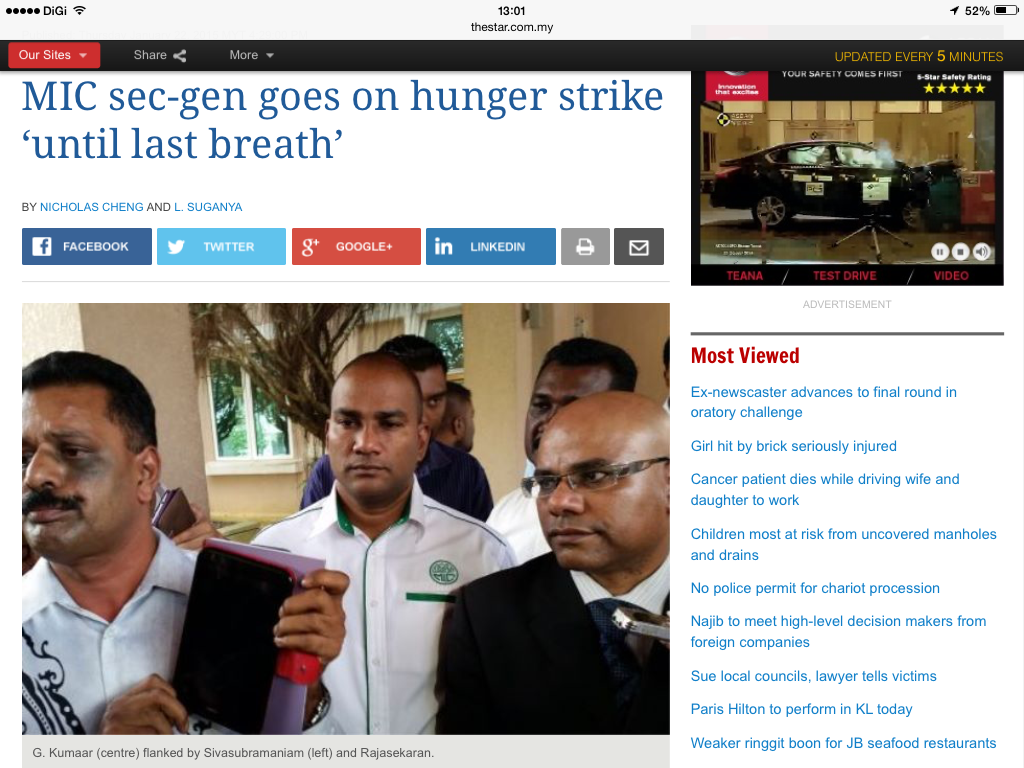
The Malaysian Indian Congress (MIC) which is a component party of the ruling Barisan Nasional is at loggerheads with the Registrar of Societies as the latter had detected irregularities in the MIC party elections. As such, the RoS had instructed the MIC to hold another party elections or something to that effect. The party’s President, G Palanivel has thus far disobeyed the RoS instruction.

Enter the party’s Secretary-General, Kumaar Aamaan, who some say is the illegal Sec-Gen given that the RoS did not recognise the party elections thus rendering all appointees illegal. He went to the RoS office and went on a hunger strike:

2015/01/img_1318.jpg

He also declared that he would fast until his last breath:

2015/01/img_1324.png

Then he said because of his hunger strike, he received a death threat:

2015/01/img_1323.png

Now, why would anyone bent on dying for his cause feel threatened by a death threat? It does sound funny, doesn’t it?

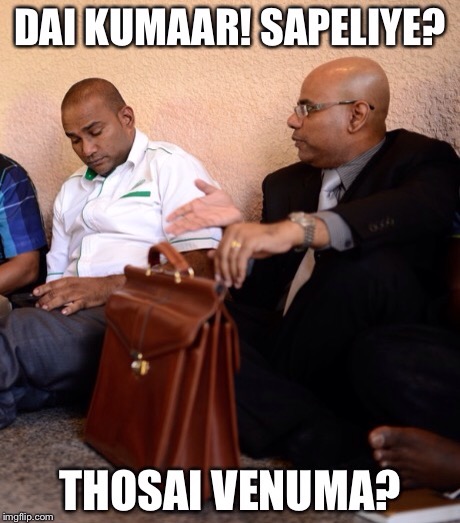
I really think he was feeling very hungry at that point:

2015/01/img_1326.jpg

And just as I thought he would sit there through the weekend in front of the RoS office, all skin and bones, came the shocking news:

2015/01/img_1335.png

SAY WHAT???? You said you were going to fast until your last breath! Are you hungry?

2015/01/img_1334.jpg

That is the Drama King who has turned the much-respected MIC into another lawless DAP. If you think that that’s funny, wait until the next bomb I am about to drop:

WHERE ARE THOSE BN PEOPLE WHO MADE SO MUCH NOISE ABOUT THE DAP DISOBEYING THE INSTRUCTION FROM THE ROS LAST YEAR? WHY HAVE THEY ALL GONE SILENT?

Now you may laugh and wonder.

The Final Curtain?

Another former Minister has spoken out at Najib Razak’s apparent use of Anwar Ibrahim to attack his opponents. Former Minister, Sanusi Junid, has hinted that if Najib does not step down now, UMNO and BN will suffer.

Anwar, who has been in TV3’s bad books, and who also issued a general ban on broadcast journalists from that station to cover any of his or PKR’s events, has been given full attention by the station to lambast Najib’s opponents within UMNO.

Najib, who took over the helm of both UMNO and BN from a weak predecessor, is seen by the public as a weaker Prime Minister. That the BN fared as bad as or worse than GE12 in the last general elections says a lot about his leadership. While he does try to have a hands-on approach on many things which is good, his policies and decisions made seem to lack any prior thoughts, begging the public to ask if it is really Najib’s consultants who do the thinking while Najib just read the scripts and smile or frown as directed.

I, for one, don’t give much thought on the political squabbles. I am more concerned with those who incessantly try to run down the country; but this latest tiff between Najib and his critiques started off with the 1MDB fiasco, and it seems that someone has unearthed the leadership’s Pandora Box.

Who after Najib is none of my concern. Whoever commands majority support of UMNO with the blessing of the component parties in BN should be able to lead. However, the UMNO tradition (budaya) of never to shine before your leader does ought to be done away with. I was told that during the recent floods, although the Deputy Prime Minister was in town while many including the Prime Minister were away shopping or golfing abroad, the former did not act swiftly until instructed to do so. How true this is, I don’t know but if so, it truly is damaging that you cannot decide as a Deputy Prime Minister on behalf of the Prime Minister who was away golfing. “Mana boleh! Ini budaya UMNO!” said the person to my father when asked why did the Deputy Prime Minister not act since the Prime Minister was on holiday abroad.

Najib could easily have called for an impromptu press conference to announce that the DPM was to head the disaster management team while he had to golf with Obama to discuss pressing matters. There was a whole army of foreign press there that he could have used to convey the message to worried Malaysians, but he did not. Was he waiting for his consultants to come up with a script and a set of more acceptable wardrobe?

It was equally bad that (I’m very sure it was his consultants who prepared this line) Najib made only the home and business insurance issue as THE reason for not declaring an emergency in the flood-stricken states. There was a bunch of other stronger reasons that could have been used, but maybe his consultants thought it was best to use the insurance issue as that was more personal for flood victims. Well, it backfired. Miserably! Adding insult to injury, the disaster-relief operation was like a dumbstruck Medusa. Every agency was doing its own thing with no clear command and control until much later. Given that the head of the National Security Council is an administrator rather than a field man, and has had no experience managing disasters, with the Prime Minister being abroad, things did not move as they should have.

Anyway, I have digressed from the issue of Najib’s quarrel with his detractors. But I think Najib’s continuous display of dishing out half-baked policies and display of desperately holding on to the Premiership simply means that he is no Tun Razak, who was brilliant in character and leadership that even political dinosaurs like Lim Kit Siang misses him, and Dyana Samad remembers Tun Razak’s superb leadership although she was still swimming inside her father’s balls when the Tun died.

UMNO needs to evolve and revamp itself in order to stay relevant in the next general elections. But first, it needs a serious change in leadership.

I Don’t Know What To Say

There is this flurry of signals flying around that factions within UMNO that are aligned to Najib Razak are at war with those pro-Dr Mahathir. Some accuse Dr Mahathir of being behind a movement to topple Najib, while the latter is being accused of using Anwar Ibrahim to hit out at Daim Zainuddin, Dr Mahathir’s long-time confidante.

I don’t really care who is fighting whom; I have stated time and time again in this blog that I was and shall remain a soldier and my loyalty is to my King and Country. However, if the allegations about both parties are true, the next general election will become UMNO’s curtain call.

You see the same thing happening in MIC where supporters of the President and Deputy President are at war, and the dormer President, Samy Vellu, has been dragged into the fray.

I don’t know what to say. But this blog posting from former Chief Editor of Utusan Melayu and former Information Minister, Zainuddin Maidin, paints the chaotic picture of the squabble within UMNO itself.

It is in Malay. Malaysians should be able to read and understand the post. Only non-Malaysians would need Google translate for this:

Salam Terakhir Zam Kepada Penulisan Politik

Banjir: Luaskan Minda Sepet Anda

Jikalau kita menyebut kepada orang yang berminda sepet akan dua perkara iaitu, pertama, peperangan di Timur Tengah boleh menyebabkan kenaikan harga minyak secara global; dan kedua, kenaikan harga minyak akan menyebabkan kenaikan harga barangan keperluan, mereka lebih tertumpu kepada perkara kedua dan tidak memperdulikan perkara pertama yang menjadi asas kepada perkara kedua.

Ini adalah kerana minda yang sepet lebih mengutamakan perkara yang lebih mempunyai pengaruh kepada kehidupan seharian mereka.

Maka, berbunyilah suara-suara sumbang apabila saya menulis mengenai Kenapa Tidak Isytihar Darurat Bencana semalam.

Perkara yang mereka nampak hanyalah mengenai urusan tuntutan insuran mungkin terjejas sekiranya Darurat Bencana diisytiharkan. Timbullah bijak pandai berminda sepet yang bertanya pula: “Berapa ramaikah di antara 160,000 mangsa banjir yang telah mengambil insuran untuk melindungi rumah dari bencana alam seperti banjir? Berapa ramaikah orang kampung yang telah mengambil perlindungan insuran untuk bencana banjir untuk pondok buruk mereka?”

Jawapannya ialah tidak ramai. Bahkan, saya mungkin boleh menyokong minda sepet mereka dengan mengatakan tiada langsung pondok buruk yang diinsurankan dengan perlindungan bencana banjir. Tetapi, untuk yang tidak tinggal di pondok buruk yang ada membuat perlindungan dari bencana banjir di dalam insuran am mereka, pengecualian tuntutan boleh dikenakan oleh syarikat-syarikat insuran, dan ini akan merugikan mereka.

Maka, minda yang sepet dengan segera bersuara menyatakan bahawa hanya mereka yang berkemampuan untuk menambahkan sejumlah 0.5% dari kos insuran mereka untuk perlindungan banjir sahaja yang akan menerima manafaat sekiranya Darurat Bencana tidak diisytiharkan. Jawapannya ialah: ITU TIDAK BENAR.

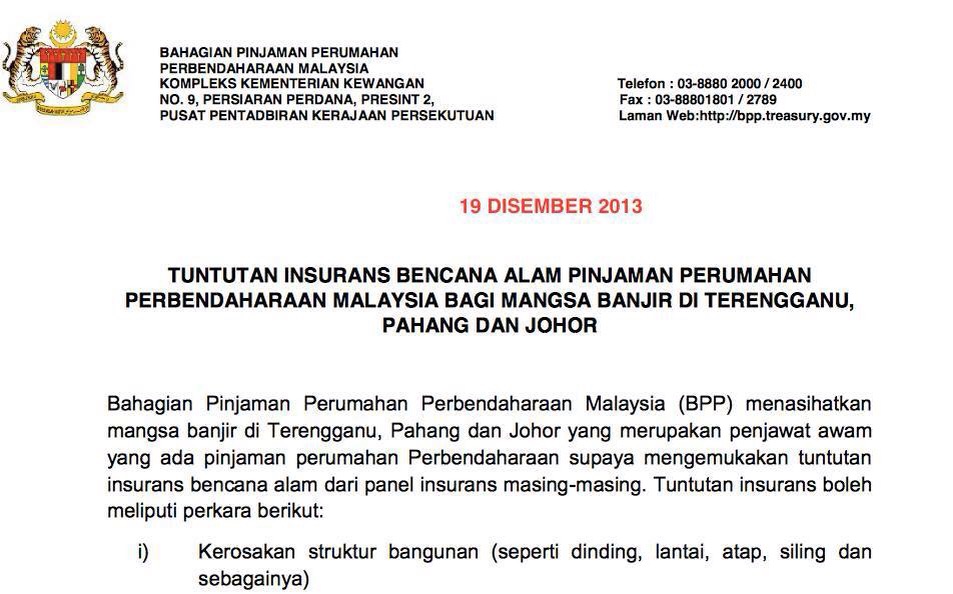
Hampir sepuluh hari yang Pada tahun lepas, satu pekeliling telah dikeluarkan untuk mangsa banjir di kalangan kakitangan kerajaan yang mempunyai pinjaman perumahan untuk membuat tuntutan insuran :

/home/wpcom/public_html/wp-content/blogs.dir/938/4219071/files/2014/12/img_0698.jpg

Bayangkan masalah yang boleh mereka hadapi sekiranya Darurat Bencana diisytiharkan.

Walaupun kuasa untuk mengisytiharkan Darurat Bencana berada di tangan Perdana Menteri atas nasihat Jawatankuasa Pengurusan Bencana Pusat, Perdana Menteri masih perlu berbincang dengan kerajaan di negeri-negeri terjejas untuk pengesahan keadaan darurat kerana kuasa kerajaan negeri-negeri tersebut mengikut undang-undang yang termaktub di bawah Perlembagaan Persekutuan masih wujud. Sekiranya kerajaan di negeri-negeri tersebut tidak merasakan bahawa sesuatu bencana itu sudah diluar kawalan, dan menyebabkan jumlah kemalangan jiwa yang amat besar, boleh menyebabkan keselamatan dan ketenteraman awam di negeri tersebut berada di luar kawalan, dan tidak lagi selamat untuk para pelabur untuk terus beroperasi di situ, maka bolehlah mereka bersetuju untuk mengisytiharkan darurat.

Walau bagaimanapun, tanpa mengisytiharkan Darurat Bencana, Kerajaan Persekutuan telahpun mengerahkan aset-aset di bawah jabatan-jabatan dan kementerian-kementeriannya untuk membantu dalam operasi bantuan bencana banjir bak kata orang kampung, “Beyond the call of duty.” Malah, segala kos operasi bantuan bencana banjir juga ditanggung sepenuhnya oleh Kerajaan Persekutuan, bukan oleh kerajaan di negeri-negeri terbabit.

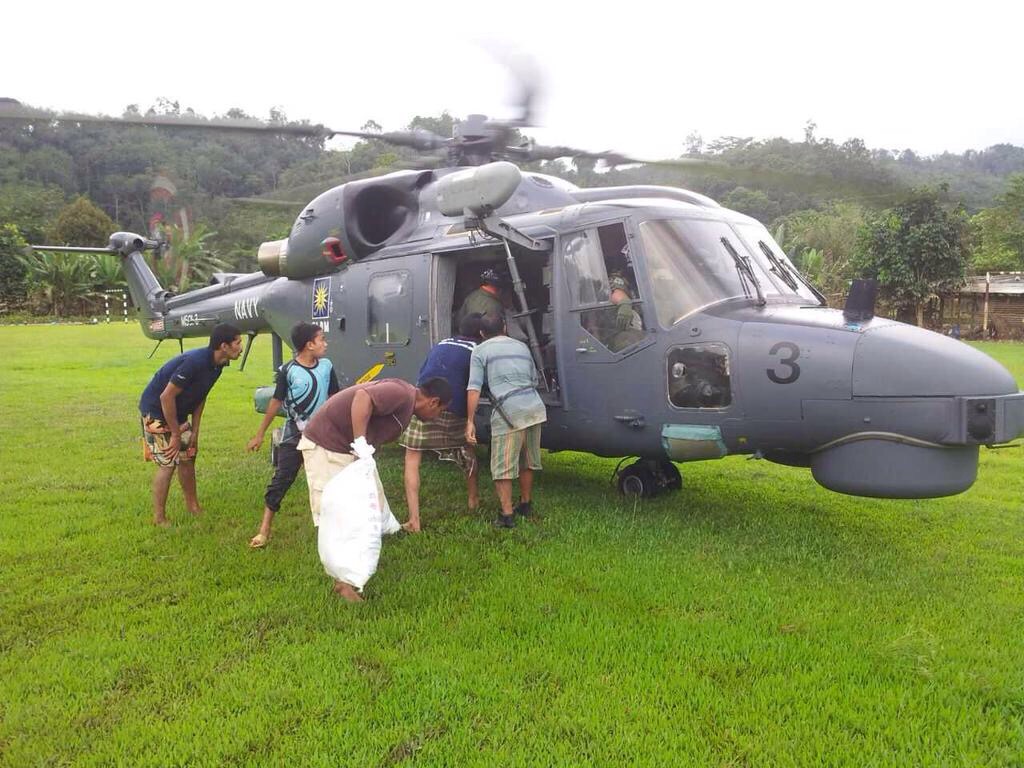
Yang berminda sepet ini juga mahu Darurat Bencana diisytiharkan agar aset-aset Angkatan Tentera Malaysia dapat dikerahkan di negeri-negeri terbabit. Ingin saya bertanya aset apakah yang digunakan di dalam gambar-gambar berikut?

/home/wpcom/public_html/wp-content/blogs.dir/938/4219071/files/2014/12/img_0688.jpg

/home/wpcom/public_html/wp-content/blogs.dir/938/4219071/files/2014/12/img_0671.jpg

/home/wpcom/public_html/wp-content/blogs.dir/938/4219071/files/2014/12/img_0700.jpg

Tidakkah mereka nampak seramai 1,000 orang anggota tentera darat, 50 buah bot telah dikerahkan ke negeri Kelantan sahaja? Ini tidak termasuk aset-aset seperti bot-bot dan pesawat milik Tentera Udara dan Tentera Laut!

Itulah yang tidak ternampak oleh minda-minda sepet. Mereka hanya nampak perkataan insuran yang telah saya tulis, dan Perdana Menteri umumkan semalam.

Perkara kedua yang telah saya tulis dan tidak ternampak juga oleh minda-minda sepet ialah berkenaan para pelabur boleh mengeluarkan pelaburan mereka dari negeri-negeri terbabit sekiranya keadaan Darurat Bencana berlaku tanpa membayar sebarang kos kepada kerajaan negeri-negeri tersebut. Tetapi, seperti yang saya nyatakan di permulaan artikel ini, pelaburan asing tidak memberi kesan secara langsung kepada minda-minda sepet. Perkara seperti itu adalah terlalu rumit bagi mereka dan hanya kerajaan negeri sahaja yang patut memikirkan kesannya. Minda sepet hanya hendak tahu mengenai insuran yang mereka tidak beli, dan harga teh tarik yang mereka gemari sahaja. Sama ada saudara-mara, rakan-taulan mereka akan mempunyai pekerjaan setelah Darurat Bencana diisytiharkan bukan menjadi keutamaan mereka.

Oleh itu, saya amat berharap mereka yang waras dan mempunyai minda yang ufuknya luas, dapat memahami keadaan dan prihatin terhadap bukan sahaja sesuatu keadaan, tetapi juga bagaimana keadaan tersebut boleh memberi kesan langsung kepada orang-orang yang di penghujung ufuk pandangan dan minda mereka.

Itu sahaja harapan saya kerana yang sepet tetap akan mengatakan pandangan yang sepet itulah yang betul.

The Malay Sybarites

This is a bit overdue. With all the “bangang” accusations being thrown to and fro between pro-UMNO bloggers (I was made there are several camps with different paymasters) and the independent pro-BN bloggers, I decided to hold the issue for a while until things have quieten down.  I am not exactly a pro-BN blogger, nor do I have any love for the opposition and their loose coalition, nor that I am a paid blogger as I have never had to use political connections to feed my family in any way whatsoever.  I am the simple nine-to-five, salary-earning employee who watches what goes on around him and voices out once in a while when things are not right.  The “bangangs” then would be those who are chosen by the rakyat to govern on the rakyat’s behalf yet think they can do no wrong and are above criticisms.

The reason for the title above is because people don’t find it bordering on racism if I bash the Malays.  Malay-bashing, in Malaysia, is not racist at all and outsiders (non-Malaysians) are often invited to bash the Malays as well.  Furthermore, being a Malay, it would make me a racist to bash those from my own race.  However, be advised that while what I will write will orbit around the title above, with a broader mental horizon you would be able to see that what follows may also apply to other races.  Of course, to maintain a non-racist post, I shall name my victims collectively as the Malays.

Like it or not, the UMNO of today is a far cry compared to the UMNO people of my age or older were.  I touched on how the late Tun Razak was when it came to shouldering the responsibilities the post of Prime Minister burdened him with.   In my opinion, UMNO was and is still regarded by those who join it as a platform to make money on the pretext of helping the Malays.  Mind you, the same phenomena also exists in other political parties on both sides of the fence.  You would not have seen this in the initial phase of the Barisan Alternatif; you’re seeing this now in the Pakatan-ruled states.  The saying “power corrupts” still holds true.

When one joins UMNO (or any other political party for that matter), it is almost always on the invitation by someone who already is a member.  The new member will first be introduced to the introducer’s circle of “friends” who will have a Padrone, who is either the Branch Head, or the Deputy Branch Head.  Then comes the need to champion whoever the Padrone is in order to put him in place, and make sure the Padrone’s people fill up as many committee posts as possible.  This is then replicated at the Division level.  Getting into the Division’s Padrone’s good books allows one Branch Padrone to solicit small contracts as a Bumiputera Class ‘F’ contractor, which job then gets sub-contracted to (almost always) a non-Bumi contractor.  This simply means that at times, a non-Bumi contractor will become a project-financier, or finance the bid for contracts that are meant for Bumiputera contractors simply because the Malay contractors are a lazy lot and all they want is big bucks for less or no work done.  So, for those who whine about inequality, please bear in mind that the Bumiputeras are only allocated 30 percent while the non-Bumiputeras have 70 percent to grab.  Demographically, 61.4 percent of the population are allocated 30 percent of the opportunities to make wealth while the other 38.6 percent (of which the Chinese make up 24.6 percent) have the 70 percent opportunities to make wealth.

You see the above also happening in the Pakatan-run states albeit with different mechanisms.  Same goal, nevertheless.

Money begets power, and with every party election, more money has to be made in order to retain the power and position to make money – and this is true on both sides of the political fence. Hence, you see absolute nepotism in parties like PKR and DAP, while cronyism remains rife in other political parties.  You have cronies becoming CEOs of important companies; young brats who cannot even make proper presentations.  Then you have the opposition condemning such arrangements as being non-ethical when they themselves do it in government machineries in the states that they control.  What makes it worse are those who continuously condemn the government in public and on social media, yet thrive on servicing government contracts.

Political parties and members no longer lead the monastic way of life as how the political parties and members were back in the 1950s, 1960s and the 1970s.  The uplines, if you must, live lavishly, while their downlines slog to maintain this while trying to earn some crumbs for themselves as religious acolytes would.  I don’t know how UMNO, or any other political party went down the drain this way, but this greed must have predicated on a system that was created perhaps in the late 1980s.  I have not made any mention of PAS because PAS is in a league of its own, abusing religion for its own survival as if it exists to represent God on Earth.

How do we change all this?  In my opinion it would take a miracle for this to change.  As long as the young idolise their sybarite leaders, this country will continue to slide into the cesspool of failed nations.  Perhaps, changing the system would help arrest the rot, but it would take political will to effect change.  And that is where we need miracles!


Kiss And Tell

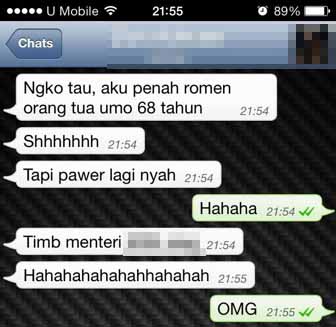
Six days ago I received a Whatsapp screen capture of a conversation between a “Tweet-famous” and a friend where the former gleefully told the latter that she had a sexual relationship with a politician.  Apparently, this “Tweet-famous” person is famous for her “kiss-and-tell” sessions and is known to flaunt her expensive handbags even though she is just holding a managerial post at a government-funded Foundation related to national security.

Whether or not the tryst is true, but I am of the opinion that even if it isn’t, such a person should not be trusted to be in an organisation that is linked and privy to senior ministries and information that flows from those ministries, or to any other government agencies.

Below is the screen capture which I have pixelated the name of the “Tweet-famous” and the Ministry her self-claimed sexual partner represents, especially to protect the politician mentioned.

Screen capture of the Whatsapp conversation between the "Tweet-famous" and her friend that was sent to me six days ago
Screen capture of the Whatsapp conversation between the “Tweet-famous” and her friend that was sent to me six days ago