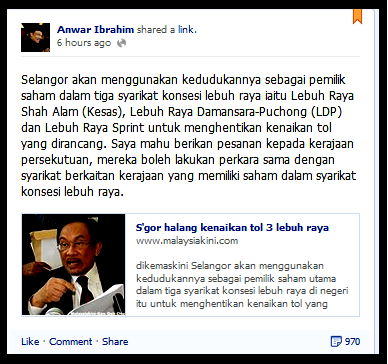
BNM Forex Scandal: A Crime Against Malaysians Exposed By Lim Kit Siang

I simply do not comprehend the fuss that is being kicked up by Mahathir’s fanatics.  On one hand they want the transparency that none of us got when Mahathir was the Prime Minister; on the other they are fuming because Mahathir, Nor Mohamed Yackop and Anwar have been implicated in the findings of the Royal Commission of Inquiry (RCI) for the Bank Negara Malaysia (BNM) foreign exchange scandal of the 1990s.

Mahathir’s long-time crony Daim Zainuddin, who served as finance minister from 14 July 1984 to 15 March 1991, for having aided and abetted Nor Mohamed by leaving BNM “to its own devices”.

Let us ask the very man whose perseverance has finally paid off:

This ought to be the reaction to the RCI findings if we are to ask Lim Kit Siang

Yes. The loss of RM31.5 billion through forex gambling was and still is a crime against the Malaysian people.  And if it weren’t for Lim Kit Siang’s persistence and perseverance, we would not have gotten where we are now.

Three people have been found principally liable for the criminal breach of trust and should be probed further over their involvement and liability.  They are the former Prime Minister Mahathir Mohamad, his then-Finance Minister Anwar Ibrahim, and ex-BNM advisor Nor Mohamed Yackop.

The commission found in its 524-paged report that the Cabinet in the 1990s was not given the full picture by Anwar on the forex losses, adding that he had “deliberately concealed facts and information and made misleading statements“. It is also of the opinion that the then Prime Minister (Mahathir) had condoned the actions of the Finance Minister.

The RM31.5 billion losses, the report said, were hidden using “unconventional accounting treatments”, such as booking losses to reserves in the balance sheet and the absorption of the remaining losses by the transfer of shares from the Government to BNM as well as the creation of a “Deferred Expenditure” to be repaid in instalments over a decade.

The RCI noted that Anwar Ibrahim, the then Finance Minister, had been informed about the actual forex losses suffered by BNM. It also said that Mahathir was informed by Anwar together with then Treasury deputy secretary-general Tan Sri Clifford Francis Herbert in late 1993 that BNM had suffered estimated losses of RM30 billion on the forex dealings for 1992 and 1993.

However, in the extract of minutes from three Cabinet meetings on March 30, April 6 and 13 in 1994, Anwar had made “no mention of the actual losses of RM12.3 billion for 1992 and RM15.3 billion for 1993.”

Anwar had chaired the March 30 meeting as the deputy prime minister. The losses for 1993 were reported as RM 5.7 billion.

The RCI also noted that the prime minister, who chaired the meeting on April 6, did not correct or offer more information when the forex losses for 1993 were recorded as only RM5.7 billion.

The RCI report said as pointed out by Herbert, he had expected Mahathir to be outraged but his reaction was quite normal with him uttering “sometimes we make profit, sometimes we make losses”.

His reaction to and acceptance of the huge forex losses suggest that he could have been aware of the forex dealings and its magnitude,” said the report.

Why Did It Take So Long?

Of course supporters of Mahathir got their knickers in a knot over the RCI findings, mostly harp on the duration it took to have a RCI formed, whether it was formed to time itself with the looming general elections so that the Pakatan Harapan would be epitome of broken hopes?

Lim Kit Siang may have harped on the matter, trying to get an RCI formed since 1994, if not earlier.  Mahathir was the Prime Minister then until the end of 2003.  No one during Pak Lah’s time took up the issue as Mahathir was then breathing down Pak Lah’s neck watching the latter’s every move.  In the end, Mahathir got Pak Lah ousted for not playing his game his way.

When Najib Razak took over at the beginning of the second quarter of 2009, Malaysia’s economy had shrunk even though oil price was high.  The GDP growth rate for Malaysia in 2009 was -2.5 percent because of the global financial crisis then, hence Najib Razak’s priority then was to safeguard the economy and take measures to improve on the GDP growth.
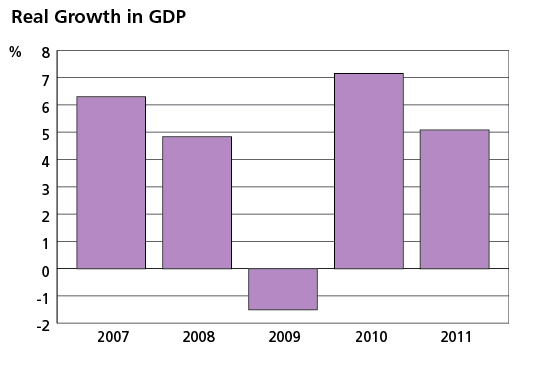
Malaysia’s GDP growth rate for 2009 was -2.5%

And ever since then Najib had been fighting on all fronts to make sure that Malaysia goes through a sustainable growth, and that there would be enough government money to still help the people, especially those from the B40 income group.  Hence, we see various initiatives like the 1Malaysia Clinic, Kedai Rakyat 1Malaysia (which is now being revamped), BR1M, PR1MA and various other 1Malaysia initiatives.

And while all that was happening, Lim Kit Siang was still going around asking for an RCI to be formed for the BNM forex scandal.  In the run up to the 13th General Elections, Lim Kit Siang wrote this on the BNM forex scandal:

“I had estimated in Parliament two decades ago that Bank Negara lost a colossal RM30 billion from the Bank Negara foreign exchange scandal under Mahathir’s premiership. But Bank Negara claimed RM10.1 billion loss in 1992 and RM5.7 billion in 1993 while former Bank Negara Deputy Governor Dr. Rosli Yaakop estimated last year at a public forum that Bank Negara lost between USD27 to USD33 billion, which was five times more than its foreign reserves and its entire assets of USD20.7 billion in 1992.”

You can read more on what Dr Rosli Yaakop had said on the BNM forex scandal  HERE.

Lim Kit Siang also said that Malaysian voters should not only pass a verdict on Najib’s non-transformation in the past four years, but also pass judgment on Mahathir’s 22 years of authoritarian and corrupt policies when he was Prime Minister from 1981 – 2003.  He said:

“I am on public record as saying that if Pakatan Rakyat is to capture Putrajaya in the 13GE, we should re-open investigation not only on the RM30 billion Bank Negara forex scandal of 1992, there should be a Royal Commission of Inquiry into the RM100 billion losses suffered by the country in the financial scandals of the 22-year Mahathir era.”

Kit Siang added that the voters should decide whether they endorse the proposal to have a wide-ranging public inquiry into Mahathir’s financial scandals in 22 years which have cost the country RM100 billion of losses and for which the present generation of Malaysians are still paying the price – although there is totally no accountability and transparency about these glaring instances of corruption, cronyism and abuses of power for more than three decades.

He said all that HERE.  And we should not forget that Lim Kit Siang also wrote a book on the BNM forex scandal.

And finally, and only when the economic outlook had improved, did Najib Razak announced that an RCI would be formed to investigate the BNM forex scandal.

In June 2017, Lim Kit Siang even wanted the report recommending the RCI to be made public.  Finally, on 8 August 2017, the RCI commenced, and Kit Siang’s 25 years of wait ended.
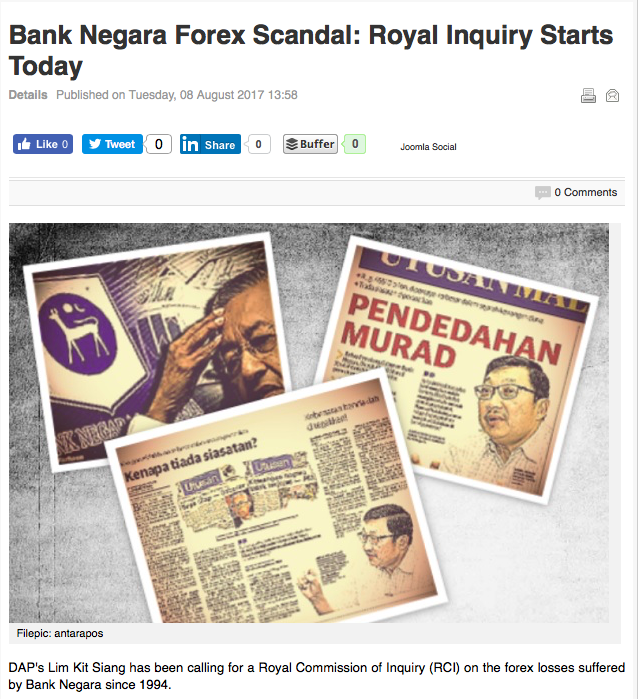
Kit Siang’s hard work finally paid off

And one other Pakatan leader who had been lying very low beneath the BNM forex scandal radar is Anwar Ibrahim.  If anyone was to ask why did the government not do anything between 2004 and 2017, the answer would be why hadn’t Anwar, since 2 September 1998, asked for an RCI on the matter? Was he afraid that he might get implicated?

You and I know the answer to that now.

And what about the 1MDB scandal? Well, unlike the BNM forex scandal, the 1MDB case was investigated by the Parliament’s Public Accounts Committee, the Royal Malaysian Police, Bank Negara Malaysia and the Malaysian Anti-Corruption Commission.  Police reports were also made against 1MDB. But not a single sen had gone missing!

For the BNM forex scandal, this is the first time that it has been investigated – by the RCI, and soon by the Royal Malaysian Police.  And the first police report was made by a member of the RCI itself after the RCI findings report was published – 25 years after the whole thing happened.

So, we should all say our thank you to Lim Kit Siang for exposing this crime against ALL Malaysians. Thank you, Lim Kit Siang – for persistently asking for your good friends to be investigated.
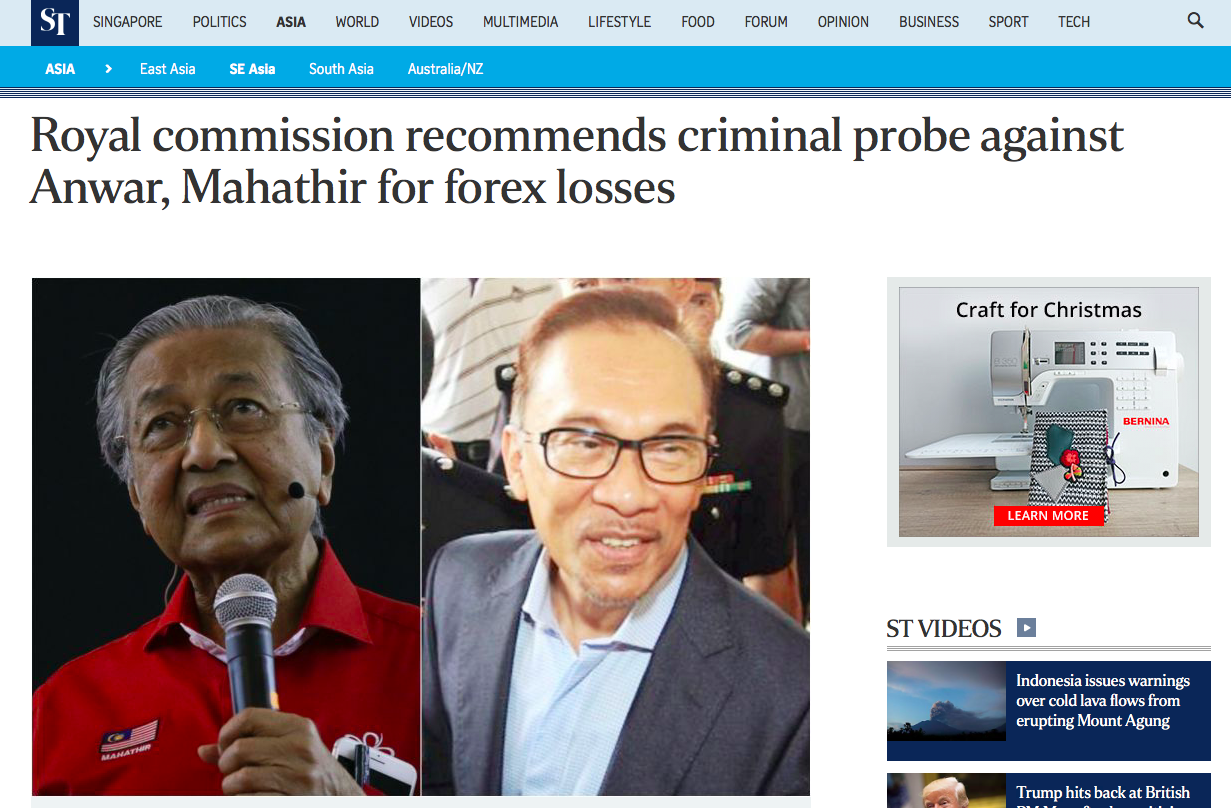
BNM Forex: Congratulations, Lim Kit Siang

The Singapore Times report on the BNM FOREX issue

For two decades DAP’s Supremo, Emperor Lim Kit Siang, fought to bring to justice those responsible for the loss of RM30 billion (RM45.25 billion in today’s terms) through foreign gambling exchange by the Bank Negara Malaysia (BNM) back in the early 1990s.  The greed of those responsible saw the BNM increase its trading volume to USD50 million lots (RM74.46 million or RM205.65 million today) compared to the market norm then of USD5 million (RM7.45 million or RM20.56 million today) to USD10 million (RM14.90 million or RM41.12 million today), amounting to billions of Dollars per day!

BNM’s maximum exposure in the foreign exchange markets then reached as high as RM270 billion – three times the country’s GDP and more than five times the country’s foreign reserves at the time!

Imagine what would have happened had we lost all that!  But imagine what RM30 billion then could have done to arrest the massive fall of the Ringgit from RM2.4765 to the USD on 1 April 1997 to RM4.88 to the USD in early January 1998.

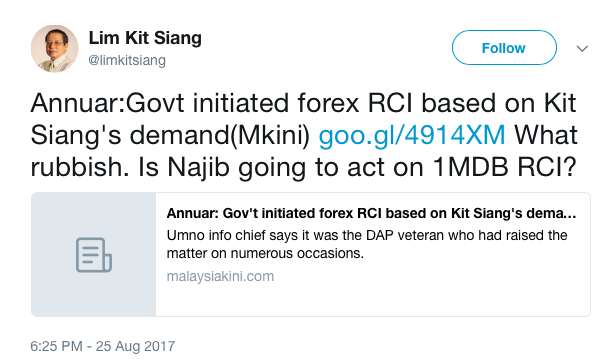
But despite pressing for someone to be accountable, Kit Siang is far from happy.  In September of this year he Tweeted this:

Has Lim Kit Siang accepted the loss of the RM30 billion he’s been screaming about?

Now Lim Kit Siang plays innocent saying he has nothing to do with wanting a Royal Commission of Inquiry into the BNM Forex scandal.  Is it because he and Mahathir are good friends now? Or is it because Mahathir’s involvement means that the DAP has lost one of its Malay political mules?

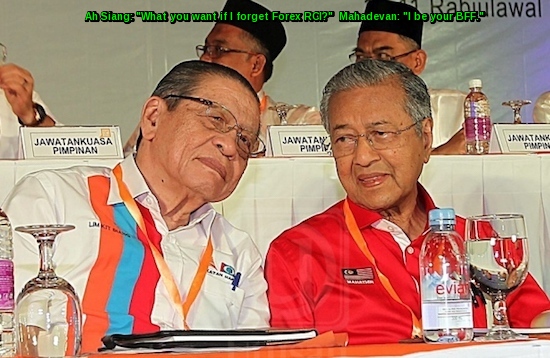
Best friends forever

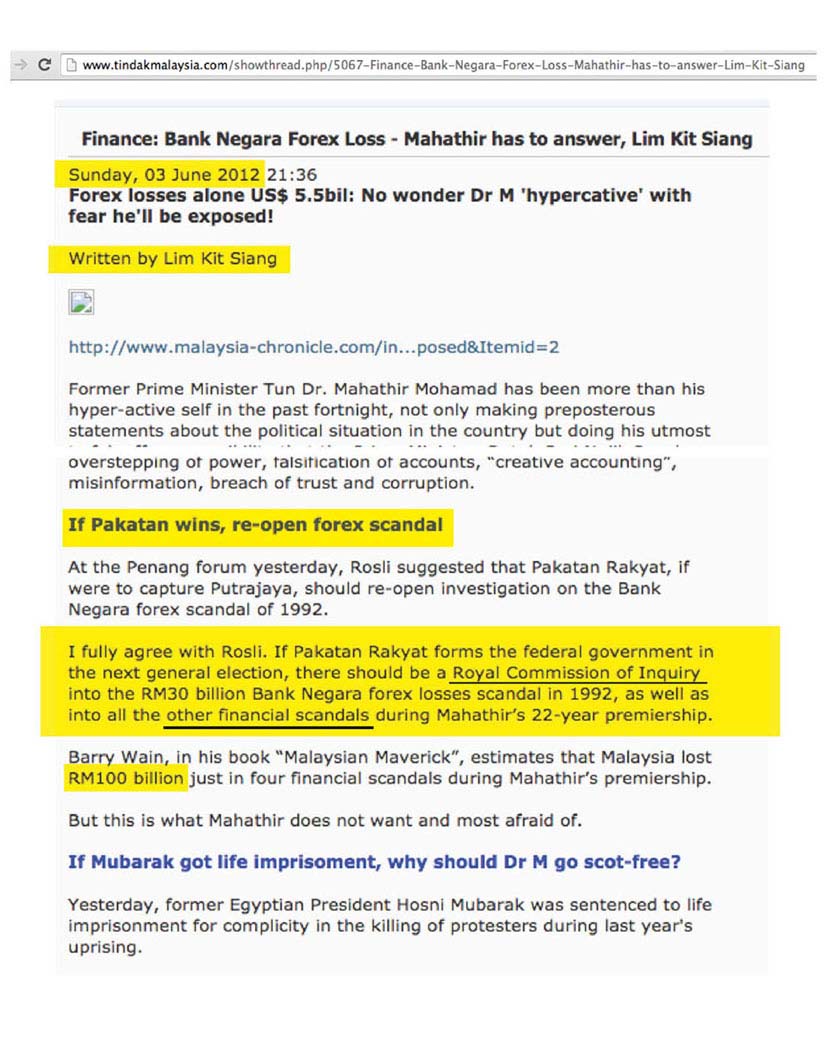
If I recall correctly, it was Lim Kit Siang who mentioned that Mahathir has to answer for the Forex loss, and that if Pakatan captures Putrajaya, he would re-open the BNM Forex scandal.  He even asked if (former Egyptian President Hosni) Mubarak got life imprisonment, then why should Mahathir go scot-free?

Lim Kit Siang’s demands re the BNM Forex Scandal

Has Lim Kit Siang forgotten all the above?  If he has, has he gone senile due to his age? If he has problems retaining his memory, then I don’t think he ought to contest in the next general elections.

Whatever it is, the biggest winner would be Anwar. Not only does he get to see his jailor jailed, but he won’t be lonely anymore.

Let’s hope they get to share the same cell.

Bedmates

Where Should The Allegiance of the Armed Forces Lie

Malaysian Armed Forces Veterans

I received this copied in a Veterans’ WhatsApp group. I omitted some parts of the message as it was just gibberish talk:

_Copied from write up by Mej **** ***** TUDM (Rtd)_

Good afternoon to all. The fight for a free Malaysia must go on!
Let us get one thing clear – the country and the government are separate entities. Governments come and go, the country is eternal.

We owe our allegiance to the country, not to the government. Therefore, saying bad things about a bad government is not being anti-national. Most important of all, voting against a bad government is not being anti-national. A bad government does not deserve loyalty. Disloyalty to the government is not disloyalty to the country; in fact, voting out a bad government is being loyal to the country.

Clean elections
Clean government
Right to dissent
Save our economy


Fine words they are, but for someone with some legal training to write as such shows how much understanding the author has of the Federal Constitution.

Let us address this “call”:

Point 1:

“Good afternoon to all. The fight for a free Malaysia must go on!
Let us get one thing clear – the country and the government are separate entities. Governments come and go, the country is eternal.

We owe our allegiance to the country, not to the government. Therefore, saying bad things about a bad government is not being anti-national. Most important of all, voting against a bad government is not being anti-national. A bad government does not deserve loyalty. Disloyalty to the government is not disloyalty to the country; in fact, voting out a bad government is being loyal to the country.”

The country and the government cannot be separated, neither can a state be separated from its state government.  Yes, governments come and go, but a government is still a government.  Officers and men of the civil service, the Armed Forces, the Police owe their allegiance to the King and Country.  The King rules the Country, as do the Sultans their respective state, through a government that was picked by the people. Be they the Federal Government or the State Government, they administer the country and the states on behalf of the King and Sultans, as well as the Governors.  This is prescribed by Article 39 of the Federal Constitution where the Executive Authority of the Federation is vested in the Yang DiPertuan Agong by him, or by the Cabinet, or by any Minister authorised by the Cabinet.

In the case of the Armed Forces, the King exercises his power through the Minister of Defence.  Which is why the officers and men of the Armed Forces are required to salute the Minister of Defence who represents the King’s executive power over the Armed Forces, and the Prime Minister who is the King’s Chief Executive, representing the King.

Article 41 states that the King is the Supreme Commander of the Armed Forces and therefore those representing the King as prescribed by Article 39 are performing their duties on behalf of the King.

Therefore, it is imperative that the Armed Forces, as well as the civil service and the Police, remain loyal to the government of the day as the government of the day represents the King – be it bad or otherwise. Whether or nor a member of the Armed Forces, or the civil service, or the Police subscribes to the government of the day politically is a secondary matter.  The oath that was taken was to be loyal to the King and Country; therefore loyalty shall be given to the government of the day.

The Minister who represents the King in matters of defence is also made the Chairman of the Armed Forces Council which is responsible for the command, the discipline and the administration of the Armed Forces, except for matters relating to their operational use.  This is prescribed in Article 137 of the Federal Constitution.

And it is the Parliament that passed an Act to amend and consolidate the law relating to the establishment, government and discipline of the Armed Forces is made which is called the Armed Forces Act, 1972.

It is also the Armed Forces Act, 1972 that gave the powers to the Armed Forces Council to enable Brigadier-General Datuk Fadzlette Othman Merican Idris Merican be promoted to Major-General while she is being seconded to a Federal Government Department.  Section 5C of the Armed Forces Act, 1972 determines that she remains a member of the regular forces but her remuneration shall be paid by that Federal Government Department.

By the same token, even the ordinary people who are citiens of Malaysia must realise that the Federal Government represents the King, the state governments represent the resective state’s Ruler.  These are governments chosen by the people but was appointed by the Rulers to administer the country and states on their behalf.  The only way to change these governments is by a democratic process called ELECTIONS (unless you have not heard of that word before).

Point 2:

“Clean elections”

Since 1955, Pulau Pinang, Perak, Kedah, Kelantan, Terengganu, Selangor and Sabah have all seen a change in government.  If the elections were not clean, would it have been possible for the Opposition to have won cash cows such as Pulau Pinang and Selangor?

Point 3:

“Clean government”

I must admit there are bad hats in the government, be it the Federal government or the states government.  This is why we have seen people like Harun Idris, Mokhtar Hashim, Khir Toyo, Lim Guan Eng charged in court for corruption. All but Lim Guan Eng have served jail time.  Guan Eng, who said that he is not afraid to go to prison, has been delaying his corruption trial using technical issues.

Many more state excos have also been arraigned in a court for corruption.  This is not possible without agencies such as the Auditor-General’s Office and the Malaysian Anti Corruption Commission which act as checks and balances to ensure that the Federal as well as states governments are run efficiently and cleanly.

Of course there are those who have yet to face the music. For example those responsible for the Maminco scandal in 1985 that saw a loss of RM1.6 billion (about RM2.56 billion in today’s terms); the Perwaja scandal in 1982 that saw a loss of about RM10 billion (RM18.73 billion in today’s terms); the BMF scandal of 1983 that had caused a loss of RM2.5 billion (RM4.5 billion today); the 1986 Deposit-Taking Cooperative Scandal that caused a loss of RM1.5 billion (about RM2.58 billion today); the RM30 billion loss by Bank Negara Malaysis through foreign exchange gambling in 1994 (RM45.25 billion today); the Malaysia Airlines scandal of 1994 with the loss of RM9.4 billion (RM14.18 billion today); the PKFZ scandal of 1999 with a loss of RM12.5 billion (RM13.5 billion in today’s terms).

The above all happened during the tenure of a certain former Prime Minister.  The grand total of losses is RM67.5 billion (or RM101.3 billion in today’s terms).  The amount shown does not include the bailouts reported in various books, Opposition leaders’ blogs and so on.

I do hope that the cry for a clean government will also call for the arraignment for the Prime Minister during whose tenure the financial scandals happened.  Had the RM101.3 billion been put to good use during those 22 years, Sabah and Sarawak would have had SIX toll-free Pan Borneo Highways, or 1,013 80-bedded Government hospitals all over the country!

Instead, it enriched the few and killed one person.

Point 4:

“Right to Dissent”

I have not seen any Opposition-leaning media being taken off print or air, unlike during a certain 22-year period of my life.  Malaysiakini et al are still spinning their version of what they call “balanced news” (read: news the way we want you to see it).  The way these media operate reminds me of a character in Netflix’s limited series called “Godless” called A.T Grigg, a newspaper owner-editor who writes news the way he sees it, not how it truly happens.

The ISA was repealed six years ago by this present administration. Although replaced with SOSMA and POTA, it doesn’t give powers to the authorities to hold anyone without trial as the ISA did. And the ISA was being used a lot against political dissenters especially in the late 1990s during the tenure of a certain former Prime Minister.

This administration also introduced the Peaceful Assembly Act, 2012 that has allowed more freedom to assemble peacefully, unlike during those days of a certain former Prime Minister where at the slightest hint of a political dissent, you get whisked away to the University of Kamunting.

Has the author of the message been arrested yet?  Of course not.  Even when he actually committed sedition against Malaysia by encouraging Sarawak to secede from Malaysia.

How is it that a legal-trained person does not know that his act is seditious escapes me

Now, how is that seditious?  If you look at Section 2 of the Sedition Act, 1948 it tells you the following:

Section 2 defines how an act is seditious. He has committed a seditious act by definition of Section 3(1)(a)

This former Armed Forces officer also committed a crime of sedition under Section 3 (1) (b) of the same Act for encouraging Sarawak to leave Malaysia:

Section 3 (1) (b) of the Sedition Act, 1948

And you thought that the Federal Constitution protects freedom of speech?  Yes, it does.  But as with all other liberties, they are subjected to restrictions.  Article 10(1) guarantees that every citizen has the right to freedom of speech and expression, but at the beginning of the Article it also says the following:

You cannot just say anything you like although you have the freedom of speech and expression

To dissent is okay. To dissent seditiously, or criminally, or dangerously, or incitingly, is not okay.

Any legal-trained person ought to know this, right? What more a former officer of the Armed Forces!

Point 5:

“Save Our Economy”

In April 2017, the World Bank forecasted that Malaysia’s GDP would be at 4.3 percent.  This was revised in June 2017 to 4.9 percent due to an acceleration in domestic economic activities (people in Malaysia are actually spending more) by 5.7 percent year-on-year.  The GDP growth was revised again in October 2017 to 5.2 percent.

Let me quote several reports here by the World Bank.

World Bank Group lead economist Richard Record said at a media briefing on the update that Malaysia’s robust GDP growth in the first half of 2017 was largely underpinned by strong private-sector expenditure, with additional impetus from an improvement in external demand.

“Private consumption expanded firmly this year, supported by favourable income growth amid stable labour market conditions, and improved consumer confidence. Private investment also sustained rapid growth rates during the period, reflecting mainly continued capital spending in the manufacturing and services sectors,” said Richard Record.

“On the external front, gross exports rebounded strongly from the subdued growth experienced in 2016, supported by double-digit growth in commodity and manufactured exports,” he added.

Economic watchdogs are generally bullish on the Malaysian economy’s performance, buttressed by strong expansion in private consumption and private investment. In the latest update on its World Economic Outlook, the International Monetary Fund has upped its GDP growth projection for Malaysia in 2017 to 4.8 percent from 4.5 percent previously.

Apart from that, the Asian Development Bank has also upgraded its 2017 growth outlook for Malaysia to 4.7% from 4.4%, and indicated that the two-year slowdown in economic growth is likely to have bottomed out last year.

Richard Record also predicted Malaysia’s economy for 2018 and 2019.

“We are forecasting Malaysia’s GDP to grow by 5 percent next year (2018) and 4.8 percent in 2019. Our prediction reflects how we are seeing the country’s macroeconomic fundamentals’ performance and the baseline scenario,” he said.

Online economics portal ‘Focus Economics’ also said the following:

“Economic momentum remained robust in Q3 as confirmed by more complete data. Export growth expanded by a double-digit pace in September, underscoring thriving external demand for Malaysian goods. Household spending was buoyed by a low unemployment rate in September and by higher wages, which were propped up by a thriving manufacturing sector, the key driver of industrial production growth in the quarter. The 2018 budget passed on 27 October is focused on fiscal consolidation and is expected to narrow the fiscal deficit from 3.0 percent in 2017 to 2.8 percent in 2018. Despite the tightening, the budget has consumer-friendly components that will increase disposable income. These include lower income tax rates, especially for middle-income earners; higher public wages; and increased assistance spending.”

By contrast, Brunei’s fiscal deficit had hit 16 percent in 2016.

Of course, with the oil prices continue to stay below the USD70 per barrel level, Malaysia as well as other countries will continue to experience some sluggishness in the economy. However, good fiscal policies have allowed us to grow unlike a neighbour of ours that is often quoted as being a model economy.  That country’s growth have been at 2 percent in 2016, and 2.5 percent this year.

The outlook for the construction sector has taken a sharp turn for the worse, with poll respondents tipping a contraction of 4.2 per cent. The previous survey, released in June, had respondents forecasting 0.2 per cent growth in the sector.

The outlook for the accommodation and food services sector in this model country has also worsened – it is now expected to shrink 1.5 per cent, from previous estimates of a 1 per cent expansion.

Economists polled expect overall economic growth of 2.5 per cent next year for this model country, the same pace as this year.

Perhaps the author of the message we are discussing here should go down South and help revive the economy of that model country.


So, there have you.  I really do not know what the fuss is about.  All I can deduce is that the author of the message is all hot air – you can feel it blowing on your face, but there is no real substance there.  This is the same as BERSIH, and the recycling of petty but stale issues by the Opposition just so that they can remain relevant, and justify for the allowances they receive from the pockets of the rakyat.

You can express your dissatisfaction, but always do so constructively. Especially if you are a member of the Malaysian Armed Forces and Malaysian Armed Forces Veterans.

Forest City: Sustaining The Future

Forest City was under a considerable amount of pressure when it first started due to the knee-jerk reactions of some environmentalists and half-baked as well as over-ripe politicians seeking quick publicity to remain relevant.  While the environmental concerns have been addressed and continues to be addressed as the project progresses, it is notable that the political concerns seem to originate only from the Malay politicians.  It seems that the Chinese politicians realise the potential this development brings.

Almost, if not all the issues have been addressed in a recent posting of mine on the matter, but it seems that these politicians are hell bent on flogging an already decomposing horse.

In the meantime, Forest City continues to develop and progress, in very notable ways.

A UN Global Model

On the 31st October 2017, Forest City won the Global Model of Green Building Industrial Park for the second consecutive year.  The award was part of the Sustainable Cities and Human Settlements Award (SCAHSA) ceremony held in New York.

Forest City wins the Global Model of Green Building Industrial Park award for its industrial park which has boosted the construction industry


The SCAHSA award established by the Global Forum on Human Settlement (GFHS), a non-profit organisation with Special Consultative Status within the United Nations Economic and Social Council (ECOSOC). It is a trend setter for urban construction everywhere that respects sustainable development.

Forest City, China’s Wuyi County and Indonesia’s Surabaya City were among the winning entries submitted from 23 countries and regions worldwide. Forest City won the SCAHSA Global Human Settlements Award on Planning and Design at the 11th Global Forum on Human Settlements (GFHS – XI).

Dr. Arab Hoballah (right), former Chief of the Sustainable Lifestyles, Cities and Industry Branch at United Nations Environmental Programme (UNEP) presents the Global Model of Green Building Industrial Park award to Forest City

Forest City, by taking full advantage of its technical resources, is creating a 1.7-square-kilometer construction-focused industrial park, to promote the development of a green building industry and improve building precision and quality, said Dr. Wang Jiying, vice general manager for overseas business at Country Garden.

Forest City will include several support facilities and a powerful water transportation system, all of which are expected to be operational in 2019, with the aim of creating a truly industrialised manufacturing base for the construction industry over the next three to five years.

Creating Potential Future Workforce

A month and a half ago when I was at Forest City, I was brought to visit one of five schools adopted by Forest City where children are given free Mandarin lessons for three months.  This is one of the ways by Forest City to ensure that the local community, especially those in the Tanjung Kupang area, have roles to play in the development.

The result is excellent:

The student above is from the first batch of students who started their Mandarin language course in August 2017 and has graduated.  Forest City is not stopping there.  Forest City’s master developer, Country Garden Pacificview Sdn Bhd (CGPV), aims to give back to the community by offering three-month basic Mandarin language courses to some 100 school children there.

CGPV plans to continue to offer the Mandarin courses in the future as part of its corporate social responsibility effort for the community here.

The second intake will be conducted from January until March next year,” Country Garden Pacificview Sdn Bhd corporate communications head Aeron Munajat told reporters when met at SK Tanjong Adang here today where she handed over certificates to the participants.

Aeron said that apart from learning Mandarin as a third language, the three-month language course will also help the students develop self-confidence which will further enhance their competitiveness in the job market in the future.

She said the course involved students and teachers from five schools, namely SK Morni Pok, SK Tanjong Adang, SK Tiram Duku, SK Tanjung Kupang and SK Pendas Laut.

The classes are conducted every Friday and Saturday from 10am to 12 noon, at the community centre in Kampung Pok,” she added.

Forest City Does Not Pawn Johor Land

The continued but futile attacks on Forest City by Malaysia’s Mugabe and his followers have again earned the ire of His Majesty The Sultan of Johor.

Has Johor ever pawned its land? What is the meaning of pawning? With Forest City, the state of Johor has increased in size. It is not about seizing land to be pawned. In Johor, there are international lots and Malay reserve land.  Anyone can buy at the international zone, be it the Mat Salleh from England or people from India, Japan, China. All of them can purchase it.  They can buy (property), but it does not mean they purchase the land to bring it back to their respective home country,” chided the Sultan.

In Johor, we have an international zone, which means that foreigners could buy. It has international status. In Forest City, we do not sell the land, we sell the strata (titles) and these strata (titles) are for permanent ownership in Johor,” he remarked.

The Sultan added that 40 percent of the investors in Forest City are Malaysians and that even the government has shares in the project, and that the project gave a lot of revenue for the state government, including quit rent and assessment, which the state of Johor benefits.

How much revenue will the Johor government get? When Forest City is completed, the assessment, quit rent will go to who? Who will get the jobs? There are transportation (initiatives), businesses and job opportunities. Don’t be narrow minded about this,” said the Sultan.

A throwback at the Sultan of Johor’s displease of Mahathir’s lies about the Forest City project

The Sultan also said that the most visible benefit of the Forest City project was the boost it has given to the value of real estate in its surrounding areas, particularly in Pontian district, which is now developing at a rapid pace.

He gave an example of how in the past, the people of Pontian were only picking buah duku (lanzones), but now people in Pontian own Mercedes Benz cars.

It means that Pontian has become a district that will see rapid development,” the Sultan stressed. “In the past, an acre (0.4 hectares) of land used to cost RM100,000, but now, it is valued up to RM3 million.”

It is no doubt that Forest City will boost the Iskandar region’s marketability.  With consumer prices 100 percent higher than in Malaysia, rent prices 500 percent higher than in Malaysia, many companies in Singapore were driven to relocate to Iskandar, while Johor Bahru’s shopping malls, food outlets and amusement parks have become a favourite for Singaporeans.  Bangkok’s recent wish for Malaysia to extend its High Speed Rail into Thailand will soon make the Iskandar Econmic Region attractive to the millionaires and billionaires of Indochina. And the green, affordable buildings of Forest City will definitely be a hit.

While they all win, the real winners will be the people of Johor and Malaysia.

The Rotten Core

Rotting Apple Core (courtesy of Science Learning Hub)

It is no surprise that the recent DAP CEC election has retained some 90 percent of its line up.  Despite being a dinosaur and having manouvered the DAP through its mother-of-all-U-turns by working with arch-nemesis Mahathir Mohamad, Lim Kit Siang emerged victorious with the most number of votes.  His son, Guan Eng, despite being charged on two counts of corruption, came out third and was returned as the Secretary-General of the party.

Returned after being missing for a term is Selangor’s Ronnie Liu who is famous for trying to stop the authorities from raiding brothels and gambling dens in Selangor before DAP came into power.  The ousted included the man who is the symbol of cleanliness, moderation and a corrupt-free DAP – Tan Seng Giaw.

And as for its multiracial image, only two Indians and one Punjabi were elected but not one Malay made it to the Top 20 – again, but former DAP Pahang Chairman Tengku Zulpuri Shah bin Tengku Puji was appointed Vice-Chairman.  He is the sole Malay in the CEC line-up.  Christopher Ross Lim, the Chinese man masquerading as Malay going by the name Zairil Khir Johari, made it at No. 19. He was born a Chinese and remains a Chinese.

Only 54 percent or 1,356 delegates attended the CEC elections out of 2,514 delegates in 2013.  This shows that the support for the Lim Dynasty is waning. They can bask in party glory now but whether that will translate into actual votes especially in Pulau Pinang remains to be seen.  With only 450,000 registered members, DAP relies more on its propaganda to win over the masses, who of late are drowning in flood waters and overwhelmed by landslides due to the over-development of the hills and reclamation works in Pulau Pinang.

And to appease the spirit of a dead man, the three-year dead Karpal Singh managed to get 43 votes, more than any of the Malay candidates.  How Karpal could still get votes baffles me.

This sums up the image of the DAP – rotten to the core.

Mahathir Masih Hina Bugis Dan Rakyat Indonesia

Mahathir Mohamad baru-baru ini mengirim seutus surat kepada DUBES Malaysia di Jakarta kerana diminta menjelaskan mengenai kenyataan beliau mengenai ‘Lanun Bugis’.

Beliau langsung tidak rasa bersalah dengan kenyataan tersebut dan tetap dengan pendirian beliau bahawa Najib Razak adalah keturunan lanun Bugis.

Lanun wujud tanpa mengenali kaum dan bangsa, dan mengaitkan Bugis dengan lanun walaupun bukan kesemuanya adalah penghinaan yang nyata.

Malah, Mahathir selain menghina kaum Bugis, beliau dengan angkuhnya menghina rakyat Indonesia tanpa mahu meminta maaf di atas penghinaan terdahulu.

Tak usahlah cucuk orang Indonesia. Mereka bukan boleh undi PRU (Pemilu) 14.”

Jelas Mahathir tidak mahu melayan permintaan DUBES Malaysia yang mahu meredakan kemaharan rakyat Indonesia terhadap Mahathir yang telah menghina orang Bugis. Pendapat rakyat Indonesia tidak penting bagi Mahathir kerana mereka tidak akan mengundi dalam PRU (Pemilu) ke-14 nanti.

Inilah perangai Mahathir, orang yang malu dikaitkan dengan keturunannya sendiri.


A Flood Of Incompetence

I am surprised that a former Brigadier General doesn’t know that you cannot simply deploy the military without explicit instructions

Former army Brigadier turned politician, Arshad Raji, seems to like the attention the electronic media has been according him lately, and he speaks about a wide spectrum of issues – from falling for Mahathir’s fake news of the so-called withdrawal of his close police protection, to the management of the floods in Pulau Pinang.

In the latter issue it was as if he was trying to downplay the Deputy Prime Minister and the BN-led Federal Government’s involvement in the management of the floods.  He was right about some of it, though.  Under the National Security Council Directive No.20, when a state emergency is declared following a disaster affecting two districts or more, the State Disaster Management Committee can call for assistance in the form of assets, finance, and other resources on the state level, and limited form of assistance from federal agencies within the state – the police, armed forces, civil defence etc.  This does not require a call to the Deputy Prime Minister at all.

Look at Level II Disaster Management by the State

The State Disaster Management Committee is chaired by the Chief Minister or Menteri Besar while the Chief Executive is the State Secretary.  But what Arshad Raji did not know, or chose to not reveal during his “press conference” was the fact that until now Lim Guan Eng has not declared a state of emergency in Pulau Pinang despite floods inundating four out of five districts in Pulau Pinang namely Seberang Prai Utara, Seberang Prai Selatan, Barat Daya and Timur Laut.

Don’t blame the Federal Government. Tokong himself did not declare a state of emergency

I lived in Pulau Pinang, on the pulau itself for three years and four months in the late 1980s and never once saw floods affecting the state on this level.  The most I would see is pockets of areas in Datuk Keramat and the Green Lane (Jalan Masjid Negeri) – Jalan Air Itam junction near the State Mosque.  Even then you could still pass the areas on your motorcycle.  Having eight deaths because of floods in a year was unheard of (one died earlier in September while seven this time around).

No rain, no floods” seems to be the best of Lim Guan Eng’s quotes pertaining to floods in Pulau Pinang.  This time, the deluge is blamed on a tyhoon that is battering Vietnam, and rightfully so.  Every time a typhoon hits Vietnam, the northern Peninsular states would receive an extra amount of rainfall.  And since 1881, Vietnam has been battered by 68 typhoons excluding the one that has just hit them.  However, the shocking bit is where 119 flash floods have hit Pulau Pinang since 2013!  That is 2.5 flash floods per month for the last four years!

I wonder why this is the case of late?

It does not take an engineer to tell you that when you do excessive hillside developments, the soil cannot absorb the rainwater as the oxidised topsoil would be transformed into a clay-like material.  The run-offs would be washed into monsoon drains, clogging up the roadside gutters and making the storm sewers shallower as silt accumulates at the bottom.  These drains flow out to sea along natural coastlines, which is why monsoon drains act as gravity sewers.  In Pulau Pinang, you can hardly find a natural coastline as most beaches with gradient have been reclaimed, and the gradient tapers off, diminishing the gravity effect.  Storm water therefore does not flow into the sea but accumulates and saturates the flatter grounds causing floods.

But who cares about eight deaths this year due to floods and one last year when you can make money selling condominium units to the rich?  But it is this excessive development by the state government that was voted in by the Pulau Pinang people that is now killing the Pulau Pinang people and have caused untold miseries.

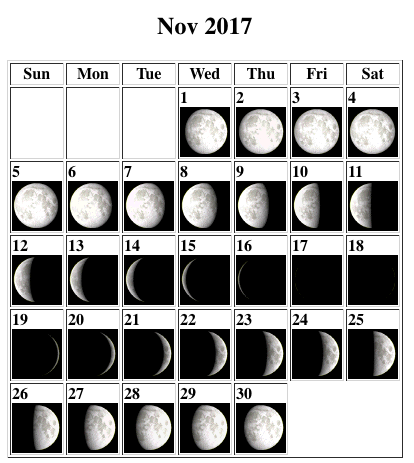
Everyone also knows that when it is the new moon or full moon, tides will be higher than usual, and that makes it harder for storm drains and rivers to flow water out to sea, what more when there is excessive water caused by the backlash of a typhoon.

Phases of the moon for November 2017

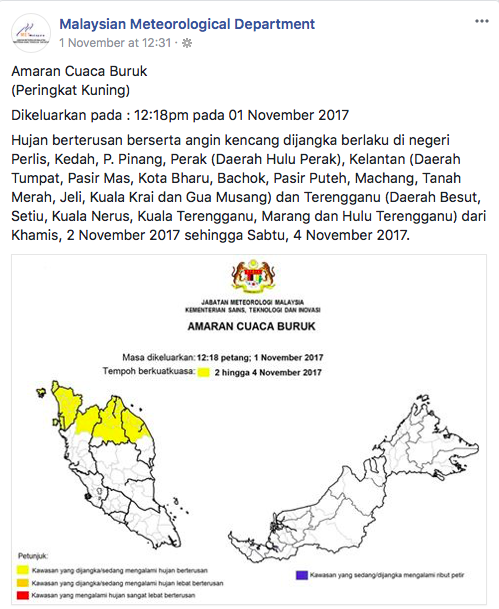
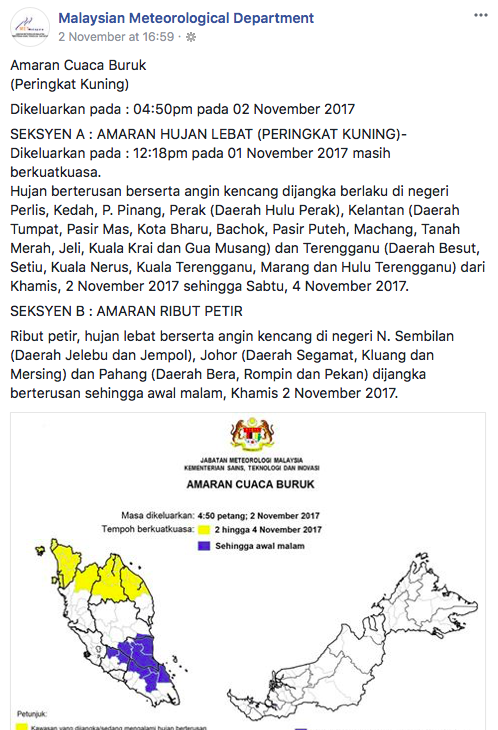
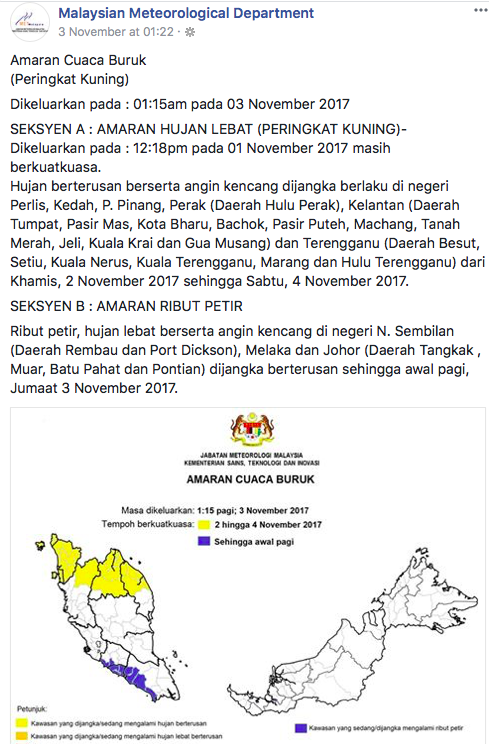
You can see that from 1 November 2017 the moon was in an advanced waxing gibbous phase and full moon over Georgetown, Pulau Pinang occured at 12.40am on Saturday, 4 November 2017.  The Malaysian Meteorological Department had issued a series of bad weather warnings for the northern Peninsular states from 31 October 2017, and every day from then on.

Met Department warning for the northern states on 31 October 2017
Met department warning the northern states that the bad weather was going to last at least four days from 1 November 2017
Another Met department warning on 2 November 2017 reminding the northern states that the bad weather was going to last at least four days until 4 November 2017
Another Met department warning issued on 3 November 2017 for the northern states that the bad weather was going to last at least until 4 November 2017

You can see that there was ample warning by the Malaysian Meteorological Department that the weather was going to be bad for four days.  What did Lim Guan Eng or his State Disaster Management Committee do?  Nothing, until it got really bad.  And at 3.00am, Lim Guan Eng became a cry baby and called the Deputy Prime Minister for help, without even declaring a state emergency.

Lim Guan Eng called the DPM for help at 3am on 5 November 2017, five days after the initial warning was issued by the Malaysian Meteorological Department

Where was his State Disaster Management Committee?  Why had they not sat down to make preparations to mitigate the situation?

Lim Guan Eng was quick to point fingers at Kelantan in the aftermath of the disastrous floods at the end of 2014.  He pointing out that corruption and the incompetency of the Kelantan state government, as well as the rampant hillside clearing as the causes of the floods.

Well, we know that there is rampant hillside clearing in Pulau Pinang.  We also know that the Chief Minister was charged on two accounts of corruption, and we also know now that it was the incompetency of the Pulau Pinang State Disaster Management Committee led by Lim Guan Eng himself as the Chairman that had caused the situation to be worse than it should be.

Lim Guan Eng’s government’s incompetence has killed one person in floods last year, 21 people in a landslide this year, and eight people in the recent floods.  This is the government that the Pulau Pinang people have voted in, and the Chief Minister chosen by them.

Pakatan’s promise
Pakatan’s promise
Pakatan’s promise

119 flash floods have occured since the promises above was made.  And Lim Guan Eng’s government is not worried.  Going by the rate the floods are killing people, there won’t be that many people left to complain about the floods – problem solved.

The Creeping of the Republicans

The Republican Creeps

I blame our history books.  In our eagerness to instill the spirit of nationalism, we took an easy way out by saying that we were colonised by the British, when in actual fact the whole of Malaya came under British rule only during the Malayan Union period.  Only Melaka, Pulau Pinang, Singapore, and for a while Pangkor and the Dindings were under the direct rule of Britain when they were  part of the Strait Settlements.  Other than that, the British advisers administered the Malay states through treaties, and the administrators were under the payroll of the respective Sultans or Rajas, not the British.

One of the leading evidence of the sovereignty and independence of the Malay states was a landmark case in England where in 1885 the Sultan Abu Bakar of Johor went to England, and according to the plaintiff of the case, Miss Mighell, took the name Albert Baker and promised to marry her.

It was held by court that the Sultan was entitled to immunity even though up to the time of suit ‘he has perfectly concealed the fact that he is a sovereign, and has acted as a private individual.’ ‘When once there is the authoritative certificate of the Queen (Victoria) through her minister of state as to the status of another sovereign, that in the courts of this country is decisive’.

To an argument that Sultan Abu Bakar had waived this immunity, the court held that the only way that a sovereign could waive immunity was by submitting to jurisdiction in the face of the court as, for example, by appearance to a writ. If the sovereign ignored the issue of the writ, the court was under a duty of its own motion to recognise his immunity from suit.

The roles of the Malay Rulers are somewhat misunderstood.  While many often think that the Institution of the Rulers mirror that of the British’s Westminster-style monarchy, it is not.  The Rulers ruled this land even when the British were here to administer the land on behalf of The Majesties.

When 31 August 1957 arrived, the powers that the Rulers had invested in the British was duly transferred to a government that was chosen by the people through a process of democracy called Elections.  It is untrue that during the British administration of this land, and now, that the Rulers have no other power other than having a say in the matters of the Religion of Islam and the Malay custom.

The Rulers, as keepers of this land, continue to enjoy their position with their income regulated by the respective laws, and receive advice from the Menteris Besar (or in the case of the Yang DiPertuan Agong, the Prime Minister). This is evident in Article 181(1) of the Federal Constitution which states:

Subject to the provisions of this Constitution,” the “sovereignty, prerogatives, powers and jurisdiction of the Rulers…as hitherto had and enjoyed shall remain unaffected.
The same was noted by Mark R Gillen of the Faculty of Law, University of Victoria (Gillen 1994:7). In the words of the late Sultan of Perak, Sultan Azlan Shah, former Lord President, it is:

a mistake to think that the role of a King, like that of a President, is confined to what is laid down by the Constitution, His role far exceeds those constitutional provisions” (Azlan Shah 1986:89)

In other words, the Rulers may be Constitutional Monarchs, but they are not limited to what have been spelt out in the Federal Constitution.

When Syed Saddiq, the runner for Mahathir wrote to the Sultan of Selangor after His Royal Highness expressed great displeasure over Mahathir’s labelling of the Bugis as “pirates who should return to their own land” and pleaded for the Sultan’s support to “fight against corruption and injustice with the people” it shows this great-person-wannabe’s lack of understanding of the position of the Rulers in the Federal Constitution.

The Rulers are apolitical.  The Rulers do not take sides, or do not express openly whom they prefer over those they do not.  For instance, when the Menteri Besar of Selangor does something that is deemed un-Menteri Besar-like, the most the Sultan would do is to express a reminder for the Menteri Besar to improve his performance so that the lives of the subjects of His Royal Highness are not in any way adversely affected.  To encourage certain courses of action is part of the duty of a Sultan, but the Sultan is above politics.

In the words of Sultan Nazrin Muizuddin Shah of Perak in July 2011:

Rulers must use wisdom to calm situations, but they do not have a ‘magic lamp’ to keep unity, especially when the situation has become chaotic.

When racial strife hit Malaysia on 13th May 1969, the Sultan of Terengganu as well as other Rulers took steps to protect their non-Malay rakyats (Kobkua Suwannathat-Pian, Faculty of Humanities, Universiti Pendidikan Sultan Idris, Kobkua 2011:364). This goes to affirm the special press statement made by the Conference of Rulers in October 2008 explaining that the Institution of Rulers is a “protective umbrella ensuring impartiality among the citizens.”

After 2008, we have witnessed how lawmakers from a certain party have been rude towards the Malay Rulers, forgetting their place in the Federa Constitution.  The Rukunegara  – means nothing to them: there is no Loyalty to the lawmakers themselves are rarely guided by the belief in God as they lie as if God does not exist, they show no loyalty to King and Country except when they need favours or awards which also means they do not subscribe to the supremacy of the Constitution, they don’t believe in the Rule of Law when it does not work according to their overall game plan, and by being rude to the authorities beginning with the Malay Rulers show that they do not practice courtesy and morality.

And are we surprised that we now have common people threatening the police, council enforcement officers, biting court officers, or show gross disrespect for the authority of the Malay Rulers?  They learn such absence of manners from their political idols.

If I were to write a letter to His Royal Highness The Sultan of Selangor, it would be to plead to His Royal Highness to pressure the authorities to hasten their investigation into the seditious nature of Mahathir’s remark.

ISA – Who Got To Play God

(This article appeared as a commentary on The Mole – 30 October 2017)

October 30, 2017

THIS would be my mellow version of the Ops Lalang.

The Internal Security Act, 1960 or the ISA, was probably the most draconian law to ever exist in Malaysia.  Prior to having the ISA, preventive detention was done through the Emergency Regulations Ordinance of 1948 aimed at combatting the communist threats.

With the end of the first Malayan Emergency in 1960, the Ordinance of 148 was done away with but was replaced with the ISA.  The mood of the period must be understood to see the reason for having such law.

Although the Communist Party of Malaya (CPM) had lost the fight, the struggle was continued from across the Thai border by cadres, as well as their supporters (Min Yuen) in Malaya.  They penetrated unions, the press, as well as associations, causing occasional racial tensions in the country.

Pre-1970 Malaysia was not all dandy when it came to race relations.  The economic power was held by the Chinese since the days of the British administration while the Malays had been relegated to being farmers or lower ranking civil servants.

The Chinese immigrants first came to the Malay states in 1777, and first settled in the state of Perak in 1830 (Patrick Sullivan, 1982: 13). Within 44 years, they numbered 26,000 in Perak alone.  In 1921, the number of Chinese immigrants in the Malay states numbered 1,171,740.  Ten years later, it was 1,704,452. In 1941, it became 2,377,990 while the Malays were at 2,277,352 (Paul H Kratoska, 1997:318). The Malays remained as a minority until the census of 1970.

During the war, the Malays did not face much hardship as the Chinese did at the hands of the Japanese.

After the war, the CPM/MPAJA and their Chinese supporters took revenge on the Malays. In Batu Pahat, Muslims were forbidden from congregating at mosques or suraus to perform the Terawih prayers (Hairi Abdullah, 1974/5: 8-9).

The same occurred in Perak and some parts of Batu Pahat where Muslims were gunned down and burnt together with the mosque they were in during Friday prayers.

Mosques and suraus were often used as places of meeting for the Chinese community (WO 172/9773, No.30: 478) and were tainted by incidents such as slaughtering of pigs, and mosques’ compound was used to cook pork, where Malays were forced to join the larger Chinese groups. Pages were torn from the Quran to be used by the Chinese using these mosques as toilet paper.

Racial clashes had begun in September 1945 where Malays and Chinese clashed in Kota Bharu, Selama, Taiping, Sitiawan, Raub.

This culminated in the slaughter of Malays early one morning in a hamlet near Kuala Kangsar called Bekor where 57 men and women, and 24 children were killed by about 500 members of the CPM aided by 500 Chinese villagers from Kelian in March 1946 (CO 537/1580: 21 and Majlis, 24 Februari 1947:5).

All in all, 2,000 lives were lost.

Such was the mood and the ISA was introduced to also prevent further racial clashes by preventing instigators from achieving their objective whatever that may be.

Therefore, it was an Act of Parliament that was used to preserve public order and morals.  If one is to read the ISA thoroughly, then it would be easier to see that the Act was not just about detention without trial, but also as a weapon for the Royal Malaysian Police to nip any cancerous threat to public order and morals in the bud.

Datuk Seri (now Tun) Dr Mahathir Mohamad was Prime Minister as well as Home Minister when Ops Lalang was executed on Oct 26 1987 (arrests were made in the early morning of Oct 27).

Datuk Seri Anwar Ibrahim was Umno Youth chief and also Education Minister in Dr Mahathir’s Third Cabinet.

Anwar had made several unpopular moves that earned the wrath of the MCA such as the removal of crucifixes from missionary schools, introduction of Bahasa Malaysia as the medium of instruction for Tamil and Chinese studies at the University of Malaya, as well as the introduction of non-Chinese educated senior assistants and supervisors to Chinese vernacular schools.

Deputy MCA president Datuk Seri (now Tan Sri) Lee Kim Sai who was also Selangor MCA chief, on the other hand, had also uttered words implying that the Malays were also immigrants.

A 2,000-strong gathering by the Dong Jiao Zong that was also attended by the DAP, MCA and Gerakan was held and a resolution was made to call a three-day boycott by Chinese schools.

Umno Youth responded with a 10,000-strong gathering at the TPCA Stadium in Kampung Baru.  It is said that Dr Mahathir then instructed Datuk Seri (Tan Sri) Sanusi Junid, who was Umno  secretary-general then, to organise a rally of 500,000 members in Kuala Lumpur.

I remember feeling the tension in the air, especially when an army personnel, Private Adam Jaafar, ran amok with his M-16 in Kampung Baru, adding more fuel to a potentially explosive situation.

The senior police management met in Fraser’s Hill to plan and then launched Ops Lalang to prevent bloodshed.

Whether or not Dr Mahathir disagreed with the police for Ops Lalang to be launched, it must be remembered that even if the police had wanted to launch the operations unilaterally, Section 8(1) of the ISA specifically mentions that it is the Home Minister who, upon being satisfied that the detention of any person is necessary, may make an order for the person to be detained for a period of not more than two years.

According to Section 73 of the Act, the police were not given the power to detain a person for more than 30 days unless the Inspector-General of Police had reported of the detention and its reason to the Home Minister.

Nowhere does the Act mention that the Home Minister SHALL or MUST act as advised by the police.  The police provided the names in a list, with reasons why they should be or were detained, but only the Minister could sign the detention order.

Dr Mahathir may now claim that Ops Lalang was the police’s idea, which may be true.  But as mentioned at the beginning of this article that the ISA is an Act of Parliament giving powers to the police to diffuse potentially explosive situations and also to protect and preserve public safety and morals.

The police used the ISA during Ops Lalang as it was intended to be used (there were also detainees from Umno during the sweep), but the Home Minister was the one who played God, and decided whom to be released before the 60 days was up, and whom to hold up to two years.

And that Home Minister is the same unrepentant person now touted to become the next PM by the DAP.

Pantywaist

Pakatan Cry Babies
Barely a few hours after Najib Razak’s announcing of the budget for 2018, the DAP came up with the above graphic to inform the people that (as usual) Najib Razak’s budget is a copycat budget.

But is it?

It must be remembered that the budget announced by Najib Razak will be implemented nationwide whereas the “Pakatan budget” mentioned in the graphic above is a pick-and-choose budget that only one has been implemented in just one state administered by Pakatan, and not a nationwide solution.

Abolish All Tolls

The Barisan Nasional (BN) -led government announced that from 1 January 2018, tolls at four locations, actually, will be abolished.  They are the Batu Tiga toll on the Federal Highway, the Sungai Rasau toll near Klang that is also on the Federal Highway, the EDL highway toll in Johor Bahru as well as the Bukit Kayu Hitam toll in Kedah.

Pakatan Harapan proposed to abolish all toll collections.  But it has not explained how they plan to compensate in the region of billions to the toll concessionaires for all the money that they have put into the highways they operate and loss of future earnings.

Furthermore, Pakatan promised since before GE12 to abolish toll collection at the Sungai Nyior toll plaza in Pulau Pinang but has not done so to-date.

Pakatan’s de facto a third of a leader, Anwar Ibrahim, had in fact made a promise not too long ago to not allow toll charges to be increased on highways they have shares in, namely, the LDP, KESAS and SPRINT.  So far they have done nothing. If they cannot even control the highways that they have substantial shares in how can we hope for them to abolish all tolls?

Anwar’s broken promise
Pakatan’s alternative budget is also unreliable when it comes to the abolishment of toll on highways.  Azmin Ali as the Menteri Besar of Selangor admitted that it was not going to be easy for them to reduce tolls let alone abolish them on highways where the state government has shares in.

Azmin Ali’s admission that it is difficult to reduce toll rates on highways Selangor has shares in
But instead of reducing or abolishing tolls, Azmin Ali introduced three new tolled highways namely the Sungai Besi-Ulu Klang Elevated Expressway (SUKE), the East Klang Valley Expressway (EKVE), and the Damansara-Shah Alam Elevated Expressway (DASH).  This is a total of 89 kilometres of new tolled highways offered by the Pakatan government versus the 2,083 kilometres  toll-free Pan Borneo Highway offered by the Barisan Nasional government.

Instead of reducing or scrapping tolls, Azmin introduced three more tolled highways in Selangor
So, who is Pakatan trying to kid when it says it wants to abolish tolls on highways?  What funds do they plan to use to acquire the concessions from concessionaires?  The government is able to abolish tolls at four locations because three of them are under PLUS which is 100 percent government-owned through UEM and EPF, and one under MRCB which has Bank Rakyat and Tabung Haji, both are government entities, as shareholders.

Another puzzling behaviour of the Pakatan is that while it claims that it will abolish tolls in total, or in Selangor or Sungai Nyior only, or just reduce the rates, it has been proven that they are just a bag filled with hot air. It has been almost a decade since their coming into power in Pulau Pinang and Selangor yet they have nothing to show. So when the BN government abolishes tolls at four locations, the reaction from them should be one of sheer happiness. Yet they seem to be otherwise. Why?

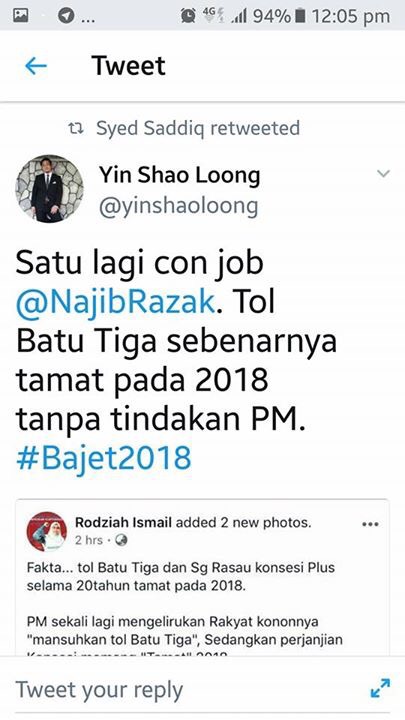
One example is Azmin’s communications director Yin Shao Loong who is unaware that the concession period for the Batu Tiga toll was extended to 2038 and not 2018.

Had the Batu Tiga toll concession period been extended, the rate users would be paying according to the original agreement signed during Mahathir’s period is RM2.40 instead of the RM1.10 users are enjoying now.

In a way, the recent offer by Maju Holdings Sdn Bhd to buy the PLUS Expressway from UEM and EPF and not increase toll rates on the highway for 20 years may have triggered the government’s decision to abolish toll collection at those four highways.  I still hope that the PM could bring all the relevant parties together to discuss the proposal as it surely benefits the rakyat if feasible.

Abolishing the GST

Prior to the introduction of the 6-percent Goods & Services Tax (GST), business owners were charged the 16-percent Sales & Services Tax (SST).  The Sales Tax was a federal consumption tax imposed on a wide variety of goods, and governed by the Sales Tax Act 1972. The Service Tax, also a federal consumption tax, was levied on customers who consumed certain taxable services, and was governed by the Service Tax Act 1975.

GST versus SST (courtesy of Bloomberg BNA)
The SST was a single stage of consumption tax where businesses cannot recover the tax paid on their purchases. This tax will be treated as a cost to business.  However, it was not a transparent form of taxation as many business owners fail to declare their taxes through transfer pricing.  The GST introduces transparency, curbs the inefficiencies, tax-payment and misappropriation issues  of the SST.

This incurred the wrath of big business owners as they can no longer hide actual sales figures to avoid being taxed.

As opposed to the SST where every single item is taxed 16 percent, household items such as but not limited to sugar, flour, cooking oil, vegetables, fish, meat, poultry and services such as healthcare, education, public transport, housing and agriculture land are exempted from the GST.  If there is a spike in the prices of these items, it is the business owners that are to be blamed for marking up prices, and consumers can report them to the KPDNKK.

It is the efficient way to collect tax from businesses that has helped the government to find an alternative form of income when price of oil have gone down tremendously.

Pakatan wants to either revert back to the SST system but has not mentioned how it plans to make up for the loss of income since oil prices cannot be depended upon, or zero-rate everything as per its alternative budget if it decides to keep the GST system, with the option to increase the rates later.

Again, Pakatan is not being transparent to the masses.

120-Day Maternity Leave versus 90-Day Maternity Leave

There are two aspects to look at when talking about maternity leaves.  First, on the employers’ side – a worker that is unable to perform her duty taxes the company as she receives full pay during her absence, and other workers have to double up to do her work.  Second, going by the concept of ‘iddah of a divorced woman – the waiting period is three menstrual cycles or three months.  I did not use the example of a widow’s waiting period because that includes a period to sufficiently overcome a huge part of grief.

Let us compare with other Muslims countries:

Bangladesh – 112 days: 8 weeks (56 days) before delivery and 8 weeks (56 days) after delivery.

Indonesia – 3 months (90 days)

Pakistan – 90 days (45 before delivery and 45 after)

Oman – 100 days (50 days before and 50 days after)

Qatar – 50 days

Saudi Arabia – 70 days

Syria – 50 days

UAE – 45 days

Yemen – 60 days

Pakatan wants to implement 120 days maternity leave, but evidence shows that after introducing a 90-day maternity leave for Selangor’s civil servants, only 30 employees have actually utilised the 90-day leave in full.

Not many took up the 90-day maternity leave provided by the Selangor state government

I guess 90 days about stretches the limit, especially for employers providing 100 percent pay during maternity leave.

TAWAS versus ADAM50

Tabung Warisan Selangor (TAWAS) is a RM100 one-off gift for every child born in Selangor with the hope of accumulating RM1,500 when they are eligible to withdraw the money when they turn 18.  Amanah Dana Anak Malaysia 2050 (ADAM50) is a 200-unit gift in the form of a trust fund for 2.8 million Malaysian babies born from 1 January 2018 to 31 December 2022. The 200 units will be credited automatically in the unit trust funds managed by Amanah Saham Nasional Bhd after the registration process is completed by their parents or guardian.

TAWAS was launched in 2008 as part of fulfilling Pakatan Rakyat Selangor’s manifesto promise. Between 2008 and 2011, RM588,391 was spent on advertising and promotion for TAWAS but less than 20 percent of newborns (60,972 out of 313,706) in Selangor were registered by the end of 2011.

The Selangor state government had no choice but to extend the registration deadline to allow for more participants but as at 22 July 2014, only 159,953 registration was collected.  The total number of live childbirths in Selangor was 421,652 by the end of 2012. By end of August 2017, TAWAS only managed to get 280,568 registrations.

TAWAS started off with funds amounting to RM13.5 million but the state government has had to spend RM22.87 million annually on TAWAS despite getting only 19.4 percent registration.  Why is there a need to spend so much on so few participants?

The Auditor-General reported that TAWAS, which was formed under the Menteri Besar Selangor (Pemerbadanan) through Yayasan Warisan Anak Selangor (YAWAS) failed to submit documents of issuance of Fixed Deposit Certificates (SST) between YAWAS and AmBank to the auditors.

There is no standard operating procedures (SOP) to fix a deadline for the issuance of SST to the participants from the date the registration was made or was approved. Audit checks found that there is no record of actual of issuance and receipt of actual SST to and from participants.

The TAWAS system only provides information on SST that had been prepared by AmBank, furthermore even YAWAS does not have detailed records on the interests received for each of the SST issued,” the report added.

ADAM50 is managed by Perbadanan Nasional Berhad (PNB) which has been managing funds such as Amanah Saham Nasional, Amanah Saham Bumiputra and Amanah Saham Malaysia.  The 200 incentive units and all dividends received on this initial amount of ADAM50 can only be redeemed when the child reaches 18 years of age.

Pakatan cannot even handle a far smaller fund efficiently and it wants to compare itself to a single corporation that handles funds in excess of RM265 billion.  Where has all the millions of Ringgits pumped into TAWAS gone to despite not getting the number of participants it had envisaged in 2008?

The Return of Petrol Subsidies

I won’t even go there. Everyone knows the removal of subsidies is so that it could be chanelled to the target groups instead of providing everyone, even foreigners, with subsidised petrol.

The Pakatan budget plans to subsidise only cars and motorcycles below 1,000cc. Only the Perodua Kancil and Perodua Viva would fit into the given category. How would the petrol pump know what cars are below 1,000cc and which ones are 1,000cc and above?

Other Pakatan Budget Jokes

While the BN government strives to lower taxes Pakatan’s alternative budget plans to introduce, on top of the 16 percent SST, an Inheritance Tax, Capital Gains Tax and increase Personal Income Tax to make up for the loss of income through the abolishment of the GST. Yet the pantywaist Pakatan have the cheek to cry foul and claim that the BN’s budget is oppressive.

So I will leave it up to you to decide whom to choose come GE14.