SAREX LIMA 2015 – The RMAF EC725

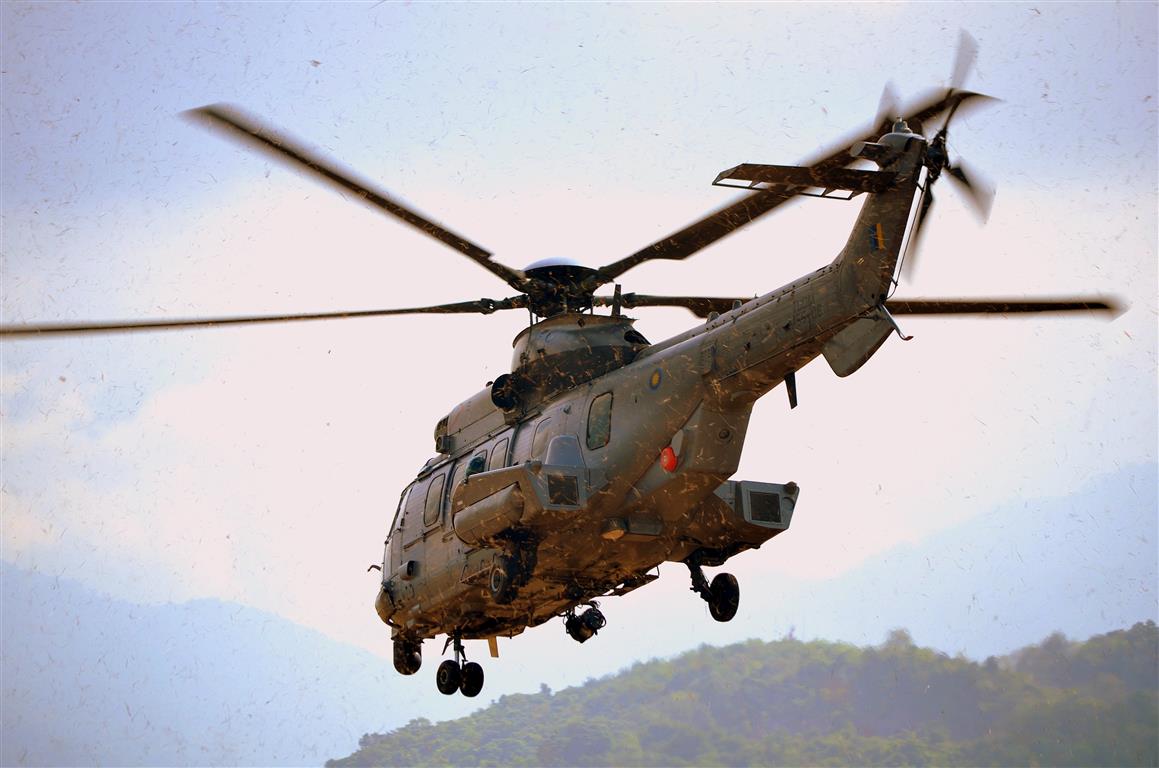
The survivor floats on the surface of the sea, having escaped a plane crash less than an hour ago.  The current here is strong and he drifts farther away from the main group of survivors.  Then he saw a speck of grey flying towards him.  It was a Airbus Helicopter EC725 dubbed the Super Cougar, the new workhorse of the Royal Malaysian Air Force.

Inside the cockpit, the pilot could spot the lone survivor and a few others, drifting towards the open sea.  Thanks to the AHCAS (Advanced Helicopter Cockpit and Avionics System), pilots of the EC725 could do what its predecessor, the Sikorsky S-61A4 Nuri, could not.  The EC725 features a full glass cockpit and the Active Matrix Liquid Crystal Displays ensure the pilots better monitoring of the displays under the glaring late morning sun.

The pilot hovers over the drifting survivor. He is assisted by a digital search and rescue system that provides automatic search patterns, transition and hover. Unlike the Nuri, the EC725 could “drift” along with the survivor as the winch strop is lowered by the air quartermaster.  Although the hover altitude is higher (more than double the Nuri’s), the EC725 managed to pick up the drifting survivor and other drifting survivors in no time, thanks to the powerful twin Turbomeca Makila 1A4 turboshaft engines that features a dual-channel Full Authority Digital Engine Control (FADEC) , something the Nuri was not capable of.  The Nuri would have to fly away after a couple of pick ups to cool its engines off.

The above was the Water Search And Rescue portion of the Search and Rescue exercise (SAREX LIMA 15) in preparation for next week’s Langkawi International Maritime and Aerospace Exhibition 2015 (LIMA 2015).  The exercise was divided into two segments, Water SAR and Land SAR.  SAREX LIMA 15 was to test the Search and Rescue plan and inter-agencies coordination and logistical cooperation.  The aim was to test, assess and improve the Airport Emergency Plan before the commencement of LIMA 2015. The Exercise was held from the 4th to 6th March 2015 and involved among others the Royal Malaysian Air Force, Royal Malaysian Police, Royal Malaysian Navy, the Malaysian Maritime Enforcement Agency, Malaysia Airports Holdings Berhad, the Fire and Rescue Services Department, the Malaysian Marine Department, Ministry of Health, the Malaysian Meteorological Department, the Malaysian Army’s Royal Medical Corps, Malaysia Airlines, Air Asia and last but not least, the Department of Civil Aviation of Malaysia.  Assets that were involved included two helicopters, 11 surface vessels and four jet-skis.

The EC725 takes off carrying critically-injured survivors during SAREX LIMA 15

When met, RMAF’s Chief of Staff (Air Operations) Major General Dato Haji Abdul Mutalib bin Abdul Wahab TUDM said that he was awed by the superb performance of the EC725.  He opined that the EC725 is by far the best search-and-rescue asset he has ever seen, given the capabilities it displayed during SAREX LIMA 15.  This is of course of utmost importance as there are quarters bent on ridiculing military purchases.  Seeing with my own eyes how the EC725 was able to hover effortlessly throughout the exercise brought much satisfaction to me knowing that this was the correct choice made by the RMAF and there should not be any politically-motivated condemnation towards the organisation for purchasing what it should have had for the longest time.

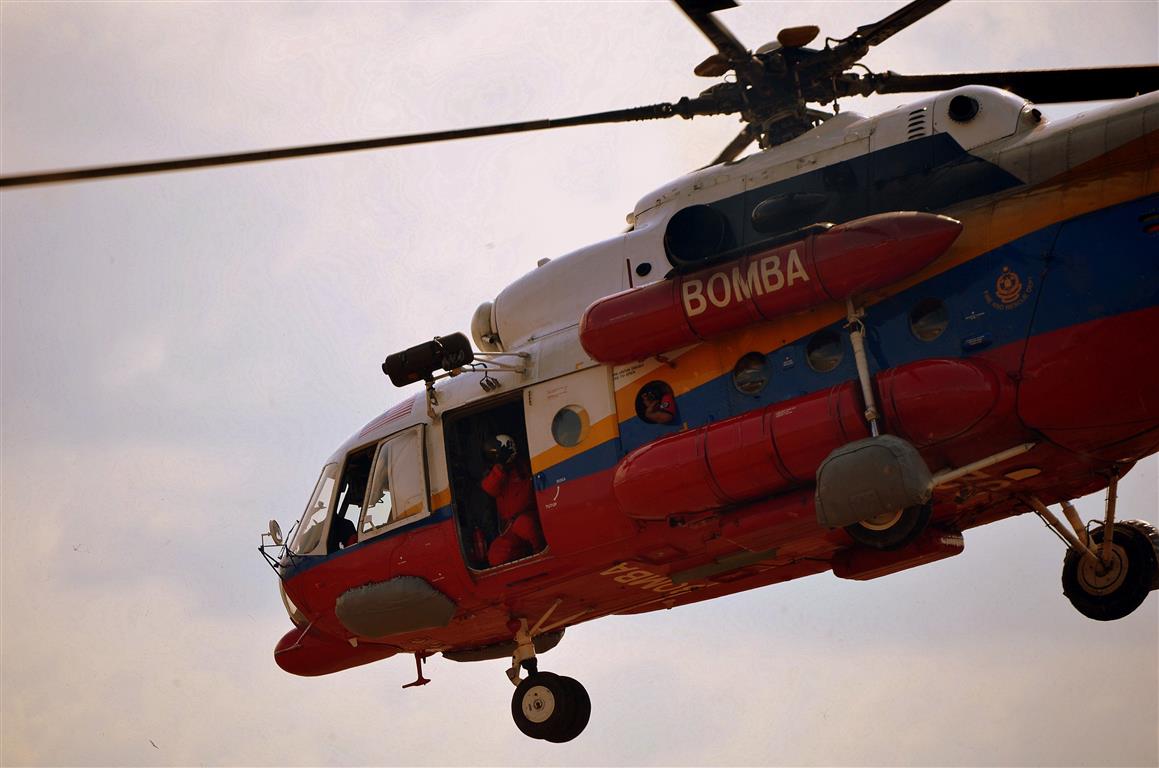
The Fire and Rescue Services Department should also be applauded for a superb medical evacuation exercise task performed at SAREX LIMA 15 using its Mi-171 helicopter.

The FRSD's Mi-171 takes off carrying three critically-injured survivors during SAREX LIMA 15
The FRSD’s Mi-171 takes off carrying three critically-injured survivors during SAREX LIMA 15

It is hoped that the inter-agencies coordination that was put to test during SAREX LIMA 15 will better prepare the emergency services for any eventuality not just for LIMA 2015, but for all search-and-rescue incidents.

Reduced To Ranks

An Indian man displays the indelible ink mark on his finger after casting his vote in Mumbai India - source www.dailymail.co.uk
An Indian man displays the indelible ink mark on his finger after casting his vote in Mumbai India – source http://www.dailymail.co.uk

Another Air Force personnel has been punished after being found guilty of more or less the same case as former Major Zaidi Ahmad. Quoting an unnamed source, the Malaysian Insider reported that Flight Sergeant Jamal Ibrahim “…was not brought to court but was still punished for the alleged offence,” something that I find outrageously absurd.  However, coming from the Malaysian Insider, I am not at all surprised.

The source said Jamal was given an option whether to fight his case in the martial court or be tried by the commanding officer and he chose the latter.
Before this gets blown by idiots who do not understand the system, first of all, whiners should not join the Armed Forces.  If you have problems following orders, get a pound for yourself at the SPCA or at a similar organisation.  Secondly, people are already starting to say that Zaidi’s dismissal from the service versus Jamal’s reduction of rank reeks of political arm twisting.
Zaidi was an officer. Jamal is not.  An officer holds the King’s Commission, an enlisted man does not.  An enlisted man’s rank is given by the service chief. An officer up to the rank of Captain gets his promotion from the Armed Forces Council, while Major and above get it from the King himself, as recommended by the Armed Forces Council.  Which is why you no longer have promotions exams once you have attained the rank of a Major.
So why was Zaidi tried by a court-martial and not given the option to be tried by his Commanding Officer like Jamal?  Why the harsh treatment?
Section 96 (1) of the Armed Forces Act, 1972 clearly states the following:
After investigating a charge against a commissioned officer below the rank of Lieutenant-Colonel or its equivalent, or against a Warrant Officer may, if an Authority has powers under the following provisions of this Part to deal with it summarily, be so dealt with by that Authority in accordance with those provisions
So, why didn’t that authority deal with Zaidi summarily?  Firstly, Zaidi did not have a Commanding Officer. He WAS the Commanding Officer. Furthermore, Section 89 (7) of the Act also mentions that “where an officer is sentenced to imprisonment, he is also sentenced to be dismissed with disgrace from His Majesty’s service.”  As only His Majesty has the power to dismiss an officer, only a Court-Martial could try him.
Jamal on the other hand is a serviceman. A non-commissioned officer. Not even an Appointed Officer or a Warrant Officer, let along a Commissioned Officer.  His Commanding Officer has the choice of giving him lesser punishments as prescribed by the Act including detention of not more than 90 days, or anything lesser.  He was also, at the beginning of his summary trial by the Commanding Officer, be given the choice of either being tried by a court-martial, or by his Commanding Officer.  We know he chose the latter. The normal proceeding would follow, in accordance to the law, with the unit’s Adjutant advising.  On arraignment, he will be read the charge according to the charge sheet and asked for his plea.  I would expect Jamal to plead guilty, given that that would give him a lesser punishment.  With his service taken into consideration, the Commanding Officer gave him the lesser punishment of reduction of rank (demotion, for those not well read) when it could have been any number of days in a gazetted detention center.
So, there you go.  No one was given a harsher treatment.  Everyone was given due process according to the law.  Now, please stop politicising the Armed Forces. That kind of thing is only done by anarchists bent on sowing the seeds of a civil war, unless you are one.
And for those in the Armed Forces, if you think you cannot serve the country apolitically, get out at the earliest opportunity you can get and once you get your NRIC, go ahead and peddle your political agenda.

Conduct Unbecoming

2015/01/img_1121.png

“Loose Talk Could Sink This Ship”

“The Walls Have Ears”

The above are among reminders you would normally see then in a military establishment. Whether or not these reminders are being repeated today remains to be answered. At least such reminders should be repeated in all courses attended by military personnel.

Back in the 1970s, at the height of the Second Emergency, soldiers got killed after wives talked eagerly in public about the husbands going for operations against communist terrorists. Mind you, wives and children are the only people in any military establishment that are never vetted by security agencies.

One such wife was even employed as a typist at one military establishment. For years she mailed the carbon papers of each important military correspondence to the intelligence service of a neighbouring country before she was arrested.

In the late 1980s, 10 officers and men of the Armed Forces were nabbed by military intelligence after they were found to have sold strategic defence files to the intelligence agencies of a neighbouring country. The highest amount paid for a file was USD96,000 for a document on contingency defence plans of a particular state. The rest were defence plans of an Air Force Base, a naval base, and the layout of a military hospital.

In the Armed Forces too you have channels to complain or air your grouses. Your quarters is leaking, you complain to the Facilities Officer. Your mess food sucks, you complain to the Mess Messing Member, or in the case of the other ranks (rank and file if you must), complain to the Duty Officer who is supposed to eat the food you eat with you. Your senior officer has wronged you, the Armed Forces Act, 1972 allows you to seek redress of wrong. Your indelible ink wears off your finger in less than a day, you complain to the Officer Commanding the Administration Branch. Better still, if it is on the same day of voting, you complain to the Elections Commission officers at your place of voting.

There is a reason that you are an Armed Forces member and not a civilian. It means that you are not a civilian. You come from a highly disciplined institution that lives by its codes of rules, regulations, standing orders and orders. You cannot whine like an old lady in public, more so when you are in uniform.

Former Major Zaidi bin Ahmad was a good officer, until the day he appeared in the photo above. He was my junior by two intakes. He was a good pilot. He flew the F-5E Tiger II before progressing to a F-18 Hornet driver, after which he was picked to lead No.12 Squadron (F-5E Tiger II) as its Commanding Officer. He was a quiet man, well-mannered, and according to those who know him, it was no secret that he is a staunch supporter of PAS.

There is nothing about being a military man and have a liking for whichever political party. When I was a serving officer, I told my men that they were free to vote for anyone they wished, but as a member of His Majesty’s Air Force, they should remain apolitical in their conduct.

Granted that Zaidi might have had good intention by talking about his experience with the indelible ink, he went against the Armed Forces Council’s Order No. 13 of 1960. What more, he was wearing his uniform. As a member of the Armed Forces, you are not to talk to the media unless you have prior clearance from the Public Relations Office at both the Air Force HQ and the Ministry of Defence. You might be subjected to unguided and mischievous questions and you might answer wrongly. You might give away more than you should, as the information you are privy to may cause harm to the defence of the nation if leaked whether intentionally or unintentionally.

After the episode above, he was under investigation I presume, and an orders signal was issued for him to be transferred to a lesser sensitive post pending investigation. Each signal (in the civilian world before the advent of the E-Mail is much like the telegram) is either an unclassified document (Pendarjahan TERBUKA), or RESTRICTED and above (Pendarjahan TERHAD ke atas). I would expect the signal pertaining to his transfer was classified as PERSONNEL-IN-CONFIDENCE (SULIT DARIHAL ANGGOTA).

A transfer is normal when one is under investigation. Policemen under investigation are always transferred to “desk” duties. The same applied to Zaidi. Instead, perhaps for political reasons, he decided to show the signal to journalists who do not have the necessary security clearance to be privy to the information on the signal.

One might argue that a transfer order is hardly detrimental to the security of the nation. Well, in this case, maybe it wasn’t. It is not so much the content that is in question but the act of showing any document to those unauthorised to view it. Imagine if his grouses are bigger, I cannot imagine what a Commanding Officer of a fighter squadron, charged with taking care of the nation’s defence, could and would reveal to unauthorised people. That act, to me, shows how this senior officer’s conduct was very unbecoming, and is not trustworthy to be looking after the nation’s defence.  To add insult to injury, Zaidi even sent out an SMS in the form of a political incitement; definitely unbecoming of a senior officer of the Armed Forces.

Was the punishment of being discharged from His Majesty’s service received by Zaidi harsh? My answer is a definite no. Firstly, Zaidi was a senior officer and a Commanding Officer. He was not some less-educated Private or Airman. He was charged under Section 50 (2) and Section 51 of the Armed Forces Act, 1972, for disobedience to superior officer and disobedience to standing orders.

If I may read to you the punishments prescribed by these sections. They read:

Every person subject to service law under this Act who, whether wilfully or through neglect, disobeys ny lawful command of his superior officer/standing orders shall, on conviction by court-martial, be liable to imprisonment or any less punishment provided by this Act.

The scale of punishments for an Officer of the Armed Forces prescribed by the Armed Forces Act, 1972, can be found in Section 89 (2) of the Act. They are:

Death,

Imprisonment to a term not exceeding 14 years,

Dismissal with disgrace from His Majesty’s service,

Dismissal from His Majesty’s service,

Forfeiture of seniority of rank,

Dismissal of an officer from the ship he belongs to,

Fine,

Severe reprimand,

Reprimand,

In the occasion of expense, damage, or loss, stoppages.

In the case of Zaidi’s, the gravity of his offences and his rank and position make only the first four punishments applicable to him.  However, since the death punishment is out of the question, the members of the Court-Martial chose the least: dismissal from His Majesty’s service, meaning that he is still entitled to his benefits.

Is that harsh? Not at all. There have been officers dismissed for lesser offences. Examplary? Yes. And very necessary.

Zaidi no doubt was a good guy. However, his political beliefs led him to do what every officer and man of His Majesty’s Armed Forces should not do: disobey orders and putting the uniform you wear to shame. A King’s Officer does not whine about his grouses in public like a yeast-infected aunt. He should live the organised life of his organisation instead of abusing his uniform for his own benefit. There were channels he could have gone through but no. He thought he knew best and in doing so he did injustice to his family.

He is now a political celebrity, a nicer way to call a donkey in politics. He will now be part of a circus act and may earn a bit from the collection made from the spectators of the nightly circus shows he will be performing in, all in the misguided name of justice. Once the next general elections is over, we hope he would have found a steady job by then.


Making Money Out Of Which RMAF Base?

I don’t know who is The Edge’s source, but this article RMAF Bases Eyed For Multi-Billion Ringgit Property Projects smells funny.

True enough that the Air Force have maade plans to do away with the base in Sungai Besi as it no longer serves a strategic purpose. Most of the units that are there will probably be moved to RMAF Subang and to the new base proposed in the Sendayan area. For that matter, RMAF Kinrara which was strategic as behind it was a rubber plantation (Kinrara estate) and also the Air Hitam forest reserve, very suitable for basic military training, is now surrounded by housing estates. It now houses only a logistics training school and does not have any strategic purpose. I suspect the unit will also be moved to either Subang or the new base in Sendayan.

What about the fighter base in Butterworth? Surely that will go because of profit-making opportunities as it has strategic importance.

Yes, the base has strategic importance. But of late, it too is surrounded by development, so much so that all you need is to be in one of the houses next to it to spy on the activities or shoot down a fighter on finals. Furthermore, Uncle Lim’s tunnel project will have its entrance/exit very near the base. That in itself is a security concern to add to the list above. However, I do not see any of the units there moving anywhere until an alternative fighter base is made ready to receive the units. I don’t see this happening even in ten years time.

I don’t know why The Edge had to list almost all the RMAF Bases as potential property projects as they are on prime development land. I do not see who on earth would consider the base in Jugra or the radar station perched in the middle of that jungle nowhere called Bukit Ibam as prime properties.

Perhaps, the list was made out to create discontent towards the government as the mention of SyedMokhtar al-Bukhary’s name is supposed to create sensationalism. Anything Malay, I guess.

The Edge has gone from a reputable newspaper to another oppo-leaning reading fit for idiots.

Air Power Is National Power – An Essay

This article was submitted to the RMAF PR Department after Defence writer, Danny Liew asked me if I was participating in the essay-writing contest (that I had no idea about). I quickly wrote one in office and mailed it within 2 hours of writing. I could not write much as we were limited to 2,000 words only (if I remember correctly).

It only won a consolation prize (not surprised though due to the lack of effort I made)

…………………………………………………………………………………………………………………….

AIR POWER IS NATIONAL POWER

Background
For most of its beginnings, the RMAF operated in support of the Malaysian Army’s and Royal Malaysian Navy’s operations, before finally gaining air defence capabilities in 1963 after receiving ten ex-RAAF CAC Sabre fighters. 56 years after its establishment and in spite of recent unfair criticisms for its mainly misguided and perceived roles, the RMAF is, still without doubt, a force to be reckoned with.

Operating uniquely a combination of modern European, American and Russian aircraft, the RMAF has a power projection that had gotten a regional neighbour publish a defence white paper to discuss what is believed to be “the first nation to have the capability to strike the mainland in sixty years.” Supported by very capable air defence coverage as well as skilled personnel, the RMAF continues to provide assurance that the sovereignty of the nation will be protected at all costs.

However, does the RMAF have enough appropriate assets to truly assert power projection?

Force Projection– Lessons from the Ambalat and Lahad Datu Incidents

“Force Projection” is a term used to describe a nation’s ability to project power and exert influence on its neighbours at the least, and viably regionally or globally.

During the Ambalat incidents from February through May 2005 saw the RMAF deploying some of its assets from the Peninsula to the East. Given the number of offensive air assets the RMAF possesses, had the conflict gone uncontrolled, it would have been a daunting task to defend both sides of the nation.

We again see a deployment of assets from the Peninsula during Ops Daulat to provide close air support for the ground combatants. The RMAF has been continuously been rotating aircraft on detachments from the Peninsula and this is far from being a feasible way of sustaining force projection.

Air Power

The British definition of air power today is:

The ability to project military force in air or space by or from a platform or missile operating above the surface of the earth. Air platforms are defined as any aircraft, helicopter or unmanned air vehicles.”

The above defines the characteristics of modern air power which provides for national deterrence against possible belligerents. The manner in which the RMAF operations are limited to does not allow for sustainable air power projection.

The factors that define effective implementation of air power include:

Airbases. There should be a network of permanent as well as alternative operating bases. Although much of the grass airstrips in Malaysia have been converted into dwelling as well as golf courses, we are still blessed with myriad small airstrips that can effectively operate smaller aircraft suitable for light-attack and helo operations. Civilian airports in Sabah and Sarawak in particular should provide the opportunity for the RMAF to form and house additional squadrons instead of detachments from the Peninsula to effectively oversee its responsibility to provide adequate air defence for those states. While air-to-air refuelling (AAR) can extend the reach of our fighters as well as their loiter time, planning factors such as distance, demand, duration as well as cost generated by the need for enhanced AAR capability need to be taken into account.

Versatility. Our air assets should also be versatile in its multi-role capabilities with quick turnarounds for other roles reconfiguration.

Air Presence. While “Sentiasa Di Angkasaraya (Always in the Air)” may be the motto of the RMAF, it is prohibitively expensive to continuously provide air presence. Already blessed with a relatively good air defence system, and in light of the MH370 incident, the RMAF may need to tweak its air intercept procedures, provided with better engine hours for its interceptors, and impose upon the Department of Civil Aviation for better airspace management control where the former has a better control of not just suspected hostiles, but also of stray friendlies.

Fragility. As air assets grow in terms of sophistication and performance characteristics, so does those of the anti-air defences. As such, suppression of air defences becomes an important and crucial role for air power. During WW2, DeHavilland produced an aircraft that embraced simplicity in battle-damage repair but effective in performance: the almost-all-wood Mosquito. While wood is more fragile than conventional aircraft material, the fragility of the Mosquito was ameliorated by its speed and superb performance. Likewise, the RMAF would need aircraft that has better speed, low radar signature and good self-protection measures to make up for the fragility due to the enemy’s enhanced air defence capabilities. This will ensure the ability of the RMAF to penetrate deep behind enemy air defence lines.

Good intelligence and Quick Response. Air Intelligence Officers must possess the correct knowledge, attitude and the ability to grasp situations in order to have an effective support for air combat operations. As intelligence is perishable, good intelligence is only good if it can be made to good use by the tacticians and strategists before its value becomes outdated. The Decision-Action cycle has to be in a tempo that supersede that of the enemy.

Stand-Off/Reach. The range of modern air-to-air, air-to-surface weapons, as well as the air platforms that carry them will demonstrate the RMAF’s commitment and resolve. This is an area where the RMAF, in moving forward, need to seek balance in when making future procurements of air assets and materiel.

Sustainability. The RMAF must ensure that its manpower, equipment and logistics are able to command its operational and objective requirements. Sustainability is the ability to maintain its aim as prescribed in the Principles of War.

Principles of War

The Principles of War were developed by Major General JFC “Boney” Fuller based on his experiences during the First World War. Applicable also to Air Power, failure to take into account these hard-won lessons can lead to mission failure. They are:

Selection and Maintenance of the Aim. It is imperative that the aim in which the RMAF plans to achieve its objectives must be carefully selected and defined with clarity. The objectives must be attainable and directed to achieving the intended strategic goals. The commanders at all levels must know how to interpret the aim and what is required of them and the resources made available to them to attain the aim. Therefore, the tasks, roles and missions selected for the air assets must be consistent and coherent with the strategic initiatives to achieve this aim.

Maintenance of Morale. Air and ground assets employed by an air force are useless without personnel that are motivated to achieving the aim. Continual training and maintenance of discipline are equally as important for the men and women of the RMAF as well as having commanders who they can look up to and trust in their leadership in times of war and peace.

Security. It is also imperative that physical protection of assets be of utmost importance against enemy interference. All personnel need to embrace the “need-to-know” and information denial culture. For the latter to occur, good and outstanding commanders who command the respect of his/her men and women play exceptional role in maintaining their morale and in making them understand the culture of information denial.

Surprise. Surprise is essential to achieve mission success and must be applied to at all levels of RMAF activities. Surprise can be achieved through secrecy, concealment, deception, originality, audacity and speed.

Offensive Action. The commander must always employ offensive action to influence the outcome of the campaign or operation. With selection and maintenance of the aim, determination must be set to maintain the initiative and deny the enemy from overcoming the goals. In peacetime, force projection via adequate appropriate assets as well as the availability of correct basing of assets provides psychological offensive action. Hence, the Government needs to see that resources are made available to the RMAF to achieve this aim.

Concentration of Force. It is essential to concentrate superior force against the enemy at the decisive time and place which calls for superior and adequate assets, as well as quick reaction to good intelligence to achieve success in war and peacetime.

Economy of Effort. Decisive strength must be achieved and maintained in order to have concentration of force. Therefore, Economy of Effort demands correct air power weapons and delivery systems to match the tasks.

Flexibility. Flexibility allows the commander to exercise judgment by modifying plans without changing the aim. It demands trust, discipline, good training and quick decision-making.

Cooperation. Better cooperation and coordination with other services can be achieved through joint exercises. This allows for concentration of force and economy of effort against the enemy.

Sustainability. As mentioned, sustainability is about maintaining the physical, spiritual and moral aspects, and the necessary fighting power of the RMAF. Without sustainability, the aim will be greatly jeopardised.

Conclusion

Air Power is important in maintaining the nation’s deterrence from belligerence. The RMAF needs the government’s support in acquiring adequate appropriate assets to maintain that deterrence as it projects the nation’s power.

MH370: Trial By Media

Ever since the disappearance of flight MH370, Malaysia has come under intense flak and have been accused of not being forthcoming nor transparent with information related to the search for and investigation into the flight.

As we all know, the disappearance of the 370 is unprecedented. In past incidents, demands flow when planes are hijacked; debris is found at crash sites. In this incident, we still don’t know how flight MH370 ended, and we can only guess where the plane might be. A coalition of nations is now searching for the airplane, and numerous false alarms have emitted from the search teams, but somehow Malaysia foots the blame for all that.

We cannot be filling in the information gap with fantasies that would lead to even worse form of speculation, but somehow the media, a foreign one in particular, is not contented with what has been presented to them thus far. This particular media even compared the lack of flow of information in the 370’s case with that of the Asiana crash at the San Francisco airport (SFO). Whether or not ethical reporting or common sense are present in that organisation, you cannot compare the 370 to the Asiana crash. Of course information was in abundance in the latter but it is only because it crashed at the airport. In the 370’s, we do not even know where it went down, let alone how! However, it would be futile to argue about ethics with a media organisation that could even fill in the information gap with absurd theories such as the Black Hole and the existence of another Bermuda Triangle.

The hunger for ratings and sensational news gets the best of this organisation. A month after the disappearance, it ran a story to suggest that the Royal Malaysian Air Force (RMAF) had scrambled fighters at 8am on 8th March 2014 to search for the missing airplane. I did a quick check with friends in the RMAF and they denied that fighters were scrambled. This is reinforced by categorical official denials by the Minister of Defence as well as by the RMAF itself.

This media then even suggested that the 370 flew at 4,000 feet to evade military radar near Pulau Perak only to re-appear 120 nautical miles away heading north-northwest. I hope that this media organisation realise that the USAF has spent trillions of US Dollars to acquire stealth aircraft such as the B-2, F-117 and the F-22. If a Boeing 777 could evade from military radar then the USAF was suckered into spending so much when they could have had a much cheaper solution in the 777.

Every time there is a press conference, although the information given, if at all available, is always about the search and rescue effort. However, all the questions posed by journos are about finding out who is to be blamed for the 370’s disappearance. More than twice that I have heard a journalist asking the CEO of Malaysia Airlines, Ahmad Jauhari Yahya, if he would resign. Had the journalists done their homework, Pierre-Henri Gourgeon only left Air France in 2011, two years after the Flight 447 tragedy, and only because of the merger between Air France and KLM.

In other incidents, airlines capped the duration of assistance rendered to the families affected by an aircrash to only one week. This has been more than a month yet MAS is still supporting the families. I am disgusted with people who are so thankless towards MAS despite the fact.

The media should know better that this plane is still missing and not a lot is known about it. As such, information may be scarce and not free-flowing. If there is nothing to be reported, then don’t report or speculate. You won’t do justice to the passenger, crew and their family members. There are other pressing issues that could be covered such as Crimea, the Rohingyas. Running down a country just because it hasn’t given you the information needed to increase your ratings certainly shows your immaturity and malicious intent.

MH 370: Is It Fair To Blame Malaysia By Saying She Was Slow To React?

Prologue

On Sunday, 23rd Monday, 24th March 2014, the Malaysian Prime Minister announced that based on the findings of the UK-based Aircraft Accidents Investigations Board it was concluded that the flight of the MH370 ended in the southern Indian Ocean.

This was met by heavy criticism in particular by families and relatives of the passengers who are in Beijing. This is understandable. As humans, we always cling on whatever glimmer of hope there is that our loved ones will somehow appear unscathed. I went through this when my brother passed away three months ago. I kept thinking that this was all a bad dream and that I would wake up to my brother’s jokes, laughter and hugs again. However, such hope should be balanced with situational logic – the acceptance of reality and that should help overcome the pathological grief a person would have. The sooner one accepts reality, the sooner the trauma will heal.

This pathological grief will get prolonged not only if one refuses to accept reality, but also by irresponsible acts to promote hope. Hope is the act of prolonging the arrival of the inevitable. I will here chide the opposition parliamentarians who call upon the government to provide physical proof that the MH370 had indeed crashed. May I just forcefully drag everyone to the reality that the aircraft cannot fly for 19 days; based on the Doppler effect triangulation the last possible location of the aircraft points to the extremely unforgiving southern Indian Ocean. If anyone, just any one person could survive the extremities of the whole situation, then let us just call that a bonus from God. While hope is good to a certain extent, my only hope is for the black boxes to be located before the batteries run out.

The search for debris is not going to be an easy task even on a normal day. Australia’s Prime Minister has described it as “looking for a needle in a haystack, but having to find the haystack first.” I would take that a step farther by saying it is like looking for hundreds of pieces of one single needle in a haystack that has yet to be found. How is that as a perspective? Now add nine-metre waves with lots and lots of whitecaps into the equation.

I take offence at a statement by representatives of the families in Beijing, as well as members of the foreign media, AND the Quislings amongst us here in Malaysia that we (Malaysia and its military) have murdered the passengers and crew, and that we have either been hiding or not been forthcoming with information or both. Malaysia has been providing all information pertaining to this incident on a daily basis, and even to the extent of sharing sensitive military data that has jeopardised its defence just so to render search and rescue efforts more effective. With the information made available to me as well as by Andak Jauhar’s analysis of the MH370 incident I shall draw a timeline so readers would understand why was the SAR conducted in the South China Sea, when exactly was SAR expanded to the west of Peninsular Malaysia, and how fast did information flow in. All times quoted in this timeline is Malaysian time (UTC +8):

08 March 2014

0041 – MH370 took off from the Kuala Lumpur International Airport with 227 passengers and 12 crew members bound for Beijing with an endurance of approximately eight hours.

0107 – the Aircraft Communications Addressing and Reporting System (ACARS) made its last transmission on the aircraft’s performance. All systems were running as per normal. Next transmission was due at 0137 hours.

0119 – a person believed to be the co-pilot acknowledged the handing over of the MH370 from Malaysia’s Flight Information Region (FIR) to Vietnam’s FIR. His last words were, “Alright, goodnight.”

0121 – the secondary radar at Subang’s Air Traffic Control centre lost contact with the MH370 over waypoint IGARI at 06.5515N 103.3443E, after a deliberate act of turning off the transponder as well as other communications equipment. The aircraft was then at 35,000 feet above sea level. However, the aircraft continues to be tracked by the Royal Malaysian Air Force’s (RMAF) primary radar and had its flight path towards waypoint VAMPI monitored and recorded by RMAF’s Air Defence Centres.

0215 – RMAF’s primary radar consistently monitored the path of the MH370 from waypoints VAMPI, GIVAL before finally losing track of it after waypoint IGREX while flying at 29,500 feet above sea level.

As a Contracting State to the ICAO Convention of 1944, Malaysia assumed the role of the Rescue Coordination Centre under Annex 12 of the Convention for the MH370 Search and Rescue efforts because the MH370 had yet to enter Vietnamese FIR control (its radar had not detected the MH370 yet when she changed her flight path). Based on sightings of debris, the Search and Rescue efforts concentrated at its last known position near waypoint IGARI.

0630 – MH370 was to have arrived in Beijing.

0811 – the last handshake between the MH370’s navigation system and an INMARSAT satellite was made.

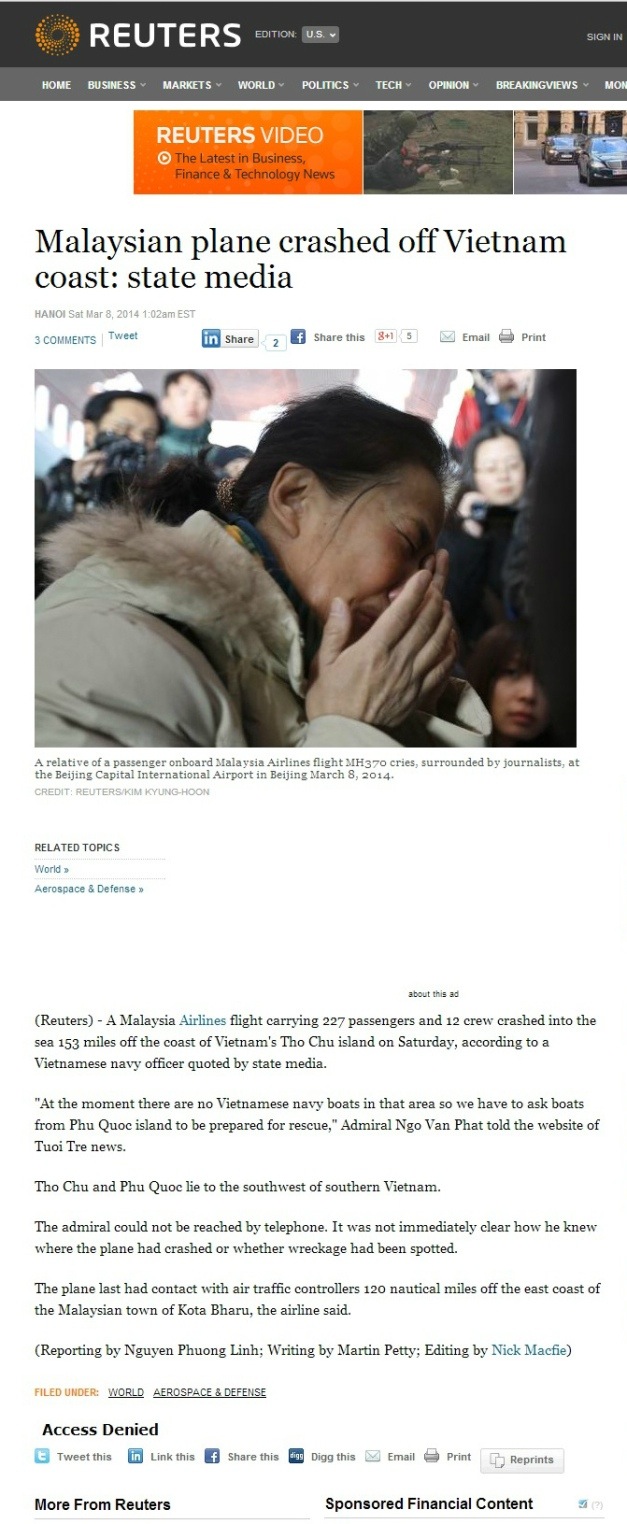
1017 – Rear Admiral Ngo Van Phat of the Vietnamese Navy announced that the MH370 may have crashed about 153 nautical miles (300km) from Tho Chu island, near Ca Mau. This statement was carried by Tuoi Tre News and was subsequently picked up and released by Reuters at 1302 hours, sending SAR assets into the area.

20140326-130701.jpg

1730 – based on the flight path monitored by the RMAF, the SAR effort was also expanded into the Strait of Malacca.

09 March 2014

– search around Tho Chu island failed to yield anything.

– the SAR efforts were expanded into the Andaman Sea. The RMAF’s sensitive radar data recordings have been shared with the SAR authorities.

10 March 2014

1343 – Vietnamese news agency Tuoi Tre reported that a passing aircraft from Singapore spotted an orange object possibly a liferaft or a lifejacket 177km northwest of Tho Chu island. SAR assets deployed later identified this object as a cable wrap.

11 March 2014

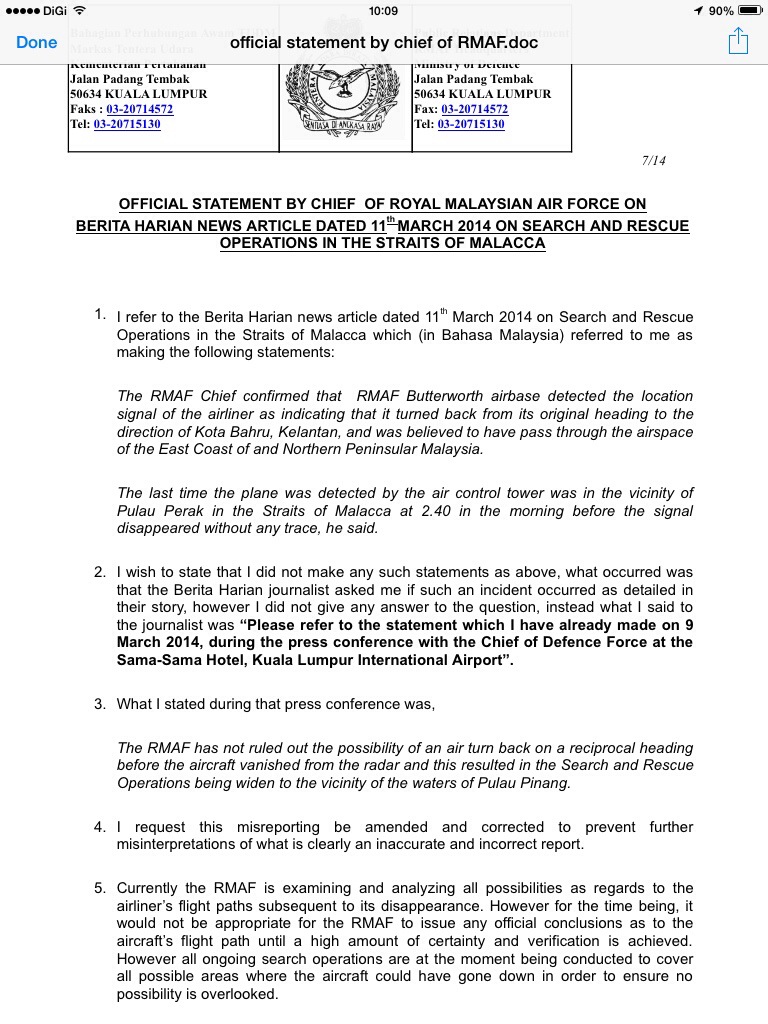
The Malaysian Chief of Air Force issued a press statement refuting a report by the Malaysian daily Berita Harian that quoted him as supposedly saying the aircraft had flown towards Pulau Perak.

20140326-131528.jpg

12 March 2014

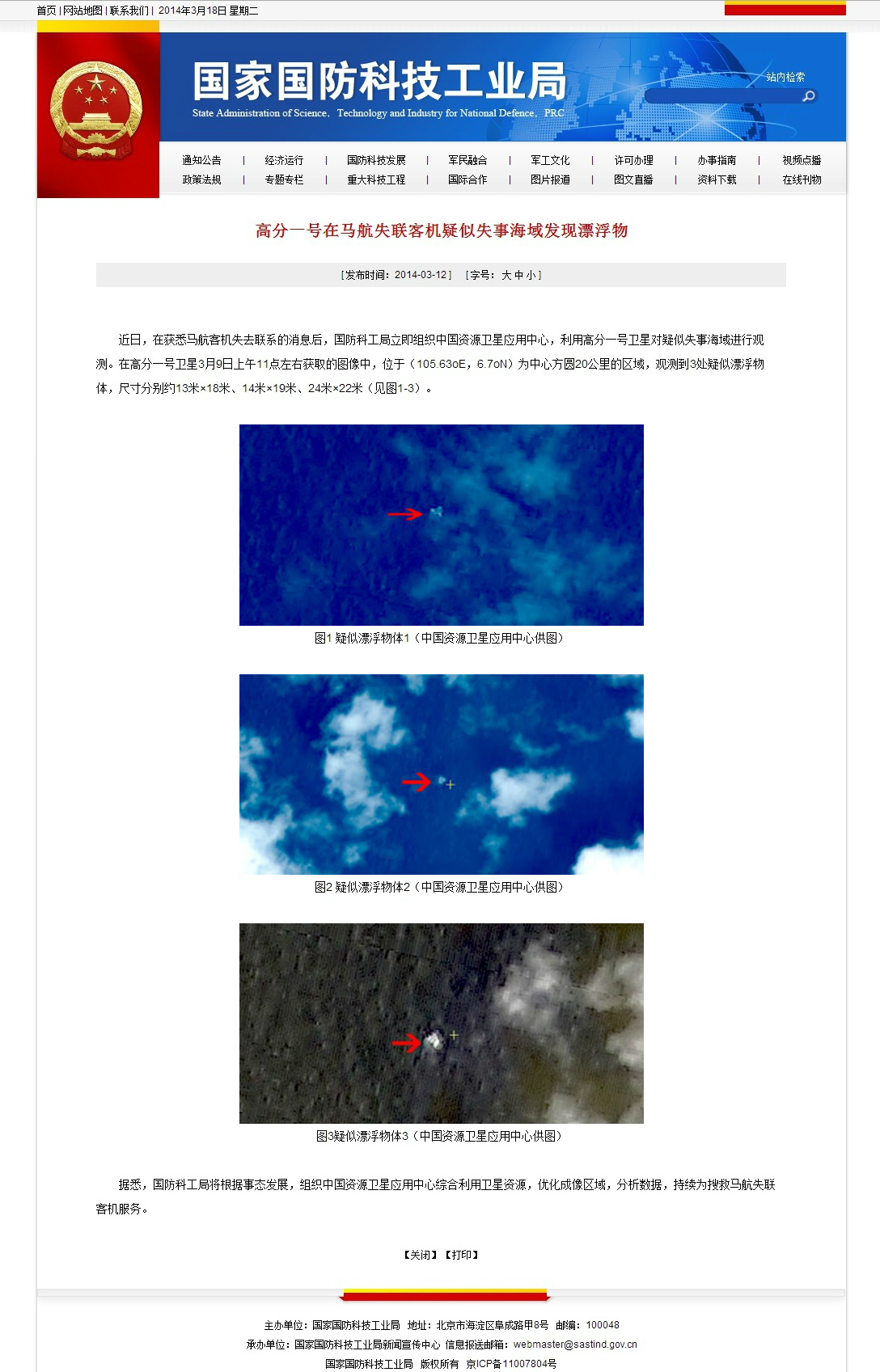
The official website of the State Administration of Science, Technology, and Industry for National Defence of China (SASTIND) showed pictures of three objects spotted in the South China Sea believed to be related to the MH370.  These photos were then shown to the public by the China Central Television (CCTV), Xinhua News Agency, CNN, BBC and also by other foreign news agencies.  According to SASTIND, these images were taken at latitude 6.7N 105.65E at 11.00am on 9th March 2014.

SASTIND website showing debris thought to be related to the MH370

Hence, SAR assets were again sent to verify the findings which we now know were false sightings, but not before more time and concentration of vital resources have been wasted.

14 March 2014

– search was expanded into the Indian Ocean.

15 March 2014

The Malaysian Prime Minister announced that the object tracked by the RMAF’s primary radar was indeed the MH370. This conclusion was made based on processed data acquired from INMARSAT and concurred by the FAA, NSTB, AAIB and the Malaysian authorities.

20 March 2014

The Australian Prime Minister announced satellite images showing large debris in the southern Indian Ocean. The image was taken four days earlier.

22 March 2014

The Chinese government announced that its satellite had found debris in the southern Indian Ocean. That image too was taken four days prior to the announcement.

24 March 2014

The Prime Minister of Malaysia announced that based on triangulation of handshakes between the MH370 and satellites, the flight ended in the southern Indian Ocean.

The rest is academic.

Epilogue

The timeline displayed above shows how Malaysia has, from Day One, been moving as fast as it could to get to the correct pointers only to be side-tracked by false and unverified sightings.  Malaysia has also been sharing everything, and literally everything including data of its sensitive military capabilities, as well as air bases so the search and rescue effort would benefit the best out of the information made available to them by the Malaysian authorities.

The timeline above also displays the average time of four days needed for satellite images to be processed before they can be safely suggested to the search and rescue teams.

What the timeline above suggests is that while the authorities are working hard to find the missing aircraft, the families as well as the public in general ought to exercise patience and restraint in their quest to know what happened. The media should be more responsible in reporting the incident as well as the search and rescue efforts as not only will the effects be adversely negative, but irresponsible reporting provides false hopes to the family that are put on an emotional roller-coaster ride on a daily basis.

And to those who call themselves Malaysians but continue in bashing whatever effort the government offers in bringing this episode to a closure, I doubt you qualify even a place as a zoological display for despicable animals.

Shame on you.

MH370: I Speak Out

20140319-225404.jpg

This posting is made with the above in mind. A lot has been said about the disappearance of the MH370. Most of what has been said are purely speculations, with some that might have qualified to be nominated for best screenplay at the Academy Awards. I, too, have some idea of what might have happened but I put them aside so I could listen to the daily press conference with an open mind. I will also attempt to maintain some form of ethics because I also have the feelings of the family of the passengers and crew in mind when I write this.

The Royal Malaysian Air Force (RMAF) has come under intense attack by both foreign and local media alike. The Air Defence system has also come under intensive fire by members of the opposition party for its failure to detect the MH370 upon deviating from its intended path and the subsequent failure to scramble our fighters. Some even say our air defence personnel were asleep on the job, and that at least one air defence radar was not working.

It is easy for keyboard warriors to criticise the RMAF without knowing what or how our air defence systems work. Perhaps when they think of an air defence system, they had the following in mind:

20140319-230523.jpg

Why I write this is to give a general understanding of how our air defence system works, and what really happened that night. I have been generally quiet on this matter as at the time of writing, I am grieving the passing of my younger brother exactly 100 days today. But duty calls, I guess.

I left the RMAF almost 20 years ago. A handful of my squad-mates are still serving senior officers. Back in September 2012, a number of bloggers (including I) and some senior editors of the Malaysian media (including those that are opposition-leaning) were invited to a media open day organised by the then Minister of Defence. Everything was displayed to us, including some of the very sensitive information, so that we could acquire enough background and understand how the RMAF works. Out of the 80 or so people who were there that day, I guess I am the only one to come to the defence of the RMAF.

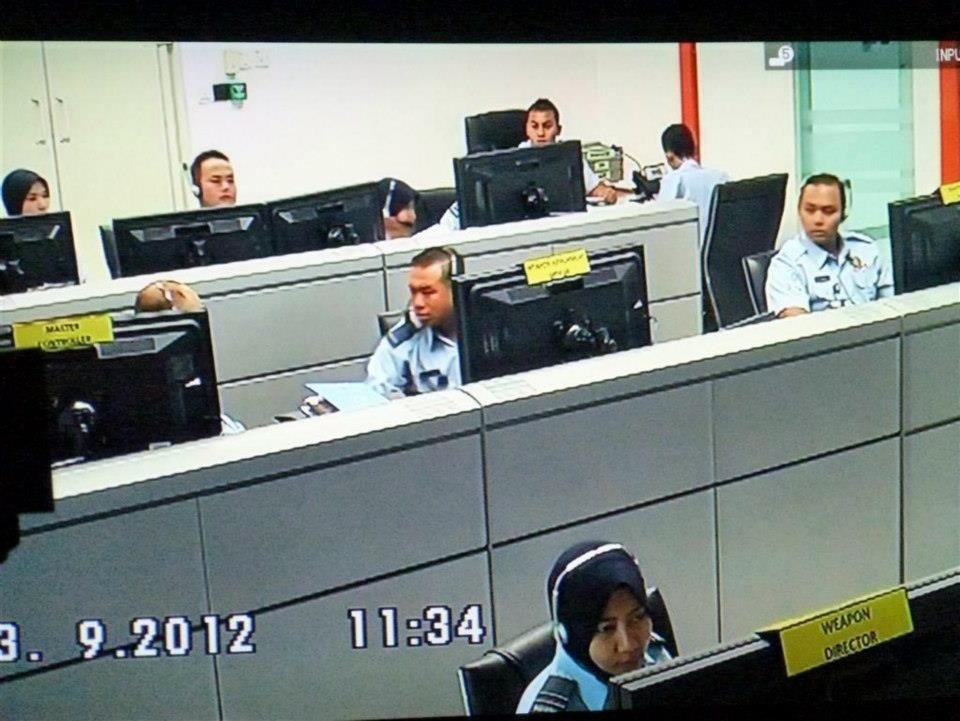
First of all, this is how a typical air defence centre looks like from the inside:

20140319-231314.jpg

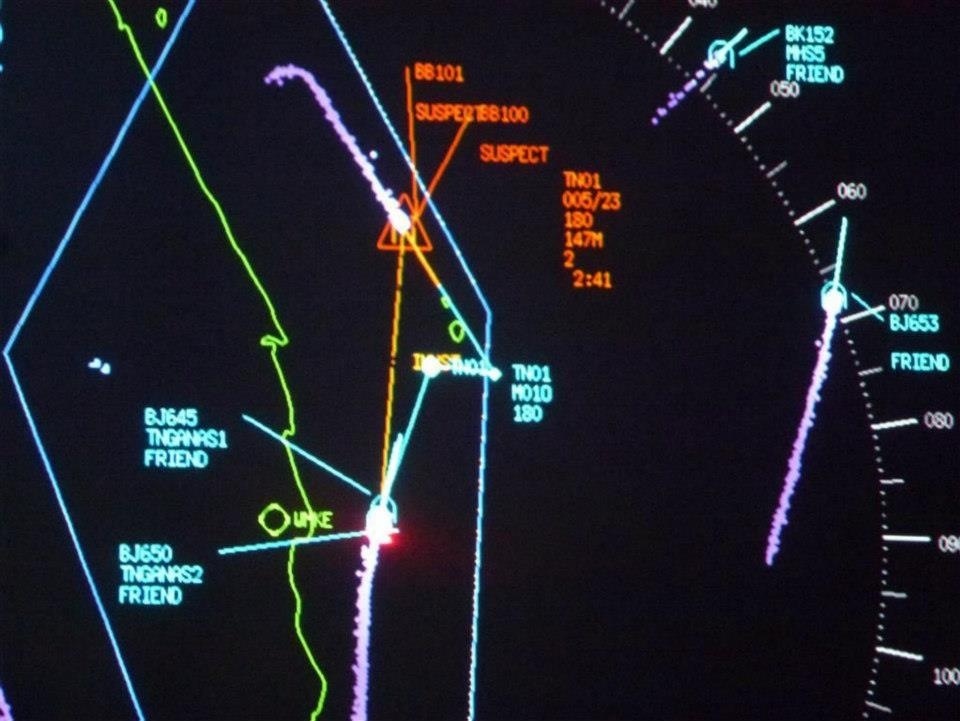
It is no longer the one-man show you see in the movie “Tora! Tora! Tora!” There are several air defence centres around Malaysia covering both the Peninsula, Sabah, Sarawak and FAR beyond. I have a photo of how far our air defence radars reach, but although I was allowed to take photos of the main display, I opt not to put it up here. Suffice to say, what we have is enough to tell us way ahead if a hostile aircraft is approaching our airspace. When we were at the air defence centre, we were shown a live interception of two bogeys by two of our MiG-29N interceptors.

20140319-231902.jpg

If I may say, what we all saw on the screen was what would have been seen by all the operators of the other RMAF Air Defence Centres around the nation that if one failed, it would not jeopardise what the others could see.

During this display, not one journo nor blogger could come up with a sane question related to what was shown to them. In the end, I and a few of my blogger friends had to ask the questions to get the RMAF clarify on issues that the media and bloggers have been attacking them on. Even the Deputy Chief of Air Force, Lieutenant General Dato Seri Haji Roslan bin Saad thanked me for my participation and for helping the RMAF clarify some issues.

Let us go back to that wee hours on Saturday, 8th March 2014. MH370 took off from Kuala Lumpur International Airport at 0041 hours (Local Time). At 0107 hours, the Aircraft Communications Addressing and Reporting System (ACARS) transmitted that all was well with the aircraft.

The aircraft soon after arrived at waypoint IGARI, about 78 nautical miles from Redang island, bearing 056 degrees) which is a point in the South China Sea between the Malaysian border with Vietnam. At this point, Lumpur Flight Information Region (FIR) would hand over the control aircraft to Vietnam. At 0119 hours, a person believed to be the co-pilot transmitted the final vox transmission, “Alright, good night.” At 0122 hours, the aircraft disappeared from secondary radar coverage without any distress call suggesting its transponder had been switched off by someone on the flight deck. However, it was only at 0240 hours that Malaysia Airlines was notified.

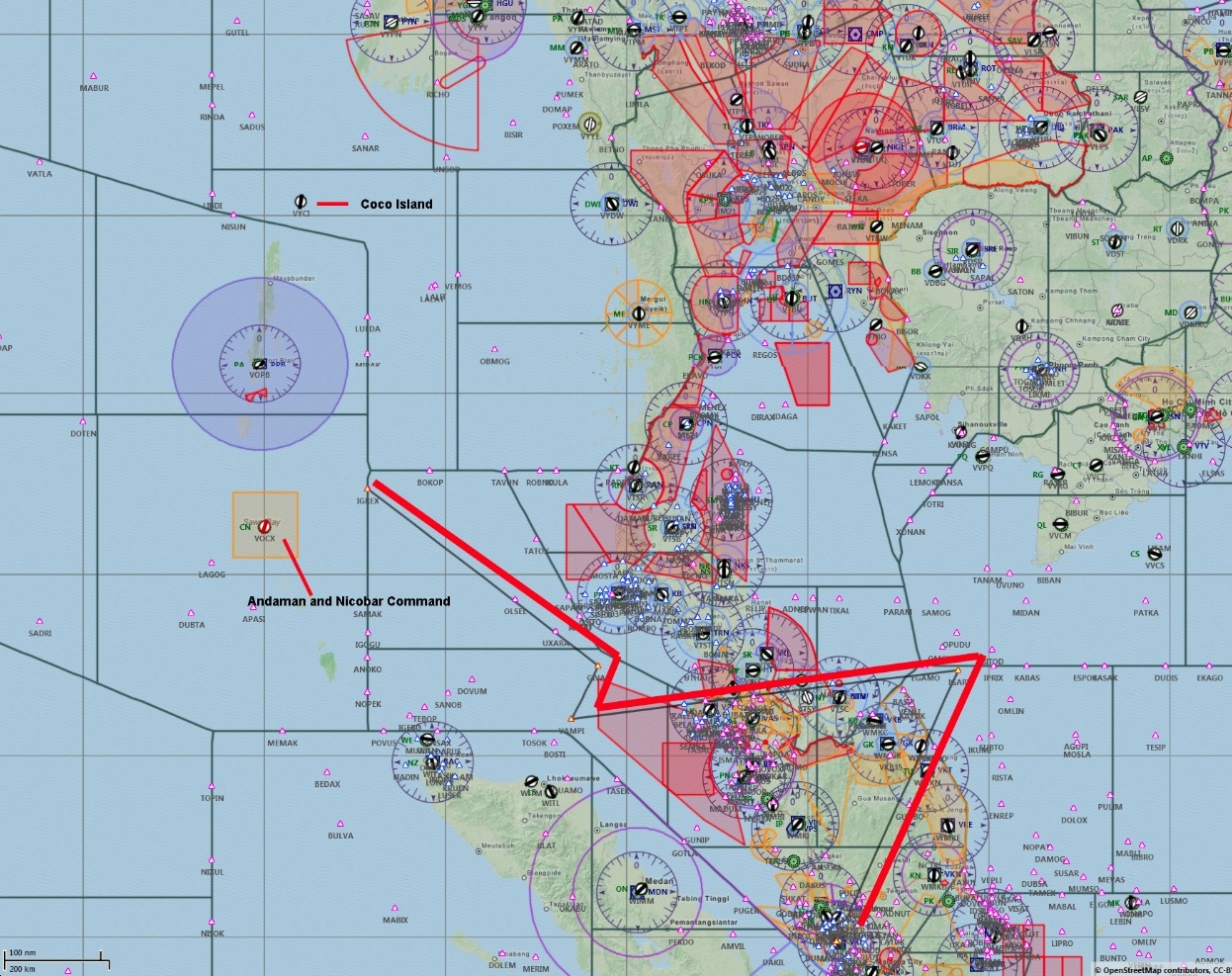
The RMAF Air Defence radars saw the MH370 tracked West Southwest to waypoint VAMPI (68 nautical miles East Northeast of Lhokseumawe, Indonesia), then Northeast to waypoint GIVAL (69 nautical miles South Southwest of Phuket International Airport) before tracking Northwest towards waypoint IGREX (100 nautical miles East Southeast of Car Nicobar airport on India’s Nicobar Islands), the last known position according to the primary radar. Where MH370 went to after this point is unknown at this point, but I believe the Indian Air Force’s Andaman and Nicobar Command’s primary radar there would have caught the MH370 in its scope.

So, if the MH370 was seen to deviate from its intended course, why didn’t the RMAF scramble its fighters to intercept the airliner?

Every bogey (unknown aircraft) would be tagged by an Air Defence Officer and this data will be processed to ascertain whether it was a threat to air defence or otherwise. In the case of the MH370, it was not regarded as hostile. Is this a weakness on the part of the RMAF? Mind you three jetliners took down the World Trade Centre towers as well as the Pentagon in the sophisticatedly-defended United States of America.

Should our fighters have been scrambled? If you remember, the MH370 was no longer in our airspace. When the MH370 tracked West Southwest from IGARI to VAMPI, she did not cross Malaysian airspace. She flew over Thai airspace and into Indonesian airspace, then tracked up to GIVAL near Phuket and subsequently to IGREX near India’s Nicobar Islands (see below).

20140320-001239.jpg

When she tracked from IGARI to IGREX she entered an area with two Royal Thai Air Force fighter bases namely the RTAF 7th Wing in Surat Thani and the 56th Wing in Hat Yai. They, too, were not scrambled. Nor were the fighters of the Indonesian Air Force (TNI-AU) scrambled from Lhokseumawe or Banda Aceh in Aceh, or Suwondo in Medan. If you think the Indonesians are as incapable as the RMAF, they forced a US military transport down without scrambling their fighters at their base in Banda Aceh on 20th May 2013 for entering Indonesian airspace without proper clearance.

The Chief of Air Force, General Tan Sri Dato Seri Rodzali bin Daud have explained that the RMAF did not see the need to scramble its fighters as the blip on the primary radar was deemed not hostile, and that there was nothing wrong with the air defence system. I just find this attack on the RMAF as another cheap publicity shot by a bunch of losers who do not know how things work and why, and would just take pot shots and see what gets hit.

I know the RMAF I see now is a far advanced RMAF than the one I left almost 20 years ago, and I have faith in the officers, men and women in their capability to defend this nation. I cannot say the same for the group of losers bent on hitting out at any institution of His Majesty Yang DiPertuan Agong.

To these losers, please just STFU!

20140320-003529.jpg

MilOps Lahad Datu: Now Every Critique Can Fly…Kites

Those with keyboard military experience playing Command & Conquer et al are now asking why are our troops being flown using Air Asia aircraft. Lots of criticisms fly here and there accusing the armed forces of not having the capability to support such an operation…and this coming from the same group of people who questioned military and police purchases of new equipment.

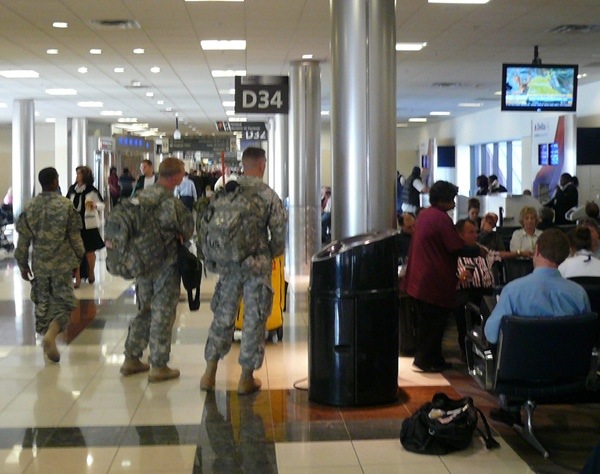
First of all, it is normal for the military to utilise civilian aircraft to support operations, even if there is no critical operations taking place. The military has been using Malaysia Airlines for as long as I can remember, even when I was still a serving officer. Now, Air Asia is being contracted to ferry military personnel.

In this operation for Sabah, you need to move two infantry battalions from the Peninsula to Sabah, and move them in the quickest and fastest manner. All war materiel will be transported using the RMAF’s C-130 transport aircraft. You cannot transport armoured personnel carriers, artillery pieces in large numbers if the C-130 is filled with infantrymen. Logistically, an army has to arrive with its firepower at around the same time. You cannot deploy an army that is still waiting for its equipment.

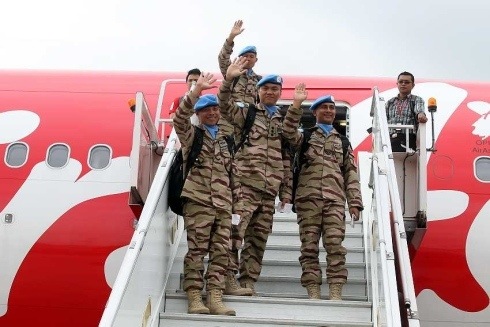
Look at the picture below of our men leaving for Lebanon. What aircraft do you think carried their equipment?

20130304-193511.jpg

And what did the British use to transport their men and materiel to the Falklands?

20130304-193642.jpg

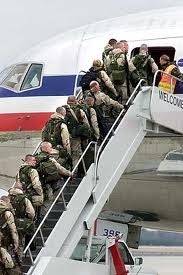
And what do the Americans use for deployments to Iraq and Afghanistan? The soldiers below are not at an Air Force base:

20130304-193746.jpg

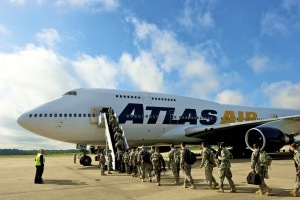
And how did they fly?

20130304-193846.jpg

20130304-193916.jpg

Come on, people! Most of you are learned lawyers and what-nots, but the way you think is just like a fourth grader. Use your brain if you actually have one. Stop whining, push politics aside and start supporting our men and women in blue and green because the closest you have been to going to war is only when you shout buckets-of-political-shit rhetoric and you are nowhere near the tenth percentile of being as brave as these men and women are.

So, just shut your trap if you have nothing good to say about them! Because you all sound like yeast-infected whiny old hags.

Defence Should Not Be Politicized

Hardly a week prior to this posting, there was a medical evacuation flight for two civilian patients made by the Royal Malaysian Air Force from Tawau to Kota Kinabalu.  Fuel cost for the flight alone, made using one of the RMAF’s workhorses, the Sikorsky S-61A4 “Nuri” helicopter, would have cost around RM6,500.  That is for just that one flight, let alone keeping all our aircraft airborne-ready to protect our airspace from intruders.

You may call me bias, as I was once part of the Air Force, but the organization is extremely proud of its capabilities.  And recently, the decision by the Air Force to allow alternative media practitioners a “no-holds barred” open day session at the RMAF Base Kuantan proved successful in answering many of the peculiar questions about the nation’s defence spending.  I was honoured not only to have been invited along by the Minister of Defence, but also for being able to help clarify certain things based on my experience to other bloggers.

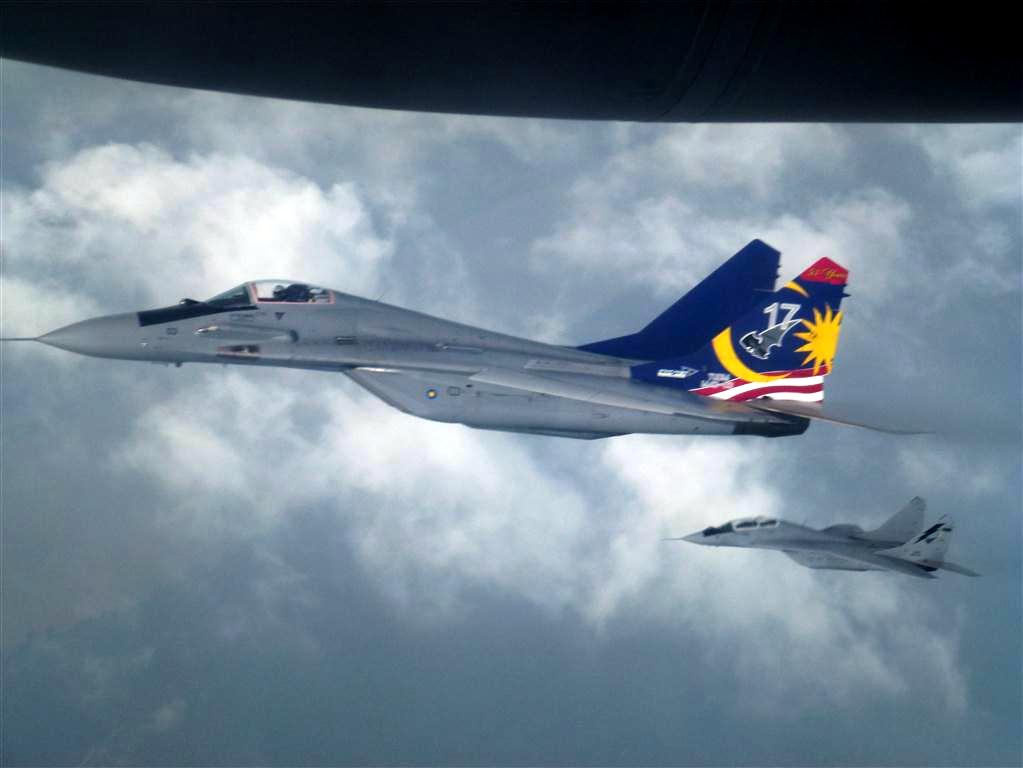
Two Mig-29N interceptors from No.17 Squadron initiating the “Forced Down” maneuvers

For the first time (probably) in the history of the Armed Forces, the Air Force allowed civilians a peep into its daily life, and were allowed to question anything from operational capabilities right to the case of the missing F-5E engine.  And it was a good thing that the Minister and the Air Force were very open in answering each question.

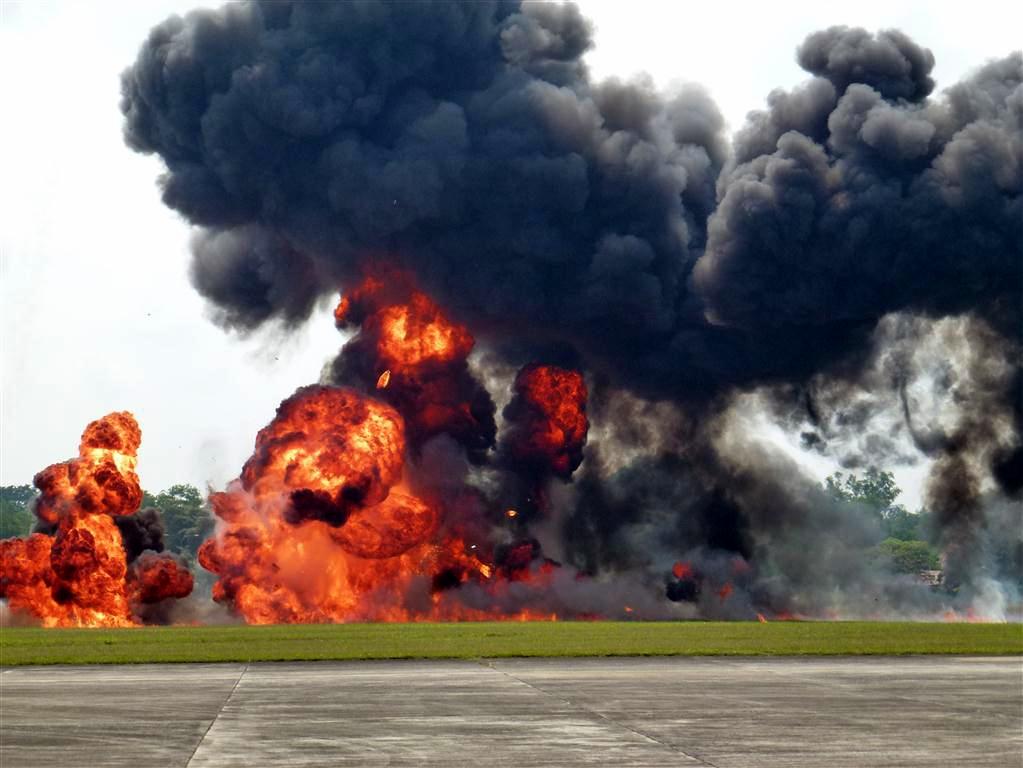
A “target” being hit by BAe Hawk 206 close air support aircraft after being “painted” with laser-targetting device employed by the RMAF Commandos, the PASKAU

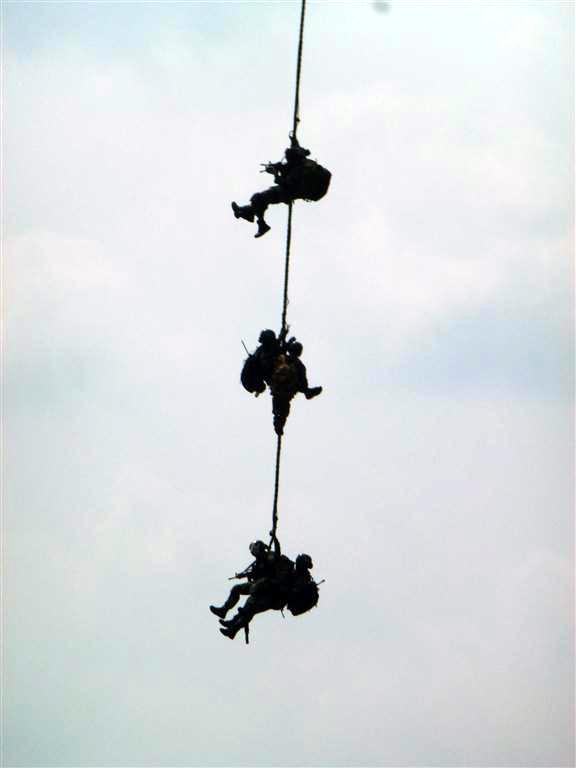
The bloggers were first taken to the Air Movement building where they were given a briefing of the activities ahead while having breakfast.  They were then taken to a static display of aircraft operated at the RMAF Base Kuantan.  They were shown the types of air interdiction missiles as well as air-to-ground munitions used by those aircraft.  Next, a section of the RMAF Commandos, the PASKAU, jumped off from 10,000 feet in a HALO (High Altitude Low Opening) formation to land in the center of the airfield where they employed a laser-targetting device to guide laser-guided munitions from the BAe Hawk 206 aircraft towards a target.  Having achieved their objective, two S-61A4 Nuri helicopters flew in tactical formation at tree-top level to extract the commandos via the SPIE-Rig (Special Purpose Insertion/Extraction) method.

Members of the elite PASKAU unit being extracted using the SPIE-Rig method

Next, the bloggers were divided into two groups.  I was in Group ‘A’ together with the Minister, Deputy Chief of Air Force, and blogger Big Dog where we were taken to the No.17 Squadron, home of the Smokey Bandits (Mig-29N).  There, we witnessed scrambling of Alert 5 aircraft that were sent to intercept two inbound bogeys (unknown aircraft) entering Malaysian airspace.  The term Alert 5, for the uninitiated, means from the point the scramble siren is sounded until the aircraft is airborne, takes five minutes.  There are, of course, different levels of interceptor aircraft readiness.

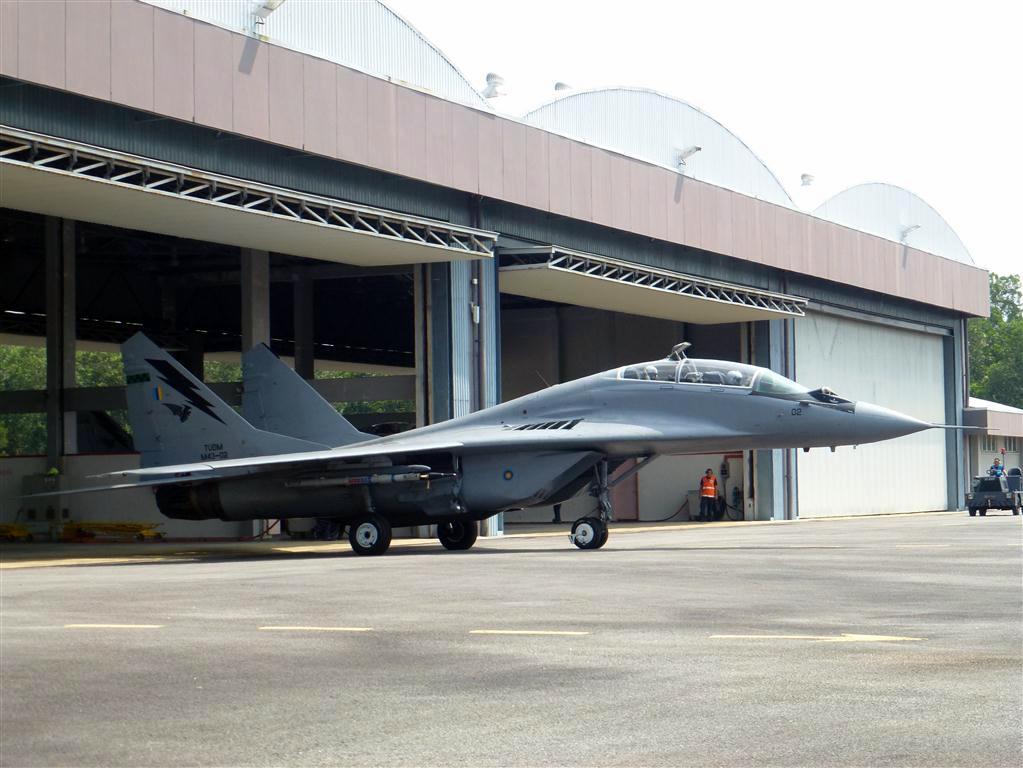
“Taufan Ganas 2” of the No.17 Squadron scrambles to intercept bogeys entering our airspace

Next we were brought to the No. 320 Sector Operations Squadron Center.  This center is one of the centers that have the whole view of what is happening in and around our airspace.  It is a superior version of what I used to see almost two decades ago and I must say I am proud of how the Air Force has spent its money.  It is both my hope and that of the Air Force’s that the Government would allocate funds for Airborne Early Warning and Command (AWACS) aircraft to further enhance this capability.  On the question of frequent intrusions to the south of the Peninsula, it is obvious that the RMAF is very well aware of what is going on there, and suffice to say, having seen the capabilities of our radar defence system, that it is not true at all what some Members of Parliament, in particular from the Opposition, have been saying.

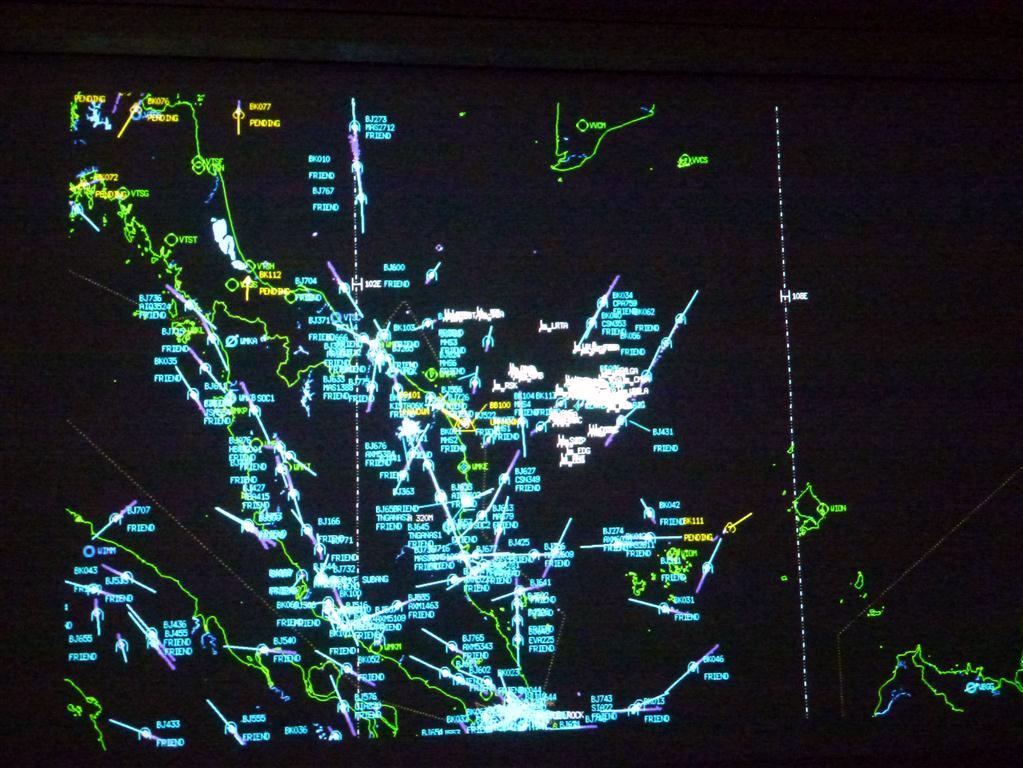
Real-time feed of all the aircraft inside our airspace, monitored by the No.320 Squadron. This image can be zoomed in to see each individual area

With the addition of the Air Combat Maneuvering Instrumentation system our pilots have tripled their kill ratio compared to what it was back in the late 1980s and early 1990s.  Back then, our Air Force was already a force to be reckoned with.  Now, as in the words of a squadmate of mine who is associated with the ACMI system:

“You can run, but you cannot hide!”

The visit at the RMAF Base Kuantan ended with a visit to the training facilities developed locally by or in co-operation with local defence players.  These facilities have produced world-class skilled officers, men and women in order to protect us better.  Lunch was served at the Air Movement building where the Minister answered several questions pertaining to the Air Force, including debunking of claims that very senior officers of the Air Force are involved in the case of the missing F-5E engine.  It is clear now that the Opposition does not want the case to be tried by the Courts Martial because they have a lot to hide, and are trying to divert attention by framing others.

The Minister also asked for both mainstream and alternative media practitioners to be fair to the Armed Forces, and not politicize defence spending.  This is in light of the Opposition ridiculing the Armed Forces, especially in the Scorpene submarines case, that has somewhat affected the morale of the men and women of our Armed Forces.  When their claims of the Scorpenes not being able to dive was debunked live during LIMA 2011, they went to town with the costs of procurements and expenses.

I am sure they will never question the RM6,500 fuel cost for the S-61A4 Nuri medical evacuation flight last week had it been one of their family members being flown for medical treatment.  Therefore, stop politicizing our national defence.

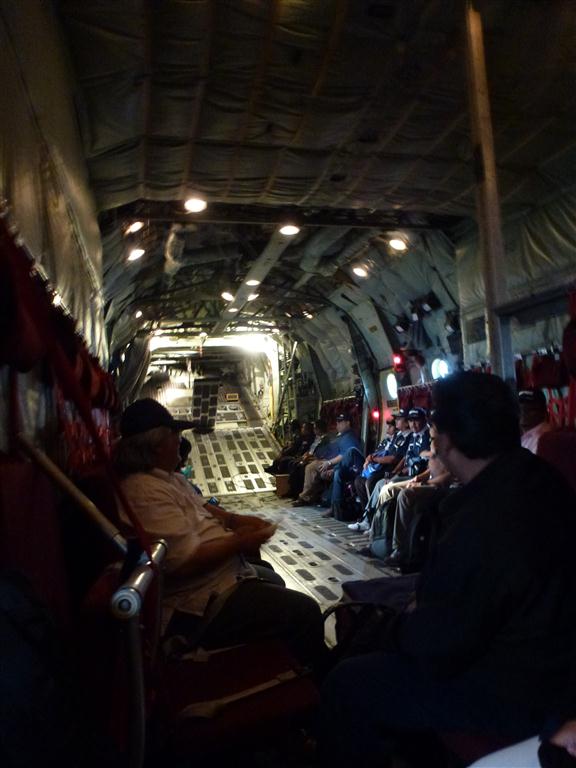
Inside the C-130H transport aircraft