Having found a partner-in-crime in Mahathir, Lim Kit Siang pushes aside all allegations that he had made against the founder of the Pribumi party.
Three years on, as the DAP Parliamentary Leader still owes the people of Sabah an answer pertaining to Mahathir’s involvement in the IC-for-vote scam otherwise known as “Project IC” or “Project M.”
I am not making this up. I am merely asking Lim Kit Siang if, now that he has Mahathir’s ears, the allegations he had made against the latter are true, or if he had been misleading the Sabahans especially in a scam of his called “I-Lie-For-Votes”?
—-———————————
KUALA LUMPUR, 21 JAN: Rakyat bukan setakat tidak yakin terhadap integriti institusi negara, malah pertikai iltizam kerajaan Barisan Nasional (BN) terhadap dasar 1Malaysia terhadap fitnah bekas Perdana Menteri paling lama memerintah, Tun Dr Mahathir Mohamad kepada Bapa Malaysia, Tunku Abdul Rahman dan satu juta warga generasi Merdeka apabila cuba menjustifikasikan Projek IC atau Projek M yang melakukan jenayah dan pengkhianatan “kewarganegaraan-untuk-undi” di Sabah bagi mempertahankan kuasa UMNO di negeri itu.
Ketua Parlimen DAP, Lim Kit Siang berkata, Perdana Menteri, Datuk Seri Najib Razak sepatutnya membersihkan nama Tunku Abdul Rahman, bapanya sendiri Tun Razak dan satu juta warga generasi Merdeka daripada fitnah Mahathir itu.
Katanya, Mahathir juga sepatutnya menjawab kepada rakyat Sabah dan Malaysia mengapa beliau hidup di dalam pembohongan selama dua dekad iaitu 10 tahun sebagai PM dan 10 tahun selepas bersara apabila menafikan kewujudan Projek IC atau Projek M yang melakukan penipuan “kewarganegaraan-untuk-undi”.
“Persoalannya, bagaimana rakyat Malaysia mahu melihat dasar 1Malaysia Najib sebagai sebuah dasar yang serius bagi menjadikan Malaysia yang lebih berdaya maju, lebih produktif dan lebih berdaya saing apabila usaha pembangunan bangsa bukan saja oleh Tunku Abdul Rahman, juga satu juta warga generasi Merdeka diperkecil malah difitnah seperti yang dilakukan Mahathir.
“Mahathir mendakwa Tunku melakukan sesuatu yang lebih teruk daripada Projek IC atau Projek M apabila memberi kewarganegaraan kepada sejuta warga semenanjung Malaysia yang tidak layak,” katanya dalam kenyataan media mengenai Pengiraan Detik 82 hari ke PRU-13, semalam.
Kit Siang yang juga Ahli Parlimen Ipoh Timur berkata, matlamat 1Malaysia adalah untuk menjadikan Malaysia lebih berdaya maju, lebih produktif dan lebih berdaya saing, dan kemuncaknya sebuah negara yang hebat: sebuah negara yang diharapkan agar setiap warga Malaysia melihat dirinya terlebih dahulu sebagai rakyat Malaysia, dan kemudian barulah melihat dirinya berdasarkan bangsa, agama kawasan geografi dan latar belakang sosial, dan juga sebuah negara yang diharapkan agar prinsip 1Malaysia dijalin dalam struktur ekonomi, politik dan sosial masyarakat.
Menurutnya, Rakyat Malaysia sekarang bingung dengan jawapan Najib selepas mesyuarat Majlis Tertinggi Barisan Nasional Khamis lalu mengenai pendedahan penipuan “kewarganegaraan-untuk-undi” oleh Suruhanjaya Siasatan Diraja (RCI) mengenai pendatang tanpa izin di Sabah dan reaksi Mahathir.
“Sebenarnya, Najib tidak katakan apa yang lebih penting daripada yang beliau katakan iaitu masih awal untuk membuat kesimpulan daripada RCI memandangkan ia masih di peringkat permulaan dengan 167 lagi saksi akan dipanggil, Najib juga berhati-hati mengelak memberi komen kepada fitnah Mahathir terhadap Tunku serta satu juta warga generasi Merdeka.
“Adakah ini bermakna Najib menyokong fitnah Mahathir bahawa Tunku memberi kewarganegaraan kepada sejuta warga tidak layak iaitu bukan saja mengaitkan Bapa Malaysia tetapi juga bapa Najib, Tun Razak
“Saya harap Najib segera membersihkan bukan saja nama Tunku tetapi juga bapanya, Tun Razak dan menjauhkan dirinya daripada fitnah Mahathir itu,” katanya.
Katanya, klip video terkenal “Listen, listen, listen!” Sharifah-Bawani adalah bukti terkini berterusan dan bahaya tersembunyi pusaka 22 tahun pemerintahan drakonian Mahathir, mendedahkan kepalsuan dakwaan bahawa pemerintahan Najib membuang segala beban lampau yang bersifat Mahathir dan kini menganut kepercayaan “Era kerajaan tahu semua telah berlalu”. – Roketkini.com
——————————
I would like to call upon Malaysians now to ask Lim Kit Siang if Mahathir has answered him, and make the answer known to us all, especially the Sabahans, in the mass and electronic media.
Lim Kit Siang can read the original article here in case he is absent-minded.
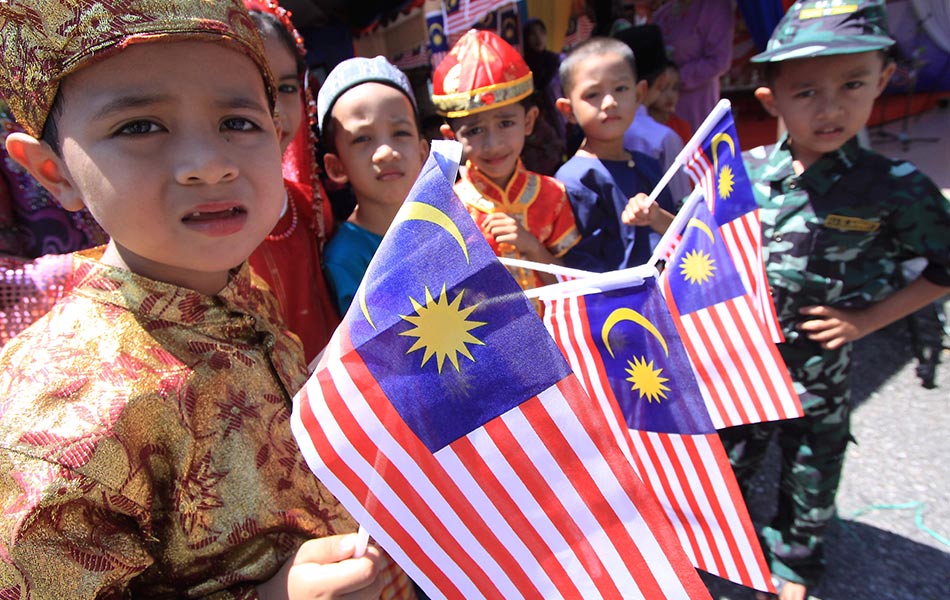
Children in different costumes holding the Malaysia flag – BERNAMAThis article is the last installment in a series on the Formation of Malaysia, and is a continuation from The Road to Malaysia: Part 3 – The Cobbold Commission.
“… there is no doubt about the wishes of a sizeable majority of the peoples of these territories to join the Federation of Malaysia.” (UN Secretary-General U Thant, 13th September 1963]
After World War 2, the British was economically and financially strained to maintain its colonies especially those east of Suez. It would be a matter of time before Britain would have to give up all of its colonies abroad, save for some of the smaller ones. The Cobbold Commission’s report agreed unanimously that a decision in principle should be taken by governments as soon as possible; that the new state should be called Malaysia; that the constitution of the Federation of Malaya should be adapted for Malaysia, instead of drafting a completely new one; that there should be no right to secede from Malaysia after merger.
Although the Tunku had asked the Malayan Commissioners to sign the report, he was still apprehensive about what “Malaysia” would do to his political position, and what kind of repercussions “Malaysia” would have on Malaya’s relationship with Indonesia and the Philippines.
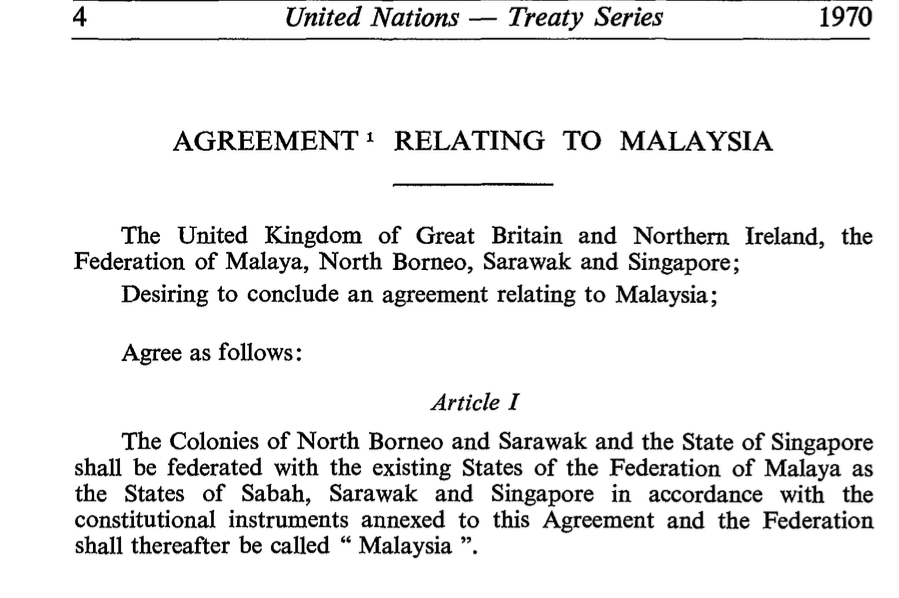
The Malaysia Agreement was signed on the 9th July 1963. Although not sovereign nor self-governing, the leaders of both North Borneo and Sarawak were invited to sign it. Annexed to the Agreement were a number of Constitutional instruments that included admission to the federation of the three former British dependencies; state constitutions for Sabah (as North Borneo would be called), Sarawak and Singapore; a scheme to compensate officers retiring from government service in North Borneo and Sarawak.
A separate legislation ending British jurisdiction in North Borneo, Sarawak and Singapore was enacted at Westminster. It did not provide for the separate independence of the three territories but transferred sovereignty to the new Federation of Malaysia (Commonwealth Relations Office and Commonwealth Office Briefs for Malaysia Bill, 1963 – Dominions Office DO 169/329). Therefore the self-rule given by the British to Sarawak on the 22nd July 1963 and the declaration of independence by Sabah on the 31st July 1963 were not a recognition of the independence of either Sarawak or Sabah, but an independence of the states in adherence to Malaysia (Ghazali Shafie’s Memoir on the Formation of Malaysia, p438). For all intents and purposes, both North Borneo and Sarawak remained as Colonies of Great Britain until the coming into operation of Malaysia.
If the appointment of a Chief Minister is to be taken as the point when independence had been achieved, Malaya would have been independent in July of 1955!
The late President Wee Kim Wee of Singapore, then a young Straits Times reporter, covered Sabah’s Merdeka Day and filed a report that, from all the obvious evidence, it was a declaration of independence within Malaysia.
The Malaysia Agreement referred to North Borneo, Sarawak and Singapore as Colonies.Malaysia Day was supposed to have happened on the 31st August 1963. However, several last minute events forced Malaysia Day to be postponed.
1) a last-minute interference by British officials prevailing upon Iban leaders to demand for the post of Sarawak Governor whilst also keeping the post of Chief Minister, thus reneging on an earlier understanding that for the first two years, the post of either the Chief Minister or Governor should go to a Malay if the other was given to an Iban. The Tunku was livid and decided that Malaysia would happen without Sarawak. All the cabinet ministers of Malaya except Tun Razak agreed with the Tunku. Through Ghazali Shafie, Razak negotiated with the leaders of Sarawak and in the end Abang Haji Openg was the Governor designate, Stephen Kalong Ningkan as the Chief Minister, and Temenggung Jugah as a Federal Minister in-charge of Sarawak Affairs. Had it not been for Razak’s persistence, the Tunku would have had things go his way and Sarawak would not have been in Malaysia.
2) the protest by both the Philippines and Indonesia at the United Nations against the formation of Malaysia. They requested that the UN secretary-general, or his representative, should ‘ascertain’ the extent of support in the Borneo territories for Malaysia, that observers from all three governments should accompany the UN mission, and that the formation of Malaysia should be postponed until the completion of the UN report.
Led by Lawrence Michelmore (the American deputy director of the UN Office of Personnel) the mission consisted of Argentinian, Brazilian, Ceylonese, Czech, Ghanaian, Pakistani, Japanese, and Jordanian members of the UN Secretariat. It was accompanied by observers from Indonesia and the Philippines—an arrangement which the British government grudgingly accepted. From 24th August to 4th September they held public hearings in widespread locations and reconvened in Kuching on 5th September, past the 31st August 1963 deadline. This forced Malaya to change the date for Malaysia Day to 16th September 1963.
The UN report, which was published on the 14th September, was generally favourable to Malaysia. In his assessment of the mission’s findings, U Thant was in no doubt that ‘a sizeable majority of the peoples’ wished to join Malaysia, although he also rebuked the Malayans for fixing a new Malaysia Day before the mission had completed its work. Even before the survey was finished, however, Indonesia and the Philippines were attempting to discredit it and, on its publication, they rejected the report and refused to be bound by its findings.
3) was of the PAS Government in Kelantan wanting the Malaysia Agreement and Malaysia Act to be declared ‘void and inoperative.’ Kelantan argued that the Act would abolish the Federation of Malaya, thereby violating the Federation of Malaya Agreement of 1957; that the proposed changes needed the consent of each state of Malaya and that this had not been obtained; that the Sultan of Kelantan should have been a party to the Malaysia Agreement in the same way as the Malay rulers had been signatories of the Malaya Agreement of 1957; that constitutional convention called for consultation with the rulers of individual Malay states regarding subsequent changes to the constitution; and that the federal parliament had no power to legislate for Kelantan in this matter.
On the 14th September 1963 the Chief Justice ruled that both the Malaysia Agreement and the Malaysia Act were constitutional (Tan Sri Mohamed Suffian bin Hashim, An introduction to the constitution of Malaysia (Kuala Lumpur, 1972) pp 13–14).
By 16th September 1963, we are all Malaysians.
Looking back, I remember an article quoting Tan Sri Abdul Ghani Gilong relating his experience visiting Kuala Lumpur on the invitation of the Tunku, he said:
“Kami naik kenderaan yang dipandu. Bagi sesetengah anggota delegasi saya, itulah kali pertama mereka menikmati air paip dan tandas berpam.”
“Kami dibawa ke beberapa tempat dan kampung yang sudah mendapat pembangunan seperti jalanraya dan sebagainya. Saya sendiri apabila balik ke Sabah telah berkempen menyokong penubuhan Persekutuan Malaysia dengan memberitahu kawan-kawan mengenai pembangunan yang ada di Malaya ketika itu.
Katanya satu kejadian lucu ialah apabila ada anggota rombongannya tidur di lantai dalam bilik hotel mereka dan bukan di atas katil yang empuk.
“Apabila saya nampak, mereka memberitahu saya mereka ingatkan katil itu adalah untuk ‘tuan’, seolah-olah hanya orang kulit putih boleh tidur di atas katil dan anak tempatan tidur di atas lantai sahaja.”
“Saya beritahu mereka katil itu mereka punya untuk tidur di atasnya.”
(“We rode on a vehicle that came with a driver. For some members of my delegation, that’s the first time they enjoyed tap water (running water) and flushing toilets.”
“We were taken to several places and villages that have received development such as roads and so on. When I went back to Sabah I campaigned in support of the establishment of the Federation of Malaysia by telling my friends about the existing development in the then Malaya.
He said that one funny scene was when there were members of his entourage who slept on the floor in their hotel room and not on their comfortable.
“When I saw, they told me they thought it was a bed especially for the ‘master’, as if only the white people could sleep on the bed while the local people sleep on the floor.”
Such was how inferior the people of Sabah and Sarawak felt of themselves before Malaysia existed, and it was not that long ago.
I believe that there has been progress that has been made in both Sabah and Sarawak although there should be more. When I was working offshore, most of my drilling and marine crew are from Sabah and Sarawak, especially the Ibans. My last Chief Mate is a Kelabit from Bario, while one of our vessels’ Captain is a Kedayan from Limbang. In my opinion, both the Merdeka Day on the 31st August and Malaysia Day on the 16th September are equally important to us. Without the 31st August 1957 event, Malaysia would not have happened and I shudder to think what ill-fortune would have befallen the people of Sabah and Sarawak, especially with China, Indonesia and the Philippines staking a claim in both the states.
I also believe that the current Federal Government is doing all it can to fulfill the promises made back in 1963, an uhill task given that previous Prime Ministers, especially a particular former Prime Minister for 22 years, did not do much for the people of Sabah and Sarawak.
Let us concentrate on nation-building, and put aside state-nationalism as that brings about nothing beneficial to any of us. And let us not let hatred destroy us. Our forefathers who agreed to form Malaysia did so following the democratic system, and not through violent nor nonsensical demonstrations or coups.
And let us remember the famous words by the great Temenggung Jugah ak Barieng:
“Anang aja Malaysia tu baka Tebu, Manis di pun, tabar Di ujung”
(Let’s hope Malaysia does not end up like a sugarcane. Sweet at the beginning, bland at the end)
In Vietnam, Laos and Cambodia the communists were making advances while the number of American servicemen in Vietnam tripled the number sent in 1950. In Indonesia, the influence of the Partai Komunis Indonesia on President Sukarno was strong. In Singapore, all the political parties except Singapore UMNO accused the PAP of having carried out negotiations to be merged with Malaya without first consulting the people. This gave ammunition to the communists in Singapore and their sympathisers to attack both Lee Kuan Yew and the Tunku.
In British Borneo, the communists and their sympathisers tried to intimidate the natives thinking that it would work as it did in Singapore. Truth be told, it had quite the opposite effect. Lee Kuan Yew observed that as in Singapore, those anti-Malaysia in Sarawak were the Chinese communists, chauvinists and their sympathisers, while in North Borneo, they were Chinese businessmen and Chinese who were under the influence of individual British officials who were opposed to the Malaysia Concept, or ignorant of it. Kuan Yew noted that the direct links between the Chinese in Perlis throughout Malaya and Singapore to the British Borneo are the Chinese newspapers. Hence, Kuan Yew suggested to the Tunku for the Chinese chauvinists be separated from the Chinese communists and the two groups should be separated.
Members of the Cobbold Commission arrived in Kuching in the morning of the 20th February 1962. The members were:
Sir Cameron Fromanteel Cobbold, former Governor of the Bank of England, also Chairman of the Commission of Enquiry,
Sir Anthony Foster Abell, former British Governor of Sarawak and the High Commissioner to Brunei,
Sir David Watherston, the last British Chief Secretary of Malaya,
Wong Pow Nee, the Chief Minister of Penang, and,
Ghazali Shafie, Permanent Secretary to the Ministry of Foreign Affairs of Malaya.
They were first brought to the Astana, a house that was built in 1870 by the second White Rajah, Charles Anthoni Johnson Brooke as a wedding gift for his wife, Margaret Alice Lili de Windt. It had been occupied by the British Governor since 1946. Ghazali Shafie could not help but notice a Jawi inscription at the entrance of the Astana left by one of the Brookes “BERHARAP LAGI BERNAFAS, (Have Hope While There Is Still Breath)” perhaps an apt motivation for the colonial officials who did not want Sarawak to be part of the Federation of Malaysia.
The Brookes had built the Astana on the northern bank of the Sarawak river because it was where the Malays were. The Brookes depended on the Malays for safety and security, the Chinese for prosperity and trading, while the natives were not entirely trusted. The same compartmentalisation was practised in Sarawak by the colonial officials after taking over the state from the Brookes in 1946.
The first groups of interviewees were interviewed in Kuching on the 21st February 1962. The first group amongst these interviewees was extremely pro-Malaysia. They were led by Abang Mustapha, Datu Bandar of Kuching. The second group was led nby Ong Kee Hui from SUPP. This group was against the special rights to be accorded to the natives of Sarawak unless if it is not stated in the to-be-formulated Constitution. This group had a contempt for the backwardness of the natives and had regarded their leaders as men of no consequences. This stand prompted an Iban by the name of Jonathan Bangau whom the SUPP had nominated as the party’s leader in Sibu to resign.
The next day, another group of Chinese in Kuching were interviewed. Their spokesperson, a Chinese woman, twisted and distorted events in Malaya into something truly hateful. She accused the Malayan Government of policies that turned very young girls into prostitutes and had labour laws that accorded workers not more than Ringgit 1.50 per fourteen-hour working day without holidays! When these allegations were countered by Ghazali and Wong Pow Nee, she informed the Commission that she had read the stories from Chinese newspapers to which Wong Pow Nee murmured that these must have been communist publications.
In Bau and Simanggang (now Sri Aman), banners and placards expressing anti-Malaysia slogans in Chinese characters plastered the town in anticipation of the Commission members interviewing residents there. The scene was different in Kanowit and Kapit. People shook the hands of the Commission members, especially the Malayan ones. One of the Tuai Rumah even held Ghazali Shafie’s hand as they walked through Kapit town. They were all awaiting the arrival of Malaysia!
However, Ghazali learnt that under the colonial administration the Iban had suffered oppression and suppression. This began when Sarawak was under the Brunei Sultanate and continued under the Brookes and subsequently the British. When they faced the Commission, they were all for Malaysia and some even emphasised on the need for a speedy arrival of better education and development for the Iban community.
At Binatang (now Bintangor), the division between the wishes of the natives and the Chinese was most prominent. The natives were all for the speedy arrival of Malaysia while the Chinese were divided into two groups: one favouring a referendum, while the other favouring a Federation of North Borneo, Brunei and Sarawak – a line maintained especially by the communists.
In North Borneo, the only negative views were given by the British officials and expatriates as well as the rich local businessmen. At this juncture, Ghazali noted that these British officials knew nothing or chose to disregard Harold MacMillan’s famous “Wind of Change” speech in Cape Town made on the 3rd February 1960.
Cobbold, not having any experience in dealing with the Far East, succumbed to the ideas of these officials that in his draft, he recommended that both the British and Malayan Governments should have executive powers over the British Borneo states for five years. Both Wong Pow Nee and Ghazali believe that the Malayan Government would never agree to perpetuate colonialism in any form. However, the two governments should discuss the matter should they want the British officials to stay on in Borneo in the service of the two territories. Wong Pow Nee quoted the state of Penang where he was once a Chief Minister to demonstrate the point that the British fears were groundless and that the Tunku, the Malayan people as well as the 70 percent who advocate the creation of Malaysia in the North Borneo and Sarawak would not agree to Cobbold’s suggestions as it would still be a form of colonialism. What more that the communists in Malaya, Singapore, Indonesia, China and the Soviet Union had branded the Malaysia Concept as neo-colonialism. Interesting also to note here is that in April 1962, the Philippines House of Representatives had made a formal claim on North Borneo. On the 20th January 1963, Drs Subandrio, and alleged communist and also Sukarno’s Foreign Minister and Second Deputy Prime Minister announces Indonesia’s “confrontation” towards Malaysia.
In the end, on the 31st July 1962, Prime Minister Harold MacMillan told the Malayan delegates that Her Majesty’s Government was just as anxious to see Malaysia succeed. Soon after, an Inter-Governmental Committee (IGC) was set up by the Malayan and British Governments that would include the North Borneo and Sarawak Governments. On the 12th September 1962, the North Borneo Legislative Council adopted the following motion:
“Be it resolved that this Council do welcome the decision in principle of the British and Malayan Governments to establish Malaysia by the 31st August, 1963…”
Then on the 26th September 1962, the Council Negri of Sarawak adopted the following motion without dissent:
“This Council welcomes the decision in principle of the British and Malayan Governments to etablish Malaysia by the 31st August, 1963…”
The Federation of Malaysia that would include the Federation of Malaya, North Borneo and Sarawak was to come into operation by the 31st August 1963. All in all, the IGC made recommendations in its report pertaining to the States’ Constitutions, legislative powers, financial provisions, elections, the Judiciary, public service, citizenship, immigration, religion, education, the National Language, status of existing laws, the position of the indigenous races and transitional arrangements prior to the formation of Malaysia.
North Borneo was thoroughly satisfied with the IGC report and the North Borneo Legislative Council unanimously adopted the Report on the 13th March 1963. The Sarawak Government was satisfied and considered that the Report contained “generous terms of safeguards for Sarawak.” Stephen Kalong Ningkan as the Secretary-General of the Sarawak Aliance said that his party “fully endorses the Report.” Leong Ho Yuen, the Vice-Chairman of the SUPP said: “All in all, the Report is quite satisfactory. Though we cannot get all we asked for, at least we have been given a high percentage.” The Sarawak Council Negri voted unanimously to adopt the Report on the 8th March 1963, five days before North Borneo.
Donald Stephens who was the Chairman of the Executive Committee of the North Borneo Alliance said: “The whole of North Borneo will now welcome with joy the creation of Malaysia.”
Tomorrow, on Malaysia Day, we shall look into the self-rule granted to the State of Sarawak and why was Malaysia formed on the 16th September 1963 instead of on the 31st August. We will also look at what was said by those who were involved in parts of the process.
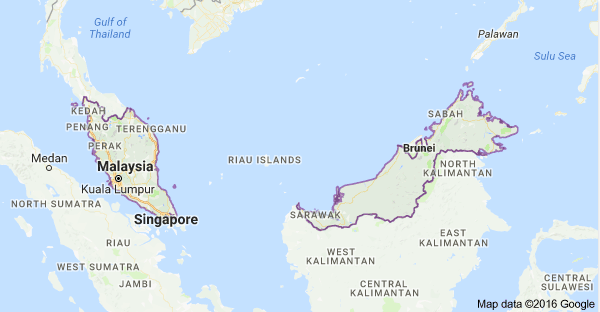
Google map data 2016 of Malaysia“Najib Abdul Razak has done more for Sarawak than all the previous Prime Ministers, including the one who served for 22 years,” said Sarawak Chief Minister, Adenan Satem to a crowd of about 3,000 people at the State Gawai Dayak Dinner in 2015 (Malaysiakini: 4 June 2015). That was what crossed my mind when thinking about sacrifices on the morning of the first day of Aidil Adha. Najib Razak broke previous Prime Ministers’ record for being the PM who has visited Sarawak the most and has brought about promising developments in both Sabah and Sarawak including the toll-free Pan Borneo Highway. What is most important is the capacity building for Bumiputera contractors through the 30 percent participation of Bumiputera contractors in this project.
All this had its beginnings more than 50 years ago when both Sabah and Sarawak were the British Colonies of North Borneo and Sarawak.
Prior to 1948, there was no country called Malaya but a territory of nine sultanates as British Protectorates and three Straits Settlements as Crown Colonies. Only the Crown Colonies were under direct British rule via the Colonial Office (Seademon Says: The Road to Merdeka – British Malaya, 12th September 2011). The British almost succeeded in implementing a Federation albeit through the shortlived Malayan Union, but that was later replaced with the Federation of Malaya on 1st February 1948.
Back then, Malaya was just a place for the Chinese migrants to work for money that would be sent home to China – the country the British had encouraged them to remember as their home during the interwar years. Tun Ghazali Shafie, then the Deputy Assistant District Officer of Kuala Lipis. He recalled how, when asked if the Chinese would support the Malays in an endeavour to dislodge all British Advisors from all the states of Malaya, the Justice of Peace for Kuala Lipis Mr Ong Siong Teck replied, “We Chinese had always been independent. Of course, but we must be given a place.”
On the 27th July 1955, the Alliance Party had won all but one seat in the Federal Legislative Council elections, and on Sunday, 31st July 1955, the Tunku handed the British High Commissioner his list of cabinet members (six Malays, three Chinese and two Indians) that would still have to be passed to the Rulers for their formal concurrence. This was when the Federation of Malaya gained self rule, a big step towards independence. At this time, there was a planned hegemony over the mainland including Malaya and Singapore, leaving the islands to Sukarno’s Indonesia (Seademon Says: The Road to Merdeka – Persekutuan Tanah China, 6th September 2011). Communism was rearing its ugly head at Malaya, Singapore and Borneo.
By June 1959, Singapore had its General Elections and Lee Kwan Yew’s People’s Action Party (PAP) was swept into power. The communist group in Singapore, including those in the PAP, had to lie low for the time being as Kuan Yew had promised the British that he would not allow any subversive elements to conduct their activities. Singapore was keen for a merger with Malaya as that would grant them independence and assure them that the Federal government of Malaya would never allow the communists to exist.
By the end of April 1961, the situation in the South East Asia had changed drastically with the Pathet Lao guerrillas had come quite close to Luang Prabang in northern Laos, with the help of the Soviet Union and China. It was then that Ghazali Shafie pressed the Tunku to hasten the “Malaysia Concept” to create a Federation of Malaya, Singapore and the British North Borneo that included the Sultanate of Brunei.
On the 27th May 1961, the Tunku signalled the birth of the “Malaysia Concept” in a speech in Singapore to the Foreign Correspondents Association (Ghazali Shafie’s Memoir on the Formation of Malaysia, 1998 pg.26):
“…sooner or later Malaya should have an understanding Ong Siong Teck Britain and the peoples of Singapore, North Borneo, Brunei and Sarawak. It is premature for me to say now how this closer understanding can be brought about, but it is inevitable that we should look ahead to this objective and think of a plan whereby these territories can be brought closer together in political and economic cooperation…”
“In North Borneo, there were already signs that Manila was going to make a cartographic claim based on some vague historical background,” wrote Ghazali Shafie, “(and) the Communist Clandestine Organisation (CCO) in Sarawak with assistance from abroad had begun to show its fangs and claws. Whitehall would never do nything very positive for the people and that colonial territory could not be defended by armed means in the post-World War II period of anti-colonialism.”
The British then planned for a federation for North Borneo, Brunei and Sarawak, and some British officials in Brunei even encouraged the locals to hate Malayan expatriates there. In fact, a Malayan forest officer, Yakin, was assaulted by Bruneians. These Malayans were there at the request of Sultan Sir Omar Ali Saifuddin III to replace British officials in key posts, making the Bruneians think that the Malayans were stealing their jobs and subtly colonising them.
The Yang DiPertuan Agong, the Tunku and Malaysian officials visiting Brunei were subjected to insults and had the word CONGO shouted at them. The truth is no Brunei high officials had ever bothered explaining to the people of Brunei the reason they were there, including Haji Marsal Maun, the Menteri Besar of Brunei.
Before ending the visit, the Tunku made a radio broadcast to the people of Brunei telling them that the presence of Malayan officials in Brunei was at the request of His Highness the Sultan of Brunei and it was never Malaya’s intention to colonise.
While the Yang DiPertuan Agong left Brunei for Kuala Lumpur, the Tunku continued his tour to Sibu on board the KD Mutiara. She was the first ship that was specifically built for the Royal Malayan Navy. She was also the first RMN vessel to be given the “Kapal DiRaja” title and was the first RMN vessel to be built locally. Their destination was Sarawak, a state that was once a realm of Brunei until 1841 when James Brooke was granted the areas around Kuching and Bau, from Sultan Omar Ali Saifuddin II, and was later given the title Rajah of the territories. The White Rajahs ruled Sarawak until 1946 when after the war Charles Vyner Brooke, the 4th Rajah of Sarawak ceded his interest in Sarawak to the Colonial Office for a sizeable pension for him and his three daughters. Unsure of the legality of the cession, the British Government quickly passed a Bill of Annexation, effectively ending the rule by the White Rajahs.
In Sibu the Tunku met with Temenggung Jugah, Aini Dobi (whose brother Rosly Dobi was hanged for the assassination of Governor Duncan George Stewart in 1949), Tuanku Bujang, Abang Louis Barieng and Ahmad Zaidi Adruce. An Iban in the administrative service in Sibu approached Ghazali Shafie asking the latter to explain more about the “Malaysia Concept.” Ghazali Shafie told the former in general what it was all about and the intentions of uplifting the indigenous people using the same special position of the Malays in the Malayan Federal Constitution. Bennet agreed that Sarawak could achieve independence through the “Malaysia Concept” but his worry was having the Chinese from Singapore flooding Sarawak. Ghazali suggested that Sarawak could ask for special powers to control immigration to which Bennet touched Ghazali’s hand saying, “Please help us.”
The Ibans were in a dire strait. Sibu was a town that was very Chinese – 95 percent of its 29,630 inhabitants in 1961 were Chinese. In comparison, Sibu had 162,676 inhabitants in 2010 and 65 percent were Chinese. A school that the Tunku had visited just outside of Sibu only had a Primary Two class and was not able to find a teacher compared to a Chinese school nearby. The British were not interested in developing the locals and if the situation was to continue for long, the rate of development for the Iban would be slow compared to the Chinese who had very good schools. Even Temenggung Jugah was illiterate. He had a signatured tattoed to his left arm and would put his left arm on a piece of paper so he could copy that to sign documents!
As they left Sibu and the KD Mutiara sailed down the Rajang, it was obvious that Sarawak as a colony would not be left alone by Communist China. Ships from China sailing the Rajang had revolutionary songs blaring over their tannoy system, even in the town of Binatang (now Bintangor). It was obvious that the Chinese were using revolutionary propaganda to stir up anti-colonial feelings amongst Sarawak’s masses, and that the “Malaysia Concept” would be the best way to save Sarawak especially from China.
When the KD Mutiara sailed past Binatang, a town of a few brick houses and a dirt road, the people had come out to the jetty shouting for the Tunku to stop. The Tunku requested for Lt Ismail, the CO of KD Mutiara to anchor so he could go ashore. The Tunku was met by hundreds of people who gave him a very warm welcome, and the Tunku gave them some words of encouragement. Ghazali was met by two young people, an Iban police inspector and a Malay customs officer. Ghazali noted that both were critical of the colonial administration which had never brought any development to the local people. These two officers later resigned from their respective jobs and spent full time promoting the “Malaysia Concept.”
In the next part we shall talk about the consutations with North Borneo, Singapore and how the British tried to stall the formation of Malaysia.
Former Sabah Chief Minister Tan Sri Joseph Pairin Kitingan knows very well what Mahathir would do to those he hates. He experienced that first hand in 1990 when Mahathir went all out to try depose him as Chief Minister. Pairin was Chief Minister of Sabah from 1984 to 1995.
Speaking to reporters after receiving a courtesy visit from the Kadazandusun Cultural Association Youth Council yesterday Pairin said that when Mahathir is a ‘political animal’ who, when he does not like a person, would go all out (to get the person out of his way).
Therefore, it comes as no surprise to Pairin when Mahathir would form a new party and work with his enemies just to try force Najib Razak out of office.
In politics, anything goes – wrote Awang Selamat, a pseudonym used for Utusan Malaysia’s editorials. And that includes trying to erase his dark past by working with DAP’s Lim Kit Siang whom he had put behind bars without trial during his tenure. It was Mahathir whom had planted the idea that DAP is nothing less than the enemies of the Malays and what Malaysia stands for, in the mind of the Malay masses. Equally disgusting is Lim Kit Siang whom had spent most of his life in DAP slandering Mahathir as being the most corrupted dictator, now seen being in the same bed with Mahathir.
Another person who would know Mahathir well is Tan Sri Musa Hitam, who was Mahathir’s deputy from 1981 to 1986. While he described Mahathir as “observant, innovative, and meticulous” he also used the words “authoritarian, contemptuous, and belligerent”.
In an article by The Star, Musa said Dr Mahathir could be pleasant and engaging at times, but would often come off as being disinterested in dialogue or debate.
“Discussion and debate were never the order of the day,” he wrote in his book ‘Frankly Speaking’ which was recently launched by His Royal Highness the Sultan of Perak.
“Discussion and debate were never the order of the day.” – Musa Hitam describing Mahathir
In his book Musa wrote:
“Malaysia today is going through a difficult transition. Trying to establish a mature democracy after more than two decades of authoritarian rule is not easy. Moreover, there is no guarantee that the current, more open political system will continue. Malaysia would, in fact, find itself gripped by reactionary forces that even now are advocating policies and practices that – if adopted – would eventually result in the country becoming a failed state.”
This was echoed by the former Grand Mufti of Jordan, Professor Dr Amin Mohammad Sallam al-Manasyeh in an interview with the portal MalaysiaGazette. “I am of the opinion that if Allah gives him (Najib) time, he will continue to develop and position Malaysia as the best country in the world. That’s what I think about him,” he said in the interview.
I, too, had doubts about Najib Razak’s ability to do well as the leader of this country. Up until April of 2015 at least, I and like-minded friends did not think that he would last in the face of relentless acrid attacks by Mahathir. By May, Mahathir faltered and changed goalposts several times while Najib Razak stood firm, unwilling to budge even a bit. Most of us saw that the light shone by Najib in the tunnel of lies made by his detractors is far brighter than the one shone by Mahathir. And this year, Mahathir received multiple slaps first in the form of the resignation of his son Mukhriz as the Menteri Besar after being told by the Council of Regent of Kedah that he had lost majority support of the State Assembly. This was followed by his own resignation from UMNO. Then came the hattrick wins in Sarawak, Sungai Besar and Kuala Kangsar elections where, despite Mahathir’s claims, Barisan Nasional still won. And then he was conned by his own people for faking more than half a million signatures of people reportedly in support of his ‘Save Malaysia’ declaration.
Mukhriz, seen here with Tan Sri Tunku Sallehuddin ibni Almarhum Sultan Badlishah, Chairman of the Council of Regent of Kedah (right), and council member Tan Sri Tunku Abdul Hamid Thani, leaving the Wisma Darul Aman after a meeting with the Council of Regent.
One would think that at 91, Mahathir would take it slow and call it a day. Well, that is not Mahathir. In the end he sets up another political party called Parti Pribumi Bersatu Malaysia (BERSATU) where Najib’s former deputy Muhyiddin Yassin becomes the pro-tem President, and his son Mukhriz the pro-tem Treasurer. And where is Mahathir in this party? He positions himself as Lim Kit Siang has – the Puppet Master. Despite being a political giant, Muhyiddin has all but lost support in Pagoh and Muar. Many Johoreans still remember him for his sins committed against the Malays. He would now have to find another seat to contest in. Otherwise his political career is as good as over.
Admitted to the National Heart Institute for medical complications the day his party’s registration form was submitted to the Registrar of Societies, Mahathir’s first act upon being ill was to post a blog article attacking Najib, not taking care of his health or coming to a realisation that his days as a mortal are numbered, and that instead of creating more sins, he should repent. No, things like that never seem important to Mahathir. And neither would the parasites who call themselves “his advisers” advise the old man to slow down. Instead, they feed his anger, and he in turn feeds them for making him angry. And Mahathir should remember that whenever he, the authoritarian, gets angry, he loses support. Zuraidah Ibrahim aptly puts it in the South China Morning Post:
Instead of departing on his terms, as he did in 2003, he may now find himself leaving the scene a loser.
For Najib Razak, it is business as usual. As in the old adage wrongly attributed to Thomas Jefferson:
In matters of style, swim with the current; in matters of principle, stand like a rock.
I haven’t said much about the RM2.6 billion money that was donated through a vehicle bearing Najib Razak’s name. What I know for sure is that the Malaysian Anti Corruption Commission sent three officers to meet up with the source of the donation or the donor’s agent. I also mentioned on other socmed posts that the Attorney-General has every right to not indict any case that is forwarded to his office as per Article 145(3) of the Federal Constitution.
Many cry foul, till today, but could never come up with arguments based on legal facts, including (I don’t feel sorry for this) idiots who think that by being in the MACC they know everything. They simply don’t. So, let’s visit the facts.
Case Facts
Najib Razak received a political donation equivalent to RM2.6 billion,
The money was received through a private account bearing Najib Razak’s name.
Legal Facts
The Constitution of a political party that was approved under the Societies Act allows a political party to receive political donations;
Najib Razak received the donation as the Head of a political party, not as the Prime Minister or as Najib Razak the individual. To those who carry signs bearing the words “Mana RM2.6 billion” I say up yours, the money is NOT for you.
Therefore, based on the facts given by paragraphs 1 and 2, there is no burden of law on Najib Razak for receiving the money.
The Anti Money Laundering Act (AMLA) is a law to control monetary transactions. Bank Negara Malaysia (BNM) would have to approve those transactions.
In Najib’s case, BNM had already approved the transaction. Therefore, BNM has to abide by the law, terms and regulations pertaining to the law.
Approval of that transaction also means the transaction is free from any burden of the law.
Based on the facts above I opine that the Attorney-General had made the correct decision and everyone should give it a rest.
Now I hope someone would tell the Attorney-General to dig up this particular issue that I believe was buried by someone under the instruction of someone else:
Di atas adalah petikan takrif “Darurat Bencana” yang menjadi tajuk perbualan ramai terutamanya apabila keadaan banjir di lima negeri terutamanya negeri-negeri pantai timur Semenanjung menjadi lebih teruk. Dari takrif tersebut yang diberikan melalui Arahan Majlis Keselamatan Negara No.20, jelas bencana banjir yang melanda kita sekarang masih tidak menepati kehendak maksud “Darurat Bencana.”
Namun, masih ramai yang merasakan bahawa Perdana Menteri harus mengisytiharkan Darurat Bencana tanpa mengetahui akibat pengisytiharaan keadaan tersebut.
Untuk yang tanya kenapa tiada pengisytiharaan darurat bencana, berikut adalah jawapannya: Sekiranya diisytiharkan darurat, mana-mana perkara yang boleh dituntut melalui insurans, tidak akan boleh dituntut termasuklah insurans bangunan dan kenderaan yang diambil untuk premium bencana. Untuk masa ini, di Kelantan, keseluruhan pembiayaan kos banjir telah diambil alih oleh Kerajaan Persekutuan sepenuhnya melalui agensi-agensi Kerajaan. Jawatankuasa Pengurusan Bencana pun telah diambil alih oleh Kerajaan Persekutuan semalam hasil persertujuan pihak Kerajaan Negeri.
Ini adalah kerjasama Kerajaan Persekutuan dan Negeri di mana YAB MB Kelantan juga telah keluarkan kenyataan bahawa buat masa ini tiada keperluan untuk isytiharkan darurat dan semua pengisytiharan juga akan dibincangkan bersama dengan Kerajaan Persekutuan.
Pengisytiharan Darurat juga akan menyebabkan Kerajaan tidak boleh lagi menahan keluar pelabur yang telah membuat pelaburan sebelum ini di kawasan banjir tanpa apa-apa pampasan kepada pihak Kerajaan dan pekerja sekiranya tertakluk kepada perjanjian pelaburan.
Ia secara langsung beri impak kepada negeri tersebut.
The apex court of Malaysia, the Federal Court, has ruled in favour of the Appellate Court to deny the Christian Herald Weekly the use of “Allah” in its articles instead of “God” or “Lord”. Four out of the seven bench members voted to uphold the ruling by the Appellate Court while three dissented. While many jumped saying that it was an unfair decision, I did not see one person noting that one of the dissenting members is a Malay and a Muslim.
The ruling brings to a closure a divisive episode that began in 2006 that led to several unnecessary reactive incidents in early 2010 due to a High Court decision in favour of the Christian Herald Weekly. While BigDog argues that the apex court’s ruling upholds Articles 3(1) and 11(4) of the Federal Constitution, many think that it is their right to use Allah in reference to God.
Let me quote what was said as part of the judgment delivered:
‘The usage of the word Allah is not an integral part of the faith in Christianity. The usage of the word will cause confusion in the community.’
Many including outsiders such as Francis X Clooney SJ in his article entitled “Is Allah Not Our God? – America Magazine (Catholic) tried to argue for the Catholics in Malaysia without understanding the history behind this ruling and how Articles 3(1) and 11(4) of the Federal Constitution came about.
Perhaps, I may need to point out to Mr Clooney as well as uninformed Malaysians that while in the Peninsular Malaysia the use of Allah and several other words are regulated by various laws, they are not regulated for use in the Sidang Injil Borneo’s Bibles for the people of Sabah and Sarawak. Even in Indonesia some Christians use “Allah” – and this is all due to historical reasons.
In my blog post entitled The Case For God, I wrote about the history of the usage of “Allah” in Christian literatures:
Let us remember one thing. Malaya (Peninsula Malaysia) was never colonised as a whole by the British, save for Penang, Malacca, and Singapore, while Sabah and Sarawak came under direct British colonial rule. Penang was acquired through a deal to lease the island made between the British East India Company and the Sultan of Kedah; Malacca was acquired from the Dutch through the Treaty of Bencoolen; and Singapore was included in the Treaty of Bencoolen by making the severely weakened Dutch to not object to the British occupation of Singapore. The people of these three places, together with Sabah and Sarawak, became British subjects.
Through treaties with the Sultans on the Peninsula, the British helped administer the State of the respective Sultans, while the Sultans remained as the supreme head of these sovereign states. The administration of Islam came under the purview of the respective Sultans as the protectors of the state’s religion.
So, why does Indonesia have Bibles that use the word Allah to describe God?
Unlike Malaya, Indonesia was a nation of conquered people. Hello! Remember the Dutch? When Douglas MacArthur met Emperor Hirohito, he purposely stood next to the Emperor to show the Japanese people that the Emperor was not a demi-God. Victors get to do as they please, and this is probably the same case as the Ladang Rakyat issue in Kelantan. The Dutch conquered parts of Indonesia beginning in 1595, and as part of its attempt to call the Malay diaspora in Indonesia to Christianity, the Book of Matthew was translated into the Indonesian language in 1629; and where the Dutch set foot, other religions were formally prohibited although Chinese temples as well as mosques remained in existence.
Missionaries, too, made headway in Sabah and Sarawak, converting the populace to Christianity. Sir Stamford Raffles recommended to Rev. Thomas Raffles (Buitenzorg, 10th February 1815, Mss. Eur. F.202/6) that Borneo be given vigorous campaigns by the missionaries as “the island is inhabited by a race scarcely emerged from Barbarism.”
This does not mean that the Malays were free from attempts to proselytize them. In fact, Raffles, in a letter to his cousin in 1815 mentioned how “Religion and laws are so united” in Muslim dominated areas that the introduction of Christian beliefs will bring about “much mischief, much bitterness of heart and contention”.
Raffles contended that Christianity must be packaged in a new form and be conveyed to the Muslim majority through a gradual approach. The “pagans”, on the other hand, required no stratagems. His methods include the establishment of missionary schools where the Malays are taught to read and write in their own language. Then he set up printers to publish books in Malay. Missionaries were largely responsible for this effort with the help of local agents, and the most famous of these agents was a chap called Abdullah Abdul Kadir who is better known as Munshi (Teacher) Abdullah. He and other Munshis taught Christian missionaries the Malay language. His role went beyond that and became the first Muslim in South East Asia to translate the Bible into the Malay language, that he became the target of his contemporaries who called him Abdullah Paderi (Pastor Abdullah) among other things.
It is interesting to note, however, that Raffles never once attempted to convert Malays in the Federated and Unfederated Malay States where the Sultans rule and guard the interest of the religion of Islam. This is because it would be foolhardy to anger the Sultans whom the British had a treaty with, by undermining the sanctity of Islam by converting their subjects. In the case of Raffles, he only focused his efforts on those who are British subjects.
Here we see the subtle tactics of the Christian missionaries during Raffles’s times, and the Malay lackeys who colluded with them. We can see the similarities in events of nowadays. But the above is also why we have Allah in the Bibles of Indonesia and Sabah and Sarawak, but not in Peninsula Malaysia.
And the above continues to be protected and respected in Sabah and Sarawak by the 10-point agreement which also includes the immigration right to refuse entry to any undesirable persons that the Opposition has said is a violation of their rights.
What does the above history have to do with modern-day Malaysia where history should or suggested be forgotten?
In my later post entitled The Case For God – Part 3 I wrote about the attempts to proselytise Muslims which is in contravention of the Federal Constitution:
As mentioned in the previous installment, too, I find the argument that Allah is the common denominator for God in this region a joke. The common denominator in the Indo-Malay speaking world would be Tuhan instead of Allah. However, Allah is the term that is inside the Quran for as long as time can remember. I cannot say the same for the Bible as it no longer reflects the Old Testament. Anyhow, you cannot find the name Allah inside the Old Testament. Just a Hebrew name that does not even resemble both the Arabic and Roman spelling of Allah. Even so, Elohim as called by the Jews, refers to The God that has no Son, nor an equivalent called the Holy Spirit. Mind you, even the Jews are totally against the concept of deifying a human being. I am sure my wife’s Iban relatives who are Christian would understand the term “Tuhan” without any problem since Bahasa Malaysia is derived from the Malay language, and the term for God in Malay is Tuhan.
We have seen the subtle tactics of missionaries of those days in the first installment and how their modus operandi is now refined by present-day missionaries. This blogger had had the opportunity to meet up with Muslims proselytized during the month of Ramadhan of 2012 and was told of the very fine and subtle methods used to proselytize Muslims in Malaysia. Back in the late 19th and early 20th century, the Malay people were not only bombarded with the Malay Bible, but also Christian publications in Malay such as Buletin Ariffin, Cermin Mata, Sahabat and Warta Melayu. Little has changed, but made only better. Recently, Johor’s Department of Islamic Affairs, together with the Home Ministry, confiscated 250 Christian literature in the Malay language. Imagine these books having titles such as Kaabah, Mengenal Rasul and Wahyu Illahi. With the state of Johor having around 58 percent Muslims, 2 percent Christians, and 40 percent other religions, who were these Malay literature targeting? Ibans? Christians? Chinese? Read more about the attempt to proselytize Muslims in BigDog’s post.
So, what about the use of Allah by Christians in Indonesia, Egypt etc.?
Tell me how good has that been for Indonesia and Egypt? How well do the Muslims and Christians get along in those countries? The very reason we do not have beheading of Christians in Kelantan or lynching of Muslims in Sarawak is because we do not step on each others toes.
When the Turks charged at the British lines during the Battle of Gallipoli, they cried “Allahu Akbar.” The British soldiers retorted, “Come and get your Allah here!”
If the same British soldiers are here now, they would be utmost disappointed that the Christians in Malaysia now want to accept Allah – the name of the God they believed to be false – as the special noun to replace the word “god”.
Why am I still on this issue? Some lawyers now say whatever decree the Agong issues, is not binding for non-Malays and non-Muslims.
Fine. The Malay Rulers may not have intrinsic powers left apart from dissolving or withholding a cabinet or state assembly, appoint a Prime Minister or a Menteri Besar, and protect the religion of Islam and Malay customs. I shall not dwell too deeply into this but my friend SatD has written a very good piece on this in his blog Pure Shiite.
What is most important is that when the Selangor Islamic Religious Department (JAIS) confiscated those Bibles containing the special noun “Allah”, they were acting on the provisions of Section 9 of the Selangor Shariah Criminal Enactment which prohibits the use of 25 or so Islamic words and nouns in non-Muslim publications. You will be committing a crime merely by having one in your house or car, let alone propagate one to a Muslim (or more).
What does the Shariah enactment have to do with non-Muslims, you may ask. Everything! It is NOT an Islamic law, it is a State law! Actually, it is a State Criminal Law! And a state criminal law applies to all be they Muslims or otherwise. And it is a STRICT LIABILITY law! Like I said, you have one, you break the law!
You constitutional law sexperts may also argue that the law is unconstitutional. It may be so. But it is the state law until and until a Constitutional court decides otherwise.
Oh, cry foul all you want and claim that the Apellate Court judges were all Malays. This is the part that I do not understand. All these challenges to the decision of the Apellate Court may be a norm to some of you common criminals and petty lawbreakers; the judges may not even hazard to act against them but the person who should be taking action, the Attorney-General, should. It is in contempt of a court ruling. What does that tell me, a layman? The A-G is simply useless for allowing lawlessness become a norm.
When Muslims cry foul to the Christians saying that “Allah” is an integral part of Islam, it is because the concept of trinity is an antithesis of the “Oneness” of Allah. The special noun refers to The God, One and Only God. Not a God that needs a trike to be able to “stand.”
The Christians lashed back saying that the Muslims should not tell them what is integral and what is not to them, saying that Allah is integral to the Christians. Else why quarrel over the special noun?
The word “integral” means something that if not present, does not complete something. Like tyres to cars.
Let me ask them this: if “Allah” is integral to the Christian faith, does this mean that the Popes, for 2,000 years, all the way from St Peter Petrus, have gotten it all wrong?
Maybe those adamant to use the special noun “Allah” can now shout to the Pope to come get his “Allah” here.
Just before midnight on Sunday, 4th May 2014, four heavily armed men dressed in army fatigues robbed four fishermen of their boat engines off Tanjung Labian, the scene of last year’s bloody incursion by armed Filipino men. Around 2.45am on Tuesday, 6th May 2014, just 51 hours after Sunday’s incident, five armed men also dressed in army fatigues kidnapped Chinese national, Yang Zai Lin from his fish farm on Pulau Baik south west of Lahad Datu. The Marine Police sent two fast patrol craft, a PA-class and a PSC-class, to intercept the boat the armed men used. There was an exchange of gunfire between them near Pulau Mataking but the armed men evaded capture in international waters after reaching the Sibutu islands, some 10 nautical miles from Mataking, quoting the Sabah Police Commissioner, Datuk Hamza Taib in The Star newspaper.
I cannot but agree with Kalabakan MP, Datuk Ghapur Salleh who was quoted to have said the following:
““Esscom is a toothless tiger. They have no command of the police or the army. It is better to get someone who has power.”
For those who have never been to that part of the world, let me first orientate you on the landscape.
Map showing Lahad Datu and Pulau Baik
As you can see in the map above, Pulau Baik (where the incident took place) is at the bottom left of the map, definitely more than 30 nautical miles away from Lahad Datu.
A map showing Lahad Datu, Semporna, and their proximity to the Sibutu islands of the Philippines
The distance between Pulau Baik and the fringe of the Sibutu islands is approximately 50 nautical miles. In calm seas and in a really fast boat, it should take an hour from Pulau Baik to the Philippines.
Mataking island and its proximity to the Sibutu islands
The distance between Mataking and the Sibutu islands is around 8 nautical miles.
Looking at the landscape, it would be erroneous to treat the whole area like any other borders that Malaysia has with its neighbours. And appointing a civilian to head trans-border armed incursions is downright negligence.
The marine police dispatched two patrol craft to intercept the armed intruders but stopped once the armed men were in their territorial waters for reasons only known to them. This morning’s incident is the third cross-border kidnapping incident in the areas controlled by ESSCOM.
The two fast patrol craft sent to intercept the armed men are very fast ones indeed (see photos below). Why they stopped once the armed men crossed into Filipino-waters puzzles me. I do not know how well read the people running ESSCOM are, but maybe they only read certain parts of the United Nations Convention on the Law of the Sea (UNCLOS) such as Paragraph 3 of Article 111 of the Convention that states the following:
“The right of hot pursuit ceases as soon as the ship pursued enters the territorial sea of its own State or of a third State.
Perhaps, Paragraph 2 of the same Article should have been read too! It says:
“The right of hot pursuit shall apply mutatis mutandis to violations in the exclusive economic zone or on the continental shelf, including safety zones around continental shelf installations, of the laws and regulations of the coastal State applicable in accordance with this Convention to the exclusive economic zone or the continental shelf, including such safety zones.“
In this case, in fulfilling with Article 98 of UNCLOS, a breach by our patrol craft into the waters of the Philippines would have been a technical breach, with mutatis mutandis applied, based on an agreement between the Philippines (then Secretary of Foreign Affairs, Carlos P Romulo) with Indonesia and Malaysia in July 1977 allowing cross-border hot pursuits and a system for families to cross the borders, while Article 100 of UNCLOS empowers the Philippines to allow that arrangement to be in place.
A Royal Malaysian Police’s PA-class patrol craft
With regards to this, the former Chief of Navy, Admiral Tan Sri Ramlan Mohamed Ali RMN, proposed in 2000 (after the first kidnappings in Sipadan) specific designated sea routes for vessels to enter Sabah, and enhancing monitoring capabilities by installing surface search radars (Project 1206) on islands off Sabah. This was proposed in a meeting with the then-Chief Minister of Sabah, Tan Sri Chong Kah Kiat. This proposal would have enhanced security in Sabah, especially in areas now under the jurisdiction of the ESSCOM. However, when Chong Kah Kiat was replaced in 2003, the proposal was mostly forgotten.
Kidnapping for ransom in an area that had seen the death of several Malaysian servicemen defending the nation and later sworn to be defended from further incursions by armed Filipino men is unacceptable. Three kidnappings involving four hostages in a span of six months is disgusting. I am not sorry for standing by my opinion that the ESSCOM should not be headed by a civilian. ESSCOM, in my opinion, is not RASCOM. Although the RASCOM (Rajang Security Command) was set up by the National Security Council in 1972 to combat communist insurgency by the Kalimantan Utara People’s Party (PARAKU) chiefly in Sibu, Sarikei, Kapit and Mukah areas. There was not much cross-border incidents as the terrorists were mainly domestic, unlike in Eastern Sabah. In the ESSCOM area, the security forces struggle to deny people from the Philippines from landing in Sabah for both economic and malicious reasons. No matter how developed the ESSCOM areas may be, you will still get Filipinos who would do anything in Sabah for personal gains. The gold that can be found in Sabah is worth risking their life for, and there are tens of thousands just 50 nautical miles away who are willing to take that risk once in a while, group by group.
A Royal Malaysian Police’s PSC-class fast interceptor similar to the one involved in the shootout near Mataking
If you look again at the maps above, both kidnappings took place on islands very close to the mainland. This did not happen on the peripheral islands such as Mataking, Mantabuan, Boheydulang or even Timba-Timba. It is a well-known fact that our waters in Eastern Sabah are very porous in nature. I however suspect that the kidnappings were executed by people on the way back to Sibuti from either the Lahad Datu or Semporna areas.
Last month, I was in Eastern Sabah and managed to speak to a few personnel involved in guarding the islands in that area. What I noticed different this time is that even the Army no longer has its Rover RHIB interceptors stationed on the islands of Siamil and Sipadan. In the course of a week I was in that area, five fish-bombing incidents took place in Siamil alone and there was nothing the Army could do about it as they did not have a boat to pursue the perpetrators. Red tapes caused by the formation of ESSCOM has slowed down procurement processes. I was also told by senior operations people on the mainland that they are even frustrated by the Director-General of ESSCOM for rejecting the military’s need to conduct clandestine operations in Lahad Datu and Semporna to flush out suspected sleepers (as I would term them). This clearly shows the lack of understanding by the DG of ESSCOM of military operations, and certainly of creating ESSCOM without giving due respect for defining its raison d’être with clarity and utmost conviction. You cannot run an agency that fights trans-border armed intruders like a government department. You are bound to fail miserably.
An Army personnel stands guard at Siamil island and can only watch boats go by
As mentioned in a blog post of mine that I wrote last year, Defence-in-Depth is the method that should and must be employed in Eastern Sabah. The first layer would have to be that of Force Projection – a term used to describe a nation’s ability to project power and exert influence in the ESSCOM area. This has to be achievable and has to be sustainable in nature. Firstly, all cross-border family members need to have their boats registered and each boat is assigned with a registration number that is stored into a database that can be easily accessed by patrol crafts, surface and aerial combat units. These registration numbers must be displayed on the bow of their pump boat. They can only enter via the designated routes that Admiral Ramlan proposed back in 2002. We have many shallow reefs in that area and manned stations or posts can be built where each boat wanting to enter will have to report to first layer posts to register their intention. Once their destination is made known, they will be issued with a colour-coded pass that they need to surrender at the second-layer post which would be at their destination. The process is reversed when they want to return to the Philippines. These first layer posts should be manned by the equivalent of an infantry section with RHIB interceptors at hand to intercept violators. Each of these posts would also house surface search radars that transmits radar data to a sectoral command center. Radar picket vessels should be on station to cover the approaches to and from Eastern Sabah and should cover all 1400 kilometers stretch. This is where the two of the Principles of War come into play: the Concentration of Force, and Economy of Effort. Obviously, based on my observations at Siamil and Sipadan, the Angkatan Tugas Bersama 2 (ATB2) is ill-equipped to carry out such tasks.
Basing of assets also need to be considered. While it is good to have major surface units such as the navy’s NGPV to be on station, these vessels are limited in endurance unless supply vessels are also available to re-supply and re-fuel. These vessels need to be on-station for weeks before they can be replaced by another surface unit. Major islands along the approaches from the outer limits all the way in should also have combat helicopters stationed on them. Combat helicopters carrying two PASKAL snipers each can be airborne in under ten minutes to intercept armed intruders. Certainly in the incident early this morning, the availability of such asset would have helped prevent the kidnappers from seeking refuge in their own territory. Auxiliary ships, perhaps smaller versions of the Bunga Mas 5 and Bunga Mas 6 operated by the Navy with the assistance from MISC need to be employed in these areas to support operations.
Good intelligence is important. There is nothing as valuable as good intelligence. More often than not, even during the February 2013 incursion that led to the Ops Daulat, intelligence played an important role. The coordination of good intelligence is equally important but I was told that such a thing does not exist under ESSCOM. Valuable intelligence remain valuable only if they are acted upon in the quickest possible time, thus commanders need to have a good grasp of strategic and tactical knowledge that their Decision-Action tempo has to overcome that of the enemy they are fighting. However as it is, the soldiers on Siamil and Sipadan can only watch if intruders sail past them at a safe distance.
On land, villages that may be used as hiding places for sleepers and intruders should be relocated at new villages and that would make effective the Chief Minister’s plan to introduce curfew in high risk areas. Cutting off the locals from the intruders would also help in identifying them and distinguishing them from locals. This is the area Mentek should be concentrating on as an Immigration officer and as an act for the Sabah people – weed out the illegals.
Of course, diplomacy has to be one of the layers of defence-in-depth. In pursuant of Article 100 of UNCLOS, the Philippines must render all assistance in the repression of piracy as well as in upholding the 1988 Convention for the Suppression of Unlawful Acts at Sea (SUA) that came into force in 2005.
Ops Daulat was not the first time that we have had armed incursions. on the 25th September 1985, 21 armed intruders dressed in Army fatigues attacked Lahad Datu town at 12 noon. The Royal Malaysian Police’s patrol boats PX29 and PX16, later supported by PZ14 cornered the intruders at Mataking and decimated them. While in pursuit, the marine policemen received an order from the then-Sabah Commissioner of Police to “not allow the pirates to live.” Such was the statement of the aim, clearly defined, and that order determined the outcome of the battle.
Eastern Sabah is not just any security zone. It is a zone that faces members of battle-hardened paramilitary groups that have been fighting the Government of the Philippines since the late 1960s. Therefore, protecting this zone means having to conduct military-like operations that should be handled by professional combatants and not by civilians. If the statement of aim of the strategy is to deny incursions, then it would have to be conducted with resolve and not through half-baked approaches or emulating other security zones whose methods are peculiar only to those areas, but not in areas managed by ESSCOM.
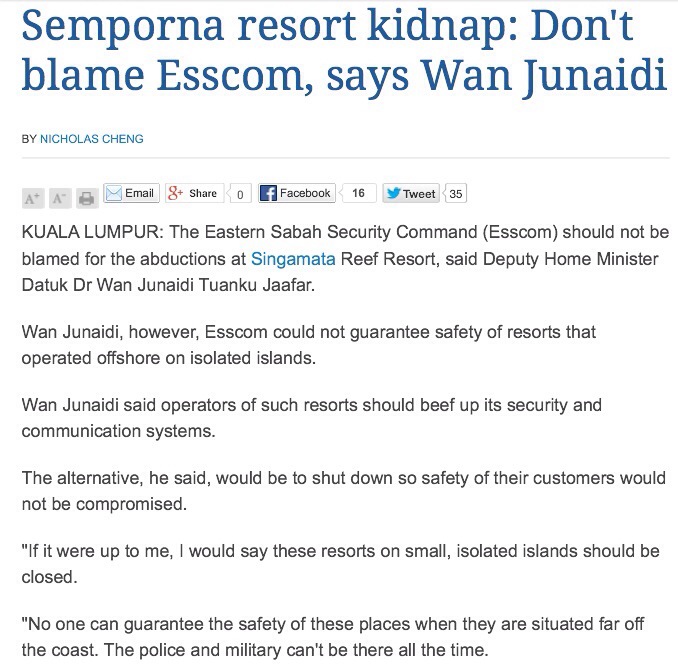
If you think it is disgusting that armed men believed to be from the terrorist group Abu Sayyaf could infiltrate our borders of the east coast of Sabah last November, shoot dead a tourist from Taiwan and kidnapped his wife, then again a few days ago taking a tourist from China and a resort worker away, guess what is even more disgusting? That the man above, the Deputy Minister of Home Affairs, had the cheek to say the following (as quoted by The Star:
Who are we to blame then, Wan Junaidi?
May I remind the Deputy Minister that ESSCOM was created on 7th March 2013 to ensure the security of the ESSZONE is taken care of in a holistic manner so there would be no recurrence of the Lahad Datu incursion and of other similar incidents. Maybe I can provide the Deputy Minister with a statement by the Prime Minister on Police Day 2013 that was posted on ESSCOM’s website.
ESSCOM is an agency under the Prime Minister’s Department to undertake the enhancement of security in the ESSZONE defined as 10 districts from Kudat to Tawau spanning 1,733.7 kilometers, to prevent recurrence of any form of intrusion by unwanted foreign elements. The method that should be employed to affect this is by applying the Defence-in-Depth concept that I wrote about in March of 2013 when ESSCOM was first formed. The military has worked with the police in a support role on numerous occasions starting with the First and Second Emergencies of 1948-1960 and 1968-1989 periods respectively, in various UN missions such as to Cambodia, Liberia, and Timor Leste. The military also supported the operations conducted by the police in Ops Daulat last year, and since then the military and police have conducted basic recruit training jointly at the Army Recruit Training Centre in Port Dickson to enhance better understanding between the two. Therefore, the issue of one not being able to accept orders by the other does not arise. In any case in peacetime, the command of the police prevails and the military plays a supporting role, and this has always been case. The Immigration however, does not have any experience in operational security as they only act as filters to immigration, and not experienced nor trained in deploying combat assets. It is no secret that the southern Filipinos have no respect nor fear for our Immigration Department. They only fear our police and the military.
I don’t subscribe to Wan Junaidi’s remark that the resorts should close down. They have been in existence even before the formation of ESSCOM. They are still located within our littoral zones. Should they not be protected? Should there not be security forces stationed at these resorts as there is on Mataking, Mabul, Sipadan, SiAmil and other islands? If the resort owners do not cooperate, what is the problem? Who makes the policies? Can’t action be taken against resort owners who do not respect policies? Stop giving stupid excuses, Wan Junaidi, and start behaving like a Deputy Minister. If ESSCOM cannot even get the buy-in because it does not have the will to enforce and execute policies, it should be disbanded and leave it to the police and military to run an enhanced version of Ops PASIR. The Immigration Department should just go back to stamping passports and weed out illegal immigrants.
So, who is to be blamed, Wan Junaidi? Who is to be blamed for appointing a non-combatant to take charge of a combat situation? Who is to be blamed if as a result of the appointment two armed incursions have taken place resulting in the kidnapping of three people and the death of one? I will blame Wan Junaidi for making stupid statements, one after another, and blame the government for making him a Deputy Minister.









 SeaDemon Says
You must be logged in to post a comment.