PKR: The Big Fat Joke – Part 4

KENYATAAN MEDIA DEWAN PEMUDA PAS WILAYAH PERSEKUTUAN 8 September 2014 / 13 Zulkaedah 1435H

Nik Nazmi : Langkah Kajang Yang Sumbang

Saya menggesa supaya Ketua Angkatan Muda Keadilan (AMK) merujuk terlebih dahulu punca krisis Menteri Besar Selangor yang bermula daripada Langkah Kajang sebelum membuat kesimpulan melulu terhadap kewibawaan Presiden PAS, Dato’ Seri Tuan Guru Abdul Hadi Awang.

Langkah Kajang yang dicatur jelas merapuhkan keutuhan Pakatan Rakyat dan menghakis semangat setiakawan yang dihulurkan oleh PAS.

Walaupun PAS telah menyatakan pendirian bahawa Langkah Kajang tidak berkaitan untuk menukar Menteri Besar Selangor, namun jelas pada tarikh 21 Julai 2014, PKR telah mengumumkan YB Dato’ Seri Dr Wan Azizah sebagai calon Menteri Besar yang baru. Sila rujuk juga kenyataan Presiden PKR yang disiarkan oleh laman berita Astro Awani bertarikh 5 Ogos 2014. “Kita merancang strategi ‘Langkah Kajang’ untuk membolehkan Anwar menjadi ahli dewan undangan negeri dan kemudiannya Menteri Besar tetapi telah digagalkan oleh kerajaan Barisan Nasional,” “Jawatan Menteri Besar sememangnya untuk Anwar pada awalnya, saya tidak akan teragak-agak untuk menjadikan beliau sebagai penasihat sekiranya saya menjadi Menteri Besar,”

Tindakan PKR tersebut memaksa PAS untuk mengadakan mesyuarat di peringkat Majlis Syura Ulama’ dan membuat keputusan untuk mengekalkan Tan Sri Khalid Ibrahim sebagai Menteri Besar Selangor. Kemudian, apabila beliau dipecat pada tarikh 9 Ogos 2014, PAS sekali lagi terpaksa bermesyuarat pada 17 Ogos 2014 untuk membuat pencalonan baru kerana Tan Sri Khalid Ibrahim sudah hilang kelayakan asas untuk menjadi Menteri Besar Selangor.

Mengambil kira keputusan PKR (21 Julai 2014), pemecatan Tan Sri Khalid Ibrahim, pihak istana dan perspektif Islam, Presiden PAS turut menamakan YB Azmin Ali untuk jawatan itu selain daripada Wan Azizah. Secara tidak langsung dan diamati dengan cermat, ia menzahirkan pendirian PAS dalam menentukan pemimpin utama untuk mentadbir sebuah kerajaan yang mesti seseorang individu yang berkebolehan, berkelayakan dan memiliki ciri-ciri kepimpinan tertentu.

Isu ini berlanjutan dan sehinggalah pada tarikh 27 Ogos pihak istana meminta setiap pemimpin parti menamakan lebih dua nama untuk dipertimbangkan oleh Sultan Selangor bagi mengisi jawatan Menteri Besar. Perkara tersebut telah dipenuhi oleh Presiden PAS dan ia sekali lagi menunjukkan sikap matang dan bijak.

Saya berpendapat, YB Nik Nazmi memulakan langkah sumbang sebagai Ketua AMK yang baru. Beliau harus akur bahawa liabiliti politik yang berlaku pada hari ini di Selangor menimbulkan kegusaran di peringkat akar umbi. Saya menjangkakan kita akan mengambil tempoh masa yang lebih lama untuk memulihkan sokongan kepada Pakatan Rakyat. Yang Benar, Ir. Hj. Khairil Nizam Khirudin, Ketua Pemuda, Dewan Pemuda PAS Wilayah

Page Rasmi Ir Hj Khairil Nizam Khirudin | Naib Ketua Dewan Pemuda PAS Malaysia, Ketua Dewan Pemuda PAS Wilayah Persekutuan
2014-09-08
 

Making Money Out Of Which RMAF Base?

I don’t know who is The Edge’s source, but this article RMAF Bases Eyed For Multi-Billion Ringgit Property Projects smells funny.

True enough that the Air Force have maade plans to do away with the base in Sungai Besi as it no longer serves a strategic purpose. Most of the units that are there will probably be moved to RMAF Subang and to the new base proposed in the Sendayan area. For that matter, RMAF Kinrara which was strategic as behind it was a rubber plantation (Kinrara estate) and also the Air Hitam forest reserve, very suitable for basic military training, is now surrounded by housing estates. It now houses only a logistics training school and does not have any strategic purpose. I suspect the unit will also be moved to either Subang or the new base in Sendayan.

What about the fighter base in Butterworth? Surely that will go because of profit-making opportunities as it has strategic importance.

Yes, the base has strategic importance. But of late, it too is surrounded by development, so much so that all you need is to be in one of the houses next to it to spy on the activities or shoot down a fighter on finals. Furthermore, Uncle Lim’s tunnel project will have its entrance/exit very near the base. That in itself is a security concern to add to the list above. However, I do not see any of the units there moving anywhere until an alternative fighter base is made ready to receive the units. I don’t see this happening even in ten years time.

I don’t know why The Edge had to list almost all the RMAF Bases as potential property projects as they are on prime development land. I do not see who on earth would consider the base in Jugra or the radar station perched in the middle of that jungle nowhere called Bukit Ibam as prime properties.

Perhaps, the list was made out to create discontent towards the government as the mention of SyedMokhtar al-Bukhary’s name is supposed to create sensationalism. Anything Malay, I guess.

The Edge has gone from a reputable newspaper to another oppo-leaning reading fit for idiots.

Masquerade


maskedmonkey

Firstly, I do not know who gave the title “Constitutional Expert” to Professor Aziz Bari.  The fact that he used to lecture at the law faculty of the International Islamic University does not make him one.  It is like saying every soldier is a demolitions expert. However, everyone can safely deduce that he leans more towards Pakatan Rakyat, especially PKR, politically.

Probably every Tom, Dick and Harry might have responded to Aziz Bari’s claim that the Sultan of Selangor has no right to ask for more names for the latter to choose as the next Menteri Besar of Selangor.  He said this as reported by Malaysiakini’s Pakar: Sultan Tiada Kuasa Minta Banyak Nama (27th August 2014). In his statement, Aziz said that in a Parliamentary system, the (state) government is responsible to the state assembly, not to the Sultan. He added that the Sultan only has to agree to appoint the candidate with the most support in the state assembly as the Menteri Besar.

“Majority,” he said to Malaysiakini, “is the only (appointment) criteria, therefore the Sultan has no right to request for more names since there is already majority.”

Perhaps our “Constitutional Expert” does not know much on the history behind the Constitution. The Rulers may be Constitutional Monarchs but ours is not the same as the Westminster Monarch that they have in England.  In England, the monarchy was reinstated with the installation of King Charles II by Parliament after the failure of Oliver Cromwell’s Republic that followed the decapitation of King Charles I.  All laws are passed by Parliament without the Queen’s Consent (or King’s Consent if the Ruler of England is male) save for four things: bills affecting the royal prerogative (whatever the royal prerogatives are, are quite shady due to the nature of the uncodified Constitution in England). The second is bills affecting the hereditary revenues of the Duchy of Lancaster or the Duchy or Cornwall. Third, bills affecting the personal property of the monarch, and lastly, bills affecting the “personal interests” of the monarch.

To understand the role of the Rulers in Malaysia one must take several steps back in the history of this nation.  The mistake made by the government since those days is to instill the spirit of nationalism into every Malaysian.  The simplest way is to say that we were colonised by the British, and that we gained independence for them – which would only be true for Pulau Pinang, Melaka and Singapore. When Malaya gained “independence” only Pulau Pinang and Melaka rejoined Malaya while Singapore remained a British colony.  The British were here by virtue of the various treaties made with the respective Malay rulers.  British advisers were appointed and were paid by the Sultan who appointed them to administer the state on behalf of the Sultan.  They basically administered everything except for matters that affected Islam and the Malay customs, which remained the Sultan’s sole prerogative.  When the British administration left in 1957, this role was taken over by the Menteri Besar and the state executive assembly that form the administration part of the state government through elections.  The executive power remains with the Sultan. This is evident in Article 181(1) of the Federal Constitution that says:

“Subject to the provisions of this Constitution,” the “sovereignty, prerogatives, powers and jurisdiction of the Rulers…as hitherto had and enjoyed shall remain unaffected.”

The same was noted by Mark R Gillen of the Faculty of Law, University of Victoria (Gillen 1994:7). In the words of the late Sultan of Perak, Sultan Azlan Shah, former Lord President, it is:

“a mistake to think that the role of a King, like that of a President, is confined to what is laid down by the Constitution, His role far exceeds those constitutional provisions” (Azlan Shah 1986:89)

On Aziz Bari’s claim that the (state) government is answerable to the state assembly and not to the Sultan, may I remind Aziz Bari that in Article 50 of the Selangor Constitution, 1959, it says;

“The executive authority of the State shall be vested in His Highness and exercisable, unless otherwise provided by the Federal Constitution or this Constitution, by him or by the State Executive Council or any member of the State Executive Council authorised by the State Executive Council, byt executive functions may by law be conferred on other persons or authorities.”

You cannot form a government without the consent of the Sultan; hence the need for the Menteri Besar and members of the Executive Council to take an oath of office before the Sultan to administer the State on behalf of the Sultan.

On Aziz Bari’s claim that the Sultan is only to appoint as Menteri Besar whoever has the support of the majority in the state assembly, Aziz Bari should go back to where he read law and ask for his money back.  The Selangor State Constitution explicitly states in Articles 51 and 53(2) that the appointment of the Menteri Besar is the prerogative of the Sultan. The person to be appointed as Menteri Besar is a person, IN HIS MAJESTY’S JUDGMENT is likely to command the confidence of the majority of the members of the Assembly.  Therefore it is right for His Royal Highness to ask for more than two names to be submitted by each political party that has the majority command of the state assembly.

The same happened in Terengganu when UMNO wanted Idris Jusoh to continue on as the Menteri Besar after the 2008 General Election but the Sultan overruled and insisted on Ahmad Said instead.

The above is the form of democracy with the Sultan having the right to choose whom to head the executive branch of his government to administer the state on His Majesty’s behalf.  What is not democratic is Rafizi Ramli’s instruction to Selangor State Assemblymen under PKR except Wan Azizah and Azmin Ali to decline if nominated as the Menteri Besar by the other parties.

This is to choose a state government FOR THE PEOPLE, not for PKR. Rafizi should just shut up and hide behind his boss, while Aziz Bari ought to ask for his law school fees back, find a better law school and stop this masquerade.


In A Way, It Is A Great Aidil Fitri

One after another tragedy befell us. 2014 struck us as annus horribilis. Our faith in the capability of this nation was tested again and again, and at times for many it seemed as if we are the laughing stock of the world.

One man surprised me: Najib Razak. I for one did not think that he would be able to keep his head above the turbid waters created by the MH17 incident where world powers and their allies were already showing fists to each other, while Malaysia looked helpless in the middle. Out of nowhere, Najib appeared on television screens almost worldwide, announcing that Malaysia had secured the two black boxes, the bodies retrieved, and unlimited access to the crash sites. And it seemed for a long second, everyone in the world paused and wondered how could this nothing nation secure such a deal?

I have always maintained that if the parties involved in the conflict are eager to prove their innocence, they should cooperate. That was exactly what Alexander Borodai did. Malaysia did not care for the conflict. All Malaysia want is to be able to send back fathers, mothers, grandfathers, grandmothers, sons and daughters back to their loved ones; therefore it was important for Malaysia to speak to who seems to be in-charge of the area and situation, not necessarily recognising who is who in Eastern Ukraine.

A simple but decisive stroke of diplomacy by the least expected nation’s Prime Minister has brought about all but a final closure to the MH17 episode. Najib Razak, in my eyes, has proven himself a worthy leader, a diplomat to be respected. As for MH370, search will recommence next month earliest, and we hope to have good news from that as well although it may seem all but futile.

At least, in the case of MH17, Malaysians can have a great albeit sombre Aidil Fitri. At least we know they will be coming back. And we pray the same for those on board the MH370.

Dato’ Seri Najib, I thank you and seek your forgiveness for not having faith in your handling of the MH17 tragedy. Not only have you proven that I was wrong about you, you went on to prove you are far better than the leaders of the developed nations.

Selamat Hari Raya Aidil Fitri, Maaf Zahir dan Batin.

Clear And Present Danger – Part 2

While Najib Razak seems clueless about the bills drafted by the National Unity Consultative Council (NUCC) to replace the supposedly draconian and archaic Sedition Act, the warning Tun Dr Mahathir had given on this issue (The Star – Removal of the Sedition Act Will Lead To Chaos, 30/6/14) ought to be taken seriously. Najib has been proven wrong on several occasions before where the removal of the ISA and the introduction of the SOSMA has led to more terrorists to use Malaysia as a gateway; removal of the Emergency Ordinances have led to more crime; and the Peaceful Assembly Act seem toothless to regulate exactly what it is meant for even to the extent of being called “anti-human rights”.

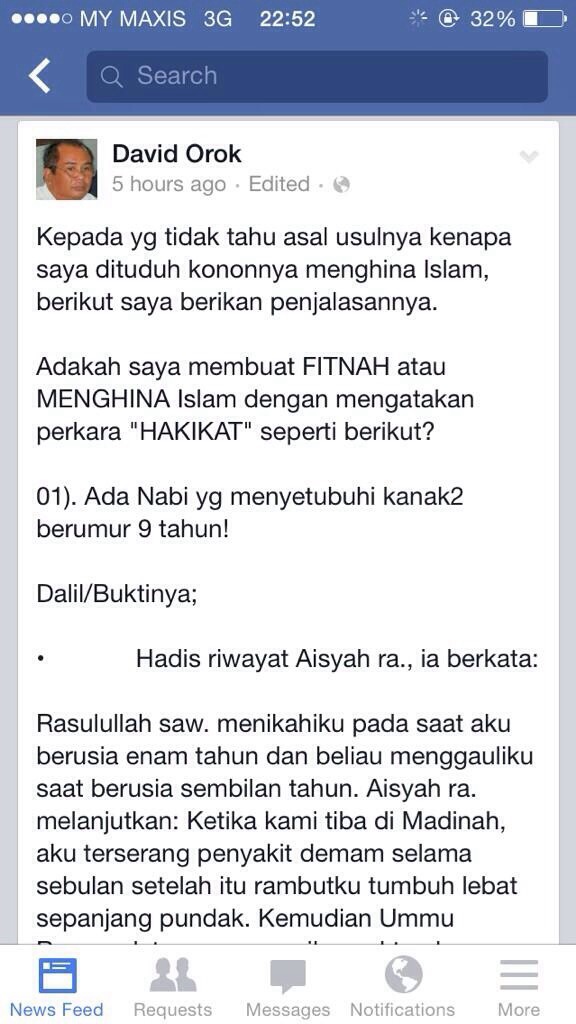
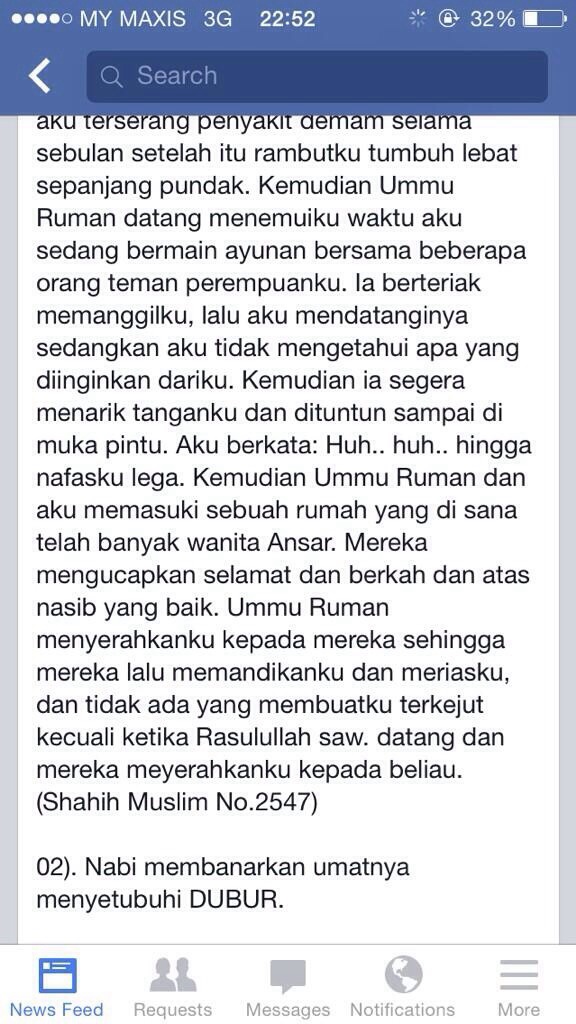
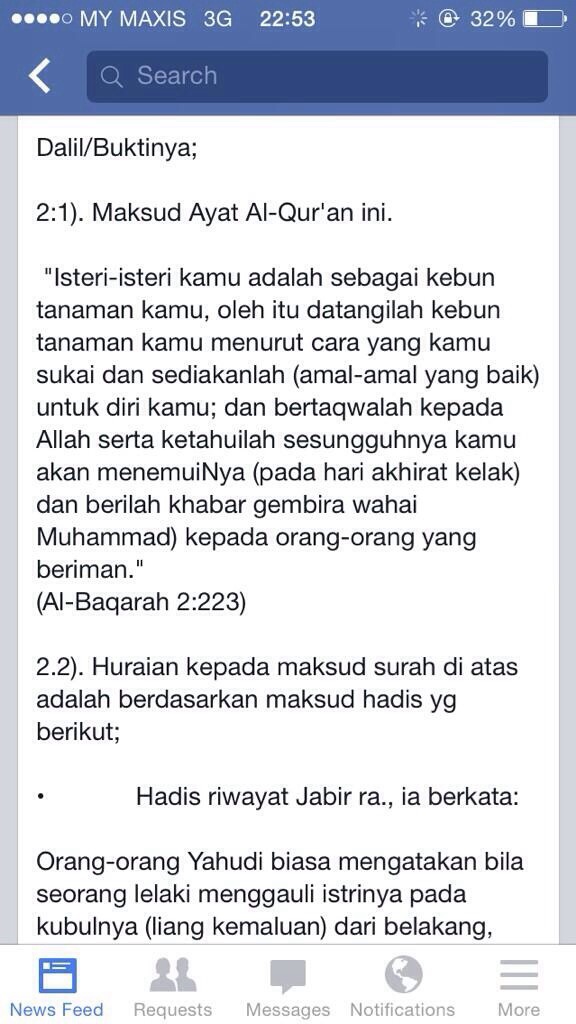
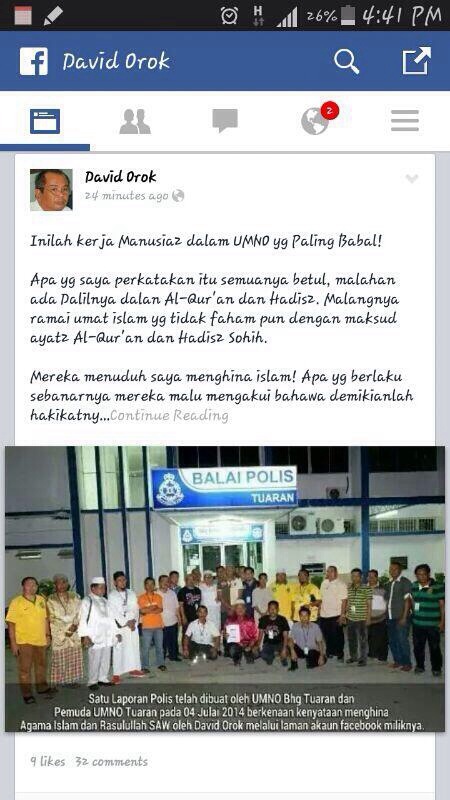
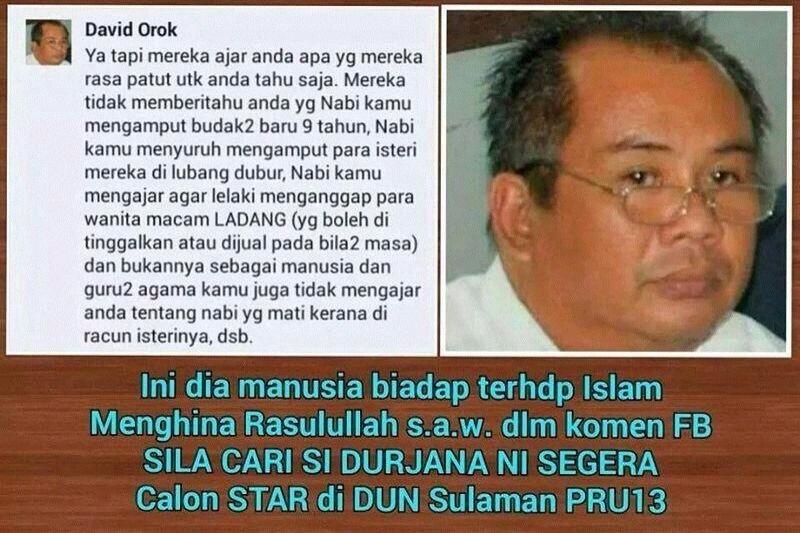
Now, David Orok, the STAR division head for Tuaran, Sabah, applies the incitement as well as clear and present danger tests on Muslims by ridiculing Islam in the most vulgar manner:

So, what is Najib going to say now? That we the Malays should give more and take less in this “give-and-take” situation where it is always the Malays who have to understand the feelings of the minorities for fear of backlash by human rights activists?

I’m sorry, Najib, I will never support the removal of the Sedition Act because your version of human rights seem more like a free-for-all animal rights.

20140705-235421-86061466.jpg

20140705-235444-86084951.jpg

20140705-235500-86100810.jpg

20140705-235513-86113527.jpg

———————————————————————————
Updated 10am, Sunday 6/7/14

20140706-095705-35825263.jpg

20140706-095705-35825077.jpg

20140706-095704-35824866.jpg

Clear And Present Danger

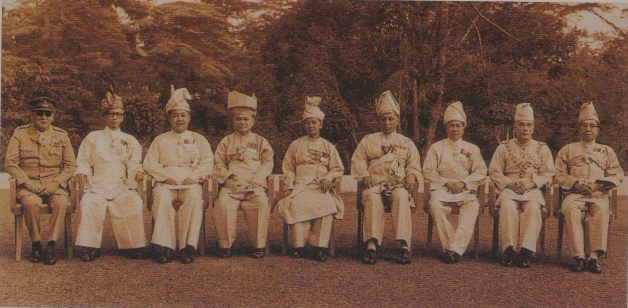
The Predecessors of the current Rulers at a Rulers' Conference
The Predecessors of the current Rulers at a Rulers’ Conference

The roles of the Rulers (or sometimes referred to as the Malay Rulers) in this blessed nation are somewhat misunderstood.  While many often think that the Institution of the Rulers mirror that of the British’s Westminster-style monarchy, it is not.  Britain had undergone a period of regicide and for a moment was a republic under Oliver Cromwell, but monarchy was reinstalled with the ascension of Charles II guided by the British Parliament with laws made and passed solely by the Parliament. Here, we have Rulers who, until 1957, ruled the land (although much of the administration was passed to British advisers through various treaties who were on the Rulers’ payroll).  It was only on 31st August 1957 that the executive powers of the Rulers were handed over to a civilian government chosen by the majority of the people of the Federation of Malaya. The Rulers, as owners of this land, continue to enjoy their position with their income regulated by the respective laws, and receive advice from the Menteris Besar (or in the case of the Yang DiPertuan Agong, the Prime Minister). This is evident in Article 181(1) of the Federal Constitution which states:

“Subject to the provisions of this Constitution,” the “sovereignty, prerogatives, powers and jurisdiction of the Rulers…as hitherto had and enjoyed shall remain unaffected.”

The same was noted by Mark R Gillen of the Faculty of Law, University of Victoria (Gillen 1994:7). In the words of the late Sultan of Perak, Sultan Azlan Shah, former Lord President, it is:

“a mistake to think that the role of a King, like that of a President, is confined to what is laid down by the Constitution, His role far exceeds those constitutional provisions” (Azlan Shah 1986:89)

As history have shown, time and time again, the strength and weakness of the Rulers lie in the strength or weakness of those responsible to advise the Rulers.  Those appointed as the Prime Minister and Menteris Besar are expected to be sincere, wise and knowledgeable, truthful and forthcoming no matter how bitter the advice may be, so that the Rulers can act with just with their feet firmly on the ground, or in the Malay saying:

Supaya Raja tidak dibuai dalam khayalan; tidak diulit gurindam pujian

Why I have not referred to the Rulers in this particular post as the Malay Rulers is deliberate, with references made to various research papers on this subject.  Before the entrance of the British advisers, each of the Ruler was the Ruler of all he surveyed and was the enjoyer of all he surveyed. This means that there were no state boundaries as we now have to show the dominion of each Ruler, and the people whom we collectively refer to as the Malays (as the Chinese and Indians are back in China and India are) used to refer to themselves as people of where they originated: orang Muar, orang Jasin, orang Pekan so on and so forth.  Their loyalty is to the Ruler who has dominance over their area. With the introduction of the Chinese and Indian immigrants by the British, the role of the Ruler transcended protector of the Malays, as protector of the immigrant subjects as well. The Hikayat Johor of the early 20th century lauds Sultan Abu Bakar of Johor for “looking after the Chinese subjects living in the state.” There is also mention of Chinese and Indians welcoming the Sultan home from an overseas journey (Anthony Milner, Australian National University, Milner 2002:214).

Even a left-wing Malay who wanted to unite a Raja-less Malaya with Batavia (Jakarta), Ibrahim Yaacob, referred to a Kelantan Ruler bestowing a prestigious title on a Chinese merchant and observed that the Johor state council building looked like a Chinese audience hall because it was decorated Chinese writing. When Ibrahim Yaacob asked what was the writing about, he was told that it recorded the personal service of wealthy Chinese people to the Ruler (Milner 2002:261).  Ibrahim Yaacob later served as a Lieutenant-Colonel in the Japanese Giyuugun (Volunteer Army) and fled Malaya for Batavia and served under Sukarno taking up the name Iskandar Kamel Agastya (SeaDemon: Road to Merdeka – Persekutuan Tanah China (6th September 2011).

When racial strife hit Malaysia on 13th May 1969, the Sultan of Terengganu as well as other Rulers took steps to protect their non-Malay rakyats (Kobkua Suwannathat-Pian, Faculty of Humanities, Universiti Pendidikan Sultan Idris, Kobkua 2011:364). This goes to affirm the special press statement made by the Conference of Rulers in October 2008 explaining that the Institution of Rulers is a “protective umbrella ensuring impartiality among the citizens.” The statement itself explains the Rulers’ constitutional role respecting the so-called “Social Contract” between Malays and non-Malays, and assures the non-Malays that there is no need to “harbour any apprehension or worry over their genuine rights.” (Kobkua 2011:425-426).

When the British wanted the Sultan of Selangor to banish a Chinese man, Ho Chick Kwan, (Ho Chick Kwan v Honourable British Resident Selangor, Criminal Appeal No. 11 of 1931), Ho was described as a “natural born subject of the Ruler of the State of Negeri Sembilan, and his adopted mother Lui Ho described herself as owing “true allegiance to His Highness the Sultan of Selangor.”

Such is the role of the Rulers in unifying the rakyat, and such was how the non-Malays back then were loyal subjects of the Rulers as the Malays were – a far cry compared to what we have today.

As mentioned in the fifth paragraph above, the strength and weakness of the Ruler depends on the strengths, weaknesses, sincerity, truthfulness, and knowledge of their adviser, namely the Prime Minister and the Menteris Besar.  The recent fiasco in Johor shows how a weak adviser can put the Ruler in harm’s way.  When the British acted as advisers and administered the states of behalf of their respective Rules, many of the Malays, including Ibrahim bin Yaacob, Burhanuddin Helmy et al saw no need for the monarchy to remain as an institution, hence the desire to make Malaya a republic united with Batavia. UMNO then took over as the linchpin of the Malays from the Rulers with the formation of the Malayan Union.

It is easy to understand why the Rulers agreed to the formation of the Malayan Union: weakened by the pompous nature of their British advisers who departed when the Japanese arrived, the Japanese relegated the Rulers into nothing more than deputy advisers in the administration of the Malay customs and religion.  Imagine what it was like for a Johor commoner to see his Sultan being scolded by the Japanese for leaning on his stick.  Seen working with the Japanese in World War Two, and weak in the eyes of the Malays, the Rulers did not have much choice but to succumb to the demands of the British.  But the Tunku was quick in restoring the faith of the Malays in the Rulers. He recalled that:

“At all costs I wanted to avoid having a split with the Rulers.” (Simon C Smith, Professor of International History, University of Hull, Smith 1995:183)

The seemingly weak administrations of both Abdullah Badawi and Najib Razak, and the digression of UMNO from its original intended path of protecting Islam, the Malays and Bumiputras and its inherent weakness in dealing with various right-wing Chinese and Indian organisations that have thrived under weak administrations have led to the formation of right-wing Malay groups such as the PERKASA and ISMA.  Najib seems to have given in to a lot of demands from people who will never ever support him nor his party, promising uncontrolled legal reforms thence setting up the left-leaning National Unity Consultative Council.  The National Harmony and Reconciliation Bill proposed by the NUCC is seen as a clear and present danger to a society that is already on the edge of destruction.

In Section 6 (1) (iii) of this Bill, will render the Rulers powerless in selecting the Menteri Besar for their respective state; the Agong will not have the power to select his Prime Minister, the Attorney-General, his Inspector-General of Police, or his Chief of Armed Forces even.  You Malays and Bumiputras may think that Article 153 can protect you, but you should also read Article 153(5) of the Federal Constitution and see what it says, and tell me if what I have written in this paragraph is not true.

Section 7 (1) (ii) even allows people of the LGBT group to hold important positions.  Gender equal opportunity is already in effect, but regardless of sexual orientation? I have gay friends and some are good friends of mine. Even they cringe whenever their lifestyle is brought under the spotlight by glamour-seeking peers.  It is not that they are not talented but will this not tear the fabric of our society?  May I ask the so-called religious Muslims and Christians if they agree with this?  In the name of Human Rights, we are beginning to fight to become animals, where unnatural ways are to become the norm of our society. I wonder how long would the Christian church in Malaysia be able to resist same-sex marriages with this Bill coming into effect. Removal of the Sedition Act would certainly act as a catalyst to destruction, much as the removal of the Internal Security Act has contributed to the worsening condition of the country.  There is nothing wrong with either Act.  Mere tweaking to prevent the laws from being abused by politicians would have been sufficient.

I fear for the future of this nation.  We must not let extremism prevail.

This is where the Rulers can play a role in holding the fragile fabric of this divisive society, to once again play a pivotal role in bringing this nation back to its senses.  We can no longer rely on weak Prime Ministers and Menteris Besar to protect this society from falling apart, all in the name of Human Rights (and the desire to please non-believers thinking you can get votes by kow-towing to their demands).  The Rulers also need to keep their conduct, and that of their families, in check.  There is no use correcting the society when they and those related to them do not behave with the utmost decorum.  And as history has proven again and again, the Rulers can act independently from their weak and self-interested advisers.

In the words of Sultan Nazrin Muizuddin Shah of Perak in July 2011:

Rulers must use wisdom to calm situations, but they do not have a ‘magic lamp’ to keep unity, especially when the situation has become chaotic.

I was an Officer of the Armed Forces of Malaysia, my loyalty has always been for my King and Country.  I humbly beg His Royal Highnesses to intervene and override weak and destructive suggestions of the government of the day.  Again in the words of Sultan Nazrin:

Unity requires a willingness to sacrifice, accept defeat willingly and celebrate victory with humility.”

I, your humble servant, humbly beg.

Kobkua Suwannathat-Pian. This goes to affirm

The Case For God – Part 4

The apex court of Malaysia, the Federal Court, has ruled in favour of the Appellate Court to deny the Christian Herald Weekly the use of “Allah” in its articles instead of “God” or “Lord”. Four out of the seven bench members voted to uphold the ruling by the Appellate Court while three dissented. While many jumped saying that it was an unfair decision, I did not see one person noting that one of the dissenting members is a Malay and a Muslim.

The ruling brings to a closure a divisive episode that began in 2006 that led to several unnecessary reactive incidents in early 2010 due to a High Court decision in favour of the Christian Herald Weekly. While BigDog argues that the apex court’s ruling upholds Articles 3(1) and 11(4) of the Federal Constitution, many think that it is their right to use Allah in reference to God.

Let me quote what was said as part of the judgment delivered:

‘The usage of the word Allah is not an integral part of the faith in Christianity. The usage of the word will cause confusion in the community.’

Many including outsiders such as Francis X Clooney SJ in his article entitled “Is Allah Not Our God? – America Magazine (Catholic) tried to argue for the Catholics in Malaysia without understanding the history behind this ruling and how Articles 3(1) and 11(4) of the Federal Constitution came about.

Perhaps, I may need to point out to Mr Clooney as well as uninformed Malaysians that while in the Peninsular Malaysia the use of Allah and several other words are regulated by various laws, they are not regulated for use in the Sidang Injil Borneo’s Bibles for the people of Sabah and Sarawak. Even in Indonesia some Christians use “Allah” – and this is all due to historical reasons.

In my blog post entitled The Case For God, I wrote about the history of the usage of “Allah” in Christian literatures:

Let us remember one thing. Malaya (Peninsula Malaysia) was never colonised as a whole by the British, save for Penang, Malacca, and Singapore, while Sabah and Sarawak came under direct British colonial rule. Penang was acquired through a deal to lease the island made between the British East India Company and the Sultan of Kedah; Malacca was acquired from the Dutch through the Treaty of Bencoolen; and Singapore was included in the Treaty of Bencoolen by making the severely weakened Dutch to not object to the British occupation of Singapore. The people of these three places, together with Sabah and Sarawak, became British subjects.
Through treaties with the Sultans on the Peninsula, the British helped administer the State of the respective Sultans, while the Sultans remained as the supreme head of these sovereign states. The administration of Islam came under the purview of the respective Sultans as the protectors of the state’s religion.

So, why does Indonesia have Bibles that use the word Allah to describe God?
Unlike Malaya, Indonesia was a nation of conquered people. Hello! Remember the Dutch? When Douglas MacArthur met Emperor Hirohito, he purposely stood next to the Emperor to show the Japanese people that the Emperor was not a demi-God. Victors get to do as they please, and this is probably the same case as the Ladang Rakyat issue in Kelantan. The Dutch conquered parts of Indonesia beginning in 1595, and as part of its attempt to call the Malay diaspora in Indonesia to Christianity, the Book of Matthew was translated into the Indonesian language in 1629; and where the Dutch set foot, other religions were formally prohibited although Chinese temples as well as mosques remained in existence.

Missionaries, too, made headway in Sabah and Sarawak, converting the populace to Christianity. Sir Stamford Raffles recommended to Rev. Thomas Raffles (Buitenzorg, 10th February 1815, Mss. Eur. F.202/6) that Borneo be given vigorous campaigns by the missionaries as “the island is inhabited by a race scarcely emerged from Barbarism.

This does not mean that the Malays were free from attempts to proselytize them. In fact, Raffles, in a letter to his cousin in 1815 mentioned how “Religion and laws are so united” in Muslim dominated areas that the introduction of Christian beliefs will bring about “much mischief, much bitterness of heart and contention”.

Raffles contended that Christianity must be packaged in a new form and be conveyed to the Muslim majority through a gradual approach. The “pagans”, on the other hand, required no stratagems. His methods include the establishment of missionary schools where the Malays are taught to read and write in their own language. Then he set up printers to publish books in Malay. Missionaries were largely responsible for this effort with the help of local agents, and the most famous of these agents was a chap called Abdullah Abdul Kadir who is better known as Munshi (Teacher) Abdullah. He and other Munshis taught Christian missionaries the Malay language. His role went beyond that and became the first Muslim in South East Asia to translate the Bible into the Malay language, that he became the target of his contemporaries who called him Abdullah Paderi (Pastor Abdullah) among other things.

It is interesting to note, however, that Raffles never once attempted to convert Malays in the Federated and Unfederated Malay States where the Sultans rule and guard the interest of the religion of Islam. This is because it would be foolhardy to anger the Sultans whom the British had a treaty with, by undermining the sanctity of Islam by converting their subjects. In the case of Raffles, he only focused his efforts on those who are British subjects.
Here we see the subtle tactics of the Christian missionaries during Raffles’s times, and the Malay lackeys who colluded with them. We can see the similarities in events of nowadays. But the above is also why we have Allah in the Bibles of Indonesia and Sabah and Sarawak, but not in Peninsula Malaysia.

And the above continues to be protected and respected in Sabah and Sarawak by the 10-point agreement which also includes the immigration right to refuse entry to any undesirable persons that the Opposition has said is a violation of their rights.

What does the above history have to do with modern-day Malaysia where history should or suggested be forgotten?

In my later post entitled The Case For God – Part 3 I wrote about the attempts to proselytise Muslims which is in contravention of the Federal Constitution:

As mentioned in the previous installment, too, I find the argument that Allah is the common denominator for God in this region a joke. The common denominator in the Indo-Malay speaking world would be Tuhan instead of Allah. However, Allah is the term that is inside the Quran for as long as time can remember. I cannot say the same for the Bible as it no longer reflects the Old Testament. Anyhow, you cannot find the name Allah inside the Old Testament. Just a Hebrew name that does not even resemble both the Arabic and Roman spelling of Allah. Even so, Elohim as called by the Jews, refers to The God that has no Son, nor an equivalent called the Holy Spirit. Mind you, even the Jews are totally against the concept of deifying a human being. I am sure my wife’s Iban relatives who are Christian would understand the term “Tuhan” without any problem since Bahasa Malaysia is derived from the Malay language, and the term for God in Malay is Tuhan.

We have seen the subtle tactics of missionaries of those days in the first installment and how their modus operandi is now refined by present-day missionaries. This blogger had had the opportunity to meet up with Muslims proselytized during the month of Ramadhan of 2012 and was told of the very fine and subtle methods used to proselytize Muslims in Malaysia. Back in the late 19th and early 20th century, the Malay people were not only bombarded with the Malay Bible, but also Christian publications in Malay such as Buletin Ariffin, Cermin Mata, Sahabat and Warta Melayu. Little has changed, but made only better. Recently, Johor’s Department of Islamic Affairs, together with the Home Ministry, confiscated 250 Christian literature in the Malay language. Imagine these books having titles such as Kaabah, Mengenal Rasul and Wahyu Illahi. With the state of Johor having around 58 percent Muslims, 2 percent Christians, and 40 percent other religions, who were these Malay literature targeting? Ibans? Christians? Chinese? Read more about the attempt to proselytize Muslims in BigDog’s post.

So, what about the use of Allah by Christians in Indonesia, Egypt etc.?
Tell me how good has that been for Indonesia and Egypt? How well do the Muslims and Christians get along in those countries? The very reason we do not have beheading of Christians in Kelantan or lynching of Muslims in Sarawak is because we do not step on each others toes.

I also wrote the following:

So is “Allah” an integral part of Christianity? I argued on this when the Appellate Court decided against the High Court ruling:

When the Turks charged at the British lines during the Battle of Gallipoli, they cried “Allahu Akbar.” The British soldiers retorted, “Come and get your Allah here!”
If the same British soldiers are here now, they would be utmost disappointed that the Christians in Malaysia now want to accept Allah – the name of the God they believed to be false – as the special noun to replace the word “god”.
Why am I still on this issue? Some lawyers now say whatever decree the Agong issues, is not binding for non-Malays and non-Muslims.
Fine. The Malay Rulers may not have intrinsic powers left apart from dissolving or withholding a cabinet or state assembly, appoint a Prime Minister or a Menteri Besar, and protect the religion of Islam and Malay customs. I shall not dwell too deeply into this but my friend SatD has written a very good piece on this in his blog Pure Shiite.
What is most important is that when the Selangor Islamic Religious Department (JAIS) confiscated those Bibles containing the special noun “Allah”, they were acting on the provisions of Section 9 of the Selangor Shariah Criminal Enactment which prohibits the use of 25 or so Islamic words and nouns in non-Muslim publications. You will be committing a crime merely by having one in your house or car, let alone propagate one to a Muslim (or more).
What does the Shariah enactment have to do with non-Muslims, you may ask. Everything! It is NOT an Islamic law, it is a State law! Actually, it is a State Criminal Law! And a state criminal law applies to all be they Muslims or otherwise. And it is a STRICT LIABILITY law! Like I said, you have one, you break the law!
You constitutional law sexperts may also argue that the law is unconstitutional. It may be so. But it is the state law until and until a Constitutional court decides otherwise.
Oh, cry foul all you want and claim that the Apellate Court judges were all Malays. This is the part that I do not understand. All these challenges to the decision of the Apellate Court may be a norm to some of you common criminals and petty lawbreakers; the judges may not even hazard to act against them but the person who should be taking action, the Attorney-General, should. It is in contempt of a court ruling. What does that tell me, a layman? The A-G is simply useless for allowing lawlessness become a norm.
When Muslims cry foul to the Christians saying that “Allah” is an integral part of Islam, it is because the concept of trinity is an antithesis of the “Oneness” of Allah. The special noun refers to The God, One and Only God. Not a God that needs a trike to be able to “stand.”
The Christians lashed back saying that the Muslims should not tell them what is integral and what is not to them, saying that Allah is integral to the Christians. Else why quarrel over the special noun?
The word “integral” means something that if not present, does not complete something. Like tyres to cars.
Let me ask them this: if “Allah” is integral to the Christian faith, does this mean that the Popes, for 2,000 years, all the way from St Peter Petrus, have gotten it all wrong?
Maybe those adamant to use the special noun “Allah” can now shout to the Pope to come get his “Allah” here.

Air Power Is National Power – An Essay

This article was submitted to the RMAF PR Department after Defence writer, Danny Liew asked me if I was participating in the essay-writing contest (that I had no idea about). I quickly wrote one in office and mailed it within 2 hours of writing. I could not write much as we were limited to 2,000 words only (if I remember correctly).

It only won a consolation prize (not surprised though due to the lack of effort I made)

…………………………………………………………………………………………………………………….

AIR POWER IS NATIONAL POWER

Background
For most of its beginnings, the RMAF operated in support of the Malaysian Army’s and Royal Malaysian Navy’s operations, before finally gaining air defence capabilities in 1963 after receiving ten ex-RAAF CAC Sabre fighters. 56 years after its establishment and in spite of recent unfair criticisms for its mainly misguided and perceived roles, the RMAF is, still without doubt, a force to be reckoned with.

Operating uniquely a combination of modern European, American and Russian aircraft, the RMAF has a power projection that had gotten a regional neighbour publish a defence white paper to discuss what is believed to be “the first nation to have the capability to strike the mainland in sixty years.” Supported by very capable air defence coverage as well as skilled personnel, the RMAF continues to provide assurance that the sovereignty of the nation will be protected at all costs.

However, does the RMAF have enough appropriate assets to truly assert power projection?

Force Projection– Lessons from the Ambalat and Lahad Datu Incidents

“Force Projection” is a term used to describe a nation’s ability to project power and exert influence on its neighbours at the least, and viably regionally or globally.

During the Ambalat incidents from February through May 2005 saw the RMAF deploying some of its assets from the Peninsula to the East. Given the number of offensive air assets the RMAF possesses, had the conflict gone uncontrolled, it would have been a daunting task to defend both sides of the nation.

We again see a deployment of assets from the Peninsula during Ops Daulat to provide close air support for the ground combatants. The RMAF has been continuously been rotating aircraft on detachments from the Peninsula and this is far from being a feasible way of sustaining force projection.

Air Power

The British definition of air power today is:

The ability to project military force in air or space by or from a platform or missile operating above the surface of the earth. Air platforms are defined as any aircraft, helicopter or unmanned air vehicles.”

The above defines the characteristics of modern air power which provides for national deterrence against possible belligerents. The manner in which the RMAF operations are limited to does not allow for sustainable air power projection.

The factors that define effective implementation of air power include:

Airbases. There should be a network of permanent as well as alternative operating bases. Although much of the grass airstrips in Malaysia have been converted into dwelling as well as golf courses, we are still blessed with myriad small airstrips that can effectively operate smaller aircraft suitable for light-attack and helo operations. Civilian airports in Sabah and Sarawak in particular should provide the opportunity for the RMAF to form and house additional squadrons instead of detachments from the Peninsula to effectively oversee its responsibility to provide adequate air defence for those states. While air-to-air refuelling (AAR) can extend the reach of our fighters as well as their loiter time, planning factors such as distance, demand, duration as well as cost generated by the need for enhanced AAR capability need to be taken into account.

Versatility. Our air assets should also be versatile in its multi-role capabilities with quick turnarounds for other roles reconfiguration.

Air Presence. While “Sentiasa Di Angkasaraya (Always in the Air)” may be the motto of the RMAF, it is prohibitively expensive to continuously provide air presence. Already blessed with a relatively good air defence system, and in light of the MH370 incident, the RMAF may need to tweak its air intercept procedures, provided with better engine hours for its interceptors, and impose upon the Department of Civil Aviation for better airspace management control where the former has a better control of not just suspected hostiles, but also of stray friendlies.

Fragility. As air assets grow in terms of sophistication and performance characteristics, so does those of the anti-air defences. As such, suppression of air defences becomes an important and crucial role for air power. During WW2, DeHavilland produced an aircraft that embraced simplicity in battle-damage repair but effective in performance: the almost-all-wood Mosquito. While wood is more fragile than conventional aircraft material, the fragility of the Mosquito was ameliorated by its speed and superb performance. Likewise, the RMAF would need aircraft that has better speed, low radar signature and good self-protection measures to make up for the fragility due to the enemy’s enhanced air defence capabilities. This will ensure the ability of the RMAF to penetrate deep behind enemy air defence lines.

Good intelligence and Quick Response. Air Intelligence Officers must possess the correct knowledge, attitude and the ability to grasp situations in order to have an effective support for air combat operations. As intelligence is perishable, good intelligence is only good if it can be made to good use by the tacticians and strategists before its value becomes outdated. The Decision-Action cycle has to be in a tempo that supersede that of the enemy.

Stand-Off/Reach. The range of modern air-to-air, air-to-surface weapons, as well as the air platforms that carry them will demonstrate the RMAF’s commitment and resolve. This is an area where the RMAF, in moving forward, need to seek balance in when making future procurements of air assets and materiel.

Sustainability. The RMAF must ensure that its manpower, equipment and logistics are able to command its operational and objective requirements. Sustainability is the ability to maintain its aim as prescribed in the Principles of War.

Principles of War

The Principles of War were developed by Major General JFC “Boney” Fuller based on his experiences during the First World War. Applicable also to Air Power, failure to take into account these hard-won lessons can lead to mission failure. They are:

Selection and Maintenance of the Aim. It is imperative that the aim in which the RMAF plans to achieve its objectives must be carefully selected and defined with clarity. The objectives must be attainable and directed to achieving the intended strategic goals. The commanders at all levels must know how to interpret the aim and what is required of them and the resources made available to them to attain the aim. Therefore, the tasks, roles and missions selected for the air assets must be consistent and coherent with the strategic initiatives to achieve this aim.

Maintenance of Morale. Air and ground assets employed by an air force are useless without personnel that are motivated to achieving the aim. Continual training and maintenance of discipline are equally as important for the men and women of the RMAF as well as having commanders who they can look up to and trust in their leadership in times of war and peace.

Security. It is also imperative that physical protection of assets be of utmost importance against enemy interference. All personnel need to embrace the “need-to-know” and information denial culture. For the latter to occur, good and outstanding commanders who command the respect of his/her men and women play exceptional role in maintaining their morale and in making them understand the culture of information denial.

Surprise. Surprise is essential to achieve mission success and must be applied to at all levels of RMAF activities. Surprise can be achieved through secrecy, concealment, deception, originality, audacity and speed.

Offensive Action. The commander must always employ offensive action to influence the outcome of the campaign or operation. With selection and maintenance of the aim, determination must be set to maintain the initiative and deny the enemy from overcoming the goals. In peacetime, force projection via adequate appropriate assets as well as the availability of correct basing of assets provides psychological offensive action. Hence, the Government needs to see that resources are made available to the RMAF to achieve this aim.

Concentration of Force. It is essential to concentrate superior force against the enemy at the decisive time and place which calls for superior and adequate assets, as well as quick reaction to good intelligence to achieve success in war and peacetime.

Economy of Effort. Decisive strength must be achieved and maintained in order to have concentration of force. Therefore, Economy of Effort demands correct air power weapons and delivery systems to match the tasks.

Flexibility. Flexibility allows the commander to exercise judgment by modifying plans without changing the aim. It demands trust, discipline, good training and quick decision-making.

Cooperation. Better cooperation and coordination with other services can be achieved through joint exercises. This allows for concentration of force and economy of effort against the enemy.

Sustainability. As mentioned, sustainability is about maintaining the physical, spiritual and moral aspects, and the necessary fighting power of the RMAF. Without sustainability, the aim will be greatly jeopardised.

Conclusion

Air Power is important in maintaining the nation’s deterrence from belligerence. The RMAF needs the government’s support in acquiring adequate appropriate assets to maintain that deterrence as it projects the nation’s power.

Just Ranting, Laaaaaaawwww!

Let me just rant.

If you read the title above with a Malaysian-Chinese accent, you’ll get the effect.

What is unique about our Federal Constitution and the laws made under it?  That it has both the “secular” and “Islamic” features.  The “secular features include Articles that give the Federal Constitution its supreme status, that the provision of Islam as THE religion of the Federation of Malaysia does not depart from any other provision, that the Syariah courts have limited authority, so on and so forth.  Meanwhile, its theocratic features include provisions that allows the independent nature of the Syariah courts from the civil courts (Article 121 (1A)), ALL Muslims are subject to the Syariah laws, State support for Islamic religious institutions, preaching of any religion to Muslims is regulated, that the concept of Malay and the religion of Islam are intertwined, and several other provisions made pertaining to Islam being the religion of the Federation. Bear in mind that Articles 4(1) and 162(6) of the Federal Constitution affirm the supremacy of the Federal Constitution over Parliament – contrary to popular belief.

Now, what am I ranting about? Initially, I wanted to rant about ESSCOM and the latest kidnapping, but since two recent issues are more pressing than Mentek’s failure-blame-placed-on-the-police-army-and-navy issue.  They are the comment made by Tan Sri Khalid Abu Bakar, the Inspector-General of Police on the issue of the custody of two children to two sets of parents of different religion as well as Menteri Besar of Selangor’s plan to seek audience with HRH The Sultan of Selangor on the possible return of Bibles confiscated by MAIS/JAIS to the Bible Society of Malaysia.

A bit of background on the first issue: custody.  Two couples namely Muslim-convert Izwan Abdullah and ex-wife S.Deepa, and M. Indira Gandhi and her ex-husband, also a Muslim-convert Mohd Ridzuan Abdullah. Both men converted to Islam without the knowledge of their respective wife resulting in the latter claiming for custody of their children.  Well, it is slightly more complicated than how I have described the case but that is the gist of it. The civil courts have granted custody to the wives while the Syariah courts sided with the husbands. In both cases, the children were converted to Islam without the respective wife’s prior knowledge.

How did the IGP get into the line of fire?  The IGP has refused calls from certain quarters of the public to get the Royal Malaysian Police involved by upholding the various courts order and suggested for the Welfare Department to take custody of the children instead.

I agree with the IGP that the police should not get involved in the custody struggle, but on the other hand the police cannot ignore an arrest warrant issued by the court.  The dilemma here is that the police is expected to uphold both laws, civil and syariah. However, we must all look at the broader picture.  What the IGP said is right.  The children in the custody fights should be under the care of the Welfare Department.  People from the Welfare Department who say otherwise are either ignorant of the law, or are just trying to wash their hands in this matter.  Section 17(1)(h) says that a child is in need of care and protection if there is a conflict between the child and his parents or guardians, that family relationships are seriously disrupted, thereby causing the child emotional injury. Section 18 of the same Act gives the provision for the Welfare Department to take the child into temporary custody.

Why am I in agreeable with this measure?  Even with Ridzuan arrested and placed in custody for contempt of court, he is still entitled to the normal legal channels and can file an appeal against the custody order made in favour of his ex-wife by the High Court.  Only when ALL legal channels have been exhausted, and a final court decision has been made regarding these two cases then the Police should carry out the final order. With the children in custody of the State, the parents can have equal and neutral access to the children at pre-determined times, regulated by the Welfare Department.  All conversions should go through a process where the original Identification Card be held by the religious officer performing the conversion, and the conversion to be registered at the National Registration Department for the converted to receive an Identification Card.  The process should also include a meeting with the spouse/family of the person wanting to convert before any conversion to take place.

Now, back to the issue of the confiscated Bibles.

I have written at length on this issue earlier this year.  I even provided the background why they can use Allah in Sabah, Sarawak and even Indonesia but not in Peninsular Malaysia here ,here and here.

The Majlis Agama Islam of Selangor (Selangor Islamic Religious Council) and the Jabatan Agama Islam Selangor (Selangor Islamic Religious Department) or known to many simply as MAIS and JAIS respectively, are adamant to uphold the Control and Restriction on the Propagation of Non-Islamic Religions Enactment, 1988 under which the Bibles in the Malay language are confiscated.  May I remind everyone that the Enactment is a strict-liability State law, and not a law made under the Syariah context. It applies to all, non-Muslims and Muslims alike.  On 11th June, the Attorney-General, Abdul Gani Patail announced that JAIS had erred in seizing the Bibles, and that no charges would be made, rendering the case closed.

Just as I thought the A-G as a useless human being in this particular post, I strongly believe that the statement he made and how he came to this decision are driven by grave errors.  Firstly, the A-G had made irrelevant introductions to the case by treating the case as one that involves national security. This is because the A-G’s Chambers had recorded statements made by Home Ministry officials indicating that the Bibles do not fall under their purview, therefore do not involve national security. This, my dear A-G, is not about national security. It is about the dangers to public order and moral. Due to the statement made by the A-G on this matter, the Menteri Besar of Selangor, Khalid Ibrahim, will be meeting His Royal Highness the Sultan of Selangor to discuss the issue of returning the Bibles to the Bible Society of Malaysia. Making matters worse is the Prime Minister himself has seen fit to get involved in the melee that is a State prerogative by suggesting that MAIS meet up with the A-G to discuss way forward.

Here is what MAIS and JAIS should do in the case of the useless Attorney-General: go to court and apply for a writ of mandamus to compel Gani Patail to do the right thing. Gani has erroneously digressed from the crux of the issue and have added to the confusion of many, with the possibility of creating a wrong precedence.  The A-G as a public officer should have carefully studied the issue AS IT IS, and not introduce irrelevant matters such as national security before coming to a decision.

May I remind MAIS that in the case of the A-G, to refer to Teh Cheng Poh @ Char Meh v. PP  case where Lord Diplock who was a member of the Privy Council opined in 1978 that the Attorney-General had erred in allowing for the trial of a 14-year old juvenile in the High Court. The 14-year old was represented by the late Karpal Singh. Therefore, MAIS should apply for a writ of mandamus. Meanwhile, MAIS should also file a police report against Shah Alam MP, Khalid Samad, who suggested that MAIS’s authority over JAIS be removed, effectively usurping the powers of the Sultan of Selangor in an unconstitutional manner.

In both cases mentioned above, the rule of law must prevail and should not be allowed to be manipulated by anyone, especially by the politicians, and cool heads should prevail.  Government agencies should also act without fear or favour in exercising the provisions of the law.  Meanwhile, public officers who cannot perform tasks expected of them should be removed.

Gani said statements recorded from Home Ministry officials also indicated that the books did not fall under their purview and, thus, did not involve national security. – See more at: http://www.themalaysianinsider.com/malaysia/article/bible-seizure-case-closed-no-prosecution-says-a-g#sthash.J58v3D4q.dpuf

ESSCOM’s Failure: Who To Blame?

20140404-195043.jpg

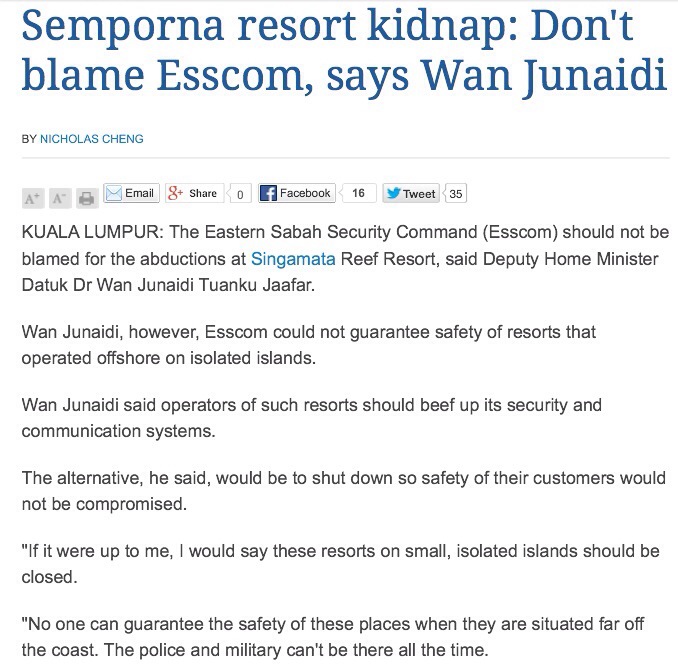
If you think it is disgusting that armed men believed to be from the terrorist group Abu Sayyaf could infiltrate our borders of the east coast of Sabah last November, shoot dead a tourist from Taiwan and kidnapped his wife, then again a few days ago taking a tourist from China and a resort worker away, guess what is even more disgusting? That the man above, the Deputy Minister of Home Affairs, had the cheek to say the following (as quoted by The Star:

20140404-200102.jpg

Who are we to blame then, Wan Junaidi?

May I remind the Deputy Minister that ESSCOM was created on 7th March 2013 to ensure the security of the ESSZONE is taken care of in a holistic manner so there would be no recurrence of the Lahad Datu incursion and of other similar incidents. Maybe I can provide the Deputy Minister with a statement by the Prime Minister on Police Day 2013 that was posted on ESSCOM’s website.

20140404-200958.jpg

ESSCOM is an agency under the Prime Minister’s Department to undertake the enhancement of security in the ESSZONE defined as 10 districts from Kudat to Tawau spanning 1,733.7 kilometers, to prevent recurrence of any form of intrusion by unwanted foreign elements.  The method that should be employed to affect this is by applying the Defence-in-Depth concept that I wrote about in March of 2013 when ESSCOM was first formed.  The military has worked with the police in a support role on numerous occasions starting with the First and Second Emergencies of 1948-1960 and 1968-1989 periods respectively, in various UN missions such as to Cambodia, Liberia, and Timor Leste. The military also supported the operations conducted by the police in Ops Daulat last year, and since then the military and police have conducted basic recruit training jointly at the Army Recruit Training Centre in Port Dickson to enhance better understanding between the two.  Therefore, the issue of one not being able to accept orders by the other does not arise.  In any case in peacetime, the command of the police prevails and the military plays a supporting role, and this has always been case.  The Immigration however, does not have any experience in operational security as they only act as filters to immigration, and not experienced nor trained in deploying combat assets.  It is no secret that the southern Filipinos have no respect nor fear for our Immigration Department. They only fear our police and the military.

I don’t subscribe to Wan Junaidi’s remark that the resorts should close down. They have been in existence even before the formation of ESSCOM. They are still located within our littoral zones. Should they not be protected? Should there not be security forces stationed at these resorts as there is on Mataking, Mabul, Sipadan, SiAmil and other islands?  If the resort owners do not cooperate, what is the problem? Who makes the policies? Can’t action be taken against resort owners who do not respect policies? Stop giving stupid excuses, Wan Junaidi, and start behaving like a Deputy Minister.  If ESSCOM cannot even get the buy-in because it does not have the will to enforce and execute policies, it should be disbanded and leave it to the police and military to run an enhanced version of Ops PASIR. The Immigration Department should just go back to stamping passports and weed out illegal immigrants.

So, who is to be blamed, Wan Junaidi?  Who is to be blamed for appointing a non-combatant to take charge of a combat situation? Who is to be blamed if as a result of the appointment two armed incursions have taken place resulting in the kidnapping of three people and the death of one?  I will blame Wan Junaidi for making stupid statements, one after another, and blame the government for making him a Deputy Minister.