E-Hailing versus Taxi Drivers: An Endless Contention

MAHATHIR_MOHAMAD_1540128271
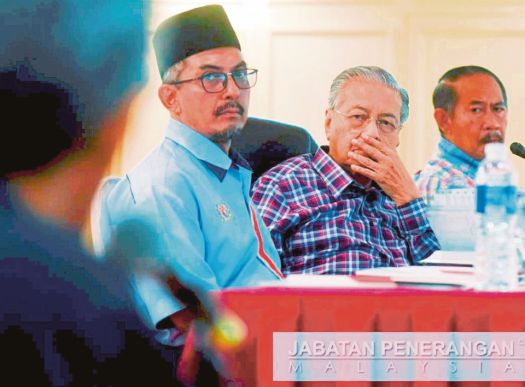
Mahathir reacts to the outburst by taxi drivers in Langkawi – courtesy of Sinar Harian

So, 10 Langkawi taxi drivers hurled abuses at the Prime Minister before walking out of the hall recently where they were to have a dialogue with the latter.

They were utterly dismayed at the government’s decision to allow E-hailing services, namely Grab, to continue its existence and complement the taxi services.

Their anger is understandable.  In March of last year, taxi drivers and owners staged a protest against the previous administration outside the Parliament building, for allowing Grab to operate, and were joined by the likes of Mahfuz Omar, Rafizi Ramli, while in 2015 Datin Seri Wan Azizah Ismail joined them at Padang Merbok.

Although the Prime Minister has denied ever wanting to abolish Grab and other E-Hailing services, the taxi drivers and owners feel as if the government has reneged on its promises to protect their interests.

Prior to the walk out last Sunday, there have been two rallies opposing Grab services organised by taxi drivers; one at Padang Merbok in July, and the latest was five days ago outside the Ministry of Finance.

Back in the 1960s and 1970s, you would either have to go to a taxi stand, or call up a taxi stand to have a taxi sent to your location, or wait for one to pass by.  With the advent of radio taxi services in the 1980s, getting a taxi was similar but quicker as the taxi could be roaming near your neighbourhood.

Not much has changed since, but with mobile phones, if you know the taxi driver personally, you could call him or her to come pick you up.

E-Hailing is not much different.  You have a car owner, registered with Grab for example, who would choose on the software whether he or she would like to pick up a passenger who has hailed for a ride using his or her mobile device.

A destination is given and the car owner drives the passenger to the given destination. The fare is fixed; so unlike with taxi drivers, you do not get the last-minute discussion for extra payments.

You can either opt for a credit/debit card payment, or pay by cash.

But E-Hailing is more attractive to the passengers.  Besides having the fare fixed, you don’t need to conduct a cash transaction, they can pick you up from anywhere and drop you off at your choice of destination at any time of the day or night.

With E-Hailing, more and more partygoers would be willing to not drive at night, thus increasing the size of the cake in contention.

It is late at night when the dissatisfaction with taxi drivers is at its peak.

Try hailing a taxi in the middle of the night: if your destination does not conform to their desired location, they could refuse you or reject you.

More often than not, they would prefer not to use the meter and throw you a figure. That figure could be more if they suddenly tell you that they will ‘balik kosong’, meaning that it would be difficult for them to get a passenger in your area after dropping you off.

It is not easy to find an equilibrium where both services can co-exist without losing much to each other.

While it may be true that E-Hailing also takes a slice from the same cake, I doubt that any taxi driver has gone unemployed since the introduction of E-Hailing services.

Swedish-German economist at Oxford Martin School conducted a study in 2013 in cities in the US of the impact Uber has had on the income of taxi drivers.

He found that though it is true that the income of taxi drivers had been affected, the drop was in the region of 10 percent, while E-Hailing services had resulted in a 50-percent rise in the number of self-employed drivers.

Frey expressed that traditional jobs have not been displaced.

In the case of Langkawi, it is difficult to get a taxi, especially if you venture out to the less touristy places.

The Langkawi Craft Complex for example, is almost half an hour away from the taxi stand in Kuah, and 25 minutes away from the one at the Langkawi International Airport.

I doubt if anyone would get a taxi if they waited by the road side.

Perhaps the answer to the plight of the taxi drivers is to subscribe to an E-Hailing service of their own, much like the radio taxi service.

Pay a certain amount as annual fee to a management company, they can download the application, and charge by the meter, and the payment goes into an account, just like Grab or Uber.

Like their counterparts in Singapore, they should be able to accept credit and debit card payments, and passengers get to rate them as well.  I am sure that such an application could be produced.

That way, they have a level playing field with the other E-Hailing services drivers, and maintain the quality of their service.

With two-thirds of the world’s population due to live in cities by 2050, the cake will keep on growing for both taxis and E-Hailing services drivers.  A combination of private providers and public mass rapid systems will be the imminent scenario.

My only wish for now is for foldable bicycle owners to be allowed to bring their bicycle on board our trains during peak hours.

That would increase the ridership of the trains, while both E-Hailing and improved taxi systems complement the process by moving workers from office to meeting venues and back.

(This article was first published on The Mole)
11th Malaysia Plan Mid-Term Review

atok

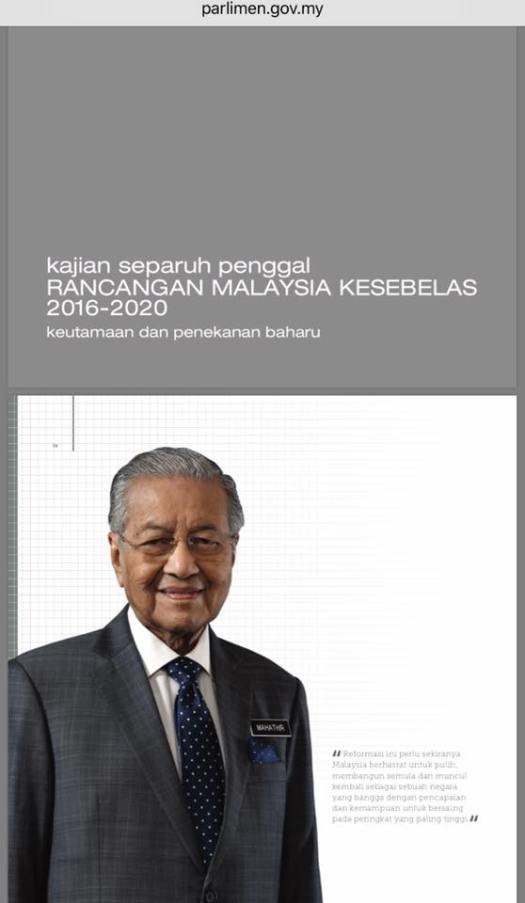
Yesterday, the Parliament’s website published the 11th Malaysia Plan mid-term review paper which was unveiled by Prime Minister Mahathir Mohamad which, among others, officially confirmed that the national debt as at end of 2017 stood at RM686.8 billion, and not RM1 trillion as announced by Finance Minister Lim Guan Eng.

That drew flak from the masses who felt that they were duped into voting out the previous Barisan Nasional government and lied to by the current government.  As a result, the document has been taken down.  This says a lot about transparency of the current government.

A quick check at the Economic Planning Unit’s website shows that a copy of the document is still downloadable by clicking on this LINK.

Anyway, if that is taken down too, you can click on the following link to download the pdf document.

Kajian Separuh Penggal RMK11

Food – Salve Of The Soul

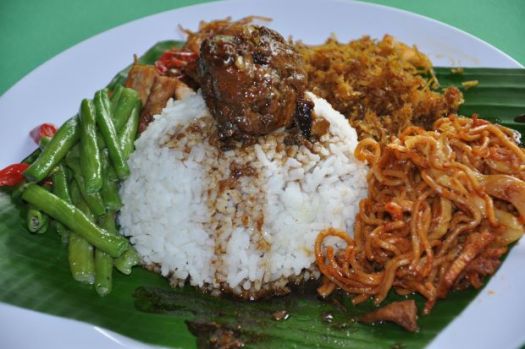
Nasi Ambeng
Nasi Ambeng is a favourite amongst the Javanese community in Malaysia

MY wife is a Johorean – well, half-Johorean.  Her mother is from Kuching, Sarawak. So, when it comes to what is good as food, I trust her judgment.

Why am I writing about food this time? I see a lot of unhappy news lately and I think food is what makes us all happy.

I was brought up eating Johor-style cooking; with the cabbage, or bean curd and beansprouts in masak lemak putih, asam pedas, soto and lontong with kuah lodeh (lontong actually refers to the compressed rice, and not the whole dish).

I was picky when it came to food but going to the Malay College broadened my culinary horizon – Kuala Kangsar gave me Mi Bandung at Restoran Zabdi, Laksa Perak by our Makcik Canteen, Masak Lemak Kuning, Gulai Otak Lembu by the riverside, and not to mention the ulat-filled sayur bayam and stir-fried long beans from the dining hall.

My wife and I were once upon a time both married to spouses from Kedah. My love for curry is because of Kedah’s Gulai Kawah Daging cooked using either the Serbuk Kari Chap ‘O’ or Serbuk Kari Chap Tarbus. The owner of Serbuk Kari Chap ‘O’ drove a car bearing the registration number KAR 10.

I love the Nasi Lemak Kuning which is now more famously represented by Nasi Lemak Royale with the Daging Masak Hitam (it’s Nasi Kandar by the way, and tastes nothing like the Nasi Lemak).

For laksa I would drive to Kuala Kedah for the famous Laksa Teluk Kechai.  Not forgetting the Peknga Nyioq Gulai Ikan Termenung (Coconut Pancake dunked in Indian Mackerel Curry) and Pulut Sambal.

Try having lunch at Restoran Sri Pumpung, my all-time favourite lunch spot.  Top that with an ice-cold glass of Nira Nipah (Nipa palm sap) and your day is made.

Despite all the good food, my wife and I agree on one thing – Hari Raya in Kedah for us non-Kedahan was an omen for both our marriages.

Hari Raya for me means lemang, nasi impit, rendang, dodol, lempuk durianaccompanied by barrels of ice-cold soda. For my wife her Hari Raya food means Nasi Bariyani Gam, Laksa Johor, Mi Rebus, Lontong with Kuah Lodeh, assorted cakes, and endless flow of lamnet (soda water – a Malay contraction of the word lemonade – which is used to describe soda).

In Kedah back in the 1980s and 1990s, Hari Raya was ketupat palas (either plain, or with beans, or with corn) served with serunding (meat floss – not to be confused with the Indonesian serunding which is spicy fried coconut flakes), and squash (cordial drink, if you must).  And no matter which house you visit, they would serve you ketupat palas with serunding. And maybe cookies and mini-popiah or mini-karipap filled with serunding.

Only some houses would serve you something different – bihun goreng or the neither-here-nor-there Mi Kuah.

I cannot make out what the Mi Kuah is all about. Yellow noodles in pale-colour spicy but salty gravy.  And while the kids all ventured out to collect duit raya, the adults would flock in front of the television set watching either some Hari Raya concert or a Hindustani movie.

I always ended up with a bad bout of constipation. Little wonder our marriages to Kedahans did not last.

So, Hari Raya for us now depends on whose in-laws’ house we are at: hers or mine.  If it is at her in-laws’ place, then we’d be feasting on Nasi Impit, Lemang, assortment of Rendang, Laksa, Mi Rebus, Satay, Nasi Minyak; and if it is at my in-laws’ place it’s Lontong with Kuah Lodeh, Laksa Sarawak, Mi Kolok, Bubur Pedas Sarawak, Laksa Johor, Soto, Nasi Lemak with Spicy Beancurd Soup, Nasi Bariyani Gam, Mi Bandung.

Do you know it’s blasphemous to eat your Laksa Johor with fork and spoon? Laksa Johor is supposed to be eaten with the hand, just so you know!

If you drive into the kampungs to visit during Hari Raya, you would be served with Nasi Ambeng, Burasak, whatever meat in Masak Ungkep style.  Not forgetting the Tiwol with Sambal Bawang, Rempeyek, Kerepek, Kuih Ros, Kuih Deram.

And it is in these kampungs in Johor that I get my dose of excellent Mi Bandung, Nasi Goreng Daging, Mi Rebus Johor, Pepes Ayam (similar to Otak-Otak but is made of chicken instead of fish), ABC Degan (Javanese for coconut).

If you visit the houses of the aristocrats down in Johor Bahru, you’d get to sample the rarely-made Harissa which is a concoction of either tenderised beef or lamb meat cooked with oats for three hours, and is served with sambal and honey.  Not many Johoreans have tasted the Harissa.

Before the Kedahans slam me, remember that I said (apart from Hari Raya) Kedah food is excellent too.  In the early 1990s I would frequent the Nats (morning markets or called Pasar Tani elsewhere) and the Pasar Malam – Tuesdays in Kepala Batas, Wednesdays in Changlun, Thursdays in Tanah Merah, Fridays in Napoh and Sundays in Pekan Jitra. The locals call it PJ.  Coincidentally, PJ is right next to KL– Kubang Lembu.

It was at the Pasar Malam that I would get my supply of fresh meat and Ikan Kembung, and my favourite Kuey Teow Kerang.

A whole plate of Ikan Kembung cost RM2 a plateful. The eyes and skin were shining, gills pink.

Imagine the bitterness I felt when I was transferred to Kuala Lumpur and the Ikan Kembung had to be weighed before it was sold, red sunken eyes, darkened gills, slimy with strong fishy odour.  And costs a lot more than in Kedah, too!

So, no matter where you are, food soothes the soul.

And in times like this, if you feel down, just Google what you want to eat, Waze for the place, and make your day.

I promise you, you will end your day feeling much better.

(This article was first published by The Mole)

Utusan’s VSS : Umno’s weakening bridge to the masses

UMNO’s annual general assembly for the year had come and gone.

Looking at the live videos and photos taken during the event, it seems that the grand old party is as strong as ever. 

Not only was the Dewan Merdeka filled to the brim, outside the hall, the walkways were packed with Umno members who were not delegates.  It was easy to have forgotten that this is the party that now only holds 20.9 percent of the popular vote, hanging onto just two states – Perlis and Pahang.

How Umno will fare in the next general election will depend on the path the leadership of the party has charted.  

It is the support and interest of the common Malays, be they party members or non-party members, that Umno must continue to win.  

Sadly, the president’s speech did not yield anything that would chart Umno’s path in the near future. 

It seems that the president is more comfortable going along with the words of Lao-Tzu: “Silence is a source of great strength.”

But is it?

Staying silent would only work if you are angry, frustrated, annoyed, confused, or overwhelmed.

It is meant to calm you, and the situation you are in. Venting out might just cause more problems if you say something that you are not supposed to.

However, as the leader of an organisation, staying silent and not charting a path for those under your charge simply shows bad leadership skills.

Staying silent shows lack of adaptability and having little vision for the future. A bad leader is not one who makes wrong decisions; a bad is leader is one who makes NO decisions!

How long does he want to keep silent?

The Utusan group, owned by Umno, will be 80 years old next year. It is now a national institution.

Utusan Malaysia used to have a circulation of 350,000 copies a day back in the 1990s.  That dropped to 144,438 in the first half of 2016. By the end of 2017, it was at 112,050.

Although it is not a party publication like Harakah or The Rocket, Utusan Malaysia is regarded as an Umno publication.

That. However, is not the case.

Since its inception in 1939 as Utusan Melayu, the newspaper became a medium for the people to voice out their opinion towards the British administration.

Since then it has been the sole voice fighting for and defending Malay and Bumiputera rights; just as Sin Chew Jit Poh has for the Chinese community.

With the change of government on May 10 2018, unlike other media group that had been seen as being pro-Barisan Nasional, only Utusan Malaysia remains consistent championing the Malay and Bumiputera rights and at the same time defending the Rulers Institution as well as the status of Islam and Bahasa Malaysia in the Federal Constitution.

The rest were quick to pander to the new government despite being fiercely critical just the day before.

Utusan is now facing with its most critical moment – having to decide on the fate of 800 of its 1,500-strong work force nationwide.  It is so critical that it warranted two articles written by its Economic Editor, Johardy Ibrahim.

The first article (Hello! Utusan Apa Khabar? – Utusan Malaysia, 27 May 2018) talked about the state of the newspaper in the post-GE14 environment.  It talked about Utusan waiting for a direction from Umno, its majority shareholder.  

In the second article (VSS: 5 Hal Kekok – Utusan Malaysia, 30 September 2018), he wrote about the dilemma facing the staff of the Utusan Group, whether to take the VSS offer or not, and the challenges that they now face.

Yes, Utusan is in financial difficulties, and is in danger of being de-listed from the bourse. But what has Umno done as its biggest shareholder?  

The most I have seen done is one thank you to Utusan for being loyal to Umno made by the Secretary-General of the Umno Veterans, Mustapha Yaakub (Terima Kasih Kumpulan Utusan – Utusan Malaysia, 30 September 2018).

Maybe the party leadership needed the time between defeat and the annual general assembly to get Umno’s act together, thus thinking about its strategic assets is of less priority. 

Only if at the end of the general assembly was there a clear direction. Alas, there wasn’t one. 

You only hear about the defections, the “we almost won in Negeri Sembilan, Melaka” and the need to stay united.  

My question to Umno is ; is the president the only one who is supposed to think and direct?

Whatever happened to delegation of duties? The Umno  high council is supposed to be a body that manages and administers Umno’s affairs collectively.  This is not a one-man show! Umno is not thinking!

In all the speeches that were delivered, none of the strategic assets were mentioned.  There was no mention of any form of appreciation or gratitude to the voters who have made Umno the single-party with the greatest number of seats won.  

The voters are strategic assets too.

With the end of the Barisan Nasional government, Umno’s most-prominent asset, the Putra World Trade Centre, will no longer see huge government-backed expositions taking place there.

I did not hear of any suggestion for divisions in the Klang Valley and Negeri Sembilan to be allowed to hold their annual meetings there. A simple vote to amend the Umno constitution would have made that possible.

Nor did I hear of any encouragement from the leadership for their children’s wedding reception be held at the PWTC.  Would it not serve to benefit the venue rather than holding them at hotels owned by others? Invite those from other component and friendly parties such as the MIC and PAS to have theirs there too at friendly rates.

The worst is the silence over the fate of the Utusan.  With encouragement in speeches, if 20 percent of the claimed 3 million Umno members were to buy a copy of Utusan Malaysia, the paper would stand to make about RM324 million per year; an amount that would have allowed it to be financially-sufficient.

Such encouragement, or even directive, would have been a far better gratitude shown to a very loyal strategic asset than a simple thank you from the Secretary-General of its veterans.

A simple direction for the paper to move would have helped it chart its course.

UMNO should realise that Utusan is its bridge to the masses. Utusan is still the favourite read for Malays from the rural and bottom poorer quartile. If UMNO loses its hold on Utusan, it will no longer have its reach into the Malay heartland.

But of course, to the leadership of Umno, silence is the source of great strength.  Greater than losing 800 workers.

(This article was first published by The Mole)

Is Malaysia Really Secular?

multiracial
Multi ethnic and multi religious Malaysia (pic courtesy of Sun Daily)

STAMFORD Raffles once wrote to his missionary cousin Reverend Thomas Raffles that Borneo be given vigorous campaigns by the missionaries as “the island is inhabited by a race scarcely emerged from Barbarism” (Buitenzorg, 10th February 1815, Mss. Eur. F.202/6).

He wrote the above after the latter had sought to spread Christianity among the population of the Malays in the Malay States.

Raffles, in his letter also said, “Religion and laws are so united (that the introduction of Christian beliefs will bring about) much mischief, much bitterness of heart and contention”.

Islam has been the religion of the land since its introduction in the 12th Century A.D.   1,000 years before that it was Hinduism with temples built in the Sungai Batu Pahat, south of Gunung Jerai.

This was preceded by a much earlier civilisation in Sungai Batu, Kedah that practised some form of animism with temples that had southerly staircase directions aligned with Gunung Jerai.

After that, the rulers of the respective states embraced Islam. As a result, the Syariah law, such as the Undang-Undang 99 Perak, the Batu Bersurat Terengganu and the Hukum Kanun Melaka, was established.

Those who think that Syariah law exists only after the introduction of the Common Law are gravely erroneous.

In 1908, Richard James Wilkinson, a British colonial administrator who, with the backing of Sultan Idris I, was responsible for the establishment of the Malay College in Kuala Kangsar, and who was also a scholar of Malay and history, wrote on the status of Islamic law in the Malay states:

There can no doubt that Moslem law would have ended up becoming the law of Malaya had not British law stepped in to check it.” (William R. Roff, Patterns of Islamization in Malaysia, 1890s-1990s: Exemplars, Institutions and Vectors, Journal of Islamic Studies Vol. 9, Is. 2 (1998), 210-228, at 211).

This was reinforced by two British judges in the landmark case of Ramah binti Ta’at v Laton binti Malim Sutan 6 FMSLR (1927).

Their judgment reaffirmed that Islamic law was the law of the land.

In the pursuit of our independence, the Reid Commission, commissioned by both Her Majesty the Queen of England and the Malay Rulers had initially omitted a proposal by the Malay Rulers to have Islam as the religion of the Federation.

Reid saw it fit that matters of religion be handled only by the Ruler of the respective States, and that the special position of the Malays be reviewed after 15 years.

When the report was published, the strongest objections came from the man revered by Malaysians now as the father of multiracialism – Dato Onn Jaafar, who as the leader of Parti Negara, said that the Malays had been let down.

PAS claimed that the Malay interests had been cast aside (von Vorys (1975)

Hence, Tunku Abdul Rahman later submitted that Islam be made the religion of the Federation with two provisos added:

* that it would not affect the position of the Rulers as head of religion in their respective States;  and second,

* the practice and propagation of other religions to the non-Malays in the Federation would be assured under the Constitution (UMNO/SUA 154/56, Minutes of Alliance ad-hoc political sub-committee meeting, 2 April 1957).

Sir Donald Charles MacGillivray personally felt that such a provision would be advantageous because the Yang DiPertuan Agong could at the same time become the head of the faith in the Settlements of Penang and Malacca (CO 1030/524 (10), MacGillivray to Secretary of State, 25 February 1957; See also CO 1030/524 (18), MacGillivray to Secretary of State, 21 March 1957).

Fast forward to the present, Article 3 of the Federal Constitution has clearly mentioned Islam as the religion of the Federation with the Rulers being the Head of religion in their respective States, while the Yang DiPertuan Agong becomes the Head of religion in the States of Pulau Pinang, Melaka, Sabah and Sarawak, as well as in the Federal Territories of Kuala Lumpur, Labuan and Putrajaya.

Islam is not an official religion but the religion of the Federation.

The provisos, added to safeguard the practice and propagation of other religions, are now enshrined in Article 11 with limits to propagate given in Clause 4 of the said Article, to safeguard and honour the position of Islam as the religion of the Federation.

There is even a separation of jurisdiction when it comes to the position of Islam in the Federal Constitution.

The Syariah Law comes under the purview of the respective Rulers, and the Attorney-General of Malaysia, under Article 145(3) does not have the jurisdiction over proceedings before a Syariah court, a native court of a court-martial.

This separation of jurisdiction is also present as provided by Article 121(1A) where both the High Court of Malaya and High Court of Sabah and Sarawak do not have any jurisdiction over Syariah matters.

An accord was reached between those who were party to the discussion – the Malay Rulers, the British who administered the Rulers’ sovereign states on their behalf, and the multiracial government chosen by the people in 1955 to represent them.

Therefore, any claim that the Syariah law infringes on the rights of the non-Muslims is fallacious.

Prof Dr Abdul Aziz Bari opined that Malaysia is not a secular state because Islam has been put as the religion of the Federation by Article 3(1) of the Federal Constitution (DPM: M’sia Is Not A Secular State, The Sun Daily, 18 July 2007) while Prof Dr Shad Saleem Faruqi believed that Malaysia is never secular but at the same time, is not an Islamic state (The Sun Daily, op. cit.,).

For me, Islamic law has always had a precedence in this land making the nature of it, as underscored by Article 3(1), an Islamic state.

Being so however, does not mean that it is a theocratic state as it allows its non-Muslim inhabitants to practise their religion freely.

(This article was first pubished by The Mole)

Beautiful Malaysia

kgkota01
Char Kuay in the morning brings people together to the table

Malaysia turned 55 last weekend.  Although the electronic and social media platforms are filled with rancorous exchanges, the general population is nice to each other, no matter the political leaning.

We come from a somewhat mixed family. My father was attended to by an Amahwhen he was little.  His eldest sister married a wonderful Chinese man whose last words were, “Tell the world that I lived and died as a Muslim.” Two Chinese and an Indian were married into my family.

Slightly more than four decades ago I went to a Chinese kindergarten somewhere in Melaka.  It was just a couple of years after 13 May 1969 but the relationship between races then was good, or so it seemed to this little boy then.  Although I cannot recall any of my schoolmates’ name, we played together.  Almost every evening my father would take me to Uncle Ah Boon’s house where I would converse with them in beginner’s Mandarin before stopping for some Putu Piring at the foot of Bukit Peringgit.

I went to the St John’s Primary School on Jalan Bukit Nanas and had great classmates such as Yong Choon Wah, Chow Kah Sung, Michael Foo.  While waiting for the bus to go home, Choon Wah and I and a few others would go up and down the escalators at the neighbouring AIA building where an A&W outlet was once located until the Sikh jaganabbed us and threatened to send us to the police station. Not once did my friends and I see each other, other than as fellow Malaysians.

That jagabecame famous on 4 August 1975 when he was shot beneath the eye by a Japanese Red Army terrorist who had taken 35 people there as hostages.  His name was Sukdave Singh.

My favourite Nasi Lemak from then till now is the Nasi Lemak Tanglin.  I often jogged to where it was located, a small stall in front of a Chinese kopitiam and a plate of Nasi Lemak accompanied by the kopitiam’s glass of Sirap Ais and Lengkung were the highlight of my week, almost every week.

kgkota02
Not Nasi Lemak Tanglin. This was at the kampung kopitiam, downed with a cup of Kopi Cap Rambutan

A few years later when I was at The Malay College, I realised that 80 percent of the teachers there then were Chinese.  Ask any MCKK alumni who went there between 1972 to 2005 and they can tell you that the Additional Mathematics guru then was Mr Tan Gim Hoe.  Every one of his students would remember his famous “Tatapa. Tatapa” (Tak Apa, Tak Apa) as he tries his best to make you understand his lesson.  He even wrote the Additional Mathematics textbook! MCKK was Mr Tan’s first and only posting, and in the 33 years and 10 months that he was there he helped produce brilliant Malay students such as the former Khazanah head Tan Sri Azman Mokhtar.  I used to meet Mr Tan in town every Saturday for Add Maths tuition when I was in Form 4.  While some of the boys would be upstairs at Kuala Kangsar’s famous Yut Loy restaurant for a quick smoke, I would be with my Pau Daging, Add Maths books and Mr Tan.

TanGimHoe
Mr Tan Gim Hoe taught at The Malay College for three decades until his retirement, and nowhere else

Unlike back in the 1970s, we hardly see Malays and Chinese dine together these days.  Not only do we look at each other with contempt, we also now question each other’s rights that are enshrined in the Federal Constitution. I blame the education system – the Arabisation of the National Schools, and the existence of vernacular schools. Children who do not grow up together will never learn about each other.

Just when everything seems bleak, my wife and I made a road trip along the coastal road in Selangor to attend a wedding in Sabak Bernam.  We stopped for breakfast at a nice kopitiam in Kuala Selangor.  For tea, we crossed into lower Perak where we found a kampung sundry shop that doubles as a kopitiam that has a mix of Malay and Indian clientele.

Michael, the second-generation proprietor, spoke to us in lower Perak Malay accent.  He told us that the suppliers of the Nasi Lemak, noodles and kuih are local Malays.  “It is the way of life here. We live in our community where we don’t see each other as Malay, Chinese or Indian,” he stressed. Prosper thy neighbouris his motto.

kgkota03
Pulut Sambal, made by the kampung Malays, sold at this Chinese kopitiam

“Come back tomorrow morning for some Char Kuay,” he said before we left. “I’ll make them fresh for you.”  And we did! Michael and his son CJ served us one of the best Char Kuay ever, complemented by his homemade Seri Kaya.  But it was not just the food and kampung coffee that had us in awe, it was how Michael and his clients enjoy their banter.

It was there and then that I was transported back to the 1970s, where Malaysians eat and drink and joke together, without a hint of any political divide.

And that made it the most beautiful Malaysia Day ever.

Lest We Forget The Alliance

I don’t know what prompted the Malaysian Chinese Association (MCA) to go it all alone in the recent Balakong by-election.

Perhaps, it did not want to be seen as an Umno lackey as it had always been labelled as. But this was the first time that it had contested under its own party logo since the first general election in 1955.

As we can now see, there is a general lethargy among the masses in respect of politics.

We have had three by-elections since the downfall of the Barisan Nasional government and the turnout during the by-elections have been rather poor.

On the 87th day, the Sungai Kandis by-election saw a drop of 18,476 voters compared to the numbers during the 14th general election.

Umno had initially wanted to contest using its own logo but changed its mind. Under the BN banner, the Barisan Nasional saw an 11.49 percent swing compared to 5.84 percent for Pakatan Harapan.

Umno was helped by Parti Islam Se Malaysia (Pas) although the latter still showed a certain amount of distrust towards the former.

There was very little or no involvement at all by MCA and MIC. The majority was reduced by 5,842 compared to 12,480 on May 9.

In the Seri Setia by-election which was held 22 days after Pakatan Harapan’s failure to fulfil its election manifesto promises, Pas saw a 31.01 percent swing for the party, helped by the fact that BN did not contest but assisted Pas during the campaign period.

Pakatan saw a swing 8.02 percent votes against it. The majority was reduced to 4,027 compared to 19,372 during the 14th general election.

MCA, which contested under its own banner against Pakatan, saw a swing of 4.11 percent for it compared to Pakatan’s 7.46 percent.

This means that even with a very much reduced turnout (49.16 percent of the total turnout during the 14th general election), MCA had failed to make a significant impact on the voters.

The philosopher, Jorge Agustín Nicolás Ruiz de Santayana y Borrás or George Santayana, once said that those who do not remember the past are condemned to repeat it.  In this case, the MCA had forgotten its own history.

Before the independence of Malaya, both the MCA and Umno were political enemies.  There was already a feeling of discontent among the Malays in the pre-war period over their poor economic position vis-à-vis the Chinese and Indians.

Professors T.H Silcock and Ungku Aziz noted in 1950 that the Malay peasants and fishermen were dependent on Chinese middlemen while Malays worked as messengers in offices where Chinese and Indians were clerks.

However, Umno knew that in order to achieve independence, a long-lasting relationship with other races needed to be forged. It was during the Umno general assembly of 1949 that Onn Jaafar said,

“It is absolutely important for the Malays to obtain closer ties with the other people in this country.  It is time for us to take the wider view than the kampung view. I ask of you, which will you choose, peace or chaos, friendship or enmity?”

Although the grassroots of Umno was against Onn Jaafar’s idea that led him to leave the party two years later, it opened up a door for both the MCA Selangor Branch and Kuala Lumpur Umno branch to work together in the Federation’s first local elections.

Both Umno and MCA competed against each other and against other parties in Pulau Pinang in December 1951.

MCA had only managed to obtain the support from the Chinese while Umno the Malays. It was Datuk Yahya Abdul Razak from the Kuala Lumpur Umno branch who approached Selangor MCA branch chairman, H.S Lee to discuss the possibility of a cooperation of the two parties.

In January 1952, both branches of the two parties announced that they were jointly-contesting the Kuala Lumpur elections.

The Umno-MCA alliance won 10,340 votes while Onn Jaafar’s IMP won 6,641 votes. MIC joined the alliance in 1954.

This alliance went on to win all but one seats in the 1955 general election.  The rest is history.

In the past, MCA relied on the English-speaking, urban-dwelling portion of the Chinese community who make up about 10 percent of the seven million Chinese people in this country.

That 10 percent is now drowned in smugness and disconnect as they now have the DAP to represent them in the Pakatan Harapan government despite how telling it is that the Pakatan Harapan government is not really interested in reforms.

MCA now needs to go down to the rural ground to try and win the voters back.

There is no way that the MCA can do this all alone by itself. It still needs Umno, MIC and even Pas to help it make a breakthrough.

This can only come about with a rebranding of the approach, and the fight for a common good, with the protection for all races remaining intact.

(This article first appeared on The Mole)

Why Malaysia Should Not Derail China

The Addis Ababa – Djibouti railway now cuts down the journey time from the landlocked nation to a port access to just 12 hours

THOSE born before 1978 would probably remember the song “Do They Know It’s Christmas?” written by Bob Geldof (of the Boomtown Rats) and Midge Ure (of Ultravox) with the opening verses sung by Paul Young, Boy George and the late George Michael.

The song was released in late 1984 with the aim of raising unds for the famine-struck people of Ethiopia.  Famine had struck the country from 1983 and killed more than one million people, with eight million more becoming victims. It was the worst famine of the 20th Century.

That was 34 years ago.  In the capital Addis Ababa according to a CNN report, dirt roads are being replaced by six-lane highways, and the recently-opened Addis Ababa to Djibouti electrified rail services connects the landlocked nation to the Port of Djibouti.

The projects were carried out by China through EXIM bank loans.

Architect Alexandra Thorer, who lived in Addis Ababa as a child wrote her thesis on the city’s urbanisation – “The speed at which Addis grew mirrored the pace of 21st-century urban explosion in China.”

Back in the 1980s, Malaysia was one of the examples of an economic powerhouse, modernisation and moderation.  Globally, we were seen as the voice of the Non-Aligned Movement, where the fourth Prime Minister spoke up against the West.

But that was three decades ago, just as how Ethiopia was back then when Bob Geldof and friends raised £150 million to help its people through Live Aid.

Most of the Non-Aligned Movement nations have now sought for development aid from China, especially those in Africa.

Ian Taylor, a professor in African political economics at Scotland’s University of St Andrews noted that Africa as a continent lag behind other developing regions in virtually all infrastructure sectors.

He says that Western companies and organisation are not offering any money for the development of these infrastructures.

The 32-kilometer Kuala Lumpur to Klang railway line was opened for use in 1886.  It started at the old Kuala Lumpur Railway Station, initially ending at the temporary terminus at Bukit Kuda, and onto Klang when the Connaught Bridge was completed in 1890.

This alignment passes the tin mining areas of Petaling and Sungai Way. As a result, development in these two areas boomed, and so did the other towns serve by the Federated Malay States railway, just as rivers and roads have contributed tremendously to other areas in the Malay states.

The East Coast Rail Line (ECRL) and the High-Speed Rail (HSR) would have allowed not just developments, but also businesses to boom.

The ECRL would have allowed businesses from Kota Bharu to arrive in Kuala Lumpur, and vice-versa, in just four and a half hours.

The HSR would have allowed people living in Kuala Lumpur to commute to work in Muar, Batu Pahat and Johor Bahru, and even Singapore on a daily basis.

Just as the Kajang sate businesses have been brisk since the completion of the MRT Sungai Buloh to Kajang line, both the ECRL and the HSR would have had that effect for thousands more.

But claims of neo-colonialism in view of Chinese investments in this country are not going to make us great.

Three decades ago, people would have stood up and applauded such claims, but those times are long gone.

If we want to see economic recovery and growth, we need to learn how to keep an open mind towards foreign investment.

After all, China is only our third largest foreign investor. Western companies including Boeing and Airbus now treat China as a key production and processing base, but China does not treat their presence as a form of colonisation.

Nor does the US, which has received $175 billion from China up until June 2018, has been turned into a colony.

The China-built Addis Ababa Light Rail system now cut through the heart of the city, carrying at least 113,500 passengers daily.

Norway is now mulling the idea of having China build a new Stockholm to Oslo high-speed rail. Bangkok plans to build a 2,506-kilometer high-speed rail linking Chiangmai, Nong Khai, Rayong and Padang Besar – all with China’s assistance.

Other China-assisted railway projects now include the China-Laos railway, the Jakarta to Bandung high-speed rail, the Serbia and Hungary rail link, Moscow to Kazan high-speed rail, and the Lahore automated rapid transit metro system.

Meanwhile, Malaysia, it seems, is contented in playing hero like a mouse threatening an elephant while completely missing the train.

(This article was first published by The Mole)

The Opposition Government

I remember a quote that is credited to the late Maya Angelou – “I’ve learned that people will forget what you said, people will forget what you did, but people will never forget how you made them feel.”

This has a lot to do with the title I chose for this commentary as it addresses both sides of the political divide.

 The recent by-election in Sungai Kandis is a good example to portray Maya Angelou’s quote.

Slightly more than half did not turn up to vote. Proportionately, the percentage of support shown for Pakatan Harapan had gone down by 36 percent while the support for the Barisan Nasional went down by half that number: 17 percent.

Pakatan’s majority was reduced by 53 percent. The number of votes cast went down from 85.57 percent to just 49.4 percent making it the worst turnout in the history of Malaysian elections.

And this by-election was held on a Saturday – a day when everyone inside and outside of Selangor are on holiday. This goes to show that while voters are tired of Pakatan’s consistence in reneging on election promises, their trust in BN has not improved either.

Without wanting to sound impertinent, Barisan Nasional’s folly was probably to have former Prime Minister Datuk Seri Najib Razak joining the campaign trail.

I was told by former senior government servants as well as friends who are voters in that constituency that not all voters have forgiven Najib whatever the explanation may be and that his foray in Sungai Kandis could jeopardise BN’s chances.

It is without doubt that as Prime Minister, he did a lot to help the common people, but as long as he has not cleared his name he should not be seen as the leader of the BN.

Whether his supporters like it or not, all the photos shown on mainstream media gave the impression that he still leads BN and wherever he went, he stole the limelight from the candidate and BN leadership.

Barisan Nasional supporters simply have to remember that he is now just a division leader without any post in the central committee.

The wounds are still fresh, and until he has cleared his name in a court of law, he will always be seen as the cause of voters turning away from the BN.

People have not forgotten how they felt when they voted to bring the BN down so that Najib could be removed.

Barisan Nasional also has to remember that they cannot go it alone and that Parti Islam SeMalaysia (Pas) has to be roped in in order to cause considerable damage to Pakatan.  Like it or not, Pas was the backbone of all the Bersih rallies.

Without Pas, Bersih is nothing. And it won’t be the first time that both BN and Pas have worked together.  A better understanding and cooperation needs to be formulated.

The good thing seen from the results is that the voters now realise that Pakatan will never walk the walk and is all about talk the talk.

Despite claims that Najib and the BN are the culprits that have brought about the “miserable” economic condition, all Pakatan has done is to do endless U-turns and rebrand all of Najib’s efforts and have allowed almost all the allegedly wasteful iconic projects to proceed.

The ones that have not been given the green light are being subjected to ‘continual review’. This only goes to show the voters that Pakatan’s claims about Najib and the BN were all apocryphal.

Ridiculous policies such as the imminent introduction of a third national car project has caused Pakatan supporters to vent out in anger on Facebook.

Hopes are being dashed.

In a neighbouring constituency, I see Pakatan supporters now flocking to Barisan Nasional service centres to seek help. It seems that they rued the day they voted their previous assemblymen out.

Their Pakatan representatives are seen as nothing but snollygosters and trumpery.

Given all that, Barisan Nasional still has not gotten its act together.

I still do not see an effective Opposition front be it inside or outside the Parliament. There are still no nightly ceramahs as you would see coming from the Pakatan side the day after the any general election.

If anything is to happen, BN must also be prepared to walk the walk and not just talk the talk.  Until that happens, the BN is still the opposition that thinks that it is still the government and Pakatan the government that still thinks that it is the opposition.

(This article was first published on The Mole)
Hoping For Better Healthcare

doctor

Among the more important aspects of welfare that the government has to look after without fail is healthcare.  Fortunately, public healthcare in Malaysia already has a good foundation.  The only thing that needs to be done is for it to be better enhanced.

Among the issues that has to be addressed is of the issue of the glut of medical practitioners in this country.  Every year, about 5,000 new doctors are produced, including 1,000 from overseas universities and colleges.  The problem now is that these new doctors have to do two years of housemanship in government hospitals before they can be recognised as general practitioners.  The problem is, government hospitals could only take in 10,000 housemen at any one time.  Therefore, new doctors would have to wait between eight months to a year before they could do their housemanship.

Health Minister Dr Dzulkefly Ahmad’s recent announcement that the Klinik 1 Malaysia will be enhanced by locating doctors and proper drug-dispensing units could help the situation.  Not only that, it would alleviate the congestion that we see at almost all Klinik Kesihatan on a daily basis.  There are 196 Klinik 1 Malaysia currently operating on a 24-hour basis manned by an Assistant Medical Officer and nurses.  Having at least twelve doctors doing three eight-hour shifts would allow for more medical graduates to be absorbed.

If the financing mechanism could be formulated, the Skim Peduli Sihat nationwide extension could also help private clinics, especially those in the urban and suburban areas whose business is affected by the presence of Klinik 1 Malaysia.  The idea is for the B40 group to be able to seek basic healthcare at private clinics for RM500 per family per year, or for individuals above the age of 21 earning above RM1,500 a month, RM200 per person per year.  This would certainly help private clinics and help alleviate the congestion at Klinik Kesihatan.

I certainly hope that the government would roll these initiatives out soon.  The government must be seen to be serious in making reforms, and not look back and blame the previous government.  Pakatan Harapan is now the government and has all the means to improve the situation.  For now, Dr Dzul is on the right track.  I hope he would be able to move forward with healthcare reforms.