ESSCOM ERROR

20130330-105410.jpg

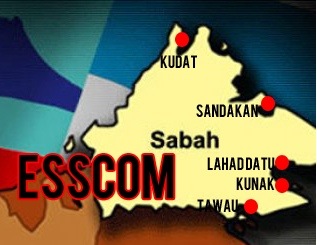
When the government announced the formation of the Eastern Sabah Security Command (ESSCOM), I said to myself, “About bloody time!”. I imagined security sectors formed from Kudat to Sandakan to Lahad Datu to Semporna and Tawau, mirroring what we used to have along the Malaysian-Thai border during the Communist insurgency such as Kota Alfa, Kota Bravo, Kota Charlie and Kota Delta spanning Kuala Perlis to Tumpat. The initial aim was to combat the communist guerrillas and stopping their infiltration from Southern Thailand. After the treaty in December 1989, we had elements of the Unit Pencegahan Penyeludupan (UPP) or the Anti-Smuggling Unit operating in these areas in a supporting role, to curb the smuggling of contrabands and also human trafficking.

Instead, I find it rather amusing when the Ketua Setiausaha Negara announced that Datuk Mohammad Mentek has been appointed as the Director of ESSCOM effective April 1st. What is wrong with this appointment? Mohammad Mentek is the Director of Immigration for the state of Sabah, the agency that, in my opinion, has failed badly in curbing the in-flow of illegal Filipino and Indonesian immigrants into that state.

The New Straits Times ran a story on Mohammad Mentek’s appointment and a statement by the KSN that was complemented by Mohammad’s curriculum vitae; citing even that Mohammad would be very experienced in the field of security and public order.

This April 1st appointment has to be an April’s Fool joke with an extremely bad taste. Surely the KSN should know the functions of the Immigration Department like the back of his hand. If I may provide a memory-jogger for all, the. immigration Department’s functions are:

  • 1. Issuing of passports and travel documents to Malaysian Citizens and Permanent Residents.

    2. Issuing of visas, passes and permits to Foreign Nationals entering Malaysia.

    3. Administering and managing the movement of people at authorised entry and exit points.

    4. Enforcing the Immigration Act 1959/63, Immigration Regulations 1963 and Passport Act 1966.

  • If you think I made the above up, read it here. How much of an expert do you think the Sabah Director of Immigration would be in the field of counter-insurgency warfare, joint-command operations and public order? Other than the pen being mightier than the sword, I doubt if the person’s handled anything more than the butter knife, let alone deploy battalions of soldiers and policemen in combat situations.

    This is another example of the government missing out on a good opportunity to make things better. Obviously, the main concern when we talk about Sabah right now is its defence from foreign elements. With the heavy presence of our security forces there, we can only see illegal immigrants returning to their homeland, and not the other way round. Therefore, the government should have had a clear aim (again, quoting from the Principles of WAR) in ensuring its strategies in making Sabah more secure conform to this aim. A concept called Defence-in-Depth should have been adopted instead where the Army and Police’s General Operations Force occupy the peripheral islands off Sabah, as being done in Ops PASIR, supported by the Navy, Marine Police and the Malaysian Maritime Enforcement Agency. These are the front-liners that will be meeting armed militants head-on. Onshore, defence and security should be effected by the Army and Police. The Immigration Department will just stick to its supporting role, weeding out illegal immigrants.

    Therefore, in my opinion, the ESSCOM should be jointly-directed by the Deputy Commander of the Army’s 1st Division, one of the deputies of the Commissioner of Police, Sabah, and the Malaysian Maritime Enforcement Agency’s Head of Regional Enforcement for Sabah and Labuan. The reason is because they are in-charge of the combat and combat-capable units operating in this region, not the Immigration.

    In conclusion, the choice of the Director of Immigration for Sabah as the Director for ESSCOM is a grave mistake. I respect the person for who he is, but if the government wants to be seen serious in protecting the Malaysians in the state of Sabah, leave the job to the professionals. Not someone who holds a Master of Science (Statistics) degree and a Bachelor of Science (Mathematics) degree from the University of Minnesota, United States.
    The Chinese Navy “Visits” Beting Serupai

    20130328-174347.jpg

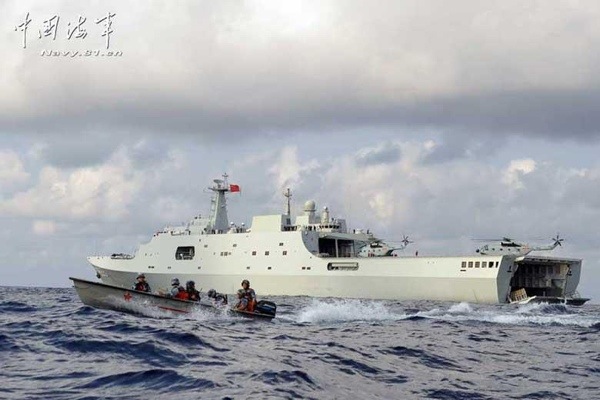
    Mention the name Beting Serupai you might get frowned upon by many. Mention the name James Shoal, and it may raise a few eyebrows. To most Malaysian, they would not be able to pinpoint where James Shoal is, save for some avid fishing enthusiasts, but this 22-meter deep shoal 80 kilometres off Bintulu, Sarawak, has been “visited” by elements of the People’s Liberation Army – Navy (PLA-N) or simply referred to as the Chinese Navy, yesterday.

    In its report on the 26th March 2013, the Associated Press wrote:

    The official People’s Daily online said Wednesday that one destroyer, two frigates and an amphibious landing ship took part in the drills around Chinese-controlled outcroppings. They involved hovercraft, ship-born helicopters, amphibious tanks, and land-based fighters and bombers, and were followed by a ceremonial visit Tuesday to James Shoal farther south.

    The Beting Serupai has always been part of China’s claim, lumped together in the Spratlys, as its southernmost territory. Prior to this “visit” the PLA-N visited the shoal in 1993 and 1994. In April of 2010, its vessel, the Marine Surveillance Ship-83 placed a sovereignty stele into the water area of the shoal.

    When Malaysia enhanced its relationship with China in May 2011, it was looked at as a step further towards harnessing a greater economic relationship. The Malaysian Opposition was quick to excoriate the act as political pandering. But in retrospect, it was strategically a good move as it relives the act by the Sultanate of Melaka with the Chinese. China is not a country one could just ignore. As in the 15th century, an alliance with China not only provides economic benefits, but also from a military standpoint.

    It is no secret that after China’s warnings to Japan, South Korea and Taiwan in 2012, the United States was actively looking for bases in this region. Among the countries where bases are sought include the Philippines and Vietnam. However, no other modern naval base offers the best proximity than Malaysia’s own Teluk Sepanggar just north of Kota Kinabalu. Therefore, it comes as no surprise that the carrier battle group of the USS John C Stennis decided to make a port call there in early October 2012. Before that, in the month of April 2012, the RMN base was visited by the US Navy Secretary, who brought with him the submarine-tender, the USS Emory S Land, and the Los Angeles-class nuclear attack submarine, the USS Louisville.

    The only factor that is stopping the US Navy from getting naval base facilities in Sabah is probably not having a Malaysian government that would kowtow to them. Therefore, the outcome of the next general elections would be important to them. Little wonder that Sabah has been the aim of a certain party. However, this writer hopes that this dangerous effort would not come to fruition.

    That the Department of Foreign Affairs of the Philippines has asked Filipinos to stop referring to Sabah as Sabah, Malaysia three days ago, citing Memorandum Circular No. 162 issued by Malacanang back in 2008. The DFA has also begun referring to Filipinos fleeing Sabah as “displaced persons” instead of “evacuees” or “returnees.” This is the Philippines government doing a 180 on its previous position re the Sabah claim. The fact that the US Navy and Marines have begun deploying its assets in the Philippines comes as no surprise. On Tuesday the USN and US Marine Corps offloaded more than 270 tactical and amphibious assault vehicles in Subic Bay, Zambales.

    American troops from the 3rd Marine Expeditionary Brigade, III Marine Expeditionary Force, offloaded a High Mobility Multipurpose Wheeled Vehicle from the container and roll-on, roll-off ship USNS 1st Lt. Jack Lummus on March 21. Some 8,000 troops from both the US and the Philippines will commence its Balikatan exercise on 5th April. And the US has yet to offer an explanation on why its minesweeper, the USS Guardian, could run aground on Tubbataha Reef in the Sulu Sea near Palawan, two weeks before the incursion by the Sulu militants. And suddenly, Jamalul Kiram III who hardly has enough money to cover the bills for his twice-weekly kidney dialysis, could find the financial resources to send hundreds of armed militants across the Sulu Sea to Lahad Datu.

    Perhaps, the Chinese naval exercise in the South China Sea and its “visit” to the southernmost part it claims comes as a warning to any party that plans to upset the military balance in the region. China, I would expect, would want to protect its interests; and the 180 by the Philippines in the Sabah issue could be seen as an attempt to de-stabilise the region. Having Sabah not only allows a nation to dip its fingers into Sabah’s oilfields but also increases its EEZ reach into the Spratlys.

    Whatever the intentions may be by all the related parties, the Malaysian government should seriously look into increasing its naval and aerial assets. A country that is weak militarily will only see its soil trampled by foreign forces. The government should also make sure Sabah is not lost to another nation, and act against the Quislings who have caused the emergency in Lahad Datu.

    Crisis Mismanaged

    The Prime Minister recently said that lessons of the Sulu intrusion must be identified. That is only half the battle won. It should also be learnt.

    When the Sulu militants began landing at Kampung Tanduo in the Lahad Datu district of Sabah, both the military intelligence and police’s Special Branch knew exactly their numbers, type of weapons, how many more they were expecting, whose house they rendezvoused at and their intention of coming to Sabah. Within hours, elements of the General Operations Force plus the army’s 5th Brigade were deployed to effect a cordon around the area, with combat elements from the Navy, Marine Police and the Maritime Enforcement Agency taking stations offshore. More military conventional and non-conventional forces plus naval assets were already enroute in the ensuing initial hours. Within the first 24-hours, I am in the opinion that we had an overwhelming force to combat the militants. As a former serving officer of His Majesty’s Armed Forces of managerial level, I would have quickly acted in accordance to the Principles of War and the Principles of Crisis Management.

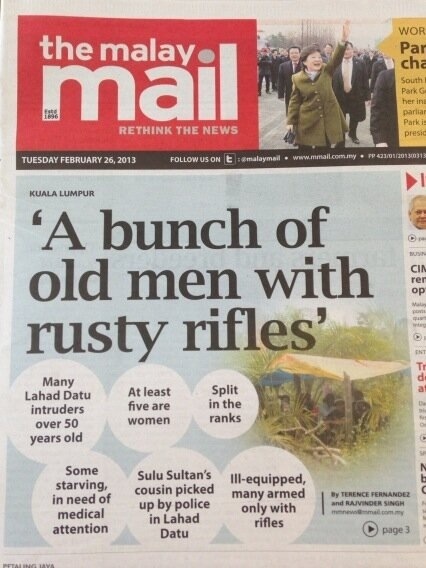
    The first Principle of War is the Selection of Aim and its Maintenance. This is the Master Principle that must be established at the commencement of hostilities and followed through and through, and everything else should fall in place. However, we see the pussy-footing of this issue in Putrajaya, in particular the Ministry of Home Affairs, in making decisions. What we saw instead was the downplaying of the seriousness of the matter by the Minister himself. How can we forget his “old men with rusty rifles” response to his appreciation of the enemy’s physical condition, forgetting the fact that these men had been involved in insurgency warfare against their own government, beheading priests and nuns and fellow Muslims, burning churches etc for the past half a century.

    20130317-145439.jpg

    This was the same reaction from Admiral Sir Tom Phillips while sailing on board one of the Royal Navy’s most-modern battleships, the HMS Prince of Wales, off the east coast of Malaya. “The Japs can’t see us very well because they have slant eyes,” was his remark when Japanese bombers approached his ships.

    In short, never underestimate your enemy, and never take your eyes off them. Margaret Thatcher followed this principle upon being informed of the Argentinian invasion of the Falkland islands. Within the first 48 hours, she mustered the largest modern British armada to repel the invasion.

    This is because the seventh Principle of Management is You Have 48-Hours. The first 48-hours is the crunch time. If you are not ahead of the crisis within this time, you will be run over by the crisis. What we saw was more negotiations being done by the police as instructed by their superiors. We see that the enemy have already established their aim in accordance with the first Principle of War, yet we were not acting in response to that aim. While the Minister of Home Affairs was seen making ad hoc comments in between plating trees on the issue, still downplaying the crisis, the Minister of Defence was not yet roped into the whole thing to assist in resolving the crisis. This is against the Ninth Principle of War which is Cooperation – to incorporate teamwork, sharing burden of dangers, risks, and opportunities. This gave time for the enemy to maintain their aim of coming to Sabah, and they dug in, with no intention of leaving.

    20130317-151138.jpg

    There was no communication between the authorities and members of the public, a clear failure in crisis communication. Rules five of the Principles of Crisis Management clearly states that there are three key messages to be delivered within the first 48 hours of the crisis, and they are:

  • We have a plan to deal with….and this has to go hand-in-hand with the first Principle of War,
  • We regret to inconvenience…show compassion to the people affected by the crisis so that hey will understand their need to be inconvenienced, and,
  • We have begun investigations into this matter to ensure this does not occur in the future…you need to re-assure the public that you are on top of this.
  • You need to back this up with action, but after the first skirmish that saw the demise of the first two policemen from the VAT69, there was no follow up. This was not in accordance with the third principle of war which is Offensive Action. This is the practical way to seek to gain advantage, to sustain the momentum and seize the advantage. This never happened. We lost the fifth principle of war: Surprise.

    Instead, there was absolute silence, and misleading statements issued such as the attack on the police party at Kampung Simunul near Semporna that caused a huge loss of life. Gunfire could be heard from nearby islands, and in this age of digital wireless communications, word spreads faster than before the last shot was fired that night. Instead, the official communiqué said it was a drug raid and was not related to the events in Kampung Tanduo. Mind you, although Kampung Tanduo is in the district of Lahad Datu it is much closer to the district of Semporna, gateway to the Tun Sakaran Marine Park, home to the tourist-packed islands of Mabul, Kapalai, Mataking and Sipadan. When this event finally hits the fan, and villagers took it upon themselves to dispatch of one of the militants themselves, did the authorities finally admitted what had happen.

    Such silence only fuelled rumours, as stated in the sixth principle of Crisis Management: Beware of the Court of Public Opinion. The Opposition rumour-mill was quick with this, and the government was slow to react, relying on the service of contracted and non-contracted bloggers to do the public relations, while the Ministry of Communications was also slow in its response and did nothing to explain to the masses about the cession agreement so on and so forth, just a response made in passing by the Minister during an ad hoc interview. I often wonder if it was done in such a manner for self-promotion or that Radio Televisyen Malaysia, as an arm of the Ministry of Communications, did not have the time nor resources to come up with fillers to educate the general public on the crux of the issue in Lahad Datu.

    In the end, the public wanted action. And finally, the Minister of Defence was roped in. He went back to KL to brief the Prime Minister on what needs to be done. Subsequently, the Prime Minister ordered the police and military to work together and do the necessary to end this. Only now we see a more structured concentration of force and economy of effort by the joint-military-police action against the militants. And finally, press conferences are handled by senior police and military officers who give hard, no-nonsense facts, rather than by politicians who are more familiar with sugar-coating facts.

    And as the tenth principle of Crisis Management states: Every Crisis Is An Opportunity. Smart leaders would know that in the midst of a crisis, there is an opportunity to be seized. The government has announced an increase in the defence budget to support the formation of the East Sabah Security Command (ESSCOM). However, the decision to place this command under the Chief Minister of Sabah instead of the National Security Council could be erroneous.

    Trust me, there will be more trouble. If there is a lesson to be learnt from all this, it is to leave defence and security matters in the hands of the professionals. Not politicians.

    The Darker Shade of Grey

    My pro-BN friends may not like this post. Just when they were having it good with this:

    20130316-191743.jpg

    Then they decided that since they have the ammo to attack, they might as well use them all up:

    20130316-191923.jpg

    In my opinion, it is good when you have all that ammunition and firepower, but it would also be equally good to know when to use what.

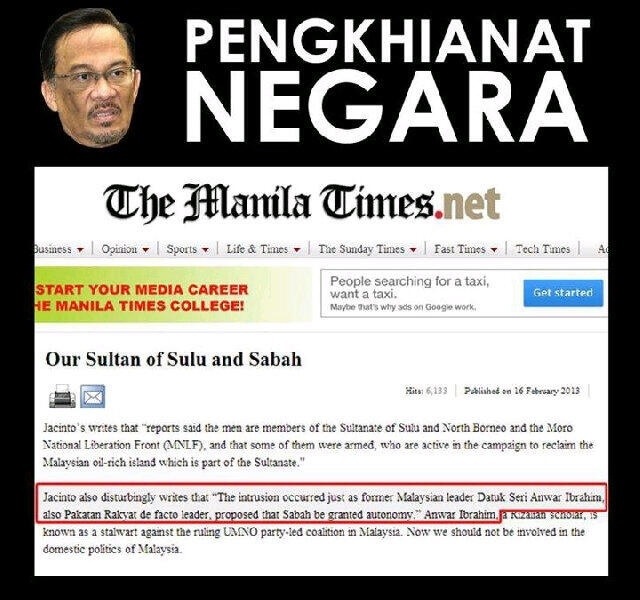
    The Manila Times and Reuters articles linking Anwar Ibrahim to the incursion by Sulu militants, coupled with the death of nine of our servicemen in action against them, caught Anwar off-balance and was on the verge of falling down. His signature reactions of denials and threats to bring to court local mainstream media over the allegations, but not sue the foreign ones, underscore his guilty-conscience. Both the mainstream media and pro-BN websites were already all over him.

    There was a brief attempt to divert the attention of all when the father of his purported sodomy victim made an about turn and announced that his son (the victim) has been part of a conspiracy to have Anwar found guilty of the act in order to deny him the chance of becoming the next Prime Minister of Malaysia. However, events in Lahad Datu proved overwhelming; and for a moment it seemed that it was almost game over for Anwar, as far as they eyes of those labelled as “the grey voters”. There was nothing more infuriating than having a Parliamentarian being instrumental in the act of aggression towards His Majesty’s security forces.

    Then, before the public could grasp the gist of the whole situation in Lahad Datu, pro-BN websites started putting up screen captures of someone who looks like Anwar Ibrahim, in an intimate act with another male inside a hotel room.

    To me, it is not even an overkill. It is rather like letting loose your ammo a la John Rambo, hoping to strike something. Instead, only the cheerleaders cheered while some other pro-BN supporters retorted. For the pro-Anwar, the standard-issue answers came out, ranging from the usual “it’s not him” to “this time they have found a much slimmer actor to match Anwar’s tummy.”

    For the grey voters, this is a proof that both sides embark in gutter-politics. It is also a sign to them, although it may not be true, that the government cannot find a strong link between Anwar and the Sulu militants that the government had to resort to punching below the belt to get at Anwar before the next general election.

    I don’t know why this issue was brought forth. Anwar’s sexual preferences is a foregone conclusion. you can find legal documents affirming this. At this juncture the pro-BN sites should just focus on the efforts of the BN government in assisting the people, instead of playing the same game that the pro-PR sites are playing. The saying “If you can’t beat them, join them” does not apply in this situation. You do not simply join those who swim in filth to prove that you could do it too. For those who support Anwar will continue to support him, just as those who attack him are staunchly BN. Not one person from either side is going to change his or her mind just because they see the clips of two men fondling each other.

    But…the Grey ones might react negatively.

    What the pro-BN sites should remember is there is no use in trying to change those who are Black into White; but rather change the Grey into a lighter shade. Unfortunately, this is not how some see it. It is their loss as they may find a high turnout in the next elections but still with a high number of protest or spoilt votes.

    It would be an interesting election-results night.

    Lahad Datu: Why Pakatan Rakyat Does Not Deserve To Be Briefed

    Today, Lim Kit Siang of the Democratic Action Party, a member of the loose coalition calling themselves the Pakatan Rakyat, has called upon the Prime Minister to brief the Pakatan Rakyat lawbreakers lawmakers on the operational updates of Ops Daulat that is being conducted by the PDRM and the Armed Forces.

    However, apart from being total idiots, the Pakatan Rakyat side cannot be trusted with national secrets. And my friend, OnDaStreet, whom sides neither he Pakatan Rakyat nor the Barisan Nasional, has explained why beautifully.

    Read more on his blog.

    MilOps Lahad Datu: Now Every Critique Can Fly…Kites

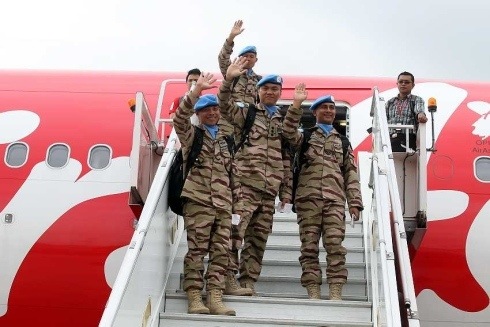
    Those with keyboard military experience playing Command & Conquer et al are now asking why are our troops being flown using Air Asia aircraft. Lots of criticisms fly here and there accusing the armed forces of not having the capability to support such an operation…and this coming from the same group of people who questioned military and police purchases of new equipment.

    First of all, it is normal for the military to utilise civilian aircraft to support operations, even if there is no critical operations taking place. The military has been using Malaysia Airlines for as long as I can remember, even when I was still a serving officer. Now, Air Asia is being contracted to ferry military personnel.

    In this operation for Sabah, you need to move two infantry battalions from the Peninsula to Sabah, and move them in the quickest and fastest manner. All war materiel will be transported using the RMAF’s C-130 transport aircraft. You cannot transport armoured personnel carriers, artillery pieces in large numbers if the C-130 is filled with infantrymen. Logistically, an army has to arrive with its firepower at around the same time. You cannot deploy an army that is still waiting for its equipment.

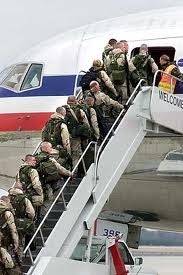
    Look at the picture below of our men leaving for Lebanon. What aircraft do you think carried their equipment?

    20130304-193511.jpg

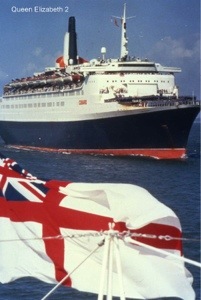
    And what did the British use to transport their men and materiel to the Falklands?

    20130304-193642.jpg

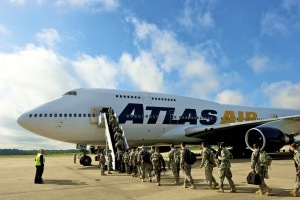
    And what do the Americans use for deployments to Iraq and Afghanistan? The soldiers below are not at an Air Force base:

    20130304-193746.jpg

    And how did they fly?

    20130304-193846.jpg

    20130304-193916.jpg

    Come on, people! Most of you are learned lawyers and what-nots, but the way you think is just like a fourth grader. Use your brain if you actually have one. Stop whining, push politics aside and start supporting our men and women in blue and green because the closest you have been to going to war is only when you shout buckets-of-political-shit rhetoric and you are nowhere near the tenth percentile of being as brave as these men and women are.

    So, just shut your trap if you have nothing good to say about them! Because you all sound like yeast-infected whiny old hags.

    Sabah: Revisit 1950

    We enter the fourth day of skirmishes with eight deaths on our side without any long-term solution. Fighting an almost endless stream of battle-hardened enemy along a porous coastline. Like it or not, we have to face the facts and hit it head on, and stop living in denial.

    With Nur Misuari, leader of the MNLF, already giving a stern warning to Malaysia over the recent firefights, and the growing sentiment in the Philippines in support of their people fighting our forces on the eastern part of Sabah, we have no choice but to be firm. And when we fight an enemy that abides by no rules, we will have to make up our own as we did back in 1950.

    The latest skirmish that cost the life of six police officers and men goes to show that there are sympathizers amongst the hundreds of thousands of Filipinos earning their living here – most calling Sabah home instead of the Moro region.

    In view of this, I would like to suggest to the government to revisit the Briggs’ Plan not only to ensure that the militants do not get support from sympathizers, but also to ensure that those who are genuinely here to make Sabah home are well taken care of in terms of provisions and medical treatment.

    I leave the mechanism to the authorities but this is no time to be pussy-footing. The Sabah coastline that is exposed to infiltration stretches from Kudat and all the way southeast to Tawau. Even if we deploy all 300,000 men of the police and Armed Forces, we would be stretching our resources film-thin.

    Give it a thought, but please don’t take another 23 days to decide.

    Take Sabah Away, Mr Sulu

    When the late Gene Roddenderry wanted an Asian character to be part of the crew of the Federation Starship USS Enterprise, he wanted a surname that does not represent any particular nation. George Takei, an actor in the world-renowned TV show recalled how Roddenderry opened up a map, looked at Asia and saw the Sulu Sea and exclaimed:

    “Ah! The waters of that sea touch all shores!”

    That was how the character Hikaru Sulu got his name.

    And how true it is that the Sulu Sea has now touched on the raw and sensitive parts of the shores of both Malaysia and the Philippines.

    I wrote some days back on the current stand-off in Lahad Datu and it is today Day 11th since a group of armed men claiming to represent the Sultan of Sulu landed in Lahad Datu, Sabah in Malaysia, asking for the return of Sabah to the Sultanate of Sulu.  When the Philippines government worked a peace deal with the Muslims in the country’s deep south via the Bangsamoro Framework Agreement, the Muslims and their Filipino brethren embraced it as finally a way forward after decades of impasse.  The framework allows for the creation of a single and autonomous entity called Bangsamoro replacing the Autonomous Region of Muslim Mindanao.

    The framework agreement was signed at the Malacanang Palace on 15th October 2012 in the presence of President Beningno Aquino III of the Philippines; Al Haj Murad Ebrahim, the Chairman of the Moro Islamic Liberation Front; Najib Razak, Prime Minister of Malaysia; and Ekmeleddin İhsanoğlu, Secretary-General of the Organisation of Islamic Countries.

    Absent was Nur Misuari, leader of the Moro National Liberation Front. Nur Misuari had called the BFA irrelevant claiming it was cloned by President Aquino and Najib Razak.  The MILF is a breakaway group that was part of the MNLF back in the 1970s.  Disagreement in the way Nur Misuari handled issues led to the group breaking away.

    Also absent was the Sultan of Sulu.  The alienation of the Sultan probably led to the Lahad Datu stand-off.  The Sultan admitted to have been prompted by the alienation to send some 400 men across the sea to Sabah, as the BFA had seen not only improvements in the lives of the Bangsamoro that he played no role in, but also in the intimacy between the Philippines and Malaysia as neighbours.  And as mentioned in my previous posting on this issue, Nur Misuari’s MNLF supports the Sultan.  And this recent posture is to display its relevance again to the Moro people.

    But why was the Sultan alienated in the peace process?  Simple – there are now ten people who claim the throne.  The Philippines government cannot be dealing with ten different Sultans with ten different basic ideas on how to bring peace and development to the Bangsamoro.  Nur Misuari himself did not attend the signing as he fears that there is an ongoing warrant issued for his arrest for waging war against the Philippines government.

    As the militants are bogged down into their second week in Lahad Datu surrounded by the Malaysian security forces, Nur Misuari was quick to threaten Malaysia saying “if one drop of blood is spilled then we will be forced to come to their aid.”  Nur Misuari also said the following:

    This should be handled by cooler heads…that it would also be good to await the Malaysian general election to see who will be the new Prime Minister…

    And who has Nur Misuari implied by that?  None other than his old friend, Anwar Ibrahim.  It was reported by Reuters and confirmed by Philippine military sources that Anwar had traveled and met Nur Misuari to discuss land claims in Sabah, a few months before the Lahad Datu incident happened.  Anwar has vehemently denied this, but the photo below shows otherwise:

    20130222-175404.jpg

    Now, Anwar Ibrahim seems a dubious character himself. In a recent open letter, his former legal counsel member, Yuktes Vijay, asked about the former’s links to Islamic fundamentalists as well as known terrorists. Therefore, it is not impossible for him to have met Nur Misuari to discuss the matter, and then deny it like he denied ever being conferred the title of Huguan Siou although people from his own political party had announced that on Facebook, complemented by photos of him.

    The Philippines government has sent six naval vessels to stop people from the Moro region from entering Malaysian waters as this stand-off continues.  And although the Malaysian government has an upperhand and the firepower to end this stand-off, it is probably of best interest to the Bangsamoro, the government of the Philippines as well as Malaysia, to not allow anything to jeopardise the BFA that is still in its infancy.  Perhaps, the MILF and supporters of the BFA in the Moro region should lend their support to both governments to try end this madness.

    In the meantime, while treading gently on this issue, both governments should get to the root of this and probe Anwar Ibrahim’s role in facilitating or prompting this incident.  For it would not have happened had it not been for someone from the Malaysian side advocating and encouraging it to happen.  It is something close to Sabah, and we know Sabah is being wooed by Anwar’s party.  Get the support of the Kadazan-Dusun-Murut community by being recognised as their Paramount Leader (Huguan Siou), you will get support from the Christians in the west side of Sabah.  Get a deal with the Tausugs in Sulu, you will get support from the Muslims especially in the eastern part of Sabah.

    But at what cost?  That remains unanswered.  But maybe Gene Roddenderry would frown had he known the Sulu Sea is one of the volatile areas of the region.

    FELDA Sulu

    Sometime in the evening on Tuesday, 12th February, around 100 members of the Moro National Liberation Front under the command of Nur Misuari, infiltrated Sabah’s maritime border and landed at Kampung Tanduao, Tanjung Labian in Lahad Datu. Led by Haji Musa, an aide of Prince Mohammad Ismail A Kiram, fourth son of Sultan Muhammad Fuad A Kiram, Sultan of Sulu & Sabah.

    This group converged upon the house belonging to a Ahmad Malandi, a.k.a Mat Bom, who earned the nickname for attacking a FELDA office using fish bomb. The initial group consisted of around five men wearing robes while 27 others wearing incomplete camouflage uniforms. All are armed with M-14 and M-15. Some 70 others joined later. Our security forces, acting on intelligence report, swiftly reacted by sending two companies of men from the General Operations Force and Malaysian Army’s 5th Brigade, while naval units supported by the marine police and the maritime agency gave offshore support.

    To date, there is not a single hostage taken but this group of militants have spread themselves all over the island. Government negotiators, backed by officials from the Government of the Philippines are now continuously engaging the infiltrators. The demands include recognition of the group as the Royal Army of the Sultanate of Sulu, and for Sulu immigrants not to be deported back to the Philippines.

    That is the gist of the events. However, I don’t believe those are, or would be the only demands. In 2008, Nur Misuari had pledged loyalty and support for the Sultan’s claim on Sabah. The funny thing is, in 1962, the Sultan’s father, Sultan Esmail E Kiram, ceded his rights to claim Sabah (North Borneo then) to President Diodado Macapagal. Manila is no longer interested in claiming Sabah although it has never dropped its claim for political reasons. And Malaysia’s victory at The Hague in the Sipadan and Ligitan claims weakens further Manila’s position re Sabah.

    20130215-203057.jpg

    Ahmad Malandi, or Mat Bom, once attacked the FELDA office in Lahad Datu in the 1990s after failing to settle a dispute with FELDA over an ancestral land that became part of FELDA Sahabat 20 scheme where some 1,000 immigrants of Sulu descent have settled. He was never charged. Mat Bom is now reported to be in an ICU ward at a local hospital. His son was reported to have travelled to Bongoa in Tawi-Tawi province in Mindanao to seek help from the armed men.

    Blogger Outsyed The Box wrote in The Mole that the incursion by MNLF could have been prompted by the Opposition. This is NOT far-fetched. In fact, when the Bangsamoro Framework Agreement was signed at Malacanang Palace on the 15th October 2012, it did not go down well with Nur Misuari. And guess who tried to play Big Brother to Nur Misuari and broker a different peace deal?

    Having read both links and seeing the events that are unfolding in Lahad Datu, one cannot dismiss the unseen agenda in the appointment of a new Huguan Siou last week. It could be coincidental. It could be a dangerous conincidence. Being a Huguan Siou allows one to have the support of the masses in the implementation of one’s agenda. Furthermore, my source informed me that these armed men want Sabah to be an autonomous state under the influence of the Sultanate of Sulu before GE13. Which is why they have also demanded to be allowed to remain in Sabah. Maybe an agreement was made with Nur Misuari back in October.

    Anyway, I will let you come to your own conclusion.

    Congratulations To The Kadazans, Dusuns and Muruts

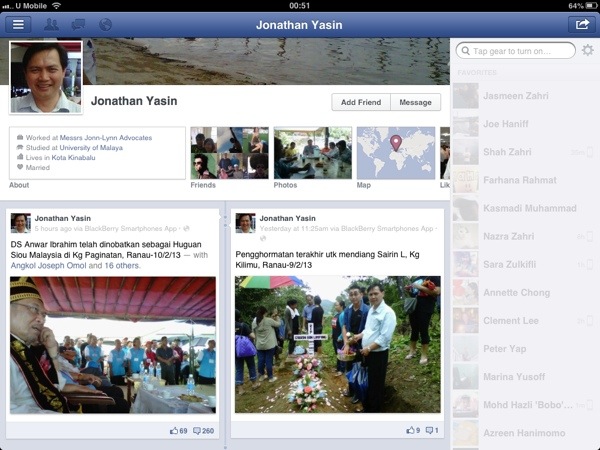
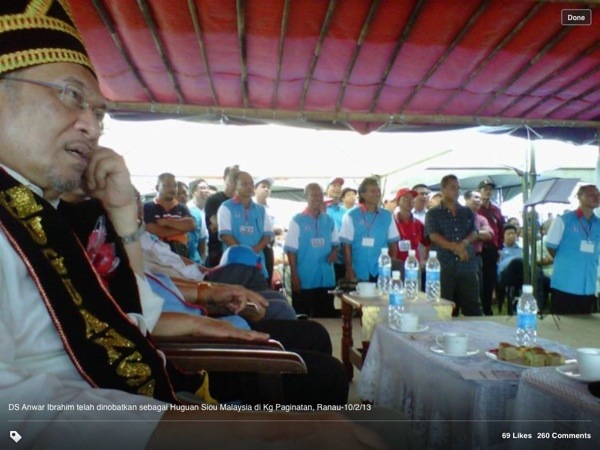
    This is probably the Chinese New Year gift from Pakatan Rakyat to the people of Sabah; especially the Kadazans, Dusuns and Muruts. According to Jonathan Yasin of PKR Sabah, PKR Supremo, Anwar Ibrahim is the new Huguan Siou (Paramount Leader) as of 10th February 2013. This appointment, according to Jonathan’s Facebook, took place at Kampung Paginatan in Ranau district.

    20130211-014227.jpg

    So, where does Pakatan Rakyat or PKR plan to throw Joseph Pairin Kitingan, the incumbent Huguan Siou? Does PKR now want to replace the Kadazandusun Cultural Association by usurping the latter’s power and appoint a Huguan Siou who is not from the KDM community?

    Let us have a look at the bigger picture:

    20130211-014908.jpg

    I guess this is how Pakatan Rakyat treat the people of Sabah. Whatever goes as long as Pakatan Rakyat forms a government, gains power, and Anwar achieves his life-long ambition of becoming the Prime Minister of Malaysia. I won’t be surprised Sarawak would receive the same treatment. Who cares about local sensitivities or what the locals want?

    Oh, wait! If you look at the second picture, the caption also says that Anwar has been appointed the Huguan Siou of MALAYSIA! That, in effect, replaces His Majesty Yang DiPertuan Agong (Paramount Ruler of Malaysia).

    Little wonder Pakatan Rakyat is so confident of taking over Putrajaya and calling it their year, come what may. After all, IT IS the Year of the SNAKE.