Hatyai Accord: The Failure of the Domino Theory – Part 3

As mentioned in the previous posting, the CPM split into two factions in October 1974: the CPM and the MPLA (CPM-Marxist-Leninist).

In 1975, the Chinese-backed Khmer Rouge ousted the Cambodian military government and began a reign of terror. In Vietnam, Soviet-backed North Vietnamese Army rolled into Saigon, effectively ending the Vietnam War. By December 1975, Laos too, fell to the Communists. In South-East Asia, there was real fear that the ASEAN nations would be next to fall to Communism – the Domino Theory was born.

Both the CPM and MPLA’s spirit were boosted by this new turn of events. Their activities peaked in 1975. There were bombings of the National Monument (Tugu Negara), the Police Field Force camp in Jalan Pekeliling in Kuala Lumpur Having scored a morale-boosting victory by assassinating the Inspector-General of Police, Tan Sri Abdul Rahman Hashim, a year earlier, they set their sights on Tan Sri Yuen Yuet Leng’s predecessor, Tan Sri Jimmy Khoo Chong Khong, the Chief Police Officer of Perak. Tan Sri Khoo was ambushed near the Ipoh General Hospital by the same assassins that murdered the IGP. His brave driver, Sergeant Chong, returned fire despite having being hit repeatedly by the assassins’ bullets. Sergeant Chong died soon after, but not before injuring one of the assassins in the head that then led the police to them.

Between 1976 and 1977, the Malaysian media was filled with nothing but stories of ambushes and attacks by the communist terrorists against the police and the military.

When Chairman Mao Zedong died, Deng Xiaoping returned to mainstream politics. Given his rapport with Chin Peng, the CPM was fueled to up the revolutionary ante. However, in 1978 Deng visited Thailand, Kuala Lumpur and Singapore, and was convinced to stop exporting Communism. As a result, in 1981 Deng ordered the ‘Suara Revolusi Malaya’ to stop broadcasting. The CPM had had to relocate the radio station to South Thailand and renamed it ‘Suara Demokrasi.’ Starved of support, the CPM and MPLA were riddled with internal strife and political cleansing (including the execution of suspected counter-revolutionaries) that their effectiveness was greatly reduced. The MPLA changed its name to the Malayan People’s Army (MPA) in 1982. One of the last gunbattles that occurred in the vicinity of Kuala Lumpur was in May 1983, on the day my paternal grandmother died. A patrol car chanced upon a group of Min Yuens and communist terrorists near what was Mimaland in Gombak. In the gunbattle, one policeman and one CT were killed, while the other policeman and another CT were injured.

The West Betong and Sadao groups of the CPM decided to surrender themselves to the Thai government in 1987 when they realised their struggle was not achieving any success, and with no clear political or military objectives.

On 2nd December 1989, the Communists gave up armed struggle and signed a peace treaty with the governments of Malaysia and Thailand, ending the Second Emergency.
——————————————————————————–

So, were the communist terrorists freedom-fighters as claimed by some parties?

When the Federation of Malaya achieved independence, the CPM had lost all clout in fighting “imperialism” and “colonialism”; yet it continued to do so, and even refused to recognise the formation of the Federation of Malaysia in 1963 by supporting the Indonesian campaign of lynching Malaysia (Ganyang Malaysia). Let us also not forget that the CPM’s counterparts in especially Sarawak continued to wage war against the government ’til 1989. Among those killed fighting the terrorists in Sarawak was Superintendent Joni Mustapha, a Sarawak hurdler in 1958-59. Joni was loyal to his men. He was in a cinema in Sibu watching a movie with his son when he got word that his men were pinned down by heavily armed terrorists upriver. He left his son behind and travelled by boat to reach his men. He was felled by machinegun fire, but remained to direct the firefight against the terrorists until he died. Seeing his commander die, Corporal Nguing, an Iban warrior, unsheathed his machete and charged at the terrorists only to be mown down.

Therefore, the communists terrorists not only fought against what some perceived as the “puppet-regime” in Kuala Lumpur, they fought against Malaysians on every inch of this hallowed soil trying to introduce communism, and turn this beloved country of ours into either a China-leaning satellite, or a Soviet-leaning one. It was never a nationalistic fight for freedom as claimed by some mentally-skewed politicians and their supporters either. There is nothing nationalistic about joining the forces of a foreign-nation to lynch your own people, if the CPM ever regarded Malaysians as their own. Remember, the CPM waged war against the Malaysian people for 32 years after the independence.

Was the fight against the communists solely a malay struggle as claimed by a former Minister? No. Kanang ak Langkau is an Iban. So was Corporal Nguing. Tan Sri Khoo Chong Khong, Tan Sri Yuen Yuet Leng, Colonel Chong Kheng Lay – chinese. Former DSP Jeganathan, whom I had the honour of working with, is an Indian. He was absorbed into the Special Branch from Jabatan Talikom to set up the police VHF network, jungle-bashing, ploughing his way through to construct towers in the jungle with the communists hot on him. Inspectors Kamalanathan and Robert Cheah were injured when a grenade was lobbed into the Ipoh coffee shop where they were having coffee. I worked briefly with Kamalanathan who still limped in 1995 with a shrapnel lodged inside him decades after the incident.

It was a war against all of us, Malaysians – free and independent Malaysians, by godless creatures who call themselves freedom fighters, a war that none of us Malaysians should ever forget, and against those none of us should ever support.

The people of Malaysia, the Malaysian Armed Forces, the Royal Malaysian Police, should always be on guard for a resurgence of communism in Malaysia. The peace treaty of 1989 was just a declaration of the end of an armed struggle; not the giving up of the communist ideology.

Hatyai Accord: The Failure of the Domino Theory – Part 2

After the failure of the Communist Party of Malaya’s (CPM) revolt against British colonial rule and the subsequent independent Federation of Malaya’s government, the CPM retreated almost in full to Southern Thailand. In 1961, Chin Peng, leader of the CPM moved to China and sought support from Beijing. Deng Xiaoping, who was the most influential Chinese leader of the time although he never held any head of state office, promised Chin Peng a sum of US$100,000 in support of the CPM’s struggle.

In 1963, when Sabah, Sarawak and Singapore chose to join the Federation of Malaya to form the Federation of Malaysia, Indonesia objected violently by launching a campaign to lynch the newly-formed country out of existence dubbed “Ganyang Malaysia.” The CPM joined the Indonesian forces to fight against the people of Malaysia.

On New Year’s Day in 1968, the Communist Party of China launched the “Cultural Revolution”. The CPM, taking this as a queue and in conjunction with the celebration of the 20th anniversary of the beginning of the first Malayan Emergency, issued on 1st June 1968 a directive: “Hold High the Great Red Banner of Armed Struggle and Valiantly March Forward.” The first act, 16 days later, was to ambush the security forces and murdered 17 of its members in the Kroh area in Perak. Thus begins the Second Emergency. A year later, with the support of the Communist Party of China, the CPM began transmitting “Suara Revolusi Malaya” from the Hunan province, aimed to gather momentum and support from sleeper-agents, CPM members in South Thailand, and communist symphatizers who remained at large.

When Malaysia and Singapore parted ways, the DAP took up the role of the PAP. There were demonstrations and strikes almost on a weekly basis organised by the DAP. With the party being predominantly Chinese, race relations took a toll. This fact was successfully exploited by the CPM. The CPM indoctrinated people at all levels: Chinese civil servants, student leaders, trades unionists, the non-Malay members of the Armed Forces and Police, the middle classes with their ideology. All it did was to portray that the malays dominated the political scene while the chinese and Indians were relegated to being second-class citizens. Does this ring a bell? By 1969, the damage to race relations was just waiting for the final straw to break its back.

Those who were born after 1970 will never be able to recall how a curfew siren sounds like, but this writer had had that experience of rushing home (our quarters was not only fenced up using the normal chain-link fence, the perimeter chain-link fence was covered in total by barbed wire) every time the siren sounded. Those were the days when our boys in blue had to fight on two fronts: against the communists, and against the common criminal.

Fresh from the race riots of May 1969, the government felt that it could not afford any more ethnic antipathy. During the First (Malayan) Emergency, the setting up of New Villages by order of General Templer caused other races to look at the Chinese population as communist-symphatizers, when the truth was far from it. The government of Malaysia rightfully did not declare the Second Emergency as one, but instead learned from the Briggs Plan that the only way to win the war against the communists was through the tandem improvement of security and development: KESBAN – Keselamatan dan Pembangunan (Security and Development).

KESBAN was carried out to protect the people from subversion, insurgency and a state of lawlessness. It saw the coordination of all agencies from kampung level all the way up. I had had the opportunity to work under Tan Sri Yuen Yuet Leng (one of the heroes of Operation Ginger during the First Emergency), who as the Chief Police Officer of Perak, had to fight not just the war against the communists but also against common criminals. He related to me how, when the police force was stretched thin in Perak, called all the head of gangsters in Perak and appointed them as Rukun Tetangga heads.

“They were born leaders with natural leadership skills. All I had to do was channel those skills to positive use.”

The newly-appointed Rukun Tetangga heads were given the task to uphold the law and maintain peace and order. Any gang member found breaking the law would be surrendered to the police, else the leader will be arrested. This ploy work, crime was drastically reduced, and the police had a freer hand in combatting the communist terrorists in Perak.

The Rukun Tetangga (Neighbourhood Watch) was born out of KESBAN. It saw people of all races work together to keep their neighbourhood peaceful; but what it did most was to foster a good relationship and understanding between races. People were more tolerant of each other back then than they are now. Mind you, it was around half a decade after the race riots of 1969. No one, save for a few, cared whether one was Malay, Indian or Chinese, or Muslim, Christian, Buddhist, Tao or Hindu. They were all Malaysians back then.

KESBAN also allowed for development to reach the rural areas; where there was no electricity, some kampungs began to enjoy at least 12-hour electricity supply per day, with the police and military guarding the power supply network from the occasional sabotage by the CPM. Once more rural areas were developed and connected, the communist terrorists moved further deep inside the jungle.

KESBAN would not have been possible had it not been for the establishment of diplomatic ties between China and Malaysia. In February 1972, US President Nixon established diplomatic ties with Communist China in order to stem the influence of the Soviet Union in East Asia. The late Tun Abdul Razak did so in 1974. China warmed up to Malaysia. Everywhere the Malaysian delegation went, children lined up the streets waving the flags of both nation. One must remember that back in 1961, Chin Peng had gone to meet with Deng Xiaoping. The latter enjoyed strong support in the Communist Party of China but was not in good terms with Chairman Mao. The diplomatic ties between Mao and Razak was in a way a hint to Chin Peng and Deng. The CPM retaliated with the assissination of Tan Sri Abdul Rahman Hashim, the then Inspector-General of Police a week later.

Due to the relationship between China and Malaysia, in October 1974, the CPM saw a split in its ranks, and eventually a split in the organisation. The CPM Marxist-Leninist, a splinter group leaning towards the Soviet Union was born. This group was then renamed the Malayan People’s Liberation Army.

IN PART 3 I WILL WRITE MORE ON THE SECOND EMERGENCY TO ITS EVENTUAL COLLAPSE

Hatyai Accord: The Failure of the Domino Theory – Part 1

Very early one morning as I prepared to go to school, I could hear a distant dull explosion, followed a bit later by the rattle of the window panes. It was 1975, 7 years into the Second Emergency. It preceded the assassination of the then Chief Police Officer of Perak, Tan Sri Khoo Chong Kong (November 1975), and in turn was preceded by the assassination of the then Inspector-General of Police, Tan Sri Abdul Rahman Hashim. These events were among the reasons that drove me to serve in the Malaysian Armed Forces and managed to join the later part of the Second Emergency campaign.

The Communist Party of Malaya (CPM) has its roots from the South Seas Communist Party (SSCP), otherwise known as the Nanyang Communist Party, that was headquartered in Singapore. The latter was formed by the Chinese Communist Party (CCP) in 1922. Since communism was introduced to this region by Dutch radicals, the SSCP’s theater of operations were mainly focused in the Dutch East Indies, infiltrating trades unions and disrupting lives. The SSCP attempted an uprising in 1925 which was crushed by the Dutch East Indies authorities and retreated to Singapore where they grouped up. In 1930, the SSCP was dissolved and the Communist Party of Malaya was born.

We all know what happened during the post-war years preceding the First Malayan Emergency. But let me add a point to make people understand a fact here. In my Twitter profile, I described myself as …not prejudiced. I hate everyone equally. This is to show my political stand (or the virtual absence of it). I have friends on both sides of the political fence. One thing I cannot stand is stupidity and blind loyalty. The left-leaning side (depending on which compass direction you are facing) claims that the Tunku, Tun Abdul Razak, Tun Hussein Onn and Tun Mahathir were not freedom fighters. They have been accused as British lackeys, serving the Colonial government’s interests. I guess I will have to forgive them for their lack of knowledge in history before I bludgeon any of them for their sheer stupidity, but:

Tunku Abdul Rahman, Tun Abdul Razak, Tun Hussein Onn and Tun Dr Mahathir all came from the states of Kedah, Pahang and Johor. When were these states under Colonial rule at any time other than during the brief Malayan Union period?

I should bludgeon the right-leaning side as well for not noticing the above for their defence. Shame on you.

The CPM was organised into the Malayan People’s Anti-British Army but changed that to the Malayan People’s Liberation Army (MPLA) with the aim to set-up the People’s Democratic Republic of Malaya (and Singapore). I guess most of us know the connotation of the name, and countries that had inherited the name, such as the People’s Democratic Republic of Korea (aka North Korea).

The MPLA was supported by the CPM’s civilian organisation named Min Yuen. This organisation organised supplies for the MPLA.

The first Malayan General Elections was held in 1955, and Malaya had its first Chief Minister: Tunku Abdul Rahman, whose first act was to bring peace to the nation by declaring partial amnesty to members of the CPM. This partial amnesty was called off 6 months later with only 17 members of the CPM surrendering.

I will also not dwell so much on the details of the First Emergency (1948-1960), but for those not in the know, there was the first National Service registration in the late 1950s after we gained our independence. Some 240,000 registered to combat the communists, or 17 percent of the 1.4 million inhabitants of Malaya then. 20,000 were called up, but only 1500 reported for training. All of them were absorbed into the Federation of Malaya Police Force.

Then, there was a second National Service registration in 1958, but those registered were never called up because by then the members of the CPM realised that the independent Government of the Federation of Malaya, headed by the Tunku and backed by the parties representing the Malays, Chinese and Indians, was not offering any more amnesty and was adamant to obliterate the CPM. This drove the members to surrender by the hundreds, wave after wave, that in the middle of 1958 the CPM, whose MPLA was active only in Perak and South Johor by 1957, had to fall back to the Thai side of the border. Chin Peng and his Central Executive Committee had of course retreated in 1953 when the tide started to turn against the CPM.

In 1960, the Government of the Federation of Malaya declared the Malayan Emergency (First Emergency) over.

I WILL WRITE ABOUT THE CPM IN THE 1960s AND THE SECOND EMERGENCY

Running Dogs

Running Dog – a literal translation from the Mandarin words zu gu, used to depict a servile follower or a lackey

Short of a month six years ago, Ronnie Liu of the DAP attempted to get the sympathy of Malaysians towards Chin Peng et al. I hold the view that Man must seek knowledge and truth for justice to prevail. But Ronnie Liu’s was doing a white-wash by equating the communists’ struggle to nationalism by describing the clamping of the British on PKMM in 1947 as the reason the communists took drastic action to free the Tanah Melayu from colonisation when in fact PKMM sided with the Malayan Union in 1946 by working with AMCJA and PUTERA that have close ties with the CPM. It was on 1st April 1946 that PKMM supported and welcomed the appointment of Sir Edward Gent as the Governor of the Malayan Union.

The CPM had been around since the 1930s if not earlier, and with the capitulation of the Kuomintang in China, the CPM was more interested in making the Tanah Melayu a China-leaning satellite communist state.

Body of a policeman at the Bukit Kepong police station burnt by the communist terrorists

Fast-forward to the present day, where the VP of PAS, Mohammad Sabu (aka Mat Sabu) glorified Mat Indera, leader of the 4th Company of the CPM that attacked the Bukit Kepong police station and massacred the police personnel as well as family members in February 1950, as the true heroes of the nation. At the same time, he claimed that the policemen who had died in that tragedy were officers of the British Empire (read Mat Sabu hina pejuang negara – Utusan Malaysia 27th August 2011.

Mat Sabu had said the above when giving a political ceramah at Tasek Gelugor, Pulau Pinang on the 21st August 2011.

Mat Sabu glorifying the communist terrorists at Tasek Gelugor (Utusan Malaysia)
Mat Sabu glorifying the communist terrorists at Tasek Gelugor (courtesy of Utusan Malaysia)

Mat Sabu also went on to describe Dato’ Onn Jaafar and Tunku Abdul Rahman as British officers. Six years ago, Ronnie Liu went on the same line by saying UMNO and MCA were British lackeys, or “friends of the British.”

Mat Indera, Samsiah Pakeh and a few other Malays who joined the CPM were mostly Indonesian nationalists from Sumatera whose people were not of the Sultan’s people. Therefore, they look to the Indonesian freedom struggle for inspiration.

What Mat Indera did to the survivors of the Bukit Kepong massacre who could not escape in time is nothing to be proud of, even if he is to be regarded as a nationalist. He and his men burned the police station and quarters down and even threw children of the deceased policemen into the flames alive. Mat Indera was later captured and hung to death.

When the Persekutuan Tanah Melayu gained independence in 1957, the CPM did not lay down arms. In fact, their struggle to turn Malaya into a communist satellite continued for another 3 years despite pulling out of Malaya in defeat in 1953 and headquartered in southern Thailand. There was a brief lull until they resumed with the Second Emergency in 1969. If they were truly fighting for independence, why then did they go on killing thousands up until 1989? Let us also not forget that when Malaysia was formed in 1963, Chin Peng refused to acknowledge the legitimacy of Malaysia and joined forces with the Indonesian Armed Forces during the Indonesian Confrontation to crush Malaysia. So, can you call Chin Peng a nationalist?

Chin Peng, Mat Indera et al contributed to Malaysia nothing more than the wastage and destruction of wealth and lives.

As for UMNO and MCA being friends of the British, I hope both Mat Sabu and Ronnie Liu could explain then why did Sir Gerald Templer call Aziz Ishak a rat? Ronnie Liu’s blatant attempt to paint that the independence was given on a silver platter by the British to the Alliance is nothing more than a display of ignorance, one that is now being parroted by a lower-IQed Mat Sabu.

Why did Tunku and the Alliance members who won their federal, state and municipal seats walk out of these chambers in protest?

Why did Tunku and T.H. Tan have to lobby their friends in the British Parliament before the Colonial Secretary would see them?

I hope and pray that Mat Sabu will give such a talk in military bases as well police stations; not forgetting also to veterans of the security forces and wait long enough to see what they think.

As for me, it is my opinion which you may not share, that Ronnie Liu is the CPM’s running dog, while Mat Sabu is DAP’s running dog.

Murtads

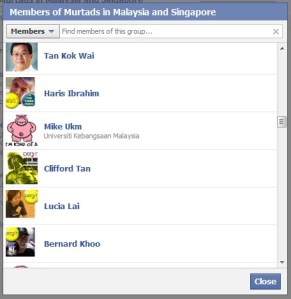
Online social networks are fun places; you get to meet all kinds of people from all over the world. One such group is the Murtads in Malaysia and Singapore on Facebook. The description of the group reads as follows:

Islamic apostates in Malaysia and those who support them. This group has the goal to network the apostates of Islam from Malaysia and those who would like to offer support and discuss about this issue.

The Apostates in Malaysia group offers a safe place for those who are trapped by Islam in Malaysia. Feel free to introduce yourself, share your stories and concerns, anything you like. This place is especially for you. 🙂

By government orders, Faith Freedom International (faithfreedom.org) is currently banned by every ISP in Malaysia. Internet usage is also highly monitored in Malaysia today. Those found to be accessing and/or publishing disagreeable contents according to the Malaysian government and the Islamic government of Malaysia are subject to arrest and up to a heavy degree of indeterminable punishment. Apostasy, according to a fatwa issued my the Islamic government of Malaysia, a national security threat and treason. Therefore, for security reasons, I encourage those who are apostates especially in Malaysia to use a secondary Facebook account to participate in this group.

Everyone is welcomed to join this group and participate in the discussions. Being an apostate is such an intimate and troubling concern to individuals who are affected in Malaysia, therefore it only makes sense that we have compassion as there is already weight of the burden that they carry – this can be a wonderful place for everyone if we decide to make the conscious effort to be nice to each other here 🙂

Even more surprising is to find several known figures from Malaysia that include Raja Petra, Boo Cheng Hau (DAP), Xavier Jayakumar (PKR), and Ean Yong (DAP):

Murtad One

Murtad Two

Murtad Three

Murtad Four

Friends of PAS, I presume.

(Images taken with thanks from Cucu Tok Selampit‘s blog.

Mana Ada Sistem

So, Nazri Aziz has announced of a settlement deal between the Government and Tajuddin Ramli over legal cases involving the latter and several Government-linked companies (GLCs) that includes a case of breach of contract. The GLCs are Atlan Holdings Bhd., Naluri Corp Bhd., Telekom Malaysia Bhd., Pengurusan Danaharta Nasional Bhd., and Malaysia Airlines (MAS).

In light of the recent MAS-Air Asia fishy tale, people are wary of this deal announced by Nazri. He said the proposal was made after Tajudin approached certain ministers for help in the matter. He was quoted to have said:

“What is wrong to settle the matter? The cases did not go for trial (yet)”

Of course it doesn’t look wrong if you look at it that way. What of the moral duty to the rakyat whose government’s GLCs have suffered for almost a decade because of wrongdoings? Would it not send the wrong signal to other CEO of GLCs?

You know who, you know how, you can go home now.

Mana Ada Sistem?

OR-CARE! Part 3

Siapa yang tak faham OR-CARE! tu merujuk kepada jin, atau binatang, atau orang, sila layari posting-posting berikut: OR-CARE! dan OR-CARE part 2.

Entahlah.

Kadang-kadang aku tak faham nasib aku ni.

Kat area dining dalam rumah aku tu ada dua jenis entrance. Pintu daun biasa yang ada satu tombol berserta extra lock; dan sliding “door.”

Satu malam minggu lepas, lepas bersahur, aku tengok pintu daun biasa tu tak berkunci. Aku pun tanyalah si OR-CARE ni kenapa tak berkunci. Dia jawab dalam bahasa aliennya (yang aku lebih kurang faham):

“Iya. Sudah!”

Bila aku tanya kenapa pulak sampai time gitu pun tak berkunci jugak, dia jawab:

“Iya. Sudah dikunci tapi bibik lupa untuk kuncinya.”

Boleh?

Malam-malam berikutnya eloklah berkunci pintu tu. Maka, subuh pada hari aku nak balik kampung minggu lepas, hati aku rasa tak sedap. So, aku check pulak sliding door.

TAK BERKUNCI!!!

Tak sempat aku nak remind dia pasal sliding door tu. Aku pun balik ke kampung dengan wife aku untuk beberapa hari. Bila dah balik ke rumah, satu malam lepas sahur, aku check lagi sliding door.

MASIH TAK BERKUNCI!!!

Dan perkara ni berlaku lagi malam tadi.

So, pagi tadi bila aku alihkan kereta aku supaya tak block kereta anak aku (pukul 4 pagi ye kawan-kawan), aku tengok si OR-CARE ni keluar juga untuk membuang sampah dapur. so, aku pun ambik la kesempatan ni untuk nak beritahu dia pasal sliding door yang tak berkunci tu.

AKU: “Bibik, kakak udah kasi duit gaji bibik?”

OR-CARE: “Gaji….(pause 5 saat)….duit…(pause lagi 5 saat)…udah (pause 5 saat lagi)….terimah kasih”…(pause 5 saat)….SENGIH MACAM KERANG BUSUK

Aku tak faham kenapa banyak sangat pause tu. Mungkin dia belum clearkan cache memorynya; dan aku tak expect model alien macam dia ada virtual memory. Jadi bila RAM penuh, system slow.

AKU: “Bik, (sambil tunjuk ke arah sliding door) pintu tu tak berkunci malam tadi.”

OR-CARE: (sambil pandang ke arah jari aku dengan penuh blank) “Iya (pause 5 saat)…udah dikunci.”

Aku: “Saya yang kunci pintu tu malam tadi. Dah 3 malam dah pintu tu tak berkunci.”

OR-CARE: “Ya Allah! Tiga malam? Ingat bibik udah dikunci. Lupa bibik! Masfafnjsw;gbsdjka*(&^76r senr9yq39230902 ssdpr113r9ujmcmsdklASFJMVFPWE, ASTAGA! Nanti bibik tengok.” (dia mula keluar bahasa alien dia yang langsung aku tak faham.

Lalu dia bergegas lari masuk rumah sambil aku ikut dari belakang. Elok dia lepas dari pintu masuk, dia pusing, tutup dan KUNCI PINTU DARI DALAM DENGAN AKU TERCEGAT KAT LUAR!!!! AKU NAK MASUK MACAM MANA, BENGONG???!!!

Aku tengok dari luar dia tengah check kunci sliding door. Aku pun buat gesture suruh dia buka pintu depan sebab aku nak masuk. Dia tengok aku, pause 5 saat, terus berlari dan buka pintu depan.

AKU: “Kenapa bibik kunci? Saya nak masuk!”

OR-CARE: “Iya…(pause 5 saat)…udah dikunci.”

AKU: “Apa yang dah kunci?”

OR-CARE: “Itu…pintu kaca itu (sliding door).”

Tolonglah, wahai Alien, tunjukkanlah apa dosa aku di bulan yang mulia ni!!!!

This Is Not Enticing

Okay, everyone else has had their share of what to say about a certain offensive/racist/sexist Ramadhan public service advertisement shown recently on TV8. It was said to be stereotyping the chinese community in Malaysia, and everyone including Patrick Teoh went to town about it.

But nobody gives a damn about the Payu Up, Ombak Besar and most controversial of all, KOPI JANDA. KOPI JANDA (Divorcee’s Coffee) is shown almost nightly in between TV3’s Nightline segments and has that seducing voice saying out its tagline “Bukan nak menggoda, cuma nak berniaga (I’m not enticing, I’m just selling).” I believe it is downright sexist, and somehow implies that divorcees are out there to entice men to sell their business products. Furthermore, it is marketed under JANDA (Jaringan Amanah Niaga Demi Ad-Din or Business Trust Network for the Religion).

Perhaps because the advertisement seems to target only the malay audience that is why nobody gives a damn.

But it is nevertheless sexist and degrading.

Kopi janda, bukan nak menggoda, tapi nak berniaga!
Kopi janda, bukan nak menggoda, cuma nak berniaga

A Gag Reflex

So, in light of the JAIS fiasco over the raid on the Damansara Utama Methodist Church, the Menteri Besar has issued the most democratic order yet: the GAG ORDER. All State Executive Councillors as well as staff from JAIS have been barred from saying anything pertaining to the issue. The Menteri Besar is also said to want to hear what the Sultan of Selangor has to say.

If my memory serves me right, the current Menteri Besar of Selangor was never one who would listen to His Majesty the Sultan. Take for example the tussle over the appointment of Datuk Mohd Khusrin Munawi as the State Secretary. As a matter of fact, the Selangor State Government has also shown its disrespect to the Raja Permaisuri Agong by not attending the International Islamic Songs Festival held in Selangor that was graced and officiated by Her Majesty.

Barisan Nasional, too, has had its fair share of “not listening to the Sultan” when the Palace of Terengganu insisted on having the current Menteri Besar replacing the previous one. We know how that turned out. But Pakatan Rakyat seems more riddled with episodes of dissing the respective State’s Royal Institution:

1. Nizar Zakaria, the former MB of Perak, refused to heed to the Sultan’s call to vacate his post as the Menteri Besar after losing majority support in the Perak’s Dewan. In a press conference, Nizar was quoted to have said:

“Saya dengan rendah hati mohon derhaka dengan berkata kepada baginda ’patik sebagai MB dan pemimpin kerajaan, mohon tidak letak jawatan”

He requested to disobey the directive from His Majesty the Sultan. Anyway, Nizar still maintains the prefix “MB” in his Twitter ID, for reasons best known only to him.

2. V Sivakumar, the ADUN for Tronoh from the DAP, had to be forcibly removed from the Dewan. He also went against the Palace when, as the then-Speaker (or so he thought), he suspended and banned the new Menteri Besar and six state Excos from entering the Dewan.

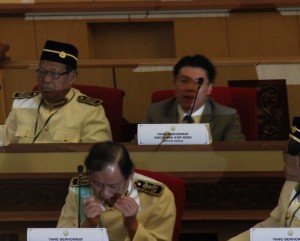
3. Not to be outdone, also in Perak, the ADUN for Pantai Remis (again, from DAP), Nga Kor Ming, attended the Dewan sitting not dressed in the ceremonial dress WITH THE RAJA MUDA IN ATTENDANCE, while his cousin, Ngeh Koo Ham, the ADUN for Sitiawan (yet again from DAP) wore the ceremonial dress, but without the songkok.

Ngeh and Nga in defiance

4. In Johor, Boo Cheng Hau (DAP-Skudai) also did not don the songkok in the state’s Dewan, in the presence of the Sultan of Johor. Perhaps, wearing a songkok to him would be an insult to his race (since he is always harping on race issues).

5. Also in Johor, two years earlier, Gwee Tong Hiang (DAP-Bentayan), wore only a blue business suit to the Dewan’s sitting. However, the Speaker ordered him to do so, 15 minutes before the opening ceremony. Ong Kow Meng (DAP-Senai) also did the same.

6. Two years ago, during the 217th Malay Rulers Conference, the Chief Minister of Penang, Lim Guan Eng (also from the DAP) did not don a songkok in the presence of His Majesty the King and His Royal Highnesses the Sultans, Raja and Yam DiPertuan Besar as well as His Excellencies the Governors of Sabah, Sarawak, Melaka and Pulau Pinang.

7. Most recently, DAP state excos in Sarawak did not don the songkok at the state Dewan sitting in the presence of His Excellency the Governor of Sarawak.

Therefore, since when has the Pakatan Rakyat-led Selangor state government started listening to what the Palace has to say?

They Think They Know But They Don’t

To God belongs the East and the West,
Wheresoever you look is the face of God.
Qur’an 2:115

During my A-levels, I studied in a Grammar school in England. I was the only Muslim in that school. Every day during assembly, students would sing the hymn. I had to sing to; in fact, I had a hymn book of my own. We would also cite the Lord’s Prayer, which ’til this day I still memorise (in fact I also memorise the Shri Ganesha Shloka). I have also made four pilgrimages to Mecca.

So, what am I by JAIS’s definition? A Christian or a Hindu?

The raid by JAIS on the Damansara Utama Methodist Church is nothing short of damaging, not only to the image of Islam, but to the image of Pakatan Rakyat that has been struggling to demonstrate the cohesiveness among its member parties on the issue of religious tolerance despite differences especially caused by the stance of PAS.

Politics aside, I do not see any reason for Muslims not to be allowed to attend functions held at a church, or any other non-Islamic religious institutions. Let us use our brain for a moment – if Islam is that restrictive, will it be viewed as an open and welcoming religion by non-Muslims? Read that verse from the Quran at the top – I can even perform my prayers in a church if I so wish, for example when I take refuge from rain outside (as long as the Christian community do not feel offended if I do), because wherever I go, I will be treading on God’s Earth.

I do not see any wrong done by the Muslims who were there to join their Christian neighbours, as I do not see any wrong for a Christian attending a tahlil for a Muslim deceased. I do not even see any wrong for Muslims to participate in events organised by a Church for as long as it is for the betterment of the community. And I was ever ready to defend the local church from attacks by misinformed Muslims early last year.

Prophet Muhammad (pbuh) even made a promise to the Christians when a delegation from the Saint Catherine’s monastery asked for Muslims’ protection in 628 A.D:

“This is a message from Muhammad ibn Abdullah, as a covenant to those who adopt Christianity, near and far, we are with them.

Verily I, the servants, the helpers, and my followers defend them, because Christians are my citizens; and by God! I hold out against anything that displeases them.

No compulsion is to be on them. Neither are their judges to be removed from their jobs nor their monks from their monasteries. No one is to destroy a house of their religion, to damage it, or to carry anything from it to the Muslims’ houses.

Should anyone take any of these, he would spoil God’s covenant and disobey His Prophet. Verily, they are my allies and have my secure charter against all that they hate.

No one is to force them to travel or to oblige them to fight. The Muslims are to fight for them. If a female Christian is married to a Muslim, it is not to take place without her approval. She is not to be prevented from visiting her church to pray. Their churches are to be respected. They are neither to be prevented from repairing them nor the sacredness of their covenants.

No one of the nation (Muslims) is to disobey the covenant till the Last Day (end of the world).”

Dare JAIS brand Muhammad (pbuh) an infidel?