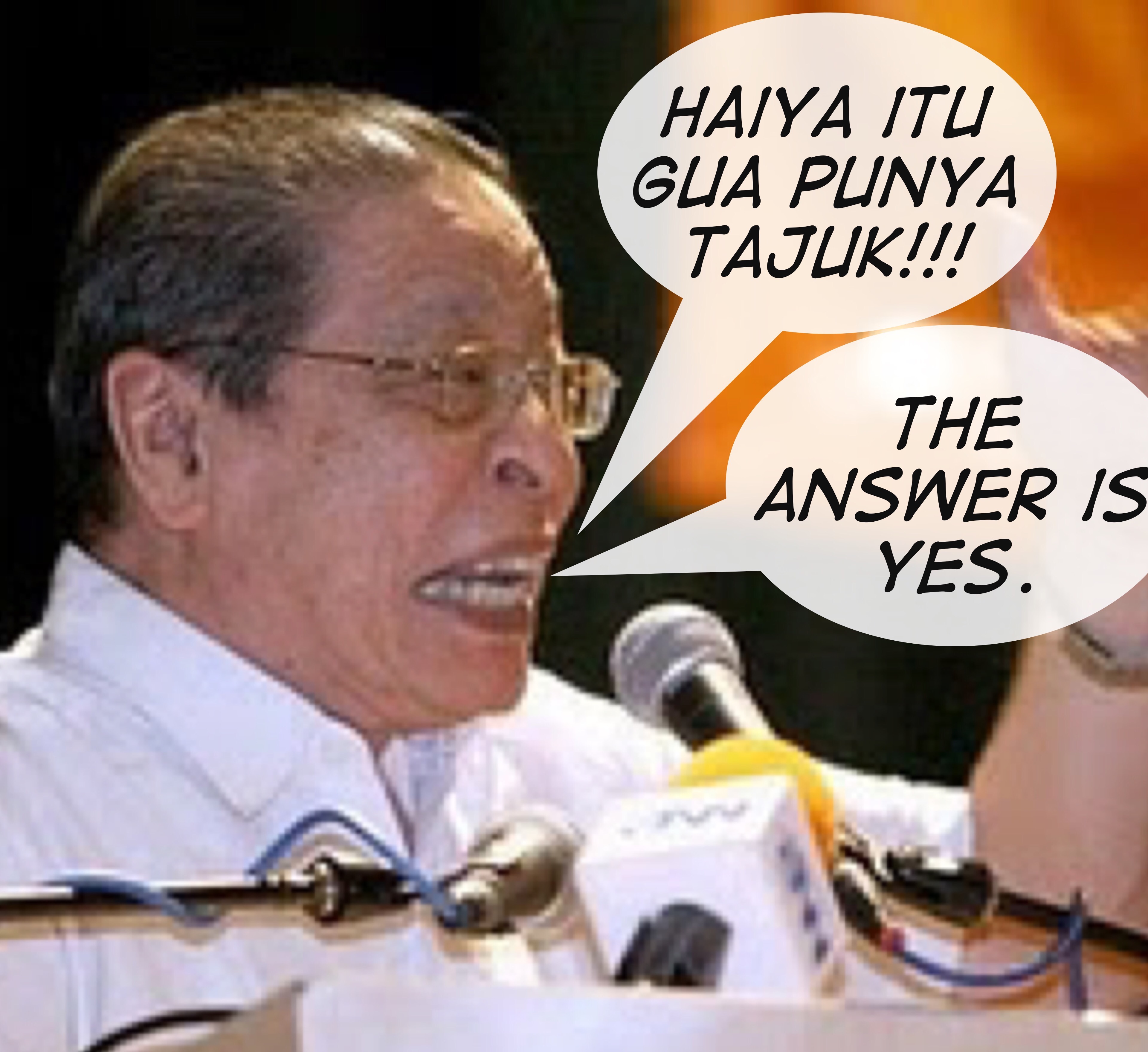
It was supposed to be a press conference to announce la granouille extraordinaire Zaid Ibrahim’s yet another leap into a political party.
Minutes after the announcement Zaid’s joy was short-lived when U-Turn Mahathir took a swipe at him saying to the press that he hopes Zaid’s stay in DAP would be longer than the ones he had had in other opposition parties.
Zaid Ibrahim never had anything nice to say about U-Turn Mahathir either. You can read a special section on the old Pharaoh from Page 215. Don’t bother buying the book now because he now has to like the old Pharaoh. Just get one from someone who plans to return the book for a refund.
Talking about books the best moment of the press conference was when a reporter asked what is DAP owner Lim Kit Siang’s current stand on the Royal Commission of Inquiry for the BMF scandal.
The author of two books blaming the BMF scandal on U-Turn Mahathir went through the roof!
This is how DAP would behave once power is being given to them. We can already see how charged-for-corruption Chief Minister Lim Guan Eng has been behaving in Penang.
Like father like son.
Anyway, Kit Siang says that he stands by his request for an RCI to he set up to investigate the BMF scandal.
However, he added that an RCI should first be formed to investigate the 1MDB scandal.
The Commission of Inquiry set up to investigate the BMF scandal in the 1980s was not given the power to summon witnesses to testify. There was no other investigation done.
1MDB had had its accounts and other documents opened up for the MACC, police, Bank Negara, the PAC (which coincidentally has members of the opposition in it), and had to undergo a forensic audit performed by the Auditor-General’s Office.
There was no “bailout” for the 1MDB as opposed to the BMF scandal which was bailed out by Petronas amounting to RM2.188 billion on top of the RM2.255 billion that vanished through loans to the Carrian Group.
Also Kit Siang, please note that the RM4.443 billion came from the rakyat’s coffers so to speak as money at BBMB was from Petronas to assist the Bumiputera, and Petronas money used to bail BBMB out belonged to the people too.
BMF lent Malaysian money to a foreign company for the purpose of projects outside Malaysia that have nothing to do with Malaysia.
1MDB on the other hand borrowed foreign money for projects in Malaysia. There is no ‘rakyat’s money’ involved as claimed except the ones used to form 1MDB.
And also please remember, the US DOJ never named the current Prime Minister in its investigation documents, only a reference to an ‘MO1’ was made as that person was not directly involved in the investigation.
However, the CIA document specifically linked the BMF scandal to U-Turn Mahathir.
So Kit Siang. It is your credibility that is on the line here. Whether DAP makes it in GE14 depends on whether you would support the formation of a RCI for the BMF scandal without any conditions.
Your son is going to jail for corruption and you are the only one left from your family to ensure that your family continues to be relevant to the rakyat.
Or are you too busy kissing U-Turn Mahathir’s ass and defending him to even think about the end of your credibility as well as your political career as you know it?
Perhaps DAP supporters should start burning all the books written by Kit Siang and ditch he and his family.
There is no use keeping an old man who has no integrity yet is trying to dictate things to others.
When Ku Nan said that Penang should be made into Federal Territory, Johor-born Penang Chief Minister from Melaka who has been charged in court for corruption, Lim Guan Eng, went on a campaign asking Penangites to love Penang. The campaign has been ridiculed and scorned by original Penangites.
I made it a point to pen down the fact that Guan Eng was born in Johor Bahru in 1960 and went to the Batu Pahat High School and Melaka High School.
Although he was the Kota Melaka MP for three terms with consecutively reduced majority the Melaka DAP discarded him and his wife Betty like trash. He came out last in the 2005 Melaka DAP Committee elections. Even his wife Betty beat him to take the second-last spot. Therefore, while Betty being DAP Supremo Lim Kit Siang’s daughter-in-law was spared being in the last position, Kit Siang’s own son was trash in the eyes of Melaka DAP.
Sensing that he could get trashed in the 2008 general elections if he continued to contest in Kota Melaka, he ran to Penang to contest at the Bagan parliamentary and Air Puteh state seats.
To show that he is fair to other races, he appointed Perak-born P Ramasamy also from DAP and Datuk Dr Mansor Othman from PKR.
In 2012, Mansor was alleged to have called Lim Guan Eng “cocky”, “arrogant”, “dictator” and a “tokong” (deity). Tokong stuck on him well and until now he is being referred to as that by his detractors. With very little tolerance for dissent, Mansor was struck out and replaced by Dato’ Mohd Rashid bin Hasnon after the 2013 general elections.
Since then, Guan Eng has fought tooth and nail with local NGOs such as the Consumers Association of Penang, Georgetown Heritage Action Group, Persatuan Kebajikan dan Penduduk Tamil, Penang Dravidar Kalagam, Malaysia Nambikei Yekkam, Penang Tamil Pathukappu Yekkam and Persatuan Penduduk Penduduk Baru Kawan. This is due to Guan Eng’s dictatorial behaviour in demolisihing, reclaiming, and developing Penang without giving any due consideration to heritage, environment nor religion.
And who is Lim Guan Eng to tell Penangites to love Penang when he himself does not trust the Penangites?
When he could feel that he might be spending several years in jail for corruption, he asked DAP leaders and members to accept Selangor-born Chow Kon Yeow from Kuala Lumpur as the next Chief Minister of Penang when he is jailed. Aren’t there Penangites in his exco line-up?
There are 11 exco members in Penang:
Lim Guan Eng as the CM is from Johor/Melaka,
Rashid Hasnon, Deputy CM1 is from Johor,
P Ramasamy, Deputy CM2 is from Selangor,
Chow Kon Yeow is from Kuala Lumpur,
Chong Eng is from Pahang,
Phee Boon Poh is from Penang,
Lim Hock Seng is from Penang,
Danny Law is from Perak,
Jagdeep Singh Deo is from Penang,
Abdul Malik Abul Kassim is from Penang,
Dr Afif Bahardin is from Penang.
I am sure many Penang DAP members remember Thum Weng Fatt.
Before Lim Guan Eng could difference between Batu Maung and Batu Kawan, it was Thum Weng Fatt who represented DAP on every single issue in Penang. He would travel around in his yellow van providing services to the people. Many Penangites could still identify Thum and the yellow van.
Yet when DAP took over the administration in 2008, Lim Guan Eng and his father made it as if they had done all the hard work.
When Thum passed away, his sister cursed Lim Guan Eng and DAP for not lifting a finger to assist her late brother whom had given his all for his love of DAP.
Maybe it is because Thum was a Penangite. Which is why 55 percent of his excos are NOT from Penang. Which is why his two deputies are not from Penang. Which is also why his proposed successor is also NOT from Penang.
I guess he doesn’t trust Penang people. I don’t think he loves Penang at all. Penang is probably a form of merchandise that he could use to enrich himself and only those loyal to him.
That is why his advice for Penangites should love Penang should translate into “Penangites should love whatever Tokong Lim Guan Eng does with Penang.”
Ada saja yang mengeluh mengenai harga barang serta nilai Ringgit yang tidak seperti zaman Tok Kadok. Tidak kurang juga yang membandingkan bagaimana harga rokok pada zaman Mahathir Mohamad adalah jauh lebih murah dari zaman Najib Razak.
Benar. Harga rokok Dunhill 20 sekotak kini mencecah RM17.00. Namun ianya bukan disebabkan kelemahan matawang tetapi diakibatkan oleh kenaikan cukai ke atas rokok.
Kita ambil tahun 1993, iaitu zaman pemerintahan Mahathir Mohamad. Harga Big Mac pada masa itu ialah RM3.35 manakala harga minyak RON92 (semasa itu minyak RON95 masih belum wujud di Malaysia) berharga RM1.06 seliter.
Pendapatan median bulanan setiap keluarga di Malaysia pada tahun 1993 ialah RM1,077 manakala bagi Bumiputera ianya adalah RM887.
Ini bermakna sekiranya kesemua pendapatan tersebut digunakan untuk membeli Big Mac maka setiap keluarga mampu membeli sebanyak 321 Big Mac manakala bagi sebuah keluarga Bumiputera hanya termampu sebanyak 265 Big Mac.
Untuk pembelian minyak RON92 pula setiap keluarga di Malaysia boleh membeli sebanyak 1,016 liter manakala keluarga Bumiputera boleh membeli 837 liter.
16 tahun kemudian apabila pentadbiran Najib Razak mengambil alih pucuk pimpinan pendapatan median bulanan setiap keluarga di Malaysia meningkat kepada RM2,830 dan RM2,531 bagi keluarga Bumiputera.
Harga Big Mac telah meningkat kepada RM6.80 (kenaikan sebanyak RM3.45 berbanding tahun 1993) manakala minyak RON95 setelah RON92 tidak lagi dijual di Malaysia berharga RM1.80 seliter (kenaikan sebanyak 74 sen).
Ini menjadikan kemampuan bulanan setiap keluarga pada tahun 2009 membeli Big Mac meningkat kepada 416 biji manakala keluarga Bumiputera membeli 372 biji Big Mac. Peningkatan berbanding tahun 1993 ialah sebanyak 95 biji Big Mac (peningkatan 29.45 peratus) manakala bagi keluarga Bumiputera pula ialah sebanyak 107 biji Big Mac (peningkatan 40.6 peratus).
Untuk pembelian minyak RON95 pula, kemampuan bulanan setiap keluarga pada tahun 2009 membeli minyak RON95 meningkat kepada 1,572 liter manakala keluarga Bumiputera membeli 1,406 liter. Peningkatan berbanding tahun 1993 ialah sebanyak 556 liter (peningkatan 54.74 peratus) manakala bagi keluarga Bumiputera pula ialah sebanyak 569 liter (peningkatan 68.04 peratus).
Ini bermakna taraf hidup bagi setiap keluarga di Malaysia telah meningkat walaupun harga barangan juga meningkat berbanding pada zaman pentadbiran Mahathir Mohamad. Bagi keluarga Bumiputera pula, walaupun pendapatan mereka masih di bawah purata pendapatan setiap keluarga di Malaysia, kualiti hidup mereka meningkat dengan mendadak melebihi dari peningkatan purata keluarga di Malaysia pada tahun 2009 berbanding 1993.
Lima tahun kemudian, iaitu pada tahun 2014, pendapatan bulanan setiap keluarga di Malaysia adalah RM4,585 (kenaikan RM1,755 atau RM351 setahun) dan RM4,214 (kenaikan RM1,683 atau RM336 setahun) bagi keluarga Bumiputera.
Manakala harga Big Mac dan RON95 pula berada pada paras RM7.60 sebiji dan RM2.30 seliter (iaitu sama dengan harga minyak pada bulan Februari 2017).
Kemampuan untuk membeli Big Mac sebulan bagi setiap keluarga di Malaysia telah meningkat kepada 603 biji (peningkatan 44.96 peratus) manakala bagi keluarga Bumiputera pula sebanyak 554 biji (peningkatan 48.97 peratus). Peningkatan bagi kemampuan keluarga Bumiputera sekali lagi mengatasi peningkatan setiap keluarga di Malaysia.
Bagi RON95 pula, kemampuan pembelian bulanan bagi setiap keluarga di Malaysia telah meningkat kepada 1,993 liter (peningkatan 26.79 peratus) manakala bagi keluarga Bumiputera pula sebanyak 1,832 liter (peningkatan 30.30 peratus). Peningkatan bagi kemampuan keluarga Bumiputera sekali lagi mengatasi peningkatan setiap keluarga di Malaysia.
Itu tahun 2014. Bagaimana pula dengan dakwaan bahawa kadar inflasi membuatkan rakyat Malaysia kini tidak mampu untuk membeli makanan?
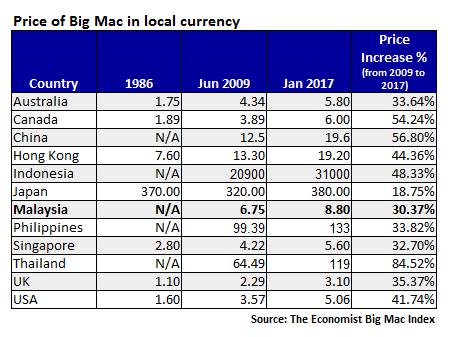
Perbandingan harga Big Mac dari 2009 hingga 2017 mengikut matawang masing-masing negara
Perbandingan di atas menunjukkan kenaikan harga Big Mac di antara tahun 2009 hingga 2017 menunjukkan kenaikan harga Big Mac Malaysia adalah kedua terendah berbanding negara lain. Kalau kita lihat restoran-restoran terutamanya yang mahal seperti Serai di Empire Subang masih penuh pada waktu makan tengahari tidak mengira hari hinggakan barisan yang beratur menunggu tempat duduk begitu panjang setiap hari.
Begitu juga di Facebook dan Instagram kita dapat melihat betapa ramai rakyat Malaysia yang mampu bercuti sama ada di dalam mahupun luar negara. Ini berlaku mahupun dakwaan bahawa rakyat Malaysia tertekan akibat kekurangan wang dan Ringgit tidak laku di luar negara.
Semasa saya menunaikan ibadah Umrah setiap tahun dari tahun 1998 hingga musim Haji 2001, setiap pengendali pakej hanya memenuhi satu buah bas setiap penerbangan. Yang pergi secara puratanya berumur 45 tahun ke atas. Jarang ada yang berumur kurang dari 30 tahun.
Apabila saya kembali ke Mekah pada tahun 2014, ia menjadi tiga buah bas setiap pengendali pakej bagi setiap penerbangan dan lebih ramai pasangan muda turut serta. Baru-baru ini ia telah meningkat kepada empat buah bas setiap pengendali pakej setiap penerbangan dan begitu ramai pasangan muda yang membawa anak-anak kecil, atau pergi beribadah bersama seluruh keluarga. Bukan sahaja mereka yang menjalankan perniagaan atau kerja dengan syarikat swasta, malah guru-guru peringkat bawahan juga mampu pergi anak-beranak.
Anda boleh membaca dengan lebih lanjut lagi mengenai jumlah kerusi penerbangan yang diperlukan untuk jemaah Umrah dari Malaysia setiap hari DI SINI.
Mahukah anda kembali ke tahun 2001 semasa pentadbiran Mahathir Mohamad?
Perangkaan tidak pernah berbohong. Tidak seperti puak Pakatan yang suka menabur fitnah mencanangkan bagaimana harga barang naik di bawah kerajaan Barisan Nasional. Tidak pula mereka menceritakan bagaimana kualiti dan taraf hidup juga telah naik melebihi kenaikan harga barangan.
Untuk perbandingan, janji untuk menghapuskan tol di negeri Selangor masih tinggal janji.
Janji untuk menghapuskan tol di Sungai Nyior, Pulau Pinang masih tinggal janji.
Malah kerajaan Pulau Pinang DAP sejak 2008 telah menaikkan harga lesen, kadar parkir, lesen perniagaan (begitu juga di Selangor) dan menaikkan kadar tarif air di Pulau Pinang sebanyak EMPAT kali.
Tidak cukup dengan itu, di Selangor anda dikehendaki membayar 20 sen untuk setiap beg plastik yang anda perlukan semasa membeli barang.
Dulu anda mendapat beg plastik secara percuma sekiranya anda membeli barangan berharga, sebagai contoh, RM10. Ini bermakna kos pembelian beg plastik oleh peniaga telah difaktorkan ke dalam kos penjualan barangan. Dicampur dengan GST anda membayar RM10.60.
Kini anda dikenakan RM10 + 20 sen menjadikan RM10.20 dan apabila dikenakan GST anda perlu membayar RM10.81! Anda membayar sebanya dua kali untuk satu beg plastik dan peniaga membuat keuntungan atas angin sebanyak 21 sen bagi setiap beg plastik.
Ada yang mengatakan bahawa polisi membayar untuk beg plastik ini bagus kerana kutipan akan diserahkan kepada kerajaan negeri untuk tujuan memerangi pencemaran. Apa kata Azmin Ali?
Azmin tak kata pun dia suruh kita bayar 20 sen untuk beg plastik
Ada pula yang kata kutipan akan disalurkan ke badan-badan amal dan bukan kerajaan. Apa pula kata Exco Selangor Elizabeth Wong?
Eli Wong pun kata dia hanya BERHARAP agar para peniaga akan menyalurkan kutipan 20 sen kepada badan-badan amal dan bukan kerajaan. Dia tak suruh. Jadi siapa kena tipu?
Rafizi yang menjanjikan penurunan harga barangan akan berlaku dengan penurunan harga minyak juga masih belum tunaikan janji walhal minyak pernah turun dari RM2.70 seliter pada zaman Pak Lah kepada RM1.60 seliter pada awal tahun 2016. Namun hingga kini tidak nampak penurunan harga barangan.
Apabila disoal di dalam group WhatsApp, beliau hanya menjawab bahawa itu bukan masalah beliau.
Perangai sotong
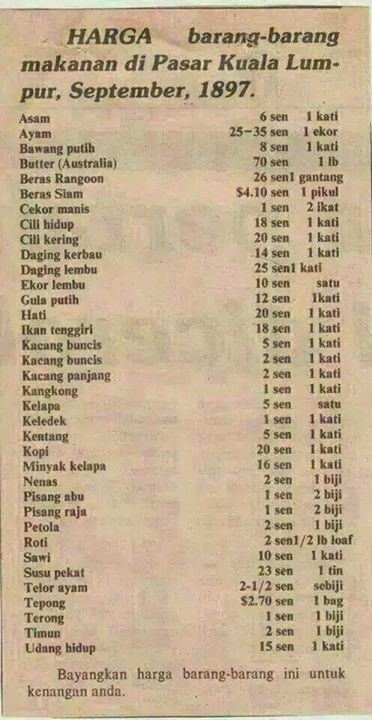
Seingat anda, pernahkah ibubapa anda menyebut bagaimana barangan langsung tidak mahal? Dan sekiranya anda masih mahu membuat perbandingan di antara zaman Mahathir Mohamad dan zaman Najib Razak dan rindukan zaman Mahathir Mohamad, kenapa anda tidak mahu rindukan zaman pentadbiran penasihat British dan Kapitan Yap Ah Shak?
Of late there have been calls for the return of Pulau Pinang to the sovereign Ruler of Kedah. This is because since being governed by the DAP, Pulau Pinang (Penang) has been behaving like an autonomous state while chasing out Malays, Indians as well as marginalised Chinese from the island state.
If I were to follow my heart, I would wish for Kedah to reassert its sovereignty over Penang. However, legally that would be disastrous for Malaysia.
The History of the
The proponents for the return of Penang to Kedah base their arguments on the agreement made in 1786 between the British East India Company and the Ruler of Kedah at the time, Sultan Abdullah Mukarram Shah. During that time, Kedah was already under the Rattanakosin Kingdom established by King Taksin. Kedah was already paying tributes in the form of Gold Flowers to the Kingdom of Siam in 1781 and had accepted the Siamese sovereignty.
In the 1786 agreement, Francis Light was supposed to assist the Kedah ruler in the event that Kedah comes under attack by another power; the British East India Company (BEIC) was not to protect enemies of Kedah (namely the Burmese and Siamese); and BEIC was to pay the Kedah government an annual repariation of 30,000 Spanish Dollars for the lease of Penang.
Tension grew when Francis Light did not inform his superiors in India of the full details of what he had promised to Sultan Abdullah. In the end, Light was asked to provide Sultan Abdullah with less than what had been requested. The EIC decided to to provide the Sultan with any form of protection and nothing was said of financial repariation.
Light was forced to use the island’s revenue to pay the Sultan but offered only $10,000 Straits Dollars a year for eight years for the island, or $4,000 Straits Dollars a year for so long as the Company occupied the island.
The unamused Sultan then gathered his forces in Prai in late 1790 to take Penang back by force which was defeated by Light. Sultan Abdullah sent his emmissaries Tunku Sharif Muhammad, Tunku Alang Ibrahim and Datuk Penggawa Telibun to negotiate a treaty with Light.
In 1791 a treaty called the Treaty of Friendship and Peace was signed between the BEIC and the Sultan of Kedah and the annual payment of a sum of 6,000 Spanish Dollars was promised to the Sultan for the rights to Penang and the two countries promised “to live in peace by sea and land, to continue as long as the Sun and Moon give light.” BEIC was to no longer provide protection to Kedah against its enemies. This treaty supercedes the treaty of 1786. (Dr Cheah Boon Kheng, former lecturer, History Department of the Universiti Sains Malaysia)
In 1800, another treaty was signed between BEIC and Sultan Ahmad Tajuddin Halim Shah II, the successor of Sultan Abdullah for the lease of Seberang Prai (called Province Wellesley then) for an annual sum of 4,000 Spanish Dollars that is to continue “as long as the Sun and Moon give light.”
From 1826, the BEIC placed Penang under the Straits Settlements. Subsequently, in 1874 the BEIC was dissolved and as a result of the 1873 East India Stock Dividend Redemption Act the Straits Settlements came under direct British Crown rule via its government in India.
The Brtish Government became the rightful owner of Penang as successor of the BEIC.
Towards The Independence of Malaya
Each state in what was called Malaya were sovereign states up until 31st August 1957 when the Federation of Malaya that existed following the breakdown of the Malayan Union in 1948 ceased to exist.
“Malaya” as it was known then was made up of the Federated Malay States (Selangor, Perak, Negeri Sembilan, Pahang), the Unfederated Malay States (Kedah, Kelantan, Terengganu, Perlis, Johor), and the Straits Settlements (Penang, Melaka and Singapore).
The discussions leading to the formation of the 1957 Federation of Malaya excluded Singapore in the equation.
During these discussions, both Melaka and Penang were referred to as the Crown Colonies whose people are citizens of Britain. The discussions involved Her Majesty Queen Elizabeth’s Government, the Nine Malay Rulers, and the Alliance government the people had elected to represent them.
In an early stage, it was agreed by both Her Majesty’s Government and the Nine Rulers that the office and person of the Yang DiPertuan Agong and the Queen would jointly administer the Settlements as “equal partners.” According to this arrangement, the Queen would delegate her sovereign authority to the Yang DiPertuan Agong as the representative of the Queen and the Nine Rulers and that the Melaka and Penang would have a Governor appointed in consultation with the Straits Settlements’ office (CO1030/132(28) dated 16 August 1956).
This would be in line with protecting the Straits Chinese who were British subjects whose representation to the British government expressed fears that if Penang is administered by the independent Malayan government, they would be subjected to discrimination.
The British High Commissioner to Malaya, Sir Donald MacGillivray had already expressed grave doubts as to whether that arrangement would be accepted by the Alliance Party as the latter had wanted all the Settlements involved to be part of the newly independent and self-governing Malaya (CO1030/135 (2) dated 19 July 1956).
UMNO as represented by Tunku Abdul Rahman had also proposed that the provisions for Malay reservations in the proposed Constitution should be applied to Penang and Melaka. However, this was met with stiff resistance by the British government. The Secretary of State said the proposal could “aggravate racial feeling”, adding that during the 180 years of British rule in the Settlements there had been no racial discrimination (CO1030/496 (8) dated 14 May 1957).
A compromise was proposed by the Rulers’ legal adviser, Neil Lawson, who suggested that one of the clauses on land reservations to include a provision to allow the State governments to set up a trust to buy land for the settlement of the Malays. This compromise was accepted by the meeting. This proposal was contained in Article 88 of the Federal Constitution allowing Parliament to modify the articles on land (Articles 83 – 87) for application in Penang and Melaka (Constitutional Proposals for Malaya, Cmnd, 210, op.cit).
If you noticed in all the above meetings not once did the Sultan of Kedah, Sultan Sir Badlishah ibni al-Marhum Sultan Abdul Hamid Halim Shah, discussed the return of Penang to Kedah as well as asserting His Royal Highness’s sovereign authority over Penang.
This demonstrates that Pulau Pinang and Seberang Perai were no longer legally part of the Kedah Sultanate.
However, what also almost happened was the return of Melaka to the Dutch.
On 16 May 1957, a newspaper Straits Budget reported that the Malayan Party under Tan Kee Gak had planned to ask the British Secretary of State about the Anglo-Dutch Treaty of 1824 in respect of Melaka. According to Tan Kee Gak, Britain was planning to abandon Melaka to Malaya and as a contracting party was in breach of the said contract. Therefore, Melaka should be returned to the Dutch instead of be part of an independent Malaya.
The Colonial Office viewed the report seriously and sought the advice of the Foreign Office which in turn sought the help of the government of the Netherlands to renounce such a claim explicitly (CO1030/439 (79) dated 20 June 1957).
Summary
I have no reservation whatsoever in expressing my disgust at the way Lim Guan Eng runs Penang and uses it in a very unMalaysian way. But I doubt there is any legal avenue that would allow for the return of Penang to Kedah that would be undamaging to the country in its present legal form. It would allow for parties in Melaka perhaps to ask Netherlands to reconsider claiming the state as its own based on the 1824 treaty, and Manila would have a legal precedence to follow in its claim on Sabah.
Not once did the Sultan Of Kedah from the days of Sultan Ahmad Tajuddin Halim Shah II through Sultan Abdul Halim Mu’adzam Shah have ever staked a claim on Penang. This is simply because the treaties of 1791 and 1800 have superceded the one made in 1786.
And Penang’s current form is because of the 1957 Federal Constitution, cemented further by the 1963 Federal Constitution, agreed upon by all including by the Nine Malay Rulers without a single objection to its sovereign status. So how is it that Penang should be taken back by Kedah?
If the current claim is about the maruah (face/pride) of the Kedah Sultanate or about the pride of the Malays, that is just the mouth talking before the brain could think.
It would be nice to live dreaming about the day Penang becomes another district of Kedah but that is what the heart wishes. It is the legal and constitutional implications that have to be thought of thoroughly.
The word means hem or a fold on a piece of cloth or paper. A Malay synonym would be ‘lipatan.’ To Lipat or to Kelepet would colloquially mean ‘to pillage.’
Malaysia Airlines Boeing 737-800
Malaysia Airlines has always been a favourite airline of mine. The national flag carrier is THE symbol of Malaysia’s global reach. However, the airline which roots can be traced back to 71 years ago has been suffering badly from an especially bad episode of mismanagement dating back from 1994.
Disguised under the New Economic Policy that was supposed to assist the Bumiputeras to be economically stronger, U-Turn Mahathir and financial henchman Daim Zainuddin selected several cronies to helm public-listed companies. They include Amin Shah Omar Shah (who screwed up the Kedah-class NGPV programme) and Tajuddin Ramli (TR) who stripped Malaysia Airlines of its edge and finances.
Malaysia Airlines was okay for about two years before crashing in 1997 with a net loss of RM259.85 million (RM426.15 million in today’s terms) from a net profit the year before of RM333.01 million (RM546.14 million in today’s terms).
Like the collosal losses of real money the nation had to absorb through the BMF as well as the BNM Forex scandals, U-Turn Mahathir and Daim saw it fit for Malaysia Airlines, or rather their crony Tajuddin Ramli, be bailed-out using, again, the rakyat’s money.
The Malaysian Airlines System (MAS) police report on January 9 and the police investigations into alleged million-ringgit management irregularities at the MAS cargo division during the tenure of former MAS executive chairman and key shareholder Tan Sri Tajudin Ramli is a most welcome departure from the invariable past practice of government and corporate cover-ups, especially in government-owned or controlled companies, making Malaysia notorious as a country teeming with “heinous crimes without criminals” – starting with the infamous Bumiputra Malaysia Finance (BMF) scandal in the eighties.
It has been reported that the alleged management irregularities centred on business arrangements between MAS and a Germany-based cargo handler controlled by Tajudin Ramli and focussed on contracts between MAS and ACL Advanced Cargo Logistic GmbH, a 60%-owned unit of Naluri Bhd., a listed Malaysian company in which Tajudin is the largest shareholder. ACL operates a cargo facility in Hahn, Germany, that MAS in 1999 contracted to use as its global cargo hub.
The management irregularities being investigated by the police can only be the tip of an iceberg as MAS has chalked up colossal debts of RM9.2 billion and accumulated losses of R2.5 billion, requiring repeated billion-ringgit bailouts at the public taxpayers’ expense – and the Malaysian public are entitled to demand a full accountability as to how the national airline could end up as such a sick company, a national embarrassment and a burden on public coffers.
It was reported that the management irregularities in the cargo division were discovered in an audit ordered by the government after taking control of MAS early last year following the scandalous RM1.79 billion buyback bailout of Tajudin’s 29.09 per cent stake at RM8 a share when the market price was only RM3.68.
This raises the question as to why an audit was not conducted before the government’s buyback bailout of Tajudin’s MAS stake – which would have a very important bearing on the proper price of the government buyout.
I am sure Uncle Ah Siang has not forgotten this episode too when he became pally with U-Turn Mahathir recently. Surely the interest of the rakyat is paramount to the God of DAP.
Or is it still?
He continued:
On March 21 last year, the then Finance Minister, Tun Daim Zainuddin, gave a long and most unsatisfactory reply in Parliament during question time to justify the buy-back bailout of Tajudin’s MAS stake which took place under his watch, but he failed to address or answer the two most important questions, viz:
Why no independent professional valuation was ever done when the government agreed to pay Tajudin’s Naluri Bhd for the MAS stake at RM8 per share representing a premium of RM4.32 or 117 per cent over the closing market price at RM3.68 per share when the deal was signed on 20th December 2000; and
Why rules for the bail-out of companies established by the National Economic Action Council in the “National Economic Recovery Plan” was violated and Tajudin was not only spared from having to “take his appropriate hair-cuts” but was given a bonanza at taxpayers’ expense to reward for his mismanagement of MAS by being given 117% premium for the MAS shares over the market price, transforming it into a personal rescue for Tajudin instead of a public rescue for MAS.
The current police investigations into management irregularities in MASkargo Sdn. Bhd. have again brought to the fore the questions concerning prudence, propriety, responsibility, integrity, accountability and transparency of the decision to use RM1.79 billion public funds for the buy-back bailout of Tajudin’s MAS stake.
Last month, the government announced a RM6.1 billion MAS restructuring exercise involving assets sale to enable the national carrier to retire some of its debts and provide RM820 million as working capital, which is just a creative way for a second round of government bailout for the national airline.
Malaysia Airlines, Perwaja, Renong as well as other companies steered towards oblivion by their cronies had to be bailed out using the rakyat’s coffers, and not one person has ever been charged in a court of law for the breach of trust they committed. This included Amin Shah Omar Shah who, prior to being given the contract to build our Navy’s vessels, had never built a single fishing boat!
Kit Siang the self-proclaimed rakyat’s champion as recent as 2012 stated in the DAP’s mouthpiece Roketkinithat Mahathir cannot pretend to be ignorant of the MAS scandal.
Lim Kit Siang was so furious about the bailout of Konsortium Perkapalan using the rakyat’s money that on the 16th June 1998 he wrote:
But Mahathir should similarly give full co-operation to the Royal Commission of Inquiry into Nepotism, particularly as to whether there is any nepotism in the government, through Petronas, using hundreds of millions of ringgit of public funds to bail out Mirzan Mahathir’s Konsortium Perkapalan Bhd.
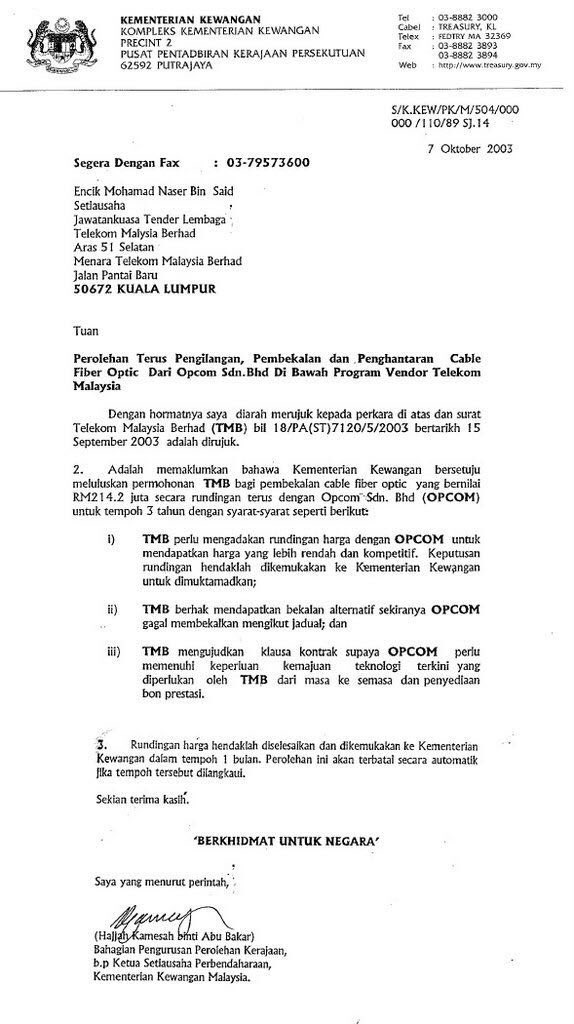
Just recently, a copy of a directive from the Ministry of Finance to Telekom Malaysia regarding a direct negotiation contract award totalling RM214.2 million to Mukhriz Mahathir’s OPCOM made its rounds on the Internet:
A blog post by a Sup Torpedo wrote about this back in 2006:
Mahathir’s criticism of Scomi is justified. It has proved that Scomi does not garner very much government work and now that’s all open to scrutiny. Unlike a company called Opcom Sdn. Bhd. who had a direct nego approved by the Finance Ministry way back in 2003 when Mahathir was both Prime Minister and Finance Minister. The amount of the tender by Telekom Malaysia Berhad was two hundred and fourteen MILLION ringgit. The Ministry of Finance approved it, no doubt with the blessing of the then Finance Minister and Prime Minister, Tun Dr. Mahathir Mohamad.
Hey! What’s new? If you look at the above letter, it was dated on the 7th October 2003. The old fart stepped down as the Prime Minister and the Finance Minister on the 31st October 2003.
It was an eleventh-hour effort to enrich his kin – a true nepotistic egoist dictator who was afraid that money made during his 22-year dictatorship would not be enough to cover his grave.
Even in 2006, during the peak of the old fart’s attacks on his successor Abdullah Ahmad Badawi, observers such as Sup Torpedo could see that it was little about putting the interest of the rakyat ahead as compared to securing money for the Thousand-year Reich of his:
Don’t miss the wood for the trees. This fight that Mahathir got going on with Pak Lah is not about doing the right thing. It is at best about putting his old crony’s rice bowl firmly where the padi fields grow. At the very worst of motives might be the will to further advance Mukhriz’s political career and provide continuity to the old ways.
Again, what is new now? Virtually nothing, except for one little glaring fact: WHY IS UNCLE KIT SIANG SELLING HIS SOUL AND PUTTING HIS PERSONAL POLITICAL INTERESTS AHEAD OF THE RAKYAT’S BY MAKING A U-TURN ON HIS ATTACKS ON MAHATHIR?
A simple answer would be that he is nothing but the stinking, arrogant cow-dung for brain hypocrite he has always been. Power is what he seeks for power ensures riches, just like his charged-for-corruption son.
And what of the rakyat then?
As the saying goes: “The meek shall inherit shit.”
Kit Siang also published a book on the BNM Forex losses scandal
Yes. The year was 1994 when Lim Kit Siang found it ultra-important to publish a book on the Bank Negara Malaysia (BNM) foreign exchange scandal that caused the loss of RM30 billion (estimated to be at RM49 billion in today’s terms).
The book is called, as you would have guessed, ‘The Bank Negara RM30 Billion Forex Losses Scandal‘.
The BNM forex scandal losses in 1991 made international headlines at the time, forcing the resignation of BNM’s governor Jaffar Hussein.
Again I should thank Kit Siang for writing all this, making it easier for me to see what he had written on the issues he raised in the past.
In 2004, Kit Siang called upon Nor Mohamed Yackop who then was sworn in as a Senator to become Finance Minister II to issue a White Paper on the matter.
“Up to now, the government has failed to “come clean” on the colossal Bank Negara forex losses as a result of speculation in the international currency markets from 1992-1994, with the losses cited as ranging from RM10 billion to RM30 billion. In Parliament in 1994, I had given reasons as to why the Bank Negara’s forex losses as a result of its forex speculation operations could have amounted to as high as RM30 billion, which had not been seriously rebutted by any top government leader or Bank Negara official,” he wrote on his blog limkitsiang.com.
In April 1991, a Reuter news agency report from London described Bank Negara as “a dominant force on the foreign exchange scene for some years” and it was accused by some forex operators as “a market bully”.
The 1991 Reuter report states:
“Over the past two years it has stepped up its trading volume, and this year it has started dealing in what dealer described as ‘really massive amounts’…
“Typically, Bank Negara operates in US$50 million lots, compared with the market norm of US$5 million or US$10 million and deals with maybe six major banks in Europe and six in New York, dealers said.
“One trader said the only dealers rivaling Bank Negara would be the Japanese funds. But while these funds enter the market no more than once or twice a year, Bank Negara is coming in and doing yards (billions) of dollars a day.
“”Its recent technique has been to hit major banks for US50 million each, then his them 10 minutes later, dealers said.
“Then it changes centre, and does it all over again.”
The April 1994 issue of Malaysian Business – one of the publications in the New Straits Times stable – reported that Bank Negara’s maximum exposure in the foreign exchange markets reached as high as RM270 billion – three times the country’s GDP and more than five times the country’s foreign reserves at the time!
Kit Siang added that some Government leaders were wise after the event, and one of them was none other than Daim Zainuddin, under whose first tenure as Finance Minister from 1984-1991 the Bank Negara’s unorthodox forex speculation started, who said on April 4, 1994 that while those responsible for the huge forex losses of Bank Negara had accounted for their mistakes by resigning, central banks should never “play with fire” with such forex speculation.
It was Kit Siang who pointed out the irony.
In 1995, a book on international high finance, ‘The Vandal’s Crown‘ by Gregory J. Millman on Page 229 had this to say about the Bank Negara forex scandal:
“Using all the resources a central bank commands – privileged information, unlimited credit, regulatory power, and more – Malaysia’s Bank Negara became the most feared trader in the currency markets. By trading for profit, Bank Negara committed apostasy against the creed of central banking. Instead of working to ensure global financial stability, Bank Negara repeatedly shoved huge sums of money into the most vulnerable market situations in order to destabilize exchange rates for its own profit” (p.226)
“(Bank) Negara operated behind a thick veil of secrecy. The bank seldom spoke publicly about its controversial trading activities. Yet it was increasingly clear to foreign exchange traders that Bank Negara’s operations in the foreign exchange markets went far beyond simple self-defense. It became the most awesome currency trader in the world.” (p. 227)
“(Bank) Negara’s market manipulation was so egregrious that one American central banker said, ‘If they tried this on any organized exchange in the world, they’d go to jail.’ However, in the unregulated international currency markets, there were neither police nor jailers. The only rule was the rough justice of the vandals, and it was this rule that eventually brought (Bank) Negara down.
“In 1992, (Bank) Negara took on a large pound sterling position, apparently expecting Britain to maintain the discipline required by the European Exchange Rate Mechanism. It was a bad economic and political judgement. (Bank) Negara lost approximately $3.6 billion when Britain withdrew from the ERM, letting sterling collapse. The next year, (Bank) Negara lost an additional $2.2 billion. By 1994, Bank Negara was technically insolvent and had to be bailed out by an infusion of fresh money from Malaysia’s finance ministry.”
Recently, Abdul Murad Khalid who was the Assistant Governor of BNM who resigned in 1999 revealed that the forex losses were in actual US Dollars and not in Malaysian Ringgit.
“There was no control… The most important thing is that there was no investigation at all,” Murad was quoted as saying by NST.
Asked if the then Prime Minister knew about the losses, he replied: “I’m sure the governor briefed them.”
Kit Siang’s silence on this issue is indeed deafening. The so-called champion of the rakyat now has his balls as wrinkled as his face is. And all to achieve his personal political ambition.
In 1993, Anwar Ibrahim who was then the Finance Minister responded on behalf of his then-master, U-Turn Mahathir, to Kit Siang’s query on some “rumours about BNM losing money gambling forex“.
Anwar said that the rumour was not true at all.
When confronted, again by Kit Siang, a year later, Anwar said “the amount is not huge.”
The above engagements can be found in the Parliament Hansard.
After Murad’s revelation we know now that the amount is actually colossal.
We also know that U-Turn Mahathir as well as Daim Zainuddin were very much in the know of the losses.
And we know that Lim Kit Siang is just another opportunist snake manipulating the issue to gain support from the rakyat but now bats no eyelid to work hand-in-hand with his sworn enemy so he could come into power.
I am pretty sure he feels pleased looking at himself in the mirror every morning knowing he had blatantly lied to the people.
In my post yesterday Noraihan Che Ali, Bahri Mohamad Zin’s second wife’s sister-in-law revealed that a team from Bahri’s Special Operations Division was sent from Putrajaya to raid her house and office confiscating documents pertaining to properties left by her late husband.
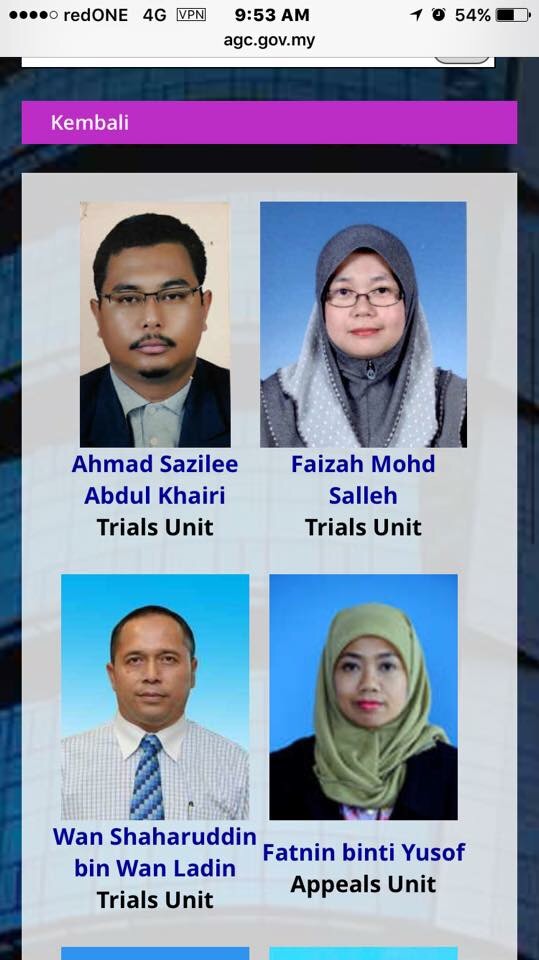
I have just been informed by friends in the legal profession that the Deputy Public Prosecutor who signed the Search Order was one Ahmad Sazilee bin Abdul Khairi.
I shall take a few steps back from that event.
DPP Ahmad Sazilee bin Abdul Khairi is not a nobody. He was seconded to the MACC from the Attorney-General’s Chambers (AGC) and resided in Bahri’s Special Operations Division.
In August 2015, Ahmad Sazilee was one of three persons from Bahri’s division who were arrested by police in connection with leaking the SRC International/1MDB investigation details to Sarawak Report.
Puzzling, they were all released on bail but never charged in a court of law.
How then could he on the 14th January 2016 sign a Search Order made under Section 31 of the MACC Act as a DPP in the MACC when he was no longer there?
I wonder if the police investigating officer (IO) is aware of the above facts? From what I learnt the investigation paper (IP) was only submitted to the AGC two weeks ago (a year after Noraihan made her first police report). The IP has been rejected by the AGC as the investigation was shoddy.
The two should have been investigated under Section 8(1)(d)(iv) and (e)(iv) of the Official Secrets Act, 1972, and investigate the wife under Section 8(2) of the same Act.
To date, they have never been investigated nor charged in a court of law.
I wonder if Ahmad Sazilee’s sitting in the Trials Unit has anything to do with this.
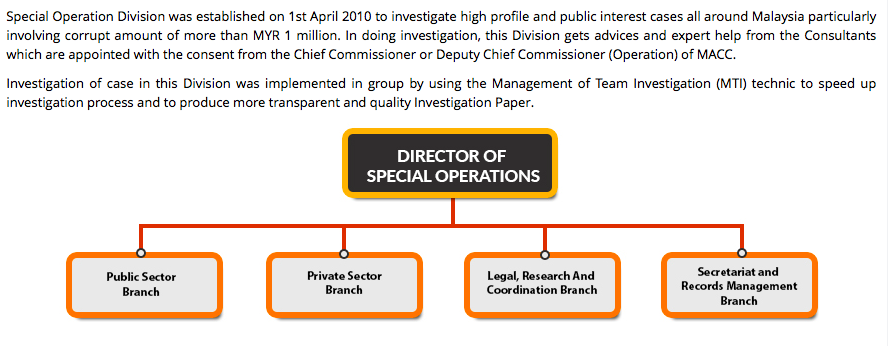
As you remember in yesterday’s post it has been pointed out that Bahri’s division was formed to investigate high-profile cases of public interests and not some petty family property tussle.
Yet, Bahri’s division was sent from Putrajaya to Kota Bharu without the knowledge of the MACC Kelantan office.
For a MACC Search Order to be made there has to be an offence or offences committed under the MACC Act.
Whatever it is, the fact that Bahri’s second wife made the MACC report, Bahri allowing his division to raid Noraihan’s home and office, and a DPP no longer with the MACC signing a search order as a MACC DPP stinks awfully of a conspiracy to get their hands on RM100 million worth of properties.
If I were the IO whose IP was rejected by the AGC I would pluck the three from their cage and grill them.
And I would start with Ahmad Sazilee bin Abdul Khairi.
It’s almost like the Netflix series called ‘A Series Of Unfortunate Events’ where things don’t get any better as it progresses. Or so it seems for Bahri Mohammad Zin, former Director of Special Operations of the MACC, and his second wife Noor Haslina Abdullah who proclaims to be the Director-General of Akademi Memandu KIST Sdn Bhd (AMKIST).
Earlier this evening, I received a press statement by Noraihan Che Ali, the widow of Noor Haslina’s eldest brother Mazly pertaining to a police report filed by Bahri against her last week.
According to the statement, Noraihan welcomes the report made by Bahri and hopes that the MACC as well as the police would then expedite the investigation into the matter.
She was made to understand, the raid by MACC’s Special Operations Division headed by Bahri was based on the report to MACC (report number IPJ/RPTNO/0011/2016) made by none other than Noor Haslina herself. Noraihan pointed that although Bahri denies of any involvement the fact that the raiding party originated from Bahri’s division makes the whole affair more sinister.
Perhaps the two characters named in the Search Order above need to be interviewed by the police!
Noraihan also noted that the MACC website says that the Special Operations Division was formed in 2010 to investigate high-profile cases as well as cases of public interest and asks how can a family property tussle be a high-profile case or something of public interest that warrants the Division to interfere?
A quick check on the MACC website confirms Noraihan’s statement.
It looks like Noraihan’s questions are valid and warrants a thorough investigation by the police. The MACC has no choice but to cooperate in providing all neccessary information and documents pertaining to the case.
The MACC is a government body entrusted to stem if not eradicate corrupted practices in this country and it is only right that it seeks out to rid itself of people who have and can abuse this trust.
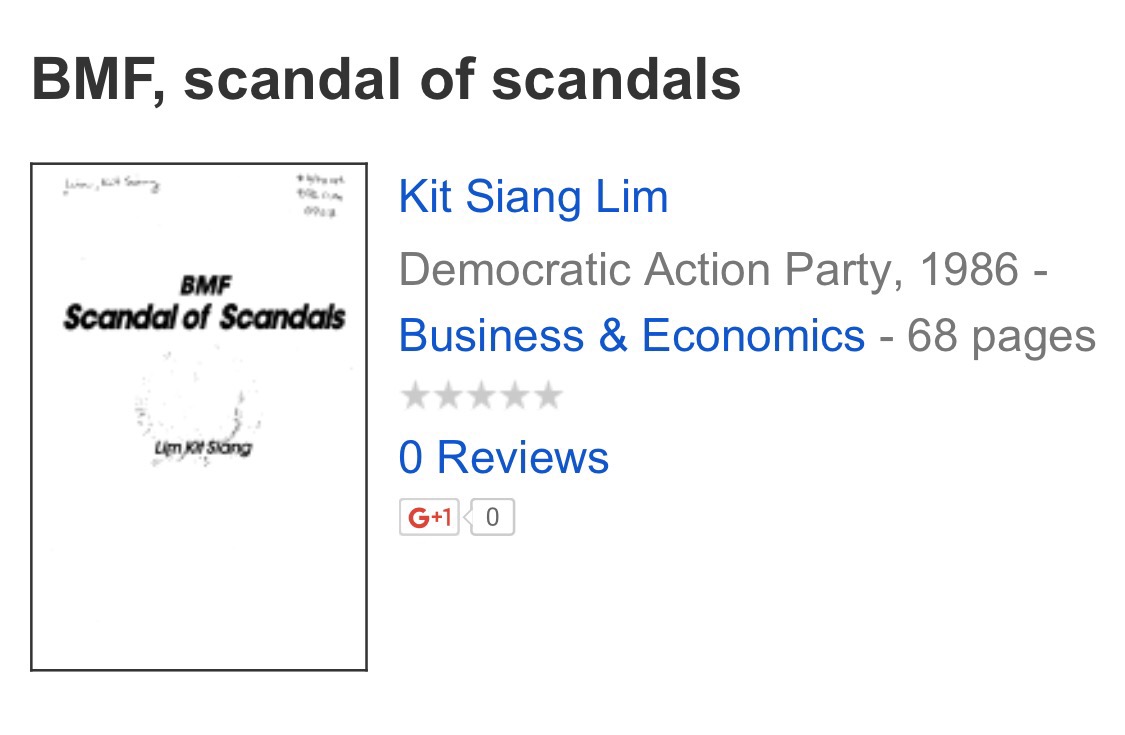
The above is a cover of Lim Kit Siang’s 1983 book on the BMF scandal that involved the Mahathir administration.
The scandal must have been so damning that it warranted a book written of the accounts.
And in the age of the Internet you can find at least ten works of Lim Kit Siang that are related to the BMF scandal.
Three years after the publication of the above book, Lim Kit Siang published another one! So important was the BMF scandal that he had to publish another to keep the public informed of the scandal.
Three Bank Negara governors resigned within a span of 13 years beginning with Tan Sri Abdul Aziz Taha in 1985 who cited disagreement with Mahathir’s administration on lending policies.
His successor the late Tan Sri Jaafar Hussein resigned in the wake of a massive RM15 billion foreign exchange loss suffered by the bank in defending the ringgit.
Finally Tan Sri Ahmad Mohd Don resigned in 1998 over differences with Mahathir on monetary policies.
The BMF scandal was so important to Lim Kit Siang because unlike the 1MDB, billions of public funds meant for the betterment of the people, the Bumiputera in particular, disappeared and we have all been told to just “let it slide.”
Some may say that I am inaccurate but since when have my detractors had any attention for accuracies? They prefer to believe rubbish like the Sarawak Report than actual published audited documents.
That is just a sign of desperation. Now a 30-year old CIA document has exposed the undoing of the Malaysian economy by a certain dictator-like leader.
This is not an exposé by the likes of myself. We are only highlighting, as Kit Siang said, nothing new. We are just jogging the memory of Lim Kit Siang and informing those who were too young to remember this scandal as well as those idealists who were born after the event.
I know Lim Kit Siang remembers everything but chose to pretend being an amnesiac ass just to fulfill his political ambitions.
And it matters not if the rakyat’s interest should take precedence because to him we are all pawns in his political game.
I see many adverse reactions to the exposé of the BMF scandal that has implicated to a certain extent U-Turn Mahathir.
Even the man in question has gone on record declaring that he was not the CEO of Bumiputera Malaysia Finance (BMF) or Bank Bumiputera Malaysia Berhad (BBMB) when the whole affair began.
First and foremost, we must understand the structure of BBMB and BMF to understand the scandal.
BBMB was formed through monies from Petronas (RM50 million per month) with the aim to assist the Bumiputera agenda. BMF was formed as a subsidiary to invest in properties in Hong Kong using the monies received by BBMB.
A series of loans totalling RM2.5 billion were given by BMF to the Carrian Group beginning 1979 to invest in Hong Kong’s booming property industry.
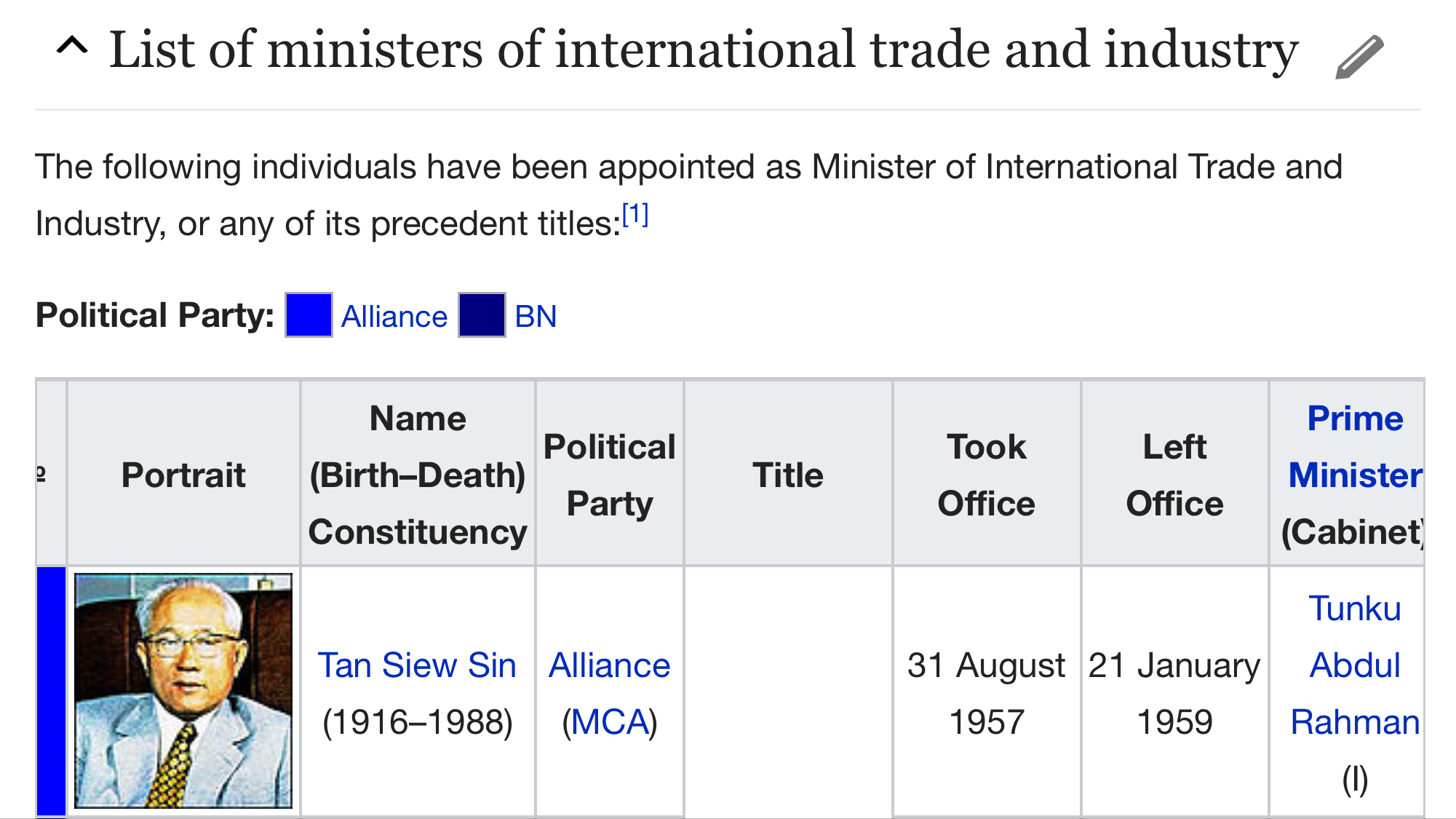
As BBMB was a GLC, any investment abroad would naturally come under the Ministry of International Trade and Industry (MITI).
In 1979, MITI was already under the stewardship of none other than U-Turn Mahathir, who was also the Deputy Prime Minister since Tun Razak’s passing in 1976.
Obviously Mr U-Turn would have had to okay any form of investment to be made by BBMB’s subsidiary.
In fact, according to his old new friend Anwar Ibrahim, when the whole deal turned sour about three to four years later, U-Turn Mahathir who was then the Prime Minister even okayed for more money to be thrown into the venture to contain the damage!
In the end, BBMB had had to be rescued using taxpayers money twice, amounting to USD600 million in today’s terms.
There was never a Royal Commission of Inquiry set to investigate the causes of the losses.
After being pressured, U-Turn Mahathir in the end reluctantly formed a three-man commission led by the late Tan Sri Ahmad Nordin (then Datuk Wira) to investigate the case.
This commission had no real powers and in 1986 concluded that what was going on in BMF was just “the tip of the iceberg” and implied that bigger hands were at play.
The commission’s report was never tabled in Parliament and had limited public release (2,000 copies only at RM250 each said the Malaysian Bar).
Tan Sri Ahmad Nordin was accused of working with the Opposition and was ostracised by the Mahathir administration.
That, my friends, was how innocent U-Turn Mahathir was.

















You must be logged in to post a comment.