Kit Siang Racist No.1 – Bahagian Akhir

Saya telah menulis betapa rasisnya Lim Kit Siang dalam Bahagian 1 dan Bahagian 2 sebelum ini.

Lim Kit Siang bukan sahaja seorang rasis, malah beliau juga menentang apa jua usaha kerajaan ketika itu untuk memerangi dakyah komunis.

Dua hari sebelum pilihanraya umum ke-3 (1969), Kit Siang telah mengadakan satu sidang akhbar di mana beliau menuduh bapa tiri kepada orang kanannya sekarang iaitu Christopher Ross Lim sebagai “Menteri Pelajaran penipu.”  Christopher Ross Lim kini menggunakan nama Zairil Khir Johari. Tiada “bin”.

Kit Siang telah menuduh kerajaan Perikatan ketika itu membuat Malaysia sertai Liga Anti-Komunis Sedunia, satu tuduhan yang telah dinafikan oleh Khir Johari.

Soalan: kenapa Kit Siang beriya-iya menghentam kerajaan sekiranya benar sekalipun Malaysia sertai Liga tersebut?

Jawapan: pihak pembangkang ketika itu, termasuk DAP, dipenuhi dengan mereka yang bersimpati dengan perjuangan Parti Komunis Malaya.
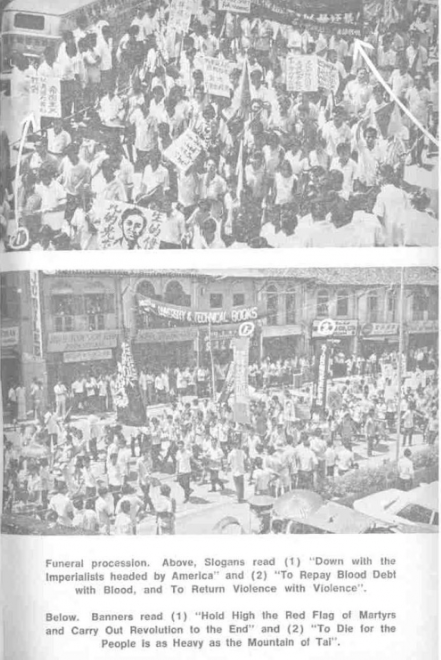
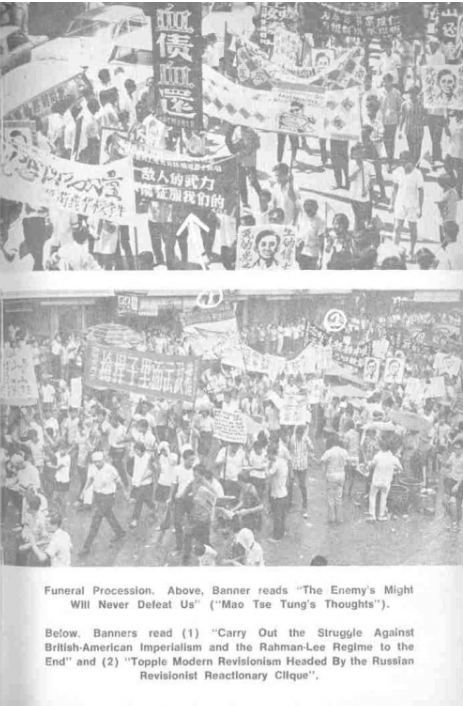
Slogan-slogan Komunis dipamerkan semasa perarakan anti-Kerajaan Melayu oleh Pembangkang
Slogan Komunis dibawa oleh para penyokong pembangkang

Sebulan sebelum itu iaitu pada 24 April 1969, seorang petugas UMNO, Encik Kassim bin Omar, yang sedang dalam perjalanan pulang setelah tamat tempoh berkempen pada hari tersebut telah dibunuh dan mayatnya dilumurkan cat merah oleh para penyokong pembangkang.  Inilah di antara sebab mengapa tempoh berkempen yang lama boleh menjadi berbahaya kepada keselamatan dan ketenteraman dalam negeri.

Sejak bulan Julai 1968, iaitu sebulan selepas bermulanya Darurat Kedua (pemberontakan bersenjata kedua oleh Parti Komunis Malaya) yang tamat 21 tahun kemudian, Kit Siang telah mengapi-apikan semangat perkauman di kalangan para penyokong pembangkang.

Di antara pengapian yang dinyatakan di atas adalah seperti berikut:

  1. Pada 27 Julai 1968, di sebuah rapat umum DAP di Tanjung Malim, Perak, Kit Siang telah dengan sengaja memutarbelitkan polisi Pendidikan Kerajaan dengan memberitahu hadirin bahawa polisi pendidikan Kerajaan direka untuk menghapuskan suratkhabar bahasa Cina, sekolah-sekolah Cina dan juga bahasa Cina.
  2. Pada 24 Ogos 1968, di sebuah rapat umum di Slim River, Perak, Kit Siang telah dengan sengaja memutarbelitkan polisi Kerajaan mengenai Bahasa Kebangsaan dengan tujuan menimbulkan syak dan kemarahan kaum-kaum lain terhadap orang Melayu.
  3. Pada 7 September 1968, di sebuah rapat umum DAP di KM38, Jalan Sungai Besi, dan pada 21 September 1968, di Kampung Baru Sungai Way, Kit Siang telah dengan sengaja menghasut kebencian terhadap kerajaan dan orang Melayu dengan membuat fitnah terhadap MCA dengan cara menuduh parti tersebut membantu kerajaan orang Melayu menghapuskan bahasa Cina dengan tidak mengiktiraf projek Universiti Nanyang.
  4. Pada 29 September 1968, di sebuah rapat umum DAP di Batu Pahat, Johor, 2 November 1968, di Lawan Kuda Bahru, Gopeng, Perak, dan pada 26 Januari 1969, di Jalan Yow, Pudu, Kuala Lumpur, Kit Siang telah mengapi-apikan kebencian dengan memberitahu para hadirin bahawa polisi kerajaan adalah polisi rasis kerana kerajaan telah memberi keutamaan kepada Bumiputera untuk memasuki IPTA sekaligus menjadikan kaum lain sebagai rakyat kelas kedua di negara ini.
  5. Pada 12 Februari 1969, di sebuah rapat umum DAP yang diadakan di Jalan Lengkongan Brunei, Kuala Lumpur, Kit Siang telah sekali lagi mengapi-apikan semangat perkauman dengan memberitahu para hadirin bahawa Kerajaan menunjukkan sikap diskriminasi dengan Melayu diberi keistimewaan untuk memasuki IPTA, mendapat pekerjaan dan pengagihan tanah.

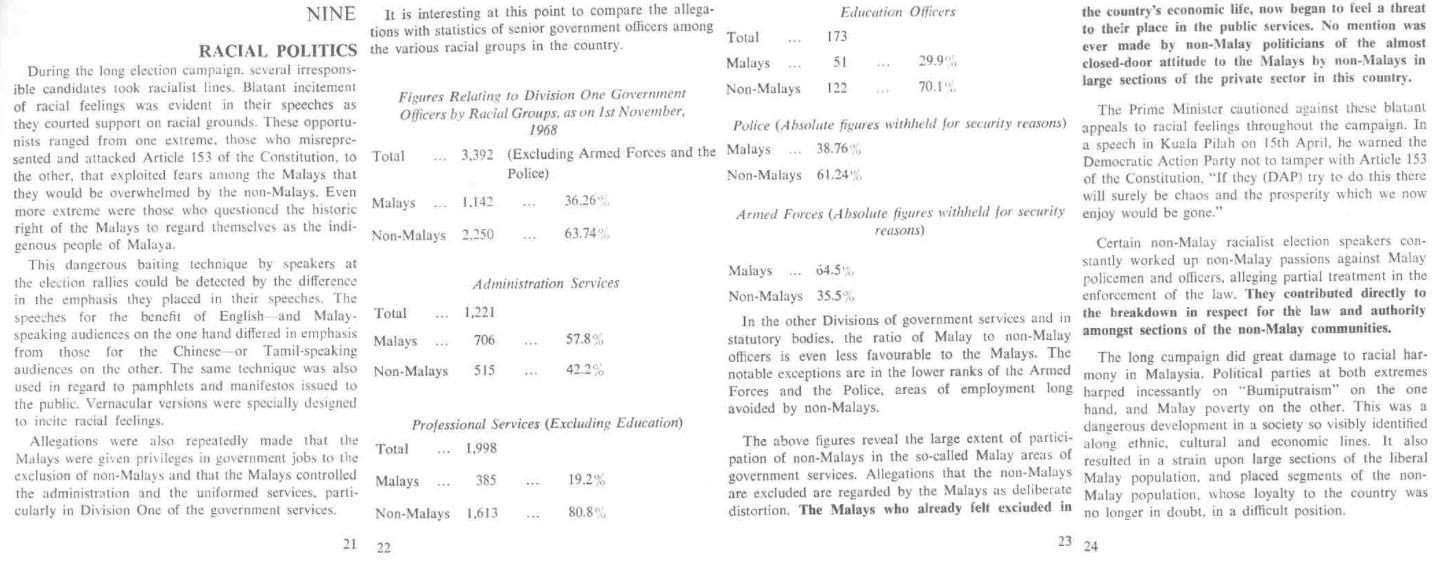
Apa yang Kit Siang tidak beritahu kepada umum adalah hakikat bahawa di dalam jabatan-jabatan kerajaan pun (kecuali Angkatan Tentera Malaysia), bukan Melayu mengatasi Melayu dalam peratusan penjawat awam seperti yang tertera di dalam gambar di bawah:
Nyata sekali sikap rasis dan penghasut yang dimiliki Kit Siang masih belum pudar hingga ke hari ini.  Pilihanraya umum telah diadakan pada hari Sabtu bersamaan 10 Mei 1969.  Parti Perikatan yang terdiri dari UMNO, MCA dan MIC telah memenangi 66 buah kerusi, kurang 23 dari pilihanraya umum ke-2, manakala pohak pembangkang telah memenangi 54 buah kerusi.

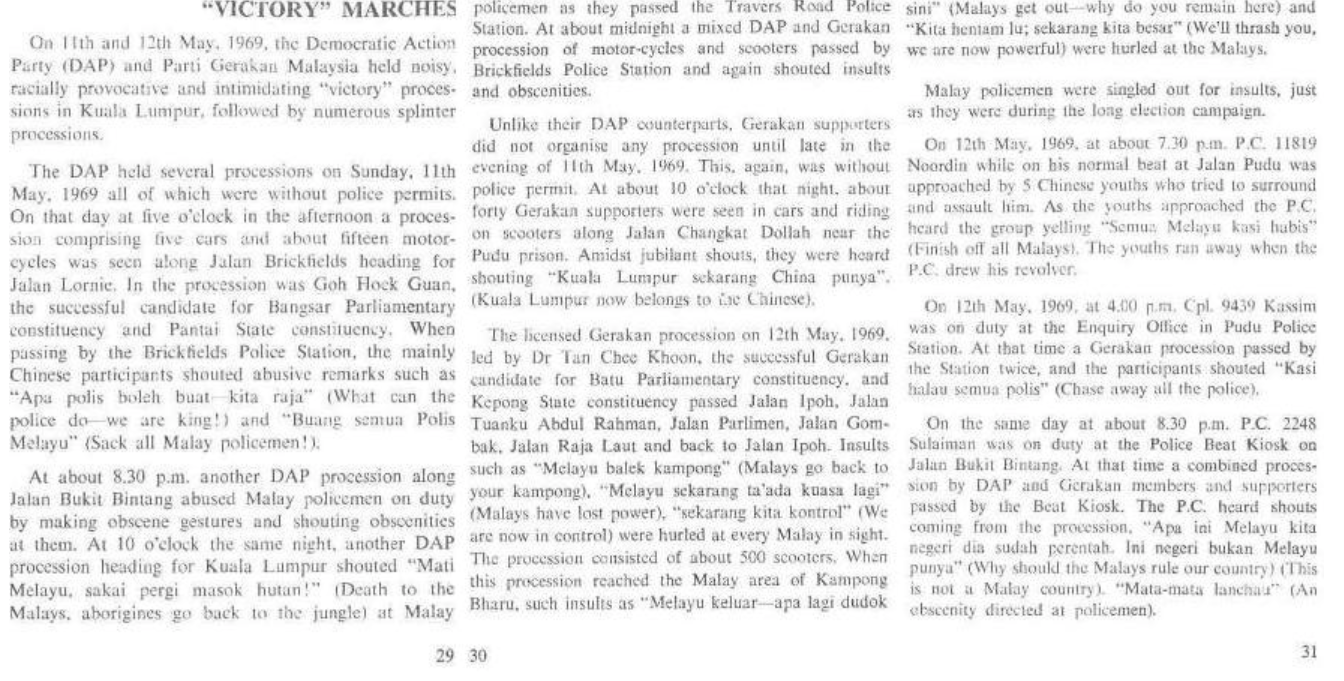
Pada pukul 5.30 petang, 11 Mei 1969, DAP telah membuat satu perarakan tanpa permit polis yang mengandungi ima buah kereta dan 15 buah motorsikal bermula di Brickfields menghala ke Jalan Lornie (kini Jalan Syed Putra).

Apabila perarakan ini melalui di hadapan Balai Polis Brickfields (kini telah dirobohkan), para peserta yang hampir kesemuanya Cina berteriak:

Apa polis boleh buat? Kita raja! Buang semua polis Melayu!

Pada pukul 10 malam hari yang sama, semasa melalui hadapan Balai Polis Jalan Travers, mereka berteriak:

Mati Melayu! Sakai pergi masuk hutan!

Kata-kata penghinaan ini sekali lagi dilemparkan terhadap anggota-anggota polis apabila mereka sekali lagi melalui di hadapan Balai Polis Brickfieds.

Pada masa yang sama di Changkat Thamby Dollah berhampiran dengan Penjara Pudu, lebih kurang 40 orang penyokong pembangkang telah berteriak:

“Kuala Lumpur Cina punya!

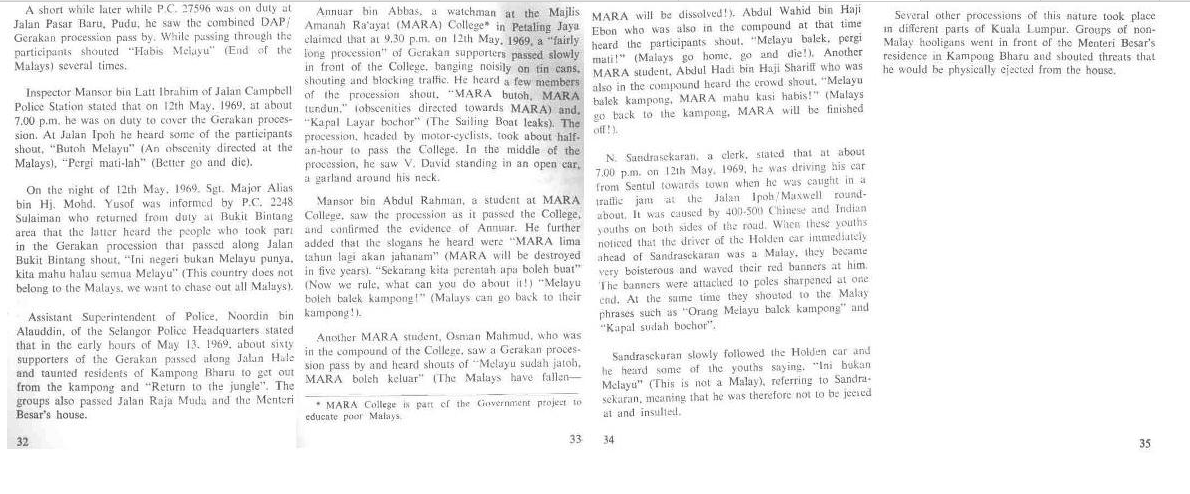
Keesokan harinya iaitu pada hari Isnin 12 Mei 1969, 500 buah skuter yang dinaiki penyokong pembangkang telah melalui Jalan Ipoh, Jalan Parlimen, Jalan Gombak, Jalan Raja Laut sebelu kembali ke Jalan Ipoh sambil berteriak kepada setiap orang Melayu yang mereka nampak:

Melayu sekarang tak ada kuasa lagi. Sekarang kita control!

Apabila konvoi ini tiba di perkarangan Kampung Bahru, mereka berteriak kepada orang Melayu:

Melayu keluar! Apa lagi duduk sini? Kita hentam lu! Sekarang kita besar!

Pada sebelah malamnya, para penyokong pembangkang terus keluarkan kata-kata kesat terhadap anggota polis Melayu seperti:

Mata-Mata Lancau!

Butoh Melayu! Pergi matilah!

Bukan saya sengaja ada-adakan benda yang saya tulis di atas.  Anda boleh baca sendiri dalam gambar laporan 13 Mei 1969 yang dibuat oeh Majlis Gerakan Negara (MAGERAN) ketika itu:
Di mana Lim Kit Siang semasa berlakunya pencacian dan maki hamun terhadap orang Melayu di Kuala Lumpur?

Lim Kit Siang pada pagi hari Selasa bersamaan 13 Mei 1969 telah bersedia melarikan diri ke Kota Kinabalu supaya beliau tidak berada di situ sekiranya berlakunya pergaduhan antara kaum.

Beliau tiba di Kota Kinabalu dan terus mengadakan rapat umum DAP di Kampung Air. Di situ beliau telah menghasut dan mengapi-apikan bukan sahaja kebencian terhadap orang Melayu malah kali ini cuba timbulkan kemarahan terhadap penganut agama Islam.

Beliau memberitahu para hadirin ketika itu bahawa Kerajaan cuba menubuhkan Malaysia yang Melayu (Malay Malaysia) dengan membahagikan rakyat kepada Bumiputera dan Bukan Bumiputera.  Beliau juga membuat fitnah kononnya Kerajaan akan menjadikan pentadbiran negeri Sabah sebuah pentadbiran Melayu.  Beliau juga menghasut kebencian terhadap Islam dengan menabur fitnah bahawa Kerajaan akan menghantar rakyat Malaysia (termasuk penduduk Sabah beragama Kristian) untuk berperang dan mati di Timur Tengah untuk membantu rakan-rakan ahli-ahli OIC menawan semula Baitulmaqdis dari genggaman Israel.
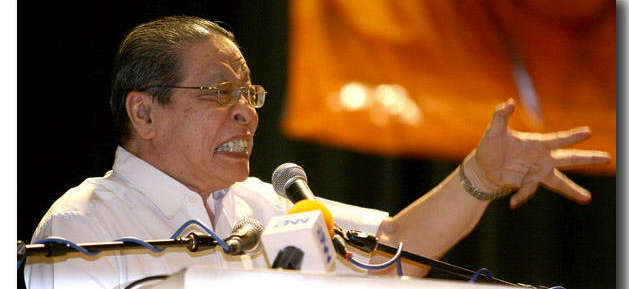
Demikianlah betapa rasis dan hinanya Lim Kit Siang dan parti DAP yang dipimpinnya.  Hampir 48 tahun selepas peristiwa 13 Mei 1969, Kit Siang masih lagi menyerang kerajaan yang dikatakan kerajaan Melayu.  Ketika itu, Melayu bersatu memertahankan haknya yang telah sedia ada sebelum datangnya datuk dan nenek Lim Kit Siang – hak yang telah termaktub dalam Perlembagaan Persekutuan yang dipersetujui semua kaum.

Malangnya sekarang ada yang mengaku Melayu tetapi mudah lupa.  Kini pengkhianat ini serta para pengikutnya pula yang menjilat Kit Siang serta mereka yang seangkatan dengannnya.
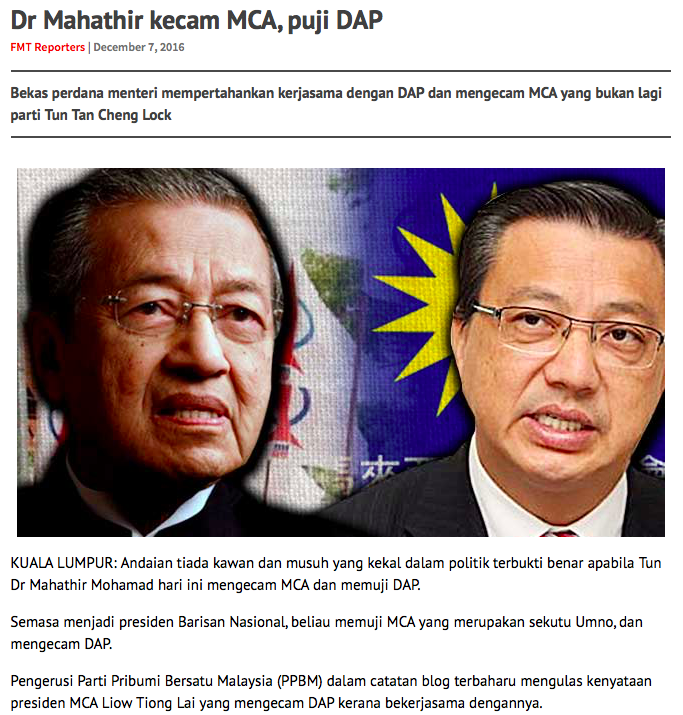
Lagi Pembohongan

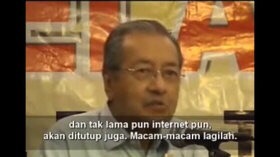
Kalau ikut Mahathir, macam-macam dah kena tutup kini. Namun, seperti yang didakwa Alexandria Luger, Mahathir akan masuk neraka kerana kerap berbohong.

Hari ini Mahathir berbohong lagi. Dia kata Forest City memberi hakmilik tanah kekal kepada para pembeli.

Rasanya dah berbuih dah penerangan diberikan mengenai perkara ini. Bhaiya Bangladesh kontrak mungkin telah faham sefahamnya akan penerangan tersebut. Tetapi sebab penerangan ini bukan diberikan dalam bahasa ibunda beliau maka agak sukar bagi beliau memahami.

Ahli Parlimen Sekijang terpaksa terangkan sekali lagi bahawa yang hakmilik kekal adalah hartanah strata. Dua bulan lepas pun DYMM Sultan Johor dah terangkan perkara yang sama.

Nak diterangkan dalam bahasa apa lagi?

Kemudian, Najib Razak pula yang dipersalahkan. Bukankah Forest City perihal tanah negeri Johor? Apa kena-mengena dengan kerajaan pusat? Masing-masing negeri ada unit perancang ekonominya sendiri.

Kenapa tak salahkan Tuanku Sultan Johor? Tak berani macam rakan sekapal beliau?

Memang Forest City bakal mendapat status bebas cukai. Apa masalahnya? Langkawi juga masih pulau bebas cukai.

Kalau Mahathir gunakan Internet sewajarnya dan bukan untuk menyebarkan fitnah semata-mata maka beliau pasti mengetahui bahawa kenyataan beliau bahawa status bebas cukai Langkawi akan ditarik balik hanyalah pembohongan yang nyata.

Apa yang diumum kerajaan adalah hanya kedai-kedai berlesen sahaja yang akan dibenarkan menjual barangan rokok dan arak bebas cukai di Langkawi.

Begitu juga langkah untuk meminta pemilik kenderaan yang berdaftar di Langkawi mengemukakan jaminan bank sebelum boleh dibenarkan membawa kenderaan mereka keluar dari pulau tersebut. Ini adalah untuk mengatasi kepincangan yang berlaku sejak sekian lama.

Siapakah yang telah menjual sebegitu banyak tanah orang tempatan Langkawi kepada para kroni suatu ketika dahulu? Siapa yang mengambil tanah 80 penduduk Melayu Pantai Gelang, Langkawi untuk dijadikan resort

Mengenai pinjaman oleh warga China pula, itu semua cerita basi yang diulang berkali-kali. Saya maafkan beliau. Bercerita sesuatu berulang kali ini ada hubungkaitnya dengan penyakit nyanyuk. Mungkin suatu hari nanti beliau akan memandang kepada anak beliau dan bertanya, “Hang apanama?” berkali-kali juga.

Sebenarnya saya kasihankan beliau. Pernah disanjung ramai suatu masa dahulu tetapi pernah ditolak sebagai perwakilan oleh Bahagian sendiri semasa masih dalam parti angkat beliau, UMNO. Namun beliau masih tidak sedarkan diri.

Kini beliau hanya mampu merangkak sambil menjilat kahak hijau yang diludahnya dahulu sambil ditunggangi oleh joki-joki yang mengharapkan kemenangan seekor kaldai tua.

Sudah-sudahlah berbohong. Kita tak boleh hidup selama-lamanya. Janganlah diikuti perangai Rafizi. Beliau rasa beliau masih muda.

Jangan sampai anda digelar SOTUN pula.

Yang Tinggal Hanyalah Kekosongan Di Antara Sepasang Telinga

Beruk cimpanzi mempunyai nilai IQ bersamaan 40.  Manusia yang normal mempunyai IQ di antara 90 hingga 109.  Sekiranya anda mempunyai IQ yang kurang dari 80, maka IQ anda hanya sedikit lebih baik dari IQ seekor cimpanzi. Oleh sebab itu cimpanzi mudah diajar menggunakan “flash cards” ataupun “kotak.”  Mari kita tonton video ini:

http://www.youtube.com/watch?v=r5nTVF3uits

Seronok, kan?

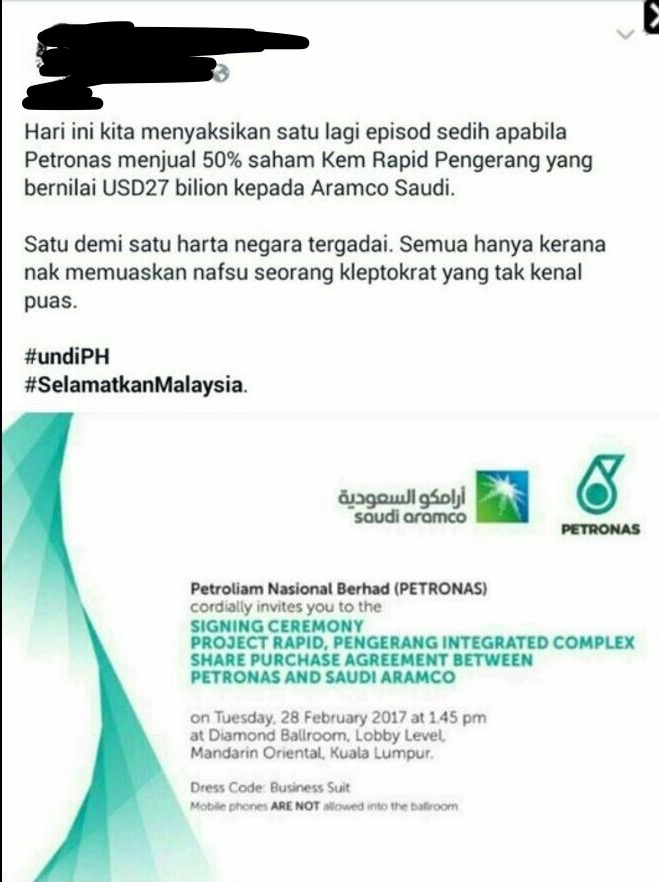
Baiklah.  Pada hari ini saya ingin menceritakan bagaimana Malaysia dikatakan telah menjual PETRONAS ataupun Projek RAPID di Pengerang kepada Arab Saudi sepertimana yang dinyatakan oleh beberapa tokoh Pakatan termasuk dengan para penyokong mereka.

Contoh pertama:

Cuba teka. Berapakah nilai IQ makhluk ini?

Adakah Malaysia telah menjual sebanyak 50 peratus saham Projek RAPID seperti yang didakwa oleh makhluk di atas?

Kita katakan kotak di bawah mewakili keseluruhan Projek RAPID:

square

Projek RAPID ini membabitkan pembinaan kilang penapis minyak mentah, pemisah nafta yang akan menghasilkan kira-kira tiga juta tan etilena, propilena, C4 dan C5 olefin (melalui proses yang dikenali sebagai “cracking”) setahun dan sebuah kompleks polimer dan petrokimia yang boleh mengeluarkan pelbagai bahan kimia berkaitan.

Projek ini juga mengandungi projek pembinaan terminal laut dalam, terminal regasifikasi (penukaran cecair kepada gas), terminal LNG, projek unit pengasing udara, projek pembekalan air mentah dan lain-lain.

Supaya cimpanzi-cimpanzi faham dengan lebih mudah, kita bahagikan kotak di atas kepada empat seperti di bawah:

boxes

Sekarang kotak di atas dibahagikan kepada A, B, C dan D yang mewakili kesemua projek-projek yang saya sebutkan di atas, yang dijalankan atau bakal dijalankan di Projek RAPID.

Untuk memudahkan cimpanzi-cimpanzi memahami perwakilan petak-petak kecil di atas, kita katakan bahawa projek penapisan minyak mentah dan “cracking” adalah diwakili oleh Petak ‘C’.  Secara kebetulan, huruf ‘C’ juga ialah huruf awalan untuk Cimpanzi.

Saudi Aramco telah membeli sebanyak 50 peratus dari saham Petak ‘C’ dengan nilai RM31 billion.  Maka, Petak ‘C’ kini menunjukkan pegangan saham sebanyak 50 peratus milik Saudi Aramco dan 50 peratus lagi milik PETRONAS.

boxes

Soalan saya sekarang ialah, bagaimana makhluk di atas, yang mewakili makhluk-makhluk yang sewaktu dengannya, boleh mencanangkan penipuan bodoh bahawa Projek RAPID kini 50 peratus milik Saudi?

Kebodohan ini juga terbit semasa makhluk-makhluk tersebut mencanangkan bahawa satu aset strategik tentera telah dijual kepada China. Bila terbukti bahawa dakwaan mereka itu satu penipuan yang nyata, mereka marah, tetapi tidak boleh memberi hujah berfakta untuk menidakkan kebodohan mereka itu.

Yang canang bodoh, yang sokong pencanang pun sama bodoh.

Saya kira anda faham dengan penjelasan mudah yang telah diberikan di atas.  Saya yakin anda mempunyai nilai IQ sebanyak 90 ataupun lebih.

Cimpanzi pun mungkin akan faham sebab saya menggunakan contoh kotak, iaitu satu cara paling berkesan untuk mengajar cimpanzi.

Sekiranya tidak, samalah anda dengan makhluk di atas, dan di bawah.

Apa yang tinggal brader?

Tan Bang Ang Dan MB Johor

ADUN Mengkibol, Tan Hong Pin semalam dengan bangganya mendakwa bahawa Menteri Besar Johor, Khaled Nordin, tinggal bersama-sama 13 orang pengundi lain di sebuah rumah kedai di Masai, Johor.

Menurut Malaysiakini, daftar pemilih bagi suku ketiga 2016 yang merekodkan pertukaran alamat pemilih oleh Khaled dan anaknya Akmal Saufi ke lokasi di atas.

Daftar pemilih bagi suku berikutnya mencatatkan 12 lagi individu turut disenaraikan kepada alamat yang sama.

Jika daftar pemilih itu diwartakan, maka akan ada 14 orang, termasuk MB dan anaknya, didaftarkan sebagai pengundi di alamat itu,” kata ADUN DAP itu.

Ia adalah antara ratusan butiran pengundi yang didakwa mencurigakan yang dikemukakan oleh Tan kepada Suruhanjaya Pilihan Raya Johor, hari ini.

Menurut Tan, alamat yang dipersoalkan ialah ibu pejabat Umno bahagian Pasir Gudang di alamat 1, Jalan Tembusu, Taman Rinting.

Lantas saya membuat pemeriksaan ringkas kerana mungkin Tan dilahirkan tidak cukup sifat dan tiada daya pemikiran untuk membuat pemeriksaan ringkas dan mudah menggunakan Internet.

Saya mendapati bahawa alamat yang konon-kononnya mencurigakan Tan itu adalah lokasi Pejabat UMNO Bahagian Pasir Gudang.

Inilah rumah kedai mencurigakan Tan Bang Ang
Saya akan lebih teruja sekiranya terdapat para pengundi yang berdaftar di dua lokasi pengundian berbeza yang boleh dicapai dalam masa kurang lapan jam.  Ini bermakna sekiranya beliau boleh mengikis kulit jari untuk menghilangkan dakwat kekal selepas mengundi di lokasi pertama, beliau boleh pergi ke lokasi kedua mungkin di sebuah negeri berjiranan untuk mengundi kali kedua.

Saya lebih tertarik dengan suatu perkara yang pernah diajukan kepada Ambiga dan rakan-rakan sebelum Pilihanraya Umum Ke-13 pada tahun 2013 di mana dua orang pemimpin pembangkang berdaftar sebagai pengundi MENGGUNAKAN ALAMAT RUMAH SEORANG AHLI UMNO!

20130424-232533

Seperti yang tertera dalam Tweet di atas bertarikh 16hb April 2013 (sebelum Pilihanraya Umum Ke-13), Dato Zaiful Ayu Ibrahim, anak kepada Tan Sri Dr Ibrahim bin Saad, meminta tolong Ambiga, BERSIH 2 dan Nurul Izzah menyiasat bagaimana dua orang pengundi hantu bernama Wan Azizah binti Wan Ismail dan Anwar bin Ibrahim boleh berdaftar di rumah keluarganya di Permatang Pauh sedangkan keluarganya secara keseluruhan merupakan penyokong tegar UMNO di kawasan Parlimen tersebut.

Apabila saya memeriksa senarai pengundi berdaftar terkini bertarikh 27hb September 2016, saya dapati kedua-dua pengundi hantu tersebut masih berdaftar sebagai pengundi di alamat tersebut!

Pengundi-pengundi hantu masih wujud di Permatang Pauh
Tidak menghairankanlah jika Tan tidak teliti dalam perkara seperti ini. Beliau pernah dirujuk ke Jawatankuasa Hak dan Kebebasan Dewan Undangan Negeri (DUN) Johor atas alasan membawa masuk orang luar tanpa kebenaran ke dalam dewan persidangan.

Apabila mendapat sedikit kuasa menjadi ADUN, Tan berlagak seolah-olah Dewan Undangan Negeri Johor itu DAP yang punya.  Teringat saya kepada suatu perumpamaan lama dalam tentera, “Seperti Red Indian mendapat senapang.”  Habis kesemuanya di tembak termasuk langit.

Sekiranya Tan kurang kebangangannya, beliau akan membantu SPR mencari senarai orang yang tidak layak mengundi dan orang yang telah mati yang masih tersenarai sebagai pengundi.  Setakat berdaftar di rumah kedai tidaklah seteruk orang kuat PKR dan Ketua Anus Usus Umum Pakatan berdaftar di rumah orang kuat UMNO sekurang-kurangnya untuk dua pilihanraya umum dan dua pilihanraya kecil di tempat yang sama.

Malangnya, semasa waktu bantahan untuk Rang Daftar Pemilih suku tahunan diberikan, dia tidak membantah. Kini baru beliau hendak timblkan syak wasangka.

 Menurut Seksyen 9A Akta Pilihan Raya 1958, mana-mana daftar pemilih yang telah diwartakan tidak boleh dicabar di mana-mana mahkamah.


Saya yakin, contohnya di Selangor di mana Shah Alam merupakan kawasan majoriti Melayu, kini mempunyai ramai pengundi berbangsa Cina dipindahkan di situ.  Saya tidak menuduh sesiapa tetapi perhatikanlah kemungkinan berlakunya pertambahan pengundi berdaftar berbangsa Cina di kawasan Setia Alam yang kini di bawah Parlimen Shah Alam, dan lihat akan penurunan jumlah pengundi berdaftar di kawasan-kawasan di mana DAP menang dengan majoriti yang besar – sebagai contoh, Parlimen Seputeh di mana majoritinya melebihi 50,000.  Kemungkinan ada perpindahan kawasan mengundi bagi sebilangan mereka.

Kemungkinan juga ada 23 orang pengundi di setiap rumah kedai di situ.

Boleh Tan Bang Ang periksa?

Tan Bang Ang
Tan Bang Ang

The Black Plague 

For those who claim that they are Malaysian yet cannot speak the language, let me translate to you what His Royal Highness The Sultan of Johor said above:

“Ladies and gentlemen, let me remind you of a sickness that has come to Johor, that is caused by a deadly virus.

This virus is worse than the Zika virus because it has no known cure. If a heart attack could cause immediate death, this virus could cause a lifetime of suffering.

This virus that I am talking about is called disunity.

This virus is carried by a new political party and is spread by its members. This virus is deadly because there it is difficult to cure. When society is infected, it destroys the people’s lives and also the nation’s prosperity.

Therefore I hope that my rakyat will stay away from this virus. Use your wisdom and don’t regret later.

The carrier of this virus will bash the government and incite the people to hate the leaders on a daily basis, and then turn a blind eye on the benefits that the government has brought them. When their agenda is not achieved they will just leave society to suffer.

I speak as an elder or as a father who loves unity and wish to see my rakyat live in peace and tranquility. I do not want to see my rakyat in disunity and I loathe certain individuals. They have personal agenda and incite the people to quarrel among themselves.

When there is discord the rakyat will live in misery and when that happens don’t turn to me (for help).”

There is one party that was recently formed that has come to Johor and fit that description. The illness that is bring could only be called the ‘Black Plague‘. It seems to be the term closest to the description of the carriers mentioned by HRH The Sultan of Johor.

Which party do you think is being referred to? Would you care to hazard a guess?

Investigating The Hospital Sultanah Aminah Tragedy – Part 2

There is a huge possibility that the culprit of the tragedy is electrical fire.  In a previous article I discovered that out of the five fire incidents prior to the tragedy, three were electrical fires, the last incident bekng on the 15th October 2016. What I discovered next is alarming:

A Harian Metro headline of a scoop that was first exposed by TV9’s daring and no-nonsense senior broadcast journalist Zulhazri Abu Bakar

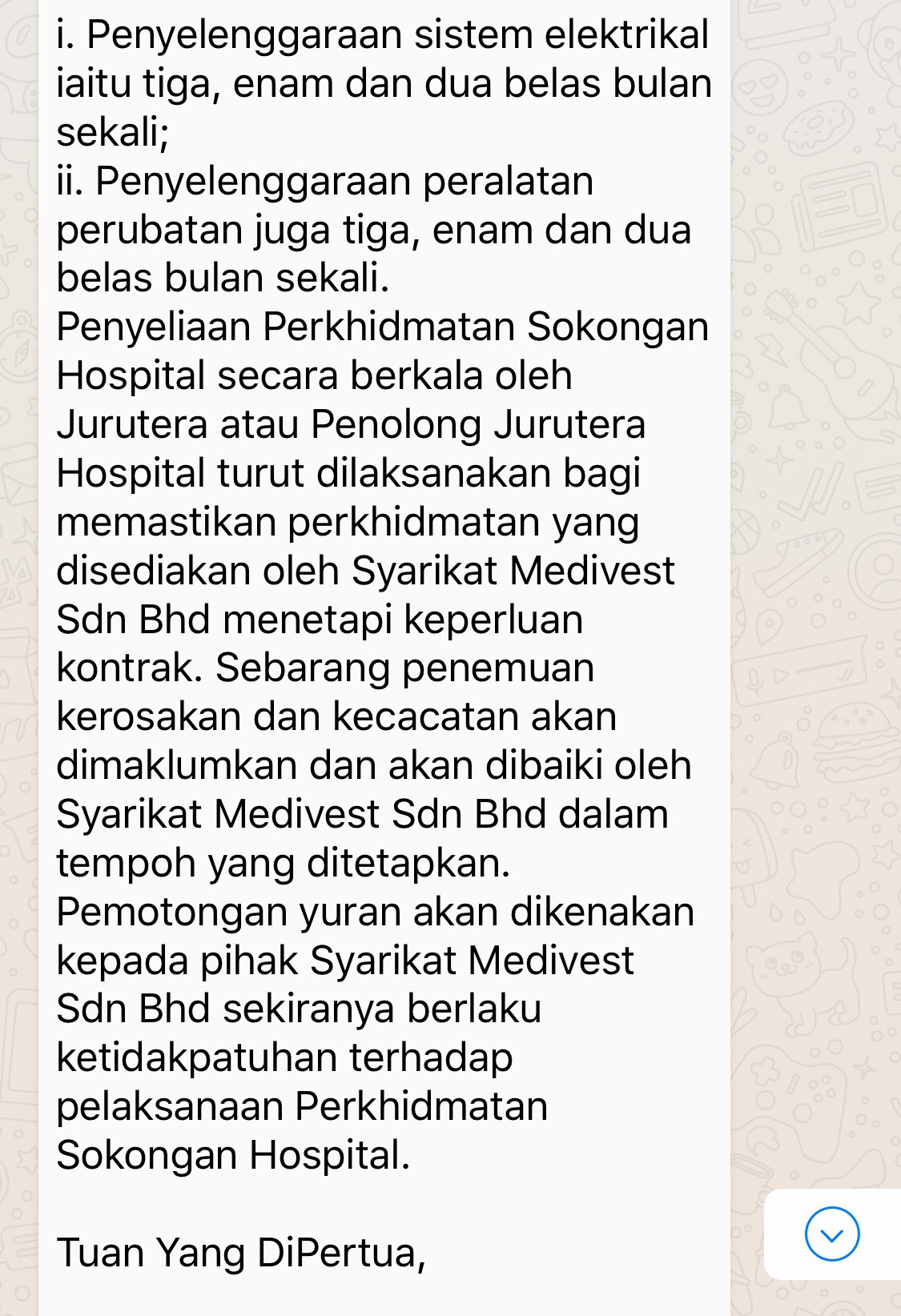
We wonder if fire prevention and electrical safety audits took place at the Hospital Sultanah Aminah (HSA) at all. The Minister of Health, in a briefing to the members of the Dewan Rakyat assured us that it has been done.


Impressive! Electrical maintenance is being done every quarter, half yearly and annually.

But look at how messy the wiring is, and this photo was taken after the second electrical fire incident that occurred in the Operating Theatre on the First Level. Let us take a closer look:


The above does not resemble The quality of electrical work done by a person certified by the Energy Commission to carry out such works. And by the look of it, this has definitely gone through several annual electrical inspection and maintenance schedules but obviously no corrective action has been taken. My question is, were the scheduled audits and maintenance mere paper exercises? Or in the words of safety practitioners – tick the boxes exercise?

According to the JBPM statistics collected between 1990 and 2002, electrical fire is the largest contributor of fire incidents. Regulation 67 of the Electricity Supply (Regulation) Act, 1990 requires a minimum of one inspection per month by a competent person of electrical installations not exceeding 600 Volts!

For larger voltage installations it is obvious that the frequency has to be increased! All these regulations are in place to provide the guidelines for building owners to perform routine inspections and maintenance to minimise incidents of electrical fires!

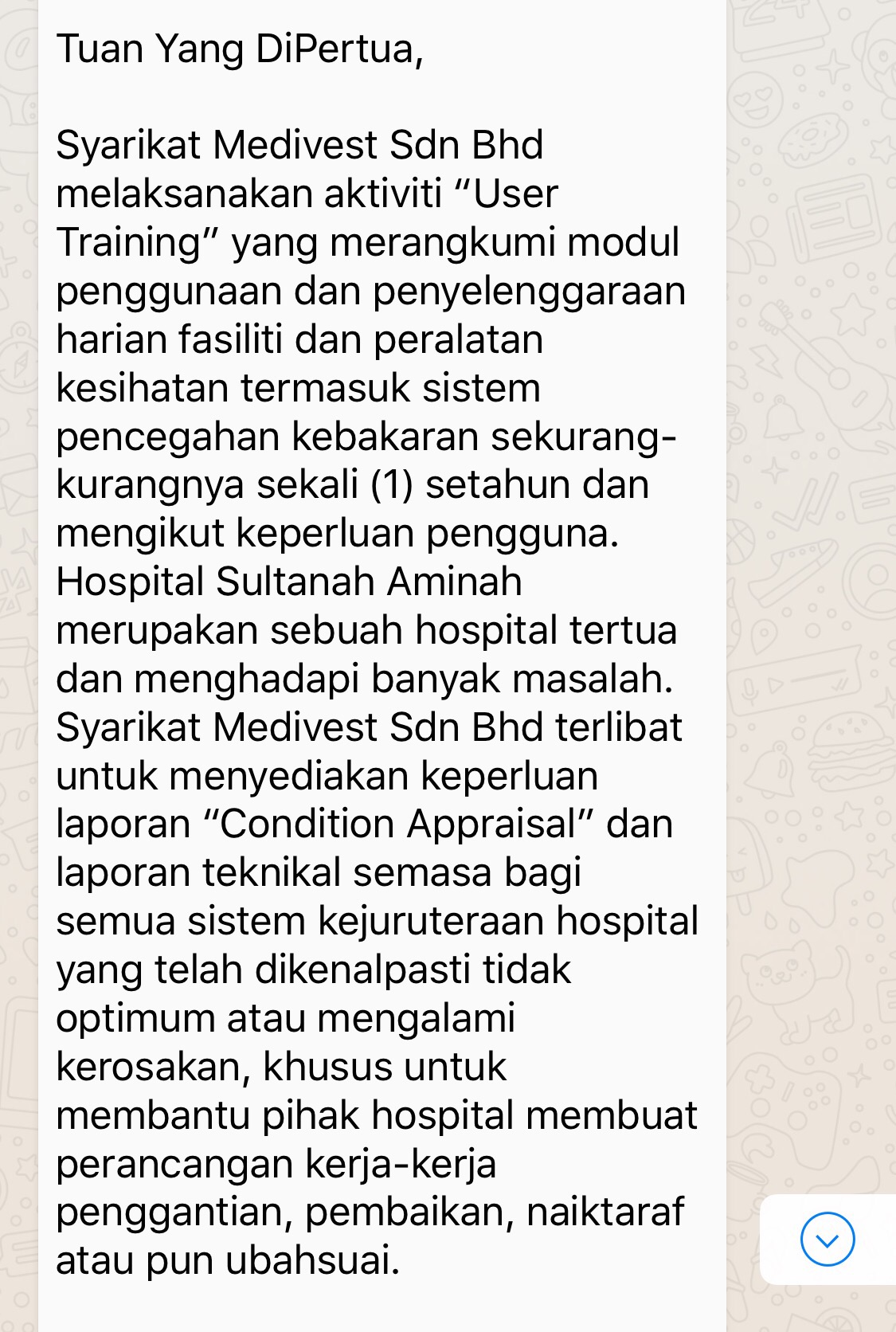
Obviously the concessionaire tasked with ensuring that everything is in good order, Medivest Sdn Bhd (formerly known as both Tongkah Medivest and then Pantai Medivest) had not done its job as required! The Energy Commission’s Regional Director Idris Jamaludin was spotted heading a nine-men team of electrical and gas experts into the HSA and we anxiously await their findings.

The Minister continues:

The HSA had requested last month for a fire drill to be conducted. This request I was told, was turned down by the Fire and Rescue Services Department (JBPM) because the HSA was not equipped with a fire-fighting systems control panel and nor were there the respective floor plans included in its fire safety plan! 

How could fire drills be conducted if the fire safety plan is not complete? Which begs a question from me – when was the last Fire Certificate issued to the HSA?

Word has it that between 2014 and 2016, no fire and evacuation drill nor fire-fighting training was ever conducted. The last drill and training that was recorded was in 2009! Therefore it is safe to say that the last Fire Certificate was obtained then! How is it possible that Medivest Sdn Bhd, a company that was given the 30-year concession to maintain the operational safety of our hospitals be allowed to do things against whatever safety laws and regulations that are there to protect lives and government properties? Are they not suppose to conduct at least one training per annum as briefed to the Dewan by the Minister?

This is by no means a witch hunt. This is borne out of frustration and the utter disbelief that such complacency and incompetence are allowed to flourishby especially the state health department and the top management of Medivest Sdn Bhd.

Lives have been lost! Dozens more affected by their loss and injury! Millions of Ringgits worth of government properties have been lost because some people do not do their job as expected!

Heads therefore must roll!

The Johor Conundrum

Has Khaled Nordin lost control over Johor?

Blogger Life of Annie wrote on the 24th May 2013:

Five years from now, Johor will not even be an Umno stronghold if those in control of the party are “beraja di mata, bersultan dihati” even among their fellow Umno people.

Do mark my word on this.

It took merely almost three and a half years before that actually happened following the departure of Jorak assemblyman Datuk Dr Shahruddin Md Salleh from UMNO to join Mahathir’s Pribumi.  For the first time in 61 years, the Barisan Nasional/Alliance holds its two-thirds majority in its Peninsular safe deposit, Johor, by a single thread.

Losing two-thirds majority in UMNO’s bastion used to be unthinkable right until the 13th General Elections when the Chinese Tsunami swept many state and parliamentary seats.  It lost 12 seats in the last general elections compared to GE12 in 1998, and this time around the biggest gainer was the DAP with nine extra seats.  Barisan Nasional ended up initially with 38 out of the 56 seats. With the departure of Jorak, it now holds the two-third majority with the bare minimum number of seats.

Despite the progress and development that are taking place in Johor, Ghani was trounced not because he did not do his job, but because of blatant racial sentiment. As with the previous three general elections, Ghani would not be seen sitting comfortably in his office at least two years prior to the elections. He would be on the ground making sure that the machinery is ready to face the next battle, and there would be elections simulations held at various levels of the state’s BN. Ghani would also make sure that his relationship with the Johor Civil Service (JCS) remain at the highest level.

Life of Annie also pointed out that when Ghani pointed out to Khaled that his Pasir Gudang division was in danger of falling into the Opposition’s hands, Khaled did not take that rather well and rubbished the findings.  The simulation was almost correct – Barisan Nasional held on to Pasir Gudang with less than 1,000 votes ahead.

With Ghani ousted, Khaled wanted to make his own mark as the Menteri Besar.  The job as the Menteri Besar of Johor is not exactly an easy one.  With a Sultan who can be somewhat overbearing and often puts his hands into the affairs of the state administration, the Menteri Besar would have to know how to manage both the Sultan and the state administration without upsetting either one. Ghani was an old hand at this and knew exactly how to handle the Sultan, having had to also manage the unconventional behaviour of the Almarhum Sultan Iskandar previously.  He had a good relationship with both Sultans, knowing when exactly to pull the strings and when to let it slack.  Khaled is said to let the Sultan have things his way so much so that even the promotion of JCS officers is left for the Sultan to decide.  While Ghani was often seen patting the back of JCS officers for the good job that they do, Khaled lets the Sultan do the Menteri Besar’s job for him.  While the Sultan might like it, this doesn’t augur well for the state Barisan Nasional.  Any administration would want to have some form of control over its civil service and a good rapport to go with.

The number of gatekeepers one needs to go through to get to Khaled is another common complaint by the common people. Journalists covering Khaled also complain that at almost every event, Khaled is being surrounded by his posse of young lieutenants, even to the extent of having the nearest table to the VIP table occupied solely by this group of people.  This makes Khaled look like the overgrown hipster. It only makes the Menteri Besar less approachable even to the Ketua Bahagians. It is said that he was advised by UMNO veterans to go down and meet the grassroot leaders. His response was, “Aku tak kenal orang Johor (I don’t know the Johor leaders).”

It is already less than two years to the next general elections.  Unlike Ghani before him, Khaled is still mostly seen in Johor Bahru.  Ghani and his executive councillors would have been scouring the state to see what else that have been missed.  Speaking to a Puteri UMNO division head recently she expressed her worry that none of the division heads have actually begun to activate their election machineries in a concerted manner.  This particular Puteri UMNO head has had to conduct her own voters and membership registration drive; an effort which is puny compared to the ones that have and are being done by the DAP in Johor alone. If you were to ask the UMNO division chiefs in Johor, they would tell you that all is rosy, and that is until you speak to them on a one-on-one basis. However,  Khaled has told reporters that the Johor Barisan Nasional still holds a comfortable majority despite it being razor thin after the departure of Jorak.  To the UMNO grassroots, Khaled’s confidence is extremely worrying.

It is no secret that the DAP will be working with Pribumi to wrestle control of Johor from the Barisan Nasional come GE14.  It is hardly an impossible task too!  Muhyiddin might be a figure to be reckoned with both in Pagoh and Muar, but outside those two areas, he is still remembered as the person who sold Johor Malays’ rights to the Chinese.  Mahathir knows this very well as he was the one who rescued Muhyiddin when the latter became a persona non grata in Johor in the early 1990s.  Mahathir knows that Muhyiddin carries a lot of baggage with him and would not be the correct person to lead the country if the Opposition wins. There is already an attempt to kill Muhyiddin politically.  You hardly hear of any statement being made by Muhyiddin while Mukhriz is seen going around in Johor conducting membership registration drives.  No clues needed for the question on who is Mahathir’s choice for PM.

DAP on the other hand, wants to conquer the western Johor belt, where there is a significant number of Chinese population as compared to the eastern belt. During a dinner at the Landmark Hotel with Batu Pahat DAP members, DAP’s MP for Kluang Liew Chin Tong and ADUN for Senai Wong Shu Qi related the plan to wrestle Parit Sulong, Pulai and Pasir Gudang. With Batu Pahat already in PKR’s hands, all that is needed is for Muar to fall, and it is most likely that Muhyiddin would contest there, if not the often-clueless Syed Saddiq, a Muarian himself.

Even Azmin Ali does not want to be left out by the Mahathir and Pribumi bandwagon.  He was seen recently in Muar together with Mahathir at a Pribumi event. It is no secret that he is heading the drive for PKR to work together with Mahathir – a sentiment not shared by the pro-Wan Azizah camp that includes Wan Azizah loyalists Rafizi Ramli and Wong Chen.  There is even talk that Azmin might work towards dissolving PKR and jump en masse into Pribumi. While that is not totally impossible, the departure of Ezam from UMNO to Pribumi has certainly strengthen that theory.

The Johor conundrum is something that the Barisan Nasional (read UMNO) cannot take lightly if it were to gain more seats in the next general elections.  If Khaled is not moving, then someone should take the lead and face the Opposition head on.  There are two FELDA regions that need to be handled with care.  Khaled should realise that there is more to Johor than just Johor Bahru.  He has to go down on the ground and get the feel himself instead of relying on reports from the UMNO divisions and the various sugar-coated reports from agencies.  If you do not know the terrain and its people, you will lose the war. Don’t be like Hamid Karzai who was dubbed the ‘Mayor of Kabul‘ despite being the President of Afghanistan!

And in the words of Life of Annie opus citatum:

If this is how Khaled’s people want to behave, then I dare say that he will be just a one term MB and Johor will fall five years from now.


Kelantan: The 15th Yang DiPertuan Agong

Daulat Tuanku - Sultan Muhammad V has been elected as the 15th Yang DiPertuan Agong
Daulat Tuanku – Sultan Muhammad V has been elected as the 15th Yang DiPertuan Agong

Sultan Muhammad V, the 29th Sultan of Kelantan, has been elected to become the 15th Yang DiPertuan Agong by the Council of Rulers today.  His Royal Highness shall be replacing Tuanku Al-Haj Abdul Halim Mu’adzam Shah ibni Almarhum Sultan Badlishah, the Sultan of Kedah whose tenure will end on the 12th December 2016.

For months whispers have been flying around that HRH Sultan Muhammad V would not be eligible be elected as the YDP Agong as he is not married.  However, there are only three reasons for a nominated Sultan to be disqualified;

  1. He is not an adult,
  2. He has made known to the Council of Rulers that he wishes not to be nominated, or,
  3. Five of the Rulers vote against his nomination for reasons such as being mentally or physically challenged, or for some other reason.

The second and third reasons were used during the discussion to elect the First Yang DiPertuan Agong where Sultan Abu Bakar of Pahang was the most senior Ruler after Sultan Sir Ibrahim of Johor who had declined the nomination due to old age (Sultan Sir Ibrahim passed away on the 8th May 1959). He became the Sultan of Pahang on the 24th June 1932. However, Sultan Abu Bakar’s nomination was rejected FIVE TIMES by the Rulers because he was a controversial figure – he had financial difficulties and had wanted to marry a perempuan ronggeng (Abdullah Ahmad, 2016 p.141).  Tunku Abdul Rahman, who was then the Chief Minister of Malaya advised Sultan Abu Bakar against marrying this woman named Hathifah binte Abdul Rashid if he wanted to become the Yang DiPertuan Agong. Sultan Abu Bakar agreed.

However, Sultan Abu Bakar married Hathifah anyway and Tunku only discovered so when they were honeymooning in Hong Kong (Straits Times, 21st April 1957).

Being single is not a prerequisite for a Sultan or Raja to be elected to the throne of the Yang DiPertuan Agong.

Early this morning, the infamous portal Malaysiakini and the Malaysiakini-wanna-be Malay Mail Online both reported that the Sultan of Johor had declined the offer to become the next Yang DiPertuan Agong, quoting a Facebook page and not official sources.

It has been a norm that the Raja or Sultan with the most seniority would be considered as the candidate for the post of the Yang DiPertuan Agong.  All the nine states have since provided a Yang DiPertuan Agong and the list of seniority is as follows:

  1. The Yam DiPertuan Besar of Negeri Sembilan,
  2. The Sultan of Selangor,
  3. The Raja of Perlis,
  4. The Sultan of Terengganu,
  5. The Sultan of Kedah,
  6. The Sultan of Kelantan,
  7. The Sultan of Pahang,
  8. The Sultan of Johor,
  9. The Sultan of Perak.

With the ascension of the Sultan of Perak, Sultan Azlan Shah, as the ninth Yang DiPertuan Agong, a new official list was made based on the seniority of the states that have provided a Yang DiPertuan Agong previously.  Whether or not Johor was offered is not known but such offer could only be made had the Sultans of Kelantan and Pahang declined the nomination.  It would seem impossible for the Sultan of Kelantan to reject such offer only to accept it later when the one that should have been offered next is the Sultan of Perak.

Such is the uniqueness of the office of the Yang DiPertuan Agong that was institutionalised on the 31st August 1957.  It was first to be called the Yang DiPertuan Besar but was rejected by the Rulers Council in favour of Yang DiPertuan Agong.  Every five years the Rulers would meet to elect the next Yang DiPertuan Agong and the Timbalan Yang DiPertuan Agong.  Although some say that this is similar to that practised in the United Arab Emirates, the office of the President of the UAE is a hereditary office of absolute monarchies.  They are the government whereas in Malaysia the government is elected by the people and is dismissed by the people through general elections.  And unlike in the UAE, the Rulers council cannot dismiss a Prime Minister or anyone else without the advise of the Prime Minister.  Therefore, a recent attempt by Parti Pribumi member named Mahathir to get the Rulers Council to intervene and dismiss the Prime Minister is just a futile and cheap attempt to lie to the people of Malaysia.  Of course, there would be those mentally-challenged people who would believe that he is right.

With the election of Sultan Muhammad V as the 15th Yang DiPertuan Agong it is hoped that this would bring about a much better cooperation between the PAS-led Kelantan state government and the Barisan Nasional-led Federal government. Such cooperation would be very beneficial to not only the development and people of the state of Kelantan, but also to the Malays and Islam in Malaysia that are coming under constant attacks by Malay liberalistas, evangelists and chauvinistic politicians opposed to Malay unity and the position of Islam as the Religion of the Federation.

DAULAT TUANKU!

Beta Melangkaui Politik

BETA MELANGKAUI POLITIK-DYMM SULTAN JOHOR
  
“Pemimpin atau bekas pemimpin dengan pemikiran sempitnya yang tidak menyukai Singapura” 
Siapakah gerangannya?
Jangan pula beranggapan bahawa Tuanku akan menyokong sesiapa pun dari tanah Johor hanya kerana dia adalah rakyat Johor (termasuklah bekas Menteri Besar Johor)

Dalam berita hari ini, Sultan Johor, Sultan Ibrahim Ibni Almarhum Sultan Iskandar menegaskan bahawa baginda tidak berminat dengan politik dan tidak menyokong mana-mana ahli politik.
Baginda bertitah bahawasanya Perdana Menteri, Datuk Seri Najib Tun Razak harus diberi peluang oleh kerana mantan perdana menteri yang terdahulu juga pernah membuat kesilapan.
S : Ampun Tuanku, maafkan kami untuk bertanyakan soalan sensitif ini, memandangkan sekarang Johor dilanda oleh fenomena politik. Melalui kenyataan pihak istana, samada melalui saluran rasmi mahupun media sosial, dapat dibayangkan seolah-olah Tuanku mengkritik DS Najib dan tidak menyukai beliau.
J : Tidak, beta tidak pilih kasih terhadap sesiapa. Beta tidak pernah menyatakan rasa tidak suka kepada DS Najib. Beliau tetap seorang Perdana Menteri samada kita suka atau tidak.
Beta harus tegaskan bahawa setiap Perdana Menteri pernah membuat kesilapan. Bagi beta, Muhyiddin Yassin adalah bekas Menteri Besar Johor juga Bekas Timbalan Perdana Menteri. Beliau telah datang mengadap beta melalui temujanji dan beta membenarkannya tetapi seboleh-bolehnya beta tidak ingin berbincang mengenai politik. Beliau datang mengadap sebanyak dua kali.
Beliau ada menyuarakan rasa tidak puas hatinya dan beta mendengar keluhan beliau itu. Beta juga ada berjumpa dengan PM dan perkara sama turut berlaku, beta tidak membincangkan hal-hal berkaitan politik. Beta tidak berminat terhadap isu politik namun jika beliau (PM) inginkan pendapat dan nasihat, beta sentiasa dengan hati terbuka membantu sebagai seorang sahabat.
Isu samada anda dari tanah Johor ataupun tidak, ianya tidak pernah timbul.
Pihak istana menerima kunjungan dari mana-mana pemimpin tetapi tidak bermakna beta akan melobi kepimpinan mereka.
Mereka adalah ahli politik tetapi janganlah mencemarkan serta menggunakan nama baik istana untuk tujuan politik mereka. Beta bangga menjadi anak jati Johor tetapi itu bukan bermakna beta akan membuta tuli menyokong sesiapa pun yang berasal dari Johor. Rakyat juga janganlah membuat andaian sedemikian.
Perdana Menteri berasal dari Pahang namun beliau tetap memberi perkembangan terbaru apabila ianya berkaitan dengan hal negeri. Ada pertemuan rasmi seperti yang dilaporkan media, tetapi ada juga pertemuan tidak rasmi kami yang orang lain tidak tahu.
Beliau menunjukkan keprihatinan mengenai isu yang berkaitan dengan Johor lebih lagi berkenaan dengan Singapura. Kami bersetuju dan percaya bahawa Johor serta Malaysia akan dapat memperolehi kebaikan daripada projek-projek pembangunan yang sedang dijalankan, sebaik selesai pembinaan projek keretapi laju Kuala Lumpur-Singapura, keuntungan dan kebaikan tersebut sudah boleh dinikmati.
Beta tidak ingin mengungkit mengenai masa lepas mahupun pilih kasih kepada mana-mana ahli politik, aktif mahupun yang sudah bersara, tetapi Perdana Menteri harus mengerti dan memahami perlunya kerja keras dan tidak mengulangi kesilapan yang lepas.
Beta tidak faham apa rasionalnya pemimpin Malaysia yang ingin memulakan sengketa dua negara terhadap Singapura. Itu yang beta gelarkan sebagai “pemikiran sempit”.
Sumber http://www.thestar.com.my/news/nation/2015/12/27/johor-ruler-im-above-politics-the-interest-of-the-rakyat-always-comes-first/

The Gent Factor

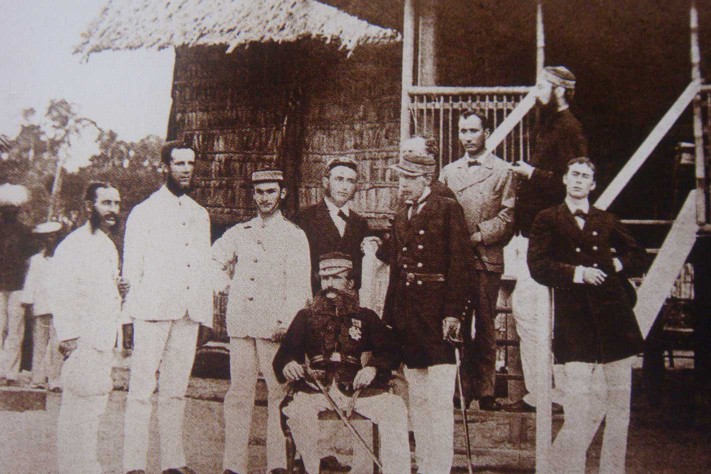
Sir William Jervois (seated) with JWW Brich stading to his left, and Frank A Swettenham right most by the staircase
Sir William Jervois (seated) with JWW Birch standing to his left, and Frank A Swettenham right most by the staircase

Delegation of Authority

141 years ago Perak became the first sovereign state in the Malay peninsula to come into a treaty with the British for the latter to provide the former with protection, while the former has the “right” to interfere in the internal administration of the state – by the appointment of a Resident or Adviser to the Sultan, on the payroll of the Sultan, and whose “advice” must be asked and “acted upon” in all matters other than the ones affecting the Malay religion and custom (C.D Cowan, 1961; Emily Sadka, 1968; Eunice Thio, 1969).  Between 1874 and 1930, similar but not identical treaties were signed with the other Sultans and Head of States. The treaties notwithstanding, the Sultans and Head of States remain the sovereign ruler of their respective sovereign state. De facto however, the British assumed the unstated “right” to administer the states as well with the exception of Kelantan through the Kelantan Treaty of 1910 (signed in Kota Bharu on 22 October 1910) when the government of King George V undertook not to interfere in the “internal administration” of the state or to curtail the “administrative authority” of the Ruler.

Sovereignty of the Rulers

Although the Rulers had divested much of their independence, both they and their state remained sovereign.  Independence is not equal to sovereignty.  As a principle of international law, sovereignty denotes, in its purest form, the concept of a ‘supreme authority’ be it an individual or a collective unit and implied power to exercise independence both internationally and domestically. Paradoxically, inherent in this conception of sovereignty is the possibility that the sovereign state could also impose limits on its own independence without suffering a diminution of its inherent sovereignty (L Oppenheim, 1928 pp 135 and 250; Albert Lau, 1991).  In other words, the Anglo-Malay treaties in no way compromised the de jure sovereignty of the Malay Rulers.

There were three test cases to determine the sovereignty of the Rulers and the State they ruled:

  1. The infamous Mighell v Albert Baker a.k.a Mighell v The Sultan of Johore (1894) which I have also covered in a previous article when the issue of the Ruler’s immunity as a sovereign was raised in an English court, it was ruled that, although the Sultan by treaty had bound himself not to exercise some of the rights of a sovereign ruler, this did not deprive him of his character as an independent sovereign.
  2. In Duff Development Company Limited v The Government of Kelantan (1924), the House of Lords similarly upheld the sovereignty of Kelantan and its Ruler was not intended to be qualified by the terms of the treaty.
  3. In Pahang Consolidated Company Limited v State of Pahang (1933), the Privy Council summarised the constitutional position in Pahang as follows: subject to the limitations which the Sultan had from time to time imposed upon himself, he remained ‘an absolute ruler in whom resides all legislative and executive power.’ (See, 1894; Q.B 1924; A.C and M.L.J)

The above implied that Britain could do nothing in these states contrary to the terms of the existing treaties.  W. Ormsby-Gore, the Under-Secretary of State for the Colonies put it in 1928:

“Our (Britain’s) position in every State rests solemnly on treaty obligations….We neither have the right nor the desire to vary this system of government or to alter the type of constitution or administration that now obtains.” (W Ormsby-Gore report, 1928).

This was later echoed by Sir P. Cunliffe-Lister, the 1st Earl of Swinton and a prominent British Conservative politician,  on 14 July 1933:

“There is no question at all of altering in any degree, even by a comma, the Treaties which bind us…and which are charters of the agreements with the Rulers both of the Federated and Unfederated Malay States.”

Interesting, however, is that the Colonial Office came close to discussing the deposition of two Sultans namely the Sultan of Johore (1906) and the Sultan of Terengganu (1919).  In the case of the Sultan of Johore, the Colonial Office was told that unless Sultan Ibrahim of Johore complied with His Majesty’s Government’s wishes, he must “retire from the business altogether.”  In 1914, Sultan Ibrahim was brought to task again for allowing conditions in Johore to deteriorate “to that which called for decided action in 1906” and warned that, unless the administration improved, “the only alternative is his removal from the State.”  In 1919, Malayan officials, increasingly piqued by the obstructive nature of Sultan Muhammed of Terengganu, similarly recommended that “sufficient pressure” should be put on him to “compel his resignation.” (Minute by Lucas, 30 March 1906 CO 273/324 no. 10619; Young to Harcourt, 19 March 1914, CO 273/406 no. 13282; and report by J. Humphreys, 3 December 1919, CO 537/797 no. 5002).

Having said that, it frustrated the British that they had no jurisdiction whatsoever by virtue of the treaties signed, and a movement was initiated by Edward Gent, to change all that.

Willan’s Mission and the Malayan Union

Among the thorny problems of pre-WW2 Malay States is the question of the Chinese immigrants brought in by the British. In the Strait Settlements of Penang, Melaka and Singapore, they could be given the status of British Protected Persons. In both the Federated Malay States (FMS) and the Unfederated Malay States (UMS) the British have no jurisdiction to apply the same rule to them, nor are they citizens of their respective host state.  As far as the Malay Rulers were concerned, only the Muslim Malays are their subjects, not those who are alien, non-native and are non-Muslims.  The British tried to convince the Rulers and also by asking the Chinese to pledge loyalty to the Rulers.  However, the Chinese were disinclined to accept the Malay Rulers as theirs.

The problem arose when in 1929 the Chinese government passed the Chinese Nationality Law stating that all persons of the Chinese race, wherever born, were considered as subjects of China.  As such, the Chinese government could intervene in cases where the Chinese are not being fairly treated.

In 1911, the Malays made up 53% of the population. By 1931, they were already outnumbered and in 1941 formed only 41% of the population.  The Chinese community was at 43%, displacing the Malays as the dominant racial group. The Malays were in a disadvantageous position and this proved explosive in 1946 during the Bekor tragedy.  The Malays remained as the minority until 1970.

The only solution out of this is for the Chinese in the Malay states to be declared as British Protected Persons, but such move is against the treaties.  To put this into effect, Malaya has to come under a federation or a union where power is central, and the Anglo-Malay Treaties be reviewed and replaced by a new one.

Following the Fall of Singapore on 15 February 1942, the British saw that it was no longer possible to return to the pre-war system as they had failed to provide the Malay states the protection from the Japanese.  Edward Gent saw this as an opportunity to streamline all the Malay States and the Strait Settlements excluding Singapore under one administration to be based in Kuala Lumpur.  A month after the Fall of Singapore, he set up a team to quickly work out a solution and framework even though it was still not known then how the war would end.

When the war ended, this plan was quickly put in place. Between 8 to 29 September 1945, the Deputy Chief Civil Affairs Officer of Malaya, HC Willan, accompanied by the Senior Civil Affairs Officer for Johor, Colonel MC Hay, made his way to the Pasir Pelangi palace and interviewed the Sultan Ibrahim. Having studied files and found proof of Sultan Ibrahim collaborating with the Japanese, his task was to assess the Sultan’s reception of the British.  Not once, noted Willan, did Sultan Ibrahim hinted that the British had let him down by losing Johor.  More remarkably, Sultan Ibrahim wrote to Colonel Hay the very next day intimated his willingness to “serve under the British Military Administration.”  Willan opined that Johor would sign the new treaty.

Of all the Malay Rulers, only the Sultan of Perak proved difficult. Willan proposed that Johor, Selangor, Negeri Sembilan and Pahang should be approached in that order to sign the revised treaty. Once the rest have signed, there would not be any reason for Perak not to sign. When Harold MacMichael arrived in Johor, Sultan Ibrahim offered no resistance although he produced a memorandum containing points relating to the Sultan’s personal prestige and the status of Johor reproduced as Annex I in MacMichael’s report – Albert Lau, 1991). This is the “1946 agreement” made in conjunction with the signing of the Malayan Union agreement between the government of Johor and the British Military Administration that has been played up in the social media of late as the Federated Malay States agreement of 1948 had yet to be formulated. Johor was the first state to submit to being colonised by the British.

As expected, Sultan Abdul Aziz of Perak became the stumbling block.  For Sultan Abdul Aziz, the central issue was still sovereignty.  He wrote:

“It is true that under the Treaties I was bound to accept the advice of the British Resident, but nevertheless I was a Sovereign in my State having power to assent or withhold assent to legislation. I am now invited to sit as a member at an Advisory Council with the Governor assuming the function which rightly belongs to me. Being a member of the Advisory Council with authority over the other States is a doubtful honour. I neither desire to have any influence over the other States nor welcome any other Ruler to have influence within my State.”

The Sultan was also further incensed that under the new agreement the Malays in Perak would no longer swear allegiance to him but to the Malayan Union, thus in effect reducing him to the position of a Sultan without subjects:

“All these facts tend to show that my sovereign rights are in real danger. You can well imagine my feelings. I have no status, no State and no subjects.”(Sultan Abdul Aziz to Alexander Newboult, 20 February 1946, CO 537/1548 no. 50823/34 Pt.1)

By the latter half of February 1946, there was more cohesiveness amongst the Rulers in going against the Malayan Union.  The Rulers had tactically rallied behind an informal united front presided by the Sultans of Perak and Kedah.  In a concerted display of solidarity, the Rulers of Perak, Kedah, Pahang, Selangor and Negeri Sembilan jointly petitioned to defer the implementation of the new Malayan Union constitution until an independent commission had first visited the country and consulted local opinion. (Newboult to Hall, 22 February 1946, CO 537/1548 no. 50823/34 Pt.1).

The movement against the Malayan Union was born and so was UMNO. The discussions on the formation of the Federation of Malaya began with the British, the Rulers and UMNO taking part in the discussions.


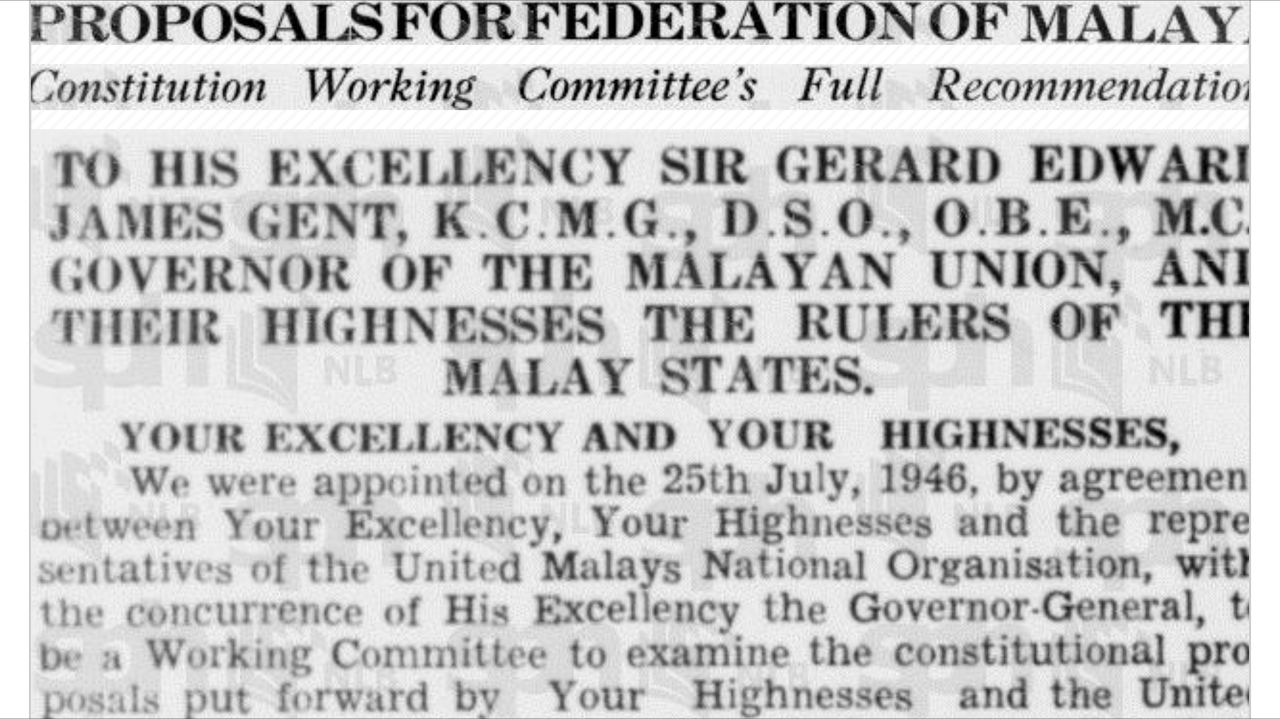
Proposals for the Federation of Malaya Agreement

Epilogue

The Anglo-Malay treaties were left relatively intact with more power given to the people to effect some degree of self-governance, the Rulers continued with their ceremonial roles and duties.  The Federation of Malaya came into effect on 1 February 1948, replacing the Malayan Union.

On 31 August 1957, the Federation of Malaya became independent, not from colonisation, but from feudalism.  Executive powers that were given to the British have been given to the people of Malaysia to determine how they are to be governed and by whom. All agreements and treaties made between the Rulers and the British since 1874 became void. Professor Datuk Dr Ramlah Adam said all agreements inked during the British colonial period are considered void automatically after Aug 31, 1957.

“These issues are over. The powers of the Malay royalty are now included in the Federal Constitution.”

There is no more “state citizenship” but only “federation citizenship,” which makes Malaysians who they are irrespective of where they were born.  The Federal Constitution too does not provide for any state to secede from the Federation. This was further enhanced in Sabah where the Malaysia Agreement of 1963 specifically says the state cannot secede.

Unsolicited remarks should not be made and the spirit of history has to be understood in order to understand why are we where we are, and why are we who we are.  Such talks only put the sacrifices of our predecessors in vain.