How Financially-Strapped Malaysians Celebrate Ramadhan

It has been a while that I have actually driven late at night in Kuala Lumpur, a city that city-dwellers claim to have become more and more unaffordable to live in.  So, I took a drive last night just to see how it looks like mid-Ramadhan.  I shun driving through KL towards the end of Ramadhan because there would be a mad rush for season end bargains.  The middle of Ramadhan should be alright for a drive.

I was wrong.  I used to be able to park my car in front of the embassy of Nepal on Jalan Ampang (behind St John’s primary school) and walk across the Klang river for a plate of roti canai on previous years’ Ramadhan night.  However last night, the jam started just after the intersection between Jalan Sultan Ismail and Jalan Ampang as cars tried to get to the Masjid India and Capital Square areas.  Parked cars lined the sides of Jalan Ampang from across Sunway Tower all the way to Jalan Melaka!

A friend who works at a very famous textile mall in the Masjid India area confided that sales this Ramadhan has so far exceeded the total sales for Ramadhan 2016.  And it has only been 15 days since the beginning of Ramadhan with another two weeks to go.

I have not gone to see the sales of Naelofar scarves.  If hundreds of dUCk scarves costing RM800 each could all disappear from the shelf within five minutes, I expect a mad scramble for the Naelofar ones which have gone on sale one week before Ramadhan even started!

What about the Ramadhan buffets?

Ramadhan buffets are generally dearer compared to last year.  I have had the chance to sample some by both invitations and personal visits.  I have not seen one that is not full, be it at one that costs RM65 per head or the one that charges RM218 per head.  And most are not corporate invites as they throng these venues in shorts and t-shirts, and often than not I see long tables of families, not co-workers, enjoying their Ramadhan buffet.  Even university students swamped the RM65 ones, something unthinkable back in the mid-1980s.

At one venue the hotel car park was full that I had to park next to the waste bins near the hotel’s goods delivery area!  I was lucky to have gotten that spot as I see scores of people having to walk from afar after parking their car by the roadside.

So, how oppressed are the Malaysians financially?  Is it true that it used to be better two Prime Ministers ago?

Consumer spending in Malaysia over 10 years (Trading Economics/Department of Statistics Malaysia)

If you look at the graph above on consuer spending in Malaysia over the last ten years, despite claims that RM1 could get you many things back then compared to now, consumer spending in Malaysia has been on the upward trend.  If you look at your social media accounts, even university students can afford to go on a holiday in Bali and Lombok now when the farthest they would go back in the 1990s was a weekend in Port Dickson.  Students in the 1990s could hardly afford a flight to Kota Kinabalu.

Consumer spending increased to RM152 billion in the first quarter of this year from RM150 billion in the last quarter of 2016 and averaged RM101.7 billion from 2005 until the first quarter of 2017.  The lowest consumer spending by Malaysian was in the second quarter of 2005 when it was RM56.8 billion and peaked at RM153.5 billion in the second quarter of 2016 – exactly the period when whining Malaysians complained without facts that the country is on the brink of financial doom.

As a matter of fact according to the Department of Statistics of Malaysia, the median and mean monthly salary and wages paid to employees in 2016 have increased by 6.2 and 6.3 percent respectively compared to 2015.

This is also helped by the fact that sales tax has gone down from the 10 percent sales tax (and 6 percent service tax) that were not fully remitted to the government due to the suspected underdeclaring of sales and profits, to just 6 percent Goods and Services Tax.
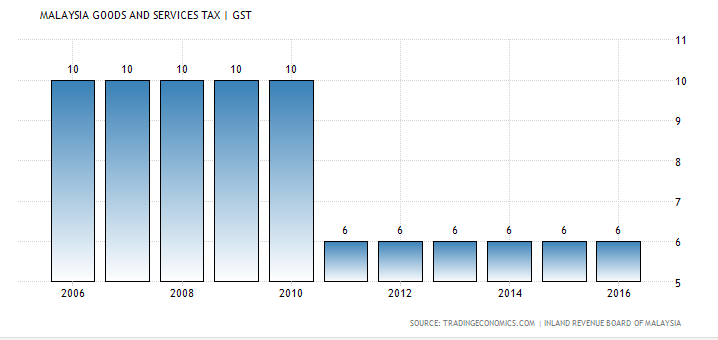
Sales Tax in Malaysia (Trading Economics/Malaysian Inland Revenue Department)

Corporate Tax, despite claims that the government has been charging corporations more, has been brought down to just 24 percent in 2016 from 30 percent back in 1997.

Corporate Tax in Malaysia from 1997 to 2016 (Trading Economics/Malaysian Inland Revenue Department)

Even the April 2017 numbers for Year-to-Date car sales figures in Malaysia had increased compared to the corresponding period in 2016.

And the government continues to make life more affordable in especially Kuala Lumpur, the city many big spenders complain is getting expensive to live in.  The Light Rapid Transit system that was originally built especially for the 1998 Commonwealth Games, has now been extended in service to connect Puchong and Putra Heights, while by 17 July 2017 the Mass Rapid Transit Line 1 will connect Sungai Buloh to Kajang directly meeting the KTM Komuter in Sungai Buloh and Kajang, while meeting directly with the LRT at Pasar Seni, and is within walking distance with the KL Monorail at Bukit Bintang.

The LRT will further extend from Bandar Utama to Johan Setia, south of Port Klang, and will be passing Tropicana, Glenmarie, Shah Alam stadium, UiTM, Bukit Raja, Sri Andalas and Bukit Tinggi.  The construction of LRT extension (known as LRT 3) has already commenced.

The MRT Line 2, which has also begun its site clearing phase will be from Sungai Buloh to Putrajaya, passing through Sri Damansara, Kepong, Jinjang, Sentul, Titiwangsa where it will meet with the KL Monorail and LRT Ampang/Seri Petaling lines before going through Kampung Baru, Ampang Park, KLCC East, TRX, Bandar Malaysia, Kuchai, Bandar Tasik Selatan where it meets with the LRT, ERL and KTM Komuter, Serdang, Seri Kembangan, and Cyberjaya.

Meanwhile KTM Komuter will have a service linking its station at Subang Jaya with the Subang Skypark Terminal.

These are all ways initiated by the government to make connectivity better and cost of living lesser for the people of the Klang Valley.  At least, no false promises such as abolishing tolls have been made, such as the one made by the DAP-led state government in 2007 which have not only gone unfulfilled, but also reneged on by introducing not only tolls for Pulau Pinang voters to shoulder, but also having to foot higher parking charges statewide.
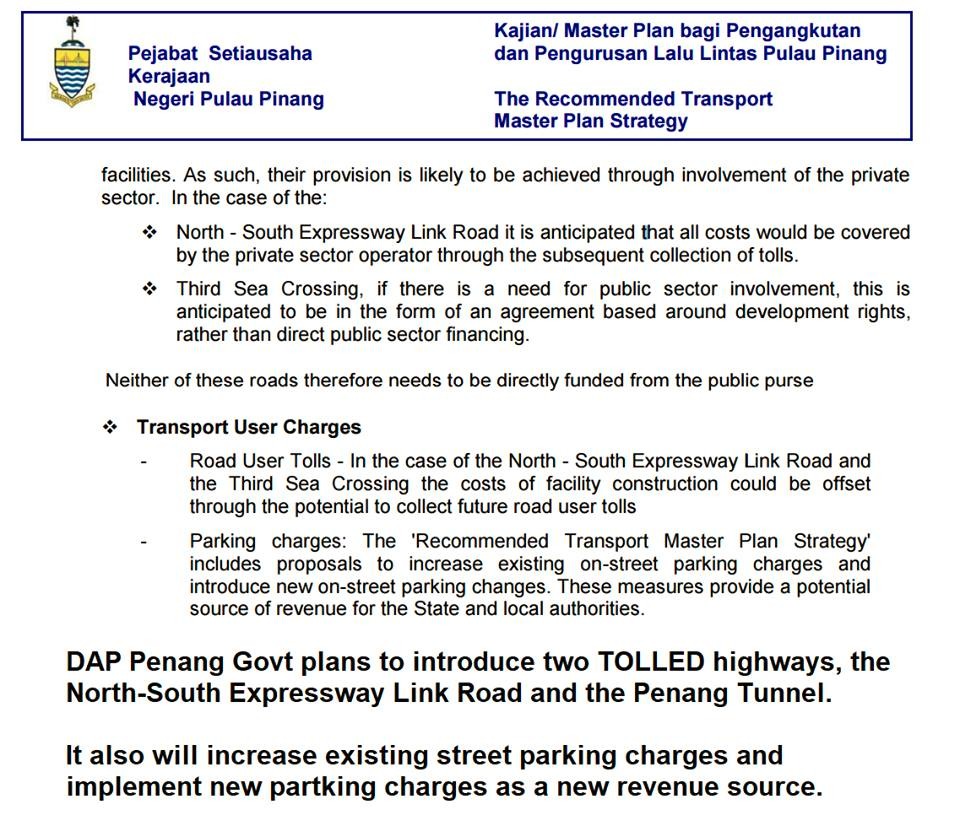
Statement by the Pulau Pinang state government promising a tolled highway

So, stop complaining saying things are unbearably expensive because figures show more people can afford to splurge, and stop telling lies in this holy month of Ramadhan, for those who claim to be Muslims or decent, refined and educated human beings.

Not Synced At All

Recently Azmin Ali announced a two and a half months bonus for Selangor civil servants. The civil servants rejoiced at hearing this news and I am sure Azmin cheered himself.

He stands to get almost RM73,000 as his pay is RM29,000 per month.

With two weeks to go till the end of Ramadhan, news leaked out that the confirmation of any bonus payout will only be made known this coming Tuesday. And already netizens are up in arms over it.


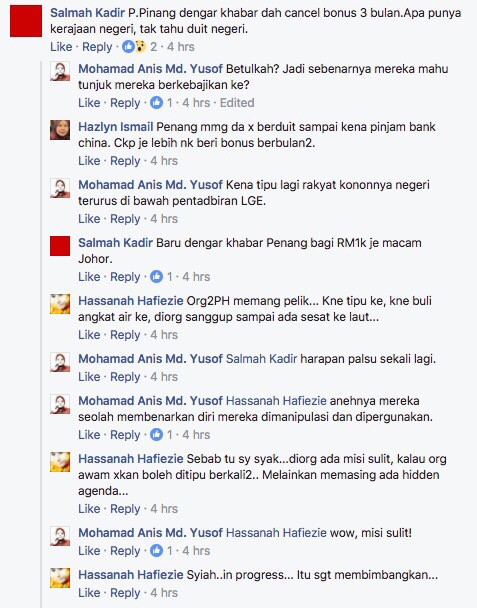
And it seems Pulau Pinang is mulling to cancel its binus payout due to short of funds, as seen in the discussion below:


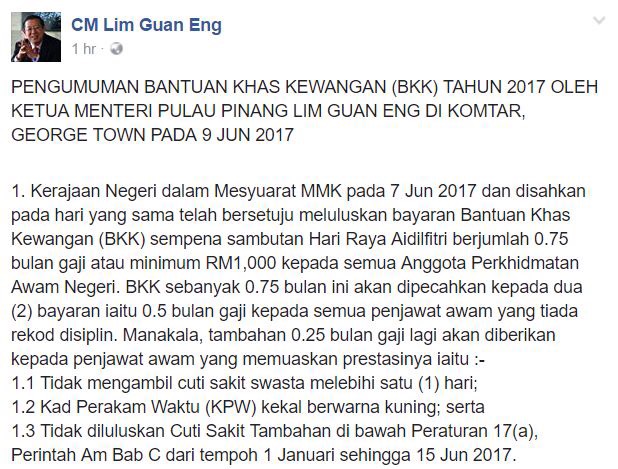
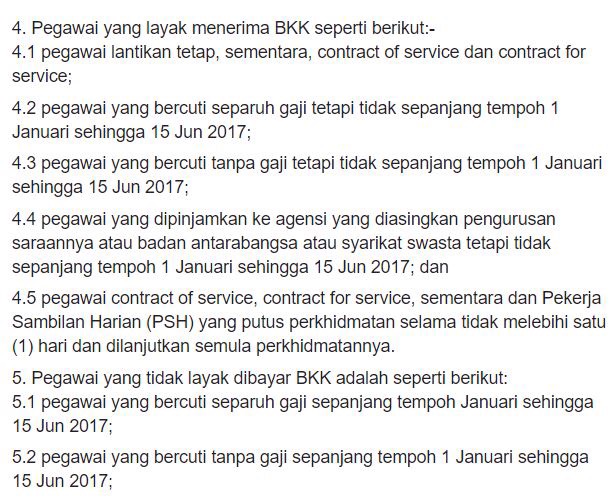
The Pulau Pinang state government had recently announced that it will give bonus to its civil servants, but with certains terms attached:


The bonus is for 0.75 months or RM1,000 minimum, whichever is higher. This goes to show that the Pulau Pinang government is no longer cash rich.

In order to be able to pay the bonus out, and to continue keep the administration running, the Pulau Pinang state legislative assembly recently passed an enactment to allow the state government to take an undisclosed amount of cash loan from the EXIM Bank of China.

As in the words of Tokong Chao Ah Beng, “borrow money to make more money.”


It seems that the business of running a state government is all too easy. It does not matter how you manage the finances, if you run short of cash, borrow.

And it does not matter who has to shoulder the burden of repaying this debt. According to portal Utaranews, each Penang Lang will have to pay back RM28,000 for this loan..

What does Tokong care? He’s going to jail and he’ll be fed and cared using the money that the Penang suckers pay in the form of taxes. So not only do they have to bear RM28,000 each, but in fact RM28,000 + x being the anount Tokong will be living off them.

This shows how the Pakatan-led states government is totally not in sync with the wishes and wants of the rakyat. They are always dancing to their own tempo, and not with the rakyat – just like this pathetic attempt by DAP MP for Bukit Mertajam, Steven Sim Chee Keong, to be in sync with his constituents.

​​​

Lim Kay Kiang

Kay Kiang is a Hokkien term to describe someone who acts smarter than he really is. So Lim Kit Siang is actually Lim Kay Kiang.  His parting shot for Friday’s Twitter was to ask Najib Razak about an allegation that RM9.5 million was paid to Shafee Abdullah who was prosecuting for the government in Anwar Ibrahim’s Sodomy 2.0 trial.

The allegation was made by Sarawak Report which said that two payments were made by Najib Razak using 1MDB funds from an Ambank account.

I shall not comment about the status of the accounts mentioned by Lim Kay Kiang. I shall let others handle that part.  This is typical shit-stirring by Lim Kay Kiang who has turned a blind eye on his son Chao Ah Beng’s corrupt practices.  Chao Ah Beng, who is a quintessential Ah Beng said that he will fight to the end to clear his name has been delaying his own trial to play for more time.

What Lim Kay Kiang ought to realise is that firstly, no matter the amount that was paid to Shafee, the money could not have come from 1MDB.  Even Pakatan-mouthpiece Malaysiakini said that the money had been transferred out of Malaysia the day the account that held the money was closed – 30 August 2013.

Secondly, Shafee was the prosecutor for the trial. You can pay him all the money available in Malaysia but the verdict and judgment rest on the trial judges.  Therefore, what effect does paying Shafee have on the outcome of the trial?

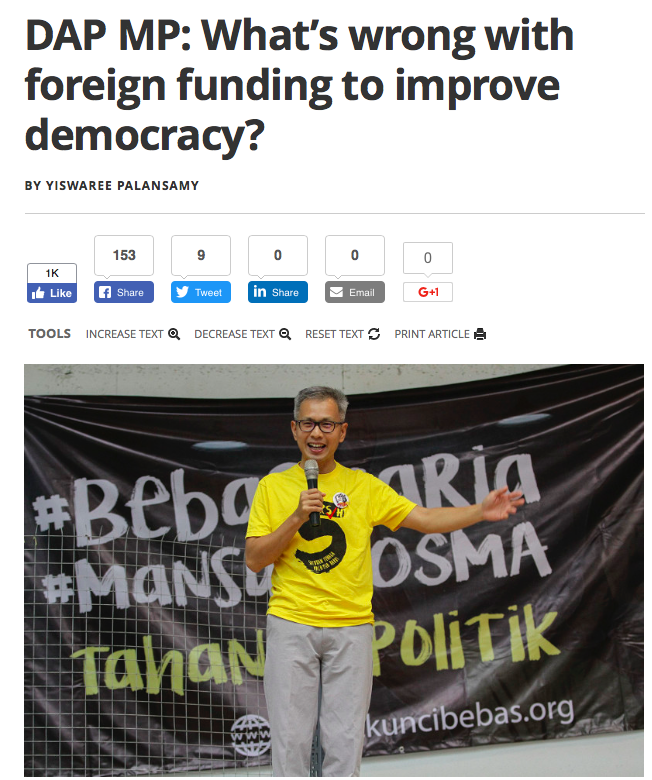
The money that was received by the account bearing Najib Razak’s name was for UMNO.  Whatever amount that was not used was transferred out of the country.  I am sure that there is nothing wrong with receiving funds for political purposes, to make the country a better place.  If you don’t believe me, you can ask Pony Tua who is the DAP’s chief mischief.

Perhaps Lim Kay Kiang should ask Pony Tua what he meant by “What’s wrong with foreign funding to improve democracy.”

Lim Kay Kiang can stir all the shit up if he wants to but he should also surrender his son to the nearest prison before commenting on a non-issue trying to make a rocket of a dildo.

Sabah 20-Point Agreement: Language

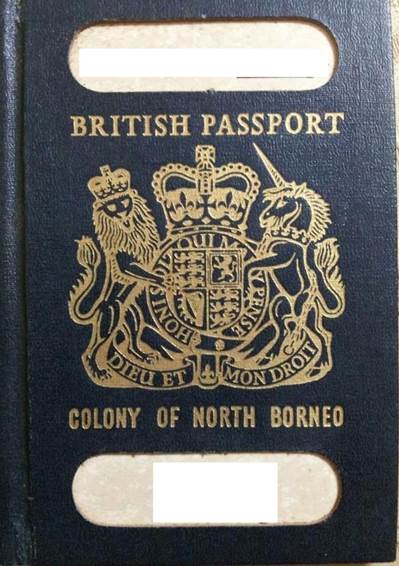
Colonial passport for the colonised people of North Borneo
For the previous installment on religion, please click HERE.


Dr Jeffrey Kitingan also raised the point on language on pages 11-12 of his book, ‘The 20 Points – Basis for Federal – State Relations for Sabah, 1987′.  Language was the second point of the 20-Point Memorandum put forth before Malaysia was formed.

His points were, that:

  1. Malay should be the national language of the Federation;
  2. English should continue to be used for a period of ten years after Malaysia Day;
  3. English should be the official language of North Borneo, for all purposes, State or Federal, without limitation of law.

Dr Jeffrey wrote that it was Tun Mustapha’s administration that had changed the status of English by passing a bill and introducing a new clause 11A into the State Constitution, making Bahasa Malaysia the officia language of the State Cabinet and the State Legislative Assembly.

At the same time, he claimed, the National Language (Application) Enactment, 1973 was passed purporting to approve the extension of an Act of Parliament terminating or restricting the use of English for other official purposes in Sabah.

He also said that the National Language Act, 1963/67 was only amended in 1983 to allow it to be extended to Sabah by a State enactment, but no such enactment had been passed.  Therefore, the National Language Act, 1963/67 is still not in force in Sabah.

He claims that the amendments hae brought about the following consequences:

  1. Many civil servants who were schooled in English are employed as temporary or contract officers because of their inability to pass the Bahasa Malaysia examination.
  2. The change in the medium of instruction in schools have affected the standard of teaching due to lack of qualified Bahasa Malaysia teachers.
  3. The teaching of other native languages has been relegated to the background.

Now, let us see what the Malaysia Solidarity Consultative Committee (MSCC), the Cobbold Commission, the Inter-Governmental Committee (IGC) as well as the Federation of Malaysia Agreement had to say about the points raised above.

Malaysia Solidarity Consultative Committee (MSCC) Memorandum

On Page 122 of the MSCC Memorandum, the Committee accepted that the Federation should have a national language and placed no objection to the adoption of the National Language of the Federation of Malaya, Singapore and Brunei (the Malay language) as it is the lingua franca of the region.

However, the MSCC had asked the Parliament to make provision for the English language to remain to be used for a period of TEN YEARS after the formation of the new Federation in 1963.  This is in light of the same period given to the states in the Federation of Malaya in the Federation of Malaya Constitution that is TEN YEARS after 1957.

The Cobbold Commission

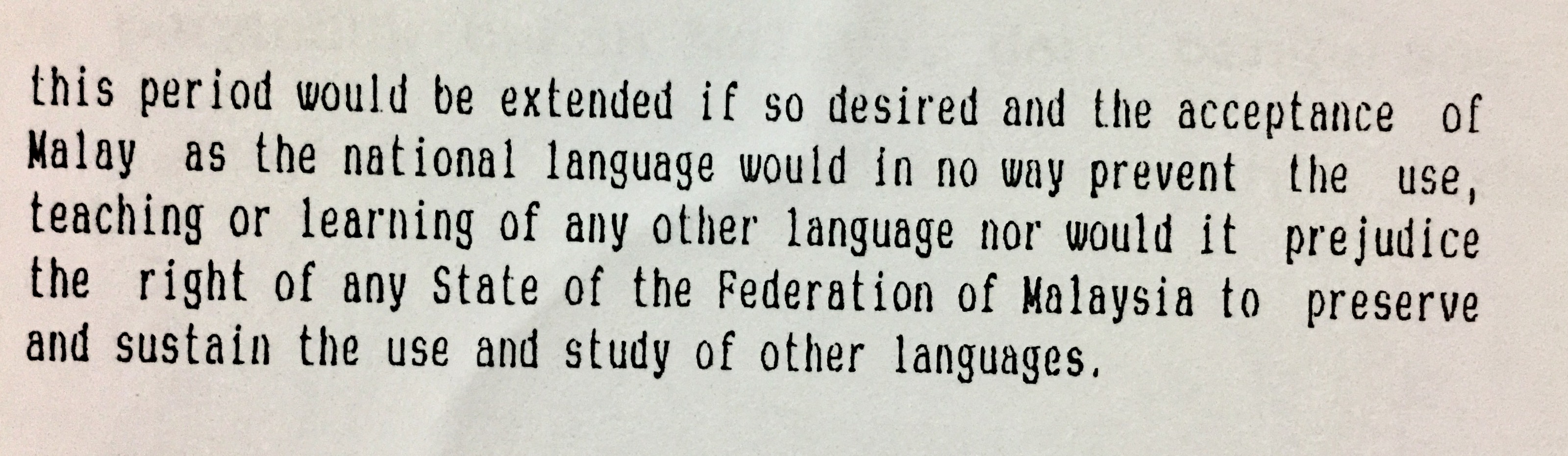
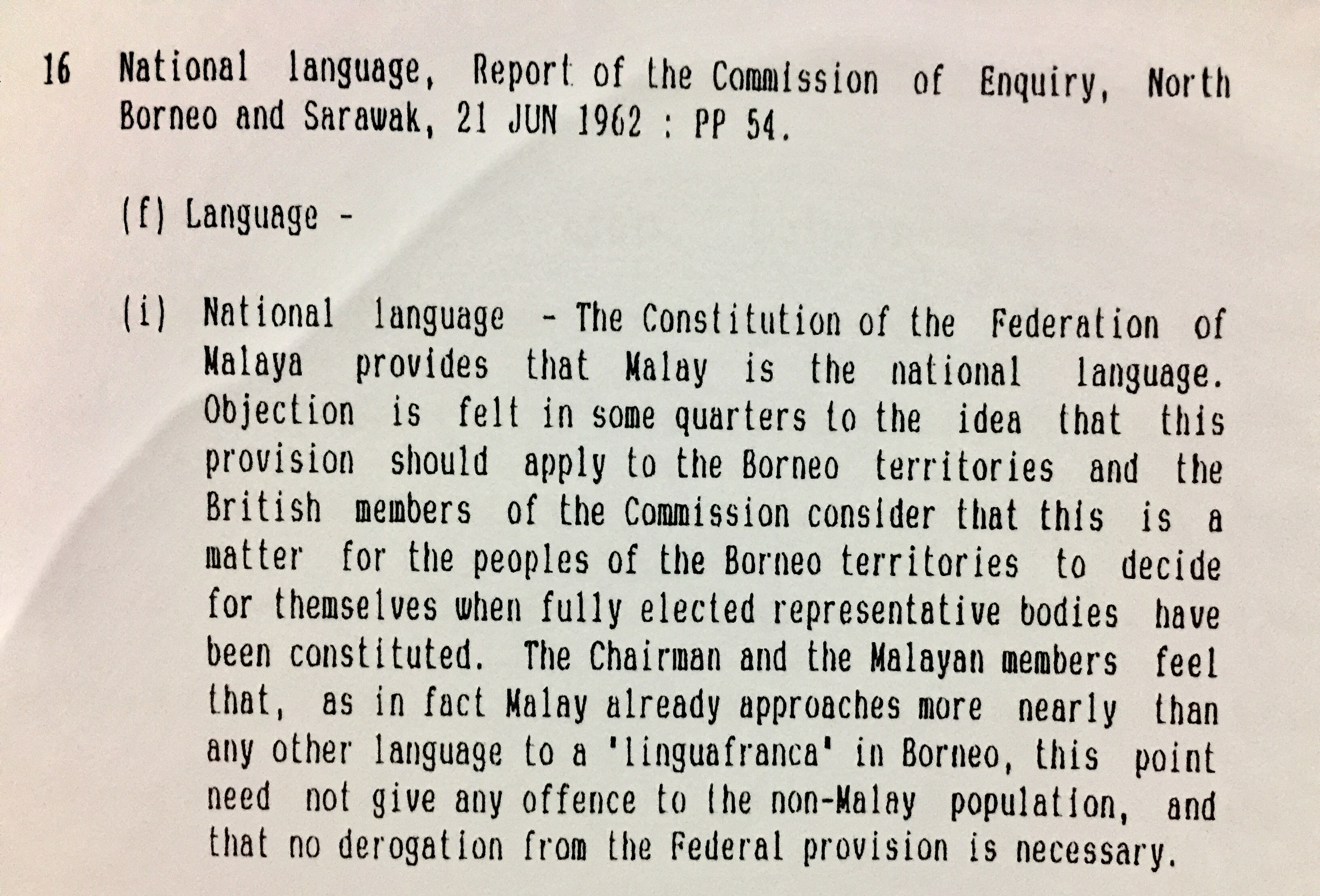
According to the Report of the Commission of Enquiry, North Borneo and Sarawak (the Cobbold Commission) dated 21 June 1962 on page 54, the objection to the use of Bahasa Melayu as the language of the Federation and its application to North Borneo and Sarawak are matters that the people of the two states should resolve themselves when fully-elected representative bodies have been constituted.

The Chairman and members from Malaya do not think that their opinion of Bahasa Melayu being the language closest to those spoken in the region and therefore should be the lingua franca should not offend the non-Malays and any derogation from the Federal provision is necessary.

On the issue of official languages the Cobbold Commission found that there is majority support for both Bahasa Melayu and English to be used as the official languages in both the Borneo states without any time limit.  This was the view of the Chairman of the Commission and its British members.

The members from Malaya however thought that with MALAYSIA in total consideration such provision cannot be accepted as it breaches the existing provisions in the Federation of Malaya Constitution.  Therefore the Malayan members recommend that a provision be made without affecting the position of Bahasa Melayu as the official language of the Federation where English shall continue to be an official language in the states of North Borneo and Sarawak along with Bahasa Melayu for a period of ten years after the establishment of the Federation of Malaysia.

This shall continue until such time the Federal government in consultation with the State governments provides otherwise.  The same was recommended for application to the indigenous languages used in debates and discussions in the respective state assemblies.

The Chairman and the British members however opined that there should be no time limit applied to the indigenous languages, until and unless the State governments decide otherwise.

The Inter-Governmental Committee (IGC)

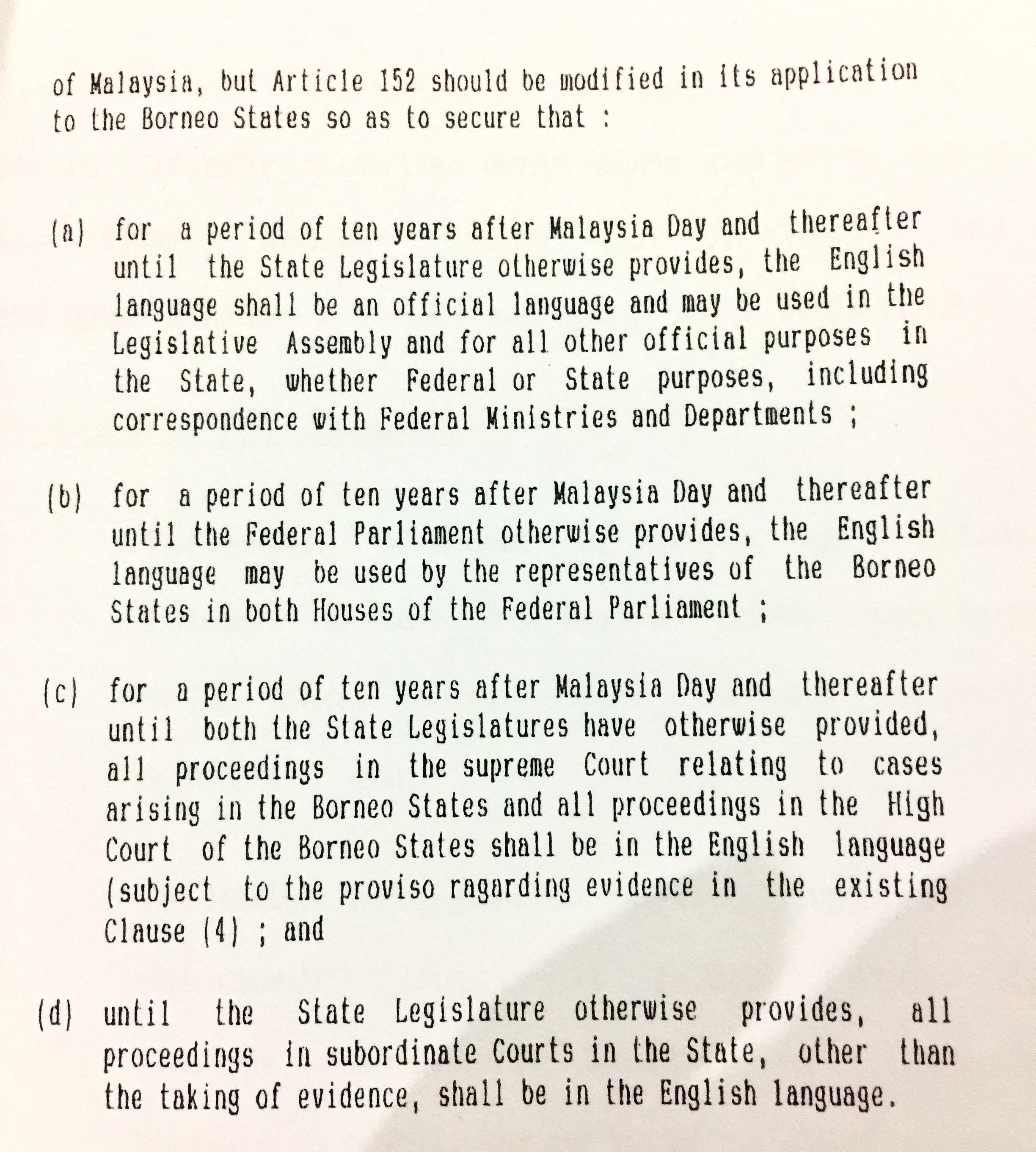
The IGC on Page 26 of its report recommended that Bahasa Melayu be made the official language of the Federation of Malaysia but Article 152 of the Constitution should be modified for its application to the Borneo states as follows:

  1. For a period of TEN YEARS after Malaysia Day and until the State Assemblies provide otherwise, English becomes an official language not just for the State Assemblies but also in other official purposes of both State and Federal, including correspondences with Ministries and Federal departments.
  2. For a period of TEN YEARS after Malaysia Day and until the Parliament of Malaysia provides otherwise, English shall be allowed to be used by representatives from the Borneo states in both Houses of Parliament.
  3. For a period of TEN YEARS after Malaysia Day and until both State Assemblies provide otherwise, all proceedings in the Supreme Court for cases involving cases from the Borneo states and all proceedings in the High Courts of both Borneo States shall be conducted in English.
  4. Until the State Assemblies provide otherwise all proceedings in the subordinate Courts in the Borneo states other than the taking of evidence, shall be in English.

Of course at the end of it all parties agreed upon something hence the Federation of Malaysia Agreement, 1963 was signed.  So what does the Agreement say?

Federation of Malaysia Agreement, 1963

Taking into account the recommendations and points made in the MSCC, the Cobbold Commission and the IGC, the Federation of Malaysia Agreement, 1963 on pages 42 and 43 made provisions that no Act of Parliament terminating or restricting the use of English for the purposes stated below shall come until TEN YEARS after Malaysia Day:

  1. the use of the English language by the representatives from the Borneo states in either house of Parliament,
  2. the use of the English language for proceedings in the High and Subordinate Courts of Borneo until the State Assemblies provide for otherwise, or for proceedings in the Federal Court that involves cases from the Borneo states,
  3. the use of the English language in the Borneo states in the Legislative Assemblies or for other official purpose including the purpose of the Federal Government,
  4. the use of native languages in the native courts and in the case of Sarawak, the use of native languages in the State Assembly until otherwise provided for by an Enactment of the legislature.

During the Tun Mustapha Administration the status of the English language was altered in a bill by inserting a new clause called Clause 11A into the Sabah State Constitution, 1989 (pages 17-18), making Bahasa Malaysia as the official language of the Sabah Cabinet and of the State Legislative Assembly.

The content of this Clause is as follows:

“Without prejudice to clause (8) of Article 24, the official language of the State Cabinet and the Legislative Assembly shall be in Bahasa Malaysia:

Provided that:-

a) notwithstanding the provisions of this Article, the English language may be used for such period and for such purposes as may for the time be provided by or in accordance with Article 152 of the Federal Constitution; and

b) an official English version shall be provided of anything which is required to be printed or reduced into writing and may be published in the Gazzette.”

However, Jeffrey disputes the passing of the National Language (Application) Enactment, 1973 that allegedly allows the application of an Act of Parliament to terminate or restrict the use of the English language for other official purposes in Sabah.  This preceded the National Language Act 1963/67 that was only amended in 1983 to allow it to be applied to Sabah through a state enactment.  Nonetheless, there was no state enactment on the matter that was passed as of 1991.  As such, as of 1991 the National Language Act, 1963/67 was still not enforced in Sabah.

Based on the Federation of Malaysia Agreement (Malaysia Agreement), 1963, it is clear that the position of the English language as an official language can be altered TEN YEARS after Malaysia Day.  It was put into force through a law that was enacted by the State Legislative Assembly of Sabah in 1973.  Having said that, no specific enactment was passed as of 1991 to enforce the National Language (Amendments and Extension) Act, 1983 in Sabah.

Jeffrey Kitingan’s assumptions and allegation pertaining the illegality of the National Language Act, 1963/67 and State Enactment No.7, National Language (Application) Enactment, 1973 which preceded the National Language (Amendments and Extension) Act, 1983 by ten years was more of playing a regional sentiment especially in the context of teaching and learning of the indigenous languages in Sabah.

Questioning the use of Bahasa Malaysia as the official language after 27 years of Sabah being part of the Federation of Malaysia clearly displays the arrogance on Jeffrey’s part, and his refusal to accept the fact that the Bahasa Malaysia is the reflection of the spirit of the people of Malaysia that forms a bridge for all races towards national integration.

In the next installment, we shall talk about the third point – CONSTITUTION.

The Greatest Malaysian Misleader

Delusional old crap

The above is an extract from an interview of a psychopathic and delusional old man by the Nikkei Asian Review yesterday.  He said that he had never abused his power when he was the Prime Minister.

If you have a copy of Barry Wain’s ‘Malaysian Maverick‘ you can see the list of abuses that Mahathir had done during his premiership.  And those are only the ones that Mr Wain had discovered.

Time Magazine quoted an economist at Morgan Stanley in Singapore as saying that the country might have lost as much as US$100 billion since the early 1980s to corruption. Under Mahathir’s 22 years term, there were monetary losses amounting to over at least hundred of billions of Ringgit and this excluded those unaccounted for, and irretrievable.

Another politician, Syed Husin Ali, whose party is now worshipping Mahathir said, “Petronas has neither been fully transparent nor accountable with how it spends its money, especially in aiding and abetting Tun Mahathir to indulge in unproductive construction of mega projects, to bail out ailing crony companies and corporate figures, and to involve itself in excessive and wasteful spending on celebrations and conferences.”

For the record, Mr Wain has never been sued by Mahathir.  Neither has Mahathir’s foe-turned-best friend Lim Kit Siang been sued for his remarks on the former.

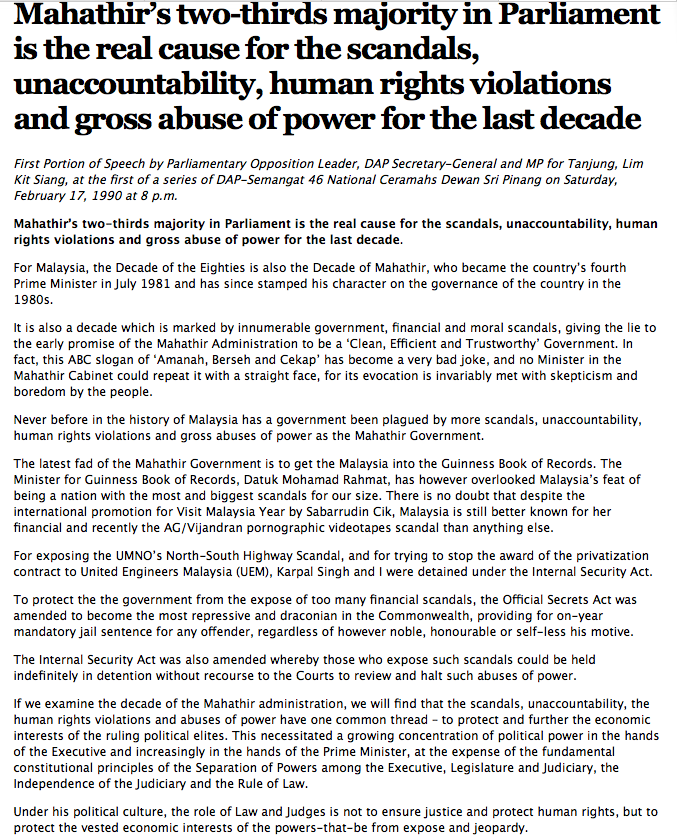
Lim Kit Siang aka The Emperor once wrote:

If we examine the decade of the Mahathir administration, we will find that the scandals, unaccountability, the human rights violations and abuses of power have one common thread – to protect and further the economic interests of the ruling political elites. This necessitated a growing concentration of political power in the hands of the Executive and increasingly in the hands of the Prime Minister, at the expense of the fundamental constitutional principles of the Separation of Powers among the Executive, Legislature and Judiciary, the Independence of the Judiciary and the Rule of Law.

Under his political culture, the role of Law and Judges is not to ensure justice and protect human rights, but to protect the vested economic interests of the powers-that-be from expose and jeopardy.

Two-thirds parliamentary majority has become a blank cheque for abuses of power and human rights violations.”

Emperor Lim was notably vocal on the issues of the Forex scandal that all but wiped out our Bank Negara reserves and also the BMF scandal before he became the jockey that now rides on the political mule called Mahathir.  But the things he wrote on Mahathir are still there waiting to be used against the latter should he (Mahathir) forget his current position – a mule.

As a matter of fact, Emperor Lim also has examples of abuse of power in relation to freedom of the press during Mahathir’s time – and I am not talking just about Ops Lallang.


So for Mahathir to claim that he never abused his power as the Prime Minister is an absolute farce.  It only goes to show how desperate he is to paint a false picture of his past to the youngsters who were yet to be born when Mahathir had this country beneath his fists.

He thinks that the Pakatan will collectively agree to his ambitions of either putting his son as the Prime Minister or he become one himself based on his 22-year experience.

But we all know that no one in the Pakatan wishes to have another one term of Mahathir remembering what he was capable of.  So they will just ride on his anger towards Najib Razak…like the old mule he is.

Auld Lang Swine

I have no respect for the perfidious people above.  I have no respect for people who leave their party and form or join another and go against their former party.

Nor do I have respect for people who go back on their words after spending a lifetime making others believe those words.

Spineless. Principle-less.

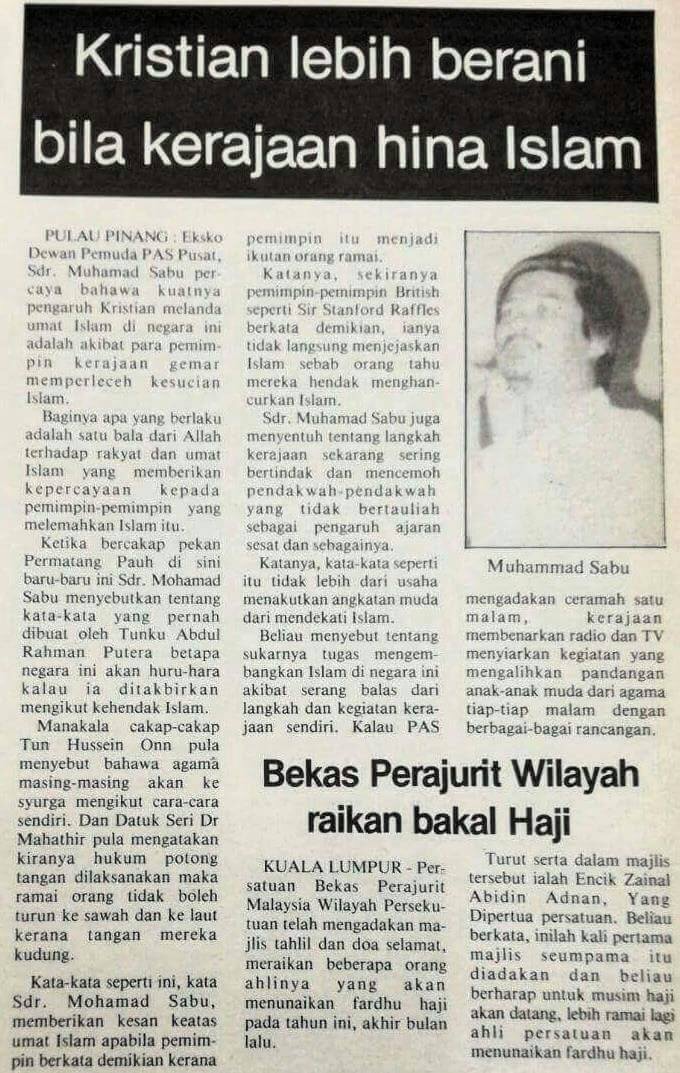
Look at Mat Sabu for instance. Once he was speaking out loud against the Christians.


He even spoke against the proselytising of Muslims by Christian evangelists, giving speeches against the act.


Now he is subservient to the party that is run by evangelists – becoming their loyal dog that does their biddings.

Then you have this 92-year old man who once claimed that Anwar Ibrahim is too old to become a Prime Minister.


Suddenly he is thinking of becoming the Prime Minister again, after saying he’d never return to the Premier seat again.


Probably that is the reason he did not lift the “Anwar As The 7th PM” placard at the recent PKR convention and pretended he was takkng a video with his phone.


We are, I guess, living in the age of the auld lang swine.

Sabah 20-Point Agreement: Religion

Colonial passport for the colonised people of North Borneo

For the previous installment on the background, please click here.

In his book on Page 101, Dr Jeffrey Kitingan wrote that although there is no objection to Islam being the religion of the Federation there should not be a STATE RELIGION in North Borneo.  Therefore, anything pertaining to Islam in the MALAYAN CONSTITUTION cannot be applied to NORTH BORNEO.

His grouse on this matter came about as a result of the late Tun Datu Mustapha expelling Christian priests from Sabah and accused both Tun Datu Mustapha and Datuk Harris Salleh of acting in such manner to strengthen their political position with the Federal government, therefore Islam should not be the religion of the state of Sabah.

The above controversial statement goes against the agreements reached as recorded by the Cobbold Commission, the Malaysia Solidarity Consultative Committee (MSCC) , and the Inter-Governmental Committee (IGC) in 1962.

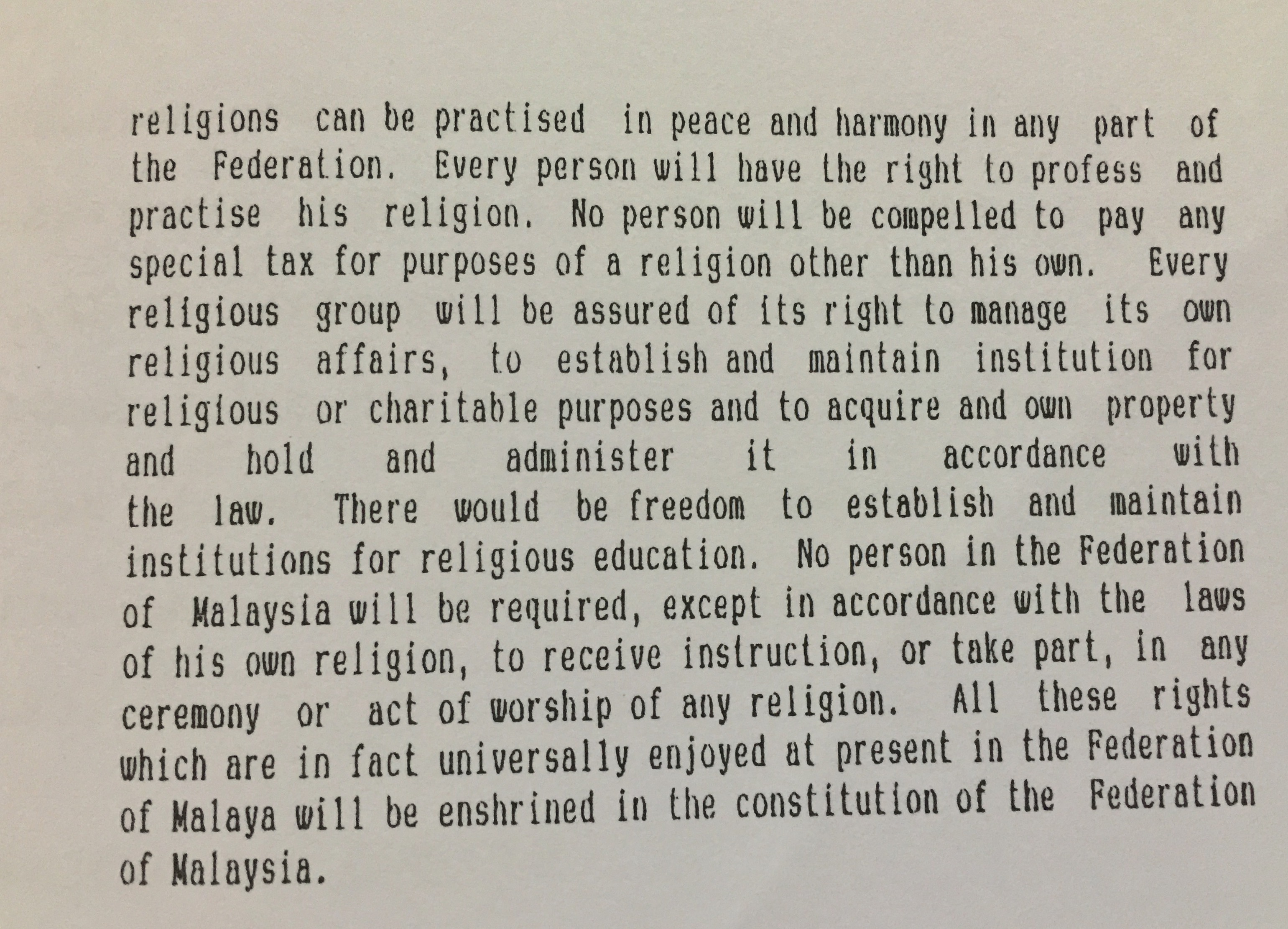
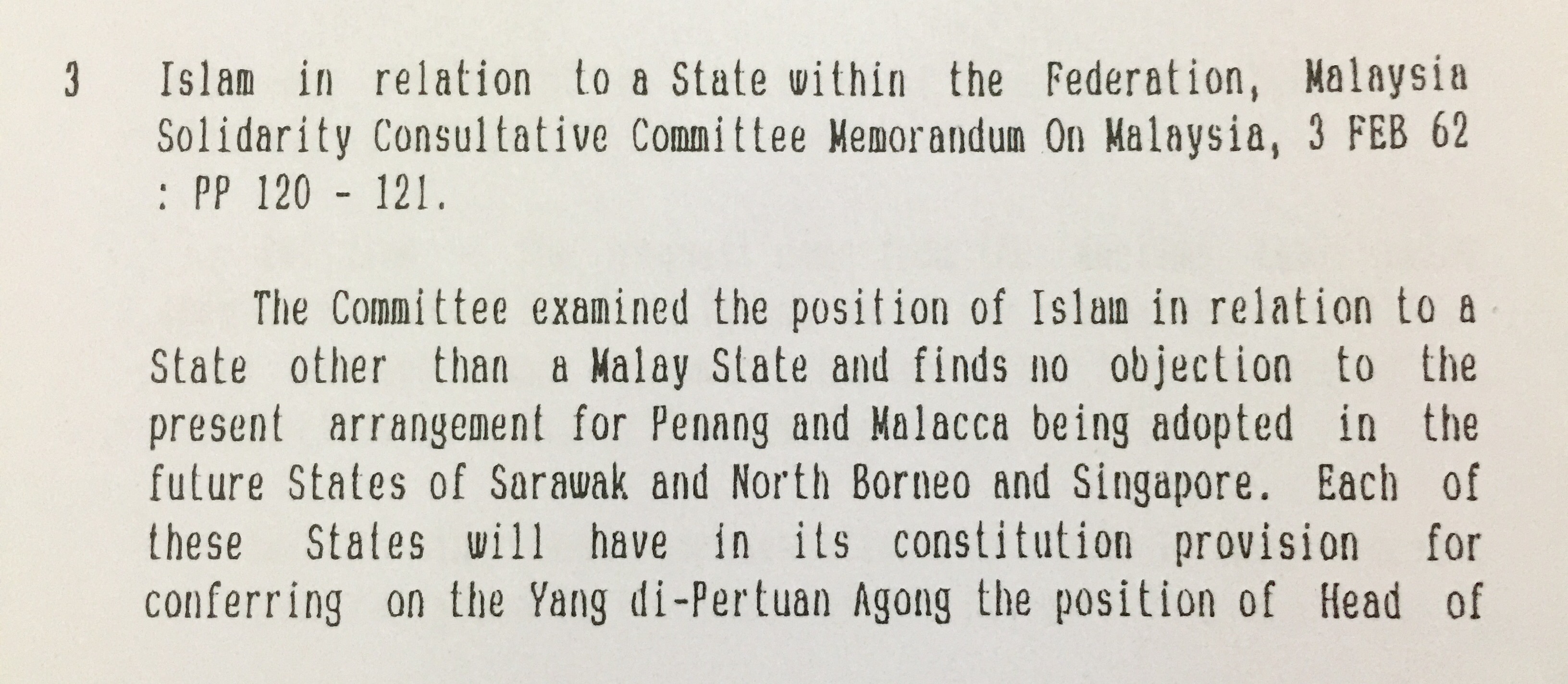
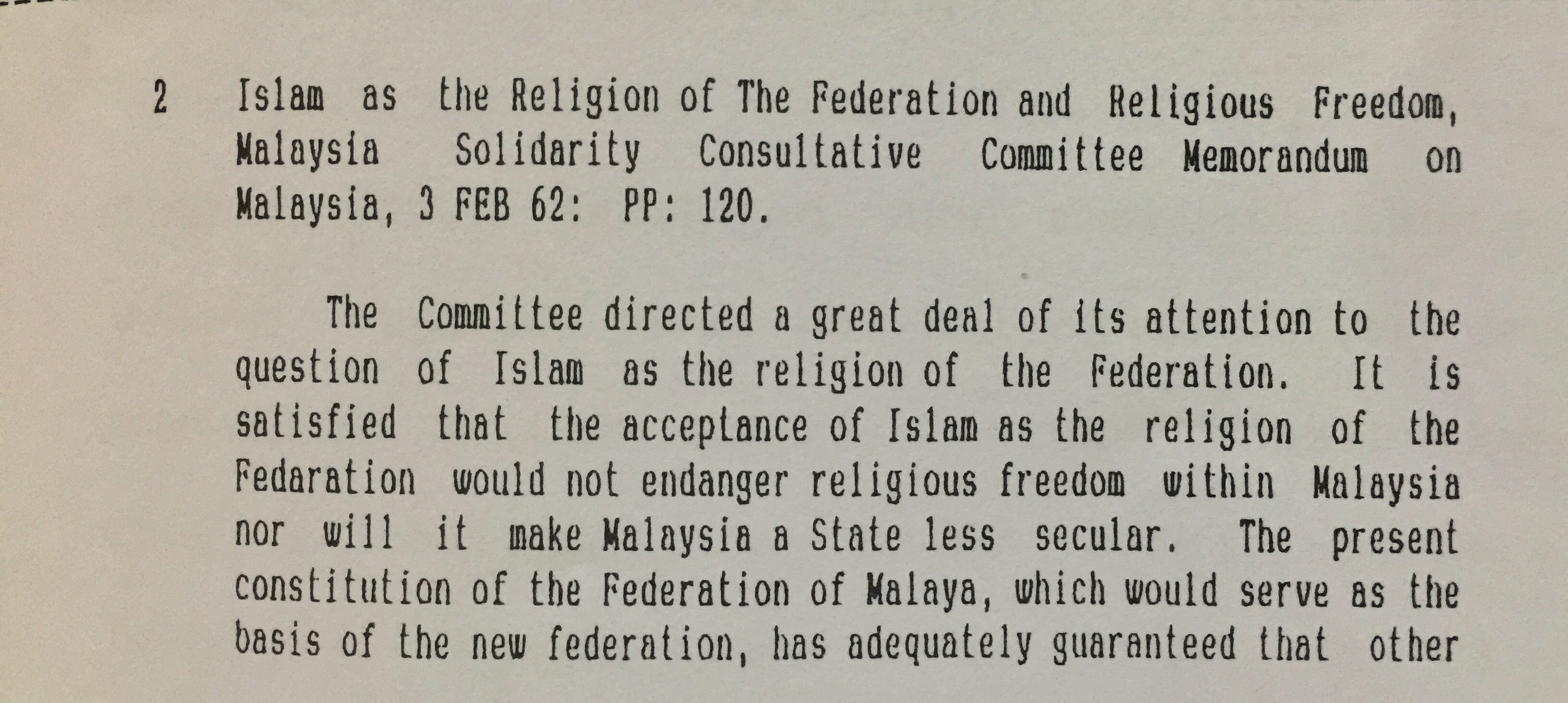
According to the memorandum of the MSCC that was chaired by Donald A Stephens (later Chief Minister of Sabah, Tun Fuad Stephens) with representatives from Singapore, Malaya, Sarawak and North Borneo, the MSCC found that the acceptance of Islam as the religion of the Federation does not endanger religious freedom as evident on Page 120 of the MSCC memorandum dated 3 February 1962:

MSCC Memorandum dated 3 February 1962 PP 120

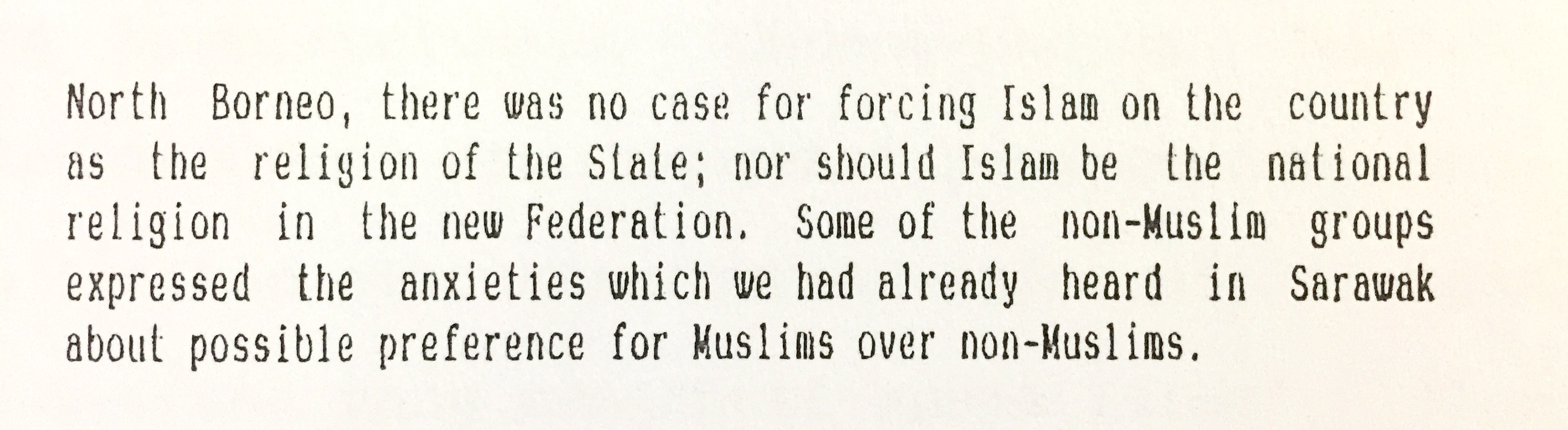
The MSCC had scrutinised the position of Islam in respect of states other than the Malay States and found no objection was made against the then-present arrangement for Pulau Pinang and Melaka to also be adopted by North Borneo, Sarawak and Singapore.

Each of the states above would have its own constitution to address the requirement with Yang DiPertuan Agong as the Head of Islam in those states.  The respective State’s Assembly will enact laws to govern Islamic affairs and form a Board to advise the Yang DiPertuan Agong on matters pertaining to Islam.
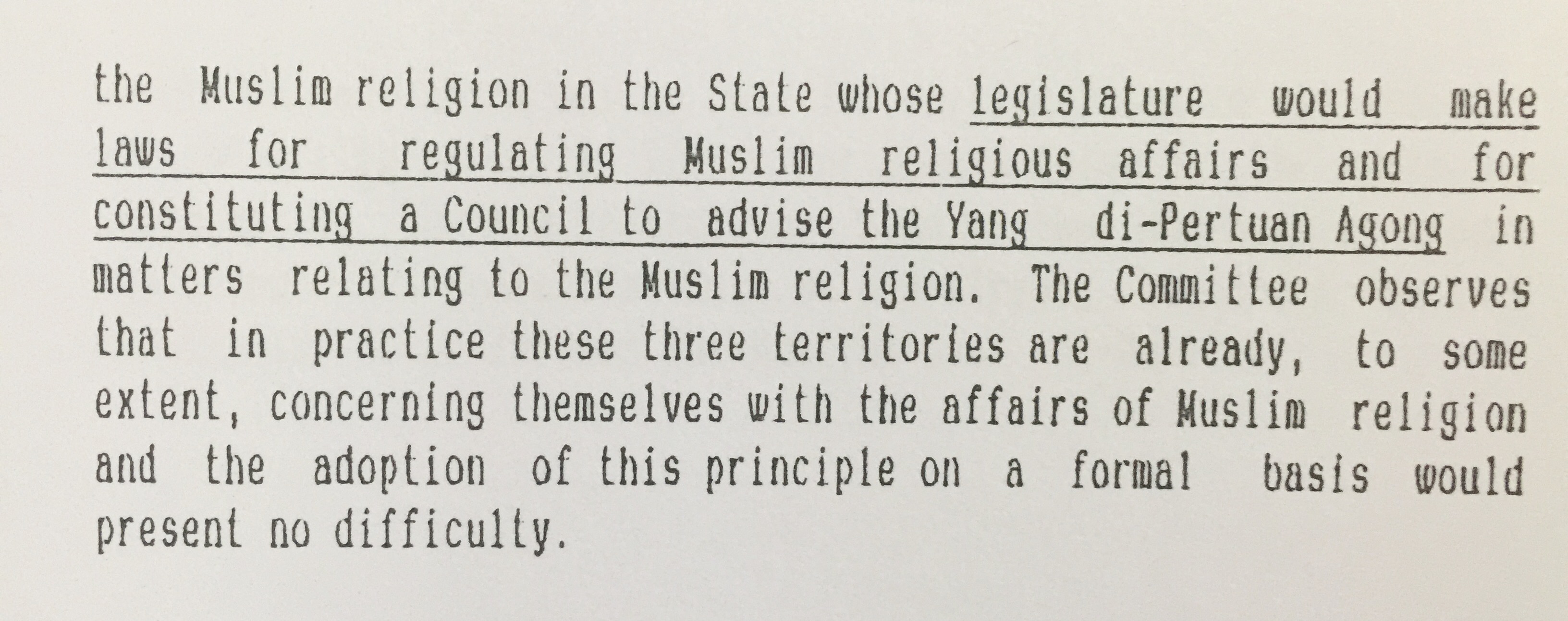
On pages 120 and 121 of the memorandum mentioned it is stated so:


MSCC Memorandum dated 3 February 1962 PP 120-121

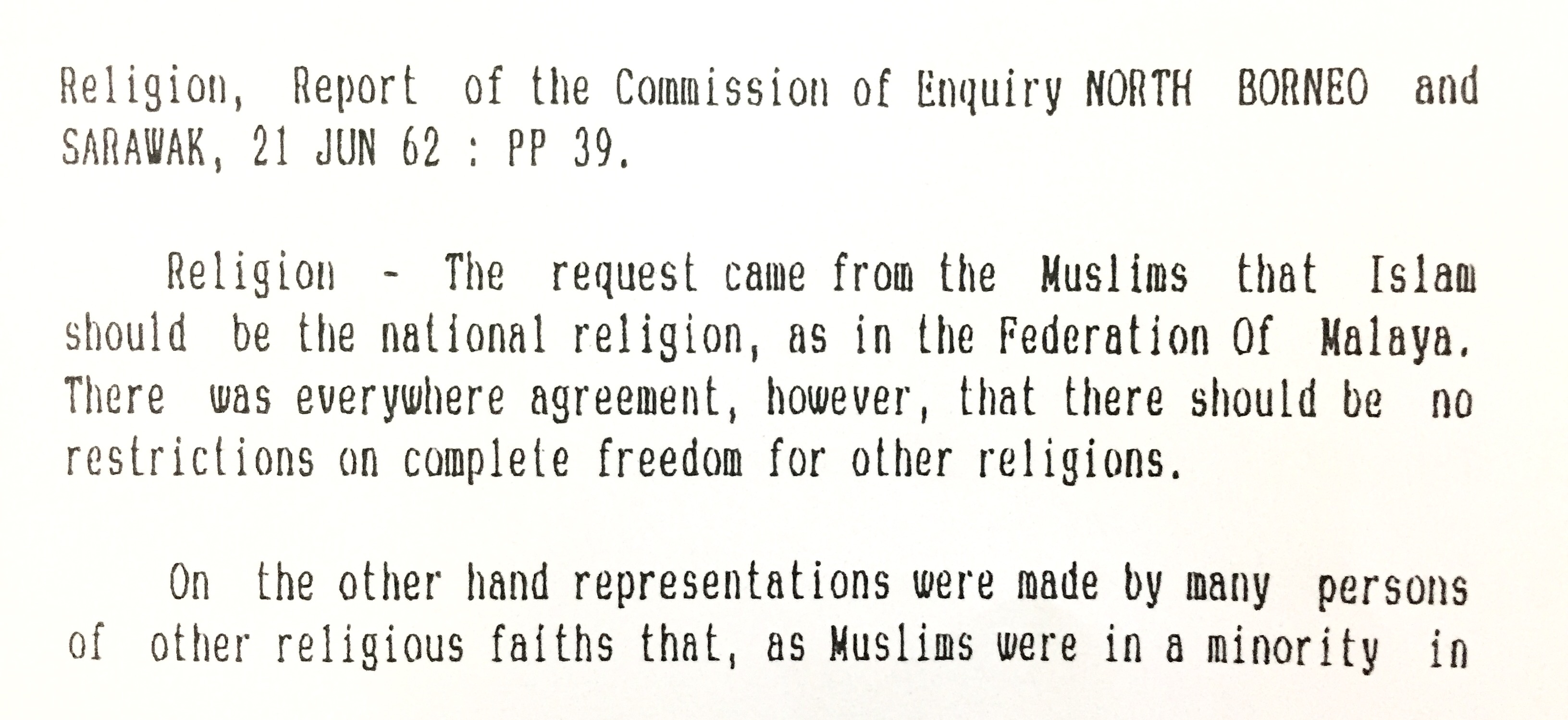
In the Report of the Commission of Enquiry (Cobbold Commission), North Borneo and Sarawak, dated 21st June 1962 found that there was everywhere agreement that as the Muslims are minorities in North Borneo and Sarawak, there should be no restrictions on complete freedom of other religions in those states.

Cobbold Commission Report dated 21 June 1962 PP 39

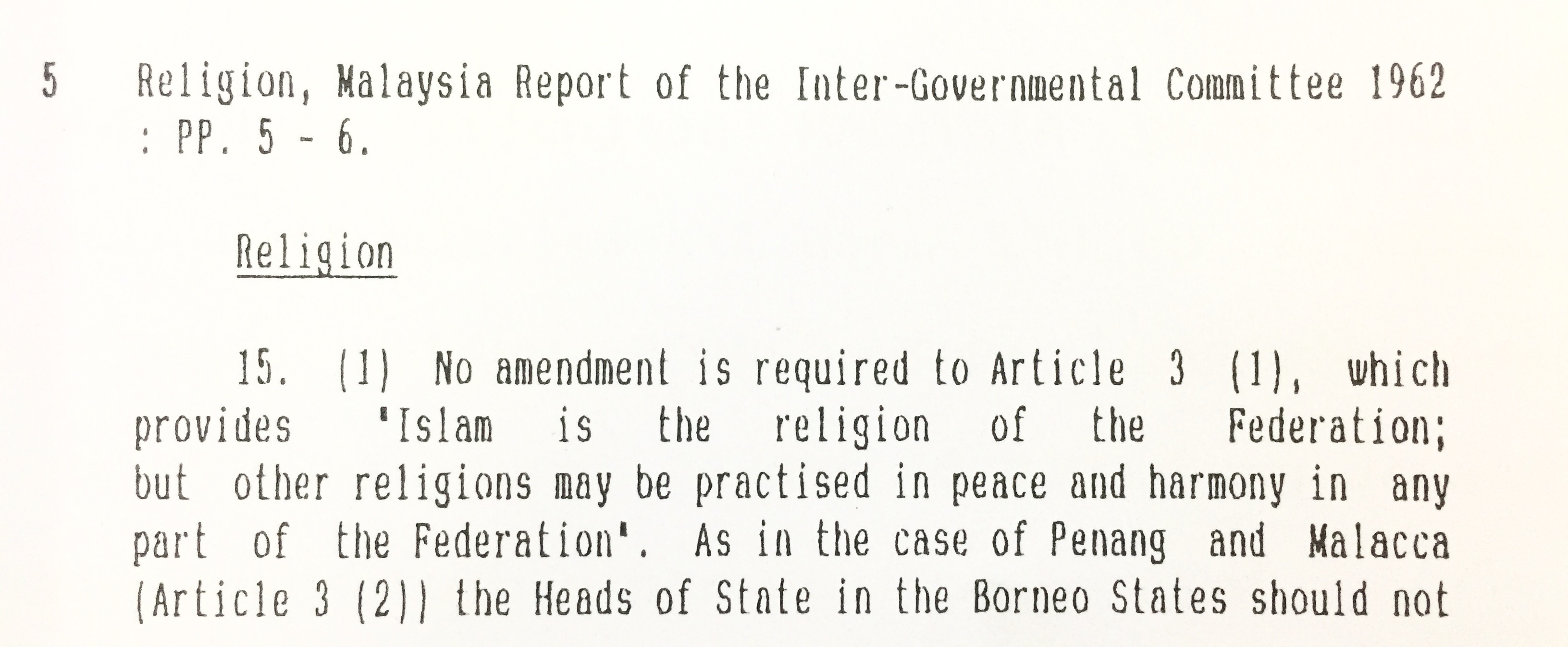
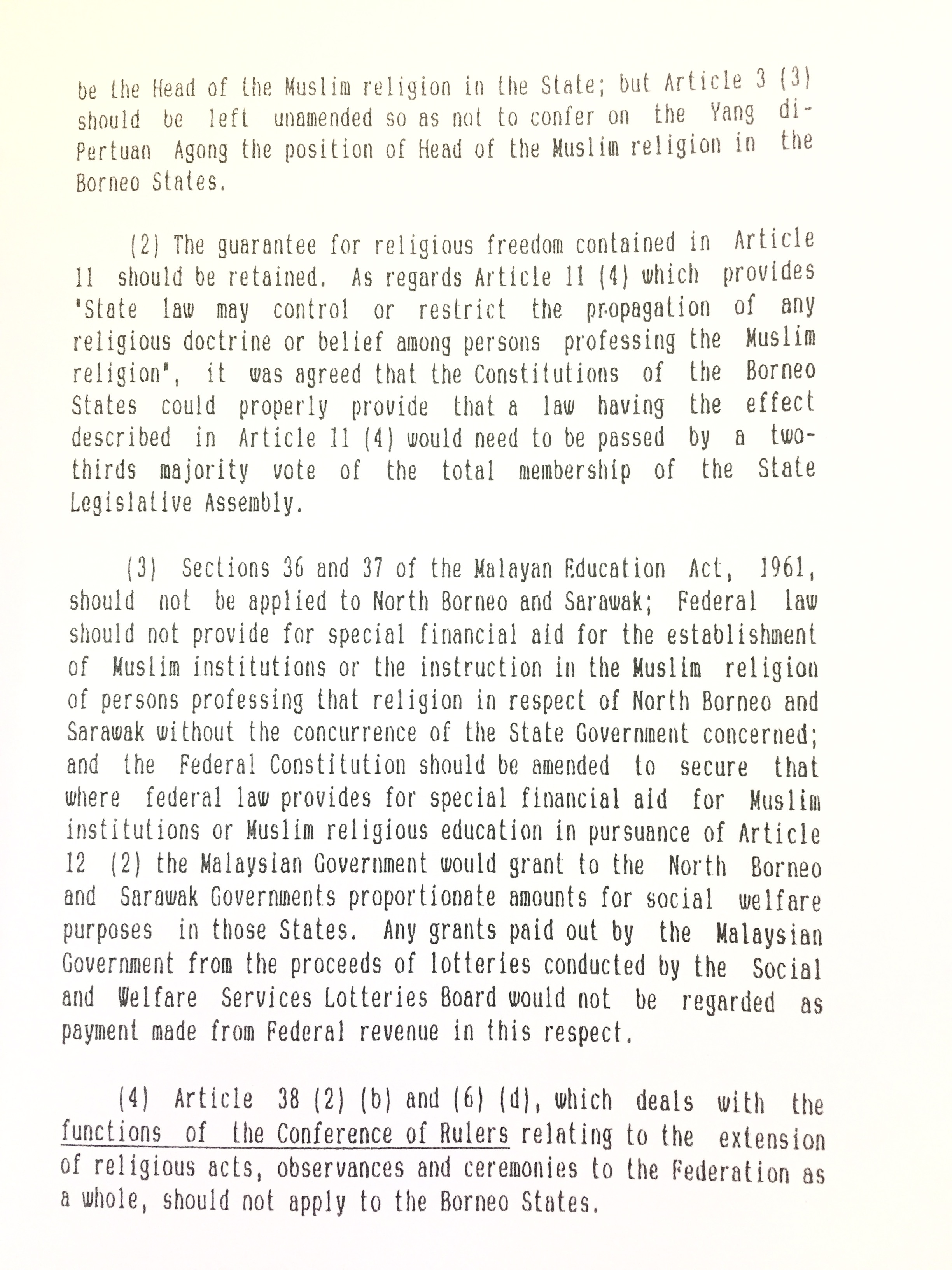
In relation to that, the Inter-Governmental Committee, headed by Lord Landsdowne produced a report in 1962 and made the following recommendations on religion on Pages 5 and 6 which have been passed by the Sabah (and Sarawak) state assembly as follows:

IGC Report 1962 on Religion PP 5-6

The IGC, which has representation from the Federation of Malaya representing the states in the Federation, Singapore, North Borneo and Sarawak, recommended that Article 3 needed no amendment.  However, the provision of financial aid to Muslim establishments should only come with the concurrence of the states of North Borneo and Sarawak.  This has since been provided for via Section 3 of the Sabah Islamic Laws Administration Enactment, 1992 where the Yang DiPertuan Agong is the Head of Islam in Sabah, and a Council (Majlis Agama Islam Sabah) was formed to manage and administer the Islamic affairs in Sabah. This has also been provided in the Sabah State Constitution (Articles 5B(1) and 5B(2)).

As mentioned at the beginning of this article, Dr Jeffrey Kitingan was angered by Tun Datu Mustapha’s action to chase out Christian missionaries from Sabah in 11972.  Dr Jeffrey used this as the basis of raising the religion issue that was presented as part of the 20-point memorandum for the inclusion of Sabah into the Federation of Malaysia.

Having understood the reason for his raising the issue again, we must also understand the events that had taken place after Tun Datu Mustapha’s ousting of the Christian missionaries.

Parti Bersatu Sabah (PBS) won the state elections and formed the Sabah state government in 1985.  From that point up until 1991, the Sabah state government built 825 churches compared to only 216 suraus and mosques.

The state government’s refusal to entertain a request by the Sabah Islamic Council made on the 2nd August 1986 and again on the 12th August 1986 to amend the state’s Shariah Law (Administration) Enactment No.15/77 to accord to the Yang DiPertuan Agong the power to administer Islam in the state of Sabah as required by Article 3(3) of the Federal Constitution (as amended on the 12th August 1976) and Article 5B of the Sabah State Constitution (as amended on the 28th December 1985) clearly denied the Yang DiPertuan Agong His Majesty’s prerogative that was agreed by the Malaysia Solidarity Consultative Council, the findings of the Cobbold Commission as well as the Inter-Governmental Committee, and the wishes made by the Muslims of North Borneo in 1962.

The ousting of the Christian missionaries in 1972 was made because the nine missionaries who were foreigners abused the work permit given to them to work in Sabah, not to conduct evagelical missions.  They were Roman Catholics, Anglicans, the Basil Mission and from the Borneo Evangelical Mission.

As Immigration affairs is a Sabah prerogative as accorded in the Federal Constitution of Malaysia, the first act by the Sabah state government under Tun Datu Mustapha was to deny them an extension of their work permit.  They were then given a 14-day special pass to enable them to make arrangements to leave Sabah.  However, the missionaries refused to obey the 13-day order.

Consequently, they were removed from Sabah through a Removal Order issued by the Sabah Immigration Department made under Section 32 of the Immigration Ordinance 12/59.

The Federal government had no role whatsoever in the removal of these missionaries.  It was purely a state decision that was made based on a sound reason – the people of Sabah, regardless of race or religion had been living harmoniously.  However, these missionaries have been sowing the seeds of hatred among the Christians of Sabah towards the Muslims by telling them to fear the “Islamisation” of Christians through forced conversions, a claim the missionaries themselves could not substatiate.

There was a plea made by the Christians in Sabah to the then-Prime Minister for the missionaries to be allowed to remain in Sabah.  Tun Abdul Razak however recommended to the Christians of Sabah to instead allow priests from the Peninsular and Sarawak to replace the nine missionaries.

In his book, Jeffrey Kitingan had profusely spoken about alleged digressions from and breach of the Federation of Malaysia Agreement but avoided on the issue of the Sabah state government of 1985 breaching agreements made by the MSCC, findings of the Cobbold Commission, the IGC as well as the Federal Constitution of Malaysia.

On the contrary, the Federal government has been fulfilling its end of the agreement by allowing the freedom for other religions to be practiced by its followers as per the agreement.

At no point was there any intrusion made by the Federal government in the affairs of Sabah, and that the removal of the missionaries from Sabah for violating the conditions of the work permit was totally a state issue, made using the powers accorded to the state of Sabah, as agreed by all parties that had agreed on the formation of the Federation of Malaysia.

In the next installement, we shall talk about the second point – LANGUAGE.

The Sinister Daily

Ask Blogger-turned-Deputy Minister, YB Dato’ P. Kamalanathan, about fake news and he would lament the demise of ethical journalism.  He was once asked by a journalist from a local daily to comment on the video of an Indian-looking woman having her head shaved by two Malay-looking men that was made viral.

Being a responsible social media practitioner, Kamalanathan made the effort to verify the authenticity of the video, only to find out that it had originated from a South American nation, and the incident had happen in that particular country.

When we talk about the ethics of journalism, we would easily imagine the responsibility to ensure the accuracy of the journalists’ work; to verify information before releasing an article; and to shun stereotyping.  Unfortunately, in the world of today’s journalism, accuracy is no longer a value but sensationalism is.  More often than not, an article is conjured to shape the way readers think rather than to allow them to form their own opinion based on a balanced article.

Coincidentally, twenty years ago this year, the eighteenth James Bond movie was released. It was about a psychopathic media mogul who plans to provoke global war to boost sales and ratings of his news divisions.  Although far-fetched, the plot is what many online and print media do nowadays.  And what is to be provoked may not be as dangerous as a global war but equally explosive racial or religious clashes.

Enter The Star.

Yesterday evening, The Star announced the immediate suspension of its Group Editor-in-Chief, Datuk Leanne Goh Lee Yen and executive director Dorairaj Nadason, but not before it sent four editors to face the wrath of the KDN.  The KDN had slapped the daily with a seven-day show cause, while the Inspector-General of Police has begun investigating it under the Sedition Act.

Sedition Act may be seen as a heavy-handed response, but not given The Star’s penchant for inciting racial and religious outrage. It has an array of examples of provoking the above.

During the month of Ramadhan in 2011, The Star published three pork-centred advertisements in its Ramadhan Delights pullout.  Three pork advertisements in a Ramadhan Delights pullout could not have been unintentional. The KDN summoned The Star and was let off with a slap on the wrist.

A screenshot of justread-whatever.blogspot.com article on The Star’s Ramadhan Pork Fest

A mere two years later, it published a report on the rise in the number of child marriages in Malaysia.  The choice of visual display accompanying the report was extremely suggestive.

The suggestive photo used by The Star when reporting on child marriages

The Star harped only on the 2012 statistics provided by the Malaysian Syariah Judiciary Depart­ment (JKSM) where 1022 marriage application involving at least a minor was approved by the Syariah judiciary.  And then it sought the view of Sisters in Islam to justify the report, putting Islam in a bad light.

What it failed to report was that in the same year, 468 marriages involving non-Muslim minors were also approved.  How is that for balanced reporting?  I know that the link given is from 2016, but could the The Star journalist filing that story not have gone to the National Registraton Department to seek for the non-Muslim numbers?

What is sad is that the story was filed by a Muslim journalist.

However, not all of The Star’s journalists were dancing the same tune.  Joceline Tan whose columns have been taking on the Opposition by the horns, faces the wrath of the DAP and PKR on almost a daily basis.  Another was Sira Habibu who, when based in Pulau Pinang, wrote exposés on the DAP and PKR polls.

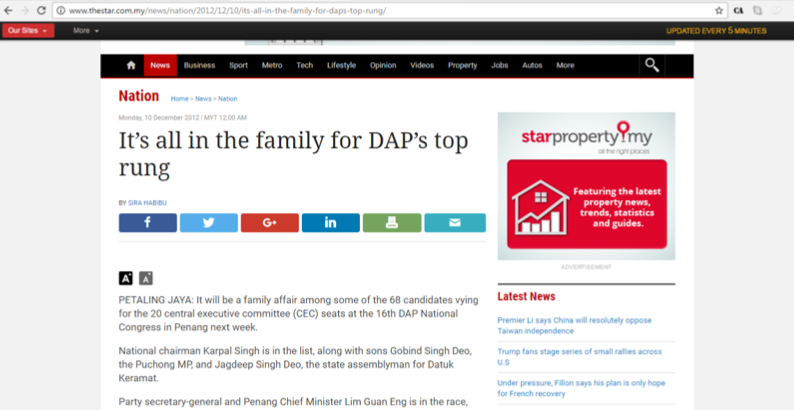
Things changed for Sira Habibu when Leanne Goh was appointed the Group Editor-in-Chief in 2014.  Sira was tranferred to Kelantan and away from being able to do stories on especially the DAP.  She had one very notable article ridiculing the DAP polls which was given the title “It’s All In The Family For DAP’s Top Rung.”

Sira Habibu’s article ridiculing the DAP line up

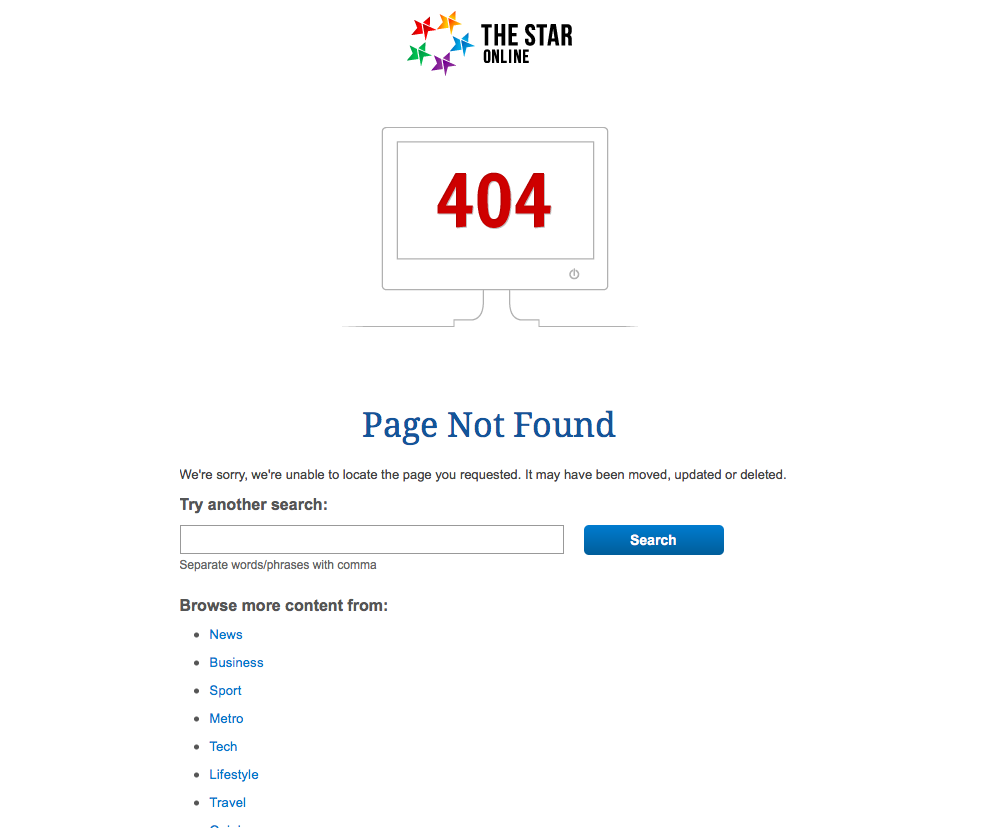
If you search for the article using its URL now, which is www.thestar.com.my/news/nation/2012/12/10/its-all-in-the-family-for-daps-top-rung/ you will find that it is no longer there.

This is where Sira Habibu’s article on the DAP line up was

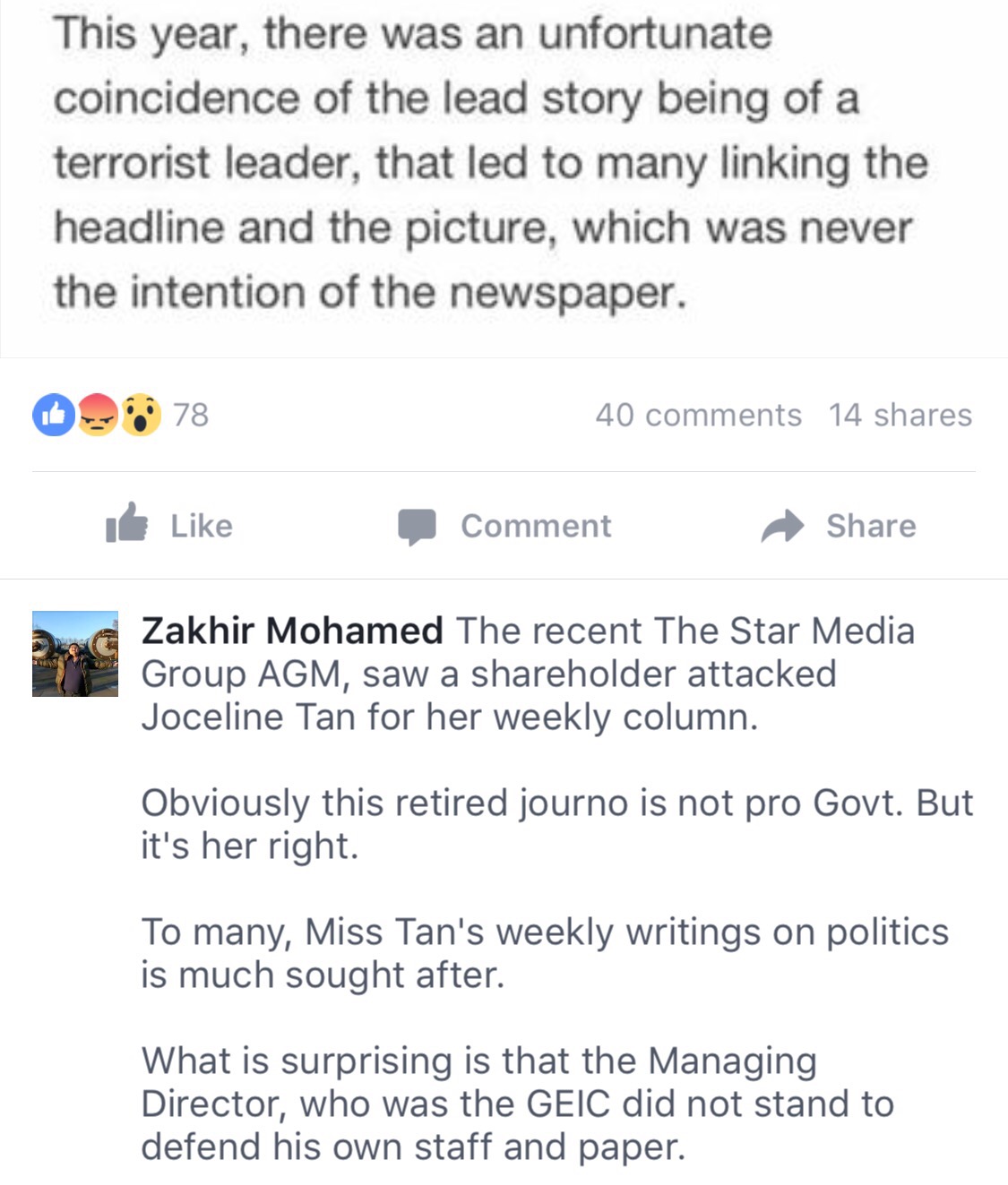
Leanne Goh did not even defend Joceline Tan’s writing when attacked by a former The Star journalists for being anti-Opposition.

Since then, The Star has been pandering to the DAP evangelists and Liberal Muslims on the pretext of promoting a “Moderate Malaysia.”

When Pastor Ramond Koh went missing in February 2017, The Star went to town with the case, reporting at least seven times between March and May this year on the issue with headlines such as this:

The above headline suggests that the Malaysian security forces and indirectly the Malaysian government may be involved in the disappearance of the said pastor.  The location of the video is not where the pastor was first said to have gone missing and the speed of the CCTV camera panning suggests that there was someone controlling the camera and that the person knew what to wait for and what was going to happen.

The Star’s coverage of the missing pastor was picked up by foreign portals that have since put Malaysia in a bad light.

All the above quoted The Star.  So what is Leanne Goh’s game?

The Star has since suspended Leanne Goh and a senior editor Dorairaj Nadason over the frontpage fiasco, and have returned Datuk Wong Chun Wai to oversee the editorial operations.  But mind you some of the examples I mentioned above also happened during Chun Wai’s time as the GEIC which goes to show that he was not in total control back then.

The Star has issued countless apologies especially to the Muslims in Malaysia but has remained remorseless.

So would Chun Wai be able to wrestle the evangelist and liberal monsters who reside within The Star, or would a suspension of its publishing and printing permits that it so deserves be needed to remind not only The Star, but all journalists to be ethical? Maybe only then its habit of promoting racial and religious hatred will stop.

We will see what the next six days will bring us.

Did Lim Guan Eng Suggest Anarchy To Overthrow The Government?

Apparently on the 10th December 2014, Tokong Lim suggested that if the Barisan Nasional wins the next general elections when it does not get the popular votes, the change must be done from the streets.

He was speaking at the Lecture Theatre, Student Wing, Block S3.1 Level B3, Rajaratnam School of International Studies, Nanyang Technological University, Singapore.

If the following recording is authentic then the Tokong is not just a corrupted politician and ex-convict, but also an agent provocateur for inciting an undemocratic method to change His Majesty’s government.

LIM GUAN ENG’S SPEECH
“We know that Barisan Nasional are sore losers. They are really sore losers and they will not give up power that easily. Now, what will happen if they refuse to give up power? And I think this is one very important question in people’s minds, especially in the last election when we won the popular mandate but not the number of seats, we can see the huge mess if this issue comes out.

Now, if we win power, both in terms of popular votes, that means the popular votes, but (also) in terms of the number of seats, and then we are not allowed to take power, I think the matter has to be resolved on the streets and it will be resolved on the streets.”
TERJEMAHAN UCAPAN LIM GUAN ENG
“Kita tahu bahawa Barisan Nasional adalah jenis yang tidak berpuas hati jika kalah. Mereka adalah jenis yang sangat tidak berpuas hati jika kalah dan mereka tidak akan menyerahkan kuasa dengan mudah. 

Sekarang, apa akan berlaku jika mereka enggan menyerahkan kuasa? Dan saya fikir ini adalah satu soalan yang sangat penting dalam minda rakyat, terutamanya dalam pilihan raya lepas bila kita menang mandat popular tetapi bukan bilangan kerusi, kita boleh lihat kacau-bilau besar jika isu ini timbul.

Sekarang, jika kita mendapat kuasa, di dalam kedua-dua dari segi undi popular, maknanya tentunya undi popular, tetapi (juga) dari segi bilangan kerusi, dan kemudian kita tidak dibenarkan untuk mengambil-alih kuasa, saya fikir perkara ini mesti diselesaikan di jalan-jalan raya dan ia akan diselesaikan di jalan-jalan raya.”

This is what the law says:

PENAL CODE

130G. Whoever knowingly— (a) incites or promotes the commission of a terrorist act; shall be punished with imprisonment for a term which may extend to thirty years, and shall also be liable to fine.

153. Whoever malignantly or wantonly, by doing anything which is illegal, gives provocation to any person, intending or knowing it to be likely that such provocation will cause the offence of rioting to be committed, shall, if the offence of rioting is committed in consequence of such provocation, be punished with imprisonment for a term which may extend to one year, or with fine, or with both; and if the offence of rioting is not committed, with imprisonment for a term which may extend to six months or with fine or with both.

DEFINITION OF TERRORIST ACT

(3) An act or threat of action falls within this subsection if it— (a) involves serious bodily injury to a person; 90 Laws of Malaysia ACT 574 (b) endangers a person’s life; (c) causes a person’s death; (d) creates a serious risk to the health or the safety of the public or a section of the public; (e) involves serious damage to property; (f) involves the use of firearms, explosives or other lethal devices; (g) involves releasing into the environment or any part of the environment or distributing or exposing the public or a section of the public to— (i) any dangerous, hazardous, radioactive or harmful substance; (ii) any toxic chemical; or (iii) any microbial or other biological agent or toxin; (h) is designed or intended to disrupt or seriously interfere with, any computer systems or the provision of any services directly related to communications infrastructure, banking or financial services, utilities, transportation or other essential infrastructure; (i) is designed or intended to disrupt, or seriously interfere with, the provision of essential emergency services such as police, civil defence or medical services; (j) involves prejudice to national security or public safety; (k) involves any combination of any of the acts specified in paragraphs (a) to (j), and includes any act or omission constituting an offence under the Aviation Offences Act 1984 [Act 307].

The police must act on this lunatic.

Dunce Accumulating Party – Part 3

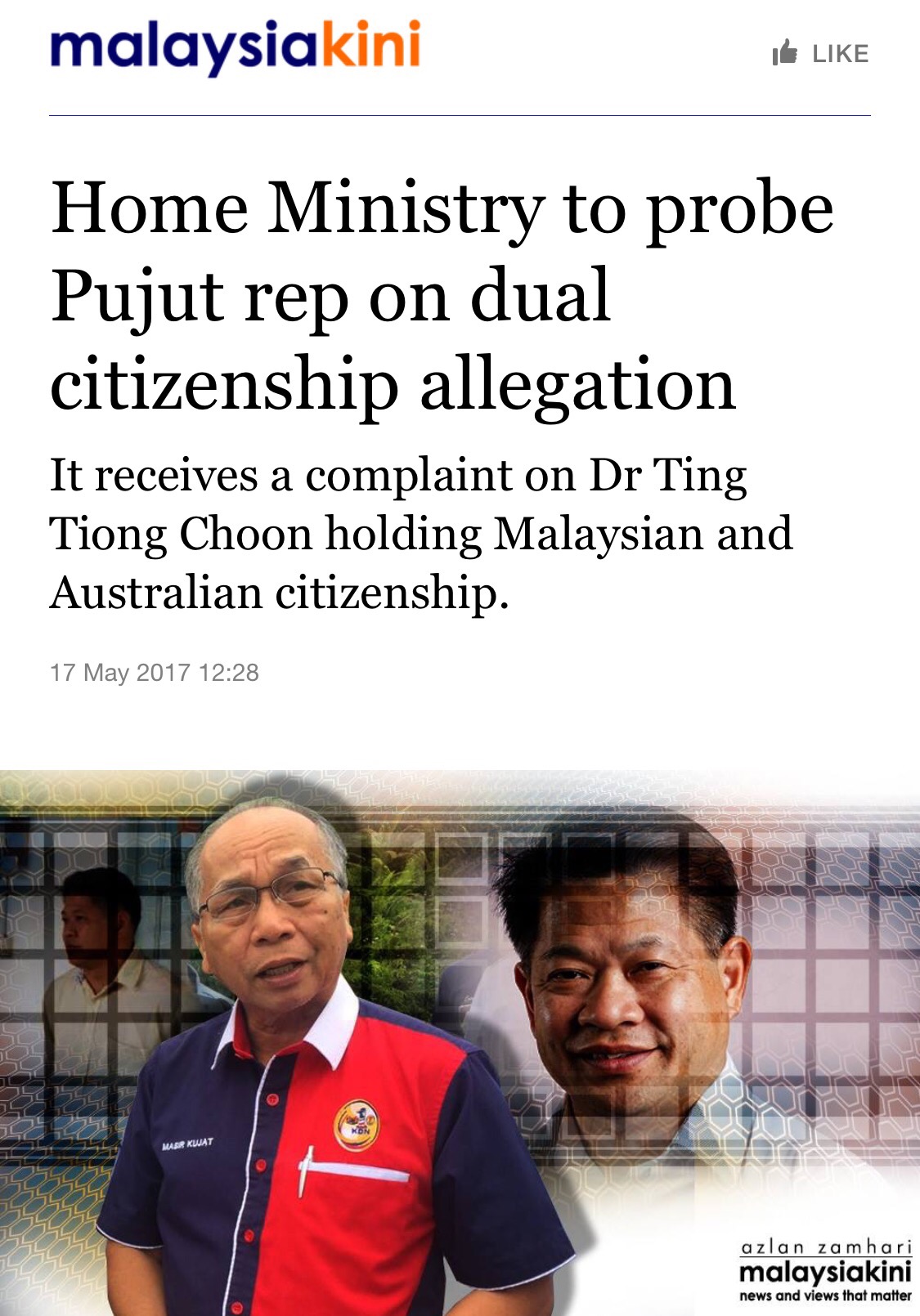
Do you still remember Ting Tiong Choon, the Australian with the bak chang face who duped the idiots living in Pujut into voting for him into office last year?

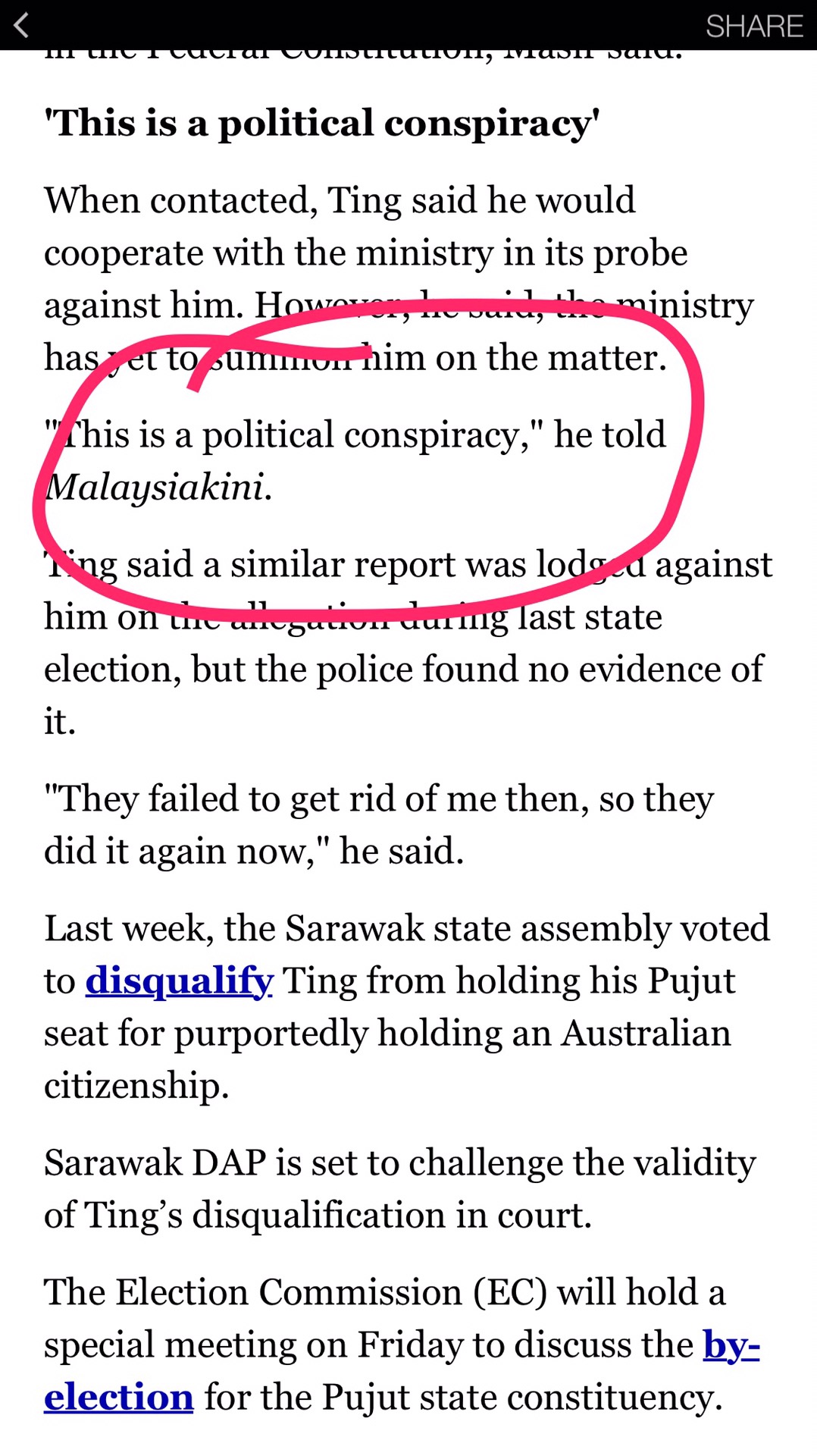
He claims that his removal from the Sarawak State Assembly is a political conspiracy.

Yes, the bak chang-faced Australian claims that it was a political conspiracy that had him ejected as an ADUN.


This conspiracy would have begun eight years before Ah Choon was born. Those who drafted the Federal Constitution knew that Ah Choon would be born in Malaysia on the 31st October 1965, and then apply for a PR status in Australia on 5 May 1994 after entering the country using a student visa on 7 May 1994.

However, he had his application rejected on 3 April 1995. In 2007 and 2008, Ah Choon bought substantial number of properties and set up many companies, and then applied for an Australian citizenship under the INVESTMENT category.

You can read more about it here.

That is how advanced the political conspirators were.

It did not sound as if Ah Choon had Malaysia’s interests at heart, nor the intention to return as a Malaysian to help Sarawakians as claimed.

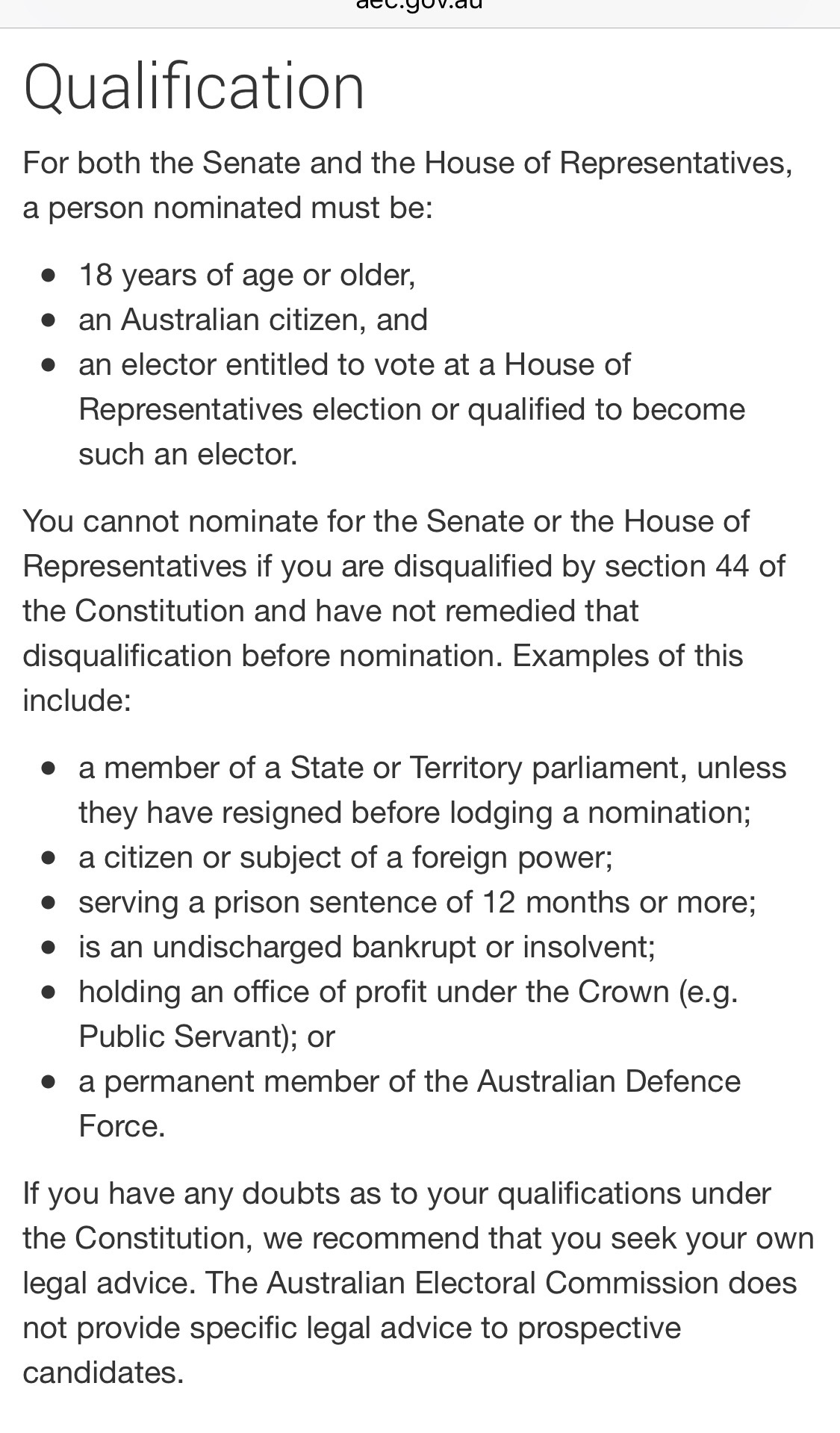
The moment you take up another country’s citizenship you lose your Malaysian one. It is that simple.

And as a foreigner, you cannot contest in Malaysia’s elections, state or federal.

You cannot contest in Australia too if you are a foreign citizen.


Perhaps Ah Choon cannot read because he is perhaps an Ah Beng.

Or perhaps it is a DAP political conspiracy to field a foreign phantom candidate and then act stupid and lay the blame on the Barisan Nasional.

DAP after all is filled with criminals and lawbreakers.