The title above sounds like the phrase “kong ka li kong” which in Kamus Besar Bahasa Indonesia describes as untrustworthy, scheming, conspiring in an evil plot. It describes the DAP aptly.
I can imagine how majority of the voters in Penang must have felt in March 2008 when Pakatan Rakyat managed to wrestle Pulau Pinang from the clutches of BN’s Gerakan after almost 51 years. It was a hopeful change for the better. Voters then probably thought that the Barisan Nasional did not really fit into their idea of progress and prosperity a clean and efficient government might have given. They tried their luck thinking that it was worth a try to change. The candidates from the Pakatan Rakyat, too, thought that it was worth a try although they did not envisage a victory.
When they did, they had no idea how to fulfill promises that had been made to the voters. The most famous of all promises was that Kampung Buah Pala that had been in existence for decades, would remain standing. This was the promise made by Anwar Ibrahim in the run up to the 12th General Elections.
In the video below you could see Anwar Ibrahim promising the residents of Kampung Buah Pala that he would speak to the Chief Minister-designate and within two weeks, officers from the Chief Minister-designate’s office would announce themselves that Kampung Buah Pala would be saved.
And the people of Kampung Buah Pala probably fell for it and helped vote Gerakan out on the 8th March 2008. Less than three weeks later, the village that had stood for decades was bulldozed.
Anwar could also claim that the person in the video above was not him – the person may look like him, but was not him.
However, a similar promise was made by a DAP candidate by the name of Sanisvara Nethaji Rayer s/o Rajaji Rayer. Rayer promised that the village would remain a standing village should Professor Dr. P. Ramasamy (of DAP) remain in power. “As long as the Tiger of Bukit Gelugor (Karpal) represents us, I am sure no one can enter our territory,” he was quoted to have said.
Then, comes the gentrification of Pulau Pinang. The poor, be they Chinese, Malay or Indians, are being systematically removed from their traditional dwelling in the name of progress and development.
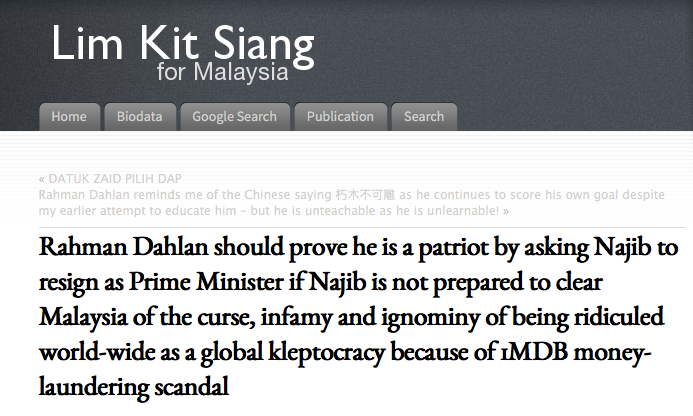
While his son has been charged in court for corrupt practices while holding the Chief Minister’s office, Emperor Lim Kit Siang is still asking for Najib Razak to resign over the 1MDB issue.
However, it is typical of DAP to NOT walk the talk.
Hopefully the voters of Penang and in other states have wised up. DAP under the Emperor and Tokong has done more than what you have accused the BN of doing in just under two terms. If you realy hate BN but want people with integrity, you should really kick the Lims out, as well as perpetual liars like Tony Pua. They are not indispensable. And they are NOT as popular in DAP as Teresa Kok paints them to be.
Think carefully! Save your island before it sinks.
Long before most netizens and majority of the current workforce were born, DAP’s Emperor Lim Kit Siang complained on 1st September 1977 about the lack of public transport and increase in fares by now-defunct well-known bus company, Sri Jaya. Four days later, he called for the resignation of both Ganie Gilong of Sabah who was the Transport Minister, and Dr Goh Cheng Teik who was the Deputy Transport Minister to resign.
Political and monetary instabilities as a result of the international monetary crises in the early 1970s and the oil crisis in late 1973 contributed to the worldwide recession, stagflation and very slow recovery. Consumer Price Index (1967 = 100) jumped by 10.5 percent in 1973 and 17.4 percent the following year. In 1977 it was down to 4.7 percent, the lowest since 1973, and the CPI figure never went down further until 1984.
Money, Income and Prices of Malaysia (1966-89) from the book The Monetary and Banking Development of Singapore and Malaysia by Sheng-Yi Lee
It was a time when Malaysians could hardly afford anything. In order to assist the rakyat, Tun Abdul Razak set up the Restoran Rakyat in August 1973. It was where a nasi lemak breakfast would cost only 20 sen and a simple lunch of rice, fish curry and vegetables would cost only 80 sen. Of course, 20 sen those days is like RM2.00 of today but any balanced meal today that costs less than RM10.00 per plate is greatly welcomed.
The Restoran Rakyat, near today’s Dataran Merdeka – Tun Razak’s way of helping the rakyat in KL to overcome inflation (courtesy of harithsidek.blogspot.com)
Also introduced by Tun Razak was the BMW – Bas Mini Wilayah, in September 1975. The fare to any destination was 40 sen then and was only increased to 50 sen in 1991 and 60 sen two years later. The BMW services were discontinued in July 1998 when it was replaced by Intrakota and subsequently RapidKL in 2005.
The notorious BMW – BERNAMA Images/Paul Tan
Today, as a result of a great foresight by the current government, land public transport and infrastructure have improved in leaps and bounds. According to a research report published on the 4th April 2017 by the Financial Times, Malaysia’s transport users get the best deals in ASEAN.
Graphs comparing Malaysia and the rest of the ASEAN-5 in terms of spending on transport as well as the WEF’s ranking for the ASEAN-5 transportation infrastructure (Financial Times)
The graph shows that Malaysian commuters spend about USD12 per day on commuting as opposed to Indonesia, Vietnam and the Philippines where commuting could cost up to USD20 per day, the only exception being Thailand where it could get to USD15 per day.
Malaysia is also ranked in the Top 20 from 138 nations in terms of transportation infrastructure, according to the World Economic Forum.
Malaysian spending on transportation rose to 0.7 percent of the GDP in 2016 compared to 2015, and the Financial Times research report attributes this to Prime Minister Najib Razak who continues to make infrastructure a key priority.
While the completion of the MRT SBK (Sungai Buloh-Kajang) Line 1 targetted for July 2017 and the construction of the MRT SSP (Sungai Buloh-Putrajaya) Line 2 and LRT 3 now taking place, urban and suburban dwellers in the Klang Valley can expect a much economical and more integrated mode of getting around, while feeder services such as the ETS, KTM Komuter, and the soon-to-be-expected HSR and double-tracking projects will allow growth in other areas and allow for cross-country commuting to and from work.
Projects like the ECRL and the Pan-Borneo highway will provide for the growth and availability of jobs not only in the urban areas but also in greenfields as well as pockets of rural towns where meaningful economic activities have thus far eluded.
With a projected population of 32.5 million by 2030, elaborate and efficient land public transport systems must be in place to ensure efficient mobility within and between spatial conurbations across Malaysia while the introduced National Land Public Transport Master Plan (NLPTMP) will ensure continual improvements and additions are made to the land public transport systems.
Malaysians should be thankful that plans have been made to improve transportation infrastructure instead of constantly complaining.
What everyone fears most is for the Malays to unite. I wrote this a few months back. All the lawmakers know that the RUU355 amendments have no impact whatsoever to the non-Muslims, and even if all the Muslims MPs from both PAS and UMNO were to vote for the amendments, they will never attain the 2/3rd majority required to pass the bill for it to go to the next stage.
Which is why the Malays in the DAP, PAN, PKR and Pribumi are the tools for the DAP leadership to use, as in the words of Superman Hew, “to screw the Malays using the Malays.”
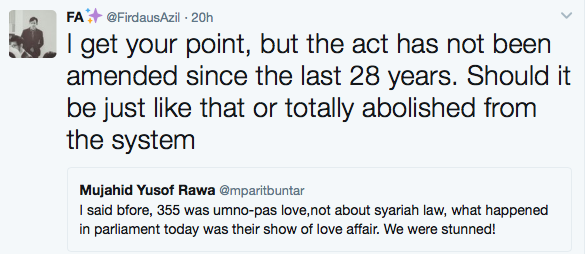
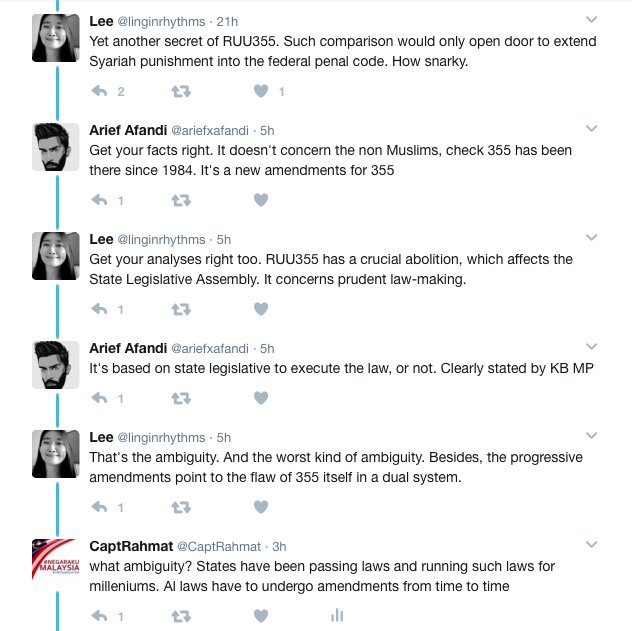
Objections are raised using mainly the Malay tools. The screen-capture of a Twitter conversation between a BERNAMA journalist and a PAN MP is the evidence to that.
In the run up to its tabling, the RUU355 has met with lots of resistance. I don’t believe that the lawmakers don’t know that it is the right of each religious group to manage and administer its own affairs. I also don’t believe that the lawmakers do not know that Islam is the religion of the Federation.
But the resistance towards it is mainly to avoid the provision of an opportunity for Muslims and Malays to unite just before the next general elections. They oppose just for the sake of opposing.
And then in comes the individuals who do not see or understand that in Islam, protecting the rights of a community supercedes the rights to protect an individual’s rights, nor understand the separation of jurisdiction between the civil law and Syariah law.
This dual system of law first existed in the Malay states in Perak in 1807 with the introduction of the Royal Charter of Justice of 1807 in Pulau Pinang. Prior to that, laws based on the Syariah has been the lex loci of this land.
Islam first came to this land in the ninth century A.D and flourished in the 13th century, 200 years before the kingdom of Melaka was founded. The first evidence of a coded Syariah law was from the Terengganu’s Batu Bersurat, written in 1303, a full century before Melaka.
The kingdom of Melaka produced two major legal digests, which formed the main source of written law in Melaka – the Hukum Kanun Melaka , and the Undang-Undang Laut Melaka . The Hukum Kanun consists of 44 chapters, which touched upon matters such as the duties and responsibilities of the Ruler, prohibitions amongst members of society and penalties for civil and criminal wrongs and family law. The Undang-Undang Laut consists of 25 chapters, which covered maritime matters, such as the duties and responsibilities of ships’ crew, laws pertaining to voyages and trade. The law contained in the above written codes are said to be based on Islamic law of the Shafie School, together with elements of local custom.
Melaka’s written codes were responsible for the growth of other written codes in other states of the Peninsula: Pahang Legal Digest 1595, the laws of Kedah 1605, the Laws of Johore 1789, and the 99 Laws of Perak, 1878.
Therefore, the question of the Syariah creeping into the lives of the Muslims of the land does not hold true. The reverse however is. The RUU355 is not about amending the offences but merely seeking the agreement to enhance the punishments to be meted out for the offences. And as explained in previous writings as per clickable links above, the Federal Constitution is the supreme law of the land and therefore offences already covered in the Penal Code as well as in other civil laws made canoot be tried under the Syariah laws of Malaysia.
Furthermore, the separation of jurisdiction of the legal systems provided by the Constitution also ensures that the rights of non-Muslims are protected – only Muslims can be subjected to the Syariah law.
On the question of the Muslims being subjected to dual laws, this is not a problem. If a Muslim commits theft, he will not get his hand amputated in Malaysia. Theft is an offence under the Penal Code and therefore the Muslim offender gets punished according to what is provided for by the Penal Code. The punishments that the Syariah court can mete out cannot go beyond the Second List of the Ninth Schedule of the Federal Constitution of Malaysia.
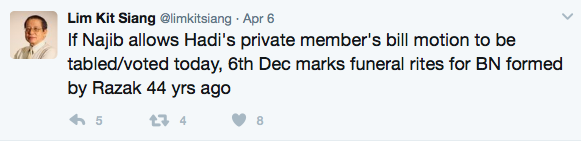
DAP Emperor Lim Kit Siang was against the introduction of Section 298A of the Penal Code of Malaysia. In a Parliament debate on the 9th December 1982 on the Penal Code and Criminal Procedure Code (Amendment) Bill 1982 he said the following:
I quote:
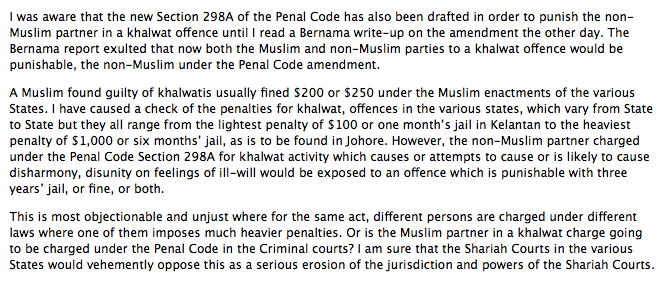
I was aware that the new Section 298A of the Penal Code has also been drafted in order to punish the non-Muslim partner in a khalwat offence until I read a Bernama write-up on the amendment the other day. The Bernama report exulted that now both the Muslim and non-Muslim parties to a khalwat offence would be punishable, the non-Muslim under the Penal Code amendment.
A Muslim found guilty of khalwat is usually fined $200 or $250 under the Muslim enactments of the various States. I have caused a check of the penalties for khalwat, offences in the various states, which vary from State to State but they all range from the lightest penalty of $100 or one month’s jail in Kelantan to the heaviest penalty of $1,000 or six months’ jail, as is to be found in Johore. However, the non-Muslim partner charged under the Penal Code Section 298A for khalwat activity which causes or attempts to cause or is likely to cause disharmony, disunity on feelings of ill-will would be exposed to an offence which is punishable with three years’ jail, or fine, or both.
This is most objectionable and unjust where for the same act, different persons are charged under different laws where one of them imposes much heavier penalties. Or is the Muslim partner in a khalwat charge going to be charged under the Penal Code in the Criminal courts? I am sure that the Shariah Courts in the various States would vehemently oppose this as a serious erosion of the jurisdiction and powers of the Shariah Courts.
So, in 1982 Lim Kit Siang opposed the introduction of Section 298A because a similar offence tried under the Syariah law would only provide for a much lesser sentence. Why is he complaining now about Hadi wanting to introduce higher punishments for the same? Wouldn’t it be fair for the non-Muslims?
He added:
As the purpose of the 2M government is to uphold the sanctity of Islam, defend true Islamic values and Muslim unity in the country so as to be able to deal with the problems of kafir mengafir, two imam issue, separate prayers and burials, in the Muslim community, the government should confine its legislative efforts to the Muslims only, and not draft a Bill with such far-reaching consequences in allowing for State interference in the practice, profession and propagation of non-Muslim faiths.
35 years later, he backtracks on the need for Muslims to make better its laws for the Muslims only. Which is why I say Lim Kit Siang is opposing for the sake of opposing so that the Muslims do not rally behind this bill months before the general election is due.
Even PKR’s Wong Chen acknowledged back on 29th Aril 2013, six days before the 13th General Elections that in order to gain support from the Malays, PAS, which was a partner in the Pakatan Rakyat coalition, needed to play up the Hudhd issue and had the full support from the parties in the Pakatan Harapan.
Hannah Yeoh, who is the Speaker of the Selangor State Assembly even allowed the Hudud motion to be brought into the assembly. So why oppose the same motion when it is brought into Parliament? Why the double standard?
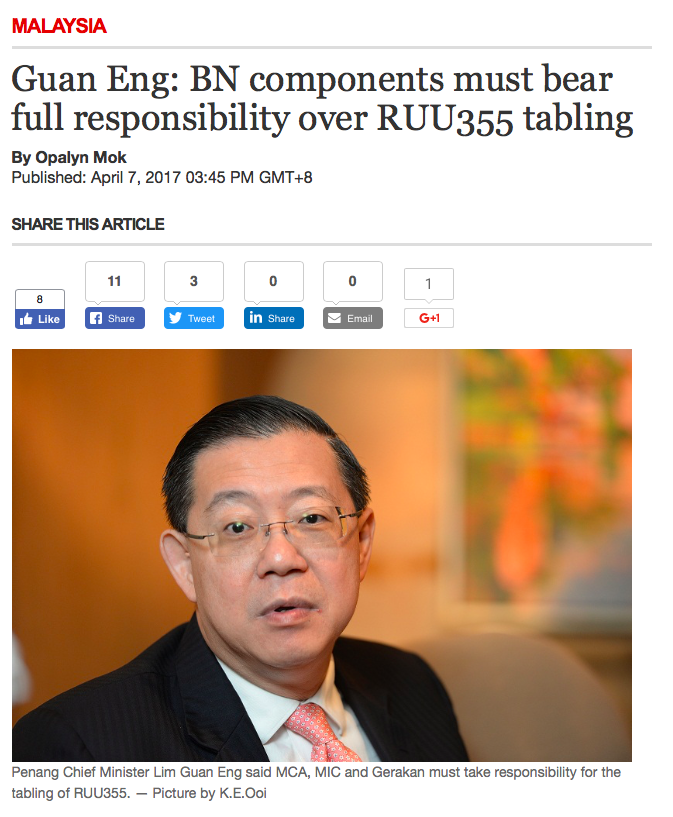
And why must Lim Guan Eng ask the BN components such as MCA, MIC and others to bear responsibility for the tabling of the RUU355? Why don’t he ask his party’s Anthony Loke and Hannah Yeoh instead? They both supported Hudud and the tabling of Hudud in the Selangor State Assembly (as in the case of Hannah Yeoh).
Anthony Loke even went to town with his support for Hudud telling his Chinese audience not to be aafraid of Hudud:
Yet, the RUU355 is not even about Hudud. So, what is unconstitutional about the RUU355?
Only the objections by the vapid non-Muslims against the RUU355 is unconstitutional, as it is a right given to all religious groups, not just the Muslims, to manage its own affairs. I don’t have to agree with the amendments proposed by the RUU355, but it is my religion and therefore it should be left to the Muslims to manage its own affairs – as guaranteed by the Federal Constitution.
And as for the atheists, just stay off my social media accounts. You don’t have the locus standi to participate in this debate.
Imagine not long after QZ8501 went down an airline advertisement reads:
“Our planes land at airports, not at sea.”
Or,
“Our planes may be older but they are safer.”
But the above never happened. Imagine if it was another airline that had gone down. Guess who would be quick to make fun of the situation?
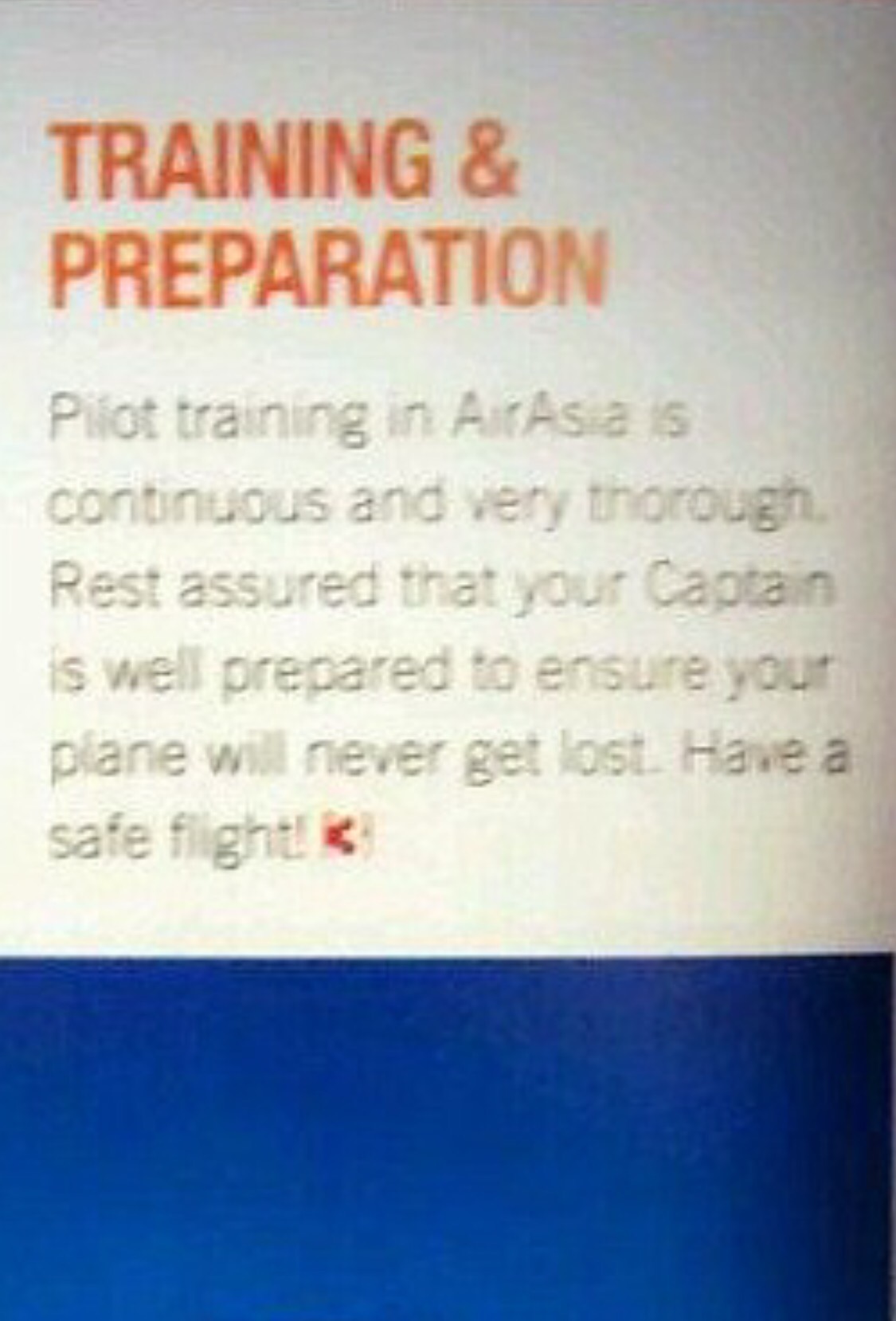
It happened when Malaysia Airlines Flight 370 went missing in the Southern Indian Ocean. The Air Asia in-flight magazine came up with an extremely distasteful article:
But of course, Air Asia is the fun airline. Everything is about having fun and making fun.
According to a statement carried by The Star, the airline said each applicant was briefed for her consent on the process before the checks were carried out.
“Grooming checks for visible marks are conducted privately by female supervisors in a professional manner and is part of the interview process,” it said.
“Herein candidates are briefed ahead and consent from each candidate is required prior to proceeding to ensure that no prominent marks will be visible while wearing the uniform,” it said.
How different are the uniforms?
Cabin crew uniforms: Malaysia Airlines, Air Asia and Malindo Air
Malindo Air cabin crew wear a finer white kebaya top. If you have ugly scars or tattoos, they would show up easier than if you are wearing the uniforms of Malaysia Airlines and Air Asia.
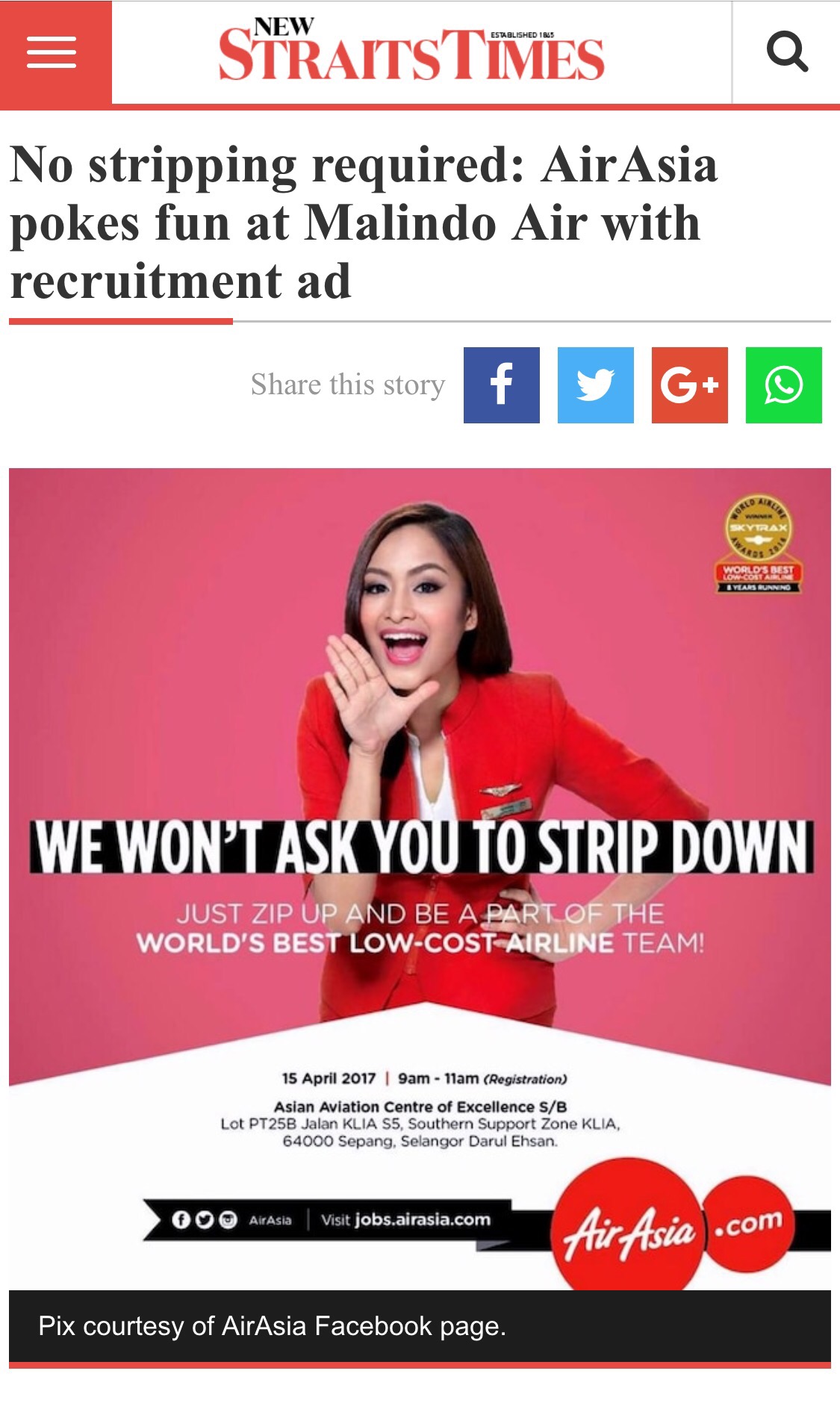
As expected, Air Asia was quick to take a CHEAP shot at Malindo Air’s unfortunate episode:
It may all seem funny to Air Asia and ridiculous to many, but how does Malindo Air’s policy on body marks fare compared to other airlines?
Ryanair’s cabin crew
RYANAIR
Perhaps like Malaysia Airlines, Singapore Airlines and Air Asia, tattoos that can be covered by the uniform are acceptable. No visible tattoos are allowed.
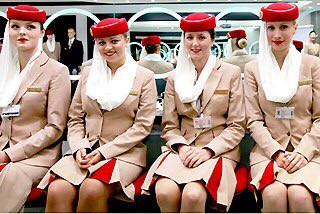
Emirates’s cabin crew
EMIRATES
Emirates has a similar policy. Tattoos that are visible while wearing their uniform are not allowed. The tattoos cannot be covered by cosmetics or bandages.
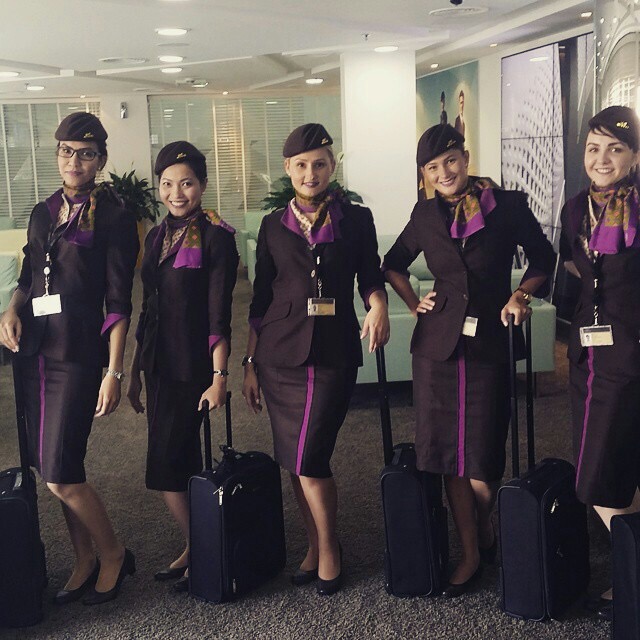
Etihad Airways’s cabin crew
ETIHAD
Etihad Airways has the same policy as Emirates’s. You cannot have tattoos that are visible while wearing their uniform and no covering using cosmetics or bandages are allowed.
Qatar Airways’s cabin crew
QATAR
If you look at the uniform you would think that Qatar Airways has the same policy as the ones adopted by the airlines mentioned above.
WRONG!
Qatar Airways does not allow tattoos no matter where they are located – PERIOD. The airline did not hesitate to make redundant senior employees when the policy was introduced.
How do you think did the interviewers find out about where their tattoos are? By stuffing remote cameras inside the candidates’ clothes?
Generally, any airline policy would say that cabin crew cannot have visible distinctive marks, be they scars, birthmarks or tattoos.
Normally a candidate is required to declare if she has any of such mark on her body and where are they exactly positioned.
If the candidate refuses to declare such marks, it would eventually be found out during the physical or medical examination stage. If they find a mark that you have not declared, you will be asked to go home.
Even if you get employed and decide to have a tattoo, your airline medical examination will uncover this and your employment contract will be ceased immediately.
Singapore Airlines is strict on tattoos as well. Although more liberal than Malaysia is, visible tattoos, scars and marks are not allowed to be on any of its cabin crew.
This is firstly because of the branding of Singapore’s icon. Whoever had read the book “Branding Strategy: The Singapore Airlines Story” would know what I mean. Branding in Singapore Airlines lingo means uniformity – Asian hair (no blonde Asians), Asian features, similar makeup, nails and service attitude. You cannot even talk on your mobile phone while walking in the Singapore Girl uniform.
Secondly, the branding of Singapore Airlines, or of any airline for that matter, is about superficiality. Being in an airliner is like being in a five-star hotel. Everyone wants to be served by a pleasant and well-groomed waiter/waitress, or in this case, stewards and stewardesses.
So it is not as easy as Air Asia’s claim of zipping up and you can become a cabin crew no matter if you have pock marks or pus-filled acne on your face.
Malindo Air’s cabin crew, like the ones Malaysia Airlines and Singapore Airlines have carry that image of elegance. You know you are not on board an Air Asia flight when on board any of the other three airlines mentioned.
In short, although it offers inexpensive fares, Malindo Air maintains its brand and class. It certainly does not feel like a no-frills airline.
If you look up the definition of no-frills you will see that it means, among others, providing only the basic necessary of service – in another word: CHEAP.
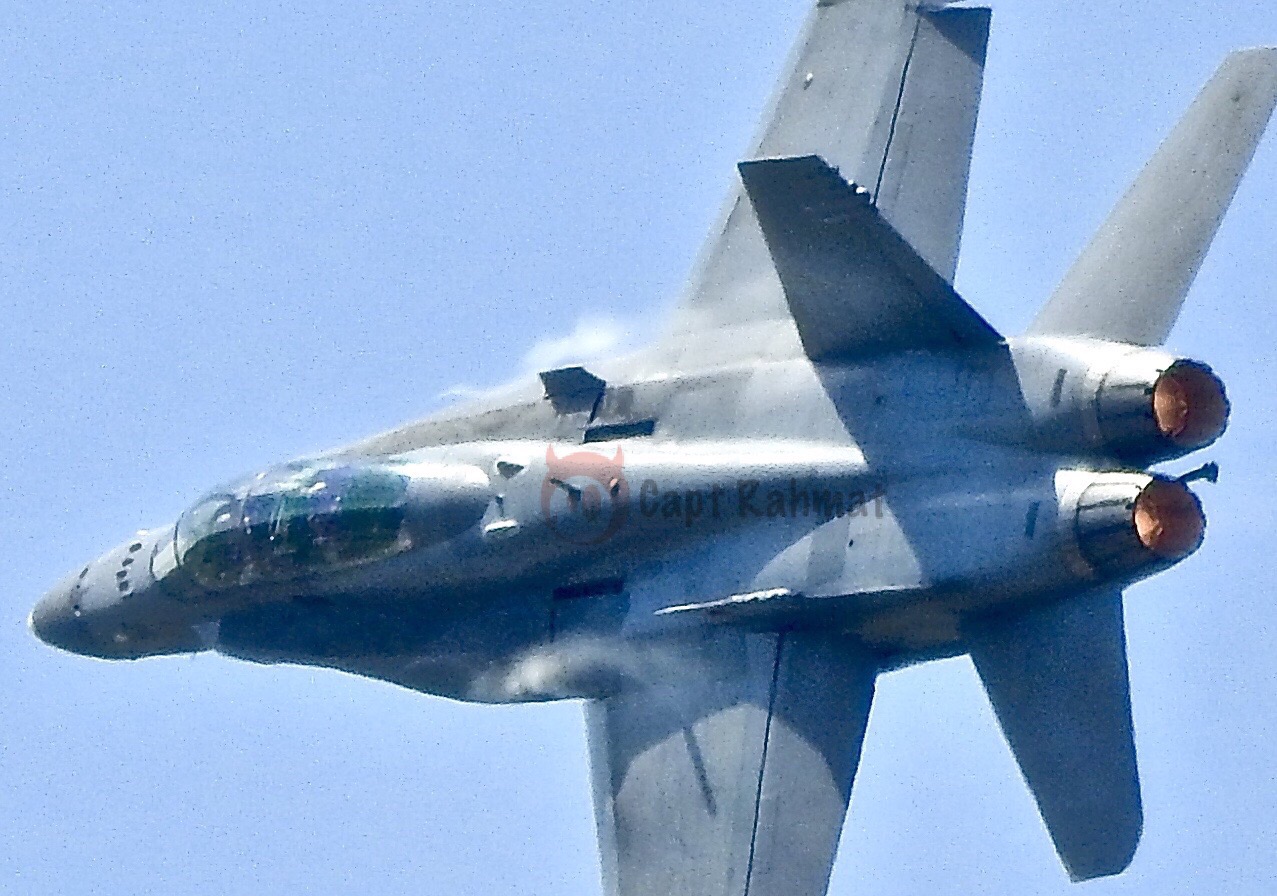
Condensation forms over the leading edges of an RMAF F/A-18D Hornet as it makes a high-speed maneuver
The 14th edition of the biennial Langkawi International Maritime and Aerospace exhibition ended last week leaving many in awe of the performances and displays in both the aerospace and maritime segments. Kudos to the EN Projects Sdn Bhd as the main organiser and also to the Ministry of Defence, Ministry of Transport as well as the supporting government agencies.
The 14th edition of LIMA saw an increase in the number of exhibitors compared to LIMA ’15. 555 exhibitors participated this time compared to 512 in 2015. While 39, 689 trade visitors visited LIMA ’15, 40,280 trade visitors were at LIMA ’17, surpassing the target of 40,000 trade visitors. 139,478 public visitors were at LIMA ’15. The target for this edition was 140,000 public visitors. Surprisingly, 236,689 public visitors visited this year’s LIMA – 104,557 visitors on the first open day, and 132,132 on the final day making a total of 276,969 visitors to LIMA ’17.
It must have been a boon to the Langkawi economy to have that increase in the number of visitors over five days and definitely helpful to the small traders especially in the Padang Matsirat, Pantai Cenang, Pantai Tengah, Kedawang, and Kuah areas.
A special commendation should be given to the Chief of the Royal Malaysian Air Force and Chief of the Royal Malaysian Navy for lending their support in driving the industries as well as foreign armed forces’ participation in all the activities during LIMA 17.
QUALITY OF EXHIBITORS
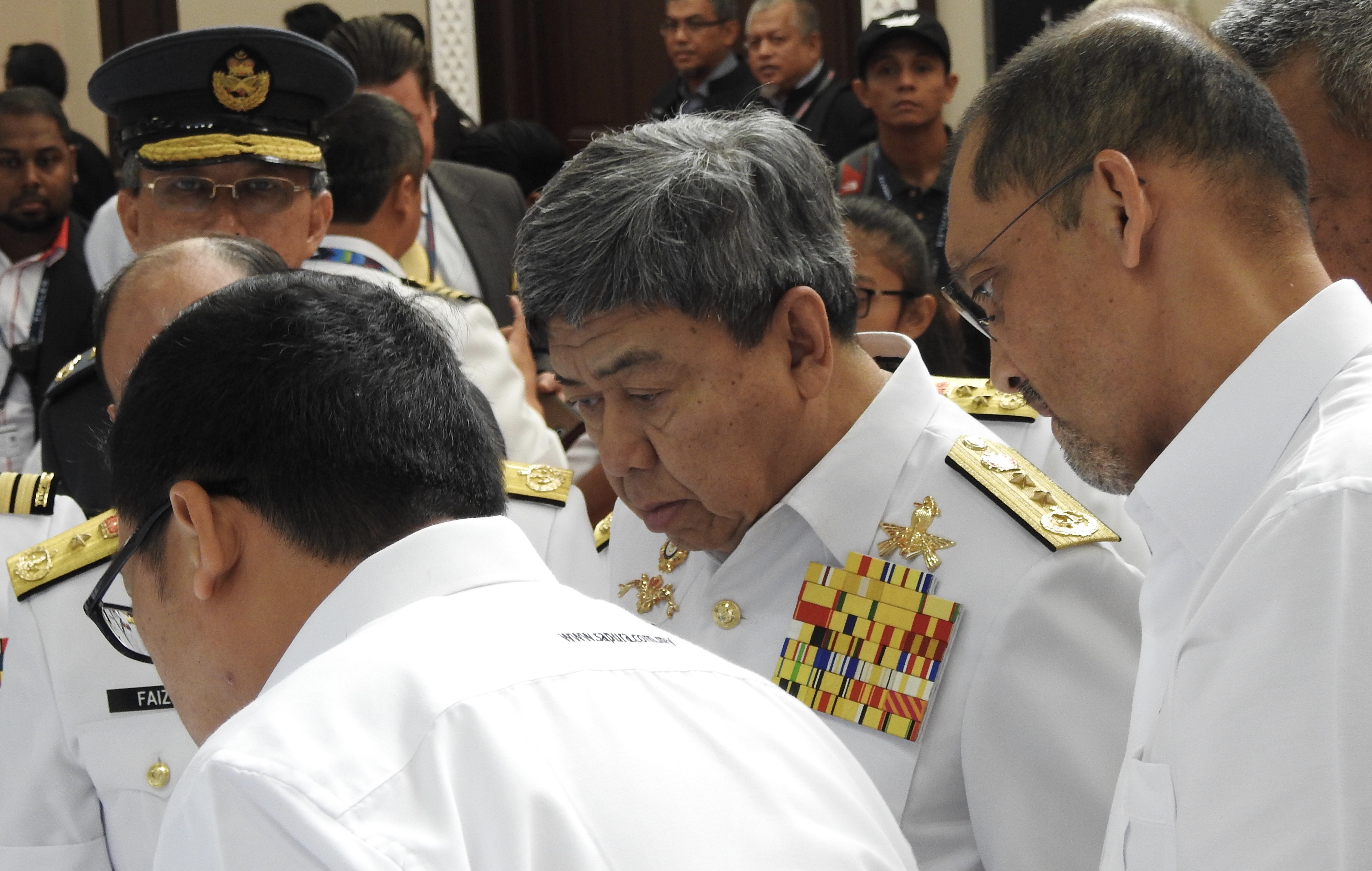
His Royal Highness The Sultan of Selangor visiting one of the exhibition booths
From my personal observation, since the 13th edition of LIMA there has been an inreasing number of unrelated government agencies and companies exhibiting at the Mahsuri International Exhibition Centre such as the Langkawi Development Authority (LADA), the Majlis Amanah Rakyat (MARA) and a Private Limited printing company!
Unless there is a masterplan to annouce Langkawi as an aviation and maritime hub, I do not see the relevancy in having LADA at the aviation exhibition hall. MARA would be relevant if it provides assistances for students to study maritime or aeronautical-related studies or for local small and medium enterpreneurs to participate in the local maritime and aviation industry which is rather limited.
What did not happen was for local universities to showcase their research projects in order to secure fundings from local and foreign aviation and maritime giants. LIMA would be a perfect platform for local universities to showcase their research in both the industries.
Local shipbuilders, other than the local giants in the defence sector, were largely missing from the exhibition. Local shipbuilders are mainly into constructing oil and gas and transportation of cargo, crude and gas products should have showcased their capabilities at LIMA. This is where the Ministry of Transport could help in getting the participation of more civilian-transport applications providers to exhibit at LIMA.
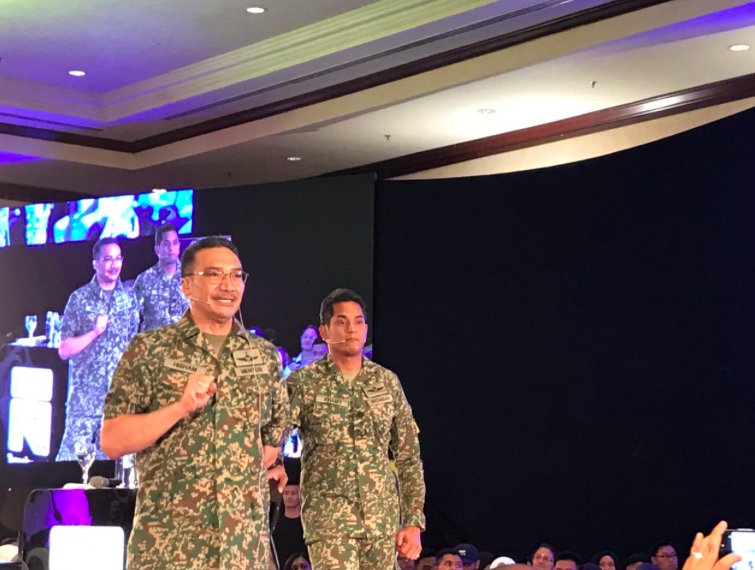
Kudos should also be given to both the Minister of Defence as well as the Minister for Youth and Sports in driving the National Transformation 2050 (TN50) programmes for the youth at LIMA. LIMA should also be about providing avenues for the youth to participate in the aviation and maritime industries.
Datuk Seri Hishammuddin and YB Khairy Jamaluddin at the Defence Dialogue and Press Conference TN50 during LIMA ’17
LESSONS FROM THE OIL AND GAS INDUSTRY
The Malaysian Oil and Gas industry has its biennial Asian Oil, Gas and Petrochemical Engineering (OGA) Exhibition and is into its 16th edition this year. Unlike LIMA, OGA is fully industry-driven. The event is supported by the British-Malaysian Chamber of Commerce, Malaysian Gas Association, Malaysian Offshore Contractors Association, Malaysia Petroleum Resources Corporation, Offshore Support Vessels Owners Association and the Malaysia Oil and Gas Services Council.
LIMA is co-organised by EN Projects Sdn Bhd and the Ministry of Defence, supported by five ministries, the Malaysian Armed Forces, Royal Malaysian Police, Malaysian Maritime Enforcement Agency, Fire and Rescue Services Department, and the Royal Malaysian Customs. I am surprised that none of the industry councils and associations play the supporting role instead of just collaborating role.
We have so many defence and security contractors yet they all have to rely on the ministries and agencies above to put together an event for them to participate. Why does the government have to do the hard selling on their behalf? Isn’t it time, after 14 editions, for the industry players themselves to come together and become the co-organisers or event supporters?
Lined up at sea off Tanjung Malai were military vessels or vessels chartered by the military. I did not see a single vessel from the Malaysia Shipowners’ Association, or civilian and military boatbuilders showcasing their products at sea.
LIMA could be bigger than just a military/security party. Airlines did not send their aircraft this time around. At LIMA ’15 there was an Airbus A320-200 belonging to Air Asia. This was absent at LIMA ’17. Imagine a daily flypast of aircraft – perhaps an arrowhead formation with an Airbus A380 followed by an Airbus A330 and A320 flanked by Boeing 737-800s and Boeing 737-900s, followed by a smaller diamond four formation of ATR-72s.
The above will never happen unless industry players take the lead in supporting LIMA.
OPPORTUNITIES
For the Royal Malaysian Air Force, opportunities to replace the Mikoyan-Gurevich MiG-29N comes in the form of the Dassault Rafale. LIMA ’17 saw Dassault Aviation pulling no punches when promoting the Rafale for Malaysia. LIMA ’17 was followed by a visit by French President Francoise Hollande who also put the sale of the Dassault Rafale to Malaysia on the agenda. Although Malaysia had said that it was not time to purchase the Rafale, it is important to note that the F/A-18D Hornets will be 30 years old in 10 years while the Sukhoi Su-30MKM will be in its 20th year of service in the RMAF.
The other interesting Euro-Canard contender is the Saab JAS-39 Gripen. The Royal Thai Air Force’s Gripen participated in the aerobatic display in the first four days. Touted as a more affordable but equally potent as the Dassault Rafale, the Gripen’s cost would prove to be an attractive candidate to replace the MiG-29N.
At LIMA ’15, Saab had offered the Malaysian government a lease deal for 16 JAS-39C/D Gripens.
However, the tragedy involving a RTAF JAS-39 Gripen that killed its pilot earlier this year still plays in everyone’s mind. The Gripen was performing in Hatyai for the Thai Children’s Day. Footage of the accident shows the Gripen starting a slow aileron roll; once inverted, the aircraft fails to complete the maneuver, stops rolling and takes a nosedive crashing near the airfield’s runway.
There has been ten accidents involving the Gripen with nine hull losses and one fatality. At least two of the accidents have been attributed to Flight Control Software issues. The incident in Hatyai is still being investigated.
Of course there is also the option to upgrade the surviving 16 MiG-29Ns as a stop-gap mesure. At LIMA ’15, Malaysia’s Aerospace Technology Systems Corporation offered upgrades that would only be a fraction of the cost of purchasing new MRCAs.
The upgraded aircraft will be called the MiG-29NM and will include a Zhuk-ME FGM-229 slotted phased-array fire control radar that will provide an air-to-ground capability not available on the baseline aircraft, which are optimized for the air defense role.
The avionics system incorporates a night vision goggle-compatible glass cockpit, with two color multifunction displays and hands-on-throttle-and-stick (HOTAS) functionality.
Weapons systems and pylons will be upgraded, making the MiG-29NM capable of carrying the full range of air-to-air and air-to-ground weapons available to Malaysia’s Su-30s.
The Klimov RD-33 Series 3 engines of the MiG-29N will remain, but a conformal fuel tank added to the spine of the aircraft, together with an extra ventral tank, will increase operational range by 30 percent.
Malaysia, however, had declined this offer deemed expensive.
It would be interesting to note that other than the Indian Air Force, the Myanmar Air Force had also recently upgraded its MiG-29s at RAC MiG facilities near Moscow. This upgrade, said to be cheaper than what was initially offered to Malaysia, is now being offered to both Malaysia and Bangladesh which operates eight MiG-29B and is also seeking upgrades.
It would be interesting to see what the government’s decision on the MiG-29Ns would be.
Opportunities such as this is what local companies should get involved with. The aerospace industry that had taken off with the introduction of LIMA still remains status quo. Indonesia has gone on commercial production with its aircraft lines while we are stil struggling to even produce components that would be accepted internationally.
MOVING FORWARD
LIMA is here to stay. Other than the Singapore Air Show, this is one that is looked at in this region. While the Singapore Air Show is huge, LIMA is just of the right size for mission-specific companies to participate in. It is just unfortunate that the industry is not helping out to drive the show instead of relying on the government’s goodwill.
Hopefully EN Projects Sdn Bhd together with the Ministry of Defence and Ministry of Transport would flog the industry players to play a much bigger role in helping to drive LIMA into the exhibition every global industry player would look forward to.
Those who believed Lim Guan Eng’s lies back in March 2008 are among those who believed the promise that the Tokong would be able to solve the 40-year flood woes in just eight months.
A hundred and eight months later there seems to be no end in sight to the recurring floods in Penang.
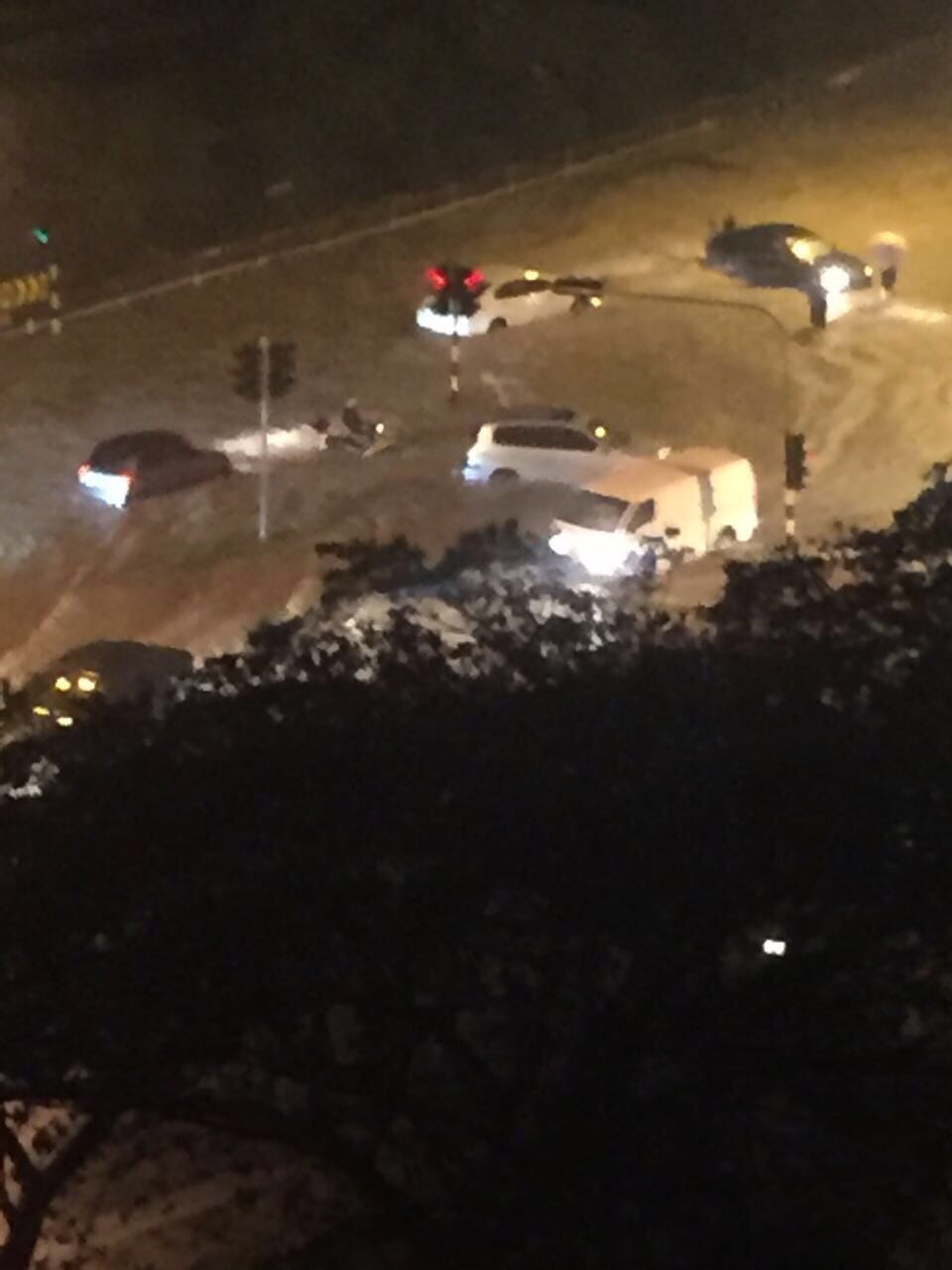
In the latest episode, torrential rain that occurred just before sunset yesterday saw Jalan Kampung Relau, Bayan Baru, Farlim, Jalan Paya Terubong, Sungai Dua, Jalan Masjid Negeri and Jalan P Ramlee inundated by flood waters for the second time in one week.
Perhaps, this is the reason Tokong doesn’t need a swimming pool in his bungalow. Flood waters would give him an instant one. After all, how many times do you jump into a swimming pool in a year if you have one?
The Tokong is notorious for not fulfilling promises made.
Yesterday the Minister of Works Datuk Fadillah Yusof asked Tokong for an update of the studies that are being done to support Penang’s request for a third bridge.
Fadillah said that Tokong had submitted the request to the ministry in May last year and that three months later, the Penang Chief Minister acknowledged that the RM305 million studies for the project had not been completed.
Tokong then told the Ministry that the studies would be submitted either at the end of 2016 or early 2017.
“As it was the end of the first quarter and past the deadline stated by Lim, it is well within our right to ask for an update,” Fadillah said in a statement yesterday.
Tokong revealed that the feasibility studies for the undersea tunnel were now “stuck” at 87% completion because the state had not received the master plan for the 650ha reclamation around the Butterworth Outer Ring Road.
What surprised me is that although no approval has been given by Tokong’s government since the master plan has yet to be completed, reclamation works off Gurney Drive is already in full swing.
“This master reclamation plan has yet to be completed despite the project being awarded in 1999 and despite DAP running the state for nine years. We are aware that large-scale reclamation has started on the island and has progressed at a good pace since a year ago,” Fadillah explained.
Does this mean that the Tokong is accustomed to doing things without following procedures which have been there to curb abuses?
Perhaps this practice has become a norm now in Penang, which is why Emperor Lim Kit Siang is seeking to contest in Penang should his son’s imminent jail term commence.
Penang is a money pot and the dictatorship of both Tokong and the Emperor ensures that no dissenters are allowed.
I would be surprised if the corrupted Tokong and his dictatorial father will continue to have a hold on Penang.
Then again, there will always be the April’s Fools.
Many would have thought that President Rodrigo “The Punisher” Duterte of the Philippines as a difficult man to come to a deal with.
When the President visited Malaysia last November, there were five Malaysians being held captive by bandits in the south of the Republic as a result of Kidnap-for-Ransom incidents.
Many criticised Najib Razak’s joining in Duterte’s karaoke diplomacy but as a seasoned diplomat and a leader Najib knew that it was Duterte’s way of asking him to loosen up before concluding business.
As a result, Duterte himself oversaw the rescue efforts and as a result the five Malaysians held as hostages were returned to their families.
Last night, as a result of another masterstroke conjured by both Najib Razak and another seasoned and internationally-respected diplomat Anifah Aman who worked behind the scene to secure the release of Malaysians held in Pyongyang since 7 March 2017.
The RMAF Global Express jet upon arrival
This morning a Royal Malaysian Air Force Global Express jet arrived in Kuala Lumpur with the Malaysian embassy staff as well as their family members.
Anifah Aman was there waiting.
Anifah Aman with family members of the Malaysian embassy staff waiting at the airport
Speaking later to reporters Anifah said that the efforts to bring back the Malaysians showcases diplomacy at its best.
“There can be no substitute for diplomacy, for level-headedness in dealing with such situations, and this has served Malaysia well in this instance,” said the Foreign Minister.
He thanked Prime Minister Datuk Seri Najib Tun Razak for placing his trust in the Foreign Ministry to lead negotiations with North Korea.
There is no substitute for level-headedness and skillful diplomacy, and definitely no substitute for a great leadership and solid friendship that delivers each time.
Doris “Dorie” Miller was a Petty Officer (Sergeant equivalent) Ship’s Cook Third-Class on board the battleship USS West Virginia in the US Navy. That was about the only trade available for African-Americans when World War Two broke out.
It was a time when racial segregation and discrimination was strong in the US of A.
Yet, Dorie Miller was awarded the Navy Cross for helping move his mortally wounded Ship’s Captain Mervyn Sharp Bennion from further danger and saved countless other wounded crew.
Miller was never given any training to handle any weapon but took it upon himself to man a .50-caliber Browning anti-aircraft machine hun to shoot at Japanese airplanes.
Despite working in a system that discriminates him, he gave his all for his country as expected of him.
In Malaysia, civil servants have integrity problems. Five teachers have been slapped with a show-cause letter each for participating on an Opposition stage openly criticising the government-of-the-day.
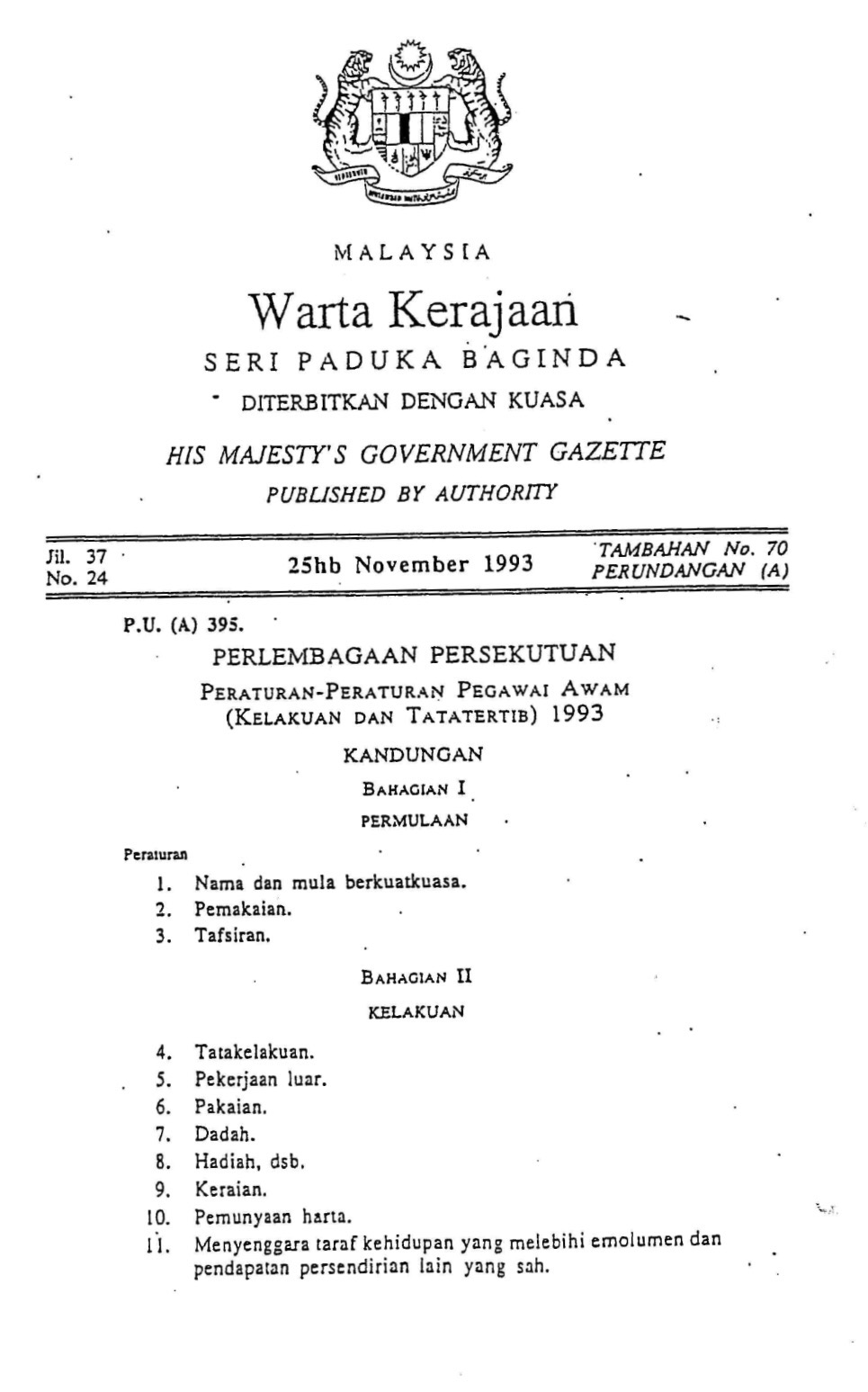
Their action is in breach of Regulations 4(1) of the (Peraturan-Peraturan Pegawai Awam ( Kelakuan dan Tatatertib) 1993 – P.U.(A)395/1993.
When I was an Officer Cadet my instructors told me that as an Officer of His Majesty’s Service I must remain impartial at all times but may vote for those whom I think deserves to represent the people.
Civil servants must remain impartial as they represent the government. This ensures that integrity of the civil service and the trust of the people are not affected.
The Ministers who head each of the Ministry are elected into their positions, get a feel of what is happening on the ground before formulating policies to steer the machinery of the Ministry he or she is in-charge of in line with whole direction the nation is moving towards.
I turn it is for the civil servants to implement these policies on the ground and ensure the effectiveness of the policies, if not, provide feedback. They are not independent from the government-of-the-day they must serve and for that their impartiality is paramount.
Therefore, civil servants must refrain from openly expressing their political views what more stand on a political stage spewing hatred and anger towards the government they work for.
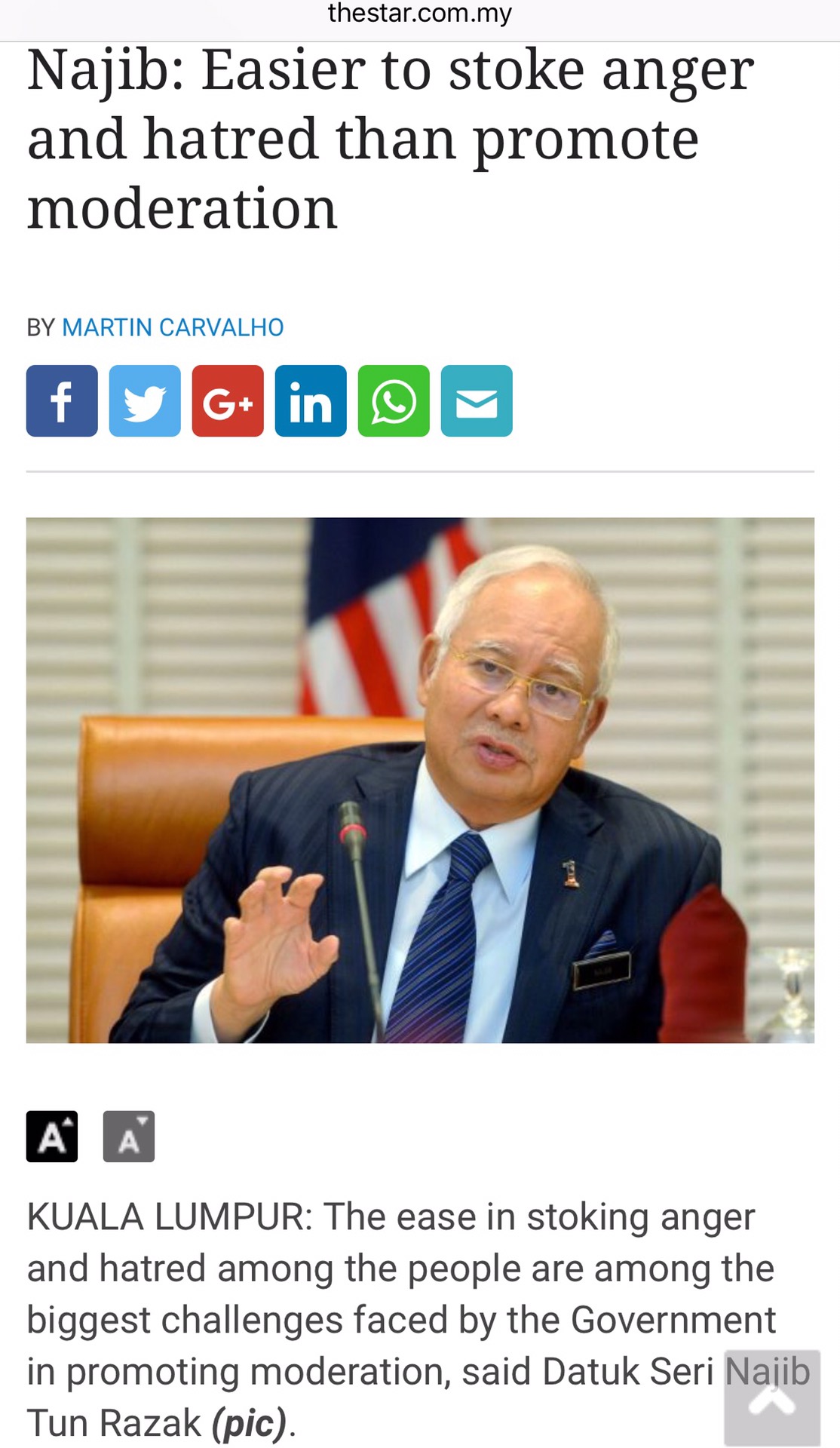
Even the Prime Minister lamented that the government is facing a huge challenge as it is easier for the people to stoke anger and hatred.
The tactics to incite and spread hatred and anger now ate the same as the ones used to create racial and religious disharmony and hatred towards the government in the months preceding the 13 May 1969 tragedy.
It is made worse now as disgruntled civil servants now join in the fray and speak against the government thinking that it is part of their democratic rights.
The need for teachers to preseve political impartiality was stressed even in Indonesia by Vice President Jusuf Kalla.
He said that teachers need to instead maintain their professionalism and focus on providing education to students.
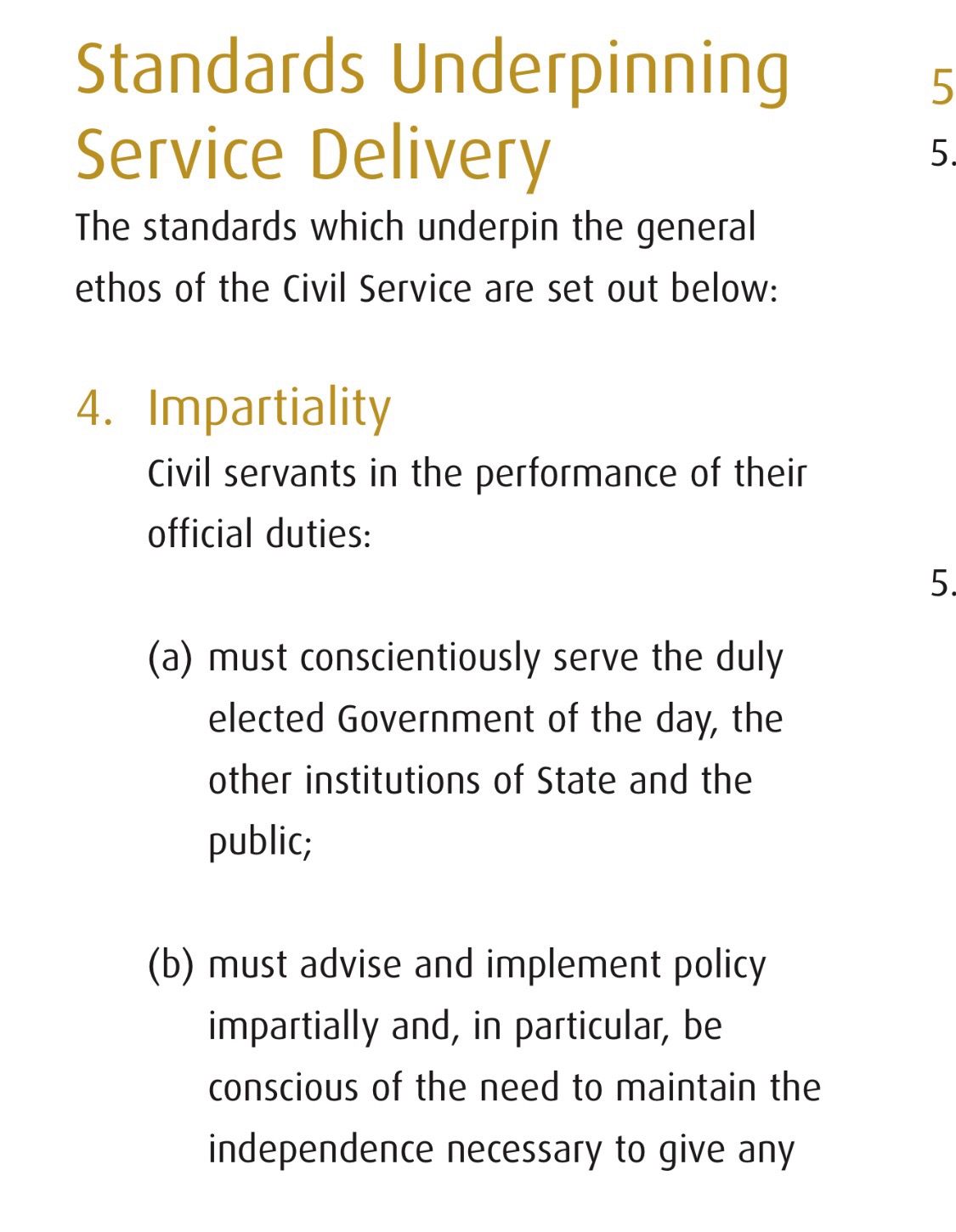
In Singapore, the need for civil servants to remain politically impartial is enshrined in its Civil Service Code of Standards and Behaviour.
It says that the civil servants must conscientiously serve the government-of-the-day.
Political impartiality is also important to maintain public confidence in the civil service.
For this I agree with the Education Minister that although Malaysia is a democratic country and it is within the rights of the five teachers to support whomever they wish to, the teachers are still subjected to the regulations for civil servants.
“If they are teachers, appearing on the Opposition stage criticising the government, and there is slander and malicious intent then it is better for them to leave the teaching profession and contest in elections,” added the Minister.
Ask yourself what would you do if your domestic helper openly criticise you in front of your neighbours?
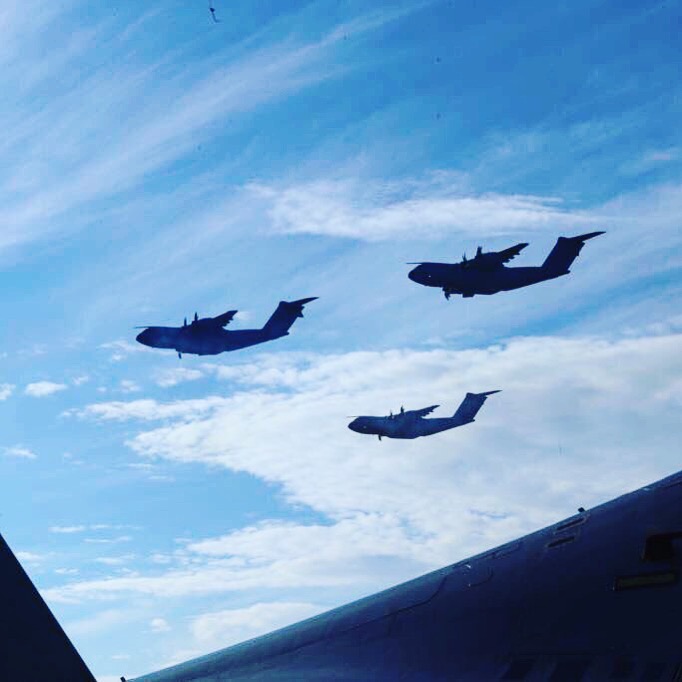
Three RMAF Airbus A400M aircraft perform a fly pass at the LIMA ’17 exhibition
Defence expenditure is likely to rise as this region and beyond continue to face traditional and non-traditional threats. The role of the defence industry is also changing dramatically, as new and changing threats require further research and development, increasing the overall costs and pricing of defence products and services.
This was the gist of the message conveyed by Dato’ Sri Najib Razak, the Prime Minister of Malaysia, at the opening ceremony of the Langkawi International Aerospace and Maritime 2017 (LIMA ’17) exhibition this morning.
“We need to equip our fighting men with the capabilities required to face modern warfare, both symmetrical and asymmetrical, and LIMA ’17 brings together major aerospace and maritime firms from around the world to demonstrate their state-of-the-art static and aerial displays and cutting-edge technologies,” he added.
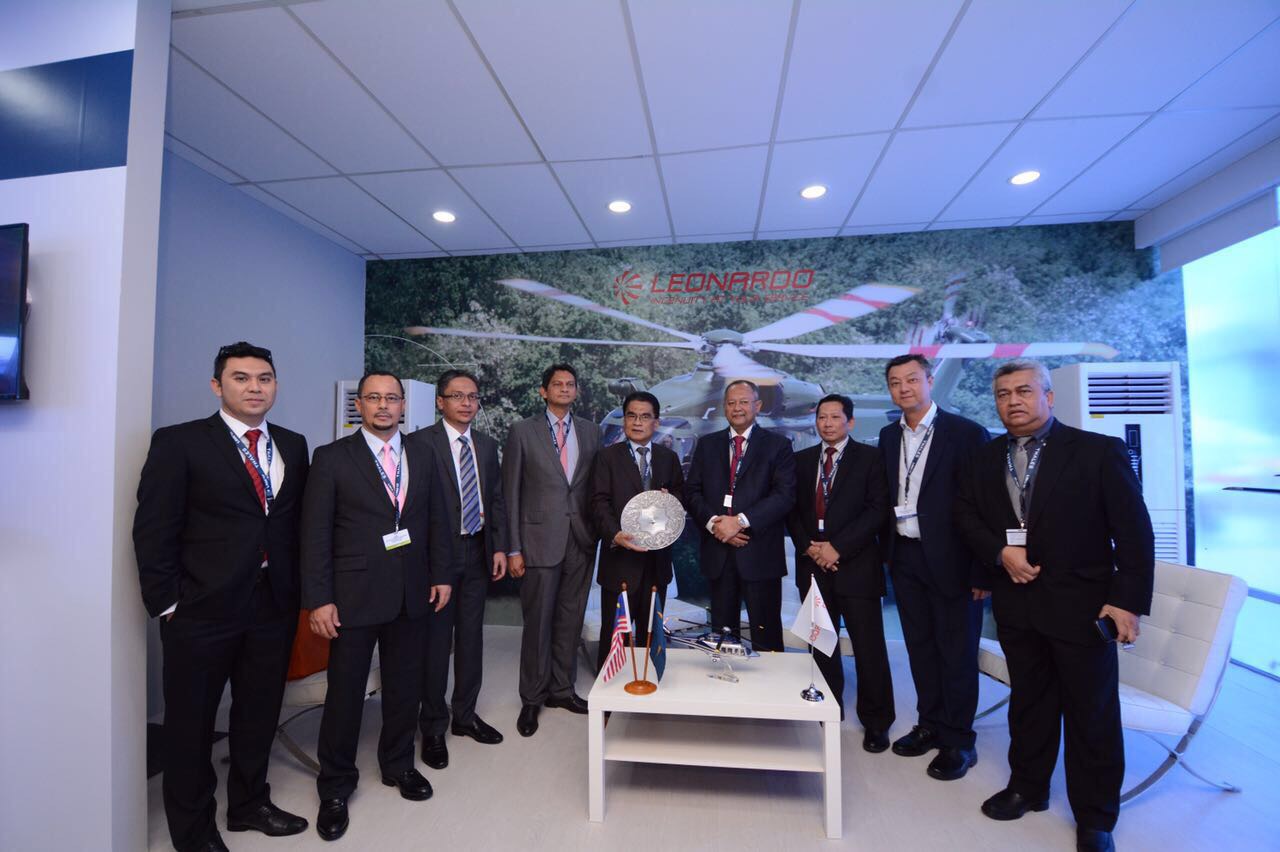
One of the exhibitors, Leonardo Helicopter Division, a division of the Leonardo S.p.A that is headquartered in Italy, celebrated today the successful reaching of the impressive 100,000 flying hours milestone with the Weststar Aviation Services’s AW139 fleet.
Weststar Aviation Services is the largest South East Asian offshore helicopter services provider and largest helicopter operator of the AW139 in Asia.
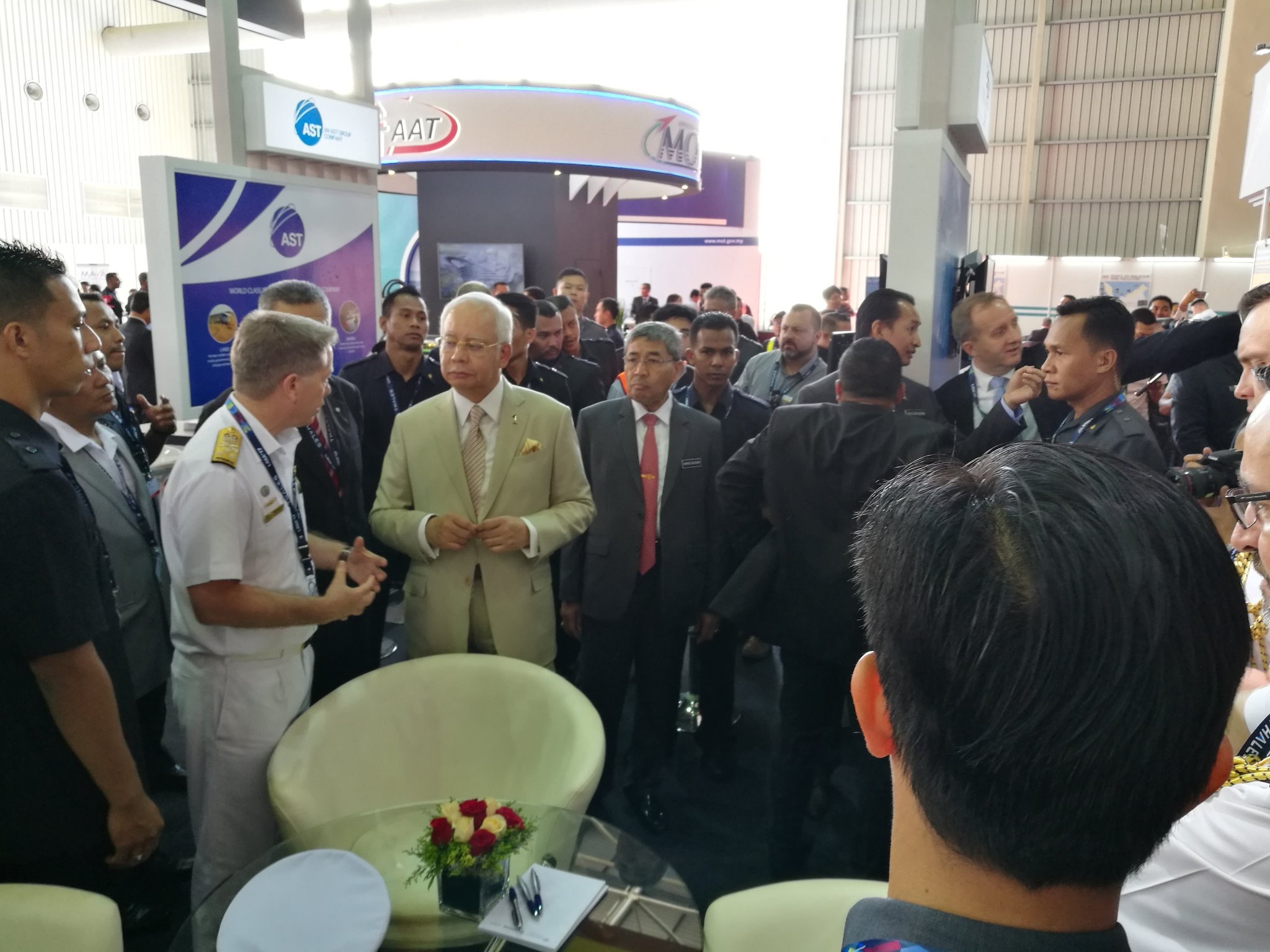
Dato’ Sri Najib Razak visiting one of the booths at the Mahsuri International Exhibition Center in Langkawi after the opening of LIMA ’17
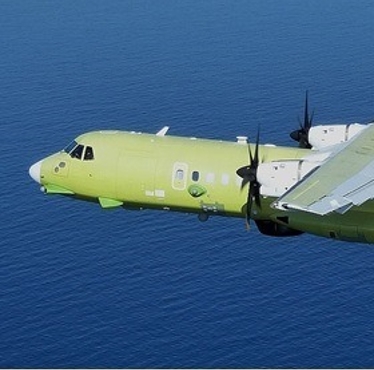
Leonardo has also brought the ATR-72MP aircraft which is being proposed for Malaysia’s requirement for an advanced new maritime patrolcapability. In the Electronics Warfare segment, Leonardo has signed a Memorandum of Understanding with Hensoldt (the new name for Airbus DS Electronics and Border Security) to offer Mode-5 IFF (Identification Friend or Foe) solutions to customers around the world. This collaboration between two European leaders in defence electronics technology shows how, by joining forces, the team can position itself as market leader for cutting-edge new requirements. The two companies, working together as “Team Skytale”, have already been selected as preferred bidder by the UK Ministry of Defence to upgrade IFF systems on more than 400 land, sea and air vehicles.
The ATR 72MP is a multirole Maritime Patrol, Electronic Surveillance and C4I (Command, Control, Communications, Computers, and Intelligence) aircraft with very affordable costs, developed and built by Leonardo’s Aircraft Division from the platform of the modern ATR 72-600 regional turboprop (pic courtesy of Leonardo Company)
The IFF technology allows operators to electronically identify friendly forces, distinguishing them from potential enemies. It does this by sending out an interrogation signal to unidentified platforms and verifying the automatic responses that are sent back, effectively a modern-day challenge and password system. Ensuring that ground, air and naval crews can reliably recognise their compatriots is one of the main ways of avoiding ‘friendly fire’ incidents. In 2020, all NATO nations are mandated to switch over to the new, more-secure ‘Mode-5’ version of the technology and other nations looking to operate alongside NATO forces will also need to be able to interact with the new standard. Mode-5 uses the latest cryptographic techniques to avoid the threat of deception by adversaries.
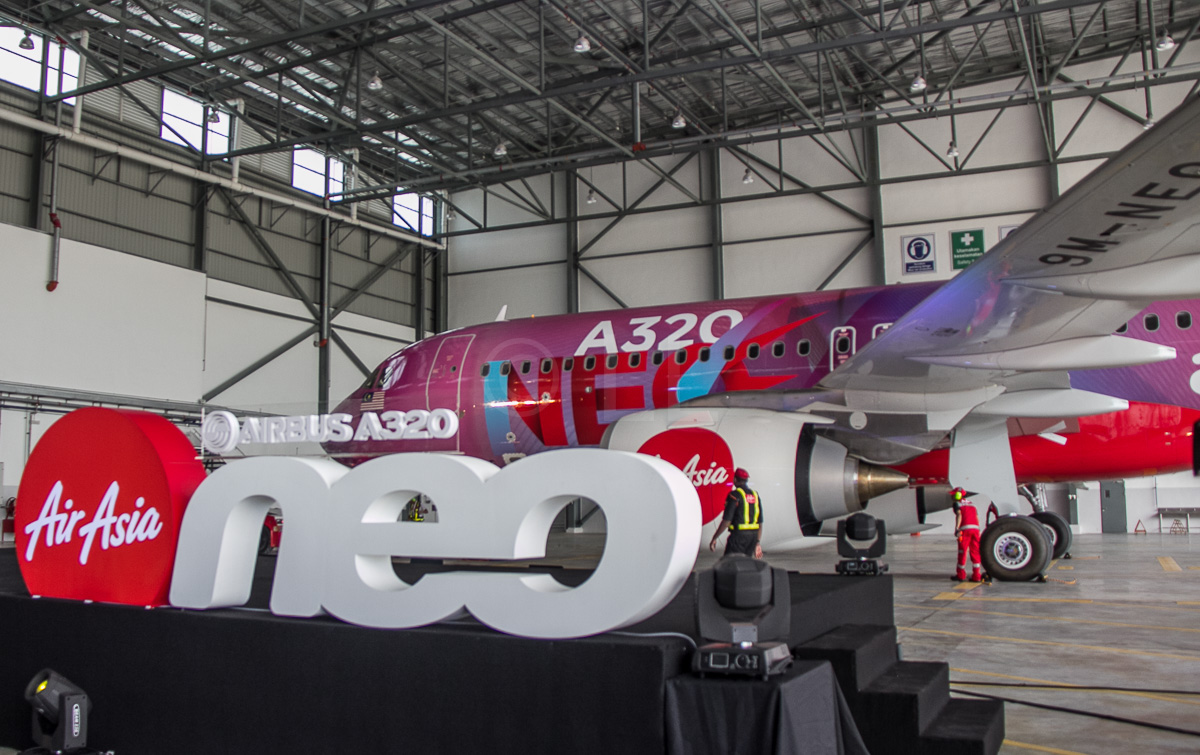
In another development, Thales has been selected by AirAsia to supply avionics systems on AirAsia’s new fleet of 304 A320neos. Thales will equip the 304 single-aisles with its market leading Flight Management System (FMS), the navigation solution of choice for Airbus aircraft, alongside the THALES/ACSS T3CASsurveillance platform, the preferred solution for all Airbus single aisle aircraft.
AirAsia’s Airbus A320neo (pic courtesy of Economy Traveller)
Thales has been partnering with AirAsia, leading LCC in Asia, since 2005, forging a close relationship in support of the airline’s growth strategy. AirAsia already equips their entire Airbus fleet with Thales systems and has selected the group for all maintenance and support operations for Thales systems equipped across their entire A320 fleet of 200 aircraft. In addition to the avionics suite, Thales will continue to provide a Repair-by-The-Hour (RBTH) long-term maintenance contract to support AirAsia’s fleet expansion. The agreement provides guaranteed turnaround times on repairs and offers a commitment of reliability with reduced operational risk.
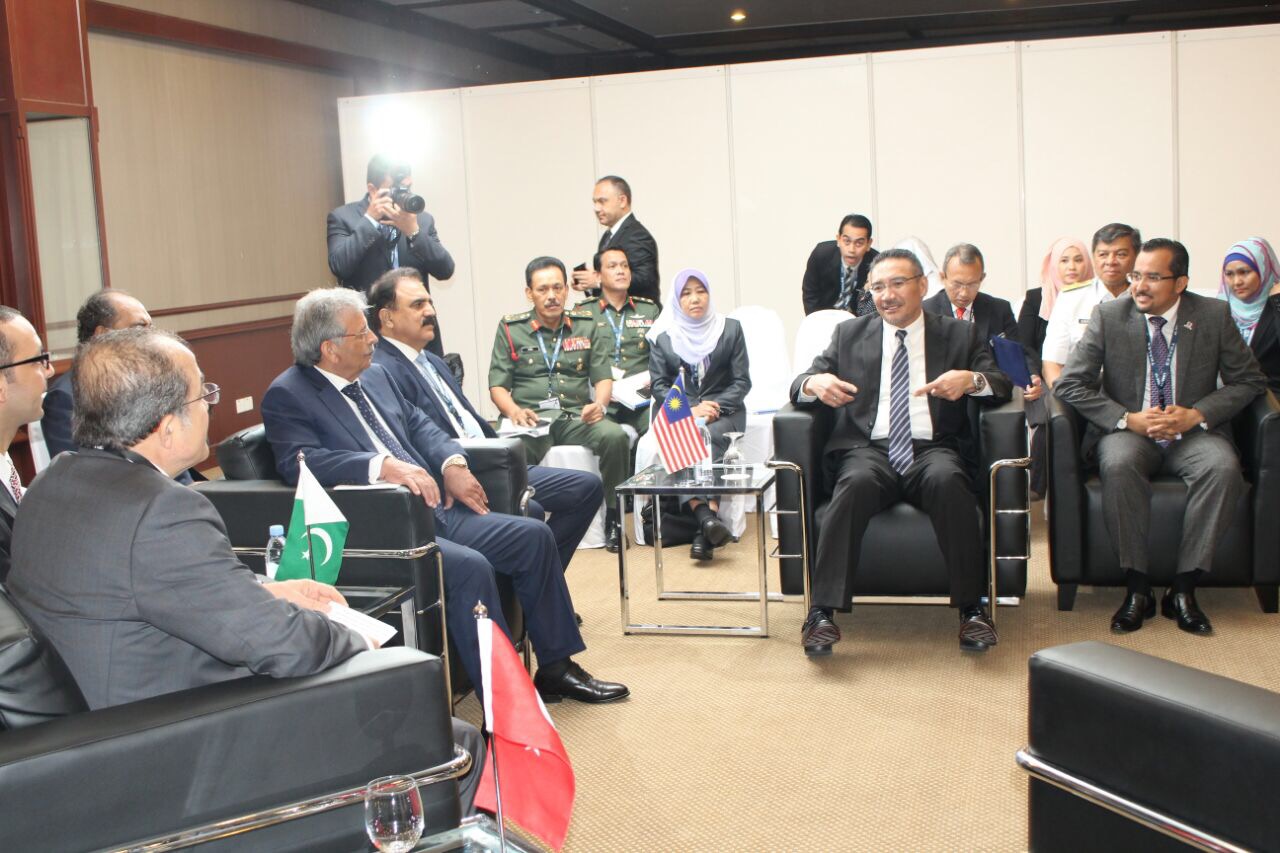
Malaysia Minister of Defence, Hishammuddin Tun Hussein, meets with representatives from five countries to discuss asymmetrical threats by Da’esh
Meanwhile, Malaysia’s Minister of Defence, Dato’ Seri Hishammuddin Tun Hussein, met with representatives from five countries including Pakistan, Turkey, Indonesia and Qatar to present his view on how to combat the Da’esh threats. The establishment of the King Salman Center of International Peace was also on the agenda of this meeting.
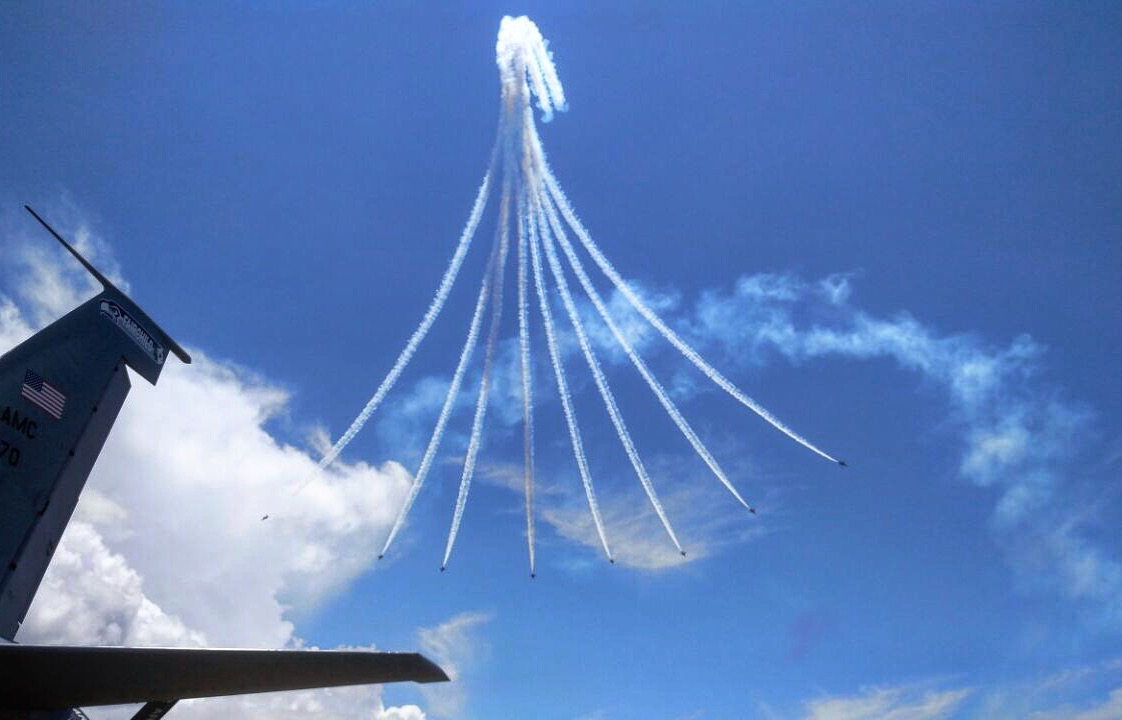
The RoKAF Black Eagles performing the “Bomb Burst” formation over Langkawi
Making its debut in Langkawi is the Republic of Korea Air Force’s 53rd Air Demonstration Group. Commonly known as the “Black Eagles” the RoKAF team buzzed the skies of Langkawi in their KAI T-50B Golden Eagle supersonic advanced trainers. The T-50B is one of the few supersonic trainers currently available in the world.
The Russians is well-represented. The “Russian Knights (Russkiye Vityazi)” aerobatic team showcasing their Sukhoi Su-30SM aircraft for the first time outside Russia, while the Royal Malaysian Air Force performs aerobatics in its Sukhoi Su-30MKM.
The air aces of the two countries, whose performances constantly evoke admiration of the audience, highly praised the flight characteristics of their supermanouverable aircraft.
President of Irkut Corporation Oleg Demchenko marked the high skills of pilots and their ability to use the maximum extent of the fighter’s capabilities while First vice-president of UAC Alexander Tulyakov said: “Positive evaluation of aircraft given by pilots is very important for us – the developers and manufacturers”.
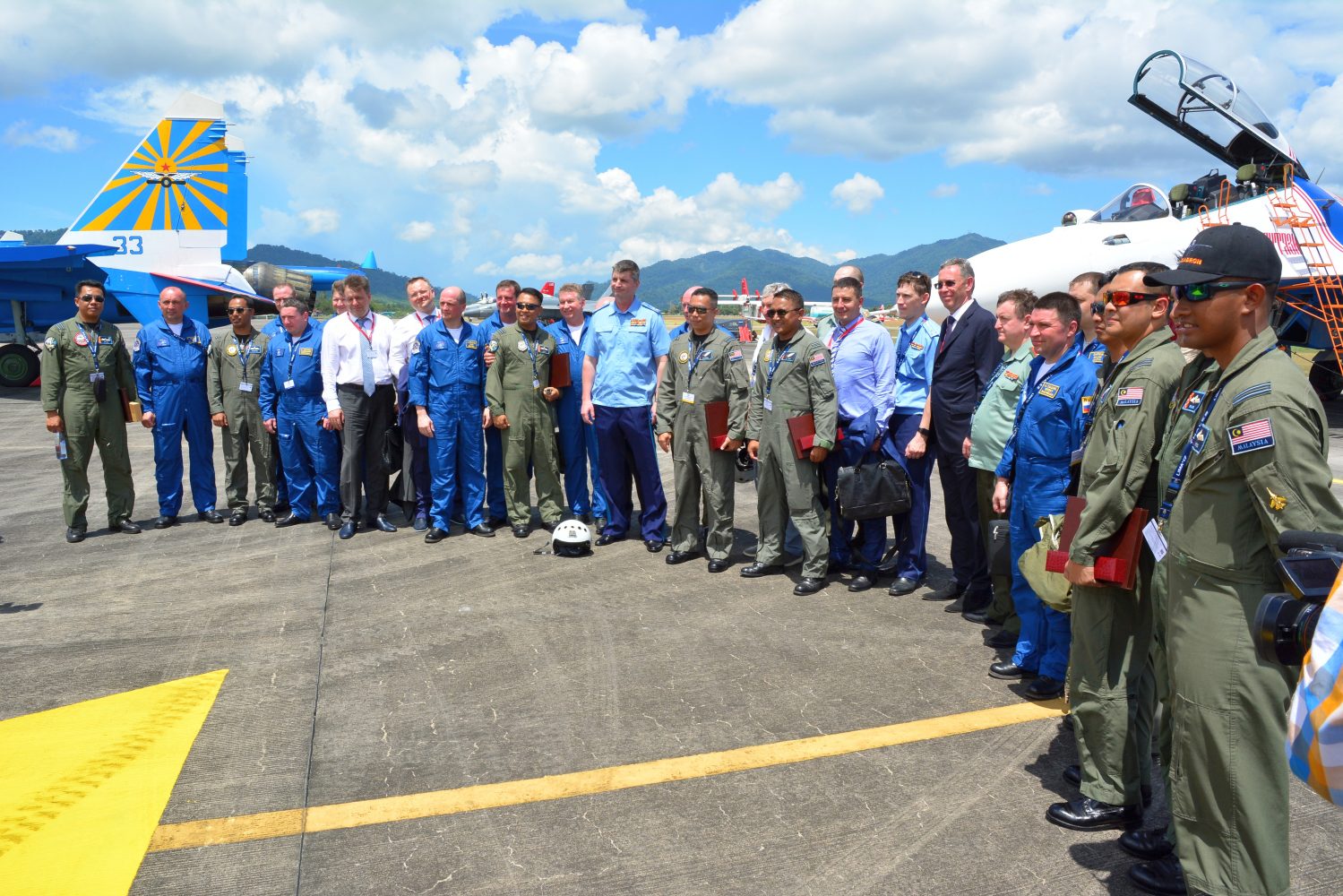
The meeting resulted with a joint photo shoot against the background of Su-30SM and Su-30MKM aircraft.
Sukhoi Su-30 pilots from the Russian Knights and the RMAF’s No.11 Squadron pose together
Russian’s Rostec State Corporation is working with the government of Malaysia to expand cooperation through the supply of civilian products and aviation.
“Over the last 20 years Malaysia has been a strategic partner of the Rostec State Corporation. We are actively involved in military and technical cooperation in a number of areas: aviation, the army and the military navy, and in recent years our cooperation has gained momentum. We are currently engaged in arms supply programs and are upgrading technology that was previously supplied to Malaysia.
We are also looking to extending our cooperation to civil areas that have growth potential: electronics, composite materials and IT. The civil aviation market, especially the helicopter sector, is also showing great potential for us,” said Head of the joint delegation from Rostec and Rosoboronexport at the 2017 LIMA exhibition Viktor Kladov, Director for International Cooperation and Regional Policy Department of the State Corporation.
“LIMA-2017 is the most important event for the aviation and military navy markets of Malaysia and the surrounding region and our participation in it is a long-standing tradition. LIMA-2017 is attracting representatives of various countries of this region and we are looking to conducting fruitful negotiations both with the Malaysian Government and delegations from other countries,” he pointed out.
In the afternoon, the Prime Minister Najib Razak officiated the Maritime Segment which also involved major exhibitors such as THALES, MAST, ACS and SAAB, showcasing the latest technologies in defence products and a demonstration by the elite forces of Malaysia’s security enforcement agencies.
This year’s opening gimmick had the elite forces searching for a box containing a key for the Prime Minister to activate the launch sequence. The key was located using technologically-advanced, unmanned equipment that assisted the forces, including from the Royal Malaysian Navy (RMN), and was handed over to the Chief of Navy, Admiral Tan Sri Ahmad Kamarulzaman Haji Ahmad Badaruddin who then handed it to the Prime Minister.
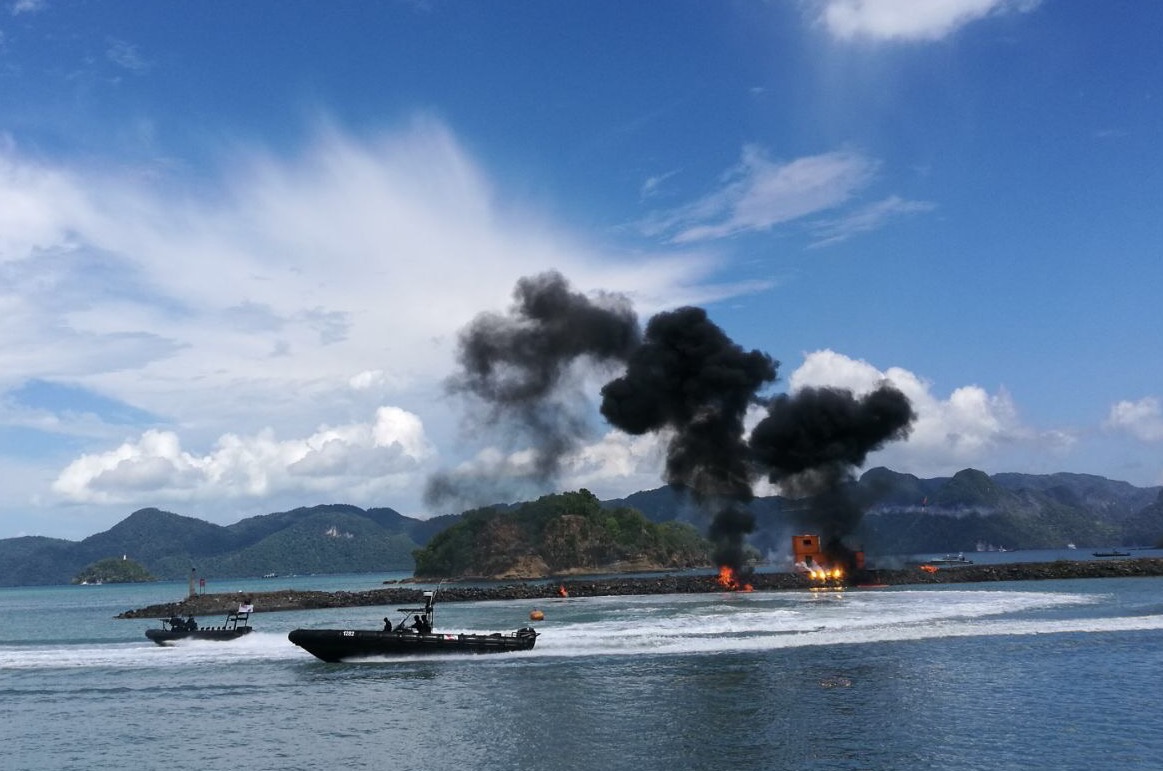
Following the launch, a live action demonstration from the RMN Special Forces, the Malaysian Maritime Enforcement Agency, the Royal Malaysian Police and the Marine Department of Malaysia with the setting being a hostage rescue mission at sea.
Demonstration by the Royal Malaysian Navy’s special forces, the Marine Operations Force of the Royal Malaysian Police, the Malaysian Maritime Enforcement Agency and the Marine Department performs a demonstration
Later, Najib officiated the naming ceremony of the Malaysian Maritime Enforcement Agency’s latest Offshore Patrol Vessel, the “KM Pekan”. In attendance were Defence Minister Hishammuddin Tun Hussein as well as Japan’s Deputy Minister of Land Infrastructure, Transportation and Tourism, Tanaka Ryosei.
The “KM Pekan” is one of two offshore patrol vessels donated by the Japanese government to the MMEA in 2016. Both vessels are 92 meters in length with speed of 20 knots and endurance of 30 days, suitable for enforcement missions in the South China Sea as well as in eastern Sabah. Both are equipped with a helideck and state-of-the-art radars.
According to the Director-General of the MMEA, Admiral (Maritime) Datuk Seri Ahmad Puzi Ab Kahar, a set of crew has been sent to Japan to bring home the second vessel.
I have written on how racist Lim Kit Siang is in Part 1 dan Part 2 prior to this final part.
Lim Kit Siang is not only a racist, he was also against any attempt by the government to counter communist revolutionary ideology.
Two days prior to the 3rd General Elections (1969), Kit Siang held a press conference to accuse his now right-hand man Christopher Ross Lim’s stepfather as “Lying Education Minister.” Christopher Ross Lim now uses the name Zairil Khir Johari. No “bin (Arab for ‘son of’)”.
Kit Siang accused the Alliance government then of enrolling Malaysia into the World Anti-Communist League, an accusation denied by Khir Johari.
Question: why did Kit Siang slam the government even if it was true that Malaysia had joined the World Anti-Communist League?
Answer: the Opposition at that time was teemed with members and sympathisers of the Communist Party of Malaya.
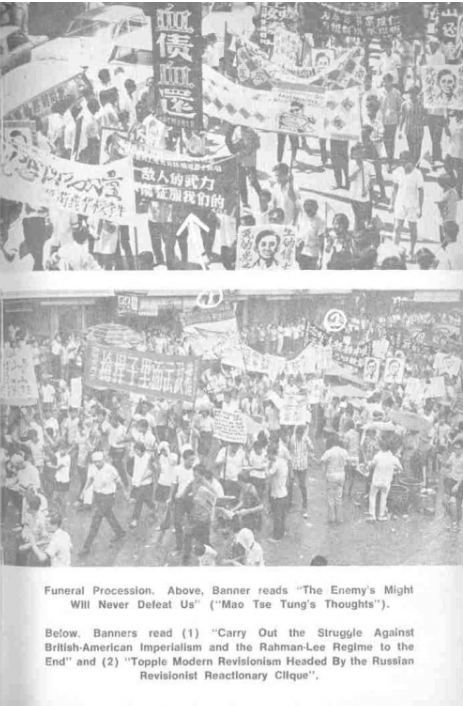
Communist slogans displayed in anti-government ralliesCommunist slogans carried by Opposition supporters
A month before that, on 24 April 1969, an UMNO worker, Encik Kassim bin Omar, who was on his way home after the end of campaign hours for the day was stopped by Opposition supporters as he passed the Datuk Keramat section of Pulau Pinang and brutally murdered. His face was smeared with red paint used to paint anti-government slogans by the Opposition supporters. This is among the reasons long campaign periods can be detrimental to public safety and order.
Since July 1968, that is a month after the commencement of the Second Malaysian Emergency (second armed uprising by the Communist Party of Malaya) that ended 21 years later, Kit Siang fired up racial hatred among the Opposition supporters.
Among the events of incitements that he did were:
On 27 July 1968, at a DAP rally in Tanjung Malim, Perak, Kit Siang on purpose twisted the facts of the National Education Policy by telling the audience that the policy had been designed to eradicate the Chinese newspapers, Chinese schools as well as the Chinese language.
On 24 August 1968, at a rally in Slim River, Perak, Kit Siang intentionally twisted the facts of the policy on the National Language to raise suspicion of and hatred for the Malays .
On 7 September 1968, at a DAP rally at KM38, Jalan Sungai Besi, and on 21 September 1968, at the Sungai Way new village, Kit Siang intentionally incited hatred towards the Malays and the Government by slandering MCA accusing the party of assisting a Malay government to eradicate the Chinese language by not recognising the Nanyang University project.
On 29 September 1968, at a DAP rally in Batu Pahat, Johor, 2 November 1968, in Lawan Kuda Bahru, Gopeng, Perak, and on 26 January 1969, at Jalan Yow, Pudu, Kuala Lumpur, Kit Siang incited hatred by informing the audience that the government’s policies are racist policies by giving priority to the Bumiputera to enter the public universities, automatically placing the other races as second-class citizens.
On 12 February 1969, at a DAP rally held at Jalan Lengkongan Brunei, Kuala Lumpur, Kit Siang once again incited racial sentiments by telling the audience that the Government has shown its racist character by giving priority to the Malays to enter public universities, giving government jobs and distribution of land.
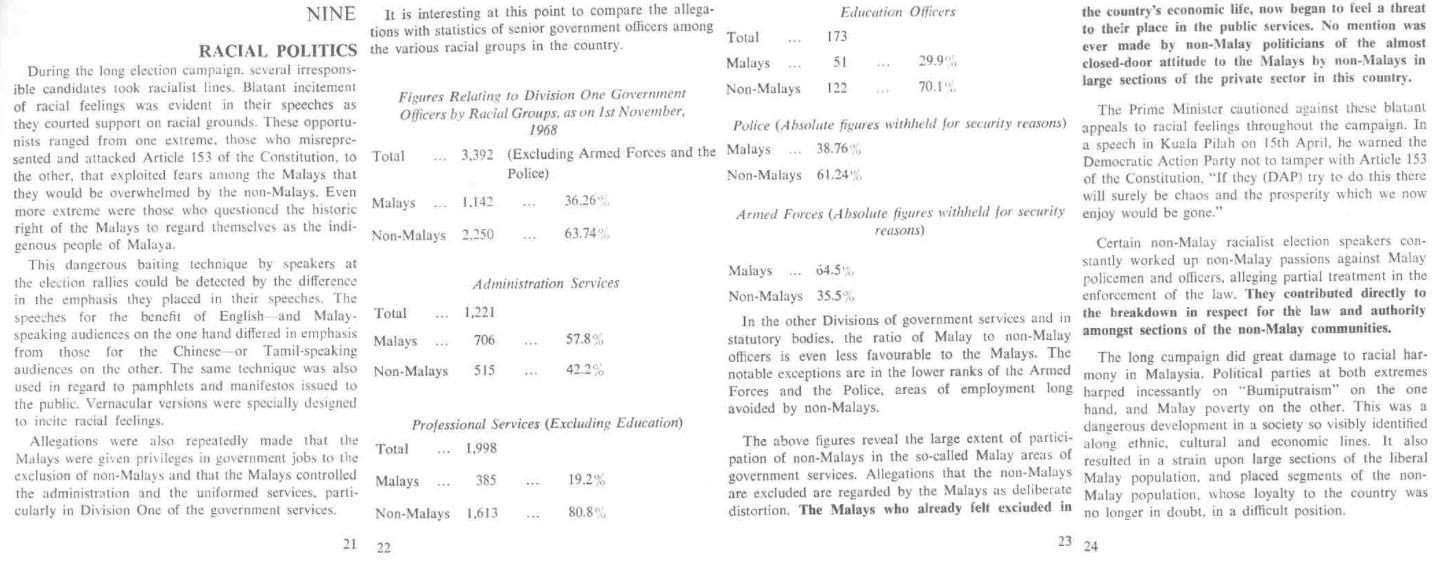
What Kit Siang did not tell any of his audience is that even in government posts (except for the Malaysian Armed Forces), the percentage of non-Malays in the civil service far surpassed the number of Malays as evident in the excerpt from the National Operations Council’s (MAGERAN) White Paper below:
It is evident that Kit Siang’s racist and agitative character has never diminished till today. The General Election was conducted on Saturday 10 May 1969. The Alliance party (UMNO, MCA and MIC) won 66 seats, 23 lesser than in the 2nd General Election while the Opposition won 54.
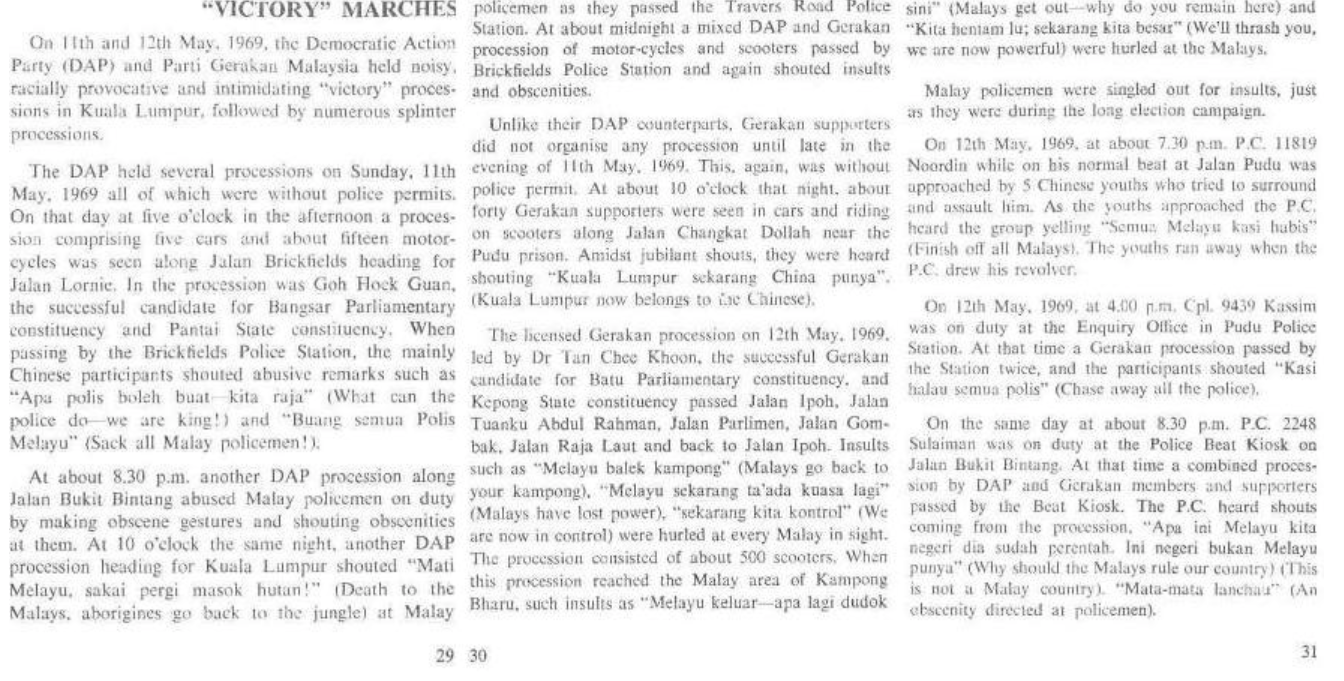
At 5.30pm, 11 May 1969, DAP held a victory parade without police permit that comprised of five cars and 15 motorcycles that started from Brickfields towards Jalan Lornie (now Jalan Syed Putra).
When they passed in front of the Brickfields Police Station (now demolished), the mostly Chinese participants shouted:
“What can the police do? We are the rulers! Throw out all the Malay policemen!“
At 10pm on the same day, while parading in front of the Jalan Travers Police Station, they shouted:
“Death to the Malays! Sakai (derogatory term for aborigines) go back to the jungle!“
The same insults were hurled at policemen on duty when they again passed the Brickfields Police Station.
At the same time at Changkat Thamby Dollah near the old Pudu Jail (behind Berjaya Times Square), about 40 Opposition supporters shouted:
“Kuala Lumpur belongs to the Chinese!“
On the next day, Monday 12 May 1969, 500 scooters rode by Opposition supporters passed Jalan Ipoh, Jalan Parlimen, Jalan Gombak, Jalan Raja Laut before returning to Jalan Ipoh shouting at every Malay person they encounter:
“The Malays are now powerless. Now we are in control!“
When this convoy arrived at the threshold of Kampung Bahru, they shouted to the Malays:
“Malays get out! Why are you still here? We’ll beat you up! Now we are bigger (more powerful)!“
At night, more insults and abuses were hurled at Malay policemen on duty:
“Mata-Mata Lancau! (Penis Constables)”
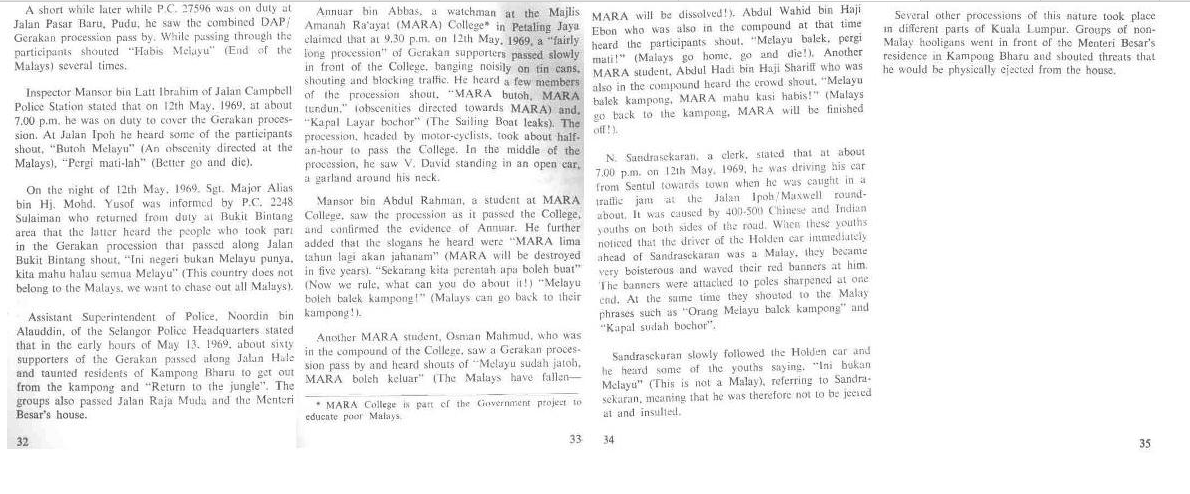
“Butoh Melayu! Pergi matilah! (Fuck the Malays! Go and die!)“
I did not make all the stuff above up. You can read them in the MAGERAN report as per the images below:
Where was Lim Kit Siang when abuses and insults were hurled at the Malays in Kuala Lumpur?
Lim Kit Siang on the morning of Tuesday 13 May 1969 was ready to flee to Kota Kinabalu so that he would not be in Kuala Lumpur if any untoward incident was to happen.
The moment he arrived in Kota Kinabalu he immediately went to a DAP public rally in Kampung Air. Sabah was scheduled to vote on the 25 May 1969 and Sarawak on 7 June 1969. In Kota Kinabalu he not only incited hatred towards the Malays but also towards the religion of Islam.
He told the audience that the Government was trying to create a Malay Malaysia by dividing the rakyat into Bumiputera dan Non-Bumiputera. He also lied by saying that the Government wants to turn the Sabah Government into a Malay Government. He also incited hatred towards Islam by saying that the Government would send Malaysians including non-Muslims (including Sabah Christians) to fight and die in the Middle East to help other OIC members to free Jerusalem from the clutches of Israel.
That is how racist and despicable Lim Kit Siang is as well as the DAP that he leads. Almost 48 years have passed since 13 May 1969, Kit Siang is still attacking what he calls the ‘Malay’ government. Back then, the Malays were united in protecting their rights that have been in existence way before the arrival of Lim Kit Siang’s ancestors – rights that have been agreed upon by representatives of all the Nation’s races and enshrined in the Federal Constitution.
Unfortunate for us now there are those who claim that they are Malays but forget easily. Now this traitor and his worshippers stick a straw up Lim Kit Siang’s rear orifice and suck up to the DAP Supremo.


















You must be logged in to post a comment.